
Showing 62 items matching "victorian railways country railways"
-
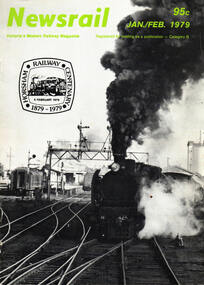 Victorian Railway History Library
Journal - Newsrail January-February 1979, Brendan O'Leary and Bruce McLean, Seymour-Mansfield Goods and The Mildura-Yelta Railway, 1979
... ...Victorian Railways Country Railways...Seymour-Mansfield Goods and The Mildura-Yelta Railway Victorian Railways Freight Services Victorian Railways Country Railways Index,Ill, p.24. ...Index,Ill, p.24. non-fiction victorian railways freight services, victorian railways country railways -
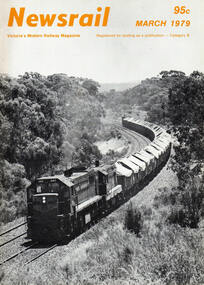 Victorian Railway History Library
Journal - Newsrail March 1979, Geoff Bainbridge and N. Houghton, The 1978/79 Wheat Harvest and Wheat Land Inspection, 1979
... ...Victorian Railways Country Railways...The 1978/79 Wheat Harvest and Wheat Land Inspection Victorian Railways Freight Services Victorian Railways Country Railways Index,Ill, p.24. ...Index,Ill, p.24. non-fiction victorian railways freight services, victorian railways country railways -
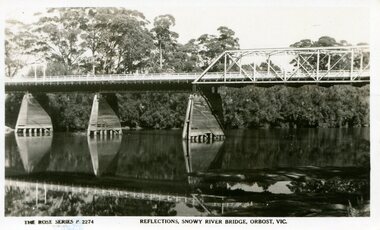 Orbost & District Historical Society
postcard, C1920-1940
... After the end of the first World War the Victorian Railways considered an extension of the railhead across the river at Orbost, and in 1922 a new timber and steel girder structure, a joint Country Roads Board — Victorian Railways venture, was built and completed at a cost of £41,000 (the steel girders came from the Flinders Street viaduct reconstruction). ...After the end of the first World War the Victorian Railways considered an extension of the railhead across the river at Orbost, and in 1922 a new timber and steel girder structure, a joint Country Roads Board — Victorian Railways venture, was built and completed at a cost of £41,000 (the steel girders came from the Flinders Street viaduct reconstruction). ...This photograph shows the second major bridge across the Snowy River at Orbost. The current Snowy River bridge is the fourth to provide a crossing to the township of Orbost. The first, in 1891, lasted just two years before it succumbed to flood waters. The bridge in this photograph was built in the 1920s as a road and rail bridge, and was again partly washed away by flood waters in 1934. After the end of the first World War the Victorian Railways considered an extension of the railhead across the river at Orbost, and in 1922 a new timber and steel girder structure, a joint Country Roads Board — Victorian Railways venture, was built and completed at a cost of £41,000 (the steel girders came from the Flinders Street viaduct reconstruction). Subsequently it was decided not to take the railway across the river, and the bridge was only used by road traffic. It was severely battered by floods during its life. and after the 1971 floods was eventually replaced by the current bridge in 1975. (info from Newletter 54N by John Phillips) This item is an early pictorial record of the previous Snowy River bridge at Orbost. A postcard with a black / white photograph of a bridge - timber and steel girder structure - across the Snowy River at Orbost, Reflections of the bridge are seen in the water. snowy-river-bridge-orbost -
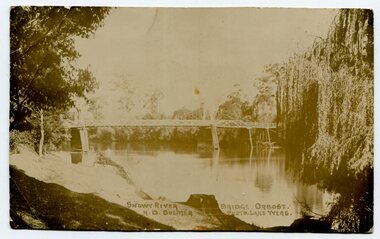 Orbost & District Historical Society
black and white photographs, Howard D. Bulmer, first half 20th century
... After the end of the first World War the Victorian Railways considered an extension of the railhead across the river at Orbost, and in 1922 a new timber and steel girder structure, a joint Country Roads Board — Victorian Railways venture, was built and completed at a cost of £41,000 (the steel girders came from the Flinders Street viaduct reconstruction). ...After the end of the first World War the Victorian Railways considered an extension of the railhead across the river at Orbost, and in 1922 a new timber and steel girder structure, a joint Country Roads Board — Victorian Railways venture, was built and completed at a cost of £41,000 (the steel girders came from the Flinders Street viaduct reconstruction). ...This bridge was built in the 1920s as a road and rail bridge, and was partly washed away by flood waters in 1934. After the end of the first World War the Victorian Railways considered an extension of the railhead across the river at Orbost, and in 1922 a new timber and steel girder structure, a joint Country Roads Board — Victorian Railways venture, was built and completed at a cost of £41,000 (the steel girders came from the Flinders Street viaduct reconstruction). Subsequently it was decided not to take the railway across the river, and the bridge has only been used by road traffic. This is a pictorial record of an early bridge across the Snowy River at Orbost. A large black / white photograph of the Orbost Snowy River bridge. There is a large copy as well as a postcard copy in sepia. on front - Snowy River Bridge Orbost H.D. Bulmer - photo - Lake Tyers. snowy-river-bridge-orbost -
 Orbost & District Historical Society
black and white photograph, July 1922
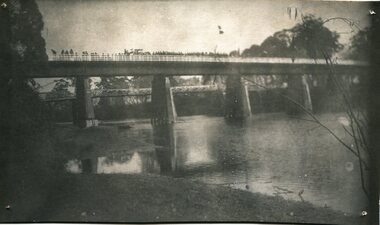
... Victorian Railways and the Country Roads Board. Constructed at a cost of 35,000 pounds and used second-hand girders from the Flinders Street- Spencer Street viaduct. On July 4 1922 it was officially opened by Mrs James Cameron. Unfortunately, her husband, who had long championed the building of the bridge so that it would be ready for the railway...Victorian Railways and the Country Roads Board. Constructed at a cost of 35,000 pounds and used second-hand girders from the Flinders Street- Spencer Street viaduct. On July 4 1922 it was officially opened by Mrs James Cameron. Unfortunately, her husband, who had long championed the building of the bridge so that it would be ready for the railway ...A new bridge over the Snowy River at Orbost was opened for traffic on June 20th 1922. It was designed for future joint use by road and railway traffic, but it was only used for road traffic. During the last few years the condition of an old suspension bridge [the 1893 bridge] which was the only vehicular crossing between the town of Orbost and the railway station, caused much concern. The structure was of timber, except for the wire suspension cables of its central span of about 100 feet. A design was prepared in 1914 for a permanent bridge with five spans of 85 feet composed of plate girders on concrete piers. With great increase in the price of steel work during the war, the cost of this design became prohibitive, and the need for a new structure becoming urgent, alternative proposals were investigated. As a result the present design was adopted as providing a sem-permanent bridge at moderate cost. The new bridge spans the river about 160 feet upstream from the old bridge on a slight skew, the piers being at an angle of 80 degrees with the centre line of the bridge. It has a camber of about 2 feet 5 inches in its total length of 527 feet. ( information from Newsletter March 2014 - Lois Crisp) The photograph shows Mrs James Cameron cutting the ribbon at the opening of the Orbost Pile Bridge in 1922. This second bridge, was built by the Victorian Railways and the Country Roads Board. Constructed at a cost of 35,000 pounds and used second-hand girders from the Flinders Street- Spencer Street viaduct. On July 4 1922 it was officially opened by Mrs James Cameron. Unfortunately, her husband, who had long championed the building of the bridge so that it would be ready for the railway to continue to the border, was too ill to attend the ceremony. In fact, James Cameron died on July 13 after a long and severe illness (ref. S.R.M. 20.7.1922). There is a section of this ribbon in the collection - Registration No. 366. This is a pictorial record of a significant event in Orbost's history. A black / white photograph of a pile bridge with a suspension bridge behind it. There are many people standing on the bridge. on back - "Opening of Pile Bridge - 1922" snowy-river-bridge ceremonies cameron-mrs -
 Orbost & District Historical Society
black and white photograph, July 1922
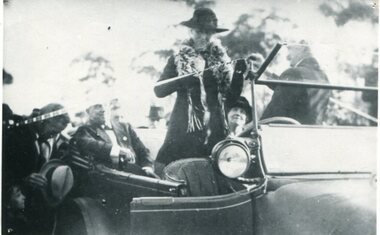
... Victorian Railways and the Country Roads Board. Constructed at a cost of 35,000 pounds and used second-hand girders from the Flinders Street- Spencer Street viaduct. On July 4 1922 it was officially opened by Mrs James Cameron. Unfortunately, her husband, who had long championed the building of the bridge so that it would be ready for the railway...Victorian Railways and the Country Roads Board. Constructed at a cost of 35,000 pounds and used second-hand girders from the Flinders Street- Spencer Street viaduct. On July 4 1922 it was officially opened by Mrs James Cameron. Unfortunately, her husband, who had long championed the building of the bridge so that it would be ready for the railway ...The photograph shows Mrs James Cameron cutting the ribbon at the opening of the Orbost Pile Bridge in 1922. The first bridge was officially opened in August, 1893 (ref. S.R.M. 12.8.1893) by Mrs W. Watt, the mother of Councillor Watt, who presided over the opening of the 1922 bridge. This bridge was extensively damaged when a herd of cattle allegedly stampeded over it causing the cable to snap. Even after repairs it became obvious that a new bridge was needed. This second bridge, was built by the Victorian Railways and the Country Roads Board. Constructed at a cost of 35,000 pounds and used second-hand girders from the Flinders Street- Spencer Street viaduct. On July 4 1922 it was officially opened by Mrs James Cameron. Unfortunately, her husband, who had long championed the building of the bridge so that it would be ready for the railway to continue to the border, was too ill to attend the ceremony. In fact, James Cameron died on July 13 after a long and severe illness (ref. S.R.M. 20.7.1922). There is a section of this ribbon in the collection - Registration No. 366. This item is a pictorial record of a significant event in Orbost's history. A black / white photograph of a lady standing up in a motor vehicle cutting a ceremonial ribbon snowy-river-bridge-orbost cameron-mrs ceremonies -
 Orbost & District Historical Society
black and white photograph, 1971
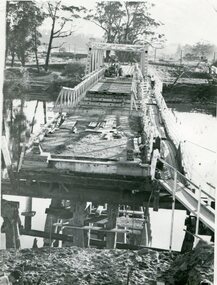
... After the end of the first World War the Victorian Railways considered an extension of the railhead across the river at Orbost, and in 1922 a new timber and steel girder structure, a joint Country Roads Board — Victorian Railways venture, was built and completed at a cost of £41,000 (the steel girders came from the Flinders Street viaduct reconstruction). ...After the end of the first World War the Victorian Railways considered an extension of the railhead across the river at Orbost, and in 1922 a new timber and steel girder structure, a joint Country Roads Board — Victorian Railways venture, was built and completed at a cost of £41,000 (the steel girders came from the Flinders Street viaduct reconstruction). ...This photograph shows the second major bridge across the Snowy River at Orbost. The current Snowy River bridge is the fourth to provide a crossing to the township of Orbost. The first, in 1891, lasted just two years before it succumbed to flood waters. The bridge in this photograph was built in the 1920s as a road and rail bridge, and was again partly washed away by flood waters in 1934. After the end of the first World War the Victorian Railways considered an extension of the railhead across the river at Orbost, and in 1922 a new timber and steel girder structure, a joint Country Roads Board — Victorian Railways venture, was built and completed at a cost of £41,000 (the steel girders came from the Flinders Street viaduct reconstruction). Subsequently it was decided not to take the railway across the river, and the bridge was only used by road traffic. It was severely battered by floods during its life. and after the devastating 1971 floods was eventually replaced by the current bridge in 1975. (info from Newletter 54N by John Phillips) This is a pictorial record of the flood damage in 1971 when part of the Snowy River Bridge was washed away. A black / white photograph of a bridge which has been damaged by floodwaters. It shows one end has been washed away. orbost-snowy-river-bridge-1971 floods-orbost-1971 -
 Orbost & District Historical Society
ribbon, 1922
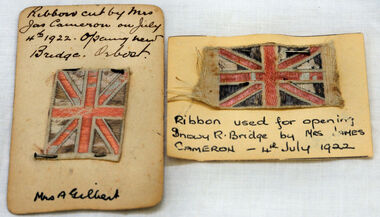
... Victorian Railways and the Country Roads Board. Constructed at a cost of 35,000 pounds and used second-hand girders from the Flinders Street- Spencer Street viaduct. On July 4 1922 it was officially opened by Mrs James Cameron. Unfortunately, her husband, who had long championed the building of the bridge so that it would be ready for the railway...Victorian Railways and the Country Roads Board. Constructed at a cost of 35,000 pounds and used second-hand girders from the Flinders Street- Spencer Street viaduct. On July 4 1922 it was officially opened by Mrs James Cameron. Unfortunately, her husband, who had long championed the building of the bridge so that it would be ready for the railway ...They are both pieces of ribbon used for the opening of the snowy River Bridge on July 4 1922. The ribbon was made to represent the red, white and blue of the British flag. This was the second bridge over the Snowy River. The first bridge was officially opened in August, 1893 (ref. S.R.M. 12.8.1893) by Mrs W. Watt, the mother of Councillor Watt, who presided over the opening of the 1922 bridge. This bridge was extensively damaged when a herd of cattle allegedly stampeded over it causing the cable to snap. Even after repairs it became obvious that a new bridge was needed. This second bridge, was built by the Victorian Railways and the Country Roads Board. Constructed at a cost of 35,000 pounds and used second-hand girders from the Flinders Street- Spencer Street viaduct. On July 4 1922 it was officially opened by Mrs James Cameron. Unfortunately, her husband, who had long championed the building of the bridge so that it would be ready for the railway to continue to the border, was too ill to attend the ceremony. In fact, James Cameron died on July 13 after a long and severe illness (ref. S.R.M. 20.7.1922). Souvenirs kept by enthusiastic spectators like this have helped to preserve the history of an important Orbost event. Two pieces of ribbon in British flag pattern of red, white and blue. These have been pinned onto card with a handwritten description of their history. snowy-river cameron souvenir -
 Orbost & District Historical Society
black and white photograph, Rose Stereograph Company, first half 20th century
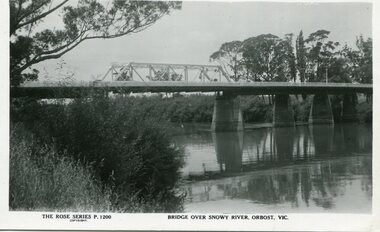
... It was a new timber and steel girder structure, a joint Country Roads Board — Victorian Railways venture and was built and completed at a cost of £41,000 (the steel girders came from the Flinders Street viaduct reconstruction). Subsequently it was decided not to take the railway...It was a new timber and steel girder structure, a joint Country Roads Board — Victorian Railways venture and was built and completed at a cost of £41,000 (the steel girders came from the Flinders Street viaduct reconstruction). Subsequently it was decided not to take the railway ...A new bridge over the Snowy River at Orbost was opened for traffic on June 20th 1922. It was a new timber and steel girder structure, a joint Country Roads Board — Victorian Railways venture and was built and completed at a cost of £41,000 (the steel girders came from the Flinders Street viaduct reconstruction). Subsequently it was decided not to take the railway across the river, and the bridge was only ever used by road traffic. Postcards form a vital part of social and historical records for researchers. This postcard is a pictorial record of an earlier bridge across the Snowy River at Orbost. A black / white postcard photograph of a bridge over the Snowy River at Orbost. 0n front - The Rose Series P1200 copyright Bridge Over Snowy River Orbost Vic. snowy-river-bridge -
 Orbost & District Historical Society
black and white photograph, Howard D. Bulmer, first half 20th century
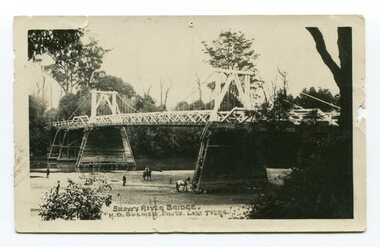
... After the end of the first World War the Victorian Railways considered an extension of the railhead across the river at Orbost, and in 1922 a new timber and steel girder structure, a joint Country Roads Board — Victorian Railways venture, was built and completed at a cost of £41,000 (the steel girders came from the Flinders Street viaduct reconstruction). ...After the end of the first World War the Victorian Railways considered an extension of the railhead across the river at Orbost, and in 1922 a new timber and steel girder structure, a joint Country Roads Board — Victorian Railways venture, was built and completed at a cost of £41,000 (the steel girders came from the Flinders Street viaduct reconstruction). ...A new bridge over the Snowy River at Orbost was opened for traffic on June 20th 1922. It was intended as a road and rail bridge, and was again partly washed away by flood waters in 1934. After the end of the first World War the Victorian Railways considered an extension of the railhead across the river at Orbost, and in 1922 a new timber and steel girder structure, a joint Country Roads Board — Victorian Railways venture, was built and completed at a cost of £41,000 (the steel girders came from the Flinders Street viaduct reconstruction). Subsequently it was decided decided not to take the railway across the river, and the bridge was only used by road traffic. This is a pictorial record of an early bridge over the Snowy River at Orbost. A black / white postcard photograph of a bridge across a shallow river with men on horseback underneath. snowy-river-bridge -
 Orbost & District Historical Society
black and white photograph, first half 20th century
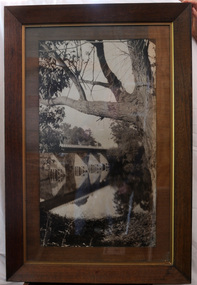
... After the end of the first World War the Victorian Railways considered an extension of the railhead across the river at Orbost, and in 1922 a new timber and steel girder structure, a joint Country Roads Board — Victorian Railways venture, was built and completed at a cost of £41,000 (the steel girders came from the Flinders Street viaduct reconstruction). ...After the end of the first World War the Victorian Railways considered an extension of the railhead across the river at Orbost, and in 1922 a new timber and steel girder structure, a joint Country Roads Board — Victorian Railways venture, was built and completed at a cost of £41,000 (the steel girders came from the Flinders Street viaduct reconstruction). ...This is a bridge across the Snowy River at Orbost. This bridge was built in the 1920s as a road and rail bridge, and was partly washed away by flood waters in 1934. After the end of the first World War the Victorian Railways considered an extension of the railhead across the river at Orbost, and in 1922 a new timber and steel girder structure, a joint Country Roads Board — Victorian Railways venture, was built and completed at a cost of £41,000 (the steel girders came from the Flinders Street viaduct reconstruction). Subsequently it was decided not to take the railway across the river, and the bridge has only been used by road traffic. This is a pictorial record of an early bridge across the Snowy River at Orbost. A very large black / white photograph under glass in a timber frame. It is of a bridge across a river and is framed by trees. bridge snowy-river-bridge road-transport-orbost -
 Orbost & District Historical Society
black and white photograph, 1975
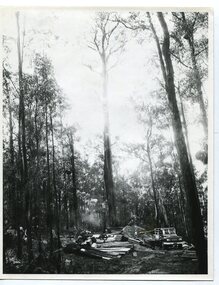
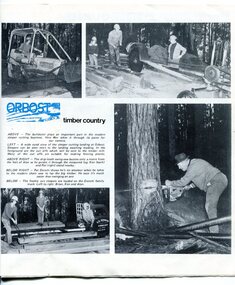
... Victorian railways Magazine in 1975. This was a pamphlet produced for Victorian Railways. . It contains photographs and an article about Orbost as "Timber Country" and a detailed article titled, " Cutting Sleepers is a Family Business" which tells about the Donchi family....Victorian railways Magazine in 1975. This was a pamphlet produced for Victorian Railways. . It contains photographs and an article about Orbost as "Timber Country" and a detailed article titled, " Cutting Sleepers is a Family Business" which tells about the Donchi family. ...The Donchi family has been cutting sleepers since the 1890s in the Orbost area. This photograph , one of a set of six, was taken for an article in the Victorian railways Magazine in 1975. This was a pamphlet produced for Victorian Railways. . It contains photographs and an article about Orbost as "Timber Country" and a detailed article titled, " Cutting Sleepers is a Family Business" which tells about the Donchi family. This item is associated with the timber and sleeper-cutting industry in the Orbost Region. Timber sleepers were superceded by concrete sleepers in c. 1970s. Orbost has historically been based on the timber industry, but that industry has declined considerably over the last 20 years..The number of locals involved in the timber industry has declined and many of the mills have closed. This item reflects a time when that industry was a significant contributor to the economy of the district. A black / white photograph of a bush scene of a timber harvesting coupe used by the Donchi family. on back - Pr 8766 sleeper-cutting-orbost donchi-orbost timber-industry-orbost -
 Orbost & District Historical Society
black and white photograph, VR Printing Works, 1975
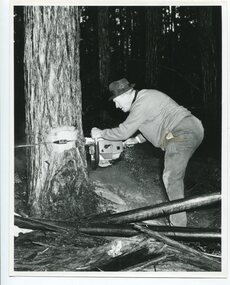
... This photograph, one of six, was taken for the Victorian railways Magazine in 1975, a pamphlet produced for Victorian Railways. It contains photographs and an article about Orbost as "Timber Country" and a detailed article titled, " Cutting Sleepers is a Family Business" which tells about the Donchi family...This photograph, one of six, was taken for the Victorian railways Magazine in 1975, a pamphlet produced for Victorian Railways. It contains photographs and an article about Orbost as "Timber Country" and a detailed article titled, " Cutting Sleepers is a Family Business" which tells about the Donchi family This item is associated with the timber and sleeper-cutting industry in the Orbost Region. ...Pat Donchi's grandfather came to Orbost to cut sleepers in the 1890s. Pat and his sons have carried on since then. This photograph, one of six, was taken for the Victorian railways Magazine in 1975, a pamphlet produced for Victorian Railways. It contains photographs and an article about Orbost as "Timber Country" and a detailed article titled, " Cutting Sleepers is a Family Business" which tells about the Donchi family This item is associated with the timber and sleeper-cutting industry in the Orbost Region. Timber sleepers were superceded by concrete sleepers in c. 1970s. Orbost has historically been based on the timber industry, but that industry has declined considerably over the last 20 years. The number of locals involved in the timber industry has declined and many of the mills have closed. This item reflects a time when that industry was a significant contributor to the economy of the district. A black / white photograph of Pat Donchi, a local sleeper cutter, falling a tree with a chainsaw. on back - Pr 8708 timber-industry-orbost donchi-orbost sleeper-cutting-orbost -
 Orbost & District Historical Society
black and white photograph, VR Printing Works, 1975
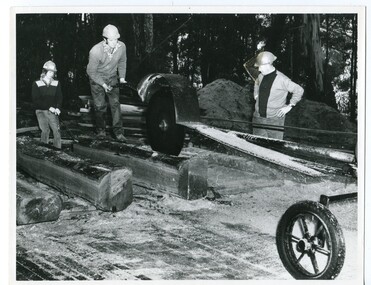
... This phootograph , one of a set of six, was taken for the Victorian Railways Magazine, August,1975, a pamphlet produced for Victorian Railways. It contains photographs and an article about Orbost as "Timber Country" and a detailed article titled, " Cutting Sleepers is a Family Business" which tells about the Donchi family.Name ...This phootograph , one of a set of six, was taken for the Victorian Railways Magazine, August,1975, a pamphlet produced for Victorian Railways. It contains photographs and an article about Orbost as "Timber Country" and a detailed article titled, " Cutting Sleepers is a Family Business" which tells about the Donchi family.Name Associated with the timber and sleeper-cutting industry in the Orbost Region. ...The Donchi family has ben involved in sleeper cutting in the Orbost district since the 1890s. This phootograph , one of a set of six, was taken for the Victorian Railways Magazine, August,1975, a pamphlet produced for Victorian Railways. It contains photographs and an article about Orbost as "Timber Country" and a detailed article titled, " Cutting Sleepers is a Family Business" which tells about the Donchi family.Name Associated with the timber and sleeper-cutting industry in the Orbost Region. Timber sleepers were superceded by concrete sleepers in c. 1970s. Orbost has historically been based on the timber industry, but that industry has declined considerably over the last 20 years. The number of locals involved in the timber industry has declined and many of the mills have closed. This item reflects a time when that industry was a significant contributor to the economy of the district. A black / white photograph of Pat, Ken and Alan Donchi working a large saw at a timber coupe in Orbost. on back - Pr 8767 timber-industry-orbost sleeper-cutting-orbost donchi-family -
 Orbost & District Historical Society
VR Printing Works, 1975
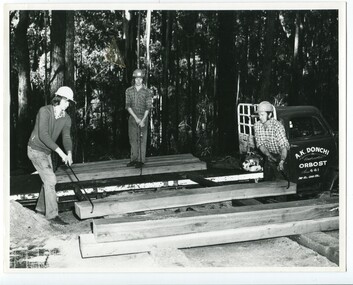
... The photograph was taken for an article in the Victorian Railways Magazine in 1975, a pamphlet produced for Victorian Railways. It contains photographs and an article about Orbost as "Timber Country" and a detailed article titled, " Cutting Sleepers is a Family Business" which tells about the Donchi family....The photograph was taken for an article in the Victorian Railways Magazine in 1975, a pamphlet produced for Victorian Railways. It contains photographs and an article about Orbost as "Timber Country" and a detailed article titled, " Cutting Sleepers is a Family Business" which tells about the Donchi family. ...The three men in this photograph, one of a set of six), are all from the Donchi family who have been involved in sleeper - cutting since the 1890s. From left to right they are Brian, Ken and Alan Donchi. The photograph was taken for an article in the Victorian Railways Magazine in 1975, a pamphlet produced for Victorian Railways. It contains photographs and an article about Orbost as "Timber Country" and a detailed article titled, " Cutting Sleepers is a Family Business" which tells about the Donchi family. This photograph is associated with the timber and sleeper-cutting industry in the Orbost Region. Timber sleepers were superceded by concrete sleepers in c. 1970s. Orbost has historically been based on the timber industry, but that industry has declined considerably over the last 20 years..The number of locals involved in the timber industry has declined and many of the mills have closed. This item reflects a time when that industry was a significant contributor to the economy of the district. A black / white photograph of three members of the Donchi family working at sleeper - cuttingin a timber coupe in Orbost. on back - Pr 8764 timber-industry-orbost sleeper - cutting donchi-family-orbost -
 Orbost & District Historical Society
black and white photograph, VR Printing Works, 1975
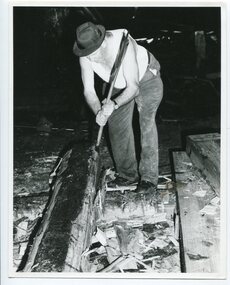
... This is one of a set of six photographs taken for the Victorian Railways Magazine, a pamphlet produced for Victorian Railways. t contains photographs and an article about Orbost as "Timber Country" and a detailed article titled, " Cutting Sleepers is a Family Business" which tells about the Donchi family The man in the photograph is Pat Donchi, a member of the Donchi family, who have been involved in the sleeper - cutting industry since the 1890s. ...This is one of a set of six photographs taken for the Victorian Railways Magazine, a pamphlet produced for Victorian Railways. t contains photographs and an article about Orbost as "Timber Country" and a detailed article titled, " Cutting Sleepers is a Family Business" which tells about the Donchi family The man in the photograph is Pat Donchi, a member of the Donchi family, who have been involved in the sleeper - cutting industry since the 1890s. ...This is one of a set of six photographs taken for the Victorian Railways Magazine, a pamphlet produced for Victorian Railways. t contains photographs and an article about Orbost as "Timber Country" and a detailed article titled, " Cutting Sleepers is a Family Business" which tells about the Donchi family The man in the photograph is Pat Donchi, a member of the Donchi family, who have been involved in the sleeper - cutting industry since the 1890s. This item is associated with the timber and sleeper-cutting industry in the Orbost Region. Timber sleepers were superceded by concrete sleepers in c. 1970s. Orbost has historically been based on the timber industry, but that industry has declined considerably over the last 20 years.The number of locals involved in the timber industry has declined and many of the mills have closed. This item reflects a time when that industry was a significant contributor to the economy of the district. A black / white photograph of a sleeper cutter at work swinging a broad axe. on back - Pr 8765 timber-industry-orbost sleeper-cutting-orbost donchi-family -
 Orbost & District Historical Society
pamphlet, VR Printing Works, Railways, 1975
... Victorian Railways. In 1976 the name Victorian Railways was replaced by Vicrail. Railways have played a key role in Victorian transport especially in linking regional towns to the cities. The railways have provided jobs for many Orbost people. This item is associated with the history of the Orbost-Bairnsdale railway line and therefore reflects the role that the rail line played in the social and economic history of Orbost. pamphlet-victorian-railways sleeper-cutting donchi A pamphlet produced for Victorian Railways. On the front is a coloured photograph of a train. It contains photographs and an article about Orbost as "Timber Country ...This pamphlet was produced by Victorian Railways. In 1976 the name Victorian Railways was replaced by Vicrail. Railways have played a key role in Victorian transport especially in linking regional towns to the cities. The railways have provided jobs for many Orbost people. This item is associated with the history of the Orbost-Bairnsdale railway line and therefore reflects the role that the rail line played in the social and economic history of Orbost. A pamphlet produced for Victorian Railways. On the front is a coloured photograph of a train. It contains photographs and an article about Orbost as "Timber Country" and a detailed article titled, " Cutting Sleepers is a Family Business" which tells about the Donchi family. pamphlet-victorian-railways sleeper-cutting donchi -
 Ringwood and District Historical Society
Map, Victorian Railways Map showing country lines existing and under construction c1875 (or possibly 1890?)
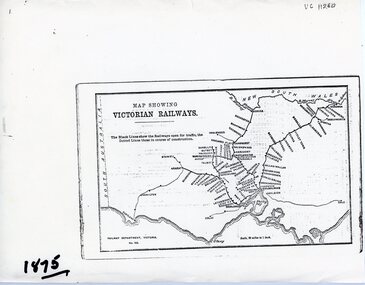
... Victorian Railways Railways Department No 162 Handwritten "1875" An 4 photocopy of map. No details of original source. However there is a State Library Victoria record (See References) which states year as c1890 Victorian Railways Map showing country lines existing and under construction c1875 (or possibly 1890?) ...An 4 photocopy of map. No details of original source. However there is a State Library Victoria record (See References) which states year as c1890 Map Showing Victorian Railways Railways Department No 162 Handwritten "1875" -
 Ringwood and District Historical Society
Magazine, Victorian Railways - News Letter - Centenary Number September 1954
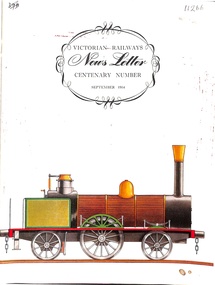
... Victorian Railways Printing Works, Laurens St, Morth Melbourne for the Publishers The Victorian Railways Commissioners. Colour Magazine with many black and white photographs, for the Railway Centenary 1854 - 1954. Articles include: Trains-Ancient and Modern, The Iron Horse: a Century's Pedigree, Bridge Pioneers, In the Bearded Nineties, A Question ot Time (Railway clocks), 100 years around the Country, The "W.N" (Weekly Notice), Old Timers, Railways at War (incl ship building at Newport Workshops), Throttle Benders, Among Ourselves, How the VRI Started. ...Colour Magazine with many black and white photographs, for the Railway Centenary 1854 - 1954. Articles include: Trains-Ancient and Modern, The Iron Horse: a Century's Pedigree, Bridge Pioneers, In the Bearded Nineties, A Question ot Time (Railway clocks), 100 years around the Country, The "W.N" (Weekly Notice), Old Timers, Railways at War (incl ship building at Newport Workshops), Throttle Benders, Among Ourselves, How the VRI Started. Wholly set up and printed by the Victorian Railways Printing Works, Laurens St, Morth Melbourne for the Publishers The Victorian Railways Commissioners. -
 Warrnambool and District Historical Society Inc.
Map, Victorian Railway W'bool No1 & No2, 1897
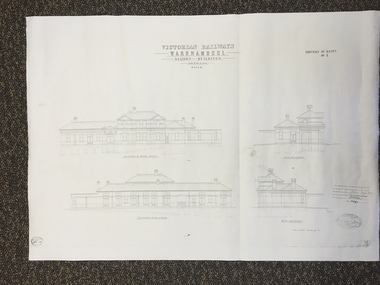
... Victorian Railways for the erection of the Warrnambool Railway Station building. It is a two-storey building still existing today. The railway came to Warrnambool in 1890 and they must have used temporary buildings for seven years before this railway building was erected. It had offices, booking counter and public facilities on the ground floor and housing for the Station Master on the first floor. The building erected was a typical design for country...Victorian Railways for the erection of the Warrnambool Railway Station building. It is a two-storey building still existing today. The railway came to Warrnambool in 1890 and they must have used temporary buildings for seven years before this railway building was erected. It had offices, booking counter and public facilities on the ground floor and housing for the Station Master on the first floor. The building erected was a typical design for country ...These two sheets show the 1897 plans drawn up by the Victorian Railways for the erection of the Warrnambool Railway Station building. It is a two-storey building still existing today. The railway came to Warrnambool in 1890 and they must have used temporary buildings for seven years before this railway building was erected. It had offices, booking counter and public facilities on the ground floor and housing for the Station Master on the first floor. The building erected was a typical design for country town railway stations and many of similar design were erected in the 1880s and 90s. These plans are important because they show clearly the design of the Warrnambool Railway Station buildings when they were first erected in the 1890s.They will be very useful for researchers. The coming of the railway was a significant event in Warrnambool’s history and did much to make the port and shipping a less viable proposition. These are two architect’s plans and drawings of the Warrnambool Railway Station building (1897). The drawings are black and white and the first plan shows the ground floor plan and the first floor plan and the outbuildings. The second plan shows drawings of the building with its elevation to the platform and its elevation to Merri Street. There are two stamps of the Railways Department, Melbourne. These are copies, not originals. ‘Victorian Railways, Warrnambool, Station Buildings, Scale 8 feet to one inch, Contract No. 6379B (Nos. 1 and 2)’ warrnambool, railway station buildings -
 Bendigo Historical Society Inc.
Document - BILL ASHMAN COLLECTION: CORRESPONDENCE
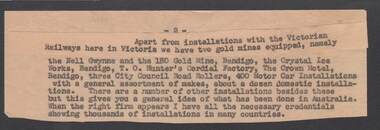
... Victorian Railways Nell Gwynne 180 Gold Mine Bendigo Crystal Ice Works T O Hunter's Cordial Factory The Crown Hotel City Council Cut off portion page 2. Top part glued on. List of installations, including the Victorian Railways, the Nell Gwynne and the 180 Gold Mine, Bendigo. The Crystal Ice Works, Bendigo, T. O. Hunter's Cordial Factory, The Crown Hotel,Bendigo City Council Road Rollers, car installations and domestic installations. Also mentioned when the right firm appears all the necessary credentials showing thousands of installations in many countries ...Cut off portion page 2. Top part glued on. List of installations, including the Victorian Railways, the Nell Gwynne and the 180 Gold Mine, Bendigo. The Crystal Ice Works, Bendigo, T. O. Hunter's Cordial Factory, The Crown Hotel,Bendigo City Council Road Rollers, car installations and domestic installations. Also mentioned when the right firm appears all the necessary credentials showing thousands of installations in many countries are ready. sciences, instruments - general, scalebuoy, bill ashman collection - correspondence, victorian railways, nell gwynne, 180 gold mine bendigo, crystal ice works, t o hunter's cordial factory, the crown hotel, city council -
 Bendigo Historical Society Inc.
Book - RAILWAYS COLLECTION: TRAIN TIMES COUNTRY AND INTERSTATE SUMMER ISSUE 1971/72
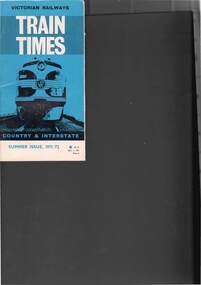
... RAILWAYS COLLECTION- Victorian Railways train times country and interstate - summer issue 1971/72 as at Nov 1, 1971 price 5c, glossy cover in blue, black and white showing a Diesel train on the front, first page is loose....RAILWAYS Bendigo To Melbourne RAILWAYS COLLECTION- Victorian Railways train times country and interstate - summer issue 1971/72 as at Nov 1, 1971 price 5c, glossy cover in blue, black and white showing a Diesel train on the front, first page is loose. ...RAILWAYS COLLECTION- Victorian Railways train times country and interstate - summer issue 1971/72 as at Nov 1, 1971 price 5c, glossy cover in blue, black and white showing a Diesel train on the front, first page is loose. railways, bendigo to melbourne -
 Bendigo Historical Society Inc.
Book - RAILWAYS COLLECTION: TRAIN TIMES COUNTRY AND INTERSTATE WINTER ISSUE 1965
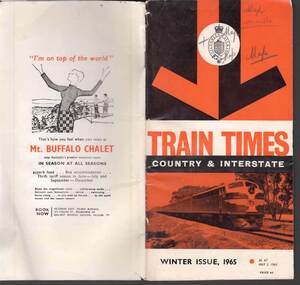
... RAILWAYS COLLECTION - Victorian Railways train times country and interstate - winter issue 1965 - as at May 3, 1965 price 6d - glossy cover in orange, black and white showing a Diesel train on the front. ...RAILWAYS Bendigo To Melbourne RAILWAYS COLLECTION - Victorian Railways train times country and interstate - winter issue 1965 - as at May 3, 1965 price 6d - glossy cover in orange, black and white showing a Diesel train on the front. ...RAILWAYS COLLECTION - Victorian Railways train times country and interstate - winter issue 1965 - as at May 3, 1965 price 6d - glossy cover in orange, black and white showing a Diesel train on the front. Back page has a fold out map of rail routes. railways, bendigo to melbourne -
 Ballarat Tramway Museum
Ephemera - Timetable, Victorian Railways (VR), "Country Tour by Royal Train of Her Majesty Queen Elizabeth II", 15/02/1954 12:00:00 AM
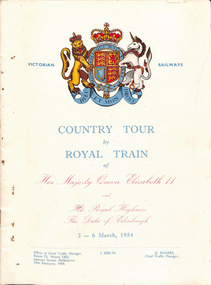
... Royal Visit Victorian Railways Ballarat Timetable - 28 pages, Victorian Railways titled "Country Tour by Royal Train of Her Majesty Queen Elizabeth II". ...Timetable - 28 pages, Victorian Railways titled "Country Tour by Royal Train of Her Majesty Queen Elizabeth II". Details the timetable and arrangements for the Royal Tour of 3 - 6 March 1954. Printed by VR Gives details of the train times and for example the time spent in Ballarat of 75mins. royal visit, victorian railways, ballarat -
 Ballarat Tramway Museum
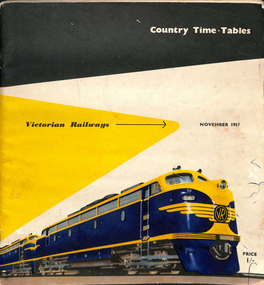
Ephemera - Timetable, Victorian Railways (VR), "Country Time-Tables - Victorian Railways November 1957", Nov. 1957
... Ballarat Railways VR Victorian Railways Timetables Timetable - 60 page book, centre stapled titled "Country Time-Tables - Victorian Railways November 1957". ...Timetable - 60 page book, centre stapled titled "Country Time-Tables - Victorian Railways November 1957". Shows train services to Ballarat at the time and for the VR. Relevant pages including fares and a VR map have been scanned. See Reg Items 6824, 8116, 8117 and for 1998, 1957, 1981, 2021 respectively. ballarat, railways, vr, victorian railways, timetables -
 Ballarat Tramway Museum
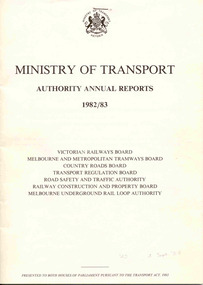
Document - Report, Ministry of Transport, "Ministry of Transport Authority Annual Reports 1982/83", 1983
... 84 page, printed report on white art paper - titled "Ministry of Transport Authority Annual Reports 1982/83" for the: Victorian Railways Board Melbourne and Metropolitan Tramways Board Country Roads Board Transport Regulation Board Road Safety and Traffic Authority Railway Construction and Property Board Melbourne Underground Rail Loop Authority This document represented the final report of the listed authorities who were abolished on 30/6/1983 and replaced by the Metropolitan Transit Authority, State Transport Authority, the Road Traffic Authority and the Road Construction Authority. ...Trams tramways MMTB VR Annual Reports On front cover in pencil, "142 4 Sept 84' 84 page, printed report on white art paper - titled "Ministry of Transport Authority Annual Reports 1982/83" for the: Victorian Railways Board Melbourne and Metropolitan Tramways Board Country Roads Board Transport Regulation Board Road Safety and Traffic Authority Railway Construction and Property Board Melbourne Underground Rail Loop Authority This document represented the final report of the listed authorities who were abolished on 30/6/1983 and replaced by the Metropolitan Transit Authority, State Transport Authority, the Road Traffic Authority and the Road Construction Authority. ...84 page, printed report on white art paper - titled "Ministry of Transport Authority Annual Reports 1982/83" for the: Victorian Railways Board Melbourne and Metropolitan Tramways Board Country Roads Board Transport Regulation Board Road Safety and Traffic Authority Railway Construction and Property Board Melbourne Underground Rail Loop Authority This document represented the final report of the listed authorities who were abolished on 30/6/1983 and replaced by the Metropolitan Transit Authority, State Transport Authority, the Road Traffic Authority and the Road Construction Authority. Signed by the Minister S.M. Crabb. Has on the inside cover, a stapled With Compliments slip with the name of Race Mathews MP typed in. On front cover in pencil, "142 4 Sept 84' trams, tramways, mmtb, vr, annual reports -
 Tatura Irrigation & Wartime Camps Museum
Booklet, Newsrail - May 1992, 1992
... country rail trains. Includes accident of Brill Railcar (known as the "Beetle") at a level crossing on Toolamba-Echuca line 1949, at Byrneside newsrail - may 1992 vr rail motors potts d small w Victorian railways On Front cover - Central Highlands Tourist Railways' 91RM rounds a curb as it heads towards Dayelsford after a trip to Musk. ...Contains photographs of country rail trains. Includes accident of Brill Railcar (known as the "Beetle") at a level crossing on Toolamba-Echuca line 1949, at Byrneside On Front cover - Central Highlands Tourist Railways' 91RM rounds a curb as it heads towards Dayelsford after a trip to Musk. Sunday 15.9.91. Ads for model trains on back cover. newsrail - may 1992, vr rail motors, potts d, small w, victorian railways -
 Wangaratta RSL Sub Branch
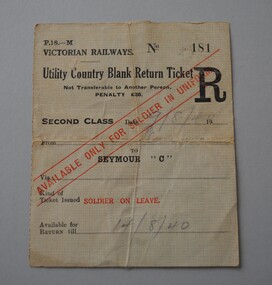
Ephemera - Rail Ticket, C1940
... Victorian Railways for military personnel travelling within regional Victoria during 1940. "P.18-M" designates the specific accounting/ticket form code used by the Victorian Railways at the time for military utility tickets. "Available only for soldier in uniform" — was a strict wartime requirement in 1940 to prevent misuse of concessions and to ensure soldiers were identifiable for travel on restored country services. ...Victorian Railways for military personnel travelling within regional Victoria during 1940. "P.18-M" designates the specific accounting/ticket form code used by the Victorian Railways at the time for military utility tickets. "Available only for soldier in uniform" — was a strict wartime requirement in 1940 to prevent misuse of concessions and to ensure soldiers were identifiable for travel on restored country services. ...World War II-era military concession pass issued by the Victorian Railways for military personnel travelling within regional Victoria during 1940. "P.18-M" designates the specific accounting/ticket form code used by the Victorian Railways at the time for military utility tickets. "Available only for soldier in uniform" — was a strict wartime requirement in 1940 to prevent misuse of concessions and to ensure soldiers were identifiable for travel on restored country services. This ticket is dated 9/8/1940 and available for return till 14/8/1940 to Seymour. Item belonged to Robert Francis ISKOV VX15237 served with the 59th Battalion/Hume Regiment CMF before joining the 2/14th Battalion at Caulfield in September 1940. He disembarked for the Middle East in November, 1940 and fought in the Syrian campaign in 1941. In 1942 the 2/14th Battalion returned to Australia and sent to Papua where he fought at the Battle of Isurava before the battalion was sent to Gona. On 1943 Bob returned to Australia to undertake officer training and in 1945 with the 2/23rd Battalion sailed to Morotai and served with the battalion on Tarakan. He returned to Australia in November, 1945 and discharged a month later Small paper ticket with black and red lettering P.18 - M Victorian Railways No 181 ww2, bob iskov, amf, victorian railways return ticket, soldier on leave, 1940 -
 Puffing Billy Railway
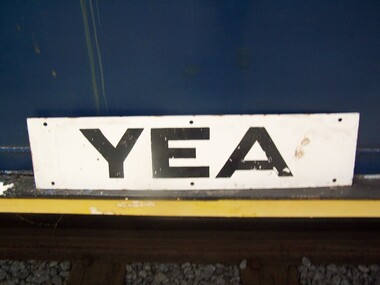
Station Sign - Yea
... Railway Park consisting of the historic railway station and eleven acres of parkland. It has a picnic shelter, barbecue, toilets, playground, skatepark, walking track, community reserve and includes Rotary Park. The station building houses Blackthorn Textiles (a privately run craft shop). Also on the site are the former goods sheds which are available for hire for varied functions. The Yea Country Market is held in the park on the first Saturday of each month and local artists hold an exhibition and sale in the goods sheds each Easter. The site is listed on the Victorian...Railway Park consisting of the historic railway station and eleven acres of parkland. It has a picnic shelter, barbecue, toilets, playground, skatepark, walking track, community reserve and includes Rotary Park. The station building houses Blackthorn Textiles (a privately run craft shop). Also on the site are the former goods sheds which are available for hire for varied functions. The Yea Country Market is held in the park on the first Saturday of each month and local artists hold an exhibition and sale in the goods sheds each Easter. The site is listed on the Victorian Heritage Register ref: https://en.wikipedia.org/wiki/Yea_railway_station photo at http://vhd.heritagecouncil.vic.gov.au/vhd-images/places/000/078/092.jpg Historic - Victorian Railways ...Station Sign - Yea Yea Station Opened 16 November 1883 Closed 8 November 1978 Yea is a former railway station in Yea, Victoria, Australia. The tracks have been removed and the reserve has been turned into The Yea Railway Park consisting of the historic railway station and eleven acres of parkland. It has a picnic shelter, barbecue, toilets, playground, skatepark, walking track, community reserve and includes Rotary Park. The station building houses Blackthorn Textiles (a privately run craft shop). Also on the site are the former goods sheds which are available for hire for varied functions. The Yea Country Market is held in the park on the first Saturday of each month and local artists hold an exhibition and sale in the goods sheds each Easter. The site is listed on the Victorian Heritage Register ref: https://en.wikipedia.org/wiki/Yea_railway_station photo at http://vhd.heritagecouncil.vic.gov.au/vhd-images/places/000/078/092.jpg Historic - Victorian Railways Station sign used at Yea Station Station Sign - Yea Metal rectangle Station Name Sign with white enamel back ground and black letters Yea puffing billy, station sign, yea station -
 Vision Australia
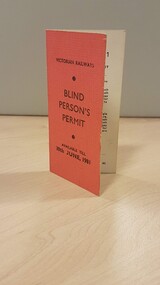
Card - Object, Victorian Railways Blind Person's Permit 1981, 1981
... Victorian Railways to ascertain that the bearer was indeed a blind person and entitled to free travel. This example was numbered 1741 and was issued in the name of Mr N.L. Walker. It outlines that the pass is used by a blind person for free travel on suburban journeys and half price fares on country or intersystem journeys. Victorian Railways ...The travel pass was used by Victorian Railways to ascertain that the bearer was indeed a blind person and entitled to free travel. This example was numbered 1741 and was issued in the name of Mr N.L. Walker. It outlines that the pass is used by a blind person for free travel on suburban journeys and half price fares on country or intersystem journeys. 1 rectangular travel pass with red cloth cover and black text victorian railways, association for the blind
