
Showing 55 items matching "war memorials -- belgium"
-
 Returned Nurses RSL Sub-branch
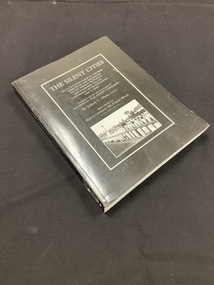
Book, Sidney C. Hurst, The silent cities : an illustrated guide to the war cemeteries and memorials to the "missing" in France and Flanders: 1914-1918, 1929
... ...War memorials -- Belgium...War memorials -- France National cemeteries -- Belgium National cemeteries -- France War memorials -- Belgium Soldiers' monuments -- Belgium Soldiers' monuments -- France Guide to the War Cemeteries in France and Flanders ... ...Guide to the War Cemeteries in France and Flanders ... The Silent Cities was Rudyard Kipling's inspired name for the Cemeteries of the Western Front ... [provides] a complete guide to all Cemeteries containing war graves and all Memorials recording the Missing of the Forces of the British Empire who fell in France and Flanders during the Great War ... Some contain 'Special Memorials indicating officers and men whose graves have been destroyed by shell-fire or who are known or believed to be buried in that Cemetery--publisher's website. Facsimile reprint. First published London : Methuen, 1929.Paperback book with black cover. Title down the spine in white print. Front cover has a white border with title and author details printed inside in white text and a black and white photo of gravesites.non-fictionGuide to the War Cemeteries in France and Flanders ... The Silent Cities was Rudyard Kipling's inspired name for the Cemeteries of the Western Front ... [provides] a complete guide to all Cemeteries containing war graves and all Memorials recording the Missing of the Forces of the British Empire who fell in France and Flanders during the Great War ... Some contain 'Special Memorials indicating officers and men whose graves have been destroyed by shell-fire or who are known or believed to be buried in that Cemetery--publisher's website. Facsimile reprint. First published London : Methuen, 1929. war memorials -- france, national cemeteries -- belgium, national cemeteries -- france, war memorials -- belgium, soldiers' monuments -- belgium, soldiers' monuments -- france -
 Returned Nurses RSL Sub-branch
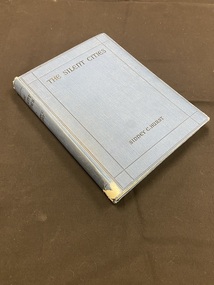
Book - Illustrated hardcover book, Sidney C. Hurst, The silent cities : an illustrated guide to the war cemeteries and memorials to the "missing" in France and Flanders: 1914-1918, 1929
... ...War memorials -- Belgium...War memorials -- France National cemeteries -- Belgium National cemeteries -- France War memorials -- Belgium Soldiers' monuments -- Belgium Soldiers' monuments -- France Guide to the War Cemeteries in France and Flanders ... ...Guide to the War Cemeteries in France and Flanders ... The Silent Cities was Rudyard Kipling's inspired name for the Cemeteries of the Western Front ... [provides] a complete guide to all Cemeteries containing war graves and all Memorials recording the Missing of the Forces of the British Empire who fell in France and Flanders during the Great War ... Some contain 'Special Memorials indicating officers and men whose graves have been destroyed by shell-fire or who are known or believed to be buried in that Cemetery--publisher's website. Facsimile reprint. First published London : Methuen, 1929.Blue hardcover book. Title and author in black print across the spine. Torn white sticker label at the base of the spine. The front cover has a double border of thin black lines, inside the border the title is printed across the top and the author at the bottom.non-fictionGuide to the War Cemeteries in France and Flanders ... The Silent Cities was Rudyard Kipling's inspired name for the Cemeteries of the Western Front ... [provides] a complete guide to all Cemeteries containing war graves and all Memorials recording the Missing of the Forces of the British Empire who fell in France and Flanders during the Great War ... Some contain 'Special Memorials indicating officers and men whose graves have been destroyed by shell-fire or who are known or believed to be buried in that Cemetery--publisher's website. Facsimile reprint. First published London : Methuen, 1929. war memorials -- france, national cemeteries -- belgium, national cemeteries -- france, war memorials -- belgium, soldiers' monuments -- belgium, soldiers' monuments -- france -
 Lilydale RSL Sub Branch
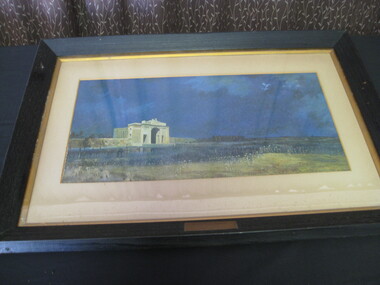
Print - Framed Print, Captain William Frederick Longstaff, Menin Gate at Midnight (Ghosts of Menin Gate), Painted 1927
... Print of original oil painting by Will Longstaff depicting a host of ghostly soldiers marching across a field in front of the Menin gate War memorial at Ypres, Belgium....Plaque on frame "Menin Gate at Midnight / copyright reserved / by / Will Longstaff / presented to the Commonwealth Government of Australia / by / Lord Woolayinton Print of original oil painting by Will Longstaff depicting a host of ghostly soldiers marching across a field in front of the Menin gate War memorial at Ypres, Belgium. Menin Gate at Midnight (Ghosts of Menin Gate) Print Framed Print Captain William Frederick Longstaff ...Print of original oil painting by Will Longstaff depicting a host of ghostly soldiers marching across a field in front of the Menin gate War memorial at Ypres, Belgium.Plaque on frame "Menin Gate at Midnight / copyright reserved / by / Will Longstaff / presented to the Commonwealth Government of Australia / by / Lord Woolayinton -
 Melbourne Legacy
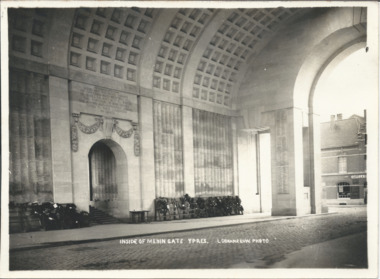
Photograph, Inside Menin Gate, Ypres, 1930
... war memorial in Ypres. It appears to be a professional photograph purchased as a souvenir. See also 01025 Tyne Cot Cemetery Passchendale as it is by the same manufacturer and is dated 1930. The Menin Gate Memorial to the Missing is a war memorial in Ypres, Belgium...war memorial in Ypres. It appears to be a professional photograph purchased as a souvenir. See also 01025 Tyne Cot Cemetery Passchendale as it is by the same manufacturer and is dated 1930. The Menin Gate Memorial to the Missing is a war memorial in Ypres, Belgium ...A photo of the Menin Gate war memorial in Ypres. It appears to be a professional photograph purchased as a souvenir. See also 01025 Tyne Cot Cemetery Passchendale as it is by the same manufacturer and is dated 1930. The Menin Gate Memorial to the Missing is a war memorial in Ypres, Belgium, dedicated to the British and Commonwealth soldiers who were killed in the Ypres Salient of World War I and whose graves are unknown (source Wikipedia). The source of these photos is not known but they were stored together in the archives. The source of these photos is not known but they were stored together in the archives. The founders of Legacy were returned servicemen from the first world war and may have returned to France in the 1930s. Manufactured by L. Duhameeuw, Ypres.The professional photos from France imply that Legatees were making pilgrimages to the battlefields of France in the 1930s in memory of their comrades.Black and white photo of Menin gate in Ypres, Belgium.Indistinct round stamp on the back.world war one, souvenir, memorial, ypres -
 Federation University Historical Collection
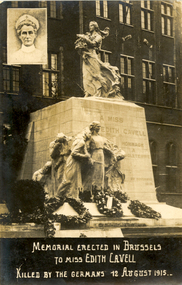
Photograph - Postcard, Edith Cavell Memorial, Brussells
... Belgium during World War I, for which she was arrested. She was subsequently court-martialled, found guilty of treason and sentenced to death. Despite international pressure for mercy, she was shot by a German firing squad. Her execution received worldwide condemnation and extensive press coverage. (http://en.wikipedia.org/wiki/Edith_Cavell) Edith Cavell Chatham-Holmes Family Collection nurse world war one world war sculpture Black and White postcard showing the memorial ...Edith Louisa Cavell (4 December 1865 – 12 October 1915) was a British nurse and patriot. She is celebrated for saving the lives of soldiers from all sides without distinction and in helping some 200 Allied soldiers escape from German-occupied Belgium during World War I, for which she was arrested. She was subsequently court-martialled, found guilty of treason and sentenced to death. Despite international pressure for mercy, she was shot by a German firing squad. Her execution received worldwide condemnation and extensive press coverage. (http://en.wikipedia.org/wiki/Edith_Cavell)Black and White postcard showing the memorial erected in Brussels to Edith Cavell. A portrait of Edith Cavell in nurses uniform is inset. This card was purchased by an Australian soldier, probably Henry Smerdon Holmes, during World War One. edith cavell, chatham-holmes family collection, nurse, world war one, world war, sculpture -
 The Beechworth Burke Museum
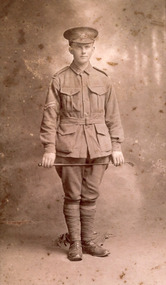
Photograph, 1916-17
... Peach is also one of the diarists of WWI, including of this significant period of Australian military history, from 1916 to 18, which can be accessed via the Australian War Memorial. military medal defending Australia and Victoria military service HMAT A64 Demosthenes Wipers ANZAC Burke Museum Beechworth Ypres Australian military services Beechworth Post Office First World War wartime our boys Belgium Flanders Fields WW1 British War Medal Victory Medal Broodseinde Third Battle of Ypres Reverse: BMM 8779 item catalogue number pencilled in right-hand bottom corner. ...Portrait of William Edward Peach in First World War military uniform, holding a crop in front of his thighs with military kit on the ground behind him. A Beechworth postal employee who enlisted in 1915, this photograph is probably taken in 1917, as he is a corporal in the photo and was promoted to this rank in May 1917. This photograph is of historic significance as it depicts William Edward Peach, a Beechworth postal assistant who enlisted in the Australian Imperial Force (AIF) on his nineteenth birthday, 5 August 1915, which required his parents' permission. He was decorated with the military medal for his courage in battle 4/5 October 1917 at the Battle of Broodseinde Ridge near Ypres, the most successful allied attack of the Third Battle of Ypres (31 July to 10 November 1917), also known as the Battle of Paschendale, which saw the greatest loss of human life during World War One, with almost half a million lives were lost on all sides. According to the recommendation for his military medal, Peach 'displayed conspicuous courage and initiative', taking charge after his platoon commander became a casualty, handling the men 'under heavy fire with great skill'. He also assisted the Company Commander in reorganising their military objectives. The photograph is of social as well as historic significance for the Beechworth community, because it provides a direct link between local, national and international histories in relation to Australia' s participation in one of WWI's best-known battles. The record has strong research potential given the ongoing public and scholarly interest in war, history, and especially the ANZAC legend, which is commemorated annually on 25 April, known as ANZAC Day. Peach is also one of the diarists of WWI, including of this significant period of Australian military history, from 1916 to 18, which can be accessed via the Australian War Memorial. Sepia rectangular photograph printed on gloss Kodak photographic paper mounted on board. Reverse: BMM 8779 item catalogue number pencilled in right-hand bottom corner.military medal, defending australia and victoria, military service, hmat a64 demosthenes, wipers, anzac, burke museum, beechworth, ypres, australian military services, beechworth post office, first world war, wartime, our boys, belgium, flanders fields, ww1, british war medal, victory medal, broodseinde, third battle of ypres -
 Lara RSL Sub Branch
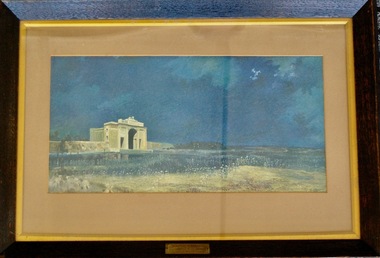
Framed Picture Print, MENIN GATE AT MIDNIGHT
... war memorial. Longstaff painted the work after attending the unveiling of the Menin Gate memorial, at Ypres in Belgium, on 24 July 1927. ...war memorial. Longstaff painted the work after attending the unveiling of the Menin Gate memorial, at Ypres in Belgium, on 24 July 1927. ...Menin Gate at Midnight (also known as Ghosts of Menin Gate) is a 1927 painting by Australian artist Will Longstaff. The painting depicts a host of ghostly soldiers marching across a field in front of the Menin Gate war memorial. Longstaff painted the work after attending the unveiling of the Menin Gate memorial, at Ypres in Belgium, on 24 July 1927. The memorial commemorated those men of the British Empire, including Australia, who died in the battles of the First World War around the town. The painting is part of the collection of the Australian War Memorial in Canberra. It was purchased by Lord Woolavington for 2,000 Guineas and presented to the Australian government.[1] After a royal command viewing for George V and the Royal family at Buckingham Palace, the painting was displayed in Manchester and Glasgow. It was then taken around Australia, where record crowds paid to view the work. Longstaff oversaw the making of 2,000 prints and 400 of these were given to the nascent Australian War Memorial to sell to raise funds.Rectangular shaped glass covered picture frame showing a print of the MENIN GATE AT MIDNIGHTMENIN GATE AT MIDNIGHT by WILL LONGSTAFF Presented to the Commonwealth Government of Australia by Lord Woolavington paintings, prints, ww1, lara r.s.l. menin gate, world war one. -
 Montmorency–Eltham RSL Sub Branch
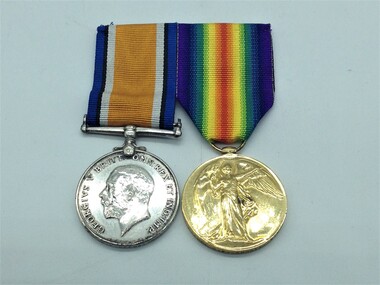
Medal - Medal Group, WW1, 2166 Lieutenant Reginald Frank Barratt
... War. Wounded at Zillebeke, near Ypres, Belgium. Died of wounds 22nd August 1917 at the age of 38. Buried at Bedford House Cemetery, Enclosure No 2, (Plot 1, R0w F, Grave 23), Zillebeke, Belgium. Panel number , Roll of Honour Australian War Memorial...War. Wounded at Zillebeke, near Ypres, Belgium. Died of wounds 22nd August 1917 at the age of 38. Buried at Bedford House Cemetery, Enclosure No 2, (Plot 1, R0w F, Grave 23), Zillebeke, Belgium. Panel number , Roll of Honour Australian War Memorial ...Information from "The AIF Project" Lieutenant Reginald Frank Barratt was born in 1879 in Withington, Manchester, Lancashire, England. Regimental number 2166. 3rd Field Artillery Brigade, Military District 3 and Military District 6. Arrived in Australia in 1903 aged 24. Address was Mount Street, Heidelberg, Victoria. Occupation - Farmer. Enlistment date was 17th August 1914. Served with the 68 Battery Royal Field Artillery during the South African War. Rank on enlistment was Sergeant. Embarkation details - Unit embarked from Melbourne, Victoria on board Transport A2 Geelong on 19th September 1914. Rank Lieutenant - Unit 1st Divisional Ammunition Column. Information from the Roll of Honour - Awarded Royal Human Society Medal for saving three lives from drowning in Orange River during South African War. Wounded at Zillebeke, near Ypres, Belgium. Died of wounds 22nd August 1917 at the age of 38. Buried at Bedford House Cemetery, Enclosure No 2, (Plot 1, R0w F, Grave 23), Zillebeke, Belgium. Panel number , Roll of Honour Australian War Memorial British War Medal - The medal was struck by the Royal Mint, is a silver disc 36mm in diameter with a straight clasp suspended without swivel. The obverse shows Sir Bertram Mackennal's bare headed effigy of King George V facing left with the legend 'GEORGIVS V BRITT:OMN:REX ET IND:IMD - "George V, King of all the British Isles & Emperor of India". The reverse, designed by William McMillan, shows St George, naked on horseback and armed with a short sword, an allegory of the physical & mental strength which achieved victory of Prussianism. The horse tramples on the Prussian eagle shield and the emblems of death, a skull and cross bones. In the background are ocean waves and just off centre near the right upper time is the risen sun of victory. The years 1914-1918 appear on the perimeter in the left and right fields respectively. The watered silk ribbon is 32mm wide with 3mm wide royal blue band, 2mm wide black band, 3mm wide white band repeated in reverse order and separated by 16mm wide orange band. Victory Medal - The medal is bronze disc 36mm in diameter with a winged figure of Victory on the obverse. The reverse has the words 'THE GREAT WAR FOR CIVILIZATION 1914-1918', all surrounded by a laurel leaf. The watered silk ribbon is 32mm wided has two rainbow design with the violet from each rainbow on the outside edges, moving through to a central red stripe where both rainbows meet.The recipients name, rank and unit are impressed on the bottom edge of the medals - Lieut F Barratt AIF -
 Greensborough Historical Society
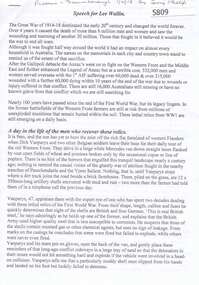
Article, Terry Phillips, Speech for Lee Wallin, by Terry Phillips at Probus Club, 01/10/2018
... War Memorial Park. Text of speech about the ongoing activity to recover unexploded ammunition from French and Belgian World War 1 battlefields....War Memorial Park. Text of speech about the ongoing activity to recover unexploded ammunition from French and Belgian World War 1 battlefields. world war 1 terry phillips 5 p. typescript; 4 p. newsletter and 1 p. invitation Speech for Lee Wallin, by Terry Phillips at Probus Club Article Greensborough Probus Club Terry Phillips ...Speech for Lee Wallin, by Terry Phillips at Probus Club [advertised as 'World War I Last 100 Days']; with Greensborough Probus Club newsletter October 2018, and invitation to Remembrance Day 2018 Service at Kangaroo Ground War Memorial Park. Text of speech about the ongoing activity to recover unexploded ammunition from French and Belgian World War 1 battlefields.5 p. typescript; 4 p. newsletter and 1 p. invitationworld war 1, terry phillips -
 Phillip Island and District Historical Society Inc.
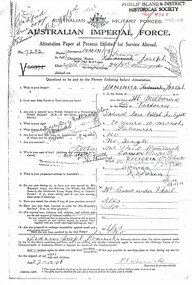
Document, Francis Joseph Dominick WW1 Enlistment and death documents
... war memorial. The Dominick family had 40 acres on the Nobbies Road, next to the Smiths. He enlisted in South Melbourne on 27/10/1916 and was killed in action on 4 October 1917 in Belgium....war memorial. The Dominick family had 40 acres on the Nobbies Road, next to the Smiths. He enlisted in South Melbourne on 27/10/1916 and was killed in action on 4 October 1917 in Belgium. ...Francis was known as Joseph and his name is on the Cowes war memorial. The Dominick family had 40 acres on the Nobbies Road, next to the Smiths. He enlisted in South Melbourne on 27/10/1916 and was killed in action on 4 October 1917 in Belgium.Historical2 photocopied WW1 documents. One is his enlistment form and the other is a report of death in action.Australian Imperial Force Attestation Paper of Persons Enlisted for Service Abroad. Field Service Army Form B 20290Aworld war 1, joseph dominick, military, dominick family -
 Colac RSL Sub Branch
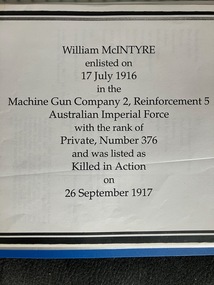
Print - WILLIAM McINTYRE, DOCUMENT, 30/3/2025
... SERVICE RECORDS OF WILLIAM McINTYRE SERVICE NO 376 PLACE OF BIRTH PORT MELBOURNE VICTORIA DATE OF BIRTH 27/07/1886 DATE OF ENLISTMENT 17/06/1916 PLACE LIVING ON ENLISTMENT BET BET VICTORIA RANK ON ENLISTMENT PRIVATE UNIT NAME MACHINE GUN COMPANY 2REINFORCEMENT5 AWM EMBARKATION ROLL NO 24/7/3 EMBARKATION DETAILS UNIT EMBARKED AT MELBOURNE PER HMAT A73 COMMONWEALTH ON 17/09/1917 FATE KILLED IN ACTION 26 SEPTEMBER1917 PLACE OF BURIAL NO KNOWN GRAVE COMMEMORATION DETAILS THE YPRES [ MENIN GATE ] MEMORIAL [ PANIAL 17 ] BELGIUM PANEL NUMBER ROLL OF HONOUR AUSTRALIAN WAR MEMORIAL...SERVICE RECORDS OF WILLIAM McINTYRE SERVICE NO 376 PLACE OF BIRTH PORT MELBOURNE VICTORIA DATE OF BIRTH 27/07/1886 DATE OF ENLISTMENT 17/06/1916 PLACE LIVING ON ENLISTMENT BET BET VICTORIA RANK ON ENLISTMENT PRIVATE UNIT NAME MACHINE GUN COMPANY 2REINFORCEMENT5 AWM EMBARKATION ROLL NO 24/7/3 EMBARKATION DETAILS UNIT EMBARKED AT MELBOURNE PER HMAT A73 COMMONWEALTH ON 17/09/1917 FATE KILLED IN ACTION 26 SEPTEMBER1917 PLACE OF BURIAL NO KNOWN GRAVE COMMEMORATION DETAILS THE YPRES [ MENIN GATE ] MEMORIAL [ PANIAL 17 ] BELGIUM PANEL NUMBER ROLL OF HONOUR AUSTRALIAN WAR MEMORIAL DOCUMENT Print WILLIAM McINTYRE ...SERVICE RECORDS OF WILLIAM McINTYRE SERVICE NO 376 PLACE OF BIRTH PORT MELBOURNE VICTORIA DATE OF BIRTH 27/07/1886 DATE OF ENLISTMENT 17/06/1916 PLACE LIVING ON ENLISTMENT BET BET VICTORIA RANK ON ENLISTMENT PRIVATE UNIT NAME MACHINE GUN COMPANY 2REINFORCEMENT5 AWM EMBARKATION ROLL NO 24/7/3 EMBARKATION DETAILS UNIT EMBARKED AT MELBOURNE PER HMAT A73 COMMONWEALTH ON 17/09/1917 FATE KILLED IN ACTION 26 SEPTEMBER1917 PLACE OF BURIAL NO KNOWN GRAVE COMMEMORATION DETAILS THE YPRES [ MENIN GATE ] MEMORIAL [ PANIAL 17 ] BELGIUM PANEL NUMBER ROLL OF HONOUR AUSTRALIAN WAR MEMORIAL -
 Running Rabbits Military Museum operated by the Upwey Belgrave RSL Sub Branch
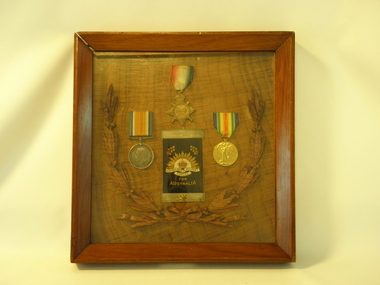
Memorial, Commonwealh of Australia et al, Family Memorial case for deceased veteran son, post World War One
... He was killed at Polygon Wood, Zillebrook near Ypres in Belgium on 4th October 1917 aged 25. world war one medal military ypres badge plaque polygon wood On one side are the Sons Medals (War Medal, 1914-1918 Medal and the Victory Medal), Mothers Badge (for being the mother of a deceased soldier) with a plaque from King Geaorge honouring the Service of "L/Cpl Chester George Mather of the 22nd Battalion AIF" on the other Double sided wooden and glass display case Family Memorial case for deceased veteran son Memorial Commonwealh of Australia King George ...The War Medal, 1914-1918 Medal and the Victory Medal, Mothers Badge (for being the mother of a deceased soldier) with a plaque from King George honouring the Service of L/Cpl Chester George Mather on the other. L/Cpl Mather enlisted on 8th of June 1915 and embarked for France on HMAT Anchises on the 26th Augest 1915. He was killed at Polygon Wood, Zillebrook near Ypres in Belgium on 4th October 1917 aged 25.Double sided wooden and glass display caseOn one side are the Sons Medals (War Medal, 1914-1918 Medal and the Victory Medal), Mothers Badge (for being the mother of a deceased soldier) with a plaque from King Geaorge honouring the Service of "L/Cpl Chester George Mather of the 22nd Battalion AIF" on the otherworld war one, medal, military, ypres, badge, plaque, polygon wood -
 Bendigo Military Museum
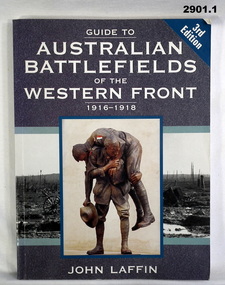
Book - BOOK, BATTLEFIELDS, Kangaroo Press, Australian Battlefields of the Western Front 1916-1918
... Belgium, French & English. Australian Battlefields of the Western Front 1916-1918 Book BOOK, BATTLEFIELDS Kangaroo Press Australian War Memorial ....1) Soft card cover with black & white photo of battlefield on front & back. Coloured photo of soldier carrying a wounded comrade over his shoulder. History of Author, John Laffin on back cover. 204 pages black & white with photos & maps. Complete history covering cemeteries, battlefields, commemorations, etc. .2) - .6) Tourist Information in Belgium, French & English.“3rd Edition on front cover”books - military history, battlefields -
 4th/19th Prince of Wales's Light Horse Regiment Unit History Room
Booklet, Department of Veterans' Affairs, A Guide to Australian Memorials on the Western Front, in France and Belgium. April 1916-November 1918, 2002
... Memorials Western Front World War 1 P045 Colour printed booklet A Guide to Australian Memorials on the Western Front, in France and Belgium. ...Colour printed bookletP045memorials, western front, world war 1 -
 Warrnambool and District Historical Society Inc.
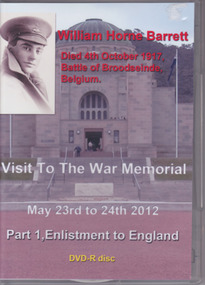
Film - DVD, Newell Barrett, Tower Hill, W. H Barrett, 2012
... War Memorial as a local enlistment. His mother was Mary Ann Horne and the Hornes were farmers in the Allansford/Nullawarre area. Barrett was killed in action in October 1917 at Broodseinde, Belgium. ...Front Cover: ‘William Horne Barrett, died 4th October 1917, Battle of Broodseinde, Belgium, Visit to the War Memorial, May 23rd to 24th 2012, Part One, Enlistment to England’. ...War Memorial as a local enlistment. His mother was Mary Ann Horne and the Hornes were farmers in the Allansford/Nullawarre area. Barrett was killed in action in October 1917 at Broodseinde, Belgium. ...William Horne Barrett was the great uncle of the donor and maker of the DVD, Newell Barrett. The DVD contains photographs of Barrett’s enlistment and embarkation for England and the photographs are accompanied by a commentary and text. Sergeant William Barrett enlisted in the 39th Battalion, C Company in 1916, and, although he came from Ballarat, his name is on the Warrnambool War Memorial as a local enlistment. His mother was Mary Ann Horne and the Hornes were farmers in the Allansford/Nullawarre area. Barrett was killed in action in October 1917 at Broodseinde, Belgium. He was buried near the trench he was occupying and today has no known grave. This DVD is of some significance as it contains information on a World War One soldier who was connected to the Warrnambool area through his mother, a member of the Horne family who were farmers in the Allansford/Nullawarre area. It will be useful for researchers.This is a DVD-R disc of the enlistments and embarkation details of William Horne Barrett (World War One). The running time is 56 minutes. The cover has two photographs of the Canberra Australian War Memorial in muted colour and an inset photograph of William Barrett. Front Cover: ‘William Horne Barrett, died 4th October 1917, Battle of Broodseinde, Belgium, Visit to the War Memorial, May 23rd to 24th 2012, Part One, Enlistment to England’. world war one, horne family, william horne barrett -
 Eltham District Historical Society Inc
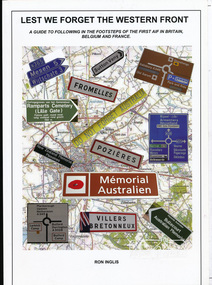
Book, Ronald William Inglis, Lest we forget the Western Front : a guide to following in the footsteps of the first AIF in Britain, Belgium and France, 2010
... A guide to sites and memorials relevant to the first Australian Imperial Force in Britain, Belgium and France in the First World War...A guide to sites and memorials relevant to the first Australian Imperial Force in Britain, Belgium and France in the First World War australian imperial force war memorials world war 1 battle fields ISBN 9780646519920 170 p. : ill. ...A guide to sites and memorials relevant to the first Australian Imperial Force in Britain, Belgium and France in the First World War170 p. : ill. (some col.), maps (some col.), ports. ; 30 cm.ISBN 9780646519920australian imperial force, war memorials, world war 1 battle fields -
 Eltham District Historical Society Inc
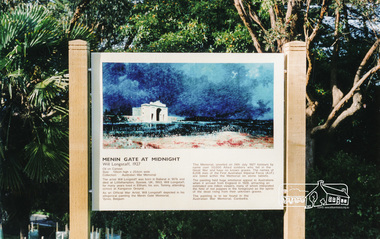
Photograph, Information Panel: Will Longstaff's "Menin Gate at Midnight"
... War Memorial The artist Will Longstaff was born in in Ballarat in 1879 and died at Littlehampton, Sussex, UK, 1953. Will Longstaff for many years lived in Eltham, his son Tommy, attending school at Kangaroo Ground. As an Official War Artist, will Longstaff depicted in his alegorical painting the Menin Gate Memorial, Ypres, Belgium...Since this photograph was taken (date unknown) the information panel has been restored and re-erected by staff of the Shire of Nillumbik who replicated the wooden side frame pieces with the same wood-turn design as seen here in the original. menin gate at midnight william longstaff kangaroo ground memorial information panel Shire of Eltham War memorial MENIN GATE AT MIDNIGHT Will Longstaff, 1927 Oil on canvas, Size 135cm high x 254cm wide Collection: Australian War Memorial The artist Will Longstaff was born in in Ballarat in 1879 and died at Littlehampton, Sussex, UK, 1953. Will Longstaff for many years lived in Eltham, his son Tommy, attending school at Kangaroo Ground. As an Official War Artist, will Longstaff depicted in his alegorical painting the Menin Gate Memorial, Ypres, Belgium ...In April 2002, illustrative panels were set in place at Kangaroo Ground War Memorial Park designed to inform visitors about significant aspects of the reserve and its tower. One of these deals with its indigenous story, another portrays its original 1920 memorial, a third has upon it Will Longstaff’s famous war painting, “Midnight at Menin Gate.” This sign establishes a connection with the First World War by way of the painting "Menin Gate at Midnight". (NL 144) The artist William Longstaff lived in Eltham; his son attended school at Kangaroo Ground. The orignal of his painting is on permanent display in the Australian War Memorial. Since this photograph was taken (date unknown) the information panel has been restored and re-erected by staff of the Shire of Nillumbik who replicated the wooden side frame pieces with the same wood-turn design as seen here in the original. Colour photographMENIN GATE AT MIDNIGHT Will Longstaff, 1927 Oil on canvas, Size 135cm high x 254cm wide Collection: Australian War Memorial The artist Will Longstaff was born in in Ballarat in 1879 and died at Littlehampton, Sussex, UK, 1953. Will Longstaff for many years lived in Eltham, his son Tommy, attending school at Kangaroo Ground. As an Official War Artist, will Longstaff depicted in his alegorical painting the Menin Gate Memorial, Ypres, Belgium. The Memorial unveiled on 24th July 1927 honours by name over 50, 000 allied soldiers who fell in the Great War and have no known graves. The names of 6,208 men of the first Australian Imperial Force (A.I.F.) are listed within the Memorial on stone tablets. The painting held huge emotional appeal to Australians when it arrived from England in 1928, attracting an estimated one million viewers, many of whom interpreted the field of red poppies in the foreground as the spirits of the dead rising from their unknown graves. The painting is to be found in the Australian War Memorial, Canberra.menin gate at midnight, william longstaff, kangaroo ground memorial, information panel, shire of eltham war memorial -
 Bendigo Historical Society Inc.
Postcard - ACC LOCK COLLECTION: KRIEGER-DENKMAL CHARLEROI (BELGIEN), POSTCARD, 1914-1918
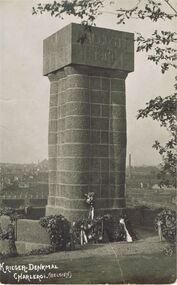
... Belgium... Krieger-Denkmal... Charleroi... War memorial...Postcard, WW1, B&W image of Krieger-Denkmal (War Memorial) erected by the Germans at Chareroi in Belgium to celebrate a victory in August 1914. ...POSTCARD Postcard WW1 Belgium Krieger-Denkmal Charleroi War memorial Postcard, WW1, B&W image of Krieger-Denkmal (War Memorial) erected by the Germans at Chareroi in Belgium to celebrate a victory in August 1914. ...Postcard, WW1, B&W image of Krieger-Denkmal (War Memorial) erected by the Germans at Chareroi in Belgium to celebrate a victory in August 1914. It is a stone tower with the city behind it. Wreaths placed at the base and 'August 1914' inscribed at the top plinth. In 1920, after the War, it was blown up.postcard, postcard, ww1, belgium, krieger-denkmal, charleroi, war memorial -
 Warrnambool and District Historical Society Inc.
Postcard - Postcards Gladys Holmes collection. WW1, 10 Post Cards from Archie to Gladys, Circa 1915-1920
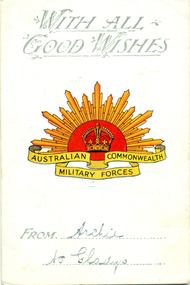
... Details of feelings, ship journeys, overseas war service and few photographs of period 1915/6- 1919. some of the writers/authors have photographs on the Byaduk Memorial hall Honour Board. gladys vida holmes frank holmes archie mcvillivray wilfred rentsch william t harper albert v harper 001800.1: To Gladys from Archie - undated 001800.2: To Gladys, With Kindest Regards, From Archie - undated 001800.3: Dear Gladys.. Sept 14.... Bye Archie; Harefield Hospital 001800.4: Dear Gladys...Kindest regards Archie; Sutton Veny June 16/1918 001800.5: Dear Gladys..Archie; Belgium ...All overseas correspondence to Gladys Holmes. Vida Holmes, Frank and Jim from Byaduk servicemen, relatives and friends, during WW! service 1915-1919. Except Letters and postcards from Orford Critchlow to Gladys. Some of the seven servicemen died and are remembered on the Byaduk war memorial- Wilfred Rentsch, William Thomas Harper, Stanley O Miller, Albert V Harper and Walter Kinghorn. Gladys wad born in Byaduk 1897 daughter to Joseph (Baker) and Agnes Holmes with sisters Vida and Una and brother Frank. She married Alexander George Anderson of Stawell in 1924. Archie McGillivray married Minnie Ramsay, the Scottish sister of a friend Ashley Ramsay.Primary documents sent to Byaduk residents from local friends serving overseas in WW!. Details of feelings, ship journeys, overseas war service and few photographs of period 1915/6- 1919. some of the writers/authors have photographs on the Byaduk Memorial hall Honour Board.001800.1 -001800.10 Cardboard postcards, some colour, one photograph and one embroidered001800.1: To Gladys from Archie - undated 001800.2: To Gladys, With Kindest Regards, From Archie - undated 001800.3: Dear Gladys.. Sept 14.... Bye Archie; Harefield Hospital 001800.4: Dear Gladys...Kindest regards Archie; Sutton Veny June 16/1918 001800.5: Dear Gladys..Archie; Belgium, March 21/1919 001800.6: To Gladys ....From Archie; 16/3/1918 001800.7: Dear Gladys...Your old pal Archie; Belgium, 16/3/1918 001800.8: Dear Gladys....Love from Archie, France, Jan 27/1918 001800.9: To Gladys from Archie; Christmas 1918 001800.10: Dear Gladys....from Arch, France Nov 7 1917 001800.8: 001800.9: gladys, vida holmes, frank holmes, archie mcvillivray, wilfred rentsch, william t harper, albert v harper -
 Bendigo Military Museum
Book - MILITARY HISTORY, WW1, British - Australasian Publishing Service, "THE ALL-AUSTRALIA MEMORIAL", 1917
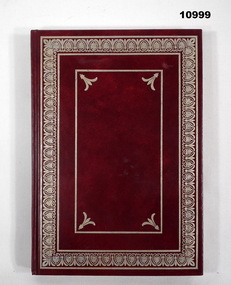
... Memorial. A HISTORICAL RECORD OF NATIONAL EFFORT DURING THE GREAT WAR." Soldier's details - with portrait photograph. "ANDERSON, Andrew C. Sgt. 1st Anzac Cycle C.; s. of Mr and Mrs D. Anderson, Hay; b. Hay, June 11, 1894; educ. Jivtho S.S.; grocer; enl. May 31, 1915; emb. June 16, 1915. War Service; Egypt, Gallipoli, France, Belgium...Memorial. A HISTORICAL RECORD OF NATIONAL EFFORT DURING THE GREAT WAR." Soldier's details - with portrait photograph. "ANDERSON, Andrew C. Sgt. 1st Anzac Cycle C.; s. of Mr and Mrs D. Anderson, Hay; b. Hay, June 11, 1894; educ. Jivtho S.S.; grocer; enl. May 31, 1915; emb. June 16, 1915. War Service; Egypt, Gallipoli, France, Belgium ...From Title Page - "The All-Australia Memorial. A HISTORICAL RECORD OF NATIONAL EFFORT DURING THE GREAT WAR." Soldier's details - with portrait photograph. "ANDERSON, Andrew C. Sgt. 1st Anzac Cycle C.; s. of Mr and Mrs D. Anderson, Hay; b. Hay, June 11, 1894; educ. Jivtho S.S.; grocer; enl. May 31, 1915; emb. June 16, 1915. War Service; Egypt, Gallipoli, France, Belgium; ret. Australia at cessation of hostilities.; disc August 7, 1919." Andersons War Service. Andrew Charles Anderson No 2116 (born Hay NSW, enlisted Liverpool) on 1.5.1915 in 6th Reinforcements 4th Bn age 20 years 11 months, embark for Eygpt 16.6.1915, joined Bn on Gallipoli 10.8.1915, Hospital 10.8.1915 (listed as Shock) transferred to England, rejoin Unit Eygpt 15.1.1916, transfer to 56th Bn then to 5Div Cyclist Bn, embark for France10.6.1916, Awarded Military Medal 25.6.1917, 16.1.1918 transfer to Aust Corps Cyclist Bn, hospital 16.2.1918 with Scabies then Furnunculosis, rejoin Unit 16.5.1918, RTA 19.4.1919, Discharged with the rank of Sgt on 7.8.1919.Hardcover book. Cover - cardboard with dark ruby red coloured buckram. Gold and black coloured ink on front and spine. Front - Rising Sun emblem with "AUSTRALIAN/ COMMONWEALTH/ MILITARY FORCES". Pages 158 pages, cut, white paper with gold coloured trim on page edges. Numerous cardboard (brown coloured) pages dividing chapters. Illustrated - sepia coloured photographs, artworks and diagrams with some photographs mounted on cardboard pages. At front before Title page - inset photograph of a soldier in uniform with soldier's details (see in Context Historical) mounted on cardboard page.publications, books, military history, ww1 -
 Bendigo Historical Society Inc.
Document - Jack Lockett Collection: Army Certificate of Discharge
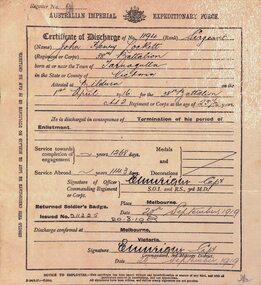
... Belgium remained the focus of the 38th Battalion's activities for the next five months, until it was rushed south to France in late March 1918 to meet the German Army's Spring Offensive. The 38th participated in its last major action of the war between 29 September and 2 October 1918 as part of the Australian-American operation that breached the formidable defences of the Hindenburg Line along the St Quentin Canal. It was disbanded in April 1919. Source, Australian War Memorial...Belgium remained the focus of the 38th Battalion's activities for the next five months, until it was rushed south to France in late March 1918 to meet the German Army's Spring Offensive. The 38th participated in its last major action of the war between 29 September and 2 October 1918 as part of the Australian-American operation that breached the formidable defences of the Hindenburg Line along the St Quentin Canal. It was disbanded in April 1919. Source, Australian War Memorial ...John Henry Lockett OAM (22 January 1891 – 25 May 2002) was the oldest man ever in Australia when he died aged 111 years, 123 days. As one of the last surviving veterans of World War I, he was acclaimed as a national hero during the last decade of his life. Lockett was born in the small Victorian town of Waanyarra, near Bendigo. He left school aged nine to work on a local farm. Later, he worked for his uncles in the Mallee. On 24 March 1916, he travelled to Mildura to enlist in the Australian Imperial Force. He served in France with the 38th Battalion, earning promotion to sergeant and was discharged on 20 September 1919. https://en.wikipedia.org/wiki/Jack_Lockett The 38th Battalion was formed on 1 March 1916 at a camp established on the Epsom Racecourse at Bendigo in Victoria. After training in both Australia and Britain, the 38th Battalion crossed to France in late November 1916 and moved into the trenches of the Western Front for the first time on 1 December.The 38th fought in its first major battle at Messines, in Belgium, between 7-9 June 1917. It fought in another two major attacks in this sector - the battle of Broodseinde on 4 October, and the battle of Passchendaele on 12 October. Belgium remained the focus of the 38th Battalion's activities for the next five months, until it was rushed south to France in late March 1918 to meet the German Army's Spring Offensive. The 38th participated in its last major action of the war between 29 September and 2 October 1918 as part of the Australian-American operation that breached the formidable defences of the Hindenburg Line along the St Quentin Canal. It was disbanded in April 1919. Source, Australian War Memorial https://www.awm.gov.au/collection/U51478 After the war, Jack returned to The Mallee and selected a 640 acres (260 ha) block of land in Linga, Victoria, deciding to make his living as a farmer. In 1923, he married Maybell Ingwerson and they had four children together. In 1963, the couple retired to Bendigo, leaving the farmland (which now covered more than 130,000 acres (53,000 ha), in the care of their children and grandchildren. An off-white coulored document with black print and black handwriting headed AUSTRALIAN IMPERIAL EXPEDITIONARY FORCE Certificate of Discharge No 1194 Sergeant John Henry Lockett 38th Battalion, born Tarnagulla Victoria Attested at Mildura 1st April 1916for the 38th Battalion at the age of 25 1/2 years Total service 1268 days Service abroad 1143 days Discharge confirmed at Melbourne Victoria 20th September 1919 On the reverse V/B 60883 No 177770 Description of the above named Soldier on discharge Age 28 1/2 years Height 5' 10", complexion Medium, Eyes Blue, Hair Brown, Trade Farmer, Intended place of Residence Ouyen P.O. Victoria Singed J H Lockett jack lockett, mabel ingwersen, 38th australian infantry battalion, w.w.1, mallee farming -
 Bendigo Historical Society Inc.
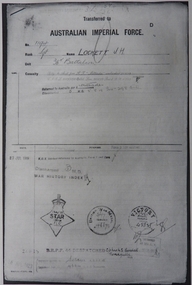
Document - Jack Lockett Collection: Copies of Army Service documents
... Belgium remained the focus of the 38th Battalion's activities for the next five months, until it was rushed south to France in late March 1918 to meet the German Army's Spring Offensive. The 38th participated in its last major action of the war between 29 September and 2 October 1918 as part of the Australian-American operation that breached the formidable defences of the Hindenburg Line along the St Quentin Canal. It was disbanded in April 1919. Source, Australian War Memorial...Belgium remained the focus of the 38th Battalion's activities for the next five months, until it was rushed south to France in late March 1918 to meet the German Army's Spring Offensive. The 38th participated in its last major action of the war between 29 September and 2 October 1918 as part of the Australian-American operation that breached the formidable defences of the Hindenburg Line along the St Quentin Canal. It was disbanded in April 1919. Source, Australian War Memorial ...John Henry Lockett OAM (22 January 1891 – 25 May 2002) was the oldest man ever in Australia when he died aged 111 years, 123 days. As one of the last surviving veterans of World War I, he was acclaimed as a national hero during the last decade of his life. Lockett was born in the small Victorian town of Waanyarra, near Bendigo. He left school aged nine to work on a local farm. Later, he worked for his uncles in the Mallee. On 24 March 1916, he travelled to Mildura to enlist in the Australian Imperial Force. He served in France with the 38th Battalion, earning promotion to sergeant and was discharged on 20 September 1919. https://en.wikipedia.org/wiki/Jack_Lockett The 38th Battalion was formed on 1 March 1916 at a camp established on the Epsom Racecourse at Bendigo in Victoria. After training in both Australia and Britain, the 38th Battalion crossed to France in late November 1916 and moved into the trenches of the Western Front for the first time on 1 December.The 38th fought in its first major battle at Messines, in Belgium, between 7-9 June 1917. It fought in another two major attacks in this sector - the battle of Broodseinde on 4 October, and the battle of Passchendaele on 12 October. Belgium remained the focus of the 38th Battalion's activities for the next five months, until it was rushed south to France in late March 1918 to meet the German Army's Spring Offensive. The 38th participated in its last major action of the war between 29 September and 2 October 1918 as part of the Australian-American operation that breached the formidable defences of the Hindenburg Line along the St Quentin Canal. It was disbanded in April 1919. Source, Australian War Memorial https://www.awm.gov.au/collection/U51478 After the war, Jack returned to The Mallee and selected a 640 acres (260 ha) block of land in Linga, Victoria, deciding to make his living as a farmer. In 1923, he married Maybell Ingwerson and they had four children together. In 1963, the couple retired to Bendigo, leaving the farmland (which now covered more than 130,000 acres (53,000 ha), in the care of their children and grandchildren. Thirteen photocopies relating to Jack Lockett's service in the Australian Imperial Force jack lockett, mabel ingwersen, 38th australian infantry battalion, w.w.1, mallee farming -
 Bendigo Historical Society Inc.
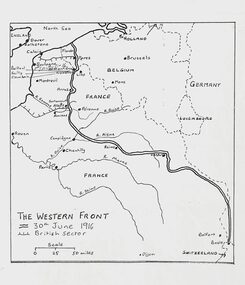
Map - Jack Lockett Collection: Copies of two maps of WW1 Battles
... Belgium remained the focus of the 38th Battalion's activities for the next five months, until it was rushed south to France in late March 1918 to meet the German Army's Spring Offensive. The 38th participated in its last major action of the war between 29 September and 2 October 1918 as part of the Australian-American operation that breached the formidable defences of the Hindenburg Line along the St Quentin Canal. It was disbanded in April 1919. Source, Australian War Memorial...Belgium remained the focus of the 38th Battalion's activities for the next five months, until it was rushed south to France in late March 1918 to meet the German Army's Spring Offensive. The 38th participated in its last major action of the war between 29 September and 2 October 1918 as part of the Australian-American operation that breached the formidable defences of the Hindenburg Line along the St Quentin Canal. It was disbanded in April 1919. Source, Australian War Memorial ...John Henry Lockett OAM (22 January 1891 – 25 May 2002) was the oldest man ever in Australia when he died aged 111 years, 123 days. As one of the last surviving veterans of World War I, he was acclaimed as a national hero during the last decade of his life. Lockett was born in the small Victorian town of Waanyarra, near Bendigo. He left school aged nine to work on a local farm. Later, he worked for his uncles in the Mallee. On 24 March 1916, he travelled to Mildura to enlist in the Australian Imperial Force. He served in France with the 38th Battalion, earning promotion to sergeant and was discharged on 20 September 1919. https://en.wikipedia.org/wiki/Jack_Lockett The 38th Battalion was formed on 1 March 1916 at a camp established on the Epsom Racecourse at Bendigo in Victoria. After training in both Australia and Britain, the 38th Battalion crossed to France in late November 1916 and moved into the trenches of the Western Front for the first time on 1 December.The 38th fought in its first major battle at Messines, in Belgium, between 7-9 June 1917. It fought in another two major attacks in this sector - the battle of Broodseinde on 4 October, and the battle of Passchendaele on 12 October. Belgium remained the focus of the 38th Battalion's activities for the next five months, until it was rushed south to France in late March 1918 to meet the German Army's Spring Offensive. The 38th participated in its last major action of the war between 29 September and 2 October 1918 as part of the Australian-American operation that breached the formidable defences of the Hindenburg Line along the St Quentin Canal. It was disbanded in April 1919. Source, Australian War Memorial https://www.awm.gov.au/collection/U51478 After the war, Jack returned to The Mallee and selected a 640 acres (260 ha) block of land in Linga, Victoria, deciding to make his living as a farmer. In 1923, he married Maybell Ingwerson and they had four children together. In 1963, the couple retired to Bendigo, leaving the farmland (which now covered more than 130,000 acres (53,000 ha), in the care of their children and grandchildren. Two photocopies of hand drawn maps on one A4 sheet of paper. One side labeled THE WESTERN FRONT 30th June 1916 British Sector Scale 1 inch to 50 miles. The Western Front spans from the North Sea to Switzerland. The other side is labeled POZIERES scale 1 inch to 500 yards. July to September 1916. There are numerous roads and trench lines. jack lockett, mabel ingwersen, 38th australian infantry battalion, w.w.1, mallee farming, pozieres 1916, the western front 1916 -
 Bendigo Historical Society Inc.
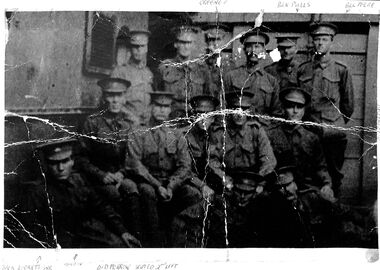
Postcard - Jack Lockett Collection:
... Belgium remained the focus of the 38th Battalion's activities for the next five months, until it was rushed south to France in late March 1918 to meet the German Army's Spring Offensive. The 38th participated in its last major action of the war between 29 September and 2 October 1918 as part of the Australian-American operation that breached the formidable defences of the Hindenburg Line along the St Quentin Canal. It was disbanded in April 1919. Source, Australian War Memorial...Belgium remained the focus of the 38th Battalion's activities for the next five months, until it was rushed south to France in late March 1918 to meet the German Army's Spring Offensive. The 38th participated in its last major action of the war between 29 September and 2 October 1918 as part of the Australian-American operation that breached the formidable defences of the Hindenburg Line along the St Quentin Canal. It was disbanded in April 1919. Source, Australian War Memorial ...John Henry Lockett OAM (22 January 1891 – 25 May 2002) was the oldest man ever in Australia when he died aged 111 years, 123 days. As one of the last surviving veterans of World War I, he was acclaimed as a national hero during the last decade of his life. Lockett was born in the small Victorian town of Waanyarra, near Bendigo. He left school aged nine to work on a local farm. Later, he worked for his uncles in the Mallee. On 24 March 1916, he travelled to Mildura to enlist in the Australian Imperial Force. He served in France with the 38th Battalion, earning promotion to sergeant and was discharged on 20 September 1919. https://en.wikipedia.org/wiki/Jack_Lockett The 38th Battalion was formed on 1 March 1916 at a camp established on the Epsom Racecourse at Bendigo in Victoria. After training in both Australia and Britain, the 38th Battalion crossed to France in late November 1916 and moved into the trenches of the Western Front for the first time on 1 December.The 38th fought in its first major battle at Messines, in Belgium, between 7-9 June 1917. It fought in another two major attacks in this sector - the battle of Broodseinde on 4 October, and the battle of Passchendaele on 12 October. Belgium remained the focus of the 38th Battalion's activities for the next five months, until it was rushed south to France in late March 1918 to meet the German Army's Spring Offensive. The 38th participated in its last major action of the war between 29 September and 2 October 1918 as part of the Australian-American operation that breached the formidable defences of the Hindenburg Line along the St Quentin Canal. It was disbanded in April 1919. Source, Australian War Memorial https://www.awm.gov.au/collection/U51478 After the war, Jack returned to The Mallee and selected a 640 acres (260 ha) block of land in Linga, Victoria, deciding to make his living as a farmer. In 1923, he married Maybell Ingwerson and they had four children together. In 1963, the couple retired to Bendigo, leaving the farmland (which now covered more than 130,000 acres (53,000 ha), in the care of their children and grandchildren. An A4 size copy of a postcard with a black and white photograph of 14 men in army uniforms with some men identified - Greeno, Ben Pulls, Bill McCae, Jack Lockett Snr, Maldon, Dad Morrow. On the back there is a copy of the back of the postcard with handwriting - Dear Boys this a group of my cobbers No 1 section ............Dont loose it, Jack jack lockett, mabel ingwersen, 38th australian infantry battalion, w.w.1, mallee farming -
 Bendigo Historical Society Inc.
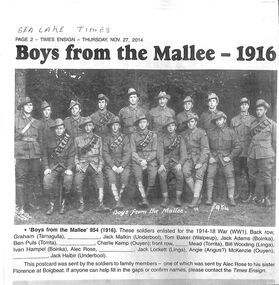
Memorabilia - Jack Lockett Collection: Boys from the Mallee 1916
... Belgium remained the focus of the 38th Battalion's activities for the next five months, until it was rushed south to France in late March 1918 to meet the German Army's Spring Offensive. The 38th participated in its last major action of the war between 29 September and 2 October 1918 as part of the Australian-American operation that breached the formidable defences of the Hindenburg Line along the St Quentin Canal. It was disbanded in April 1919. Source, Australian War Memorial...Belgium remained the focus of the 38th Battalion's activities for the next five months, until it was rushed south to France in late March 1918 to meet the German Army's Spring Offensive. The 38th participated in its last major action of the war between 29 September and 2 October 1918 as part of the Australian-American operation that breached the formidable defences of the Hindenburg Line along the St Quentin Canal. It was disbanded in April 1919. Source, Australian War Memorial ...John Henry Lockett OAM (22 January 1891 – 25 May 2002) was the oldest man ever in Australia when he died aged 111 years, 123 days. As one of the last surviving veterans of World War I, he was acclaimed as a national hero during the last decade of his life. Lockett was born in the small Victorian town of Waanyarra, near Bendigo. He left school aged nine to work on a local farm. Later, he worked for his uncles in the Mallee. On 24 March 1916, he travelled to Mildura to enlist in the Australian Imperial Force. He served in France with the 38th Battalion, earning promotion to sergeant and was discharged on 20 September 1919. https://en.wikipedia.org/wiki/Jack_Lockett The 38th Battalion was formed on 1 March 1916 at a camp established on the Epsom Racecourse at Bendigo in Victoria. After training in both Australia and Britain, the 38th Battalion crossed to France in late November 1916 and moved into the trenches of the Western Front for the first time on 1 December.The 38th fought in its first major battle at Messines, in Belgium, between 7-9 June 1917. It fought in another two major attacks in this sector - the battle of Broodseinde on 4 October, and the battle of Passchendaele on 12 October. Belgium remained the focus of the 38th Battalion's activities for the next five months, until it was rushed south to France in late March 1918 to meet the German Army's Spring Offensive. The 38th participated in its last major action of the war between 29 September and 2 October 1918 as part of the Australian-American operation that breached the formidable defences of the Hindenburg Line along the St Quentin Canal. It was disbanded in April 1919. Source, Australian War Memorial https://www.awm.gov.au/collection/U51478 After the war, Jack returned to The Mallee and selected a 640 acres (260 ha) block of land in Linga, Victoria, deciding to make his living as a farmer. In 1923, he married Maybell Ingwerson and they had four children together. In 1963, the couple retired to Bendigo, leaving the farmland (which now covered more than 130,000 acres (53,000 ha), in the care of their children and grandchildren. A photocopy of an article and photograph headed - PAGE 2 TIMES ENSIGN - THURSDAY, NOV. 2014 (Sea Lake Times?) Boys from the Mallee- 1916. A photograph of a postcard of17 men in Australian Army Uniforms, 10 standing and seven sitting. Names listed Graham (Tarnagulla), Jack Malkin (Underbol), Tom Baker (Walpeup), Jack Adams (Binka), Ben Puls Torria), Charlie Kemp (Ouyen), Mead (Torrita), Bill Wooding (Linga), Ivan Hampel (Boinka), Alec Rose, Jack Locket (Linga) Angus McKenzie (Ouyen), Jack Halbir (Underbool) This postcard was sent by Alec Rose to his sister Florence. dge and Rheola. jack lockett, mabel ingwersen, 38th australian infantry battalion, w.w.1, mallee farming -
 Bendigo Historical Society Inc.
Photograph - Jack Lockett Collection: Five W.W.1 photographs
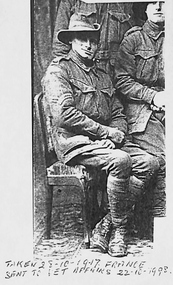
... Belgium remained the focus of the 38th Battalion's activities for the next five months, until it was rushed south to France in late March 1918 to meet the German Army's Spring Offensive. The 38th participated in its last major action of the war between 29 September and 2 October 1918 as part of the Australian-American operation that breached the formidable defences of the Hindenburg Line along the St Quentin Canal. It was disbanded in April 1919. Source, Australian War Memorial...Belgium remained the focus of the 38th Battalion's activities for the next five months, until it was rushed south to France in late March 1918 to meet the German Army's Spring Offensive. The 38th participated in its last major action of the war between 29 September and 2 October 1918 as part of the Australian-American operation that breached the formidable defences of the Hindenburg Line along the St Quentin Canal. It was disbanded in April 1919. Source, Australian War Memorial ...John Henry Lockett OAM (22 January 1891 – 25 May 2002) was the oldest man ever in Australia when he died aged 111 years, 123 days. As one of the last surviving veterans of World War I, he was acclaimed as a national hero during the last decade of his life. Lockett was born in the small Victorian town of Waanyarra, near Bendigo. He left school aged nine to work on a local farm. Later, he worked for his uncles in the Mallee. On 24 March 1916, he travelled to Mildura to enlist in the Australian Imperial Force. He served in France with the 38th Battalion, earning promotion to sergeant and was discharged on 20 September 1919. https://en.wikipedia.org/wiki/Jack_Lockett The 38th Battalion was formed on 1 March 1916 at a camp established on the Epsom Racecourse at Bendigo in Victoria. After training in both Australia and Britain, the 38th Battalion crossed to France in late November 1916 and moved into the trenches of the Western Front for the first time on 1 December.The 38th fought in its first major battle at Messines, in Belgium, between 7-9 June 1917. It fought in another two major attacks in this sector - the battle of Broodseinde on 4 October, and the battle of Passchendaele on 12 October. Belgium remained the focus of the 38th Battalion's activities for the next five months, until it was rushed south to France in late March 1918 to meet the German Army's Spring Offensive. The 38th participated in its last major action of the war between 29 September and 2 October 1918 as part of the Australian-American operation that breached the formidable defences of the Hindenburg Line along the St Quentin Canal. It was disbanded in April 1919. Source, Australian War Memorial https://www.awm.gov.au/collection/U51478 After the war, Jack returned to The Mallee and selected a 640 acres (260 ha) block of land in Linga, Victoria, deciding to make his living as a farmer. In 1923, he married Maybell Ingwerson and they had four children together. In 1963, the couple retired to Bendigo, leaving the farmland (which now covered more than 130,000 acres (53,000 ha), in the care of their children and grandchildren. Five photographs including Jack Lockett a. A photocopy of part of a group photograph, Jack sitting on a chair wearing an Australian Army Uniform. Written underneath - Teken 25-10-1917 France sent to Vet affairs 22-10-1998 b. A black and white photograph of a ship crowed with people on deck with printing - H.M.A.T. "RUNIC" (copyright) 20/6/16 written on the back in blue ink - Private Jack Locket No 1194 D Company 38th Battalion A.I.F. left Port Melbourne pier on Tues 20 June 1916 aboard H.M.A.T. RUNIC bound for England via South Africa. He was below deck peering out of a porthole when the boat pulled away from the pier, as he had the job of guarding some supplies. the arrived in England on (sic) Returning to Australia on Miltides on Mon 17th Feb 1919 as a Sargent Discharged 20 SEPT 1919 c. A very faded sepia tone photograph of four men in Army Uniforms without hats. three sitting and Jack Lockett lying on the man in the middle. Written on the back - JACK LOCKETT LYING ON ONE of His 3 MATES NAMES UNKNOWN FIRST AIF 1914 -1918 GREAT WAR d. A black and white postcard of Jack Lockett in an Australian Army Uniform sitting cross legged in a chair with an image of a forest behind him. Written on the back J H LOCKETT D COY 38 BATT 3DIV NO1194 1stAIF FRANCE e. c. A very faded sepia tone photograph of nine men in Army Uniforms wearing gas masks, six men standing, four men Kneeling in front. Behind them there is a corrugated-iron building. Written on the back - FIRST GAS MASKS W.W. 1 JACK LOCKET 2nd RIGHT STANDING jack lockett, mabel ingwersen, 38th australian infantry battalion, w.w.1, mallee farming, h.m.a.t. runic, gas masks -
 Bendigo Historical Society Inc.
Journal - Jack Lockett Collection: Brief handwritten 38th Battalion Histroy
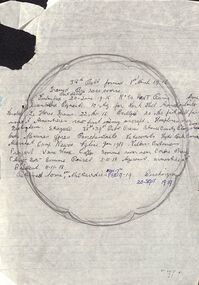
... Belgium remained the focus of the 38th Battalion's activities for the next five months, until it was rushed south to France in late March 1918 to meet the German Army's Spring Offensive. The 38th participated in its last major action of the war between 29 September and 2 October 1918 as part of the Australian-American operation that breached the formidable defences of the Hindenburg Line along the St Quentin Canal. It was disbanded in April 1919. Source, Australian War Memorial...Belgium remained the focus of the 38th Battalion's activities for the next five months, until it was rushed south to France in late March 1918 to meet the German Army's Spring Offensive. The 38th participated in its last major action of the war between 29 September and 2 October 1918 as part of the Australian-American operation that breached the formidable defences of the Hindenburg Line along the St Quentin Canal. It was disbanded in April 1919. Source, Australian War Memorial ...John Henry Lockett OAM (22 January 1891 – 25 May 2002) was the oldest man ever in Australia when he died aged 111 years, 123 days. As one of the last surviving veterans of World War I, he was acclaimed as a national hero during the last decade of his life. Lockett was born in the small Victorian town of Waanyarra, near Bendigo. He left school aged nine to work on a local farm. Later, he worked for his uncles in the Mallee. On 24 March 1916, he travelled to Mildura to enlist in the Australian Imperial Force. He served in France with the 38th Battalion, earning promotion to sergeant and was discharged on 20 September 1919. https://en.wikipedia.org/wiki/Jack_Lockett The 38th Battalion was formed on 1 March 1916 at a camp established on the Epsom Racecourse at Bendigo in Victoria. After training in both Australia and Britain, the 38th Battalion crossed to France in late November 1916 and moved into the trenches of the Western Front for the first time on 1 December.The 38th fought in its first major battle at Messines, in Belgium, between 7-9 June 1917. It fought in another two major attacks in this sector - the battle of Broodseinde on 4 October, and the battle of Passchendaele on 12 October. Belgium remained the focus of the 38th Battalion's activities for the next five months, until it was rushed south to France in late March 1918 to meet the German Army's Spring Offensive. The 38th participated in its last major action of the war between 29 September and 2 October 1918 as part of the Australian-American operation that breached the formidable defences of the Hindenburg Line along the St Quentin Canal. It was disbanded in April 1919. Source, Australian War Memorial https://www.awm.gov.au/collection/U51478 After the war, Jack returned to The Mallee and selected a 640 acres (260 ha) block of land in Linga, Victoria, deciding to make his living as a farmer. In 1923, he married Maybell Ingwerson and they had four children together. In 1963, the couple retired to Bendigo, leaving the farmland (which now covered more than 130,000 acres (53,000 ha), in the care of their children and grandchildren. An A blue-lined A4 page with black ink handwriting. A brief history of the 38th Battalion A.I.F. from when it was formed 1st March 1916 until returning home on 17th February 1919. A decorated circle is drawn with pencil over the handwriting jack lockett, mabel ingwersen, 38th australian infantry battalion, w.w.1, mallee farming, h.m.a.t. runic, gas masks -
 Bendigo Historical Society Inc.
Letter - Jack Lockett Collection: Letter Re Mission to France 1993
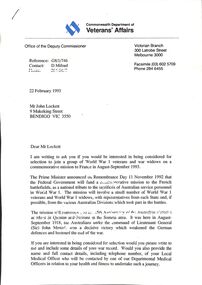
... Belgium remained the focus of the 38th Battalion's activities for the next five months, until it was rushed south to France in late March 1918 to meet the German Army's Spring Offensive. The 38th participated in its last major action of the war between 29 September and 2 October 1918 as part of the Australian-American operation that breached the formidable defences of the Hindenburg Line along the St Quentin Canal. It was disbanded in April 1919. Source, Australian War Memorial...Belgium remained the focus of the 38th Battalion's activities for the next five months, until it was rushed south to France in late March 1918 to meet the German Army's Spring Offensive. The 38th participated in its last major action of the war between 29 September and 2 October 1918 as part of the Australian-American operation that breached the formidable defences of the Hindenburg Line along the St Quentin Canal. It was disbanded in April 1919. Source, Australian War Memorial ...John Henry Lockett OAM (22 January 1891 – 25 May 2002) was the oldest man ever in Australia when he died aged 111 years, 123 days. As one of the last surviving veterans of World War I, he was acclaimed as a national hero during the last decade of his life. Lockett was born in the small Victorian town of Waanyarra, near Bendigo. He left school aged nine to work on a local farm. Later, he worked for his uncles in the Mallee. On 24 March 1916, he travelled to Mildura to enlist in the Australian Imperial Force. He served in France with the 38th Battalion, earning promotion to sergeant and was discharged on 20 September 1919. https://en.wikipedia.org/wiki/Jack_Lockett The 38th Battalion was formed on 1 March 1916 at a camp established on the Epsom Racecourse at Bendigo in Victoria. After training in both Australia and Britain, the 38th Battalion crossed to France in late November 1916 and moved into the trenches of the Western Front for the first time on 1 December.The 38th fought in its first major battle at Messines, in Belgium, between 7-9 June 1917. It fought in another two major attacks in this sector - the battle of Broodseinde on 4 October, and the battle of Passchendaele on 12 October. Belgium remained the focus of the 38th Battalion's activities for the next five months, until it was rushed south to France in late March 1918 to meet the German Army's Spring Offensive. The 38th participated in its last major action of the war between 29 September and 2 October 1918 as part of the Australian-American operation that breached the formidable defences of the Hindenburg Line along the St Quentin Canal. It was disbanded in April 1919. Source, Australian War Memorial https://www.awm.gov.au/collection/U51478 After the war, Jack returned to The Mallee and selected a 640 acres (260 ha) block of land in Linga, Victoria, deciding to make his living as a farmer. In 1923, he married Maybell Ingwerson and they had four children together. In 1963, the couple retired to Bendigo, leaving the farmland (which now covered more than 130,000 acres (53,000 ha), in the care of their children and grandchildren. A typed letter on two A4 pages to Jack Lockett Sent from the Commonwealth Department of Veterans Affairs, Office of the Deputy Commissioner, 22 February asking Jack if he wished to be considered for selection to join a commemorative mission to France in August - September 1993. Signed Brian Flynn DEPUTY COMMISSIONER jack lockett, mabel ingwersen, 38th australian infantry battalion, w.w.1, mallee farming, commemorative mission to france 1993, brian flynn -
 Bendigo Historical Society Inc.
Letter - Jack Lockett Collection: Letter Re Person profiles of W.W.1 veterans
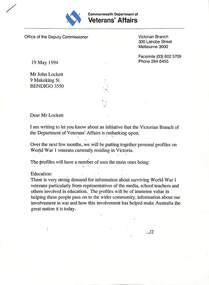
... Belgium remained the focus of the 38th Battalion's activities for the next five months, until it was rushed south to France in late March 1918 to meet the German Army's Spring Offensive. The 38th participated in its last major action of the war between 29 September and 2 October 1918 as part of the Australian-American operation that breached the formidable defences of the Hindenburg Line along the St Quentin Canal. It was disbanded in April 1919. Source, Australian War Memorial...Belgium remained the focus of the 38th Battalion's activities for the next five months, until it was rushed south to France in late March 1918 to meet the German Army's Spring Offensive. The 38th participated in its last major action of the war between 29 September and 2 October 1918 as part of the Australian-American operation that breached the formidable defences of the Hindenburg Line along the St Quentin Canal. It was disbanded in April 1919. Source, Australian War Memorial ...John Henry Lockett OAM (22 January 1891 – 25 May 2002) was the oldest man ever in Australia when he died aged 111 years, 123 days. As one of the last surviving veterans of World War I, he was acclaimed as a national hero during the last decade of his life. Lockett was born in the small Victorian town of Waanyarra, near Bendigo. He left school aged nine to work on a local farm. Later, he worked for his uncles in the Mallee. On 24 March 1916, he travelled to Mildura to enlist in the Australian Imperial Force. He served in France with the 38th Battalion, earning promotion to sergeant and was discharged on 20 September 1919. https://en.wikipedia.org/wiki/Jack_Lockett The 38th Battalion was formed on 1 March 1916 at a camp established on the Epsom Racecourse at Bendigo in Victoria. After training in both Australia and Britain, the 38th Battalion crossed to France in late November 1916 and moved into the trenches of the Western Front for the first time on 1 December.The 38th fought in its first major battle at Messines, in Belgium, between 7-9 June 1917. It fought in another two major attacks in this sector - the battle of Broodseinde on 4 October, and the battle of Passchendaele on 12 October. Belgium remained the focus of the 38th Battalion's activities for the next five months, until it was rushed south to France in late March 1918 to meet the German Army's Spring Offensive. The 38th participated in its last major action of the war between 29 September and 2 October 1918 as part of the Australian-American operation that breached the formidable defences of the Hindenburg Line along the St Quentin Canal. It was disbanded in April 1919. Source, Australian War Memorial https://www.awm.gov.au/collection/U51478 After the war, Jack returned to The Mallee and selected a 640 acres (260 ha) block of land in Linga, Victoria, deciding to make his living as a farmer. In 1923, he married Maybell Ingwerson and they had four children together. In 1963, the couple retired to Bendigo, leaving the farmland (which now covered more than 130,000 acres (53,000 ha), in the care of their children and grandchildren. A typed letter on two A4 pages to Jack Lockett sent from the Commonwealth Department of Veterans Affairs, Office of the Deputy Commissioner, 19 May 1994. It's asking if he would be part of program putting together personal profiles on World War 1 veterans currently residing in Victoria. Signed Brian Flynn, DEPUTY COMMISSIONER jack lockett, mabel ingwersen, 38th australian infantry battalion, w.w.1, mallee farming, profile of w.w.1 veterans, brian flynn -
 Bendigo Historical Society Inc.
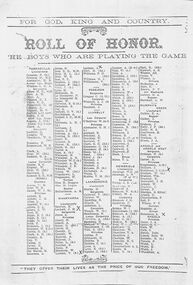
Memorabilia - Jack Lockett Collection: Copy of Roll of Honor
... Belgium remained the focus of the 38th Battalion's activities for the next five months, until it was rushed south to France in late March 1918 to meet the German Army's Spring Offensive. The 38th participated in its last major action of the war between 29 September and 2 October 1918 as part of the Australian-American operation that breached the formidable defences of the Hindenburg Line along the St Quentin Canal. It was disbanded in April 1919. Source, Australian War Memorial...Belgium remained the focus of the 38th Battalion's activities for the next five months, until it was rushed south to France in late March 1918 to meet the German Army's Spring Offensive. The 38th participated in its last major action of the war between 29 September and 2 October 1918 as part of the Australian-American operation that breached the formidable defences of the Hindenburg Line along the St Quentin Canal. It was disbanded in April 1919. Source, Australian War Memorial ...John Henry Lockett OAM (22 January 1891 – 25 May 2002) was the oldest man ever in Australia when he died aged 111 years, 123 days. As one of the last surviving veterans of World War I, he was acclaimed as a national hero during the last decade of his life. Lockett was born in the small Victorian town of Waanyarra, near Bendigo. He left school aged nine to work on a local farm. Later, he worked for his uncles in the Mallee. On 24 March 1916, he travelled to Mildura to enlist in the Australian Imperial Force. He served in France with the 38th Battalion, earning promotion to sergeant and was discharged on 20 September 1919. https://en.wikipedia.org/wiki/Jack_Lockett The 38th Battalion was formed on 1 March 1916 at a camp established on the Epsom Racecourse at Bendigo in Victoria. After training in both Australia and Britain, the 38th Battalion crossed to France in late November 1916 and moved into the trenches of the Western Front for the first time on 1 December.The 38th fought in its first major battle at Messines, in Belgium, between 7-9 June 1917. It fought in another two major attacks in this sector - the battle of Broodseinde on 4 October, and the battle of Passchendaele on 12 October. Belgium remained the focus of the 38th Battalion's activities for the next five months, until it was rushed south to France in late March 1918 to meet the German Army's Spring Offensive. The 38th participated in its last major action of the war between 29 September and 2 October 1918 as part of the Australian-American operation that breached the formidable defences of the Hindenburg Line along the St Quentin Canal. It was disbanded in April 1919. Source, Australian War Memorial https://www.awm.gov.au/collection/U51478 After the war, Jack returned to The Mallee and selected a 640 acres (260 ha) block of land in Linga, Victoria, deciding to make his living as a farmer. In 1923, he married Maybell Ingwerson and they had four children together. In 1963, the couple retired to Bendigo, leaving the farmland (which now covered more than 130,000 acres (53,000 ha), in the care of their children and grandchildren. An A4 photocopy of a ROLL OF HONOR for people who served in World War 1, with names from the towns of TARNAGULLA, WAANYARRA including (marked with a X) Lockett J.H., Lockett T., Lockett J., LLANELLY, LAAANECOORIE, NEWBRIDGE, MURPHY'S CREEK, ARNOLD and ARNOLD WEST including (marked with a X) Metelman J.C., Metelman A and RHEOLA jack lockett, mabel ingwersen, 38th australian infantry battalion, w.w.1, mallee farming
