
Showing 12 items matching "war. 'tropical' uniform"
-
 Warrnambool RSL Sub Branch
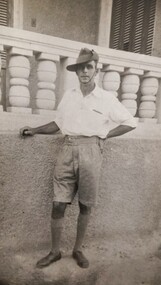
Photograph - NB in Palestine 1940-1941, Norman Barrett in Palestine
... War. 'tropical' uniform...WW2 in Palestine War. 'tropical' uniform 'Palestine' written on back of pic Photo/postcard Norman Barrett in Palestine Photograph NB in Palestine 1940-1941 ...WW2 in PalestinePhoto/postcard'Palestine' written on back of picwar. 'tropical' uniform -
 City of Moorabbin Historical Society (Operating the Box Cottage Museum)
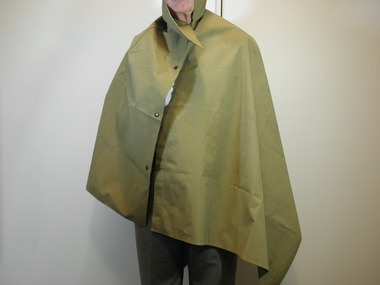
Uniform - Armed Services, Cape/groundsheet, 20th century
... War, a second pattern lightweight hootchie was issued made from nylon, but retaining the hardware and loops. This lightweight hootchie weighed a mere 680 grams, still heavy, but suitable for tropical use. Currently the hootchie is made from AUSCAM nylon material . Historic significance; representative of the type believed to have been issued to Australian servicemen in World War II, possibly in World War I. uniforms ...Rain cape, also used as a groundsheet, issued Australian servicemen. Purchased for the donor from an "Army Surplus" store and re-purposed for camps as a Scout in the late 1960s. The MK VII Groundsheet (Rain Cape / Poncho) was introduced in October 1917 during WW1. They were made from dyed cotton, proofed with a rubber compound, "well vulcanized" on one side. Weight 3lb. 8oz;. 78 inches long by 36 inches wide and made by the Victoria Rubber Co. Edinburgh. They were used again during WWII 1939-45 Today the Army uses the hootchie - a sheet of 70D nylon or PU-coated cotton with various press snaps and webbing tape loops attached around the outside which allow it to be used in a variety of configuration. During WWII Australian forces fighting the Japanese in the Islands had an urgent requirement for a decent individual shelter. The rubberized canvas groundsheets and rain capes continued to be used, but these were less than effective in the tropics. Towards the end of the war in the Pacific Australia began issuing its troops a lighter weight version of the groundsheet manufactured from polyurethane-coated cotton – During the Malayan Emergency of the 1950s, Australian troops were issued with hooded ponchos. Unlike the WWII US pattern ponchos which always had a hole in the dead centre of the poncho sheet, the Australian-issue hooded ponchos made an effective shelter – especially when two where clipped together. The problem of course is that the rubberized canvas ponchos were far too heavy for jungle use. 1960s Australian units in Borneo were issued with the first pattern lightweight hootchies. 1 Kg. 1970 the Vietnam War, a second pattern lightweight hootchie was issued made from nylon, but retaining the hardware and loops. This lightweight hootchie weighed a mere 680 grams, still heavy, but suitable for tropical use. Currently the hootchie is made from AUSCAM nylon material . Historic significance; representative of the type believed to have been issued to Australian servicemen in World War II, possibly in World War I.Waterproofed Canvas rain cape, also used as a groundsheet in the Australian Army, press studs to close as a cape, collar to cover neck.NILuniforms, australian army, world war ii, army surplus, scouts australia, bentleigh, moorabbin, world war 1, hooded ponchos, borneo, auscam nylon material, hootchies, malayan emergency, vietnam war, groundsheets -
 City of Moorabbin Historical Society (Operating the Box Cottage Museum)
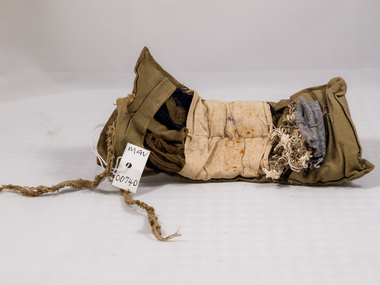
WW11 1939-1945 Australian Army Soldiers Sewing Kit, c1939
... War. Containing the standard requirements for uniform/clothing repair in the field. Items include:- assorted sewing needles,spare metal (quad hole) buttons and spare cotton/wool thread. Originally the "hold-all" (or pouch) was manufactured using leather, which was in plentiful supply in Australia and is quite durable. The major problem with leather however, especially in tropical...War. Containing the standard requirements for uniform/clothing repair in the field. Items include:- assorted sewing needles,spare metal (quad hole) buttons and spare cotton/wool thread. Originally the "hold-all" (or pouch) was manufactured using leather, which was in plentiful supply in Australia and is quite durable. The major problem with leather however, especially in tropical ...1939 - 1945 Australian Army Sewing Kit. This kit is just one of many different brands of sewing kit - issued to Australian troops during the Second World War. Containing the standard requirements for uniform/clothing repair in the field. Items include:- assorted sewing needles,spare metal (quad hole) buttons and spare cotton/wool thread. Originally the "hold-all" (or pouch) was manufactured using leather, which was in plentiful supply in Australia and is quite durable. The major problem with leather however, especially in tropical or damp conditions - is it's susceptibility to moisture. This will then have an adverse affect upon the metal items contained within the kit, obviously resulting in corrosion to the metal sewing needles and buttons. This sewing kit hold-alls was manufactured from a khaki cotton or similar material. The metal thimble is missing.Standard issue sewing kit for Australian Soldiers serving in WW2 1939-45 in New Guinea and tropical areasA rectangular khaki cotton pouch containing wool and cotton threads, needles, metal buttons, folding stainless steel scissors that rolls up and is tied by two cotton bands.world war 11 1939-1945, cotton, khaki, soldier field kit, sewing kit, new guinea, army supply department, australian army, moorabbin, bentleigh, cheltenham, -
 Mission to Seafarers Victoria
Photograph - Photograph, Black and white, 1939-1942
... tropical dress being worn by the seafarers this photograph may have been taken near one of these two theatres of conflict or on return to Sydney. Padre Oliver's service during both world wars and his experience as a newly ordained minister with the RAN made a significant impact on his life and forged close bonds with both the merchant and naval services. padre oliver frank leslie oliver hmas australia ii ww2 royal australian navy chaplain kate oliver Large group of seafarers in tropical uniform aboard a battleship assembled beneath two large gun barrels with robed padre facing away from the photographer at what appears to be an improvised altar. ...Padre Oliver served aboard HMAS Australia 2 and visited several African ports including Aden and was a first hand witness to the battle of the Coral Sea in WW2. Given the tropical dress being worn by the seafarers this photograph may have been taken near one of these two theatres of conflict or on return to Sydney.Padre Oliver's service during both world wars and his experience as a newly ordained minister with the RAN made a significant impact on his life and forged close bonds with both the merchant and naval services.Large group of seafarers in tropical uniform aboard a battleship assembled beneath two large gun barrels with robed padre facing away from the photographer at what appears to be an improvised altar. padre oliver, frank leslie oliver, hmas australia ii, ww2, royal australian navy, chaplain, kate oliver -
 Rye RSL Sub Branch
Cork helmet wolesley, Embelton & Co. Melbourne Australia, Twentieth Century
... Whether worn with a tropical uniform with jacket and trousers, or open necked shirt and shorts, the wearer was easily identifiable as British or one of the Commonwealth countries. world war two head dress helmet pith cork cloth covered leather trimmed royal australian air force officer flight lieutenant khaki pith helmet air force tropical hat Hand written in brown ink. ...This type of head dress was very commonly worn by British Commonwealth Forces in the Sub Continent and other tropical areas. This particular example would have been a common sight in Northern Australia during the time frame, as well as Africa, Middle East and the Pacific. It is a light weight ventilated helmet offering good air circulation via the vent in the top of the crown, and shade to the back of the neck. As well as protection by the peaked front for the eyes reducing glare, preventing sun and heat stroke. It also created an image of gentlemanly dress and pride in appearance. It conformed to an ideal and was considered quite fashionable and a little dashing, often worn at a jaunty angle, creating a rakish air, far from today's simplistic view of pure functionality and at as low as possible cost. Whether worn with a tropical uniform with jacket and trousers, or open necked shirt and shorts, the wearer was easily identifiable as British or one of the Commonwealth countries.WW2 RAAF Wolsley cork helmet. Helmet Khaki cotton six (6) panel outer, with three (3) fold pugaree. Colour patch on left side approximately 6cm X 5.5cm, Dark blue,2.5cm, Light blue, 0.5cm and Maroon 2.5cm. Tan leather trim around brim, tan leather chin strap. Traditional pith helmet four (4) hole domed type vent on top of crown. Beige leather sweat band pierced around the top and with a cotton cord adjustment threaded around. Fixed to shell in four points diagonally. Interior is also covered in Khaki cotton. Hand written in brown ink. A1917 F/Lt C KERR GRANTworld war two, head dress, helmet, pith, cork, cloth covered, leather trimmed, royal australian air force, officer, flight lieutenant, khaki, pith helmet, air force, tropical, hat -
 Running Rabbits Military Museum operated by the Upwey Belgrave RSL Sub Branch
Jacket - Tropical
... Uniform RAAF RAAF KHAKI - RAAF Group Captain Carmichael #31244 with ribbons, Air Force Cross, 39-45 star, Pacific Star, Brit. War Medal (+MID),Australian Service Medal, Air Efficiency Award).(trousers U570B) Jacket - Tropical ...RAAF KHAKI - RAAF Group Captain Carmichael #31244 with ribbons, Air Force Cross, 39-45 star, Pacific Star, Brit. War Medal (+MID),Australian Service Medal, Air Efficiency Award).(trousers U570B)uniform, raaf -
 National Vietnam Veterans Museum (NVVM)
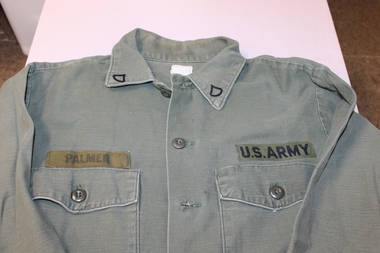
Uniform - Shirt, US Army
... Early in the Vietnam war, US troops wore this heavy cotton OG-107 utility shirt. Later, the Tropical Combat Uniform (TCU) made of a lighter poplin fabric and featuring angled pockets, became standard, although the OG-107 remained in use. ...Early in the Vietnam war, US troops wore this heavy cotton OG-107 utility shirt. Later, the Tropical Combat Uniform (TCU) made of a lighter poplin fabric and featuring angled pockets, became standard, although the OG-107 remained in use. ...Early in the Vietnam war, US troops wore this heavy cotton OG-107 utility shirt. Later, the Tropical Combat Uniform (TCU) made of a lighter poplin fabric and featuring angled pockets, became standard, although the OG-107 remained in use. Olive drab long sleeved shirt with embroidery on the collar peaks. Button front with square, buttoned flap chest pockets. A cloth name is stitched above the right-hand pocket. US Army/Palmerus army, shirt, palmer, vietnam, us uniform, american uniform, united states army -
 Tatura Irrigation & Wartime Camps Museum
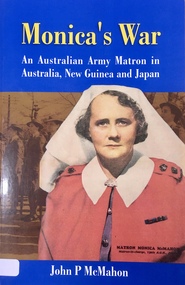
Book - Monica's War, John P Mcmahon, Monica's War, an Australian Army Matron in Australia, New Guinea and Japan, 2016
... tropical illnesses and post traumatic stress disorders Front cover is blue top & bottom witha sepia coloured strip featuring women in uniform, also a colour photo of matron Monica McMahon wearing a white matron veil, red cape with white collar. Epaluts on her shoulders feature army badges, also her ribbons are pinned on the chest. An army badge is pinned at her throat. Underneath is a grey dress with metal buttons. Back cover is blue and brown with white writing re the subject of the book. Front cover is printed as follows : Monica's War ...True story of an Army nurse who served in a hospital ship, New Guinea, Japan, Internment Camp at Tatura, and her struggles to have the AANS members to be permitted to care for soldiers suffering tropical illnesses and post traumatic stress disordersFront cover is blue top & bottom witha sepia coloured strip featuring women in uniform, also a colour photo of matron Monica McMahon wearing a white matron veil, red cape with white collar. Epaluts on her shoulders feature army badges, also her ribbons are pinned on the chest. An army badge is pinned at her throat. Underneath is a grey dress with metal buttons. Back cover is blue and brown with white writing re the subject of the book. Front cover is printed as follows : Monica's War. An Australian Army Matron in Australia, New Guinea and Japan. John P McMahonTrue story of an Army nurse who served in a hospital ship, New Guinea, Japan, Internment Camp at Tatura, and her struggles to have the AANS members to be permitted to care for soldiers suffering tropical illnesses and post traumatic stress disordersaustralian army nursing service, camp nursing staff -
 Moorabbin Air Museum
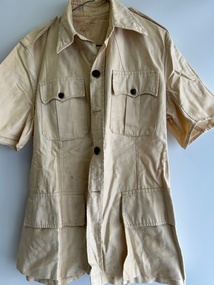
Uniform (item) - RAAF Tropical Uniform Jacket, RAAF Tropical Uniform Jacket Belonging To W.A.Eacott
... Post war Walter returned to Australia, he became "Citizen of the Year" in Werribee 1992 for his service to the community. In 1993 he was awarded the Order of Australia Medal for services to youth and to the retired. RAAF Mess Tropical Uniform ...This RAAF dress uniform and other associated article of clothing was owned by Walter Alexander Scott. Joined RAF December 1940 to be trained as a pilot, he got his wings December 1941, became a night fighter pilot after OTU and posted to 219 Squadron. Was posted to 603 Squadron December 1942 flying Beaufighters on coastal command convoy escorts, desert patrols, supporting Sicilian and Italian invasions (all from the N.African desert, then on Greek Island " Armed Rovers" until 10 November 1943, just at the end of ops, when he was shot down in the Aegean Sea and became a POW the next day 11 November 1943. Transferred to Germany he was in Stalag IVB for 3 months, before exchanging ID with an Irish soldier ,in order to get out of the main camp into a working sub-camp in order to escape. Post war Walter returned to Australia, he became "Citizen of the Year" in Werribee 1992 for his service to the community. In 1993 he was awarded the Order of Australia Medal for services to youth and to the retired. -
 Mont De Lancey
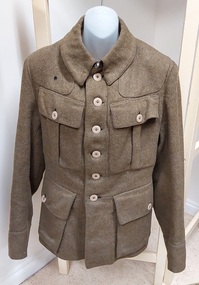
Uniform - WW2 Battle Dress Jacket, 1940's
... The four-pocket long Service Dress tunic was heavily worn by officers, garrison troops, the Citizen Military Forces (CMF), and in non-tropical training or formal operational headquarters throughout World War II. WW11 WW11 uniform WW11RAAF Stamped on the material lining: '2R 19MD35' with a 'crown insignia' above. ...The four-pocket long Service Dress tunic was heavily worn by officers, garrison troops, the Citizen Military Forces (CMF), and in non-tropical training or formal operational headquarters throughout World War II. An Australian WWII four-pocket longer khaki wool serge service dress tunic, or military coat. The two pockets on the chest are pleated with two plain below: they all have cream plastic buttons closing the flap. There are six cream plastic buttons for closure down the front. The collar is turnd down and the sleeves have wide cuffs. The back has a middle pleat opening. It is lined and has thick beige wool on the back of the collar and reinforced shoulders. Below the top right hand collar is a stitched reinforced hole possibly for badges.Stamped on the material lining: '2R 19MD35' with a 'crown insignia' above.ww11, ww11 uniform, ww11raaf -
 Moorabbin Air Museum
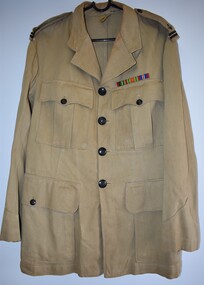
Uniform (item) - Royal Australian Air Force (RAAF) Tropical Dress Jacket Owned By M.Quick
... Tropical Dress Jacket Owned By M.Quick. Single breasted khaki jacket, features two pleated breast pockets with scalloped flaps and two unpleated bellow hip pockets, the jacket is fastened by four bakelite King's Crown buttons. Both shoulder straps have rank braid for a Flying Officer. The ribbon bar has three ribbons which signify campaign and service awards comprising, Pacific Star, Defence Medal and War Medal (1939-1945) The name M.Quick is written inside collar. Royal Australian Air Force (RAAF) Tropical Dress Jacket Owned By M.Quick. Uniform ... -
 Moorabbin Air Museum
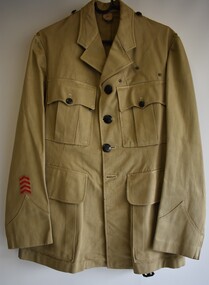
Uniform (item) - Royal Australian Air Force (RAAF) Tropical Dress Jacket Owned By H.S.Fraser 409102
... Tropical Dress Jacket Owned By H.S.Fraser 409102. Single breasted jacket features two pleated breast pockets with scalloped flaps and two unpleated bellow hip pockets, the jacket is fastened by four bakelite King's Crown buttons (one of which is missing) and matching waist belt. With four red service chevrons on the lower right sleeve of jacket, each chevron denotes the years of war service. Service number 409102 is written on inside of collar, with H.Fraser 409102 written on the inside back of jacket. Royal Australian Air Force (RAAF) Tropical Dress Jacket Owned By H.S.Fraser 409102. Uniform ...Manufactured by M.TX
