
Showing 21 items matching "warrnambool and district football"
-
 Warrnambool and District Historical Society Inc.
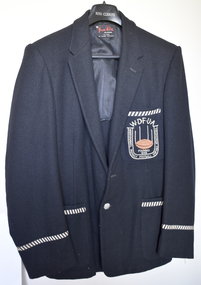
Uniform - Warrnambool District Football Umpires Association Blazer, Ince Bros Melbourne, c.1970
... Warrnambool District Football Umpires Association Blazer......Warrnambool and District Football...This blazer would have been worn by a member of the Warrnambool District Football Umpires Association at formal and social occasions. ...Melbourne Tailors and Blazer Specialists. W.D.F.U.A. WARRNAMBOOL DISTRICT FOOTBALL UMPIRES ASSOCIATION FOUNDED 1946...Uniforms Warrnambool and District Football Warrnambool District Football Umpires Association PURE WOOL Ince Bros. ...This blazer would have been worn by a member of the Warrnambool District Football Umpires Association at formal and social occasions. This Association was founded in 1946 and continues today, providing umpires for football matches in the Warrnambool District including the Hampden Football League.This uniform came from a Collectables Shop in Fairy Street, Warrnambool but the original owner is unknown. The blazer is a memento of a Warrnambool sporting group of interest and would be useful for display.This is a black cloth blazer with beige and black bands on the sleeves and pockets. It has one silver coloured button and one missing at the front. Inside the blazer is black lining at the top. The sleeves have a white and black pin striped lining. The pocket has the Association badge embroidered with beige and tan. There is a maker's label inside the front collar and a loop for hanging the blazer on a hook.PURE WOOL Ince Bros. Melbourne Tailors and Blazer Specialists. W.D.F.U.A. WARRNAMBOOL DISTRICT FOOTBALL UMPIRES ASSOCIATION FOUNDED 1946uniforms, warrnambool and district football, warrnambool district football umpires association -
 Warrnambool and District Historical Society Inc.
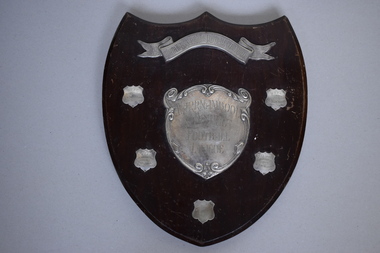
Shield, 1947
... ...Warrnambool & District Football League... This trophy has been presented to the Warrnambool & District Football League by the South Warrnambool Football Club. ...‘South Warrnambool Football Club Shield’ ‘Warrnambool & District Football League’ ‘R.C.F.C. ...This trophy has been presented to the Warrnambool & District Football League by the South Warrnambool Football Club. ...This trophy has been presented to the Warrnambool & District Football League by the South Warrnambool Football Club. This latter club still plays in the Hampden Football League and dates back to the 1880s and possibly beyond and has always been a traditional rival of the Warrnambool Football Club. West End Football Club dates back to the 1890s and joined with the Allansford Football Club in the 1960s to form the West End Allansford team. In 2001 the name ‘West End’ was dropped from the club’s name. Russells Creek Football Club was established in 1931 and still plays in the Warrnambool & District Football League which dates back to the early 1900sThis football trophy is of interest as it comes from the mid 20th century and concerns two local Warrnambool football clubs still existing today and one club that no longer exists.This is a wooden trophy in the shape of a shield. It has a silver scroll on the top and a silver heart shape in the middle. There is a cord on the back of the shield attached by metal hooks for hanging purposes. There are five small shields with etched writing on four of these. The shield is a little scratched. ‘South Warrnambool Football Club Shield’ ‘Warrnambool & District Football League’ ‘R.C.F.C. Premiers 1947 Tom Zanos (Captain) H. Drewitt (Coach)’ ‘W.E.F.C. Premiers 1948 P. Lake Capt. & Coach G.R.Thomas Pres.’ ‘W.E.F.C. Premiers 1949 W.L. ‘Jack’ McMurrick Capt. & Coach’ ‘West End F.C. Premiers 1950 W.L. McMurrick Capt. & Coach’ south warrnambool football club, warrnambool & district football league -
 Warrnambool and District Historical Society Inc.
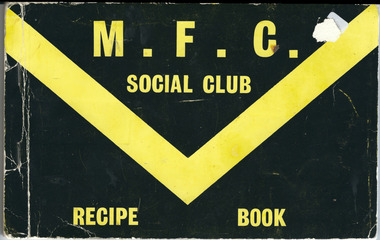
Booklet, Merrivale Football Club Recipe, 1970s
... This recipe book was produced about the 1970s to raise funds for the Merrivale Football Club, an Australian Football club (the Tigers) from Merrivale, a suburb of Warrnambool. It is in the Warrnambool and District Football League, being one of the four founding clubs in 1946, and winning premierships in 1958, 1979, 1991, 1996 and 2003. ...This recipe book was produced about the 1970s to raise funds for the Merrivale Football Club, an Australian Football club (the Tigers) from Merrivale, a suburb of Warrnambool. It is in the Warrnambool and District Football League, being one of the four founding clubs in 1946, and winning premierships in 1958, 1979, 1991, 1996 and 2003. ...This recipe book was produced about the 1970s to raise funds for the Merrivale Football Club, an Australian Football club (the Tigers) from Merrivale, a suburb of Warrnambool. It is in the Warrnambool and District Football League, being one of the four founding clubs in 1946, and winning premierships in 1958, 1979, 1991, 1996 and 2003. The recipe book is of some interest as it demonstrates the way sporting clubs raised funds in the 1970s and the recipes themselves show the types of meals and food that were popular at that time. This is an in-house publication by the Merrivale Football Club Social Club with recipes (about 60 pages) typed in pink, buff, lemon, green, blue and Old Gold coloured paper. The front cover is black with gold printing and marking. The pages are stapled. Front Cover: M.F.C. Social Club Recipe Bookwarrnambool football, merrivale football club 1970's -
 Warrnambool and District Historical Society Inc.
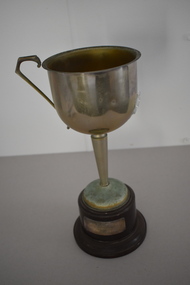
Trophy, W F A L Earles Cup 1937
... This football team appears to date back from the late 1890s but it is known that it was competing in the early 1900s in the Thursday afternoon matches in the Warrnambool and District Football Association. ...This football team appears to date back from the late 1890s but it is known that it was competing in the early 1900s in the Thursday afternoon matches in the Warrnambool and District Football Association. ...This trophy was won by the West End Football Club in 1937. This football team appears to date back from the late 1890s but it is known that it was competing in the early 1900s in the Thursday afternoon matches in the Warrnambool and District Football Association. In the 1930s it was in the Warrnambool Football Association competition and about the 1960s it amalgamated with Allansford to form the West End Allansford Football Club. The name West End disappeared in 2001 when the name changed to Allansford Football Netball Club. No further information has been found on the J.Earls Cup.Although this trophy is in poor condition it is interesting as a memento of a local club that existed for over 100 years.This is a gold-coloured cup with a slender tapering piece resting on a circular base. The base is on a brown Bakelite stand. The cup has had two side handles but one handle is missing. The stand has a silver-coloured plaque. The cup and plaque are much stained and oxidized. ‘W.F.A. J. Earls Cup Premiers West End 1937’ warrnambool football association 1930s -
 Warrnambool and District Historical Society Inc.
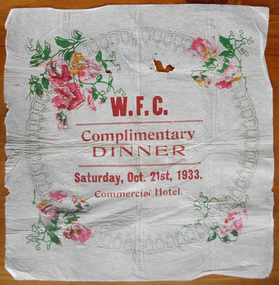
Ephemera - Serviette Warrnambool Football Club dinner 1933, 1933
... Games of various sized teams were played in the early years and it was in 1889 that the Warrnambool and District Football Association was formed. ...Games of various sized teams were played in the early years and it was in 1889 that the Warrnambool and District Football Association was formed. ...Warrnambool Football Club was formed in June 1861 making it one of the earliest clubs formed in Australia and many of the earliest players and associates were members also of the Warrnambool Cricket club which was established around 1854. Games of various sized teams were played in the early years and it was in 1889 that the Warrnambool and District Football Association was formed. The year marked with the celebration of this dinner, was important in the club’s history as it marked their entry into the wider Hampden football league, where it still plays to the present day. As the venue for this dinner, the Commercial Hotel on the corner of Liebig and Timor Sts, was commonly used in the early days as a club meeting place. The history of the club was recorded in “The Birth of the Blues” by Ron Cole, Harry Keilar, Ron McCorkell and Ian Wright, in 2007.The Warrnambool Football club is one of the longest surviving sporting clubs in the Warrnambool district and as such, would have involved or touched the lives of many of its residents. This serviette marks a dinner which was an important event in the history of the Warrnambool Football Club. White crepe paper with circular bell pattern, which has been embellished in each corner with pink flowers and green leaves. Centre of circle printed in large red lettering.WFC Complimentary Dinner Saturday Oct. 21st 1933 Commercial hotel.warrnambool, warrnambool football club, wfc dinner 1933, commercial hotel 1933, commercial hotel -
 Warrnambool and District Historical Society Inc.
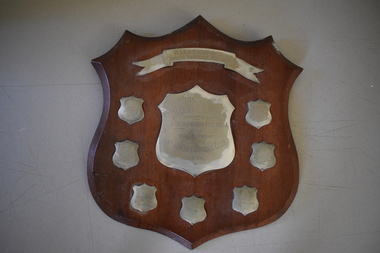
Trophy, Junior Challenge Shield 1936, 1932
... This club, founded in the late 19th century, played in Western District Leagues until 1946 when it joined the newly-formed Warrnambool District Football League. In 1971 it merged with the Allansford Football Club to become the West End-Allansford Club and in 2002 the name ceased to exist when the team name was changed back to Allansford Football Club. ...The sport of Australian football has been, and still is, highly prominent in the Warrnambool district with football first played in the town in 1861. ...This junior football shield was given by James Fairbairn (1897-1940), a prominent Western District pastoralist, aviator, local politician and Federal Cabinet minister. He was killed in a Canberra air disaster in 1940. The shield shows that several football teams, including West End, Russells Creek and East Warrnambool won the shield in the 1930s. In 1936 the shield was won outright by West End Football Club. This club, founded in the late 19th century, played in Western District Leagues until 1946 when it joined the newly-formed Warrnambool District Football League. In 1971 it merged with the Allansford Football Club to become the West End-Allansford Club and in 2002 the name ceased to exist when the team name was changed back to Allansford Football Club. This trophy is of interest as a football trophy given over 80 years ago and as a memento of the Warrnambool West End Football Club, a team no longer existing. The sport of Australian football has been, and still is, highly prominent in the Warrnambool district with football first played in the town in 1861. This is a wooden shield with nine silver-coloured metal discs affixed to the shield with metal pins. Eight of these discs are shield-shaped. All of the discs have etched inscriptions. The discs are somewhat stained and the wooden shield has traces of paint on it. There is a wire attached to the back of the shield for hanging on a wall. ‘Warrnambool Junior Football League’ ‘Junior Challenge Shield presented by J.V. Fairbairn Esq. M.L.A. 1932’ ‘Won Outright West End Football Club 1936’ west end football club, warrnambool, j.v.fairbairn -
 Flagstaff Hill Maritime Museum and Village
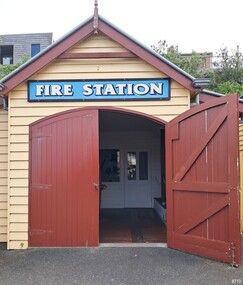
Memorabilia - Fire Brigade Collection, Warrnambool Fire Brigade, 1863-1950s
... A BRIEF HISTORY OF THE WARRNAMBOOL FIRE BRIGADE - [Ref: Quarrell, A, 2013, The Warrnambool Fire Brigade: 1863-2013, Amazon Printing, Warrnambool]: “Since the township of Warrnambool was established in the 1840s, there were several attempts at forming a Fire Brigade. ...The original replica Fire Station at Flagstaff Hill was constructed in 2006 by members of the CVA Warrnambool Fire Brigade. It was rebuilt in 2015, ironically due to damage from fire in the adjacent building, and now includes a locked display. The fire station faithfully replicates the designs of the late 1800s fire stations found across Victoria. Every detail, including the type of nails used, adheres to period-correct specifications. The objects on display are on loan from the CFA. They provide a glimpse into the history and evolution of firefighting in Victoria, preserving the heritage and legacy of the brave men and women who have served their communities. Fire Brigade Collection highlights: . Hose reels and equipment: essential firefighting equipment used during the late 19th and early 20th centuries. . Brass helmets: symbolic headgear worn by firefighters for protection and identification. . Photographs: historical images capturing the evolution of firefighting in the region. . Certificates: awards highlighting the skill and dedication of firefighters. A BRIEF HISTORY OF THE WARRNAMBOOL FIRE BRIGADE - [Ref: Quarrell, A, 2013, The Warrnambool Fire Brigade: 1863-2013, Amazon Printing, Warrnambool]: “Since the township of Warrnambool was established in the 1840s, there were several attempts at forming a Fire Brigade. However, many issues hindered progress. Firstly, minimal fires were recorded. Secondly, the town had no money to purchase expensive equipment, including a fire engine, and thirdly and most importantly, there was no infrastructure for accessible running water from pipes, as we know today. But after the expansion and growth of the township, it was time for action. The Warrnambool Fire Brigade was formed in 1863. The Brigade has served Warrnambool on a daily basis ever since. The volunteers of the Brigade were required to fill their water carts each evening from a spring on Cannon Hill and be on standby to deliver water to fire scenes. In 1889, the Warrnambool Council built a new Fire Station at 25 Liebig Street. Today, the Civic Centre is located on this site.” The objects on loan from the Warrnambool Fire Brigade are significant to local history since its establishment in 1863. They tell the story of the Brigade’s history, which is part of Warrnambool and the district’s history.Warrnambool Fire Brigade Collection: a variety of historic objects and equipment used by the firemen of the brigade since 1863. The items are kindly on loan from the Warrnambool Fire Brigade in a building originally erected in the Village by the Fire Brigade to house their historic collection. The items include: EQUIPMENT: 2 fire reels, 3 leather buckets, 1 wooden ladder, 2 old pumps, 2 fire extinguishers, 1 foam nozzle, 2 hydrants, 1 red chest with breathing apparatus, 1 large grey chest, 1 red metal thread gauges box, 2 copper and brass extinguishers, 3 copper and brass branches, 1 canvas bucket, assorted reels of hose, assorted couplings and branches, PHOTOGRAPHS/CERTIFICATES: 3 Discipline Certificates dated 1894, 1893, 1911, Mounted photo of members of the Warrnambool Fire Brigade Football Club, Mounted photos of members of the Warrnambool Fire Brigade in uniform, framed photo of LC Marshall UNIFORMS: 1 Officer’s jacket, 1 blazer, 1 turnout jacket, 1 harness belt, 1 leather helmet, 1 pair of boots, 1 brass helmet, 1 axe belt with axe and plug spanner TROPHIES: 1 clock flagstaff hill maritime museum and village, great ocean road, shipwreck coast, flagstaff hill, warrnambool, maritime village, maritime museum, cfa, fire brigade, warrnambool fire brigade, fire reel, leather bucket, wooden ladder, pump, fire extinguisher, foam nozzle, fireman’s hydrant, breathing apparatus, copper and brass extinguishers, copper and brass branches, canvas bucket, discipline certificates, warrnambool fire brigade football club, l c marshall, officer’s jacket, blazer, turnout jacket, harness belt, leather helmet, pair of boots, brass helmet, axe belt with axe and plug spanner, clock, mantle clock -
 Warrnambool and District Historical Society Inc.
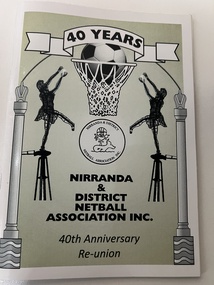
Booklet, Nirranda & District Netball Ass 1840-1970, 2011
... Nirranda is a small settlement 28 kilometres south east of Warrnambool and its history and activities are of interest to the surrounding districts. ...This is a booklet giving information on the Nirranda & District Netball Association Inc. It is a 40th anniversary publication. This association was formed in 1971 with Nirranda, Nirranda South, AllansForest, Curdievale and Commingle the competing teams. In 1991 the competing teams were AllansForest, Nullawarre North, Nirranda and Nirranda South and these clubs continued until 2010 when a new format saw individual teams playing under the administration of the Association. The Association continues today.This book is of interest as a record of the Nirranda & District Netball Association. Nirranda is a small settlement 28 kilometres south east of Warrnambool and its history and activities are of interest to the surrounding districts. Netball is the most popular sport for women in the area and the clubs are mostly allied with the local football teams. This is a soft cover booklet of 52 pages. The cover has a white background with a stylized sketch of two netballers (wire sculptures) standing on a windmill frame and throwing at a netball ring with decorative columns on the side. The sketch is in black, green and grey tonings. The booklet contains a Foreword, Personal Profiles, Extracts from Association Minutes and records of competition winners. The pages are stapled.Front Cover: ‘40 Years Nirranda & District Netball Association Inc, 40th Anniversary Re-union’. nirranda & district netball association, history of nirranda, warrnambool history -
 Warrnambool and District Historical Society Inc.
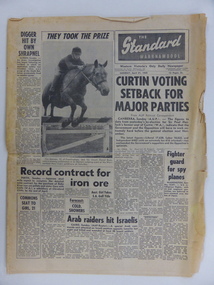
Document Newspaper, The Standard 1969, Monday 21st April 1969
... This paper records local, national and International news with events such as elections news, sports news, and 807 entries for the Warrnambool May Races.Other local articles relate to curriculum at Warrnambool High School,Port Fairy Sea Scouts as well as football results for many local teams of all levels. ...This paper records local, national and International news with events such as elections news, sports news, and 807 entries for the Warrnambool May Races.Other local articles relate to curriculum at Warrnambool High School,Port Fairy Sea Scouts as well as football results for many local teams of all levels. There are also photographs of Junior tennis A grade champions. Likewise there are many advertisements for local businesses such as Swintons Rock A bye Cradle shop and Stephens Stores. The film The graduate was playing at the Capitol Theatre and still drawing large crowds The Warrnambool Standard was established in 1872 and had remained locally owned until taken over by the Melbourne Age in 1980. Both were subsequently taken over by Fairfax media in 1983As the only daily local newspaper in the Western District,The Warrnambool Standard contains much that is of interest socially and historically. Black text with photograph of young boy on horseback ,jumping fence. back page has articles about sport with photograph of three footballers contesting for the ball. 12 PagesThe Warrnambool Standard Monday April 21 1969.warrnambool, warrnambool standard, standard 1969, -
 Warrnambool and District Historical Society Inc.
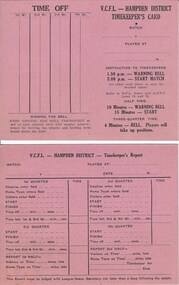
Document, VCFL Hampden District, Mid 20th century
... These cards are to be filled out by the timekeeper at football matches in the hampden district which covers the area from Colac to Port Fairy in Western Victoria. ...These cards are to be filled out by the timekeeper at football matches in the hampden district which covers the area from Colac to Port Fairy in Western Victoria. The form has space to record the various aspects of time matters for each football game. A common but essential part of the running of sports .Both cards are identical and are bright pink with black text in table form on front and back. V C F L Hampden Districtwarrnambool,, hampden league, hampden district, timekeepers vcfl -
 Warrnambool and District Historical Society Inc.
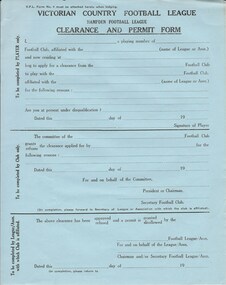
Document, Hampden Football League Clearance Form, 1950s
... Football-Netball League...History of Warrnambool...Western District...Hampden Football-Netball League History of Warrnambool Western District Sport This is a blue sheet of paper –the form used for football players being cleared to other clubs in the Hampden Football League (4 copies). ...This form was used by football players wishing to transfer to other clubs. It was used in the 1950s by the Hampden Football League. This League, now known as the Hampden Football-Netball League, is in south western Victoria and was founded in 1930. This form is of minor interest as an example of the forms used by footballers wishing to transfer to other clubs in the 1950s. This is a blue sheet of paper –the form used for football players being cleared to other clubs in the Hampden Football League (4 copies). The form is blue with black print. There are spaces for the applicant for transfer, the committee representative of the team from which the applicant desires a clearance and the Hampden Football League representative to insert the relevant information. hampden football-netball league, history of warrnambool, western district sport -
 Warrnambool and District Historical Society Inc.
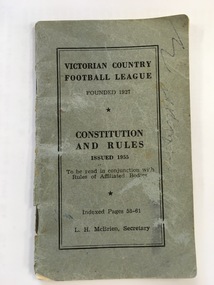
Booklet, Victorian Country Football League Constitution and Rules, 1955
... Football League in 1955. The Hampden League centred around the Warrnambool area was one of the districts covered at that time by the Victorian Country Football League. victorian country football league warrnambool Back cover: ‘189936’ This is a small soft-covered booklet of 64 pages. ...This booklet lists the Constitution and Rules of the Victorian Country Football League in 1955. The Victorian Country Football League was founded in 1927 and merged with AFL Victoria in 2012 to form AFL Victoria Country. In 1955 the Victorian Country Football League had eight delegates elected by the League and one District Councillor from each of the fifteen designated country districts. The object of the League was to promote the game in the Victorian country areas. This booklet is of some interest as it details the Constitution and Rules of the Victorian Country Football League in 1955. The Hampden League centred around the Warrnambool area was one of the districts covered at that time by the Victorian Country Football League.This is a small soft-covered booklet of 64 pages. It has a pale green cover with ruled black lines and printed information on the front and the name of the printer on the back. The pages have been stapled but the staples are now removed. The cover is torn at the spine and the cover is somewhat scuffed with some scribble on the cover edge. The back cover and one of the pages have biro annotations on them. The booklet has an index at the back and a couple of blank pages for notes. Back cover: ‘189936’victorian country football league, warrnambool -
 Warrnambool and District Historical Society Inc.
Clothing - Blazer, Blazer South Warrnambool cricket Club, 1930s
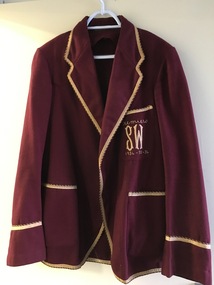
... Football League for Geelong. The blazer indicates that the cricket team he played for was the Premier team for 1934, 1935, and 1936 and the ‘S.W.’ on the blazer pocket may indicate South Warrnambool but it is more likely to be ‘South West’, perhaps the name of the district the team played in. ...Football League for Geelong. The blazer indicates that the cricket team he played for was the Premier team for 1934, 1935, and 1936 and the ‘S.W.’ on the blazer pocket may indicate South Warrnambool but it is more likely to be ‘South West’, perhaps the name of the district the team played in. ...This blazer belonged to Gordon Burleigh (1888-1956) who lived at ‘Macken Hill’ in Mepunga. He was the ninth child of James and Janet Burleigh who were early settlers in the Nullawarre area. Gordon Burleigh was a prominent and successful sportsman playing football and cricket in the local area and playing one game in 1914 in the Victorian Football League for Geelong. The blazer indicates that the cricket team he played for was the Premier team for 1934, 1935, and 1936 and the ‘S.W.’ on the blazer pocket may indicate South Warrnambool but it is more likely to be ‘South West’, perhaps the name of the district the team played in. This blazer is of considerable interest as it belonged to Gordon Burleigh, a prominent sportsman in the district in the early decades of the 20th century.This is a maroon-coloured blazer which belonged to Gordon Burleigh of Mepunga. It has gold-coloured edging and piping on the sleeves, pockets and edges (collar etc) of the blazer. It has two material-covered buttons and stitched buttonholes and gold stitching on the pocket. There is a tag on the collar but no writing is visible. Pocket: ‘Premiers, S.W., 1934-35-36’gordon burleigh, local cricket in the 1930s, warrnambool, cricket blazer -
 Warrnambool and District Historical Society Inc.
Book, Kevin Reed, From the Goldfields to the G, 2014
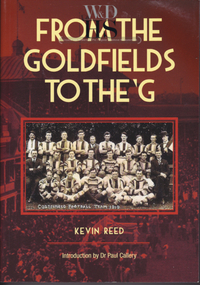
... It contains information on the footballing career of Dr John Douglas, a former resident of Warrnambool and important chapters on football and cricket in the Warrnambool district in the 1970s, 80s and 90s and the footballing personalities who came from the area over the years. ...It contains information on the footballing career of Dr John Douglas, a former resident of Warrnambool and important chapters on football and cricket in the Warrnambool district in the 1970s, 80s and 90s and the footballing personalities who came from the area over the years. ...An account of the development of Australian Rules football in both rural and suburban Victoria.This is a paper back book with a red and gold cover with a photograph of Costerfield Football Team, 1919 on the cover (335 pages) The book is signed inside by Kevin Reed non-fictionAn account of the development of Australian Rules football in both rural and suburban Victoria.warrnambool, kevin reed, dr john douglas, warrnambool cricket 1980's, warrnambool football 1970's 1980's -
 Warrnambool and District Historical Society Inc.
Locket, Locket Gold Bostock, 1880s
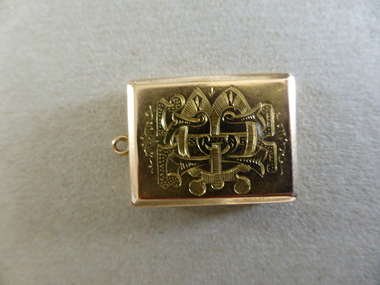
... This gold locket was presented to Thomas Edward Bostock on his retirement as Secretary of the Warrnambool Cricket Club on 1st August 1884. Thomas Bostock was a member of the Bostock family who had come from Tasmania to the Warrnambool district in the late 1840s. ...This gold locket was presented to Thomas Edward Bostock on his retirement as Secretary of the Warrnambool Cricket Club on 1st August 1884. Thomas Bostock was a member of the Bostock family who had come from Tasmania to the Warrnambool district in the late 1840s. ...This gold locket was presented to Thomas Edward Bostock on his retirement as Secretary of the Warrnambool Cricket Club on 1st August 1884. Thomas Bostock was a member of the Bostock family who had come from Tasmania to the Warrnambool district in the late 1840s. The Bostock brothers were prominent in the history of the area as pastoralists, shopkeepers, flour millers and Bond Store operators. They were all enthusiastic local cricketers. Thomas worked for the Bank of Australasia in the 1880s and was a keen footballer and cricketer. He moved to Geelong where he made his mark as a Councillor, Mayor and businessman, with several buildings and a street named after him. This item is of very high significance because:- 1. It is an attractive and valuable gold locket from Victorian times 2. It has strong local significance as it was presented in 1884 to a prominent Warrnambool man, Thomas Edward Bostock 3. It has considerable social significance, demonstrating the customs of the time of a man carrying a locket containing miniatures of personal interest to the bearer and of the presentation of such an object by a sporting club. This is a gold locket with a monogram of T.E. Bostock on the front and an inscription on the back. The locket has a small ring at the top so that it could be attached to a watch chain. The locket opens to reveal two oval inserts (one with a blue background) suitable for small photographs or miniatures.Monogram - T.E.B. Inscription: ‘Presented to T.E. Bostock by the Warrnambool Cricket Club on retiring from Secretaryship, Aug 1st 1884’ bostock, thomas edward bostock, warrnambool cricket club 1884, bostock brothers warrnambool, bostock locket -
 Warrnambool and District Historical Society Inc.
Booklet, Hampden League, 2005
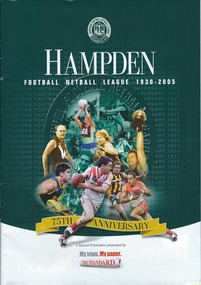
... Football and netball are the two major winter sports in the Western District. Hampden Football Netball League warrnambool Front cover: ‘Hampden Football Netball League 1930-2005, 75th Anniversary, A Special Publication presented by My Town, My Paper, the Standard’. ...This is a publication with information on the Hampden Football Netball League at the time of its 75th anniversary. The Hampden Football League was established in 1930 as a breakaway competition in response to the Western District League’s abolition of sectional competition. The League went into recess during World War Two. In 1987 netball became part of the League’s administration. The Hampden League is one of the important rural football and netball leagues in Victoria. This publication is of interest as an important source of local information on the history of the Hampden Football Netball League. Football and netball are the two major winter sports in the Western District.This is an A4 size booklet of 36 pages. It contains black and white and colour photographs, information on each of the member football and netball teams, the Hampden League logo, advertisements and a multi-coloured front and back cover with collages containing the images of many footballers and netballers. The pages are stapled.Front cover: ‘Hampden Football Netball League 1930-2005, 75th Anniversary, A Special Publication presented by My Town, My Paper, the Standard’. hampden football netball league, warrnambool -
 Warrnambool and District Historical Society Inc.
Tray, Stan Sharkey 1978-79, C 1978
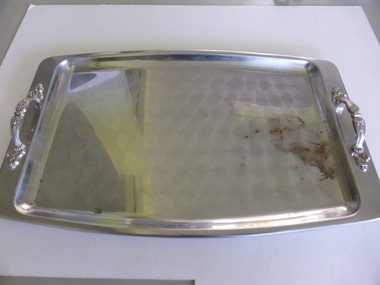
... Bushfield is situated on the outskirts of Warrnambool . The local Bushfield recreation reserve has been home to a number of local football and cricket clubs which play in various leagues in the Warrnambool district. ...Bushfield is situated on the outskirts of Warrnambool . The local Bushfield recreation reserve has been home to a number of local football and cricket clubs which play in various leagues in the Warrnambool district. ...Bushfield is situated on the outskirts of Warrnambool . The local Bushfield recreation reserve has been home to a number of local football and cricket clubs which play in various leagues in the Warrnambool district. Litle could be The Bushfield Cricket club has possibly been combined with another local team It is home to the Woodford Cricket Club which is the closest club to Bushfield and which uses the Bushfield oval as its home ground. It is a member of the Warrnambool and District Cricket Association. We have little information on Stan Sharkey who was obviously associated with the club in the late 1970's.Cricket is an important part of sporting life in Australia and especially in country regions where clubs often form part of the social network of the towns and districts. They rely heavily on the contributions of volunteers such as Stan Sharkey to operate. Many have recorded their histories through the years but nothing could be found on the Bushfield club.Oblong stainless steel tray with rounded corners . It has ornate handles screwed into either end , a raised lip around all sides and a circular brushed pattern on the flat surface of the tray. There is an inscription in the centre of the tray.Engraved in centre of tray," Stan Sharkey. In appreciation of servicesfor season 1978-79. From President & Players Bushfield Cricket Club."Marked stainless steel on back.warrnambool, bushfield, bushfield cricket club -
 Warrnambool and District Historical Society Inc.
Trophy, Walker & Hall Ltd Silversmiths, Pritchard cup, 1920s
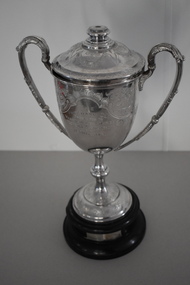
... Football in Warrnambool District...Football in Warrnambool District Harry Pritchard, Warrnambool 1920s history of warrnambool ‘The Pritchard Cup presented to Warrnambool Ward’s (sic) Football Association by H. ...This is a trophy given to a Warrnambool Football Association by Harry Pritchard. He was a Warrnambool businessman who had the Warrnambool Sports Depot store in Kepler Street in the 1920s. The trophy was for the winner of the Warrnambool Wards Football Association. This was a Junior Association promoted by the Warrnambool Football Club and it existed from 1924 to 1930. It was proposed that the four Council Wards, Hopkins, Victoria, Albert and Merri each had a football team but it is not clear if all had teams and how many teams from other areas took part in the competition. The Pritchard Cup records that the Hopkins Ward Football Team won the trophy in 1926 and that Allansford, a team outside of the four wards, won in 1927. The records of the Allansford Football Club go back to the 1890s. This cup is of considerable interest, firstly as an attractive trophy in its own right and secondly as a memento of a football association connected with the Warrnambool Council Wards. Both the Council Wards structure and the Wards football association no longer exist. This is a silver cup with two ornamental handles, a slender stem and a silver base. The cup has a lid with a knob in the middle. The cup, lid and base are all heavily etched and patterned with scrolls, leaves and flowers. There is an inscription on one side of the cup. The cup sits on a circular brown wooden base which has a cloth or paste mixture affixed to the bottom. The wooden section has two silver plaques with inscriptions. There is a small piece of wood missing on the side of the top of the mount. ‘The Pritchard Cup presented to Warrnambool Ward’s (sic) Football Association by H. Pritchard.’ ‘Won by Hopkins Ward Football Club Season 1926’ ‘Won by Allansford Football Club Season 1927’ football in warrnambool district, harry pritchard, warrnambool 1920s, history of warrnambool -
 Warrnambool and District Historical Society Inc.
Memorabilia - Newspaper cuttings scrapbook, Martin Carter, Saddler, Warrnambool, late 19th century (1887-1894)
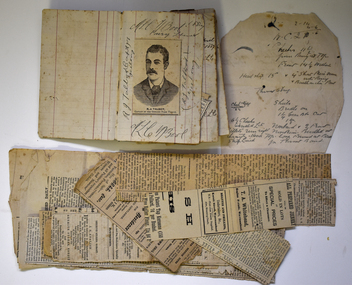
... ...Football in the Warrnambool District...It is a valuable research tool. Warrnambool Town Band Martin Carter Warrnambool Football in the Warrnambool District Sydney Giddings Warrnambool Saddler M.L.Carter Warrnambool June 13th 1887 S.Carter Saddler Warrnambool (stamp) This is a small notebook with a black cover. ...This scrapbook contains newspaper cuttings, mainly about football, and other written material from the late 19th century. It belonged to Martin Carter ((1870-1943), a Warrnambool saddler who worked for many years in the saddlery business established by his father, Samuel. Martin Carter was very active in community affairs - President of the Warrnambool Bowling Club, a member of the local Volunteer Militia, Secretary of the Progress Association, a football player and umpire and a local cricketer. He was the Secretary of the Warrnambool Town (later City) Band for fifty years and a memorial plaque in his honour was erected at the Band headquarters in Warrnambool. He was also a Warrnambool Councillor (1917-1925) and Warrnambool Mayor (1922-24). His interest in football can be seen from the great number of football newspaper cuttings in this notebook.This little notebook is most interesting as it provides us with details on football in the Warrnambool district in the late 19th century and gives us an indication of the popularity of the game at that time. It is a valuable research tool.This is a small notebook with a black cover. The pages contain ruled red lines over which have been pasted newspaper cuttings. Some pages have handwritten material and some pages are blank. There are also several loose cuttings. The notebook has been stapled but the staples have been removed.M.L.Carter Warrnambool June 13th 1887 S.Carter Saddler Warrnambool (stamp)warrnambool town band, martin carter warrnambool, football in the warrnambool district, sydney giddings warrnambool saddler -
 Warrnambool and District Historical Society Inc.
Typewriter & ribbon, Imperial, Mid 20th century
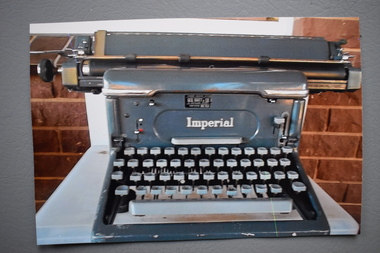
... District was born at Mortlake in 1845 and Gordon Toleman was also born in Mortlake. He lived with his family in Warrnambool for many years. He was an accountant the Nestles Factory at Dennington for over 25 years. He was actively involved in community affairs, including the Warrnambool Urban Fire Brigade (life member), the Florado Festival, the Warrnambool Olympic Pool committee and the Merrivale and Terang Football Clubs (player and captain). ...District was born at Mortlake in 1845 and Gordon Toleman was also born in Mortlake. He lived with his family in Warrnambool for many years. He was an accountant the Nestles Factory at Dennington for over 25 years. He was actively involved in community affairs, including the Warrnambool Urban Fire Brigade (life member), the Florado Festival, the Warrnambool Olympic Pool committee and the Merrivale and Terang Football Clubs (player and captain). ...This typewriter belonged to Gordon William Toleman (1910-1975). The first known Toleman born in the Western District was born at Mortlake in 1845 and Gordon Toleman was also born in Mortlake. He lived with his family in Warrnambool for many years. He was an accountant the Nestles Factory at Dennington for over 25 years. He was actively involved in community affairs, including the Warrnambool Urban Fire Brigade (life member), the Florado Festival, the Warrnambool Olympic Pool committee and the Merrivale and Terang Football Clubs (player and captain). He was also a life member of the Hampden Football League as a long-term Secretary and Treasurer and a secretary of the Warrnambool Football Club.This typewriter is of interest as one belonging to Gordon Toleman, a Warrnambool 20th century resident and a person well-known for his involvement in community activities..1 This is a metal typewriter with black and grey keys and a red and black typewriting ribbon. It has three gauges or scales. .2 These are two typewriter ribbons in red and black with circular metal covers. ‘Imperial’ ‘Geo Wraitt & Co 15 McKillop Street Repairs MU 7051’ gordon toleman, history of warrnambool -
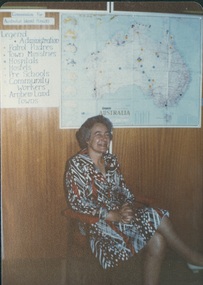 Uniting Church Archives - Synod of Victoria
Colour photo, Prior to 1977
... At a Presbyterian Fellowship camp at Warrnambool, Frances and the others were sleeping in the Church Hall on palliases. ...At a Presbyterian Fellowship camp at Warrnambool, Frances and the others were sleeping in the Church Hall on palliases. ...Everyone seemed to know Frances – it was November 1985 – I met Frances at the Victorian Synod office as she lent me her office to interview staff for St Philip’s which I was taking over in 1986. The interviews completed, she took me to a nearby coffee shop where we had a delightful chat. I came away much the richer, more informed about St Philip’s and feeling I had known Frances forever. And so started our 23 year friendship, with me hearing the first of many stories – for Frances was a wonderfully gifted story teller with a capacity to turn the past into life, and its characters into real people. It seems fitting that a person destined to add to Australia’s history should be born down the beach from Mendonca’s Mahogany ship – Port Fairy on the 28 January 1924. There she went to school – first to primary school then to Camperdown’s Higher Elementary School which went to Year 10. She was the eldest of four children with three brothers, Jock, Norman and Rod. After Year 10, Frances took a job in Camperdown as a dental nurse. She tackled this successfully until deciding to study at Rolland House in Carlton to become a Deaconess. Jock, her brother, recalls asking Frances what made her decide to be a Deaconess. At a Presbyterian Fellowship camp at Warrnambool, Frances and the others were sleeping in the Church Hall on palliases. During the night she awoke and her eye was drawn to a stained glass window, unusually brightly lit. On the window were the words “Follow Me”. Without flinching Frances took the words to heart and decided to serve God as a Deaconess, and during her time with the Australian Inland Mission she became quite a legend. What a patriot Frances was! She loved the stories of pioneers and knew well the history of where she had come from – the Western District. A keen follower of cricket, she would be right up with the last test and the issues of the team. Originally a Melbourne football supporter, she became an avid Geelong supporter and would often score at the annual self destruct St Philip’s vs Flynn Church match. She loved the gladiatorial, albeit often suicidal display. And though an Aussie through and through she loved her Scottish roots. Through her stories, she could easily transport a person in the Centralian landscape onto the heather of the Highlands. In spite of her love for Scotland, the city which was her favourite was New York. Frances – truly a citizen of the world. As a citizen of the world Frances fought for Indigenous and migrant women’s rights and was active in the World Council of Churches, sponsoring local and overseas women to study in Australia and to return to their homes as trained teachers and theologians. Up until recently she was involved in the Spina Bifida and Hydro Cephalis Association of SA. By the time she had taken up with the AIM Frances had a well tuned desire for social justice. To her it was important that the poor and less fortunate were given a go. She felt that the Labor Party provided her best avenue to push her social justice desires. After joining the party in 1956, she quickly became a respected member of the party and worked tirelessly for it, being honoured in the end with life membership. In the party she knew everyone and everyone knew her. She introduced me to Bob Hawke and when I spoke to Gough Whitlam once on a plane, he affirmed to me his friendship with Frances. In her cottage was a picture of her with Kevin Rudd with his arm around her. She is remembered by her party colleagues as someone who had a real compassion for helping people. She believed in the traditional ethic of the Labor Party which is to help those who are less fortunate. Interestingly, she supported St Philip’s moving from solely being a residential college to a school because we had chosen a relatively low fee base to enable maximum access for people and our boarding house continued to, and still does, offer accommodation to any student wishing to attend schools in Alice. Having supported the outback for years from the engine rooms of the mission arm of the church in Victoria, Frances then decided to move to Alice for her retirement. Settling in the little cottage at the far south eastern corner of Old Timers, this became to me, my family and I’m sure to plenty of people, Frances’ Cottage. But moving to Alice was hardly moving into retirement. She quickly became Chaplain at St Philip’s where she clearly showed her love for the children and staff and a real belief in St Philip’s role – to provide access to education for isolated children. She became a stalwart of the Adelaide House Museum, a wonderful member of the congregation, a powerful contributor to the Presbytery and the Annual Synod. Frances was strong, never flinched on a point of principle and discussed things face to face so that you truly knew where you stood with her. She had a great feeling for the pastoralists and knew many of them well. As Chaplain of the College she related well to the children and in addition, knew many of their families. She also felt deeply for the Indigenous people and regularly tackled the issue of how conditions could be improved for them. As we developed the school at St Philip’s, Frances worked with me on so many things. She would visit the College each week for Chapel, run a Sunday school for little kids and the service for all the boarders. When the school was ready to start she wrote the College prayer, said now every week by all students. The prayer says so much about Frances. She pioneered the RE program, teaching RE and in addition to Sunday, visited staff and students every Wednesday. At Presentation Night she presented a homily and provided the blessing – always a strong presence in front of the College community. She was so much part of St Philip’s that when we built the new boarding house in 1990 it seemed so obvious to call it McKechnie House. As a faithful servant of Adelaide House for years and an enthusiastic member of the National Trust, Frances was the first chairperson of the committee, a driving force to redevelop Adelaide House and she worked tirelessly to present John Flynn’s Hospital in the best light. She helped to deliver the stories of Flynn and McKay and the Outback missionaries to so many people and was instrumental in producing meaningful displays. I enjoyed walking around the museum with her intensely, enjoying her detailed stories of the past missionary era and I know many others would have as well. As a loyal and loving member of the Flynn Church, and being such a comrade of Fred McKay’s, Frances understood intricately the symbols which lie within the architecture. Once again, as a story teller, each one had a yarn attached to it. Over her twenty-three years as a member of the Flynn Church she has made a wonderful contribution. As a charismatic personality people were naturally attracted to Frances and were touched and affected by her. Peter Robson, twenty-two years at St Philip’s, remembers her asking him why he had stayed so long at the College. He explained to her that it was her address one day in Chapel in the early times that inspired him to keep going. With great wisdom she had said, “You can’t conquer something, unless you allow it to conquer you.” St Philip’s had conquered him. Wherever she went, whomever she was with, she had a real and lasting impact. Frances brought the reality of the Outback to so many as she addressed congregations around Victoria. She started the Australian Church Women’s Fellowship in the Northern Territory in 1997. She was also involved in setting up the Institute for Aboriginal Development. I believe that Frances should have been recognised nationally for her work with an AM. However, she was the Northern Territory finalist in the Senior Australian of the Year Awards in 2003. In 2004 she was awarded an OBE – not from the Queen but at Old Timers. This is a coveted award which means “Over Bloody Eighty”. Frances was part of it all, in the river, at a bush dance, at a dinner, at a service, at a party, at a meeting, at a footy game, at a cricket game, at Synod, at Presbytery, at Labour meetings, I could go on. Frances McKechnie, what a wonderful Australian. (Eulogy by Chris Tudor) Frances McKechnie died mid-2008. Deaconess Frances McKechnie is seated in front of a map of Australia marked with Australian Inland Mission places identified.At the time the photo was taken, McKechnie was the Victorian Regional Officer for the Australian Inland Mission (Presbyterian). At one stage, she worked for National Mission Frontier Services from 1968 to 1986. See below for the eulogy at her funeral by Chris Tudor. (Frances died May or June 2008.)deaconess frances mckechnie; australian inland mission; presbyterian church
