
Showing 88 items matching "warrnambool and district historical society collection"
-
 Warrnambool and District Historical Society Inc.
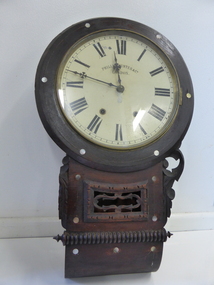
Clock, Wall Clock, Late 19th century?
... This clock has no known provenance but has been in the Warrnambool and District Historical Society collection for many years. ...This clock has no known provenance but has been in the Warrnambool and District Historical Society collection for many years. ...This clock has no known provenance but has been in the Warrnambool and District Historical Society collection for many years. This clock is a good example of a 19th century (or perhaps early 20th century?) wall clock and is an attractive display item. This is a wooden- frame clock for hanging on a wall. The face is tin painted cream with some paint missing. The numbers on the face are Roman numerals and the hands have Maltese crosses at the ends and are painted. The face is inlaid with 6 small circular dots of mother-of-pearl and there are seven similar inlaid circles on the wooden base. The glass covering the dial is hinged and brass-edged. The wooden base has fretwork and scroll sections and carved decorative edges and a rounded bottom. One side piece of the decoration is missing. The fretwork piece opens to show a brass pendulum. At the back of the clock are two pegs and a metal clip for hanging the clock. ‘Phillip Hunter & Co. London’ history of warrnambool, wall clock -
 Warrnambool and District Historical Society Inc.
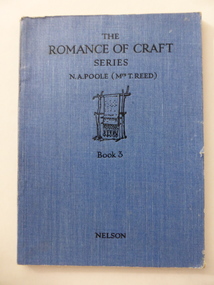
Book, The Romance of Craft, 1929
... Several of her paintings are in the Warrnambool and District Historical Society collection....Several of her paintings are in the Warrnambool and District Historical Society collection. ...This book belonged to Mary Norman- Bail (1883-1962). She came to Warrnambool in 1901 and studied art and became an art teacher and artist. She moved to Echuca and then Ararat where she set up a school called The Pathfinder. She became well known as an artist and exhibited her work in the Victorian Artists Exhibitions. In 1922 she married Jesse Bail and had one child named Jessica. Several of her paintings are in the Warrnambool and District Historical Society collection.This book is of considerable interest because of its connection to a Warrnambool artist.This a soft covered book of 88 pages. It has a blue cover with black printing and an image of a weaving loom. It contains printed material and many illustrations and diagrams. The Pathfinder School Ararat St. Andrew's M NORMAN - BAIL Principal and Proprietormary norman- bail, warrnambool -
 Warrnambool and District Historical Society Inc.
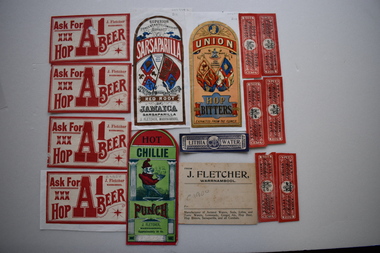
17 labels, J Fletcher, Early 20th century
... His business continued until 1930. The Warrnambool and District Historical Society has a collection of bottles used by John Fletcher to contain his products. ...His business continued until 1930. The Warrnambool and District Historical Society has a collection of bottles used by John Fletcher to contain his products. ...In 1888 it was reported in "Victoria and its Metropolis" that John Fletcher carried on the business of a manufacturer of aerated waters, cordials, hop bitters, etc. in Warrnambool, and traded throughout the Western District. The establishment was started by a Mr. J. Davis with whom Mr. Fletcher was connected from its commencement, and whom he succeeded in 1885. His business continued until 1930. The Warrnambool and District Historical Society has a collection of bottles used by John Fletcher to contain his products. These labels are significant as John Fletcher was a most successful manufacturer of cordials and aerated waters in Warrnambool in the late 1800s and early 1900s .1 Buff coloured rectangular card label with black text. 2 Rectangular label with curved top adhered to a piece of white paper. It is coloured red, blue black and gold and features two standards and text. .3 Rectangular label with curved top adhered to the reverse of .2. It is coloured red and green and features a sketch of Punch carrying a bowl of a steaming substance and text .4 Rectangular label with curved top adhered to a piece of white paper. It is coloured red, apricot, dark and light blue, gold and black. It features the linked initials JF, two standards a trade mark and text .5 Rectangular label with curved top adhered to the reverse of .4 It is coloured red, blue, green, black and gold. It features two standards and text. .6 Identical to .3 but not adhered to paper .7,.8, .9 .10 White rectangular labels with red text. .9 has a damaged corner. .10 is adhered to a piece of white paper. .11,.12,.13,.14,.15..16 Red rectangular labels with black text and a coat of arms. .13 is adhered to a piece of pink card, .17 Blue rectangular label with text and a coat of arms .1 FROM J. FLETCHER, WARRNAMBOOL Manufacturer of Aerated Waters, Soda, Lithia and Tonic Waters, Lemonade, Ginger Ale, Hop beer, Hop Bitters, Sarsaparilla and all Cordials .2 SUPERIOR CONCENTATED COMPOUND EXTRACT OF SARSAPARILLA PREPARED FROM THE BEST RED ROOT OF JAMAICA SARSAPARILLA J. FLETCHER,WARRNAMBOOL .3 HOT CHILLIE PUNCH J. FLETCHER WARRNAMBOOL Approximately 26 Oz. .4 UNION TRADE MARK JOHN FLETCHER WARRNAMBOOL HOP BITTERS EXTRACTED FROM THE FLOWER .5 J FLETCHER WARRNAMBOOL SUPERIOR GREEN COLOURED WITH BURNT SUGAR GINGER CORDIAL .6 Identical to .3 .7,.8,.9,.10 ASK FOR XXX HOP A1 BEER J FLETCHER WARRNAMBOOL .11,.12,.13.14,.15.16 SODA WATER J Fletcher .17 LITHIA WATER J FLETCHER WARRNAMBOOL john fletcher, warnambool, cordials -
 Warrnambool and District Historical Society Inc.
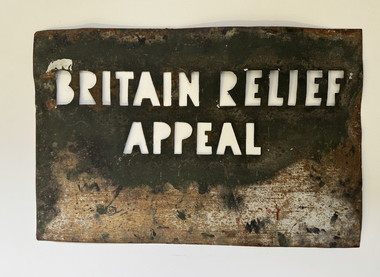
Functional object - Metal Stencil, Britain Relief Appeal, c. 1950
... The Warrnambool & District Historical Society has in its collection over 100 letters sent by grateful British recipients of these parcels to the senders, the employees of the local Warrnambool business, Swintons Stores....The Warrnambool & District Historical Society has in its collection over 100 letters sent by grateful British recipients of these parcels to the senders, the employees of the local Warrnambool business, Swintons Stores. ...This stencil has been made to imprint the label, 'Britain Relief Appeal' on to parcels and packages sent to Britain in the late 1940s and the early 1950s from the City of Warrnambool. Britain endured severe rationing of food, clothing, petrol and furniture from 1940 because of the outbreak of World War Two and this rationing continued in some form after the war up to 1954. Australian towns and cities established organizations such as Food For Britain and sent regular parcels of food and clothing to Britain during those times. The British Relief Appeal in Warrnambool (via the Warrnambool Food For Britain committee) was sponsored by the Warrnambool City Council, Toc H, Australian Red Cross, and various local charities and businesses. The Warrnambool & District Historical Society has in its collection over 100 letters sent by grateful British recipients of these parcels to the senders, the employees of the local Warrnambool business, Swintons Stores.This stencil is of interest as a memento of the effects of rationing in Britain in post-World War Two times and the close ties that existed between Australian towns and cities and their British counterparts.This is a rectangular-shaped metal stencil, originally painted black, with cut-out letters in the centre. Britain Relief Appealwarrnambool food for britain committee, warrnambool britain relief committee, world war two -
 Warrnambool and District Historical Society Inc.
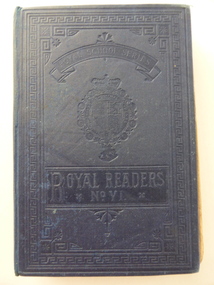
Book, Royal reader No 6, 1891
... Jean Glasgow was the daughter of William and Isabella Glasgow who lived in the same area. The Warrnambool and District Historical Society has in its collection examples of the Glasgow butter moulds. ...Jean Glasgow was the daughter of William and Isabella Glasgow who lived in the same area. The Warrnambool and District Historical Society has in its collection examples of the Glasgow butter moulds. ...This is a school reader used in the 1890s by Maggie Glasgow at Wangoom State School. This school opened in 1865 on the Warrnambool/ Wangoom Road as a Common School but it is now closed. Maggie Glasgow is probably Margaret Glasgow (1880-1954), the daughter of John and Esther Glasgow who were dairy farmers and cheese makers at Blackwood Hill, Wangoom. Jean Glasgow was the daughter of William and Isabella Glasgow who lived in the same area. The Warrnambool and District Historical Society has in its collection examples of the Glasgow butter moulds. This book is of interest as an early school reader for Victorian children. Used in the 1890s this book has some Australian content. The Glasgow children that used this book are members of the Glasgow families important at the turn of the 19th century as cheese makers in the Warrnambool district. This is a hard cover book of 400 pages. Several pages are missing. The cover is dark blue with ornamental patterning on the front and embossed lettering. The text contains many black and white illustrations, some of which have been coloured in by hand. The inscriptions and other written material have been handwritten in black ink and pencil. The pages are partly detached from the binding. ‘Maggie Glasgow, State School No. 645 Wangoom, 31/5/95’ (written twice) ‘Jean Glasgow’ ‘Dear old Mag’ ‘Isie wants a half holiday because L.W. got 20 for English’ maggie glasgow, jean glasgow, history of warrnambool -
 Warrnambool and District Historical Society Inc.
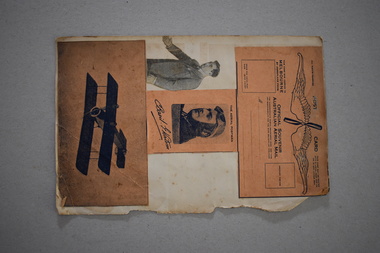
Postcard, Basil Watson Scrapbook, 1917
... The Warrnambool and District Historical Society has in its collection the small galvanized bucket seat which came from Watson’s plane and the original first air letter written by the Mayor of Melbourne to the Mayor of Warrnambool. ...The Warrnambool and District Historical Society has in its collection the small galvanized bucket seat which came from Watson’s plane and the original first air letter written by the Mayor of Melbourne to the Mayor of Warrnambool. ...The Hollywood film stars pasted on to one side of this paper are of no historical interest to our Society. The four paper items attached to the other side relate to the pioneer aviator, Basil Watson. He flew the first aeroplane to come to Warrnambool in January 1917. Watson flew from Point Cook to Warrnambool in one hour 55 minutes, an Australian cross-country flying record at the time. He had built his own aeroplane which was 18 feet long with a wing span of 26 feet and it had a 7 cylinder 50 H.P. rotary Gnome engine. In Warrnambool he amazed the crowds with his dare-devil aerial acrobatics, looping the loop 14 times over the Warrnambool Racecourse. Watson also brought several letters with him, making him the bearer of the first aerial mail to Warrnambool. Sadly Basil Watson died when his plane crashed at Point Cook in March 1917, just two months after his record-breaking flight to Warrnambool. The Warrnambool and District Historical Society has in its collection the small galvanized bucket seat which came from Watson’s plane and the original first air letter written by the Mayor of Melbourne to the Mayor of Warrnambool. These four items are of considerable historical interest as they are souvenirs issued at the time of Basil Watson’s aviation exploits in the early 1900s and Watson is of great importance in the aviation history of Warrnambool.This is a piece of paper (possibly from a scrapbook) with one torn edge. Pasted on to the paper on one side are newspaper photographs of early Hollywood female film stars. On the other side are four items relating to the pioneer aviator, Basil Watson – an airmail post card, a newspaper black and white photograph, a souvenir black and white photograph and a card with an illustration of an early aeroplane (pictured upside down). ‘The Aerial Postman Basil Watson’ ‘Official Souvenir Australian Aerial Mail’ basil watson, pioneer aviator, aviation in warrnambool’s history, history of warrnambool -
 Flagstaff Hill Maritime Museum and Village
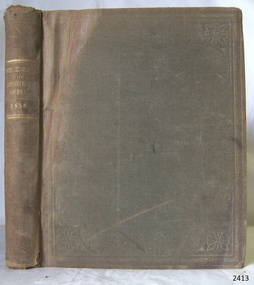
Journal - Book, R. Groombridge and Sons, The Civil Engineer and Architects Journal, 1858
... The collection was scattered between Flagstaff Hill, Warrnambool Art Gallery and the Warrnambool & District Historical Society. ...The collection was scattered between Flagstaff Hill, Warrnambool Art Gallery and the Warrnambool & District Historical Society. ...The Civil Engineer and Architect's Journal, particularly during the mid-19th century, was a staple reference for professionals during the height of the Industrial Revolution. By 1858, this journal (published by R. Groombridge and Sons in London) was documenting a fascinating transition in structural design—moving away from traditional masonry and toward the bold use of cast and wrought iron.The Civil Engineer and Architects Journal Publisher: R Groombridge and Sons Date: 1858non-fictionThe Civil Engineer and Architect's Journal, particularly during the mid-19th century, was a staple reference for professionals during the height of the Industrial Revolution. By 1858, this journal (published by R. Groombridge and Sons in London) was documenting a fascinating transition in structural design—moving away from traditional masonry and toward the bold use of cast and wrought iron.flagstaff hill, warrnambool, shipwrecked-coast, flagstaff-hill, flagstaff-hill-maritime-museum, maritime-museum, shipwreck-coast, flagstaff-hill-maritime-village, book, the civil engineer and architects journal -
 Flagstaff Hill Maritime Museum and Village
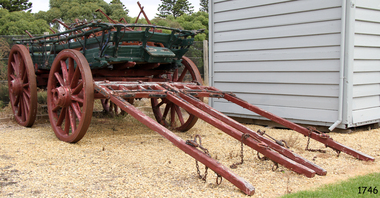
Vehicle - Wagon, Early 20th Century
... district. He went on to pursue dairying and general farming at his property “Warrumyea” Wangoom. Bell’s son Stanley James Bell went to the Wangoom School. His first reader from this school, published in 1909, has his name inscribed in the flyleaf “Stanley J. Bell, Warrumyea, Wangoom” and is now in the collection of the Warrnambool & District Historical Society...district. He went on to pursue dairying and general farming at his property “Warrumyea” Wangoom. Bell’s son Stanley James Bell went to the Wangoom School. His first reader from this school, published in 1909, has his name inscribed in the flyleaf “Stanley J. Bell, Warrumyea, Wangoom” and is now in the collection of the Warrnambool & District Historical Society ...This wagon is linked to Mr Stanley James Bell via his father Mr John Bell, who owned "Warrumyea" at Wangoom. It is believed that Stanley grew up and worked for his father at this property, eventuality inheriting his father's death in 1920. This wagon was likely used at Mr Stanley Bell's property “Warrumyea” at Wangoom around 1920-1940. The wagon was donated in 1984, at which time it was noted as having a brass plate inscribed "Jas", which name Stanley was known by. Also, a painted on the wage was “S J Bell Wangoom”. Remnants of the original paint colours of blue and yellow show on the photograph, which was taken at the time of cataloguing. Mr John Bell Snr from Plymouth, England, arrived in Portland, Victoria, around 1860. He had served in the British navy as a lad for a number of years. On arriving in Australia he travelled to the Wangoom district where he lived for many years. Mr J Bell worked for 20 years as herd manager at “Wangoom Park”., for Mr F Tozer (1843-1954), one of the original pioneers of the western district. He went on to pursue dairying and general farming at his property “Warrumyea” Wangoom. Bell’s son Stanley James Bell went to the Wangoom School. His first reader from this school, published in 1909, has his name inscribed in the flyleaf “Stanley J. Bell, Warrumyea, Wangoom” and is now in the collection of the Warrnambool & District Historical Society. Stanley went on working the property “Warrumyea” and eventually purchased “Wangoom Park” in 1956, where his father had been employed years before. Mr S J Bell died in 1968.The wagon is significant for its association with the farming history of Wangoom and the Warrnambool area in general. Also, the wage is significant for its association with one of the early families that settled in the Warrnambool area and their contribution to the dairying and general farming industries that sprang from their efforts. The wagon has a good provenance linking it to Mr Stanley James Bell and is also a good example of how goods were transported using horse-drawn vehicles at the beginning of the 20th century.Four-wheeled wagon or cart,12 spokes in each wheel, wooden axle with rear hub brake. Hinged and chained tailboard. Wheels have metal rims. Metal frame and wooden superstructure. Wagon has two pairs of staves. Wooden shelves, one missing with turntable. Small toolbox in front. Made by Kelly and Preston of Ballarat. Metal nameplate of the owner attached, "Jas" (S J Bell of Wangoom).. Original inscription, now obscured, was painted “Kelly and Preston Builders Ballarat”. Metal plate inscribed "Jas", and "S J Bell Wangoom". flagstaff hill, warrnambool, shipwrecked-coast, flagstaff-hill, flagstaff-hill-maritime-museum, maritime-museum, shipwreck-coast, flagstaff-hill-maritime-village, wagon, sj bell, stanley james bell, wangoom park, warrumyea, first reader, john bell 1830-1920, stanley james bell 1904-1968, warrnambool pioneers, f tozer, western district, kelly and preston of ballarat -
 Flagstaff Hill Maritime Museum and Village
Functional object - Latch, before 1890
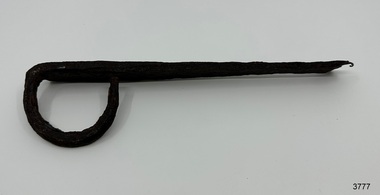
... The council then transferred items to various places, including Flagstaff Hill and the current Warrnambool Art Gallery. Flagstaff Hill’s early Accession Records book lists the items as being received from the Old Warrnambool Museum collection; the Latch is record 152 and the Pin is record 153. ...The council then transferred items to various places, including Flagstaff Hill and the current Warrnambool Art Gallery. Flagstaff Hill’s early Accession Records book lists the items as being received from the Old Warrnambool Museum collection; the Latch is record 152 and the Pin is record 153. ...Due to the interest of a public works inspector, James Gilroy, who in 1890 dug in the 'ship's remains' of a wreck now known as the Mahogany Ship, Ancient Wreck, Gold Ship, or Ancient Vessel, three relics were located. Two of these objects, a bronze bolt and an iron latch, are part of Flagstaff Hill’s collection of shipwreck artefacts. The third object was a heavily oxidised ‘quantity of ironwork’. - The iron latch was possibly from a galley oven door or fireplace - The bronze bolt, spike or pin Both the bolt and latch are listed on the same page in the records of the Old Warrnambool Museum, and noted that they were found by K.A.G. (or H.A.G.) on the site of the Ancient wreck in 1890. Interestingly, another item in these records is ‘Notes on Ancient wreck, near Gorman’s Lane’. Gorman’s Lane is just inland from the sand dunes of the Coastal Reserve at Tower Hill. The current location of these Notes is unknown. The Museum opened in 1886 and continued until 1963, when it was closed by the Warrnambool City Council and the whole collection was put into storage. The council then transferred items to various places, including Flagstaff Hill and the current Warrnambool Art Gallery. Flagstaff Hill’s early Accession Records book lists the items as being received from the Old Warrnambool Museum collection; the Latch is record 152 and the Pin is record 153. An article, ‘Birthplace of our History’ by Don Dean, is on file in the Warrnambool and District Historical Society. It was published in the Australian POST, on March 17, 1955. This article describes the findings of the items going back to 1890, along with other information about sightings of what has come to be known as the Mahogany Ship. The mystery of the Mahogany Ship began in 1836 when two shipwrecked sealers discovered the remains of an “ancient vessel” in the sand dunes about four miles west of Warrnambool. Since the last recorded sightings in the 1880’s the true origin of the Mahogany Ship has remained one of Australia’s most famous historical mysteries. One of the more recent theories is that the vessel was one of the Portuguese ships exploring the Australian coast in 1522. For over one hundred years, searchers have attempted to locate and identify the wreck. The search continues for the tangible evidence which will once and for all establish the Mahogany Ship’s place in Australia’s History. The latch has local historic significance as it was found in the sand dunes of Warrnambool in 1890. The latch is also significant for being part of the original 1886 Warrnambool Museum's collection. The latch is significant for its possible link to one of Victoria’s and Australia’s maritime mysteries, the Mahogany Ship (also known as the Ancient Wreck). It is one of the very few known relics that could give evidence of the existence and history of the vessel. The ship is listed on the Victorian Heritage Register S438 as it is one of Victoria’s oldest recorded shipwrecks. The identity of the vessel has the potential to change Australia’s history.Latch, iron. Flat iron latch tapers inward from loop handle to narrow end with prongs. Handmade. warrnambool, shipwrecked coast, flagstaff hill maritime museum, shipwreck coast, mahogany ship, latch, relic, old warrnambool museum, ancient vessel, ancient wreck, oven latch, fireplace latch, galley oven, gold ship, gorman's lane, coastal reserve, tower hill -
 Flagstaff Hill Maritime Museum and Village
Functional object - Bolt, before 1890
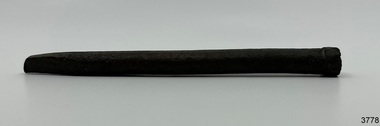
... The council then transferred items to various places, including Flagstaff Hill and the current Warrnambool Art Gallery. Flagstaff Hill’s early Accession Records book lists the items as being received from the Old Warrnambool Museum collection; the Latch is record 152 and the Pin is record 153. ...The council then transferred items to various places, including Flagstaff Hill and the current Warrnambool Art Gallery. Flagstaff Hill’s early Accession Records book lists the items as being received from the Old Warrnambool Museum collection; the Latch is record 152 and the Pin is record 153. ...Due to the interest of a public works inspector, James Gilroy, who in 1890 dug in the 'ship's remains' of a wreck now known as the Mahogany Ship, Ancient Wreck, Gold Ship, or Ancient Vessel, three relics were located. Two of these objects, a bronze bolt and an iron latch, are part of Flagstaff Hill’s collection of shipwreck artefacts. The third object was a heavily oxidised ‘quantity of ironwork’. - The iron latch was possibly from a galley oven door or fireplace - The bronze bolt, spike or pin Both the bolt and latch are listed on the same page in the records of the Old Warrnambool Museum, and noted that they were found by K.A.G. (or H.A.G.) on the site of the Ancient wreck in 1890. Interestingly, another item in these records is ‘Notes on Ancient wreck, near Gorman’s Lane’. Gorman’s Lane is just inland from the sand dunes of the Coastal Reserve at Tower Hill. The current location of these Notes is unknown. The Museum opened in 1886 and continued until 1963, when it was closed by the Warrnambool City Council and the whole collection was put into storage. The council then transferred items to various places, including Flagstaff Hill and the current Warrnambool Art Gallery. Flagstaff Hill’s early Accession Records book lists the items as being received from the Old Warrnambool Museum collection; the Latch is record 152 and the Pin is record 153. An article, ‘Birthplace of our History’ by Don Dean, is on file in the Warrnambool and District Historical Society. It was published in the Australian POST, on March 17, 1955. This article describes the findings of the items going back to 1890, along with other information about sightings of what has come to be known as the Mahogany Ship. The mystery of the Mahogany Ship began in 1836 when two shipwrecked sealers discovered the remains of an “ancient vessel” in the sand dunes about four miles west of Warrnambool. Since the last recorded sightings in the 1880’s the true origin of the Mahogany Ship has remained one of Australia’s most famous historical mysteries. One of the more recent theories is that the vessel was one of the Portuguese ships exploring the Australian coast in 1522. For over one hundred years, searchers have attempted to locate and identify the wreck. The search continues for the tangible evidence which will once and for all establish the Mahogany Ship’s place in Australia’s History. The bolt has local historic significance as it was found in the sand dunes of Warrnambool in 1890. The bolt is also significant for being part of the original 1886 Warrnambool Museum's collection. The bolt is significant for its possible link to one of Victoria’s and Australia’s maritime mysteries, the Mahogany Ship (also known as the Ancient Wreck). It is one of the very few known relics that could give evidence of the existence and history of the vessel. The ship is listed on the Victorian Heritage Register S438 as it is one of Victoria’s oldest recorded shipwrecks. The identity of the vessel has the potential to change Australia’s history.Bolt, also referred to as spike or pin. Bronze bolt, round body with head on one end that has straight sides, tapers to a point at the other end.warrnambool, shipwrecked coast, flagstaff hill maritime museum, shipwreck coast, mahogany ship, relic, pin, spike, old warrnambool museum, nail, ancient vessel, ancient wreck, portuguese ship, gold ship, gorman’s lane, coastal reserve, tower hill -
 Flagstaff Hill Maritime Museum and Village
Functional object - Paper Fastener, 1919-1923
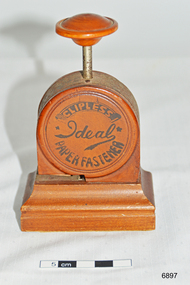
... Dr Angus was appointed on a part-time basis as Port Medical Officer (Health Officer) in Warrnambool and held this position until the 1940’s when the government no longer required the service of a Port Medical Officer in Warrnambool; he was thus Warrnambool’s last serving Port Medical Officer. ...The Ideal Clipless Paper Fastener is what is known as a stapleless stapler. It uses the Bump fastening method which was patented in the U.S. in 1911. The Ideal measures 4.75″ H x 3.125″ W x 1.875″ L and weighs 6.5 ounces. It was manufactured and sold in Japan but also exported to England. The case is made of stained wood with the fastening mechanism made of polished steel. From unsubstantiated sources I understand the wood is Japanese Boxwood, but I cannot verify that at this time. The markings on the front and reverse are done in black paint. The two patents listed on the reverse side of the fastener are Japanese patents. They were granted in March and September 1918 respectively. The patents were granted to two different men. The letters CK on the reverse of the fastener seem to be the initials of the two patent holders. If the design of a C superimposed over the K is a trademark as indicated, it would imply that the two patent holders went into business together to manufacture the Ideal Fastener. I’ve been unable to determine fully the names of the patent holders, but the K seems to refer to a Mr. Kuroda who was the author of the later patent. The Ideal fastener was sold alongside the Clipless Stand Machine (available 1911-1923) and Bump Fasteners in Japan. The latest patent number on the Ideal is from September 1918. Furthermore, there was also an all-steel model of the Ideal Clipless Paper Fastener being sold in 1922. While the available evidence is both sparse and largely circumstantial, I believe the Ideal Clipless Paper Fastener would have been sold from 1919 until about 1923. Furthermore, with the availability of an all-steel model in 1922, it is likely that this newer model would have been introduced as the replacement for the wooden-cased version giving me further reason to believe that this would not have been sold after 1923. The fastener was donated to Flagstaff Hill Maritime Village by the family of Doctor William Roy Angus, Surgeon and Oculist. It is part of the “W.R. Angus Collection” includes historical medical equipment, surgical instruments and material once belonging to Dr Edward Ryan and Dr Thomas Francis Ryan, (both of Nhill, Victoria) as well as Dr Angus’ own belongings. The Collection’s history spans the medical practices of the two Doctors Ryan, from 1885-1926 plus that of Dr Angus, up until 1969. Dr. Angus was in England in the 1920’s and could very well have purchased the Ideal Clipless Paper Fastener during his study time there. It was donated to Flagstaff Hill Maritime Village by the family of Doctor William Roy Angus, Surgeon and Oculist. It is part of the “W.R. Angus Collection” and includes historical medical equipment, surgical instruments and material once belonging to Dr Edward Ryan and Dr Thomas Francis Ryan, (both of Nhill, Victoria) as well as Dr Angus’ own belongings. The Collection’s history spans the medical practices of the two Doctors Ryan, from 1885-1926 plus that of Dr Angus, up until 1969. ABOUT THE “W.R.ANGUS COLLECTION” Doctor William Roy Angus M.B., B.S., Adel., 1923, F.R.C.S. Edin.,1928 (also known as Dr Roy Angus) was born in Murrumbeena, Victoria in 1901 and lived until 1970. He qualified as a doctor in 1923 at University of Adelaide, was Resident Medical Officer at the Royal Adelaide Hospital in 1924 and for a period was house surgeon to Sir (then Mr.) Henry Simpson Newland. Dr Angus was briefly an Assistant to Dr Riddell of Kapunda, then commenced private practice at Curramulka, Yorke Peninsula, SA, where he was physician, surgeon and chemist. In 1926, he was appointed as new Medical Assistant to Dr Thomas Francis Ryan (T.F. Ryan, or Tom), in Nhill, Victoria, where his experiences included radiology and pharmacy. In 1927 he was Acting House Surgeon in Dr Tom Ryan’s absence. Dr Angus had become engaged to Gladys Forsyth and they decided he further his studies overseas in the UK in 1927. He studied at London University College Hospital and at Edinburgh Royal Infirmary and in 1928, was awarded FRCS (Fellow from the Royal College of Surgeons), Edinburgh. He worked his passage back to Australia as a Ship’s Surgeon on the on the Australian Commonwealth Line’s T.S.S. Largs Bay. Dr Angus married Gladys in 1929, in Ballarat. (They went on to have one son (Graham 1932, born in SA) and two daughters (Helen (died 12/07/1996) and Berenice (Berry), both born at Mira, Nhill ) According to Berry, her mother Gladys made a lot of their clothes. She was very talented and did some lovely embroidery including lingerie for her trousseau and beautifully handmade baby clothes. Dr Angus was a ‘flying doctor’ for the A.I.M. (Australian Inland Ministry) Aerial Medical Service in 1928 . Its first station was in the remote town of Oodnadatta, where Dr Angus was stationed. He was locum tenens there on North-South Railway at 21 Mile Camp. He took up this ‘flying doctor’ position in response to a call from Dr John Flynn; the organisation was later known as the Flying Doctor Service, then the Royal Flying Doctor Service. A lot of his work during this time involved dental surgery also. Between 1928-1932 he was surgeon at the Curramulka Hospital, Yorke Peninsula, South Australia. In 1933 Dr Angus returned to Nhill and purchased a share of the Nelson Street practice and Mira hospital (a 2 bed ward at the Nelson Street Practice) from Dr Les Middleton one of the Middleton Brothers, the current owners of what previously once Dr Tom Ryan’s practice. Dr Tom and his brother had worked as surgeons included eye surgery. Dr Tom Ryan performed many of his operations in the Mira private hospital on his premises. He had been House Surgeon at the Nhill Hospital 1902-1926. Dr Tom Ryan had one of the only two pieces of radiology equipment in Victoria during his practicing years – The Royal Melbourne Hospital had the other one. Over the years Dr Tom Ryan had gradually set up what was effectively a training school for country general-practitioner-surgeons. Each patient was carefully examined, including using the X-ray machine, and any surgery was discussed and planned with Dr Ryan’s assistants several days in advance. Dr Angus gained experience in using the X-ray machine there during his time as assistant to Dr Ryan. When Dr Angus bought into the Nelson Street premises in Nhill he was also appointed as the Nhill Hospital’s Honorary House Surgeon 1933-1938. His practitioner’s plate from his Nhill surgery is now mounted on the doorway to the Port Medical Office at Flagstaff Hill Maritime Village, Warrnambool. When Dr Angus took up practice in the Dr Edward and Dr Tom Ryan’s old premises he obtained their extensive collection of historical medical equipment and materials spanning 1884-1926. A large part of this collection is now on display at the Port Medical Office at Flagstaff Hill Maritime Village in Warrnambool. In 1939 Dr Angus and his family moved to Warrnambool where he purchased “Birchwood,” the 1852 home and medical practice of Dr John Hunter Henderson, at 214 Koroit Street. (This property was sold in1965 to the State Government and is now the site of the Warrnambool Police Station. and an ALDI sore is on the land that was once their tennis court). The Angus family was able to afford gardeners, cooks and maids; their home was a popular place for visiting dignitaries to stay whilst visiting Warrnambool. Dr Angus had his own silk worm farm at home in a Mulberry tree. His young daughter used his centrifuge for spinning the silk. Dr Angus was appointed on a part-time basis as Port Medical Officer (Health Officer) in Warrnambool and held this position until the 1940’s when the government no longer required the service of a Port Medical Officer in Warrnambool; he was thus Warrnambool’s last serving Port Medical Officer. (Masters of immigrant ships arriving in port reported incidents of diseases, illness and death and the Port Medical Officer made a decision on whether the ship required Quarantine and for how long, in this way preventing contagious illness from spreading from new immigrants to the residents already in the colony.) Dr Angus was a member of the Australian Medical Association, for 35 years and surgeon at the Warrnambool Base Hospital 1939-1942, He served with the Australian Department of Defence as a Surgeon Captain during WWII 1942-45, in Ballarat, Victoria, and in Bonegilla, N.S.W., completing his service just before the end of the war due to suffering from a heart attack. During his convalescence he carved an intricate and ‘most artistic’ chess set from the material that dentures were made from. He then studied ophthalmology at the Royal Melbourne Eye and Ear Hospital and created cosmetically superior artificial eyes by pioneering using the intrascleral cartilage. Angus received accolades from the Ophthalmological Society of Australasia for this work. He returned to Warrnambool to commence practice as an ophthalmologist, pioneering in artificial eye improvements. He was Honorary Consultant Ophthalmologist to Warrnambool Base Hospital for 31 years. He made monthly visits to Portland as a visiting surgeon, to perform eye surgery. He represented the Victorian South-West subdivision of the Australian Medical Association as its secretary between 1949 and 1956 and as chairman from 1956 to 1958. In 1968 Dr Angus was elected member of Spain’s Barraquer Institute of Barcelona after his research work in Intrasclearal cartilage grafting, becoming one of the few Australian ophthalmologists to receive this honour, and in the following year presented his final paper on Living Intrasclearal Cartilage Implants at the Inaugural Meeting of the Australian College of Ophthalmologists in Melbourne In his personal life Dr Angus was a Presbyterian and treated Sunday as a Sabbath, a day of rest. He would visit 3 or 4 country patients on a Sunday, taking his children along ‘for the ride’ and to visit with him. Sunday evenings he would play the pianola and sing Scottish songs to his family. One of Dr Angus’ patients was Margaret MacKenzie, author of a book on local shipwrecks that she’d seen as an eye witness from the late 1880’s in Peterborough, Victoria. In the early 1950’s Dr Angus, painted a picture of a shipwreck for the cover jacket of Margaret’s book, Shipwrecks and More Shipwrecks. She was blind in later life and her daughter wrote the actual book for her. Dr Angus and his wife Gladys were very involved in Warrnambool’s society with a strong interest in civic affairs. He had an interest in people and the community They were both involved in the creation of Flagstaff Hill, including the layout of the gardens. After his death (28th March 1970) his family requested his practitioner’s plate, medical instruments and some personal belongings be displayed in the Port Medical Office surgery at Flagstaff Hill Maritime Village, and be called the “W. R. Angus Collection”. [References; Ideal Clipless Paper Fastener, Antique Outings http://antiqueoutings.com/ideal-clipless-paper-fastener/ ; Australian College of Ophthalmologists, Vol 11, 1970.; Medical Directory of Australia listing, alphabetical says 1929, Royal College of Surgeons Edinburgh says 1928; Documents re Dr Angus from daughter Berry McDade, received at Flagstaff Hill Maritime; Portland Examiner, June 13, 1969; The Advertiser (Adelaide) 14th Nov, 1910 - Blind restored to sight – Dr Edward Ryan, Melbourne; The Hamilton Spectator, Wed 15th April 1914 – Ararat man with eye affliction attended to by Drs E & T Ryan; The Nhill Hospital, first 100 years, 1885-1985, by Jan Doust; The Horsham Times, Tuesday 6th January 1885 – Dr Edward Ryan appointed to Nhill Hospital; People who passed this way – Warrnambool and District Historical Society; Warrnambool Base Hospital Report 1969-1970 The Standard, 22/6/1990; The Argus, 1970; Letter to Mrs G Angus from John Lindsay, Flagstaff Hill, 8/5/1973; ] This Ideal Clipless Paper Fastener is significant as a rare example of a clipless paper fastener used as office stationery of the 1920’s. This Ideal Clipless Paper Fastener is significant for its association with the W.R. Angus Collection, which is significant for still being located at the site it is connected with, Doctor Angus being the last Port Medical Officer in Warrnambool. The collection of medical instruments and other equipment is culturally significant, being an historical example of medicine from late 19th to mid-20th century. Dr Angus assisted Dr Tom Ryan, a pioneer in the use of X-rays and in ocular surgery. Paper fastener, clipless or stapleless. Part of the W.R. Angus Collection. Branded Ideal Clipless Paper Fastener, made in Japan. Push down action on wooden handle, metal cutting mechanism cuts and folds the cut flap to join two pieces of paper. Stained wood base, sides and handle, floral fabric under base. Inscriptions on sides and base are in black paint print. Early to mid 1900’sPrinted on sides “IDEAL CLIPLESS PAPER FASTENER” and “TRADE MARK (K with a C through it) PATENT NO. 45105 46743” and stamped into base "MADE IN JAPAN"flagstaff hill, warrnambool, shipwrecked coast, flagstaff hill maritime museum, maritime museum, shipwreck coast, flagstaff hill maritime village, great ocean road, dr w r angus, dr ryan, surgical instrument, t.s.s. largs bay, warrnambool base hospital, nhill base hospital, mira hospital, flying doctor, ideal stapleless stapler, ideal clipless paper fastener, ideal paper fastener made in japan, paper fastener, office stationery, patent 45105 46743, ideal clipless paper fastener ck, logo ck c over k -
 Cheese World Museum
Centrifuge, electric
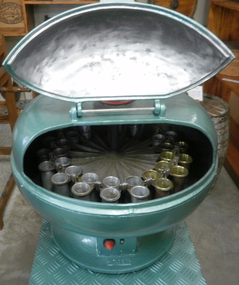
... When it was superseded it was passed to one of the users of the machine, Les O'Callaghan, president of the Warrnambool & District Historical Society who placed it in the historical society collection. ...When it was superseded it was passed to one of the users of the machine, Les O'Callaghan, president of the Warrnambool & District Historical Society who placed it in the historical society collection. ...This Babcock tester was used in the laboratory at the Kraft cheese factory, Allansford. When it was superseded it was passed to one of the users of the machine, Les O'Callaghan, president of the Warrnambool & District Historical Society who placed it in the historical society collection. In 2009 when the historical society premises were upgraded there was insufficient room to store the tester so it was donated to Cheese World Museum. The machine was used to test the butterfat content of milk. Prior to dairy factories coming into existence farmers made butter individually on farms. There was no need for milk testing until farmers supplied factories for payment. Payment was based on a gallon of milk weighing 10lbs (pounds) and this led to richer milk, containing a high degree of butterfat for use in buttermaking, being paid at the same rate as lesser quality milk. In 1890 Stephen Moulton Babcock, an American professor at the University of Wisconsin-Madison, developed a method of determining the amount of butterfat in milk, thus providing a standardised and fairer system for payment. Babcock Test Process 1. 18 grams of milk (17.6ml) was put into a test tube 2. The same amount of sulphuric acid was added 3. A centrifuge at 50ºC was rotated at more than 900 revs per minute 4. The fat floating on top of the liquid in the test tube was measured The Babcock Test provided fairer compensation to farmers and also helped produce a consistent product for consumers. It also allowed for selective breeding when dairy herd testing evolved. ‘The Babcock Test is so simple that it can be used by any careful person, and it is inexpensive to operate. From the very beginning it was so complete in every detail that no change has had to be made in it.’ (Babcock Test http://www.en.wikipedia.org/wki/Babcock_test 31 March 2009) Round green metal container with opening lid. Inside houses a spinning rotor with 20 test tube holders around the outside in two circular rows.7173 BABCOCKTESTER 190allansford, dairy manufacturing, milk testing, babcock test, babcock, stephen moulton, butter, warrnambool cheese and butter factory company -
 Warrnambool and District Historical Society Inc.
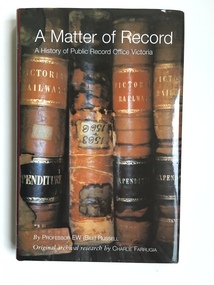
Book, A Matter of Record, 2003
... collection in the possession of the Melbourne Public Library through to the important 1973 Victorian Public Records Act to the present day institution at North Melbourne. The Melbourne Public Library, the Historical Society of Victoria and the History School of the University of Melbourne were early contributors to the preservation of Victoria’s archives. This book is in the library of the Warrnambool and District ...This book gives the history of the Public Record Office, Victoria. It was written by Professor Bill Russell and produced in 2003. The research by Charlie Farrugia that enabled the book to be written was carried out entirely using the Public Record Office archives. The book documents the 1903 beginnings of the Public Record Office from a small collection in the possession of the Melbourne Public Library through to the important 1973 Victorian Public Records Act to the present day institution at North Melbourne. The Melbourne Public Library, the Historical Society of Victoria and the History School of the University of Melbourne were early contributors to the preservation of Victoria’s archives. This book is in the library of the Warrnambool and District Historical Society and is an important reference for us in regard to the history of archival preservation of historical documents in our State. In addition we are a Place of Deposit for historical records that are surplus to the requirements of the Public Record Office of Victoria and that concern more directly the history of Warrnambool and district. Many local Warrnambool and district residents use the facilities at the Public Record Office at North Melbourne and the link between that institution and Warrnambool historical groups is important. This is a hard cover book of 227 pages. The cover is black with gold lettering on the spine. The dust cover is dark red with printed material about the author and the book’s contents. The front of the dust cover has an illustration of four Victorian Railways ledgers in sepia tones and the back of the dust cover has a small illustration in brown and white of a heritage label. The book has a Contents page, an Acknowledgement page, a Foreword, an Introduction, eight chapters, Appendices, Notes and References and an Index. The book is a 2003 history of the Public Record Office of Victoria written by Professor Bill Russell and researched by Charlie Farrugia. Front Cover: ‘A Matter of Record, A History of Public Record Office Victoria by Professor E W (Bill) Russell, Original archival research by Charlie Farrugia.’ Spine: ‘A Matter of Record, Russell, Public Record Office Victoria’. public record office, professor bill russell, charlie farrugia, historical records of victoria -
 Warrnambool and District Historical Society Inc.
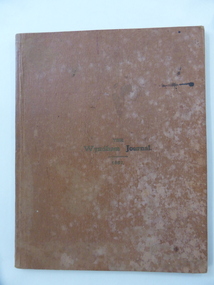
Booklet, The Wyndham Journal, late 19th century
... collection of nine newsletters printed on board the ship, ‘General Wyndham’ in 1857. The cover is light brown and is very stained. The contents of the newspapers include poems, news items, reports of the ship’s log and its progress, accounts of the activities and organizations aboard the ship, letters to the editor and editorials. The stamp of the Warrnambool & District Historical Society...historical interest. ‘General Wyndham’ Ship 19th century Emigration to Australia Betsy and Thomas Smith History of Warrnambool This is a bound book of 44 pages containing a collection of nine newsletters printed on board the ship, ‘General Wyndham’ in 1857. The cover is light brown and is very stained. The contents of the newspapers include poems, news items, reports of the ship’s log and its progress, accounts of the activities and organizations aboard the ship, letters to the editor and editorials. The stamp of the Warrnambool & District Historical Society ...This is a booklet containing the newspapers published on board the ship, ‘General Wyndham’ during its voyage from Liverpool to Melbourne in 1857. The newspapers may be copies of the newspapers rather than original ones. Betsey(Betsy/ Betty) Smith, the wife of Thomas Smith of Warrnambool, came to Australia with their daughter Lizzie (Elizabeth) on board the ‘General Wyndham’ in 1857 on the particular voyage during which these newsletters were printed (the emigrant ships coming to Australia at that time usually carried printing presses of some kind). It is conjectured that Thomas Smith who had come to Australia on an earlier voyage and who was a printer in Koroit Street, Warrnambool in the 19th century, printed and bound the newsletters that his wife had kept. This book is of great importance as a good collection of the newsletters printed on board emigrant ships. If the newsletters came from Betsy Smith then the significance is even greater. The newsletters tell us so much about life on board the ‘General Wyndham’ ship – the range of articles, the light-hearted humorous touches, the accounts of the deaths on board, the picture of life on board that is conveyed and the overall professional look of the newsletters make the journal interesting to read and of great historical interest. This is a bound book of 44 pages containing a collection of nine newsletters printed on board the ship, ‘General Wyndham’ in 1857. The cover is light brown and is very stained. The contents of the newspapers include poems, news items, reports of the ship’s log and its progress, accounts of the activities and organizations aboard the ship, letters to the editor and editorials. The stamp of the Warrnambool & District Historical Society is prominent throughout the book and some of the pages have been bound at the edges with white taping.‘general wyndham’ ship, 19th century emigration to australia, betsy and thomas smith, history of warrnambool -
 Warrnambool and District Historical Society Inc.
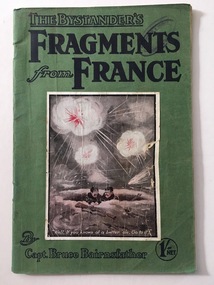
Booklet, Fragments from France B Bairnsfather, Circa 1916
... collection of his cartoons. The Fragments from France was extremely popular and sold hundreds of thousands of copies. The drawings display a wry humour of the terrible situation of the first world war. This item has strong historical artistic and social significance. warrnambool fragments from france captain bruce bairnsfather Capt Bruce Bairnsfather. "To dear father from jean " written in black pen on first page. Two stamps Warrnambool and District Historical Society ...Captain Bruce Bairnsfather was a British humourist and cartoonist. This booklet, Fragments from France contains a collection of his cartoons. The Fragments from France was extremely popular and sold hundreds of thousands of copies. The drawings display a wry humour of the terrible situation of the first world war. This item has strong historical artistic and social significance.Dark green soft card cover with black text. Illustration in black and white tones and white text is pasted on front cover. It shows two soldiers in dugout with explosions bursting around them.Advertisements inside front and back covers. 48 pages with monochrome illustrations with captions underneath each .Capt Bruce Bairnsfather. "To dear father from jean " written in black pen on first page. Two stamps Warrnambool and District Historical Society. Mussell & MacDonald newsagents & stationers Henty.warrnambool, fragments from france, captain bruce bairnsfather -
 Warrnambool and District Historical Society Inc.
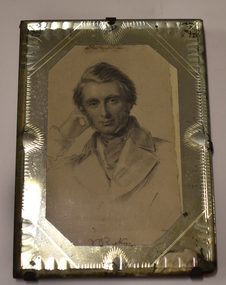
Artwork, other - Framed copy of engraving, John Ruskin, late 19th century
... Most of the collection was lost over the years but some items remain, housed at the Warrnambool Art Gallery, Flagstaff Hill Maritime Museum and the Warrnambool and District Historical Society, with the John Ruskin item being part of the latter group's collection....Most of the collection was lost over the years but some items remain, housed at the Warrnambool Art Gallery, Flagstaff Hill Maritime Museum and the Warrnambool and District Historical Society, with the John Ruskin item being part of the latter group's collection. ...This framed copy of a sketch of John Ruskin comes from the original steel plate engraving dating from about 1845. John Ruskin (1819-1900) was a notable English writer, philosopher, art critic and polymath in the Victorian era. He was the first Professor of Fine Art at Oxford University and was a prolific writer interested in the connection between nature, art and society, anticipating the more modern interest in environmental and sustainability issues. This framed item is from the collection of the old Warrnambool Museum which was first established in 1871 by the Warrnambool Mechanics' Institute under the curatorship of a local policeman, Joseph Archibald. This first museum faded away but was revived in 1883 by Joseph Archibald in his retirement years. The Museum continued as part of the Mechanics' Institute until 1963 as an important and much-admired institution. Most of the collection was lost over the years but some items remain, housed at the Warrnambool Art Gallery, Flagstaff Hill Maritime Museum and the Warrnambool and District Historical Society, with the John Ruskin item being part of the latter group's collection.This item is of considerable interest, firstly because it comes from the collection of the old Warrnambool Museum and secondly because it shows the local interest in the 19th century of the notable English writer and philosopher, John Ruskin. This is a copy of a steel plate engraving, a black and white sketch of the head and upper body of John Ruskin. It is enclosed in a cut glass frame with a red cardboard backing attached by metal clips. A section of the backing is torn off and there is damage to the bottom part of the glass frame.J. Ruskinold warrnambool museum, warrnambool art gallery, flagstaff hill maritime museum, warrnambool & district historical society, joseph archibald, john ruskin portrait -
 Warrnambool and District Historical Society Inc.
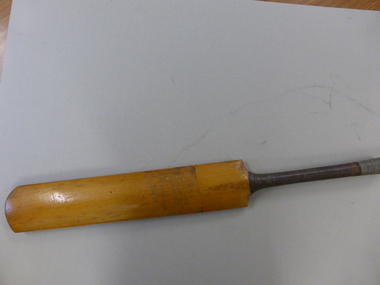
Bat, Cricket bat, 1870s
... The old Museum closed in the 1960s and the bat was then passed on to the Warrnambool and District Historical Society from the Warrnambool City Council collection of items from the Museum. ...The old Museum closed in the 1960s and the bat was then passed on to the Warrnambool and District Historical Society from the Warrnambool City Council collection of items from the Museum. ...This bat was awarded to Thomas William Southcombe in 1876 for the best batting average during the 1875-6 season at Warrnambool Cricket Club. Thomas William Southcombe was the son of Thomas and Mary Southcombe of Port Fairy. With his parents, Thomas and Mary, he arrived in Port Fairy in 1854. Thomas Senior was a carpenter who established several businesses in Port Fairy and served on the local Council for many years as a Councillor and Mayor. Thomas Junior appears to have migrated to U.S.A. and died there in 1904. The cricket bat was manufactured by the British firm of James Lillywhite, Frowd & Co. James Lillywhite was an English cricketer whose uncle had originally established the sports store and manufacturing business which lasted under various names until the 21st century. A cricketer named Lillywhite played in Warrnambool in 1874 with an All England Team under the captaincy of W.G.Grace. It is not known whether this was James Lillywhite or another member of the Liilywhite family as several of them played first class cricket.. The impression of the signature of W.H.Ponsford on the bat is an intriguing one. W.H. (Bill) Ponsford was a famous Australian cricketer who retired in the late 1930s. The Southcombe cricket bat was given by Mary Southcombe (Thomas’ sister) to the old Warrnambool Museum in 1923 and it is surmised that Bill Ponsford visited Warrnambool in 1957 (tthis appears to be the date under the signature imprint) and was shown the bat. It is then surmised that he rested a piece of paper or an album page on the bat while he signed his name and the impression of the signature has come through onto the bat. The old Museum closed in the 1960s and the bat was then passed on to the Warrnambool and District Historical Society from the Warrnambool City Council collection of items from the Museum. This bat is of considerable importance because of its provenance and its connection with the Warrnambool Cricket Club, the Southcombe family of Port Fairy, the Lillywhite manufacturers, the old Warrnambool Museum and Bill Ponsford. It is also a good example of the type of cricket bat used in Australia in the 1870s. This is a wooden cricket bat (light colour wood, presumably willow) with a handle covered in oiled thread. It has an etched inscription on one side of the bat and the names of the manufacturer and distributor on the other side. There is also a faint impression of another signature. The blade of the bat is slightly curved. ‘W.C.C. Season 1875-6 Presented to T.W. Southcombe, for Best Batting Average’ ‘James Lillywhite Frowd & Co., Manufacturers, Borough, England’ ‘Made for George Marsh, Melbourne’ ‘W.H.Ponsford, -/1/1957’ warrnambool cricket club, thomas william southcombe, w.h.ponsford, warrnambool’s old museum -
 Warrnambool and District Historical Society Inc.
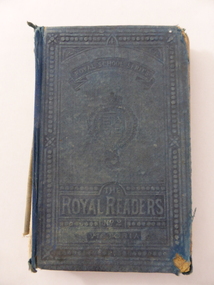
Book, The Royal Readers No 2 Victoria, Late 19th century
... It is also important as a book belonging to Jessie Bonnett, a member of the Bonnett family of farmers in the Mepunga area. The Warrnambool and District Historical Society holds in its collection some other items that belonged to Jessie Bonnett, including an important World War One scrapbook jessie bonnett mepunga east state school ‘Jessie Edith Bonnett, Mepunga East State School No. 2762’ This is a hard cover book of 186 pages. ...This book is one of the series of Royal Readers (Scotland) introduced into schools in Victoria in 1877 to replace the Irish Readers. They were in use until the 1920s and at first contained mostly British material (as does this copy which has no Australian content and features many articles on animals). By the late 19th century the Royal Readers used in Victoria contained some Australian material and it is presumed that this copy is an early edition. The Bonnett families were associated with farming in the Mepunga area and Jessie Edith Bonnett, the daughter of Frederick Bonnett and Charity Bonnett (nee Phillips) was born in Allansford in 1897. Jessie Bonnett spent her life on the family farm at Mepunga and was the last of the Bonnett families in that area. Mepunga East State School was established in 1886 with Ruth Broadway as the first Head Teacher. It has now closed. This book, though tattered, is of interest as an example of the Royal Readers used by pupils in Victorian schools in the late 19th and early 20th centuries. It is also important as a book belonging to Jessie Bonnett, a member of the Bonnett family of farmers in the Mepunga area. The Warrnambool and District Historical Society holds in its collection some other items that belonged to Jessie Bonnett, including an important World War One scrapbookThis is a hard cover book of 186 pages. The cover was originally a dark blue-green colour but it is much faded and is now almost detached from the binding. The spine and several pages at the beginning and the end are missing. The text contains many black and white illustrations and some have been coloured in. Some of the pages are torn and stained. There is much scribble on the front and back covers. The inscriptions are handwritten in black ink.‘Jessie Edith Bonnett, Mepunga East State School No. 2762’ jessie bonnett, mepunga east state school -
 Warrnambool and District Historical Society Inc.
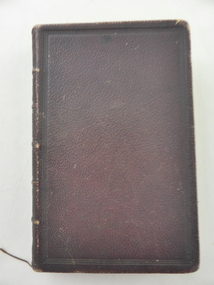
Book, Psalms & Hymns, 1855
... This book has been in the collection of the Warrnambool and District Historical Society for many years and little is known of its origins. ...This book has been in the collection of the Warrnambool and District Historical Society for many years and little is known of its origins. ...This book has been in the collection of the Warrnambool and District Historical Society for many years and little is known of its origins. ‘Anne Watson’ may be Annie Watson, nee Grant (1830-1906), the wife of John Watson who came to Victoria in 1855 and had a farm in the Cudgee area. There is a reference to a ‘G. Geary’ as a member of the Belfast (Port Fairy) Choral Society in 1860. This is an early memento of settlers in the Warrnambool area and their religious adherence and, as such, is of some interest. This is a hard cover book of 391 pages. The cover is brown leather with gold lettering on the spine. The pages are gilt-edged. The inscription is handwritten in black ink. There are two mauve stamps of the Warrnambool and District Historical Society on the front and back pages. The cover is a little scuffed. ‘Presented to Anne Watson by her nephew, Godfrey N. B. Geary, Oct. 4th 1856’. history of warrnambool, anne watson -
 Warrnambool and District Historical Society Inc.
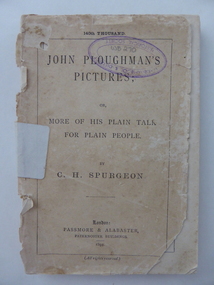
Book, John Ploughman's Pictures, 1892
... It appears that Spurgeon’s books were in many a home in Warrnambool in the 19th century. This book is of great interest as one which was familiar to many residents of Warrnambool and district in the 19th century. ...This book was written by Charles Haddon Spurgeon (1834-1892), a famous and influential English Protestant preacher who attracted a great following in the 19th century, not only in England, but throughout the British Empire and U.S.A. He reached the masses by producing many religious tracts, costing one penny, and publishing his sermons and his John Ploughman books with their simple homilies. These books were sub-titled ‘Plain Talk for Plain People’ with the copy we have being the second in the series labelled ‘140th thousand’ and published in 1892, the year of Spurgeon’s death. It appears that Spurgeon’s books were in many a home in Warrnambool in the 19th century. This book is of great interest as one which was familiar to many residents of Warrnambool and district in the 19th century. Charles Spurgeon was apparently widely known to Warrnambool residents in the 19th century. The Warrnambool Examiner newspaper frequently carried news items about Spurgeon’s eloquent preaching and the crowds he was drawing. It also published some of his sermons from time to time and reported at length his final illness and death. One of the unidentified photograph albums in the collection of the Warrnambool and District Historical Society contains a photograph of Charles Spurgeon and his wife. This is a book of 158 pages with some of the pages missing at the end. The book is coverless and held together with string and a piece of glued paper. The text has 38 short instructional articles with many black and white illustrations. The first and last pages are torn and almost detached. history of warrnambool, charles spurgeon -
 Warrnambool and District Historical Society Inc.
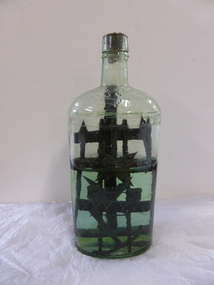
Bottle, Chinese puzzle, 19th century
... This item, always known as a ‘Chinese Puzzle,’ has been in the collection of the Warrnambool and District Historical Society for many years. ...This item, always known as a ‘Chinese Puzzle,’ has been in the collection of the Warrnambool and District Historical Society for many years. ...This item, always known as a ‘Chinese Puzzle,’ has been in the collection of the Warrnambool and District Historical Society for many years. It is such an oddity that it is probable that it came from the collection of the old Warrnambool Museum which was established in the 1870s-80s and was dismantled in the 1960s. It had many objects of a bizarre nature such as this as many local people while on their travels brought back from many different countries objects deemed to be of unusual interest. This item is of great interest as an oddity from the 19th century and it attracts great attention when it is displayed. This is a spherical-shaped imperial quart thick glass bottle with a cork in the top. It contains a clear liquid filling two-thirds of the bottle. Inside the bottle and filling it to the top of its main section are several pieces of metal of varying shapes. These originally were part of a puzzle, presumably with the object being to unlock the shapes from each other. These have now been connected to each other with what looks like thin wire. The liquid is still reasonably clear. The cork is a little worn at the top. ‘Imperial Quart’chinese puzzle, warrnambool -
 Warrnambool and District Historical Society Inc.
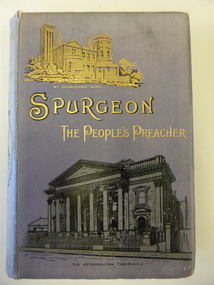
Book, Spurgeon the people's teacher, Late 19th century
... One of the photograph albums in the collection of the Warrnambool and District Historical Society includes a photograph of Charles Spurgeon and his wife, thus appearing to indicate his popularity and influence extended as far as Warrnambool and district. ...This is the biography of Charles Haddon Spurgeon (1834-1892), a famous and influential English Protestant preacher who attracted a great following throughout the British Empire and U.S.A. He reached the masses by producing many religious tracts costing one penny and publishing his sermons and his John Ploughman books with their simple homilies. It appears that many of his books were in Warrnambool homes in the 19th century.This book is of interest as it details the life of Charles Spurgeon, a person whose sermons and writings were familiar to many people in Warrnambool in the 19th century. The Warrnambool Examiner newspaper frequently carried news items about Spurgeon’s eloquent preaching and the crowds he was drawing. It also published some of his sermons and reported at length his final illness and death. One of the photograph albums in the collection of the Warrnambool and District Historical Society includes a photograph of Charles Spurgeon and his wife, thus appearing to indicate his popularity and influence extended as far as Warrnambool and district. This is a hard cover book of 330 pages. The cover has a mauve background with gold lettering on the front cover and spine. The front cover has an image in gold of the Spurgeon’s home and an image in black and grey of the Metropolitan Tabernacle. The spine has an image in gold, black and grey of Charles Spurgeon. The book has 19 chapters and 20 black and white illustrations. There are several pages at the back of the book advertising books by the publisher (Walter Scott Press). charles spurgeon, history of warrnambool -
 Warrnambool and District Historical Society Inc.
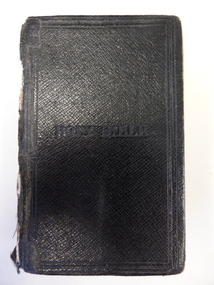
Book, Holy Bible, 1924
... This book has been in the collection of the Warrnambool and District Historical Society for many years so it is presumed it has some connection to the local pioneering Ware families. ...The Ware families were prominent early settlers in the Warrnambool district. But Doris Ware, the recipient of this, was probably the woman born in Echuca in 1887, the daughter of John and Sarah Ware and no other details are available on her. Muckleford is a town near Castlemaine. This book has been in the collection of the Warrnambool and District Historical Society for many years so it is presumed it has some connection to the local pioneering Ware families.This is a black leather-covered book of 1016 pages. The cover has embedded lettering on the front cover and gold lettering on the spine. The cover has come apart from the binding and has been mended with adhesive tape. The spine section of the cover is completely detached from the binding. The inscription is handwritten in black ink with later writing in blue ink. ‘Presented to Doris Ware from the Muckleford Methodist Sunday School. C.W. Talbot Sec.’ ’25.2.28’ doris ware, history of warrnambool -
 Warrnambool and District Historical Society Inc.
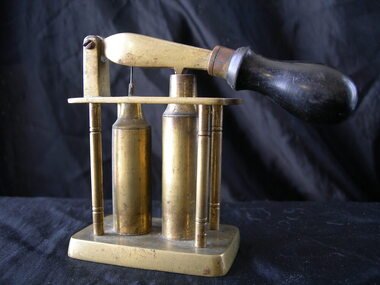
Munitions, Cartridge reloader
... This cartridge re-loader has been in the collection of the Warrnambool and District Historical Society for many years but it has no known local provenance. ...This cartridge re-loader is most likely for loading 12 gauge shotgun shells. It is not known if it was for private or military use. This cartridge re-loader has been in the collection of the Warrnambool and District Historical Society for many years but it has no known local provenance. It is an interesting relic from times past. This is a brass cartridge re-loader. It has a rectangular brass base with four brass columns supporting a rectangular top with a hollow middle. The columns of the casing are affixed with metal screws. Inside this protective casing are two cartridge-shaped brass pillars, one with a metal spike at the end and one with a small opening at the top. Both of these pillars are fixed to the base of the protective casing. Over-arching these two objects is a brass lever hinged at the end. This has a wooden handle The arm of the lever has a small protusion on the bottom which pushes into the opening of one of the pillars. It also has a small indentation which fits into the spike of the other pillar. ‘12’ history of warrnambool, cartridge re-loader -
 Warrnambool and District Historical Society Inc.
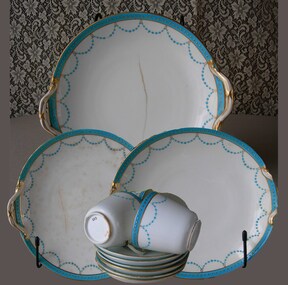
Tea Set, 1920s
... This tea set has been in the collection of the Warrnambool & District Historical Society for many years and it has no known provenance. ...This tea set has been in the collection of the Warrnambool & District Historical Society for many years and it has no known provenance. ...This tea set has been in the collection of the Warrnambool & District Historical Society for many years and it has no known provenance. It is an attractive set of china dating from the 1920s. This tea set is a good example of the household china used on special occasions in the Warrnambool area in the 1920s. It will be useful for display.This is a 17 piece tea set – Tea Pot, Jug, Sugar Basin, Five Saucers, Five Plates, Four cups (Maruhon Ware, ‘Della Robbia’ pattern). All the pieces have the same decoration of raised painted flowers, leaves, scrolls and borders in bright blue, green, black, orange, cherry red and yellow. The blue colourin the centre of the saucers is a little faded. The sugar basin has some paint peeling on the lid. history of warrnambool, maruhon ware, ‘della robbia’ pattern, china -
 Warrnambool and District Historical Society Inc.
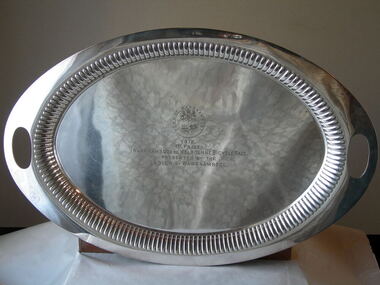
Trophy, Tea and Coffee Set (Cycle Trophy), Early 20th century
... In 197… the trophy was donated to the Warrnambool and District Historical Society. This is one of the most attractive and interesting items in our collection. ...The Warrnambool to Melbourne/ Melbourne to Warrnambool Cycle Race is an annual event which is nationally known and attracts today international cyclists and riders from around Australia. In 1912 the ladies of Warrnambool under the direction of Mrs Younger, the Lady Mayoress, arranged to have this tea and coffee service engraved with the town crest and the relevant details so that it could be presented to the winner of the 1912 Warrnambool to Melbourne Cycle Race. But the race was not run because of a dispute between the League of Wheelmen and the race sponsor. The trophy was kept for the following year but again the race was not held. Then again in 1914 the race was cancelled because of the outbreak of World War One. So it was decided to raffle the trophy to recoup the costs. The raffle was won by Mrs Herriot and eventually the trophy ended up in Queensland with a daughter of the winner. In 197… the trophy was donated to the Warrnambool and District Historical Society. This is one of the most attractive and interesting items in our collection. It is well provenanced and is of great importance in: 1. the history of the Melbourne to Warrnambool Cycle Race. This race, of prime importance in Warrnambool’s sporting calendar and history, is the second oldest one race cycle race in the world and one of the longest one day cycle events in the world. 2. demonstrating the way the women of Warrnambool in 1912 banded together to support a premier event in the Warrnambool’s annual sporting calendar.1 Silver-soldered oval tray with fluted inside edge (has inscription) .2 Silver-soldered oval-shaped coffee pot with handle and spout .3 Silver-soldered oval-shaped tea pot with hinged lid .4 Silver-soldered bowl-shaped sugar basin with two handles and concave-shaped lid and ridged on sides .5 Silver-soldered milk jug with lid and concave-shaped handle The five items are engraved with the Town of Warrnambool crest and all have the maker’s marks on the base of the item. Tray: ‘1912 1st Prize Warrnambool to Melbourne Bicycle Race Presented by the Ladies of Warrnambool’ Base of items: ‘F HP. W. & M. 53515A, Walker and Hall, Sheffield England, Warranted Hard & Silver Soldered’. warrnambool to melbourne cycle race, melbourne to warrnambool/ -
 Warrnambool and District Historical Society Inc.
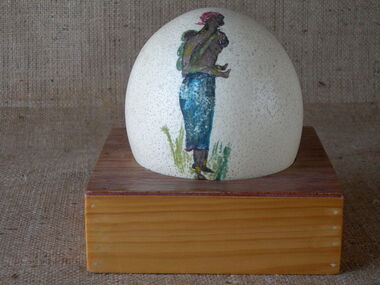
Egg, Painted Ostrich Egg, Early 20th century
... This ostrich egg has been in the collection of the Warrnambool and District Historical Society for 45 years and the only known connection it has to Warrnambool is seen in the fact that the donor was Mrs Uebergang and the Uebergang name is well-known in our district as the Uebergangs were pioneering settlers in the Allansford/ Warrnambool area. history of warrnambool ostrich eggs painted ostrich egg This is a cream-coloured ostrich egg resting in a circular cavity in the centre of a rectangular wooden frame. ...Ostrich eggs were a novelty item found in many homes in the 19th and early 20th centuries, though in Australian homes they were more likely to be emu eggs. Some ostrich eggs may have been brought to Australia from South Africa after the Boer War or purchased by travellers to foreign lands at other times. This ostrich egg has no known provenance.This ostrich egg has been in the collection of the Warrnambool and District Historical Society for 45 years and the only known connection it has to Warrnambool is seen in the fact that the donor was Mrs Uebergang and the Uebergang name is well-known in our district as the Uebergangs were pioneering settlers in the Allansford/ Warrnambool area. This is a cream-coloured ostrich egg resting in a circular cavity in the centre of a rectangular wooden frame. The egg has a small hole on the top and has paintings of an African woman and child on one side of the egg and huts with palm trees on the other side. history of warrnambool, ostrich eggs, painted ostrich egg -
 Warrnambool and District Historical Society Inc.
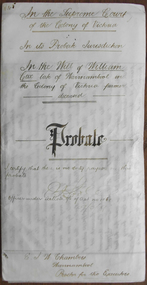
Document - William Cox Probate 1899, 1899
... His executors were Thomas Goodall, a law clerk who managed the office of the lawyer Ernest Chambers in Warrnambool and John Ward, a pioneer settler in Warrnambool and a shopkeeper in Jamieson Street in 1899. ...Tait collection: item 19 of 62 This is an 1899 document giving Will and Probate details of William Cox who died in Warrnambool in March 1899. He was a farmer residing in Moore Street Warrnambool at the time of his death at the age of 83. He left real estate to the value of £425 and personal estate to the value of £412 to Gwenllian Williams who may have been his sister or niece. A Mr and Mrs Williams were also living in the Moore Street house at the time of Cox’s death. His executors were Thomas Goodall, a law clerk who managed the office of the lawyer Ernest Chambers in Warrnambool and John Ward, a pioneer settler in Warrnambool and a shopkeeper in Jamieson Street in 1899. No other details are available on William Cox. This is an interesting document as it gives details of the Will and Probate belonging to a local Warrnambool person, William Cox. The lawyer dealing with the document was Ernest Chambers who had legal offices in Warrnambool, Port Fairy and Koroit at the end of the 19th century and the beginning of the 20th century. This document has been passed on to successive lawyers occupying legal chambers in the Kepler Street building and that is where the document was held until passed on to the Warrnambool and District Historical Society in 2014.This is an 1899 piece of parchment paper folded in two with handwritten material on three sides of the paper. The seal of the Supreme Court of the Colony of Victoria is attached with blue ribbon and there are two stamps, one blue one of the Colonial Bank in Warrnambool and the other a red one of the Master in Equity of the Supreme Court in Melbourne. Two of the pages have ruled black lines. The writing is very clear but the pages are a little stained.In the Supreme Court of the Colony of Victoria In its Probate Jurisdiction In the Will of William Cox late of Warrnambool in the Colony of Victoria farmer deceased; Probate; I certify there is no duty payable on this probate (signature) Officer under Section 96 of act No 106; E J W Chambers Warrnambool Proctors for the Executorswilliam cox, ernest chambers, john ward, thomas goodall, tait collection -
 Warrnambool and District Historical Society Inc.
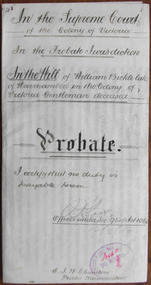
Document - William Bickle Probate 1900, 1900
... It was then passed on in 2014 to be part of the Warrnambool and District Historical Society collection. william bickle ernest chambers tait collection john warren This is a 1900 piece of parchment paper folded in two with handwritten material on three sides. ...Tait collection: item 20 of 62 This 1900 document gives details on the Will and Probate of William Bickle, described as a ‘Gentleman’, who died in April 1900. He left real estate to the value of £240 and personal estate to the value of £286. His wife Jane received the income from these assets during her lifetime and on her death the estate went to Bickle’s nephew and niece. The executors were John Warren, a painter of Jamieson Street, Warrnambool and Thomas Goodall, a law clerk of Warrnambool. No other details are available on William Bickle. Thomas Goodall was the manager of the law office of Ernest Chambers in Warrnambool. Chambers had offices in Port Fairy, Koroit and Warrnambool at the end of the 19th century and the beginning of the 20th century. This document is of interest because it contains information on the Will and Probate of William Bickle, a Warrnambool resident at the time of his death. The document was in the possession of the lawyer, Ernest Chambers and has been passed down to successive lawyers occupying the Kepler Street building. It was then passed on in 2014 to be part of the Warrnambool and District Historical Society collection.This is a 1900 piece of parchment paper folded in two with handwritten material on three sides. The seal of the Supreme Court of the Colony of Victoria is attached with a green ribbon and there are two stamps, one a red one of the Master in Equity of the Supreme Court, Melbourne and the other a blue one of the Savings Bank, Warrnambool. The handwriting is highly legible.william bickle, ernest chambers, tait collection, john warren -
 Warrnambool and District Historical Society Inc.
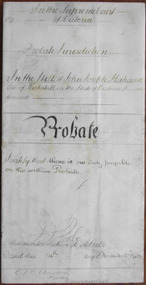
Document - John J Flahavin Probate 1903, 1903
... This document in his possession passed to successive lawyers occupying the legal premises in Kepler Street and were located there in 2014 and passed on to the Warrnambool and District Historical Society. This document is of some interest as it concerns a Kirkstall resident in the early 1900s. ...Tait collection: item 23 of 62 This paper contains details of the Will and Probate papers of John Joseph Flahavin who died in December 1902. He was a farmer at Kirkstall but no further details on him have been found. He left real estate to the value of £100 and personal estate to the value of £5 to his wife Margaret Flahavin. She died in the June of the following year before her husband’s will had been finalized. The lawyer in the case, Ernest Chambers, had legal offices in Warrnambool. Port Fairy and Koroit at the end of the 19th century and the beginning of the 20th century. This document in his possession passed to successive lawyers occupying the legal premises in Kepler Street and were located there in 2014 and passed on to the Warrnambool and District Historical Society. This document is of some interest as it concerns a Kirkstall resident in the early 1900s. It will be useful to researchers.This is a cream-coloured piece of parchment paper folded in two (1903). It has handwritten material on three sides of the paper. There is a seal of the Supreme Court of Victoria attached with a green ribbon and there are three purple stamps of the Master in Equity of the Supreme Court. The paper is somewhat stained and the writing is faded but legible. In the Supreme Court of Victoria; Probate Jurisdiction; In the Will of John Joseph Flahavin late of Kirkstall in the State of Victoria Farmer deceasedjohn flahavin, ernest chambers, warrnambool, kirkstall, tait collection
