
Showing 820 items matching "wharves"
-
 Port Fairy Historical Society Museum and Archives
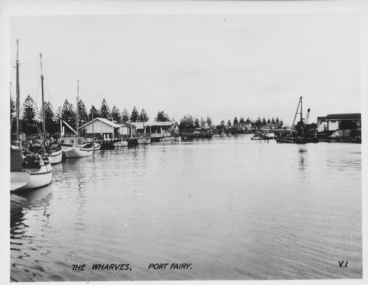
Photograph - Postcard, The Wharves, Port Fairy
... The Wharves, Port Fairy......wharves...Post card depicting the Port Fairy Wharves looking east...The Wharves, Port Fairy...Post card depicting the Port Fairy Wharves looking east Moyne river Fishing boats wharves The Wharves, Port Fairy Black and white photograph The Wharves, Port Fairy Photograph Postcard ...Post card depicting the Port Fairy Wharves looking eastBlack and white photographThe Wharves, Port Fairymoyne river, fishing, boats, wharves -
 Mission to Seafarers Victoria
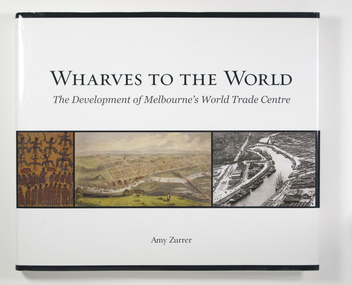
Book - Reference book, Melbourne Books, Wharves To The World: The Development Of Melbourne's World Trade Centre, 2011
... Wharves To The World: The Development Of Melbourne's World Trade Centre...Her work focuses on the WTC, the Yarra River, Wharves of the World and early history of Melbourne, and she has assisted greatly in supporting the neighbouring Mission to Seafarers Centre and its role within the community. ...(some col.), ports. Wharves To The World: The Development Of Melbourne's World Trade Centre Book Reference book Melbourne Books Amy Zurrer ...Wharves to the World: The Development of Melbourne's World Trade Centre is a photographic chronicle of the history of the World Trade Centre and its surrounds. The book traces the journey of land and the buildings that occupied it - from its beginnings with the Wurundjeri people to its role as a trading hub in early Melbourne, then as the site of the modern-day World Trade Centre, and now as part of a flourishing residential and commercial Precinct. As with any major project The World Trade Centre has face its share of fêlures, but despite thèse it has become an integral part of the City. So it goes that was once home to swampland and the City morgue has been transformer into a Diamond of the Yarra River.A 128-page book of printed matter, photographs, engravings and drawings. The hard cover is white with the title in gold lettering on the front. The dust-cover is also white with black lettering. Along the lower half of the cover, front and back, is a strip of six photos, three coloured and three black and white. 128 p. : ill. (some col.), ports. non-fictionWharves to the World: The Development of Melbourne's World Trade Centre is a photographic chronicle of the history of the World Trade Centre and its surrounds. The book traces the journey of land and the buildings that occupied it - from its beginnings with the Wurundjeri people to its role as a trading hub in early Melbourne, then as the site of the modern-day World Trade Centre, and now as part of a flourishing residential and commercial Precinct. As with any major project The World Trade Centre has face its share of fêlures, but despite thèse it has become an integral part of the City. So it goes that was once home to swampland and the City morgue has been transformer into a Diamond of the Yarra River.yarra yarra tribe, early melbourne, world trade centre, melbourne, southbank, northbank, australian wharf, siddeley street, waterfront, amy zurrer, wurundjeri, spencer street bridge, north wharf, riverlee, wtc, wharf, harbor trust, sir john coode, harbour trust, little dock, polly woodside, wharfies, divers -
 Warrnambool and District Historical Society Inc.
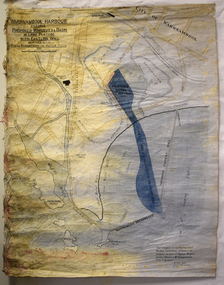
Map - Map of Proposed Alterations to Warrnambool Harbour 1925, Warrnambool Harbour Committee, Warrnambool Harbour Proposed Wharves and Basin in Lake Pertobe with Eastern Wall, 1925
... Warrnambool Harbour Proposed Wharves and Basin in Lake Pertobe with Eastern Wall...Warrnambool Harbour Proposed Wharves and Basin in Lake Pertobe with Eastern Wall Map Map of Proposed Alterations to Warrnambool Harbour 1925 Warrnambool Harbour Committee Captain Menzies, Warrnambool Harbour Master A. ...This map was printed in 1925 and contains the Warrnambool Harbour alterations proposed by the Warrnambool Harbour Committee incorporating the original designs of Captain Menzies, the Warrnambool Harbour Master and the City Engineer, Mr A. Lavercombe. The main features of the proposal were the extension of the Eastern Wall to almost enclose the harbour and a basin in Lake Pertobe. The design was to be placed before the Victorian Royal Commission on the Outer Ports which was established partly to examine the allegations of unsatisfactory work carried out in Warrnambool when the Breakwater was extended 300 feet in 1914 and also to make recommendations regarding all regional ports. The Warrnambool Breakwater was completed in 1890 but failed to provide the shipping conditions needed to continue Warrnambool as a viable port. Many plans and proposals for port improvement such as this one were produced in the late 19th century and the first half of the 20th century with the port officially closed in the 1940s. Still today the Breakwater and Warrnambool Harbour conditions remain a source of contention.This map is significant as it shows a 1925 design for Warrnambool Harbour hitherto little-known. It also has markings showing land sites of the time (BayView Hotel, Woollen Mill etc.)This is a map made of thick yellow paper pasted onto a cloth backing. It has two cloth tags at the top for tying up the map when folded. It appears to be a hand-drawn map copied with printed material added. The map is shaded green and red in some areas. Attached by nails to the map are wooden frames, rounded at the bottom and partly curved at the top. The map is torn and partly detached at the top. The top frame has a cord attached for hanging the map.warrnambool harbour, captain menzies, a.lavercombe city engineer, warrnambool breakwater, royal commission on outer ports -
 Ballarat Heritage Services
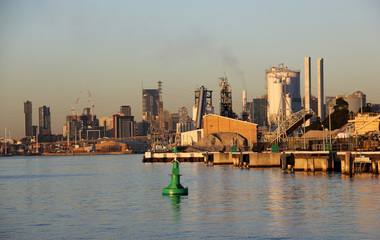
digital photographs, L.J. Gervasoni, Yarra River Melbourne Docklands wharves and markers, 2015
... Yarra River Melbourne Docklands wharves and markers...yarra river melbourne docklands yarra river dock docklands shipping port channel water ship wharf channel marker Digital Images Yarra River Melbourne Docklands wharves and markers digital photographs L.J. ...Digital Imagesyarra river melbourne docklands, yarra river, dock, docklands, shipping, port, channel, water, ship, wharf, channel marker -
 City of Melbourne Libraries
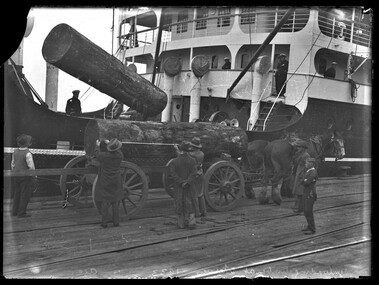
Photograph (item), Bull, Hugh Jones, 1897-1993, Unloading timber at Victoria Dock, 1933
... ...wharves...Photographer notations on slide: "Unloading Timber at Wharves 1933 Age B5" Published: Age (Melbourne, Vic.: 1854- ), Tuesday 15 August 1933 MAHOGANY FROM MANILA. (1933, August 15). ...Photographer notations on slide: "Unloading Timber at Wharves 1933 Age B5"...Photographer notations on slide: "Unloading Timber at Wharves 1933 Age B5" Published: Age (Melbourne, Vic.: 1854- ), Tuesday 15 August 1933 MAHOGANY FROM MANILA. (1933, August 15). ...Photographer notations on slide: "Unloading Timber at Wharves 1933 Age B5" Published: Age (Melbourne, Vic.: 1854- ), Tuesday 15 August 1933 MAHOGANY FROM MANILA. (1933, August 15). The Age (Melbourne, Vic. : 1854 - 1954), p. 11. Retrieved January 16, 2026, from http://nla.gov.au/nla.news-article204377024 Published title: MAHOGANY FROM MANILA Published Caption: Age Tue 15 Aug 1933 Caption: Unloading Mahogany Logs brought from Manila, Philippine Islands, by the steamer Taiping, which berthed yesterday at Victoria Dock. The vessel discharged twenty logs, each weighing three tons, the first shipment of this type of timber landed in Melbourne. Research by Project Volunteer, Louise McKenzie: This photograph in many ways epitomises Melbourne in the 1930s. It is a time of enormous growth, development and change. But before delving into that, the photo itself is very powerful. The huge mahogany logs being unloaded appear to be so heavy that the ship itself seems to list to port as they are craned over the side. They are being levered into a cart to which two large and sturdy Clydesdale horses are hitched. In contrast to the traditional horses, the wharf is crisscrossed with modern railway tracks. Unloading is both mechanical and manual, and the scene is one of intense interest to a young boy bystander. The ship appears to be squat and solid, but the whole image also gives a feeling of movement and intensity. The mahogany being delivered to Melbourne would be intended for high quality furniture. In the 1930s Australia actually had a growing timber industry, but much of the eucalyptus wood was being utilised for mass produced furniture, and much of this furniture would then have had a veneer applied to it. The fact that it was economic to import this timber from the “Philippine Islands” – not a traditional trading market for Australia – reflects a Victorian economy that was strong enough to support a growing demand for good quality furniture Mahogany was described as a classic, strong hardwood, often used for dark opulent furniture. In the 1930s the importation of timber from Manila (Philippines) to Australia was a notable trade, particularly in Philippine Lauan (often referred to as Philippine Mahogany), which was used as a cheaper alternative to other hardwoods. 1930s furniture, dominated by the art deco style, used a mix of luxurious exotic woods like mahogany, macassar and ebony for high-end pieces, often veneered over less expensive woods such as walnut, birch and poplar, and with plywood, chrome and lacquer also popular for more practical, streamlined designs during the Depression era. By the mid 1930s timber mills were being relocated away from the immediate dock area, but the fact that these logs were being transported by horse-drawn cart implies that the load would not have had to be taken too far for milling. 1885 the Melbourne Harbour Trust Commissioners had decided that land in or near the city was far too valuable to be used as timber yards. Furthermore, large stacks of timber posed a fire risk. The Trust asked the Victorian Government to reserve a site on the east side of the Yarra River opposite Yarraville and Spotswood. Here, in 1889, the Trust began building six jetties and a wharf specifically for the landing of timber. Clydesdale horses were initially brought to Victoria from Tasmania in the 1830s, and with the 1850s gold rush they were imported direct from Scotland. Melbourne was from its earliest years an important centre of horse-breeding from both imported and colonial-bred stock, providing the well-built draught horse for pulling heavily loaded wagons, the harness horse for delivery work and drawing coaches, and the saddle-horse used for riding. Stud breeding facilities were advertised from the early 1840s. By the 1870s the horse export trade was thriving, and the Port of Melbourne was the country's busiest exporter of horses to Indian, Asian and New Zealand markets. Kirk's Melbourne Horse and Carriage Bazaar in Bourke Street first advertised for business in 1840, and by the 1850s Bourke Street West was famed for its horse bazaars and saleyards. The Victorian Clydesdale Horse Society reports that Clydesdale working horses were a vital part of Melbourne's infrastructure and agricultural industry in the 1930s, when they reached the peak of their popularity despite the increasing competition from mechanization. Their main roles and usage at this time were: • City Delivery: Clydesdales were a common sight for metropolitan deliveries, particularly for breweries (such as Carlton & United Breweries), milk runs, and bread deliveries. • Industrial Work: They were heavily used for hauling cargo at the docks, in construction, and at specialized sites like the Truganina Explosives Reserve, where they pulled wagons. • Agriculture: In surrounding rural areas, they were the primary power source for ploughing and agricultural machinery. • Specialization: By the 1930s, the Clydesdale was smaller and more compact than the Shire or Percheron breeds, making them ideal for navigation in urban environments. After the 1930s their numbers decreased due to the onset of WWI and mechanisation. Wartime petrol rationing led to a brief revival for the working horse, as suburban tradesmen, now used to motor delivery, took their old jinkers out of mothballs. By 1947, however, only 1.5% of city traffic was horse-drawn. In 1952 the large horse cartage company A. Kellet Pty Ltd sold its 250 horses and converted its Richmond stables to storage. In the 1950s at Station and Princes piers, wharf labourers refused to work with the six draught horses still being used to haul trolleys and which were soon superseded by the fork lift, semi-trailer and mobile crane. Where carefully trained horses had once shunted trains in city goods yards, a few hundred a week were now being killed at the abattoirs for pet and human consumption. The last MCC dray horse was withdrawn from service in 1958, but some of the few remaining working animals are used by the mounted police for crowd control at demonstrations and football games. The death knell had also sounded for the associated trades of farrier, saddler and blacksmith. Our photo, therefore, showing the wharf with both the haulage Clydesdales and the rail lines, is a strong visual summary of the social and economic changes experienced in Victoria in the 1930s and on towards the 1950s. Our photo is located at Victoria Dock (also known as Victoria Harbour) which is still an active component of Melbourne’s port system. In 1892 the West Melbourne Dock (later Victoria Dock) was opened, downstream and immediately west of the Spencer Street railway shunting yards. It contained a swing basin for ships, replacing the one which had been provided on the south side of the river, later to be the Duke and Orr dry dock, west of the Charles Grimes Bridge. Further west was the South Wharf along the river bank. The history of Victoria Dock is extremely well described by Ashley Smith in his 2 March 2022 article in Docklands News, and its accompanying aerial photo of the Dock taken in 1934. He writes: "In the early 1930s Victoria Dock was one of the biggest sites for trade and export in Melbourne. A constant queue of ships sailed in, unloaded their cargo, recharged and reloaded, then left for the next port. Around the time this photo was taken (found in a 1934 photo book), the trapezium-shaped basin had been through some changes since its construction in the 1890s. The 497-metre-long Central Pier, finished in 1919, now featured six sheds to house the ever-increasing volume of cargo. The entrance had also been widened in the 1920s to allow better access. Some of the berths featured three-ton jib electric cranes to help with loading cargo and a rail network connected to the State Railway service. By the time construction was completed, the dock was 39 hectares and hailed as the second-largest dock in the world (behind Cavendish Dock, Barrow-in-Furness). To further save costs, excavations were dug to a more reasonable seven metres below low water, instead of British engineer Sir John Coode’s recommended 8.3 metres. Even then, the costs were still around £900,000. It was envisaged, with the extra wharfage, that around thirty 90-metre ships could berth inside. On March 22, 1892, Victoria Dock was opened by Victoria’s Governor, the Earl of Hopetoun (later Australia’s first Governor-General) who opened the sluice to let the Yarra in. It took six days to fill the basin with The Leader newspaper estimating that it would take another six months to completely fill (March 26, 1892). In the end, it took nearly a year before the first ship was allowed to enter on February 20, 1893, when the steamer Hubbuck sailed in to unload 1200 tonnes of cargo in 15 hours. The Argus (February 23, 1893) reported that the ship’s captain, J. R. Brodie, called the Yarra “better than the Thames”, and compared Victoria Dock favourably to the Albert Dock (Liverpool)." This would be a good time to move our focus on to the Taiping, which is the transporter of these giant mahogany logs. The Taiping was a steel-hulled, single-screw passenger-cargo Chinese steamer, which today has the dubious legacy of being involved in a collision headlined as “The Chinese Titanic”. It was constructed by the Hong Kong and Shampoa Dock Company at its facility in Hong Kong, with completion in 1926 for service under the Australia Oriental Line. Her gross register tonnage measured 4,324 tons, reflecting her design for inter-island and coastal trade routes, accommodating both passengers and freight. She operated routes connecting Australian ports with East Asian destinations. As World War II approached, Taiping continued predominantly working the trade routes between China and Australia, until December 1941, when she evacuated women and children from Hong Kong to Manila just before Japanese forces overran the region. She then safely reached Australia despite enemy air raids. Taiping was then requisitioned by the Royal Navy and repurposed as a victualling stores issuing ship for the Eastern Fleet, supporting logistical needs in the Pacific and Indian oceans. Returned to the Australian Oriental Line in 1947, she underwent refitting and by mid-1948 was chartered to the Shanghai Shipping Company, and modified for greater passenger accommodation – approximately 500 passengers. In 1948/49 the Chinese Civil War took place. The Taiping departed Shanghai on 26 January 1949 as one of the final vessels evacuating civilians from to Keelung Harbour in Taiwan. Reports indicate that the Taiping carried double the rated capacity of passengers i.e. 1000. The ship carried families, military personnel, civilians, carrying personal belongings, gold and valuables in hope of resettlement in Nationalist Taiwan. It also held heavy cargo in the form of silver and gold bullion loaded by the Central Bank of China. Because of the risk of patrols, and to conserve fuel, the Captain took the ship away from the usual open-sea passage, and instead navigated along the coast. He also extinguished navigation lights to avoid detection. Shortly after midnight on 27 January 1949 the Taiping collided with the smaller cargo steamer Chien Yuan in the East China Sea near the Zhoushan Archipelago. The Chien Yuan was also operating in darkness. The subsequent collision was catastrophic. The Chien Yuan sank with in 5 minutes, with the loss of 72 of its 74 crew. The Taiping sustained severe structural compromise from the broadside strike and initially remained afloat, then made a swift descent into the freezing water, with no attempt at an organised evacuation. No formal recovery process was instigated, however a distress signal went out. 32 survivors were picked up by the Australian destroyer HMAS Warramunga (on patrol nearby), a passing US vessel found 2 more, and local Zhoushan fishermen retrieved others. In the end, only 37 people survived. The event is remembered as a poignant moment in the mass migration to Taiwan, with families tragically separated. A memorial to the disaster exists at the Keelung Harbour naval base on Taiwan. With its total of over 1,500 deaths, it constituted one of the worst peacetime maritime losses. It is sometimes referred to as the “Oriental Titanic” because of the similarly large loss of life and speed of demise with the RMS Titanic in 1912. A fictional depiction of this event appears in the John Woo movies “The Crossing (Part 1) (2014), and The Crossing II (2015), known in Chinese as “Taiping Wheel”. The narrative weaves a story around pre-disaster romances and wartime turmoil among passengers, culminating in the ship’s rapid sinking. “The production, a high-budget Sino-Taiwanese-Hong Kong co-effort, portrays the event as a microcosm of the 1940s Sino-Japanese and civil war legacies, though critics noted the melodramatic style prioritizing spectacle over historical precision.” In conclusion, it is nice to return to our photo, and observe the people involved in this moment. The dockworkers are, so typical of the 1930s, dressed in what looks to us like formal clothing – dark suits or coats, white shirts, and black hats. I am particularly drawn to the young boy, bare-headed, arms crossed, and so intent on the unloading process. He too is wearing a white shirt, black trousers and jacket, and black shoes. This is 1933 Melbourne – but the haircut he is sporting is now very “hipster” and modern in 2026 Melbourne. References: MAHOGANY FROM MANILA. (1933, August 15). The Age (Melbourne, Vic. : 1854 - 1954), p. 11. Retrieved January 30, 2026, from http://nla.gov.au/nla.news-article204377024 Wikipedia, Taiping steamer, https://en.wikipedia.org/wiki/Taiping_(steamer) Wikipedia, Victoria Dock, https://en.wikipedia.org/wiki/Victoria_Dock_(Melbourne) Docklands News, Ashley Smith, 2 Mar 2022, https://www.docklandsnews.com.au/victoria-dock/ Living Histories: Heritage Council of Victoria, Jill Barnard, 2008, Jetties and Piers, https://livinghistories.net.au/wp-content/uploads/2015/11/Jetties-ONL-intro_Part-1.pdf eMelbourne, Wharves and Docks, https://www.emelbourne.net.au/biogs/EM01612b.htm Australian Academy of Technological Sciences – Harvesting Wood, https://www.austehc.unimelb.edu.au/tia/225.html Old Treasury Building, On the Water – The Docks, https://tinyurl.com/3wkbk66m Old Treasury Building, On The Road, https://tinyurl.com/dw44yr3t Port of Melbourne, Victorian Places, https://www.victorianplaces.com.au/port-of-melbourne Docklands Heritage Study - Environmental History, https://mvga-prod-files.s3.ap-southeast-4.amazonaws.com/public/2024-05/docklands-heritage-review-thematic-environmental-history-1991.pdf eMelbourne, Horses, https://www.emelbourne.net.au/biogs/EM00723b.htm Victorian Clydesdale Horse Society, https://www.clydesdalesvic.org.au/history The Crossing, https://letterboxd.com/film/the-crossing-i/Photographer notations on slide: "Unloading Timber at Wharves 1933 Age B5"ships, shipping, timber industry, shipwrecks, horses, docks, wharves, 1930-1939, wars, docklands -
 Lakes Entrance Historical Society
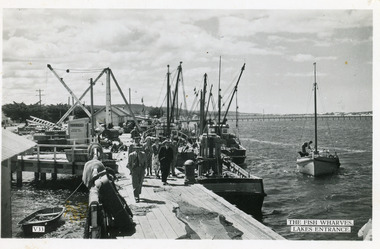
Photograph - Fishing Boats, Eastern wharf/ Harbecks wharf, Lakes Entrance Victoria 1950's
... The Fish Wharves Lakes Entrance...Eastern wharf colloquially known as 'Harbecks Wharf' and 'The Scallop Wharf'|One other copy same size Fishing Industry Waterfront Boats and Boating Transport Memorials The Fish Wharves Lakes Entrance Black and white photograph of fishing boats moored at the eastern wharf. ...Eastern wharf colloquially known as 'Harbecks Wharf' and 'The Scallop Wharf'|One other copy same sizeBlack and white photograph of fishing boats moored at the eastern wharf. The wharf has a clutter of vehicles, a crane, ladder, fishing nets and onlookers. In left background the tops of the Great War Memorial cypress trees, right background the footbridge is seen. Lakes Entrance VictoriaThe Fish Wharves Lakes Entrance fishing industry, waterfront, boats and boating, transport, memorials -
 Melbourne Tram Museum
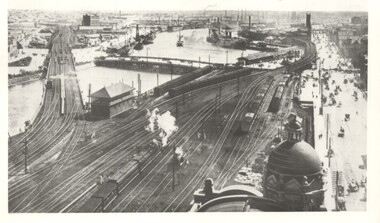
Photograph - Yarra River from Flinders St Station clock tower, Town and Country Journal, 1909
... ...wharves...In the view are are steam hauled suburban trains, Flinders St A signal box, Queensbridge, and the wharves on either side of the river. The viaduct was expanded to four tracks in 1915. ...In the view are are steam hauled suburban trains, Flinders St A signal box, Queensbridge, and the wharves on either side of the river. The viaduct was expanded to four tracks in 1915. ...Photos show the Yarra river and the shipping turning basin that was used prior to the construction of the Spencer St bridge. In the view are are steam hauled suburban trains, Flinders St A signal box, Queensbridge, and the wharves on either side of the river. The viaduct was expanded to four tracks in 1915. Yields information about Yarra River, Flinders St railway station yards and shipping,Set of two photographs looking west from the Flinders St Station clocktower. over the Yarra River and station yards.On rear of both prints in ink: 1 – Melbourne - West from clock tower on Flinders St station - “Town and Country Journal 21/7/1909” Copy neg Mark Plummer collections ex late John Alfred collection. .2 - Melbourne, Looking west along Flinders St from clocktower of Flinders St station. Copy neg Mark Plummer collections ex late John Alfred collection. Has “T&C 20/12/09” in pencil on rear. bridges, flinders st station, yarra river, wharves, railways, signal boxes, queens bridge, shipping -
 Glenelg Shire Council Cultural Collection
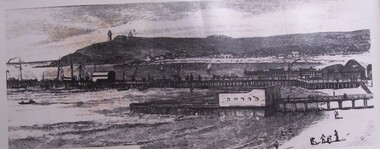
Photograph - Photograph - Portland Wharf prior to 1890, n.d
... Front: Portland Wharves before 1890. Back: Port of Portland Authority....Portland Lighthouse Whalers Bluff Battery Point Front: Portland Wharves before 1890. Back: Port of Portland Authority. ...Whaler's Bluff lighthouse in Portland was originally located on Battery Point. It was erected there in 1859. In 1889 it was relocated, stone by stone to Whaler's Bluff. The reasoning given was that the space on what is now known as Battery Point was needed for guns and it was also thought that the lighthouse was less open to attack at Whaler's Point.Black and white photo. Lighthouse on Battery Point. Baths in foreground. People on Beach. Sail boats in bay. Pier in Centre.Front: Portland Wharves before 1890. Back: Port of Portland Authority.portland lighthouse, whalers bluff, battery point -
 Port Melbourne Historical & Preservation Society
Audio - Oral History, Tippo HAYES, Wendy Morris, 22 May 1984
... Tippo HAYES discussing his life in Port Melbourne, particularly working on the wharves...Interview used in contribution to the book "They can Carry me Out" Domestic life Piers and Wharves - Webb Dock Workers Tippo HAYES Duration side 0:44:53 Tippo HAYES discussing his life in Port Melbourne, particularly working on the wharves Audio Oral History, Tippo HAYES Wendy Morris ...Interview used in contribution to the book "They can Carry me Out"Tippo HAYES discussing his life in Port Melbourne, particularly working on the wharvesDuration side 0:44:53domestic life, piers and wharves - webb dock, workers, tippo hayes -
 Lakes Entrance Historical Society
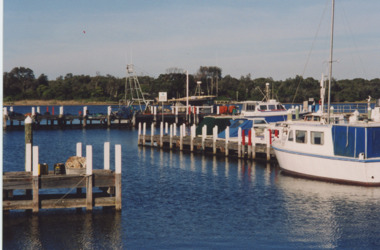
Photograph - Boating and Jetties at Lakes Entrance c1995, Boating and Jetties at Lakes Entrance, 1995 c
... Colour photograph of wharves with boats moored to the west of Post Office Jetty Lakes Entrance Victoria...Jetties Waterways Boats and Boating Colour photograph of wharves with boats moored to the west of Post Office Jetty Lakes Entrance Victoria Boating and Jetties at Lakes Entrance Photograph Boating and Jetties at Lakes Entrance c1995 ...Colour photograph of wharves with boats moored to the west of Post Office Jetty Lakes Entrance Victoriajetties, waterways, boats and boating -
Glenelg Shire Council Cultural Collection
Photograph, n.d
... Black and white photo of model wave pool at PHT, with structures representing the wharves, jetties and piers of Portland harbour....Port of Portland Authority Port of Portland Archives Black and white photo of model wave pool at PHT, with structures representing the wharves, jetties and piers of Portland harbour. ...Port of Portland Authorityport of portland archives -
Port Melbourne Historical & Preservation Society
Audio - Oral History, Tom HILLS, Trevor Robinson, 4 Jun 1984
... Tom HILLS discussing his life working on the wharves, Communist politics, standing for Port Melbourne Council and more...Interview used in contribution to the book "They Can Carry me Out" (Originally taken from a Radio Australia program) Piers and Wharves - Webb Dock Local Government - City of Port Melbourne Politics Tom HILLS Duration side 0:25:26 Tom HILLS discussing his life working on the wharves, Communist politics, standing for Port Melbourne Council and more Audio Oral History, Tom HILLS Trevor Robinson ...Interview used in contribution to the book "They Can Carry me Out" (Originally taken from a Radio Australia program)Tom HILLS discussing his life working on the wharves, Communist politics, standing for Port Melbourne Council and moreDuration side 0:25:26piers and wharves - webb dock, local government - city of port melbourne, politics, tom hills -
Port Melbourne Historical & Preservation Society
Headwear - Straw hat, Myer, 1950 - 1959
... Belonged to donor's father who worked at J Kitchen & Sons and the wharves...Belonged to donor's father who worked at J Kitchen & Sons and the wharves Costume Gardner On inner band " made expressley for the Myer Store for Men, Melbourne" White straw hat black 3 tier band. ...Belonged to donor's father who worked at J Kitchen & Sons and the wharvesWhite straw hat black 3 tier band. Top of hat around crown is perforated. Inside has brown leather band with small bow at back. Soft pad on inside of crownOn inner band " made expressley for the Myer Store for Men, Melbourne"costume, gardner -
Port Melbourne Historical & Preservation Society
Tool - Gladstone bag and bale hooks, Percy Allan MAY, 1920 - 1930s
... Bag and tools used by donor's father, Percy Allan MAY, when working on the wharves...Bag and tools used by donor's father, Percy Allan MAY, when working on the wharves Maritime Piers and Wharves - Waterside Workers Percy Allan MAY .01- Brown leather Gladstone Bag with pages of "the Sun" March 19 1979. .02 - Bale Hook - straight shank with curved end. .03 - Bale Hook - curved shank with extended straight section .04 - Bale Hook - small curved shank with very curved end .05 - Bale Hook - small curved shank with small curved end Tool Gladstone bag and bale hooks, Percy Allan MAY ...Bag and tools used by donor's father, Percy Allan MAY, when working on the wharves.01- Brown leather Gladstone Bag with pages of "the Sun" March 19 1979. .02 - Bale Hook - straight shank with curved end. .03 - Bale Hook - curved shank with extended straight section .04 - Bale Hook - small curved shank with very curved end .05 - Bale Hook - small curved shank with small curved endmaritime, piers and wharves - waterside workers, percy allan may -
 Flagstaff Hill Maritime Museum and Village
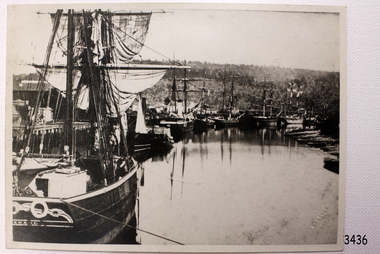
Photograph
... Black and White photograph of Launceston Wharves with Paddle Tug Tamar. 159 mm x 115mm SH 284 Ships T-Z....flagstaff hill warrnambool shipwrecked-coast flagstaff-hill flagstaff-hill-maritime-museum maritime-museum shipwreck-coast flagstaff-hill-maritime-village photograph Launceston Wharves Paddle Tug Tamar Paddle Tug Tamar. Black and White photograph of Launceston Wharves with Paddle Tug Tamar. 159 mm x 115mm SH 284 Ships T-Z. ...Black and White photograph of Launceston Wharves with Paddle Tug Tamar. 159 mm x 115mm SH 284 Ships T-Z.flagstaff hill, warrnambool, shipwrecked-coast, flagstaff-hill, flagstaff-hill-maritime-museum, maritime-museum, shipwreck-coast, flagstaff-hill-maritime-village, photograph, launceston wharves, paddle tug tamar, paddle tug, tamar. -
Glenelg Shire Council Cultural Collection
Photograph - Photograph - Portland Harbour, n.d
... Paterson & K. S. Anderson wharves, Black Nose Point & Lawrence Rocks in background....Paterson & K. S. Anderson wharves, Black Nose Point & Lawrence Rocks in background. ...Port of Portland Authority Archivesport of portland archives, portland harbour, k s anderson, s l patterson, wharf, lawrence rocks -
Port Melbourne Historical & Preservation Society
Postcard - Queen's Bridge wharves, 'Chandos' Fine Art Series, c. 1900
... Postcard, unused, depicting Queens Bridge and wharves c1900, from 'Chandos' Fine Art Series. ...piers and wharves Postcard, unused, depicting Queens Bridge and wharves c1900, from 'Chandos' Fine Art Series. ...Postcard, unused, depicting Queens Bridge and wharves c1900, from 'Chandos' Fine Art Series. Image set in oval mask, with decorative border edging card (see item 468)piers and wharves -
 Seaworks Maritime Museum
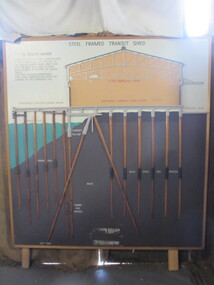
Diagram
... Cross section of wharves and steel framed sheds built along the Yarra river between the 1920s and 1960s. ...Cross section of wharves and steel framed sheds built along the Yarra river between the 1920s and 1960s. ...Cross section of wharves and steel framed sheds built along the Yarra river between the 1920s and 1960s. The South Melbourne side of the Yarra River is reclaimed swamp land. Without a solid foundation for the construction of the wharves and transit sheds, extended piles were sunk into the mud to support the wharf and shed structures. An example of this design may be found at 5 South Wharf which was built in the 1930s. The transit sheds gave shelter for cargo while waiting to be loaded onto a ship or to be collected by truck after being unloaded from a ship. The transit shed became surplus to requirements with the introduction of containers.Wooden diagram of a transit shed featuring a shed sitting atop mud with some water. It shows the splices sitting in the mud to support the shed. "Steel Frames Transit Shed/ 15 South Wharf/ Model of Typical wharf construction/ of 1940- made for the opening of/ the "new" 15 South wharf shed (1944),/ Note the deep piles and elevated/ rear of the shed to allow for the truck/ trays./ This shed feature disappeared/ from port construction with the/ coming of the container era/ reinforced wharf apron/ 3 ton travelling crane/ reinforced concrete shed floor/ concrete road/ water level/ concrete pile cap/ cradled piles/ timber pile splices/ mud/ mild steel pile splices/ 110 ft pile" "On loan from Port of Melbourne Authority" -
 Mission to Seafarers Victoria
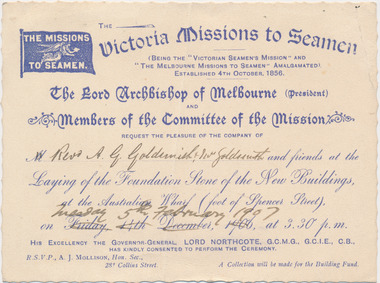
Card - Invitation card, The Victoria Missions to Seamen, 1906
... The original date for the laying of Foundation stone for the first Mission building at Australian Wharf in 1906 had to be changed to the 5th of February 1907 due to industrial action at the Wharves. See scrapbooks and clippings for details. ...The original date for the laying of Foundation stone for the first Mission building at Australian Wharf in 1906 had to be changed to the 5th of February 1907 due to industrial action at the Wharves. See scrapbooks and clippings for details. ...The original date for the laying of Foundation stone for the first Mission building at Australian Wharf in 1906 had to be changed to the 5th of February 1907 due to industrial action at the Wharves. See scrapbooks and clippings for details. Lord Northcote the Governor General officiated. The invitation marks the establishment for the first time at the Australian Wharf official recognition of the need to establish a Mission for seafarers in this location, some six years after presentation of the letter in 1897 from 22 Captains urging and requesting a respectable and convenient facility. Just ten years later the Mission would have to move to an adjacent site and raise funds for yet another Mission building in 1916. A heavy card with crimped edge with commercially printed invitation in cursive scripts from the Archbishop of Melbourne and the Members of the Committee of the Mission. A blue flying angel Missions to Seamen flag is printed in the top left corner. The invitee name is written in sepia ink as is an altered date. Ink inscriptions: the Rev A.G. Goldsmith and Mrs Goldsmith // ; printed date of Friday 14th of December 1906 is crossed out and superscribed in handwritten ink as: Tuesday 5th of February 1907 lord northcote, governor general, rev gurney goldsmith, foundation stone, australian wharf, the melbourne missions to seamen, victorian seamen's mission, 1907, siddeley street, alfred gurney goldsmith, walter richmond butler -
 Port Melbourne Historical & Preservation Society
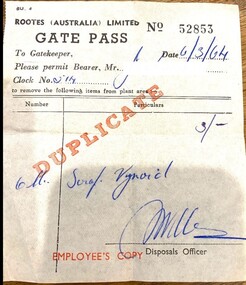
Document - Rootes (Aust) Ltd Gate Pass, 06 Mar 1964
... He then worked on the wharves until retiring in the early 1980's He lived in Cumberlland Road, Port Melbourne, for roughly 60 years....He then worked on the wharves until retiring in the early 1980's He lived in Cumberlland Road, Port Melbourne, for roughly 60 years. ...Donor's father, Geoff JACKSON, worked at Rootes (Australia) Ltd as a cushion maker for several years from 1964. He then worked on the wharves until retiring in the early 1980's He lived in Cumberlland Road, Port Melbourne, for roughly 60 years.Digital copy of a Rootes (Australia) Gate Pass No 514. The Gate Pass allowed the removal from the plant area of 6lbs of Scrap Vynoid.industry - manufacturing, rootes/chrysler, geoff jackson -
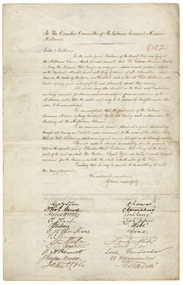 Mission to Seafarers Victoria
Letter - Petition, October November 1897
... We are confident that the good work of the mission is being hampered by its not having such a place near the shipping at the Melbourne wharves. Our crews are at present placed at a great dis advantage through not having an institute more convenient to the scene of their labours than that at Port Melbourne, which, on a very wet or a very hot, is not easily reached. ...The letter petitions the Executive Committee to create a facility on the wharves, "where sailors of every grade could profitably and pleasantly spend their evenings." ...The letter petitions the Executive Committee to create a facility on the wharves, "where sailors of every grade could profitably and pleasantly spend their evenings." ...This document reveals the way in which Mission to Seafarers grew in response to demand. With increased shipping to Australia for all purposes, the need for the then existing Mission to grow to be conveniently located and to accommodate seafarers became increasingly evident. This document also shows the formal nature of documents and petitions in the 1890s and documents the names of twenty-two contemporaneous ships and their respective captains. The Anna, Dharwar and Mermerus arrived in port at the end of July 1897. The Carmanina arrived on the 21 October 1897. The Loch Katrine, at the end of the list, arrived on 5 November 1897. The letter was published in the Argus, 22 December 1897: "APPEAL FOR SEAMEN. TO THE EDITOR OF THE ARGUS. Sir, I beg that in the interests of the Victorian Seamen's Mission you will be kind enough to publish the appended testimony of the ship masters who for many years have been trading to this port, and therefore have had many opportunities of judging the effects of his work. The mission has much need of monetary assistance, and, should any of your numenous leaders deem it worthy of support, the committee would feel most grateful for any help that may be given in this direction. It has been the pleasure of the committee as far as possible to supply the crews of all outward bound steamers and sailing vessels with literature for their use on the voyage. My former appeals through your columns for leading matter have always been liberally responded to, and I trust that should any of our booksellers have any surplus stock of periodicals, religious and secular, illustrated or otherwise, at the end of the year, they will kindly remember the Victorian Seamen's Mission and the sailors. Private individuals also who may have stacks of literature by them, if they would kindly send some to the Seamen's Institute, Beach street, Port Melbourne, would cause the cheering of many a dark and lonely hour in the seamen's life. From 900 to 1.200 parcels have hitherto been given to the sailors and firemen annually by this mission, and we should be extremely grateful to those who would place us in a position to continue such donations in the future. Yours, &c. , E. JAMES, Chaplain to the Mission. Seamen's Institute, Beach street, Port Melbourne, Dec. 10." -------------------------------------------------- "To the Executive Committee of the Victorian Seamen's Mission, Melbourne. "Ladies and Gentleman, "We, the undersigned captains of several ships now lying at the Melbourne wharves think it most desirable that the Victorian Seamen's Mission, being the mission that has for so many years shown a most part their interest in the spiritual, moral, and social well-being of the seamen of all nationalities, shall him on the banks of the Yarra an institute such as that at Port Melbourne, where sailors of every grade could profitably and pleasantly spend their evenings. At almost every other seaport in the world such institutions are being provided for seamen, and we are satisfied from our opinion of the Melbourne public that the matter needs only to be prominently brought under their notice to be accomplished. We are confident that the good work of the mission is being hampered by its not having such a place near the shipping at the Melbourne wharves. Our crews are at present placed at a great dis advantage through not having an institute more convenient to the scene of their labours than that at Port Melbourne, which, on a very wet or a very hot, is not easily reached. If a site could be obtained immediately above the Gasworks but on the other side of Flinders street extension, that is to say, on the lower part of the land on which the Harbour Trust offices are built, it would be most convenient for the shipping on both the north and south side of the river. Trusting that it may be possible to do some thing to meet this long felt want, We suscribe ourselves, Yours respectfully, Geo.H Steven, master ship Dharwar; Thos. Curd, master ship Narcissus; James Horne, master ship Loch Garry; T.Tait, master ship Loch Ryan; T. Nilsen, master ship Hebe; G. Ch Christian, master ship Anna; R.E. Peasley, master ship Seminole; Wm. Martin, master ship Loch Ness; T.C. Martin, master ship Loch Tay; W.H. Bennett, master ship Loch Vennachar; J. Raglan Brodie, master s.s. Warrnambool; James E. Coles, master ship Mermerus; J. H. Walker, master ship Hinemoa; R.J. Johns, master ship Ariel; D. Gorchem (sic. Gerckens), master ship Matador; H. Petersen, master ship Nesaia; Wm. J. Reid, master s.s. Star of New Zealand; A. F. Svhanstrom, master ship Hermes; Alex. Smith, master ship Sophocles; W. Y. Bunn, master ship Carmanian; William Anderson, master ship Loch Katrine."This petition is historically significant as it is documentary evidence of the need for a new facility for seafarers signed and presented by the captains of 21 ships, including several of the sister ships of the Loch Ard. The need for a new facility was a result of changes in shipping and the use of the Melbourne ports in the 1890's and this document supported the pressure on the Harbour offices to finally release land for an appropriate building in the early 20th C.Mounted hand-written petition to the Executive Committee of the Victorian Seaman's Mission Melbourne. The letter petitions the Executive Committee to create a facility on the wharves, "where sailors of every grade could profitably and pleasantly spend their evenings." This portion of the letter takes up three quarters of the document. The remainder has two lists, one of twelve captain's signatures and the other of the names of their ships. The list is continued on the reverse side with an additional nine signatures and corresponding ship names.In cursive handwriting: To The Executive Committee of the Victorian Seamans Mission', / Melbourne / Ladies and Gentlemen / we the undersigned captains....... We subscribe / ourselves respectfully, Captain signatures and names of ships ( NB Ship names in upper case for this entry ): Geo H. Stevens - DHARWAR / Thomas Curd - NARCISSUS; / James Horn - LOCH GARRY / T.Tait - LOCH RYAN ; / T.NIlsen - Hebe ; / G.C. Christians - ANNA ;/ R E Peasley - SEMIOLE ; / William Martin - LOCH NESS ; / T C Martin - LOCH TAY;/ W H Bennett - LOCH VENNUACHAR; / RJ Raglan Brodie - SS WARRNAMBOOL; ; / James E. Coles - MERMERUS; / ( signatures continue overleaf) J H Walker - HINEMORA ; / R J Johns - ARIEL; / D Gorchem - MATADOR; / H Petersen - NESAIA;/ William J Reid - STAR of N. ZELAND [sic] ; / TJ Sohanstrom - HERMES;/ Alex Smith - SOPHOCLES; / W Y Bunn - CARMANIAN;./ William Anderson - LOCH KATRINE;/ Handwritten in red ink on the front of the parchment: "8182" NB The second digit in the number sequence appears to have been written over and could also be a "9", an "8" or a "3". paper Watermark "HERCULES". Prior to conservation and taped to the glass on the reverse side of the parchment was a small piece of paper reading: "Letter written in 1897 and signed between the last week of October and the first week of November." T and C probably stands for Trade and Customs and 8382 is the file no." (H8.4 x W11.8)victoria, melbourne, ships, petition, australia-wharf, captains, signatures, 717-flinders-street-docklands, maritime welfare services, mission to seafarers, seamen's mission, mission to seamen, mermerus, captain coles, sir john coode, loch line, loch ness, loch gary, loch ryan, ss warrnambool, loch tay, loch vennachar, matador, nesaia, d. gerckens, h. petersen, a.f. svhanstrom, hermes, ariel, loch katrine, william anderson, dharwar, narcissus, hebe, anna, hinemoa, sophocles, carmanian, captains' petition -
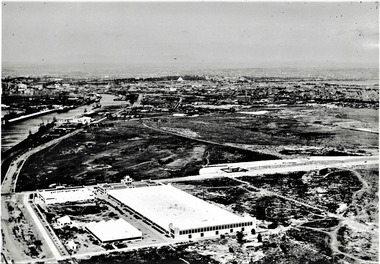 Port Melbourne Historical & Preservation Society
Photograph - Aerial view of Fisherman's Bend circa 1940, circa1940
... The original home of the Victoria Golf Club is shown on the left beside the Yarra River winding towards the city & North & South Wharves. ...The original home of the Victoria Golf Club is shown on the left beside the Yarra River winding towards the city & North & South Wharves. Photograph Aerial view of Fisherman's Bend circa 1940. ...From the collection of Terry KEENAN. The 9 hole golf course known as the Sandridge Golf Club was part of Victorian Golf Clubs until it moved to Cheltenham in 1927. Trotting 'Speedway' located at top right of photograph.Black and white photograph of Fishermans Bend, Port Melbourne, c. 1940 showing General Motors Holden in the foreground. The original home of the Victoria Golf Club is shown on the left beside the Yarra River winding towards the city & North & South Wharves. built environment, fishermans bend, built environment - industrial, general motors-holden, victoria golf club, sport - golf, sport - horse racing -
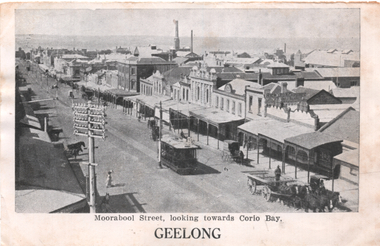 Ballarat Tramway Museum
Photograph, "Moorabool Street looking towards Corio Bay Geelong", c1915
... On the reverse is a photo of the Geelong wharves, with some ships docked on the wharf....On the reverse is a photo of the Geelong wharves, with some ships docked on the wharf. ...Photograph or illustration from a magazine or book with a photograph of a cross bench tram - tram 12 in Moorabool St. Photo taken from an elevated position and looking towards Corio Bay. Has some horse-drawn carts in the view. The chimney of the MESCo power station can be seen. On the reverse is a photo of the Geelong wharves, with some ships docked on the wharf.Yields information about the view of Moorabool St c1915.Black and white photographs from an illustration.tramways, trams, geelong, moorabool st, cross bench tram, geelong wharf, tram 12, geelong tramway -
Port Melbourne Historical & Preservation Society
Photograph - Yarra River, Ron Laing, 1990s
... The Bolte Bridge which caused this closure of Victoria Dock, North and South Wharves is covered in photos 1319.01-.35....The Bolte Bridge which caused this closure of Victoria Dock, North and South Wharves is covered in photos 1319.01-.35. yarra river built environment transport - shipping ron laing A set of 47 colour photogaphs of the Yarra River at various locations from the old Sandridge Railway Bridge westward to the power house at Newport Photograph Yarra River Ron Laing ...Part of Ron Laing's collection of photographs recording Port Melbourne over a thirteen year period. Donated to the PMH&PS by the photographer. nb Includes photographs of Victoria Dock in the period of time after the commercial shipping had gone but before the start of the proposed high-rises. The Bolte Bridge which caused this closure of Victoria Dock, North and South Wharves is covered in photos 1319.01-.35.A set of 47 colour photogaphs of the Yarra River at various locations from the old Sandridge Railway Bridge westward to the power house at Newportyarra river, built environment, transport - shipping, ron laing -
 Melbourne Tram Museum
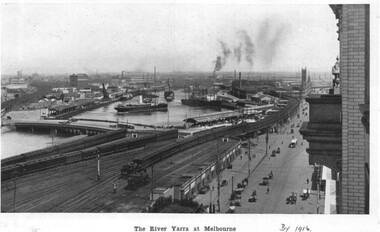
Photograph - Illustration, c1916
... Illustration from a photograph reproduced in a magazine of the river Yarra, Flinders St railway yard, the viaduct, the swing basin, the wharves and Queens Bridge. Has a number of cable cars and trains in the view. ...Trams tramways Flinders St Railways Shipping Cable Trams in ink in bottom right hand comer "By 1916" Illustration from a photograph reproduced in a magazine of the river Yarra, Flinders St railway yard, the viaduct, the swing basin, the wharves and Queens Bridge. Has a number of cable cars and trains in the view. ...Illustration from a photograph reproduced in a magazine of the river Yarra, Flinders St railway yard, the viaduct, the swing basin, the wharves and Queens Bridge. Has a number of cable cars and trains in the view. Taken prior to the construction of the second or duplicate viaduct which was completed during 1915. Construction of the second viaduct on the south side of the original can be seen.in ink in bottom right hand comer "By 1916"trams, tramways, flinders st, railways, shipping, cable trams -
 Mission to Seafarers Victoria
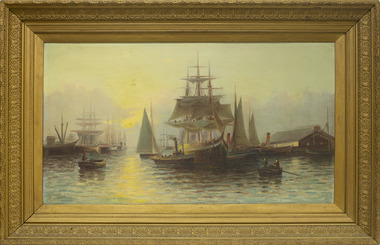
Painting - Oil painting, Evening on the Yarra, c. 1898
... ...wharves...(or maybe a transcrit or print error and this is the same person) The painting shows a busy Yarra River with sailing ships at dock with smaller sailing vessels and row boats at the end of the 19th century. sailing ship docks wharves artwork yarra river john white artwork-paintings j. white sheds Lower front left corner: signature (possibly) J. ...The subject is similar to John Ford Paterson's painting also called "Evening on the Yarra'. The artiste signed J. White on the left bottom corner. A mention of a painting called "Evening on the Yarra" by John Whyte (mispelling or not?) is made in The Age in 1898 about the Annual Exhibition of the Melbourne Art Club. There are different leads for the name : it could be John Goldsworthy White, an amateur marine painter, or J.S. White, a marine painter active in the 1890s and member of the Victorian Sketching Club. (or maybe a transcrit or print error and this is the same person) Marine artLarge oil painting of sailing ships at dock with smaller sailing vessels and row boats on stretched canvas in elaborate gilt Victorian frame. Unglazed Steel eyelets and hanging wire Lower front left corner: signature (possibly) J. Whitesailing ship, docks, wharves, artwork, yarra river, john white, artwork-paintings, j. white, sheds -
Port Melbourne Historical & Preservation Society
Journal (collection) - Shipping Records, Arrivals & Departures in the Port of Melbourne, Glen Stuart, 1988 - 2016
... Until 2001 the author recorded the details of ships entering & leaving from personal observation & newspaper listings. When access to wharves was restricted from 2002, the author also came to rely on information from his ship to shore radio and later the Port of Melbourne website. ...Transport - Shipping Piers and Wharves Glen STUART A collection of 29 Journals begun in June 1998 record daily shipping movements in the Port of Melbourne until November 2016, Journal Shipping Records, Arrivals & Departures in the Port of Melbourne. ...Researched & recorded by Glen Stuart.A personal record of ships visiting the Port of Melbourne.Chronological orderShip visits hand-written in a collection of pre-printed diaries ranging in size from A4 (27 journals) to A6 (2 journals). transport - shipping, piers and wharves, glen stuarttransport - shipping, piers and wharves, glen stuart -
 Mission to Seafarers Victoria
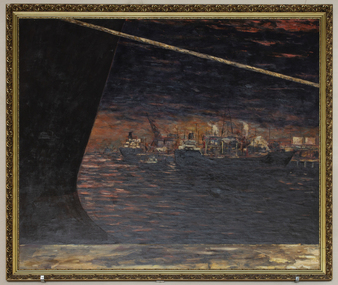
Painting, Ian Parry, Night Time at North Wharf, 1990
... ...wharves...P & O Nedlloyd organisation was a strong supporter of the MIssion and the Annual Maritime Art Prize established here. p & o nedloyd shipping melbourne ports docklands wharfside wharves ian parry maritime art acta maritime art prize artwork-paintings Signature and date bottom right corner: "Parry 89" Large moulded gilt wood frame, non glazed painting of shipping, oil on canvas Night Time at North Wharf Painting Painting Ian Parry ...Ian Parry (born 1947) is a Melbourne-born artist living in Tasmania, active since 1974 and collected by National and State Collections. He was winner of the 1990 ACTA Maritime art Prize. He also took part in 2006, to the ANL Art Prize organised each year at the Mission since 2003. In his biography on his website: Ian Parry was born into a family of seafaring descent. His extensive career as a respected practising artist and teacher, has uniquely included a fishing fleet apprenticeship and years as a single handed fisherman in Bass Strait. "In the early 70's when I first showed at the renowned Powell St gallery in Melbourne, the paintings were large, abstract, with allusion to the experience of the world of water, sky and land. My visual world has always been permeated with the wet parts of this place and continues to be so to this day. Maritime and geological charts and the daily necessity of plotting a course, appear in paintings where necessary, as a means of getting a schematic representation of the subject into play, trying to free the work from the tyranny of the horizon line but frequently returning. Now-a-days I am returning to abstraction, making paintings that allow me free rein with colour and composition, aiming for a sense of permanence and independence in each work." Maritime ArtLarge moulded gilt wood frame, non glazed painting of shipping, oil on canvasSignature and date bottom right corner: "Parry 89"p & o nedloyd, shipping, melbourne ports, docklands, wharfside, wharves, ian parry, maritime art, acta maritime art prize, artwork-paintings -
 Kew Historical Society Inc
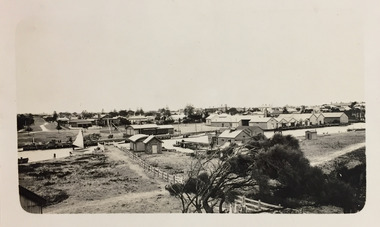
Photograph - Wharves and harbour on the Moyne River at Port Fairy, c.1926
... In what would appear to be one of his rare trips to coastal Victoria, Henry Christian took this photo of the wharves and harbour on the Moyne River at Port Fairy in c.1926. ...The photograph shows the buildings along the river and parts of the township in the distance. Photograph Wharves and harbour on the Moyne River at Port Fairy ...Henry Beater Christian (1886-1962) , was a descendant of one of the earliest settler families in Kew. Employed at the Kew Asylum as a 'public servant', he was a skilled amateur photographer, photographing numerous scenes in Kew and on his travels around Victoria. The majority of his photographs date from 1916 to 1929. His finest photographs are housed in two photograph albums. Digital copy of a photograph from page 24 of the 47-page photograph album containing 261 gelatinous silver images, loaned by Diane Washfold with permission given to digitise and hold a copy in our collection. In what would appear to be one of his rare trips to coastal Victoria, Henry Christian took this photo of the wharves and harbour on the Moyne River at Port Fairy in c.1926. The photograph shows the buildings along the river and parts of the township in the distance. henry beater christian (1886-1962), landscape photography, christian-washfold collection, photograph albums, moyne river, port fairy (vic.) -
 Mission to Seafarers Victoria
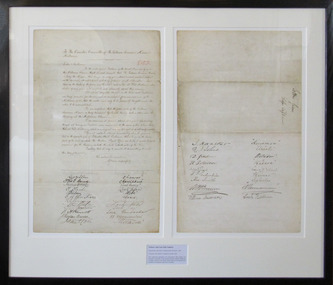
Print - Reproduction, Petition, The Photography Department (Jeremy Dillon), Captains' Petition, 2016
... We are confident that the good work of the mission is being hampered by its not having such a place near the shipping at the Melbourne wharves. Our crews are at present placed at a great dis advantage through not having an institute more convenient to the scene of their labours than that at Port Melbourne, which, on a very wet or a very hot, is not easily reached. ...We are confident that the good work of the mission is being hampered by its not having such a place near the shipping at the Melbourne wharves. Our crews are at present placed at a great dis advantage through not having an institute more convenient to the scene of their labours than that at Port Melbourne, which, on a very wet or a very hot, is not easily reached. ...This is a reproduction of the original 1897 Captains' petition to build a Central Institute on the Yarra river. "To the Executive Committee of the Victorian Seamen's Mission, Melbourne. "Ladies and Gentleman, "We, the undersigned captains of several ships now lying at the Melbourne wharves think it most desirable that the Victorian Seamen's Mission, being the mission that has for so many years shown a most part their interest in the spiritual, moral, and social well-being of the seamen of all nationalities, shall him on the banks of the Yarra an institute such as that at Port Melbourne, where sailors of every grade could profitably and pleasantly spend their evenings. At almost every other seaport in the world such institutions are being provided for seamen, and we are satisfied from our opinion of the Melbourne public that the matter needs only to be prominently brought under their notice to be accomplished. We are confident that the good work of the mission is being hampered by its not having such a place near the shipping at the Melbourne wharves. Our crews are at present placed at a great dis advantage through not having an institute more convenient to the scene of their labours than that at Port Melbourne, which, on a very wet or a very hot, is not easily reached. If a site could be obtained immediately above the Gasworks but on the other side of Flinders street extension, that is to say, on the lower part of the land on which the Harbour Trust offices are built, it would be most convenient for the shipping on both the north and south side of the river. Trusting that it may be possible to do some thing to meet this long felt want, We suscribe ourselves, Yours respectfully, Geo.H Steven, master ship Dharwar; Thos. Curd, master ship Narcissus; James Horne, master ship Loch Garry; T.Tait, master ship Loch Ryan; T. Nilsen, master ship Hebe; G. Ch Christian, master ship Anna; R.E. Peasley, master ship Seminole; Wm. Martin, master ship Loch Ness; T.C. Martin, master ship Loch Tay; W.H. Bennett, master ship Loch Vennachar; J. Raglan Brodie, master s.s. Warrnambool; James E. Coles, master ship Mermerus; J. H. Walker, master ship Hinemoa; R.J. Johns, master ship Ariel; D. Gorchem (sic. Gerckens), master ship Matador; H. Petersen, master ship Nesaia; Wm. J. Reid, master s.s. Star of New Zealand; A. F. Svhanstrom, master ship Hermes; Alex. Smith, master ship Sophocles; W. Y. Bunn, master ship Carmanian; William Anderson, master ship Loch Katrine."Framed and mounted reproduction of Captains' petitionpetition, seamen's mission, yarra river, captains, victoria, melbourne, ships, australia-wharf, signatures, 717-flinders-street-docklands, maritime welfare services, mission to seafarers, mission to seamen, mermerus, captain coles, sir john coode, loch line, loch ness, loch gary, loch ryan, ss warrnambool, loch tay, loch vennachar, matador, nesaia, d. gerckens, h. petersen, a.f. svhanstrom, hermes, ariel, loch katrine, william anderson, dharwar, narcissus, hebe, anna, hinemoa, sophocles, carmanian, early origins, 2016, exhibitions
