
Showing 43 items matching "wheat storage"
-
 Glenelg Shire Council Cultural Collection
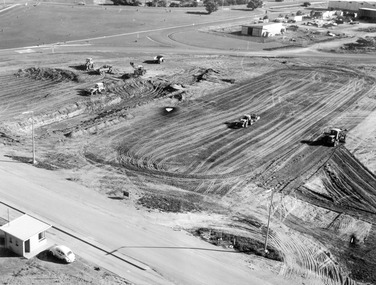
Photograph - Photograph - construction of wheat storage, Portland, c. 1970
... Photograph - construction of wheat storage, Portland...... wheat storage...Black and white photograph of trucks at construction site. Wheat storage site construction...Front: (no inscriptions) Back: Wheat storage site, June 8th (pencil, upper left)...Wheat storage site construction Photograph Photograph - construction of wheat storage, Portland ...Port of Portland Authority archivesFront: (no inscriptions) Back: Wheat storage site, June 8th (pencil, upper left)port of portland archives, construction, wheat storage -
 Glenelg Shire Council Cultural Collection
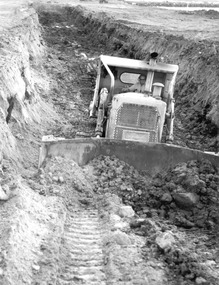
Photograph - Photograph - wheat storage construction, Portland, c. 1970
... Photograph - wheat storage construction, Portland...... wheat storage...Black and white photograph of grader in trench. Wheat storage construction....Front: (no inscriptions) Back: Northern Trench, Wheat Storage Site, June 11th (pencil, upper left)...Wheat storage construction. Photograph Photograph - wheat storage construction, Portland ...Port of Portland Authority archivesFront: (no inscriptions) Back: Northern Trench, Wheat Storage Site, June 11th (pencil, upper left)port of portland archives, wheat storage, construction -
 Glenelg Shire Council Cultural Collection
Photograph - Photograph - wheat storage, c. 1970
... Photograph - wheat storage...... wheat storage...Construction of wheat storage....Front: (no inscriptions) Back: Wheat Storage Site, June 8th (pencil, upper left)...Construction of wheat storage. Photograph Photograph - wheat storage ...Port of Portland Authority archivesFront: (no inscriptions) Back: Wheat Storage Site, June 8th (pencil, upper left)port of portland archives, wheat storage, construction -
 Glenelg Shire Council Cultural Collection
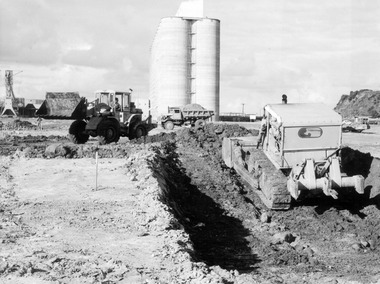
Photograph - Photograph - wheat storage construction, c. 1970
... Photograph - wheat storage construction...... wheat storage...Preliminary earthworks, wheat storage site....Front: (no inscriptions) Back: Preliminary earthworks, wheat storage site/ June 4th (pencil, upper left)...Preliminary earthworks, wheat storage site. Photograph Photograph - wheat storage construction ...Port of Portland Authority archivesFront: (no inscriptions) Back: Preliminary earthworks, wheat storage site/ June 4th (pencil, upper left)port of portland archives, wheat storage, portland harbour, construction -
Glenelg Shire Council Cultural Collection
Photograph - Photograph - wheat storage construction, Portland, c. 1970
... Photograph - wheat storage construction, Portland...Black and white photograph of shovel in trench. Wheat storage construction at Portland harbour....Front: (no inscriptions) Back: Southern Trench, wheat storage site, June 11th (pencil, upper left)...Wheat storage construction at Portland harbour. ...Port of Portland Authority archivesFront: (no inscriptions) Back: Southern Trench, wheat storage site, June 11th (pencil, upper left)port of portland archives -
Glenelg Shire Council Cultural Collection
Photograph - Photograph - wheat storage construction, Portland, c. 1970
... Photograph - wheat storage construction, Portland...Foundation testing, wheat storage site....Front: (no inscriptions) Back: Foundation testing, wheat storage, June 11th (pencil, upper left)...Foundation testing, wheat storage site. Photograph Photograph - wheat storage construction, Portland ...Port of Portland Authority archivesFront: (no inscriptions) Back: Foundation testing, wheat storage, June 11th (pencil, upper left)port of portland archives, construction -
 Bendigo Historical Society Inc.
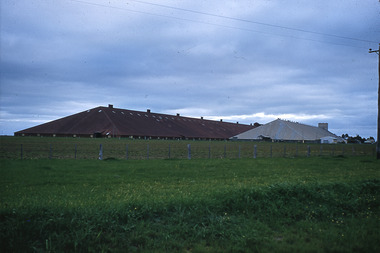
Slide - Mouat Crawford Collection: Farming Life in the Wimmera, 1960s
... ...wheat storage...Bag Wheat Storage Shed at Murtoa...BHS Collection farming wimmera wheat wheat storage murtoa mouat crawford collection Bag Wheat Storage Shed at Murtoa Slide Mouat Crawford Collection: Farming Life in the Wimmera ...BHS CollectionBag Wheat Storage Shed at Murtoafarming, wimmera, wheat, wheat storage, murtoa, mouat crawford collection -
 Glenelg Shire Council Cultural Collection
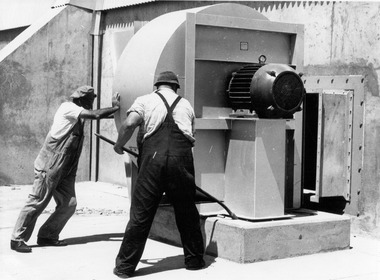
Photograph - Photograph - machinery at Portland harbour, c. 1970
... ... wheat storage...Possible the construction of the wheat storage site....Possible the construction of the wheat storage site. Photograph Photograph - machinery at Portland harbour ...Port of Portland Authority archivesFront: (no inscriptions) Back: [instructions for enlargement and cropping on back in lead and pale blue pencil]port of portland archives, construction, wheat storage -
 Glenelg Shire Council Cultural Collection
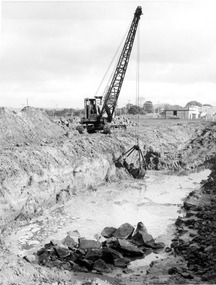
Photograph - Photograph - wheat storage construction, Portland, c. 1970
... Photograph - wheat storage construction, Portland...Photograph Photograph - wheat storage construction, Portland ...Port of Portland Authority archivesFront: (no inscriptions) Back: Dragline on southern trench, wheat site/ June 11th (pencil, upper left)port of portland archives -
Bendigo Historical Society Inc.
Document - BROADCASTING STATION 3CV, MARYBOROUGH, 2 March, 1956
... build silos for wheat storage capacity is 100...In 1939 the firm began to build silos for the storage of bulk wheat and the present storage capacity is 100,000 bushels. 1944 power was changed from steam to electricity. ...Willersdorf and Forbes build silos for wheat storage capacity is 100 000 bushels. 1944 power was changed from steam to electricity. 20 sacks an hour. 1938 a chaff mill was built best in Victoria. ...Broadcasting Station 3CV, Maryborough. A souvenir of the opening of the New Studios and Offices of Central Victoria Broadcasters Pty Ltd. March 2nd, 1956. Established 1956, offices in Burke Street, opening coincides with the stations 21st birthday, March 2 for the former celebration, October 26 for the latter. Coverage included Bendigo, Ballarat, Daylesford, Castlemaine and Maryborough. 3CV plays active part in assisting charities and hospitals at Maryborough, Daylesford, Maldon and Dunolly. Active Women's Radio Club with branches in country centres adds strength to station's charitable efforts. Opening 3CV's new premises will widen the scope of the station's charitable efforts, and stronger link with Australian Commercial Broadcasting stations. Writer Harold V Nunn writes history of district of Mayborough. Manager Ken J Parker, Central Victoria Broadcasters Pty. Ltd. The Souvenir brochure also covers topics such as: deep lead mining. WWI. Houses being pulled down. New settlements of Mildura. Secondary Industries. Bowenvale, Alma, Majorca, Craigie, Amherst, Adelaide Lead, Havelock, Bet Bet, Bently. Primary production and a railway staff of approximately 150. Maryborough a little town without a future. Coal fields at Wonthaggi. 1917 a public meeting was convened in an effort to stem the tide of adversity. Mayor George Frost, M.L.A., decision to form a Progress Association, a policy of secondary industry was decided upon and committees were appointed, James L Drew much credit is due. Maryborough's move for rejuvenation was revolutionary, because apart from Ballarat, Bendigo and Geelong, it was regarded as so much presumption that industry could be expected to function with success in a country town. Governments were unsympathetic. Maryborough & district people showed determination to succeed and their faith in their town. Employment and economic security provided by the industries outweighed the debt. Maryborough's general position is that it is no longer dependent upon one particular phase of activity. The first of the industries to be formed in 1918 was the Butter Factory. The nearer dairy companies did not take kindly to the prospect of another opposition company taking supplies from their districts, and in the first few years of establishment completion made the going hard for the management. But adopting a conservative policy and placing all profits to reserve I the first six years of operation headway was gradually made. Thus it was a red letter day for the company in 1925 when the first dividend of 5 percent was paid.1955 dividend of 10 per cent. Operating it's own trucks the dairy serviced local dairymen up to 40 miles. Maryborough Knitting mills est. 1923, having transferred from Clunes. Out bid Ballarat and Bendigo to the industry. The mill has what is probably the largest circular underwear plant in the Commonwealth, which is conservatively valued at 198,913 pounds. It produces between four and five million garments each year, worth over one million pounds. The company has established subsidiary mills at Dunolly, Talbot and Avoca. The company also assisted in the establishment of the Interknit Hosiery Co. Ltd., Clunes. The Maryborough Flour Mills is the second oldest of Mayborough's industries. It was built by Mr Cadwallader over 70 years ago. It was later sold to Mr. A Land and then to Jas. Minifie & Co. It had a somewhat 'in-and -out' existence until purchased in 1923 by Messrs. Willersdorf and Forbes, of Eddington. In 1939 the firm began to build silos for the storage of bulk wheat and the present storage capacity is 100,000 bushels. 1944 power was changed from steam to electricity. The mill has an out put of 20 sacks an hour. 1938 a chaff mill was built, and now is regarded as one of the best in Victoria. Its output in one year of approximately 6,800 tons is a State record for a single cutter. During this 30 year period Patience and Nicholson Limited has grown with Maryborough and is now one of the major key industries of Australia. The P&N brand covers precision tools - taps, dies and twist drills - indispensable to the country's economy, and quality is acknowledged equally by an air craft factory in Canada, a dockyard in Thailand, a railway workshop in New Zealand, no less than by our own Australian industries. Maryborough can be proud of the part played by P&N in war when, geared to the needs of the times, it poured countless millions of tools into defence factories and to the armed forces of the Allies, and now in peace when it is providing, hydro-electric undertakings and the manufacture of cars and tractors. From 1858, W Phelan & Sons Pty Ltd has made phenomenal and spectacular growth, becoming incorporated as a private company in 1929. It is without doubt the greatest private development in the history of Maryborough. 1940 joinery manufacture was commenced. The company entered the Ready Built Housing field in `950 - and in 1951 established a factory at Cairns, Northern Queensland to overcome the manufacturing difficulties being experienced due to the shortage of plywood in Victoria. Present activities include: Ready Built Housing Factory, on-site building, a modern joinery, timber yard, drying kilns, etc., and plumbing & electrical & engineering services, a door and panel factory at Cairns, retail hardware store, Melbourne Sales Depot. Hedges & Bell Pty Ltd were est 1945, with a staff of 40 employees are the largest printing firm outside the metropolitan area. The branch of Premier Wireworks is a contribution made by the decentralisation policy of the State.event, official, celebration, broadcasting station 3cv, maryborough. a souvenir of the opening of the new studios and offices of central victoria broadcasters pty ltd. march 2nd, 1956. established 1956, offices in burke street, 21st birthday. coverage bendigo, ballarat, daylesford, castlemaine maryborough. assisting charities and hospitals maldon and dunolly. women's radio club opening 3cv's new premises australian commercial broadcasting stations. writer harold v nunn writes history of district of mayborough. manager ken j parker, central victoria broadcasters pty. ltd. souvenir brochure: deep lead mining. wwi. houses pulled down. new settlements. primary production railway staff. coal fields wonthaggi. 1917 a public meeting was convened in an effort to stem the tide of adversity. mayor george frost, m.l.a., form a progress association, policy of secondary industry, james l drew rejuvenation was revolutionary, employment and economic security. the first of the industries to be formed in 1918 was the butter factory. thus it was a red letter day for the company in 1925 when the first dividend of 5 percent was paid.1955 dividend of 10 per cent. operating it's own trucks serviced local dairymen. maryborough knitting mills est. 1923 largest circular underwear plant in the commonwealth. established subsidiary mills at dunolly, talbot, avoca. interknit hosiery co. ltd., clunes. the maryborough flour mills it was built by mr cadwallader. mr. a land jas. minifie & co. messrs. willersdorf and forbes, build silos for wheat storage capacity is 100, 000 bushels. 1944 power was changed from steam to electricity. 20 sacks an hour. 1938 a chaff mill was built, best in victoria. patience and nicholson limited the p&n precision tools - taps, dies and twist drills. war, geared to the needs of the times, countless millions of tools into defence factories the armed forces of the allies, hydro-electric undertakings and the manufacture of cars and tractors. from 1858, w phelan & sons pty ltd, incorporated 1929. 1940 joinery manufacture. ready built housing field in 1950 - 1951 established a factory at cairns, northern queensland to overcome the manufacturing difficulties being experienced due to the shortage of plywood in victoria. present activities: ready built housing factory, on-site building, a modern joinery, timber yard, drying kilns, etc., and plumbing & electrical & engineering services, a door and panel factory at cairns, retail hardware store, melbourne sales depot. hedges & bell pty ltd were est. 1945, with a staff of 40 employees are the largest printing firm outside the metropolitan area. the branch of premier wireworks is a contribution made by the decentralisation policy of the state. -
Glenelg Shire Council Cultural Collection
Photograph - Photograph - wharf construction, Portland, n.d
... ... wheat storage...Port of Portland Authority Archieves Port of Portland Archives construction wheat storage Black & white photo showing wharf construction. ...Port of Portland Authority Archievesport of portland archives, construction, wheat storage -
Glenelg Shire Council Cultural Collection
Photograph - Photograph - construction site for grain terminal, 1964
... ... wheat storage...Port of Portland Authority archives Port of Portland Archives construction wheat storage Front: (no inscriptions) Back: P.G.5 (blue pen, upper left) Black and white photograph of metal framing erected on side of pier. ...Port of Portland Authority archivesFront: (no inscriptions) Back: P.G.5 (blue pen, upper left)port of portland archives, construction, wheat storage -
 Charlton Golden Grains Museum Inc
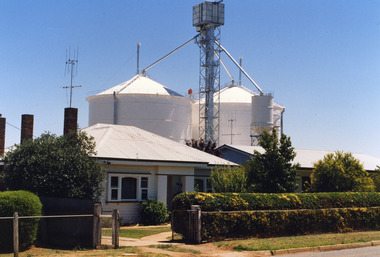
Photograph, Storage Silos Charlton Victoria 3525
... ...Wheat Storage Silos...Basil & Esme Avery Wheat Storage Silos Storage Silos Charlton Victoria 3525 Photograph ...basil & esme avery, wheat storage silos -
 Sunbury Family History and Heritage Society Inc.
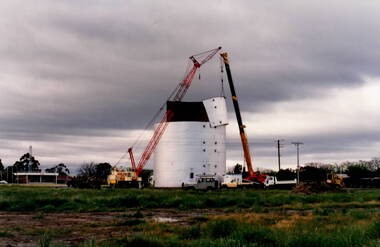
Photograph, Wheat silo
... Wheat storage...The wheat silo was erected on railway land on the west side of the railway line at Sunbury from approx 1970s - 1980s. It served as a grain storage...The wheat silo is a reminder of past agricultural industries that were carried out in Sunbury. Wheat storage Silos Sunbury Railway Station Evans Street A non-digital photograph of two trucks and a crane dismantling a metal wheat silo, which has been standing in an open area. ...The wheat silo was erected on railway land on the west side of the railway line at Sunbury from approx 1970s - 1980s. It served as a grain storage provision for the local cereal farmers. With the expansion of the shopping centre the silo was dismantled to provide commercial development on the west side of the railway line.The wheat silo is a reminder of past agricultural industries that were carried out in Sunbury.A non-digital photograph of two trucks and a crane dismantling a metal wheat silo, which has been standing in an open area. A CFA pavilion is visible in the distance.wheat storage, silos, sunbury railway station, evans street -
 Bendigo Historical Society Inc.
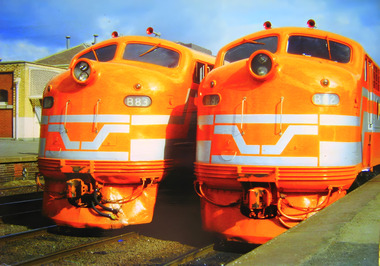
Photograph - David Bernoth Rail Photographs - Korong Vale, March 2012
... Loaded wheat could be dispatched to either Bendigo where it would travel on to Melbourne and Geelong or it could go to Dunnoly, a large inland wheat storage facility. It had two signalboxes, (A box controlled 2 sets of interlocked gates), loco depot and 8 track marshalling yard as well as the usual goods shed, livestock loading facilities and weighbridge. ...Loaded wheat could be dispatched to either Bendigo where it would travel on to Melbourne and Geelong or it could go to Dunnoly, a large inland wheat storage facility. It had two signalboxes, (A box controlled 2 sets of interlocked gates), loco depot and 8 track marshalling yard as well as the usual goods shed, livestock loading facilities and weighbridge. ...Korong Vale was a speck of a town with a population of just 238 people in 1981 and most of them would have been railway employees. It was the junction for the Sea Lake and Robinvale lines, during wheat season it was common to send relieving crews there to cope with the heavy traffic. Loaded wheat could be dispatched to either Bendigo where it would travel on to Melbourne and Geelong or it could go to Dunnoly, a large inland wheat storage facility. It had two signalboxes, (A box controlled 2 sets of interlocked gates), loco depot and 8 track marshalling yard as well as the usual goods shed, livestock loading facilities and weighbridge. Perusal of the signal diagrams (link above) will show the extent of the yard tracks. It all ended in 1983 when practically everything you see in the following photos was demolished. About the only structure now remaining is the water tank on the down side of the Vernon street level crossing.DVD. David Bernoth Rail photographs - Six Photos This item contains the following photos: 6847.2a Colour photo of two diesels Nos. 883 and 882 at a station 6847.2b Black and white photo of a sign at Korong Vale railway station. 6847.c Colour photo of Korong Vale A Signal Box and the level crossing gates 6847.2d Black and white photo of a loco van at Korong Vale 6847.2e Black and white photo of Workman's Vehicle at Korong Vale 6847.2f Black and white photo of the top front view of Engine 761bendigo, railways, david bernoth collection, korong vale -
Bendigo Historical Society Inc.
Administrative record - Commercial Egg Producers' Association of Victoria (CEPA) Central Council Correspondence, 1978
... The key points are:Purpose: The association is inquiring about the possibility of submitting evidence to the Beef and Meat Enquiry. 8504.34e This document is a formal inquiry from the Central Council of the C.E.P.A. to the Australian Wheatgrowers Federation regarding wheat storage for egg producers near Bendigo. The key points are:The Central Council is requesting information about arrangements for holding wheat for egg producers within 40 km of Bendigo. 8504.34f A recommendation letter made to submit information to the Senate Standing Committee on National Resources regarding the adequacy of quarantine and control measures for protecting Australia's pastoral industries from exotic livestock and plant diseases. 8504.34g The document is a letter from the Commercial Egg Producers' Association of Victoria to the Victorian Egg Marketing Board, expressing concerns about rumored changes to payment schedules for egg producers. 8504.34h The document is a protest letter from an association representing small poultry producers regards Rising Government Charges and License Fees 8504.34i This document to the Department of agriculture highlights concerns from a conference regarding the insufficient penalties for non-compliance with the Hen Quota regulations in Victoria. 8504.34j This document is a formal correspondence dated July 17, 1978, from K. ...The key points are:Purpose: The association is inquiring about the possibility of submitting evidence to the Beef and Meat Enquiry. 8504.34e This document is a formal inquiry from the Central Council of the C.E.P.A. to the Australian Wheatgrowers Federation regarding wheat storage for egg producers near Bendigo. The key points are:The Central Council is requesting information about arrangements for holding wheat for egg producers within 40 km of Bendigo. 8504.34f A recommendation letter made to submit information to the Senate Standing Committee on National Resources regarding the adequacy of quarantine and control measures for protecting Australia's pastoral industries from exotic livestock and plant diseases. 8504.34g The document is a letter from the Commercial Egg Producers' Association of Victoria to the Victorian Egg Marketing Board, expressing concerns about rumored changes to payment schedules for egg producers. 8504.34h The document is a protest letter from an association representing small poultry producers regards Rising Government Charges and License Fees 8504.34i This document to the Department of agriculture highlights concerns from a conference regarding the insufficient penalties for non-compliance with the Hen Quota regulations in Victoria. 8504.34j This document is a formal correspondence dated July 17, 1978, from K. ...The Commercial Egg Producers' Association of Victoria was active by the 1930s, engaging in industry management and lobbying.The Commercial Egg Producer's Association (CEPA) had branches in Bendigo, South Bendigo, Eaglehawk, Wedderburn, Murrabit and Euroa.CEPA Commercial Egg Producer's Association (Bendigo Region) correspondence, for the year 1978. This item includes the following documents: 8504.34a The Commercial Egg Producers' Association of Victoria conference agenda December 1978 8504.34b Notice of half yearly Conference Dec 1978 8504.34c A letter congratulating Mr. Tom Austin on his appointment to the Cabinet. 8504.34d A formal letter from the Secretary of an association, K. Fitzgibbon, addressed to the Chairman of the Beef and Meat Enquiry. The key points are:Purpose: The association is inquiring about the possibility of submitting evidence to the Beef and Meat Enquiry. 8504.34e This document is a formal inquiry from the Central Council of the C.E.P.A. to the Australian Wheatgrowers Federation regarding wheat storage for egg producers near Bendigo. The key points are:The Central Council is requesting information about arrangements for holding wheat for egg producers within 40 km of Bendigo. 8504.34f A recommendation letter made to submit information to the Senate Standing Committee on National Resources regarding the adequacy of quarantine and control measures for protecting Australia's pastoral industries from exotic livestock and plant diseases. 8504.34g The document is a letter from the Commercial Egg Producers' Association of Victoria to the Victorian Egg Marketing Board, expressing concerns about rumored changes to payment schedules for egg producers. 8504.34h The document is a protest letter from an association representing small poultry producers regards Rising Government Charges and License Fees 8504.34i This document to the Department of agriculture highlights concerns from a conference regarding the insufficient penalties for non-compliance with the Hen Quota regulations in Victoria. 8504.34j This document is a formal correspondence dated July 17, 1978, from K. Fitzgibbon (Secretary) to Mr. J. Bourchier at Hills Bazaar, Bendigo. 8504.34k This document is a formal letter from K. Fitzgibbon (Secretary) to Mr. D. McClure, M.L.A., enclosing copies of two letters previously sent to Mr. Wishart, Director General of the Department of Agriculture. The correspondence follows a recent conference and is intended to keep Mr. McClure informed of communications with the Department of Agriculture. 8504.34l This document is a formal letter dated July 17, 1978, from K. Fitzgibbon (Secretary) to Mr. F. Grimwade, M.L.A. 8504.34m This document is a formal letter from K. Fitzgibbon (Secretary) to Mr. W. Ebery, M.L.A., dated July 17, 1978. The main points are:The letter transmits copies of two letters that were sent to Mr. Wishart, Director General of the Department of Agriculture. 8504.34n This document is a formal correspondence dated July 17, 1978, from K. Fitzgibbon (Secretary) to Mr. B. Reid, M.L.C. The key points are:The letter encloses copies of two letters previously sent to Mr. Wishart, Director General of the Department of Agriculture. 8504.34o This document is a formal letter from K. Fitzgibbon (Secretary) to Mr. S. McDonald, dated July 17, 1978. The key points are:The letter serves as a cover note, enclosing copies of two letters sent to Mr. Wishart, Director General of the Department of Agriculture. 8504.34p This document is a formal inquiry from the Poultry Industry Association to the Diagnostic Centre regarding the establishment of a Liaison Committee. A panel of representatives from the Poultry Industry Association is provided for the committee, including Broadbent, J. Scott, R. Stephens, and Fitzgibbon. 8504.34q The document is a letter from the Commercial Egg Producers Association of Victoria, advocating for the introduction of a standardized Stock Feed Wheat Price across Australia 8504.34r The document provides a contact and organizational listing for the Commercial Egg Producers' Association of Victoria. 8504.34s The document is a formal letter from the Commercial Egg Producers' Association of Victoria to the Grains Division of the Victorian Farmers' Union 8504.34t This document is a formal letter from the Commercial Egg Producers' Association of Victoria, addressed to the Minister of Agriculture, nominating candidates for vacancies on the Victorian Egg Marketing Board. 8504.34u Meeting Announcement of the annual Central Council meeting 8504.34v The document outlines the agenda for a commercial egg producers' conference, highlighting several industry concerns and proposals 8504.34w This document is a letter from the Secretary of the Commercial Egg Producers Association of Victoria to the N.S.W. Egg Marketing Board. Concern about N.S.W. egg quotas - The Association believes N.S.W. has not reduced its egg quotas to the appropriate level 8504.34x The letter is a protest regarding the Victorian Egg Marketing Board's decision to transfer the Sympag License at Kangaroo Flat to Crystal Egg Co. in Bendigo. 8504.34y The document is a formal letter from an association to the Victorian Egg Marketing Board, requesting a review and potential increase in the prices for 2nd grade eggs. 8504.34z The Commercial Egg Producers Association requests that Agricultural Officers receive periodic refresher training, specifically for procedures like blood sampling. 8504.34aa This document is a formal complaint from an association addressed to the manager of Crystal Egg Co. The association is concerned that farmers are not receiving their own fillers back after grading. Fillers from one farm may be returned to another farm, rather than to their original owner.The association highlights a potential disease risk if fillers are mixed between farms. 8504.34ab The letter is a formal complaint addressed to the Secretary of the Victorian Egg Marketing Board. The association is concerned that farmers are not receiving their own fillers back after grading. Fillers from one farm may be returned to another farm, rather than to their original owner.The association highlights a potential disease risk if fillers are mixed between farms. 8504.34ac The document is a formal letter from the Commercial Egg Producers Association to the Victorian Egg Marketing Board. The key points are:The Association recommends that all fertile eggs be classified as second quality. This grading is suggested as a precautionary measure to protect market standards. 8504.34ad The document is a formal letter from the Secretary of the Commercial Egg Producers Association of Victoria to the Minister of Agriculture. Farmers are frustrated by the excessive amount of statistical forms they are required to complete. 8504.34ae The document is a formal letter proposing the establishment of a Liaison Committee at the Diagnostic Centre. 8504.34af The document is a formal letter addressing the need for improved egg unloading facilities at grading floors in Bendigo. The Central Council of the Commercial & Producers Association of Victoria discussed concerns about unloading facilities at two grading floors in Bendigo. 8504.34ag Minutes from the the association's half yearly Conference Dec 1978 8504.34ah Minutes from the the association's annual Conference June 1978 8504.34ai Minutes from the the association's Executive Meeting May 1978 8504.34aj Minutes from the the association's half yearly Conference Dec 1977 8504.34ak Minutes from the the association's annual Conference June 1977egg producer's information, correspondence, cepa, commercial egg producers' association -
 Flagstaff Hill Maritime Museum and Village
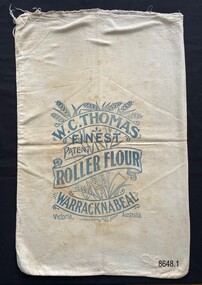
Textile - Flour bag - W.C.Thomas, Warracknabeal
... Thomas ran a number of flour mills throughout the Victorian wheat belt, with the Warracknabeal Mill operating from 1884 to 1964. After their use for flour storage, flour bags were able to be reused for bulk storage of other dry goods or sewn into domestic objects such as tea towels, pillowcases or waggas....storage W.C. Thomas Warracknabeal Flour mill W.C. Thomas, Finest, Patent, Roller Flour, Warracknabeal, Victoria, Australia. Wheat ...This flour bag came from the W.C. Thomas Flour Mill at Warracknabeal, Victoria. W.C. Thomas ran a number of flour mills throughout the Victorian wheat belt, with the Warracknabeal Mill operating from 1884 to 1964. After their use for flour storage, flour bags were able to be reused for bulk storage of other dry goods or sewn into domestic objects such as tea towels, pillowcases or waggas.This is a good example of a flour bag from a prominent Victorian flourmill, operating from the late 19th century to the mid-20th century.Calico flour bag for 'Roller Flour' from the flour mill of W.C. Thomas in Warracknabeal, a large wheat growing area in Victoria. The stencil on the front of the bag includes an image of wheat overlaid with the written information in scroll format.W.C. Thomas, Finest, Patent, Roller Flour, Warracknabeal, Victoria, Australia. Wheat image.flagstaff hill maritime museum and village, great ocean road, shipwreck coast, flour bags, calico, domestic object, textile, food storage, w.c. thomas, warracknabeal, flour mill -
 Flagstaff Hill Maritime Museum and Village
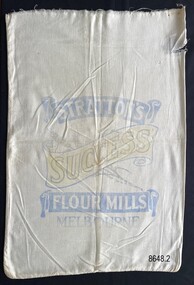
Textile - Flour bag - Stratton's, Melbourne
... Flagstaff Hill Maritime Museum and Village Great Ocean Road Shipwreck Coast calico domestic object textile food storage Stratton's flour bag Stratton's, Success, Flour Mills, Melbourne Calico flour bag for 'Success Flour' from Stratton’s flour mill in Melbourne. The stencil on the front of the bag includes the image of a wheat ...Flour bags were used when purchasing flour from the late 19th century to the mid 20th century. They were able to be reused for bulk storage of dry goods or sewn into domestic objects such as tea towels, pillowcases or waggas.The flour bag provides an example of a useful domestic packaging product, from the early 20th century.Calico flour bag for 'Success Flour' from Stratton’s flour mill in Melbourne. The stencil on the front of the bag includes the image of a wheat stalk overlaid with the written information in scroll format.Stratton's, Success, Flour Mills, Melbourneflagstaff hill maritime museum and village, great ocean road, shipwreck coast, calico, domestic object, textile, food storage, stratton's, flour bag -
 Flagstaff Hill Maritime Museum and Village
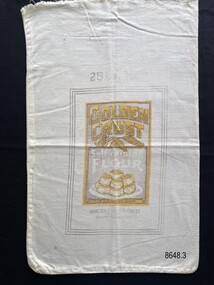
Textile - Flour bag - Golden Crust
... Flagstaff Hill Maritime Museum and Village Great Ocean Road Shipwreck Coast calico domestic object textile food storage flour bag Golden Crust 25lbs, Golden Crust, Self-raising Flour, Blended with Phosphate Aerator, Hancock’s Golden Crust Pty.Ltd. South Yarra, Vic Calico flour bag for Golden Crust Self-raising flour, 25lb. The stencil on the bag includes the manufacturer’s address and images of heads of wheat ...Flour bags were used when purchasing flour from the late 19th century to the mid 20th century. They were able to be reused for bulk storage of dry goods or sewn into domestic objects such as tea towels, pillowcases or waggas.The flour bag provides an example of a useful domestic packaging product, from the early 20th century.Calico flour bag for Golden Crust Self-raising flour, 25lb. The stencil on the bag includes the manufacturer’s address and images of heads of wheat and a plate of scones. 25lbs, Golden Crust, Self-raising Flour, Blended with Phosphate Aerator, Hancock’s Golden Crust Pty.Ltd. South Yarra, Vicflagstaff hill maritime museum and village, great ocean road, shipwreck coast, calico, domestic object, textile, food storage, flour bag, golden crust -
 Flagstaff Hill Maritime Museum and Village
Textile - Flour bag - McAlpin's Flour containing Aerophos'
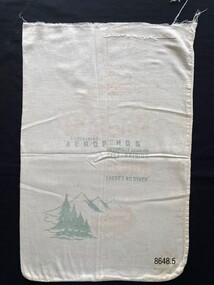
... storage flour bag McAlpin's Self-raising flour McAlpin’s (faded red) CONTAINING AEROPHOS’, PHOSPHATE AERATOR, SELF-RAISING, FLOUR (faded red), “THERE’S NO OTHER” Faded red square with writing …. CALCIUM …. Faded red triangle with T inside it to the far right of the trees Faded red writing at the bottom of the bag: PREPARED WITH PHOSPHATE AERATOR, AEROPHOS 25 LBS NET Calico flour bag for McAlpin’s self-raising flour. The stencil on the bag is very faded especially where red ink has been used. It includes an image of mountains and fir trees in green ink and a stalk of wheat ...Flour bags were used when purchasing flour from the late 19th century to the mid 20th century. In Melbourne, McAlpin's were one of the best known suppliers of self-raising flour. The business first began as a bakery in 1879 and was taken over in 1959. This is a good example of a flour bag from a well know Victorian supplier prominent in the early twentieth century.Calico flour bag for McAlpin’s self-raising flour. The stencil on the bag is very faded especially where red ink has been used. It includes an image of mountains and fir trees in green ink and a stalk of wheat sweeping up from bottom right to top / middle left in red ink.McAlpin’s (faded red) CONTAINING AEROPHOS’, PHOSPHATE AERATOR, SELF-RAISING, FLOUR (faded red), “THERE’S NO OTHER” Faded red square with writing …. CALCIUM …. Faded red triangle with T inside it to the far right of the trees Faded red writing at the bottom of the bag: PREPARED WITH PHOSPHATE AERATOR, AEROPHOS 25 LBS NET flagstaff hill maritime museum and village, great ocean road, shipwreck coast, calico, domestic object, textile, food storage, flour bag, mcalpin's, self-raising flour -
 Flagstaff Hill Maritime Museum and Village
Textile - Flour Bag Pillowcase
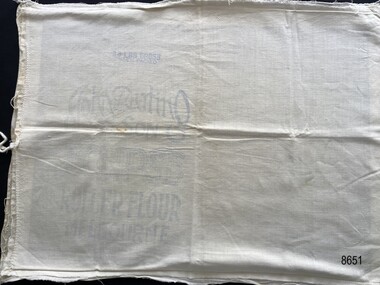
... Flagstaff Hill Maritime Museum and Village Great Ocean Road Shipwreck Coast Warrnambool Calico Domestic object textile food storage John Darling & Son Eclipse Roller Flour O-SO-LITE Flour pillowcase flour bag Side 1 25LBS GROSS WHEN PACKED, John Darling & Son, ECLIPSE, ROLLER FLOUR, MELBOURNE Side 2 O-SO-LITE, Self-raising, FLOUR, Creamy & Delicious, O-SO-LITE PRODUCTS, 412 COLLINS ST MELBOURNE, C.I. Decoration of wheat ...Flour bags were a useful source of material to be repurposed into domestic objects in the early 20th century. This object, fashioned from two well-known brands of flour bag, was most likely used as a pillowcase.The pillowcase provides an example of how flour bags were recycled and repurposed into useful domestic objects in the early 20th century.Two flour bags opened out and sewn together to create a possible pillowcase. The open end has a tie sewn to each side to enable the pillowcase to be closed. The bags have been sewn with the inscriptions on the inside of the pillowcase.Side 1 25LBS GROSS WHEN PACKED, John Darling & Son, ECLIPSE, ROLLER FLOUR, MELBOURNE Side 2 O-SO-LITE, Self-raising, FLOUR, Creamy & Delicious, O-SO-LITE PRODUCTS, 412 COLLINS ST MELBOURNE, C.I. Decoration of wheat stalks surround the inscription.flagstaff hill maritime museum and village, great ocean road, shipwreck coast, warrnambool, calico, domestic object, textile, food storage, john darling & son, eclipse roller flour, o-so-lite flour, pillowcase, flour bag -
 Flagstaff Hill Maritime Museum and Village
Container - Kitchen Canister set, Late 19th to early 20th century
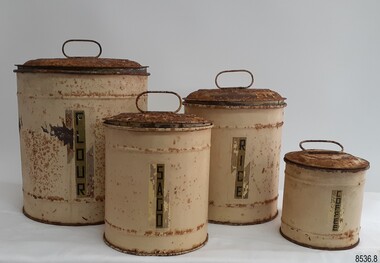
... wheat and barley were protected from pests by being stored in airy buildings, often raised from the ground. This was an age-old practice used by civilizations such as the ancient Egyptians and early Hebrews. Smaller quantities of food for short-term use in the homes were stored in woven baskets or clay pots. This set of kitchen food containers is an example of colonial food storage ...This set of kitchen dry food canisters is made of metal; each container has a different height, width and capacity. The rolled thin metal has created a strong, round design with decorative rings on the circumference. The base and close-fitting lid protect the contents from vermin and most insects, and the handle on top aids in the removal of the lid. Metal containers like these are reusable and can be re-purposed, which is advantageous when living in regional or rural areas. The type of manufacture indicates that the set was made in the late 19th to early 20th century. Gradually, colourful and attractive plastic kitchenware began to replace metalware. One of the canisters is labelled 'coffee'; coffee plants and seeds were transported from Brazil into Australia in 1788 when the First Fleet arrived although their growth was unsuccessful. However, by the 1920s, a tenth of the Australian population was drinking readily stored coffee. Large quantities of harvested grains such as maize, wheat and barley were protected from pests by being stored in airy buildings, often raised from the ground. This was an age-old practice used by civilizations such as the ancient Egyptians and early Hebrews. Smaller quantities of food for short-term use in the homes were stored in woven baskets or clay pots.This set of kitchen food containers is an example of colonial food storage used in a domestic setting to store and preserve dry ingredients. These canisters give a snapshot of early domestic life in Australia. Canister set; four cylindrical cream coloured metal canisters with domed lids that have lift-up handles on top. They are made from rolled metal and the bases and lids have a side seam. Each canister is a different size and displays a label for different contents. The adhesive labels are vertical, and a gold colour with black vertical text. The cream paint has brush strokes and small areas have exposed green paint under the cream. The insides of the bases are painted dark grey but the lids have no paint underneath. The empty canisters can fit one inside the other. Labels, in descending order: "FLOUR" "RICE" "SAGO" "COFFEE"flagstaff hill, flagstaff hill maritime museum and village, warrnambool, maritime museum, maritime village, great ocean road, shipwreck coast, canister set, kitchen storage, food storage, metal canisters, dry food storage, food packaging, kitchen container, vintage, flour, rice, sago, coffee, kitchenalia, late 19th to early 20th centuries, nesting canisters -
 Orbost & District Historical Society
flour bags, mid 20th century
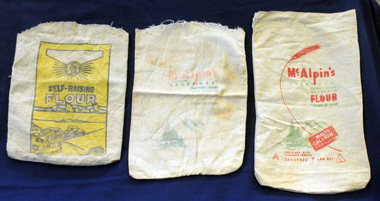
... The flour bags are good examples of packaging and design for Australian produce which sold across Australia and overseas in the mid 20th century. flour-bags warren-helena mcalpin mcvitty food-storage Three rectangular, open calico flour bags. 2491.1 is faded and has red and green print sketch of a fir tree with mountains in the background- "McAlpin's, Containing "Aerophos", Self-Raising Flour; "There's No Other". 2491.2 has similar print with a red stalk of wheat and "7lbs Net" and a C inside a triangle. 2491.3 has yellow background inside a rectangular frame with black print - "Tested ; Self-Raising Flour"; a drawing of a wheat field; "Medallion Brand ; Groves McVitty & Co Pty Ltd' 8 Market Street Melbourne. flour bags J.McAlpin & Sons, ...These three flour bags belonged to Helena Warren (nee McKeown) who was a self-taught photographer who became the local press correspondent and producer of postcard images. She was married to William John warren and lived in Newmerella. Flour bags were used for bulk purchases of flour in early to mid 20th century. They would have been laundered and re-used for storage. In earlier times empty flour bags were washed and boiled and then made into tea towels or children’s bloomers, or underwear. The flour bags are good examples of packaging and design for Australian produce which sold across Australia and overseas in the mid 20th century. Three rectangular, open calico flour bags. 2491.1 is faded and has red and green print sketch of a fir tree with mountains in the background- "McAlpin's, Containing "Aerophos", Self-Raising Flour; "There's No Other". 2491.2 has similar print with a red stalk of wheat and "7lbs Net" and a C inside a triangle. 2491.3 has yellow background inside a rectangular frame with black print - "Tested ; Self-Raising Flour"; a drawing of a wheat field; "Medallion Brand ; Groves McVitty & Co Pty Ltd' 8 Market Street Melbourne.flour-bags warren-helena mcalpin mcvitty food-storage -
 Kiewa Valley Historical Society
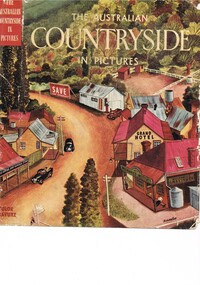
Book - Reference Countryside, The Australian Countryside in Pictures, circa 1950s
... wheat and next to him is a merino sheep. To the left and down are two dogs one with a fox in its jaws. The book contains 240 pages, 300 illustrations in gravure and 25 pictures in full colour. The inside fly leaf is a colour photograph of a rural scene with dirt road running in the centre and to the left a farm house and a five bay open storage barn...wheat and next to him is a merino sheep. To the left and down are two dogs one with a fox in its jaws. The book contains 240 pages, 300 illustrations in gravure and 25 pictures in full colour. The inside fly leaf is a colour photograph of a rural scene with dirt road running in the centre and to the left a farm house and a five bay open storage barn The Australian Countryside in Pictures Book - Reference Countryside Publishers (The Herald & Weekly Times Ltd) ...This book is a "snapshot" in time (1950s) detailing life in Australia covering a time when a "man's word and handshake" were his moral and quasi legal bond, and the now relative defunct saying "smoko" (having a "time out" from work for a cigarette and tea or coffee). The book spans an era where the male was still the "head" of the family even though for a majority of families the women took on the many "male only" roles during the World War II period. This shift in the leadership of the family hierarchy is mentioned, so ever slightly, (not to offend the still predominant macho male image) in both rural and city environments. The effects of the war, and later the push for women's emancipation and equality in both family, social, workplace and political areas of life, since this book was published, is now finally resolved. However there are still some sections of the recent migrate population where this male dominance is causing a few problems.The significance of this book is not only because it was donated by Mrs C. Roper ( from the Roper Family, a pioneer Kiewa Valley and surrounding Region family - originally beef cattle graziers) but also a Kiewa Valley resident and family, experiencing the shift in the social and economical life of post World War II rural Australia. The strong heritage link to this region of many families still residing within its boundaries, is a clear affirmation of the bond that the Kiewa Valley and its Regions have upon family unity. This unity within the rural environment is something that is attracting more and more families from sometimes alienating city life.This printed coloured sketched, or painted paper sleeve of the book is freely wrapped over a dark red hard cover. Into the front of the cover is pressed a standing pose of a farmer with long sleeves rolled up over his elbows. Behind him and to the right are what appears to be three sacks of wheat and next to him is a merino sheep. To the left and down are two dogs one with a fox in its jaws. The book contains 240 pages, 300 illustrations in gravure and 25 pictures in full colour. The inside fly leaf is a colour photograph of a rural scene with dirt road running in the centre and to the left a farm house and a five bay open storage barnOn the tittle page is a signature "C Roper"country life, australian "outback", rural industries, life on the land, swag-man of the bush -
 Kiewa Valley Historical Society
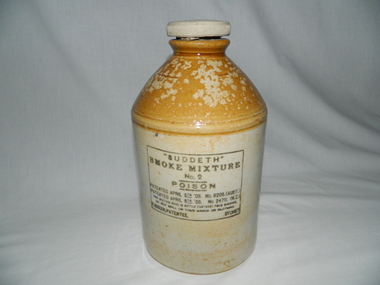
Jug Glazed, 1930s to 1950s
... wheat producing regions. Milk producers suffered from the mice by products contaminating their fresh milk containers and storage facilities. ...This item was used in conjunction with the Suddeth (Sudden Death) Carbon Bi-siilphide fumigator during many rabbit plagues that invaded Victoria and NSW before CSIRO introduced the myxomatosis virus in 1950.The contents of this jug was very important pre 1950 for all rural areas which suffered under the annual mice plagues, especially the wheat producing regions. Milk producers suffered from the mice by products contaminating their fresh milk containers and storage facilities. Rabbit warrens causing farm machinery instabilities and also horseback activities eg mustering herds.This glazed pottery jug has a screw on lid and a cream coloured body with a caramel brown neck. The remnance of a handle, which has been broken off is located at the top just below the the rim of the lid.On one side below the neck and within a black boundary mark "SUDDETH" and below "SMOKE MIXTURE No. 2" and sandwiched between two black lines "POISON". Below this and in five lines "PATENTED APRIL 6th '08 No. 11205(AUST.)" "PATENTED APRIL 6th '08 No. 24711 (N.Z.)" "THIS MIXTURE GOES IN BOTTLE FURTHEST FROM MACHINE" "DO NOT SPILL ON YOUR HANDS OR CLOTHING" "F, GREER, PATENTEE SYDNEY"ceramic bowls, contamination of farm produce, domestic farm hygiene, vermin extermination poisons -
![[1] Three Bears Porridge Flaked Oatmeal Bag (Front)](/media/collectors/510b3f7f023fd725b4cd51fe/items/683baf6c69688f11138d56ba/item-media/683bf711460ecdfee7105b40/item-fit-380x285.jpg?cb=6) Arapiles Historical Society
Arapiles Historical SocietyContainer - Roy SCHMIDT Collection - Cotton Flour Bags (3)
... storage. The export reference (Bandung) underscores Australia's historical agricultural trade ties with Southeast Asia, especially in wheat and flour exports. – Roy SCHMIDT resided with his siblings Mabel and Jack at ‘Parklands’ 85 Lake Avenue Natimuk home of Heinrich Friederick ‘Heiny’ & Minna Christina SUDHOLZ nee LANGE and their children Louis, Sophie, Alma, Lena (Roy's Mother), Florence 'Florrie' and Edward ‘Ted’....storage. The export reference (Bandung) underscores Australia's historical agricultural trade ties with Southeast Asia, especially in wheat and flour exports. – Roy SCHMIDT resided with his siblings Mabel and Jack at ‘Parklands’ 85 Lake Avenue Natimuk home of Heinrich Friederick ‘Heiny’ & Minna Christina SUDHOLZ nee LANGE and their children Louis, Sophie, Alma, Lena (Roy's Mother), Florence 'Florrie' and Edward ‘Ted’. ...[1] Three Bears Porridge Flaked Oatmeal Bag: This textile bag originates from Canadian Cereal Mills Ltd., which marketed "Three Bears" flaked oatmeal. Popular in the early 1900s to mid-century, this product combined functional packaging with a child-friendly incentive — a cut-out cloth doll. The practice of printing toys, games, or clothing patterns on flour or oat sacks was a common marketing strategy, encouraging reuse and appealing to families during times when thrift and creativity were essential, especially during the Depression and wartime years. The Three Bears brand played off the enduring popularity of children’s nursery tales, while the doll encouraged children (and parents) to reuse packaging creatively. This object captures a unique intersection of food marketing, household resourcefulness, and early 20th-century domestic life. [2] Mammy Self-Raising Flour Bag: This item is a mid-20th-century Australian flour bag, branded “Mammy Oven Puff”, produced by A. Mammy Products Pty Ltd in West Footscray, Victoria. The use of the name "Mammy" and the caricatured illustration draws on a now widely recognised and offensive racial stereotype originating from American minstrel culture, commonly used in product branding in the early-to-mid 20th century. While the bag reflects a specific period in Australian domestic and commercial packaging history, it also exemplifies racially insensitive advertising that would be considered inappropriate and harmful by today’s standards. Such items are preserved today in museum collections to help document past social attitudes, consumer culture, and the evolution of racial representation in advertising. [3] Bandung Blue Triangle Brand Flour Bag: This bag represents a mid-20th-century Australian flour export product, particularly aimed at international markets such as Indonesia (as indicated by "Bandung"). The “Blue Triangle Brand” was likely a registered trademark used by a Melbourne-based flour mill engaged in both local and overseas trade. The use of durable cloth bags for bulk flour was common prior to the widespread adoption of paper and plastic packaging. These bags were often reused domestically for household textiles, clothing patterns, or storage. The export reference (Bandung) underscores Australia's historical agricultural trade ties with Southeast Asia, especially in wheat and flour exports. – Roy SCHMIDT resided with his siblings Mabel and Jack at ‘Parklands’ 85 Lake Avenue Natimuk home of Heinrich Friederick ‘Heiny’ & Minna Christina SUDHOLZ nee LANGE and their children Louis, Sophie, Alma, Lena (Roy's Mother), Florence 'Florrie' and Edward ‘Ted’.[1] Three Bears Porridge Flaked Oatmeal Bag: A vintage cloth oatmeal bag printed with black ink on both sides. One side is branded with "Three Bears Porridge – Flaked Oatmeal", showing an image of three bears behind a gate, referencing the well-known “Goldilocks and the Three Bears” fairytale. The opposite side features a printed cut-out doll design, showing a young girl with curly hair holding a bouquet of flowers, intended to be sewn into a stuffed toy. Instructions note that the reverse side (the doll’s back) could be obtained from a second bag. The design combines product branding with a promotional activity for children, typical of early- to mid-20th-century grocery packaging aimed at reuse. [2] Mammy Self-Raising Flour Bag: A small vintage cloth flour bag with printed branding in faded red, blue, and black inks. The front of the bag features a central image of a caricatured smiling African American woman wearing a headscarf. The text is unevenly faded but legible in parts. The bag has a rectangular shape with an open top edge and signs of previous use, including creasing and some fraying at the corners. [3] Bandung Blue Triangle Brand Flour Bag: A large, rectangular vintage cloth flour bag made of cream-coloured calico or cotton. The front of the bag is printed in bold blue ink with branding and export information. It prominently features a large triangular logo reading “Blue Triangle Brand” and numerous lines of text in block and stylised fonts. The bag is open at the top with frayed edges, suggesting it was once machine-stitched shut and later opened.[1] Three Bears Porridge Flaked Oatmeal Bag: Front side (branding side): "THREE BEARS Porridge – FLAKED OATMEAL" "7 Lbs. Net." “Packed and guaranteed by Canadian Cereal Mills Ltd., Toronto” Reverse side (doll pattern): "This is the Front for Three Bears Cut-out Doll" "In order to complete this Doll it will be necessary to obtain the Back Design from another Bag of Three Bears Rolled Oats or Oatmeal." [2] Mammy Self-Raising Flour Bag: Main product name: “MAMMY OVEN PUFF SELF-RAISING FLOUR” Additional text: “The Only Creamed Flour” “Prepared with phosphate aerator” “A. MAMMY PRODUCTS PTY. LTD., Sunshine Rd., West Footscray. Phone: FW 7321” “7 LBS. NET” (near top edge, very faded) [3] Bandung Blue Triangle Brand Flour Bag: The bag is printed with the following: “10270” “G.W.C | H.L” “BANDUNG” “BEST AUSTRALIAN” “BLUE TRIANGLE BRAND” (inside the triangle logo) “GROWER & GRINDERS” (curved around the logo) “Patent Roller” “MELBOURNE” “FLOUR” “50 LBS. GROSS WHEN PACKED” These inscriptions indicate that this flour bag was manufactured in Melbourne, Australia, and was likely exported to Bandung, Indonesia.farm equipment, flour, milling, oats, mammy, bandung blue, schmidt, sudholz, parklands -
 Bendigo Historical Society Inc.
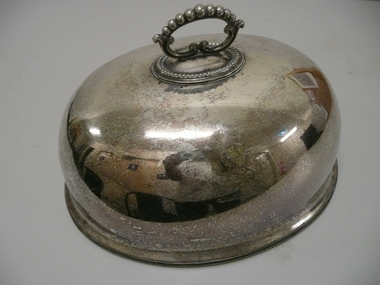
Domestic Object - LARGE MEAT COVER
... DOMESTIC EQUIPMENT Food storage & preservation meat cover DI500 Mappin Brothers 222 Regent Street and London Bridge Large oval shaped silver plated meat cover with handle and a Lion rampant clutching a sheaf of wheat engraved on one side. ...Large oval shaped silver plated meat cover with handle and a Lion rampant clutching a sheaf of wheat engraved on one side.Mappin Brothers 222 Regent Street and London Bridgedomestic equipment, food storage & preservation, meat cover, di500 -
 Victorian Interpretive Projects Inc.
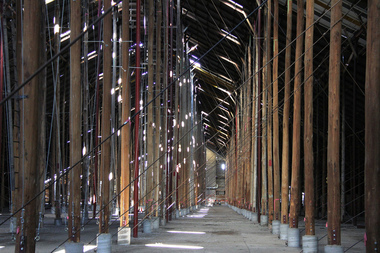
Photograph - digital, LJ Gervasoni, Murtoa Stick Shed 00031, 13/08/2011
... In 1941 the GEB, under chairman and general manager Harold Glowrey, proposed large temporary versions of the horizontal bulk storage sheds already in use in Western Australia. The proposal was approved by the Victorian Wheat and Woolgrowers Association, who considered the use of shed storages as a longer term proposition. ...In 1941 the GEB, under chairman and general manager Harold Glowrey, proposed large temporary versions of the horizontal bulk storage sheds already in use in Western Australia. The proposal was approved by the Victorian Wheat and Woolgrowers Association, who considered the use of shed storages as a longer term proposition. ...From the Victorian Heritage Register statement of significance H0791 The Marmalake/Murtoa Grain Store, originally the No.1 Murtoa Shed, is located within the Murtoa Grain Terminal, adjacent to the grain elevator tower and railway line. The shed is 280m long, 60m wide and 19m high at the ridge with a capacity of 3.4 million bushels. The hipped corrugated iron roof of the shed is supported on approximately 600 unmilled hardwood poles set in a concrete slab floor and braced with iron tie rods. These poles are the reason for use of the term "stick shed". With its vast gabled interior and the long rows of poles the space has been likened to the nave of a cathedral. An elevator at one end took wheat from railway trucks to ridge level where it was distributed by conveyor along the length of the shed, creating a huge single mound of grain. Braced internal timber bulkheads on either side took the lateral thrust of the wheat, and conveyors at ground level outside the bulkheads took wheat back to the elevator for transport elsewhere. Wheat had been handled in jute bags from the start of the Victorian wheat industry in the mid nineteenth century. Bulk storage had been developed in North America from the early 1900s. NSW began building substantial concrete silos from 1920-21. In Western Australia, farmers' co-operatives, who had to supply their own bulk storage from 1934-5, pioneered the use of low-cost horizontal sheds of timber and corrugated iron for bulk storage. Following its establishment in 1935 the Victorian Grain Elevators Board (GEB) planned a network of 160 concrete silos in country locations, connected by rail to the shipping terminal at Geelong. By the outbreak of the Second World War there was a worldwide glut of wheat, and Australia soon had a massive surplus which it was unable to export. Only 48 silos had been established under the Victorian Silo Scheme so far, and wartime material and labour restrictions prevented progress with this scheme. The storage deficit had become an emergency by 1941 as Britain obtained its imports from North America, rather than over the lengthy and difficult shipping route from Australia. In 1941 the GEB, under chairman and general manager Harold Glowrey, proposed large temporary versions of the horizontal bulk storage sheds already in use in Western Australia. The proposal was approved by the Victorian Wheat and Woolgrowers Association, who considered the use of shed storages as a longer term proposition. After initial resistance from the Australian Wheat Board, some of whose members represented wheat bagging interests, the Commonwealth and Victorian governments agreed to split the costs, and Murtoa was chosen as a suitable site for the first emergency storage. The main contractor, Green Bros, commenced work on the No.1 Murtoa Shed in September 1941, deliveries of bulk wheat began in January 1942, and the store was full by June of the same year. In the following years the Council for Scientific and Industrial Research (later CSIRO) conducted valuable research and experiment on the impacts and control of insect pests at the Murtoa No.1 shed. With these discoveries, and the development of more effective pesticides, use of the No.1 shed and the larger No.2 shed, erected in 1942/43, continued for many years. The No.2 shed was demolished in 1975. By the 1990s, pest resistance to pesticides and requirements for both pest free and insecticide free grain rendered open storage of this type unviable. The No. 1 store was also becoming increasingly expensive to maintain, and its use was phased out from 1989.Image of the Marmalake/Murtoa Grain Store which is of historical, architectural, scientific (technical) and social significance to the State of VictoriaDigital colour image of the interior of the Marmaduke . Murtoa grain storage facility better known as the Stick Shed. The shed was constructed in World War Two to store grain. The supporting columns are trees.marmalake, murtoa grain store, wheat store, stick shed, murtoa -
 Bendigo Historical Society Inc.
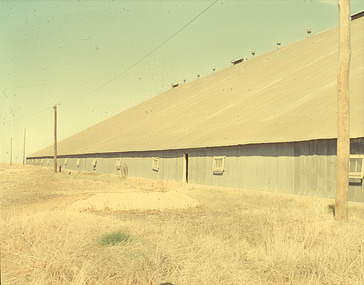
Slide - Mouat Crawford Collection: Farming Life in the Wimmera
... Storage...wimmera...wheat...AGRICULTURE Farm Crop Storage wimmera wheat silo stick shed murtoa mouat crawford collection PERUTZ Wheat terminal at Murtoa, known as the stick shed Markings: Murtoa(SIC) Bulk Wheat Terminal. ...Wheat terminal at Murtoa, known as the stick shed Markings: Murtoa(SIC) Bulk Wheat Terminal. The Stick Shed. Used as a teaching aid.PERUTZagriculture, farm, crop storage, wimmera, wheat silo, stick shed, murtoa, mouat crawford collection -
 Charlton Golden Grains Museum Inc
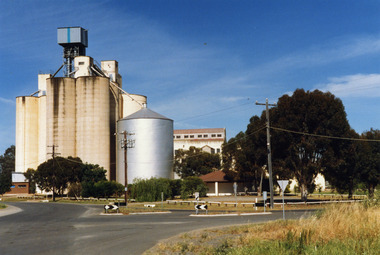
Photograph, Charlton Shire, Charlton Flour Mill, c.1987
... wheat intake of **695,000 bushels**. However, the mill also faced setbacks. On January 21, 1949, disaster struck when a **large fire** erupted in the storage shed, which contained 500 tons of bagged flour ready for export and new flour bags. ...wheat intake of **695,000 bushels**. However, the mill also faced setbacks. On January 21, 1949, disaster struck when a **large fire** erupted in the storage shed, which contained 500 tons of bagged flour ready for export and new flour bags. ...A previous mill had operated in Charlton by Mr. W.E. Foreman on the banks of the Avoca River and was acquired in 1919 by Noske Bros. The present Flour Mill was built by Noske Bros and opened in May 1927. It was taken over by the Grain Elevator Board in the 1970s. Noske's Flour Mill, with its commanding presence and towering silos, has long **dominated the Charlton skyline** and remains a significant landmark, even though it no longer mills flour. The mill's history is deeply intertwined with the development of Charlton and the grain industry of the surrounding district. The foundation for the mill's presence was laid in 1919 when Messrs Noske Bros. Pty. Ltd., already owning mills in Horsham, Nhill, and Murray Bridge, acquired G. H. Foreman’s Mill located by the Avoca River. The founder, **T. J. Noske**, was an early pioneer of flour exporting, expanding his milling business after unexpectedly acquiring the Horsham mill. ### A State-of-the-Art Operation The original mill by the river operated until August 1926 before being closed and dismantled. Plans were well underway for a **new, state-of-the-art mill** to be located at the former Cobb and Co site. In 1927, the new mill began operation. It was one of the largest in the state, boasting a capacity of three tons of flour per hour, a 250 h.p. diesel engine, and three initial silos. The mill quickly gained a reputation for **excellence** for both its design and its flour, which was sold successfully in local and overseas markets. ### Periods of Expansion and Trial The mill continued to grow, reflecting the importance of the local agricultural industry. Between 1940 and 1941, **nine new silos** were built, adding bulk receival points. In the record-breaking 1968 season, the mill received a colossal wheat intake of **695,000 bushels**. However, the mill also faced setbacks. On January 21, 1949, disaster struck when a **large fire** erupted in the storage shed, which contained 500 tons of bagged flour ready for export and new flour bags. The blaze was so intense that smoke was visible as far away as Wycheproof, and it threatened to destroy the entire mill. Thanks to the monumental efforts of the Charlton, St. Arnaud, Wycheproof, and Wedderburn Brigades, who ran the main pump almost continuously for 26 hours, the damage was contained, though the estimated loss was a substantial £60,000. ### Transformation of the Site At its peak, the mill was a major employer, providing work for approximately 65–70 men. But after over 45 years of operation, flour production at the mill ceased on October 25, 1973. Noske Industries Ltd. sought to adapt, converting the operation to a less successful stock feed production centre. In 1977, the **Grain Elevators Board** took over the site as a grain receival depot, building a large elevator tower that surpassed the height of the original buildings. The site eventually returned to private hands and, since 2000, has been owned and operated as a primary grain receival site for **GrainCorp**, cementing its continued, vital role in Charlton's agricultural life. Colour photograph of Charlton Flour Mill and silos. Intersection of Kaye & Davies Streets in the foreground. One large silver silo and three taller greyish concrete silos to the left. Three other cream coloured silos behind. There are pipes and sheds on top of the silos. There is a cream single story building to the right of the silver silo and a multi-storey building behind with eight window in the upper level. There is a small red brick building on the far left of the photo.w.e. foreman, noske bros, flour mill charlton, business, industry
