
Showing 63 items matching "wheel brakes"
-
 Moorabbin Air Museum
Manual - Ansett Boeing 767 operating manuals, Boeing 767 Operating Manual Chapter 1 Limitations October 1988 Chapter 2 Normal Procedures October 1988
... ...Automatic wheel brakes...Ansett Boeing 767 operating manuals Weight limitations Centre of gravity Locker & floor loading Operational limits Engine APU Automatic wheel brakes Cabin pressurisation Autopilot Cargo fire Autothrottle Fuel system Icing conditions Passenger evacuation Pre flight Engine start & before take off Taxi out & take off Climb & cruise procedure Severe air turbulence procedure Descent Holding Instrument flight procedures Landing roll procedure Taxi in & park Overview of limitations & normal procedures for Boeing 767, circa 1988 Spiral bound book style manual Boeing 767 Operating Manual Chapter 1 Limitations October 1988 Chapter 2 Normal Procedures October 1988 Manual Ansett Boeing 767 operating manuals ...Overview of limitations & normal procedures for Boeing 767, circa 1988Spiral bound book style manualnon-fictionOverview of limitations & normal procedures for Boeing 767, circa 1988weight limitations, centre of gravity, locker & floor loading, operational limits, engine, apu, automatic wheel brakes, cabin pressurisation, autopilot, cargo fire, autothrottle, fuel system, icing conditions, passenger evacuation, pre flight, engine start & before take off, taxi out & take off, climb & cruise procedure, severe air turbulence procedure, descent, holding, instrument flight procedures, landing roll procedure, taxi in & park -
Moorabbin Air Museum
Manual - Sikorsky S61 helicopters, Coulson Aircraft Sikorsky 61 Training Manual
... ...Wheel brakes...Sikorsky S61 helicopters Airframe Powertrain Transmission Fuel system Electrical system Flight controls Aircraft hydraulic systems Automatic flight control systems Retractable landing gear system Wheel brakes Engine fire detection & extinguisher systems Pitot static system Windshield Cabin heat & ventilation Cargo sling Lighting Emergency equipment Performance Weight & balance Specifications & Limitations Technical overview of Sikorsky S61 for training purposes, circa 2009 Plastic covered, spiral bound book type manual Coulson Aircraft Sikorsky 61 Training Manual Manual Sikorsky S61 helicopters ...Technical overview of Sikorsky S61 for training purposes, circa 2009Plastic covered, spiral bound book type manual non-fictionTechnical overview of Sikorsky S61 for training purposes, circa 2009airframe, powertrain, transmission, fuel system, electrical system, flight controls, aircraft hydraulic systems, automatic flight control systems, retractable landing gear system, wheel brakes, engine fire detection & extinguisher systems, pitot static system, windshield, cabin heat & ventilation, cargo sling, lighting, emergency equipment, performance, weight & balance, specifications & limitations -
 Melbourne Tram Museum
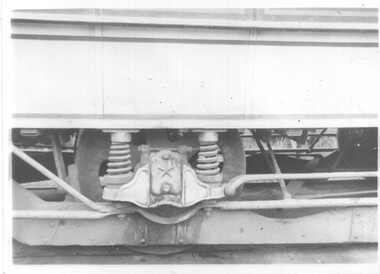
Photograph - Black and white - cable tram axle box
... Shows the side skirts around the wheel. Part of the brake rigging can be seen as well....Shows the side skirts around the wheel. Part of the brake rigging can be seen as well. ...Photograph of an Melbourne Tramway and Omnibus cable tram showing the axle box, springs and wheel supporting the body of a trailer. Shows the side skirts around the wheel. Part of the brake rigging can be seen as well.Yields information about cable tram trailers wheel sets.Black and white photograph on paper. Two copies held.trams, tramways, mtoco, cable trams, trailers, wheels, axle boxes -
 Ballarat Tramway Museum
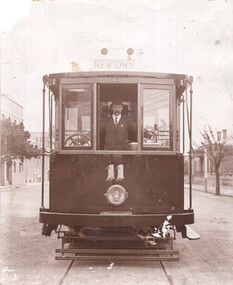
Photograph - MESCo Geelong 11 front view, Melbourne Electric Supply Co. (MESCo), 1914?
... Based on the inscription, Rolling Stock Superintendent Rogers is showing the expanse between the controller handle and the hand brake wheel. The tram was withdrawn during 1928....Based on the inscription, Rolling Stock Superintendent Rogers is showing the expanse between the controller handle and the hand brake wheel. The tram was withdrawn during 1928. ...Photograph shows MESCo Geelong tram No. 11 after conversion from trailer No. 1 to an electric tram during 1913 and 1914 (See Trolley Wire, April 1976, Keith Kings). The tram has the destination of Newtown. Based on the inscription, Rolling Stock Superintendent Rogers is showing the expanse between the controller handle and the hand brake wheel. The tram was withdrawn during 1928.Yields information about MESCo tram 11 after its conversion from a trailer to an electric tram. Black and white photograph with hand written notes on the rear.In pencil "Converted tram front view, R S Supt. Rogers"tramways, geelong, tramcars, conversion, tram 11, controllers -
 Melbourne Tram Museum
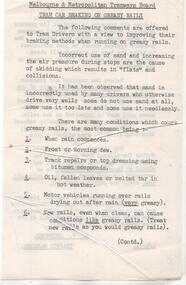
Document - Instruction, Melbourne & Metropolitan Tramways Board (MMTB), "MMTB Tram Car Braking on Greasy Rails", 1/05/1975 12:00:00 AM
... Gives instructions about braking, use of sand, conditions, skidding, wheel flats and braking distances. ...Gives instructions about braking, use of sand, conditions, skidding, wheel flats and braking distances. ...Instruction - printed on both sides of a sheet cut to fit into Rule Books, titled "MMTB Tram Car Braking on Greasy Rails", signed by R. C. Drummond Traffic Manager 1/5/1975. Gives instructions about braking, use of sand, conditions, skidding, wheel flats and braking distances. See also 3652.1 for another copy.trams, tramways, drivers, braking, instructions, tramcars, training -
 Australian Gliding Museum
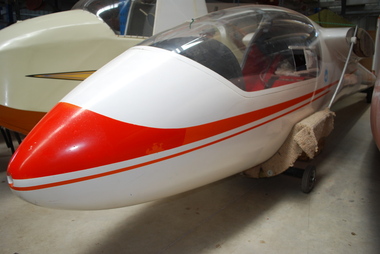
Machine - Glider – Sailplane, 1969
... It has a 17 metre wing span, retractable wheel and tail brake parachute. Several hundred Phoebus sailplanes (all versions) were made by the manufacturer Bolkow at Ottobrun in Germany before production ended in 1970. ...It has a 17 metre wing span, retractable wheel and tail brake parachute. Several hundred Phoebus sailplanes (all versions) were made by the manufacturer Bolkow at Ottobrun in Germany before production ended in 1970. ...The Phoebus is a fibreglass composite sailplane that was designed by H. Nagele, R. Linder and R. Eppler in the early 1960s for competition flying. It is a derivative from the Akaflieg Stuttart Phonix which was the first sailplane to be built of fibreglass. The first Phoebus, a Standard Class design with a 15 metre wingspan, flew in 1964. The Phoebus C is the open class version of the type that was introduced in 1967. It has a 17 metre wing span, retractable wheel and tail brake parachute. Several hundred Phoebus sailplanes (all versions) were made by the manufacturer Bolkow at Ottobrun in Germany before production ended in 1970. The Museum’s Phoebus C, serial number 866, was built in 1969. It was donated to the Museum by Ian Cohn in 2008. Early fibreglass design that was manufactured in numbers. The Phoebus is a modern looking single seat glass fibre sailplane with a ‘T’ tailplane. It is finished in white with light red detailing including thin red stripe on wings and some red striping on fuselage sides from nose to underneath wings.Serial number 866 on plate affixed inside cockpit – registration VH-GSW which has been painted on the sides of the fuselage rear of the wings. A Freistaat Bayern crest has been applied to each side of the vertical stabilizer. australian gliding, glider, sailplane, bolkow, phoebus, cohn, nagele, linder, eppler -
 Flagstaff Hill Maritime Museum and Village
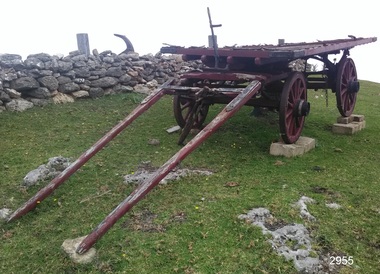
Wagon, circa 1850s
... A four-wheeled wooden horse-drawn wagon with flat top described as a Wagon Dray in historical writings. Painted brown and black. The wagon has rear brakes...The Wagon Dray is also an example of agricultural freight and general transportation during the 1800 and 1900 century. flagstaff hill warrnambool shipwrecked-coast flagstaff-hill flagstaff-hill-maritime-museum maritime-museum flagstaff-hill-maritime-village cartage manifold and bostock of warrnambool manifold family of western victoria bostock family of western victoria four wheeled wagon wagon horse drawn wagon farm wagon aitkin aitkin bostock manifold dray aitkin family cart aitken flour mill "Manifold and Bostock" very feint A four-wheeled wooden horse-drawn wagon with flat top described as a Wagon Dray in historical writings. Painted brown and black. The wagon has rear brakes ...Bostock & Manifold were all from pioneering families in the Western District of Victoria almost from the time of settlement. Family history: The Bostock family were prominent in Warrnambool from the 1850s to the 1880s. Patriarch Robert Bostock had in 1813 been transported to Sydney from Sierra Leone for having 'felonious traded in slaves' and sentenced to 14 years transportation. He moved to Tasmania in 1821 where he died in 1847. A number of his children came to Port Phillip. Edward Robert Bostock held the Jellabad run from 1849 to 1853. George Bostock (1826-1858) was a Warrnambool Shire Councillor in 1856. Thomas Edward Bostock (1828-1874) was a Shire Councillor in the late 1860s. Augustus Bostock (1833-1920) lived in Warrnambool. Augustus Bostock was the 9th child of Robert and Rachael Bostock of Vaucluse Epping Forest, Van Diemen's Land. He was only 4 years old when his mother died. He was inspired by his father to seek his fortune in the Western District of Victoria. He arrived around 1850. He married Margaret Aitkin in July 1865. Augustus owned several properties in the district and leased others. He sat on the court of Warrnambool, Mortlake or Hexham as required. He resided at Marramook in Hawkesdale and later moved to Vaucluse in Hopetoun Road Warrnambool, where he died in 1920 at the age of 87. The Wagon is significant locally and state wide for its association with Augustus Bostock who was involved in many aspects of life in the Western District of Victoria, racing, cricket, and social activities to name a few. Bostock & Manifold were all from pioneering families in the Western District of Victoria almost from the time of settlement. The wagon is significant for its historical and economic association with the local Warrnambool business of Manifold & Bostock. These men had leased and owned vast tracts of land and operated businesses around the district together at various times often associated with the farming industry. One example is the Manifold & Bostock store and flour mill from which the wagon dray is believed to have been associated with for the delivery of goods. Their flour mill began operation in 1850 in 7-17 Stanley St South Warrnambool and was known as “Jetty Mills” Manifold and Bostock in 1858 purchased the Mill from John and G Elliot (brothers) with half an acre of ground and a cottage for £1600. It appears addresses of the company changed over the years as the town grew. These are listed in “Jones, Lewis & Peggy flour mills of Victoria” showing the company operating from, Fairy Street and later at the Merri River near the cutting, known as Banyan and Merri Streets. The company ceased trading in 1870. The Wagon Dray is also an example of agricultural freight and general transportation during the 1800 and 1900 century.A four-wheeled wooden horse-drawn wagon with flat top described as a Wagon Dray in historical writings. Painted brown and black. The wagon has rear brakes, wooden, operated from a metal handle at the front of the Wagon. Front wheels are attached to a turnstile to allow easy turning of the wagon. This flat-topped, horse driven, four-wheeled Wagon was used for cartage by the business of Manifold & Bostock, Warrnambool. The original sign writing of the wagon is obscured or painted over. There is a feint mark of lettering to the sides and back edges of the cart Manifold & Bostock. "Manifold and Bostock" very feintflagstaff hill, warrnambool, shipwrecked-coast, flagstaff-hill, flagstaff-hill-maritime-museum, maritime-museum, flagstaff-hill-maritime-village, cartage, manifold and bostock of warrnambool, manifold family of western victoria, bostock family of western victoria, four wheeled wagon, wagon, horse drawn wagon, farm wagon, aitkin, aitkin bostock manifold, dray, aitkin family, cart, aitken, flour mill -
 Flagstaff Hill Maritime Museum and Village
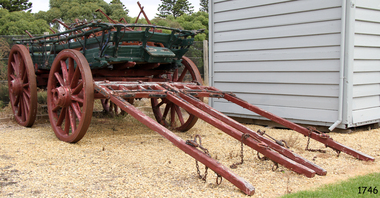
Vehicle - Wagon, Early 20th Century
... Four-wheeled wagon or cart,12 spokes in each wheel, wooden axle with rear hub brake. Hinged and chained tailboard. ...Four-wheeled wagon or cart,12 spokes in each wheel, wooden axle with rear hub brake. Hinged and chained tailboard. ...This wagon is linked to Mr Stanley James Bell via his father Mr John Bell, who owned "Warrumyea" at Wangoom. It is believed that Stanley grew up and worked for his father at this property, eventuality inheriting his father's death in 1920. This wagon was likely used at Mr Stanley Bell's property “Warrumyea” at Wangoom around 1920-1940. The wagon was donated in 1984, at which time it was noted as having a brass plate inscribed "Jas", which name Stanley was known by. Also, a painted on the wage was “S J Bell Wangoom”. Remnants of the original paint colours of blue and yellow show on the photograph, which was taken at the time of cataloguing. Mr John Bell Snr from Plymouth, England, arrived in Portland, Victoria, around 1860. He had served in the British navy as a lad for a number of years. On arriving in Australia he travelled to the Wangoom district where he lived for many years. Mr J Bell worked for 20 years as herd manager at “Wangoom Park”., for Mr F Tozer (1843-1954), one of the original pioneers of the western district. He went on to pursue dairying and general farming at his property “Warrumyea” Wangoom. Bell’s son Stanley James Bell went to the Wangoom School. His first reader from this school, published in 1909, has his name inscribed in the flyleaf “Stanley J. Bell, Warrumyea, Wangoom” and is now in the collection of the Warrnambool & District Historical Society. Stanley went on working the property “Warrumyea” and eventually purchased “Wangoom Park” in 1956, where his father had been employed years before. Mr S J Bell died in 1968.The wagon is significant for its association with the farming history of Wangoom and the Warrnambool area in general. Also, the wage is significant for its association with one of the early families that settled in the Warrnambool area and their contribution to the dairying and general farming industries that sprang from their efforts. The wagon has a good provenance linking it to Mr Stanley James Bell and is also a good example of how goods were transported using horse-drawn vehicles at the beginning of the 20th century.Four-wheeled wagon or cart,12 spokes in each wheel, wooden axle with rear hub brake. Hinged and chained tailboard. Wheels have metal rims. Metal frame and wooden superstructure. Wagon has two pairs of staves. Wooden shelves, one missing with turntable. Small toolbox in front. Made by Kelly and Preston of Ballarat. Metal nameplate of the owner attached, "Jas" (S J Bell of Wangoom).. Original inscription, now obscured, was painted “Kelly and Preston Builders Ballarat”. Metal plate inscribed "Jas", and "S J Bell Wangoom". flagstaff hill, warrnambool, shipwrecked-coast, flagstaff-hill, flagstaff-hill-maritime-museum, maritime-museum, shipwreck-coast, flagstaff-hill-maritime-village, wagon, sj bell, stanley james bell, wangoom park, warrumyea, first reader, john bell 1830-1920, stanley james bell 1904-1968, warrnambool pioneers, f tozer, western district, kelly and preston of ballarat -
 Flagstaff Hill Maritime Museum and Village
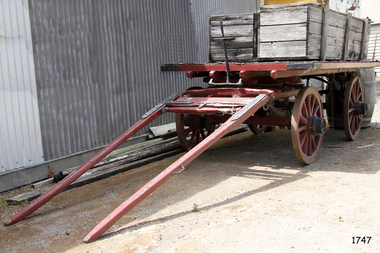
Wagon
... Wagon, four wheeled fully sprung with tail board, railing on each side plus hand operated brake on rims of rear wheels. ...flagstaff hill warrnambool shipwrecked-coast flagstaff-hill flagstaff-hill-maritime-museum maritime-museum shipwreck-coast flagstaff-hill-maritime-village cart wagon horse drawn vehicle "S J Bell Wangoom" Wagon, four wheeled fully sprung with tail board, railing on each side plus hand operated brake on rims of rear wheels. ...Wagon, four wheeled fully sprung with tail board, railing on each side plus hand operated brake on rims of rear wheels. Wooden frame, metal turntable and single shalves. Double chain for harness attached to wooden tail piece. Metal rimmed wheels. Wagon once belonged to S.J. Bell, Wangoom"S J Bell Wangoom"flagstaff hill, warrnambool, shipwrecked-coast, flagstaff-hill, flagstaff-hill-maritime-museum, maritime-museum, shipwreck-coast, flagstaff-hill-maritime-village, cart, wagon, horse drawn vehicle -
 Flagstaff Hill Maritime Museum and Village
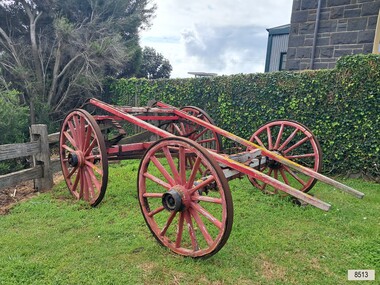
Vehicle - Wagon, Circa 1909
... It is a four-wheel, horse-drawn vehicle with iron tyres, brakes, spoked wheels painted red with decorative yellow strips on the hubs, a timber shaft, and springs on the undercarriage. ...It is a four-wheel, horse-drawn vehicle with iron tyres, brakes, spoked wheels painted red with decorative yellow strips on the hubs, a timber shaft, and springs on the undercarriage. ...This wagon was used in towns across south-west Victoria during the first half of the twentieth century by Pooran Singh, an Indian-born immigrant. Singh arrived in Australia alone in 1899 at the age of 30. The following year, at the Colac Licensing Court in western Victoria, he was one of 78 hawkers granted a Hawker’s Licence. According to the Colac Herald, all but two of the applicants appeared to be Asian. While some hawkers registered horse-drawn carts, Singh was one of nineteen licensed to trade on foot, selling door to door. Applicants were encouraged to contribute to a collection for the Colac Hospital. Over time, Pooran Singh came to own his own wagon—a top-of-the-range light delivery vehicle—and a horse named Prince. His work often took him along rough country roads, and for a period, he worked in the Corryong district of north-eastern Victoria, an area popular with hawkers. In September 1909, near Thowgla, he was thrown from his wagon while attempting to navigate a deep rut and was run over by one of its wheels. Although he suffered bruising to his chest, his injuries were not serious. The following year, he was granted a Hawker’s Licence in Corryong. By 1916, Singh was living and working at Garvoc in western Victoria, where that year, he lost his paper licence on Cooramook Road, and he placed a notice in The Standard. In 1918, at the Warrnambool Petty Sessions Court, he was one of four applicants granted renewal of their hawkers’ licences, and each donated ten shillings to Warrnambool Hospital. Throughout these years, Singh became well known to farmers and their families as he travelled across Victoria’s Western District, living and working from his covered wagon. In his later years, Pooran Singh formed a close friendship with John Jandes Moore and his wife, Vera, of Russells Creek, Warrnambool. They offered him the use of their property as a base for his travels and cared for him during his final illness. John Moore was later appointed one of the two executors of Singh’s will. Pooran Singh died in Warrnambool on 8 June 1947, aged 77. His final wish was to be cremated and for his ashes to be returned to India for immersion in the Ganges. The cremation was arranged by Guyett’s Funerals in Warrnambool. Having never married, Singh left his estate to his four nephews, enabling them to buy land and build homes; one later installed a memorial plaque in his honour. In the late 1980s, Guyett’s Funerals placed his ashes in the niche wall at Warrnambool Cemetery as a memorial, while continuing to hope that family instructions might eventually arrive. Nearly 63 years after his death, renewed enquiries brought public attention to the long and respectful care given to his ashes. As a result, the renowned Indian cricketer Kapil Dev travelled to Warrnambool to collect them and escort them to India, helping to fulfil Singh’s final wish. He was joined by one of Singh’s grand-nephews, Harmel Uppal, who had travelled from England. At a formal ceremony on 25 July 2010 commemorating Singh’s life, the ashes were handed to Dev and Uppal, and local resident Avis Quarrell, who had known Singh as a child, read a poem she had written in his memory. She still owned a shell necklace that Singh had made for her mother. Some Warrnambool locals who had been closely involved also travelled to India, where they joined Uppal’s family from the village of Uppal Bhopa, near Jalandhar. On 31 July 2010, Pooran Singh’s ashes were immersed in the Ganges, fulfilling the wish he had expressed more than six decades earlier. After Pooran Singh’s death, his horse and wagon remained on John Moore’s property. When Prince died, he was buried on the beach at Warrnambool. The wagon remained with the Moore family and was occasionally used as a cubby house. In about 1997, John Moore, the son of John Jandes Moore, donated it to Flagstaff Hill. After restoration, the wagon became an attraction in the village, where volunteer Pat and his Clydesdale horse, Duke, offered visitors rides around Flagstaff Hill’s lake. This wagon is significant for its association with an Indian emigrant who used it to earn an income in Australia. It also reflects the vital role of hawkers, who travelled through rural and regional communities in the late nineteenth and early twentieth centuries, supplying food, goods and news. The wagon is also historically significant as a former Flagstaff Hill attraction, offering visitors the experience of horse-drawn rides around the lake.Wagon: a light delivery vehicle once used as a hawker's wagon. It is a four-wheel, horse-drawn vehicle with iron tyres, brakes, spoked wheels painted red with decorative yellow strips on the hubs, a timber shaft, and springs on the undercarriage. It was once a covered wagon, fitted with green, wooden sideboards, a front seat with leather-padded backrest and mounting steps. The late-19th to early-20th-century wagon was once owned by Pooran Singh, a local Indian hawker. flagstaff hill, warrnambool, maritime village, maritime museum, flagstaff hill maritime museum and village, shipwreck coast, great ocean road, southwest victoria, northwest victoria, western district, colac, colac hospital, colac licensing court, thowgla, corryong, garvoc, cooramook road, warrnambool petty sessions court, warrnambool hospital, russells creek road, ganges, warrnambool cemetery, uppal bhopa, jalandhar, hawker’s licence, covered wagon, wagon, hawker's wagon, horse-drawn cart, hawker's cart, light delivery vehicle, hawker, travelling salesman, travelling hawker, door-to-door sales, rural salesman, rural commerce, prince, duke, clydesdale horse, 1997, pooran singh, indian immigrant, pat, john james moore, vera moore, john and vera moore, john moore, guyatt’s funerals, kapil dev, harmel uppal, avis quarrell -
 Flagstaff Hill Maritime Museum and Village
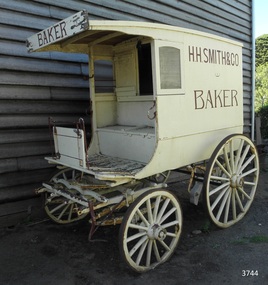
Vehicle - Wagon, H.H. Smith & Co. Baker, Circa 1930s - 1940s
... wheeled horse-drawn delivery wagon, front wheels smaller than rear wheels. Wagon is clad with metal sheets and lined with varnished timber panels. Wheels have metal rims, wooden spokes and rear wheels have wooden brake pads. ...wheeled horse-drawn delivery wagon, front wheels smaller than rear wheels. Wagon is clad with metal sheets and lined with varnished timber panels. Wheels have metal rims, wooden spokes and rear wheels have wooden brake pads. ...This baker’s wagon or cart transported and delivered bread and other baked goods in the Warrnambool area. It currently has advertising for H.H. Smith & Co. Henry Huntington Smith (1857-1941) owned and operated his Warrnambool bakery in the late 19th and early 20th century. However, the design of the wagon is similar to those used by local bakers in the 1930s and 1940s and probably originated from Stephenson’s Bakery in Warrnambool, which operated around that time. The wagon’s original internal shelves were removed in the early days of Flagstaff Hill so that children could have rides around the village in a horse-driven cart. BAKERS’ HISTORY There were many bakeries in Warrnambool in the 19th to mid-20th century. Each bread bakery made horse and cart deliveries in its allocated zone. SMITH’S BAKERY; – as shown on the wagon’s signage. Henry Huntington Smith (1857-1941) was born and educated in Warrnambool. He worked at Davis’ steam biscuit factory in Timor Street before he began his own bakery business in 1885 near the corner of Fairy and Koroit Streets. A few years later Smith built a new bakery on the corner of Fairy and Lava Street where it still stands today (2025) as Monaghan’s Pharmacy. The building was designed by James McLeod in 1892 as a bakehouse, shop and residence for Smith The address was known locally as Smith’s Corner. Next door to the bakery, at 136 Fairy Street, were stables built by Jobbins and McLeod in 1886 for William Cust. A photograph in the archives of the Warrnambool and District Historical Society shows the 1892 building with four fancy horse-drawn wagons on the street with white-clad drivers and a promotional stand erected with 5 bakers in uniform and the signage “H H Smith & Co, Pastry Cooks and Confectioners”. One of the wagons appears to have “H H Smith” painted on the side. H.H. Smith & Co. placed an Advertisement in the Weekly Times in December 1896 promoting its business as bakers, confectioners and pastry cooks, praising their shop as an ‘ornament to the town’ with ‘neat appointments’ and ‘dainty decorations’. It also boasted of supplying a large number of customers within a twelve-mile radius of Warrnambool. In November 1919 The Warrnambool Standard announced the marriage of Henry H Smith, Mayor of Warrnambool, to Jeannie Samson-Goodman in East Adelaide. In the same newspaper was a notice that Frank Crossley was to open as baker and pastry cook in H.H. Smith’s premises. As well as being the proprietor of the H.H. Smith Bakery, Henry Huntington Smith was a Councillor for the Warrnambool Municipality from 1913 to 1937 and Mayer for two terms. In December 1919 during his first term as Mayor, he was honoured for the work he had done with returning soldiers after World War I, receiving a document in recognition of this work, presented by the Mothers, Wives and Sisters of returned soldiers. Smith was very interested and involved in the community in many roles, including being the Vice President of the first Warrnambool and District Historical Society. STEPHENSON’S BAKERY: – believed to be the past owner of the wagon. The last owner of the bakery was Harold Stephenson. Stephenson was enlisted in the A.I.F. and was invalided home in 1943 before the end of the Second World War. He also served as a Councillor from 1958 to 1976, during which time he served six terms as Mayor for the City of Warrnambool (1966-1973) while he had the bakery. He was very involved in many local organisations including the Warrnambool Surf Life Saving Club and the Road Race Committee. He died in 1985, lauded as being one of Warrnambool’s “most distinguished civic leaders”. It has been said that the baker injured in World War II invented a special contraption to enable him to get up into the wagon and that he alerted his customers that he was in their vicinity by blowing a whistle. The customers would come out and choose their bread from the back of his wagon then pay him for it. However, another account is given by a man who once earned pocket money by helping the baker on his rounds. He says that it was Stephenson, the owner and manager of the bakery, and not the delivery baker who received a significant injury during the war, making him unable to climb the stairs of his upstairs accommodation at the bakery, therefore causing him to sleep downstairs. At this time in the early to late 1940 Stephenson’s bakery had three wagons, one for each of the delivery rounds. The wagons were painted black and yellow. Two of the drivers were Stan Lake and Ali (Alec) Dean who both had wagons with the covered cabin design. The third driver was Bill Lake who had a flat wagon. Stan Lake delivered in the area around Lava and Koroit Streets, Ali Dean had another round and Bill Lake had the Dennington area. Bread continued to be delivered into the 1960s but by this time the delivery vehicles were motorised. The goods produced at Stephenson’s bakery included bread baked in different shaped tins such as High Tin, Sandwich and Vienna. Some shapes were easily divided into half by breaking them apart, therefore the baker could make two-quarter loaves from a half loaf, satisfying different needs. There was the option of white or brown bread, sweet buns, fruit buns and Boston buns. The baker’s assistant was known to take great delight in ‘trimming’ the broken halves of excess bread and crust, enjoying his treat. THE BAKERY PREMISES: – Southeast corner of Fairy and Lava Streets, Warrnambool. The building retains the original cast iron veranda. Above the veranda, a motif of a wheat sheaf in ornamental plaster can be seen. Inside the building, there are still some of the original fittings. The building was classified by the National Trust in August 1979. After the Second World War, an official system of zoning was introduced as a fair way for the baking industry to operate. In 1949 different pricing was introduced by the Government for either delivered or retail purchased bread. Many of the small local bakeries went out of business after the Government banned zoning. The way was made open for the larger bread manufacturers to enter the local market with cheaper prices. Some of those companies were Mc Queens, Tip Top, Twisties, and Sunicrust, (Mc Queens ‘new’ bakery building was where the current Toyworld shop now stands, is, in the Ozone carpark.) O’Grady’s Bakery, later changing hands and known as Burkes Bakery, was on Fairy Street near the Timor Street intersection, on the North West side. There was also a bakery named Almay. The baker’s wagon is significant because of its association with H.H. Smith’s Bakery in Warrnambool.. The H.H. Smith’s Bakery building on the corner of Fairy and Lava Streets, built in 1892, is classified by the National Trust, August 1979. Smith Street Warrnambool was named after Henry Huntington Smith, who was a Warrnambool Councillor 1913 – 1937 and Mayor 1919 – 1921. Baker’s wagon, often referred to as a baker’s cart. Four wheeled horse-drawn delivery wagon, front wheels smaller than rear wheels. Wagon is clad with metal sheets and lined with varnished timber panels. Wheels have metal rims, wooden spokes and rear wheels have wooden brake pads. Horse shaft is timber with metal fittings. Front has a metal lamp holder, brake lever, metal hand grips and decorative metal foot plates. The wagon has suspension leaves on back and sides and double suspension leaves on the front. Driver’s area at front has a roof, glass side windows and wooden box seat with hinged compartment accessing wagon storage area. Door above back of seat has buckled leather handgrip strap attached, door slides open for access to wagon area. Back of wagon has a wooden step and a split door; top door has ventilation louvers, both doors have metal latches. Wagon is painted cream with brown trim and signage and green step. Remnants of red and green paint are visible; underside of seat panel is painted grey. Wagon advertises H.H. Smith & Co. Baker, a Warrnambool business established in 1885, but is of a more modern design seen around 1930’s and 1940’s and most likely belonging to Stephenson's bakery. Brown signwriting on sides of wagon “H.R. SMITH & CO. / BAKER” Brown signwriting across front of wagon “BAKER” warrnambool, shipwrecked-coast, flagstaff-hill, flagstaff-hill-maritime-museum, maritime-museum, shipwreck-coast, flagstaff-hill-maritime-village, shipwrecked-artefact, great ocean road, baker’s wagon, h.h. smith baker, warrnambool, henry h smith, jeannie samson-goodman, frank crossley, mayor of city of warrnambool, vice president of warrnambool and district historical society, stephenson’s bakery warrnambool, harold stephenson, warrnambool surf life saving club, road race committee, national trust building, stan lake, bill lake, ali dean, 19th and 20th century bakers, davies steam biscuit factory warrnambool, james mcleod building designer, jobbins and mcleod, william cust, h h smith & co, pastry cooks and confectioners, bakery trade, bread delivery wagon -
 Flagstaff Hill Maritime Museum and Village
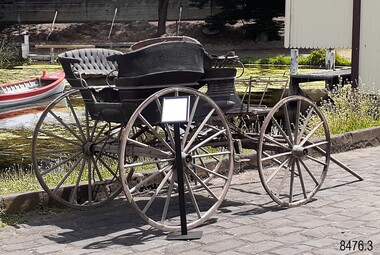
Vehicle - Murweh Carriage, c.1874
... Flagstaff Hill Maritime Museum and Village Warrnambool Great Ocean Road Shipwreck Coast Murweh buggy cart carriage wagon horse-drawn vehicle Victorian buggy four-wheeled carriage coachman’s seat bench seat side-facing benches upholstered seats Victorian decals heritage vehicle decoration antique hand painting hand painted decals motifs iron-rimmed wheels wooden brake blocks leaf springs T-pole shaft rear step equine carriage 19th century vehicle Victorian transport transport gentleman’s vehicle James Wotton Shevill Councillor Mayor Jeremiah Wade F.B. whitehead Thomas James Rome Warrnambool obstruction Warrnambool Genealogy Warrnambool pioneers Victorian carriage one horse carriage two horse carriage horse drawn carriage Motif painted on an oval panel [a musical lyre within a blue floral wreath flanked by scrolls] Carriage; the Victorian-era horse-drawn four-wheeled open carriage has a coachman’s bench seat across the front and two side-facing bench seats in the rear. ...This private late-nineteenth-century four-wheeled carriage has been built to transport a family or group of passengers with a coachman in the front seat. It can be pulled by one horse, or by two horses if the T-pole is attached. The button fittings along each side of the carriage indicate that a folding roof or hood was once attached. The frame across the front of the carriagewas likely to have been a ‘dashboard’ with a leather or wood covering to prevent water, mud and other particles from splashing onto the passengers. The rear step between the two side-facing bench seats is adjustable to allow for ladies’ long skirts. These rear seats appear to be removable, in which case the carriage could be converted to a wagon to transport goods and equipment. The carriage could have been illuminated by oil or carbide lamps placed into the lamp holders on the sides. The carriage was kept under cover for many years in an open-front sandstone building that also included living quarters and an area that may have been stable. It was at ‘Murweh’ a Warrnambool property at 203 Liebig Street. The home is now Heritage and National Trust Listed and described as a ‘gentleman’s residence’. It was built by James Wotton Shevill in the 1860s. Shevill was a councillor from 1875 to 1878, serving in 1878 as Mayor of the Borough of Warrnambool. Jeremiah Wade lived at Murweh there from 1879-1880. By 1915 F.B. Whitehead and his family were living there, and by 1930 the address was used by Mr T.J. Rome and his family. Thomas James Rome was still using that address in September 1973 after his 100th birthday. It is believed that one of the property’s owners had been an Obstetrician in Warrnambool. The current owner re-told the story that children used to hide in the back section of the carriage and smoke, hidden from the sight of onlookers. He had heard the story from a previous owner.The well-appointed horse-drawn four-wheeled carriage is likely to have first belonged to a local councillor and past Mayor of the town of Warrnambool, J.W. Shervill, whose 1860s city property was the carriage location for many years. The carriage is a rare local example of a town-based lifestyle befitting a prosperous personality of the late 19th century. It adds to the story of Warrnambool's development as a town influenced by the port, wealth gained from shipping and the home place of prominent local people such as the Councillor and later Mayor. The side-facing rear seating is unusual for a passenger carriage. It has the feature of removable rear bench seats, allowing for the dual purpose of a carriage or wagon.Carriage; the Victorian-era horse-drawn four-wheeled open carriage has a coachman’s bench seat across the front and two side-facing bench seats in the rear. There are steps at the front on each side and a centre adjustable step and the back. It has a hinged shaft, two lamp holders and a separate T-pole. The bench seats have padded backrests upholstered in green leather and each has padded armrests at the ends. A rectangular metal frame, likely to have been a dashboard, is mounted across the front of the carriage. It has two inner vertical bars. The carriage's body is painted dark green with crimson highlights on some of the panelling. Decorative oval panels with hand-painted motifs are mounted along the sides. The side panels of the carriage have metal fastener buttons attached. The iron-rimmed wheels have sixteen wooden spokes and copper cuffs on the outside of the hubs, and the rear wheels are higher than the front wheels. Wooden brake blocks are mounted onto the back wheels and are active by a metal lever at the front right side of the carriage. The undercarriage is fitted with leaf springs on each side, mounted from front to back axles. Included are: (1) The separate T-pole that allows two horses to be harnessed to the carriage (2) Leather horse winkers with metal hardware and oval brass plate on the side of each winkerMotif painted on an oval panel [a musical lyre within a blue floral wreath flanked by scrolls] flagstaff hill maritime museum and village, warrnambool, great ocean road, shipwreck coast, murweh, buggy, cart, carriage, wagon, horse-drawn vehicle, victorian buggy, four-wheeled carriage, coachman’s seat, bench seat, side-facing benches, upholstered seats, victorian decals, heritage vehicle decoration, antique hand painting, hand painted decals, motifs, iron-rimmed wheels, wooden brake blocks, leaf springs, t-pole shaft, rear step, equine carriage, 19th century vehicle, victorian transport, transport, gentleman’s vehicle, james wotton shevill, councillor, mayor, jeremiah wade, f.b. whitehead, thomas james rome, warrnambool obstruction, warrnambool genealogy, warrnambool pioneers, victorian carriage, one horse carriage, two horse carriage, horse drawn carriage -
 Flagstaff Hill Maritime Museum and Village
Vehicle - Spring Cart, Late 19th to early 20th centuries
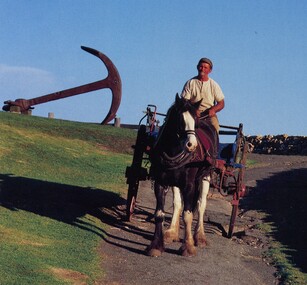
... wheeled cart with shallow box tray and plank seat bolted across the front. Wheels have metal rims and fourteen (14) wooden spokes. A plank is bolted from side to side. A decorative metal step is on the cart's left and has acorn cut-out shapes in the plate. Both wheels have a brake...wheeled cart with shallow box tray and plank seat bolted across the front. Wheels have metal rims and fourteen (14) wooden spokes. A plank is bolted from side to side. A decorative metal step is on the cart's left and has acorn cut-out shapes in the plate. Both wheels have a brake ...A spring cart is a two-wheeled, one-horse cart, often with the driver standing up to drive it, and otherwise seated on a simple seat. Carts like this one had springs to make the ride smoother. It is a lighter version of a farm dray and is sometimes called a spring dray. Spring carts were often used on farms for carrying loads. In the towns, some businesses used a spring cart for deliveries of bread, milk and other goods. The carts would be used for travel and for families going on outings and picnics. Visitors to Flagstaff Hill Maritime Village from 1986 to 1992 would enjoy watching a Clydesdale horse named Duke as he worked around the village with his driver Pat McGowan. He would be hitched to a wagon or to this lightweight spring cart or sometimes he would pull the wagon with the cart attached as a trailer. The cart was used for maintenance, carting loads of timber or stone around the site or from town to Flagstaff Hill. Sometimes Duke and the cart would take visitors for cart rides around the Village. Pat McGowan was known for his restoration of horse-drawn vehicles including this spring cart. He already had 40 years of horse handling experience when he began looking after Duke, feeding and harnessing him and driving the horse and cart around the Village. Pat’s dog ‘Yabbie’ would often join them. In August 1992 Duke had to be put down. Warrnambool Veterinary Clinic and other fund-raisers began well-supported appeals and the beloved horse was replaced by a Clydesdale also named Duke (the second), who began work in late October 1992. He, like his predecessor, had a quiet temperament and was comfortable in the traffic. The spring card is an example of vehicles used on farms, for business delivery and for domestic transport in the late-19th and early-20th century. This cart is of note for being associated with the Clydesdale horse Duke which pulled the cart around Flagstaff Hills in the 1980s and 1990s, representing transport of that period.Spring cart; two-wheeled cart with shallow box tray and plank seat bolted across the front. Wheels have metal rims and fourteen (14) wooden spokes. A plank is bolted from side to side. A decorative metal step is on the cart's left and has acorn cut-out shapes in the plate. Both wheels have a brake block that is operated by a lever on the cart's right. The cart has eight-leaf suspension from front to back. The box tray is painted blue and has decorative pale yellow detail. Each shaft pole has has a handle fitting on it. (Horse equipment with the cart is a leather covered, straw filled collar.) flagstaff hill, flagstaff hill maritime museum and village, warrnambool, maritime museum, maritime village, great ocean road, shipwreck coast, springcart, spring cart, jingle, horse-drawn cart, one horse cart, two-wheeled cart, dray, spring dray, wagon, transportation, travel, cart, duke, clydesdale, pat mcgowan, delivery cart, yabbie, cartwright, horse-drawn vehicle, transport, horse cart -
 Orbost & District Historical Society
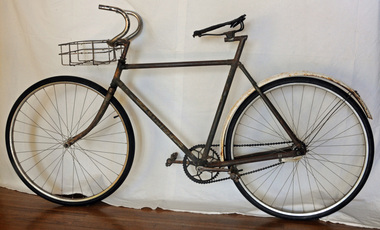
bicycle, 1930's -1940's
... It has 26inch wheels, back pedal brakes and has a wire basket attached to the curved handle bars. There is a leather seat in poor condition. The back wheel...It has 26inch wheels, back pedal brakes and has a wire basket attached to the curved handle bars. There is a leather seat in poor condition. The back wheel ...This bike belonged to Wally Paten who worked in the Orbost Butter Factory in the 1940's. Wally's father, Thomas Paten came to Orbost in 1893 and began growing fancy seeds in 1907 for H. James. He built the first levee bank in Orbost (ref. Mary Gilbert). The Comet bike was distributed by the Myer Emporium. "Comet:" was their house brand. They also sold the "Peter Pan". It was named "The Comet" probably because it was a fast bike. At the time it was an expensive bike . Ted Waterford made headlines riding Melbourne to Adelaide one way then return on a Comet in 1932.Bicycles have been a part of Australian life for more than 140 years. The bicycle soon began competing with the horse as a convenient and economical way for people to get around. This bicycle is an example of an early style which was used by an Orbost local.A man's road bicycle. It has 26inch wheels, back pedal brakes and has a wire basket attached to the curved handle bars. There is a leather seat in poor condition. The back wheel has a mudguard painted white. The bike is ungeared. This is probably the original frame with newer wheels. The pedals are metal.Tyres - made in Korea down tube -COMETcomet-bicycle bicycle paten-wally transport -
 Kiewa Valley Historical Society
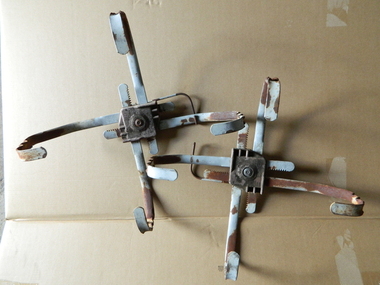
Pair of vehicle wheel traction devices
... This traction device was made to increase traction and braking on slippery surfaces eg. snow / ice and can be fitted on two wheels on one or more axles of a vehicle. These devices can fit many wheel sizes. these 'snow chains' were used in the early 1970's....This traction device was made to increase traction and braking on slippery surfaces eg. snow / ice and can be fitted on two wheels on one or more axles of a vehicle. These devices can fit many wheel sizes. these 'snow chains' were used in the early 1970's. ...This traction device was made to increase traction and braking on slippery surfaces eg. snow / ice and can be fitted on two wheels on one or more axles of a vehicle. These devices can fit many wheel sizes. these 'snow chains' were used in the early 1970's.These vehicle traction devices were used at Falls Creek during winter.Rusted steel device used to grip vehicle wheels to enable traction over slippery surfaces. Four steel curved prongs connected at a solid steel rectangular centre. Each prong has teeth at the centre enabling it to fit through and be moved for tightening. The prongs are at 90 degrees to each other. The steel prongs are 'waved' on the outer wheel where they contact the surface of the ground. On the outside of the centre piece a coiled piece of steel is attached extending out to curve around one of the prongs Inside centre on steel rectangular plate: "Christiana Spigervek" / "Norway Patent Nos. 116148 / 116188 / Norway / Foreign Patents Pending."snow chain; vehicle traction device; falls creek -
 Kiewa Valley Historical Society
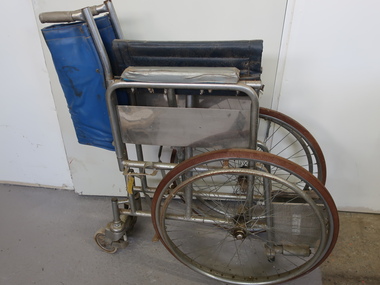
Wheelchair
... wheel is steel and the inner is rubber with metal spokes attached. The foot plates are of ribbed steel. The ribbed seat is blue made of thick canvas as is the back of the chair. Some plastic has been glued on the back. The arm rests are also covered with old torn plastic. There is a metal stick on the side used to brake...wheel is steel and the inner is rubber with metal spokes attached. The foot plates are of ribbed steel. The ribbed seat is blue made of thick canvas as is the back of the chair. Some plastic has been glued on the back. The arm rests are also covered with old torn plastic. There is a metal stick on the side used to brake ...After WWII demand for wheelchairs increased. The original wheelchairs were driven by the patient's hands pushing the wheels. Later a motor was added. Then the motor and battery were built into the chair under the seat. This was followed by developments in ergonomics (comfort), controls, comfort and performance.See KVHS 1796, KVHS 1797Used by Wilma Davies, a Kiewa Valley resident, who suffered from polio from the early 1950s.2 large wheels - The outer wheel is steel and the inner is rubber with metal spokes attached. The foot plates are of ribbed steel. The ribbed seat is blue made of thick canvas as is the back of the chair. Some plastic has been glued on the back. The arm rests are also covered with old torn plastic. There is a metal stick on the side used to brake the chair by being pulled enabling it to touch the wheel and slow it down or stop it from turning."Sibbing / Melbourne" on the foot platespolio, wheelchair, pandemic -
 Australian Gliding Museum
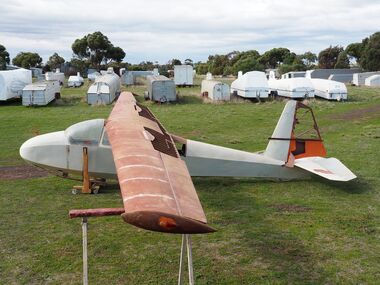
Machine - ES56 Nymph Sailplane
... Other changes included the installation of scissor type air brakes in the wing instead of simple hinged flap spoilers and the addition of a landing wheel behind the skid on the fuselage. ...Other changes included the installation of scissor type air brakes in the wing instead of simple hinged flap spoilers and the addition of a landing wheel behind the skid on the fuselage. ...ES 56 Nymph Following the successful introduction of the ES 52 Kookaburra two-seater in mid-1954, Edmund Schneider Ltd designed a higher performance single seat sailplane of similar construction and with similar handling qualities. It was designated the ES 56 and became known as the ES56 “Nymph”. The ES56 Nymph was a success in that it delivered the anticipated performance and was found to have satisfactory flying characteristics. However, only the prototype (“Nymph -I”) and three production examples (“Nymph-II”) were built. Schneiders made some changes to the design before building the production version. The wing chord at the tip on the prototype measured 650 mm. This was reduced to 500 mm for subsequent builds. The explanation is that provision was made in the original design for the possible lengthening of the tapered wing to 13 metres. However, apparently it was decided to retain the 11.900 metre span which allowed the tip chord to be reduced slightly. Other changes included the installation of scissor type air brakes in the wing instead of simple hinged flap spoilers and the addition of a landing wheel behind the skid on the fuselage. On one of the Nymph-II a dorsal was added on top of the fuselage forward of the vertical fin when repairs were made rectifying damage incurred as a result of an accident at Benalla on 31 March 1963. Even before these ES56 gliders were finished, Edmund Schneider Ltd decided to offer a less expensive single seat design to cater in particular for newly solo pilots, the ES57 Kingfisher. With the Kingfisher, Schneiders reverted to a traditional airfoil (Gott 549) for the wing instead of the laminar flow section that was chosen for the Nymph in the pursuit of performance. As such, the Kingfisher was more appropriately characterised as a single seat version of the Kookaburra in comparison to the Nymph. Schneiders continued for a time to offer the ES56 Nymph as a high-performance sailplane. However, its place in the market was soon overtaken by imported designs with superior performance, such as the Schleicher KA6, which Schneiders also imported and built under license. Nymph-I was test flown in December 1955 and entered by Harry Schneider into the gliding championships held at Waikerie from 5th to 16th of that month. Harry finished 12th in the individual placing out of a field of approximately 24. The capabilities of the Nymph were further demonstrated by Harry Schneider in January 1956 with a Gold C flight of 193 miles from Gawler in South Australia to Walpeup in Victoria. Nymph-I was acquired by the Port Pirie Gliding Club in South Australia. It has been saved and restored and is a regular feature at vintage glider rallies in Victoria and New South Wales. See Museum Newsletter No 35 Winter Edition 2017 pages 3 -6, for that story. The Nymph-II production models were delivered by Edmund Schneider Ltd in October 1956 to the Gliding Club of Victoria, the Victorian Motorless Flight Group and the Royal Australian Navy Gliding Association. The VMFG flew its Nymph in the First National Gliding Championships at Tocumwal, NSW, in December 1956 and all three were flown at the Second National Gliding Championships at Benalla in 29th December 1958 to 8th January 1959, delivering competitive performances based on handicap. Nymph-I Serial Number 17 Original owner – Port Pirie Gliding Club, S.A. Registered VH-GHG on 20 August 1957 Re-registered VH-GHA on 11 October 2016 Currently Raywood, Victoria Believed airworthy Nymph-II Serial Number 20 Original owner – R.A.N. Gliding Association Registered VH-GDX on 20 May 1957 Currently Locksley, Victoria. In storage Nymph-II Serial Number 21 Original owner – Gliding Club of Victoria Registered VH-GHU on 27 August 1957 Currently Bendick Murrell, N.S.W. In storage Nymph-II Serial Number 22 Original owner – Victorian Motorless Flight Group Registered VH-GFE on 5 March 1957 Currently Bacchus Marsh, Victoria Under restoration for display. The Museum’s exhibit is the ES56, serial number 22, registered as VH-GFE. The glider was flown by the VMFG in Victoria until approximately September 1968. GFA records show that it was transferred to Queensland in 1968, and it passed through several owners until the mid-1970s. Information received indicates that it was flown by the Leichardt Soaring Club at Mount Isa in the (late?) 1960s. The history from then is not presently known except to say that it has been kept in dry storage for many years. It is not known when the glider was last flown. What is Significant? The Schneider ES 56 Nymph single seat sailplane, serial number 22, designed and built in 1955-1956, by Edmund Schneider Ltd in Adelaide. It was delivered to its original owner, the Victorian Motorless Flight Group, in October 1956, and registered as VH-GFE on 5 March 1957. How it is Significant? The ES56 Nymph is of historical, aesthetic, scientific and research, and social significance to the Australian gliding community. Why it is Significant? The ES56 is of historical significance as it was designed and built by Edmund and Harry Schneider. The Schneiders immigrated to Australia after the end of the second world war bringing with them considerable expertise in relation to glider design and construction. Over the following decades they maintained a close association with the Gliding Federation of Australia and the gliding clubs and through their glider production made a major contribution to the sport. The ES56 is part of that story. The ES56 in its design and construction exhibits the glider construction technology of the time, which principally consisted of lightweight wooden framework skinned with ply and doped fabric. It exbibits design innovation, notably the use of a laminar flow wing profile in pursuit of better glide performance. Also, considerable attention was given to simplifying the structure in order to keeping cost and the weight low. The ES56 played a useful role at gliding clubs where it was operated, especially the late 1950s and early 1960s and is remembered well by pilots who flew her. The glider is in the course of restoration and provides an insight into the skills and workmanship that were involved in design, building and maintenance of these wooden aircraft. It is of aesthetic and scientific and research significance. Glider airframe of a traditional wood and fabric covered constructionNoneglider, sailplane, edmund schneider, harry schneider, es56, nymph, es57, kingfisher, victorian motorless flight group, gliding club of victoria, ran gliding association, port pirie gliding club, leichardt soaring club. -
 Ballarat Tramway Museum
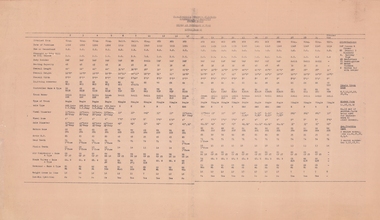
Document - List, State Electricity Commission of Victoria (SECV), "Numbers and Particulars of Trams" - Bendigo, c1964
... Gives details for each tram at that time, where from, date of purchase, New or second hand (all ), Straight or drop sill or drop centre, Body builder, Seating capacity, overall length, overall height, overall width, Lightning arrester, controller make and type, Truck Maker and type, type of truck, axle type, wheel diameters, wheel base, axle diameter, motors type and maker, Motor horsepower, Gear Teeth, Air compressor make and type, Brake Valves make and type, Governor make and type, Weight in tons and whether suitable for one man operation. ...Gives details for each tram at that time, where from, date of purchase, New or second hand (all ), Straight or drop sill or drop centre, Body builder, Seating capacity, overall length, overall height, overall width, Lightning arrester, controller make and type, Truck Maker and type, type of truck, axle type, wheel diameters, wheel base, axle diameter, motors type and maker, Motor horsepower, Gear Teeth, Air compressor make and type, Brake Valves make and type, Governor make and type, Weight in tons and whether suitable for one man operation. ...Gives details for each tram at that time, where from, date of purchase, New or second hand (all ), Straight or drop sill or drop centre, Body builder, Seating capacity, overall length, overall height, overall width, Lightning arrester, controller make and type, Truck Maker and type, type of truck, axle type, wheel diameters, wheel base, axle diameter, motors type and maker, Motor horsepower, Gear Teeth, Air compressor make and type, Brake Valves make and type, Governor make and type, Weight in tons and whether suitable for one man operation. Side list gives details of abbreviations, list of tram types and note on Birney 15. List of trams include "Cleaner Car". Undated. See item 3430 for Ballarat version and 8721 and 8722.Yields detailed information about Bendigo trams -c1964Dyeline print from a typed list.2nd copy has in ink "BTPS 613" in the top right hand corner.tramcars, bendigo, equipment, lists, data -
 Ballarat Tramway Museum
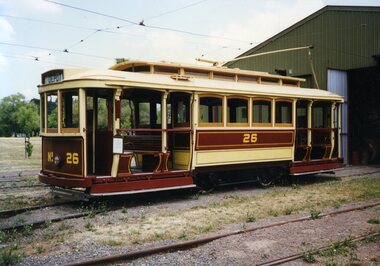
Vehicle - Tramcar, Duncan and Fraser, SECV Tram No. 26, 1916
... Single truck, (4 wheel), drop end California Combination tramcar, reconstructed to as built Condition, cross bench seats in drop ends, longitudinal seats in centre saloon, 2 sliding doors internally, air braked. ...Trams tram 26 Single truck, (4 wheel), drop end California Combination tramcar, reconstructed to as built Condition, cross bench seats in drop ends, longitudinal seats in centre saloon, 2 sliding doors internally, air braked. ...Single truck, (4 wheel), drop end California Combination tramcar, reconstructed to as built Condition, cross bench seats in drop ends, longitudinal seats in centre saloon, 2 sliding doors internally, air braked. See Destination City, Destination Eaglehawk Fares Please 1978 to 1987 for conversion back to California combination tram. Trolley Wire Aug 1984 re car mileages for 26, 27 and 28 Trolley Wire Feb. 1988 for article re conversiontrams, tram 26 -
 Ballarat Tramway Museum
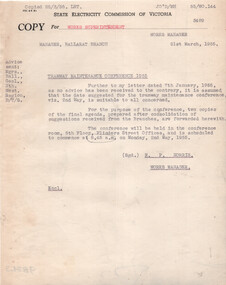
Administrative record, State Electricity Commission of Victoria (SECV), "Notes for 5th Annual Conference", 1955
... The typed foolscap sheet dated 5/5/1955 from the Works Supt to the Depot Foreman referring matters that require early attention - such as sponges, traction lamps, 22E brake gear, trolley wheel pressure, and survey of the Sebastopol line....The typed foolscap sheet dated 5/5/1955 from the Works Supt to the Depot Foreman referring matters that require early attention - such as sponges, traction lamps, 22E brake gear, trolley wheel pressure, and survey of the Sebastopol line. ...Set of notes for the Provincial Tramways Maintenance meeting to be held in Melbourne - 2/5/1955. Has a summary of actions from the 1953 (item 8057) and 1954 (item 9029) conferences. Second item is a memo regarding the date of the conference, dated 21/3/1955 and signed by P P Norris Works Manager. The typed foolscap sheet dated 5/5/1955 from the Works Supt to the Depot Foreman referring matters that require early attention - such as sponges, traction lamps, 22E brake gear, trolley wheel pressure, and survey of the Sebastopol line.Yields information and demonstrates SEC Meeting minutes about discussions between the three Provincial operators about tramcars and operations.Twenty foolscap typed sheets stapled in a landscape format to a folded manila card, a typed quarto sheet and a typed loose foolscap sheet.secv, ballarat, trams, tramways, minutes, sec, geelong, bendigo, tramcar equipment, maintenance, trackwork, trolley wheels, motors, maximum traction, employees, lamps, cleaning -
Ballarat Tramway Museum
Administrative record, State Electricity Commission of Victoria (SECV), "Some notes pertaining to tramway conference, Ballarat", 4/1954
... Notes actions on the 1952 and 1953 conferences, rail profile survey, bitumen paving, painting of tram, blinds, removal of sun blinds, lights fitted to trams, brake blocks - hardness and allowable wear, side bearing clearances, castings, track and depot workshop hours, costs, trolley wheels, lubrication products used, alterations to Maximum traction tramcars, and failure of pony wheel axles....Notes actions on the 1952 and 1953 conferences, rail profile survey, bitumen paving, painting of tram, blinds, removal of sun blinds, lights fitted to trams, brake blocks - hardness and allowable wear, side bearing clearances, castings, track and depot workshop hours, costs, trolley wheels, lubrication products used, alterations to Maximum traction tramcars, and failure of pony wheel axles. ...Set of notes prepared before the 1954 conference by the Ballarat office. Notes actions on the 1952 and 1953 conferences, rail profile survey, bitumen paving, painting of tram, blinds, removal of sun blinds, lights fitted to trams, brake blocks - hardness and allowable wear, side bearing clearances, castings, track and depot workshop hours, costs, trolley wheels, lubrication products used, alterations to Maximum traction tramcars, and failure of pony wheel axles.Yields information and demonstrates SECV meeting notes prepared prior to a joint meeting.Four foolscap sheets - carbon copy.secv, ballarat, trams, tramways, minutes, sec, tramcar equipment, maintenance, trackwork, trolley wheels, motors, maximum traction, employees -
Ballarat Tramway Museum
Letter - between Mr Strickland of MMTB & Mr Pringle ESCo, Electric Supply Co. of Vic (ESCo), 1928
... Set of 8 letters, between Mr Strickland Chief Engineer MMTB and Mr P J Pringle of ESCo Ballarat re meeting with each other, regarding grinding of rails, Berlin drum brakes, rail corrugations, wheel flanges, the Pontelac Tramway Rail grinder of Birmingham, wheel profiles, with reference to a report in the Electric Railway & Tramway Journal, flat or coned treads, and wheel and rail wear....Set of 8 letters, between Mr Strickland Chief Engineer MMTB and Mr P J Pringle of ESCo Ballarat re meeting with each other, regarding grinding of rails, Berlin drum brakes, rail corrugations, wheel flanges, the Pontelac Tramway Rail grinder of Birmingham, wheel profiles, with reference to a report in the Electric Railway & Tramway Journal, flat or coned treads, and wheel and rail wear. ...Set of 8 letters, between Mr Strickland Chief Engineer MMTB and Mr P J Pringle of ESCo Ballarat re meeting with each other, regarding grinding of rails, Berlin drum brakes, rail corrugations, wheel flanges, the Pontelac Tramway Rail grinder of Birmingham, wheel profiles, with reference to a report in the Electric Railway & Tramway Journal, flat or coned treads, and wheel and rail wear.Yields information about discussions between MMTB and ESCo re wheels and shows the method of communications in mid 1928.Set of 8 typed letters - carbon copies or originals on quarto paper.tramways, ballarat, reports, tramcars, esco, mmtb, wheels, rails, grinding -
 Ballarat Tramway Museum
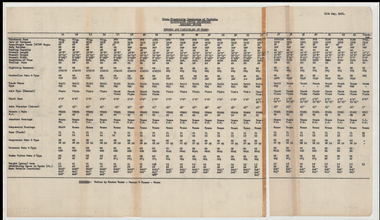
Document - List, State Electricity Commission of Victoria (SECV), "Numbers and Particulars of Trams" - Ballarat, 11/5/1961
... Ballarat - Gives details of where purchased from , date of purchase, type, body builder, seating capacity, overall length, overall height, overall width, condition of tram, trolley base, Lightning arrester, controller make and type, Truck Maker and type, type of truck, axle type, wheel base, axle diameter, motors type and maker, Motor horsepower, Armature bearings, suspension bearings, gear teeth, Air compressor make and type, Brake Valves make and type, Governor make and type, Weight in tons and details of advertising space in racks. ...Ballarat - Gives details of where purchased from , date of purchase, type, body builder, seating capacity, overall length, overall height, overall width, condition of tram, trolley base, Lightning arrester, controller make and type, Truck Maker and type, type of truck, axle type, wheel base, axle diameter, motors type and maker, Motor horsepower, Armature bearings, suspension bearings, gear teeth, Air compressor make and type, Brake Valves make and type, Governor make and type, Weight in tons and details of advertising space in racks. ...Ballarat - Gives details of where purchased from , date of purchase, type, body builder, seating capacity, overall length, overall height, overall width, condition of tram, trolley base, Lightning arrester, controller make and type, Truck Maker and type, type of truck, axle type, wheel base, axle diameter, motors type and maker, Motor horsepower, Armature bearings, suspension bearings, gear teeth, Air compressor make and type, Brake Valves make and type, Governor make and type, Weight in tons and details of advertising space in racks. At base has typed (original) list of trams of the two types, single truckers and bogie trams. List of trams includes the scrubber and No. 20 which was scrapped prior to system closure. See also 3430 and 8722 for other versions - different dates and 8690 for a Bendigo list. Note: Framed copies of both Ballarat and Bendigo are held in the depot. Some changes have been made to the tramcars since the preparation of this sheet and there are some errors and differences. See also Reg Item 6879 for an annotated version.Yields information about the dimensions and equiipment on Ballarat Tramcars operated by the SEC.Typed List (Carbon copy) of tramcars and their details for Ballarat dated 11 May 1961, titled "Numbers and Particulars of Trams". Two sheets which have been taped together. Two copies held. tramcars, ballarat, equipment, lists, data -
 Ballarat Tramway Museum
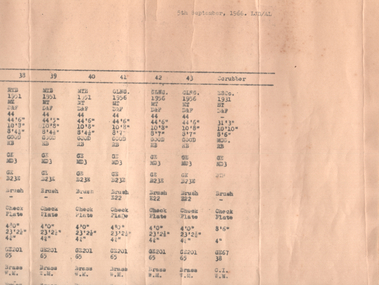
Document - List, State Electricity Commission of Victoria (SECV), "Numbers and Particulars of Trams" - Ballarat, 5/9/1966
... Ballarat - Gives details of where purchased from , date of purchase, type, body builder, seating capacity, overall length, overall height, overall width, condition of tram, trolley base, Lightning arrester, controller make and type, Truck Maker and type, type of truck, axle type, wheel base, axle diameter, motors type and maker, Motor horsepower, Armature bearings, suspension bearings, gear teeth, Air compressor make and type, Brake Valves make and type, Governor make and type, Weight in tons and details of advertising space in racks. ...Ballarat - Gives details of where purchased from , date of purchase, type, body builder, seating capacity, overall length, overall height, overall width, condition of tram, trolley base, Lightning arrester, controller make and type, Truck Maker and type, type of truck, axle type, wheel base, axle diameter, motors type and maker, Motor horsepower, Armature bearings, suspension bearings, gear teeth, Air compressor make and type, Brake Valves make and type, Governor make and type, Weight in tons and details of advertising space in racks. ...Ballarat - Gives details of where purchased from , date of purchase, type, body builder, seating capacity, overall length, overall height, overall width, condition of tram, trolley base, Lightning arrester, controller make and type, Truck Maker and type, type of truck, axle type, wheel base, axle diameter, motors type and maker, Motor horsepower, Armature bearings, suspension bearings, gear teeth, Air compressor make and type, Brake Valves make and type, Governor make and type, Weight in tons and details of advertising space in racks. At base has typed (original) list of trams of the two types, single truckers and bogie trams. List of trams includes the scrubber and No. 20 which was scrapped prior to system closure. See also 3430 and 8721 for other versions - different dates and 8690 for a Bendigo list. Note: Framed copies of both Ballarat and Bendigo are held in the depot. Some changes have been made to the tramcars since the preparation of this sheet and there are some errors and differences. See also Reg Item 6879 for an annotated version.Yields information about the dimensions and equiipment on Ballarat Tramcars operated by the SEC.Dyleline print of a typed List of tramcars and their details for Ballarat dated 5 September 1966 (typed on), titled "Numbers and Particulars of Trams". tramcars, ballarat, equipment, lists, data -
 Ballarat Tramway Museum
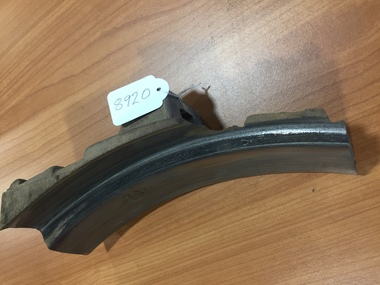
Functional object - Brake shoe
... Used on tramcars - pressed against the wheel by air or hand pressure to stop a tramcar. Demonstrates a brake shoe - cast iron - part of a tram car braking system. ...Used on tramcars - pressed against the wheel by air or hand pressure to stop a tramcar.Demonstrates a brake shoe - cast iron - part of a tram car braking system.Tramcar Brake Shoe in worn and broken conditionballarat, tramcar, brake shoe -
 Ballarat Tramway Museum
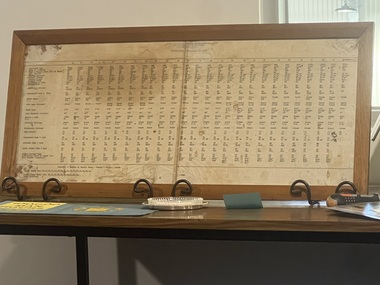
Document - Framed list, State Electricity Commission of Victoria (SECV), "Numbers and Particulars of Trams", mid 1960s?
... Ballarat - Gives details of where purchased from, date of purchase, type, body builder, seating capacity, overall length, overall height, overall width, condition of tram, trolley base, Lightning arrester, controller make and type, Truck Maker and type, type of truck, axle type, wheel base, axle diameter, motors type and maker, Motor horsepower, Armature bearings, suspension bearings, gear teeth, Air compressor make and type, Brake Valves make and type, Governor make and type, Weight in tons and details of advertising space in racks. ...Ballarat - Gives details of where purchased from, date of purchase, type, body builder, seating capacity, overall length, overall height, overall width, condition of tram, trolley base, Lightning arrester, controller make and type, Truck Maker and type, type of truck, axle type, wheel base, axle diameter, motors type and maker, Motor horsepower, Armature bearings, suspension bearings, gear teeth, Air compressor make and type, Brake Valves make and type, Governor make and type, Weight in tons and details of advertising space in racks. ...Ballarat - Gives details of where purchased from, date of purchase, type, body builder, seating capacity, overall length, overall height, overall width, condition of tram, trolley base, Lightning arrester, controller make and type, Truck Maker and type, type of truck, axle type, wheel base, axle diameter, motors type and maker, Motor horsepower, Armature bearings, suspension bearings, gear teeth, Air compressor make and type, Brake Valves make and type, Governor make and type, Weight in tons and details of advertising space in racks. At base has typed (original) list of trams of the two types, single truckers and bogie trams. List of trams includes the scrubber and No. 20 which was scrapped prior to system closure but excludes No. 19 which was transferred to Bendigo 1961. Item undated - mid to late 1960s?. See also items 3430, 8721, 8722 and 9182 for other versions.Yields information about the dimensions and equiipment on Ballarat Tramcars operated by the SEC.Wooden varnished frame and glazed typed list with a backing board.tramcars, ballarat, equipment, lists, data -
 Ballarat Tramway Museum
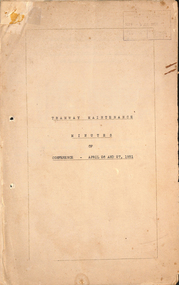
Administrative Record - Meeting Minutes, State Electricity Commission of Victoria (SECV), "Tramway Maintenance Minutes of Conference - April 26 and 27 1951", 1951
... Topics covered - tyres and wheel centres, truck maintenance, suspension bearings, bearing metal (white metal), motor armatures, carbon brushes, air receivers, overhead equipment, tracks, car renovation - painting, gold lining, roof, floor treatment and covering, trolley wheels, purchase requisitions, spare parts, supplies, brake shoes, timber, castings, tramway drawings, patterns and a summary of action. ...Topics covered - tyres and wheel centres, truck maintenance, suspension bearings, bearing metal (white metal), motor armatures, carbon brushes, air receivers, overhead equipment, tracks, car renovation - painting, gold lining, roof, floor treatment and covering, trolley wheels, purchase requisitions, spare parts, supplies, brake shoes, timber, castings, tramway drawings, patterns and a summary of action. ...Document titled "Tramway Maintenance Minutes of Conference - April 26 and 27 1951", attended by SEC Head Office Officers, representatives from Bendigo and Geelong. Opening note on page 2 - that the discussions should be based on the SEC operating the tramways indefinitely. Topics covered - tyres and wheel centres, truck maintenance, suspension bearings, bearing metal (white metal), motor armatures, carbon brushes, air receivers, overhead equipment, tracks, car renovation - painting, gold lining, roof, floor treatment and covering, trolley wheels, purchase requisitions, spare parts, supplies, brake shoes, timber, castings, tramway drawings, patterns and a summary of action. Has a list of attendees.Yields information and demonstrates SEC Meeting minutes about discussions between the three Provincial operators about tramcars and operations.Minutes - 26 duplicated foolscap sheets pinned (was stapled poorly) in the left hand corner.trams, tramways, minutes, sec, geelong, ballarat, bendigo, tramcar equipment, maintenance, trackwork, overhead, painting, trolley wheels, brakes, motors -
Ballarat Tramway Museum
Administrative Record - Meeting Minutes, State Electricity Commission of Victoria (SECV), "Tramway Maintenance Minutes of Conference - May 1 and May 2, 1952", 1952
... Topics covered - tyres and wheel centres, truck maintenance, suspension bearings, bearing metal (white metal), motor armatures, carbon brushes, air receivers, overhead equipment, tracks, car renovation - painting, gold lining, roof, floor treatment and covering, trolley wheels, purchase requisitions, spare parts, supplies, brake shoes, timber, castings, tramway drawings, patterns and a summary of action. ...Topics covered - tyres and wheel centres, truck maintenance, suspension bearings, bearing metal (white metal), motor armatures, carbon brushes, air receivers, overhead equipment, tracks, car renovation - painting, gold lining, roof, floor treatment and covering, trolley wheels, purchase requisitions, spare parts, supplies, brake shoes, timber, castings, tramway drawings, patterns and a summary of action. ...Document titled "Tramway Maintenance Minutes of Conference - May 1 and May 2", attended by SEC Head Office Officers, representatives from Bendigo and Geelong. Topics covered - tyres and wheel centres, truck maintenance, suspension bearings, bearing metal (white metal), motor armatures, carbon brushes, air receivers, overhead equipment, tracks, car renovation - painting, gold lining, roof, floor treatment and covering, trolley wheels, purchase requisitions, spare parts, supplies, brake shoes, timber, castings, tramway drawings, patterns and a summary of action. Also includes notes on tramway statistics, employee's duties, one man operation, track drains, interchange of ideas and experiences and discussions of a general nature and notes on scrapping trams in badly damaged condition. Each item where relevant looks back at the actions from the previous conference. Has a list of attendees.Yields information and demonstrates SEC Meeting minutes about discussions between the three Provincial operators about tramcars and operations.Minutes - 53 duplicated foolscap sheets pinned with a folding clip in top left hand corner.trams, tramways, minutes, sec, geelong, ballarat, bendigo, tramcar equipment, maintenance, trackwork, overhead, painting, trolley wheels, brakes, motors, one man trams, scrapped trams, employees, rules -
 Ballarat Tramway Museum
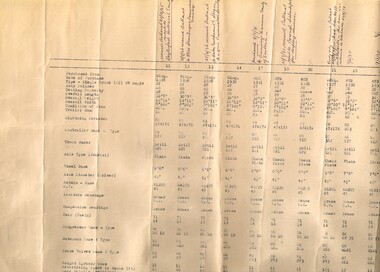
Document - List, State Electricity Commission of Victoria (SECV), Details of Ballarat Trams - marked up
... Gives details of where purchased from , date of purchase, type, body builder, seating capacity, overall length, overall height, overall width, condition of tram, trolley base, Lightning arrester, controller make and type, Truck Maker and type, type of truck, axle type, wheel base, axle diameter, motors type and maker, Motor horsepower, Armature bearings, suspension bearings, gear teeth, Air compressor make and type, Brake Valves make and type, Governor make and type, Weight in tons and details of advertising space in racks. ...Gives details of where purchased from , date of purchase, type, body builder, seating capacity, overall length, overall height, overall width, condition of tram, trolley base, Lightning arrester, controller make and type, Truck Maker and type, type of truck, axle type, wheel base, axle diameter, motors type and maker, Motor horsepower, Armature bearings, suspension bearings, gear teeth, Air compressor make and type, Brake Valves make and type, Governor make and type, Weight in tons and details of advertising space in racks. ...Demonstrates the source of the tramcars for both Ballarat. Gives details on equipment, sizes and seating capacity of the tramcars as at August 1964 with hand written notes about the acquisition and disposal of some of the tramcars.Printed List of trams and their details for Ballarat Trams ( similar to item 3430.1), dated 5-September-1966, titled "Numbers and Particulars of Trams". Handwritten notes have been made for the acquisition dates for the tramcar and disposal details of the vehicle along the top edge. 3430 - Ballarat - typed carbon copy - two sheets, were taped together. Gives details of where purchased from , date of purchase, type, body builder, seating capacity, overall length, overall height, overall width, condition of tram, trolley base, Lightning arrester, controller make and type, Truck Maker and type, type of truck, axle type, wheel base, axle diameter, motors type and maker, Motor horsepower, Armature bearings, suspension bearings, gear teeth, Air compressor make and type, Brake Valves make and type, Governor make and type, Weight in tons and details of advertising space in racks. At base has typed (original) list of trams of the two types, single truckers and bogie trams. List of trams includes the scrubber and No. 20 which was scrapped prior to system closure. Handwritten notes have been made for the Acquisition dates for the tramcar and disposal details of the vehicle along the top edge.tramcars, ballarat, sec, disposal, sale of trams, acquisitions -
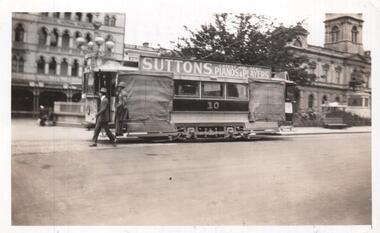 Ballarat Tramway Museum
Photograph - Black & White Photograph/s, Lee A Ratten, 8/06/1928 12:00:00 AM
... wheel comb, Sturt St, 8/6/1928. Black and white photograph of Ballarat ESCo No. 10 at the corner of Sturt and Lydiard St with the Town Hall and the National Mutual building in the background. The tram has the open compartment completely covered. Has a Sutton's roof advertisement. Dated 8/6/1928. Track brakes ...Yields information about the appearance of an ESCo Ballarat tram late 1920's.Black and white photograph of Ballarat ESCo No. 10 at the corner of Sturt and Lydiard St with the Town Hall and the National Mutual building in the background. The tram has the open compartment completely covered. Has a Sutton's roof advertisement. Dated 8/6/1928. Track brakes have been removed. Two copies held. On rear in pencil (very faint) - "Ballarat Car 10, 4 wheel comb, Sturt St, 8/6/1928.trams, tramways, esco, sturt st, tram 10
