
Showing 107 items matching "william watts"
-
 Bacchus Marsh & District Historical Society
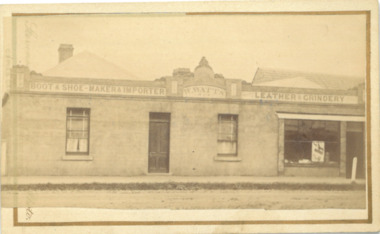
Photograph, William Watts Boot and Shoemaker Shop 194 Main Street Bacchus Marsh 1883
... William Watts Boot and Shoemaker Shop 194 Main Street Bacchus Marsh 1883...William Watts arrived in Bacchus Marsh in 1862 and for many years conducted a boot and shoe makers business in Main Street. ...William Watts arrived in Bacchus Marsh in 1862 and for many years conducted a boot and shoe makers business in Main Street. ...William Watts arrived in Bacchus Marsh in 1862 and for many years conducted a boot and shoe makers business in Main Street. This building, known as ‘Kentbury’ was built about 1858, and was formerly the premises of Bastings, cordwainer. The premises were enlarged in 1876 and occupied by Weaver. The building was demolished c.1960. Small sepia unframed photograph on card with gold border framing photograph. Housed in the album, 'Photographs of Bacchus Marsh and District in 1883 by Stevenson and McNicoll'. The image depicts the frontage of a boot and shoe makers premises.Signage on the upper part of the building reads 'Boot and Shoe Maker - Importer - Watts - Leather - Grindery'. The left hand side of the building appears to be a domestic dwelling, with a central door and two windows, one on either side. To the right there is a large shop display window and door. Both doors open directly onto the footpath. A post, probably a hitching post, stands on the footpath.On the front: Stevenson & McNicoll. Photo. 108 Elizabeth St. Melbourne. COPIES CAN BE OBTAINED AT ANY TIME. On the back: LIGHT & TRUTH inscribed on a banner surmounted by a representation of the rising sun. Copies of this Portrait can be had at any time by sending the Name and Post Office Money Order or Stamps for the amount of order to STEVENSON & McNICOLL LATE BENSON & STEVENSON, Photographers. 108 Elizabeth Street, MELBOURNE. stevenson and mcnicoll 1883 photographs of bacchus marsh and district, boot makers, shoe shops -
 Glen Eira Historical Society
Article - Watts, William Cowley
... Watts, William Cowley...Watts William Cowley...This file contains four items about William Cowley Watts, brother of Thomas Henry Watts:. 1/ Photocopy of two articles from newspapers on one page. ...This file contains four items about William Cowley Watts, brother of Thomas Henry Watts:. 1/ Photocopy of two articles from newspapers on one page. ...This file contains four items about William Cowley Watts, brother of Thomas Henry Watts:. 1/ Photocopy of two articles from newspapers on one page. One entitled "Portait for the Mayoral Gallery" (Caulfield Contact 01/09/1988) relates to a portrait of William Cowley Watts, who was the Shire President of Caulfield in 1876 and 1883, being added to Council's memorial gallery of Mayors. The other entitled "GLENHUNTLY-steeped in history" (Southern Cross 18/06/1986) states that the history of the suburb Glenhuntly is derived from the house Glen Huntly built in 1855 as the home of Thomas Watts. It was the first architect designed house in Caulfield. A black and white photograph of the house with Thomas Watts' family is included in the Southern Cross article. The house was named after the ship Glen Huntly which travelled from Scotland to Port Phillip Bay arriving 7 April 1840 2/ Research notes (2 pages) on the Watts family of Caulfield being one line of info (likely from rate books but unsourced and undated) giving 1874 details of a property in Orrong Road for William Cowley Watts on one page; plus a separate page with one line of information (unsourced and undated) giving 1910 Directory information for James S Watts architect at "Whybe" Murray St E. south side. 3/ An A4 typed article about William Cowley Watts which is similar but not the same as the Caulfield Contact article above. 4/ A photocopy combining a photo of a head and shoulders portrait of a man with handwritten notes identifying him as William Cowley Watts (1839-1883), Shire President of Caulfield, City Surveyor of Melbourne.watts william cowley, watts thomas henry, shire president, councillors, caulfield, monuments, memorials, portrait, gallery of mayors, city offices, architects, architecture, national trust, victorian institute of architects, city surveyor of melbourne, drainage system, watts charles george, caulfield grammar school, fellow of the federal institute of accountants, city treasurer of melbourne, watts geoffrey, glen huntly, glenhuntly, glenhuntly traders association, caulfield city council, huntly street, grange road, glenhuntly road, watts john, watts mary, thos. h. watts and sons, shire of caulfield, drainage, irrigation sewerage, sanitation, land surveys, royal society, mansion, retail trade, merchants, station place, watts james s, murray street, "whybe" -
Eltham District Historical Society Inc
Document - Folder, Saxon, Rubena May (Ruby)
... ...William Watts...Rubena May Saxon, known as Ruby ,was the child of Elizabeth Mary Saxon who later married William Watts. The family lived in Eltham for a period. ...Rubena May Saxon, known as Ruby ,was the child of Elizabeth Mary Saxon who later married William Watts. The family lived in Eltham for a period. ...Rubena May Saxon, known as Ruby ,was the child of Elizabeth Mary Saxon who later married William Watts. The family lived in Eltham for a period. Contents Email Rhonda Beatie to Eltham District Historical Society, 24 February 2016. Seeks a date of birth of Ruby (Rubena) May Saxon who might have attended Eltham Primary School during 1900 to 1905.Newspaper clippings, A4 photocopies, etcrubena may (ruby) saxon, elizabeth mary saxon, william watts -
 Eltham District Historical Society Inc
Document - Folder, Watts
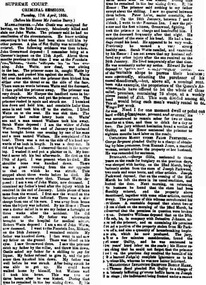
... ...William Watts...Family research queries John and Sarah Watts William and Mary Watts Both families were shoemakers. ...Letter: Sue Wills, Waterford West, Qld, n.d. seeking information on John and Sarah Watts and William and Mary Watts (both families shoemakers) 3. ...Family research queries John and Sarah Watts William and Mary Watts Both families were shoemakers. ...Family research queries John and Sarah Watts William and Mary Watts Both families were shoemakers. John and Sarah Watts arrived in Eltham circa 1850. John Watts was recorded in the initial 1858 Eltham Roads District Board rates book living in Little Eltham, also 1859 and 1860. The property then appears to be in the name of Thomas Watts from 1861 to 1863 at least. Thomas was married to Ann. According to a Facebook contact from family researcher Rosie Watts in Queensland, the children of John and Sara were Betsy aka Elizabeth, Ann, Maria, Robert and Sarah (later Jones). Sarah was born 1850, the only child born in Australia. Sarah Watts remained in Eltham and married a man by the name Meadows. On 24 January 1860 John Watts was asaulted by a beligerant drunk (John Castle) whilst sitting at the bar of the Fountain Hotel that evening. Castle without warning grabbed Watts by the throat, pushed him over and kicked him in the head with his heavy boots. Constable Lalor was called and Castle attempted to assault him as well. Watts was helped up, was sick and was taken home by his son and a Mr Wallace. He went to bed. Watts died April 11 and his wfe Sarah advised the Coroner's inquest held April 11 that he had never left his bed from that time. Castle was charged with manslaughter. He was found guilty by jury and sentenced to 18 months hard labour on the roads. John Watts is buried in Eltham Cemetery in an unmarked grave before records were kept. His wife, Sarah later Sarah Meadows (previously Watts, nee Tew) is buried there also along with her daughter Ann Southerly Head (nee Meadows). john watts, william watts, mary watts, john castle, manslaughter, fountain hotel, constable peter lalor, shoemaker, sarah meadows, sarah watts (nee tew) -
Eltham District Historical Society Inc
Document - Folder, Watts, John
... ...William Watts...Contents Letter Sue Wills to Shire of Eltham Historical Society, undated: Seeking information on John and Sarah Watts, and William and Mary Watts, who lived in Eltham. ...Contents Letter Sue Wills to Shire of Eltham Historical Society, undated: Seeking information on John and Sarah Watts, and William and Mary Watts, who lived in Eltham. ...John Thomas Watts was an early settler in Eltham. Contents Letter Sue Wills to Shire of Eltham Historical Society, undated: Seeking information on John and Sarah Watts, and William and Mary Watts, who lived in Eltham. Letter Betty Jeffrey to Mr Bassett Smith, 3 May 1984: Provides information on her family. Letter Betty Jeffrey (nee Watts) to Eltham Historical Society, 1 September 2000. Provides information about John Thomas Watts.Newspaper clippings, A4 photocopies, etcjohn watts, sarah watts, william watts, mary watts, thomas watts, john thomas watts, eltham cemetery, elizabeth cockwell, agnes watts, julia watts, henry arthur watts, percival charles watts, maria watts, samuel jeffrey watta, fountain inn eltham, peter lalor senior constable eltham -
 Uniting Church Archives - Synod of Victoria
Photograph, Rev. Thomas Watt Leggatt
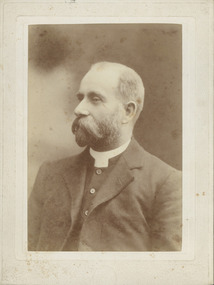
... B. 1859 Glasgow; Glasgow University; 1886 ordained in Scots Church Melbourne; to New Hebrides Mission, Aulua, Malekula; 1907 Dunolly; 1910 Sunbury; 1919 Convener of Board of Missions; editor "Record"; 1923 Abbotsford; 1929 Glen Iris; 1931 Moderator, Victoria; 1944 died 23 August. Son, William Watt Leggatt was a politician in the Bolte Government in Victoria...."Thomas Watt Leggatt - Aulua, New Hebrides - minister Sunbury, Abbotsford. Father of Sir William (Bill) Watt Leggatt, Ormond Law Agent for (?) ...Father of Sir William (Bill) Watt Leggatt, Ormond Law Agent for (?) ...B. 1859 Glasgow; Glasgow University; 1886 ordained in Scots Church Melbourne; to New Hebrides Mission, Aulua, Malekula; 1907 Dunolly; 1910 Sunbury; 1919 Convener of Board of Missions; editor "Record"; 1923 Abbotsford; 1929 Glen Iris; 1931 Moderator, Victoria; 1944 died 23 August. Son, William Watt Leggatt was a politician in the Bolte Government in Victoria.Sepia photo of Leggatt posed facing his right; dressed in 19th century clerical suit, collar and waistcoat."Thomas Watt Leggatt - Aulua, New Hebrides - minister Sunbury, Abbotsford. Father of Sir William (Bill) Watt Leggatt, Ormond Law Agent for (?) in London - Deaconess Dorothy Leggatt."leggatt, thomas watt, new hebrides -
 Bendigo Military Museum
Photograph - PHOTOGRAPHS WW2, c.1939-45
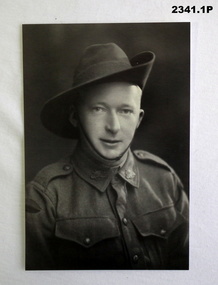
... Three Bendigo Brothers. William Francis Watts V59667 & VX138000. First enlisted in the 38th Bn on 17.7.1940, transferred to the 2nd AIF 2.4.1943 age 27 years, embarked from Darwin for New Britain with 16th Australian Infantry Bn on 24.12.1944, disembark Jacquinot Bay 30.12.1944, discharged from the AIF on 10.1.1946 in 16th Aust INF Bn. ....1) Photo black & white, copy of original, portrait of William Francis Watts VX138000. .2) Photo black & white, copy of original, 2 soldiers outside a hut re Ernest John Harold WATTS (Jack) VX62580 & Charles Edward WATTS VX58447....Three Bendigo Brothers. William Francis Watts V59667 & VX138000. First enlisted in the 38th Bn on 17.7.1940, transferred to the 2nd AIF 2.4.1943 age 27 years, embarked from Darwin for New Britain with 16th Australian Infantry Bn on 24.12.1944, disembark Jacquinot Bay 30.12.1944, discharged from the AIF on 10.1.1946 in 16th Aust INF Bn. ...Three Bendigo Brothers. William Francis Watts V59667 & VX138000. First enlisted in the 38th Bn on 17.7.1940, transferred to the 2nd AIF 2.4.1943 age 27 years, embarked from Darwin for New Britain with 16th Australian Infantry Bn on 24.12.1944, disembark Jacquinot Bay 30.12.1944, discharged from the AIF on 10.1.1946 in 16th Aust INF Bn. Ernest John Harold Watts VX62580 enlisted 27.8.1941 age 29 years, embark for the Middle East on 2.11.1941 with Aust Army Postal Unit, embark for Aust 7.2.1942, discharged from the AIF 31.10.1945 with the rank of Cpl in Aust Army Postal Unit. Charles Edward Watts VX58447 enlisted on 7.7.1941 age 31 years, embark for the Middle East 3.9.1941 with Australian Army Postal Unit, embark for Aust 4.2.1942, hospital aboard ship, Cardiac Neurosis, discharged from the AIF on 6.7.1942. Both Ernest and Charles were Postal Workers pre enlistment..1) Photo black & white, copy of original, portrait of William Francis Watts VX138000. .2) Photo black & white, copy of original, 2 soldiers outside a hut re Ernest John Harold WATTS (Jack) VX62580 & Charles Edward WATTS VX58447.photography-photographs, military history -
Federation University Historical Collection
Photograph, Ballarat School of Mines Memorial Stone
... ...william a. watt...This Memorial Stone was laid by The Honble William A. Watt M.L.C. Premier of Victoria June 5 1914 W.H. ...buildings ballarat school of mines smb campus william a. watt premier of victoria w.h. middleton plaque memorial stone foundation stone This Memorial Stone was laid by The Honble William A. ...Colour photographThis Memorial Stone was laid by The Honble William A. Watt M.L.C. Premier of Victoria June 5 1914 W.H. Middleton Presidentbuildings, ballarat school of mines, smb campus, william a. watt, premier of victoria, w.h. middleton, plaque, memorial stone, foundation stone -
Marysville & District Historical Society
Document (Item) - Research Document, Joan Anderson, John W Lindt, Unknown
... william lindt...fernshaw...watts...He was survived by his wife Catherine who continued to run ‘The Hermitage’ guest house before she retired to the city. john william lindt fernshaw watts river black spur the hermitage nicholas nicholas john caire the argus An account of the life of John W Lindt. ...An account of the life of John W Lindt.An account of the life of John W Lindt. John William Lindt (1845–1926), was a German-born Australian landscape and ethnographic photographer, early photojournalist, and portraitist. John Lindt was responsible for a folio of photographs of the Fernshaw and Watts River area and he sold over 25,000 images of the Black Spur from his original negatives. In 1895 he was able to purchase land on the North East side of the Black Spur and subsequently built his home and guesthouse "The Hermitage" from where he continued his photographic career. In 1913 he collaborated with Nicholas Caire to produce a tourist booklet on the area. In 1925 the Argus reported that Lindt "continues to produce remarkable and most artistic pictures of the beauties of mountain landscape. He is not a believer in the blurred effects favoured by many ... instead he is a master of detail." Aged 81 Lindt died of heart failure during disastrous bushfires on 19 February 1926 at the Hermitage. He was survived by his wife Catherine who continued to run ‘The Hermitage’ guest house before she retired to the city.john william lindt, fernshaw, watts river, black spur, the hermitage, nicholas, nicholas john caire, the argus -
 Marysville & District Historical Society
Photograph (Item) - Black and white photographs, Unknown
... william lindt...fernshaw...watts...He was survived by his wife Catherine who continued to run ‘The Hermitage’ guest house before she retired to the city. john william lindt fernshaw watts river black spur the hermitage nicholas nicholas john caire the argus Early black and white photographs of John William Lindt. ...Early black and white photographs of John William Lindt.Early black and white photographs of John William Lindt. John William Lindt (1845–1926), was a German-born Australian landscape and ethnographic photographer, early photojournalist, and portraitist. John Lindt was responsible for a folio of photographs of the Fernshaw and Watts River area and he sold over 25,000 images of the Black Spur from his original negatives. In 1895 he was able to purchase land on the North East side of the Black Spur and subsequently built his home and guesthouse "The Hermitage" from where he continued his photographic career. In 1913 he collaborated with Nicholas Caire to produce a tourist booklet on the area. In 1925 the Argus reported that Lindt "continues to produce remarkable and most artistic pictures of the beauties of mountain landscape. He is not a believer in the blurred effects favoured by many ... instead he is a master of detail." Aged 81 Lindt died of heart failure during disastrous bushfires on 19 February 1926 at the Hermitage. He was survived by his wife Catherine who continued to run ‘The Hermitage’ guest house before she retired to the city.john william lindt, fernshaw, watts river, black spur, the hermitage, nicholas, nicholas john caire, the argus -
Marysville & District Historical Society
Document (Item) - Book extract, John (Jack) Cato, John William Lindt F.R.G.S. of Melbourne-The Story of the Camera in Australia, 1955
... william lindt...fernshaw...watts...John (Jack) Cato was a keen photographer from an early age and was the author of The Story of the Camera in Australia which when it was first published in 1955, was the first history of Australian photography and photographs. john william lindt fernshaw watts river black spur the hermitage nicholas nicholas john caire the argus john (jack) cato the story of the camera in australia An account of the life of John Willliam Lindt extracted from the book The Story of the Camera in Australia. ...An account of the life of John Willliam Lindt extracted from the book The Story of the Camera in Australia.An account of the life of John Willliam Lindt extracted from the book The Story of the Camera in Australia. John William Lindt (1845–1926), was a German-born Australian landscape and ethnographic photographer, early photojournalist, and portraitist. John Lindt was responsible for a folio of photographs of the Fernshaw and Watts River area and he sold over 25,000 images of the Black Spur from his original negatives. In 1895 he was able to purchase land on the North East side of the Black Spur and subsequently built his home and guesthouse "The Hermitage" from where he continued his photographic career. In 1913 he collaborated with Nicholas Caire to produce a tourist booklet on the area. In 1925 the Argus reported that Lindt "continues to produce remarkable and most artistic pictures of the beauties of mountain landscape. He is not a believer in the blurred effects favoured by many ... instead he is a master of detail." Aged 81 Lindt died of heart failure during disastrous bushfires on 19 February 1926 at the Hermitage. He was survived by his wife Catherine who continued to run ‘The Hermitage’ guest house before she retired to the city. John (Jack) Cato was a keen photographer from an early age and was the author of The Story of the Camera in Australia which when it was first published in 1955, was the first history of Australian photography and photographs.john william lindt, fernshaw, watts river, black spur, the hermitage, nicholas, nicholas john caire, the argus, john (jack) cato, the story of the camera in australia -
 Eltham District Historical Society Inc
Document - Folder, Lyon, 2014
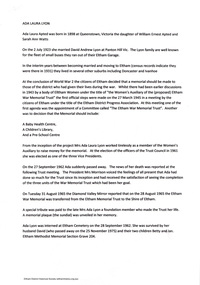
... Watts...William Ernest Apted...ADA LAURA LYON Ada Laura Apted was born in 1898 at Queenstown, Victoria the daughter of William Ernest Apted and Sarah Ann Watts On the 2 July 1923 she married David Andrew Lyon at Panton Hill Vic. ...[Author: Jim Allen c.2014] Biography Ada Laura Lyon (nee Apted) David Andrew Lyon eltham war memorial trust Sarah Ann Watts William Ernest Apted Folder of information on Lyon family. ...ADA LAURA LYON Ada Laura Apted was born in 1898 at Queenstown, Victoria the daughter of William Ernest Apted and Sarah Ann Watts On the 2 July 1923 she married David Andrew Lyon at Panton Hill Vic. The Lyon family are well known for the fleet of small buses they ran out of their Eltham Garage. In the interim years between becoming married and moving to Eltham (census records indicate they were there in 1931) they lived in several other suburbs including Doncaster and Ivanhoe At the conclusion of World War 2 the citizens of Eltham decided that a memorial should be made to those of the district who had given their lives during the war. Whilst there had been earlier discussions in 1943 by a body of Eltham Women under the title of "the Women's Auxiliary of the (proposed) Eltham War Memorial Trust'' the first official steps were made on the 27 March 1945 in a meeting by the citizens of Eltham under the title of the Eltham District Progress Association. At this meeting one of the first agenda was the appointment of a committee called "The Eltham War Memorial Trust''. Another was to decision that the Memorial should include: A Baby Health Centre, A Children's Library, And a Pre-School Centre From the inception of the project Mrs Ada Laura Lyon worked tirelessly as a member of the Women's Auxiliary to raise money for the memorial. At the election of the officers of the Trust Council in 1961 she was elected as one of the three Vice Presidents. On the 27 September 1962 Ada suddenly passed away. The news of her death was reported at the following Trust meeting. The President Mrs Morrison voiced the feelings of all present that Ada had done so much for the Trust since its inception and had received the satisfaction of seeing the completion of the three units of the War Memorial Trust which had been her goal. On Tuesday 31 August 1965 the Diamond Valley Mirror reported that on the 28 August 1965 the Eltham War Memorial was transferred from the Eltham Memorial Trust to the Shire of Eltham. A special tribute was paid to the late Mrs Ada Lyon a foundation member who made the Trust her life. A memorial plaque (the sundial) was unveiled in her memory. Ada Lyon was interned at Eltham Cemetery on the 28 September 1962. She was survived by her husband David (who passed away on the 25 November 1975) and their two children Betty and Ian. Eltham Methodist Memorial Section Grave 204. [Author: Jim Allen c.2014] Folder of information on Lyon family. Contents: 1. Ada Laura Lyon (nee Apted) - biography written by Jim Allen (1 A4 page)biography, ada laura lyon (nee apted), david andrew lyon, eltham war memorial trust, sarah ann watts, william ernest apted -
Glen Eira Historical Society
Document - Glenfern
... Article on his schooling, and his further business history, his marriage details and tribute from Premier William Watt, 1871-1946....Article on his schooling, and his further business history, his marriage details and tribute from Premier William Watt, 1871-1946. Watson Thomas Lauder Watson James Brookman Agnes Montgomery Watson Jessie Watson Thomas Watson Thomas Greenless Watson Kathleen Hall Kathleen Glendora House names Nepean Highway Elsternwick Offices of parliament Document Glenfern ...This file contains four items about the Watson family, sometime owners of Glenfern: 1/ Photocopy of Thomas Lauder Watson family tree, great grandfather of the Watsons of Glenfern, period 1820 to 1988. 2/ Photocopy of James Watson and Agnes Montgomery Bookman Marriage Register entry dated 20/06/1883. 3/ Photocopy of a record for Thomas Watson held on the ScotlandsPeople website noting that his spouse was born 17/10/1816. 4/ Print of article from brightoncemetery.com website on Thomas Greenless Watson, 1859-1912, parliamentary official. Article on his schooling, and his further business history, his marriage details and tribute from Premier William Watt, 1871-1946.watson thomas lauder, watson james, brookman agnes montgomery, watson jessie, watson thomas, watson thomas greenless, watson kathleen, hall kathleen, glendora, house names, nepean highway, elsternwick, offices of parliament -
 Eltham District Historical Society Inc
Photograph, Hurstbridge Railway Station, Opening Day, 25 June 1912
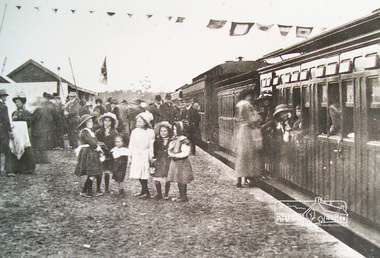
... Local member of parliament Ewen Cameron and Victorian Premier William Watt were present. Agitation for a railway extension began in 1888 when a meeting was held at Arthurs Creek to press for the construction of a railway line from Heidelberg to Kinglake. ...Local member of parliament Ewen Cameron and Victorian Premier William Watt were present. Agitation for a railway extension began in 1888 when a meeting was held at Arthurs Creek to press for the construction of a railway line from Heidelberg to Kinglake. ...Despite inclement weather, up to 500 people attended the opening of the Eltham-Hurstbridge railway on 25 June 1912. Local member of parliament Ewen Cameron and Victorian Premier William Watt were present. Agitation for a railway extension began in 1888 when a meeting was held at Arthurs Creek to press for the construction of a railway line from Heidelberg to Kinglake. The Chairman Mr Charles Draper said this was necessary because this was the best fruit growing district in Victoria. Mr Cameron M.P. pointed out that whatever route the line took it would have to follow the Diamond Valley from Eltham. At the same time another meeting was pressing for the line to be extended to Queenstown (St Andrews). However when detailed surveys were made it was discovered that the only possible route was to Hurstbridge because of the hills. In 1912 the railway was opened terminating at Hurstbridge. Digital filerailway station, hurstbridge -
 Flagstaff Hill Maritime Museum and Village
Rangefinder, E R Watts & Sons, 1930-1945
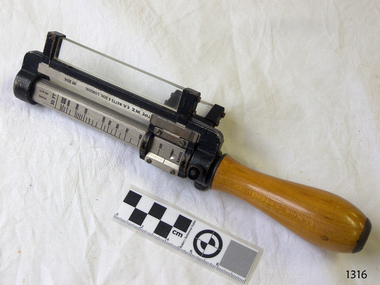
... He was succeeded by his brother George William Watts with the vacant post of Managing Director being filled by G. ...He was succeeded by his brother George William Watts with the vacant post of Managing Director being filled by G. ...E. R. Watts and Son, makers of theodolites and other surveying instruments, of 123 Camberwell Road, London. The company was established in 1856 by Edwin Watts at twenty-three he had saved £100 from his earnings to start the business with his staff consisting of one boy and later Alexander Clarkson as an apprentice with the workshop a small room over a Bemondsey stable. Watts' first order was from Negretti and Zambra for a mining dial Alexander Clarkson In the early days the firm worked mainly on marine compasses. Edwin Watts would go down to the Docks to adjust the compasses once they had been installed on the ships. In May 1873 the business moved to larger premises a house with a garden. The workshop was also the home of Mr and Mrs Watts and their five sons and three daughters. By now there were fifteen to twenty men employed by the firm. The company were commissioned to supply the Theodolites and Levels for the construction to the Canadian Pacific Railway in 1881. Towards the end of the century, the firm began to make heliographs continuing to produce them for the government until just before the Second World War when by agreement assigned their manufacture to another firm. 1904 The first dividing engine was completed by George William Watts. It was so remarkable an instrument at the time and for years afterwards, In 1907 Arthur Ames went to Canada and started an organisation in Winnipeg in 1909 this became a separate company called E. R. Watts and Son Ltd. of Ottawa. This firm developed considerably and was eventually with the co-operation of three other instrument companies (Cambridge Instrument Co, Ross, and Negretti and Zambra), were reconstituted as ”Instruments Ltd” of Ottawa and Toronto. During the next ten years, the firm expanded greatly to include glass grinding, leather work, dividing and engraving, testing, adjusting and packing. This expansion was continued during the First World War when workshops were completed and the machinery installed and running within eleven weeks from the start of construction. During the war, a Sergeant Coles, among the rats, lice and mud of the trenches, fitted various bits of scrap into his cocoa tin and made the first Flash Spotter for plotting the positions of enemy guns. Coles was rushed home to the firm's factory where he and George William Watts designed a spotter not made out of a cocoa tin and as a result, the Watts Vertical Force Variometer was developed during WWI. Other Watts instruments made in the First World War included the Light Mountain Theodolites which were taken on Mt Everest expeditions. In 1919 ER Watts and Sons was incorporated as a limited company and in 1939 G. A. Whipple joined the Board of Directors. Shortly afterwards, Frank Charles Watts died having been Chairman of the firm for over 37 years and seen it through the First World War with all its expansions and difficulties. He was succeeded by his brother George William Watts with the vacant post of Managing Director being filled by G. A. Whipple. During the Second World War, the company expanded further and the number of employees rose to well over 1,300. In 1946 Watts acquired 78% of Adam Hilger and the microscope maker James Swift and Son Who were Manufacturers of Theodolites, Levels, Alidades, Meteorological Instruments, Variometers, and many other types of scientific instruments Then in 1948 the company amalgamated with Adam Hilger as Hilger and Watts which was then incorporated as a public company.Naval Rangefinder with a vertical wooden handle, and an arrangement of optical lenses. Three reversible brass inserts calibrated on both sides in yards, correspond to various base heights, (20 and 25 feet, 30 and 35 feet and 40 and 50 feet). They are fitted along the axis of the instrument. When the scale for the appropriate base height is selected and inserted, the carriage can be slid for coincidence and the distance read at the index mark on the sliding carriage.inscribed "Rangefinder Cotton Type Mk II" Calibrated scale up to 5000 yds (50 ft), 5000 yds (35 ft), 4000 yds (25 ft) made by E. R. Watts & Son.flagstaff hill, warrnambool, shipwrecked coast, flagstaff hill maritime museum, maritime museum, shipwreck coast, flagstaff hill maritime village, great ocean road, rangefinder, cotton type, e r watts & sons, naval range finder, marine equipment -
 Melton City Libraries
Newspaper, Special Melton People, 1971
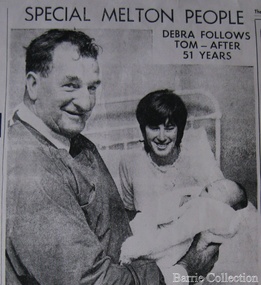
... Later that same year she married William Watts and together they moved to Toolern Vale and built a bluestone and mud brick home. ...Later that same year she married William Watts and together they moved to Toolern Vale and built a bluestone and mud brick home. ..."Hannah ‘Grannie’ Wattsis one of Melton’s mostcelebrated and cherished pioneers. Born in Ireland in 1831, Hannah immigrated to Australia with her husband George Byrns in 1854. Moving to Melton, they built a wattle and daub hut home where they lived with their four children until George was tragically killed in 1860. Unusually for the time, Hannah purchased land in her own name in the Melton township in 1863. Later that same year she married William Watts and together they moved to Toolern Vale and built a bluestone and mud brick home. It is believed that while travelling to Australia, Hannah assisted the ship surgeon and demonstrated a natural aptitude for the tasks assigned to her. When she was living in Melton she assisted other women in an unofficial capacity as neighbourhood midwife, while also working on her farm and raising her six children. By 1887, however, her reputation as a midwife had grown to such an extent that she was able to establish her own practice. William Watts died in 1874, but Hannah remained in Toolern Vale for the next twenty years. In 1894, she moved into the Melton township and built Lynch Cottage on the corner of Yuille and Sherwin streets, near Toolern Vale Creek. There she assisted in the births of hundreds of Melton residents, as well as the laying out of the deceased. Meticulous in her record keeping, Hannah Watts recorded the details of a total of 442 births between the years 1886 and 1921. Lynch Cottage was officially registered as a private hospital in 1911 and Hannah was listed in the Victorian Register of Midwives in 1917. Hannah Watts died on 21 October 1921, a few months after she assisted with the delivery of her final baby, Thomas Watts Minns. She was 90 years old. Hannah was buried in Melton Cemetery and mourned by the Melton community. Her obituary in the Gisborne Gazette is a testament to how beloved she was by the people she served: ... while in the absence of medical aid residents looked to Grannie as their doctor, philosopher and friend. Hundreds, in fact we might say thousands of people held the deceased in veneration ... A woman of great energy and determination combined with superior intelligence, Grannie conquered difficulties that would have made many falter... Today Grannie Watts is remembered by her descendants and by many locals in the City of Melton. Created in 1985, Hannah Watts Park honours Grannie Watts’ pioneering work for the health and wellbeing of hundreds of Meltonians. Not only is the park a fitting tribute to the memory of an outstanding citizen, it also continues to provide today’s residents and visitors with a space to walk, relax, gather and celebrate in Melton" .Tom Minns holding Debra Wain, first hospital baby to be born In Melton since 1921. Article featured in the Herald. Mother Rhonda Wain is featured in the photo too. local identities, local significant events -
 Orbost & District Historical Society
black and white photograph, August 1897
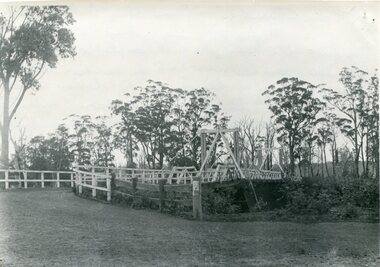
... Mr Granter and Mr Clarke finished it as a suspension bridge which was opened by Mrs William Watt. Soon after a mob of cattle stampeded, the weight snapped the cable, letting one side sag. ...Mr Granter and Mr Clarke finished it as a suspension bridge which was opened by Mrs William Watt. Soon after a mob of cattle stampeded, the weight snapped the cable, letting one side sag. ...This is a photograph of the bridge from the Orbost side. The first pile bridge over the Snowy River was just completed by Mr Jim Granter when the 1891 flood took out the centre,. There were differences of opinion as to whether the council should pay . The Shire Secretary, Mr John Draffin, persuaded them to honour their obligations. Mr Granter and Mr Clarke finished it as a suspension bridge which was opened by Mrs William Watt. Soon after a mob of cattle stampeded, the weight snapped the cable, letting one side sag. Mr R.P. Cameron repaired it and this bridge remained until 1922. "In 1890 the contract for a bridge was let to Mr James Granter for £1450. This structure with additions and improvements made to it was to cost the ratepayers about £2,500, and its erection was proceeded with in a very satisfactory manner until, just as the greater-part of the work had been completed, the flood of 1891 came down on it, piling up mountains of logs, timber and debris against the piers, which had not been made wide enough apart to allow for. contingencies of this kind. The structure held out bravely until the turn of the flood and then gave way with a crash, about five bays from the centre disappearing in the stream." ( Snowy River Mail August 12 1893) This item is a pictorial record of one of the first bridges across the Snowy River in Orbost.A black / white photograph of the old wooden suspension bridge over the Snowy River. There are two copies 919.1 and 919.2. There are two other photos showing the whole bridge taken from further back.on back - "Orbost Bridge...."snowy-river-bridge-orbost granter-james -
 Orbost & District Historical Society
black and white photograph, C1890
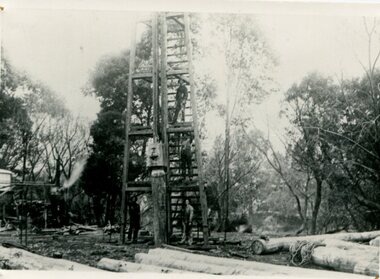
... Mr Granter and Mr Clarke finished it as a suspension bridge which was opened by Mrs William Watt. Soon after a mob of cattle stampeded, the weight snapped the cable, letting one side sag. ...Mr Granter and Mr Clarke finished it as a suspension bridge which was opened by Mrs William Watt. Soon after a mob of cattle stampeded, the weight snapped the cable, letting one side sag. ...This photograph shows the construction of the first bridge over the Snowy River at Orbost being built. a copy was also donated by Gil and Heather Richardson. The first pile bridge over the Snowy River was just completed by Mr Jim Granter when the 1891 flood took out the centre,. There were differences of opinion as to whether the council should pay . The Shire Secretary, Mr John Draffin, persuaded them to honour their obligations. Mr Granter and Mr Clarke finished it as a suspension bridge which was opened by Mrs William Watt. Soon after a mob of cattle stampeded, the weight snapped the cable, letting one side sag. Mr R.P. Cameron repaired it and this bridge remained until 1922. "In 1890 the contract for a bridge was let to Mr James Granter for £1450. This structure with additions and improvements made to it was to cost the ratepayers about £2,500, and its erection was proceeded with in a very satisfactory manner until, just as the greater-part of the work had been completed, the flood of 1891 came down on it, piling up mountains of logs, timber and debris against the piers, which had not been made wide enough apart to allow for. contingencies of this kind. The structure held out bravely until the turn of the flood and then gave way with a crash, about five bays from the centre disappearing in the stream." ( Snowy River Mail August 12 1893)This is a pictorial record of the construction of the first bridge over the Snowy River.A black / white photograph of four men working on the construction of a new bridge and its pylons a man is standing on a timber tower/ derrick. There are logs in the foreground, trees in the background. sheds on the left and possibly a steam engine.on back - "first bridge - 1st pile being driven"snowy-river-bridge granter-jim bridge -
 Flagstaff Hill Maritime Museum and Village
Weapon - Ammunition, Before 1878
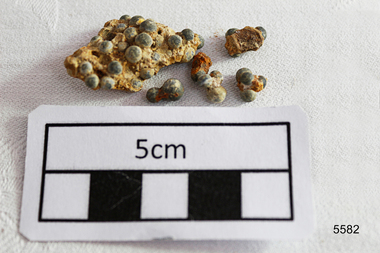
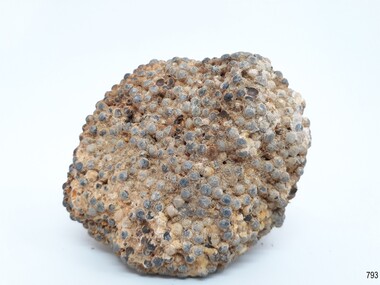
... This “shot tower” process was first patented by William Watts of Bristol in 1782. His calculation of a 150 feet fall was not only to form evenly spherical droplets through surface tension, but also to provide partial cooling and solidification to each shot before they hit the water below. ...This “shot tower” process was first patented by William Watts of Bristol in 1782. His calculation of a 150 feet fall was not only to form evenly spherical droplets through surface tension, but also to provide partial cooling and solidification to each shot before they hit the water below. ...The objects are a small sample of small gauge lead shot raised by Flagstaff Hill divers from the LOCH ARD shipwreck site in 1976. Companion pieces are in the Maritime Village collection. The three masted, iron hulled, LOCH ARD was wrecked against the tall limestone cliffs of Mutton Bird Island in the early hours of the first of June 1878. Included in her diverse and valuable cargo were 22 tons of lead shot, packed in cloth bags and wooden casks. Bulk quantities of lead shot, uniformly round balls of dull grey metal ranging from 2mm “birdshot” to 8mm “buckshot”, were routinely exported to the Australian colonies. Shot was used mostly as projectiles fired from smooth bored guns to bring down moving targets such as wild ducks and small game. It was also useful as ballast, when a dense, “pourable” weight was required to fill cavities or establish volume within a measuring container. The production of consistently round spheres of lead shot required the pouring of molten metal through a sieve and then a long drop through the atmosphere to a water filled basin for final cooling and collection. This “shot tower” process was first patented by William Watts of Bristol in 1782. His calculation of a 150 feet fall was not only to form evenly spherical droplets through surface tension, but also to provide partial cooling and solidification to each shot before they hit the water below. The value of his innovation was the minimising of indentation and shape distortion, avoiding the expense of re-smelting and re-moulding the lead. Lead shot was already being produced in Australia at the time the LOCH ARD loaded her cargo and left Gravesend on the second of March 1878. James Moir constructed a 157 feet circular stone shot tower near Hobart in 1870, with a peak annual production of 100 tons of lead shot sold in 28 pound linen bags. However colonial demand exceeded this source of local supply. The continued strength of the market for lead shot in the Colony of Victoria prompted substantial investment in additional productive capacity in Melbourne in the next decade. In 1882 Richard Hodgson erected the 160 feet round chimney-shaped Clifton Hill shot tower on Alexandra Parade (VHR H0709) and in 1889 Walter Coop built the 160 feet square tower-shaped Melbourne Central shot tower on La Trobe Street (VHR H0067). At its peak, the Coop Tower produced 6 tons of lead shot per week, or 312 tons per annum. The shipwreck of the LOCH ARD is of State significance – Victorian Heritage Register S417 Flagstaff Hill’s collection of artefacts from LOCH ARD is significant for being one of the largest collections of artefacts from this shipwreck in Victoria. It is significant for its association with the shipwreck, which is on the Victorian Heritage Register (VHR S417). The collection is significant because of the relationship between the objects, as together they have a high potential to interpret the story of the LOCH ARD. The LOCH ARD collection is archaeologically significant as the remains of a large international passenger and cargo ship. The LOCH ARD collection is historically significant for representing aspects of Victoria’s shipping history and its potential to interpret sub-theme 1.5 of Victoria’s Framework of Historical Themes (living with natural processes). The collection is also historically significant for its association with the LOCH ARD, which was one of the worst and best known shipwrecks in Victoria’s history. A quantity of 2mm and 4mm lead shot ammunition retrieved from the LOCH ARD shipwreck site. They are concreted together by sediment. There are (6) small pieces with some single shot and a larger conglomerate of cemented shot. flagstaff hill, warrnambool, shipwrecked coast, flagstaff hill maritime museum, maritime museum, shipwreck coast, flagstaff hill maritime village, great ocean road, loch line, loch ard, captain gibbs, eva carmichael, tom pearce, glenample station, mutton bird island, loch ard gorge, lead shot, colonial industry, melbourne shot towers, victorian metallurgy, colonial imports -
 Flagstaff Hill Maritime Museum and Village
Functional object - Lead shot, Circa 1877
... This “shot tower” process was first patented by William Watts of Bristol in 1782. His calculation of a 150 feet fall was not only to form evenly spherical droplets through surface tension, but also to provide partial cooling and solidification to each shot before they hit the water below. ...This “shot tower” process was first patented by William Watts of Bristol in 1782. His calculation of a 150 feet fall was not only to form evenly spherical droplets through surface tension, but also to provide partial cooling and solidification to each shot before they hit the water below. ...This artifact is a sample of small caliber lead shot recovered by Flagstaff Hill divers from the wreck of the Loch Ard in 1975. Included in her diverse and valuable cargo were 22 tons of lead shot, packed in cloth bags and wooden casks. Bulk quantities of lead shot, uniformly round balls of dull grey metal ranging from 2mm “birdshot” to 8mm “buckshot”, were routinely exported to the Australian colonies. Shot was used mostly as projectiles fired from smooth bored guns to bring down moving targets such as wild ducks and small game. It was also useful as ballast, when a dense, “pourable” weight was required to fill cavities or establish volume within a measuring container. The production of consistently round spheres of lead shot required the pouring of molten metal through a sieve and then a long drop through the atmosphere to a water filled basin for final cooling and collection. This “shot tower” process was first patented by William Watts of Bristol in 1782. His calculation of a 150 feet fall was not only to form evenly spherical droplets through surface tension, but also to provide partial cooling and solidification to each shot before they hit the water below. The value of his innovation was the minimising of indentation and shape distortion, avoiding the expense of re-smelting and re-moulding the lead. Lead shot was already being produced in Australia at the time the Loch Ard sinking in March 1878. James Moir had constructed a 157 feet circular stone shot tower near Hobart in 1870, with a peak annual production of 100 tons of lead shot sold in 28 pound linen bags. However colonial demand exceeded this source of local supply. The continued strength of the market for lead shot in the Colony of Victoria prompted substantial investment in additional productive capacity in Melbourne in the next decade. In 1882 Richard Hodgson erected the 160 feet round chimney-shaped Clifton Hill shot tower on Alexandra Parade (VHR H0709) and in 1889 Walter Coop built the 160 feet square tower-shaped Melbourne Central shot tower on La Trobe Street (VHR H0067). At its peak, the Coop Tower produced 6 tons of lead shot per week, or 312 tons per annum. History of the Loch Ard: The Loch Ard got its name from "Loch Ard" a loch that lies to the west of Aberfoyle, and the east of Loch Lomond. It means "high lake" in Scottish Gaelic. The vessel belonged to the famous Loch Line which sailed many vessels from England to Australia. The Loch Ard was built in Glasgow by Barclay, Curle & Co. in 1873, the vessel was a three-masted square-rigged iron sailing ship that measured 79.87 meters in length, 11.58 m in width, and 7 m in depth with a gross tonnage of 1693 tons with a mainmast that measured a massive 45.7 m in height. Loch Ard made three trips to Australia and one trip to Calcutta before its fateful voyage. Loch Ard left England on March 2, 1878, under the command of 29-year-old Captain Gibbs, who was newly married. The ship was bound for Melbourne with a crew of 37, plus 17 passengers. The general cargo reflected the affluence of Melbourne at the time. Onboard were straw hats, umbrellas, perfumes, clay pipes, pianos, clocks, confectionery, linen, and candles, as well as a heavier load of railway irons, cement, lead, and copper. There were other items included that were intended for display in the Melbourne International Exhibition of 1880. The voyage to Port Phillip was long but uneventful. Then at 3 am on June 1, 1878, Captain Gibbs was expecting to see land. But the Loch Ard was running into a fog which greatly reduced visibility. Captain Gibbs was becoming anxious as there was no sign of land or the Cape Otway lighthouse. At 4 am the fog lifted and a lookout aloft announced that he could see breakers. The sheer cliffs of Victoria's west coast came into view, and Captain Gibbs realised that the ship was much closer to them than expected. He ordered as much sail to be set as time would permit and then attempted to steer the vessel out to sea. On coming head-on into the wind, the ship lost momentum, the sails fell limp and Loch Ard's bow swung back towards land. Gibbs then ordered the anchors to be released in an attempt to hold their position. The anchors sank some 50 fathoms - but did not hold. By this time the ship was among the breakers and the tall cliffs of Mutton Bird Island rose behind. Just half a mile from the coast, the ship's bow was suddenly pulled around by the anchor. The captain tried to tack out to sea, but the ship struck a reef at the base of Mutton Bird Island, near Port Campbell. Waves subsequently broke over the ship and the top deck became loosened from the hull. The masts and rigging came crashing down knocking passengers and crew overboard. When a lifeboat was finally launched, it crashed into the side of Loch Ard and capsized. Tom Pearce, who had launched the boat, managed to cling to its overturned hull and shelter beneath it. He drifted out to sea and then on the flood tide came into what is now known as Lochard Gorge. He swam to shore, bruised and dazed, and found a cave in which to shelter. Some of the crew stayed below deck to shelter from the falling rigging but drowned when the ship slipped off the reef into deeper water. Eva Carmichael a passenger had raced onto the deck to find out what was happening only to be confronted by towering cliffs looming above the stricken ship. In all the chaos, Captain Gibbs grabbed Eva and said, "If you are saved Eva, let my dear wife know that I died like a sailor". That was the last Eva Carmichael saw of the captain. She was swept off the ship by a huge wave. Eva saw Tom Pearce on a small rocky beach and yelled to attract his attention. He dived in and swam to the exhausted woman and dragged her to shore. He took her to the cave and broke the open case of brandy that had washed up on the beach. He opened a bottle to revive the unconscious woman. A few hours later Tom scaled a cliff in search of help. He followed hoof prints and came by chance upon two men from nearby Glenample Station three and a half miles away. In a complete state of exhaustion, he told the men of the tragedy. Tom then returned to the gorge while the two men rode back to the station to get help. By the time they reached Loch Ard Gorge, it was cold and dark. The two shipwreck survivors were taken to Glenample Station to recover. Eva stayed at the station for six weeks before returning to Ireland by steamship. In Melbourne, Tom Pearce received a hero's welcome. He was presented with the first gold medal of the Royal Humane Society of Victoria and a £1000 cheque from the Victorian Government. Concerts were performed to honour the young man's bravery and to raise money for those who lost families in the disaster. Of the 54 crew members and passengers on board, only two survived: the apprentice, Tom Pearce, and the young woman passenger, Eva Carmichael, who lost her family in the tragedy. Ten days after the Lochard tragedy, salvage rights to the wreck were sold at auction for £2,120. Cargo valued at £3,000 was salvaged and placed on the beach, but most washed back into the sea when another storm developed. The wreck of Lochard still lies at the base of Mutton Bird Island. Much of the cargo has now been salvaged and some items were washed up into Lochard Gorge. Cargo and artifacts have also been illegally salvaged over many years before protective legislation was introduced in March 1982. One of the most unlikely pieces of cargo to have survived the shipwreck was a Minton majolica peacock- one of only nine in the world. The peacock was destined for the Melbourne 1880 International Exhibition. It had been well packed, which gave it adequate protection during the violent storm. Today the Minton peacock can be seen at the Flagstaff Hill Maritime Museum in Warrnambool. From Australia's most dramatic shipwreck it has now become Australia's most valuable shipwreck artifact and is one of very few 'objects' on the Victorian State Heritage Register.The shipwreck of the Loch Ard is of significance for Victoria and is registered on the Victorian Heritage Register ( S 417). Flagstaff Hill has a varied collection of artifacts from Loch Ard and its collection is significant for being one of the largest accumulation of artifacts from this notable Victorian shipwreck of which the subject items are a small part. The collection's objects give us a snapshot of how we can interpret the story of this tragic event. The collection is also archaeologically significant as it represents aspects of Victoria's shipping history that allows us to interpret Victoria's social and historical themes of the time. Through is associated with the worst and best-known shipwreck in Victoria's history.Lead shot; a group of mixed -sized lead shot. Small 2mm shot is embedded in a sea sediment clump of concretion. Also in the group are also 5 single 2mm shot and 4 single 4mm shot that are clean and free of sediment. The shot was recovered from the wreck of the Loch Ard.Nonewarrnambool, shipwreck coast, flagstaff hill, flagstaff hill maritime village, flagstaff hill maritime museum, shipwreck artefact, lead shot, loch ard, colonial industry, melbourne shot towers, victorian metallurgy, colonial imports -
 Flagstaff Hill Maritime Museum and Village
Lead shot, Before 1878
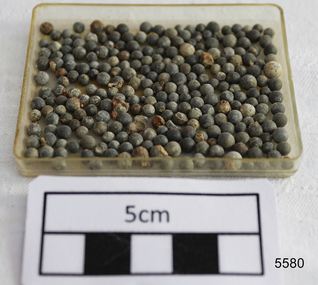
... This “shot tower” process was first patented by William Watts of Bristol in 1782. His calculation of a 150 feet fall was not only to form evenly spherical droplets through surface tension, but also to provide partial cooling and solidification to each shot before they hit the water below. ...This “shot tower” process was first patented by William Watts of Bristol in 1782. His calculation of a 150 feet fall was not only to form evenly spherical droplets through surface tension, but also to provide partial cooling and solidification to each shot before they hit the water below. ...The objects comprise a quantity of small calibre lead shot raised from the LOCH ARD shipwreck site by Flagstaff Hill divers in 1976. The Maritime Village’s collection has companion pieces. The three masted, iron hulled, LOCH ARD was wrecked against the tall limestone cliffs of Mutton Bird Island in the early hours of the first of June 1878. Included in her diverse and valuable cargo were 22 tons of lead shot, packed in cloth bags and wooden casks. Bulk quantities of lead shot, uniformly round balls of dull grey metal ranging from 2mm “birdshot” to 8mm “buckshot”, were routinely exported to the Australian colonies. Shot was used mostly as projectiles fired from smooth bored guns to bring down moving targets such as wild ducks and small game. It was also useful as ballast, when a dense, “pourable” weight was required to fill cavities or establish volume within a measuring container. The production of consistently round spheres of lead shot required the pouring of molten metal through a sieve and then a long drop through the atmosphere to a water filled basin for final cooling and collection. This “shot tower” process was first patented by William Watts of Bristol in 1782. His calculation of a 150 feet fall was not only to form evenly spherical droplets through surface tension, but also to provide partial cooling and solidification to each shot before they hit the water below. The value of his innovation was the minimising of indentation and shape distortion, avoiding the expense of re-smelting and re-moulding the lead. Lead shot was already being produced in Australia at the time the LOCH ARD loaded her cargo and left Gravesend on the second of March 1878. James Moir constructed a 157 feet circular stone shot tower near Hobart in 1870, with a peak annual production of 100 tons of lead shot sold in 28 pound linen bags. However colonial demand exceeded this source of local supply. The continued strength of the market for lead shot in the Colony of Victoria prompted substantial investment in additional productive capacity in Melbourne in the next decade. In 1882 Richard Hodgson erected the 160 feet round chimney-shaped Clifton Hill shot tower on Alexandra Parade (VHR H0709) and in 1889 Walter Coop built the 160 feet square tower-shaped Melbourne Central shot tower on La Trobe Street (VHR H0067). At its peak, the Coop Tower produced 6 tons of lead shot per week, or 312 tons per annum. HISTORY OF THE LOCH ARD The LOCH ARD belonged to the famous Loch Line which sailed many ships from England to Australia. Built in Glasgow by Barclay, Curdle and Co. in 1873, the LOCH ARD was a three-masted square rigged iron sailing ship. The ship measured 262ft 7" (79.87m) in length, 38ft (11.58m) in width, 23ft (7m) in depth and had a gross tonnage of 1693 tons. The LOCH ARD's main mast measured a massive 150ft (45.7m) in height. LOCH ARD made three trips to Australia and one trip to Calcutta before its final voyage. LOCH ARD left England on March 2, 1878, under the command of Captain Gibbs, a newly married, 29 year old. She was bound for Melbourne with a crew of 37, plus 17 passengers and a load of cargo. The general cargo reflected the affluence of Melbourne at the time. On board were straw hats, umbrella, perfumes, clay pipes, pianos, clocks, confectionary, linen and candles, as well as a heavier load of railway irons, cement, lead and copper. There were items included that intended for display in the Melbourne International Exhibition in 1880. The voyage to Port Phillip was long but uneventful. At 3am on June 1, 1878, Captain Gibbs was expecting to see land and the passengers were becoming excited as they prepared to view their new homeland in the early morning. But LOCH ARD was running into a fog which greatly reduced visibility. Captain Gibbs was becoming anxious as there was no sign of land or the Cape Otway lighthouse. At 4am the fog lifted. A man aloft announced that he could see breakers. The sheer cliffs of Victoria's west coast came into view, and Captain Gibbs realised that the ship was much closer to them than expected. He ordered as much sail to be set as time would permit and then attempted to steer the vessel out to sea. On coming head on into the wind, the ship lost momentum, the sails fell limp and LOCH ARD's bow swung back. Gibbs then ordered the anchors to be released in an attempt to hold its position. The anchors sank some 50 fathoms - but did not hold. By this time LOCH ARD was among the breakers and the tall cliffs of Mutton Bird Island rose behind the ship. Just half a mile from the coast, the ship's bow was suddenly pulled around by the anchor. The captain tried to tack out to sea, but the ship struck a reef at the base of Mutton Bird Island, near Port Campbell. Waves broke over the ship and the top deck was loosened from the hull. The masts and rigging came crashing down knocking passengers and crew overboard. When a lifeboat was finally launched, it crashed into the side of LOCH ARD and capsized. Tom Pearce, who had launched the boat, managed to cling to its overturned hull and shelter beneath it. He drifted out to sea and then on the flood tide came into what is now known as LOCH ARD Gorge. He swam to shore, bruised and dazed, and found a cave in which to shelter. Some of the crew stayed below deck to shelter from the falling rigging but drowned when the ship slipped off the reef into deeper water. Eva Carmichael had raced onto deck to find out what was happening only to be confronted by towering cliffs looming above the stricken ship. In all the chaos, Captain Gibbs grabbed Eva and said, "If you are saved Eva, let my dear wife know that I died like a sailor". That was the last Eva Carmichael saw of the captain. She was swept off the ship by a huge wave. Eva saw Tom Pearce on a small rocky beach and yelled to attract his attention. He dived in and swam to the exhausted woman and dragged her to shore. He took her to the cave and broke open case of brandy which had washed up on the beach. He opened a bottle to revive the unconscious woman. A few hours later Tom scaled a cliff in search of help. He followed hoof prints and came by chance upon two men from nearby Glenample Station three and a half miles away. In a state of exhaustion, he told the men of the tragedy. Tom returned to the gorge while the two men rode back to the station to get help. By the time they reached LOCH ARD Gorge, it was cold and dark. The two shipwreck survivors were taken to Glenample Station to recover. Eva stayed at the station for six weeks before returning to Ireland, this time by steamship. In Melbourne, Tom Pearce received a hero's welcome. He was presented with the first gold medal of the Royal Humane Society of Victoria and a £1000 cheque from the Victorian Government. Concerts were performed to honour the young man's bravery and to raise money for those who lost family in the LOCH ARD disaster. Of the 54 crew members and passengers on board, only two survived: the apprentice, Tom Pearce and the young woman passenger, Eva Carmichael, who lost all of her family in the tragedy. Ten days after the LOCH ARD tragedy, salvage rights to the wreck were sold at auction for £2,120. Cargo valued at £3,000 was salvaged and placed on the beach, but most washed back into the sea when another storm developed. The wreck of LOCH ARD still lies at the base of Mutton Bird Island. Much of the cargo has now been salvaged and some was washed up into what is now known as LOCH ARD Gorge. Cargo and artefacts have also been illegally salvaged over many years before protective legislation was introduced. One of the most unlikely pieces of cargo to have survived the shipwreck was a Minton porcelain peacock - one of only nine in the world. The peacock was destined for the Melbourne International Exhibition in 1880. It had been well packed, which gave it adequate protection during the violent storm. Today, the Minton peacock can be seen at the Flagstaff Hill Maritime Museum in Warrnambool. From Australia's most dramatic shipwreck it has now become Australia's most valuable shipwreck artefact and is one of very few 'objects' on the Victorian State Heritage Register. The shipwreck of the LOCH ARD is of State significance – Victorian Heritage Register S417 Flagstaff Hill’s collection of artefacts from LOCH ARD is significant for being one of the largest collections of artefacts from this shipwreck in Victoria. It is significant for its association with the shipwreck, which is on the Victorian Heritage Register (VHR S417). The collection is significant because of the relationship between the objects, as together they have a high potential to interpret the story of the LOCH ARD. The LOCH ARD collection is archaeologically significant as the remains of a large international passenger and cargo ship. The LOCH ARD collection is historically significant for representing aspects of Victoria’s shipping history and its potential to interpret sub-theme 1.5 of Victoria’s Framework of Historical Themes (living with natural processes). The collection is also historically significant for its association with the LOCH ARD, which was one of the worst and best known shipwrecks in Victoria’s history. A quantity of lead shot pellets retrieved from the wreck of the LOCH ARD. There are 242 loose 2mm pieces and 17 loose 4mm pieces. They are in good condition, with some shape distortion and sedimentary concretion, and shot tower made.flagstaff hill, warrnambool, shipwrecked coast, flagstaff hill maritime museum, maritime museum, shipwreck coast, flagstaff hill maritime village, great ocean road, loch line, loch ard, captain gibbs, eva carmichael, tom pearce, glenample station, mutton bird island, loch ard gorge, lead shot, colonial industry, melbourne shot towers, victorian metallurgy, colonial imports -
 Narre Warren and District Family History Group
Booklet, Narre Warren & District Family History Group Inc, Casey Cardinia Collection - Beaconsfield Information File
... The dates the articles were published, and the titles of the articles are listed below: 2/02/2004 Dedicated to the job 17/08/2005 Memorial to shine again 29/08/2007 Obituary – Mona Treasure dies, aged 80 4/04/2007 Developer’s bid demolished – the old Coach House 23/08/2007 Kellbrae circa 1923 Undated Beaconsfield Roll of Honor 11/04/2007 Death shocks town – Tony Rushton 12/04/2006 Cenotaph History Revisited 10/06/2009 Hauntingly Beautiful and now Preserved - Nature Reserve 15/09/2021 Mr Methven’s Lasting Legacy - Gary Methven 8/09/2021 New Era at Beacy Primary - Heidi Ingis 8/09/2021 Drizabones and Beards - a Farewell to Mr Methven 16/06/2021 Scout Life Member on the Honour List - Margaret Turner 13/03/2013 Beaconsfield Avenue of Honour - Official Opening 17/06/2015 Modest, But Solid Foundation - Beaconsfield Primary School 9/07/2014 Kay’s at the Wheel - Kay Rankin 18/02/2009 Little Berwick Grows an Identity 13/02/2013 Beacy Loses a Favorite Son From the Field - Alex Robson 7/09/2016 Fine Innings Comes to an End - Len Maddocks 18/04/2007 Grief Takes Its Toll - Tony Rushton UNKNOWN Shipwatchers’ Memorial to be Unveiled Nov 18 23/11/2022 Locals Against Demolition - Railway House 14/02/2024 Fiery Passion to Protect - Mick Ott 1/03/2023 Battle on Over Rail House 24/10/2018 History on a Plate 24/10/2018 Golfing Milestone Marked 21/12/2022 Stories Behind the Names 10/07/2024 Beaconsfield’s Very Best - Beaconsfield Football Club 16/10/2024 Reservoir Issue Ignored - Beaconsfield Reservoir 31/10/2024 Roots Run Deep as Beaconsfield Mitre 10 Celebrates 40 Years 22/04/2020 The Battle of the Creek 11/06/2025 OAM Honour for Couple - Graeme and Ann Taylor 9/07/2025 Beaconsfield’s Best On Show 19/03/2025 Scouting Doyen Mourned - Margaret Turner UNKNOWN A Slice of Beaconsfield - Corner Post Cafe 1/12/2025 Gwen & Audrey - Two Precious Ladies 1/12/2025 Beaconsfield Hall Relevant names relating to the articles in the folder are: Gary Ablett, Jack Adamson, James Adamson, Jim Adamson, John Adamson, Robert Sym Adamson, John Airdrie, Kane Airdrie, Alex Robson Perpetual Shield, Peter Allen, Alma Treloar Reserve, Linda Amos, Tim Anderson, Vic Anderson, Ken Archer, Joan Armitage, John Bailey, Daniel Battaglin, Cr Tania Baxter, Lord Beaconsfield, Beaconsfield Home Timber & Hardware, Beaconsfield Mitre 10, Beaconsfield Timber & Hardware, Bears Lagoon, Paul Beck, Peter Benazic, Mr E Bennett-North, Thomas Bent, Cley Bertoncello, Ned Bertoncello, Katherine Lucy Beswick, Cr George Blenkhorn, Sue Blenkhorn, Bonette Reserve, Mick Boraston, Emily Brightwell, Kelly Brooks-MacMillan, Bob Bysouth, Darren Bysouth, Josie Bysouth, Gordon Cameron, Kerry Canning, Laura Canning, Lawrie Canning, Carson Simpson Pty Ltd, Eris Cashman, Rick Cashman, Troy Cashman, Eric Chaplin, Mavis Cleary, Frank (Rocky) Clifford, Leigh Clifford, Paul Cohen, Frank Conn, Cooinda Road, Corangamite Light Horse Association, Norman Crawley, Margaret Cromb, Rik Crook, Adrian Crowe, Beverley Crowe, Pat Darcy, Geoff Davidson, Stephanie Davies, Pat Dean, Todd Devine, Amirthalingam Dhileepan, Laura Dixon, Tony Dodemaide, Audrey Dodson, Cliff Donegan, Andrew Downey, Bunny Drake, Drouin Home Timber & Hardware, Drouin Mitre 10, Edwin Flack Reserve, Warren Ellam, Gary Elliott, Kim Ellis, Clint Evans, Peter Evans, Corey Everitt, Keith Ewensen, Max Excell, Marc Fahkry, Marcell Fahkry, Ray Field, Michael Fisher, PM Andrew Fisher, Bill Flight, Joan Florence, Glenn Gambetta, John Gardiner, Jayden Gee, Bill Gehling, Tim Gerbes, Ken Goodes, Wayne Goodes, Kerrie Graham, Peter (Bonga) Graham, George Thomas Grant, Gwen Neve Garden, H J Heinz Co, Bluey Hampshire, Alf Harbour, William Harbour, Claud Harris, Joseph Harris, John Harrison, Royce Hart, Neil Harvey, Lois Hateley, Haunted Gully Olives, Fran Healy, Ray Heathcote, Anthony Hester, Paul Higgott, Scotty Hilton, Lindsay Hobson, Brad Hollick, Holm Park Reserve, Bob Hook, Loorain Hope, Pauline Hopkins, Jim Hower, Heidi Inglis, Iris Lewis Writing Competition, Craig Jackson, Ross Jackson, Harry Jensen, Damien Johnston, Tom Jok, Craig Jolliffe, Josie Bysouth Reserve, Kalora Park Cricket Club, Kellbrae, Kenilworth Villa Estate, Matt Kenny, Ben Kerrigan, Miss Joan Keys, Mrs George Keys, Kia Ora Nurseries, Graham Kneen, Afraa Kori, Graeme Legge, Cr Kate Lempriere, Light Horse & Field Artillery Museum, Little Berwick, Tammy Lobato, Di Lockwood, Patrick Lohan, Neil Lucas, Edmund Thomas Luke, Monty Luke, Una Luke, Sarah Maclagan, Len Maddocks, Ron Malhotra, Mick Malthouse, Elizabeth Markham, Alec Leslie May, Aleck May, Albert Maye, Bridgette McCallum, Anne McCormick, Troy McDermott, Neil McDonald, Maria McEwan, Fraser McGill, Ben McGowan, Don McKenzie, Jim McNamara, Cynthia Merrill, Gary Methven, Jann Methven, Scott Meyer, Frank Monyitte, Joseph Morgan, Cr Mick Morland, Kay Morland, Rebecca Mouy, MP Daniel Mulino, Ken Murphy, David Nagel, Gwen Neve, Ken Newitt, June Nicholas, Darryl Nisbet, Harry Nixon, Henry Nixon, Archie Nobelius, Carl Axel Nobelius, Carl Oscar Nobelius, Clifford Nobelius, Emily Nobelius, Florence Nobelius, Hilda Nobelius, Jack Nobelius, Percy Nobelius, Ron Nobelius, Ruby Nobelius, Rupert Nobelius, Stella Nobelius, Sylvia Nobelius, Charles Nott, Catherine Oldenburger, Paul Olsson, Jim Osborne, Oscar Nobelius Honey, Mick Ott, Cr Brett Owen, Ian Owen, Graeme Pateman, Bill Pearson, Perc Allison Oval, Thomas John Pettit, Arthur Pollard, Shaun Pollard, Samantha-Jane Potter, Scott Poulton, Yvonne Ramp, James Randle, Anne Read, Jamie Read, Jim Read, Les Reader, Jack Reid, Jason Reynolds, Rik Crook Cup, Rodney Robbie, Herman (Mac) Roberts, Katherine Lucy (Kath) Roberts, Les Roberts, Mary Roberts, Patricia Roberts, Haydn Robins, Troy Robinson, Alex Robson, Meagan Rogers, Gary Runge, Dulcie Rushton, Simone Rushton, Tony Rushton, Lou Russell, Miss Ryland, Margaret Sansom, Stuart Saw, Carolyn Schroen, Evelyn Seath, Darryl (Shags) Sheehan, Matthew Sims, Gary Sissons, L L Harold Smith, Noel Smith, St John of God Hospital, Stan Henwood Award, Cr Amanda Stapledon, Alan Stephenson, Lyn Studham, Hans Sumberg, Joan Szalman, Ann Taylor, Graeme Taylor, Taylor & Sangster Nursery, Casey Thomsen, Dick Tonks, Tooradin-Dalmore Football Club, Russell Trait, Gaylene June Treasure, Gerald Treasure, Merrilyn Joy Treasure, Mona Treasure, Rohan James Treasure, Rosalie Dawn Treasure, Alma Treloar, Betty Treloar, Margaret Treloar, Trevor Treloar, Trethowan, J H Tucker, Jessie Turner, Margaret Turner, Ted Turner, David Van Lambaart, Michael Vandenberghe, Russell Vincent, Phil Walton, Tom Watson, William Alexander Watt, Graham Watts, Charlie West, Thomas Clair Whiteside, Ted Whitten, Christine Wickes, Frederick John Williams, Rupert Ernest Williams, Bill Williamson, Cr Leticia Wilmot, Kerry Wilson, Windrush, MP Jason Wood, Rod Woodfine, Bill Zeldenryk, Dean Ziesler....The dates the articles were published, and the titles of the articles are listed below: 2/02/2004 Dedicated to the job 17/08/2005 Memorial to shine again 29/08/2007 Obituary – Mona Treasure dies, aged 80 4/04/2007 Developer’s bid demolished – the old Coach House 23/08/2007 Kellbrae circa 1923 Undated Beaconsfield Roll of Honor 11/04/2007 Death shocks town – Tony Rushton 12/04/2006 Cenotaph History Revisited 10/06/2009 Hauntingly Beautiful and now Preserved - Nature Reserve 15/09/2021 Mr Methven’s Lasting Legacy - Gary Methven 8/09/2021 New Era at Beacy Primary - Heidi Ingis 8/09/2021 Drizabones and Beards - a Farewell to Mr Methven 16/06/2021 Scout Life Member on the Honour List - Margaret Turner 13/03/2013 Beaconsfield Avenue of Honour - Official Opening 17/06/2015 Modest, But Solid Foundation - Beaconsfield Primary School 9/07/2014 Kay’s at the Wheel - Kay Rankin 18/02/2009 Little Berwick Grows an Identity 13/02/2013 Beacy Loses a Favorite Son From the Field - Alex Robson 7/09/2016 Fine Innings Comes to an End - Len Maddocks 18/04/2007 Grief Takes Its Toll - Tony Rushton UNKNOWN Shipwatchers’ Memorial to be Unveiled Nov 18 23/11/2022 Locals Against Demolition - Railway House 14/02/2024 Fiery Passion to Protect - Mick Ott 1/03/2023 Battle on Over Rail House 24/10/2018 History on a Plate 24/10/2018 Golfing Milestone Marked 21/12/2022 Stories Behind the Names 10/07/2024 Beaconsfield’s Very Best - Beaconsfield Football Club 16/10/2024 Reservoir Issue Ignored - Beaconsfield Reservoir 31/10/2024 Roots Run Deep as Beaconsfield Mitre 10 Celebrates 40 Years 22/04/2020 The Battle of the Creek 11/06/2025 OAM Honour for Couple - Graeme and Ann Taylor 9/07/2025 Beaconsfield’s Best On Show 19/03/2025 Scouting Doyen Mourned - Margaret Turner UNKNOWN A Slice of Beaconsfield - Corner Post Cafe 1/12/2025 Gwen & Audrey - Two Precious Ladies 1/12/2025 Beaconsfield Hall Relevant names relating to the articles in the folder are: Gary Ablett, Jack Adamson, James Adamson, Jim Adamson, John Adamson, Robert Sym Adamson, John Airdrie, Kane Airdrie, Alex Robson Perpetual Shield, Peter Allen, Alma Treloar Reserve, Linda Amos, Tim Anderson, Vic Anderson, Ken Archer, Joan Armitage, John Bailey, Daniel Battaglin, Cr Tania Baxter, Lord Beaconsfield, Beaconsfield Home Timber & Hardware, Beaconsfield Mitre 10, Beaconsfield Timber & Hardware, Bears Lagoon, Paul Beck, Peter Benazic, Mr E Bennett-North, Thomas Bent, Cley Bertoncello, Ned Bertoncello, Katherine Lucy Beswick, Cr George Blenkhorn, Sue Blenkhorn, Bonette Reserve, Mick Boraston, Emily Brightwell, Kelly Brooks-MacMillan, Bob Bysouth, Darren Bysouth, Josie Bysouth, Gordon Cameron, Kerry Canning, Laura Canning, Lawrie Canning, Carson Simpson Pty Ltd, Eris Cashman, Rick Cashman, Troy Cashman, Eric Chaplin, Mavis Cleary, Frank (Rocky) Clifford, Leigh Clifford, Paul Cohen, Frank Conn, Cooinda Road, Corangamite Light Horse Association, Norman Crawley, Margaret Cromb, Rik Crook, Adrian Crowe, Beverley Crowe, Pat Darcy, Geoff Davidson, Stephanie Davies, Pat Dean, Todd Devine, Amirthalingam Dhileepan, Laura Dixon, Tony Dodemaide, Audrey Dodson, Cliff Donegan, Andrew Downey, Bunny Drake, Drouin Home Timber & Hardware, Drouin Mitre 10, Edwin Flack Reserve, Warren Ellam, Gary Elliott, Kim Ellis, Clint Evans, Peter Evans, Corey Everitt, Keith Ewensen, Max Excell, Marc Fahkry, Marcell Fahkry, Ray Field, Michael Fisher, PM Andrew Fisher, Bill Flight, Joan Florence, Glenn Gambetta, John Gardiner, Jayden Gee, Bill Gehling, Tim Gerbes, Ken Goodes, Wayne Goodes, Kerrie Graham, Peter (Bonga) Graham, George Thomas Grant, Gwen Neve Garden, H J Heinz Co, Bluey Hampshire, Alf Harbour, William Harbour, Claud Harris, Joseph Harris, John Harrison, Royce Hart, Neil Harvey, Lois Hateley, Haunted Gully Olives, Fran Healy, Ray Heathcote, Anthony Hester, Paul Higgott, Scotty Hilton, Lindsay Hobson, Brad Hollick, Holm Park Reserve, Bob Hook, Loorain Hope, Pauline Hopkins, Jim Hower, Heidi Inglis, Iris Lewis Writing Competition, Craig Jackson, Ross Jackson, Harry Jensen, Damien Johnston, Tom Jok, Craig Jolliffe, Josie Bysouth Reserve, Kalora Park Cricket Club, Kellbrae, Kenilworth Villa Estate, Matt Kenny, Ben Kerrigan, Miss Joan Keys, Mrs George Keys, Kia Ora Nurseries, Graham Kneen, Afraa Kori, Graeme Legge, Cr Kate Lempriere, Light Horse & Field Artillery Museum, Little Berwick, Tammy Lobato, Di Lockwood, Patrick Lohan, Neil Lucas, Edmund Thomas Luke, Monty Luke, Una Luke, Sarah Maclagan, Len Maddocks, Ron Malhotra, Mick Malthouse, Elizabeth Markham, Alec Leslie May, Aleck May, Albert Maye, Bridgette McCallum, Anne McCormick, Troy McDermott, Neil McDonald, Maria McEwan, Fraser McGill, Ben McGowan, Don McKenzie, Jim McNamara, Cynthia Merrill, Gary Methven, Jann Methven, Scott Meyer, Frank Monyitte, Joseph Morgan, Cr Mick Morland, Kay Morland, Rebecca Mouy, MP Daniel Mulino, Ken Murphy, David Nagel, Gwen Neve, Ken Newitt, June Nicholas, Darryl Nisbet, Harry Nixon, Henry Nixon, Archie Nobelius, Carl Axel Nobelius, Carl Oscar Nobelius, Clifford Nobelius, Emily Nobelius, Florence Nobelius, Hilda Nobelius, Jack Nobelius, Percy Nobelius, Ron Nobelius, Ruby Nobelius, Rupert Nobelius, Stella Nobelius, Sylvia Nobelius, Charles Nott, Catherine Oldenburger, Paul Olsson, Jim Osborne, Oscar Nobelius Honey, Mick Ott, Cr Brett Owen, Ian Owen, Graeme Pateman, Bill Pearson, Perc Allison Oval, Thomas John Pettit, Arthur Pollard, Shaun Pollard, Samantha-Jane Potter, Scott Poulton, Yvonne Ramp, James Randle, Anne Read, Jamie Read, Jim Read, Les Reader, Jack Reid, Jason Reynolds, Rik Crook Cup, Rodney Robbie, Herman (Mac) Roberts, Katherine Lucy (Kath) Roberts, Les Roberts, Mary Roberts, Patricia Roberts, Haydn Robins, Troy Robinson, Alex Robson, Meagan Rogers, Gary Runge, Dulcie Rushton, Simone Rushton, Tony Rushton, Lou Russell, Miss Ryland, Margaret Sansom, Stuart Saw, Carolyn Schroen, Evelyn Seath, Darryl (Shags) Sheehan, Matthew Sims, Gary Sissons, L L Harold Smith, Noel Smith, St John of God Hospital, Stan Henwood Award, Cr Amanda Stapledon, Alan Stephenson, Lyn Studham, Hans Sumberg, Joan Szalman, Ann Taylor, Graeme Taylor, Taylor & Sangster Nursery, Casey Thomsen, Dick Tonks, Tooradin-Dalmore Football Club, Russell Trait, Gaylene June Treasure, Gerald Treasure, Merrilyn Joy Treasure, Mona Treasure, Rohan James Treasure, Rosalie Dawn Treasure, Alma Treloar, Betty Treloar, Margaret Treloar, Trevor Treloar, Trethowan, J H Tucker, Jessie Turner, Margaret Turner, Ted Turner, David Van Lambaart, Michael Vandenberghe, Russell Vincent, Phil Walton, Tom Watson, William Alexander Watt, Graham Watts, Charlie West, Thomas Clair Whiteside, Ted Whitten, Christine Wickes, Frederick John Williams, Rupert Ernest Williams, Bill Williamson, Cr Leticia Wilmot, Kerry Wilson, Windrush, MP Jason Wood, Rod Woodfine, Bill Zeldenryk, Dean Ziesler. ...Folder containing various newspaper clippings and other informative articles about the Beaconsfield area. There is a table of contents at the start of the folder listing the publication dates and titles of each article. The dates the articles were published, and the titles of the articles are listed below: 2/02/2004 Dedicated to the job 17/08/2005 Memorial to shine again 29/08/2007 Obituary – Mona Treasure dies, aged 80 4/04/2007 Developer’s bid demolished – the old Coach House 23/08/2007 Kellbrae circa 1923 Undated Beaconsfield Roll of Honor 11/04/2007 Death shocks town – Tony Rushton 12/04/2006 Cenotaph History Revisited 10/06/2009 Hauntingly Beautiful and now Preserved - Nature Reserve 15/09/2021 Mr Methven’s Lasting Legacy - Gary Methven 8/09/2021 New Era at Beacy Primary - Heidi Ingis 8/09/2021 Drizabones and Beards - a Farewell to Mr Methven 16/06/2021 Scout Life Member on the Honour List - Margaret Turner 13/03/2013 Beaconsfield Avenue of Honour - Official Opening 17/06/2015 Modest, But Solid Foundation - Beaconsfield Primary School 9/07/2014 Kay’s at the Wheel - Kay Rankin 18/02/2009 Little Berwick Grows an Identity 13/02/2013 Beacy Loses a Favorite Son From the Field - Alex Robson 7/09/2016 Fine Innings Comes to an End - Len Maddocks 18/04/2007 Grief Takes Its Toll - Tony Rushton UNKNOWN Shipwatchers’ Memorial to be Unveiled Nov 18 23/11/2022 Locals Against Demolition - Railway House 14/02/2024 Fiery Passion to Protect - Mick Ott 1/03/2023 Battle on Over Rail House 24/10/2018 History on a Plate 24/10/2018 Golfing Milestone Marked 21/12/2022 Stories Behind the Names 10/07/2024 Beaconsfield’s Very Best - Beaconsfield Football Club 16/10/2024 Reservoir Issue Ignored - Beaconsfield Reservoir 31/10/2024 Roots Run Deep as Beaconsfield Mitre 10 Celebrates 40 Years 22/04/2020 The Battle of the Creek 11/06/2025 OAM Honour for Couple - Graeme and Ann Taylor 9/07/2025 Beaconsfield’s Best On Show 19/03/2025 Scouting Doyen Mourned - Margaret Turner UNKNOWN A Slice of Beaconsfield - Corner Post Cafe 1/12/2025 Gwen & Audrey - Two Precious Ladies 1/12/2025 Beaconsfield Hall Relevant names relating to the articles in the folder are: Gary Ablett, Jack Adamson, James Adamson, Jim Adamson, John Adamson, Robert Sym Adamson, John Airdrie, Kane Airdrie, Alex Robson Perpetual Shield, Peter Allen, Alma Treloar Reserve, Linda Amos, Tim Anderson, Vic Anderson, Ken Archer, Joan Armitage, John Bailey, Daniel Battaglin, Cr Tania Baxter, Lord Beaconsfield, Beaconsfield Home Timber & Hardware, Beaconsfield Mitre 10, Beaconsfield Timber & Hardware, Bears Lagoon, Paul Beck, Peter Benazic, Mr E Bennett-North, Thomas Bent, Cley Bertoncello, Ned Bertoncello, Katherine Lucy Beswick, Cr George Blenkhorn, Sue Blenkhorn, Bonette Reserve, Mick Boraston, Emily Brightwell, Kelly Brooks-MacMillan, Bob Bysouth, Darren Bysouth, Josie Bysouth, Gordon Cameron, Kerry Canning, Laura Canning, Lawrie Canning, Carson Simpson Pty Ltd, Eris Cashman, Rick Cashman, Troy Cashman, Eric Chaplin, Mavis Cleary, Frank (Rocky) Clifford, Leigh Clifford, Paul Cohen, Frank Conn, Cooinda Road, Corangamite Light Horse Association, Norman Crawley, Margaret Cromb, Rik Crook, Adrian Crowe, Beverley Crowe, Pat Darcy, Geoff Davidson, Stephanie Davies, Pat Dean, Todd Devine, Amirthalingam Dhileepan, Laura Dixon, Tony Dodemaide, Audrey Dodson, Cliff Donegan, Andrew Downey, Bunny Drake, Drouin Home Timber & Hardware, Drouin Mitre 10, Edwin Flack Reserve, Warren Ellam, Gary Elliott, Kim Ellis, Clint Evans, Peter Evans, Corey Everitt, Keith Ewensen, Max Excell, Marc Fahkry, Marcell Fahkry, Ray Field, Michael Fisher, PM Andrew Fisher, Bill Flight, Joan Florence, Glenn Gambetta, John Gardiner, Jayden Gee, Bill Gehling, Tim Gerbes, Ken Goodes, Wayne Goodes, Kerrie Graham, Peter (Bonga) Graham, George Thomas Grant, Gwen Neve Garden, H J Heinz Co, Bluey Hampshire, Alf Harbour, William Harbour, Claud Harris, Joseph Harris, John Harrison, Royce Hart, Neil Harvey, Lois Hateley, Haunted Gully Olives, Fran Healy, Ray Heathcote, Anthony Hester, Paul Higgott, Scotty Hilton, Lindsay Hobson, Brad Hollick, Holm Park Reserve, Bob Hook, Loorain Hope, Pauline Hopkins, Jim Hower, Heidi Inglis, Iris Lewis Writing Competition, Craig Jackson, Ross Jackson, Harry Jensen, Damien Johnston, Tom Jok, Craig Jolliffe, Josie Bysouth Reserve, Kalora Park Cricket Club, Kellbrae, Kenilworth Villa Estate, Matt Kenny, Ben Kerrigan, Miss Joan Keys, Mrs George Keys, Kia Ora Nurseries, Graham Kneen, Afraa Kori, Graeme Legge, Cr Kate Lempriere, Light Horse & Field Artillery Museum, Little Berwick, Tammy Lobato, Di Lockwood, Patrick Lohan, Neil Lucas, Edmund Thomas Luke, Monty Luke, Una Luke, Sarah Maclagan, Len Maddocks, Ron Malhotra, Mick Malthouse, Elizabeth Markham, Alec Leslie May, Aleck May, Albert Maye, Bridgette McCallum, Anne McCormick, Troy McDermott, Neil McDonald, Maria McEwan, Fraser McGill, Ben McGowan, Don McKenzie, Jim McNamara, Cynthia Merrill, Gary Methven, Jann Methven, Scott Meyer, Frank Monyitte, Joseph Morgan, Cr Mick Morland, Kay Morland, Rebecca Mouy, MP Daniel Mulino, Ken Murphy, David Nagel, Gwen Neve, Ken Newitt, June Nicholas, Darryl Nisbet, Harry Nixon, Henry Nixon, Archie Nobelius, Carl Axel Nobelius, Carl Oscar Nobelius, Clifford Nobelius, Emily Nobelius, Florence Nobelius, Hilda Nobelius, Jack Nobelius, Percy Nobelius, Ron Nobelius, Ruby Nobelius, Rupert Nobelius, Stella Nobelius, Sylvia Nobelius, Charles Nott, Catherine Oldenburger, Paul Olsson, Jim Osborne, Oscar Nobelius Honey, Mick Ott, Cr Brett Owen, Ian Owen, Graeme Pateman, Bill Pearson, Perc Allison Oval, Thomas John Pettit, Arthur Pollard, Shaun Pollard, Samantha-Jane Potter, Scott Poulton, Yvonne Ramp, James Randle, Anne Read, Jamie Read, Jim Read, Les Reader, Jack Reid, Jason Reynolds, Rik Crook Cup, Rodney Robbie, Herman (Mac) Roberts, Katherine Lucy (Kath) Roberts, Les Roberts, Mary Roberts, Patricia Roberts, Haydn Robins, Troy Robinson, Alex Robson, Meagan Rogers, Gary Runge, Dulcie Rushton, Simone Rushton, Tony Rushton, Lou Russell, Miss Ryland, Margaret Sansom, Stuart Saw, Carolyn Schroen, Evelyn Seath, Darryl (Shags) Sheehan, Matthew Sims, Gary Sissons, L L Harold Smith, Noel Smith, St John of God Hospital, Stan Henwood Award, Cr Amanda Stapledon, Alan Stephenson, Lyn Studham, Hans Sumberg, Joan Szalman, Ann Taylor, Graeme Taylor, Taylor & Sangster Nursery, Casey Thomsen, Dick Tonks, Tooradin-Dalmore Football Club, Russell Trait, Gaylene June Treasure, Gerald Treasure, Merrilyn Joy Treasure, Mona Treasure, Rohan James Treasure, Rosalie Dawn Treasure, Alma Treloar, Betty Treloar, Margaret Treloar, Trevor Treloar, Trethowan, J H Tucker, Jessie Turner, Margaret Turner, Ted Turner, David Van Lambaart, Michael Vandenberghe, Russell Vincent, Phil Walton, Tom Watson, William Alexander Watt, Graham Watts, Charlie West, Thomas Clair Whiteside, Ted Whitten, Christine Wickes, Frederick John Williams, Rupert Ernest Williams, Bill Williamson, Cr Leticia Wilmot, Kerry Wilson, Windrush, MP Jason Wood, Rod Woodfine, Bill Zeldenryk, Dean Ziesler.non-fictionupper beaconsfield (vic.), beaconsfield (vic.) -
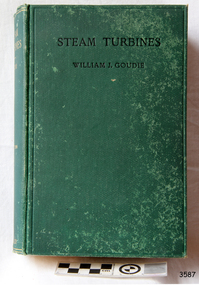 Flagstaff Hill Maritime Museum and Village
Book - Reference, William J Goudie, D. Sc., Professor (William john Goudie), Steam Turbines, 1922
... Professor William J Goudie D. Sc....James Watt...William J Goudie, D. Sc., (1868-1945). He was a member of the Institution of Mechanical Engineers, a member of the Institution of Engineers and Shipbuilders in Scotland, an Associate Member of the Institution of Civil Engineers, James Watt Chair of Mechanical Engineering, University of Glasgow, and Professor of "The Theory and practice of Heat Engines" in the University of Glasgow. ...L & Co. 1724 Institution of Mechanical Engineers Institution of Engineers and Shipbuilders Scotland Institution of Civil Engineers James Watt Professor of "The Theory and practice of Heat Engines" Thomas Longman Paternoster Row William Goudie William J Goudie Professor William J Goudie D. ...This textbook was written for engineering students by Scottish Professor, William J Goudie, D. Sc., (1868-1945). He was a member of the Institution of Mechanical Engineers, a member of the Institution of Engineers and Shipbuilders in Scotland, an Associate Member of the Institution of Civil Engineers, James Watt Chair of Mechanical Engineering, University of Glasgow, and Professor of "The Theory and practice of Heat Engines" in the University of Glasgow. He wrote several papers and books on the topics of mechanical speed and power. The publisher firm, Longmans, Green & Co., was originally founded in 1724 in London by Thomas Longman under the name Longman. In August of that year, he bought the two shops and goods of William Taylor and set up his publishing house there at 39 Paternoster Row. The shops were called Black Swan and Ship, and it is said that the 'ship' sign was the inspiration for Longman's Logo. After many changes of name and management, the firm was incorporated in 1926 as Longmans, Green & Co. Pty Ltd. The firm was acquired by Pearson in 1968 and was known as Pearson Longman or Pearson PLC. The first practical steam turbine was built in 1884 by Charles Parsons and this became the beginning of generating electricity and powering large ships. The author of Steam Turbines, Professor William John Couldie D. Sc, was a mechanical engineer who had practical experience in a marine consulting engineering service and lectured in the theory and practice of mechanical engineering.This book is an example of the development of technology that contributed to the evolution of steam turbines. The book is also significant for its connection to the publisher Longmans, Green and Co., of London, a firm that has been established for over two centuries, renowned for publishing encyclopedias, dictionaries, books on English grammar, textbooks, poetry, reference books, novels, magazines and more.Steam Turbines, by William J. Goudie, D. Sc., Second edition, rewritten and enlarged. Published by Longmans, Green & Co. in 1922. The book has a textured green hardcover with a printed black title on the front cover and a gold embossed title on the spine. The fly page describes the contents. It states the author's credentials and the book's features - 329 illustrations and numerous examples.. The logo of Longmans, Green & Co. is on the fly page. It is a line drawing of a shield above a leafy wreath border surrounding a sailing ship at sea with a plaque below. Inscriptions are on the shield and plaque.On the shield: "L & Co" [Longman Green & Co.] On the plaque: "1724" [date business was established]flagstaff hill, flagstaff hill maritime museum and village, warrnambool, maritime museum, maritime village, great ocean road, shipwreck coast, steam turbines, longmans green and co, paternoster row london, ship logo, engineering studies, textbook, 1922, longmans green and co., l & co., 1724, institution of mechanical engineers, institution of engineers and shipbuilders scotland, institution of civil engineers, james watt professor of "the theory and practice of heat engines", thomas longman, paternoster row, william goudie, william j goudie, professor william j goudie d. sc., james watt chair of mechanical engineering, steam turbine, marine turbines, steam power -
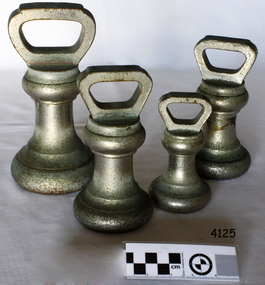 Flagstaff Hill Maritime Museum and Village
Functional object - Standard avoirdupois weights, Avery Ltd, 1950s
... William and Thomas Avery took over his scale making business and in 1818 renamed it W & T Avery. The business rapidly expanded and in 1885 they owned three factories: the Atlas Works in West Bromwich, the Mill Lane Works in Birmingham and the Moat Lane Works in Digbeth. In 1891 the business became a limited company with a board of directors and in 1894 the shares were quoted on the London Stock Exchange. In 1895 the company bought the legendary Soho Foundry in Smethwick, a former steam engine factory owned by James Watt...William and Thomas Avery took over his scale making business and in 1818 renamed it W & T Avery. The business rapidly expanded and in 1885 they owned three factories: the Atlas Works in West Bromwich, the Mill Lane Works in Birmingham and the Moat Lane Works in Digbeth. In 1891 the business became a limited company with a board of directors and in 1894 the shares were quoted on the London Stock Exchange. In 1895 the company bought the legendary Soho Foundry in Smethwick, a former steam engine factory owned by James Watt ...A weight made in England by W&T Avery a British manufacturer of weights and weighing machines. The company was founded in the early 18th century and took the name W & T Avery in 1818. The undocumented origin of the company goes back to 1730 when James Ford established the business in the town of Digbeth. On Joseph Balden, the then company’s owner’s death in 1813 William and Thomas Avery took over his scale making business and in 1818 renamed it W & T Avery. The business rapidly expanded and in 1885 they owned three factories: the Atlas Works in West Bromwich, the Mill Lane Works in Birmingham and the Moat Lane Works in Digbeth. In 1891 the business became a limited company with a board of directors and in 1894 the shares were quoted on the London Stock Exchange. In 1895 the company bought the legendary Soho Foundry in Smethwick, a former steam engine factory owned by James Watt & Co. In 1897 the move was complete and the steam engine business was gradually converted to pure manufacture of weighing machines. The turn of the century was marked by managing director William Hipkins who was determined to broadening the renown of the Avery brand and transforming the business into specialist manufacture of weighing machines. By 1914 the company occupied an area of 32,000m² and had some 3000 employees. In the inter-war period, the growth continued with the addition of specialized shops for cast parts, enamel paints and weighbridge assembly and the product range diversified into counting machines, testing machines, automatic packing machines and petrol pumps. During the second world war, the company also produced various types of heavy guns. At that time the site underwent severe damage from parachute mines and incendiary bombs. Then from 1931 to 1973, the company occupied the 18th-century Middlesex Sessions House in Clerkenwell as its headquarters. Changes in weighing machine technology after World War II led to the closure of the foundry, the introduction of electronic weighing with the simultaneous gradual disappearance of purely mechanical devices. The continued expansion was partly achieved through a series of acquisitions of other companies. After almost a century of national and international expansion, the company was taken over by GEC in 1979. Keith Hodgkinson, managing director at the time, completed the turn-around from mechanical to electronic weighing with a complete overhaul of the product range of retail sales of industrial platform scales. In 1993 GEC took over the Dutch-based company Berkel and the Avery-Berkel name was introduced. In 2000 the business was in turn acquired by the US-American company Weigh-Tronix, who already owned Salter, and is today operating as Avery Weigh-Tronix. An item used used by grocers and merchants to weigh store bought goods around the 1950s. This item gives an insight into social history of the time.Weights, metal, silver electroplated, 1 x 2lb, 2 x 4lb, 1 x 7lb. (4) all government stamped, made by Avery Ltd.Noneflagstaff hill, warrnambool, shipwrecked-coast, flagstaff-hill, flagstaff-hill-maritime-museum, maritime-museum, shipwreck-coast, flagstaff-hill-maritime-village, weight, imperial weight, imperial standard weights and measures, imperial standard weight -
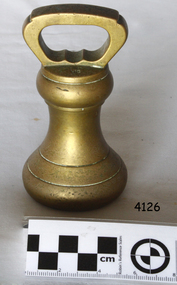 Flagstaff Hill Maritime Museum and Village
Functional object - Weight Avoirdupois, Avery Ltd, 1940-1950s
... William and Thomas Avery took over his scale making business and in 1818 renamed it W & T Avery. The business rapidly expanded and in 1885 they owned three factories: the Atlas Works in West Bromwich, the Mill Lane Works in Birmingham and the Moat Lane Works in Digbeth. In 1891 the business became a limited company with a board of directors and in 1894 the shares were quoted on the London Stock Exchange. In 1895 the company bought the legendary Soho Foundry in Smethwick, a former steam engine factory owned by James Watt...William and Thomas Avery took over his scale making business and in 1818 renamed it W & T Avery. The business rapidly expanded and in 1885 they owned three factories: the Atlas Works in West Bromwich, the Mill Lane Works in Birmingham and the Moat Lane Works in Digbeth. In 1891 the business became a limited company with a board of directors and in 1894 the shares were quoted on the London Stock Exchange. In 1895 the company bought the legendary Soho Foundry in Smethwick, a former steam engine factory owned by James Watt ...A weight made in England by W&T Avery a British manufacturer of weights and weighing machines. The company was founded in the early 18th century and took the name W & T Avery in 1818. The undocumented origin of the company goes back to 1730 when James Ford established the business in the town of Digbeth. On Joseph Balden, the then company’s owner’s death in 1813 William and Thomas Avery took over his scale making business and in 1818 renamed it W & T Avery. The business rapidly expanded and in 1885 they owned three factories: the Atlas Works in West Bromwich, the Mill Lane Works in Birmingham and the Moat Lane Works in Digbeth. In 1891 the business became a limited company with a board of directors and in 1894 the shares were quoted on the London Stock Exchange. In 1895 the company bought the legendary Soho Foundry in Smethwick, a former steam engine factory owned by James Watt & Co. In 1897 the move was complete and the steam engine business was gradually converted to pure manufacture of weighing machines. The turn of the century was marked by managing director William Hipkins who was determined to broadening the renown of the Avery brand and transforming the business into specialist manufacture of weighing machines. By 1914 the company occupied an area of 32,000m² and had some 3000 employees. In the inter-war period, the growth continued with the addition of specialized shops for cast parts, enamel paints and weighbridge assembly and the product range diversified into counting machines, testing machines, automatic packing machines and petrol pumps. During the second world war, the company also produced various types of heavy guns. At that time the site underwent severe damage from parachute mines and incendiary bombs. Then from 1931 to 1973, the company occupied the 18th-century Middlesex Sessions House in Clerkenwell as its headquarters. Changes in weighing machine technology after World War II led to the closure of the foundry, the introduction of electronic weighing with the simultaneous gradual disappearance of purely mechanical devices. The continued expansion was partly achieved through a series of acquisitions of other companies. After almost a century of national and international expansion, the company was taken over by GEC in 1979. Keith Hodgkinson, managing director at the time, completed the turn-around from mechanical to electronic weighing with a complete overhaul of the product range of retail sales of industrial platform scales. In 1993 GEC took over the Dutch-based company Berkel and the Avery-Berkel name was introduced. In 2000 the business was in turn acquired by the US-American company Weigh-Tronix, who already owned Salter, and is today operating as Avery Weigh-Tronix. An item used used by grocers and merchants to weigh store bought goods around the 1950s. This item gives an insight into social history of the time.Weight, brass, Stamped F27, 2lb.flagstaff hill, warrnambool, shipwrecked-coast, flagstaff-hill, flagstaff-hill-maritime-museum, maritime-museum, shipwreck-coast, flagstaff-hill-maritime-village, weight, brass weight -
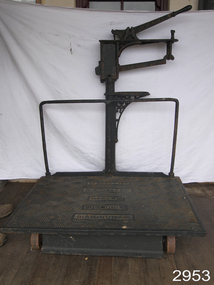 Flagstaff Hill Maritime Museum and Village
Equipment - Platform Scales
... The company had its origins in the early 1700s but only became known as W and T Avery when the brothers William and Thomas Avery inherited the scale-making business from a relative, Joseph Balden, on his death in 1813. By 1885 they had three factories and In 1895, the company acquired James Watt & Co and two years later had moved to the 25-acre Soho Foundry site in Smethwick, Birmingham where James Watt had manufactured steam engines. ...The company had its origins in the early 1700s but only became known as W and T Avery when the brothers William and Thomas Avery inherited the scale-making business from a relative, Joseph Balden, on his death in 1813. By 1885 they had three factories and In 1895, the company acquired James Watt & Co and two years later had moved to the 25-acre Soho Foundry site in Smethwick, Birmingham where James Watt had manufactured steam engines. ...Large platform scales such as these ones made by W. & T. Avery were used for weighing goods for trading and passengers' luggage. They would be used in places such as railway stations, shipping ports, customs offices and ticketing offices. Often fees would be charged to customers according to the weight of their goods and luggage. Items would be placed onto the large horizontal platform then weights would be added to the weighing bar until the bar leveled to being horizontal. The weights would be added together and the total of the weights would be used for the final figure. These scales were made in Birmingham, England, by the British company, W and T Avery. The company had its origins in the early 1700s but only became known as W and T Avery when the brothers William and Thomas Avery inherited the scale-making business from a relative, Joseph Balden, on his death in 1813. By 1885 they had three factories and In 1895, the company acquired James Watt & Co and two years later had moved to the 25-acre Soho Foundry site in Smethwick, Birmingham where James Watt had manufactured steam engines. When the last Avery family member died in 1918, the company employed over 3,000 people and had businesses all over the world. Following the highly successful introduction of the first digital retail scale in 1971, the company was taken over by the GEC Group in 1979. The business was subsequently acquired by the American company, Weigh-Tronix, in 2000 which had already acquired a competitor, Salter. The Avery name continues today in the company known as Avery Weigh-Tronix.An item that was used at the turn of the century as train platform scales or for weighing agricultural products. Made by a company that pioneered weighing equipment with offices all over the world. With many examples of this scale in museums throughout the world. Platform scales with wheels. Large cast iron, scales painted black, weight capacity to 7 CWT (hundred weight). Weight beam has markers "0. 5. 10. 15. 20. 25". Platform scale loose weight type with relieving handle; cast iron construction, fluted columns with integral weight stand, the two wheels are fitted to base at front of platform; there is a graduated steelyard 0-14bs with pear-shaped poise. Weight carrier is missing.Pressed into cast iron arm on scale, one side "W. & T. AVERY", opposite side "BIRMINGHAM", and into the platform "TO WEIGH 7 CWT, W. & T. AVERY, MAKERS, LONDON & BIRMINGHAM" flagstaff hill, warrnambool, shipwrecked-coast, flagstaff-hill, flagstaff-hill-maritime-museum, maritime-museum, shipwreck-coast, flagstaff-hill-maritime-village, measuring scales, weighing scales, weighing instrument, fees for goods, fees for luggage, ticket office -
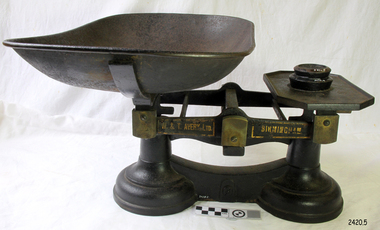 Flagstaff Hill Maritime Museum and Village
Equipment - Scale and weights, 1860-1900
... William and Thomas Avery took over his scale making business and in 1818 renamed it W & T Avery. The business rapidly expanded and in 1885 they owned three factories: the Atlas Works in West Bromwich, the Mill Lane Works in Birmingham and the Moat Lane Works in Digbeth. In 1891 the business became a limited company with a board of directors and in 1894 the shares were quoted on the London Stock Exchange. In 1895 the company bought the legendary Soho Foundry in Smethwick, a former steam engine factory owned by James Watt...William and Thomas Avery took over his scale making business and in 1818 renamed it W & T Avery. The business rapidly expanded and in 1885 they owned three factories: the Atlas Works in West Bromwich, the Mill Lane Works in Birmingham and the Moat Lane Works in Digbeth. In 1891 the business became a limited company with a board of directors and in 1894 the shares were quoted on the London Stock Exchange. In 1895 the company bought the legendary Soho Foundry in Smethwick, a former steam engine factory owned by James Watt ...The subject item was made in England by W&T Avery a British manufacturer of weights and weighing machines. The company was founded in the early 18th century and took the name W & T Avery in 1818. The undocumented origin of the company goes back to 1730 when James Ford established the business in the town of Digbeth. On Joseph Balden, the then company’s owner’s death in 1813 William and Thomas Avery took over his scale making business and in 1818 renamed it W & T Avery. The business rapidly expanded and in 1885 they owned three factories: the Atlas Works in West Bromwich, the Mill Lane Works in Birmingham and the Moat Lane Works in Digbeth. In 1891 the business became a limited company with a board of directors and in 1894 the shares were quoted on the London Stock Exchange. In 1895 the company bought the legendary Soho Foundry in Smethwick, a former steam engine factory owned by James Watt & Co. In 1897 the move was complete and the steam engine business was gradually converted to pure manufacture of weighing machines. The turn of the century was marked by managing director William Hipkins who was determined to broaden the renown of the Avery brand and transform the business into specialist manufacture of weighing machines. By 1914 the company occupied an area of 32,000m² and had some 3000 employees. In the inter-war period, the growth continued with the addition of specialized shops for cast parts, enamel paints and weighbridge assembly and the product range diversified into counting machines, testing machines, automatic packing machines and petrol pumps. During the second world war, the company also produced various types of heavy guns. At that time the site underwent severe damage from parachute mines and incendiary bombs. Then from 1931 to 1973, the company occupied the 18th-century Middlesex Sessions House in Clerkenwell as its headquarters. Changes in weighing machine technology after World War II led to the closure of the foundry, the introduction of electronic weighing with the simultaneous gradual disappearance of purely mechanical devices. The continued expansion was partly achieved through a series of acquisitions of other companies. After almost a century of national and international expansion, the company was taken over by GEC in 1979. Keith Hodgkinson, managing director at the time, completed the turn-around from mechanical to electronic weighing with a complete overhaul of the product range of retail sales of industrial platform scales. In 1993 GEC took over the Dutch-based company Berkel and the Avery-Berkel name was introduced. In 2000 the business was in turn acquired by the US-American company Weigh-Tronix, who already owned Salter, and is today operating as Avery Weigh-Tronix.An item used by grocers and merchants throughout the then British colonies of England to weigh store-bought goods around the mid to late 19th century. This item gives an insight into the daily lives of early colonial settlers and is a significant part of the era’s social history of the time.Balance scale and weights with removable dish, two round weights glued to tray 4oz and 8oz. Scales 'to weigh up to 28lb. Printed in gold on black labels each side "W & T AVERY LTD", "BIRMINGHAM" warrnambool, flagstaff-hill, flagstaff-hill-maritime-museum, maritime-museum, shipwreck-coast, flagstaff-hill-maritime-village, scale and weights, food preparation equipment, w t avery ltd, balance scale, grocers scales, james ford, william & thomas avery, birmingham uk -
 Federation University Historical Collection
Book, William Ripper, Steam, 1897
... watt governor...boilers...alf johnston...william...The news of his death comes to us with added weight of sadness when we remember that he was one of the organisers of the School entertainment last year to help swell the fund for the erection of a statue to fallen Victorian soldiers.' alfred johnston steam engine compound engines condensers heat horse-power transfer of heat combustion of fuel saturated steam cranks and crank shafts watt governor boilers alf johnston william ripper boer war On the title page is the inscription of the original owner of the book Alf G Johnston School of Mines Ballarat 1899. ...This book was owned by Alf Gresham Johnston who was a former SMB mining student from the Ballarat School of Mines. He died at the age of 29 during military service in South Africa. The following is from the Federation Uni Honour Roll at http://federation.edu.au/about-us/our-university/history/geoffrey-blainey-research-centre/honour-roll/j/alfred-gresham-johnston-1872-1901 The October 1901 Ballarat School of Mines (SMB) Students Magazine reported 'Alf. Johnston's gone. The news came as a shock to all of us at the school. He who was with us a few short months ago, in all strength of sturdy manhood, has met a soldier's death in South Africa, and we sincerely mourn his loss…. His heart was in the school, and he did his best to further its interests … His last act on leaving Australian shores was to send a telegram from Albany to Prof. Mica Smith, to whom he was warmly attached, wishing the School and all connected with it "Good-bye". In his short, all to short, life of 29 years, he had more adventure than falls the lot of most men, and possibly the spirit of adventure, and also, of duty, prompted him to throw in his lot with the "colors," and leave for the front. The news of his death comes to us with added weight of sadness when we remember that he was one of the organisers of the School entertainment last year to help swell the fund for the erection of a statue to fallen Victorian soldiers.'A small red book with a double black line bordering the front cover, with the text Longmans Elementary Science Manuals on the bottom of the cover. On the back cover is an L&Co logoOn the title page is the inscription of the original owner of the book Alf G Johnston School of Mines Ballarat 1899. Inside the front cover and on page 19 is the stamp of the School of Mines Ballaratalfred johnston, steam engine, compound engines, condensers, heat, horse-power, transfer of heat, combustion of fuel, saturated steam, cranks and crank shafts, watt governor, boilers, alf johnston, william ripper, boer war -
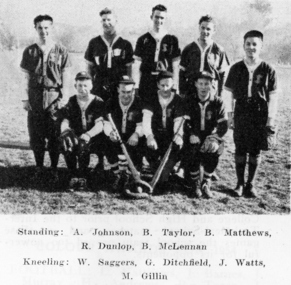 Federation University Historical Collection
Photograph - Image, Ballarat School of Mines, Ballarat School of Mines Baseball Team, 1954, 1954
... Front Row L-R: William Saggers, G. Ditchfield, J. Watts, M. Gillin...Front Row L-R: William Saggers, G. Ditchfield, J. Watts, M. Gillin Ballarat School of Mines Baseball Team, 1954 Photograph Image Ballarat School of Mines ...The image was reproduced in the 1954 Ballarat School of Mines Students' Magazine. The team coach and umpire was E.J. Barker. Photograph of the members of the Ballarat School of Mines Baseball Team in uniform and holding bats. Back row L-R: A. Johnson, B. Taylor, B. Matthews, R. Dunlop, B. McLennan. Front Row L-R: William Saggers, G. Ditchfield, J. Watts, M. Gillinballarat school of mines, jack barker, ej barker, baseball, williams saggers, e.j. barker, murray gillin -
 Federation University Historical Collection
Photograph - Black and White, Ballarat Teachers' College, 1947, 1947
... Second Row: Beth Leslie; Faye Dreher; Gwen Pamphilon; Arthur Lelean; Howard Pattenden; Jack Tyers; Hugh Fraser; William Henderson; Jack Mallett; Alan Martin; Keith Boyd; John Ellifson; John Collins; Tom Hill; Wal Henning; Burns Roddis; Fred Marshman; Dawn Doney; Pat Watts; Ann McKinnon. ...Second Row: Beth Leslie; Faye Dreher; Gwen Pamphilon; Arthur Lelean; Howard Pattenden; Jack Tyers; Hugh Fraser; William Henderson; Jack Mallett; Alan Martin; Keith Boyd; John Ellifson; John Collins; Tom Hill; Wal Henning; Burns Roddis; Fred Marshman; Dawn Doney; Pat Watts; Ann McKinnon. ...Ballarat Teachers' College was opened on may 4th, 1926, at S.S. 33, Dana Street, with an enrollment of sixty-one students, its original staff consisted of the Principal, Mr W. H. Ellwood, M.A., m.Ed. (Chairman of the Teachers' tribunal from its inception in 1946 until 1954), Miss A. Bouchier, B.A., and Mr A.B. Jones, B.A. (Lecturers). In 1927 Miss P.A. Hamano joined the staff. Teaching practice and special rural school work were carried on in schools in or near Ballarat - drawing, crafts and singing were taught by local teachers. In 1927 the college moved to the old Ballarat East Town Hall (remodelled for their use) in Barkly Street. During 1927 the numbers in the College were augmented by twenty-six Manual arts students who had formerly received their training at Ballarat High School. Manual Arts students continued till 1930, when, on grounds of economy, their training was concentrated at Melbourne Teachers' College.\During the four succeeding years approximately sixty students annually entered the primary course. Inclusive of Manual Arts students, and private fee-paying students, exactly 400 trainees passed through the college in its brief span of life (1926-1931) Fourteen years were to pass before they were again opened to students on February 2nd, 1946. The college was re-commenced at S.S. Dana Street under the guidance of Mr W.F. Lord, M.C., M.M., B.A., Dip.Ed., (Acting Principal 1946-1950), and a staff consisting of Miss E.B. Hughes, B.A., Dip. Ed., Mr C.B. Bryan, B.A., V.Com., Dip.Ed., Miss M.H. Miller, L.Mus.A., and Miss G. Kentish, Dip.Phys.Ed. The opening ceremony was performed by the Minister for education at that time, the Hon. F. Field, M.L.A., accompanied by the Hon. T.T. Hollway, M.L.A., and the then Director of Education, Mr J.A. Seitz. It was originally intended to cater for women students only (for whom 130 Victoria Street was purchased as a hostel) but, at the last moment, men were also accepted. A co-educational college was thus set up instead, and has continued as such. The original Staff has been considerable augmented, and the number of Students has been more than trebled. 1951 saw the introduction of the two-year course, successful students being presented with the Trained Primary Teachers' Certificate at the final College assembly each year. In December, 1855, College held its first Graduation Ceremony, with its own Graduation hymn, the words of which were written by Miss C.M. Canty of the staff. Mr Ellwood, former Principal,delivered the occasional address and presented the Ellwood Prize to the outstading student of the year (Mr C.P. Handreck). Students who had successfully completed the course received their certificates from Mr E.B. Pederick, Chief Inspector of Primary Schools. College accomodation having been strained for several years, it was pleasant news when tenders were called in July, 1956, for the building of the first section of the new Ballarat Teachers' College in Gillies Street, near the Botanical Gardens. At the beginning of 1958 the new College was occupied, and staff and students have appreciated greatly the appointments and cacilities of the new buildign. In 1968 the three-year Diploma Course began, co-existent with the other courses which will continue during the transitional period. Successful students in the course receive the Diploma of Teaching (Primary).Black and white photograph of students and staff of the Ballarat Teachers' College. The people are in four rows, and they stand in front of the Dana Street Primary School. Back Row: Jim Howlett; Milton Rice; Keith McLean; Jim Williams; George Nield, David Cooper, Ray Terrill, William Gleeson; Tom Pascoe; Lindsay Harley; Ron Carless; Robert Giddings; Colin Connelly; Alex Magill; Eddie Blake; William Punshon; Athol Aisbett; Kevin Collins; John O'Shannessy. Second Row: Beth Leslie; Faye Dreher; Gwen Pamphilon; Arthur Lelean; Howard Pattenden; Jack Tyers; Hugh Fraser; William Henderson; Jack Mallett; Alan Martin; Keith Boyd; John Ellifson; John Collins; Tom Hill; Wal Henning; Burns Roddis; Fred Marshman; Dawn Doney; Pat Watts; Ann McKinnon. Third Row: Ethel Esmore; Joy Love; Pat Luxford; Jean Elliott; Josie Bunny; Phyllis Borley; Joyce Matheson; Val Witney; Ruth Tozer; Nancy Kerr; K.ath Tobin; Muriel Morrish; Jean Clode; Peg Purdue; Joyce Kennedy; Margaret Palmer; Marie Faulds; Thelma Ritchie. Fourth Row: Pat Lewin; Mavis Poland; Lorna Welsh; Lynette Lynch; Nancy Alexander; Betty Williams, Val Gorrie; Alan Sonsee; Trudy Kentish; Carl Bryan; Monica Miller; W.F. Lord; Beth Hughes; Mephan McMcEwin; Mattie Hayes; Neila Vallance; Pat Robinson; Elva Surman; Joan Gunning; Norma Dally; Beatrice Freeman; Kath Crossett.ballarat teachers' college, education, dana street primary school, 1947
