
Showing 59 items matching "wire mesh"
-
 Flagstaff Hill Maritime Museum and Village
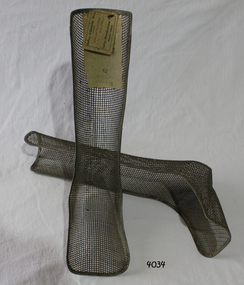
Splint, c. 1910-1920
... ...wire mesh cast...This is a pair of vintage DePuy wire mesh splints made to support a broken leg while the bone mended. ...Angus Collection. Stiff wire mesh with a hard metal border around the edges, shaped as a food and half leg, with printed paper labels attached to the top. ...This is a pair of vintage DePuy wire mesh splints made to support a broken leg while the bone mended. ...This is a pair of vintage DePuy wire mesh splints made to support a broken leg while the bone mended. The design was in use before and during WWI. It replaced the wooden splints previously used to reset bones in the late nineteenth to early 20th century. This new splint was invented by a traveling pharmaceutical salesman, Revra DePuy. He began manufacturing in his Warsaw, Indiana in 1895; the first commercial manufacture of orthopaedic equipment in the world . The company eventually became Johnson & Johnson. This pair of splints was donated to Flagstaff Hill Maritime Village by the family of Doctor William Roy Angus, Surgeon and Oculist. It is part of the “W.R. Angus Collection” that includes historical medical equipment, surgical instruments and material once belonging to Dr Edward Ryan and Dr Thomas Francis Ryan, (both of Nhill, Victoria) as well as Dr Angus’ own belongings. The Collection’s history spans the medical practices of the two Doctors Ryan, from 1885-1926 plus that of Dr Angus, up until 1969. These splints would have belonged to Dr Tom Ryan before being passed onto Dr. W.R. Angus. ABOUT THE “W.R.ANGUS COLLECTION” Doctor William Roy Angus M.B., B.S., Adel., 1923, F.R.C.S. Edin.,1928 (also known as Dr Roy Angus) was born in Murrumbeena, Victoria in 1901 and lived until 1970. He qualified as a doctor in 1923 at University of Adelaide, was Resident Medical Officer at the Royal Adelaide Hospital in 1924 and for a period was house surgeon to Sir (then Mr.) Henry Simpson Newland. Dr Angus was briefly an Assistant to Dr Riddell of Kapunda, then commenced private practice at Curramulka, Yorke Peninsula, SA, where he was physician, surgeon and chemist. In 1926, he was appointed as new Medical Assistant to Dr Thomas Francis Ryan (T.F. Ryan, or Tom), in Nhill, Victoria, where his experiences included radiology and pharmacy. In 1927 he was Acting House Surgeon in Dr Tom Ryan’s absence. Dr Angus had become engaged to Gladys Forsyth and they decided he would take time to further his studies overseas in the UK in 1927. He studied at London University College Hospital and at Edinburgh Royal Infirmary and in 1928, was awarded FRCS (Fellow from the Royal College of Surgeons), Edinburgh. He worked his passage back to Australia as a Ship’s Surgeon on the on the Australian Commonwealth Line’s T.S.S. Largs Bay. Dr Angus married Gladys in 1929, in Ballarat. (They went on to have one son (Graham 1932, born in SA) and two daughters (Helen (died 12/07/1996) and Berenice (Berry), both born at Mira, Nhill ) Dr Angus was a ‘flying doctor’ for the A.I.M. (Australian Inland Ministry) Aerial Medical Service in 1928 . The organisation began in South Australia through the Presbyterian Church in that year, with its first station being in the remote town of Oodnadatta, where Dr Angus was stationed. He was locum tenens there on North-South Railway at 21 Mile Camp. He took up this ‘flying doctor’ position in response to a call from Dr John Flynn; the organisation was later known as the Flying Doctor Service, then the Royal Flying Doctor Service. A lot of his work during this time involved dental surgery also. Between 1928-1932 he was surgeon at the Curramulka Hospital, Yorke Peninsula, South Australia. In 1933 Dr Angus returned to Nhill where he’d previously worked as Medical Assistant and purchased a share of the Nelson Street practice and Mira hospital from Dr Les Middleton one of the Middleton Brothers, the current owners of what was once Dr Tom Ryan’s practice. Dr L Middleton was House Surgeon to the Nhill Hospital 1926-1933, when he resigned. [Dr Tom Ryan’s practice had originally belonged to his older brother Dr Edward Ryan, who came to Nhill in 1885. Dr Edward saw patients at his rooms, firstly in Victoria Street and in 1886 in Nelson Street, until 1901. The Nelson Street practice also had a 2 bed ward, called Mira Private Hospital ). Dr Edward Ryan was House Surgeon at the Nhill Hospital 1884-1902 . He also had occasions where he successfully performed veterinary surgery for the local farmers too. Dr Tom Ryan then purchased the practice from his brother in 1901. Both Dr Edward and Dr Tom Ryan work as surgeons included eye surgery. Dr Tom Ryan performed many of his operations in the Mira private hospital on his premises. He too was House Surgeon at the Nhill Hospital 1902-1926. Dr Tom Ryan had one of the only two pieces of radiology equipment in Victoria during his practicing years – The Royal Melbourne Hospital had the other one. Over the years Dr Tom Ryan gradually set up what was effectively a training school for country general-practitioner-surgeons. Each patient was carefully examined, including using the X-ray machine, and any surgery was discussed and planned with Dr Ryan’s assistants several days in advance. Dr Angus gained experience in using the X-ray machine there during his time as assistant to Dr Ryan. Dr Tom Ryan moved from Nhill in 1926. He became a Fellow of the Royal Australasian College of Surgeons in 1927, soon after its formation, a rare accolade for a doctor outside any of the major cities. He remained a bachelor and died suddenly on 7th Dec 1955, aged 91, at his home in Ararat. Scholarships and prizes are still awarded to medical students in the honour of Dr T.F. Ryan and his father, Dr Michael Ryan, and brother, John Patrick Ryan. ] When Dr Angus bought into the Nelson Street premises in Nhill he was also appointed as the Nhill Hospital’s Honorary House Surgeon 1933-1938. His practitioner’s plate from his Nhill surgery states “HOURS Daily, except Tuesdays, Fridays and Saturday afternoons, 9-10am, 2-4pm, 7-8pm. Sundays by appointment”. This plate is now mounted on the doorway to the Port Medical Office at Flagstaff Hill Maritime Village, Warrnambool. Dr Edward Ryan and Dr Tom Ryan had an extensive collection of historical medical equipment and materials spanning 1884-1926 and when Dr Angus took up practice in their old premises he obtained this collection, a large part of which is now on display at the Port Medical Office at Flagstaff Hill Maritime Village in Warrnambool. During his time in Nhill Dr Angus was involved in the merging of the Mira Hospital and Nhill Public Hospital into one public hospital and the property titles passed on to Nhill Hospital in 1939. In 1939 Dr Angus and his family moved to Warrnambool where he purchased “Birchwood,” the 1852 home and medical practice of Dr John Hunter Henderson, at 214 Koroit Street. (This property was sold in1965 to the State Government and is now the site of the Warrnambool Police Station. ). The Angus family was able to afford gardeners, cooks and maids; their home was a popular place for visiting dignitaries to stay whilst visiting Warrnambool. Dr Angus had his own silk worm farm at home in a Mulberry tree. His young daughter used his centrifuge for spinning the silk. Dr Angus was appointed on a part-time basis as Port Medical Officer (Health Officer) in Warrnambool and held this position until the 1940’s when the government no longer required the service of a Port Medical Officer in Warrnambool; he was thus Warrnambool’s last serving Port Medical Officer. (The duties of a Port Medical Officer were outlined by the Colonial Secretary on 21st June, 1839 under the terms of the Quarantine Act. Masters of immigrant ships arriving in port reported incidents of diseases, illness and death and the Port Medical Officer made a decision on whether the ship required Quarantine and for how long, in this way preventing contagious illness from spreading from new immigrants to the residents already in the colony.) Dr Angus was a member of the Australian Medical Association, for 35 years and surgeon at the Warrnambool Base Hospital 1939-1942, He served as a Surgeon Captain during WWII1942-45, in Ballarat, Victoria, and in Bonegilla, N.S.W., completing his service just before the end of the war due to suffering from a heart attack. During his convalescence he carved an intricate and ‘most artistic’ chess set from the material that dentures were made from. He then studied ophthalmology at the Royal Melbourne Eye and Ear Hospital and created cosmetically superior artificial eyes by pioneering using the intrascleral cartilage. Angus received accolades from the Ophthalmological Society of Australasia for this work. He returned to Warrnambool to commence practice as an ophthalmologist, pioneering in artificial eye improvements. He was Honorary Consultant Ophthalmologist to Warrnambool Base Hospital for 31 years. He made monthly visits to Portland as a visiting surgeon, to perform eye surgery. He represented the Victorian South-West subdivision of the Australian Medical Association as its secretary between 1949 and 1956 and as chairman from 1956 to 1958. In 1968 Dr Angus was elected member of Spain’s Barraquer Institute of Barcelona after his research work in Intrasclearal cartilage grafting, becoming one of the few Australian ophthalmologists to receive this honour, and in the following year presented his final paper on Living Intrasclearal Cartilage Implants at the Inaugural Meeting of the Australian College of Ophthalmologists in Melbourne In his personal life Dr Angus was a Presbyterian and treated Sunday as a Sabbath, a day of rest. He would visit 3 or 4 country patients on a Sunday, taking his children along ‘for the ride’ and to visit with him. Sunday evenings he would play the pianola and sing Scottish songs to his family. One of Dr Angus’ patients was Margaret MacKenzie, author of a book on local shipwrecks that she’d seen as an eye witness from the late 1880’s in Peterborough, Victoria. In the early 1950’s Dr Angus, painted a picture of a shipwreck for the cover jacket of Margaret’s book, Shipwrecks and More Shipwrecks. She was blind in later life and her daughter wrote the actual book for her. Dr Angus and his wife Gladys were very involved in Warrnambool’s society with a strong interest in civic affairs. Their interests included organisations such as Red Cross, Rostrum, Warrnambool and District Historical Society (founding members), Wine and Food Society, Steering Committee for Tertiary Education in Warrnambool, Local National Trust, Good Neighbour Council, Housing Commission Advisory Board, United Services Institute, Legion of Ex-Servicemen, Olympic Pool Committee, Food for Britain Organisation, Warrnambool Hospital, Anti-Cancer Council, Boys’ Club, Charitable Council, National Fitness Council and Air Raid Precautions Group. He was also a member of the Steam Preservation Society and derived much pleasure from a steam traction engine on his farm. He had an interest in people and the community He and his wife Gladys were both involved in the creation of Flagstaff Hill, including the layout of the gardens. After his death (28th March 1970) his family requested his practitioner’s plate, medical instruments and some personal belongings be displayed in the Port Medical Office surgery at Flagstaff Hill Maritime Village, and be called the “W. R. Angus Collection”. The pair of splints was made by the world’s oldest orthopedic company, founded in 1895. The splint was a part of Dr. Tom Ryan’s equipment that was passed onto Dr W.R. Angus. It is part of the collection of historical medical equipment used in Western Victoria in the late 19th and early 20th century. The W.R. Angus Collection is significant for still being located at the site it is connected with, Doctor Angus being the last Port Medical Officer in Warrnambool. The collection of medical instruments and other equipment is culturally significant, being an historical example of medicine from late 19th to mid-20th century. Dr Angus assisted Dr Tom Ryan, a pioneer in the use of X-rays and in ocular surgery. Splint, (pair of 2) from the W.R. Angus Collection. Stiff wire mesh with a hard metal border around the edges, shaped as a food and half leg, with printed paper labels attached to the top. Labels show manufacturer and instructions. Made for supporting Tibia and Fibula bones. Label attached to one split reads "DePuy Adjustable Wire / PATENTED / Tibia and Fibula Splint / No. 32 Medium Posterior / DePuy Manufacturing Co. / Warsaw, Indiana""DePuy Adjustable Wire / PATENTED / Tibia and Fibula Splint / No. 32 Medium Posterior / DePuy Manufacturing Co. / Warsaw, Indiana"flagstaff hill, warrnambool, shipwrecked coast, flagstaff hill maritime museum, maritime museum, shipwreck coast, flagstaff hill maritime village, great ocean road, dr w r angus, dr ryan, surgical instrument, t.s.s. largs bay, warrnambool base hospital, nhill base hospital, mira hospital, flying doctor, medical treatment, medical history, medical education, medical text book, wire mesh splint, wire mesh cast, orthopaedic medical equipment, bone setting equipment, 1910’s medical equipment, medical artefact -
 Flagstaff Hill Maritime Museum and Village
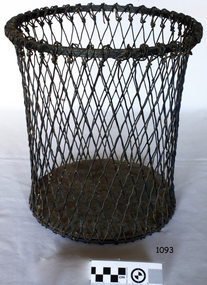
Functional object - Basket
... Item used in offices earlier part of the 20th century, waste baskets were sold in great numbers with many differing designs from the 1830s most from this time were made of willow or bamboo. Later wire mesh and pressed steel were used....Basket metal waste paper with wire mesh joined to iron ring at top and flat round cork base....Item used in offices earlier part of the 20th century, waste baskets were sold in great numbers with many differing designs from the 1830s most from this time were made of willow or bamboo. Later wire mesh and pressed steel were used. An early example of a wire mesh industrial type of waste basket used in office situations. flagstaff hill warrnambool shipwrecked-coast flagstaff-hill flagstaff-hill-maritime-museum maritime-museum shipwreck-coast flagstaff-hill-maritime-village None Basket metal waste paper with wire mesh joined to iron ring at top and flat round cork base. ...Item used in offices earlier part of the 20th century, waste baskets were sold in great numbers with many differing designs from the 1830s most from this time were made of willow or bamboo. Later wire mesh and pressed steel were used.An early example of a wire mesh industrial type of waste basket used in office situations.Basket metal waste paper with wire mesh joined to iron ring at top and flat round cork base.Noneflagstaff hill, warrnambool, shipwrecked-coast, flagstaff-hill, flagstaff-hill-maritime-museum, maritime-museum, shipwreck-coast, flagstaff-hill-maritime-village -
 Melbourne Tram Museum
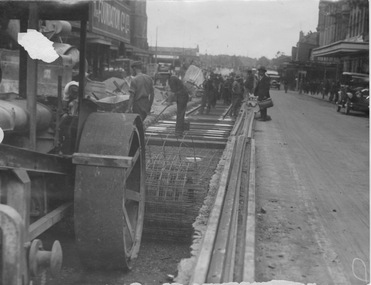
Photograph - Track laying Swanston St, 1/1926
... wire mesh...The photograph shows part of the track laying process in Swanston Street between Collins Street. and Flinders Lane with pedestrians, onlookers and motor cars. Wire mesh is being laid on the road base with some wooden sleepers and rails in place. ...The photograph shows part of the track laying process in Swanston Street between Collins Street. and Flinders Lane with pedestrians, onlookers and motor cars. Wire mesh is being laid on the road base with some wooden sleepers and rails in place. ...The photograph shows part of the track laying process in Swanston Street between Collins Street. and Flinders Lane with pedestrians, onlookers and motor cars. Wire mesh is being laid on the road base with some wooden sleepers and rails in place. A large steam powered roller is partially shown at left carrying the name of a popular construction company, The Foundation Coy. Ltd., that was contracted for many of the cable-to-electric tram conversions in the 1920s. Note that the rails being positioned are railway rails that required a check plate to be bolted to each rail to create a flangeway in the road surface. These plates can be seen stacked at the right of the track bed with pre-drilled holes. Work commenced on the conversion of the cable tram track in Swanston Street in December 1925 and proceed in a northerly direction towards Lonsdale Street. Yields information about the cable tram conversions in 1925-26 in Swanston Street.Sepia toned photograph with note on rear. Written in ink on rear of photograph is "Red Frame 10 of 10" wire mesh, wooden sleepers, rails, steam powered roller, tramways, swanston street, cable tram conversion, railway rail, check plate, flangeway, collins street, flinders lane, tha foundation coy. ltd. -
 Mont De Lancey
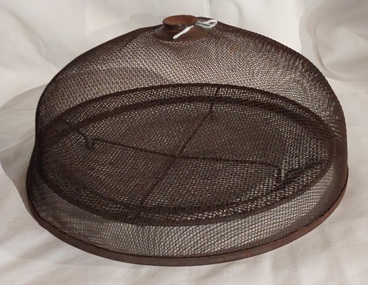
Domestic object - Mesh Food Cover, Unknown
... Wire mesh food covers are primarily used to protect food from insects and pests, especially during outdoor dining or picnics, while also keeping food fresh when dining indoors. ...A rusted vintage wire mesh domed food cover or cloche with a rounded flat knob or handle at the top. ...Wire mesh food covers are primarily used to protect food from insects and pests, especially during outdoor dining or picnics, while also keeping food fresh when dining indoors. ...Wire mesh food covers are primarily used to protect food from insects and pests, especially during outdoor dining or picnics, while also keeping food fresh when dining indoors. A rusted vintage wire mesh domed food cover or cloche with a rounded flat knob or handle at the top. It has a separate wire base with four wire feet which is placed underneath the dome lid to protect the table or surface it is placed upon. Air can surround the food.tableware, food covers, covers -
 Stawell Historical Society Inc
Photograph, Central Park Gardens 1989 -- Coloured
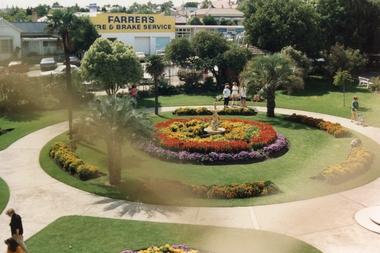
... Central Park Gardens through wire mesh. Easter Monday March 27th 1989....Photo taken by Geoff Oates stawell Central Park Gardens through wire mesh. Easter Monday March 27th 1989. Colour photo of Central Park Gardens Central Park Gardens 1989 -- Coloured Photograph ...Central Park Gardens photo of fountain garden bed with Farrer's Tyre & Brake Service in background. Easter March 1989. Photo taken by Geoff OatesColour photo of Central Park GardensCentral Park Gardens through wire mesh. Easter Monday March 27th 1989.stawell -
 Rutherglen Historical Society
Domestic object - Sieve
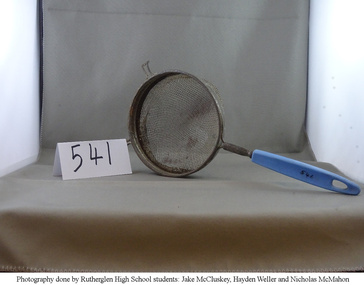
... Wire mesh slightly crushed...Wire mesh slightly crushed Domestic object Sieve ...Owned and used by Mrs Daisy ParkinWire mesh sieve with a blue plastic handle, wire rests on rim. Wire mesh slightly crushedkitchenware -
 Tatura Irrigation & Wartime Camps Museum
Strainer - food, 1940's
... Small metal and fine wire mesh strainer...Made and used by internees at Camp 3 hoefer family camp 3 tatura ww2 camp 3 domestic food preparation Small metal and fine wire mesh strainer Strainer - food ...Made and used by internees at Camp 3Small metal and fine wire mesh strainerhoefer family, camp 3, tatura, ww2 camp 3, domestic, food, preparation -
 Robin Boyd Foundation
Furniture - Chair, Harry Bertoia, Harry Bertoia Diamond Chairs, 1952
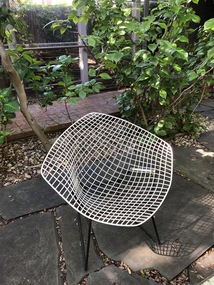
... Four white wire mesh chairs on black metal frame...Walsh St furnishings robin boyd OHM2022 OHM2022_21 Four white wire mesh chairs on black metal frame Harry Bertoia Diamond Chairs Furniture Chair Harry Bertoia ...A mid-century design classic, these chairs were designed by Harry Bertoia and produced by furniture maker Knoll.Four white wire mesh chairs on black metal framewalsh st furnishings, robin boyd, ohm2022, ohm2022_21 -
Glenelg Shire Council Cultural Collection
Slide, c. 1980
... Ditch with water in the bottom. Wire mesh barrier across ditch....Ditch with water in the bottom. Wire mesh barrier across ditch. Slide Slide ...Coloured slide. Ditch with water in the bottom. Wire mesh barrier across ditch. -
Glenelg Shire Council Cultural Collection
Costume - Ships Painters Goggles, c. 1890
... Pair of wire mesh ships painters goggles with cloth band (c.1890's)...National Trust of W.A. Pair of wire mesh ships painters goggles with cloth band (c.1890's) Costume Ships Painters Goggles ...National Trust of W.A.Pair of wire mesh ships painters goggles with cloth band (c.1890's) -
 Whitehorse Historical Society Inc.
Domestic object - Meat Safe
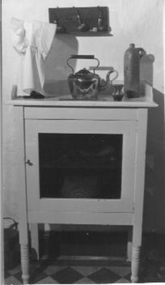
... Cream painted wooden meat safe on four legs. Wire mesh insert front and sides. ...furniture domestic Cream painted wooden meat safe on four legs. Wire mesh insert front and sides. Domestic object Meat Safe ...Cream painted wooden meat safe on four legs. Wire mesh insert front and sides. furniture, domestic -
 Warrnambool and District Historical Society Inc.
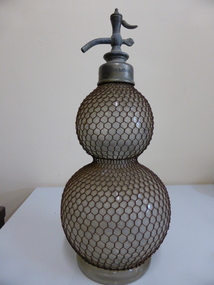
Functional object - Soda Syphon, Early 20th century
... It is covered with wire mesh and has a pewter spout. The pewter is somewhat corroded and there is one small bend in the wire mesh. ...It is covered with wire mesh and has a pewter spout. The pewter is somewhat corroded and there is one small bend in the wire mesh. ...This soda syphon used for making carbonated drinks is a French bottle made about the beginning of the 20th century. This bottle is of considerable antiquarian interest but unfortunately has no known local significance. It may, however, be the one given to the Historical Society by Mr and Mrs S. Lindsay of Koroit Street, Warrnambool. It will be useful for display. This is a French soda syphon made of clear glass in a double bulbous shape. It is covered with wire mesh and has a pewter spout. The pewter is somewhat corroded and there is one small bend in the wire mesh. There is a small glass tube inside the bottle and a there is a crack in the glass on the top sphere. On pewter spout: ‘Veritable Seltzogene D. Fevre Paris’. Label pasted on: ‘80’ soda syphon, veritable seltzogene de fevre,, paris, warrnambool -
Glenelg Shire Council Cultural Collection
Slide - Slide - Construction Portland/Cashmore airport, c. 1980
... Narrow water course between sloping banks wooden bridge across, wire mesh fence....Narrow water course between sloping banks wooden bridge across, wire mesh fence. Slide Slide - Construction Portland/Cashmore airport ...Coloured slide. Narrow water course between sloping banks wooden bridge across, wire mesh fence. -
 Orbost & District Historical Society
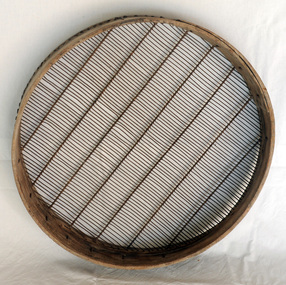
sieve, First half 20th century
... The frame holds the wire mesh sieve. It is braced with seven thin wire strips....The frame holds the wire mesh sieve. It is braced with seven thin wire strips. sieve ...Probably used in the local bean growing industry. The Orbost area was once a large bean growing area as the fertile snowy River flats produced good quality beans. It was exported to other states of Australia. Green beans were sent to Melbourne by train and later to Sydney, either via Bombala where they were railed, or to Eden to continue the journey on fish trucks. One pound per bag was considered a good price in the early 1920's and pickers were paid one shilling and sixpence. (Ref: Newmerella Valley of Plenty)A round wooden framed sieve. The frame holds the wire mesh sieve. It is braced with seven thin wire strips.sieve agriculture tool -
 Rutherglen Historical Society
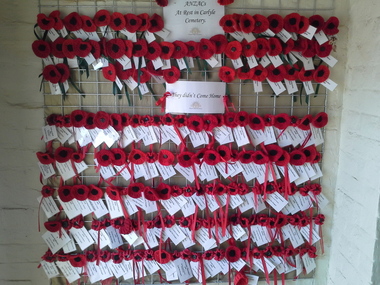
ANZAC Memorabilia, 25/04/2015
... Wire mesh panel with an arrangement of knitted and crocheted poppies, each with a name attached, to commemorate World War 1 soldiers from the Rutherglen district....world war i anzac memorials poppies At top of display: "ANZACs at Rest in Carlyle Cemetery" Below the third row of poppies: "They didn't Come Home" Wire mesh panel with an arrangement of knitted and crocheted poppies, each with a name attached, to commemorate World War 1 soldiers from the Rutherglen district. ...Display was constructed by the Rutherglen Historical Society for the 100th anniversary of ANZAC Day. Each poppy represents one soldier. Those who returned and are buried at the local cemetery are shown at the top. The remainder represent those from the district who died overseas during the War.Wire mesh panel with an arrangement of knitted and crocheted poppies, each with a name attached, to commemorate World War 1 soldiers from the Rutherglen district.At top of display: "ANZACs at Rest in Carlyle Cemetery" Below the third row of poppies: "They didn't Come Home"world war !, world war i, anzac, memorials, poppies -
 Whitehorse Historical Society Inc.
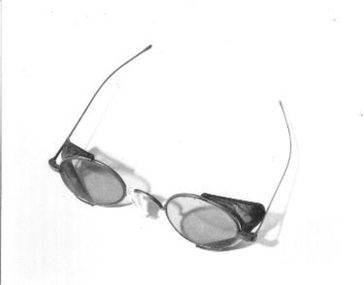
Functional object - Spectacles
... Thin wire framed spectacles with dark tinted lenses. Fine wire mesh pieces, which are movable, are attached to middle of frame surrounding lenses....personal effects seeing aids Thin wire framed spectacles with dark tinted lenses. Fine wire mesh pieces, which are movable, are attached to middle of frame surrounding lenses. ...Thin wire framed spectacles with dark tinted lenses. Fine wire mesh pieces, which are movable, are attached to middle of frame surrounding lenses.personal effects, seeing aids -
 Orbost & District Historical Society
sieve, First half 20th century
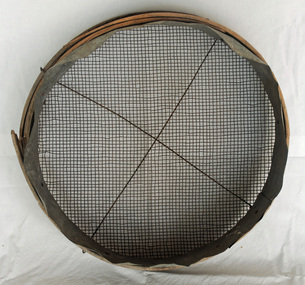
... It has a double frame with 1/4 " wire mesh held in through two frames. It has a galvanised iron inset....It has a double frame with 1/4 " wire mesh held in through two frames. It has a galvanised iron inset. sieve ...Possibly used for sieving bean seeds or corn seeds. Could have been a sand sieve.A round wooden framed sieve. It has a double frame with 1/4 " wire mesh held in through two frames. It has a galvanised iron inset.sieve agriculture tool -
 Mont De Lancey
Domestic object - Deep Fryer Basket, 1950's
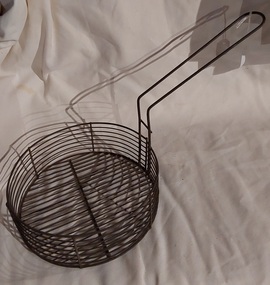
... Deep fryer baskets are typically made of wire mesh or stainless steel, and they allow for both efficient frying and draining of excess oil from cooked food. ...Deep fryer baskets are typically made of wire mesh or stainless steel, and they allow for both efficient frying and draining of excess oil from cooked food. ...Deep fryer baskets are typically made of wire mesh or stainless steel, and they allow for both efficient frying and draining of excess oil from cooked food. A medium sized vintage wire fish and chip fryer from the 1950's. The basket holds the cut chips or fish and has a long thick curved open wire formed handle which can hang on the side of the saucepan for draining the cooking oil.food preparation, food processing equipment, deep fryer basket, 1940s -
Tatura Irrigation & Wartime Camps Museum
Model - Army hut, Bill Doller
... Timber frame, galvanised iron roof and walls. Wire mesh under the eaves, instead of windows. ...Timber frame, galvanised iron roof and walls. Wire mesh under the eaves, instead of windows. ...Living quarters for internees. Very hot in summer, cold in winter. Any improvements were largely carried out by the occupants.Model of a hut. Timber frame, galvanised iron roof and walls. Wire mesh under the eaves, instead of windows. Painted olive green outside and white inside.living accommodation in camps, internment camps tatura, bill doller -
Kyneton Fire Brigade
Memorabilia - Trophy
... Silver rose bowl with three handles, gilt interior. Wire mesh cover mounted on decorative brown plastic base. ...Fire Brigade Trophy - no inscription Part of Kyneton Fire Brigade trophy collection Kyneton Fire Brigade Kyneton Volunteer Fire Brigade Fire Brigade Demonstrations Country Fire Authority Trophy Central Districts Fire Brigades Association CDFBA 4 MEN HOSE & REEL WON AT CRESWICK 1927 Silver rose bowl with three handles, gilt interior. Wire mesh cover mounted on decorative brown plastic base. ...Fire Brigade Trophy - no inscriptionPart of Kyneton Fire Brigade trophy collectionSilver rose bowl with three handles, gilt interior. Wire mesh cover mounted on decorative brown plastic base. Separate plate resting inside bowlCDFBA 4 MEN HOSE & REEL WON AT CRESWICK 1927kyneton fire brigade, kyneton volunteer fire brigade, fire brigade demonstrations, country fire authority, trophy, central districts fire brigades association -
 Clunes Museum
Photograph, MONUMENT
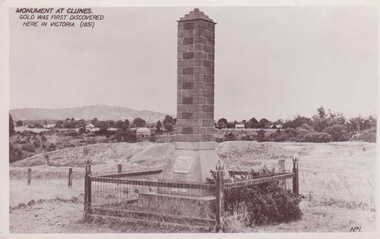
... BLACK AND WHITE POSTCARD OF THE BRICK MONUMENT ON SCENIC DRIVE, SURROUNDED BY WOOD AND WIRE MESH FENCE WITH CAMP PARADE AND MOUNT BECKWORTH IN BACKGROUND. ...BLACK AND WHITE POSTCARD OF THE BRICK MONUMENT ON SCENIC DRIVE, SURROUNDED BY WOOD AND WIRE MESH FENCE WITH CAMP PARADE AND MOUNT BECKWORTH IN BACKGROUND. ...MONUMENT BUILT AND ERECTED ON SITE OF FIRST GOLD DISCOVERY IN VICTORIA 1851. PORT PHILLIP MINE.BLACK AND WHITE POSTCARD OF THE BRICK MONUMENT ON SCENIC DRIVE, SURROUNDED BY WOOD AND WIRE MESH FENCE WITH CAMP PARADE AND MOUNT BECKWORTH IN BACKGROUND. PLAQUE ON CEMENT BASE OF BRICK PILLAR.MONUMENT AT CLUNES. GOLD WAS FIRST DISCOVERED HERE IN VICTORIA 1851.photography, monuments, memorials& mining -
 Mont De Lancey
Domestic object - Sieve, Unknown
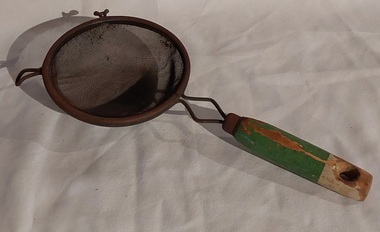
... A vintage wire mesh flour sieve or sifter with two small metal supports to rest on a bowl at the top. ...Kitchenware Kitchen equipment Flour sifters Sieves A vintage wire mesh flour sieve or sifter with two small metal supports to rest on a bowl at the top. ...A sieve typically has a fine mesh net or perforated sheet material that aerates dry ingredients like flour and sugar for a lighter cake texture. It can also be used to remove seeds from a fruit coulis or make a smooth puree. Modern flour sifters, as we know them, gained popularity in the 19th century, with patents awarded for flour sifters and sieve holders. A vintage wire mesh flour sieve or sifter with two small metal supports to rest on a bowl at the top. A thick wire frame is attached to a green and white painted wooden handle. kitchenware, kitchen equipment, flour sifters, sieves -
 Geoffrey Kaye Museum of Anaesthetic History
Equipment - Mask, Ramsay Surgical Limited
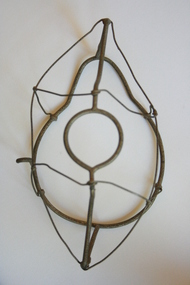
... There is a metal hook on the left hand side protuding from the base of the mask and wire mesh raised from the base with a circle in the middle....There is a metal hook on the left hand side protuding from the base of the mask and wire mesh raised from the base with a circle in the middle. ...One of a range of metal face masks designed to have a cover which helps protect the patient's face.Wire frame mask designed to cover mouth and nose. There is a metal hook on the left hand side protuding from the base of the mask and wire mesh raised from the base with a circle in the middle.facemask, anaesthesia, ramsay surgical -
 Royal Australian and New Zealand College of Obstetricians & Gynaecologists (RANZCOG)
Infant's cot associated with maternity unit, St George's Hospital, Kew, c1920s
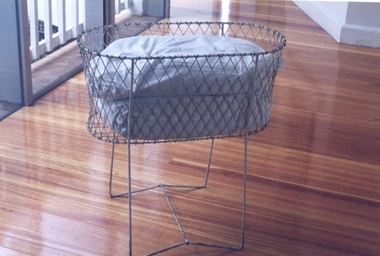
... Infant's cot, made of wire and wire mesh, with two covered mattresses [218.2, 218.3]. ...Infant care Infant's cot, made of wire and wire mesh, with two covered mattresses [218.2, 218.3]. ...This type of wire cot was in common use in Maternity hospitals from the 1920s to the 1950s. Cot and bedding originally from the Maternity Unit, St George's Hospital, Kew. The hospital in Kew was closed in 1998 and the services transferred to Box Hill Hospital. Julie Collette, former General Manager, donated this cot and other items to the Museum collection in 1998. The mattresses were made by 'Cloudsoft' bedding in Fitzroy, Victoria. Infant's cot, made of wire and wire mesh, with two covered mattresses [218.2, 218.3]. Mattress cases are printed with text that reads 'Northern Hospital Linen Service - 51' and 'Stericlean Linen Service'.infant care -
 Mont De Lancey
Domestic object - Flour Sifter, Magpie, Unknown
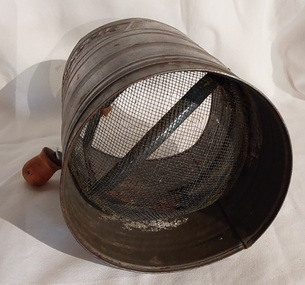
... There are horizontal bands or lines indented around the sifter as well as the brand near the top. Wire mesh inside sifts the flour as the handle is turned....There are horizontal bands or lines indented around the sifter as well as the brand near the top. Wire mesh inside sifts the flour as the handle is turned. ...Modern flour sifters, as we know them, gained popularity in the 19th century, with patents awarded for flour sifters and sieve holders. They were used in the kitchen to aerate and remove lumps from flour.A vintage tin MAGPIE brand flour sifter with a shaped handle and a wooden knob. There are horizontal bands or lines indented around the sifter as well as the brand near the top. Wire mesh inside sifts the flour as the handle is turned.'MAGPIE' is indented inside a rectangular shape at the top.kitchenware, kitchen equipment, flour sifters, sieves -
 Flagstaff Hill Maritime Museum and Village
Functional object - Food Safe, 1920s
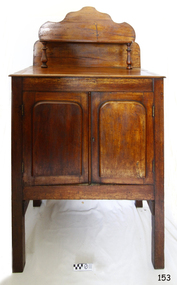
... Wooden kitchen food safe, 2 door with wire mesh at sides. Raised back panel has shaped edges and includes a shelf above bench area that has turned legs. ...The subject item gives a snapshot of domestic life from this time. flagstaff hill warrnambool flagstaff hill maritime museum maritime museum shipwreck coast flagstaff hill maritime village great ocean road food safe kitchen safe kitchen furniture Food Storage None Wooden kitchen food safe, 2 door with wire mesh at sides. Raised back panel has shaped edges and includes a shelf above bench area that has turned legs. ...The first commercially available, Australian-made domestic refrigerator to operate without ice was produced by Edward Hallstrom in 1923. It used kerosene as a power source and was promoted as ideal for outback stations where ice was not available. According to Museum Victoria, Hallstrom introduced the 'Silent Night' which ran on electricity or gas in 1935. However, Hailstorm's great-grandson, stated that the Silent Night refrigerator was introduced in 1928. Although Australians were among the pioneers of refrigeration in the 1850s, the technology wasn't adapted for domestic use until many decades later. The first domestic electric refrigerator was sold in America in 1913. It had an air-cooled refrigeration unit mounted on top of an ice box. The Frigidaire and Kelvinator brands date from 1918 when the first self-contained fridges were sold. Before this food safes were used as well to keep food away from flies and to keep items cool.A significant item used from the late Victorian era until around 1940 when people were beginning to be able to afford domestic refrigerators. After the second world war, most households had replaced their food storage cupboards or safes with refrigerators. The subject item gives a snapshot of domestic life from this time.Wooden kitchen food safe, 2 door with wire mesh at sides. Raised back panel has shaped edges and includes a shelf above bench area that has turned legs. The safe has 4 plain legs.Noneflagstaff hill, warrnambool, flagstaff hill maritime museum, maritime museum, shipwreck coast, flagstaff hill maritime village, great ocean road, food safe, kitchen safe, kitchen furniture, food storage -
 Wodonga & District Historical Society Inc
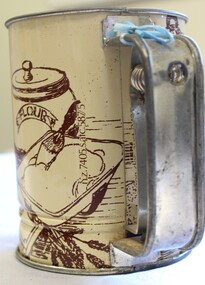
Domestic object - Flour Sifter made by KANDE Australia, Kande Kitchenware Ltd, 1920 - 1960
... The sifter / sieve is made of metal with a wire mesh and is decororated with images of other kitchen utensils and ingredients. ...The sifter / sieve is made of metal with a wire mesh and is decororated with images of other kitchen utensils and ingredients. ...Kande Kitchenware was established by Patrick Kavanagh and William English in 1922. The name Kande was formed from their initials, K and E. It had its Sydney factory in Little Collins Street, Surrey Hills. Kavanagh and English, a subsidiary of Kande Kitchenware, became a limited company in 1924, with both founders as directors. Another director was Test cricketer Jack Gregory, an all-rounder who slipped easily into the role of businessman. Gregory enjoyed success in business as on the cricket field, helping the company grow from a tiny operation to a major manufacturer and exporter that employed 80 people in 1931. They produced a wide range of utensils including cake tins, pastry cutters, pans and baking dishes. They managed to survive the difficulties of the Depression and were listed as a public company in 1949. Kande Kitchenware Ltd were taken over by Hackshalls Limited 6 July 1960.An appliance made by an early and successful Australian company which manufactured metal kitchen items during the first half of the 20th century. Th.ese utensils were widely used throughout AustraliaFlour sifter manufactured by KANDE Australia. The sifter / sieve is made of metal with a wire mesh and is decororated with images of other kitchen utensils and ingredients. It has a spring-loaded handle to which would be squeezed to operate the internal sifting mechanism.At botton of illustrations on one side "Kande AUSTRALIA"australian business, kande kitchenware, kitchen utensils, kitchenware early 20th century -
 Eltham District Historical Society Inc
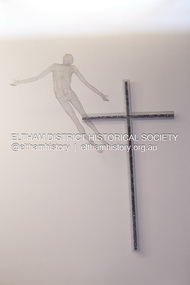
Photograph - Digital Photograph, Marguerite Marshall, Resurrection of Christ. Altarpiece, Charles Rocco (2002); Our Lady Help of Christian's Church, Henry Street, Eltham, 11 October 2006
... This alterpiece by Charles Rocco was created with wire mesh, river stones and copper. 500 x 200 x 150cm. ...This alterpiece by Charles Rocco was created with wire mesh, river stones and copper. 500 x 200 x 150cm. ...This alterpiece by Charles Rocco was created with wire mesh, river stones and copper. 500 x 200 x 150cm. It was commissioned by the Catholic parish in Eltham (Our Lady Help of Christian's) in 2002 Published: Nillumbik Now and Then / Marguerite Marshall 2008; photographs Alan King with Marguerite Marshall.; p81This collection of almost 130 photos about places and people within the Shire of Nillumbik, an urban and rural municipality in Melbourne's north, contributes to an understanding of the history of the Shire. Published in 2008 immediately prior to the Black Saturday bushfires of February 7, 2009, it documents sites that were impacted, and in some cases destroyed by the fires. It includes photographs taken especially for the publication, creating a unique time capsule representing the Shire in the early 21st century. It remains the most recent comprehenesive publication devoted to the Shire's history connecting local residents to the past. nillumbik now and then (marshall-king) collection, art, our lady help of christian’s church, charles rocco, eltham, resurrection of christ, sculpture -
 El Dorado Museum Association Inc.
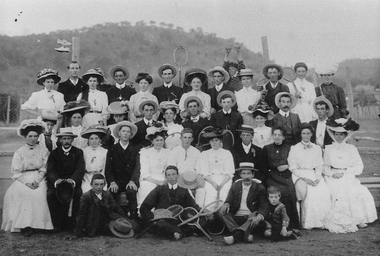
Photograph - Digital Image
... Digital image copied from a black and white photograph of a group of men in suits and hats, women in long sleeved shirts, skirts, and bonnets, and one boy, with several tennis rackets, posed in front of a wire mesh fence with hill in background....Tennis - El Dorado & Beechworth Teams, c1910 tennis men women children sport sporting team el dorado eldorado beechworth Digital image copied from a black and white photograph of a group of men in suits and hats, women in long sleeved shirts, skirts, and bonnets, and one boy, with several tennis rackets, posed in front of a wire mesh fence with hill in background. Photograph Digital Image ...Tennis - El Dorado & Beechworth Teams, c1910Digital image copied from a black and white photograph of a group of men in suits and hats, women in long sleeved shirts, skirts, and bonnets, and one boy, with several tennis rackets, posed in front of a wire mesh fence with hill in background.tennis, men, women, children, sport, sporting team, el dorado, eldorado, beechworth -
 Surrey Hills Historical Society Collection
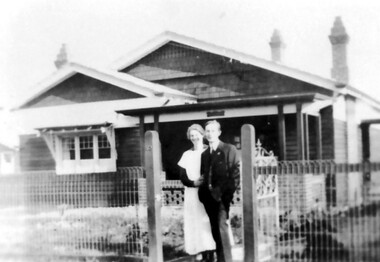
Photograph, Palstra home at 60 Guildford Road, Surrey Hills, 1920s, 1921
... The fence is of wire-mesh construction. There is a house nameplate over the verandah....The fence is of wire-mesh construction. There is a house nameplate over the verandah. ...Date is the one given by descendant Julia Thornton. William and May Palstra were married in 1920; this was their first and only home. They had 3 children, Margaret, Jocelyn and William. Margaret Thornton was a daughter of William and May Palstra; one of her daughters, Julia Thornton still lives in the house in 2023. For a time 3 generations of the family lived in the house - Margaret Thornton, Julia Thornton, her then-husband and their 2 children. The house remains in 2023 with extensions to the rear and side. Donation form signed by Julia Thornton. This is one of very few homes in the area which has been held continuously by the same family. It is typical of the Californian bungalow style built after World War 1 but modified for expanded family needs. This was achieved in a reasonably sympathetic manner before a heritage overlay was approved for a large part of Guildford Road and without a 2-storey extension.Black and white photo of William and May Palstra standing in the gateway of their Californian bungalow home in 1921. It is painted or stained in a dark colour and has 3 chimneys and a brick verandah. The fence is of wire-mesh construction. There is a house nameplate over the verandah.palstra, californian bungalows, guildford road, william palstra, may palstra, julia thornton
