
Showing 36 items matching "wombat road"
-
 Mt Dandenong & District Historical Society Inc.
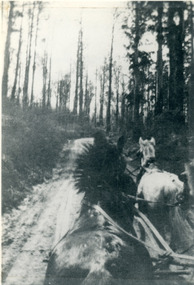
Photograph, View From Seat of Jeeves Coach, c1921
... wombat road...CRB (Main) Road between Wombat Road and Falls Road. c1921. This photograph has a detailed inscription on the back handwritten by John Lundy-Clarke in 1974....View from seat of Jeeves Coach over horses while being driven along the new CRB road between Wombat Road and Falls Rd 1921....Farndons Community Hall 42 Falls Road Mt Dandenong yarra-valley-and-the-dandenong-ranges wombat road falls road crb road jeeves coach horse View from seat of Jeeves Coach over horses while being driven along the new CRB road between Wombat Road and Falls Rd 1921. ...View the driver would have from horse drawn coach. CRB (Main) Road between Wombat Road and Falls Road. c1921. This photograph has a detailed inscription on the back handwritten by John Lundy-Clarke in 1974.View from seat of Jeeves Coach over horses while being driven along the new CRB road between Wombat Road and Falls Rd 1921.wombat road, falls road, crb road, jeeves coach, horse -
 Victorian Interpretive Projects Inc.
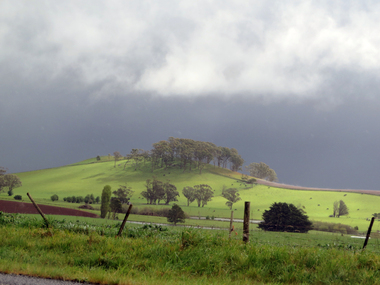
Photograph - Photograph - Colour, Clare Gervasoni, Wombat Hill near Boundary Church Road, Newlyn, 2014, 13/10/2014
... Wombat Hill near Boundary Church Road, Newlyn, 2014...road...Wombat Hill...Treed Hill on the Daylesford-Dean-Ballarat Road. It is Wombat Hill....PO Box 93R, Redan, 3350 goldfields hill boundary church road Wombat Hill Newlyn Treed Hill on the Daylesford-Dean-Ballarat Road. ...Treed Hill on the Daylesford-Dean-Ballarat Road. It is Wombat Hill.hill, boundary church road, wombat hill, newlyn -
 Victorian Interpretive Projects Inc.
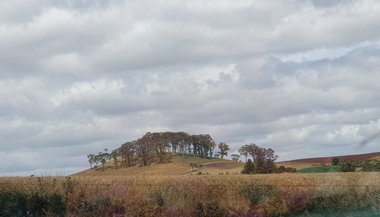
Photograph - Photograph - Colour, Clare Gervasoni, Wombat Hill near Boundary Church Road, Newlyn, 2020, 2020
... Wombat Hill near Boundary Church Road, Newlyn, 2020...road...Wombat Hill...Treed Hill on the Daylesford-Dean-Ballarat Road. It is Wombat Hill....PO Box 93R, Redan, 3350 goldfields hill boundary church road Wombat Hill Newlyn Treed Hill on the Daylesford-Dean-Ballarat Road. ...Treed Hill on the Daylesford-Dean-Ballarat Road. It is Wombat Hill.hill, boundary church road, wombat hill, newlyn -
 Victorian Interpretive Projects Inc.
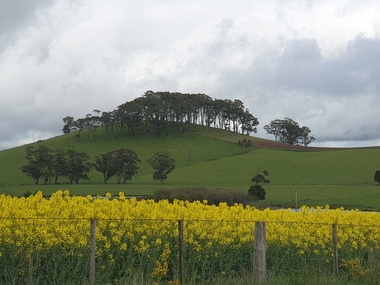
Photograph - Photograph - Colour, Clare Gervasoni, Wombat Hill near Boundary Church Road, Newlyn, 2019, 2020
... Wombat Hill near Boundary Church Road, Newlyn, 2019...road...Wombat Hill...Treed Hill on the Daylesford-Dean-Ballarat Road. It is Wombat Hill....PO Box 93R, Redan, 3350 goldfields hill boundary church road Wombat Hill Newlyn Treed Hill on the Daylesford-Dean-Ballarat Road. ...Treed Hill on the Daylesford-Dean-Ballarat Road. It is Wombat Hill.hill, boundary church road, wombat hill, newlyn -
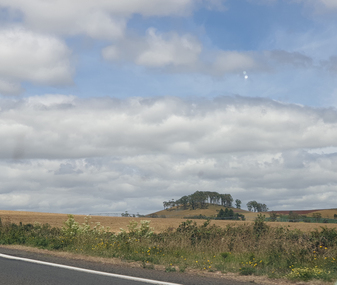 Victorian Interpretive Projects Inc.
Photograph - Photograph - Colour, Clare Gervasoni, Wombat Hill near Boundary Church Road, Newlyn, 2020, 2020
... Wombat Hill near Boundary Church Road, Newlyn, 2020...road...Wombat Hill...Treed Hill on the Daylesford-Dean-Ballarat Road. It is Wombat Hill....PO Box 93R, Redan, 3350 goldfields hill boundary church road Wombat Hill Newlyn Treed Hill on the Daylesford-Dean-Ballarat Road. ...Treed Hill on the Daylesford-Dean-Ballarat Road. It is Wombat Hill.hill, boundary church road, wombat hill, newlyn -
 Federation University Historical Collection
Book, Jacobs Lewis Vines Architects and Conservation Planners, Historic Sites Survey: Ballarat Study Area, 1980, 1980
... Barker Library (top floor) Mount Helen goldfields This survey was commissioned by the Land Conservation Council, Australian Heritage Commission and the Ministry for Conservation historic sites ballarat Wendy jacobs miles lewis gary vines berringa buninyong creswick dunnstown fiery creek lal lal langi logan cathcart mount cole Mount Egerton nerrina gong gong wombat state forest railways explorers routes early roads land conservation council ausralian hertiage commission department of planning ICOMOS (Burra) Charter nigel lewis richard aitken freehold land public land langi ghiran New jubille mine birthday tunnel mine pitfield plains smythesdale buninyong company Mount Clear mt clear canadian gully Warrenheip Distillery thomas mitchell waterloo trawalla beaufort raglan internment camps forestry mining mining mt egerton Mary Hollick Collection Jubilee Mine Burra Charter Historica areas data form explorers Egerton Company Black Horse mine Mt Egerton Government Battery kaolin Mines Anderson Brothers Barkstead Anderson's Tramway Clarkesdale Berry Leads Birthday Tunnel Mine Berringa Warrenheip Australasian Company Mount Mercer Lanvi-Kal-Kal water race 114 page report on historic sites in the Ballarat region. ...This survey was commissioned by the Land Conservation Council, Australian Heritage Commission and the Ministry for Conservation 114 page report on historic sites in the Ballarat region. It includes information on sites, a schexdule of sites, silte selection and designated areas (ie around towns)historic sites, ballarat, wendy jacobs, miles lewis, gary vines, berringa, buninyong, creswick, dunnstown, fiery creek, lal lal, langi logan, cathcart, mount cole, mount egerton, nerrina, gong gong, wombat state forest, railways, explorers routes, early roads, land conservation council, ausralian hertiage commission, department of planning, icomos (burra) charter, nigel lewis, richard aitken, freehold land, public land, langi ghiran, new jubille mine, birthday tunnel mine, pitfield plains, smythesdale, buninyong company, mount clear, mt clear, canadian gully, warrenheip distillery, thomas mitchell, waterloo, trawalla, beaufort, raglan, internment camps, forestry, mining, mining, mt egerton, mary hollick collection, jubilee mine, burra charter, historica areas data form, explorers, egerton company, black horse mine, mt egerton government battery, kaolin mines, anderson brothers, barkstead, anderson's tramway, clarkesdale, berry leads, birthday tunnel mine berringa, warrenheip, australasian company, mount mercer, lanvi-kal-kal, water race -
 Eltham District Historical Society Inc
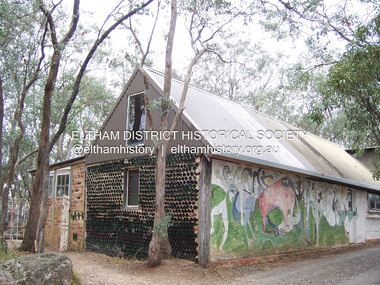
Photograph - Digital Photograph, Marguerite Marshall, Art Gallery at Clifton Pugh's Artists' Colony, Dunmoochin, Barreenong Road, Cottles Bridge, 5 February 2008
... Road, Pugh was surrounded by the Australian bush he loved, and where his ashes were later scattered. The 200 acres (81ha) of bushland, broken by glimpses of rolling hills, has more than 50 species of orchids and Pugh shared his property with native animals including kangaroos, emus, phascogales, wombats, and diverse bird life. ...Road, Pugh was surrounded by the Australian bush he loved, and where his ashes were later scattered. The 200 acres (81ha) of bushland, broken by glimpses of rolling hills, has more than 50 species of orchids and Pugh shared his property with native animals including kangaroos, emus, phascogales, wombats, and diverse bird life. ...Art Gallery with mural painted by Clifton Pugh (1924-1990) at his Artists' Colony, Dunmoochin, Barreenong Road, Cottles Bridge. Following military service in the second world war, Clifton Pugh studied under artist Sir William Dargie at the National Gallery School in Melbourne as well as Justus Jorgensen, founder of Montsalvat. For a while he lived on the dole but also worked packing eggs for the Belot family saving sufficient to purchase six acres (2.4 ha) of land at Barreenong Road, Cottles Bridge. He accumulated more land and persuaded several other artists and friends to buy land nearby, resulting in a property of approximately 200 acres, stablishing it as one of the first artistic communes in Australia alongside Montsalvat in Eltham. It was around 1951 that Pugh felt he had '"done moochin' around" and so the name of the property evolved. He bought timber from Alistair Knox to build his house on the crest of a hill. Inspired by local goldminer's huts, it was a one room wattle-and-daub structure with dirt floor. Over the years it expanded with thick adobe walls made from local clay, high ceilings and stone floors. All materials other than the local earth were sourced from second hand materials, most found at wreckers' yards. Artists from across the nation were drawn to Dunmoochin, with several setting up houses and shacks on the property, maintaining their independence but sharing their artistic zeal. Artists who worked or resided at Dunmoochin included Mirka Mora, John Perceval, Albert Tucker, Fred Williams, Charles Blackman, Arthur Boyd and John Olsen. In 2002, Pugh's house along with its treasure trove of art and a library of some 20,000 books was destroyed by fire. Traces of Pugh's home remain with the presence of the Victorian doorframe archway with leadlight of intricate design, procured from a demolished Melbourne mansion; and two bronze life-sized female statues created by Pugh and cast by Matcham Skipper. In place of Pugh's house rose two double-storey mud-brick artists' studios topped with corrugated iron rooves curved like the wings of a bird with accommodation for seven. The original studios, gallery and other buildings survived the fire. Covered under Heritage Overlay, Nillumbik Planning Scheme. Published: Nillumbik Now and Then / Marguerite Marshall 2008; photographs Alan King with Marguerite Marshall.; p153 It’s not surprising that artist Clifton Pugh was drawn to Cottles Bridge to establish his artists’ colony Dunmoochin. Undisturbed by the clamour of modern life at Barreenong Road, Pugh was surrounded by the Australian bush he loved, and where his ashes were later scattered. The 200 acres (81ha) of bushland, broken by glimpses of rolling hills, has more than 50 species of orchids and Pugh shared his property with native animals including kangaroos, emus, phascogales, wombats, and diverse bird life. Pugh encouraged these creatures to join him in the bush by creating, with Monash University, a holding station where the animals were raised. Dunmoochin inspired Pugh for such paintings as in a book on orchids and the Death of a Wombat series.1 But his love for the bush was accompanied by the fear that Europeans were destroying it and much of his painting illustrated this fear and his plea for its conservation.2 However it was his house rather than the surrounding bush that was to be destroyed. Tragically in 2002 Pugh’s house, with its treasure of art and library of 20,000 art books, was destroyed by fire. Traces of the beauty of Pugh’s home still remain, however, in the magnificent Victorian doorframe archway with leadlight of intricate design procured from a demolished Melbourne mansion; and two bronze life-sized female statues created by Pugh and cast by Matcham Skipper. Now in place of Pugh’s house, are two double-storey mud-brick artists’ studios topped with corrugated roofs curved like birds’ wings, with accommodation for seven. The original studios, gallery and other buildings remain.3 Pugh grew up on his parents’ hobby farm at Briar Hill and attended the Briar Hill Primary School, then Eltham High School and later Ivanhoe Grammar. At 15 he became a copy boy for the Radio Times newspaper, then worked as a junior in a drafting office. Pugh was to have three wives and two sons. After serving in World War Two in New Guinea and Japan, Pugh studied under artist Sir William Dargie, at the National Gallery School in Melbourne.4 Another of his teachers was Justus Jörgensen, founder of Montsalvat the Eltham Artists’ Colony. Pugh lived on the dole for a while and paid for his first six acres (2.4ha) at Barreenong Road by working as an egg packer for the Belot family. Pugh accumulated more land and persuaded several other artists and friends to buy land nearby, resulting in the 200 acre property. They, too, purchased their land from the Belot family by working with their chickens. Around 1951 Pugh felt he had ‘Done moochin’ around’ and so the name of his property was born. Pugh bought some used timber from architect Alistair Knox to build his house on the crest of a hill. Inspired by local goldminers’ huts it was a one-room wattle-and-daub structure with a dirt floor. It was so small that the only room he could find for his telephone was on the fork of a tree nearby.5 Over the years the mud-brick house grew to 120 squares in the style now synonymous with Eltham. It had thick adobe walls (sun-dried bricks) made from local clay, high ceilings and stone floors with the entire structure made of second-hand materials – most found at wreckers’ yards. Pugh’s first major show in Melbourne in 1957, established him as a distinctive new painter, breaking away from the European tradition ‘yet not closely allied to any particular school of Australian painting’.6 Pugh became internationally known and was awarded the Order of Australia. He won the Archibald Prize for portraiture three times, although he preferred painting the bush and native animals. In 1990 not long before he died, Pugh was named the Australian War Memorial’s official artist at the 75th anniversary of the landing at Gallipoli. Today one of Pugh’s legacies is the Dunmoochin Foundation, which gives seven individual artists or couples and environmental researchers the chance to work in beautiful and peaceful surroundings, usually for a year. By November 2007, more than 80 people had taken part, and the first disabled artist had been chosen to reside in a new studio with disabled access.1 In 1989, not long before Pugh died in 1990 of a heart attack at age 65, he established the Foundation with La Trobe University and the Victorian Conservation Trust now the Trust for Nature. Pugh’s gift to the Australian people – of around 14 hectares of bushland and buildings and about 550 art works – is run by a voluntary board of directors, headed by one of his sons, Shane Pugh. La Trobe University in Victoria stores and curates the art collection and organises its exhibition around Australia.2 The Foundation aims to protect and foster the natural environment and to provide residences, studios and community art facilities at a minimal cost for artists and environmental researchers. They reside at the non-profit organisation for a year at minimal cost. The buildings, some decorated with murals painted by Pugh and including a gallery, were constructed by Pugh, family and friends, with recycled as well as new materials and mud-bricks. The Foundation is inspired by the tradition begun by the Dunmoochin Artists’ Cooperative which formed in the late 1950s as one of the first artistic communes in Australia. Members bought the land collaboratively and built the seven dwellings so that none could overlook another. But, in the late 1960s, the land was split into private land holdings, which ended the cooperative. Dunmoochin attracted visits from the famous artists of the day including guitarists John Williams and Segovia; singer and comedian Rolf Harris; comedian Barry Humphries; and artists Charles Blackman, Arthur Boyd and Mirka Mora. A potters’ community, started by Peter and Helen Laycock with Alma Shanahan, held monthly exhibitions in the 1960s, attracting local, interstate and international visitors – with up to 500 attending at a time.3 Most artists sold their properties and moved away. But two of the original artists remained into the new millennium as did relative newcomer Heja Chong who built on Pugh’s property (now owned by the Dunmoochin Foundation). In 1984 Chong brought the 1000-year-old Japanese Bizan pottery method to Dunmoochin. She helped build (with potters from all over Australia) the distinctive Bizan-style kiln, which fires pottery from eight to 14 days in pine timber, to produce the Bizan unglazed and simple subdued style. The kiln, which is rare in Australia, is very large with adjoining interconnected ovens of different sizes, providing different temperatures and firing conditions. Frank Werther, who befriended Pugh as a fellow student at the National Gallery Art School in Melbourne, built his house off Barreenong Road in 1954. Werther is a painter of the abstract and colourist style and taught art for about 30 years. Like so many in the post-war years in Eltham Shire, as it was called then, Werther built his home in stages using mud-brick and second-hand materials. The L-shaped house is single-storey but two-storey in parts with a corrugated-iron pitched roof. The waterhole used by the Werthers for their water supply is thought to be a former goldmining shaft.4 Alma Shanahan at Barreenong Road was the first to join Pugh around 1953. They also met at the National Gallery Art School and Shanahan at first visited each weekend to work, mainly making mud-bricks. She shared Pugh’s love for the bush, but when their love affair ended, she designed and built her own house a few hundred yards (metres) away. The mud-brick and timber residence, made in stages with local materials, is rectangular, single-storey with a corrugated-iron roof. As a potter, Shanahan did not originally qualify as an official Cooperative member.This collection of almost 130 photos about places and people within the Shire of Nillumbik, an urban and rural municipality in Melbourne's north, contributes to an understanding of the history of the Shire. Published in 2008 immediately prior to the Black Saturday bushfires of February 7, 2009, it documents sites that were impacted, and in some cases destroyed by the fires. It includes photographs taken especially for the publication, creating a unique time capsule representing the Shire in the early 21st century. It remains the most recent comprehenesive publication devoted to the Shire's history connecting local residents to the past. nillumbik now and then (marshall-king) collection, art gallery, clifton pugh, dunmoochin, cottlesbridge, cottles bridge, barreenong road -
 Eltham District Historical Society Inc
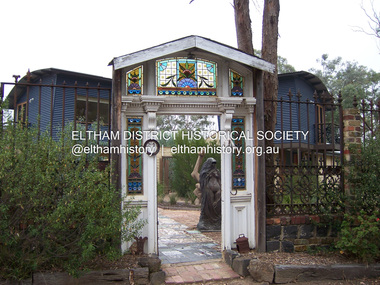
Photograph - Digital Photograph, Marguerite Marshall, Doorway of Clifton Pugh's former house at Dunmoochin, Barreenong Road, Cottles Bridge, 5 February 2008
... Road, Pugh was surrounded by the Australian bush he loved, and where his ashes were later scattered. The 200 acres (81ha) of bushland, broken by glimpses of rolling hills, has more than 50 species of orchids and Pugh shared his property with native animals including kangaroos, emus, phascogales, wombats, and diverse bird life. ...Road, Pugh was surrounded by the Australian bush he loved, and where his ashes were later scattered. The 200 acres (81ha) of bushland, broken by glimpses of rolling hills, has more than 50 species of orchids and Pugh shared his property with native animals including kangaroos, emus, phascogales, wombats, and diverse bird life. ...Following military service in the second world war, Clifton Pugh studied under artist Sir William Dargie at the National Gallery School in Melbourne as well as Justus Jorgensen, founder of Montsalvat. For a while he lived on the dole but also worked packing eggs for the Belot family saving sufficient to purchase six acres (2.4 ha) of land at Barreenong Road, Cottles Bridge. He accumulated more land and persuaded several other artists and friends to buy land nearby, resulting in a property of approximately 200 acres, stablishing it as one of the first artistic communes in Australia alongside Montsalvat in Eltham. It was around 1951 that Pugh felt he had '"done moochin' around" and so the name of the property evolved. He bought timber from Alistair Knox to build his house on the crest of a hill. Inspired by local goldminer's huts, it was a one room wattle-and-daub structure with dirt floor. Over the years it expanded with thick adobe walls made from local clay, high ceilings and stone floors. All materials other than the local earth were sourced from second hand materials, most found at wreckers' yards. Artists from across the nation were drawn to Dunmoochin, with several setting up houses and shacks on the property, maintaining their independence but sharing their artistic zeal. Artists who worked or resided at Dunmoochin included Mirka Mora, John Perceval, Albert Tucker, Fred Williams, Charles Blackman, Arthur Boyd and John Olsen. In 2002, Pugh's house along with its treasure trove of art and a library of some 20,000 books was destroyed by fire. Traces of Pugh's home remain with the presence of the Victorian doorframe archway with leadlight of intricate design, procured from a demolished Melbourne mansion; and two bronze life-sized female statues created by Pugh and cast by Matcham Skipper. In place of Pugh's house rose two double-storey mud-brick artists' studios topped with corrugated iron rooves curved like the wings of a bird with accommodation for seven. The original studios, gallery and other buildings survived the fire. Covered under Heritage Overlay, Nillumbik Planning Scheme. Published: Nillumbik Now and Then / Marguerite Marshall 2008; photographs Alan King with Marguerite Marshall.; p155 It’s not surprising that artist Clifton Pugh was drawn to Cottles Bridge to establish his artists’ colony Dunmoochin. Undisturbed by the clamour of modern life at Barreenong Road, Pugh was surrounded by the Australian bush he loved, and where his ashes were later scattered. The 200 acres (81ha) of bushland, broken by glimpses of rolling hills, has more than 50 species of orchids and Pugh shared his property with native animals including kangaroos, emus, phascogales, wombats, and diverse bird life. Pugh encouraged these creatures to join him in the bush by creating, with Monash University, a holding station where the animals were raised. Dunmoochin inspired Pugh for such paintings as in a book on orchids and the Death of a Wombat series.1 But his love for the bush was accompanied by the fear that Europeans were destroying it and much of his painting illustrated this fear and his plea for its conservation.2 However it was his house rather than the surrounding bush that was to be destroyed. Tragically in 2002 Pugh’s house, with its treasure of art and library of 20,000 art books, was destroyed by fire. Traces of the beauty of Pugh’s home still remain, however, in the magnificent Victorian doorframe archway with leadlight of intricate design procured from a demolished Melbourne mansion; and two bronze life-sized female statues created by Pugh and cast by Matcham Skipper. Now in place of Pugh’s house, are two double-storey mud-brick artists’ studios topped with corrugated roofs curved like birds’ wings, with accommodation for seven. The original studios, gallery and other buildings remain.3 Pugh grew up on his parents’ hobby farm at Briar Hill and attended the Briar Hill Primary School, then Eltham High School and later Ivanhoe Grammar. At 15 he became a copy boy for the Radio Times newspaper, then worked as a junior in a drafting office. Pugh was to have three wives and two sons. After serving in World War Two in New Guinea and Japan, Pugh studied under artist Sir William Dargie, at the National Gallery School in Melbourne.4 Another of his teachers was Justus Jörgensen, founder of Montsalvat the Eltham Artists’ Colony. Pugh lived on the dole for a while and paid for his first six acres (2.4ha) at Barreenong Road by working as an egg packer for the Belot family. Pugh accumulated more land and persuaded several other artists and friends to buy land nearby, resulting in the 200 acre property. They, too, purchased their land from the Belot family by working with their chickens. Around 1951 Pugh felt he had ‘Done moochin’ around’ and so the name of his property was born. Pugh bought some used timber from architect Alistair Knox to build his house on the crest of a hill. Inspired by local goldminers’ huts it was a one-room wattle-and-daub structure with a dirt floor. It was so small that the only room he could find for his telephone was on the fork of a tree nearby.5 Over the years the mud-brick house grew to 120 squares in the style now synonymous with Eltham. It had thick adobe walls (sun-dried bricks) made from local clay, high ceilings and stone floors with the entire structure made of second-hand materials – most found at wreckers’ yards. Pugh’s first major show in Melbourne in 1957, established him as a distinctive new painter, breaking away from the European tradition ‘yet not closely allied to any particular school of Australian painting’.6 Pugh became internationally known and was awarded the Order of Australia. He won the Archibald Prize for portraiture three times, although he preferred painting the bush and native animals. In 1990 not long before he died, Pugh was named the Australian War Memorial’s official artist at the 75th anniversary of the landing at Gallipoli. Today one of Pugh’s legacies is the Dunmoochin Foundation, which gives seven individual artists or couples and environmental researchers the chance to work in beautiful and peaceful surroundings, usually for a year. By November 2007, more than 80 people had taken part, and the first disabled artist had been chosen to reside in a new studio with disabled access.1 In 1989, not long before Pugh died in 1990 of a heart attack at age 65, he established the Foundation with La Trobe University and the Victorian Conservation Trust now the Trust for Nature. Pugh’s gift to the Australian people – of around 14 hectares of bushland and buildings and about 550 art works – is run by a voluntary board of directors, headed by one of his sons, Shane Pugh. La Trobe University in Victoria stores and curates the art collection and organises its exhibition around Australia.2 The Foundation aims to protect and foster the natural environment and to provide residences, studios and community art facilities at a minimal cost for artists and environmental researchers. They reside at the non-profit organisation for a year at minimal cost. The buildings, some decorated with murals painted by Pugh and including a gallery, were constructed by Pugh, family and friends, with recycled as well as new materials and mud-bricks. The Foundation is inspired by the tradition begun by the Dunmoochin Artists’ Cooperative which formed in the late 1950s as one of the first artistic communes in Australia. Members bought the land collaboratively and built the seven dwellings so that none could overlook another. But, in the late 1960s, the land was split into private land holdings, which ended the cooperative. Dunmoochin attracted visits from the famous artists of the day including guitarists John Williams and Segovia; singer and comedian Rolf Harris; comedian Barry Humphries; and artists Charles Blackman, Arthur Boyd and Mirka Mora. A potters’ community, started by Peter and Helen Laycock with Alma Shanahan, held monthly exhibitions in the 1960s, attracting local, interstate and international visitors – with up to 500 attending at a time.3 Most artists sold their properties and moved away. But two of the original artists remained into the new millennium as did relative newcomer Heja Chong who built on Pugh’s property (now owned by the Dunmoochin Foundation). In 1984 Chong brought the 1000-year-old Japanese Bizan pottery method to Dunmoochin. She helped build (with potters from all over Australia) the distinctive Bizan-style kiln, which fires pottery from eight to 14 days in pine timber, to produce the Bizan unglazed and simple subdued style. The kiln, which is rare in Australia, is very large with adjoining interconnected ovens of different sizes, providing different temperatures and firing conditions. Frank Werther, who befriended Pugh as a fellow student at the National Gallery Art School in Melbourne, built his house off Barreenong Road in 1954. Werther is a painter of the abstract and colourist style and taught art for about 30 years. Like so many in the post-war years in Eltham Shire, as it was called then, Werther built his home in stages using mud-brick and second-hand materials. The L-shaped house is single-storey but two-storey in parts with a corrugated-iron pitched roof. The waterhole used by the Werthers for their water supply is thought to be a former goldmining shaft.4 Alma Shanahan at Barreenong Road was the first to join Pugh around 1953. They also met at the National Gallery Art School and Shanahan at first visited each weekend to work, mainly making mud-bricks. She shared Pugh’s love for the bush, but when their love affair ended, she designed and built her own house a few hundred yards (metres) away. The mud-brick and timber residence, made in stages with local materials, is rectangular, single-storey with a corrugated-iron roof. As a potter, Shanahan did not originally qualify as an official Cooperative member.This collection of almost 130 photos about places and people within the Shire of Nillumbik, an urban and rural municipality in Melbourne's north, contributes to an understanding of the history of the Shire. Published in 2008 immediately prior to the Black Saturday bushfires of February 7, 2009, it documents sites that were impacted, and in some cases destroyed by the fires. It includes photographs taken especially for the publication, creating a unique time capsule representing the Shire in the early 21st century. It remains the most recent comprehenesive publication devoted to the Shire's history connecting local residents to the past. nillumbik now and then (marshall-king) collection, art gallery, clifton pugh, dunmoochin, cottlesbridge, cottles bridge, barreenong road -
 Ballan Shire Historical Society
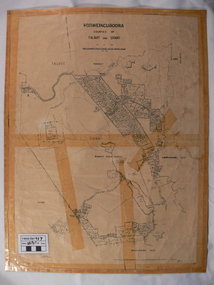
Map - Map. Korweinguboora, Department of Lands and Survey, Korweinguboora. Counties of Talbot and Grant
... roads, forests, railway lines and properties with the owners names. The inclusion of the names of landowners is of significance and value to historians. talbot moorarbool west wombat bullarto korweinguboora moorarbool east dean wombat state forest barkstead There are various pencil annotations but the are difficult to read. ...A map of the Korweinguboora area showing roads, forests, railway lines and properties with the owners names.The inclusion of the names of landowners is of significance and value to historians.A map of the Korweinguboora area showing land subdivisions and names of owners and other physical features. There is a scale in chains. No date is certain but it could be 1902. The map has been repaired with sellotape.There are various pencil annotations but the are difficult to read.talbot, moorarbool west, wombat, bullarto, korweinguboora, moorarbool east, dean, wombat state forest, barkstead -
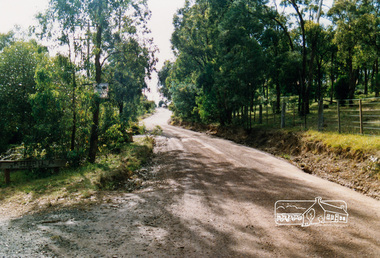 Eltham District Historical Society Inc
Photograph, Near 1 Wombat Drive, Eltham, 1991, 1991
... ...Road construction...Wombat...Eltham District Historical Society Inc 728 Main Rd Eltham melbourne Prior to road sealing works. eltham streets Road construction Wombat Drive Marked 'D' on reverse. ...Prior to road sealing works.Colour photographMarked 'D' on reverse.eltham, streets, road construction, wombat drive -
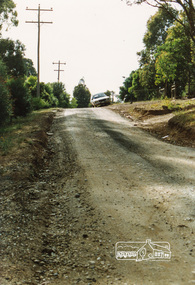 Eltham District Historical Society Inc
Photograph, Near 18 Wombat Drive, Eltham, 1991, 1991
... ...road construction...wombat...Eltham District Historical Society Inc 728 Main Rd Eltham melbourne Prior to road sealing works. eltham streets road construction wombat drive Marked 'E' on reverse. ...Prior to road sealing works.Colour photographMarked 'E' on reverse.eltham, streets, road construction, wombat drive -
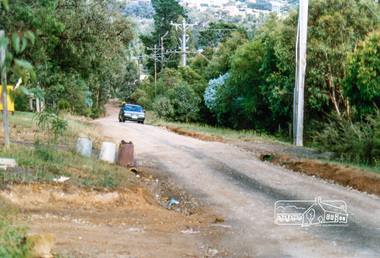 Eltham District Historical Society Inc
Photograph, Near 9 Wombat Drive, Eltham, 1991, 1991
... ...road construction...wombat...Eltham District Historical Society Inc 728 Main Rd Eltham melbourne Prior to road sealing works. eltham streets road construction wombat drive Colour photograph Near 9 Wombat Drive, Eltham, 1991 Photograph ...Prior to road sealing works.Colour photographeltham, streets, road construction, wombat drive -
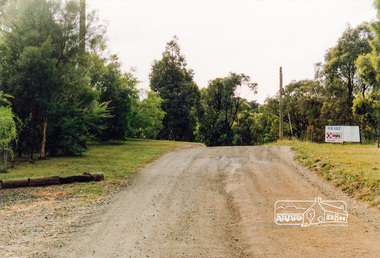 Eltham District Historical Society Inc
Photograph, Near 13 Wombat Drive, Eltham, 1991, 1991
... ...road construction...wombat...Eltham District Historical Society Inc 728 Main Rd Eltham melbourne Prior to road sealing works. eltham streets road construction wombat drive Colour photograph Near 13 Wombat Drive, Eltham, 1991 Photograph ...Prior to road sealing works.Colour photographeltham, streets, road construction, wombat drive -
 Eltham District Historical Society Inc
Photograph, Near 38 Wombat Drive, Eltham, 1991, 1991
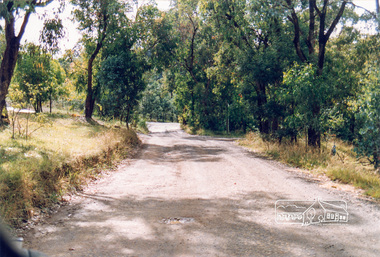
... ...road construction...wombat...Eltham District Historical Society Inc 728 Main Rd Eltham melbourne Prior to road sealing works. eltham streets road construction wombat drive Colour photograph Near 38 Wombat Drive, Eltham, 1991 Photograph ...Prior to road sealing works.Colour photographeltham, streets, road construction, wombat drive -
 Eltham District Historical Society Inc
Photograph, Near 15 Wombat Drive, Eltham, 1991, 1991
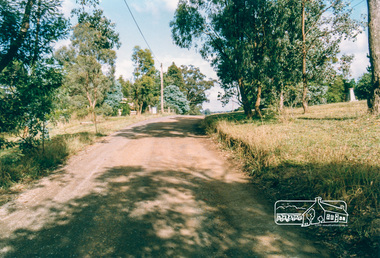
... ...road construction...wombat...Eltham District Historical Society Inc 728 Main Rd Eltham melbourne Prior to road sealing works. eltham streets road construction wombat drive Marked 'C' on reverse. ...Prior to road sealing works.Colour photographMarked 'C' on reverse.eltham, streets, road construction, wombat drive -
 Eltham District Historical Society Inc
Photograph, Near 46 Wombat Drive, Eltham, 1991, 1991
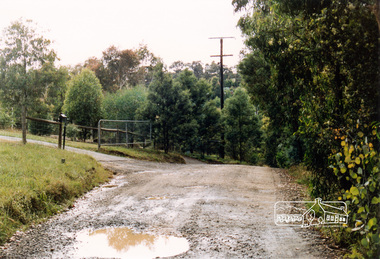
... ...road construction...wombat...Eltham District Historical Society Inc 728 Main Rd Eltham melbourne Prior to road sealing works. eltham streets road construction wombat drive Colour photograph Near 46 Wombat Drive, Eltham, 1991 Photograph ...Prior to road sealing works.Colour photographeltham, streets, road construction, wombat drive -
 Eltham District Historical Society Inc
Photograph, Near 46 Wombat Drive, Eltham, 1991, 1991
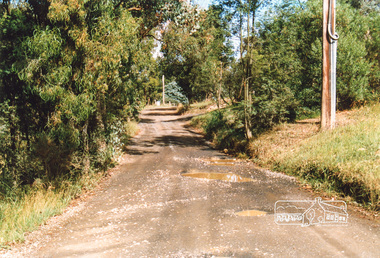
... ...road construction...wombat...Eltham District Historical Society Inc 728 Main Rd Eltham melbourne Prior to road sealing works. eltham streets road construction wombat drive Marked 'C' on reverse . ...Prior to road sealing works.Colour photographMarked 'C' on reverse .eltham, streets, road construction, wombat drive -
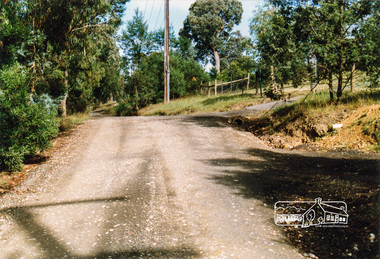 Eltham District Historical Society Inc
Photograph, Near 50 Wombat Drive, Eltham, 1991, 1991
... ...road construction...wombat...Eltham District Historical Society Inc 728 Main Rd Eltham melbourne Prior to road sealing works. eltham streets road construction wombat drive Marked 'F' on reverse . ...Prior to road sealing works.Colour photographMarked 'F' on reverse .eltham, streets, road construction, wombat drive -
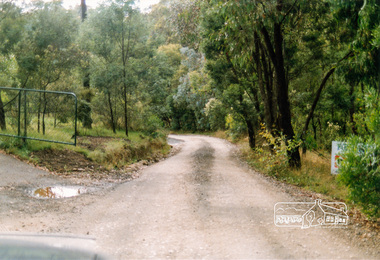 Eltham District Historical Society Inc
Photograph, Near 50 Wombat Drive, Eltham, 1991, 1991
... ...road construction...wombat...Eltham District Historical Society Inc 728 Main Rd Eltham melbourne Prior to road sealing works. eltham streets road construction wombat drive Colour photograph Near 50 Wombat Drive, Eltham, 1991 Photograph ...Prior to road sealing works.Colour photographeltham, streets, road construction, wombat drive -
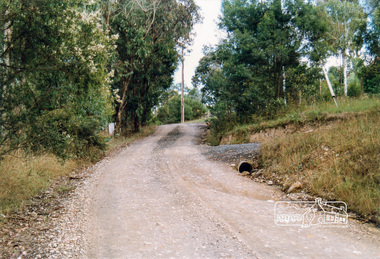 Eltham District Historical Society Inc
Photograph, Near 54 Wombat Drive, Eltham, 1991, 1991
... ...road construction...wombat...Eltham District Historical Society Inc 728 Main Rd Eltham melbourne Prior to road sealing works. eltham streets road construction wombat drive Marked 'F' on reverse. ...Prior to road sealing works.Colour photographMarked 'F' on reverse.eltham, streets, road construction, wombat drive -
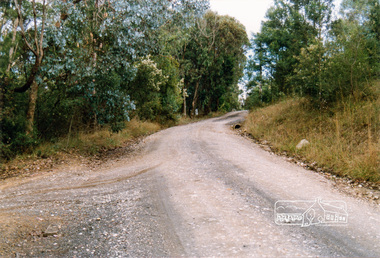 Eltham District Historical Society Inc
Photograph, Near 60 Wombat Drive, Eltham, 1991, 1991
... ...road construction...wombat...Eltham District Historical Society Inc 728 Main Rd Eltham melbourne Prior to road sealing works. eltham streets road construction wombat drive Marked 'B' on reverse. ...Prior to road sealing works.Colour photographMarked 'B' on reverse.eltham, streets, road construction, wombat drive -
 Eltham District Historical Society Inc
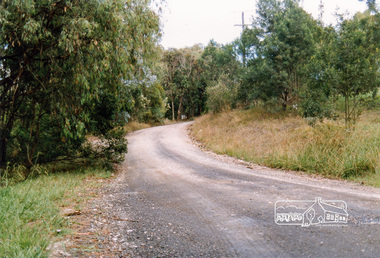
Photograph, Wombat Drive at intersection with Wombat Court, Eltham, 1991, 1991
... ...road construction...wombat...Eltham District Historical Society Inc 728 Main Rd Eltham melbourne Prior to road sealing works. eltham streets road construction wombat drive wombat court Colour photograph Wombat Drive at intersection with Wombat Court, Eltham, 1991 Photograph ...Prior to road sealing works.Colour photographeltham, streets, road construction, wombat drive, wombat court -
 Eltham District Historical Society Inc
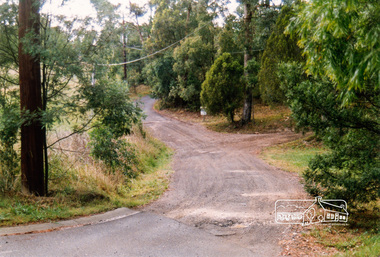
Photograph, Wombat Drive at intersection with Wombat Court, Eltham, 1991, 1991
... ...road construction...wombat...Eltham District Historical Society Inc 728 Main Rd Eltham melbourne Prior to road sealing works. eltham streets road construction wombat drive wombat court Marked 'A' on reverse. ...Prior to road sealing works.Colour photographMarked 'A' on reverse.eltham, streets, road construction, wombat drive, wombat court -
 Eltham District Historical Society Inc
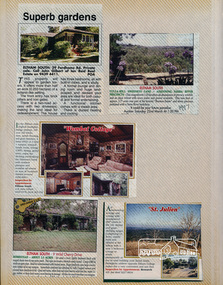
Newsclipping, 29 Fordhams Road, Culla Hill, Sweeneys Lane, Wombat Cottage and 9 Wild Cherry Drive, Eltham South and St Julien, Research
... 29 Fordhams Road, Culla Hill, Sweeneys Lane, Wombat Cottage and 9 Wild Cherry Drive, Eltham South and St Julien, Research...road...ian reid real estate...research (vic.)...st. julien...sweeneys lane...wild cherry drive...wombat...Eltham District Historical Society Inc 728 Main Rd Eltham melbourne Contained in Volume 2 of a set of two spiral magnetic photo albums, each containing 10 leaves, 20 pages; Vol. 1 labelled "Houses - Eltham South" and Vol. 2 labelled "Eltham Houses". eltham real estate advertisement houses culla hill fordhams road ian reid real estate research (vic.) st. julien sweeneys lane wild cherry drive wombat cottage Newspaper clippings promoting house auctions 29 Fordhams Road, Culla Hill, Sweeneys Lane, Wombat Cottage and 9 Wild Cherry Drive, Eltham South and St Julien, Research Newsclipping ...Contained in Volume 2 of a set of two spiral magnetic photo albums, each containing 10 leaves, 20 pages; Vol. 1 labelled "Houses - Eltham South" and Vol. 2 labelled "Eltham Houses". Newspaper clippings promoting house auctionseltham, real estate advertisement, houses, culla hill, fordhams road, ian reid real estate, research (vic.), st. julien, sweeneys lane, wild cherry drive, wombat cottage -
 Daylesford & District Historical Society
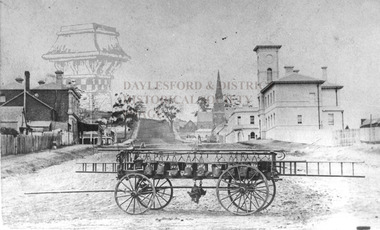
Photograph (copy), Daylesford Fire Brigade First Ladder Carriage, c1867 (original)
... Wombat Hill. The carriage stands in Victoria Street (now Central Springs Road) and shows the former Daylesford Post Office on the right. ...Wombat Hill. The carriage stands in Victoria Street (now Central Springs Road) and shows the former Daylesford Post Office on the right. ...The Daylesford Fire Brigade carriage was locally built by White and Oldham, wheelwrights and carriage makers to the design of Captain Henshaw. Their premises was behind the Victoria Hotel, and American by origin.Photograph of the first ladder carriage bought by the Daylesford Volunteer Fire Brigade, built locally, and designed by Captain Henshaw. It is an important record of purchase and some significant buildings circa 1867.Black and white photograph showing the first ladder carriage of the Daylesford Fire Brigade taken from Bridport Street looking towards Wombat Hill. The carriage stands in Victoria Street (now Central Springs Road) and shows the former Daylesford Post Office on the right. The building on the left was the Bank of Victoria, later the Belvedere Hotel, and in 2012 was Kookla. Other buildings include Victoria Building, Church of England (Anglican), Stanbridge Hall.The carriage shows ten canvas water buckets hanging on hooks, a long ladder and two hoses hang from hooks on the lower section of the four wheeled carriage. The roads and footpaths are unsealed.Typed verso: "Copied from on original kindly loaned by J. Ogilthorpe. Shows Daylesford Fire Brigades first Ladder Carriage outside the then Fire Station where Kindergarten now stands 1977. Date about mid 1860s. This ladder carriage was locally built by a wheel and carriage maker with premises behind Victorian Hotel. White and Oldham. Designed by Capt. Henshaw was an American who went to the New Zealand goldfields about 1870. Post Office was built in 1867. On Belvedre (sic) at this time a a Bank, Bank of Victoria." Stamped: "Daylesford and District Historical Society"dayelsford, daylesford fire brigade, henshaw, post office, white and oldham, -
 Ringwood and District Historical Society
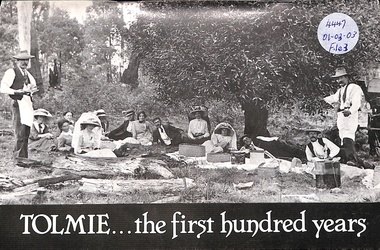
Book, Tolmie - The First Hundred Years
... Ringwood and District Historical Society 125A Warrandyte Road Ringwood North melbourne Tolmie (formerly Wombat ) The First Hundred Years to approx 1986 Tolmie - The First Hundred Years Book ...Tolmie (formerly Wombat ) The First Hundred Years to approx 1986 -
Federation University Historical Collection
Book, University of Ballarat - Daylesford: Product Development Plan
... road access to daylesford...rail and coach access to daylesford...the lake house...wombat...Barker Library (top floor) Mount Helen goldfields University of Ballarat - Daylesford: Product Development Plan JT701/Tourism Planning and Development Lecturer/Tutor: Mary Hollick university of ballarat daylesford mary hollick andrew cyples todd edmonds kylie harrington nicole landers jess lewis hepburn shire council introduction methodology history of daylesford infrastructure audit hepburn mineral springs & springs reserve hepburn springs bath house lake daylesford the convent gallery road access to daylesford rail and coach access to daylesford the lake house wombat gardens & victoria park jubillee lake jim crow wombat sir charles hotham warren hastings central, tipperary and golden mineral springs lavandula lavender farm the macaroni factory smeaton guilford trentham maldon creswick castlemaine clunes dja dja wurrung swiss/italian mineral water hepburn mineral springs reserve jubilee lake Central Springs Tipperary Springs Golden springs White soft covered book of 68 pages including 13 appendices. ...University of Ballarat - Daylesford: Product Development Plan JT701/Tourism Planning and Development Lecturer/Tutor: Mary HollickWhite soft covered book of 68 pages including 13 appendices.university of ballarat, daylesford, mary hollick, andrew cyples, todd edmonds, kylie harrington, nicole landers, jess lewis, hepburn shire council, introduction, methodology, history of daylesford, infrastructure audit, hepburn mineral springs & springs reserve, hepburn springs bath house, lake daylesford, the convent gallery, road access to daylesford, rail and coach access to daylesford, the lake house, wombat gardens & victoria park, jubillee lake, jim crow, wombat, sir charles hotham, warren hastings, central, tipperary and golden mineral springs, lavandula lavender farm, the macaroni factory, smeaton, guilford, trentham, maldon, creswick, castlemaine, clunes, dja dja wurrung, swiss/italian, mineral water, hepburn mineral springs reserve, jubilee lake, central springs, tipperary springs, golden springs -
 South West Healthcare
Ambulance Service Victoria Badge, Wombat Productions, Nurse Badges, 20th Century
... South West Healthcare Ryot Street Warrnambool great-ocean-road Nurse badges Ambulance Service Victoria Face: "AMBULANCE SERVICE / VICTORIA" Reverse: "WOMBAT PROMOTIONS", "(03) 3326 0333" Metal and enamel brooch with stud fastener. ...Metal and enamel brooch with stud fastener.Face: "AMBULANCE SERVICE / VICTORIA" Reverse: "WOMBAT PROMOTIONS", "(03) 3326 0333"nurse badges, ambulance service victoria -
 Sunshine and District Historical Society Incorporated
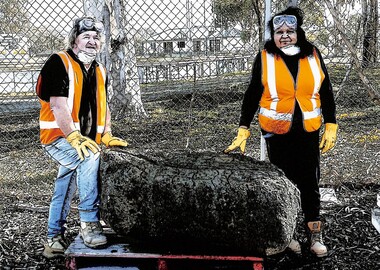
Photograph - The Walan-walan 'Bug Rug' Sculptor Kororoit Creek Sunshine West, Bajada C, Melchior, 16th August 2022
... Road and Wright Street. |What is Walan-walan? Walan-walan is a sculpture project at The Bug Rug by Fiona Clarke & Kenneth McKean Walan-walan means circle /round in Wurundjeri Woi Wurrung language. The circle has more than one meaning in First Nations cultures. In this case it represents the annual cycle of the year. Other important meanings include as a symbol for a meeting place or a body of water. The sculptures forming the circle are based on animal elemental signs of nature from local Aboriginal seasons. Wumangurruditj - Wombat...Road and Wright Street. |What is Walan-walan? Walan-walan is a sculpture project at The Bug Rug by Fiona Clarke & Kenneth McKean Walan-walan means circle /round in Wurundjeri Woi Wurrung language. The circle has more than one meaning in First Nations cultures. In this case it represents the annual cycle of the year. Other important meanings include as a symbol for a meeting place or a body of water. The sculptures forming the circle are based on animal elemental signs of nature from local Aboriginal seasons. Wumangurruditj - Wombat ...After the completion of the carvings of these 6 large Basalt Blue stone Boulders they placed in a permanent position on the Kororoit Creek Trail on the west side of the creek approximately halfway between Derby Road and Wright Street. |What is Walan-walan? Walan-walan is a sculpture project at The Bug Rug by Fiona Clarke & Kenneth McKean Walan-walan means circle /round in Wurundjeri Woi Wurrung language. The circle has more than one meaning in First Nations cultures. In this case it represents the annual cycle of the year. Other important meanings include as a symbol for a meeting place or a body of water. The sculptures forming the circle are based on animal elemental signs of nature from local Aboriginal seasons. Wumangurruditj - Wombat, Ilk - Eel, Common Brown Butterfly, Gurrborra - Koala, Pied Currawong, Goanna and Buliyong - Bat. Many First Nations stories handed down over thousands of years often included mention of stars. Fiona and Ken have added glow in the dark resin to the artworks. This will gently illuminate them at night giving them a constellatory effect. The circle is relatable in many cultures. Walan-walan is a place where people come to sit and learn or simply to talk and rest in nature. It has many uses but will firstly honour the original First Nations Custodians past, present and future, who took extremely good care of this land for 60k + years. Ref: Friends of the Kororoit Creek3008.01 - The Walan-walan 'Bug Rug' Sculptor - Artists (L-R) Kenneth McKean & Fiona Clarke 3008.02 - The Walan-walan 'Bug Rug' Sculptor - Artists engraving a rock 3008.03 - The Walan-walan 'Bug Rug' Sculptor - Artists examining an engraved rock 3008.04 - The Walan-walan 'Bug Rug' Sculptor - Artists washing an engraved rock 3008.05 - The Walan-walan 'Bug Rug' Sculptor - Artist Fiona Clarke washing an engraved rock 3008.06 - The Walan-walan 'Bug Rug' Sculptor - Engraved rock 3008.07 - The Walan-walan 'Bug Rug' Sculptor - Engraved rock 3008.08 - The Walan-walan 'Bug Rug' Sculptor - Engraved rock 3008.09 - The Walan-walan 'Bug Rug' Sculptor - Rocks on palents prior to engraving 3008.10 - The Walan-walan 'Bug Rug' Sculptor - Collection of miscelleous photographsaboriginal, aborigine, first nation, kororoit creek, sunshine west -
 Puffing Billy Railway
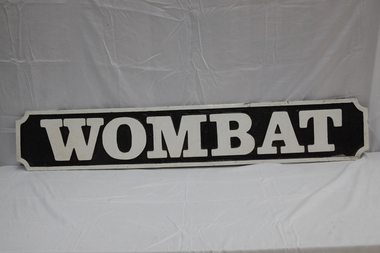
Name Plate - Wombat, 1982
... Puffing Billy Railway 1 old monbulk road Belgrave yarra-valley-and-the-dandenong-ranges From the 1982 Australian Children's TV Series Come Midnight Monday where 12A stars as "Wombat". ...From the 1982 Australian Children's TV Series Come Midnight Monday where 12A stars as "Wombat".Historic - Name Plate 'Wombat" - From the 1982 Australian Children's TV Series Come Midnight Monday where 12A stars as "Wombat".Name Plate - Wombat Thin rectangular black and white builders plate.Wombatpuffing billy, wombat, come midnight monday, name plate, 12a
