
Showing 1065 items matching "women’s fashion"
-
 Bendigo Historical Society Inc.
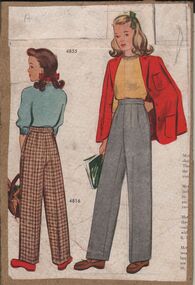
Painting - NORMAN PENROSE COLLECTION: WOMEN'S FASHION, Autumn 1940
... NORMAN PENROSE COLLECTION: WOMEN'S FASHION...... women's fashion...Norman Penrose collection: various colour and black and white pictures of women's fashion taken from magazines, etc and pasted onto cardboard. ...Painting NORMAN PENROSE COLLECTION: WOMEN'S FASHION ...Norman William Penrose (1903–1976) was an Australian painter and art teacher renowned for his depictions of regional Victorian landscapes and everyday scenes, particularly around Bendigo where he spent most of his lifeArtwork. Norman Penrose collection: various colour and black and white pictures of women's fashion taken from magazines, etc and pasted onto cardboard. Some blue and white illustrations of methods of drawing figures and clothing.artwork, norman penrose collection, artwork, women's fashion -
 Greensborough Historical Society
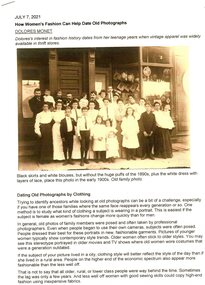
Article - Article, Internet, Dolores Monet, How women's fashion can help date old photographs, by Dolores Monet, 07/07/2021
... How women's fashion can help date old photographs, by Dolores Monet......fashion...women's...Description of women's costumes from 1860s to 1970s, illustrated by photographs from various sources. women's costume dating photographs clothing fashion women's clothing 10 p. text and black and white/sepia photographs How women's fashion can help date old photographs, by Dolores Monet Article Article, Internet Dolores Monet ...Description of women's costumes from 1860s to 1970s, illustrated by photographs from various sources.10 p. text and black and white/sepia photographswomen's costume, dating photographs, clothing, fashion, women's clothing -
 Bendigo Historical Society Inc.
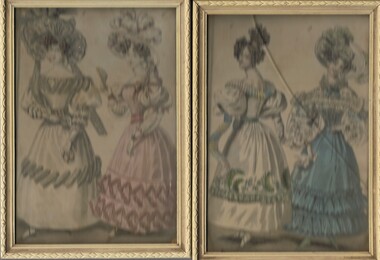
Decorative object - 2 FRAMED PRINTS, 1950
... ...Victorian Women's Fashion...2 Small Coloured Prints depicting Victorian Women's Fashion, under glass in thin cream coloured wooden frames, Donated by Mr Atkinson related to Mary Reiby...PAINTING Print home life Victorian Women's Fashion Fashion 2 Small Coloured Prints depicting Victorian Women's Fashion, under glass in thin cream coloured wooden frames, Donated by Mr Atkinson related to Mary Reiby Decorative object 2 FRAMED PRINTS ...2 Small Coloured Prints depicting Victorian Women's Fashion, under glass in thin cream coloured wooden frames, Donated by Mr Atkinson related to Mary Reibypainting, print, home life, victorian women's fashion, fashion -
 Whitehorse Historical Society Inc.
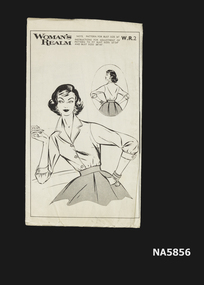
Domestic object - Woman's Realm Pattern, Woman's Realm, 1950's
... Women's fashion...Domestic dressmaking for women's fashion...Domestic dressmaking for women's fashion Women's fashion Dressmaking Paper pattern 1950's Woman's Realm As above Woman's Realm Pattern WR.2 in off white sleeve with model wearing a blouse with 3/4 length sleeves. ...Domestic dressmaking for women's fashionWoman's Realm Pattern WR.2 in off white sleeve with model wearing a blouse with 3/4 length sleeves. Bust 32"/34" and bust size 38"/40"As abovewomen's fashion, dressmaking, paper pattern, 1950's, woman's realm -
 Whitehorse Historical Society Inc.
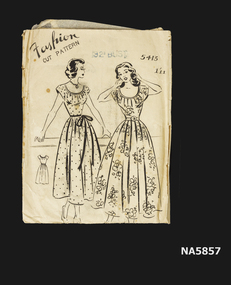
Domestic object - Fashion Cut Pattern No.5413, Fashion Cut Pattern, 1950's
... Women's fashion...Domestic dressmaking for Women's fashion...Domestic dressmaking for Women's fashion Women's fashion Dressmaking Paper patterns 1950's Fashion Cut Pattern As above Fashion Cut Pattern No.5413 Bust 32" 1'11 Pattern in cream paper sleeve. ...Domestic dressmaking for Women's fashionFashion Cut Pattern No.5413 Bust 32" 1'11 Pattern in cream paper sleeve. Has picture of two models wearing dresses with flared skirtsAs abovewomen's fashion, dressmaking, paper patterns, 1950's, fashion cut pattern -
 Flagstaff Hill Maritime Museum and Village
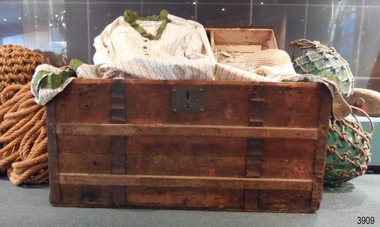
Functional object - Trunk, late-19th to mid-20th century
... ...women's fashion...The illustration pasted inside the lid is similar to those shown in women's fashion journals of the 1880s and 1890s. ...The illustration pasted inside the lid is similar to those shown in women's fashion journals of the 1880s and 1890s. ...Trunk is made strong for long journeys and rough use. Tray compartments would have been fitted inside the lid for storage of smaller items such as hats, umbrellas and underclothing. The illustration pasted inside the lid is similar to those shown in women's fashion journals of the 1880s and 1890s. A similar trunk was found in the catalogue of Anthony Hordern & Sons, a large and famous late 19th to mid 20th century retailer in Sydney,.This trunk is an example of the typical travel luggage of people migrating to the Colony of Australia in the late 19th century.Wooden cabin trunk, rectangular, brown in colour. Lid has arched top, front has a strong padlock, sides have leather strap handles. Corners and edges are reinforced with iron, iron bands and extra wooden slats. Lid is divided into tray compartments. A print of a female in 19th century costume is attached to the inside the lid in one compartment. flagstaff hil, warrnambool, flagstaff hill maritime museum, maritime museum, shipwreck coast, flagstaff hill maritime village, great ocean road, trunk, cabin trunk, travel trunk, cargo, storage, women's fashion, late 19th century fashion, travel luggage, travel goods -
 Kew Historical Society Inc
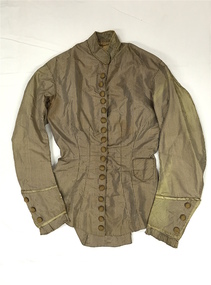
Clothing - Buttoned, Beige Striped Silk Bodice, 1870s
... women's clothing...fashion...1870s women's fashion placed an emphasis on the back of the skirt, with long trains and fabric draped up into bustles with an abundance of flounces and ruching. ...1870s women's fashion placed an emphasis on the back of the skirt, with long trains and fabric draped up into bustles with an abundance of flounces and ruching. ...1870s women's fashion placed an emphasis on the back of the skirt, with long trains and fabric draped up into bustles with an abundance of flounces and ruching. The waist was lower in the 1870s than the 1860s, with an elongated and tight bodice and a flat fronted skirt. Beige coloured silk top with narrow mauve stripes. The top has a piped mandarin collar. The top has satin trimming. women's clothing, fashion - melbourne - 1870s, bodices -
 Orbost & District Historical Society
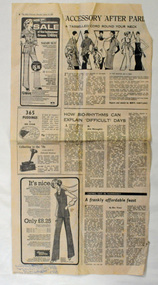
newspaper clipping, 16.8.1975
... A page from the Daily Telegraph, Saturday August 16, 1975. it contains articles and advertisements for women's fashion....A page from the Daily Telegraph, Saturday August 16, 1975. it contains articles and advertisements for women's fashion. newspaper clipping Telegraph Media Group ...The Daily Telegraph is a broadsheet newspaper published in London by Telegraph Media Group and distributed across the United Kingdom and internationally. This newspaper clipping was used by Marjorie Burton for fashion ideas. Marjorie Burton ( nee Whiteman), born 12 June, in Birmingham, England came to Orbost in 1995. In England she did office work – typing, shorthand and secretarial work - in accountants’ offices and also trained as a comptometrist with Burroughs in London. She came from a middle-class working church-going family. Her mother was a milliner who made many of Marjorie’s clothes, hats and outfits. Marjorie was married in 1938 to a salesman who later became a mechanic in the R.A.F. during WW11. Newspapers reflect the current social and fashion trends. This item is an example which reflects the women's clothing fashions of 1975.A page from the Daily Telegraph, Saturday August 16, 1975. it contains articles and advertisements for women's fashion.Bottom left hand corner of page 8 - illegible handwriting in blue pen.newspaper-article-fashion burton-marjorie -
 Flagstaff Hill Maritime Museum and Village
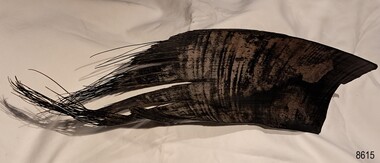
Animal specimen - Baleen
... ...women's fashion...The baleen sample is significant for its association with 19th century women's fashion. It helps to understand how garments were supported to shape a woman's figure. ...A baleen whale has hard bristly baleen that hangs from its upper jaw inside its mouth instead of teeth. Baleen is made from a protein called keratin, just like human hair and fingernails, and its colour can vary between species, from black to yellow or white. The whale uses the tough, flexible baleen like a sieve to catch its food, filtering the small sea creatures out of the sea water it releases from its mouth. In the19th Century, whales were hunted for the products that could be made from their bodies, such as oil for lubricating machinery, soap making, lamps, heaters and fuel for the lighthouse lights. The flexible baleen was used for whip handles, carriage springs and umbrella ribs. It was also used for the skirt hoops, hat ribs, and rigid ‘stays’ in tightly fitting bodices to enhance their figures. The Southern Right Whales, as well as Blue Whales and Humpback Whales, are baleen whales. The Southern Rights annually visit the ocean off the southwest coast during the breeding season. In the early 1800s whalers hunted along this coastline in their dangerous pursuit of money for the precious cargoes of whale oil and bones. The population of these large animals dwindled quickly and by the late 1840s the whaling industry dwindled. Whaling recommenced from the 1940s to the 1980s when the whale products were used to make margarine and dog food. The baleen sample has been used to educate people about whaling and about the properties of baleen. The baleen sample is significant for its association with 19th century women's fashion. It helps to understand how garments were supported to shape a woman's figure. The baleen sample represents a period when whales were hunted and killed to provide income and products for for the local settlers and for the export industry.Baleen sample from a whale's jaw. Its black shiny hard yet flexible surface is slightly rippled and textured. One end is fringed and the other and a smooth cut edge. The colour varies in places, with stripy brown colouring. flagstaff hill maritime museum and village, great ocean road, shipwreck coast, baleen, whalebone, baleen whale, keratin, 19th century, whaling industry, women's fashion, stays, bodice, women's figures, fashion, clothing, whale oil, baleen colour, whale hunting, whale products, southern right whale, blue whale, humpback whale, southwest victoria, whalers, whale bones -
 Flagstaff Hill Maritime Museum and Village
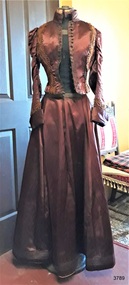
Clothing - Evening Outfit, before April 1874
... ...women’s fashion...fashion from the mid to late 1900s. These items reflect the styles and trends that were prevalent during this period, offering insight into the clothing choices and cultural influences that shaped women's attire. ...This amber satin evening outfit was worn by Mrs Isabella Mitchell (nee Russell, 1840 – 1929) at the wedding of her brother Alexander (c.1846–1938) and Eliza (nee Moore, c.1854–1939). The jacket and skirt attach at the waist by joining the metal rings around the base of the jacket, and the metal hooks on the waistband of the skirt. The outfit was donated with its own mannequin and fits it perfectly. In the colonial days, outer clothing was rarely, if ever, washed, due to the expense of fabrics and the difficulty in careful laundering. Clever methods were employed to reduce the occurrence of soiling. The mannequin included with the donation would also help keep the outfit in good shape and ensure a flattering fit. FAMILIES’ HISTORY The families connected with this wedding, where the outfit was worn, are from Warrnambool’s colonial days. Isabella and Alexander’s parents, Robert Russell and Elizabeth (nee Mitchell), were born in 1808 and married about 1830. They were from farming families in Northern Ireland, where they raised their seven children before migrating to Australia in the early colonial days, around 1857. Their graves are in the Tower Hill Cemetery. Alexander’s wife, Eliza (nee Moore, born in 1854), was also from Northern Ireland and migrated to Australia in 1858 with her parents, Thomas and Nancy Moore, in the last voyage of the sailing ship “Chance”. Isabella (Bella) talked with her granddaughter Ruby Akers about her memories of Alexander and Eliza’s wedding and other events in her life. Ruby recorded these memories in a letter. She says, “They were married in the Warrnambool Congregational Church by a pioneer minister, the Reverend Uriah Coombs. The bride wore a pale blue silk wedding gown, which she made herself. Bella was Matron of Honora, and Ian McCasker was best man. In those days, the transport to the church was usually a carriage – similar to a cab – and a pair of white ponies. They would have the reception at home, go for a drive afterwards, and at night there would be a dance. They did all the catering themselves … Eliza carried on farming in the Dennington, Yarpturk and Purnim districts until they moved to Camperdown around 1905…” Ruby’s letter later mentions “[Isabella] could recall seeing a blackfellows’ corroboree being performed near where the Dennington Bridge now stands. It was rather a terrifying experience; they seemed to be in a warlike mood, and one never knew what they would do next. One lubra came running to Granny, crying, Hide me, bad man kill me. She was bleeding from a wound in the head: probably the result of a blow from a waddy. My mother [Margaret Jane McLaughlan nee Mitchell], coming home from school in the 1800s, often met blackfellows walking ahead with spears and boomerang, the two lubras – they usually had two – following in the rear, carrying the children or any burdens they had.“ Margaret was probably in primary school at the time she saw these things. Alexander and Eliza had ten children. One of their daughters, Margaret Jane, was born in Warrnambool in 1879. She married William McCullagh, and they had eleven children. Margaret made headlines in the Warrnambool newspapers for celebrating her 100th birthday. She had lived in the district for 60 years before moving to Melbourne. Alexander passed away at the age of 92, and Eliza passed away six months later, aged 85. Their graves are in the Colac cemetery. Isabella married Ralph Mitchell, and their daughter Margaret Jane married John McLauchlan in 1891. Margaret and John’s daughter, Ruby Elizabeth Jane, married Fredrick Akers in 1938. Fredrick, born in England, was a Boer War veteran and served in the British Army. He migrated to Queensland, Australia, in 1913, and joined the Australian Army to fight in World War I. In 1935, he moved to Warrnambool, where he served in the Volunteer Defence Corps from 1938 to 1945. Both Ruby and Fredrick are buried in the Tower Hill Cemetery.The evening outfit and its accompanying mannequin serve as notable examples of female fashion from the mid to late 1900s. These items reflect the styles and trends that were prevalent during this period, offering insight into the clothing choices and cultural influences that shaped women's attire. Beyond their representation of period fashion, the outfit and mannequin are significant due to their association with colonial pioneer families from Australia, specifically Victoria and Warrnambool. These families played an important role in the development and history of the region, and the items are linked to their legacy. The evening outfit and mannequin are also notable for their connection to a wedding that united two colonial families originating from Northern Ireland. These families immigrated to Australia in the mid-1850s and became influential figures within the Warrnambool district. The wedding marked a significant event, symbolising the merging of two prominent family lineages. Furthermore, the significance of the evening outfit and mannequin extends to their connection with the colonial families’ contact with the indigenous culture of the district. These items represent a period of interaction between the native and European peoples, highlighting the cultural exchanges that occurred within the region. This lady’s evening outfit is made from amber coloured satin fabric. It comprises a short-waisted, long-sleeved jacket and a long skirt, and it has its own neck-to-floor wooden mannequin on a pedestal. The outfit was worn by Mrs Isabella Mitchell (nee Russell) as the Matron of Honour at the wedding of her brother Alexander Russell and his fiancée Eliza Moore in Warrnambool, 29th April 1874.flagstaff hill, warrnambool, shipwrecked coast, flagstaff hill maritime museum, maritime museum, shipwreck coast, flagstaff hill maritime village, great ocean road, evening outfit, wedding outfit, bridesmaid’ outfit, matron of honour outfit, clothing female, clothing late 19th century, clothing wedding late 19th century, clothing bridesmaid late 19th century, clothing antique, clothing ladies, women’s clothing, women’s fashion, alexander russell, eliza russell, eliza moore, isabella mitchell, bella mitchell, bella russell, isabella russell, ralph russell, ian mccusker, ruby akers, fredrick william akers, ruby mclauchlan, margaret jane mclaughlan nee mitchell, margaret jane mclaughlan centenarian, william mclaughlan, robert russell, elizabeth russell nee mitchell, irish immigrants, warrnambool volunteer defence corps 1938-1945, antique satin outfit, warrnambool wedding 1874, congregational church warrnambool, reverend uriah coombs, dennington farmer, yarpturk farmer, purnim district farmer, camperdown resident 1905, dennington bridge, indigenous corroboree in dennington, corroboree in warrnambool, 1880s corroboree in warrnambool, lubra and baby, indigenous corroboree in warrnambool, mccullagh family -
 Flagstaff Hill Maritime Museum and Village
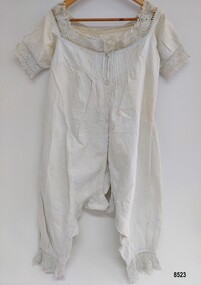
Clothing - Combination Undergarment, Eliza Towns, Late 19th century
... ...women’s fashion...The garments add to the study of the evolution of women's fashions and practicality for the early Australian settlers. ...This item of underclothing, called a "combination" is one of several linen and clothing items that were made and belonged to Mrs. Eliza Towns and donated to Flagstaff Hill Maritime Museum and Village. Eliza was born Eliza Gould in 1857 in South Melbourne (Emerald Hill) and in 1879 married Charles Towns. In the early 1880's they moved to Nhill in western Victoria and remained there for the rest of their married life. Charles was a jeweller and later became an accountant and for many years was involved with the Shire Council, the local show committee (A & P Society), the Hospital Committee and the Board of the local newspaper (the Nhill Free Press). They had three children and lived a life that would be regarded as comfortably "middle class". Eliza probably had a treadle sewing machine and would have made many of her own clothes as well as clothes for her children - adding her own handmade embroidered or crocheted decorative trim. Combination undergarments combined the chemise and drawers into one garment. The combination is divided, or bifurcated, from the waist to the crutch for easier urinating. This one-piece type of underwear was worn by females from the 1860s and into the early 1900s. The 19th Century garments had front button closures like this one, and those made in the 1900s more often had back closures. Combination underwear was popular because the all-in-one design had far fewer gathers and bulk, making the other clothing look much smoother. Their primary use was to protect clothing from perspiration and because they were made with cotton or linen, were easy to wash. Although they were worn under the corset, next to the skin (and therefore not meant to be seen), they were often decorated with lace and embroidery. Although these combinations are made with a plain cotton fabric, Eliza Towns has incorporated pin tucks, hand embroidery and crocheted lace to embellish her garment. The collection of women’s late-19th-century undergarments is an example of clothing that women would include in their wardrobes. The garments add to the study of the evolution of women's fashions and practicality for the early Australian settlers. The careful needlework in these handmade garments and hand-worked lace trims reflect the maker’s dedication to making even serviceable garments beautiful to look at and wear.Women’s white cotton and lace all-In-one combination undergarment. The handmade underwear is a combined chemise and bloomers. It has three buttons in the front and a handmade drawstring cord around the square neckline. It is trimmed with crocheted lace (with a floral design) on the neckline, sleeves and pants. It had pintucks and feather stitching on the bodice and the left and right sides are divided from the waist to the crutch. The back of the garment is plain with a gathered section at the lower back.flagstaff hill maritime museum and village, maritime museum, maritime village, warrnambool, great ocean road, victorian era, combination undergarment, all-in-one underwear, combination, ‘combinations’, one-piece underwear, one-piece undergarment, chemise and bloomers, combination chemise and bloomers, divided, bifurcated, split, chemise and drawers, women’s underwear, ladies’ underwear, undergarment, women’s clothing, women’s fashion, lingerie, 19th-century undergarment, handmade clothing, handmade lace, crocheted lace, towns family, nhill, eliza towns -
 Flagstaff Hill Maritime Museum and Village
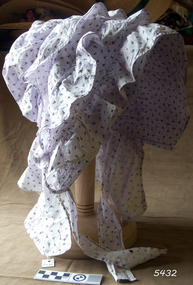
Bonnet, late 1800s - early 1900s
... ...women's fashion...This style of bonnet was commonly worn outdoors by women in South West Victoria in the late 1800s - early 1900s The bonnet is significant as a typical of women's outdoor headwear in Australia in the late 19th and early 20th century. flagstaff hill warrnambool shipwrecked-coast flagstaff-hill flagstaff-hill-maritime-museum maritime-museum shipwreck-coast flagstaff-hill-maritime-village ladies bonnet outdoor bonnet hat bonnet headwear ladies clothing late 19th century bonnet early 20th century bonnet women's fashion australian fashion australian millinery Ladies outdoor bonnet, white cotton with narrow mauve stripes and small flowers. ...This style of bonnet was commonly worn outdoors by women in South West Victoria in the late 1800s - early 1900sThe bonnet is significant as a typical of women's outdoor headwear in Australia in the late 19th and early 20th century.Ladies outdoor bonnet, white cotton with narrow mauve stripes and small flowers. Bonnet is trimmed with frills and straps to tie under the chin. Dated late 19th to early 20th century.flagstaff hill, warrnambool, shipwrecked-coast, flagstaff-hill, flagstaff-hill-maritime-museum, maritime-museum, shipwreck-coast, flagstaff-hill-maritime-village, ladies bonnet, outdoor bonnet, hat, bonnet, headwear, ladies clothing, late 19th century bonnet, early 20th century bonnet, women's fashion, australian fashion, australian millinery -
 Flagstaff Hill Maritime Museum and Village
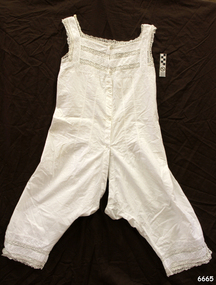
Clothing - Combination Undergarment, Late 1800s
... ...women’s fashion...The garments add to the study of the evolution of women's fashions and practicality for the early Australian settlers. ...This handmade women’s combination undergarment features hand-worked lace panels and trim, and fine pintucks. It is one of seven handmade items of white cotton underwear, all made with beautiful needlework and embroidery skill. The lingerie once belonged to the donor’s great-grandmother’s family, the Paton family of ‘Trefnant’, Yangery, in southwest Victoria. The design of this combination undergarment, or ‘combination’, includes a chemise attached to a pair of drawers or bloomers. The combination is divided, or bifurcated, from the waist to the crutch for easier urinating. This one-piece type of underwear was worn by females from the 1860s and into the early 1900s. The 19th Century garments had front button closures like this one, and those made in the 1900s more often had back closures. Combination underwear was popular because the all-in-one design had far fewer gathers and bulk, making the other clothing look much smoother. The collection of women’s late-19th-century undergarments is an example of clothing that women would include in their wardrobes. The garments add to the study of the evolution of women's fashions and practicality for the early Australian settlers. The fine linen fabric and the careful needlework in these handmade garments and hand-worked lace trims reflect the maker’s dedication to making even serviceable garments beautiful to look at and wear. Women’s white cotton and lace all-In-one combination undergarment. The handmade underwear is a combined chemise and bloomers. It has a front button closure and is trimmed with hand-worked lace panels on the bodice and lace edging around armholes, the neck, and the bottom of the legs. The left and right sides are divided from the waist to the crutch.flagstaff hill maritime museum and village, maritime museum, maritime village, warrnambool, great ocean road, southwest victoria, victorian era, combination undergarment, all-in-one underwear, combination, ‘combinations’, one-piece underwear, one-piece undergarment, chemise and bloomers, combination chemise and bloomers, divided, bifurcated, split, chemise and drawers, women’s underwear, ladies’ underwear, undergarment, women’s clothing, women’s fashion, lingerie, under-structure, 1900s undergarments, 19th-century undergarment, 20th century, handmade clothing, handmade lace, hand-worked lace, paton family, trefnant, yangery, lady's combinations, ladies combinations -
 Flagstaff Hill Maritime Museum and Village
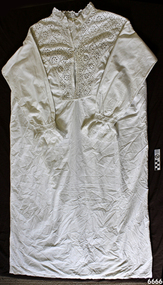
Clothing - Nightgown, Late 19th century
... ...women’s fashion...The garments add to the study of the evolution of women's fashions and practicality for the early Australian settlers. ...This handmade women’s nightgown features hand-worked Broderie Anglaise yoke and trim. It is one of seven handmade items of white cotton underwear, all made with beautiful needlework and embroidery skill. The lingerie once belonged to the donor’s great-grandmother’s family, the Paton family of ‘Trefnant’, Yangery, in southwest Victoria. This design of nightgown was worn by females in the 19th century and is still worn today.The collection of women’s late-19th-century undergarments is an example of clothing that women would include in their wardrobes. The garments add to the study of the evolution of women's fashions and practicality for the early Australian settlers. The fine linen fabric and the careful needlework in these handmade garments and hand-worked lace trims reflect the maker’s dedication to making even serviceable garments beautiful to look at and wear. Women's long straight nightgown, white cotton, with long sleeves gathered at the cuff, stand-up lace collar, and a small catch closure on the bodice's centre opening. Hand-worked Broderie Anglaise yoke and sleeve tips.flagstaff hill maritime museum and village, maritime museum, maritime village, warrnambool, great ocean road, southwest victoria, victorian era, nightie, nightgown, women’s nightwear, sleepwear, night dress, women’s clothing, women’s fashion, lingerie, 19th century, handmade clothing, broderie anglaise, hand-made broderie anglaise, paton family, trefnant, yangery, nightdress -
 Flagstaff Hill Maritime Museum and Village
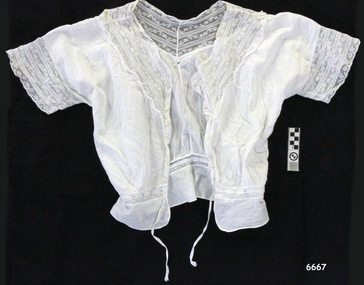
Clothing - Camisole, Late 19th Century
... ...women’s fashion...The garments add to the study of the evolution of women's fashions and practicality for the early Australian settlers. ...This handmade women’s camisole features hand-worked lace yoke and trim and a drawstring peplum waist. It is one of seven handmade items of white cotton underwear, all made with beautiful needlework and embroidery skill. The lingerie once belonged to the donor’s great-grandmother’s family, the Paton family of ‘Trefnant’, Yangery, in southwest Victoria. The collection of women’s late-19th-century undergarments is an example of clothing that women would include in their wardrobes. The garments add to the study of the evolution of women's fashions and practicality for the early Australian settlers. The fine linen fabric and the careful needlework in these handmade garments and hand-worked lace trims reflect the maker’s dedication to making even serviceable garments beautiful to look at and wear. Women's camisole, short sleeves and peplum waist. Handmade from white cotton fabric, with hand-worked lace sleeve tips, collar, waist trim and yoke. There are five buttons and two ties down the front.flagstaff hill maritime museum and village, maritime museum, maritime village, warrnambool, great ocean road, southwest victoria, victorian era, women’s underwear, ladies’ underwear, undergarment, under-structure, 1900s undergarments, 19th-century undergarment, women’s clothing, women’s fashion, lingerie, 19th century, handmade clothing, handmade lace, hand-worked lace, camisole, paton family, trefnant, yangery -
 Flagstaff Hill Maritime Museum and Village
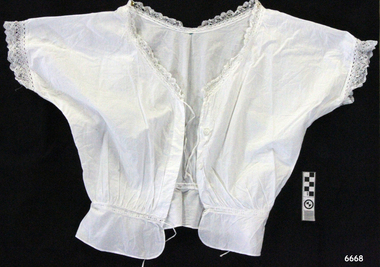
Clothing - Camisole, Late 19th century
... ...women’s fashion...The garments add to the study of the evolution of women's fashions and practicality for the early Australian settlers. ...This handmade women’s camisole features hand-worked lace yoke and trim and a drawstring peplum waist. It is one of seven handmade items of white cotton underwear, all made with beautiful needlework and embroidery skill. The lingerie once belonged to the donor’s great-grandmother’s family, the Paton family of ‘Trefnant’, Yangery, in southwest Victoria. The collection of women’s late-19th-century undergarments is an example of clothing that women would include in their wardrobes. The garments add to the study of the evolution of women's fashions and practicality for the early Australian settlers. The fine linen fabric and the careful needlework in these handmade garments and hand-worked lace trims reflect the maker’s dedication to making even serviceable garments beautiful to look at and wear. Women's camisole, short sleeves and peplum waist. Handmade from white cotton fabric, with hand-worked lace sleeve tips, neck trim and waist trim. Drawstring, tie and button closure.flagstaff hill maritime museum and village, maritime museum, maritime village, warrnambool, great ocean road, southwest victoria, victorian era, women’s underwear, ladies’ underwear, undergarment, under-structure, 1900s undergarments, 19th-century undergarment, women’s clothing, women’s fashion, lingerie, 19th century, handmade clothing, handmade lace, hand-worked lace, camisole, paton family, trefnant, yangery -
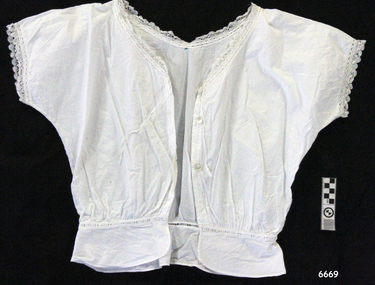 Flagstaff Hill Maritime Museum and Village
Clothing - Camisole, Late 19th century
... ...women’s fashion...The garments add to the study of the evolution of women's fashions and practicality for the early Australian settlers. ...This handmade women’s camisole features hand-worked lace yoke and trim and a drawstring peplum waist. It is one of seven handmade items of white cotton underwear, all made with beautiful needlework and embroidery skill. The lingerie once belonged to the donor’s great-grandmother’s family, the Paton family of ‘Trefnant’, Yangery, in southwest Victoria. The collection of women’s late-19th-century undergarments is an example of clothing that women would include in their wardrobes. The garments add to the study of the evolution of women's fashions and practicality for the early Australian settlers. The fine linen fabric and the careful needlework in these handmade garments and hand-worked lace trims reflect the maker’s dedication to making even serviceable garments beautiful to look at and wear. Women's camisole, short sleeves and peplum waist. Handmade from white cotton fabric, with hand-worked lace sleeve tips, collar and waist trim. It has button closures down the front.flagstaff hill maritime museum and village, maritime museum, maritime village, warrnambool, great ocean road, southwest victoria, victorian era, women’s underwear, ladies’ underwear, undergarment, under-structure, 1900s undergarments, 19th-century undergarment, women’s clothing, women’s fashion, lingerie, 19th century, handmade clothing, handmade lace, hand-worked lace, camisole, paton family, trefnant, yangery -
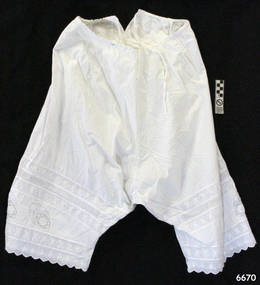 Flagstaff Hill Maritime Museum and Village
Clothing - Bloomers, Late 19th century
... ...women’s fashion...The garments add to the study of the evolution of women's fashions and practicality for the early Australian settlers. ...This handmade women’s pair of bloomers, or drawers, features hand-worked Broderie Anglaise and applique trim and a drawstring rear closure at the waist. It is one of seven handmade items of white cotton underwear, all made with beautiful needlework and embroidery skill. The lingerie once belonged to the donor’s great-grandmother’s family, the Paton family of ‘Trefnant’, Yangery, in southwest Victoria. The collection of women’s late-19th-century undergarments is an example of clothing that women would include in their wardrobes. The garments add to the study of the evolution of women's fashions and practicality for the early Australian settlers. The fine linen fabric and the careful needlework in these handmade garments and hand-worked lace trims reflect the maker’s dedication to making even serviceable garments beautiful to look at and wear. Women's bloomers or drawers, handmade from white cotton fabric, with hand-worked Broderie-Anglaise trim around the bottom of legs with applique motifs. Bloomers have a drawstring, back of waist closure.flagstaff hill maritime museum and village, maritime museum, maritime village, warrnambool, great ocean road, southwest victoria, victorian era, women’s underwear, ladies’ underwear, undergarment, under-structure, 1900s undergarments, 19th-century undergarment, women’s clothing, women’s fashion, lingerie, 19th century, handmade clothing, broderie anglaise, hand-made broderie anglaise, paton family, trefnant, yangery, bloomers, drawers, underpants -
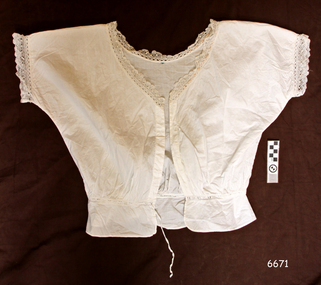 Flagstaff Hill Maritime Museum and Village
Clothing - Camisole, Late 19th century
... ...women’s fashion...The garments add to the study of the evolution of women's fashions and practicality for the early Australian settlers. ...This handmade women’s camisole features hand-worked lace yoke and trim and a drawstring peplum waist. It is one of seven handmade items of white cotton underwear, all made with beautiful needlework and embroidery skill. The lingerie once belonged to the donor’s great-grandmother’s family, the Paton family of ‘Trefnant’, Yangery, in southwest Victoria. The collection of women’s late-19th-century undergarments is an example of clothing that women would include in their wardrobes. The garments add to the study of the evolution of women's fashions and practicality for the early Australian settlers. The fine linen fabric and the careful needlework in these handmade garments and hand-worked lace trims reflect the maker’s dedication to making even serviceable garments beautiful to look at and wear. Women's camisole, short sleeves and drawstring peplum waist. Handmade from white cotton fabric, with hand-worked lace sleeve tips, collar and waist trim. Front closure.flagstaff hill maritime museum and village, maritime museum, maritime village, warrnambool, great ocean road, southwest victoria, victorian era, women’s underwear, ladies’ underwear, undergarment, under-structure, 1900s undergarments, 19th-century undergarment, women’s clothing, women’s fashion, lingerie, 19th century, handmade clothing, handmade lace, hand-worked lace, camisole, paton family, trefnant, yangery -
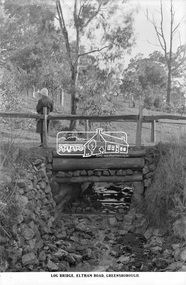 Eltham District Historical Society Inc
Photograph, The Rose Stereograph Company, Log Bridge, Eltham Road. Greensborough, c.1920
... ...women's fashion...The Cutts family understands that for these historically important pieces to rest with one family is to deny others the pleasure of their custodianship. eltham postcard travel rose stereograph company glass plate negative creek eltham road greensborough karingal road karingal yallock log bridge sherbourne road st helena road women's fashion rampton's road reserve Peter and Elizabeth Pidgeon Collection Log Bridge, Eltham Road, Greensborough Glass Plate Negative Size: 9.2 x 13.8 cm Log Bridge, Eltham Road. ...A woman stands at the end of a log bridge over a creek looking towards the south along the unsealed roadway. The sun illuminates her back. She is wearing a woollen knit beanie with edges rolled up, dark jacket and skirt, full length dark stockings and slip on dark leather shoes with raised heel, typical of the early 1920s. The creek is possibly feeding into the Karingal Yalloc. The direction of the road based on shadows is northwest as is the Eltham Road to Greensborough (present day Sherbourne, Karingal and St Helena roads). The creek is falling to the foreground so from south west to the north east, possibly feeding into the Karingal Yalloc, somewhere near presenet day Ramptons Road Reserve. This glass plate negative was used to manufacture postcards (1:1 printing) for commercial sale by the Rose Sterograph Company and its subsidiaries. George Rose founded the Rose Stereograph Company in 1880 and was joined by Herbert (Bert) Cutts in the early 20th Century. The pair formed a lifetime working partnership and strong personal friendship. Assisted by George’s two sons, Herbert George and Walter, and later by Neil Cutts, the Rose Stereograph Company continued its operations for more than 140 years. The company was initially built on stereographs, but as cinema took over and stereographs fell out of fashion, the Rose Stereograph Company developed Australia’s first commercially viable photographic postcard business. Specialising in postcards of iconic historical moments and significant landmarks, The Rose Stereograph Company became a staple of the Australian travel industry.This remarkable collection of glass plate negatives, transparencies, and postcards – arguably Australia’s most significant photography collection outside of public hands – has been passed down through the generations, surviving war, relocation, and the harsh Victorian climate. The historic Rose Stereograph collection is the culmination of George Rose’s dream of capturing and preserving precious moments in time and remains the legacy of the Rose and Cutts families. It is with great sadness that the Cutts family says goodbye to a collection that spans five generations and 140 years. The Cutts family understands that for these historically important pieces to rest with one family is to deny others the pleasure of their custodianship.Glass Plate Negative Size: 9.2 x 13.8 cmLog Bridge, Eltham Road, Greensborougheltham, postcard, travel, rose stereograph company, glass plate negative, creek, eltham road, greensborough, karingal road, karingal yallock, log bridge, sherbourne road, st helena road, women's fashion, rampton's road reserve, peter and elizabeth pidgeon collection -
 Bendigo Historical Society Inc.
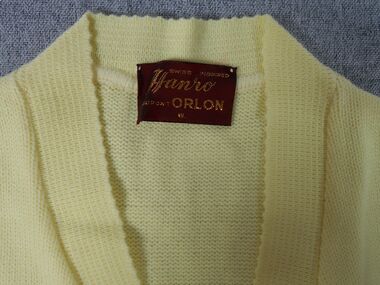
Textile - Hanro twinset cardigan, Hanro Quality Knitwear, 10/3/2026
... women's fashion...Hanro Australia knitting mills 1927-1966 women's fashion TEXTILES Garment label includes Swiss inspired, Hanro, Dupont Orlon W. ...Hanro Australia knitting mills 1927-1966Hanro yellow twinset cardigan. V neck cardigan with knitted bands and decorative edging on the bands. Decorative finish on set in sleeves. the seams are all overlocked. Machine made buttonholes. Front opening with 6 buttons. Set in long sleeves with cuffs. Plain knitting and straight shapeGarment label includes Swiss inspired, Hanro, Dupont Orlon W. Medium is stamped on the waistband near the left-hand front seam.women's fashion, textiles -
 Bendigo Historical Society Inc.
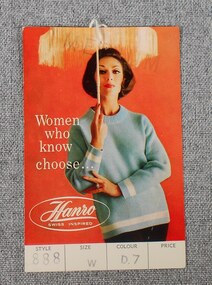
Textile - Hanro twinset jumper, Hanro Quality Knitwear, 10/3/2026
... women's fashion...Hanro Australia knitting mills 1927-1966 women's fashion TEXTILES Garment swing ticket includes Swiss inspired, Hanro, Dupont Orlon W. ...Hanro Australia knitting mills 1927-1966Hanro yellow twinset jumper. The jumper has a V-neck with a collar and short sleeves. The jumper has knitted bands and decorative edging on the bands. Decorative finish on set in sleeves. the seams are all overlocked. Plain knitting and straight shape. Garment sales tag features a model wearing a Hanro jumper. The label says "Hanro Swiss Inspired" Garment swing ticket includes Swiss inspired, Hanro, Dupont Orlon W. Medium is stamped on the waistband near the left-hand front seam. The tag has the following information: Style 888, size W and colour D.7. The care instructions are on the back of the label. women's fashion, textiles -
 Kew Historical Society Inc
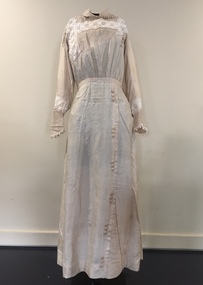
Clothing - Cream Tussar Silk Wedding Dress, c.1912
... ...women's fashion - 1910s...The Fashion & Design collection of the Kew Historical Society includes examples of women’s, men’s, children’s and infants’ clothing from the 18th, 19th and 20th centuries. ...This wedding dress was worn by the grandmother of Val Warren. costumes wedding dresses women's fashion - 1910s fashion design fashion -- 1910s Raw silk wedding dress. ...The Fashion & Design collection of the Kew Historical Society includes examples of women’s, men’s, children’s and infants’ clothing from the 18th, 19th and 20th centuries. Items in the collection were largely produced for, or purchased by women in Melbourne, and includes examples of outerwear, protective wear, nightwear, underwear and costume accessories. This wedding dress was worn by the grandmother of Val Warren.Raw silk wedding dress. The full length dress has lace on the bodice and long sleeves. Other decorative elements include finely pleated silk panels on the bodice, an insert on the skirt and on the cuffs of the sleeves The dress features extensive use of both utilitarian and decorative buttons that are covered in the same silk fabric as the dress. The final photograph shows two early repairs to the dress. Lydia Edwards in 'How to Read A Dress (Bloomsbury Academic, 2017), when describing a 1912 dress in the McCord Museum notes that: 'In 1911-12 the use of buttons for both fastening and decoration was extremely popular, the American women's magazine The Delineator declaring at the end of 1911 that "one cannot use buttons to liberally in the present mode".' (p.132)costumes, wedding dresses, women's fashion - 1910s, fashion design, fashion -- 1910s -
 Kew Historical Society Inc
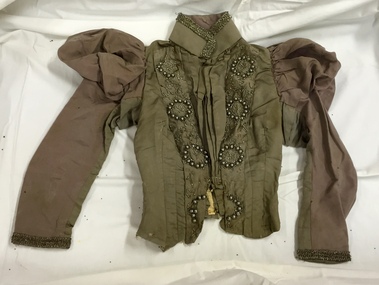
Clothing - Two Piece Grey Silk Dress, Peter Robinson, 1890s
... ...women's fashion -- 1890s...The Fashion & Design collection of the Kew Historical Society includes examples of women’s, men’s, children’s and infants’ clothing from the 18th, 19th and 20th centuries. ...Items in the collection were largely produced for, or purchased by women in Melbourne, and includes examples of outerwear, protective wear, nightwear, underwear and costume accessories.This outfit was donated by Netta Fuller. women's clothing women's fashion -- 1890s peter robinson international fashion fashion -- united kingdom fashion design fashion -- 1890s Peter Robinson. ...The Fashion & Design collection of the Kew Historical Society includes examples of women’s, men’s, children’s and infants’ clothing from the 18th, 19th and 20th centuries. Items in the collection were largely produced for, or purchased by women in Melbourne, and includes examples of outerwear, protective wear, nightwear, underwear and costume accessories.This outfit was donated by Netta Fuller.Two piece grey silk outfit comprising a tailored bodice and a very full skirt. The bodice has puffed leg-of-mutton sleeves and is heavily encrusted with large grey artificial pearls and steel beads of the period. The skirt is cut to allow for a long train at the back. Grey pearls and steel beads are similarly used on the right side of the front of the skirt. Metallic braid may have been added at a later date. The outfit has been much altered over time. There is evidence of shattered silk in parts of the garment. Printed on a strap at the waist is the label of Peter Robinson, Oxford Street/Regent Street.Peter Robinson. Oxford Street/Regents Streetwomen's clothing, women's fashion -- 1890s, peter robinson, international fashion, fashion -- united kingdom, fashion design, fashion -- 1890s -
 Surrey Hills Historical Society Collection
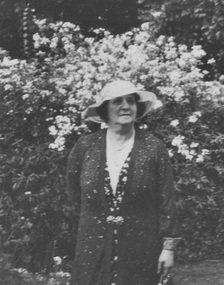
Photograph - Digital photo, Ellen Holt in her garden at 9 Beatrice Avenue, Surrey Hills
... women's fashion...women's fashion hats ellen holt 9 Beatrice Avenue Digital black and white portrait of a woman, standing in front of a flowering garden. ...Digital black and white portrait of a woman, standing in front of a flowering garden. women's fashion, hats, ellen holt, 9 beatrice avenue -
 Kew Historical Society Inc
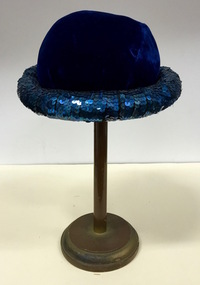
Headwear - Blue Velvet Sequinned Bowler Hat, 1980s
... bowler hats - women's fashion...The headwear collection is particularly significant in that it includes the work of notable Australian and international milliners. women's clothing -- hats headwear bowler hats - women's fashion Nil Bowler-shaped woman’s hat made of blue velvet with a rolled brim that is covered in blue sequins. ...The Kew Historical Society’s fashion and design collection is comprised of costumes, hats, shoes and personal accessories. Many of these items were purchased or handmade in Victoria; some locally in Kew. The extensive hat collection comprises items dating from the 1860s to the 1970s. While most of the hats in the collection were created by milliners for women, there are a number of early and important men’s hats in the collection. The headwear collection is particularly significant in that it includes the work of notable Australian and international milliners.Bowler-shaped woman’s hat made of blue velvet with a rolled brim that is covered in blue sequins.Nilwomen's clothing -- hats, headwear, bowler hats - women's fashion -
 Whitehorse Historical Society Inc.
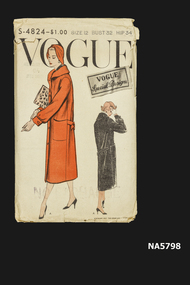
Domestic object - Dress Pattern Vogue No. 4824, Vogue Pattern Service, 1957
... ...Women's fashion...Dress patterns for making coats Dressmaking Vogue Women's fashion As above 1957 Vogue Pattern no. ...Dress patterns for making coats1957 Vogue Pattern no. S-4824 $1-00 Size 12 Bust 32 Hip 34 Dress pattern in white paper sleeve with pictures of red coat and black coat Vogue Special Design Back has 130558 Number As abovedressmaking, vogue, women's fashion -
 Whitehorse Historical Society Inc.
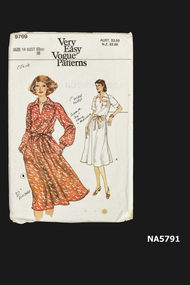
Domestic object - Very Easy Vogue Pattern No. 9769, Vogue Pattern Service, 1980c
... ...Women's fashion...Dress pattern for making dresses Dressmaking Vogue Women's fashion As above 1980 c Dress pattern in white paper sleeve with picture of red patterned dress and white dress with pale red trim. ...Dress pattern for making dresses1980 c Dress pattern in white paper sleeve with picture of red patterned dress and white dress with pale red trim. Very Easy Vogue Patterns No. 9769 size 14. Hand written "Celia" Aust. $3-50 N.Z. $3-00.As abovedressmaking, vogue, women's fashion -
 Whitehorse Historical Society Inc.
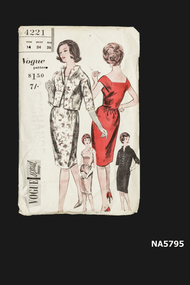
Domestic object - Dress Pattern - Vogue No. 4221, 1961c
... ...Women's fashion...Dress pattern for making dresses Dressmaking Vogue Women's fashion As above 1961 C Vogue pattern No. 4221 size 14 Dress pattern in white paper sleeve with pictures of red dress, white patterned dress with jacket, pink dress and black dress with jacket Vogue Special Design. $1.50 / 7/- Domestic object Dress Pattern - Vogue No. 4221 Vogue Pattern Service ...Dress pattern for making dresses1961 C Vogue pattern No. 4221 size 14 Dress pattern in white paper sleeve with pictures of red dress, white patterned dress with jacket, pink dress and black dress with jacket Vogue Special Design. $1.50 / 7/-As abovedressmaking, vogue, women's fashion -
 Whitehorse Historical Society Inc.
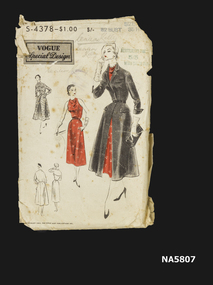
Domestic object - Vogue Paper Pattern No. 4378, Vogue, 1953
... ...Women's fashion...Paper patterns for making dresses Dressmaking Vogue Women's fashion As above 1953 Vogue paper pattern No. 4378 - S. $1.00 5/- 32Bust 35 Hip Dress pattern in cream envelope paper sleeve with pictures of red dress with black coat Vogue Special Design In pencil Cecilion Kelly No. on back 814553 Domestic object Vogue Paper Pattern No. 4378 Vogue ...Paper patterns for making dresses 1953 Vogue paper pattern No. 4378 - S. $1.00 5/- 32Bust 35 Hip Dress pattern in cream envelope paper sleeve with pictures of red dress with black coat Vogue Special Design In pencil Cecilion Kelly No. on back 814553As abovedressmaking, vogue, women's fashion
