
Showing 226 items matching "women in war work"
-
 Sunshine and District Historical Society Incorporated
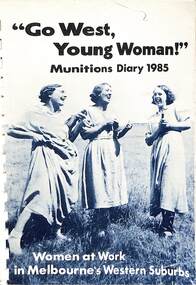
Book - "Go West, Young Woman!" Munitions Diary 1985, Melbourne's Living Museum of the West, "Go West Young Woman!" Munitions Diary 1985, 1985
... ...Women in war work...Munitions Western Suburbs of Melbourne Women in war work An historical diary which celebrates, in words and photographs, the women of Melbourne's western suburbs who worked in the explosives and munitions industries. ...An historical diary which celebrates, in words and photographs, the women of Melbourne's western suburbs who worked in the explosives and munitions industries.White plastic ring bound soft book with a photo of female munition workers on the front covernon-fictionAn historical diary which celebrates, in words and photographs, the women of Melbourne's western suburbs who worked in the explosives and munitions industries.munitions, western suburbs of melbourne, women in war work -
 Embroiderers Guild, Victoria
Textile - Hilda Watson Embroidery Sampler, Hilda Watson, 1937-1987
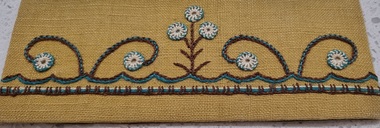
... Hilda worked on the WW1 tapestry depicting Women's War Work, displayed in the Imperial War Museum. ...Hilda worked on the WW1 tapestry depicting Women's War Work, displayed in the Imperial War Museum. ...Hilda was a member of The Embroiderers Guild U.K., a teacher and Judge. She prepared study material and embroidered items for the British Home Industries. Hilda worked on the WW1 tapestry depicting Women's War Work, displayed in the Imperial War Museum. An Annual Prize is awarded in her name for Silk Shading, by a First Year Apprentice at the Royal School of Needlework, London.One of eight stitch samplers worked on coarse counted thread or woven linen. Demonstrating a variety of techniques and embellishments.Hilda Watson Milford Surrey Label on backembroidery, sampler, england -
 Embroiderers Guild, Victoria
Textile - Hilda Watson Embroidery Sampler, Hilda Watson, 1937-1987
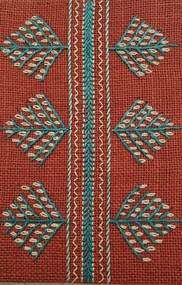
... Hilda worked on the WW1 tapestry depicting Women's War Work, displayed in the Imperial War Museum. ...Hilda worked on the WW1 tapestry depicting Women's War Work, displayed in the Imperial War Museum. ...Hilda was a member of The Embroiderers Guild U.K., a teacher and Judge. She prepared study material and embroidered items for the British Home Industries. Hilda worked on the WW1 tapestry depicting Women's War Work, displayed in the Imperial War Museum. An Annual Prize is awarded in her name for Silk Shading, by a First Year Apprentice at the Royal School of Needlework, London.One of eight stitch samplers worked on coarse counted thread or woven linen. Demonstrating a variety of techniques and embellishments.Hilda Watson Milford Surrey Label on backsampler, embroidery -
 Embroiderers Guild, Victoria
Textile - Hilda Watson Embroidery Sampler, Hilda Watson, 1937-1987
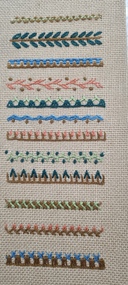
... Hilda worked on the WW1 tapestry depicting Women's War Work, displayed in the Imperial War Museum. ...Hilda worked on the WW1 tapestry depicting Women's War Work, displayed in the Imperial War Museum. ...Hilda was a member of The Embroiderers Guild U.K., a teacher and Judge. She prepared study material and embroidered items for the British Home Industries. Hilda worked on the WW1 tapestry depicting Women's War Work, displayed in the Imperial War Museum. An Annual Prize is awarded in her name for Silk Shading, by a First Year Apprentice at the Royal School of Needlework, London.One of eight stitch samplers worked on coarse counted thread or woven linen. Demonstrating a variety of techniques and embellishments.Hilda Watson Milford Surrey Label on backsampler, embroi, embroidery -
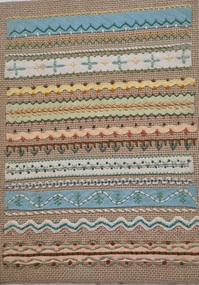 Embroiderers Guild, Victoria
Textile - Hilda Watson Embroidery Sampler, Hilda Watson, 1937-1987
... Hilda worked on the WW1 tapestry depicting Women's War Work, displayed in the Imperial War Museum. ...Hilda worked on the WW1 tapestry depicting Women's War Work, displayed in the Imperial War Museum. ...Hilda was a member of The Embroiderers Guild U.K., a teacher and Judge. She prepared study material and embroidered items for the British Home Industries. Hilda worked on the WW1 tapestry depicting Women's War Work, displayed in the Imperial War Museum. An Annual Prize is awarded in her name for Silk Shading, by a First Year Apprentice at the Royal School of Needlework, London.One of eight stitch samplers worked on coarse counted thread or woven linen. Demonstrating a variety of techniques and embellishments.Hilda Watson Milford Surrey Label on backsampler, embroidery -
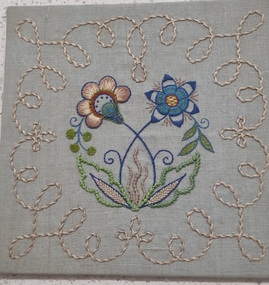 Embroiderers Guild, Victoria
Textile - Hilda Watson Embroidery Sampler, Hilda Watson, 1937-1987
... Hilda worked on the WW1 tapestry depicting Women's War Work, displayed in the Imperial War Museum. ...Hilda worked on the WW1 tapestry depicting Women's War Work, displayed in the Imperial War Museum. ...Hilda was a member of The Embroiderers Guild U.K., a teacher and Judge. She prepared study material and embroidered items for the British Home Industries. Hilda worked on the WW1 tapestry depicting Women's War Work, displayed in the Imperial War Museum. An Annual Prize is awarded in her name for Silk Shading, by a First Year Apprentice at the Royal School of Needlework, London.One of eight stitch samplers worked on coarse counted thread or woven linen. Demonstrating a variety of techniques and embellishments.Hilda Watson Milford Surrey Label on backsampler, embroidery -
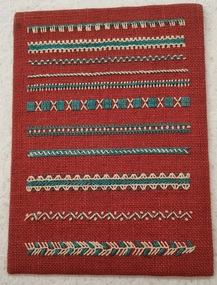 Embroiderers Guild, Victoria
Textile - Hilda Watson Embroidery Sampler, Hilda Watson, 1937-1987
... Hilda worked on the WW1 tapestry depicting Women's War Work, displayed in the Imperial War Museum. ...Hilda worked on the WW1 tapestry depicting Women's War Work, displayed in the Imperial War Museum. ...Hilda was a member of The Embroiderers Guild U.K., a teacher and Judge. She prepared study material and embroidered items for the British Home Industries. Hilda worked on the WW1 tapestry depicting Women's War Work, displayed in the Imperial War Museum. An Annual Prize is awarded in her name for Silk Shading, by a First Year Apprentice at the Royal School of Needlework, London.One of eight stitch samplers worked on coarse counted thread or woven linen. Demonstrating a variety of techniques and embellishments.Hilda Watson Milford Surrey Label on backsampler, embroidery -
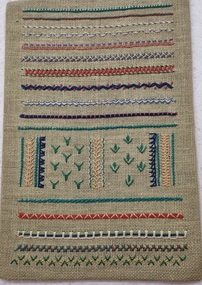 Embroiderers Guild, Victoria
Textile - Hilda Watson Embroidery Sampler, Hilda Watson, 1937-1987
... Hilda worked on the WW1 tapestry depicting Women's War Work, displayed in the Imperial War Museum. ...Hilda worked on the WW1 tapestry depicting Women's War Work, displayed in the Imperial War Museum. ...Hilda was a member of The Embroiderers Guild U.K., a teacher and Judge. She prepared study material and embroidered items for the British Home Industries. Hilda worked on the WW1 tapestry depicting Women's War Work, displayed in the Imperial War Museum. An Annual Prize is awarded in her name for Silk Shading, by a First Year Apprentice at the Royal School of Needlework, London.One of eight stitch samplers worked on coarse counted thread or woven linen. Demonstrating a variety of techniques and embellishments.Hilda Watson Milford Surrey Label on backsampler, embroidery -
 Embroiderers Guild, Victoria
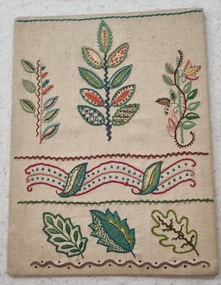
Textile - Hilda Watson Embroidery Sampler, Hilda Watson, 1937-1987
... Hilda worked on the WW1 tapestry depicting Women's War Work, displayed in the Imperial War Museum. ...Hilda worked on the WW1 tapestry depicting Women's War Work, displayed in the Imperial War Museum. ...Hilda was a member of The Embroiderers Guild U.K., a teacher and Judge. She prepared study material and embroidered items for the British Home Industries. Hilda worked on the WW1 tapestry depicting Women's War Work, displayed in the Imperial War Museum. An Annual Prize is awarded in her name for Silk Shading, by a First Year Apprentice at the Royal School of Needlework, London.One of eight stitch samplers worked on coarse counted thread or woven linen. Demonstrating a variety of techniques and embellishments.Hilda Watson Milford Surrey Label on backsampler, embroidery -
 Melbourne Legacy
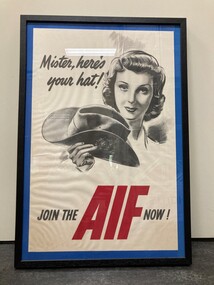
Poster, Join the AIF now!, 1941
... War recruitment poster by Richard Haughton James (source AWM). The poster is an offset lithograph on paper framed by a blue border, mounted in a black frame. It is an early example of the work of the Commonwealth Advertising Division, set up in 1941 within the Department of Information, primarily to advertise recruitment drives for men's and women's services, munitions work, war loans and national savings campaigns....War recruitment poster by Richard Haughton James (source AWM). The poster is an offset lithograph on paper framed by a blue border, mounted in a black frame. It is an early example of the work of the Commonwealth Advertising Division, set up in 1941 within the Department of Information, primarily to advertise recruitment drives for men's and women's services, munitions work, war loans and national savings campaigns. ...A framed Australian Commonwealth Military Forces Second World War recruitment poster by Richard Haughton James (source AWM). The poster is an offset lithograph on paper framed by a blue border, mounted in a black frame. It is an early example of the work of the Commonwealth Advertising Division, set up in 1941 within the Department of Information, primarily to advertise recruitment drives for men's and women's services, munitions work, war loans and national savings campaigns.A record that Legacy holds some war memorabilia as Legatees were once solely returned servicemen.Black and white sketch of a wartime lady holding a soldier's hat used as a recruiting poster in a black frame.Test of the poster "Mister, here's your hat! JOIN THE AIF NOW!"world war two, recruitment, aif -
 Federation University Historical Collection
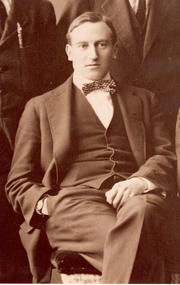
Photograph - Photograph - Black and White, Harold Herbert of the Ballarat Technical Art School, 1919
... War Service. Had been principal of the Sale Technical Art School since 1898, and had undertaken further studies in England returning to Ballarat with all sorts of entrepreneurial ideas. In 1924 the Ballarat School of Mines Students’ Magazine reported “We are perfectly safe in claiming on behalf of our school, that no institution of its kind has turned out a greater number of men and women students who have since “made good” while some have achieved enviable prominence in the world of art. Amongst these later, the most brilliant is Harold B. Herbert whose work...War Service. Had been principal of the Sale Technical Art School since 1898, and had undertaken further studies in England returning to Ballarat with all sorts of entrepreneurial ideas. In 1924 the Ballarat School of Mines Students’ Magazine reported “We are perfectly safe in claiming on behalf of our school, that no institution of its kind has turned out a greater number of men and women students who have since “made good” while some have achieved enviable prominence in the world of art. Amongst these later, the most brilliant is Harold B. Herbert whose work ...Harold Brocklebank Herbert (16.09.1891-1945) Harold Herbert was one of the first pupils at the school starting in 1891, commencing as a 15 years old he studied Applied Design and Architecture at the Ballarat Technical School of design attached to the Ballarat Fine Art Galery, transferring to the Ballarat Technical Art school attached to the Ballarat School of Mines. He was a certificated Art Teacher with the Victorian Education Department. His talents were identified by Ballarat’s Ponsonby Carew-Smith who rose to become Art Inspector with the Victorian Education Department. His teaching career included being appointed Principal of the Sale Technical Art School in 1898. Harold Herbert undertook further studies in England returning to Ballarat with all new entrepreneurial ideas. He worked at the Ballarat Technical Art School between 1915-19. Harold Herbert was involved with the design of the Ballarat Arch of Victory, and was responsible for the reproductions in ‘The Education Department’s Record of War Service. Had been principal of the Sale Technical Art School since 1898, and had undertaken further studies in England returning to Ballarat with all sorts of entrepreneurial ideas. In 1924 the Ballarat School of Mines Students’ Magazine reported “We are perfectly safe in claiming on behalf of our school, that no institution of its kind has turned out a greater number of men and women students who have since “made good” while some have achieved enviable prominence in the world of art. Amongst these later, the most brilliant is Harold B. Herbert whose work is so widely and justly appreciated throughout Australia and whose achievements are watched by his old school with the greatest pride. He commenced at the School when he was about 15 years of age, and followed a course of training very similar to what most students are doing the most valuable qualities shown by him during his career as a student were a passion for drawing and a capacity for taking pains, so essential in all artwork. He was appointed as Assistant Art Teacher at Ballarat on completion of his course, and later assistant in the office of Art Inspector. All of his spare time was devoted to out-door sketching and commercial drawing and he showed an ability in practical design for various crafts quite equal to the ability he has since displayed in depictive art. His return to this School as senior master and his departure to devote himself entirely to fine art are quite recent happenings with which all students are familiar. The wonderful exhibition he held in Melbourne on return from a sketching trip abroad has place him amongst the leading artists of Australia. Upon his death in 1945 the Ballarat School of Mines Student's Magazine recorded: "The death of the famous water-colour artist, Harold Herbert, will be a distinct loss to art in Australia. he was educated at the Ballarat Art School which it was situated in Sturt Street, and the gave promise of becoming a famous artist then. his talents were recognised, and in water-colour work he quickly made a name for himself. his landscapes in water-colour are in the principle galleries of the world, and many of them are to be found in the Ballarat gallery and in other provincial galleries. In 1941 he was appointed official war artist for the COmmonwealth, and he served in the Middle East and Syria. Exhibitions of his war pictures have been seen at different times in Melbourne."Portrait of a young man in a suit. He is Harold Brocklehurst Herbert, staffmember of the Ballarat Technical Art School (a division of the Ballarat Technical Art School). The photograph is a detail of the Ballarat School of Mines Magazine Committee, 1919. (http://victoriancollections.net.au/items/54923a682162f116140de59c)harold herbert, harold b. herbert, harold brocklebank herbert, ballarat school of mines, ballarat technical art school, art, arch of victory -
 The Beechworth Burke Museum
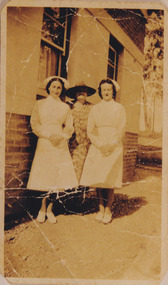
Audio - Oral History, Jennifer Williams, Mrs Sheila Parkinson, 3 January 2000
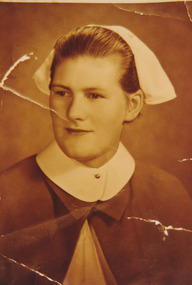
... War. At that time, unmarried women were accommodated and received nursing training on-site. Shiela was obliged to cease professional training and employment when she married in 1941, which disrupted completion of her final nursing examinations. Following post-war changes to the law that allowed married women to work...War. At that time, unmarried women were accommodated and received nursing training on-site. Shiela was obliged to cease professional training and employment when she married in 1941, which disrupted completion of her final nursing examinations. Following post-war changes to the law that allowed married women to work ...Mrs Sheila Parkinson was born in Wagga in 1916 and came to Beechworth as a young woman around 1938. Sheila trained as a psychiatric nurse at Mayday Hills hospital prior to the second World War. At that time, unmarried women were accommodated and received nursing training on-site. Shiela was obliged to cease professional training and employment when she married in 1941, which disrupted completion of her final nursing examinations. Following post-war changes to the law that allowed married women to work, Sheila returned to Mayday Hills. Sheila's husband, Don, returned to Beechworth after four years abroad as a serviceman in the Australian Air Force. Beechworth's institutions were a major source of local employment throughout the twentieth century. As well as providing limited employment opportunities to young women like Shiela, post-war European migrants from Bonegilla Migrant camp found at Mayday Hills, encouraging European migrant settlement in the district. Mayday Hills was renamed several times since its establishment in 1867. At the peak of operations, it comprised sixty-seven buildings housing over twelve hundred patients patients and five hundred staff. The hospital officially closed in 1998. Today, the decommissioned two-storey Italianate style main building stands on eleven hectares of botanical gardens under National Trust protection. The site remains a popular cultural heritage destination for visitors. This oral history recording was part of a project conducted by Jennifer Williams in the year 2000 to capture the everyday life and struggles in Beechworth during the twentieth century. This project involved recording seventy oral histories on cassette tapes of local Beechworth residents which were then published in a book titled: Listen to what they say: voices of twentieth century Beechworth. The cassette tapes were digitised in July 2021 with funds made available by the Friends of the Burke.Employed as a psychiatric nurse at one of Beechworth's large welfare institutions, Mayday Hills, Mrs Sheila Parkinson recalls the conditions faced by staff and patients at the hospital, which cared for chronically ill people from the Ovens region and patients from the Yarra Bend Asylum, Melbourne, which closed in 1925. When Sheila first began her nurse training, Mayday Hills suffered from a lack of resources and rudimentary facilities and patients frequently suffered from the cold due to poor heating and inadequate clothing and bedding. However, as the twentieth century progressed, Sheila recalls how conditions and treatments improved as a result of increased government funding of services and advances in psychiatry and pharmaceutical medicine. Mrs Sheila Parkinson's oral history recording is historically and socially significant for its witness to life in Beechworth in the pre- and post-WWII period. Sheila's story enriches our understanding of processes of modernisation with regard to psychiatric and welfare services, while the course of Sheila's professional training and employment brings attention to systemic and socio-economic barriers faced by women, as well as the valuable contribution women and migrants make in the delivery of care and ancillary services. This oral history account is socially and historically significant as it is a part of a broader collection of interviews conducted by Jennifer Williams which were published in the book 'Listen to what they say: voices of twentieth-century Beechworth.' While the township of Beechworth is known for its history as a gold rush town, these accounts provide a unique insight into the day-to-day life of the town's residents during the twentieth century, many of which would have been lost if they had not been preserved.This is a digital copy of a recording that was originally captured on a cassette tape. The cassette tape is black with a horizontal white strip and is currently stored in a clear flat plastic rectangular container. It holds up 40 minutes of recordings on each side.Mrs Sheila Parkinson /twentieth century beechworth, mayday hills, psychiatric care, benevolent asylums, nursing, wwii, psychiatric treatment, country women, psychiatric hostpital, beechworth's institutions, local employment, government institutions, listen to what they say, oral history, burke museum, sheila parkinson, beechworth lunatic asylum, beechworth mental hospital, beechworth hospital for the insane, the kerferd clinic, bonegilla migrant camp, working women, white australia policy -
 The Beechworth Burke Museum
Audio - Oral History, Jennifer Williams, Mavis Jensen, 11 May 2000
... war time, economic struggles, and women's societal roles in a rural area. Her oral history is particularly significant for its insights into developments in psychiatric patient treatment and care in regional Victoria, as well as women's work conditions in the mid-twentieth century. ...Mavis Jensen (nee Knight) was born in Broadford in 1920 and came to Beechworth with her family a year later, so her father could assist his father at Knight's Blacksmith at 1A Camp Street, where the Hotel Nicholas is now located. Mavis Jensen left school at the age of 13 and worked as a kitchen maid at Ovens Benevolent Asylum. She was employed as a ward assistant at Mayday Hills Hospital from 1939 to 1980, except for 1958-59 when she gave birth to her son, Noel. This oral history recording was part of a project conducted by Jennifer Williams in the year 2000 to capture the everyday life and struggles in Beechworth during the twentieth century. This project involved recording seventy oral histories on cassette tapes of local Beechworth residents which were then published in a book titled: Listen to what they say: voices of twentieth century Beechworth. These cassette tapes were digitised in July 2021 with funds made available by the Friends of the Burke.Mavis Jensen's account of her life in Beechworth and the local area during the 20th century is historically and socially significant to the cultural heritage of the region. She details important historical events and hardships in the region's history that had a lasting local, regional and national impact, including Australia during war time, economic struggles, and women's societal roles in a rural area. Her oral history is particularly significant for its insights into developments in psychiatric patient treatment and care in regional Victoria, as well as women's work conditions in the mid-twentieth century. This oral history account is socially and historically significant as it is a part of a broader collection of interviews conducted by Jennifer Williams which were published in the book 'Listen to what they say: voices of twentieth-century Beechworth.' While the township of Beechworth is known for its history as a gold rush town, these accounts provide a unique insight into the day-to-day life of the town's residents during the 20th century, many of which will have now been lost if they had not been preserved.This is a digital copy of a recording that was originally captured on a cassette tape. The cassette tape is black with a horizontal white strip and is currently stored in a clear flat plastic rectangular container. It holds up 40 minutes of recordings on each side.Mavis Jensen /listen to what they say, beechworth, oral history, burke museum, jensen, mavis jensen, psychiatric hospitals, mid-twentieth century psychiatry, regional hospitals, regional mental health care, mid-twentieth century women's working conditions, mayday hills hospital., ovens benevolent asylum, beechworth hospital history -
 The Beechworth Burke Museum
Uniform - Hat, 1939
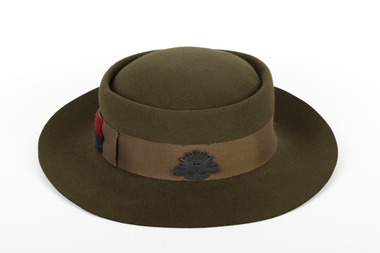
... women served in the AWAS, performing critical support roles such as clerical work, vehicle maintenance, and communications. The Signals Branch, which Joan Cahill served in, was responsible for providing reliable and secure communication services between the Australian army and Allied forces. Burke Museum Beechworth Army service army uniform Joan Cahill Australian Women's Army Service Ww2 wwII World War ...This hat was worn by Joan Cahill during her service in the AWAS, where she served in the Signals Branch and rose to the rank of Corporal. The AWAS was formed in 1941, and its main objective was to support the Australian army in various ways. Over 24,000 women served in the AWAS, performing critical support roles such as clerical work, vehicle maintenance, and communications. The Signals Branch, which Joan Cahill served in, was responsible for providing reliable and secure communication services between the Australian army and Allied forces.Khaki women's army hat with grosgrain band wrapped around the circumference with a small metal rising sun attached.burke museum, beechworth, army service, army uniform, joan cahill, australian women's army service, ww2, wwii, world war two -
 Federation University Historical Collection
Magazine, Ballarat School of Mines Students' Magazine, 1898-1901, 1898-1901
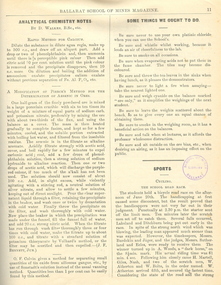
... War) * Mt William Gold-Field visit, pg 3 * The Stoping of Wide Lodes by J.V. Lake (includes cross sections) * Summaries of Notes from the Australian Mining Standard * Notes on Broken Hill Part 2- Its Mines and Minerals by W.J. Williams * Motive Power from the Waves * Electrical Notes * Some Account of Italian Mining (Sarinia, Sicily, Peidmont, Lombardia) by Candido Maglione * Students Association * Should Women Have the Vote by Frank Bessemeres * The School Theatre Parly * Past Students * Poetry * Football * Surveying Rules Vol 3., No 8, October 1900 * Ballarat School of Mines Associateship * An Engineering Laboratory * Students' Practical Work * Notes on Broken Hill Part 3 by W.J. ...War) * Mt William Gold-Field visit, pg 3 * The Stoping of Wide Lodes by J.V. Lake (includes cross sections) * Summaries of Notes from the Australian Mining Standard * Notes on Broken Hill Part 2- Its Mines and Minerals by W.J. Williams * Motive Power from the Waves * Electrical Notes * Some Account of Italian Mining (Sarinia, Sicily, Peidmont, Lombardia) by Candido Maglione * Students Association * Should Women Have the Vote by Frank Bessemeres * The School Theatre Parly * Past Students * Poetry * Football * Surveying Rules Vol 3., No 8, October 1900 * Ballarat School of Mines Associateship * An Engineering Laboratory * Students' Practical Work * Notes on Broken Hill Part 3 by W.J. ...Bound copies of the Ballarat School of Mines Students' Magazine, 1898-1901 Vol 1, No. 1, September 1898 * News and Notes (Ballarat School of Mines Museum, J.F. Usher, New British Pharmacopoeia, excursion to Bendigo) * History of the Ballarat School of Mines * Current Topics (Federation, Gladstone, Anglo-American Alliance) * Of Custom * Discovery of Coolgardie * Mining Notes(Clunes, Pitfield, Birthday Mine, Western Australia, Transvaal, Mt Bischoff, Rand Drill Co.) * From the Journals * The Societies - (Student Association, Ballarat Field Club and Science Society, Ballarat Photographic Club) * Original Poetry * Sports * Students' Association Committee Meetings * On the Increase of Temperature of the Earth With Increased Depth Vol 1, No. 2, October 1898 * Notes about some of the Past Students (E.M. Weston, J.A. Porter, H.R. Sleeman, G.E. Sander, B.C.T. Solley, T. Rhys, C. Burbury, D. McDougal, J. Matsen) * Excursion to Daylesford, p.3 * History of the Ballarat School of Mines (continued) * The Soudan * Greater Melbourne * Image of J. Hopkinson, electrical engineer killed ascending the Alps * What is Science * Mining Notes (Pitfield Plains, Victoria United G.M.Co., Lithgow, Avoca, great Cobar, Mt Whycheproof) * Student's Association (women's franchise) * Sports Vol 2, No. 1, March 1899 * News and Notes * History of the Ballarat School of Mines (continued) * Notes of Victorian Geology, 1. Granites, by Thomas S. Hart * Sir William Crookes * Summaries and Notes from the Mining Journals * Students' Association * Sports * The Bush Assayer * Solubility of Gold-Silver Alloys in Potassium Cyanide * Correspondence Vol 2, No. 2, April 1899 * News and Notes (Smythesdale Excursion, New Buildings, A.S. Coyte, R.J. Allan) * History of the Ballarat School of Mines (Continued) * The New Students (J. Owen, A. Clayton Morrisby, A.S. Atkin, J. Alexander Reid, Alfred G. Johnston, L. Lowe, F.H. Dalton, W.M. Robertson, A. Hacke, H.L. Giles, W. Martin, E. Walshe, H.L. Krause, R. Sawyer) * Berringa by Oh'E Jay * Summaries and Notes from the Mining Journals * Mount Magnet to Victoria - A Long Bicycle Trip * 1898 Examination returns * Sports Vol 2, No. 3, May 1899 * Technical Education and the Proposed Affiliation of the Schools of Mines with the Melbourne University. * Laying of the Foundation Stone of the New Classrooms (now Administration Building). Alexander J. Peacock * News and Notes (Past Students - A.S. Lilburn, J.W. Sutherland, J. Richardson, E. Prendergast, J. Wallace, J. Kidd, J. Lake, Mathew Thompson), Coolgardie Exhibition. * Trip to Lal Lal * Students' Association * Summaries and Notes from the Mining Journals * Professor Henry Louis on Mining Education * Corrections Used in Chaining by C.W. Adams * The Black Horse Cyanide Plant * Sports * Completed List of 1898 Examinations Vol 2, No. 4, June 1899 * News and Notes * The Education Problem by D.N. McLean * A Few Hints on Histological Technique by Emil Gutheil * Summaries and Notes from the Mining Journals * Students' Association * A Visit to the Skipton Caves (Mount Widdern, Ormand Hill, volcano, Emu Creek, Mount Kinross, Mount Elephant, Mount Vite Vite, Mount Kinross, Mount Hamiston) * Mount Magnet To Victoria (cont) * The New Engines at the Ballarat Woollen Mills - includes image of the Compound 700 H.P. Engines constructed for the Ballarat Woollen Mills by Austral Otis Company and consulting engineers Monash and Anderson. * Sports * Original Poetry * Correspondence Vol 2, No. 5, July 1899 * News and Notes (E. Byron Moore, Visit to Britannia Gold Mine, J. Bryant, Visit to Last Chance Mine) * A Few Hints on Histological Technique (cont) by Emil Gutheil * Summaries and Notes from the Mining Journals * Professor Alfred Mica Smith (includes image) * Notes on Victorian Geology Part 2 The Trappean Rocks, by Thomas Hart * Origin of Diamonds * Hydraulic Mining by A.E.C. Kerr * Volcanoes by F.G. Bonney * Analytical Chemistry Notes by Daniel Walker * Some Things Out To Do * Sports * Correspondence Vol 2, No. 6, August 1899 *Summaries and notes from the Mining Journals * Some Regulations of the Academy of Mines at Freiberg * A visit to Mt Lyell Smelters * Professor Gilbert J. Dawbarn (includes image) * Air compressor and Transmission of Power by Compressed air by A.E.C. Kerr * Chemistry Notes by Daniel Walker * Mineralogical Notes, Ballarat by Thomas S. Hart * Kalgurli Gold Mines, W.A. * OUr New Lab Vol 2., No 7, September 1899 * Summaries and Notes from the Mining Journals * Some recent Steam Plants at Bendigo by Gilbert Dawbarn * Professor Thomas Stephen Hart (includes image) * Students Association * Notes on Victorian Geology by Thomas Hart * Centrifugal Pumps * A New Chum's Experience by E.M. Weston Vol 2., No 8, October 1899 * The institute of Chemistry Examinations * A New Method of Qualitative Chemical Analysis by Emil Gutheil * Steam Engine Valves and Valve-Gears by Gilbert Dawbarn * Daniel Walker (includes image) * Notes on Victorian Geology by Thomas Hart * Cyaniding Cripple Creek Tellurides (Metallic Extraction Company) * Notes on Two Ballarat Gravel Pumping Plants, G.A. Wilberforce (Eureka Jennings Co and Yarrowee Sluicing Co) * History of the School of Mines (concluded) Vol 3., No 1, March 1900 * A Journey from Natal to Mashomaland with the British Police * A Plea for Research * New Caledonia by C.A.M. Deane * Notes of Victorian Geology - Lower Palaeoroic Rocks by Thomas Hart * Mt Bischoff Mine and Mill * Summaries and Notes from the Mining Journals * Things we Eat and Drink * Farewell to A.S. Coyte Vol 3., No 1, March 1900 * Mining Education * Model Locomotive made by the apprentices of the Phoenix Foundry, p2 * Glimpses of Rhodesian Police Camp Life * New Caledonia (continued) * Summaries from the Mining and Engineering Journals * Boot and Saddle Vol 3., No 3, May 1900 * A Students' Common Room * Geological Excursion to Hardie's Hill * Notes on Victorian Geology by Thomas Hart * The Planet Venus by John Brittain * Summaries and Notes from the Australian Mining Standard * The Assay Ton * Zeehan Smelters * Electrical Notes by Ohe Jay * Trop of the Cricket Club to Stawell * Students' Association * Solid Hydrogen Vol 3., No 4, June 1900 * The Minister of Mines on Mining Education (Minister A.R. Outtrim) * Lal Lal Geology Trip (Thomas Hart) * Rifle Club now defunct, pg 3 * A Contribution to the Mining Geology of Kalgoorlie, W.A. by Ferdinand Krause (includes cross sections) (Wood's Point, Rand, Johannesburg, South Africa, Gaffney's Creek, Walhalla, Shady Creek, Sago Hill at Cardigan, Bunbury) * Summaries and Notes from the Australian Mining Standard (Buninyong Estate Mine) * Monthly Progress Reports of the Geological Survey * Electrical Notes by John M Sutherland (Telagraphone, phonograph, telephone receiver) * Students' Theatre Party (Gordon Todd, Ohe Jaeger, C.S. Wakley) * Opening of the New Buildings - Ministerial Speeches (Outtrim, W.H. Irvine, New Mining Laboratory, Old Chemistry Building, Battery, Model Mine) * Students' Association * Relief of Mafeking * A Critic Criticised * Things We Eat and Drink by Ohe Jay - Oatmeal, Coffee and Cocoa. Vol 3., No 5, July 1900 * Research * Adelaide Varsity Students at Ballarat * The Manchester-Liverpool Mono Railway * Students Association * *A Contribution to the Mining Geology of Kalgoorlie, W.A. by Ferdinand Krause (continued) (includes cross-sections) * Motive Power, address by Charles A. Parsons * Summaries and Notes from the Australian Mining Standard * Sugar Manufacturing by Sugna * Great Creswick Hydraulic Sluicing Plant (THomas Hart, Ballarat School of Mines Mining Class visit) * Reminiscences of a Students Life in Germany * Football - Ballarat School of Mines v Geelong Grammar School (Australian Rules Football) Vol 3., No 6, August 1900 * Cheap Mine Management * Library * Bendigo School of Mines, pg 3 * Notes on Ore Dressing by T, Vincent, Manager The Zeehan (Tas) Silver-Lead Mines Ltd) * Motive Power * Notes on Broken Hill - Its Mines and Minerals by J. Williams * The Concert * Summaries and Notes from the Australian Mining Standard * The Dandy Duke's Dreadful Demise * The Road Race Vol 3., No 7, September 1900 * Michaelmas Excursion (Melbourne University, Prof Kernot, Applied Mechanics) * Injury to School Property * Return of E. Ditchburn (Boer War) * Mt William Gold-Field visit, pg 3 * The Stoping of Wide Lodes by J.V. Lake (includes cross sections) * Summaries of Notes from the Australian Mining Standard * Notes on Broken Hill Part 2- Its Mines and Minerals by W.J. Williams * Motive Power from the Waves * Electrical Notes * Some Account of Italian Mining (Sarinia, Sicily, Peidmont, Lombardia) by Candido Maglione * Students Association * Should Women Have the Vote by Frank Bessemeres * The School Theatre Parly * Past Students * Poetry * Football * Surveying Rules Vol 3., No 8, October 1900 * Ballarat School of Mines Associateship * An Engineering Laboratory * Students' Practical Work * Notes on Broken Hill Part 3 by W.J. Williams * The Lake View Consols by F.S. Earp - Battery Treatment of Sulpo-Telluride Ore * Neglected Mineral Fields - Eurowie and Warrata * A Glimpse Ahead * News and Notes * A.W. G. McPherson, Boer War * Students Association * Ballarat School of Mines Melbourne Excursion to the Government Electric Lighting Station, Austral-Otis Co, Working Mens College * Ballarat School of Mines Concert in Aid of Soldiers Statue Balance Sheet * Football * Cricket Vol 3., No 8b, November 1900 * Position of the Ballarat School of Mines with Regards to Mining Education * Age Limit * Entrance Examination * Presentation t0 Professor Alfred Mica Smith * Image of a Group of Old Ballarat School of Mines Students in Coolgardie and Kalgoorlie. * Students Association Vol 4., No 1, March 1901 * Espirit De Corps * A few Notes on the Testing of Explosives * Round About Inverell, NSW by F. and J. Mawl * On the Choice of Drawing Instruments * Summaries and Notes From the Technical Journals * Annual Examinations 1900 * New Students * Sporting Notes * The Vale of Coolgardie Mine, Bonnievale, W.A. by G. Stephen Hart * News and Notes (Kerr Grant, C.L. Nash, R. Gordon Todd, Vial) * Editorial Notices Vol 4., No 2, Second Term 1901 * The Metallurgical Treatment of Sulpho-Telluride Ores by L.W. Grayson * Some Metallurgical Difficulties of Aluminium * Diehl's Sulphide Process by A.E. C. Kerr * A Californian Gold Mine by A.E. C. Kerr * New Express Locomotives for the Victorian Government (Phoenix Foundry) * An Excursion to Geelong (Electric Light and Traction Company of Australia) * The Linkenback Table for our New Mining Laboratory (Humboldt Company of Colgne) * Death of Thomas Bath * The Late Alfred G. Johnson (Boer War) * An Introduction to Natural Science by Emil Gutheil * The First Annual School Sports Meeting * Concert in Aid of Magazine Funds * The Men That Made the Concert (C.E. Denniston, W.H. Chandler, Mr White, William Litte Jnr, Marriott, Giles McCracken) * Sports * News and Notes Vol 4., No 2, Third Term 1901 * Bagging-Up - A Sketch * Concentration of Difficult Silver-Lead Ores * Estimation of Chlorine, Bromine and Iodine by D. Runting * Summaries of Notes from teh technical Journals * Notes on the Use and Care of Platinum Ware Common Sense * The Machinery at the Tasmania Gold Mine, Beaconsfield, Tasmania * Mining at Walhalla - The Long Tunnel Mine * Past Students * Mapping our of Agricultural Areas, etc, In Dense Vine Lands, North Queensland by R.A. Suter * News and Notes * Concert Balance Sheet e.m. weston, robert brough smyth, mcdougall, bruce, charles burbury, harrie wood, graham j. hopwood, emil gutheil, daniel walker, thomas hart, thomas stephen hart, m. hacker, schnitzler, f.a., ditchfield, l.h, alfred e.c. kerr, charles harvey, campbell, joseph bryant, campbell & ferguson, gilbert j. dawburn, irving, g.b., kerr, a.e.c., john walter sutherland, william robertson, herbert l. krause, alfred mica smith, binh pham, crosbie, d. jack, ditchburn, j., james hiscock, alfred johnston, reid, j.a., kidd, john, james bonwick, james, j.p, overall, d, e.h salmon, gaynor marquand, williams, w.w., williams, william, deane, c.m., vincent, tom, phillips, g.e., hart, d.w., jarnail suingh, rowlands, e., ferdinand m. krause,, easterby, f.l, parsons, r.g., partington, j.r., vial, s.b., meadows, h, atkins, arthur, john braisted burdekin, w.h. corbould, ditchburn, john, hill, john, otto e. jager, mcpherson, g.t, nicholls, c, thom, j.m., crafter, stewart, john brittain, peter lalor, hardy - commissioner, thomas bath, alf johnston, charles campbell, nash, llewellyn, watson, m.a, gardener, eddie, adamson, s.g, alford, l.c, allen, r.j, arthur, d.w.b., burge, a., willia, cairncross, cooper, i, maurice osric copland, maurice copland, dickinson, s., doepel, dunstan, john, loveday dunstan, eeles, terri, flegeltaub, israel, fletcher, a, fyrar, peter, kerr grant, w.kerr, green, gary, betty harris, harris, c.m., hay, a.l., hearn, hill, martin, james, david, johnston, alfred g, kilner, marion, kingston, thomas, lewin, f.c.k., lilburne, arthur m, linahan, colin, macready, w.h, major birlefco, markwald, henry, mccaffrey, mcfarlane, kaye, mciver, s.k, mellins, b, morton, felicity, w. kenneth moss, ken moss, nash, c.w., nash, neville, nickolls, berkeley, osborne, percy, philp, e., playford, william, reid, e, roberts, gordon, ross, f.c., royce, phillip, sawyer, basil, stewart, r.c., todhunter, i, vaisey, a., vincent, john, vinden, sue, wakley, cecil, watt, james, westcott, lewis, charles w. whyte,, vial, s browning, ballarat school of mines students in coolgardie and kalgoorlie, coolgardie, kalgoorlie, claude maitland, a.l. hay, a.s. lilburne, latham watson, arthur kildahl, thomas copeland, f.a. moss, w.a. hearman, cardoc james, alexander fraser, e.o. watt, g.m. roberts, j.j. dunstan, h.v. moss, j.a. hill,, john dunstan, c.m. harris, william h. corbould, j.w. sutherland, ballarat photographic club, ballarat field naturalists club, ballarat field club and science society, photography, geology, excursions, last chance mine, tasmania gold mine, beaconsfield, tasmania, rand, south africa, mount lyell, ballarat school of mines student excursion to mount lyell, h.l. krause, ferdinand krause, krause, hardie's hill, hardie's hill excursion, lal lal, lal lal excursion, lal lal geology excursion, smythesdale, smythesdale excursion, soudan, south african miners, south star mines, wynne and tregurtha battery, ananconda copper mining, arizona copper mining, boiler plates, british guinea, butte copper smelter, daylesford geology camp, daylesford excursion, diehl process, electric power house ballarat, electric pumps, geelong rope factory, gympie, golden horseshoe estate, c johnstone, jack nichol, c. macgennis, alec saunders, alfred g. johnstone, graeme jolly, william purdie, john mann, maxwell l gaunt, sale school of mines, freiberg school of mines, schools of mines, railway locomotive -
 Federation University Historical Collection
Article - Article - Women, Ballarat School of Mines: Women of Note; Hester Darby, (1900 - 1980)
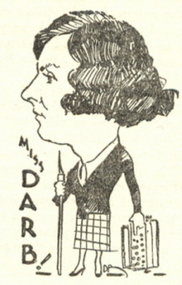
... war years Hester Darby, still teaching at SMB, worked as the honorary stenographer to the Ballarat Area Office. She was working in this capacity when troops from USA were billeted in Ballarat. After 41 years Hester Darby retired from the position of Typewriting Instructress in the Commercial Department in 1962. smb ballarat school of mines commercial classes lecturer touch typing commercial correspondence office routine 1921-1962 world war 2 honorary stenographer to area office usa troops billeted in ballarat Ballarat School of Mines: Women of Note; Hester Darby, (1900 - 1980) Article Article - Women ...Hester Clara Darby joined the staff of the School of Mines, Ballarat (SMB) as an assistant to senior Commercial Classes in April 1916. On 01 February 1921 she was appointed a lecturer. She taught the 'Touch' Method of typing, Commercial Correspondence and Office Routine. During the war years Hester Darby, still teaching at SMB, worked as the honorary stenographer to the Ballarat Area Office. She was working in this capacity when troops from USA were billeted in Ballarat. After 41 years Hester Darby retired from the position of Typewriting Instructress in the Commercial Department in 1962.smb, ballarat school of mines, commercial classes, lecturer, touch typing, commercial correspondence, office routine, 1921-1962, world war 2, honorary stenographer to area office, usa troops billeted in ballarat -
 Federation University Historical Collection
Article - Article - Women, Ballarat School of Mines, Girls' School: Women of Note; Valda D'Angri, Teacher, (1930 - )
... war-related business. She attended kindergarten, which she recalled was unusual for the time. She attended Humphrey Street State School and her secondary schooling was at Ballarat Girls' School. Val completed her secondary school education at 15 years of age and went on to tertiary study at The School of Mines, where she trained in art and dressmaking. After completing her education, she worked as draughtswoman before becoming a teacher. The remainder of her career was spent teaching art and textiles at both secondary and tertiary levels. She taught at the secondary school that she had attended. women ...Val grew up in Ballarat and started school in the early 1940s, during World War II. Her mother was a teacher and her father worked in Melbourne on war-related business. She attended kindergarten, which she recalled was unusual for the time. She attended Humphrey Street State School and her secondary schooling was at Ballarat Girls' School. Val completed her secondary school education at 15 years of age and went on to tertiary study at The School of Mines, where she trained in art and dressmaking. After completing her education, she worked as draughtswoman before becoming a teacher. The remainder of her career was spent teaching art and textiles at both secondary and tertiary levels. She taught at the secondary school that she had attended.women of note, valda d'angri, teacher, kindergarten, humphrey street state school, ballarat girls' school, ballarat school of mines, art, dressmaking, draughtswoman -
 Federation University Historical Collection
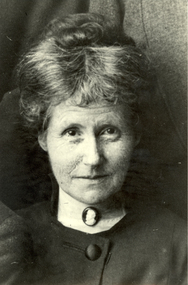
Article - Article - Women, Ballarat Technical Arts School: Women of Note; Margaret Young, Teacher, Woodcarving
... War, Honour Boards were requested to be made to honour the men who had served. Ballarat was the main provider of these boards. Margaret Young was one of the people responsible for the carvings and specially mentioned for her work by the Caulfield School in Melbourne. On her resignation, Margaret moved to Adelaide. At the past students Reunion Celebrations in 1930, Margaret Young was to be the Guest of Honour. Unfortunately she was unable to attend due to ill health. women ...Margaret Young studied at Ballarat West Art School in 1894. This was one of Ballarat's Art schools. In 1907 they merged and became Ballarat Technical Art School (BTAS). Margaret became a teacher and taught for many years at BTAS, specialising in woodcarving. At the end of the First World War, Honour Boards were requested to be made to honour the men who had served. Ballarat was the main provider of these boards. Margaret Young was one of the people responsible for the carvings and specially mentioned for her work by the Caulfield School in Melbourne. On her resignation, Margaret moved to Adelaide. At the past students Reunion Celebrations in 1930, Margaret Young was to be the Guest of Honour. Unfortunately she was unable to attend due to ill health.women of note, teacher, ballarat school of mines, smb campus, margaret young, woodcarving, ballarat west art school, ballarat technical art school, reunion celebrations, world war 1, honour boards, caulfield school, guest of honour, 1930, adelaide -
 Federation University Historical Collection
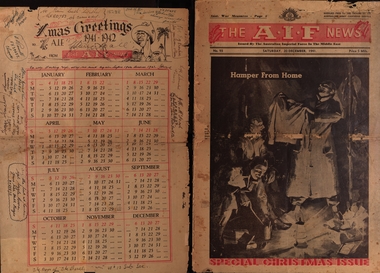
Newspaper - Twenty page issue December 1941 No. 93, Societe Orientale de Publicite, The A.I.F. News Special Christmas Issue 1941, December 1941
... Page 19 "Women of War" - photos of women at work filling in for men who have gone to war. ...Page 19 "Women of War" - photos of women at work filling in for men who have gone to war. ...The A.I.F.= The Australian Imperial Force and this newspaper was supplied free to the troops of the Australian Army Canteens Service. This issue is dated Saturday 22nd December 1941. It includes advertisments for businesses in Cairo and Alexandria; Egypt, Palestine and Syria. Page 2 includes a poem titled "This Holy Night" by Pte C.M. Walker; two sonnets by Rupert Brooke; a poem, "Waiting Dreams" by Pilot Officer J.A. Henderson RAAF and a poem by Lieut. David McNicoll AIF Abroad Air Mail - Palestine. Page 3 includes a message from General Sir Thomas Blamey, an article on the part women would increasingly play as a consequence of the emergency war policy; an advertisment for tobacco specially packed for overseas forces. Page 4 includes an article on Australian coastal cities being ready for raids. Page 5 includes an article about the Commonwealth of the Philippines and their defense which until 1946 lay with America. General D Macarthur was the Commander In Chief in the Philippines. Germany's "secret Weapon" legend. Page 6 includes "Dancing Dan's Christmas"; "Bluey and Curley" comic strip. Page 7 includes article "Rommel's Armoured Might Lies Strewn Over Libyan Sands" Page 8 includes an article: "All In Fun" - a revue - has begun a tour of Australian camps in Palestine and Syria. Page 9 includes articles "War Will Revolutionise Air Services In Australia"; a list - Greek Awards To AIF Officers and a cartoon by George Aria titled 'Jonah '. Pages 10&11 "Christmas 1941" - messages from prominent people: Mr Winston Churchill; The Govenor General (Lord Gorrie); The Prime Minister (Mr Curtin); Mininster for the Army (Mr Forde). Also photos of army operations and traditional family Christmas time. Page 12 &13 Articles regarding sport under the heading 'Australian Sporting Digest'. Page 14 A story - "The Gift of the Magi" - an O Henry Christmas Story. Also a greeting from Myer's of Melbourne and Adelaide to all Myer Men in the AIF Page 15 An article where General Blamey reassures Australia about its capability of defence. Page 16 A description of a battle by Australian sloop "Parramatta" with HMAS "Auckland" against enemy planes whilst they were escorting a merchant ship with a cargo of petrol during the Battle of Tobruk Page 17 & 18 Pages under the title 'ACK-I-FOOFS' (Articles submitted by soldiers: The real Rat of Tobruk - a rat trained by L/Cpl Jack Kneeshaw which he named "Goebbels"; poems and cartoons. Page 19 "Women of War" - photos of women at work filling in for men who have gone to war. Page 20 Xmas Greetings 1942-1942 - a 1942 Calendar signed by 14 members of the AIF, some with messages and including their Army Number. Twenty pages of news supplied free to the troops by the Australian Army Canteens Service.The last page is a calendar for 1942 with personal inscriptions and greetings of servicemen. Some inscriptions have I.D. Numbers ( VX35435 W. Johnston; QX20753 of Carmody ; VX40449 ; VX39637 N. Powell; VX32054 Blue Ernistson?; N?X23234 W.Cummins; VXthe a.i.f. news christmas edition 1941, australian imperial force, world war 2, australian army canteens service, general blamey, world war 2 - pacific war, world war 2 - phillipine islands, general d macarthur, emergency plans ww2 australia, secret weapons ww2, western desert ww2, australian imperial force - western desert ww2, civil aviation post ww2, air services australia, lord gowrie, governor general lord gowrie, prime minister john curtain, minister for the army - mr forde, cartoons 1941, women-in ww2, xmas greetings calendar 1941-1942, cairo 1941, palestine 1941, western desert 1941, advertisements 1941, middle east 1941 -
 Lara RSL Sub Branch
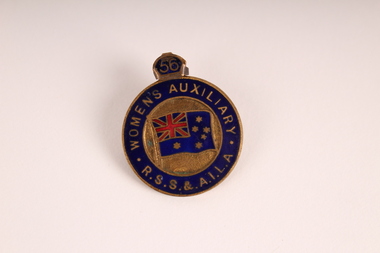
Metal badge, RSSA&AILA Women's Auxiliary Badge
... War (1914-1918). The auxiliaries grew from this beginning to raise money for the welfare of men and women who served and their widows and families. In Victoria, the RSL Women’s Council of Victoria is headquarters for Auxiliaries throughout Victoria. The aim of Women’s Council is to support the Auxiliaries, in assisting the Returned & Services League to give a helping hand to Service Members, their families and the wider community. RSL Sub-Branches and their Women’s Auxiliaries work...War (1914-1918). The auxiliaries grew from this beginning to raise money for the welfare of men and women who served and their widows and families. In Victoria, the RSL Women’s Council of Victoria is headquarters for Auxiliaries throughout Victoria. The aim of Women’s Council is to support the Auxiliaries, in assisting the Returned & Services League to give a helping hand to Service Members, their families and the wider community. RSL Sub-Branches and their Women’s Auxiliaries work ...The RSS&AILA was the name of the RSL in 1956, called Returned Sailors and Soldiers and Airmen Imperial League of Australia. The Australian Imperial Service of Women’s Auxiliary of the RSL was formed by mothers, wives, widows, sisters, daughters and aunts of men who served in the Australian Imperial Forces in the First World War (1914-1918). The auxiliaries grew from this beginning to raise money for the welfare of men and women who served and their widows and families. In Victoria, the RSL Women’s Council of Victoria is headquarters for Auxiliaries throughout Victoria. The aim of Women’s Council is to support the Auxiliaries, in assisting the Returned & Services League to give a helping hand to Service Members, their families and the wider community. RSL Sub-Branches and their Women’s Auxiliaries work together towards the same goals. As of August 2015 there are 64 Women’s Auxiliaries with approximately 1250 members. The Lara Ladies Auxiliary was disbanded in September 1952, due to not enough members to continue the auxiliary (the ladies from the beginning becoming too old – First World War). Those left promised to continue to support the RSL in all its future activities, which the ladies continue to do today as members and Associate members. Here is the last entry, dated 8th September, 1952: “Since our last meeting our President Mrs Marshall has passed away. It was decided that as there is not enough members to continue the Auxiliary the Lara Sub Branch was requested to have the Auxiliary disbanded. Assistance was promised the League by the ladies present in all its futher activities.” There were four present at this meeting. Signed by P. Walker, Hon Secretary and Treasurer.This badge is of historic significance as it represented a badge held by a member of the Ladies Auxiliary of the RSL in 1956.A metal circular badge with outer blue rim with words R.S.S.&.A.I.L.A. Women's Auxiliary. Inner gold circle has blue Australian flag. At top of badge is 56.On the reverse side of the badge is the stamped number 6965 -
 Lara RSL Sub Branch
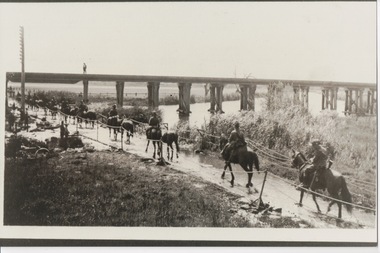
Photograph, Set 4 photographs. and others for Torquay Light Horse camp, 1940
... women enlisted at Torquay for service in WW2. Those who served in the Militia provided valuable Officers and NCOs and men for the armed services during the war. Each infantry division of the 2nd AIF had a Light Horse regiment attached to it. But the day of the Australian mounted soldier hadn’t quite passed. During World War II, Australia’s 6th Cavalry Regiment formed a mounted unit they called “The Kelly Gang” which did valuable scouting work...women enlisted at Torquay for service in WW2. Those who served in the Militia provided valuable Officers and NCOs and men for the armed services during the war. Each infantry division of the 2nd AIF had a Light Horse regiment attached to it. But the day of the Australian mounted soldier hadn’t quite passed. During World War II, Australia’s 6th Cavalry Regiment formed a mounted unit they called “The Kelly Gang” which did valuable scouting work ...These images capture for all time Light Horsemen travelling through Geelong on their way to camp at Torquay for the last Group meeting in Australia . information following - details obtained from .........https://torquayhistory.com/light-horse-brigade/ On Australia Day, 1997, Sir John Young unveiled this plaque on Point Danger, Torquay. Torquay history, Light Horse Training Camp, WW2 Plaque at Pt. Danger Note----- (See images to view plaque) The plaque identifies a significant event in Torquay’s history and the sentiments of ‘change’ for the Light Horse Brigade – from horses to machines. In 1940 the four Light Horse Regiments (4th, 8th, 13th and 20th), some 5000 Light Horse and 2000 horses camped and trained at Torquay. Three other regiments, formerly mounted on horses, were also at Torquay ‘mounted’ on privately owned trucks and cars. Division troops included Artillery, Engineers, Signals, Field Ambulance and other branches of the Army necessary to enable a Division to function. It wasn’t just the sheer numbers of men coming to this little town that made the event significant, it was also the fact that the men of the Light Horse were dramatic, almost glamorous figures and it is easy to see their exploits as some splendid adventure. Horses have played a special role in the story of Australia. They were the only means of transport across this huge country, so it was necessary for everyone to have the ability to ride a horse. When war broke out in 1899 between Britain and the Boers of South Africa (“Boer” was Dutch for “farmer”) Australia sent troops to fight. At first Britain was wary of using untried, unprofessional colonial cavalrymen but soon saw that the slouch-hatted Australian “bushmen” were a match for the fast-moving and unconventional mounted commandos of the Boers. The Australians proved themselves to be expert rough-riding horsemen and good shots. Bush life had hardened them to go for long periods with little food and water. They also showed remarkable ability to find their way in a strange country and use its features for cover, in both attack and defence. By 1914, when Australia joined the war against Germany, there were 23 Light Horse regiments of militia volunteers. Many men from these units joined the Light Horse regiments of the Australian Imperial Force (AIF). Men were given remounts (if not using their own horses) – army horses bought by Commonwealth purchasing officers from graziers and breeders. These were called “walers” because they were a New South Wales stockhorse type – strong, great-hearted animals with the strains of the thoroughbred and semi-draught to give them speed, strength and stamina. On 1st November, 1914, Australia’s First Infantry Division and the first four Light Horse regiments sailed for England in a fleet of transport ships. The first of the Light Horse arrived at Gallipoli in May without their horses. Back with their horses after Gallipoli, they were formidable combatants across the Sinai and Palestine. Some British commanders observed that the light horseman moved with a “lazy, slouching gait, like that of a sleepy tiger” but described how the promise of battle “changes that careless gait, into a live athletic swing that takes him over the ground much quicker than other troops”. They had Light Horse, Torquay, training campdeveloped a reputation as formidable infantrymen. The Turks called them “the White Ghurkas” – a reference to their deadly skill with the bayonet. The Arabs called them “The Kings of the Feathers”. The plume had originally been a battle honour of the Queensland Mounted Infantry for their work in the shearer’s strike of 1891. During WW1 it was adopted by almost all the Light Horse Regiments. It was the proud badge of the light horseman. The most famous of their battles was the attack on Beersheba- the charge of the 4th Light Horse Brigade. Mounted infantrymen and their superb walers had carried out one of the most successful cavalry charges in history – against what seemed impossible odds. They surprised the Turks by charging cavalry-style, when they would normally have ridden close to an objective then dismounted to fight. The fall of Beersheba swung the battle tide against the Turks in Palestine; and changed the history of the Middle East. While 19 men from the Surf Coast Shire served with the 4th Light Horse over the course of WW1, only four were involved in the charge of Beersheba- John GAYLARD, Philip QUINN.(Winchelsea); Wallace FINDLAY (Anglesea); Harry TRIGG (Bambra). After the war, Light Horse units played a key role in the Australian Government’s compulsory military training programme. The Citizen Military Forces (C.M.F.) thrived on the glamour of the wartime Light Horse tradition, ignoring the possibility that motor vehicles would soon replace the horses. When training was no longer compulsory, the C.M.F. regiments declined and horses became more of a luxury during the 1930s depression years of poverty and unemployment. Some regiments were motorised. Then, in 1939, Australia joined Britain in another world war. Training was increased for the militia at both home bases and regional training camps. The camp at Torquay in 1940, commanded by Major General Rankin, was at Divisional strength. By the end of the camp some felt that the Division was ready for active service. Gradually, over the next four years, the Australian Light Horse units were mounted on wheels and tracks and the horses were retired. Six men enlisted at the Torquay camp and another 57 men and women enlisted at Torquay for service in WW2. Those who served in the Militia provided valuable Officers and NCOs and men for the armed services during the war. Each infantry division of the 2nd AIF had a Light Horse regiment attached to it. But the day of the Australian mounted soldier hadn’t quite passed. During World War II, Australia’s 6th Cavalry Regiment formed a mounted unit they called “The Kelly Gang” which did valuable scouting work. In New Guinea, a mounted Light Horse Troop did patrol duty and helped carry supplies. Some fully equipped walers were flown into Borneo for reconnaissance in rugged mountain country. But by the end of the war, in 1945, the horse had disappeared from the Australian Army. References: Australian Light Horse Association www.lighthorse.org.au National Australia Archives Australian War Memorial Surf Coast Shire WW1 memorials www.togethertheyserved.com The Light horse- a Cavalry under Canvas Light Horse, Training Camp, Torquay, WW2 Late in 1939 it was decided to set up a Lighthorse training camp in Torquay to train both men and horses for the battles of the Second World War. Horses, men and equipment came on special trains from all over Victoria and NSW, and as you would expect horseman came from areas such as Omeo and Sale, the Wimmera and the Western District. They arrived at the Geelong racecourse for watering in the Barwon River and then were ridden across the ford at the breakwater and began their 11 mile trek to Torquay. Light Horse, Training Camp, Torquay, WW2 Tent city By the end of January 1940 the camp at Torquay accommodated some 5000 men and 2500 horses of the Second Cavalry Division. The rows of horses, tents and huts near Blackgate Road were quite a sight. While the cavalrymen engaged in exercises on the land and on the beaches, many of the troops took over the Torquay School for special training of men and officers. Mr Bob Pettit local farmer and Councillor for the Barrabool Shire, wrote about the Light horse in the Surf Coast Community News in 1985 saying “They used to travel about the district riding four abreast in one long convoy. To my annoyance they went through my property and shut all the gates behind them. I had certain gates open to let stock in to the water holes and it would take me three -quarters of an hour to follow the horsemen up and put all the gates right again” he continued “the men from the Light Horse were here when the fire went through in March 1940. He recalled an incident when early one morning, as some one blew the bugle, a soldier putting a white sheet on the line frightened the horses. They panicked and ran off in all directions. Six went over the cliff near Bird Rock, five were never found, and the rest were gathered up after nearly a fortnight in the bush around Addiscott and Anglesea" Light Horse, Training Camp, Torquay, WW2, Geelong Parade Geelong parade The training camp culminated in a parade through the streets of Geelong on March 12th 1940. The salute was given at the Town Hall and the troops continued on a route to the You Yang’s for a training exercise. Note-----(see media section for photograph) The Camp was abandoned in mid 1940 as it was deemed unsuitable for training during winter and the cost of a permanent camp could not be justified if it could not be used all year. Historic.......Rare,,,Interpretive.Sepia photographs.set of four ....post card size ....Horses &LighthorsemenNo 1, Lighthorsemen Regiment Geelong 1940......No 2 Light Horse at Breakwater Geelong 1938 to 1940....No 3 Light Horse at Breakwater Geelong 1938 to 1940.....No 4 Light Horse crossing Breakwater camped at Geelong Showgrounds. These markings are on reverse of photographs.light horsemengeelong 1940., world war 2 -
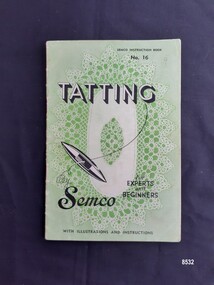 Flagstaff Hill Maritime Museum and Village
Book - Craft book, Norma Benporath, Tatting, circa 1940's
... war effort. He even suggested that women be encouraged to produce needlework items (and play a part in the war effort) by sending them as presents, to the troops up north. He also heaped praise on the Semco workplace - noting that no Saturday work...war effort. He even suggested that women be encouraged to produce needlework items (and play a part in the war effort) by sending them as presents, to the troops up north. He also heaped praise on the Semco workplace - noting that no Saturday work ...Tatting is a form of knotted lace making using thread and a small shuttle. Twisted threads are tied around or through small, pointed shuttles that can be made of bone, mother of pearl, tortoise shell, steel or plastic. This produces a stable, strong lace using simple knots of two half hitches to make rings and chains embellished with picots. The origins of tatting are not clear but early versions of decorative knotting were used by the Egyptians on their ceremonial dress. Tatting also has elements of fishermen's net making techniques and the decorative knotting that was practiced by aristocratic women from the 15th century. Tatting, as we know it today, emerged in the first half of the 19th century. The new availability of mercerised thread from 1835 encouraged a burgeoning of lace crafts of all sorts. It was known in Italy as "occhi" and in France as "la frivolite". Tatting looks fragile but is both strong and durable. An article in a column named "Wives and Daughters" published in the Star newspaper in May 1910 describes the durability of tatting lace - "there is edging and insertion still in existence that have outworn two sets of pillow slips." In the 19th century and well into the 20th century, tatting was used like crochet and knitted lace for decorative edgings, collars, doilies, tray cloths etc. At first, different tatting patterns were passed along by word of mouth from person to person, however in time, patterns regularly appeared in newspapers and magazines well into the 1950's. This book has photographs and detailed instructions for a wide range of tatted edgings and insertions suitable for household linens such as towels, doilies and tablecloths as well as patterns for whole mats. Stanley E. Mullen (a businessman) developed Semco Pty Ltd which began as a Melbourne based importation company in 1907. The first three letters of Semco's name were his initials. In 1915 it began manufacturing women's apparel, whitework and transfer patterns. In 1924 the company moved to Black Rock, Victoria and continued to produce an extensive range of needlework patterns and handcraft instruction booklets, threads etc. up until the late 1970's. Semco had a staff that included many young women. It was noted by E.J. Trait (editor of the local newspaper "Standard News") that the firm provided them with good working conditions and the correct rate of pay for women in a time of war - the starting rate for 15 year olds, mainly girls at Semco was 25 shillings per week. During World War 2, Manpower Regulations could be used to coerce workers to move into jobs that supported the war effort, but Trait argued that being employed at Semco could make this unlikely as the firm made some goods essential for the war effort. He even suggested that women be encouraged to produce needlework items (and play a part in the war effort) by sending them as presents, to the troops up north. He also heaped praise on the Semco workplace - noting that no Saturday work was the norm, allowing employees to shop and have "hair-do's" before enjoying a relaxing weekend! Semco also had a female cricket side in the women's Saturday association. After the war the firm stayed in production until the early 1990's when it was taken over by Coates-Paton Pty Ltd. Norma Benporath (1900 - 1998) was an expert in tatting techniques and taught and published extensively on the subject. She was born in New Zealand with impaired sight but cataract surgery restored 50% vision to one eye. She was inspired to learn tatting whilst watching her aunt tat and being told that tatting did not require as much sharp vision as embroidery. She quickly learnt to design her own patterns and published over 1000 tatted lace patterns between 1929 and 1952. She became a regular contributor to magazines (such as Home Beautiful) and newspapers across Australia. Her designs were also published in New Zealand, South Africa as well as the U.K. and U.S.A. When Semco, a thread manufacturer, noticed a rise in the sale of fine crochet threads, they realized they had an untapped market to explore. Norma designed a collection of tatting patterns for Semco that were used to help promote their threads. Norma also worked with Semco to produce a line of threads and shuttles specifically suited to tatting. In 1997, Norma was inducted into the "Order of Australia" for "Service to the craft of tatting as a designer and through the international publication of her patterns".This item is an excellent example of the needle work being enjoyed by women in the 1940's in Australia and the skills of the Australian designer, Norma Benporath. It is also an example of the trend that emerged for craft companies such as Semco to publish pattern books in order to advertise their own materials.A 32 page soft cover instruction book with green front and back covers showing two tatted doily designs. The book includes black and white photographs and written patterns by Norma Benporath.Front cover - "TATTING" "For / EXPERTS/ and / BEGINNERS" "By/Semco" "SEMCO INSTRUCTION BOOK" "No. 16" "WITH ILLUSTRATIONS AND INSTRUCTIONS" "9" Back cover - "FOR INSTRUCTIONS FOR WORKING SEE PAGE 22" "Published by Semco Pty. Ltd." "BLACK ROCK, 29, VIC"flagstaff hill maritime museum and village, warrnambool, great ocean road, tatting, tatting instruction book, tatting patterns, tatting shuttle, semco, semco pty ltd, norma benporath, needlework, handcrafts, household linen, craftwork -
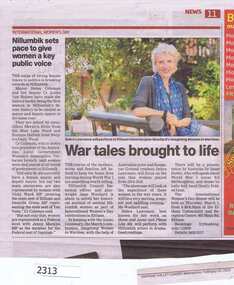 Greensborough Historical Society
Newspaper Clipping, War tales brought to life, 15/02/2015
... In March 2015 Jane Woollard (author) and Debra Lawrence (performer) presented work focussing on the lives of women during World War I....In March 2015 Jane Woollard (author) and Debra Lawrence (performer) presented work focussing on the lives of women during World War I. jane woollard world war i debra lawrence News clipping, black text, colour image. ...In March 2015 Jane Woollard (author) and Debra Lawrence (performer) presented work focussing on the lives of women during World War I.News clipping, black text, colour image.jane woollard, world war i, debra lawrence -
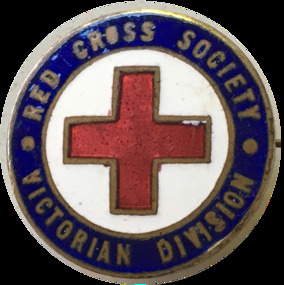 City of Moorabbin Historical Society (Operating the Box Cottage Museum)
Badge - WWI Red Cross Buttons
... work to include many forms of humanitarian aid in times of peace and war. The Australian Red Cross Society (ARCS) was formed just after the outbreak of the First World War in August 1914, originally as a branch of the British Red Cross. It is especially remembered in the provision of “comforts” for soldiers overseas. Enormous sums of money were raised, and thousands of women...work to include many forms of humanitarian aid in times of peace and war. The Australian Red Cross Society (ARCS) was formed just after the outbreak of the First World War in August 1914, originally as a branch of the British Red Cross. It is especially remembered in the provision of “comforts” for soldiers overseas. Enormous sums of money were raised, and thousands of women ...The International Committee of the Red Cross was formed in 1862. Initially its purpose was to try and find ways of overcoming the inadequacy of army medical services so as to alleviate the suffering of those wounded in armed conflict. Over time it has extended its work to include many forms of humanitarian aid in times of peace and war. The Australian Red Cross Society (ARCS) was formed just after the outbreak of the First World War in August 1914, originally as a branch of the British Red Cross. It is especially remembered in the provision of “comforts” for soldiers overseas. Enormous sums of money were raised, and thousands of women volunteers contributed their time by making vast quantities of clothing: socks, vests, mittens, mufflers, pyjamas and a variety of linen. Items were sent to headquarters located in the state capitals, often using government houses as depots, where, after being sorted and packed by yet more volunteers, they were sent to Britain or the front. The effect of this work for the recipients was to bring comfort in its truest sense, for a seemingly trivial gift of a bar of chocolate of a pair of dry socks could bring the most profound relief for a soldier on the Western Front. From the date of its inception until the armistice the ARCS dispatched 395,695 food parcels and 36,339 clothing parcels Between 1914 and 1918 more than £3,500,00 was collected and spent on Red Cross services to the Australian Forces and Empire Forces. During WW1 and WW2 Red Cross raised funds selling buttons.Early settlers in Moorabbin Shire held fundraising events for the support of Red Cross Victoria and made cakes and knitted socks, gloves and scarves for distribution to serving men and women Metal buttons with printing on themRed Crossred cross, fund raising buttons, wwi, wwii, french red cross, british red cross, market gardeners, early settlers, moorabbin shire, bentleigh, cheltenham, caulfield repatriation hospital -
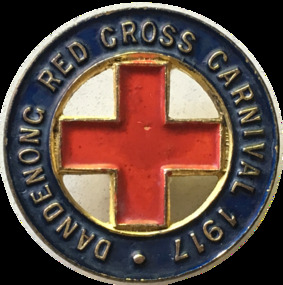 City of Moorabbin Historical Society (Operating the Box Cottage Museum)
Badge - Red Cross - Springvale, 1917
... work to include many forms of humanitarian aid in times of peace and war. The Australian Red Cross Society (ARCS) was formed just after the outbreak of the First World War in August 1914, originally as a branch of the British Red Cross. It is especially remembered in the provision of “comforts” for soldiers overseas. Enormous sums of money were raised, and thousands of women...work to include many forms of humanitarian aid in times of peace and war. The Australian Red Cross Society (ARCS) was formed just after the outbreak of the First World War in August 1914, originally as a branch of the British Red Cross. It is especially remembered in the provision of “comforts” for soldiers overseas. Enormous sums of money were raised, and thousands of women ...The International Committee of the Red Cross was formed in 1862. Initially its purpose was to try and find ways of overcoming the inadequacy of army medical services so as to alleviate the suffering of those wounded in armed conflict. Over time it has extended its work to include many forms of humanitarian aid in times of peace and war. The Australian Red Cross Society (ARCS) was formed just after the outbreak of the First World War in August 1914, originally as a branch of the British Red Cross. It is especially remembered in the provision of “comforts” for soldiers overseas. Enormous sums of money were raised, and thousands of women volunteers contributed their time by making vast quantities of clothing: socks, vests, mittens, mufflers, pyjamas and a variety of linen. Items were sent to headquarters located in the state capitals, often using government houses as depots, where, after being sorted and packed by yet more volunteers, they were sent to Britain or the front. The effect of this work for the recipients was to bring comfort in its truest sense, for a seemingly trivial gift of a bar of chocolate of a pair of dry socks could bring the most profound relief for a soldier on the Western Front. From the date of its inception until the armistice the ARCS dispatched 395,695 food parcels and 36,339 clothing parcels Between 1914 and 1918 more than £3,500,00 was collected and spent on Red Cross services to the Australian Forces and Empire Forces. During WW1 and WW2 Red Cross raised funds selling buttons.This Carnival was an example of the support given to Red Cross by market gardeners, early settler families and schools in Moorabbin ShireDandenong Red Cross Carnival 1917red cross, dandenong, springvale, chelsea, dingley, keysborough -
 Orbost & District Historical Society
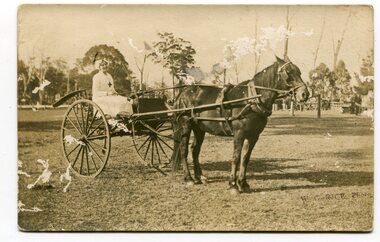
Photograph - photograph of Ethel Lynn, W C Rice, 1914-1918
... War I. She is wearing the uniform of women who engaged in fundraising for the War. Ethel was the only child of Samuel J Lynn and Elizabeth Jane Lynn (nee Warren) who farmed at Jarrahmond and bred Clydesdale horses. After the War, Ethel trained as a nurse in Melbourne at the Royal Victorian Nurses' Association. She later worked...War I. She is wearing the uniform of women who engaged in fundraising for the War. Ethel was the only child of Samuel J Lynn and Elizabeth Jane Lynn (nee Warren) who farmed at Jarrahmond and bred Clydesdale horses. After the War, Ethel trained as a nurse in Melbourne at the Royal Victorian Nurses' Association. She later worked ...This is a photograph printed onto a postcard of Ethel Lynn. She is competing in the Orbost Show, sometime during World War I. She is wearing the uniform of women who engaged in fundraising for the War. Ethel was the only child of Samuel J Lynn and Elizabeth Jane Lynn (nee Warren) who farmed at Jarrahmond and bred Clydesdale horses. After the War, Ethel trained as a nurse in Melbourne at the Royal Victorian Nurses' Association. She later worked as a nurse in England and also in Orbost. The Australian Red Cross Society (ARCS) was formed just after the outbreak of the First World War in August 1914, originally as a branch of the the British Red Cross. It came into being as a branch of the British Red Cross Society on August 13th 1914 to succour the wounded in the First World War.This photograph is significant because it is of a local Orbost district person, Ethel Lynn. Her uniform shows that she is involved with fundraising for the First World War. A sepia coloured photograph on a postcard. A woman in a white dress, with a white cap on her head, and a red cross on her front is sitting in a buggy pulled by one horse. The background shows trees and a fence.W C RICE photo on front right Ethel Lynn, Ist Prize Lady Driver, Old Show Ground is written in pencil on the back. ethel lynn, world war i fundraising, orbost show, australian red cross -
 Orbost & District Historical Society
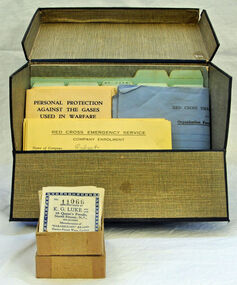
Red Cross Box, 1939
... women's efforts on the home front to support the nation during WWI and WWII were monumental. They worked tirelessly for Red Cross in response to the national emergency, serving the humanitarian needs of the nation. Women produced millions of pounds worth of in-kind support through volunteer labour and goods, sending an astonishing volume of goods overseas to servicemen and prisoners of war. ...This box was donated by Mary Gilbert who was the Orbost Red Cross Superintendent. Australian women's efforts on the home front to support the nation during WWI and WWII were monumental. They worked tirelessly for Red Cross in response to the national emergency, serving the humanitarian needs of the nation. Women produced millions of pounds worth of in-kind support through volunteer labour and goods, sending an astonishing volume of goods overseas to servicemen and prisoners of war. They knitted and sewed socks, towels and vests for soldiers.A black Red Cross box containing training cards, forms and badges. The box is made of card and covered in black fabric.red-cross gilbert-mary world-war-11 -
 Orbost & District Historical Society
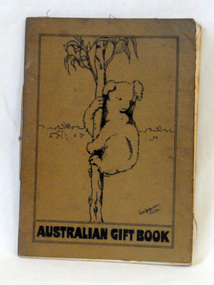
gift book, Australian armed Forces, Australian Gift Book, 1916
... War I local women's groups in Australia began working to provide provide tobacco, cakes, puddings, condensed milk, sugar, biscuits, newspapers and other 'luxury' items to supplement the Australian soldier's army rations. These fund-raising bodies were amalgamated in 1916 to form a national body, The Australian Comforts Fund (ACF), which undertook to provide 'comforts' to all Australians abroad. Sales of this book raised funds for The Australian Comforts Fund. A thin book with a brown fabric cover. On the cover is a black line drawing of a koala in a tree. It contains a summary of the work ...Early in World War I local women's groups in Australia began working to provide provide tobacco, cakes, puddings, condensed milk, sugar, biscuits, newspapers and other 'luxury' items to supplement the Australian soldier's army rations. These fund-raising bodies were amalgamated in 1916 to form a national body, The Australian Comforts Fund (ACF), which undertook to provide 'comforts' to all Australians abroad. Sales of this book raised funds for The Australian Comforts Fund.A thin book with a brown fabric cover. On the cover is a black line drawing of a koala in a tree. It contains a summary of the work done by the Australian Comforts Funds at the front, Anzac and Mudros, at the camps in Egypt with a summary of gifts and statement of accounts.The book sold for 3/- or 15 P.T. in aid of the A.C.F. It was edited by William Beit. -
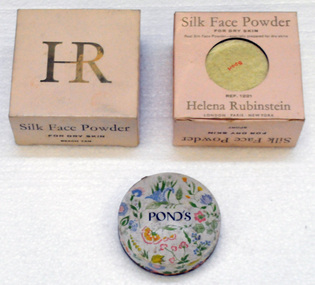 Orbost & District Historical Society
face powder, mid 20th century
... work - in accountants’ offices and also trained as a comptometrist with Burroughs in London. She came from a middle-class, working, church-going family. Her mother was a milliner who mademany of Marjorie’s clothes, hats and outfits. Marjorie married in 1938 to a salesman who later became a mechanic in the R.A.F. during WW11 In the 1940’s women’s makeup was a huge industry. Despite war ...These items were owned by Marjorie Burton. Marjorie Burton ( nee Whiteman), born 12 June, in Birmingham, England came to Orbost in 1995. In England she did office work – typing, shorthand and secretarial work - in accountants’ offices and also trained as a comptometrist with Burroughs in London. She came from a middle-class, working, church-going family. Her mother was a milliner who mademany of Marjorie’s clothes, hats and outfits. Marjorie married in 1938 to a salesman who later became a mechanic in the R.A.F. during WW11In the 1940’s women’s makeup was a huge industry. Despite war rationing, women began using makeup from the teens onwards. Cosmetics were an important part of most women's personal effects.Three containers of face powder. 2483.54 is a circular container, white with coloured flowers - the "Dreamflower Pattern". It contains some powder. 2483.55 and 2483.56 are pink boxes with gold print. 2483.54 : on base ; green text on white - Pond's Face Powder Suntan Made by Pond's Extract Co Ltd Perrivale Middx 2483.55 : Helena Rubinstein HR Silk Face Powder for Dry Skin Sport Boots 10/6 2483.56 : Helena Rubinstein HR Silk Face Powder for dry skin Beach Tan Inside is Exclusive Boots offer 6d off Your Next Purchase of Chikka pantiescosmetics skincare burton-marjorie -
 Eltham District Historical Society Inc
Audio - Audio Recording, Dr Geoffrey Sandy - Soldier Welcome Home Committees, 10 Jun. 2023
... The work of these committees is an important part of our war history, and our volunteer history. As women...The work of these committees is an important part of our war history, and our volunteer history. As women ...EDHS Newsletter No. 270 June 2023 At our next meeting at 2.00pm on Saturday 10th June 2023 we are pleased to have Dr. Geoffrey Sandy to present to us on the WW1 Soldier Welcome Home Committees, with specific reference to Eltham. Geoffrey is an author, parish historian and parish archivist for St Margaret’s Anglican Church in Eltham. Soldier Welcome Home Committees (SWHC) were established throughout Australia during WW1 by the soldier’s local community - their home. Despite WW1 being a well-researched area of Australian history, little has been published on the SWHCs. The work of these committees is an important part of our war history, and our volunteer history. As women were often well-represented, and active within the SWHCs, it is also important to our history of Australian women. Geoff has undertaken a detailed case study of the Soldier Welcome Home Committee at Eltham (SWHCE). During the WW1 period Eltham can be described a small rural community. What is fortunate is that the Minute Books of the SWHC Eltham meetings are extant and readily accessible, as these are held in the archives of Saint Margaret’s Anglican Church Eltham.1:17:13 duration Digital MP3 file; 26.5MBaudio recording, eltham district historical society, meeting, society meeting, eltham, avenue of honour, dr geoffrey sandy, welcome home committee
