
Showing 42 items matching "wood / wind "
-
 Moorabbin Air Museum
Book - Wooden aircraft, Aircraft Woodwork
... Wood / wind & sky...Wooden aircraft Wood / wind & sky Materials & equipment Construction - fuselage & tail Wings Construction of spars Construction of ribs Making bows Wing assembly Repair of airframes & wings Overview of building an aircraft with wood, circa 1972 Aircraft Woodwork Book Wooden aircraft ...Overview of building an aircraft with wood, circa 1972non-fictionOverview of building an aircraft with wood, circa 1972wood / wind & sky, materials & equipment, construction - fuselage & tail, wings, construction of spars, construction of ribs, making bows, wing assembly, repair of airframes & wings -
Glenelg Shire Council Cultural Collection
Banner - Banner - Tomorrow's Possibilities, Nov-10
... Banner, white vinyl, printed in colour both sides (same images); aerial view, showing Port and related industries - Pivot, wood chips, wind tower parts. Port of Portland 50th anniversary logo along bottom of banner. ...Banner, white vinyl, printed in colour both sides (same images); aerial view, showing Port and related industries - Pivot, wood chips, wind tower parts. Port of Portland 50th anniversary logo along bottom of banner. ... -
 Flagstaff Hill Maritime Museum and Village
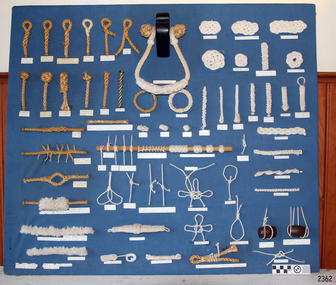
Education kit - Knot Board, Tom Long, DSM (Member of International Guild of Knot Tyers), ca 1975 to 1986
... wood. An example is a simple rope ladder. Lengths could be combined to make various thicknesses, and pieces could be skilfully joined together by splicing. The importance of knots in seafaring cannot be overestimated. When ships relied on only the wind ...The Display Board of Konts was handmade in Kings Lynn, Devon, England, by Tom Long DSM, a member of the International Guild of Knot Tyers. Tom Long more recently lived in a suburb of Melbourne. This display board shows the knots and joins used in ropework performed by a sailmaker and other skilled knot tyers and ropeworkers. It demonstrates the uses of some of the knots, such as knobs and handles, suspending lengths of wood, reinforcing spliced rope and even for decorative work. The sailmakers, travelling as part of the ship’s crew, stored their tool kit in a canvas ditty bag. It contained needles, awls, a sailmaker’s leather-palmed glove with a heavily reinforced palm, a shuttle to mend and make nets, fids, knives, mallets, brushes, rulers, and rope gauges. Sailmakers used their ropework and knot-making skills for various purposes and chose the type of rope fibre for its particular properties. For example, Italian hemp rope was preferred for the light line used in shore-to-ship rescues because it was lightweight, not easily knotted, and absorbed less water. A supply of various types of rope was a commodity on board a ship and on land in the new colonies. It was flexible, easily stored, and could be worked to create an endless variety of objects on its own or with other materials like wood. An example is a simple rope ladder. Lengths could be combined to make various thicknesses, and pieces could be skilfully joined together by splicing. The importance of knots in seafaring cannot be overestimated. When ships relied on only the wind for power and speed, there were a huge number of various ropes in use, particularly about the sails and rigging. Seafarers would be judged on their ability to tie knots speedily and correctly. A mounted display of authentic seamen's knots is on a board covered in blue fabric. Various rope grades and fibres were used to work numerous knots and splices. Some of the uses are familiar, such as the toggle, the pineapple knot, and the Turk’s head. A selection of rope grades and fibres was used to work numerous knots and splices. Some of the uses are familiar, such as the toggle, the pineapple knot, and the Turk’s head. The name or purpose of the knot is on the label below it. Labels below each knot give its name or use.flagstaff hill, warrnambool, maritime museum, maritime village, great ocean road, shipwreck coast, knot display, knot making, ropework, marine technology, sailmaker's work, sailor's knots, ship's rigging, seamen's knots, handmade, rope craft, knots, splices, display board of knots, knot board, tom long, sailmaker's knots, mariner's knots -
 Flagstaff Hill Maritime Museum and Village
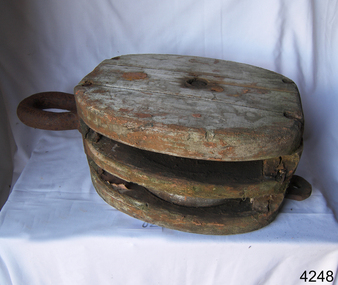
Equipment - Block, Late 19th to early 20th century
... It represents part of the rigging required to set the sails on a wind-powered vessel. flagstaff hill warrnambool shipwrecked-coast flagstaff-hill flagstaff-hill-maritime-museum maritime-museum shipwreck-coast flagstaff-hill-maritime-village block sailing block two-sheave block 2 sheave wood block marine technology sailing equipment rigging rigging block A two sheave wood sailing block with metal hook and becket. ...A sailing block is single or multiple pulleys with one or more sheaves that are enclosed in an assembly between cheeks or chocks. In use, a block is fixed to the end of a line, to a spar, or a surface. A rope line is reeved through the sheaves, and maybe through one or more matching blocks at the far end, to make up what's known as a tackle. The purchase of a tackle refers to its mechanical advantage. In general, the more sheaves in the blocks that make up a tackle, the higher its mechanical advantage. The matter is slightly complicated by the fact that every tackle has a working end where the final run of rope leaves the last sheave. More mechanical advantage can be obtained if this end is attached to the moving load rather than the fixed end of the tackle. Various types of blocks are used in sailing. Some blocks are used to increase mechanical advantage and others are used simply to change the direction of a line. A ratchet block turns freely when a line is pulled in one direction but does not turn in the other direction, although the line may slip past the sheave. This kind of block makes a loaded line easier to hold by hand and is sometimes used on smaller boats for lines like main and jib sheets that are frequently adjusted. A single, large, sail-powered warship in the mid-19th century required more than 1,400 blocks of various kinds and sizes.A historic item from an old sailing vessel from the late 19th to early 20th century, unfortunately. It represents part of the rigging required to set the sails on a wind-powered vessel.A two sheave wood sailing block with metal hook and becket. One sheave missing. flagstaff hill, warrnambool, shipwrecked-coast, flagstaff-hill, flagstaff-hill-maritime-museum, maritime-museum, shipwreck-coast, flagstaff-hill-maritime-village, block, sailing block, two-sheave block, 2 sheave wood block, marine technology, sailing equipment, rigging, rigging block -
 Flagstaff Hill Maritime Museum and Village
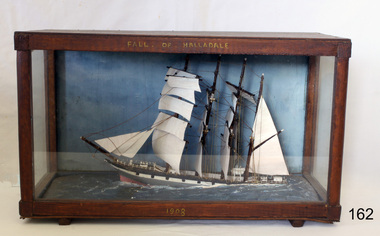
Craft - Ship Model, Falls of Halladale, 1886-1910
... winds barque trade vessel wright breakenridge & co ricer clyde On top of case frame "FALLS OF HALLADALE" and on base of case frame "1908". Paper on back of case has inscription "Frank Davey " (See note section this document for details on Frank Davey) Ship mode,l Falls of Halladale, four masted ship diorama. Glass case with wood ...The Falls of Halladale was an iron-hulled, four-masted barque, used as a bulk carrier of general cargo. She left New York in August 1908 bound for Melbourne and Sydney. In her hold was general cargo consisting of roofing tiles, barb wire, stoves, oil, and benzene as well as many other manufactured items. After three months at sea and close to her destination, a navigational error caused the Falls of Halladale to be wrecked on a reef off the Peterborough headland on the 15th of November, 1908. The captain and 29 crew members survived, but her cargo was largely lost, despite two salvage attempts in 1908-09 and 1910. The Court of Marine Inquiry in Melbourne ruled that the foundering of the ship was entirely due to Captain David Wood Thomson's navigational error, not too technical failure of the Clyde-built ship. The Falls of Halladale was built in1886 by Russell & Co., at Greenock shipyards on the River Clyde, Scotland for Wright, Breakenridge & Co of Glasgow. She was one of several designs of Falls Line of ships named after waterfalls in Scotland. The company had been founded between 1870- 1873 as a partnership between Joseph Russell, Anderson Rodger, and William Todd Lithgow. During the period 1882-92 Russell & Co. standardised designs, which sped up their building process so much that they were able to build 271 ships during that time. The Falls of Halladale had a sturdy construction built to carry maximum cargo and able to maintain full sail in heavy gales, one of the last of the 'windjammers' that sailed the Trade Route. She and her sister ship, the Falls of Garry, were the first ships in the world to include fore and aft lifting bridges. Previous to this, heavily loaded vessels could have heavy seas break along the full length of the deck, causing serious injury or even death to those on deck. The new, raised catwalk-type decking allowed the crew to move above the deck in stormy conditions. The Falls of Halladale shipwreck is listed on the Victorian Heritage (No. S255). She was one of the last ships to sail the Trade Routes from Europe and the Americas. Also of significance is that the vessel was one of the first ships to have fore and aft lifting bridges as a significant safety feature still in use on modern vessels today. The subject model is an example of an International Cargo Ship used during the 19th and early 20th centuries to transport goods around the world and representing aspects of Victoria’s shipping industry. Ship mode,l Falls of Halladale, four masted ship diorama. Glass case with wood frame. Paper on back of case with inscription "Frank Davey etc" Case frame has title "Falls of Halladale" and date on base of wood frame is" 1908". It was a four-masted iron-hulled barque.On top of case frame "FALLS OF HALLADALE" and on base of case frame "1908". Paper on back of case has inscription "Frank Davey " (See note section this document for details on Frank Davey)flagstaff hill, warrnambool, shipwrecked coast, flagstaff hill maritime museum, flagstaff hill maritime village, great ocean road, shipwreck peterborough vic, ship model, fall of halladale ship, trade winds, barque, trade vessel, wright, breakenridge & co, ricer clyde -
Blacksmith's Cottage and Forge
Clock, 1880's
... wood surround. Roman numerals on clock face. Face and pendulum covered with glass door. Two winders in front face. ...wood surround. Roman numerals on clock face. Face and pendulum covered with glass door. Two winders in front face. ...Local HistoryOrnamental mantle (shelf) clock with carved dark wood surround. Roman numerals on clock face. Face and pendulum covered with glass door. Two winders in front face. "Man. Ansonia Co. New york - United States of America" on faceclock, ansonia, new york, pendulum, mantle, shelf -
 Federation University Historical Collection
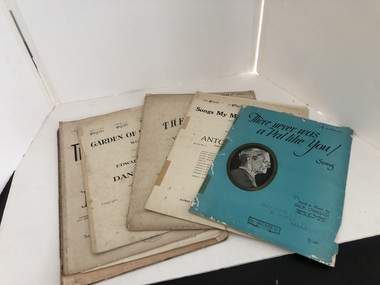
Book, Music Books from Suttons Music
... wood...there never was a pal like you...jack o'hagan...the bridge...vocal duet...miss m lindsay...mrs j worthington bliss...songs my mother taught me...anton dvorak...blue danube...suttons brass band journal...johann strauss...macushla...josephine v rowe...dermot macmurrough...boosey and co...allans music...candle in the wind...Henry Sutton taught Applied Electricity at the Ballarat School of Mines in 1883 to 1886. music books suttons music Calvary henry vaughan paul rodney enoch and sons herzelied gustav lange j.t. trekell hanover edition the desert song one alone kathryn grayson gordon mcrae otto harbach oscar hammerstein frank mandel sigmund romberg the link divine alfred h. hyatt piccolomini one fine day aria madame butterfly opera r.h elkin giacomo puccini garden of happiness edward lockton daniel wood there never was a pal like you jack o'hagan the bridge vocal duet miss m lindsay mrs j worthington bliss songs my mother taught me anton dvorak blue danube suttons brass band journal johann strauss macushla josephine v rowe dermot macmurrough boosey and co allans music candle in the wind elton john bernie taupin treasure chest of stephen foster songs eddie fisher song folio cindy oh cindy oh my pa-pa anytime I need you now then i'll be happy sweet heartaches dungaree doll im in the mood for love what a wonderful world it would be hermann lohr i heard you singing royden barrie eric coates when you come home fred e weatherly w.h squire lay down your arms anne shelton leon land ake gerhard john m williams and shaylor turners vey first piano book i went to your wedding jessie may robinson patti page mercury records he's got the whole world in his hands geoff love sway quien sera pablo beltran ruiz paul lombard norman gimbel just because the violets kennedy russell edwin ashdown ltd friends of my youth mr w burton christy's minstrels george barker ideal music books poet and peasant melody in f spring song love and devotion the storm nachtstuck rondoletto blue danube waltzes over the waves waltzes nearer my god to thee mignon gavotte warum miss clara butt idle words stephen adams menuetin no. 2 the mill liebestraum tarantelle la matinee menuet la paloma the dove gipsy rondo crescendo chanson triste romance tocatta in a thora john mccormack john harrison ivor foster preclude c# minor beautiful star of heaven sirens song marche militaire fifth nocturne sweet bye and bye turkish patrol valse des fleurs melody of love traumerei a fragment just for to-day sybil f partridge blanche ebert seaver australian music examinations board pianoforte-grade III the chappell wonder album of music slave song the lass with the delicate air the bandolero chorus gentlemen i'll sing thee songs of araby jest her way venetian song gray days god's garden folie bergere weymouth chimes un peu d'amour you'll love me yet s. coleridge taylor george sutton happy-go-lucky pete a very happy foxtrot i know the rose fred hall the prisoners child waltz ballad russ johnston pilgrim's cross h.l d'arcy jaxone frederic n. lohr harper kearton marie vagnolini suttons manuscript music book pianoforte studies public examinations in music light cavalry marche hongroise rondo alla turca moonlight sonata witches flight home sweet home narcissus wedding march sehnsucht joyful peasant les adieux love the pedlar caryl battersby edward german where will the dimple be rosemary clooney bob merrill al hoffman buttons and bows jay livingstone ray evans bob hope glen williams british songs cyril scott cherry ripe the minstrel boy blythe and merry she was by yon bonnie banks all through the night coming thro the rye i'll bid my heart be still classical fragments beethoven's adieu w. millward wake up a calendar of song harold simpson montague f. phillips ain't misbehavin' andy razaf thomas waller harry brooks robert a nelson the ideal manuscript book the riff song it one flower grows alone in your garden ebb tide carl sigman robert maxwell i'm in the mood for love jimmy mchugh dorothy fields muskat ramble edward ory night of stars and night of love tales of hoffmann offenbach the great pretender jimmy parkinson jerry duanne barry frank stan freberg the platters bert visser love is a golden ring rich dehr frank miller terry gilkyson ernie sigley d. trickey four musical cameos gavotte lullaby goblins when children play frank hutchens just a closer walk with thee jimie rodgers west of the wall wayne shanklin toni fisher Collection of music books that were available for purchase at Sutton's Music Music Books from Suttons Music Book ...Henry Sutton is a talented world-wide accepted inventor with inventions relating to the telephone, photography, wireless, cars, motorcycles, and bicycles as well as many more inventions. Henry was also one of four brothers that ran the Sutton's Music Store after the death of their Father Richard Sutton. Henry Sutton taught Applied Electricity at the Ballarat School of Mines in 1883 to 1886.Collection of music books that were available for purchase at Sutton's Musicmusic books, suttons music, calvary, henry vaughan, paul rodney, enoch and sons, herzelied, gustav lange, j.t. trekell, hanover edition, the desert song, one alone, kathryn grayson, gordon mcrae, otto harbach, oscar hammerstein, frank mandel, sigmund romberg, the link divine, alfred h. hyatt, piccolomini, one fine day, aria, madame butterfly opera, r.h elkin, giacomo puccini, garden of happiness, edward lockton, daniel wood, there never was a pal like you, jack o'hagan, the bridge, vocal duet, miss m lindsay, mrs j worthington bliss, songs my mother taught me, anton dvorak, blue danube, suttons brass band journal, johann strauss, macushla, josephine v rowe, dermot macmurrough, boosey and co, allans music, candle in the wind, elton john, bernie taupin, treasure chest of stephen foster songs, eddie fisher song folio, cindy oh cindy, oh my pa-pa, anytime, i need you now, then i'll be happy, sweet heartaches, dungaree doll, im in the mood for love, what a wonderful world it would be, hermann lohr, i heard you singing, royden barrie, eric coates, when you come home, fred e weatherly, w.h squire, lay down your arms, anne shelton, leon land, ake gerhard, john m williams and shaylor turners vey first piano book, i went to your wedding, jessie may robinson, patti page, mercury records, he's got the whole world in his hands, geoff love, sway, quien sera, pablo beltran ruiz, paul lombard, norman gimbel, just because the violets, kennedy russell, edwin ashdown ltd, friends of my youth, mr w burton, christy's minstrels, george barker, ideal music books, poet and peasant, melody in f, spring song, love and devotion, the storm, nachtstuck, rondoletto, blue danube waltzes, over the waves waltzes, nearer my god to thee, mignon gavotte, warum, miss clara butt, idle words, stephen adams, menuetin no. 2, the mill, liebestraum, tarantelle, la matinee, menuet, la paloma, the dove, gipsy rondo, crescendo, chanson triste, romance, tocatta in a, thora, john mccormack, john harrison, ivor foster, preclude c# minor, beautiful star of heaven, sirens song, marche militaire, fifth nocturne, sweet bye and bye, turkish patrol, valse des fleurs, melody of love, traumerei, a fragment, just for to-day, sybil f partridge, blanche ebert seaver, australian music examinations board, pianoforte-grade iii, the chappell wonder album of music, slave song, the lass with the delicate air, the bandolero, chorus gentlemen, i'll sing thee songs of araby, jest her way, venetian song, gray days, god's garden, folie bergere, weymouth chimes, un peu d'amour, you'll love me yet, s. coleridge taylor, george sutton, happy-go-lucky pete a very happy foxtrot, i know the rose, fred hall, the prisoners child, waltz ballad, russ johnston, pilgrim's cross, h.l d'arcy jaxone, frederic n. lohr, harper kearton, marie vagnolini, suttons manuscript music book, pianoforte studies, public examinations in music, light cavalry, marche hongroise, rondo alla turca, moonlight sonata, witches flight, home sweet home, narcissus, wedding march, sehnsucht, joyful peasant, les adieux, love the pedlar, caryl battersby, edward german, where will the dimple be, rosemary clooney, bob merrill, al hoffman, buttons and bows, jay livingstone, ray evans, bob hope, glen williams, british songs, cyril scott, cherry ripe, the minstrel boy, blythe and merry she was, by yon bonnie banks, all through the night, coming thro the rye, i'll bid my heart be still, classical fragments, beethoven's adieu, w. millward, wake up, a calendar of song, harold simpson, montague f. phillips, ain't misbehavin', andy razaf, thomas waller, harry brooks, robert a nelson, the ideal manuscript book, the riff song, it, one flower grows alone in your garden, ebb tide, carl sigman, robert maxwell, i'm in the mood for love, jimmy mchugh, dorothy fields, muskat ramble, edward ory, night of stars and night of love, tales of hoffmann, offenbach, the great pretender, jimmy parkinson, jerry duanne, barry frank, stan freberg, the platters, bert visser, love is a golden ring, rich dehr, frank miller, terry gilkyson, ernie sigley, d. trickey, four musical cameos, gavotte, lullaby, goblins, when children play, frank hutchens, just a closer walk with thee, jimie rodgers, west of the wall, wayne shanklin, toni fisher -
 Marysville & District Historical Society
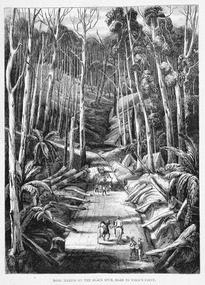
Work on paper (item) - Print of wood engraving, Ebenezer and David Syme, Road Making on the Black Spur, Road to Wood's Point, 1867
... A copy of an early wood engraving of the construction of the road over the Black Spur in Victoria. The Black Spur is known to be one of Victoria's most scenic drives. The road winds ...A copy of an early wood engraving of the construction of the road over the Black Spur in Victoria.A copy of an early wood engraving of the construction of the road over the Black Spur in Victoria. The Black Spur is known to be one of Victoria's most scenic drives. The road winds through a majestic forest of trees and tree ferns from Healesville to Narbethong and is part of the Maroondah Highway.black spur, wood's point, narbethong, maroondah highway, victoria, wood engraving -
 Federation University Historical Collection
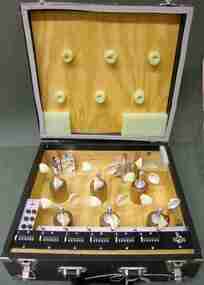
Scientific Instument, Anemometer, 6 Cup Model: Serial No. AM1-6-8875, c1975-1980
... wind energy harnessing projects, including that undertaken by MARS Industries in Ballarat. The 6-cup anemometer had a marked superiority in tests over the 3-cup anemometer and also had lower starting speeds. scientific instrument anemometer len cubitt mechanical engineering energy harnessing projects starting speeds Serial Number AM1-6-8875 Name Plate on lid between clasps. 'RIMCO" RAUCHFUSS INST & STAFF Pty Ltd 12 Monomeath Drive, Mitcham, Vic. 3132" Anemometer in a case complete with mounting blocks, but without electric leads for connecting the black finished wood ...An anemometer is intended for determining velocity distribution over an area or in a boundary layer. This item was purchased by Mechanical Engineering upon the request of Dr Len Cubitt, to determine wind speed at various heights above the ground. Investigation related to wind energy harnessing projects, including that undertaken by MARS Industries in Ballarat. The 6-cup anemometer had a marked superiority in tests over the 3-cup anemometer and also had lower starting speeds.Anemometer in a case complete with mounting blocks, but without electric leads for connecting the black finished wood case which also incorporates pulse counters and connections for power supply and for other logging instruments. Serial Number AM1-6-8875 Name Plate on lid between clasps. 'RIMCO" RAUCHFUSS INST & STAFF Pty Ltd 12 Monomeath Drive, Mitcham, Vic. 3132" scientific instrument, anemometer, len cubitt, mechanical engineering, energy harnessing projects, starting speeds -
 City of Moorabbin Historical Society (Operating the Box Cottage Museum)
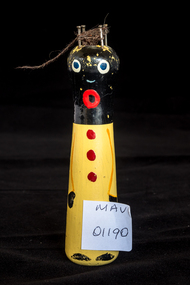
Craft work, doll, wool chain stitch, 20thC
... 20th C and probably earlier families could make this simple 'knitting machine' by using a piece of round, hollow wood and knocking 4 nails into one end of the cylinder leaving a protrusion of 2cm. An empty cotton reel was commonly used with left over knitting wool. Children were taught to wind...20th C and probably earlier families could make this simple 'knitting machine' by using a piece of round, hollow wood and knocking 4 nails into one end of the cylinder leaving a protrusion of 2cm. An empty cotton reel was commonly used with left over knitting wool. Children were taught to wind ...20th C and probably earlier families could make this simple 'knitting machine' by using a piece of round, hollow wood and knocking 4 nails into one end of the cylinder leaving a protrusion of 2cm. An empty cotton reel was commonly used with left over knitting wool. Children were taught to wind the wool around the nails in loops, figure of 8 and other patterns so that a chain was made which gradually protruded through the base of the cylinder as a knitted chain. The chains could be made to any length and then sewn together to make a usable object eg face washer.Gladys Reed was a member of the Ormond Choral Society c 1950. who performed plays and musicals the City of Moorabbin and she was skilled in hand knitting, crochet and dressmakingGladys Reed was a member of the Ormond Choral Society c 1950. who performed plays and musicals in the City of Moorabbin and this Doll was made and used by her family.c1950A small piece of painted, carved wood with central hollow and 4 nails on top used for making/ knitting a woollen chain.Painted doll featuresknitting, clothing, haberdashery, crochet, doilies, brighton, moorabbin, pioneers, dressmaking, market gardeners, early settlers, craftwork , bentleigh, lacework, moorabbin shire, reed gladys, dairy farms, fruit orchards -
 Dunkeld Museum Inc.
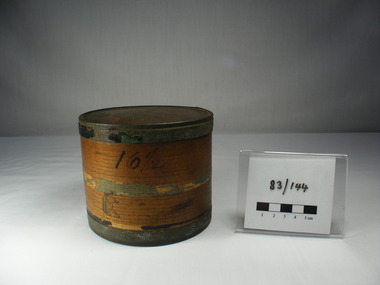
Box, Collar, Edward Henty's Collar Box, Late 18th century
... wind up his estate . Beleived to be Edward Henty's collar box. 16 and 1/2 on the side in ink. Wood ...This collar box was purchased at a clearing sale at the Henty property to wind up his estate .Beleived to be Edward Henty's collar box.Wood veneer circular collar box with tin rims on base and lid. Veneer overlapped and glued. Part of a paper label glued on the lower half of the box.16 and 1/2 on the side in ink. -
 Orbost & District Historical Society
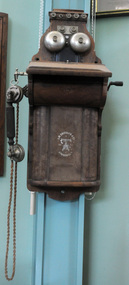
telephone, L M ERICSSON & CO, c. 1901
... winder. Near the top of the box are two round silver gongs which make the ringing sound of the phone call. The box is mostly made of wood, with the front-bottom section with a metal facing which is able to be opened to reveal the mechanism behind (including the battery). ...winder. Near the top of the box are two round silver gongs which make the ringing sound of the phone call. The box is mostly made of wood, with the front-bottom section with a metal facing which is able to be opened to reveal the mechanism behind (including the battery). ...A wall phone used in the early 20th Century in Australia, this one in the Orbost district.A wall-mounted telephone with a handpiece connected by a cord to the left hand side of the main box. On the right hand side is a winder. Near the top of the box are two round silver gongs which make the ringing sound of the phone call. The box is mostly made of wood, with the front-bottom section with a metal facing which is able to be opened to reveal the mechanism behind (including the battery). The phone has a wooden writing slope attached to the front. On the front of the metal section of the box are the words L M ERICSSON & CO trade mark STOCKHOLM. L M ERICSSON & CO TRADE MARK STOCKHOLMtelephone-communication wall-phone -
 Orbost & District Historical Society
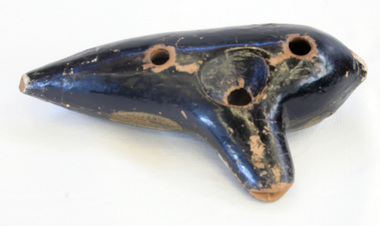
ocarina
... Small black ocarina wind instrument with finger holes. It is made of carved wood....Front - 2 manufacturing stamps and "D5" Small black ocarina wind instrument with finger holes. It is made of carved wood. ocarina ...The instrument belongs to a very old family of instruments, believed to date back over 12,000 years!Small black ocarina wind instrument with finger holes. It is made of carved wood.Front - 2 manufacturing stamps and "D5" -
 Ringwood and District Historical Society
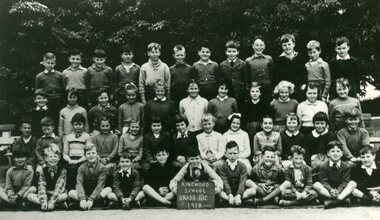
Photograph, Ringwood State School -Class photograph - Grade 3C, 1958
... , Jennifer Hall, Irene Morell, Heather Wind, Sharon(?), Barbara Skinner, Anne Hare, Robyn Woods, Mary Attick, Jill Bryant, Elizabeth Pumpa, Cliff Tann. ..., Jennifer Hall, Irene Morell, Heather Wind, Sharon(?), Barbara Skinner, Anne Hare, Robyn Woods, Mary Attick, Jill Bryant, Elizabeth Pumpa, Cliff Tann. ...Black and white photograph - Grade 3C,1958"Attached to photograph" Back Row- L to R: Steven Walker, ?, ?, Eric Millard, ?, ?, Tony Stewart, ?, ?, Bruce Rosel, ?, ?. 2nd Row - L to R: Rachell Bolton, ?, Joy Ringrose, ?, Pam Chapel, Sylvia Sefas, ?, Stephanie Iwanowicz, ?, ?, Gail Birchell 3rd Row - L to R: Larry Thompson, ?, Jennifer Hall, Irene Morell, Heather Wind, Sharon(?), Barbara Skinner, Anne Hare, Robyn Woods, Mary Attick, Jill Bryant, Elizabeth Pumpa, Cliff Tann. Front Row - L to R: ?, Jan Padjisak, ?, Graham Allen, Ian Roberts, Peter Huxley, ?, ?, ?, Ian Beath, ?. Teacher: -
 Flagstaff Hill Maritime Museum and Village
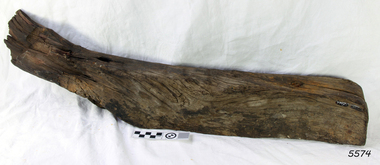
Functional object - Ship's Rib or Knee, before 1850
... wood cut into a bend like an elbow. The knee can be used in the frame of a boat or ship to spread load. THE “ENTERPRISE” 1847-1850 The wooden, two-masted schooner Enterprise was built in New Zealand in 1847 and registered in Melbourne, Australia. The Enterprise carried cargos of agricultural produce and other commodities for trade between the ports of the Colony. On September 14, 1850, the Enterprise was at anchor in Lady Bay under its Master, James Gardiner Caughtt, loaded with a cargo of wheat and potatoes. A strong south-easterly wind...wood cut into a bend like an elbow. The knee can be used in the frame of a boat or ship to spread load. THE “ENTERPRISE” 1847-1850 The wooden, two-masted schooner Enterprise was built in New Zealand in 1847 and registered in Melbourne, Australia. The Enterprise carried cargos of agricultural produce and other commodities for trade between the ports of the Colony. On September 14, 1850, the Enterprise was at anchor in Lady Bay under its Master, James Gardiner Caughtt, loaded with a cargo of wheat and potatoes. A strong south-easterly wind ...This hanging knee was from the 1850 wreck of the schooner Enterprise. The 'hanging knee' or a 'ship's knee' is used for bracing a frame or supporting a beam. It is either a naturally bent piece of wood or wood cut into a bend like an elbow. The knee can be used in the frame of a boat or ship to spread load. THE “ENTERPRISE” 1847-1850 The wooden, two-masted schooner Enterprise was built in New Zealand in 1847 and registered in Melbourne, Australia. The Enterprise carried cargos of agricultural produce and other commodities for trade between the ports of the Colony. On September 14, 1850, the Enterprise was at anchor in Lady Bay under its Master, James Gardiner Caughtt, loaded with a cargo of wheat and potatoes. A strong south-easterly wind caused the vessel to drag on its only anchor and the rudder was lost. The gale-force wind blew it sideways and it became grounded. A local indigenous man, Buckawall, braved the rough sea to take a line from the shore to the Enterprise. All five members of the crew were able to make it safely to land. The Enterprise was wrecked. The Enterprise wreck was in an area called Tramway Jetty in Lady Bay. Since then the area became the location of the Lady Bay Hotel and now, in 2019, it is in the grounds of the Deep Blue Apartments. In fact, with the constantly changing coastline through built-up sand, the wreck site is now apparently under the No 2 Caravan Park on Pertobe Road, perhaps 150 metres from the high tide. Its location was found by Ian McKiggan (leader of the various searches in the 1980s for the legendary Mahogany Ship). DIFFERENTIATING the New Zealand Schooner “Enterprise” from John Fawkner’s “Enterprize“ Dr Murray Johns, Melbourne, says in his article The Mahogany Ship Story “… As I documented in 1985, the Warrnambool wreck was of an entirely different ship, also called Enterprize [with the spelling ‘Enterprise’], but built in New Zealand in 1847. Fawkner’s ship had already been sold to Captain Sullivan in 1845 and was wrecked on the Richmond Pier in northern New South Wales early in 1847. “ - (further details are in NOTES: and FHMV documents) The hanging knee is significant for its association wreck of the Victorian Heritage Listed schooner Enterprise, VHR S238, being a New Zealand built but Australian owned coastal trader. The wreck was also significant for its association with indigenous hero Buckawall who saved the lives of the five crew on board.Portion of a ship's rib; a hanging knee, wooden, from the schooner Enterprise, 1847-1850. flagstaff hill, warrnambool, shipwrecked-coast, flagstaff-hill, flagstaff-hill-maritime-museum, maritime-museum, shipwreck-coast, flagstaff-hill-maritime-village, hanging knee, ship's knee, knee bracing timber, wooden ship building, carpentry, shipwright trade, buckawall, lady bay, enterprise, coastal steamer, ship's rib, indigenous hero, indigenous rescue -
 Mission to Seafarers Victoria
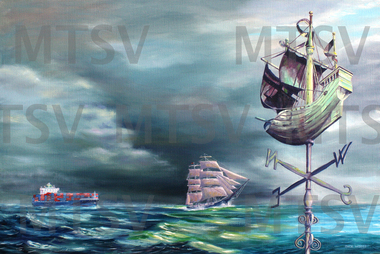
Painting, Jack Woods, Heading to a Safe Port, 2017
... The composition of the painting incorporates several features: the Galleon windvane restored to the roof of the Mission in 2020, the tanker vessel, the weather and dangerous oceans encountered by mariners, presenting symbolically the relationship of the Mission to seafaring from the 19th C. through to the present day. safe jack woods painting port artwork windjammer windvane cargo ship galleon weather vane anl maritime art prize artwork-paintings Oil painting on linen covered wooden frame, incorporating several features: from left to right a tanker vessel, a windjammer and the galleon wind vane restored to the roof of the Mission in 2020. ...This painting, which includes the beautifully crafted wind vane above the historic Mission to Seafarers’ building in Flinders Street, Melbourne, symbolises the safe port for the crew of ships, over the years, that have entered Port Phillip Bay, since the Victorian Mission was established in 1857. The stormy ocean weather for the sailors is contrasted with the calm seas near the Mission.This painting was an entry for the 2017 Maritime Art Prize. Jack's marine art covers a wide spectrum of maritime subjects, but with a focus on paintings of classic yachts that ventured over long distances to remote parts of the world. Maritime art, Marine artDonated by Jack WoodsOil painting on linen covered wooden frame, incorporating several features: from left to right a tanker vessel, a windjammer and the galleon wind vane restored to the roof of the Mission in 2020.safe, jack woods, painting, port, artwork, windjammer, windvane, cargo ship, galleon, weather vane, anl, maritime art prize, artwork-paintings -
 Warrnambool and District Historical Society Inc.
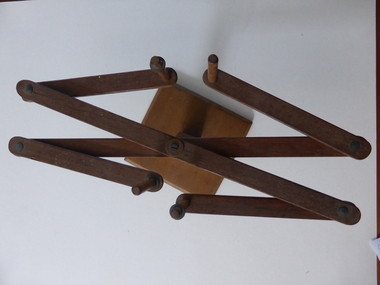
Wool Spindle, Fletcher Jones Winding spool, Circa early/ mid 20th century
... winder fletcher jones 165 on sticker on bottom. Square wooden base with bevelled edge and central post from which is screwed two wooden strips of wood. ...This object is used to wind yarn ,typically wool from a skein or hank into a ball from which it can be worked into the required garment. The skein is placed around the four pegs on the ends of each arm and wound from this into a ball. The movable arm facilitate easier winding of the yarn. It is thought that this may have come from Fletcher Jones factory where it was probably used more to rewind cotton onto reels. Either use is possible.This item or those similar would have been a well used tool in many households before the time of woollen yarn being purchased in balls. As such it has social and historical significance as well as being useful as an item to create discussion.Square wooden base with bevelled edge and central post from which is screwed two wooden strips of wood. A shorter piece of wood is riveted to each end of these two pieces and these have dowel running upright from each end. The top section is movable and can be extended or contracted as required. Light brown in colour.165 on sticker on bottom.warrnambool, wool winder, skein winder, fletcher jones -
 Kiewa Valley Historical Society
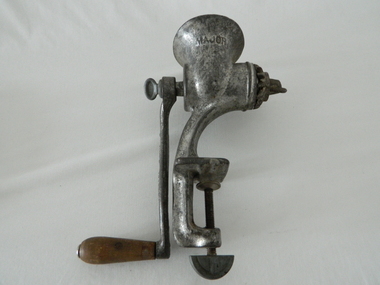
Mincer Meat, mid 1960's
... winder handle rotates the screw like mechanism to mince and express solid pieces of meat at the other end. There is a clamp below the main structure which permits the fastening of the hand driven mincer to a table or solid ledge. The hand grip of the handle is made from wood...winder handle rotates the screw like mechanism to mince and express solid pieces of meat at the other end. There is a clamp below the main structure which permits the fastening of the hand driven mincer to a table or solid ledge. The hand grip of the handle is made from wood ...This meat mincer was born in a period where hand operated mincing and blending machines were only available for household mincing meats and blending ingredients up to the 1960's. Electrical kitchen based whitegoods were rare in areas where the connection to electricity was intermittent or not at all.This kitchen aid is a very significant item in the Kiewa Valley before suitable electrically operated mincers became available and constant reliable electrical connections were installed. The Kiewa Hydro Electricity Scheme provide the stable supply of electricity which made most of the hand operated mincing machines obsolete. However large mincers for bulk supplies were still required eg. kitchens for SEC workers during the 50's and 60's.This heavy industrial type meat mincer(cast iron) has a top "rounded feeder cup" with a mincer screw blade at the bottom. A winder handle rotates the screw like mechanism to mince and express solid pieces of meat at the other end. There is a clamp below the main structure which permits the fastening of the hand driven mincer to a table or solid ledge. The hand grip of the handle is made from wood and fashioned like a clothes peg.On the rounded feeder bowl "MAJOR" and on the winder handle "A POPE PRODUCT"hand operated meat mincers, meat grinders, kitchen utensils -
 Bendigo Military Museum
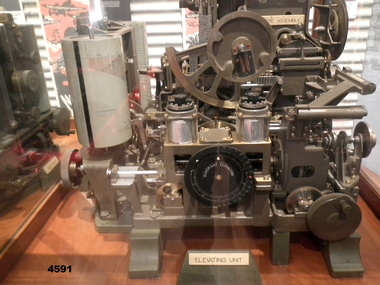
Equipment - VICKERS No1 MK III A.A. PREDICTOR, Commonwealth Government Ordnance Factory, c. 1942
... Each of the four sides has a specific task with three sides being labelled - Elevation Unit, Wind Calculator, Bearing Unit. The item is housed in a glass and wood display case. ...Each of the four sides has a specific task with three sides being labelled - Elevation Unit, Wind Calculator, Bearing Unit. The item is housed in a glass and wood display case. ...This piece of equipment was used to predict the flight path of an aircraft in order for anti-aircraft artillery to fire accurately at an approaching enemy airborne target. A crew of six operated the machine with information ready to be relayed to a gun within 50 seconds. The predictor was manufactured at the Commonwealth Government Ordnance Factory, Maribyrnong.The item is made primarily from metal, is square shaped and bolted to a wooden base. Numerous hand operated wheel dials attached to gauges which input information related to wind speed, bearings and elevation are visible. Each of the four sides has a specific task with three sides being labelled - Elevation Unit, Wind Calculator, Bearing Unit. The item is housed in a glass and wood display case. Attached to the front of the display case: 'VICKERS A.A. PREDICTOR No1 MK III MANUFACTURED BY ORDNANCE FACTORY MARIBYRNONG'pedictor, military equipment, ordnance, anti-aircraft guns -
 Bendigo Historical Society Inc.
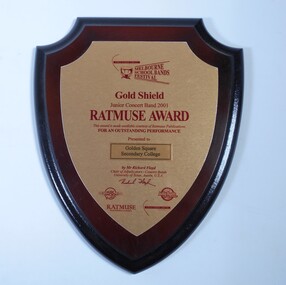
Award - School Sport Shields
... wood in the shape of a shield. a. Gold Shield awarded to the Junior Concert Band in 2001. TATMUSE AWARD for Outstanding Performance. Presented by Mr Richard Floyd. Sponsors represented by logos - Music Junction, Billy Hyde, RATMUSE (Music Publishers). Education Trust Vic. b. Yamaha Gold Award won by Golden Square Secondary College Intermediate Concert band 2003 at the Melbourne School Bands Festival. Presented to Symphonic Winds...wood in the shape of a shield. a. Gold Shield awarded to the Junior Concert Band in 2001. TATMUSE AWARD for Outstanding Performance. Presented by Mr Richard Floyd. Sponsors represented by logos - Music Junction, Billy Hyde, RATMUSE (Music Publishers). Education Trust Vic. b. Yamaha Gold Award won by Golden Square Secondary College Intermediate Concert band 2003 at the Melbourne School Bands Festival. Presented to Symphonic Winds ...Golden Square High School in the city of Bendigo, was established in temporary accommodation at Camp Hill Primary School in central Bendigo in 1960. With the completion of the new school's buildings, it moved to Golden Square in 1962, providing for Forms 1 to 6, now known as years 7 to 12. In 1978 it became a 7–10 school and was one of the original feeder schools to Bendigo Senior High School. In 1986, a Hearing Impaired Unit was established and in 1990 it underwent a name change to become Golden Square Secondary College. The Golden Square Secondary College campus closed on 28 November 2008. It merged with Kangaroo Flat and Flora Hill secondary colleges as part of the implementation of the Bendigo Education Plan. Its buildings were demolished. (Wikipedia https://en.wikipedia.org/wiki/Golden_Square_Secondary_College)Two wooden shields awarded to Golden Square Secondary College at the Melbourne School Bands Festival. Dark wood in the shape of a shield. a. Gold Shield awarded to the Junior Concert Band in 2001. TATMUSE AWARD for Outstanding Performance. Presented by Mr Richard Floyd. Sponsors represented by logos - Music Junction, Billy Hyde, RATMUSE (Music Publishers). Education Trust Vic. b. Yamaha Gold Award won by Golden Square Secondary College Intermediate Concert band 2003 at the Melbourne School Bands Festival. Presented to Symphonic Winds by Mr. K Waterworth. Award sponsored by Yamaha Music Australia, Billy Hyde Music. Blue border around a gold coloured shield.a. Sticker on the back of the Shield. "WINNING EDGE PRESENTATIONS Wholesale Trophy Framing and Giftware level 9 230 Collins Street Melbourne phone 9654 4911 Fax 9650 7106"gssc, sports top, music awards -
 Warrnambool and District Historical Society Inc.
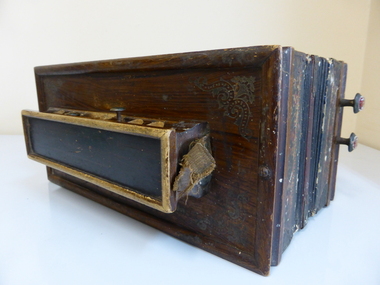
Leisure object - Musical Instrument, Accordian, Late 19th century
... wind principle. An object which is relatively common . warrnambool button accordian Brown wooden ends with metal buttons with concertina section painted blue with black edge.Two glass buttons on one end with dark pink and clear glass centres. Parts of the wood ...Accordians came into being around the start of the 19th century and has become a well loved instrument. It is thought that they originated from areas in Austria and Germany but over the following century its popularity has spread to all parts of the world. Accordians come in various sizes but all operate on the same wind principle. An object which is relatively common .Brown wooden ends with metal buttons with concertina section painted blue with black edge.Two glass buttons on one end with dark pink and clear glass centres. Parts of the wood work are decorated with scroll work. two metal discs with diagrams of lyres on end above the buttons. Remains of floral pattern around each end.warrnambool, button accordian -
Bendigo Historical Society Inc.
Document - HER MAJESTY'S WANGARATTA - VICTORIAN COMMERCIAL TRAVELLER'S CHORAL PARTY, 27 September, c1916
... Part 2. 1 Mr C Harold Oakley, his own composition. 2'A Cradle Song,' The bachelors of the Choral Party and married men. 3 Duet for Basses, Mr Vic Porter and Mr Harry Pride. 4 feat of Legerdemain, Captain Reid. 5 'Ma Honolulu Lady,' Mr E L Jones. 6 A slight interruption in the programme while Mr Gill Gliddon amuses himself and possibly the audience. 7 'The Lost Chord' Mr Chas R Herschell. 8 'Blow, Blow, Thou Wintry Wind,' Mr Horace J Wood. 9 'Little Tommy Went a-Fishing,' and 'The Mellow Melon,' C T Choral Party. ...Part 2. 1 Mr C Harold Oakley, his own composition. 2'A Cradle Song,' The bachelors of the Choral Party and married men. 3 Duet for Basses, Mr Vic Porter and Mr Harry Pride. 4 feat of Legerdemain, Captain Reid. 5 'Ma Honolulu Lady,' Mr E L Jones. 6 A slight interruption in the programme while Mr Gill Gliddon amuses himself and possibly the audience. 7 'The Lost Chord' Mr Chas R Herschell. 8 'Blow, Blow, Thou Wintry Wind,' Mr Horace J Wood. 9 'Little Tommy Went a-Fishing,' and 'The Mellow Melon,' C T Choral Party. ...Her Majesty's Wangaratta - Victorian Commercial Traveller's Choral Party. Vocalists, Instruments, Entertainers. Wednesday, Sept. 27th. Proceeds in Aid of Wangaratta Hospital. Box Plan at Bickerton's. Charles R Hershchell Musical Director. Walter A Jack, Hon. Sec. PART 1 The Traveller, Mr C Harold Oakley. 2 The Soldier's Chorus, Victorian Commercial Travellers' Choral Party. 3 Sing Me A Song of the South, Mr Horace J Wood. 4 'The Battle Eve', Messrs. W T P Sutton and Harry Pride. 5 'The Highland Brigade Burying Their Dead' Captain Reid, D.S.O. 6 'Doan yer cry, ma Honey,' 'Laugh and Grow Fat,' The C.T. Choral Party. 7 unnamed part by Mr Gill Gliddon. 8 'The Song the Anvil Sings,' Mr E L Jones. 9 'La Reve De Armour,' Mr Charles R Hershell. 10 'Johnathan Jones,' Mr Harry Pride. 11 'March of Israelites,' The C.T. Choral Party. Part 2. 1 Mr C Harold Oakley, his own composition. 2'A Cradle Song,' The bachelors of the Choral Party and married men. 3 Duet for Basses, Mr Vic Porter and Mr Harry Pride. 4 feat of Legerdemain, Captain Reid. 5 'Ma Honolulu Lady,' Mr E L Jones. 6 A slight interruption in the programme while Mr Gill Gliddon amuses himself and possibly the audience. 7 'The Lost Chord' Mr Chas R Herschell. 8 'Blow, Blow, Thou Wintry Wind,' Mr Horace J Wood. 9 'Little Tommy Went a-Fishing,' and 'The Mellow Melon,' C T Choral Party. Baton: Mr Chas R Herchell. Piano: Mr C Harold Oakley. Hon Sec: Mr Walter A Jack. Victorian Commercial Travellers' Choral Party. 1st Tenors. Sutton, W T P. Strode, Geo. Bownas, J C. Ebbott, J. M'Dowell, Geo. 2nd Tenors. Rankine, Hugh. Muirhead, Geo. Jack, W A. Vawdon, F W. Hart, W. Downing, J. Smith, Edgar. Oaten, J E V. 1st Basses. Pemberton, J. White, J H. M'Mahon, P A. Adams, W. Wilson, W J C. Jones, E L. M'Farlane, J. Wilder, D H. Spicer, A. 2nd Basses. Pride, H. Watson, A. Sinclair, P A. Miles, F. Andrews, J. Hopkinson, E R. Porter, V. Director: Chas R Herscell. Pianist: C Harold Oakley.Renwick. Pride. Nuttall, 263a P.O. Place, Melb.program, music, her majesty's wangaratta -
 Bendigo Historical Society Inc.
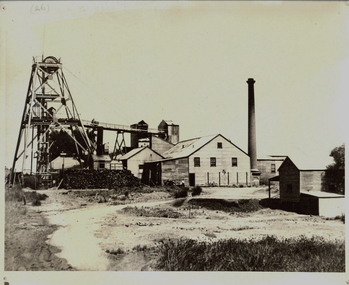
Photograph - NEW RED, WHITE AND BLUE MINE
... Poppet head, winder house, chimney, overhead tramway, stack of wood, one male figure pushing one truck on overhead tramway. ...Poppet head, winder house, chimney, overhead tramway, stack of wood, one male figure pushing one truck on overhead tramway. ...Black and white photograph. Poppet head, winder house, chimney, overhead tramway, stack of wood, one male figure pushing one truck on overhead tramway. Mine office at front right. Inscriptions: On front - '26' at TL. On back - 'New Red, White and Blue Consolidated, Main Shaft (Big Blue). Rec'd photo 21/4/67.'mine, gold, big blue ( r.w.b.consolidated), bendigo, mines and mining, mines, mining, poppet head, mining equipment -
 Australian Gliding Museum
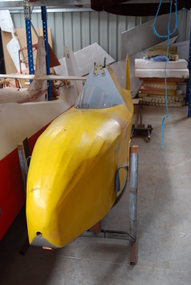
Machine - Glider – Sailplane, 1949
... wood and fabric glider that was designed in Austria for hill soaring. It is a simple design that became a popular choice for home building in the post war years in Australia when gliding as a sport was in recovery. Some examples are still flying. australian gliding glider sailplane hutter sweetwings fleetwings reichelt riley wynne milligan Small single seat glider. Fuselage and wing struts are painted yellow. Wings, rudder and tailplane / elevator are primed with pink dope. It has an open cockpit with small clear Perspex wind ...The Hutter H17 is a small single seat glider with a wing span of 9.69 metres, designed in 1934 by Wolfgang Hutter, for flying in the Austrian Alps. Construction of the museum’s example, “Sweetwings” (now registered as VH-GQM), commenced in Perth in 1949. It is one of two Hutter H17 gliders built in Western Australia by N.J. Wynne and A.G. Milligan at the time – the other “Fleetwings” (formerly VH-HDQ and since re-registered as VH-GXV) is located at Millicent, South Australia. Ownership transferred to G.R. Reichelt of Tocumwal New South Wales and later to D.B. Hunt of Thornbury in Melbourne and later Mt Isa, Queensland. It was acquired by Bill Riley of Tocumwal who donated it to the Museum. The glider was last flown on 25 October 1979 at Tocumwal. This exhibit is an example of a 1930s small wood and fabric glider that was designed in Austria for hill soaring. It is a simple design that became a popular choice for home building in the post war years in Australia when gliding as a sport was in recovery. Some examples are still flying.Small single seat glider. Fuselage and wing struts are painted yellow. Wings, rudder and tailplane / elevator are primed with pink dope. It has an open cockpit with small clear Perspex wind screen. Instruments include airspeed indicator and altimeter tucked neatly under front edge of the cockpit rim.australian gliding, glider, sailplane, hutter, sweetwings, fleetwings, reichelt, riley, wynne, milligan -
 Australian Gliding Museum
Equipment - Glider – Hang Glider Type, 2013 - 2014
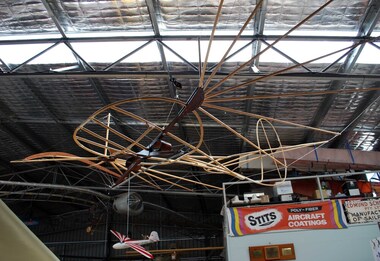
... wind tunnel testing). The replica built by Bruce Hearn is of the 1893 Lilienthal glider. It is very similar to the “Normal-Segalapparat” (Normal Glider) for which patent protection was later granted a few years later. The Lilienthal replica glider is an important addition to the AGM collection as it represents the beginning of successful gliding flight. glider hang glider lilienthal hearn replica The glider has a small plate with identification details including name of builder (Bruce Hearn) Hang glider made of wood with wire bracing – yet to be covered with authentic cotton fabric. ...Otto Lilienthal (1848-1896) from Berlin, Germany, is widely credited as being the first person to make repeated successful gliding flights. He was known for adopting a thorough scientific approach founded on observations of the flight of birds in relation to the problem of inventing a man carrying heavier than air machine that would fly. He developed and tested bird-like gliders controlled by weight shift by the pilot (a similar method to modern hang gliders). The pilot held on to the glider with his forearms resting in hoops mounted on the main structural beam connecting the wings. The weight shift was achieved by the pilot swinging his trunk and legs. In contrast, the pilot of a modern hang glider is suspended below the glider and, with the use of an A-frame, allows the whole body to be moved around to achieve control. The Lilienthal design apparently had a tendency to pitch down and a tailplane was added to mitigate this problem. Lilienthal flew from hills in the Rhinow region and from a conical hill he built near Berlin. He made over 2000 flights. Importantly, for others seeking to progress manned flight at the time and also for the historical record, reports of Lilienthal’s flights (some with photographs) were published and Lilienthal detailed his experiences and corresponded with other flight pioneers. Lilienthal’s work became well known and influenced Orville and Wilbur Wright in their initial experiments with gliders in 1899 (although in their quest to design and fly an aeroplane they relied on new data created by wind tunnel testing). The replica built by Bruce Hearn is of the 1893 Lilienthal glider. It is very similar to the “Normal-Segalapparat” (Normal Glider) for which patent protection was later granted a few years later. The Lilienthal replica glider is an important addition to the AGM collection as it represents the beginning of successful gliding flight. Hang glider made of wood with wire bracing – yet to be covered with authentic cotton fabric. The glider has a small plate with identification details including name of builder (Bruce Hearn) glider, hang glider, lilienthal, hearn, replica -
 National Wool Museum
Machine - Wrap Reel
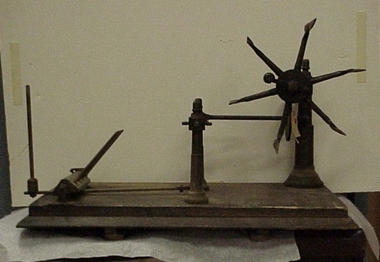
... winder MAKERS/ VWM A small hand operated wrap reel. The reel is on a wooden base, the winding mechanism is metal and turned by a wooden handle. There is a metal plaque on the base inscribed MAKERS VWM. A wood ...Wrap reel manufactured at Valley Worsted Mill and possibly used in the laboratory. "Wrap reels were used to check the yarn count in a spinning mill. A set length of yarn was wound off several test bobbins and weighed, if the weight was not the correct amount expected the spinning machines draft could be re calculated and the machine draft wheel ( cog ) changed to achieve the required count". - Greg AldridgeA small hand operated wrap reel. The reel is on a wooden base, the winding mechanism is metal and turned by a wooden handle. There is a metal plaque on the base inscribed MAKERS VWM. A wood and metal yarn feeder has broken off its mount.MAKERS/ VWMtextile machinery textile production weaving, valley worsted mill valley worsted mill, warping machinery, textile machinery, textile production, weaving, wrap reel, skein winder -
 National Wool Museum
Painting, The White Farm, 2020/21
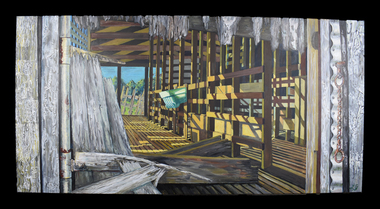
... After time this same painted wood has been left with an interesting complex patina like film on the surface which the artist has taken great care to capture. Image 1 is titled ‘Another gust of Wind...After time this same painted wood has been left with an interesting complex patina like film on the surface which the artist has taken great care to capture. Image 1 is titled ‘Another gust of Wind ...The farm buildings that Linda Gallus has studied and painted are on the farmland adjoining the Leura Park properties in Curlewis, on the Bellarine Peninsula. The current owner of the property told Linda that he bought the farm in 1994. He has used it for both sheep and cattle grazing since purchasing the property. When the farmer bought the land all the buildings on the property were painted white for sale, despite the fact they were very old. The shearing shed was in use up until the time of sale but was in a bad state of disrepair. The roof, stumps and floor required replacing. The building was no longer in use after the sale, so the shearing shed gradually fell into further disrepair. The previous owner had also used the property for growing potatoes, crops and livestock, mainly sheep. Linda’s fascination with the property came when she caught a glimpse of the white chimney over the hill driving towards Point Lonsdale, which still stands proud today on the roof of the old shearing shed. The owner kindly allowed her to visit the property over the past few years to capture the buildings using photography and painting. During this time many of the buildings have fallen. Linda calls it The White Farm as there are remnants of that original white paint on the outside of most of the buildings giving it a strange and rather beautiful patina. The structures are wonderful remnants of the history of the Bellarine. Linda first spotted the old shearing shed when she was driving home to Clifton Springs from Geelong. It was the white chimney on the shearing shed that stood out behind the rolling grassy hills. It was intriguing – bright white and still in good condition, unlike the rest of the building. After further investigation Linda got to know the owner of the property and visited it frequently to draw, take photos and paint. There is a variety of lovely old buildings on the property, but it was the shearing shed that held extra fascination for Linda. The most intriguing thing for Linda was that the buildings were all painted white at some stage and now the patina of peeling paint and bleached timber brought a wonderful mood and feeling to the farm. This is what she has tried to capture in this series of 11 paintings. Most of the buildings are falling, so Linda felt an urgency to capture them using acrylic paint on canvas in order to commemorate them forever.Acrylic Paint on Canvas. The images both feature a falling down shearing shed as the central focus. The wood of the shearing shed is a central theme of importance. The old buildings were painted white for sale despite being in a state of structural instability. After time this same painted wood has been left with an interesting complex patina like film on the surface which the artist has taken great care to capture. Image 1 is titled ‘Another gust of Wind’. It shows the exterior of the shearing shed which is in the process of collapsing from the forces of mother nature. In the background of this painting another of the buildings in the ‘White Farm’ complex is visible, in addition to blue skies and overgrown green grasses. Image 2 is titled ‘Green Trough’. It features the interior of the same collapsing shearing shed. The image is painted as though the viewer is peering through a crack of the external wall. Internally a green trough is seen hanging on an internal fence. Unlike everything else in the shearing shed, the trough appears new and in good condition. It provides a strong juxtaposition to the rest of the shearing shed, and the larger surrounding ‘White Farm’ complexbellarine peninsula, the white farm, shearing shed -
 National Wool Museum
Textile - Tapestry, Lisa Kendal et al, WARM, 2016
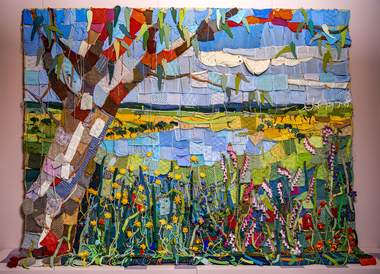
... wind turbines. The top third of the tapestry is blue sky with white clouds. It also contains the previously described gum tree leaves. Each piece of the tapestry is 100% wool and was hand knitted and stitched together. The Tapestry is accompanied by an oil painting on canvas. It is a painting that matches the tapestry and served as a template for the final tapestry. Finally, the tapestry is accompanied by another pointing on wood...wind turbines. The top third of the tapestry is blue sky with white clouds. It also contains the previously described gum tree leaves. Each piece of the tapestry is 100% wool and was hand knitted and stitched together. The Tapestry is accompanied by an oil painting on canvas. It is a painting that matches the tapestry and served as a template for the final tapestry. Finally, the tapestry is accompanied by another pointing on wood ...WARM was a community textile art project that saw over 250 knitters come together to create a beautiful collage tapestry. Made entirely from wool, the artwork contains more than 1000 individual hand knitted sections. The project takes aim at global warming, it highlights both the causes and solutions for us to create a sustainable and safe climate for future generations. Lisa Kendal, the co-creator of the project, said “One of the problems in the world is that we have forgotten how to warm ourselves with wool. We have become too dependent on fossil fuels (for heating)”. This is the key idea surrounding the project. WARM began as two large scale images created by Lars Stenberg. The first image is a landscape scarred by coal mining. The second image is the same landscape only many decades later. Regeneration and regrowth have taken over the landscape and hidden the past coal mine completely. In its place is a beautiful landscape including trees, native flowers, a lake, lots of greenery and wind turbines. From March to the end of August in 2016, knitters worked hard to create the over one thousand pieces that came together to form the final tapestry. The pieces were all designed by Fibre Artist Georgie Nicolson of Tikki Knitting Designs, who converted the second image of the healed landscape into patterns for the 250 plus knitters to follow. These patterns included unusual designs such as gum leaves, trees, native flowers and even the wind turbines. During several days of installation, the knitted pieces were stitched together by Lars Stenberg over a picture of the first image of the operational coal mine. They worked to create the second image of the renewed landscape; like an enormous collage. The WARM project was donated to the National Wool Museum in 2021. It was a much-loved hanging within the Ballarat Hospital for many years before coming to the museum. More information about the project can be found on the following website. http://www.seam.org.au/warm The tapestry is made from 1000+ hand knitted sections stitched together to make an image. In the foreground of this image is a large gum tree that stretches from the bottom left to the top right corner. The trunk of this tree follows the left edge of the tapestry, with foliage from the gum tree spanning its top border. The bottom third of the tapestry is predominantly green grass with yellow, pink and red flowers providing sporadic colour. The middle third encompasses a lake, with orange colours surrounding the banks of the water as opposed to the green grasses of the bottom third. To the right of the lake are wind turbines. The top third of the tapestry is blue sky with white clouds. It also contains the previously described gum tree leaves. Each piece of the tapestry is 100% wool and was hand knitted and stitched together. The Tapestry is accompanied by an oil painting on canvas. It is a painting that matches the tapestry and served as a template for the final tapestry. Finally, the tapestry is accompanied by another pointing on wood board. This final panting is of a coal mine. This is the setting before regeneration and regrowth have reclaimed this site, which is the theme captured in the final tapestry. In the foreground of the coal mine painting is the same gum tree described in the tapestry; however, it is grey and sickle with only 4 leaves visible at the top border, compared to the numerous leaves in the tapestry. Also in the foreground is a broken barb wire fence adding to the unwelcoming nature of the site. The colour scheme of this image is of dark greys and browns. A coal fired power plant can be seen in the final third of the image with four chimneys emitting plumes of smoke into the sky. In front of this power plant is the spiral shape of a coal mine, burrowing deep into the earth’s crust. Inside of the coal mine 3 yellow trucks are seen mining and transporting coal to the top of the mine.warm, community textile tapestry, knitting, community artwork, global warming -
 National Wool Museum
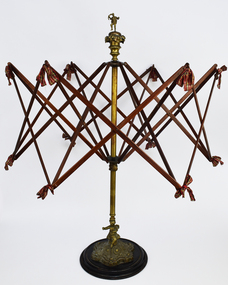
Functional object - Wool Winder, pre. 1950
... It is popular to decorate these bases on more elaborate winders, such as shown in this example. The bows featured to tie the wood segments together is another feature of more elaborate models of wool winders, also highlighted in this example. ...Umbrella swift style wool winder made of metal, wood, and ribbon. Decorated at its highest point with a sculpted man standing on one leg, holding what is perhaps a rolled newspaper as though he may be bidding at an auction. ...It is popular to decorate these bases on more elaborate winders, such as shown in this example. The bows featured to tie the wood segments together is another feature of more elaborate models of wool winders, also highlighted in this example. ...Originating from Scotland pre-1950, this wool winder is ornately decorated featuring a male figure at its peak and a cherub at its base. Wool Winders are practical objects typically with minimal decoration; however, Wool Winders with ornate design features do exist. Scrimshaw (whale ivory) was a popular choice of material in the 18th and 19th century. It is smooth, preventing yarn from getting caught when unwinding, as well as having artistic beauty. Wool winders require a heavy base, as to not topple over when in use. It is popular to decorate these bases on more elaborate winders, such as shown in this example. The bows featured to tie the wood segments together is another feature of more elaborate models of wool winders, also highlighted in this example. This winder began life in the possession of Annie Crawford. The Crawford name has a strong connection with the town of Paisley, Scotland, and its Woollen Mills. The Crawford name can be seen working at the Woollen Mills in the 1851 Scotland Census, with Robert and his brother’s James and John working as Wool dyers. Their father Alexander also worked as a Loom Weaver. The winder immigrated with Annie when she, her husband and 3 children travelled to Australia, ready to start a new life. Most of their possessions were left behind in Scotland. This winder accompanied the family on their journey; so it stands to reason that the winder was special to them. Annie Crawford passed the winder onto her eldest daughter Joan Crawford. Joan did not have any children and so she passed the winder onto the eldest female grandchild, Fiona Crawford. Fiona Crawford continued the connection of the Crawford name with textiles, with an exhibition titled "When you go looking for me, I am not there". Utilising medieval embroidery tradition of ‘Punto Assisi, the exhibition was a reflection on the lack of women recorded in history, particularly their contribution to the domestic arts. Her work investigates both the absence of women while also honouring the unknown female makers of this now highly desired art. The Wool Winder was donated to the National Wool Museum in 2021 by Dianne Crawford, the sister of Fiona Crawford. Umbrella swift style wool winder made of metal, wood, and ribbon. Decorated at its highest point with a sculpted man standing on one leg, holding what is perhaps a rolled newspaper as though he may be bidding at an auction. Or perhaps he is holding a hank of wool. The man stands upon a three-tier platform of decreasing size and design which leads to the central metal shaft. At the base, the winder is decorated with an engraved cherub. Both figures have a small hole in one of their hands, indicating that they originally held something. Unfortunately, it is not known what this is. From the central metal shaft, this winder has 2 rows of 6 arms radiating out. These arms cross in the middle to form an X. These arms are also connected horizontally with additional arms which cross. This all forms an intricate web design, tied together with ribbon. The size of the web these arms create is adjustable, to accommodate yarns of different length. Beneath the second row of arms is a locking screw which holds this row at the desired height and width. This entire top section, beginning at the central metal shaft, can be unscrewed from its base for easier storage. The base begins in a wooden circular shape growing into a smaller ornately designed raise on which the cherub sits. From the head of the cherub the central metal shaft begins.paisley, scotland, wool winder, immigration -
Tatura Irrigation & Wartime Camps Museum
Clock, pre 1954
... Mantle clock c 1950's Polished wood casing, silver face and hands. Wind up. Not working. Chiming and striking type....Mantle clock c 1950's Polished wood casing, silver face and hands. Wind up. Not working. Chiming and striking type. ...Presented to Arthur Knee by Tatura Royal Tour Committee in appreciation of services rendered as secretary on the occasion of the visit to Tatura of H.M. Queen Elizabeth 11 5 March 1954.Mantle clock c 1950's Polished wood casing, silver face and hands. Wind up. Not working. Chiming and striking type.Presented to Arthur Knee by Tatura Royal Tour Committee in appreciation of services rendered as secretary on the occasion of the visit to Tatura of H.M. Queen Elizabeth 11 5 March 1954.arthur knee, mantel clocks, tatura royal tour committee
