
Showing 11 items matching "ww1 soldier settlement"
-
 Bendigo Military Museum
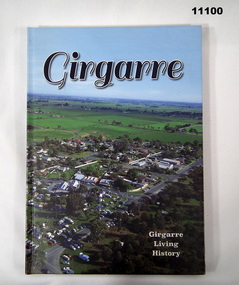
Book - LOCAL HISTORY, Athol McDonald and Jenny Wilson, "GIRGARRE - LIVING HISTORY", 2016
... ...WW1 Soldier Settlement...Page 74 to Page 101 - Introduction from Page 74 - "Soldier Settlers; Listed below are the WW1 returned servicemen/ (Soldier Settlers) who took up land at Stanhope/ North, later named Girgarre. Most leases were under/ the conditions set down by the Discharged Soldier/ Settlement Acts, which were more generous than those/ of the Closer Settlement Acts."...Publications Books Local History WW1 Soldier Settlement Girgarre Hardcover book. Cover - cardboard, with white coloured print of front, spine and back on a background colour photograph "Aerial view of Girgarre on Market Day, September 2013". 251 pages, cut, plain, white, coloured paper. ...Page 74 to Page 101 - Introduction from Page 74 - "Soldier Settlers; Listed below are the WW1 returned servicemen/ (Soldier Settlers) who took up land at Stanhope/ North, later named Girgarre. Most leases were under/ the conditions set down by the Discharged Soldier/ Settlement Acts, which were more generous than those/ of the Closer Settlement Acts."Hardcover book. Cover - cardboard, with white coloured print of front, spine and back on a background colour photograph "Aerial view of Girgarre on Market Day, September 2013". 251 pages, cut, plain, white, coloured paper. Illustrated, black and white photographs - portraits, weddings, farm activities, family occasions etc.publications, books, local history, ww1 soldier settlement, girgarre -
 Merbein District Historical Society
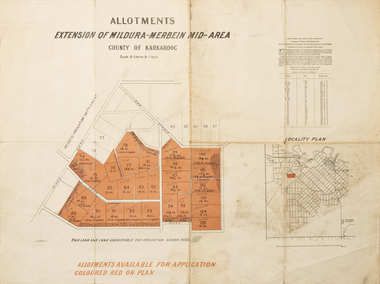
Map - Allotments Extension of Mildura-Merbein Mid-Area, Allotments available, 23 November 1920
... WW1...Soldier Settlement...Allotments available to Discharged Soldiers Discharged Soldier's Settlement Act Historic Discharged Soldiers WW1 Soldier Settlement Irrigation Photo-Lithographed at Department of lands Survey, Melbourne J. ...Allotments available to Discharged Soldiers Discharged Soldier's Settlement Act Historic Large map, folded in 4, coloured map of Merbein indicating allotments available and locality plan. Scale 10 chain to 1 inchPhoto-Lithographed at Department of lands Survey, Melbourne J. Butson 23.11.20discharged soldiers, ww1, soldier settlement, irrigation -
 Eltham District Historical Society Inc
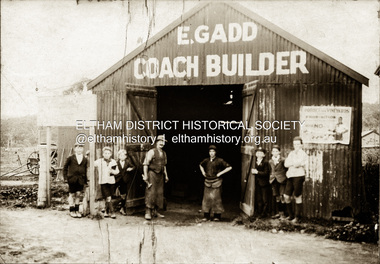
Photograph, E. Gadd Coach Builder, Eltham, c. March 1930
... A vote was being held by the Victorian government which the vineyard growers were opposed to due to the ramifications it would have upon the wider industry for dried fruits and table grapes, etc as well and how it was in direct conflict with the federal government's actions of WW1 Soldiers Settlements on vineyards as it would ruin them. ...A vote was being held by the Victorian government which the vineyard growers were opposed to due to the ramifications it would have upon the wider industry for dried fruits and table grapes, etc as well and how it was in direct conflict with the federal government's actions of WW1 Soldiers Settlements on vineyards as it would ruin them. ...Edward Gadd’s coach building and blacksmith shop was on the western side of Main Road, just south of Arthur Street and alongside Hannah Lloyd’s Railway General Store. The site was later home to the Eltham Produce Store, then a BP Petrol Station and in present-day home to Healthability at 911-917 Main Road. https://maps.app.goo.gl/az9GzxmVYFRGgYa39 Note with photo: "Man with hammer is Mr Gadd; always wore leggings and played violin at local dances. On his left is Harold Norman of Research. (Sam Howard played banjo). Mrs Read (Jock's mother) played piano by ear. Research called Normantown because no one could remember who was related to who." Note the school children; one of whom may be Jock Read. In April 1922, E.Gadd took over the West Bros. blacksmithing business at Eltham. He had many prior years’ experiences with horses and their ailments, such as diseased feet and bad breath. He advertised that he kept horse medicines in stock and was prepared to undertake clipping. [THE Eltham and Whittlesea Shires Advertiser AND Diamond Creek Valley Advocate. (1922, April 7). Eltham and Whittlesea Shires Advertiser and Diamond Creek Valley Advocate (Vic. : 1917 - 1922), p. 3 (AFTERNOON.). Retrieved July 31, 2025, from http://nla.gov.au/nla.news-article57640818] A poster on the exterior wall of the shed promotes protection of vineyards from Prohibition by voting No. This would date this photo around March 1930. A vote was being held by the Victorian government which the vineyard growers were opposed to due to the ramifications it would have upon the wider industry for dried fruits and table grapes, etc as well and how it was in direct conflict with the federal government's actions of WW1 Soldiers Settlements on vineyards as it would ruin them. [HOW VINE GROWERS WOULD BE PENALISED (1930, March 28). Advertiser (Hurstbridge, Vic. : 1922 - 1939), p. 4 (AFTERNOON). Retrieved July 31, 2025, from http://nla.gov.au/nla.news-article57762063] Edward Gadd died of pneumonia, July 1937. He had operated his coach building business in Eltham for 15 years (1922-1937). He lived in Research and left a wife and three sons. He was actively involved with the Research Hall and was largely instrumental in its establishment. [Death of Mr. Edward Gadd. (1937, July 23). Advertiser (Hurstbridge, Vic. : 1922 - 1939), p. 1. Retrieved July 31, 2025, from http://nla.gov.au/nla.news-article56845399] Following Gadd’s death, P. Sloan of Warrandyte took over the business, which he advertised as 'Eltham Shoeing Forge'. [Advertising (1937, July 30). Advertiser (Hurstbridge, Vic. : 1922 - 1939), p. 6. Retrieved July 31, 2025, from http://nla.gov.au/nla.news-article56845470] The photo was taken around March 1930 and Gadd operated his business between 1922 and 1937. This would suggest the shed would be visible in the November 1931 aerial photograph. Looking past the shed to the left the topography is relatively flat. The most probable location for the blacksmith shop, being a coach builder, would be near or on the main road. The only area in Eltham relative to other businesses that has a flattish topography with hills in the distant is around the railway station. E. Gadd’s Blacksmith shop was situated on the western side of Main Road, between Arthur and Dudley Streets and does appear to be visible in the 1931 aerial photo held by the Society. A map drawn up by Doug Orford of businesses and homes along Main Road in the 1930s shows the Gadd blacksmith shop in this precise location, just south of Staff’s general store. (See EDHS_05122). Other photos show the blacksmith shop adjacent to the Railway store and it had “Electrine Candles” advertising painted on the roof facing the southern approach along Main Road (SEPP_0611) and is just visible to the left of Lloyd’s Store c.1916-c.1922 (EDHS_02160). The rear of the shop facing the railway line is visible in EDHS_05593 Panorama at Eltham c. 1925. - Research by Peter Pidgeon, EDHS, July 2026 Sepia photographcoaches, dance band, edward gadd, eltham, harold norman, jock read, mrs read, prohibition vote, research (vic.), sam howard, vineyards, industry, school children -
 Bendigo Military Museum
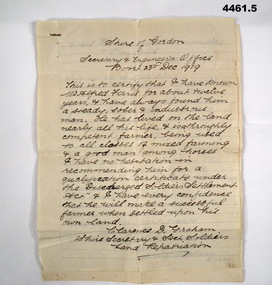
Letter - LETTERS, SOLDIER SETTLEMENT, Shire of Gordon, C. 1919 - 1920
... Soldier Settlement...post WW1...Letters cover recommendations to support the application of Alfred G Ferris for a Soldier Settlement block dated 1919 - 1920, signed by local dignitaries. Alfred G Ferris No 2156 AIF, Refer cat No 4183.3P for his service details. Soldier Settlement post WW1 ...Letters cover recommendations to support the application of Alfred G Ferris for a Soldier Settlement block dated 1919 - 1920, signed by local dignitaries. Alfred G Ferris No 2156 AIF, Refer cat No 4183.3P for his service details.Letters, 5 pages on ruled paper, hand written in ink, stapled together with metal staple.soldier settlement, post ww1, qualification certificate -
 Bendigo Historical Society Inc.
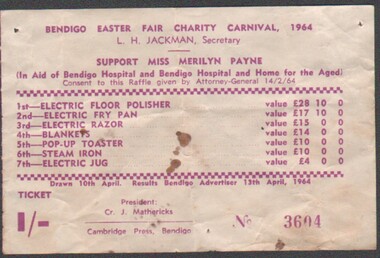
Ephemera - Bendigo Easter Fair Charity Carnival 1964 - raffle ticket
... 8375a: The Victorian soldier settlement scheme created in 1917 to lease farming land to soldiers and nurses returning from WW1. ...8375a: The Victorian soldier settlement scheme created in 1917 to lease farming land to soldiers and nurses returning from WW1. ...8375a: The Victorian soldier settlement scheme created in 1917 to lease farming land to soldiers and nurses returning from WW1. The Scheme was heavily criticised. Some reasons for this were the settlers' lack of capital, the size of the land allocated, and the prices of agricultural products both purchased and sold by the farmers. In the wake of WW2, the soldier settlement scheme was refined and, under the supervision of the Soldier Settlement Commission, was re-established. The Yarraberb Settlement was one of the settlements established in 1948. 8375b: Archibald Edmund "Archie" Robertson was born in Eaglehawk in 1884 to Martin Robertson and Anna Margaretha/Hannah Marguerita (nee. Weseloh/Wesloah). Robertson was a commissioned officer during WW1 and contributed to the welfare and advancement of the California Gully community. Following his death in 1922, following a fall from his bike, the community honoured Robertson with a memorial seat in 1923. Bendigo Easter Fair Charity Carnival 1964 - raffle ticket (ticket No 3604) costing one shilling, in support of Miss Merilyn Payne (in aid of the Bendigo Hospital and Bendigo Hospital and Home for the Aged). The raffle offers seven prizes ranging from 1st - electric floor polisher to 7th - electric jug. Printed by Cambridge Press, Bendigo.bendigo easter fair 1964, raffle ticket -
 Bendigo Historical Society Inc.
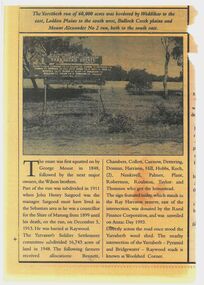
Newspaper - Newspaper articles - North Central Loddon Region
... Soldier Settlement Commission...Archie Robertson...California Gully...WW1...8375a: The Victorian soldier settlement scheme created in 1917 to lease farming land to soldiers and nurses returning from WW1. ...8375a: The Victorian soldier settlement scheme created in 1917 to lease farming land to soldiers and nurses returning from WW1. ...8375a: The Victorian soldier settlement scheme created in 1917 to lease farming land to soldiers and nurses returning from WW1. The Scheme was heavily criticised. Some reasons for this were the settlers' lack of capital, the size of the land allocated, and the prices of agricultural products both purchased and sold by the farmers. In the wake of WW2, the soldier settlement scheme was refined and, under the supervision of the Soldier Settlement Commission, was re-established. The Yarraberb Settlement was one of the settlements established in 1948. 8375b: Archibald Edmund "Archie" Robertson was born in Eaglehawk in 1884 to Martin Robertson and Anna Margaretha/Hannah Marguerita (nee. Weseloh/Wesloah). Robertson was a commissioned officer during WW1 and contributed to the welfare and advancement of the California Gully community. Following his death in 1922, following a fall from his bike, the community honoured Robertson with a memorial seat in 1923.A3 colour photocopies of newspaper articles pertaining to the North Central Victoria Region. Date of photocopy unknown. Location of original paper unknown (likely the Eaglehawk Times, unable to confirm). Both articles were cut from a larger paper. Article 8375a briefly describes the Yarraberb Solder Settlement. Article 8375b recounts the dedication of Archie Robertson's seat in California Gully. newspaper, eaglehawk heritage society, yarraberb soldiers settlement, soldier settlement commission, archie robertson, california gully, ww1, ww2 -
 Warrnambool and District Historical Society Inc.
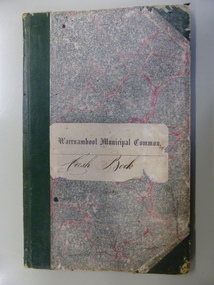
Document - Ledger, Warrnambool Municipal Common, Circa 1865
... After WW1 parts of the common were allocated to soldiers’ settlement blocks ranging from 18 to 30 acres. ...After WW1 parts of the common were allocated to soldiers’ settlement blocks ranging from 18 to 30 acres. ...This cash book contains entries which relate to the everyday operation of the Borough Common which predates the establishment of Warrnambool as a town. All ratepayers had the right to graze their cows on the common, with the cows being collected every morning by the herdsman and walked to the common. Entries relate to items such as eradication of thistles, repairs and erection of stock yards, burying of dead stock, purchase of bulls and clearing of waterholes. Salaries were paid to E. Margetts, D Allan, T Raingill, and M T Read. Auditors were James Dickson. After WW1 parts of the common were allocated to soldiers’ settlement blocks ranging from 18 to 30 acres. Other parts remained with the Crown for Municipal uses and part became the Warrnambool Golf Course. In 1925 the common was abolished.The entries in this book record the operations and earliest residents who were involved in the Common in the early days of WarrnamboolGrey and red mottled card cover with dark green points and spine. Paper label on front cover. Dark blue and tan mottled paper inside front and back covers. Warrnambool Municipal Common Cash Book.warrnambool borough, warrnambool common, e margetts, raingill, d allan, m t read, warrnambool common cash book -
 Myrtleford and District Historical Society
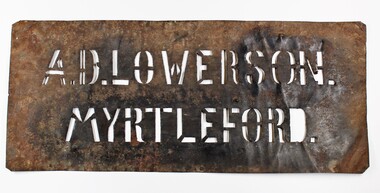
Tobacco bale stencil
... soldier settlement scheme was being reviewed at government level. He was active locally on these issues and supported fund raising for a war memorial, memorial hall and veteran welfare. The stencil represents the achievements of A.D.Lowerson, VC as an isolated example of success as a WW1 ...Stencil used by Sgt. Albert David Lowerson, VC, a soldier settler on Merriang Estate near Myrtleford. Lowerson acquired one of 19 blocks assigned by the Closer Settlement Board on the 700 acre estate in 1920. The stencil marked bales of cured tobacco leaves prior to shipment to Melbourne. Lowerson was one of the few successful soldier settler farmers in the district, operating a piggery, dairy farming and growing tobacco for almost 20 years on "St. Quentin". (Lowerson was awarded the Victoria Cross at Mont St. Quentin on September 1, 1918.) His success and status enabled him to lead a submission on farm debt and infrastructure problems when the soldier settlement scheme was being reviewed at government level. He was active locally on these issues and supported fund raising for a war memorial, memorial hall and veteran welfare.The stencil represents the achievements of A.D.Lowerson, VC as an isolated example of success as a WW1 soldier settler and as a local identity who stridently supported the need for recognition and support of ex-service personnel.Stencil made of thin sheet metal, rusted .Wording of stencil "A.D.LOWERSON. MYRTLEFORD." lowerson a.d., merriang estate, myrtleford, closer settlement board, tobacco, st. quentin, victoria cross, world war 1 -
 Tatura Irrigation & Wartime Camps Museum
Photographs, Anderson collection of irrigation and farm photos, c.1920 (Loaned), c.1920
... Carlton and Bill Anderson left Murchison for a soldier settlement block at North West Mooroopna, 2 miles from the school. Bill had been a stretcher bearer in WW1. ...Carlton and Bill Anderson left Murchison for a soldier settlement block at North West Mooroopna, 2 miles from the school. Bill had been a stretcher bearer in WW1. ...Collection of photos taken c.1920 by the Anderson family. Carlton and Bill Anderson left Murchison for a soldier settlement block at North West Mooroopna, 2 miles from the school. Bill had been a stretcher bearer in WW1. Photos taken by Anderson family of general farming activities, irrigation channel construction with horse teams, Goulburn Weir, Waranga Basin western outlet structure and channel, official opening ceremony. Photos loaned for copying.|1. Outlet structure, possibly the opening.|2.Western Channel.|3.Waranga Basin inlet.|4. Waranga Basin outlet.|5,6.Goulburn Weir.|7,8 Channel construction with horse teams.|9.Skid scoop.|10. Group at Bain.|11."Spot", Bill Anderson and the team.|12.Teams take time off.|13.Washing up.|14.Spring cart and "Smoko"|15.Bill Anderson holding horse.|16.Team of four.|17.A good crop.|18.Wonkey scoop with two horse team.|19,Horses at rest.|20.Head in nose bag.|21.Bill Anderson & Marty Clooney, tents, wagons and gig.|22.Wally Wybrow grooming horse.|23 Bill Anderson, Marty Clooney and furphy tank.|24. Four horse teams.|25.Carlton Anderson? cutting hair.|26,27.|28.Three wheel trolley made from old harvester.|29. Harvester.|30.Wally.|31.Marty Clooney and horse.|32|33.Seven horse team.|34-43.Various farm photos -
 Lake Bolac & District Historical Society
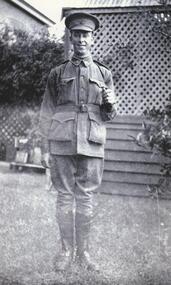
Black and white photograph, Gunner Stanley Herbert Moreton, Field Artillery Brigade, WW1
... soldier settlement. He died in 1978 at the age of 85. Moreton, Field Artillery Unit, 'Parupa Park', Soldier Settlement, Gunner Stanley Herbert Moreton, Field Artillery Brigade, WW1. ...Gunner Stanley Herbert Moreton, enlisted 04/12/1916 in a Field Artillery Unit. He embarked for France on 11/05/1917. Upon his return from the war, he purchased 'Parupa Park'. After WW2 Stanley was involved in helping with the subdivision of land for soldier settlement. He died in 1978 at the age of 85.moreton, field artillery unit, 'parupa park', soldier settlement, -
 Lake Bolac & District Historical Society
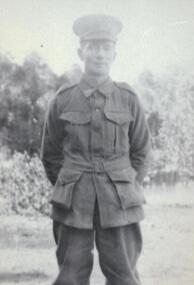
Black and white photograph, Private Hugh Michael O'Rorke, 39th Infantry Brigade, WW1
... Soldier Settlement block at Westmere and named it Killigrew'. Ray and Jan O'Brien live in the house now.' He was awarded an MBE in 1955 for services to the CFA. He died in 1962, aged 72. O'Rorke, 39th Infantry Battalion, France, Battle for Broodseinde Ridge, Soldier Settler, Westmere, O'Brien, MBE, CFA Private Hugh Michael O'Rorke, 39th Infantry Brigade, WW1. ...Private Hugh O'Rorke enlisted 28/03/1916 in 39th Infantry Battalion and embarked for France 27/05/1916. He was gassed and then severely wounded during the Battle for Broodseinde Ridge on 04/10.1917. After convalescence in England he returned to Australia and was discharged in 1918. He took up a Soldier Settlement block at Westmere and named it Killigrew'. Ray and Jan O'Brien live in the house now.' He was awarded an MBE in 1955 for services to the CFA. He died in 1962, aged 72.o'rorke, 39th infantry battalion, france, battle for broodseinde ridge, soldier settler, westmere, o'brien, mbe, cfa
