
Showing 82 items matching "year of the farmer"
-
 Marysville & District Historical Society
THE TRIANGLE NEWS-VOL 39 NO 1-JANUARY 20 2012
... ...year of the farmer...marysville victoria australia australia day celebrations marysville & district lions club australia day parade year of the farmer THE TRIANGLE NEWS-VOL 39 NO 1-JANUARY 20 2012 ...marysville, victoria, australia, australia day celebrations, marysville & district lions club, australia day parade, year of the farmer -
 Otway Districts Historical Society
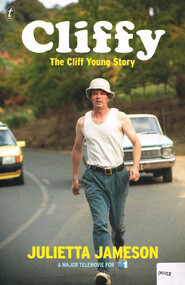
Book, The Text Publishing Company, Cliffy: the Cliff Young story, 2013
... Cliff Young was a sixty-one-year-old potato farmer from Beech Forest in the Otway Ranges, a couple of hundred kilometres south-west of Melbourne. ...Cliff Young was a sixty-one-year-old potato farmer from Beech Forest in the Otway Ranges, a couple of hundred kilometres south-west of Melbourne. ...Cliff Young was a sixty-one-year-old potato farmer from Beech Forest in the Otway Ranges, a couple of hundred kilometres south-west of Melbourne. With his distinctive shuffle, friendly wave and innocent grin, he beat a field of professional runners to take out the inaugural Westfield Sydney to Melbourne Ultra-marathon starting on April 27 and finishing May 2 in 1983.Cliffy: the Cliff Young story. Julietta Jameson. 1st ed. Melbourne (Vic); The Text Publishing Company; 2013. vi, 218 p.; illus. ISBN 978 1922 0798 6 2 Soft covercliff young; beech forest; sydney; melbourne; ultra-marathon; otways; -
 Wangaratta RSL Sub Branch
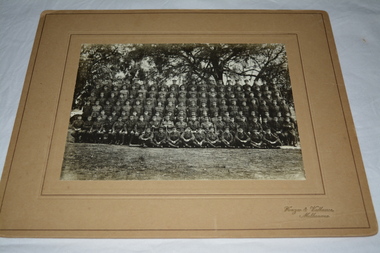
Photograph, 37th Battalion
... 37th Infantry Battalion - said to include soldier Private Francis Bradley Newton 2378 - 22 year old Farmer from Whitfield - Embarked on 20/10/1916 from Melbourne on HMAT Port Lincoln. ...37th Infantry Battalion - said to include soldier Private Francis Bradley Newton 2378 - 22 year old Farmer from Whitfield - Embarked on 20/10/1916 from Melbourne on HMAT Port Lincoln. ...37th Infantry Battalion - said to include soldier Private Francis Bradley Newton 2378 - 22 year old Farmer from Whitfield - Embarked on 20/10/1916 from Melbourne on HMAT Port Lincoln. Died 7/6/1983 buried Wangaratta CemetryBlack and white photograph mounted on light brown cardboard of large group of soldiers standing and sitting in seven rows taken outdoors under trees.Handwritten on rear of mount 37 Inf Bn 4th row from back 3rd on left or 10th from left - Frank Newton37th infantry battalion, frank newton, ww1 -
 8th/13th Victorian Mounted Rifles Regimental Collection
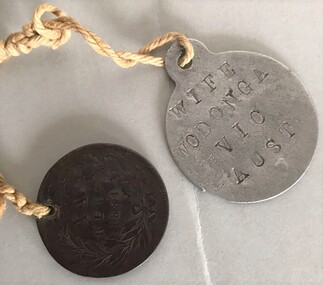
Badge - Identity disc Schleibs
... Frederick August Schleibs a 44 year old farmer of Wodonga enlisted in AIF 30 March 1916 and was allocated to 2nd Pioneer Battalion with regimental number 2972. ...Frederick August Schleibs a 44 year old farmer of Wodonga enlisted in AIF 30 March 1916 and was allocated to 2nd Pioneer Battalion with regimental number 2972. ...Frederick August Schleibs a 44 year old farmer of Wodonga enlisted in AIF 30 March 1916 and was allocated to 2nd Pioneer Battalion with regimental number 2972. En route to England he was hospitalised at Cape Town with injured knee. He was returned to Australia and discharged 27 October 1916. He reenlisted 21 February 1917 and sailed with 28th Reinforcements 8th Light Horse to Egypt. He returned to Australia following the war. Unusual to see a foreign coin used as an identity disc.Soldiers identify disc set connected by string; one aluminium and one a Portuguese 20 Reis coin. Both are stamped with information relating to 3383 Frederick Augustus Schleibs who served with 8th Australian Light Horse in World War One.On aluminium disc "A F Schleibs / 3383 / 8LH / CE", and on reverse "Wife / Wadonga / Vic / Aust". On coin "FAS / 3383 / CE"schleibs, light horse, 8th, world war one, wwi, aif, pioneer, wodonga -
 Bendigo Historical Society Inc.
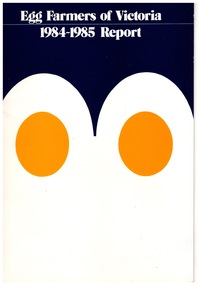
Administrative record - Commercial Egg Producers' Association of Victoria (CEPA) Central Council Correspondence, 1985
... The Association opposes the Board's recommendation to phase out dockage subsidies, viewing it as discriminatory against country egg producers and those outside metropolitan areas.They argue that industry costs should be shared equally across all sectors; also Concerns About Public Health Statements 8504.41m Letter to Bruce Reid MLC regarding the Egg Industry Stabilization Amendment Act 1985 8504.41n Letter to David Kennedy MLA regarding the Egg Industry Stabilization Amendment Act 1985 8504.41o Letter to Bernie Dunne MLC regarding the Egg Industry Stabilization Amendment Act 1985 8504.41p To Evan Walker MLC The document is a formal letter expressing protest and concern regarding the misrepresentation and misuse of confidential correspondence about the Egg Farmers of Victoria's 5-year plan. 8504.41q To the Egg Farmers of Victoria. ...The Association opposes the Board's recommendation to phase out dockage subsidies, viewing it as discriminatory against country egg producers and those outside metropolitan areas.They argue that industry costs should be shared equally across all sectors; also Concerns About Public Health Statements 8504.41m Letter to Bruce Reid MLC regarding the Egg Industry Stabilization Amendment Act 1985 8504.41n Letter to David Kennedy MLA regarding the Egg Industry Stabilization Amendment Act 1985 8504.41o Letter to Bernie Dunne MLC regarding the Egg Industry Stabilization Amendment Act 1985 8504.41p To Evan Walker MLC The document is a formal letter expressing protest and concern regarding the misrepresentation and misuse of confidential correspondence about the Egg Farmers of Victoria's 5-year plan. 8504.41q To the Egg Farmers of Victoria. ...The Commercial Egg Producers' Association of Victoria was active by the 1930s, engaging in industry management and lobbying.The Commercial Egg Producer's Association (CEPA) had branches in Bendigo, South Bendigo, Eaglehawk, Wedderburn, Murrabit and Euroa.CEPA Commercial Egg Producer's Association (Bendigo Region) correspondence, for the year 1985. This item includes the following documents: 8504.41a 8504.41a Egg Farmers of Victoria 1984-1985 Report 26 pages 8504.41b This document is an official invitation from the Victorian Egg Marketing Board, dated July 2, 1985, addressed to Mr. K. Fitzgibbon. Meeting Location and DateThe Board's August meeting is scheduled for August 21, 1985, at the Bendigo Municipal Offices, as the area is expected to be free of quarantine issues by then. 8504.41c The Board postponed the Bendigo meeting due to farm quarantines, which was later confirmed as a responsible decision. 8504.41d The document is a formal response from the Department of Agriculture and Rural Affairs to the Commercial Egg Producers Association regarding poultry industry services in northern Victoria. 8504.41e Department of Agriculture and Rural Affairs. The Central Council of the Commercial Egg Producers Association of Victoria is asked to submit a panel of at least three and not more than five qualified growers for consideration. 8504.41f Department of Agriculture and Rural Affairs. The Governor in Council has made new appointments to the Victorian Egg Marketing Board.Details of these appointments are provided in an enclosed statement (not included in the summary). 8504.41g Here are the key points from the Crystal Egg Company letter addressing complaints from the Commercial Egg Producers Association of Victoria:Response to Complaints:The company disputes all points raised in the association's letter, stating there are no grounds for the complaints.The author expresses confusion about the complaints and suggests direct communication (phone or in-person) to resolve issues quickly. 8504.41h Egg Farmers of Victoria. The document outlines correspondence regarding legislative changes and quota levy arrangements for the Victorian egg industry 8504.41i From Egg Farmers of Victoria; the document outlines proposed amendments to the Marketing of Primary Products Act, focusing on the egg industry in Victoria. 8504.41j The document details the new Producer Agent Contracts for egg producers, outlining two contract types and their key requirements 8504.41k The document is a formal letter from the Commercial Egg Producers' Association of Victoria addressed to Mr. David Kennedy, M.L.A. The Association asks Mr. Kennedy to arrange a meeting with the Minister for Agriculture, Mr. Evan Walker, to discuss issues related to transporting country eggs to Melbourne.Proposal for Egg Board Composition: 8504.41l Letter to the Egg Farmers Association of Victoria's letter. The Association opposes the Board's recommendation to phase out dockage subsidies, viewing it as discriminatory against country egg producers and those outside metropolitan areas.They argue that industry costs should be shared equally across all sectors; also Concerns About Public Health Statements 8504.41m Letter to Bruce Reid MLC regarding the Egg Industry Stabilization Amendment Act 1985 8504.41n Letter to David Kennedy MLA regarding the Egg Industry Stabilization Amendment Act 1985 8504.41o Letter to Bernie Dunne MLC regarding the Egg Industry Stabilization Amendment Act 1985 8504.41p To Evan Walker MLC The document is a formal letter expressing protest and concern regarding the misrepresentation and misuse of confidential correspondence about the Egg Farmers of Victoria's 5-year plan. 8504.41q To the Egg Farmers of Victoria. The document is a formal letter expressing concern and protest over the misrepresentation and misuse of correspondence related to the Egg Farmers of Victoria's 5-year plan. 8504.41r This document is a formal letter to the General Manager of Egg Farmers of Victoria, addressing clarifications and proposed changes to marketing and quota schemes for egg producers in Victoria and New South Wales. 8504.41s This document is a formal letter from the Secretary of CEPA, dated July 30, 1985. The key points are:The letter notifies members about a resolution regarding the incorporation of the Association. 8504.41t Disappointment with Egg Farmers of Victoria Board's Actions Producers. 8504.41u The document is a formal letter from the secretary of CEPA to the manager of Crystal Egg Co., highlighting several concerns about the company's egg grading service 8504.41v Notice of Annual Conference Announcement. The Central Council of the Commercial Egg Producers' Association will hold its Annual Conference.Date and Time: Wednesday, 19th June 1985 at 6:00 p.m.Location: R.S.L. Hall, Kangaroo Flat. 8504.41w Notice of AGM Meeting Date and Time:Thursday, 27th June 1985 at 7:00 8504.41x This document is a formal letter from K. Fitzgibbon, Secretary of CEPA, addressed to Mr. C. L. Jefferson, Secretary of the Egg Farmers of Victoria. Request for Meeting:The association is requesting a deputation with the entire Board of the Egg Farmers of Victoria in Melbourne.The purpose of the meeting is to discuss proposed changes affecting the egg industry. 8504.41y CEPA is submitting nominations for the Producer Member position on the Victorian Egg Marketing Board.T hree candidates are nominated: Peter Carpeneeer: Retiring member, served the past two years, praised for his representation, nominated for another term. Ron Robins: From Harcourt. Gary Robertson: From Lockwood South. The letter is addressed to Mr. E. Walker, Minister of Agriculture, and sent by K. Fitzgibbon, Secretary of the association. 8504.41z The document is a letter from the Commercial Egg & Producers Association of Victoria addressed to Mr. Michael John, M.L.A., congratulating him on his recent election to Parliament. 8504.41aa This document is a congratulatory letter from the Commercial Egg Producers Association of Victoria to Ken Wright, marking his election to Parliament. 8504.41ab This document is a congratulatory letter from the Commercial Egg Producers Association of Victoria to David Kennedy, marking his election to Parliament. 8504.41ac This document is a formal letter from the Secretary of CEPA to the Minister for Agriculture. The key points are:Request for Meeting. The association is seeking a meeting with the Minister for Agriculture at the earliest convenience. The main topic is to discuss the future of the poultry industry in the state. 8504.41ad This document is a formal letter from K. Fitzgibbon, Secretary of CEPA addressed to Mr. C. L. Jefferson, Secretary of the Egg Farmers of Victoria. Request for Meeting:The association is requesting a deputation (meeting) with the entire Board of the Egg Farmers of Victoria in Melbourne. 8504.40ae The document is a letter from the Bendigo Branch of the Commercial Egg Producers Association of Victoria expressing concern about proposed changes to Department of Agriculture services for the poultry industry. Key points include. The letter opposes the recommendation to transfer Greg Parkinson (a poultry industry officer) to Melbourne and review Bendigo's poultry services after 12 months. 8504.41af This document is a membership directory for the C.E.P.A. Bendigo Branch, listing members' names and addresses. Contains a table of members with their names, addresses, and membership numbers. Some members are noted as 'Life Members', indicating special status (e.g., D.T. Dixon, J.D. Oakes). 8504.41ag The document records the executive meeting of the Commercial Egg Producers Association of Victoria held on April 25, 1985 8504.41ah The Central Council Executive Meeting held on 30th May 1985 Minutes 8504.41ai The executive meeting minutes of the Commercial Egg Producers' Association of Victoria, April 1985 8504.41aj CEPA Annual Conference Minutes June 1985 8504.41ak Egg Farmers of Victoria Newsletter, four pages, March 1985 8504.41al This document outlines proposed quality standards and sampling procedures for egg freshness, focusing on Haugh Units, to be included in a 5-year plan 8504.41am Notice of Annual CEPA Meeting June 1995 8504.41an This document is an invitation from the Commercial Egg Producers Association (CEPA) to its members in the Bendigo and South Bendigo branches. Monthly MeetingsMeetings are held on the second Monday of each month at the R.S.L. Hall, Kangaroo Flat, at 8:00 p.m. 8504.41ao This document contains a series of correspondence between the South Bendigo Branch of the Commercial Egg Producers Association, government officials, and members of parliament regarding the aftermath of a fowl plague outbreak in Victoria, Australia. There was significant concern among egg producers about delays in receiving compensation for losses due to the fowl plague outbreak. 8504.41ap This document is a formal letter from the Commercial Egg Producers' Association Co-operative Limited, dated October 7, 1985. The letter informs the recipient about the status of subscription payments. It confirms that two members, Popple E. and Somerville R., have paid their subscriptions through the Co-operative.Action Requested: The secretary recommends that the recipient notes these payments for their records. 8504.41aq This document is a formal letter from the Department of Agriculture, Victoria, addressing the potential transfer and replacement of a poultry officer in the Bendigo area. 8504.41ar This document is a formal letter from the Minister for Agriculture and Rural Affairs addressing the status and future of poultry industry services in the Bendigo region 8504.41as Letters between CEPA and members of parliament re docking charges 8504.41at This document is a formal letter from Ernie Dunn, a Member of the Legislative Council and Leader of the National Party (Council), addressed to Mr. J. Heard, Secretary of the South Bendigo Branch of the Commercial Egg Producers Association. The letter informs Mr. Heard about comments made in the State Parliament regarding the replacement of the Poultry Officer in the Bendigo region. Ernie Dunn has enclosed a copy of his parliamentary comments for Mr. Heard's information.Communication: The letter serves as an official communication to keep the poultry association informed about parliamentary discussions relevant to their interests. 8504.41au This document is a formal letter from Tom Austin, MP, addressing concerns about the proposed removal of the egg transport subsidy. 8504.41av This document is a formal notification to CEPA Secretary Mr. R. Broadbent regarding the appointment of industry representatives to two Poultry Industry/Department working parties, from the Department of Agriculture 8504.41aw This document is a letter from Bernie Dunn, Member of the Legislative Council and Leader of the National Party (Council), addressed to Mrs. Joan Heard, Secretary of the South Bendigo C.E.P.A. Bernie Dunn acknowledges receipt of Mrs. Heard's letter regarding concerns about additional dockage (freight charges) for egg transport between Bendigo and Melbourne. 8504.41ax Letters between CEPA and Members of Parloiamnet. The document outlines the Victorian Egg Board's plan to phase out transport subsidies in the egg industry by 1989. Since 1937, transport costs for moving eggs from grading floors or depots to market or processing plants have been covered by an equalization fund, financed by a levy on all eggs produced.In 1984/85, subsidies totaled $710,000 (1.44 cents per dozen); by 1985/86, this was estimated at $800,000 (1.6 cents per dozen). Rising transport costs have increased the subsidy burden and associated levies.The shift of egg production from metropolitan to country areas has hidden the true cost of transport for some producers.No other primary industry subsidizes transport to market, and Victoria is the last state to do so after NSW removed its subsidy.egg producer's information, correspondence, cepa, commercial egg producers' association -
 Flagstaff Hill Maritime Museum and Village
Document - Framed Poster, Borough of Warrnambool, Victoria, Australia, after 30/06/1875
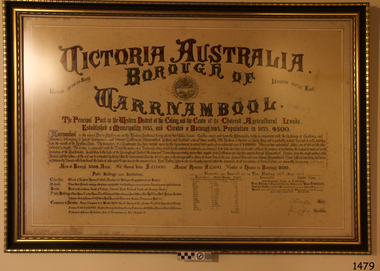
... Steam Navigation Co, Woolen Mill Co, Gas Co, Racing Club, Amateur Turf Club, Agricultural Society, Farmers’ Club, Cricket Club, Anglers’ Society, Building Society, Freemasons Odd Fellows, Foresters, Druids, Hibernians. Protestant Alliance, Rechabites, Sons of Temperance, &c, Fire Brigade &c. --- Exports and Imports for the Year Ending 30th June 1875 –-- --Exports Total Tonnage 27,800 (Calculated at the Current Warrnambool Market Prices) Potatoes Wool Wheat Barley Hides Skins Fowls Butter Cheese Eggs Tallow Leather Ale Pigs Sheep Sundries --Imports 13,000 Tons Of the Estimated Value of £520,000 Total Tonnage of Exports and Imports 40m900 Tons, Value £806,627 Passenger Travels, to ad from Warrnambool during year, 10,000 persons Revenue from all sources paid through Warrnambool Sub Treasury From 1860 to June 1875 £1, 292, 300 Thomas King [signed] Mayor Henry T Read [signed] Town Clerk” - - - - - - - - - - - - - - -- - - - - - - - - - - - - - -- - - - - - - - - - - - - - -- - - - - - - - - - - - - - - ...Steam Navigation Co, Woolen Mill Co, Gas Co, Racing Club, Amateur Turf Club, Agricultural Society, Farmers’ Club, Cricket Club, Anglers’ Society, Building Society, Freemasons Odd Fellows, Foresters, Druids, Hibernians. Protestant Alliance, Rechabites, Sons of Temperance, &c, Fire Brigade &c. --- Exports and Imports for the Year Ending 30th June 1875 –-- --Exports Total Tonnage 27,800 (Calculated at the Current Warrnambool Market Prices) Potatoes Wool Wheat Barley Hides Skins Fowls Butter Cheese Eggs Tallow Leather Ale Pigs Sheep Sundries --Imports 13,000 Tons Of the Estimated Value of £520,000 Total Tonnage of Exports and Imports 40m900 Tons, Value £806,627 Passenger Travels, to ad from Warrnambool during year, 10,000 persons Revenue from all sources paid through Warrnambool Sub Treasury From 1860 to June 1875 £1, 292, 300 Thomas King [signed] Mayor Henry T Read [signed] Town Clerk” - - - - - - - - - - - - - - -- - - - - - - - - - - - - - -- - - - - - - - - - - - - - -- - - - - - - - - - - - - - - The document is of historical, social, economic and local significance in that it summarises activities, business, community, trade, travel and government at a point in time in Warrnambool’s history – 30th June 1875. flagstaff hill warrnambool shipwrecked coast flagstaff hill maritime museum maritime museum shipwreck coast flagstaff hill maritime village great ocean road borough of warrnambool municipality of warrnambool document borough of warrnambool 1875 word picture of warrnambool 1875 tablet of borough of warrnambool 1875 statistics borough of warrnambool 1875 lithograph borough of warrnambool 1875 coat of arms warrnambool warrnambool city motto – in these we flourish establishment of warrnambool warrnambool history thomas king mayor of warrnambool henry t read town clerk of warrnambool warrnambool breakwater warrnambool jetty warrnambool imports and exports 1875 warrnambool agriculture 1875 warrnambool business 1875 warrnambool population 1875 centennial exhibition philadelphia 1876 framed certificate Signatures - "Thomas King" Mayor and "Henry T Read" Town Clerk. ...This document, also referred to as a word picture or Tablet, is framed in glass and timber with gilt trim, is handwritten with colour highlights. The penned letters rest on ruled guide lines, decorated where the lines intersect. The writing gives a description of the state of Borough of Warrnambool around 1875; its location, the area it covers, its population, Harbour and facilities, public buildings and institutions, imports and exports, financial worth, number of houses, connection with other areas of the Colony. A possible reason and origin for the document is found in an article ‘Link with US Exhibition’ from the Warrnambool Standard of December 19, 1981, written by local historian Bruce Morris. The writer mentions that the Warrnambool Borough Council met on 15th June 1875 and recorded a letter from G.C. Levey , secretary to the Melbourne group of commissioners representing the Colony, and Victoria in particular, for the Philadelphia Centennial Exhibition of 1876. The letter asks Council to provide “statistics as to the population, social condition and commercial and industrial state of the district in and around Warrnambool.” A sub committee was formed for the project. The Mayor, Cr. Thomas King, wrote and signed a Report, presented to the council on July 14, 1875, in which “The Committee … begs to recommend that a Tablet be prepared setting for the particulars respecting the following matters relating to the Borough”. The matters included area, population, annual income, churches, schools, other public buildings, societies and companies, general description of houses erected, and returns of exports and imports for 1874. The minutes note that the Report was adopted. The article above also notes the opinion of Warrnambool printers who have examined the document; it is almost certainly to be an old lithograph, which means there could be several copies. It is possible that there may be a copy in Melbourne and another in Philadelphia. It is interesting to note that (1) the quoted location co-ordinates are for an “Unnamed Road, Packsaddle NSW 2880, Australia”, and that the DMS co-ordinates for Warrnambool’s Council Offices differ, being 38.23.9.12 South, 142.28.52.887. (2) the date for “Exports and Imports for the Year Ending 30th June 1875” is different to the period mentioned by Cr. King in the sub committee’s Report of recommendation “returns of exports and imports for 1874”. The information required to have the figures for the end of June 1875 would need to have been compiled very quickly for the Tablet to be ready for the opening of the Philadelphia Exhibition on 10 May 1876. The document/certificate shows the following – - - - - - - - - - - - - - - -- - - - - - - - - - - - - - -- - - - - - - - - - - - - - -- - - - - - - - - - - - - - - “Victoria Australia, Borough of Warrnambool. Latitude, 30.24.50 South, Longitude 142.32 East The Principal Port in the Western District of the Colony and the Centre of its Choicest Agricultural Lands. Established a Municipality in 1855, and Created a Borough 1863. Population in 1875 4,500. Warrnambool is the nearest Port to Melbourne on the Western Seaboard, being about 160 miles distant. Coaches run to and from the Metropolis daily, in connexion [connection] with the Railway of Geelong and Steamers belonging to Local Companies sail between Melbourne, Warrnambool, Belfast [renamed Port Fairy], and Portland several times weekly. The Harbour is known as Lady Bay, and is partially protected by a reef of rocks stretching from the mouth of the Hopkins River. The formation of a Breakwater has been decided upon by the Government, to extend 600 yards, at an estimated cost of £100,000. There are two substantial Jetties, one of 800 and the other of 600 feet in length. The former is connected with the Town by means of a Tramroad, along which Goods, inwards & outwards, are conveyed, & the latter has been constructed solely for the purpose of facilitating the transit of material for the formation of the Breakwater. In addition to the trade of the Borough and District, the principal Townships up country receive their supplies from Melbourne and ship their exports through Warrnambool. Potatoes form the staple produce of the district, and the richness of the soil can be estimated by the fact that the Government Statistics for 1875 give as the average yield a return of Seven Tons to the acre. Several thousand acres between Warrnambool and Tower Hill are now being laid down in Potatoes by Tenants who have leased the lands at rates up to £5 per acre for the season 1875-6. Wool, Tallow, hides &c are also largely exported, while the shipments of all descriptions of Farm Produce are annually increasing. Area of Borough, 3362 Acres. Net Annual Value £27,000. Annual Revenue £5,500. Number of Houses in Borough 800. Public Buildings and Institutions Churches. Church of England, Roman Catholic, Presbyterian, Wesleyan, Congregational and Baptist. Schools. Three State Schools, average attendance nearly 1000. New Building in course of erection. Several private establishments. Banks. Bank of Australasia, Bank of Victoria, National Bank, Colonial Bank and Savings Bank. Public Buildings. Court house, Custom house, Post & Telegraph Offices, Survey & Land Offices, Shire £, Town Hall, Mechanics Institute, Volunteer Orderly Room, Odd Fellows Hall, Hospital & Benevolent Asylum, Temperance Hall &c. Companies & Societies. Steam Navigation Co, Woolen Mill Co, Gas Co, Racing Club, Amateur Turf Club, Agricultural Society, Farmers’ Club, Cricket Club, Anglers’ Society, Building Society, Freemasons Odd Fellows, Foresters, Druids, Hibernians. Protestant Alliance, Rechabites, Sons of Temperance, &c, Fire Brigade &c. --- Exports and Imports for the Year Ending 30th June 1875 –-- --Exports Total Tonnage 27,800 (Calculated at the Current Warrnambool Market Prices) Potatoes Wool Wheat Barley Hides Skins Fowls Butter Cheese Eggs Tallow Leather Ale Pigs Sheep Sundries --Imports 13,000 Tons Of the Estimated Value of £520,000 Total Tonnage of Exports and Imports 40m900 Tons, Value £806,627 Passenger Travels, to ad from Warrnambool during year, 10,000 persons Revenue from all sources paid through Warrnambool Sub Treasury From 1860 to June 1875 £1, 292, 300 Thomas King [signed] Mayor Henry T Read [signed] Town Clerk” - - - - - - - - - - - - - - -- - - - - - - - - - - - - - -- - - - - - - - - - - - - - -- - - - - - - - - - - - - - - The document is of historical, social, economic and local significance in that it summarises activities, business, community, trade, travel and government at a point in time in Warrnambool’s history – 30th June 1875.Document, also referred to as a ‘word picture’ or ‘tablet’. Document is framed in glass and timber with gilt trim, handwritten with colour highlights. The penned letters rest on ruled guide lines, decorated where the lines intersect. Document outlines the establishment of Warrnambool as a Municipality in 1855 and Borough in 1863, with a population of 4,500 in 1875. It states geographic location, public buildings and institutions, harbor facilities and imports and exports for the year ending 30th June 1875. Two signatures "Thomas King" Mayor and "Henry T Read" Town Clerk. It shows the Coat of Arms of the Borough of Warrnambool.Signatures - "Thomas King" Mayor and "Henry T Read" Town Clerk. Warrnambool Coat of Arms; “British Coat of Arms, above sailing vessel and sheaf of wheat in sun, motto “By these we flourish” and around circumference “Borough of Warrnambool 1855”flagstaff hill, warrnambool, shipwrecked coast, flagstaff hill maritime museum, maritime museum, shipwreck coast, flagstaff hill maritime village, great ocean road, borough of warrnambool, municipality of warrnambool, document borough of warrnambool 1875, word picture of warrnambool 1875, tablet of borough of warrnambool 1875, statistics borough of warrnambool 1875, lithograph borough of warrnambool 1875, coat of arms warrnambool, warrnambool city motto – in these we flourish, establishment of warrnambool, warrnambool history, thomas king mayor of warrnambool, henry t read town clerk of warrnambool, warrnambool breakwater, warrnambool jetty, warrnambool imports and exports 1875, warrnambool agriculture 1875, warrnambool business 1875, warrnambool population 1875, centennial exhibition philadelphia 1876, framed certificate -
 The Beechworth Burke Museum
Audio - Oral History, Jennifer Williams, Mr Albert (Bert) Nankervis, 15th March 2000
... In this oral history, Albert discusses his life as a farmer in Wooragee, including his role in getting electricity to Beechworth, as well as his participation in the Young Farmer’s Association Immigration Scheme, which provided work experience to migrants in order for them to learn how to farm. This oral history recording was part of a project conducted by Jennifer Williams in the year 2000 to capture the everyday life and struggles in Beechworth during the twentieth century. ...In this oral history, Albert discusses his life as a farmer in Wooragee, including his role in getting electricity to Beechworth, as well as his participation in the Young Farmer’s Association Immigration Scheme, which provided work experience to migrants in order for them to learn how to farm. This oral history recording was part of a project conducted by Jennifer Williams in the year 2000 to capture the everyday life and struggles in Beechworth during the twentieth century. ...Mr Albert (Bert) Nankervis was born at Thougla, in the Upper Murray, in 1903. He had a large family and was one of eight children, four boys and four girls. He and his family moved to a farm in Wooragee named ‘Wattle Grove’ in 1918 after his father returned from serving as a soldier in World War One. The family established ‘Wattle Grove’ as a dairy farm as Beechworth has a high demand for milk and little supply. They had 25 milk cows that were hand milked every morning in order to provide milk for approximately 100 customers in the town, with any extra going to the butter factory at Springhurst. Albert married Floré Lilias Hardy in 1930 and they had two sons, Phillip and Barry. In this oral history, Albert discusses his life as a farmer in Wooragee, including his role in getting electricity to Beechworth, as well as his participation in the Young Farmer’s Association Immigration Scheme, which provided work experience to migrants in order for them to learn how to farm. This oral history recording was part of a project conducted by Jennifer Williams in the year 2000 to capture the everyday life and struggles in Beechworth during the twentieth century. This project involved recording seventy oral histories on cassette tapes of local Beechworth residents which were then published in a book titled: Listen to what they say: voices of twentieth century Beechworth. These cassette tapes were digitised in July 2021 with funds made available by the Friends of the Burke. Mr Albert (Bert) Nankervis’s account of his life in Wooragee and the local area, including Beechworth, during the early 20th century is historically and socially significant to the cultural heritage of the region. He details his life as a farmer and milkman in the early 20th century, particularly the interwar period (1918-1939), but also discusses life after the Second World War, including employing young migrant men to train them as farmers through the Young Farmer’s Association. This oral history account is socially and historically significant as it is a part of a broader collection of interviews conducted by Jennifer Williams which were published in the book 'Listen to what they say: voices of twentieth-century Beechworth.' While the township of Beechworth is known for its history as a gold rush town, these accounts provide a unique insight into the day-to-day life of the town's residents during the 20th century, many of which will have now been lost if they had not been preserved. This is a digital copy of a recording that was originally captured on a cassette tape. The cassette tape is black with a horizontal white strip and is currently stored in a clear flat plastic rectangular container. It holds up 45 minutes of recordings on each side.Mr Albert (Bert) Nankervis / albert nankervis, bert nankervis, nankervis, wattle grove, wooragee, dairy farm beechworth, dairy farm, dairy factories beechworth, dairying, milkman, oral history, springhurst, butter factory, electricity, rural life, farming and agriculture, farm, farm work, cow, cattle, jersey cattle, interwar period, first world war, second world war, wwi, wwii, greatest generation, centenarian, nonagenarian, 1920s, 1930s beechworth, thougla, upper murray, murray, lucyvale, benalla -
The Beechworth Burke Museum
Audio - Oral History, Jennifer Williams, Mr Ken Howe, 23rd September 2000
... farmers and did not come to Beechworth for gold. Ken left school when he was 13 and a half and worked at the Zwar brothers Tannery for four years. He then went on to work at with the Forest Commission. Ken discusses his job's, family, the arrival of Baltic immigrants after world war 2, The impact of the story of Kelly's in his life and just life in general at Beechworth. This oral history recording was part of a project conducted by Jennifer Williams in the year...farmers and did not come to Beechworth for gold. Ken left school when he was 13 and a half and worked at the Zwar brothers Tannery for four years. He then went on to work at with the Forest Commission. Ken discusses his job's, family, the arrival of Baltic immigrants after world war 2, The impact of the story of Kelly's in his life and just life in general at Beechworth. This oral history recording was part of a project conducted by Jennifer Williams in the year ...Ken Howe was born on the 9th February 1941 in Beechworth. His parents came from Everton. His mothers parents were from Northern Island and his fathers parents from Everton. They were farmers and did not come to Beechworth for gold. Ken left school when he was 13 and a half and worked at the Zwar brothers Tannery for four years. He then went on to work at with the Forest Commission. Ken discusses his job's, family, the arrival of Baltic immigrants after world war 2, The impact of the story of Kelly's in his life and just life in general at Beechworth. This oral history recording was part of a project conducted by Jennifer Williams in the year 2000 to capture the everyday life and struggles in Beechworth during the twentieth century. This project involved recording seventy oral histories on cassette tapes of local Beechworth residents which were then published in a book titled: Listen to what they say: voices of twentieth century Beechworth. These cassette tapes were digitised in July 2021 with funds made available by the Friends of the Burke.Ken Howe's story offers an insight into life in Beechworth from the 1940's onwards, he details the various jobs that occurred in the Zwar brothers tannery factory, the tasks that occurred for the forest commission. He also provides insight into the role the Kelly story played in their lives and the significant places were incidents occurred. His story also offers a look into everyday Beechworth life and how the baltic immigrants after World War 2 integrated into the Australian lifestyle by working at the Zwar brothers tannery. This oral history account is socially and historically significant as it is a part of a broader collection of interviews conducted by Jennifer Williams which were published in the book 'Listen to what they say: voices of twentieth-century Beechworth.' While the township of Beechworth is known for its history as a gold rush town, these accounts provide a unique insight into the day-to-day life of the town's residents during the 20th century, many of which will have now been lost if they had not been preserved.This is a digital copy of a recording that was originally captured on a cassette tape. The cassette tape is black with a horizontal white strip and is currently stored in a clear flat plastic rectangular container. It holds up 40 minutes of recordings on each side.Mr Ken Howe /listen to what they say, beechworth, oral history, burke museum, ken howe, howe, everton, northern island, farmers, zwar brothers tannery, glue, forest commission, family -
 Mission to Seafarers Victoria
Certificate - Certificate of Competency Extra Master, 1919
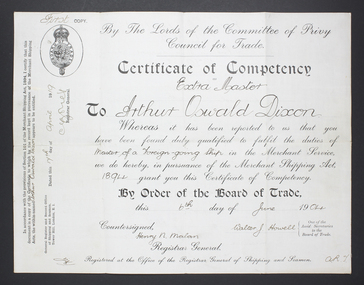
... farmer. Other correspondence and papers gifted to the Mission indicates the year 1919 (post his service in World War 1) was a time of some changes for Mr Dixon, possibly leading to his subsequent re-location to Australia show that he served as a crew member on the Merchant vessel "Hororata" a vessel which is noted in the MTSV records including an image of the crew in the early 1920s. ...farmer. Other correspondence and papers gifted to the Mission indicates the year 1919 (post his service in World War 1) was a time of some changes for Mr Dixon, possibly leading to his subsequent re-location to Australia show that he served as a crew member on the Merchant vessel "Hororata" a vessel which is noted in the MTSV records including an image of the crew in the early 1920s. ...This document one of several papers and objects from the estate of Mr Arthur O. Dixon, an ex-master mariner and later smallhold farmer. Other correspondence and papers gifted to the Mission indicates the year 1919 (post his service in World War 1) was a time of some changes for Mr Dixon, possibly leading to his subsequent re-location to Australia show that he served as a crew member on the Merchant vessel "Hororata" a vessel which is noted in the MTSV records including an image of the crew in the early 1920s. (see VC record ).This vessel is also mentioned in a narrative poem by a de-mobbed Soldier of WW1 as the transport for a number of returning servicemen and families. The poem is held in the National Library of Australia.Unusually for the early 20th C. era of Mr Dixon's service at sea two images of Mr Dixon were included in the gift of papers. Personal objects included an unusual small travel size New Testament (see VC record ) heavily annotated provide further insights into the experience of early 20th C. seafarers. Officially printed document, and official copy of an original certificate of competency issued by the office of the Register General of Shipping and Seamen recognising Arthur Oswald Dixon as an Extra Master. At right angles to the certificate is a small margin at left indication the current document is an approved copy in 1919 of the original certificate issued in 1904. See image for both sides of the document for extensive text.certificate of competency, master, captain, sailor, arthur oswald dixon, seamanship, sailors, seamen, seafarers, officers, 1904 -
Federation University Historical Collection
Book - Book - Scrapbook, Ballarat School of MInes: Scrapbook of Newspaper Cuttings, Book 80, August 1997 to October 1997
... The papers concerned are The Courier, Ballarat, The Australian, The Age and other region papers over the period of 6 August 1997 to 18 October 1997. teaching positions advertised pre-employment courses courses available enrolment for smb courses mature-age students quicker cheaper degrees real estate students honoured leisandie bongkakae of vanuatu first international graduate from smb smb appreciation night staff reject offer of 10% student waiter of the year graham paynter rural training council of australia stacey dekker wins award apprenticeships fail to meet needs smb staff say no to cynicism claxton monument and fountain "red cordial" theatre production peter vanderkley earns award food handling course at smb farmers join computer courses vineyard trainees work skills awards switzerland ararat community college ceramics of neville french open day at university of ballarat craftsmanship awards at smb corey hefferman brett overington anthony sanders simon overall george johns mayor james coghlan women's access celebration daniel james leoda atkinson training awards uni staff to vote on new agreement assessment centre zali crosbie on english-teaching trip to kenya yoshinori fujimoto survivor of earthquake creativity a winning trait state training board taste of scotland to ballarat cyber career loclan hemley stawell campus opening andrea bateman wins award decade of change in tafe Book with yellow cover, front, spiral bound. ...Collection of newspaper articles related to Ballarat School Of Mines.They cover activities and advertisements for staff. The papers concerned are The Courier, Ballarat, The Australian, The Age and other region papers over the period of 6 August 1997 to 18 October 1997. Book with yellow cover, front, spiral bound. teaching positions advertised, pre-employment courses, courses available, enrolment for smb courses, mature-age students, quicker cheaper degrees, real estate students honoured, leisandie bongkakae of vanuatu, first international graduate from smb, smb appreciation night, staff reject offer of 10%, student waiter of the year, graham paynter, rural training council of australia, stacey dekker wins award, apprenticeships fail to meet needs, smb staff say no to cynicism, claxton monument and fountain, "red cordial" theatre production, peter vanderkley earns award, food handling course at smb, farmers join computer courses, vineyard trainees, work skills awards switzerland, ararat community college, ceramics of neville french, open day at university of ballarat, craftsmanship awards at smb, corey hefferman, brett overington, anthony sanders, simon overall, george johns, mayor james coghlan, women's access celebration, daniel james, leoda atkinson, training awards, uni staff to vote on new agreement, assessment centre, zali crosbie on english-teaching trip to kenya, yoshinori fujimoto survivor of earthquake, creativity a winning trait, state training board, taste of scotland to ballarat, cyber career, loclan hemley, stawell campus opening, andrea bateman wins award, decade of change in tafe -
Federation University Historical Collection
Book - Book - Scrapbook, Ballarat School of MInes: Scrapbook of Newspaper Cuttings, Book 1, June 1974 - June 1976
... The papers concerned are The Courier, Ballarat, The Australian, The Age over the period from June 1974 to June 1976 staffing advertisements silver medal for m j petrie tech boys sample future careers fund raiser for children's home tinken award to peter storey apprenticeship week craftsmen receive certificates barker heads new education group apprenticeship scheme for young farmers school planned at mount clear r dunlop new principal submissions to school commission 3-in-one school suggested time of change for school of mines interim council formed ballarat getting two new schools mt clear school opens next year e j barker retires from vic council plans outlined for new school teacher union doubts on new school at mt clear new step in merger of tertiary colleges ballarat schools at "break even" point praise for technical school tradition careers teacher' role now official Book with deep red and white cover back and front, spiral bound. ...Collection of newspaper articles related to Ballarat School Of Mines.They cover activities and advertisements for staff. The papers concerned are The Courier, Ballarat, The Australian, The Age over the period from June 1974 to June 1976Book with deep red and white cover back and front, spiral bound. staffing advertisements, silver medal for m j petrie, tech boys sample future careers, fund raiser for children's home, tinken award to peter storey, apprenticeship week, craftsmen receive certificates, barker heads new education group, apprenticeship scheme for young farmers, school planned at mount clear, r dunlop new principal, submissions to school commission, 3-in-one school suggested, time of change for school of mines, interim council formed, ballarat getting two new schools, mt clear school opens next year, e j barker retires from vic council, plans outlined for new school, teacher union doubts on new school at mt clear, new step in merger of tertiary colleges, ballarat schools at "break even" point, praise for technical school tradition, careers teacher' role now official -
 Flagstaff Hill Maritime Museum and Village
Vehicle - Wagon, Circa 1909
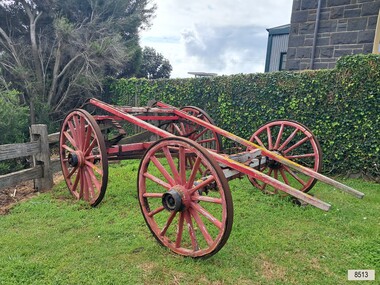
... year, he lost his paper licence on Cooramook Road, and he placed a notice in The Standard. In 1918, at the Warrnambool Petty Sessions Court, he was one of four applicants granted renewal of their hawkers’ licences, and each donated ten shillings to Warrnambool Hospital. Throughout these years, Singh became well known to farmers...year, he lost his paper licence on Cooramook Road, and he placed a notice in The Standard. In 1918, at the Warrnambool Petty Sessions Court, he was one of four applicants granted renewal of their hawkers’ licences, and each donated ten shillings to Warrnambool Hospital. Throughout these years, Singh became well known to farmers ...This wagon was used in towns across south-west Victoria during the first half of the twentieth century by Pooran Singh, an Indian-born immigrant. Singh arrived in Australia alone in 1899 at the age of 30. The following year, at the Colac Licensing Court in western Victoria, he was one of 78 hawkers granted a Hawker’s Licence. According to the Colac Herald, all but two of the applicants appeared to be Asian. While some hawkers registered horse-drawn carts, Singh was one of nineteen licensed to trade on foot, selling door to door. Applicants were encouraged to contribute to a collection for the Colac Hospital. Over time, Pooran Singh came to own his own wagon—a top-of-the-range light delivery vehicle—and a horse named Prince. His work often took him along rough country roads, and for a period, he worked in the Corryong district of north-eastern Victoria, an area popular with hawkers. In September 1909, near Thowgla, he was thrown from his wagon while attempting to navigate a deep rut and was run over by one of its wheels. Although he suffered bruising to his chest, his injuries were not serious. The following year, he was granted a Hawker’s Licence in Corryong. By 1916, Singh was living and working at Garvoc in western Victoria, where that year, he lost his paper licence on Cooramook Road, and he placed a notice in The Standard. In 1918, at the Warrnambool Petty Sessions Court, he was one of four applicants granted renewal of their hawkers’ licences, and each donated ten shillings to Warrnambool Hospital. Throughout these years, Singh became well known to farmers and their families as he travelled across Victoria’s Western District, living and working from his covered wagon. In his later years, Pooran Singh formed a close friendship with John Jandes Moore and his wife, Vera, of Russells Creek, Warrnambool. They offered him the use of their property as a base for his travels and cared for him during his final illness. John Moore was later appointed one of the two executors of Singh’s will. Pooran Singh died in Warrnambool on 8 June 1947, aged 77. His final wish was to be cremated and for his ashes to be returned to India for immersion in the Ganges. The cremation was arranged by Guyett’s Funerals in Warrnambool. Having never married, Singh left his estate to his four nephews, enabling them to buy land and build homes; one later installed a memorial plaque in his honour. In the late 1980s, Guyett’s Funerals placed his ashes in the niche wall at Warrnambool Cemetery as a memorial, while continuing to hope that family instructions might eventually arrive. Nearly 63 years after his death, renewed enquiries brought public attention to the long and respectful care given to his ashes. As a result, the renowned Indian cricketer Kapil Dev travelled to Warrnambool to collect them and escort them to India, helping to fulfil Singh’s final wish. He was joined by one of Singh’s grand-nephews, Harmel Uppal, who had travelled from England. At a formal ceremony on 25 July 2010 commemorating Singh’s life, the ashes were handed to Dev and Uppal, and local resident Avis Quarrell, who had known Singh as a child, read a poem she had written in his memory. She still owned a shell necklace that Singh had made for her mother. Some Warrnambool locals who had been closely involved also travelled to India, where they joined Uppal’s family from the village of Uppal Bhopa, near Jalandhar. On 31 July 2010, Pooran Singh’s ashes were immersed in the Ganges, fulfilling the wish he had expressed more than six decades earlier. After Pooran Singh’s death, his horse and wagon remained on John Moore’s property. When Prince died, he was buried on the beach at Warrnambool. The wagon remained with the Moore family and was occasionally used as a cubby house. In about 1997, John Moore, the son of John Jandes Moore, donated it to Flagstaff Hill. After restoration, the wagon became an attraction in the village, where volunteer Pat and his Clydesdale horse, Duke, offered visitors rides around Flagstaff Hill’s lake. This wagon is significant for its association with an Indian emigrant who used it to earn an income in Australia. It also reflects the vital role of hawkers, who travelled through rural and regional communities in the late nineteenth and early twentieth centuries, supplying food, goods and news. The wagon is also historically significant as a former Flagstaff Hill attraction, offering visitors the experience of horse-drawn rides around the lake.Wagon: a light delivery vehicle once used as a hawker's wagon. It is a four-wheel, horse-drawn vehicle with iron tyres, brakes, spoked wheels painted red with decorative yellow strips on the hubs, a timber shaft, and springs on the undercarriage. It was once a covered wagon, fitted with green, wooden sideboards, a front seat with leather-padded backrest and mounting steps. The late-19th to early-20th-century wagon was once owned by Pooran Singh, a local Indian hawker. flagstaff hill, warrnambool, maritime village, maritime museum, flagstaff hill maritime museum and village, shipwreck coast, great ocean road, southwest victoria, northwest victoria, western district, colac, colac hospital, colac licensing court, thowgla, corryong, garvoc, cooramook road, warrnambool petty sessions court, warrnambool hospital, russells creek road, ganges, warrnambool cemetery, uppal bhopa, jalandhar, hawker’s licence, covered wagon, wagon, hawker's wagon, horse-drawn cart, hawker's cart, light delivery vehicle, hawker, travelling salesman, travelling hawker, door-to-door sales, rural salesman, rural commerce, prince, duke, clydesdale horse, 1997, pooran singh, indian immigrant, pat, john james moore, vera moore, john and vera moore, john moore, guyatt’s funerals, kapil dev, harmel uppal, avis quarrell -
 City of Moorabbin Historical Society (Operating the Box Cottage Museum)
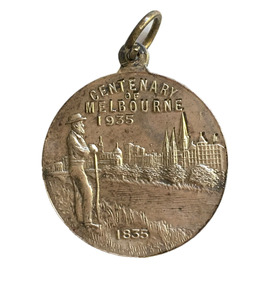
Badge - Centenary of Melbourne, c. 1935-35
... The Henty brothers, entrepreneur farmers and whalers, established the state’s first permanent European settlement in Portland in 1834. Melbourne was established the following year by a party of settlers led by John Batman. ...The Henty brothers, entrepreneur farmers and whalers, established the state’s first permanent European settlement in Portland in 1834. Melbourne was established the following year by a party of settlers led by John Batman. ...White metal medal issued to commemorate Melbourne’s centenary 1934-35. This medal was given out to Victorian school children; 325,600 white metal medals were struck. The medal references Portland, the location of Victoria’s first settlement. The Henty brothers, entrepreneur farmers and whalers, established the state’s first permanent European settlement in Portland in 1834. Melbourne was established the following year by a party of settlers led by John Batman. In 1934, as Melbourne planned to celebrate the centenary of European settlement, it seemed to some that there was little to celebrate. The financial strains of the depression, unemployment and the scandal of the city’s slums all undercut claims of unbridled progress. Perhaps because of such troubles, the organisers of the centenary celebrations tried doubly hard to be positive. The themes of the celebrations were conservative, reflecting the desire of some Melburnians for security in troubled times. The widely promoted image of the ‘Garden City’ and ‘Queen City of the South’ emphasised the idea of Melbourne as a very British city. White metal badgeCentenary of Melbournemelbourne centenary, victorian school children -
Glenelg Shire Council Cultural Collection
Medal, Centenary of Melbourne 1835 Commemorative Medallion, 1834
... The Henty brothers, entrepreneur farmers and whalers, established the state's first permanent European settlement in Portland in 1834. Melbourne was established the following year by a party of settlers led by John Batman....The Henty brothers, entrepreneur farmers and whalers, established the state's first permanent European settlement in Portland in 1834. Melbourne was established the following year by a party of settlers led by John Batman. medal numismatics celebration 1834 1934 1935 Melbourne Portland Front: Inverse: Centenary of Melbourne 1835 (Top) 1835 (Bottom) Back: Obverse: Centenary of Victoria 1934 (Round Top) Portland 1834 (Bottom) White metal medal. ...White metal medal issued to commemorate Melbourne's centenary 1934-35. This medal was given out to Victorian school children; 325,600 white metal medals were struck. There were also a few VIP pieces in other metals, including two in gold. The medal references Portland, the location of Victoria's first settlement. The Henty brothers, entrepreneur farmers and whalers, established the state's first permanent European settlement in Portland in 1834. Melbourne was established the following year by a party of settlers led by John Batman.White metal medal. Medal, silver. with hole and ring at the top. Obverse: Sailing Ship, Coast, Boat on shore, 3 men. Reverse Colonial man on grass, river, city buildings on other river bank Medal commemorates the centenary of Victoria and Portland 1834 and Melbourne 1835. Obverse:Scene of landing at Portland Bay; in ground below, PORTLAND / 1834; above, centenary of victoria / 1934 Reverse: Pioneer on south bank of Yarra looking across to Melbourne, below 1835 above, CENTENARY / OF / MELBOURNE / 1935Front: Inverse: Centenary of Melbourne 1835 (Top) 1835 (Bottom) Back: Obverse: Centenary of Victoria 1934 (Round Top) Portland 1834 (Bottom)medal, numismatics, celebration, 1834, 1934, 1935, melbourne, portland -
 Learmonth and District Historical Society Inc.
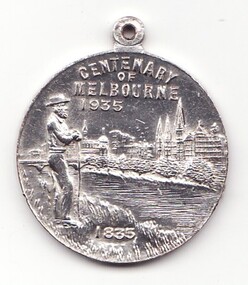
Medal - Centenary of Victoria, Centenary of Melbourne 1935
... The Henty brothers, entrepreneur farmers and whalers, established the state's first permanent European settlement in Portland in 1834. Melbourne was established the following year by a party of settlers led by John Batman. ...The Henty brothers, entrepreneur farmers and whalers, established the state's first permanent European settlement in Portland in 1834. Melbourne was established the following year by a party of settlers led by John Batman. ...White metal medal issued to commemorate Melbourne's centenary 1934-35. This medal was given out to Victorian school children; 325,600 white metal medals were struck. There were also a few VIP pieces in other metals, including two in gold. The medal references Portland, the location of Victoria's first settlement. The Henty brothers, entrepreneur farmers and whalers, established the state's first permanent European settlement in Portland in 1834. Melbourne was established the following year by a party of settlers led by John Batman. In 1934, as Melbourne planned to celebrate the centenary of European settlement, it seemed to some that there was little to celebrate. The financial strains of the depression, unemployment and the scandal of the city's slums all undercut claims of unbridled progress. Perhaps because of such troubles, the organisers of the centenary celebrations tried doubly hard to be positive. The themes of the celebrations were conservative, reflecting the desire of some Melburnians for security in troubled times. The widely promoted image of the 'Garden City' and 'Queen City of the South' emphasised the idea of Melbourne as a very British city. A visit by the Duke of Gloucester, son of George V, the ageing king, provided a reassuring strengthening of Melbourne's imperial connections. The presented view of Melbourne's history stressed the 'myth of the pioneer', embodied in the person of John Batman. Elevated to heroic status, he was reinvented as a courageous pioneer whose life exemplified the rewards of self-improvement. Such a portrayal ignored Batman's dubious 'treaty' with local Aborigines and the less savoury details of his personal life. Melbourne's indigenous people were excluded from this triumphant view of Melbourne's past. The centenary celebrations now seem dated, but the image of Melbourne as a conservative city largely influenced by Britain has been more enduring.Details the settlement of Portland, Melbourne and Victoria, 1834 - 1935Double sided round white metal medal, featuring on front face, the bay of Portland showing a ship in the harbour. On the reverse side of the medal is John Bateman overlooking the city of Melbourne and the Yarra river.The front is inscribed, "CENTENARY OF VICTORIA" 1934, across the top, bottom right has the words "PORTLAND 1834". Reverse side shows "CENTENARY OF MELBOURNE 1935", and the date 1835 at the bottom. melbourne, medal, portland, centenary of victoria 1935 -
 Orbost & District Historical Society
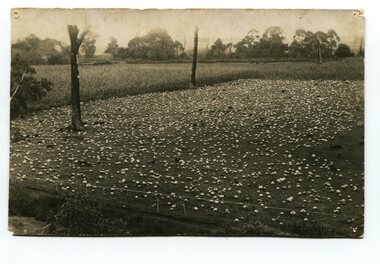
black and white photograph, Warren. Mrs H, first half 20th century
... farmers on the flats at Orbost used to grow a lot of maize and harvest the maize by putting the pigs in to eat the maize.. Maize and pumpkins fed in conjunction were largely used for fattening pigs. The photographer was Warren, Helena (1871-1962) who was a self-taught photographer who became both the local press correspondent and a producer of humorous trompe l'oeil postcard images. Helena Warren was a thirty-two year...farmers on the flats at Orbost used to grow a lot of maize and harvest the maize by putting the pigs in to eat the maize.. Maize and pumpkins fed in conjunction were largely used for fattening pigs. The photographer was Warren, Helena (1871-1962) who was a self-taught photographer who became both the local press correspondent and a producer of humorous trompe l'oeil postcard images. Helena Warren was a thirty-two year ...Many farmers on the flats at Orbost used to grow a lot of maize and harvest the maize by putting the pigs in to eat the maize.. Maize and pumpkins fed in conjunction were largely used for fattening pigs. The photographer was Warren, Helena (1871-1962) who was a self-taught photographer who became both the local press correspondent and a producer of humorous trompe l'oeil postcard images. Helena Warren was a thirty-two year old settler living on a small mixed farm with her husband, William, at Newmerella, near Orbost in Gippsland, Victoria, when she bought her first camera, an Austral Box quarter-plate. Her family says she was entirely self-taught, like many women photographers who started out with nothing but the instructions on the packets of film and chemicals. In over fifty years practice she graduated from the total novice, who opened all her first mail order plates in bright sunlight and ruined them, to a competent photographer who became both the local press correspondent and an inveterate producer of humorous trompe l’oeil postcard images.This item is a pictorial record of farming in Orbost in the early 20th century. It is also associated with Helena Warren. a well-known photographer born in Orbost.a black / white photographagriculture farming-orbost pumpkins maize pigs warren-helena -
 City of Moorabbin Historical Society (Operating the Box Cottage Museum)
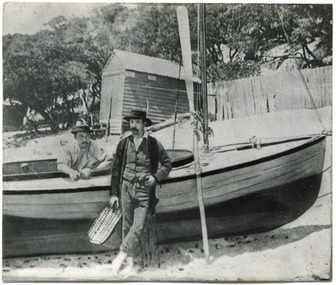
Photograph, 2 B&W, 1898 The O'Maras', Sandringham Fishermen : Date Unknown, Mud Brick House, 1898 The O'Maras', Sandringham Fishermen Date Unknown, Mud Brick House, 1898
... About twelve years ago, (* the writer states no year), there was a vacant block where the house used to be - it was next to a electrical factory. the o'maras sandringham fisherman 1898 mud brick house moorabbin wangara road reserve road electrical factory early settlers, pioneers, shire of moorabbin, sandringham, beaumaris, mentone, fishermen, dairy farmaers, poultry farmers, market gardeners, Written on back (i) The O'Maras / Sandringham / fishermen 1898 (ii) Mud brick house at Moorabbin ( house was there in 1940) / Situated in Reserve Road almost opposite Wangara Road / ( formerly Cemetery Road ). ...The O'Maras, of Sandringham fishermen. Early mud brick house. Located in Moorabbin and was still there in 1940. The house was situated in Reserve Road, almost opposite Wangara Road, (formerly Cemetery Road). About twelve years ago, (* the writer states no year), there was a vacant block where the house used to be - it was next to a electrical factory. 2x Black and White Photographs. (i) An 1898 photograph showing two men with a fishing boat on the beach. A beach house / shed , paling fence and tall tea-trees are seen in the background. (ii) A large early mud brick house with a tin roof, chimney and a water tank sitting on a block of grassed landWritten on back (i) The O'Maras / Sandringham / fishermen 1898 (ii) Mud brick house at Moorabbin ( house was there in 1940) / Situated in Reserve Road almost opposite Wangara Road / ( formerly Cemetery Road ). About 12 years ago there was a vacant block where the house used to be and it was next to an electrical factory. unsigned undatedthe o'maras, sandringham fisherman, 1898, mud brick house, moorabbin, wangara road, reserve road, electrical factory, early settlers, pioneers, shire of moorabbin, sandringham, beaumaris, mentone, fishermen, dairy farmaers, poultry farmers, market gardeners, -
 City of Moorabbin Historical Society (Operating the Box Cottage Museum)
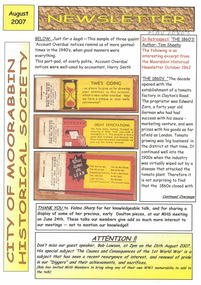
Newsletter - City of Moorabbin Historical Society Aug 2007, August 2007
... farmer, and Mr Stephen Tuck and wife to Cheltenham while Mr John Kingston was looking for land.. 60 children were enrolled at St Stephen’s Common School on Tucker Road. George Higginbotham., William Highett and Tommy Bent were confident of the years ahead.’ Upcoming events at CMHS were August 26th Mr Bob Lawson will talk about World War 1, on October 28th a talk by Dr G Whitehead titled ‘Murder’, and at the last meeting for year...farmer, and Mr Stephen Tuck and wife to Cheltenham while Mr John Kingston was looking for land.. 60 children were enrolled at St Stephen’s Common School on Tucker Road. George Higginbotham., William Highett and Tommy Bent were confident of the years ahead.’ Upcoming events at CMHS were August 26th Mr Bob Lawson will talk about World War 1, on October 28th a talk by Dr G Whitehead titled ‘Murder’, and at the last meeting for year ...The City of Moorabbin Historical Society was formed c 1960 by a group of Moorabbin residents who were concerned that the history of the area should be preserved. A good response to a call for items related to the historical area of Moorabbin Shire brought donations of a wide variety of artefacts which are now preserved by the current members of CMHS at Box Cottage Museum . Helen Stanley, Secretary of CMHS, began producing a Newsletter for members in April 2007 to provide current information and well researched items of historical interest.Helen Stanley has produced a bi-monthly Newsletter, 2007 - 2013, for the members of the City of Moorabbin Historical Society that contains well researched interesting historical items, notification of upcoming events, current advice from Royal Australian Historical Society , Museums Australia Victoria and activities of Local Historical Societies. The Newsletter is an important record of the activities of the CMHS. Tom Sheehy, a past President of CMHS, was an Historian and Author of ‘Battlers tamed the Sandbelt’, the Lawson family were early settlers, Dr Graham Whitehead, is Historian for Kingston CC and the Henry Lawson Society promotes the Poet’s works.A4 paper printed both sides x1. Issue 3 of the bi-monthly, City of Moorabbin Historical Society Newsletter produced by Society member and Secretary, Mrs Helen Stanley in August 2007. Members of the CMHS are shown 3 photocopies of ‘quaint Account Overdue ‘ notices c 1940,. An excerpt from the 1962 Moorabbin Historical Society Newsletter, edited by the President Tom Sheehy, describing the 1860’s decade that saw ‘the establishment of Edward Zorn’s Tomato factory in Clayton’s Road in 1862 and then Henry Comport’s Sauce factory in Cheltenham. ‘New settlers’ arriving in the area were William Highett , near Hampton, Mr McKinnon , an Oakleigh farmer, and Mr Stephen Tuck and wife to Cheltenham while Mr John Kingston was looking for land.. 60 children were enrolled at St Stephen’s Common School on Tucker Road. George Higginbotham., William Highett and Tommy Bent were confident of the years ahead.’ Upcoming events at CMHS were August 26th Mr Bob Lawson will talk about World War 1, on October 28th a talk by Dr G Whitehead titled ‘Murder’, and at the last meeting for year November 25th Frank Thatcher, CMHS, will welcome the Henry Lawson Society and Australian Natives Association who will again come to Box Cottage to celebrate their Bryan Kelleher Memorial Picnic Day. CITY of MOORABBIN HISTORICAL SOCIETY / AUGUST 2007 NEWSLETTERcity of moorabbin historical society, stanley helen, melbourne, moorabbin, brighton, cheltenham, ormond, bentleigh, oakleigh, kingston, highett, hampton, clayton, market gardeners, pioneers, early settlers, moorabbin shire, sheehy tom, thatcher frank, tucker road, st stephen’s common school, henry lawson society, australian natives association, whitehead dr graham, lawson bob, lawson nan, kelleher bryan, comport henry, zorn edward, highett william, bent tommy, higginbotham george, kingston john, le roy tracy pty.ltd, sydney, tomato sauce factory -
 Phillip Island and District Historical Society Inc.
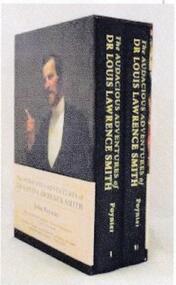
Book, John Poynter, The Audacious Adventures of Dr Louis Lawrence Smith : 1830-1910, 2014
... Smith, medico, writer, publisher, politician, litigant, showman, speculator, collector, vigneron, farmer, breeder and rider of racehorses, guiding hand for thirty year of Melbourne's great exhibition complex." - publisher's website. ...Smith, medico, writer, publisher, politician, litigant, showman, speculator, collector, vigneron, farmer, breeder and rider of racehorses, guiding hand for thirty year of Melbourne's great exhibition complex." - publisher's website. ..."L. L. Smith, medico, writer, publisher, politician, litigant, showman, speculator, collector, vigneron, farmer, breeder and rider of racehorses, guiding hand for thirty year of Melbourne's great exhibition complex." - publisher's website. Instrumental in having Phillip island opened for selection in 1868.2 v. box : illustrations (some colour), facsimiles, protraits ; 24cm.Inscribed : To the Phillip Island Historical Society from Gillian and Norman Gengoult Smith, the grandson of Dr L. L. Smith whoe's [sic] 10 year battle in the Victorian Parliament for the cause was instrumental in having Phillip island opened for settlement Signed by the author : John Poynterjohn poynter, dr louis lawrence smith, the audacious adventures of dr louis lawrence smith -
 Orbost & District Historical Society
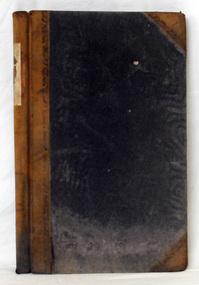
ledger, 1911-1914
... farmers were required to register all milking cows. Dogs, too, were to be registered and there were strict laws on sheep dipping. Every sheep-owner was to dip all his sheep immediately after shearing and directly from the shearing-board in every year and also at the time of dipping his sheep dip all his lambs. ...farmers were required to register all milking cows. Dogs, too, were to be registered and there were strict laws on sheep dipping. Every sheep-owner was to dip all his sheep immediately after shearing and directly from the shearing-board in every year and also at the time of dipping his sheep dip all his lambs. ...This ledger was used by the Shire of Orbost from 1911 - 1914. It was used to record fees paid for Dairy Registration, Dog Registration and Sheep dipping. At that time dairy farmers were required to register all milking cows. Dogs, too, were to be registered and there were strict laws on sheep dipping. Every sheep-owner was to dip all his sheep immediately after shearing and directly from the shearing-board in every year and also at the time of dipping his sheep dip all his lambs. In case the sheep couldn't be conveniently dipped directly from the shearing board they were to be placed and kept in a securely fenced paddock to be dipped within sixty days after shearing. Sheep-owner who neglected or failed to comply with any of these directives were liable to a penalty of not less than One pound nor more than Twenty pounds. The shire covered an area of 9,347 square kilometres and existed from 1892 until 1994 when it became part of the East Gippsland Shire Council. Orbost was at first included in the Bairnsdale Shire from 1882 and was later part of the Tambo Shire. Because of travelling distances the Croajingalong Shire was created in 1892 (name changed to Orbost Shire 17.2.1893 with James Cameron as the first Shire President. In 1994 it amalgamated to become part of East Gippsland Shire Council. The item was donated to Orbost & District Historical society from P.R.O.V. as a Place of Deposit (POD) item for safe keeping by a local history group or museum. The shire covered an area of 9,347 square kilometres and existed from 1892 until 1994 when it became part of the East Gippsland Shire Council. This item is a record of local council accounting. The Shire of Orbost no longer exists as it was absorbed by the East Gippsland Shire Council.A dark blue, leatherette covered ledger cash book with tan spine, stitched marbled end covers. Records are handwritten in blue and red ink and blue pencil. It contains records of Dairy Registration fees, Dog Registration fees and Sheep Dipping fees.Inside the front cover is a list of contents.ledger orbost-shire-council sheep-dipping dairy-registration accounts -
 Flagstaff Hill Maritime Museum and Village
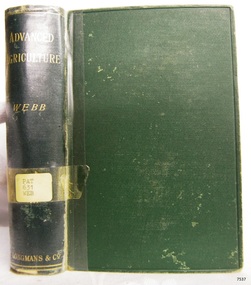
Book - Technical Reference, Henry J Webb, author, Advanced Agriculture, 1894
... farmers and farm labourers. He also held world records as a cyclist and tricyclist. This book is part of Flagstaff Hill's Pattison Collection. Longmans, Green & Co. published several of Webb's technical books. The publisher firm, Longmans, Green & Co, was originally founded in 1724 in London by Thomas Longman under the name Longman. In August of that year...farmers and farm labourers. He also held world records as a cyclist and tricyclist. This book is part of Flagstaff Hill's Pattison Collection. Longmans, Green & Co. published several of Webb's technical books. The publisher firm, Longmans, Green & Co, was originally founded in 1724 in London by Thomas Longman under the name Longman. In August of that year ...The author Henry John Webb (1846-1893) was an English botanist and agriculturalist who worked in scientific ways, described as thorough, to improve many aspects of farming, such as promoting a scientific system for making butter. He became a very successful Principal of Aspatria Agricultural College in northern England, which was set up for the training and education of farmers and farm labourers. He also held world records as a cyclist and tricyclist. This book is part of Flagstaff Hill's Pattison Collection. Longmans, Green & Co. published several of Webb's technical books. The publisher firm, Longmans, Green & Co, was originally founded in 1724 in London by Thomas Longman under the name Longman. In August of that year, he bought the two shops and goods of William Taylor and set up his publishing house there at 39 Paternoster Row. The shops were called Black Swan and Ship, and it is said that the 'ship' sign was the inspiration for Longman's Logo. After many changes of name and management, the firm was incorporated in 1926 as Longmans, Green & Co. Pty Ltd. The firm was acquired by Pearson in 1968 and was known as Pearson Longman or Pearson PLC. Interestingly, the logo in some books, such as “Steam Turbines 2nd edition, published in 1922” has the year “1724” but the logo in books such as “Advanced Agricultur, published in 1894” has the year “1726” in the logo.The book is significant for showing the technical advancement in agriculture att the end of the 19th century and can be used to trace the evolution of agricultural methods and machinery since that time. The book is significant for its connection to the publisher Longmans, Green and Co., of London, a firm that has been established for over two centuries, renowned for publishing encyclopedias, dictionaries, books on English grammar, textbooks, poetry, reference books, novels, magazines and more. The book has additional importance for its connection to the Pattison Collection, which, along with other items at Flagstaff Hill Maritime Village, was originally part of the Warrnambool Mechanics' Institutes’ Collection. The Warrnambool Mechanics’ Institute book collection has historical and social significance for its strong association with the Mechanics Institute movement and its important role in people's intellectual, cultural and social development throughout the latter part of the nineteenth century and the early twentieth century. The collection of books is a rare example of an early lending library and its significance is enhanced by the survival of an original collection of many volumes. The Warrnambool Mechanics' Institute’s publication collection is of both local and state significance.Advanced Agriculture Author: Henry J Webb Publisher: Longmans Green & Co Date: 1894 The green hardcover book includes tables, drawings and diagrams. There are inscriptions on the spine label, front endpaper sticker and stamp. The logo of Longmans, Green & Co. is on the fly page. It is a line drawing of a shield above a leafy wreath border surrounding a sailing ship at sea with a plaque below. Inscriptions are on the shield and plaque. It is part of the Pattison Collection.Label: "PAT 631 WEB" Sticker: "Corangamite Regional Library Service" Stamp: 'Warrnambool Public Museum" Logo shield: "L & Co" [Longman Green & Co.], Logo plaque: "1726" [in this book]flagstaff hill, flagstaff hill maritime museum and village, warrnambool, maritime museum, maritime village, great ocean road, shipwreck coast, pattison collection, ralph eric pattison, warrnambool mechanics’ institute, mechanics’ institute library, warrnambool library, free library, corangamite regional library service, longmans green and co., l & co., 1724, thomas longman, paternoster row london, henry j webb, agriculture, farming, botanist, lecturer, english scholar, aspatria agricultural collage principal, technical farming, zoology, chemistry, physics, geology, 1984 -
 Halls Gap & Grampians Historical Society
Newspaper - B/W
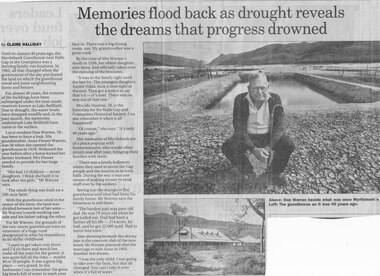
... Widowed, the year before after a horse kicked her farmer husband, Mrs Flower needed to provide for their large family. ...Widowed, the year before after a horse kicked her farmer husband, Mrs Flower needed to provide for their large family. ...Until the closure 40 years ago, the Myrtlebank Guesthouse near Halls Gap in the Grampians was a thriving family - run business. In 1962, all that changed when the government of the day purchased the land on which the guesthouse stood and some neighbouring farms and houses. For almost 40 Years, the remains of the buildings have been submered under the man made reservoir known as Lake Bellfield. Due to drought, the eater levels have dropped steadily and, in the past month, the memories underneath Lake Bellfield have come to the surface. Local resident Don warren 70, has been to have a look. His grandmother Anne Flower Warren, was 56 when she opened the guesthouse in 1916. Widowed, the year before after a horse kicked her farmer husband, Mrs Flower needed to provide for their large family. "She had 13 children - seven daughters. I think she built it to look after the girls," Mr Warren says, "The whole think was built on a 500 acre farm." With the guesthouse sited in the centre of the farm, the land was divided between two of her sons- Mr Warren's uncle working one side and his father taking the other. For Mr Warren, the grounds of the two-storey guesthouse were an extension of a huge rural playground in what he remembers as an idyllic childhood. "I used to get taken over there and I'd sit there and watch her make all the toast for the guests. It was quite full all the time - maybe 40 or 50 people. It was a great big place - very grand. In the bedrooms I can remember the great big bowls full of water to wash your face in. There was a big dining room, too. My grandmother was a great cook." By the time of Mrs Warren's death in 1936, her eldest daughter also Anne, had officially taken over the running of the business. "It was in the family right until the last bit. The youngest daughter, Auntie Hilda, took it over right at the end. they got a notice to say that's it - it's over There was no way out of that one." Mrs Ida Stanton, 78, is the historian for the Halls Gap and Grampians Historical Society. Can she remember it when it all happened? "Of course" she says "It's only 40 years ago" Her memories of Myrtlebank are of a place popular with honeymooners, who would often return year after year, bringing their families with them. "There was a lovely ballroom where they used to invite the Gap people and the tourists in to have balls. During the war it was one means of making money to send stuff over to the soldiers." Seeing just the stumps of the guesthouse and what had been his family home, Mr Warren says the bitterness is still there. "The hardest part was poor old dad. He was 70 years old when he got turfed out. Dad had been a farmer all his life - 214 acres, he had, and he got 22,000 quid. Had to move into town" Also showing beneath the drying lake is the concrete slab of the new home Mr Warren planned after his marriage to wife Anne in 1955. Another lost dream. " I was the only child, I was going to take over the farm, but that all changed. You can't take it over when it's full of water.Newspaper clipping of history of Myrtlebank by Don Warren and photo of Don at old site of pooland guest House photo Article by Claire Halliday from newspaper 2002accommodation, guesthouses, myrtlebank -
 Orbost & District Historical Society
framed photograph
... year period, and nurses were paid employees of the parent hospital. Annabella Mckenzie Fisher was born into the Mckenzie family and married into the Fisher family. She married Fisher James Fisher, a Lochend farmer...year period, and nurses were paid employees of the parent hospital. Annabella Mckenzie Fisher was born into the Mckenzie family and married into the Fisher family. She married Fisher James Fisher, a Lochend farmer ...This is a photograph of Annabella McKenzie who trained at The Royal Melbourne in the 1890's. The Royal Melbourne Hospital was the first hospital in Victoria – established in 1848 to serve the young and thriving community of Melbourne. Prior to the transfer of nursing education to the university sector, nurses were trained in a course of instruction in hospital nursing schools that awarded a certificate in general nursing. These courses were generally for a three-year period, and nurses were paid employees of the parent hospital. Annabella Mckenzie Fisher was born into the Mckenzie family and married into the Fisher family. She married Fisher James Fisher, a Lochend farmer.The Fisher family was a very early Orbost farming family.A hand-coloured photograph in an oval shaped wooden frame. It is of a woman in a nurse's uniform of a dark coloured dress with a white bib apron and black belt. The cuffs of the long sleeved dress are white. She is wearing a white cap. The oval frame is painted gold and is decorated on each side with flowers in relief.On back in pencil - Anna Bella McKenziehealth nursing fisher_annabella-mckenzie royal-melbourne-hospital -
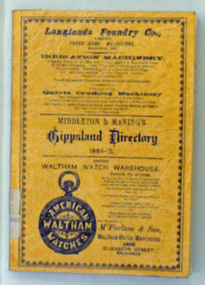 Orbost & District Historical Society
book, E-Gee Printers, Middleton & Manning's Gippsland Directory 1884-5, 1983
... year of publication for the Middleton and Manning's Gippsland Directory. It was first published by Ale Middleton and Francis Beresford Manning. Beginning with advertisements from local businesses of the time, this is followed by a short gazetteer of places around the region, as well as general information on the districts of Gippsland. The main part of the Directory consisting of about 100 pages, is the Alphabetical Directory. Listed alphabetically by surname under each region, this lists heads of household (mostly male but there are a few females mentioned), together with their occupation and address.The list includes farmers...year of publication for the Middleton and Manning's Gippsland Directory. It was first published by Ale Middleton and Francis Beresford Manning. Beginning with advertisements from local businesses of the time, this is followed by a short gazetteer of places around the region, as well as general information on the districts of Gippsland. The main part of the Directory consisting of about 100 pages, is the Alphabetical Directory. Listed alphabetically by surname under each region, this lists heads of household (mostly male but there are a few females mentioned), together with their occupation and address.The list includes farmers ...The 1884-1885 Directory was the first year of publication for the Middleton and Manning's Gippsland Directory. It was first published by Ale Middleton and Francis Beresford Manning. Beginning with advertisements from local businesses of the time, this is followed by a short gazetteer of places around the region, as well as general information on the districts of Gippsland. The main part of the Directory consisting of about 100 pages, is the Alphabetical Directory. Listed alphabetically by surname under each region, this lists heads of household (mostly male but there are a few females mentioned), together with their occupation and address.The list includes farmers, labourers, coach painters, dairywoman, teacher, saddler, brickmaker, merchant, laundress, hotel keeper, minister of religion, dressmaker, grocer, grazier, gasfitter, seedsman, coachbuilder, engineer, auctioneer, upholsterer, fowler, journalist, surveyor, musician, traveller, watchmaker, solicitor, restaurant keeper, blacksmith and miner. It is not just "business owners" mentioned in this directory it is everyone. (ref Gen E Books)This is a useful reference tool.A 135 pp soft covered book with an orange/brown cover. On the front cover in black print is a range of advertisements or local businesses. It contains a short gazetteer of places in the region as well as general information on the districts of Gippsland. The main part of the directory is an alphabetical list of the household , with occupations and addresses. This is a reprint of the original.directory-gippsland book-middleton-manning-1884-5 -
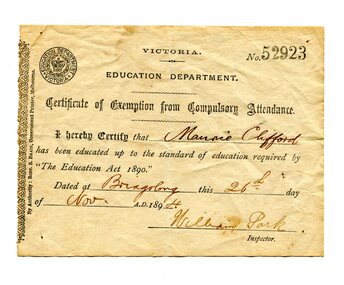 Orbost & District Historical Society
certificate, November 1894
... farmer in Briagolong. He was killed in action at Ypres, Belgium on 4 October, 1917. Having served in the 10th Australian Light Horse, Citizen Military Forces, he enlisted on 22 February 1916 as a private in 37th Battalion D Company. The 1890 Act called for all children in Victoria between the ages of 6 and 13 to attend school forty days in each quarter of a year ...This is Certificate No. 5293 and certifies that Maurice Clifford has been educated up to the standard of education required by "The Education Act 1890." It is dated at Briagolong on 26th November, 1894. Briagolong Primary School was established in 1875 when the town of Briagolong came into being. Maurice William Clifford was a farmer in Briagolong. He was killed in action at Ypres, Belgium on 4 October, 1917. Having served in the 10th Australian Light Horse, Citizen Military Forces, he enlisted on 22 February 1916 as a private in 37th Battalion D Company.The 1890 Act called for all children in Victoria between the ages of 6 and 13 to attend school forty days in each quarter of a year. Section 13 of the Act states that “Two hours before noon on any two days or two hours after noon on any two days” is deemed to be equal to one day's attendance. One of the reasons for exemption from compulsory attendance was if the child lived more than two miles from a school (or two and a half miles if aged 9 or over). If a student had reached a sufficient level of education an exemption could be granted.A white paper certificate with black print. It is issued by the Victorian Education Department for the exemption from compulsory attendance for Maurice Clifford. The certificate is printed with hand-written details.education clifford-maurice-william -
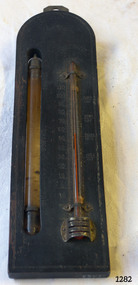 Flagstaff Hill Maritime Museum and Village
Thermometer, Early 20th Century
... Farmers used predictions they read from their Storm Glass to prepare for stormy weather or for choosing a good time for planting or harvesting their crops. This could mean to them the difference between a good year...Farmers used predictions they read from their Storm Glass to prepare for stormy weather or for choosing a good time for planting or harvesting their crops. This could mean to them the difference between a good year ...A Storm Glass and Thermometer such as this one would be used in predicting or forecasting the weather. Farmers used predictions they read from their Storm Glass to prepare for stormy weather or for choosing a good time for planting or harvesting their crops. This could mean to them the difference between a good year and a year without income. This design has been in use since the early 1800’s. According to Admiral Fitzroy (who studied the storm glass and wrote instructions on its use) the liquid in the glass changes composition and appearance according to the direction of the air moving around it. He advised the user to disturb the contents once or twice a year by tipping it upside down and shaking it gently. Item is a good example of a barometer/thermometer that would have been in most homes and farms from the late 19th century and early 20th century. This item would have been massed produced at the time therefore easily available and quite cheap to purchase making this particular item not very significant as not associated with a historic person or property or with a known manufacturer or date.Storm Glass and Thermometer, commonly called a 'Cottage Barometer', mounted on a rectangular dark rectangle of wood, top corners rounded. The Storm Glass (or weather glass, or chemical weather glass) is suspended in a long oval shaped hole in the wood on left side, held in place at top and at bottom with 2 metal bands secured by nails. The glass of this gauge is hand blown, sealed at the top with another layer of glass. The watery fluid in the storm glass is opaque brownish colour with dark particles floating in it. (Storm glasses were usually filled with a variation of a mix of camphor, distilled water, ethyl alcohol and silver nitrate.) The alcohol thermometer is mounted on the right side of the wood, bulb resting in a hollow, attached at top and near base by 2 thin metal strips, with clover-leaf shaped ends, nailed into place. Over the bulb is nailed a metal guard with 3 ventilation slits cut into it. On left of thermometer is a scale, stamped into wood, 30 below zero to 130 above zero, in 2 degree intervals. A border of 2 thin parallel lines, with remnants of light coloured paint, is around the block of wood. On the reverse side, a metal plate is nailed to the top with a mounting hole in it. Impressed sideways along edge of barometer is "STORMY" "CHANGE" "FAIR". Across the top of the thermometer is a fleur de leis in the wood, and above this it is stamped "FAHRENHEIT". On right of the thermometer, stamped into the wood, is "BLOOD/HEAT", "SUMR/HEAT", "TEMPE/RATE", "FREEZ/ING". On the back of the wood, at the base, are remnants of a white sticker with "...111.73". Carved into the wood is "HOLLAND / AV". flagstaff hill, warrnambool, shipwrecked coast, flagstaff hill maritime museum, maritime museum, shipwreck coast, flagstaff hill maritime village, great ocean road, barometer, cottage barometer, storm glass, thermometer, chemical weather glass -
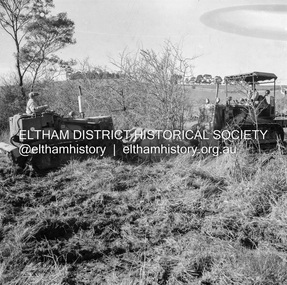 Eltham District Historical Society Inc
Negative - Photograph, J.A. McDonald, Kangaroo Ground-Queenstown Road, Aug. 1960
... farmers’ hawthorn hedges shrouding dangerous corners on busy roads. If the council does not insist on their removal for a distance clear enough for safe driving, then it must be held culpable for the accidents that are bound to happen. – WAKE UP (Melbourne) ELTHAM, CUT THE HEDGES! 50-50 (1960, 6 January), The Sun (News clipping held in SEA_74-1_007) ‘BAD HEDGES’ WILL GO “We know there are some bad hedges on corners in the Kangaroo Ground area, but roadworks this year...farmers’ hawthorn hedges shrouding dangerous corners on busy roads. If the council does not insist on their removal for a distance clear enough for safe driving, then it must be held culpable for the accidents that are bound to happen. – WAKE UP (Melbourne) ELTHAM, CUT THE HEDGES! 50-50 (1960, 6 January), The Sun (News clipping held in SEA_74-1_007) ‘BAD HEDGES’ WILL GO “We know there are some bad hedges on corners in the Kangaroo Ground area, but roadworks this year ...(Kangaroo Ground-St Andrews Road) “Rymers” Corner – shifting Hawthorn hedges on Tompkins property Council’s Drott 6 Woods Drott 9 August 1960 EDHS_05569-55 (EDHS_05577-3/4) and EDHS_05569-56 (EDHS_05577-5/6) - Hawthorn Hedges, Kangaroo Ground 50-50 ELTHAM, CUT THE HEDGES! While all of us are talking about the road toll, Eltham Council must have been in long recess. Around Kangaroo Ground are farmers’ hawthorn hedges shrouding dangerous corners on busy roads. If the council does not insist on their removal for a distance clear enough for safe driving, then it must be held culpable for the accidents that are bound to happen. – WAKE UP (Melbourne) ELTHAM, CUT THE HEDGES! 50-50 (1960, 6 January), The Sun (News clipping held in SEA_74-1_007) ‘BAD HEDGES’ WILL GO “We know there are some bad hedges on corners in the Kangaroo Ground area, but roadworks this year will eliminate them,” the Eltham Shire secretary, Mr Maxwell B. Watson, said yesterday. A reader in 50-50 yesterday complained of farmers’ hawthorn hedges obscuring drivers’ views at bad corners on busy roads in the Kangaroo Ground district. Mr Watson said the roadworks were deviations to remove the sharp turns, and the road would cut back into paddocks. The hedges would go at the same time. Meanwhile, the shire had power to require owners to cut back hedges, and this would be done if specific instances were reported and found justifiable. ‘BAD HEDGES’ WILL GO (1960, January 7), The Sun (News clipping held in SEA_74-1_007)Record of various Shire of Eltham infrastructure works undertaken during the period of 1952-1962 involving bridge and road reconstruction projects, sometimes with Eltham Shire Council Project Reference numbers quoted. It was during this period that a number of significant improvements were made to roads and new bridges constructed within the shire that remain in place as of present day (2022). In many situations, the photos provide a tangible visible record of infrastructure that existed throughout the early days of the Shire. The album was put together by or under the direction of the Shire Engineer, J.A. McDonald.infrastructure, shire of eltham, 1960-08, garden hill, kangaroo ground, kangaroo ground-queenstown road, kangaroo ground-st andrews road, rymers corner, bulldozer, drott -
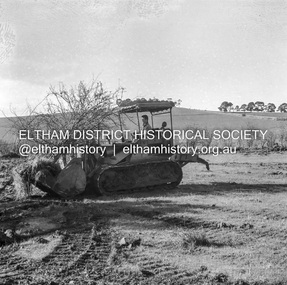 Eltham District Historical Society Inc
Negative - Photograph, J.A. McDonald, Kangaroo Ground-Queenstown Road, Aug. 1960
... farmers’ hawthorn hedges shrouding dangerous corners on busy roads. If the council does not insist on their removal for a distance clear enough for safe driving, then it must be held culpable for the accidents that are bound to happen. – WAKE UP (Melbourne) ELTHAM, CUT THE HEDGES! 50-50 (1960, 6 January), The Sun (News clipping held in SEA_74-1_007) ‘BAD HEDGES’ WILL GO “We know there are some bad hedges on corners in the Kangaroo Ground area, but roadworks this year...farmers’ hawthorn hedges shrouding dangerous corners on busy roads. If the council does not insist on their removal for a distance clear enough for safe driving, then it must be held culpable for the accidents that are bound to happen. – WAKE UP (Melbourne) ELTHAM, CUT THE HEDGES! 50-50 (1960, 6 January), The Sun (News clipping held in SEA_74-1_007) ‘BAD HEDGES’ WILL GO “We know there are some bad hedges on corners in the Kangaroo Ground area, but roadworks this year ...(Kangaroo Ground-St Andrews Road) “Rymers” Corner – shifting Hawthorn hedges on Tompkins property Council’s Drott 6 Woods Drott 9 August 1960 Showing hedge in rear already transported EDHS_05569-55 (EDHS_05577-3/4) and EDHS_05569-56 (EDHS_05577-5/6) - Hawthorn Hedges, Kangaroo Ground 50-50 ELTHAM, CUT THE HEDGES! While all of us are talking about the road toll, Eltham Council must have been in long recess. Around Kangaroo Ground are farmers’ hawthorn hedges shrouding dangerous corners on busy roads. If the council does not insist on their removal for a distance clear enough for safe driving, then it must be held culpable for the accidents that are bound to happen. – WAKE UP (Melbourne) ELTHAM, CUT THE HEDGES! 50-50 (1960, 6 January), The Sun (News clipping held in SEA_74-1_007) ‘BAD HEDGES’ WILL GO “We know there are some bad hedges on corners in the Kangaroo Ground area, but roadworks this year will eliminate them,” the Eltham Shire secretary, Mr Maxwell B. Watson, said yesterday. A reader in 50-50 yesterday complained of farmers’ hawthorn hedges obscuring drivers’ views at bad corners on busy roads in the Kangaroo Ground district. Mr Watson said the roadworks were deviations to remove the sharp turns, and the road would cut back into paddocks. The hedges would go at the same time. Meanwhile, the shire had power to require owners to cut back hedges, and this would be done if specific instances were reported and found justifiable. ‘BAD HEDGES’ WILL GO (1960, January 7), The Sun (News clipping held in SEA_74-1_007)Record of various Shire of Eltham infrastructure works undertaken during the period of 1952-1962 involving bridge and road reconstruction projects, sometimes with Eltham Shire Council Project Reference numbers quoted. It was during this period that a number of significant improvements were made to roads and new bridges constructed within the shire that remain in place as of present day (2022). In many situations, the photos provide a tangible visible record of infrastructure that existed throughout the early days of the Shire. The album was put together by or under the direction of the Shire Engineer, J.A. McDonald.infrastructure, shire of eltham, 1960-08, garden hill, kangaroo ground, kangaroo ground-queenstown road, kangaroo ground-st andrews road, rymers corner, bulldozer, drott -
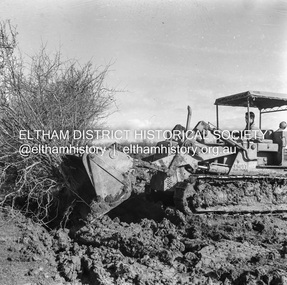 Eltham District Historical Society Inc
Negative - Photograph, J.A. McDonald, Kangaroo Ground-Queenstown Road, Aug. 1960
... farmers’ hawthorn hedges shrouding dangerous corners on busy roads. If the council does not insist on their removal for a distance clear enough for safe driving, then it must be held culpable for the accidents that are bound to happen. – WAKE UP (Melbourne) ELTHAM, CUT THE HEDGES! 50-50 (1960, 6 January), The Sun (News clipping held in SEA_74-1_007) ‘BAD HEDGES’ WILL GO “We know there are some bad hedges on corners in the Kangaroo Ground area, but roadworks this year...farmers’ hawthorn hedges shrouding dangerous corners on busy roads. If the council does not insist on their removal for a distance clear enough for safe driving, then it must be held culpable for the accidents that are bound to happen. – WAKE UP (Melbourne) ELTHAM, CUT THE HEDGES! 50-50 (1960, 6 January), The Sun (News clipping held in SEA_74-1_007) ‘BAD HEDGES’ WILL GO “We know there are some bad hedges on corners in the Kangaroo Ground area, but roadworks this year ...(Kangaroo Ground-St Andrews Road) “Rymers” Corner – shifting Hawthorn hedges on Tompkins property Council’s Drott 6 Woods Drott 9 August 1960 Showing method of lifting clumps of Hawthorn EDHS_05569-55 (EDHS_05577-3/4) and EDHS_05569-56 (EDHS_05577-5/6) - Hawthorn Hedges, Kangaroo Ground 50-50 ELTHAM, CUT THE HEDGES! While all of us are talking about the road toll, Eltham Council must have been in long recess. Around Kangaroo Ground are farmers’ hawthorn hedges shrouding dangerous corners on busy roads. If the council does not insist on their removal for a distance clear enough for safe driving, then it must be held culpable for the accidents that are bound to happen. – WAKE UP (Melbourne) ELTHAM, CUT THE HEDGES! 50-50 (1960, 6 January), The Sun (News clipping held in SEA_74-1_007) ‘BAD HEDGES’ WILL GO “We know there are some bad hedges on corners in the Kangaroo Ground area, but roadworks this year will eliminate them,” the Eltham Shire secretary, Mr Maxwell B. Watson, said yesterday. A reader in 50-50 yesterday complained of farmers’ hawthorn hedges obscuring drivers’ views at bad corners on busy roads in the Kangaroo Ground district. Mr Watson said the roadworks were deviations to remove the sharp turns, and the road would cut back into paddocks. The hedges would go at the same time. Meanwhile, the shire had power to require owners to cut back hedges, and this would be done if specific instances were reported and found justifiable. ‘BAD HEDGES’ WILL GO (1960, January 7), The Sun (News clipping held in SEA_74-1_007)Record of various Shire of Eltham infrastructure works undertaken during the period of 1952-1962 involving bridge and road reconstruction projects, sometimes with Eltham Shire Council Project Reference numbers quoted. It was during this period that a number of significant improvements were made to roads and new bridges constructed within the shire that remain in place as of present day (2022). In many situations, the photos provide a tangible visible record of infrastructure that existed throughout the early days of the Shire. The album was put together by or under the direction of the Shire Engineer, J.A. McDonald.infrastructure, shire of eltham, 1960-08, garden hill, kangaroo ground, kangaroo ground-queenstown road, kangaroo ground-st andrews road, rymers corner, bulldozer, drott -
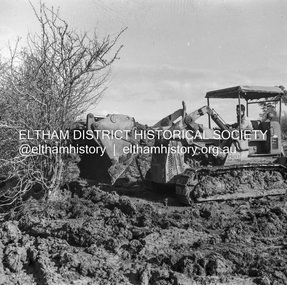 Eltham District Historical Society Inc
Negative - Photograph, J.A. McDonald, Kangaroo Ground-Queenstown Road, Aug. 1960
... farmers’ hawthorn hedges shrouding dangerous corners on busy roads. If the council does not insist on their removal for a distance clear enough for safe driving, then it must be held culpable for the accidents that are bound to happen. – WAKE UP (Melbourne) ELTHAM, CUT THE HEDGES! 50-50 (1960, 6 January), The Sun (News clipping held in SEA_74-1_007) ‘BAD HEDGES’ WILL GO “We know there are some bad hedges on corners in the Kangaroo Ground area, but roadworks this year...farmers’ hawthorn hedges shrouding dangerous corners on busy roads. If the council does not insist on their removal for a distance clear enough for safe driving, then it must be held culpable for the accidents that are bound to happen. – WAKE UP (Melbourne) ELTHAM, CUT THE HEDGES! 50-50 (1960, 6 January), The Sun (News clipping held in SEA_74-1_007) ‘BAD HEDGES’ WILL GO “We know there are some bad hedges on corners in the Kangaroo Ground area, but roadworks this year ...(Kangaroo Ground-St Andrews Road) “Rymers” Corner – shifting Hawthorn hedges on Tompkins property Council’s Drott 6 Woods Drott 9 August 1960 Showing method of lifting clumps of Hawthorn EDHS_05569-55 (EDHS_05577-3/4) and EDHS_05569-56 (EDHS_05577-5/6) - Hawthorn Hedges, Kangaroo Ground 50-50 ELTHAM, CUT THE HEDGES! While all of us are talking about the road toll, Eltham Council must have been in long recess. Around Kangaroo Ground are farmers’ hawthorn hedges shrouding dangerous corners on busy roads. If the council does not insist on their removal for a distance clear enough for safe driving, then it must be held culpable for the accidents that are bound to happen. – WAKE UP (Melbourne) ELTHAM, CUT THE HEDGES! 50-50 (1960, 6 January), The Sun (News clipping held in SEA_74-1_007) ‘BAD HEDGES’ WILL GO “We know there are some bad hedges on corners in the Kangaroo Ground area, but roadworks this year will eliminate them,” the Eltham Shire secretary, Mr Maxwell B. Watson, said yesterday. A reader in 50-50 yesterday complained of farmers’ hawthorn hedges obscuring drivers’ views at bad corners on busy roads in the Kangaroo Ground district. Mr Watson said the roadworks were deviations to remove the sharp turns, and the road would cut back into paddocks. The hedges would go at the same time. Meanwhile, the shire had power to require owners to cut back hedges, and this would be done if specific instances were reported and found justifiable. ‘BAD HEDGES’ WILL GO (1960, January 7), The Sun (News clipping held in SEA_74-1_007)Record of various Shire of Eltham infrastructure works undertaken during the period of 1952-1962 involving bridge and road reconstruction projects, sometimes with Eltham Shire Council Project Reference numbers quoted. It was during this period that a number of significant improvements were made to roads and new bridges constructed within the shire that remain in place as of present day (2022). In many situations, the photos provide a tangible visible record of infrastructure that existed throughout the early days of the Shire. The album was put together by or under the direction of the Shire Engineer, J.A. McDonald.infrastructure, shire of eltham, 1960-08, garden hill, kangaroo ground, kangaroo ground-queenstown road, kangaroo ground-st andrews road, rymers corner, bulldozer, drott
