
Showing 61 items matching "years of trial "
-
 Moorabbin Air Museum
Book - Aviation history, Flight A Pictorial History from the Wright Brothers to Supersonic
... Years of trial & error (1903-1909)...Aviation history Years of trial & error (1903-1909) An industry is born (1909-1914) The airplane goes to war (1914-1918) The age of great flights (1919-1933) Return of the monoplane (1934-1939) Air power supreme (1939-1945) The new pioneer age Pictorial history of flight, circa 1974 Flight A Pictorial History from the Wright Brothers to Supersonic Book Aviation history ...Pictorial history of flight, circa 1974non-fictionPictorial history of flight, circa 1974years of trial & error (1903-1909), an industry is born (1909-1914), the airplane goes to war (1914-1918), the age of great flights (1919-1933), return of the monoplane (1934-1939), air power supreme (1939-1945), the new pioneer age -
 Melbourne Legacy
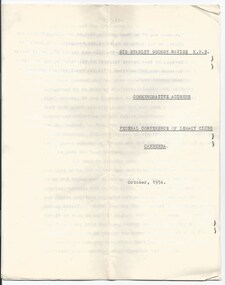
Document - Speech, Commemorative Address - Sir Stanley Savige K.B.E. Federal Conference of Legacy Clubs, Canberra, 10/1954
... He was convinced that a Second AIF would one day be urgently called upon, and as a Battalion Commander he spared no effort to train the Officers under his charge during the uneasy years of peace for the trial that he felt must come. These men have all subsequently had distinguished military careers, their names are well known and many of the serve in Legacy today. ...He was convinced that a Second AIF would one day be urgently called upon, and as a Battalion Commander he spared no effort to train the Officers under his charge during the uneasy years of peace for the trial that he felt must come. These men have all subsequently had distinguished military careers, their names are well known and many of the serve in Legacy today. ...After the death of Stan Savige this address was given at the Canberra Conference in October 1954. It is tribute to his life. Sir Stanley Savige KBE : Commemorative Address Federal Conference of Legacy Clubs, Canberra : October 1954. On the 15th of May this year Legacy learned to its enduring sorrow of the death of its Founder, Lieut. General Stanley George Savige KBE, CB, CBE, DSO, MC, ED, for more than 30 years affectionately known to us all as Legatee Stan Savige. He was the embodiment of all those things for which Legacy stands, and each one of us who knew him and worked with him feels a great and abiding sense of personal loss. It is proper, therefore, that those of us at this Conference, the first after his passing, representative of Legacy throughout the Commonwealth, and comprising so many who were his friends, so many who knew the depth of his love for Legacy, should acknowledge our debt to our Founder and ensure, so far as we may, that the inspiration of his life and work in this Cause shall not be lost to those who follow after. It was not ordained that Stanley George Savige - should enjoy a long life, but it was to prove a life of outstanding service. Born at Morwell in Victoria some 63 years ago, he received with his brothers and sisters such education as was then available to a lad in a mining district. He had no particular opportunities of advancement, but from his early days he cherished a strong ambition to make a success of his life, and with this in view he lost no opportunity of adding to his knowledge. Always a lover of the open country, a good bushman and a fine shot, he became as a young man, a Scoutmaster with a keen following of boys. Even in those early days he attracted youth and showed undoubted promise of the quality of leadership which later was to make him famous. Opportunity came with the first World War, and he took his place as a private soldier in the original 24th Battalion AIF. Followed Gallipoli and Anzac where his marksmanship and bush craft stood him in good stead. Conscious that his early training was not sufficient to secure the promotion he desired, he set himself to enlarge it. Only a man of fine fibre and rare determination could apply himself to study on that war torn Peninsula, where our men, hitherto untested, suffered every known hardship and no man knew, from hour to hour, whether he would survive. But Savige achieved it. Himself then a Corporal he found another Corporal who was a former Schoolmaster and learned from him all that he had to teach. Savige was on his way. He was commissioned on the Field and allotted the heroic task of leading the last party off that desperate coast during the famous evacuation. In France he became the Adjutant of his Battalion and one of the best known officers in the 6th Brigade. He won the Military Cross and was mentioned in despatches. Early in 1918 he received a signal distinction, He was included in a small but distinguished band of Officers and Non-Commissioned Officers from the British and Dominion Forces most carefully selected for individual courage and proved qualities of leadership, and was sent to Persia, under the command of Major-General Dunsterville, Kipling’s famous Stalky, to assist and mobilise the friendly tribes with a view to protecting the road to India, left wide open by the withdrawal of Russia. The story of the Dunsterforce, its suffering and achievements in the face of incredible hardships and difficulties, was later to be told by Savige in his book “Stalky’s Forlorn Hope”. He emerged, finally, unscathed, despite his active participation in several of the bloodiest battles of all time, with the rank of Captain and a DSO and MC to his credit, to say nothing of three mentions in despatches. In later years, further decorations were to be conferred upon him, but I believe he valued none of these so highly as his awards for outstanding personal bravery won in the Field when he was an Officer of comparatively junior rank. Such was the man who in August 1923, at the instance of his former Commander, Major-General Sir John Gellibrand, gathered around him a handful of men who had fought and laughed with him over four well remembered years. This small band adopted the name of “Legacy”, but its purpose then was, in the main, to assist in safeguarding the interests of ex-servicemen in this country. Worthy although the case undoubtedly was, the conception and ideal which was to distinguish Legacy from all kindred post-war movements did not emerge until two years later. The torch had not been lit. Legacy had not yet found its soul. What has been achieved since then is known to you all. The Legacy ideal, unique in its conception, with no known counterpart elsewhere, is now accepted, welcomed and honoured throughout the Commonwealth and abroad. But in those early days the achievements of our Founder in the face of all manner of difficulties and frustrations are worthy of our lasting memory and thankfulness. As the source of every river lies in the hills, so must the inspiration from which stems a great conceptions of service to one’s fellow men be lofty and above reproach. Savige was the embodiment of this new expression of comradeship, as he was the central figure and driving force of the little group that sponsored it. But for his zeal, his faith and determination, it is likely that the flame, newly kindled, might have flickered and died. The idea of men returned from active service pledging for the sake of their former comradeship, their personal assistance to the widows, and above all, to the children of those who had fought beside them and paid the full price of War, was so completely new and unexpected that it was by no means readily accepted. There were no funds, no precedents to guide the new adventurers, only the clear bright flame of an ideal just envisaged, and the conviction that the Cause was unassailable. Nor were there lacking many who said that the community held no place for Legacy, that it was born of sentiment only, and would quickly pass. The scoffers are gone and one since forgotten, but the torch remains and burns brighter than ever. Down the years of Legacy there are many names deserving of honour, men from all States and all stations of life, but no name stands out in such clear and bold relief as does the name of our Founder. By his works you shall know him. He was, in truth, the Soul of Legacy. He sought no office and preferred to work as one of the team. Six years went by before he accepted the Presidency of Melbourne Club, and then only because his fellows would book no further delay. “The Spirit of Legacy is Service” - so runs the Charter, and that was Savige’s Creed. By virtue of his attainments he was called upon to take a leading part in the administration of Legacy, first within his own club and later, as Chairman of the Co-ordinating Council of Legacy in Australia. But always it was the essentially human character of the work which enthralled and upheld him, and the tasks which gave him most joy were those which brought him into close personal contact with the youngsters and their home life. Like their elders they recognised his goodwill and his leadership and responded to it. It was Savige who made possible the first camps held for the boys and girls by Melbourne Club. These were erected on his own seaside property, and were originally conducted under his personal direction and largely with the aid of funds he had collected. There was hardly an important post in his own Club that Savige did not at some time occupy and adorn. He was happiest in the company of those men with whom he had served in the field, and cherished always the comradeship born of active service which is of the essence of Legacy. He was a man of strong convictions but attentive always to another’s point of view. As a Legatee he played a leading part in bringing hope and encouragement to many a mother on whom the whole responsibility of a young family had been suddenly and tragically laid; in the attainment of the ambitions of many an orphan child, which not so long since had seemed to him or her to be mere dreams, impossible of realisation. Comfort for the bereaved, new hope for the children’s physical and educational welfare, assistance with the home, aid for the sick, money for the needy and a new courage to face a future that hitherto had held no promise, all these facets of Legacy endeavour combine to present a living and enduring memorial to the man we honour as our Founder today. Between the two World Wars in addition to establishing himself successfully in civilian life and answering the constant calls of Legacy on his energy and time, Savige maintained an active association with the Army. He was convinced that a Second AIF would one day be urgently called upon, and as a Battalion Commander he spared no effort to train the Officers under his charge during the uneasy years of peace for the trial that he felt must come. These men have all subsequently had distinguished military careers, their names are well known and many of the serve in Legacy today. When the second crisis came, Savige himself was one of the first to offer, and although his youth was spent, he proudly carried the number VX13 throughout the terrible years that followed. This time he was to command, first the 17th Australian Infantry Brigade in the first action of the Second AIF against the enemy at Barida, and subsequently at Tobruk and Derna - all famous names now. It was his patrols which gave the warning - unheeded at the time - that Rommel’s reinforcements were reaching North Africa far earlier than was expected. Then followed the grim days of Greece and Crete when the fine qualities of his leadership were put to the utmost test. I have been told by those who were closest to him it was typical of Savige that when his convoys were on the move back and were being blasted from the air by the unopposed Luftwaffe, he should sit by the side of the open road, wearing his red banded cap, to steady the morale of men who had then no chance of hitting back at the enemy. Unorthodox no doubt, but here was a man indeed. Throughout the whole campaign and later when he commended the 3rd division in New Guinea and later still when with the rank of Lieutenant-General he became a Corps Commander in New Guinea and Bouganville, it was at all times characteristic of him that he should see for himself the situation in the forward areas. He dealt personally with his subordinate commanders whenever it was possible to do so. No one says his G.S.O. 1. understood better than he did the importance of front line troops seeing their G.O.C. frequently, and knowing that he was aware of and prepared to share their hardships and dangers. He took many risks that he should not have taken, exhausted himself physically and mentally times without number, and considered himself not at all in order to secure the success of his operations. Finally, in Bouganville, he brought his campaign to a victorious conclusion and accepted the personal surrender of the Japanese Commander. Savige is known as one of Australia’s most human military leaders, but let no one believe that he did not ask and receive the utmost of his men. He trained them in a hard school but he was ever conscious of their needs and observant and thoughtful of their welfare. Fearless and untiring under conditions which brought younger men down, he asked nothing that he was not himself prepared to give and do. The close of the Second World War left him with the same brave heart; but a vitality greatly impaired. He was called up again and again to perform important national tasks, notably that of Co-ordinator of Demobilisation and Dispersal. But his interest in Legacy never flagged it was in fact more personal than ever, for under his command many junior legatees, sons of former comrades had proved themselves worthy of their Fathers in war and in peace. In the bearing and achievements of the young men of the Second A.I.F. he took a particular and justifiable pride. He applied himself to the Extension of Legacy to areas where it had not previously been practicable to operate. His record of service and close personal contact with the men of both wars made him a most welcome pioneer and many new Clubs and Groups resulted from his efforts. He founded, and I doubt whether any one else could have done so, the Club in the great Capital of our Empire. His reputation and obvious sincerity surmounted obstacles that might well have daunted lesser man. Legacy’s debt to him visibly increased. But he was ever a simple man, with a great love and understanding of his fellow men and a true Legatee at heart. Much that he did will never be known or recognised, save by those who benefitted. His service in Legacy ranged from the humble kitchen of cottage and farm to our representation in Westminster Abbey itself. A knighthood set the seal upon an outstanding career. None the less when upon the death of Field Marshall Sir Thomas Blamey, Lieut. General Sir Stanley Savige became the Patron of the Melbourne Club, he retained at his own express desire, the title of Legatee Savige, and when on that final day we bade him farewell, when the Flags he had served so well were lowered and the guns which had formed a grim final salute, it was apparent to all who had eyes to see that this great and simple man had won such a place in the hearts and affection of his fellow country men as is given to few men indeed. From the packed Cathedral, escorted by his fellow Generals, followed by men of his own Units, by Legatees and a great company of others who had cause to honour and esteem him, he made his last journey. But that is not the end. His voice and presence are lost to us but his memory and inspiration must ever remain. As he has bequeathed to the National War Memorial yonder his diaries, records and battle plans, so he has bequeathed to us his fellow Legatees his greatest achievement and his trust, Legacy itself. Never was the Torch passed by worthier hands. Now it is ours to hold it high. Whatever material memorial the future many hold for him, Legacy owes its Founder a livelier recompense. It is within our power to implement what I believe to be his greatest wish, that Legacy and its ideal of comradeship and service shall flourish and endure. Let each one of us then resolve that we shall, within our Clubs, in all tasks to which we are assigned, both great and small, keep in our minds the life and spirit of Stanley George Savige, so that we may be proud at all times to say of Legacy to those who follow after - “If you would see his memorial - Look around you”.The tribute to Stanley Savige shows how greatly he was regarded by the Legatees.Off white quarto paper with black type, address given about Stan Savige to the Canberra Conference, x 12 pages.savige, speech, obituary -
 Flagstaff Hill Maritime Museum and Village
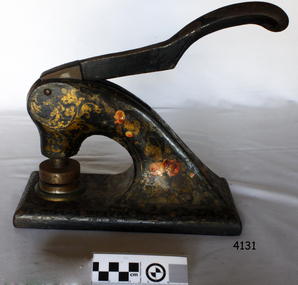
Functional object - Hand operated embossing document press, 1910
... The ‘50s and ‘60s were golden years for the mill. Security and growth gave the company confidence to trial Australia’s first electric blanket in 1958 and to install Swiss Sulzer looms in 1965. ...The ‘50s and ‘60s were golden years for the mill. Security and growth gave the company confidence to trial Australia’s first electric blanket in 1958 and to install Swiss Sulzer looms in 1965. ...The woollen mill was a vital part of Warrnambool for all but 22 years of the town’s history since it's the establishment in 1847 when the first land sales were held and white settlement began. In 1869 the Warrnambool Meat Preserving Company began operations on the mill site, in 1875, shareholders of the then defunct Warrnambool Meat Preserving Company happily sold the land and buildings on the Merri river to Warrnambool Woollen Mill Company Ltd for £5,000. The site was sold again in 1876 to grazer Robert Hood of Sherwood, who was chairman of directors of the failed company, which couldn’t raise sufficient capital to keep the works operating. The entrepreneurial Hood then used the existing plant to turn his own wool into tweed cloth. But just as the mill was starting to show a profit, a fire destroyed the building and plant on the night of 25 March 1882. So again, the mill was operational for six short years. Insurers only paid a fraction over 10% of the damage, Hood couldn't raise sufficient capital to rebuild on his own, and so the site lay unused until 1910. In 1908 Marcus Saltau and Peter John McGennan convinced the Warrnambool Chamber of Commerce to invest in a secondary industry with local capital. A public meeting in September 1908 agreed to raise £40,000, electing Saltau chairman of directors, a post he held for 34 years. A year later, using mostly local money, the Warrnambool Woollen Mill Company dispatched its first manager, John E. Bennett, to buy a plant and recruit 20 experienced staff from the Yorkshire woollen industry in December 1909. Another year more, the new mill was officially opened on 14 November 1910 by Marcus Saltau as company chairman and town mayor. Eighteen months on, in May 1912, the mill paid its first half-yearly dividend of 2 ½%. It was now working two shifts, with a year's orders to fill. In 1914 the mill ordered its own generator, providing the town with electricity and effectively doubling its plant size by October 1915, six months after Gallipoli. Thereafter, government orders for cloth and military supplies assured the mill’s success right through the First World War and on until 1923. A plant upgrade in 1922 for machinery to make worsted fabric drained profits, which, with a fall in demand, led to a loss in 1925. Profits were restored by the 1930s, despite the Depression, mostly due to tight management and robust marketing. Production boomed again during the Second World War, but soon foreign competition bit into profits, forcing the company to consolidate operations. The ‘50s and ‘60s were golden years for the mill. Security and growth gave the company confidence to trial Australia’s first electric blanket in 1958 and to install Swiss Sulzer looms in 1965. Over time, the building facades took on the modern look that the mill presented until it closed. The Dunlop company bought the mill in 1968, fending off a challenge from Onkaparinga in South Australia, and continued to expand by adding Wendouree Woollen Mill in the same year and Dream-spun Textiles a decade later, in 1979. Soon after that purchase, however, the mill began its slippery slide into decline. Dunlop sold to its former rival bidder Onkaparinga Woollen Co. Ltd in 1982, which in turn was taken over by Macquarie Worsted's only a year later, in 1983. Operations remained stable for a decade until 1994 when the Macquarie Group signaled that its newly rationalised operations left no room for the Warrnambool investment. The final operator of the mill was The Smith Family charity group, which ran the site by agreement with the Warrnambool City Council and a state government grant in that same year, 1994. The mill became more of a fabric recycler than a manufacturer. The site was sold to private operators in February 2003 and rezoned four months later to allow for the mixed housing development. The embossing press is significant for its association with the Warrnambool Woollen Mills 1910-1968, a major employer in the Warrnambool district. The press is also significant as an example of commercial office equipment used in the 19th and 20th century.Press, metal, for Company seal of Warrnambool Woollen Mill, stamping their brand as Western District Worsted Mills Pty Ltd. Metal is black with red and gold floral markings. Inscription of stamp reads "WESTERN DISTRICT WORSTED MILLS PROPRIETRY LIMITED" flagstaff hill, warrnambool, shipwrecked-coast, flagstaff-hill, flagstaff-hill-maritime-museum, maritime-museum, warrnambool woollen mills, western district worsted mills proprietry limited, worsted fabric, printing press, logo printing press, stamp printing press, shipwreck-coast, flagstaff-hill-maritime-village -
 Flagstaff Hill Maritime Museum and Village
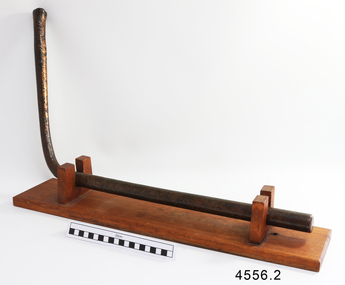
Nail, circa 1810
... years alters its shape. Iron nails had been used on ships previously, but they quickly corroded in the salt; ships needed regular, costly and time-consuming maintenance to replace the iron nails. Towards the end of the 18th century the British Navy trialled...years alters its shape. Iron nails had been used on ships previously, but they quickly corroded in the salt; ships needed regular, costly and time-consuming maintenance to replace the iron nails. Towards the end of the 18th century the British Navy trialled ...This copper nail, sometimes known as a ‘Dumpy Bolt’ or spike, was salvaged from the hull of the wreck of the “George III”. It dates back to at least 1810. It was found by an abalone diver on the south east coast of Tasmania. The nail would have been used to hold the layers of the ship’s keel frame and the planking together. The nail has been passed from the abalone diver to an interested business man on a trip to the south of Hobart, on again to the business man’s close friend who then donated it to Flagstaff Hill Maritime Village. The metal of nails such as this one, after being in the sea for a long time, become affected by the natural reaction of the sea water, causing it to degenerate and thin, and the stress from the force of the sea over the years alters its shape. Iron nails had been used on ships previously, but they quickly corroded in the salt; ships needed regular, costly and time-consuming maintenance to replace the iron nails. Towards the end of the 18th century the British Navy trialled the use of copper nails, finding them to be very successful. Merchant ships began to adopt this process in the early 19th century, although it made ship building very expensive and was more often used for ships such as the “George III” that sailed on long voyages. The three masted sailing ship “George III” was a convict transport ship built in Deptford, England, in 1810. On 14th December 1834 she left Woolwich, England, bound for Hobart Town, Van Diemen’s Land (Tasmania), under Captain William Hall Moxey. She was carrying 220 male convicts plus crew, guards and their families, totalling 294 persons (another 2 were during the voyage). Amongst the cargo were military stores including several copper drums of gun powder. On 27th January 1835 the “George III” was near the Equator, about half way into her journey. A fire broke out and the gun powder was in danger of explosion, threatening the whole ship. Two convicts braved the heat and smoke, entered the store and seized the gun powder drums, suffering burns for their efforts but saving a probable disaster. The fire destroyed some of the provisions and food was scarce. Many became ill with scurvy and some died during the journey. Nearing the end of their journey on 10th April 1835 the “George III” was headed through the D'Entrecasteaux Channel, south east Tasmania, between the mainland and Bruny Island. She was sailing in the moonlit night to hasten her arrival in port due to the great number of sick on board. She struck uncharted rocks, known only to the local whalers, between Actaeon Reef and Southport Lagoon and within hours began to break up. The ship’s boats were used to first rescue the women and children. Firearms were used to help quell the panic of the convicts below decks and some were killed by the shots. Many convicts, including the sick, were drowned. In all, 133 lives were lost including 5 of the crew, guards and their families. It was the third worst shipping disaster in Tasmanian waters. A monument in honour of the prisoners who perished in the “George III” has been erected, noting the date of the wreck as “Friday 10th April 1835.” (NOTE: there are a few differences between sources regarding dates of the shipwreck, some saying March and others April 1835. There are also differences in the figures of those on board and the number of lives lost.) The copper nail is significant as an example of sailing ship construction; fasteners used in the early 19th century on ships carrying convicts to Australia. The nail is also significant for its association with the ship “George III”. The “George III” is registered on the Australian National Shipwreck Database, ID 7195 as an Historic Shipwreck. She is the third worst shipwreck in Tasmanian waters. She is also associated with Early Australian History and the transportation of convicts to Australia. The incident of the fire on board and the bravery of the convicts in making the gun powder safe is an example of the social character of the people in early Tasmanian colonisation. Copper nail (also called a Dumpy bolt or spike) from the convict ship George III, wrecked in 1835. Nail is long, bent in an ‘L’ shape about 3/5ths along, tapering from both ends to the bend. Both ends are flat and do not taper to a point, nor have a thread. The shorter end has been polished, showing bright copper. There is pitting along the nail and virdigris is evident on the longer, unpolished end. The nail is displayed with the longer section resting on a wooden board between two ‘U’ shaped uprights, the shorter section upright. flagstaff hill, warrnambool, shipwrecked coast, flagstaff hill maritime museum, maritime museum, shipwreck coast, flagstaff hill maritime village, great ocean road, george iii, ship construction, ship nail, 1835 shipwreck, 19th century shipwreck, william moxey, d'entrecasteaux channel, convict transportation, copper nail, dumpy bolt, spike, keel nail -
 Federation University Historical Collection
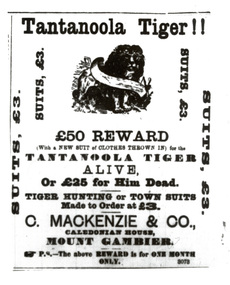
Newspaper - Newsclippings, Tantanoola Tiger Newsclippings
... years. It was of particular concern between 1909 and 1910. At that time Herbert Allchurch, an Adelaide detective, was sent to solve the mystery. A few days after his arrival Allchruch went to the front bar of the Tiger Hotel and arrested local rabbit shooter and trapper, Charlie Edmunson, with sheep stealing. After his 1911 trial...years. It was of particular concern between 1909 and 1910. At that time Herbert Allchurch, an Adelaide detective, was sent to solve the mystery. A few days after his arrival Allchruch went to the front bar of the Tiger Hotel and arrested local rabbit shooter and trapper, Charlie Edmunson, with sheep stealing. After his 1911 trial ...In the early 1880s a small circus travelled between Millicent and Mt Gambier, South Australia. After camping overnight they discovered their Bengal Tiger at escaped and disappeared into dense scrub. After searching for hours they continued to Mt Gambier and reported the loss of the tiger to police. Police and local volunteers continued the search for the escaped tiger, but no sighting were made. In the early 1890s sheep in the Tantanoola area started to disappear with the still unsighted tiger being blamed. In 1893 reports of an unusual animal in the Tantanoola area started, with many describing the animal as the missing tiger, or a large dog. One eye witness claimed to have seen the animal carrying a full grown sheep in its mouth. The reports grew in number and exaggeration with sightings from Robe to Bendigo. In the Tantanoola district children were escorted with shotgun guards to and from school, with many homes keeping guns at the ready in case the tiger suddenly appeared. In August 1895 Tom Donovan shot the "Tantanoola Tiger" on Mt Salt Station, around 20 kms south of Tantanoola. The corpse was taken to Marks, a Mount Gambier taxidermist, at which time the animal was identified as an Assyrian or Northern Russian Wolf. Donovan displayed the animal far and wide. Despite the animal's death sheep continued to disappear from properties in the district over many years. It was of particular concern between 1909 and 1910. At that time Herbert Allchurch, an Adelaide detective, was sent to solve the mystery. A few days after his arrival Allchruch went to the front bar of the Tiger Hotel and arrested local rabbit shooter and trapper, Charlie Edmunson, with sheep stealing. After his 1911 trial Edmunson admitted to stealing over 4,000 sheep during the previous 20 years. He was gaoled for six years with hard-labour in January 1911. Edmunson had been selling the skins of the stolen sheep, leaving the carcusses to rot. He earned around five pounds per week during the 1990s and early 1900s, a time when the economy was depressed. It is not known had the animal known as the Tantanoola Tiger came to Australia, but it is believed it survived one of three ships wrecked of the coast between 1890 and 1893, making it to shore along with some of the shipwrecked passengers. (From a card produced by the Tantanoola Tiger Hotel, where the 'tiger' is on display.)A collection of Newsclippings from 1892 - 1895 photocopied onto A4 white paper. The clippings relate to the Tantanoola Tiger. Clippings include: * Border Watch 1892 - Tantanoola Tiger Reward * Sydney Morning Herald, 04/07/1857 - Animals in Zoological Gardens, including a number of large cats. * Claims the Tantanoola Tiger was an escaped circus animal (ie The Advertiser [Adelaide], 31 October 1893) * Search parties for the Tantanoola Tiger (ie Barrier Miner 19/05/1893; Barrier Miner 03/1081893) * Thylacine claim (ie Morning Bulletin [Rockhampton] 11/03/1895 * Afghan and Indian Hunters (ie Barrier Miner 07/02/1895) * Sighting by John Bird of Scarsdale - Wanganui Herald 15/12/1900. " ... Mr Bird was travelling on foot along a lonely track through very dense scrub, when he was stricken with amazement to see a full-grown tiger standing in a small dam about 30ft away, and holding in its jaws the carcass of a newly-killed lamb. He remained long enough to thoroughly take in the animals appearance, and then beat a hasty retreat unmolested. His description of the animal is as follows: A tawny-coloured creature, with a dirty mottled skin; in general appearance like an immense cat; body 4ft long, and of a uniform thickness from shoulder to hindquarters; in bulk equal to a very large pig. The legs were hidden in the water. A similar animal is reported to gave been seen near Canico, some miles away. ..." * Victorian country sightings # Bullarto - Argus 06/05/1905 # Dean - Launceston Examiner 28/01/1895 # Bendigo - Hobart Mercury 15/03/1895 # Ballan - Launceston Examiner 03/08/1895 * South Australian register 17/06/1885 " There is a tiger or panther wandering at large in Victoria, according to a rumour. It has taken the place of the Bunyip, whom hundreds have seen but none captured. This tiger is supposed to have broken loose from a travelling menagerie in the North-eastern district. At the beginning we should like it roved that such an escape ever took place. Perhaps the showmen were afraid to report the fact to the police; at any rate they did not do so. The first story about the tiger being seen came from the neighborhood of Wangaratta, 60 miles from the place where it is said to have commenced business on its own account. He was followed, but vanished among trees. Next we hear of a strange animal, bigger than a St Bernard's dog, but shorter legged, having appeared at least 150 miles from Wangaratta. Between Lilydale and Wangaratta there is a dividing range 2,000 feet high in the lowest past, besides several large rivers. An finally, the tiger - changed from a panther - is reported as having been seen within the suburban circle, about 8 miles from the general Post Office. They show you footprints, and point to the carcasses of mangled cows and calves. Casts have been taken of the footprints for examination by scientific men, who pronounce them doglike, and yet not doglike, but panther-like, which gives a nervous turn, for the panther may take up killing children and grown-up people. One tiger will not account for so many apparitions. There must have been a general strike among the menageries, and a breaking-up companies. ... * Research article by Philip A. Clarke "Indigenous Spirit and Ghost Folklore of 'Settled' Australia. australian animal folklore collection, tantanoola tiger, tom donovan, herbert allchurch, charles edmunson, sheep, charlie edmunson, mythical, myth, folklore -
 The Beechworth Burke Museum
Audio - Oral History, Jennifer Williams, Mr. Vincent Makaravicius, July 2000
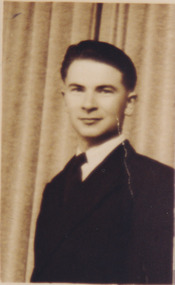
... years. This oral history recording was part of a project conducted by Jennifer Williams in the year 2000 to capture the everyday life and struggles in Beechworth during the twentieth century. This project involved recording seventy oral histories on cassette tapes of local Beechworth residents which were then published in a book titled: Listen to what they say: voices of twentieth-century Beechworth. These cassette tapes were digitised in July 2021 with funds made available by the Friends of the Burke. Vincent Makaravicius' story is historically and socially significant as it provides a unique insight into the trials ...Vincent Makaravicius was born on the 23rd of January, 1922 in a small Lithuanian village. He was the youngest of six children and after completing his primary education he went on to study horticulture at Kaunas and Vilnius. During WWII, under the threat of Soviet occupation and conscription, Vincent travelled to Germany, before coming to Australia as a refugee after his wife in 1949 on the ship 'Victory.' Vincent eventually settled in Beechworth, working at the local tannery and the Beechworth Asylum, as well as taking on boarders in the tannery boarding house in which his wife and he lived for a number of years. This oral history recording was part of a project conducted by Jennifer Williams in the year 2000 to capture the everyday life and struggles in Beechworth during the twentieth century. This project involved recording seventy oral histories on cassette tapes of local Beechworth residents which were then published in a book titled: Listen to what they say: voices of twentieth-century Beechworth. These cassette tapes were digitised in July 2021 with funds made available by the Friends of the Burke.Vincent Makaravicius' story is historically and socially significant as it provides a unique insight into the trials, tribulations, hopes, and dreams of Australian immigrants during the mid 20th century. Mr Makaravicius references the turbulent political situation and lack of food in Europe as being the reason for the mass exodus from Europe that saw an influx of refugees and migrants to Australia. His personal account highlights the spirit of survival and perseverance that is quintessential of Australian settler history. His contributions to the township of Beechworth gave him a detailed understanding of the social and historical significance of the township and the people, institutions, and local businesses on which it was built, namely the Beechworth Asylum, the local tannery, and relations between migrants and the established community. This oral history account is socially and historically significant as it is a part of a broader collection of interviews conducted by Jennifer Williams which were published in the book 'Listen to what they say: voices of twentieth-century Beechworth.' While the township of Beechworth is known for its history as a gold rush town, these accounts provide a unique insight into the day-to-day life of the town's residents during the 20th century, many of which will have now been lost if they had not been preserved.This is a digital copy of a recording that was originally captured on a cassette tape. The cassette tape is black with a horizontal white strip and is currently stored in a clear flat plastic rectangular container. It holds up 40 minutes of recordings on each side.Mr. Vincent Makaravicius /listen to what they say, beechworth, oral history, burke museum, vincent makaravicius, wwii, lithuania, kaunas, vilnius, soviet, germany, australia, victory, tannery, beechworth asylum, refugee, jennifer williams -
 Federation University Historical Collection
Photograph (black & White), Honourable William Philip Schreiner - South Africa
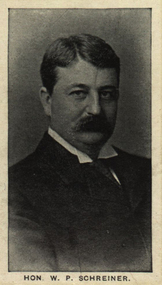
... Dinuzulu was accused of giving orders to Bambatha to start the rebellion and put on trial for treason. He was sentenced to four years imprisonment. When General Louis Botha became Prime Minister of the Union of South Africa he ordered Dinuzulu be released and transported to the farm Uitk yk in Transvaal. ...Dinuzulu was accused of giving orders to Bambatha to start the rebellion and put on trial for treason. He was sentenced to four years imprisonment. When General Louis Botha became Prime Minister of the Union of South Africa he ordered Dinuzulu be released and transported to the farm Uitk yk in Transvaal. ...William Schreiner was a barrister, politician, statesman, and Prime Minister of the Cape Colony during the Second Boer War. His proximity to parliamentarians gave him an entry to political life. In 1893 he was elected a member of the Cape Parliament for Kimberly. He became Attorney-General in Cecil Rhodes's cabinet. In1896, Schreiner and the rest of the parliamentary ministers resigned when it became obvious what Cecil Rhodes ambitions were. That ended Rhodes's term as Prime Minister. Schreiner advocated integration and equal rights for all "civilised" men. His dedication to this ideal was proved when he resigned from the National Convention in order to represent Dinuzulu, who was to stand trial for his alleged treasonous participation in the rebellion of 1906. With the forming of the Union Government in 1910 he became one of the first senators nominated to look after Black interests. In 1906 the so-called Bambatha rebellion broke out. Dinuzulu was accused of giving orders to Bambatha to start the rebellion and put on trial for treason. He was sentenced to four years imprisonment. When General Louis Botha became Prime Minister of the Union of South Africa he ordered Dinuzulu be released and transported to the farm Uitk yk in Transvaal. The Bambartha rebellion was a Zulu revolt against British rule and taxation in Natal. Individual image from photographed poster of tobacco and cigarette cards.william schreiner, barrister, politician, prime minister, cape colony, second boer war, attorney-general, cecil rhodes's cabinet, intergration and equal rights, national convention, dinuzulu, union government, bambartha rebellion, louis botha, uniion of south africa -
 Flagstaff Hill Maritime Museum and Village
Book - Compalation of Plays, Prologues, Sociatal Observations, Richard Brinsley Sheridan, The Works of Richard Brinsley Sheridan, 1874
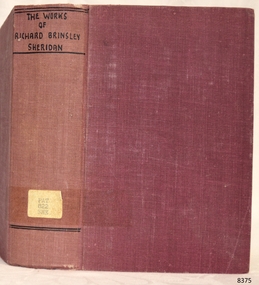
... years. He was famously aligned with Charles James Fox and was noted for his mesmerizing, hours-long speeches during the impeachment trial of Warren Hastings. ...years. He was famously aligned with Charles James Fox and was noted for his mesmerizing, hours-long speeches during the impeachment trial of Warren Hastings. ...Richard Brinsley Sheridan (1751–1816) was an Irish-born playwright, impresario, wit, and prominent Whig politician. He was a dazzling figure in late 18th-century London high society. The book, The Works of Richard Brinsley Sheridan, edited by Francis Stainforth, is an omnibus collection showcasing the full breadth of his career. The volume opens with a substantial biographical introduction (the "memoir"). It traces Sheridan's meteoric rise from an impoverished Irish theater family to the heights of Parliament and Westminster Abbey, balanced against his chaotic personal finances and battles with alcoholism. Rather than just printing his famous plays, this single-volume edition compiles his complete theatrical catalog (The Rivals, The School for Scandal, The Duenna, The Critic, Pizarro, etc.). Also included are his lesser-known verse, prologues written for the theater, classical translations, a selection of his most famous parliamentary orations, and fragments of plays and essays he never completed. The addition of a collection on “ANA,” noted on the book's flyleaf, refers to a 19th-century publishing term for a collection of anecdotes, memorable sayings, table-talk, and biographical trivia regarding a famous person. The "Sheridaniana" section in this book compiles the sharp-witted jokes, pranks, and clever remarks Sheridan made throughout his life.The Works of Richard Brinsley Sheridan Author: Richard Brinsley Sheridan Publisher: Chatto and Windus Date: 1874 Editor: Francis Edward StainforthfictionRichard Brinsley Sheridan (1751–1816) was an Irish-born playwright, impresario, wit, and prominent Whig politician. He was a dazzling figure in late 18th-century London high society. The book, The Works of Richard Brinsley Sheridan, edited by Francis Stainforth, is an omnibus collection showcasing the full breadth of his career. The volume opens with a substantial biographical introduction (the "memoir"). It traces Sheridan's meteoric rise from an impoverished Irish theater family to the heights of Parliament and Westminster Abbey, balanced against his chaotic personal finances and battles with alcoholism. Rather than just printing his famous plays, this single-volume edition compiles his complete theatrical catalog (The Rivals, The School for Scandal, The Duenna, The Critic, Pizarro, etc.). Also included are his lesser-known verse, prologues written for the theater, classical translations, a selection of his most famous parliamentary orations, and fragments of plays and essays he never completed. The addition of a collection on “ANA,” noted on the book's flyleaf, refers to a 19th-century publishing term for a collection of anecdotes, memorable sayings, table-talk, and biographical trivia regarding a famous person. The "Sheridaniana" section in this book compiles the sharp-witted jokes, pranks, and clever remarks Sheridan made throughout his life.flagstaff hil, warrnambool, flagstaff hill maritime museum, maritime museum, shipwreck coast, great ocean road, book, pattison collection, warrnambool library, warrnambool mechanics’ institute, ralph eric pattison, corangamite regional library service, warrnambool city librarian, mechanics’ institute library, victorian library board, warrnambool books and records, warrnambool children’s library, the works of richard brinsley sheridan, richard brinsley sheridan, f stainforth, plays, drama -
 Greensborough Historical Society
Book, Trains, Trials and Triumphs, 2006_
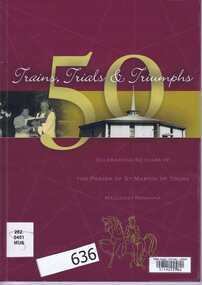
... years history of the Parish and the primary school of the same name. Details people associated with its origins and the priests who staffed the Parish. primary school catholic st martin of tours rosanna macleod Pencil words on inner flyleaf An 83 page book issued for the 50th Anniversary of The Parish of St Martin of Tours. Trains, Trials ...Issued for the 50th Anniversary celebrations of the parish of St Martin of Tours, Macleod/Rosanna.Records the first 50 years history of the Parish and the primary school of the same name. Details people associated with its origins and the priests who staffed the Parish.An 83 page book issued for the 50th Anniversary of The Parish of St Martin of Tours.Pencil words on inner flyleafprimary school, catholic, st martin of tours, rosanna, macleod -
 Glenelg Shire Council Cultural Collection
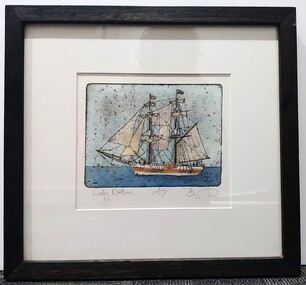
Artwork, other, BRIGIT THOMAS, Lady Nelson, c. 2015
... She also has links to other locations around the East Coast such as Trial Bay in NSW and the Mt Gambier area of SA. After 25 years of service while trading on the island of Baba the Lady Nelson was overrun by the islanders, the crew was killed and the ship stripped and later burnt and sunk. ...She also has links to other locations around the East Coast such as Trial Bay in NSW and the Mt Gambier area of SA. After 25 years of service while trading on the island of Baba the Lady Nelson was overrun by the islanders, the crew was killed and the ship stripped and later burnt and sunk. ...From - theladynelson.org.au T The original Lady Nelson was built at Deptford, in England, in 1799, for service to the Transport Office on the River Thames. She was designed with sliding keels (centre boards), a device invented by Captain John Schank of the Royal Navy to allow surveying in rivers and shallow water ways. On completion she was selected for exploration services in the Colony of New South Wales and sailed for Port Jackson on 18 March 1800 under the command of Lieutenant James Grant. A brig of 60 tons, she carried a crew comprising the commander, two mates and twelve seaman. As she left the River Thames sailors on nearby ships ridiculed her because of her size and shape, calling her, as she sailed past, 'His Majesty's Tinderbox'. At Portsmouth on the 9th February 1800 she was fitted with four brass carriage guns, three to four pounders, in addition to the two guns already on board. Because of the heavy load she was carrying she was very low in the water, having only two feet nine inches freeboard amidships. The ship finally left Portsmouth on 17th March 1800 as part of an East Indian Convoy. From 1800 to 1825 the Lady Nelson operated around the Australian Coast and fulfilled a variety of roles including exploration, surveying, forming settlements, shifting goods and people around the colonies and capturing pirates. She played pivotal roles in the European settlement of Hobart, Northern Tasmania, Melbourne, Newcastle, Port Macquarie and Northern Territory. Those onboard charted much of Bass Strait, Port Philip, Newcastle, Port Macquarie and (with the Investigator) the coasts of northern New South Wales and southern Queensland. She also has links to other locations around the East Coast such as Trial Bay in NSW and the Mt Gambier area of SA. After 25 years of service while trading on the island of Baba the Lady Nelson was overrun by the islanders, the crew was killed and the ship stripped and later burnt and sunk. A replica of the Lady Nelson was built in the 1980s.Image of a tall ship in sail. The ship is flying both the Aboriginal flag and the Australian Flag. It sails on a calm sea. There are figures on the deck - four in total. The image is mounted on cream board and framed in dark timber. Etching, hand coloured,.Front: 'Lady Nelson A/P BT' - hand written, pencil in between etching and mount Back: Artist's business card glued to back of etching, lower left hand corner:ady nelson, femal artists, female artist, women -
 Supreme Court of Victoria Library
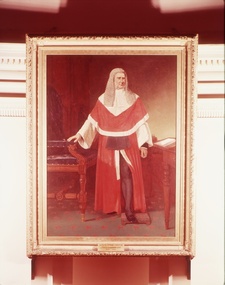
Portrait, Robert Dowling, Sir Redmond Barry, 1886
... This is in addition to his role as barrister defending aborigines in the 1840s and his position as a foundation judge of the Supreme Court of Victoria, a position he held for nearly 30 years, presiding over two of the most well known of colonial trials: the Eureka Trials in 1854 and the Kelly trial in 1880....This is in addition to his role as barrister defending aborigines in the 1840s and his position as a foundation judge of the Supreme Court of Victoria, a position he held for nearly 30 years, presiding over two of the most well known of colonial trials: the Eureka Trials in 1854 and the Kelly trial in 1880. ...This painting was created by Robert Dowling (1827-1886) in 1885. At this time Dowling was considered Australia's best portraitist. Dowling had been born in England, but migrated to Van Diemen's Land in the early 1830s with his parents. Dowling worked in both Tasmania and Victoria as an artist, before returning to England in 1857. He did not return to Australia until 1884 and received eighteen commissions for portraits. The Barry portrait was commissioned after Barry's death which explains some of the mistakes in the depiction of Barry's robes; the fur cuffs and collar are too large, and the cummerbund is sitting in the wrong place. Sir Redmond Barry is an important figure in Colonial Victorian History, responsible for the establishment and support of some of our finest cultural institutions (the University of Melbourne, the State Library of Victoria, the Supreme Court Library, and aspects of the Museum of Victoria's collection). This is in addition to his role as barrister defending aborigines in the 1840s and his position as a foundation judge of the Supreme Court of Victoria, a position he held for nearly 30 years, presiding over two of the most well known of colonial trials: the Eureka Trials in 1854 and the Kelly trial in 1880.The portrait of Sir Redmond Barry is significant because of the historical importance of Redmond Barry in colonial Victorian history. The painting is also of aesthetic significance as the work of the distinguished portraitist Robert Dowling. Portrait in oils of Sir Redmond Barry. Barry is depicted standing, dressed in red Judicial robes, his hand resting on a chair; behind is a table with books.Signed and dated 1886 (lower left) by Robert Dowling.redmond barry, portraits, judges, robert dowling -
 Supreme Court of Victoria Library
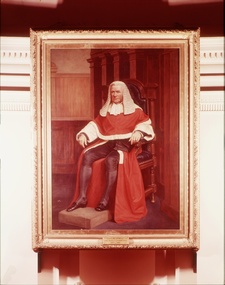
Portrait, Sir William Stawell
... trials. Sir William was appointed as Chief Justice of the Supreme Court in 1857, serving 29 years in the post. ...trials. Sir William was appointed as Chief Justice of the Supreme Court in 1857, serving 29 years in the post. ...The portrait was commissioned in 1884, near the end of Stawell's term of office. The portrait was commissioned at the same time as those of Redmond Barry and Justice Molesworth. The total cost of all three paintings was 1200 pounds. Sir William Stawell arrived in Victoria in 1842; he quickly established a reputation for himself at the Bar. After the separation of the Port Phillip colony from New South Wales, Sir William served as the attorney general in the first representative government and was the leading prosecutor in the Eureka trials. Sir William was appointed as Chief Justice of the Supreme Court in 1857, serving 29 years in the post. In addition the township of Stawell was named after the recently appointed Chief Justice in 1858. The portrait is of historical significance as a portrait of Sir William Stawell.Full length portrait in oils of Sir William Stawell. Stawell is seated and dressed in his judicial robes. Signed and dated 1887 lower right hand corner of the painting. Plaque identifying subject. The Hon. Sir W.F. Stawell.K.C.M.C Chief Justice of the Supreme Court 1857-1886judges, william stawell -
 Supreme Court of Victoria Library
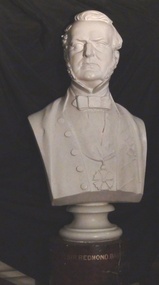
Plaster Portrait Bust, Justice Redmond Barry, 1884
... Redmond Barry is an important figure in colonial Victorian history, responsible for the establishment of key cultural institutions as well as a Supreme Court Judge for nearly 30 years, presiding over both the Eureka trials and the trial of Ned Kelly....Redmond Barry is an important figure in colonial Victorian history, responsible for the establishment of key cultural institutions as well as a Supreme Court Judge for nearly 30 years, presiding over both the Eureka trials and the trial of Ned Kelly. ...The library committee had already commissioned a portrait of Sir Redmond Barry when they purchased this bust of Barry along with that of Justice Fellows. The library still holds the receipt for this purchase of 24 pounds. The purchases were probably part of the program of outfitting the library interiors and may have been purchased for the niches, that were later covered with the portraits, ironically one of these was of Barry. Redmond Barry is an important figure in colonial Victorian history, responsible for the establishment of key cultural institutions as well as a Supreme Court Judge for nearly 30 years, presiding over both the Eureka trials and the trial of Ned Kelly.The bust of Redmond Barry is of some interest as part of the original furnishings of the library. It represents one of a number of bust portraits of Barry and is of some significance as it portrays Barry, an important figure in Victorian history. The bust is also of interest as a work of James Scurry, most well known for his architectural sculpture.Plaster bust of Justice Redmond Barry. The bust itself is painted white. The pedestal has been painted for a red and black marble effect. Barry's name appears in gold lettering. The Bust is larger than life size. The head is finely detailed with Barry in contemporary clothing with a bow tie and his orders on his chest.Sir Redmond Barry -
 The Beechworth Burke Museum
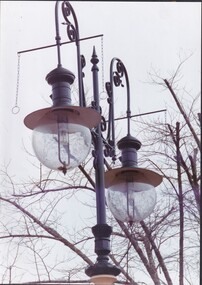
Photograph, Kathy Adamo, "Lit by a Bygone Era", 1980s
... The Court House has held a number of trials over the years including many high-profile cases such as the Ned Kelly Trials....The Court House has held a number of trials over the years including many high-profile cases such as the Ned Kelly Trials. ned kelly 1956 Beechworth beechworth court house indigo shire indigo shire photo competition kathy adamo 1980s gas lamps lit by a bygone era Reverse: TO Indigo Shire Council Photo Comp / Title 'Lit By A Bygone Era' / 05. ...The photograph was submitted to the Indigo Shire Photo Competition by Kathy Adamo in the 1980s. The photo depicts two old gas lamps outside the Court House in Beechworth. The Court House was built in 1856 after Beechworth became known as the legal headquarters in northeast Victoria. The Court House has held a number of trials over the years including many high-profile cases such as the Ned Kelly Trials.Black and white rectangular photo printed on paper mounted on black card.Reverse: TO Indigo Shire Council Photo Comp / Title 'Lit By A Bygone Era' / 05. BMM 8832 / Gas Lamps Outside Courthouse Beechworth / From / Kathy Adamo / RMB 4057 / Wangaratta / 21 6742 / Contents / Nikon F301 28-105 / Exposure Unknown / Most Historicalned kelly, 1956, beechworth, beechworth court house, indigo shire, indigo shire photo competition, kathy adamo, 1980s, gas lamps, lit by a bygone era -
 Eltham District Historical Society Inc
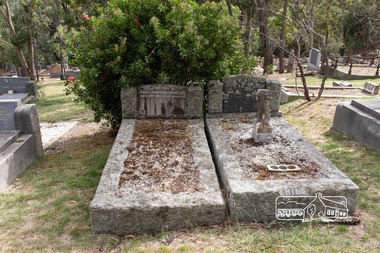
Photograph, Peter Pidgeon, Graves of Mary Josephine Swallow, John Swallow (unmarked) and Patricia Catherine Hill, Eltham Cemetery, Victoria, 5 April 2021
... trial in October of the same year. When it came time for John to face the courts, the Judge called a mistrial, the Crown would not prosecute on the grounds of insanity. John was led away from the dock of The Magistrates Court and taken directly to Willsmere, the Kew Mental Asylum. On the 9th of August 1962, John Mervyn Swallow died of heart failure, he was 57. He had been a resident of Kew for four years...trial in October of the same year. When it came time for John to face the courts, the Judge called a mistrial, the Crown would not prosecute on the grounds of insanity. John was led away from the dock of The Magistrates Court and taken directly to Willsmere, the Kew Mental Asylum. On the 9th of August 1962, John Mervyn Swallow died of heart failure, he was 57. He had been a resident of Kew for four years ...On the 29th of May 1954, a local Eltham carpenter by the name of John Swallow, committed a double murder at his home on New Street. This happened on the same day as the federal election of that year. John 48, his wife Mary 47, and stepdaughter Patricia 25, all went to the Eltham Courthouse on Main Road to cast their vote in the election that Saturday. After voting they returned home to their New Street house around midday. Patricia would later recall to ambulance officers, that she was feeling unwell, and so went to lay down when she heard an argument erupt over voting between her mother Mary and stepfather John. A concerned neighbour heard loud thudding noises and yelling coming from John and Mary’s house, he went to investigate. When he arrived at the house he was met by John at the front door. He would later describe John as “having a frantic look upon his face, and manic eyes”. John must have been a sight, bleeding and clutching a cut throat razor by his side. He then announced to the neighbour, “they voted commie!” before turning and going back inside. The distressed neighbour immediately raced home to call the Police. When the police arrived, they found Mary dead on the kitchen floor from catastrophic head injuries; her daughter, Patricia, clinging to life, slumped on her bed. Both women had been attacked by the same weapon, a large hammer, or sledge hammer as reported by the newspapers. John was also discovered in the house, bleeding from self-inflicted wounds from the razor, and had attempted to ingest caustic soda. Patricia was taken to St Vincent’s hospital, but died the following day, the 30th of May. John was also taken to St Vincent’s, where he remained under constant police guard for several months while he recovered from his injuries, at least the physical. He was eventually well enough to be taken to the City Watch House and then Pentridge Prison before his trial in October of the same year. When it came time for John to face the courts, the Judge called a mistrial, the Crown would not prosecute on the grounds of insanity. John was led away from the dock of The Magistrates Court and taken directly to Willsmere, the Kew Mental Asylum. On the 9th of August 1962, John Mervyn Swallow died of heart failure, he was 57. He had been a resident of Kew for four years. John’s body was returned to Eltham Cemetery and buried in the same grave as Mary. There is no mention of his name on the head stone. Patricia’s grave is next to Mary and John. A sad irony has an angel upon her grave, “its head missing”, possibly vandals or just an accident of time and events. What became of the home where all of this took place on New Street shall remain a mystery but within six months of this horrific event, the street had been re-named to Lavender Park Road after the original property near the end of the road, Lavender Park. In Memory Of Mary Josephine Swallow Died 29th May 1954 aged 47 Also Patricia Cathryn Hill Dearly beloved wife of Kel Called home 30th May 1954 Aged 25 yearsBorn Digitaleltham cemetery, gravestones, mary josephine swallow, patricia catherine hill, john swallow -
 Queenscliffe Maritime Museum
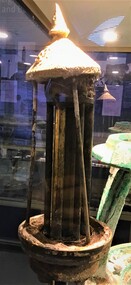
Equipment - Sun valve
... The light operated for 111 years until 1985 when it was turned off for a trial period. It was never turned back on. ...The light operated for 111 years until 1985 when it was turned off for a trial period. It was never turned back on. ...The light was powered by a kerosene lantern that had to be kept alight by the keepers until the introduction of bottled acetylene gas in 1925. The light operated for 111 years until 1985 when it was turned off for a trial period. It was never turned back on. A sun valve is a flow control activated by sunlight heat which automatically shuts off gas during daylight hours. Relic from the Hovell light run on acetylene from 1925 to 1985Sun valve from the Hovell Pile Lighthovell pile light, south channel, port phillip -
 Eltham District Historical Society Inc
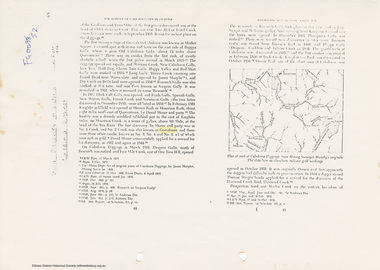
Folder, Mr Grimshaw, Miner, Kinglake and Caledonian Diggings
... years in prison. Newspaper reports of the day show his name as Josiah. Whether he was also known as John is not clear, and whether he is the same as J.L. (Jack) Grimshaw who discovered gold at Kinglake, again is unclear without undertaking further research into the matter. This murder trial...years in prison. Newspaper reports of the day show his name as Josiah. Whether he was also known as John is not clear, and whether he is the same as J.L. (Jack) Grimshaw who discovered gold at Kinglake, again is unclear without undertaking further research into the matter. This murder trial ...We have three folders catalogued for the Grimshaw name and these will in due course be consolidated/corrected: 1. EDHS_01361 – A.H. Grimshaw of Research, Vic., 1927 2. EDHS_01362 – John Grimshaw of Greensborough, 1862 (Correct name is Josiah Grimshaw) 3. EDHS_01375 – Mr Grimshaw, miner of Kinglake and Caledonian Diggings. (This is believed to be Mr J.L. (Jack) Grimshaw who reportedly discovered the first gold in Kinglake. These folders are made up of copies of pages of research undertaken by Mr Keith Chappel in the 1970s, which is now catalogued as a separate item. EDHS_04448 - Eltham District History, Eltham Road Board, 1856-1871; Research by Keith Chappel https://victoriancollections.net.au/items/5e4a290521ea671e9ccf9661 There is further information from this research concerning a William Grimshaw. Also included as part of EDHS_01375 is a photocopy of page44 from the book "Caledonia Diggings (St Andrews)", Gold Discovery in Victoria, James Flett, 1970, which references No. 2 Creek at the Caledonian Diggings as also been known as Grimshaws. We have a photo of J.L.(Jack) Grimshaw who discovered gold at Kinglake, which is part of the Shire of Eltham Pioneers Photograph Collection (SEPP) SEPP_0056 - Mr. J.L. Grimshaw; the man who found the first gold at Kinglake https://victoriancollections.net.au/items/5a6c158721ea6906ac29bd3c We also have another record of interest involving Aaron Grimshaw, Farmer of Greensborough who was an indentured Trustee of the Wesleyan Chapel in Little Eltham in 1856: EDHS_04610-3-1 - Document, Conveyance of Lot 20 Henry Street, Little Eltham North to Trustees of Wesleyan Chapel, 1856 https://victoriancollections.net.au/items/60f6d644ac5d4de270b83615 The record of Joshia Grimshaw of Greensborough is grim. He was arrested and charged with the murder of John Mitchell at Greensborough, September 24, 1962. Grimshaw was ultimately convicted of manslaughter and sentenced for three years in prison. Newspaper reports of the day show his name as Josiah. Whether he was also known as John is not clear, and whether he is the same as J.L. (Jack) Grimshaw who discovered gold at Kinglake, again is unclear without undertaking further research into the matter. This murder trial was extensively reported in the newspapers and you can find those reports on the National Library of Australia’s Trove https://trove.nla.gov.au/ Some of the reports of interest: TRIAL OF GRIMSHAW FOR MURDER (1862, October 23). The Kyneton Observer (Vic. : 1856 - 1900), p. 3. Retrieved April 21, 2023, from http://nla.gov.au/nla.news-article240899299 THE GREENSBOROUGH MURDER. (1862, September 30). The Argus (Melbourne, Vic. : 1848 - 1957), p. 6. Retrieved April 21, 2023, from http://nla.gov.au/nla.news-article5722929 MELBOURNE CRIMINAL SESSIONS. (1862, October 18). The Age (Melbourne, Vic. : 1854 - 1954), p. 6. Retrieved April 21, 2023, from http://nla.gov.au/nla.news-article154967162 CRIMINAL SESSIONS. I (1862, October 18). The Argus (Melbourne, Vic. : 1848 - 1957), p. 6. Retrieved April 21, 2023, from http://nla.gov.au/nla.news-article6480408 Folder of information on Mr Grimshaw, Miner, Kinglake and Caledonian Diggingsgrimshaw -
 Bendigo Historical Society Inc.
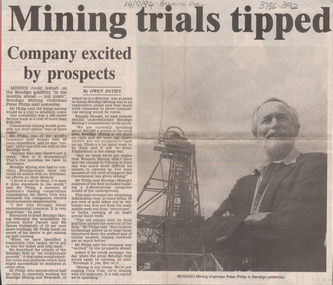
Newspaper - Kangaroo Flat Gold Mine Collection: Bendigo Mining
... trials tipped'. Peter Phillips, Bendigo Mining chairman, states that mining 'could restart on the Bendigo goldfield in the months ahead - not years'. ...trials tipped'. Peter Phillips, Bendigo Mining chairman, states that mining 'could restart on the Bendigo goldfield in the months ahead - not years'. ...'Bendigo Advertiser' article, 14th. September, 1994, titled 'Mining trials tipped'. Peter Phillips, Bendigo Mining chairman, states that mining 'could restart on the Bendigo goldfield in the months ahead - not years'. Mr. Phillips was recruited to head Bendigo Mining following the acquisition by tycoons Kerry Packer and Sir James Goldsmith of 10 per cent share holdings'.gold mining, bendigo, 1994, peter phillips, bendigo mining, kerry packer, sir james goldsmith, mining revival -
 Bendigo Historical Society Inc.
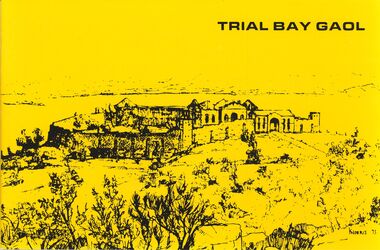
Book - STRAUCH COLLECTION: TRIAL BAY GAOL
... Trial Bay opened in 1886 after 13 years construction. It was designed for prisoners who were low risk and nearing the end of their sentences. ...Trial Bay opened in 1886 after 13 years construction. It was designed for prisoners who were low risk and nearing the end of their sentences. ...Trial Bay opened in 1886 after 13 years construction. It was designed for prisoners who were low risk and nearing the end of their sentences. From here they would participate in Public Works projects. It was named Trial Bay after the brig "Trial" sank there. This ship had been commandeered by convicts in Port Jackson and forced to sail north. Between 1915 and 1918 the prison became a detention centre for German citizens.Trial Bay Gaol, Public Works Prison and Wartime Detention Camp, a Macleay River Historical Society publication Kempsey, New South Wales, small booklet with black and white photographs.Marie h Neilhistory, australian, prisons, australia-history-nsw-prisons -
 Victoria Police Museum
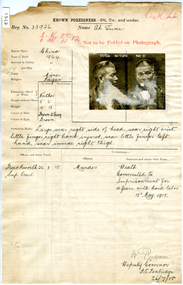
Prison record (Ah Tune), 26 July 1918
... Death sentence was commuted to 10 years imprisonment ah tune foreign prisoner beechworth murder william brasslin Prison record for Ah Tune, prisoner registered number 33926, giving details of the prisoner, his crimes and the dates and places of his trials. ...Ah Tune, kicked William Brasslin to death in a drunken brawl following an altercation, Beechworth, November 1914. Death sentence was commuted to 10 years imprisonmentPrison record for Ah Tune, prisoner registered number 33926, giving details of the prisoner, his crimes and the dates and places of his trials.ah tune, foreign prisoner, beechworth, murder, william brasslin -
 Victoria Police Museum
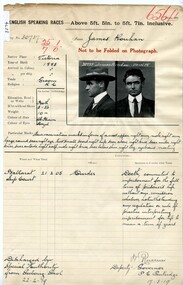
Prison record (James Rouhan), 17 March 1919
... years of age, was accused of murdering his sweetheart, Kate Beachley, with an axe, in Lydiard St., Ballarat in October 1904. Sentenced to death, commuted to life imprisonment james rouhan english speaking prisoner murder kate beachley Prison record for James Rouhan, prisoner registered number 30737, giving details of the prisoner, his crimes and the dates and places of his trials. ...James Rouhan, 19 years of age, was accused of murdering his sweetheart, Kate Beachley, with an axe, in Lydiard St., Ballarat in October 1904. Sentenced to death, commuted to life imprisonmentPrison record for James Rouhan, prisoner registered number 30737, giving details of the prisoner, his crimes and the dates and places of his trials.james rouhan, english speaking prisoner, murder, kate beachley -
 Victoria Police Museum
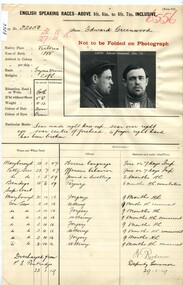
Prison record (Edward Greenwood), 25 January 1919
... His criminal career began in 1907 at the age of 22 years of age. edward greenwood english speaking prisoner obscene language offensive behaviour perjury forgery uttering Prison record for Edward Greenwood, prisoner registered number 32050, giving details of the prisoner, his crimes and the dates and places of his trials. ...In June 1915 was charged with stealing and unlawfully on premises. He was deemed an habitual criminal with prior offenses including obscene language, offensive behaviour, theft of money, larceny of eight bottles of beer. In September 1916 he was charged with forgery and uttering. His criminal career began in 1907 at the age of 22 years of age.Prison record for Edward Greenwood, prisoner registered number 32050, giving details of the prisoner, his crimes and the dates and places of his trials.edward greenwood, english speaking prisoner, obscene language, offensive behaviour, perjury, forgery, uttering -
 Victoria Police Museum
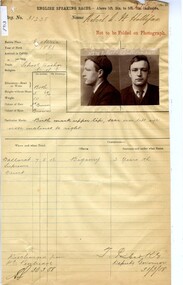
Prison record (Robert Halifax), 31 March 1908
... years old, was charged with bigamy. In December 1905 he married Myrtle Skinner, 17, in Coleraine. He had married Faithful Halifax, nee Trotter, in March 1900. english speaking prisoner robert a. h. halifax bigamy Prison record for Robert Halifax, prisoner registered number 31238, giving details of the prisoner, his crimes and the dates and places of his trials. ...Robert Halifax, a young teacher, 25 years old, was charged with bigamy. In December 1905 he married Myrtle Skinner, 17, in Coleraine. He had married Faithful Halifax, nee Trotter, in March 1900.Prison record for Robert Halifax, prisoner registered number 31238, giving details of the prisoner, his crimes and the dates and places of his trials.english speaking prisoner, robert a. h. halifax, bigamy -
 Victoria Police Museum
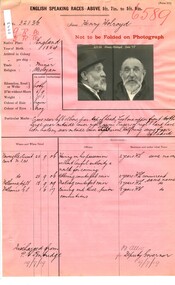
Prison record (Henry Holroyd), 19 July 1919
... Henry Holroyd was charged many times over many years with counterfeiting and coining and with having in his possession moulds for making coins. english speaking prisoner henry holroyd counterfeiting Prison record forHenry Holroyd, prisoner registered number 32136, giving details of the prisoner, his crimes and the dates and places of his trials. ...Henry Holroyd was charged many times over many years with counterfeiting and coining and with having in his possession moulds for making coins. Prison record forHenry Holroyd, prisoner registered number 32136, giving details of the prisoner, his crimes and the dates and places of his trials.english speaking prisoner, henry holroyd, counterfeiting -
 Victoria Police Museum
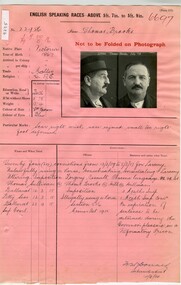
Prison record (Thomas Brooks), 14 June 1920
... years). Most of his crimes were committed whilst under the influence of drink. english speaking prisoner thomas brooks horse stealing imposition housebreaking Prison record for Thomas Brooks, prisoner registered number 22986, giving details of the prisoner, his crimes and the dates and places of his trials. ...Thomas Brooks's had a long criminal career beginning in 1889 under various aliases. His crimes included forgery, imposition, horse stealing, and housebreaking (for which he received a sentence of 10 years). Most of his crimes were committed whilst under the influence of drink.Prison record for Thomas Brooks, prisoner registered number 22986, giving details of the prisoner, his crimes and the dates and places of his trials.english speaking prisoner, thomas brooks, horse stealing, imposition, housebreaking -
 Victoria Police Museum
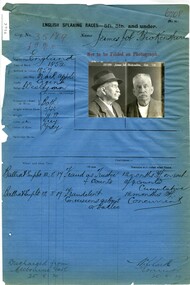
Prison record (James Brokenshire), 25 August 1920
... William Coltman received a non-custodial sentence but James Brokenshire was sentenced to four years. english speaking prisoner james job brokenshire fraud Prison record for James Job Brokenshire, prisoner registered number 35189, giving details of the prisoner, his crimes and the dates and places of his trials. ...Following an investigation into the insolvency of the firm Brokenshire and Coltman, estate agents and auctioneers, both partners were charged with fraud. William Coltman received a non-custodial sentence but James Brokenshire was sentenced to four years.Prison record for James Job Brokenshire, prisoner registered number 35189, giving details of the prisoner, his crimes and the dates and places of his trials.english speaking prisoner, james job brokenshire, fraud -
 Bendigo Historical Society Inc.
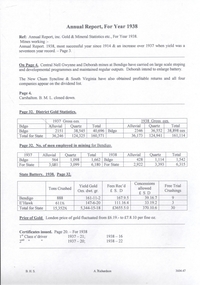
Document - MINING REPORTS - ANNUAL REPORT INC GOLD & MINERAL STATISTICS ETC 1938
... trial crushings at the State Battery for Bendigo and Eaglehawk. The London price of gold per ounce is mentioned and also the number of 1st class and 2nd class e' driver Certificate issued for the years 1937 and 1938....trial crushings at the State Battery for Bendigo and Eaglehawk. The London price of gold per ounce is mentioned and also the number of 1st class and 2nd class e' driver Certificate issued for the years 1937 and 1938. ...handwritten notes from the Annual Report. Mines mentioned ae: Central Nell Gwynne, Deborah, New Chum Syncline and the South Virginia. Carshalton B. M. L. closed down. Also mentioned are District Gold Statistics for alluvial and quartz mining, No. of men employed in mining in Bendigo. Also mentioned are tons crushed, gold yield, fees rec'd, concessions allowed and free trial crushings at the State Battery for Bendigo and Eaglehawk. The London price of gold per ounce is mentioned and also the number of 1st class and 2nd class e' driver Certificate issued for the years 1937 and 1938.Albert Richardsondocument, gold, mining reports, annual repport inc gold & mineral statistics etc 1938, central nell gwynne, deborah, new chum yncline, south virginia, carshalton b m l, state battery -
 Bendigo Historical Society Inc.
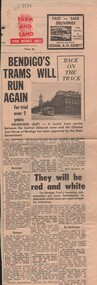
Document - BASIL MILLER COLLECTION: TRAMS - RETURNING, c1974
... Bendigo Trams Will Run Again, for trial over 2 years....Bendigo Trams Will Run Again, for trial over 2 years. Document BASIL MILLER COLLECTION: TRAMS - RETURNING ...News paper clipping. Bendigo Advertiser, 13 September 1974. Bendigo Trams Will Run Again, for trial over 2 years.person, individual, basil miller -
St Vincent's Hospital Melbourne Archives
Album - Recollections of a Trainee Nurse at St Vincent's Hospital 1940-1943 by Eileen Doris Vaughan nee Cattanach -including cartoons by Minon Phillips
... Eileen speaks of the close-knit camaraderie, of sharing each other's trials and tribulations through three war torn years and beyond. She describes her nursing vocation as "the satisfaction of giving help to those in need"....Eileen speaks of the close-knit camaraderie, of sharing each other's trials and tribulations through three war torn years and beyond. She describes her nursing vocation as "the satisfaction of giving help to those in need". ...Handwritten at age ninety- eight, Eileen nee Cattanach compiled two folders of nursing memories, including stories, accompanying photographs, cartoons and anecdotes of earlier training days at St Vincent's Hospital Melbourne. Eileen speaks of the close-knit camaraderie, of sharing each other's trials and tribulations through three war torn years and beyond. She describes her nursing vocation as "the satisfaction of giving help to those in need".Photographs have names and inscriptions, anecdotes written sideways on margins.eileen vaughan nee cattanach, minon phillips, st vincent's hospital melbourne, nurse training, the second world war, fairfield hospital melbourne -
 Coal Creek Community Park & Museum
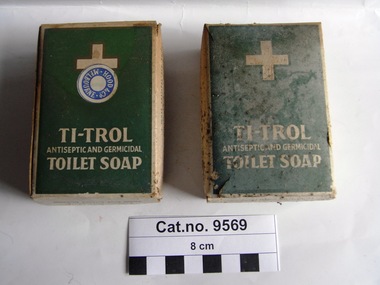
Soap, TI-TROL ANTISEPTIC AND GERMICIDAL TOILET SOAP, c. 1928-1968
... It has taken years of patient research, of test, trial and experiment to reach the pinnacle of perfection which Ti-Trol Soap is now offering to the public. ...It has taken years of patient research, of test, trial and experiment to reach the pinnacle of perfection which Ti-Trol Soap is now offering to the public. ...TROVE : Evening News (Sydney, NSW : 1869 - 1931), Thursday 11 October 1928, page 13. NEW COMPANIES The following new companies were registered this afternoon :- Australian Essential Oils Ltd : Nominal capital. £50,000, in 93.000 ordinary and 7,000 deferred shares at 10/-. to engage in business of distillers, manufacturers of, and dealers in oils from vegetables and other sub-stances, chemists etc. First directors: N. H.B.Keynor, R.K.Allport, E.M Humphries, and H. James. Head office Sydney. TROVE : Government Gazette of the State of New South Wales (Sydney, NSW : 1901 - 2001), Friday 26 July 1968 (No.89), page 3028 IN the matter of the Companies Act, 1961-1966, and in the matter of AUSTRALIAN ESSENTIAL OILS LTD (Receiver and Manager Appointed).—Roy Leslie Pegler, Receiver and Manager of Australian Essential Oils Ltd (Receiver and Manager Appointed)„ appointed by debenture holders on the 11 th July, 1966, hereby gives notice that any debenture holders and others having any claim against or to Australian Essential Oils Ltd (Receiver and Manager Appointed) are required to send particulars of their debenture or claim to the Receiver, Roy Leslie Pegler, at c.o. Messrs Pegler, Ellis & Co., Chartered Accountants, 235-7 Elizabeth Street, Sydney, N.S.W., on or before the 27th September, 1968, at the expiration of which time the Receiver and Manager will distribute the assets of the said Company to the persons and/or companies entitled, having regard only to the claims of which he then has notice.—Dated 24th July, 1968. PEGLER, ELLIS & CO., Chartered Accountants, 235-7 Elizabeth Street, Sydney, N.S.W. 8744—$5 White cardboard box printed in dark green with a round blue and white sticker on one side, containing a cream paper leaflet printed in dark green, wrapped around a greaseproof paper wrapped rectangular cake of translucent brown soap with impressed text on one side.Impressed on one side of the cake of soap ' A PRODUCT OF AUSTRALIAN ESSENTIAL OILS LTD SYDNEY'. On reverse of soap impressed 'TI-TROL ANTISEPTIC TOU\ILET SOAP'. Printed on the box 'TI-TROL ANTISEPTIC AND GERMICIDAL TOILET SOAP. Printed Leaflet wrapped around cake of soap 'Germicide TI-TROL Antiseptic, Toilet Soap ELEVEN TIMES MORE POWERFUL THAN CARBOLIC. NON IRRITANT ………NON POISONOUS. “Ti –Trol” GERMICIDAL ANTISEPTIC SOAP is the most modern of all toilet soap …..Distilled and manufactured by Australian Essential Oils Ltd., the pioneers of Tea-Tree Oil Industry in Australia, and manufacturers of that famous antiseptic solution Melasol. It has taken years of patient research, of test, trial and experiment to reach the pinnacle of perfection which Ti-Trol Soap is now offering to the public. Ti-Trol is a hand-made glycerine base soap in which only the finest ingredients are used. One of its most attractive features is that it contains a full three per cent. of “Ti-trol”. In medical and clinical practice, both in Australia and abroad, Ti Trol has given remarkable results…particularly in its cleansing properties: its soothing HEALING action on dirty and inflamed septic wounds. By incorporating Ti-Trol in a glycerine base soap, experts are agreed that the result….. Ti-Trol soap is unequalled-anywhere- for its soft soothing healing and germicidal properties. Ti-Trol soap is non-irritant and non-poisonous and can be used on the tenderest skins…babies’ or the most delicate peach-bloom complexions, with most excellent results. . PRODUCT OF A SOAP MAKER OF INTERNATIONAL EXPERIENCE Australian Essential Oils Ltd., have been fortunate in procuring the services of a soap-maker of International experience and world-wide knowledge of Soap Production, whose genius has produced Ti-Trol, and whose uncanny sense of blending has made Ti-Trol the most famous of all Germicidal Toilet Soaps. Ti-Trol is non-irritant and non-poisonous and has been proved by medical and specialised authorities top\ possess great healing and cleansing properties. It is a powerful Germicide and antiseptic….ELEVEN TIMES QUICKER THAN PURE CARBOLIC. . DANDRUFF CAN’T LIVE WITH Ti-Trol. Dandruff ......that horrible “give away” which many men and women suffer from…..can easily be dispelled by using Ti-Trol Soap this way : Rub a little Olive Oil into the scalp before retiring at night, and the following morning wash your head thoroughly with Ti-Trol Soap, allowing the lather to remain on the scalp for about a minute and a half. Then rinse the hair thoroughly in warm water. .WASH BRUSHES AND COMBS WITH Ti-Trol SOAP When you’ve done this and dried your hair, wash all your brushes and combs in a strong, soapy solution made with Ti-Trol Soap, and then carefully sponge the inside of the hat bands with a flannel or cloth moistened with this soapy solution. Follow these directions and you’ll never need to fear dandruff. .Ti-Trol…WONDERFUL HEALER OF CUTS. SORES, WOUNDS, ETC. There never was a more patent healer of CUTS, SORES, WOUNDS, ABRASIONS AND SEPTIC SORES than Ti-Trol… Here’s how to use it : Wash the affected parts with a fairly strong Ti-Trol soapy solution made with warm water, and then apply with lint soaked with Melasol, which is the miscible form of Ti-Trol (Melasol is obtainable at all chemists and stores everywhere). . Ti-Trol SOAP……..A DEODORANT, A BEAUTIFIER……a safeguard for tender skins Ti-Trol Soap, because of its delicate, pungent, aroma and antiseptic properties, is unequalled as a deodorant, and is never failing when used for this purpose. Ti-Trol Soap can be used on the tenderest skins, and even baby’s skin, with greatest safety. It’s delightful fragrance will give added pleasure to your toilet. . DO NOT WASTE Ti-Trol Soap is too valuable to waste. Therefore, use it carefully. Do not leave it in the water. To obtain greatest economy it is preferable to use a face cloth when using Ti-Trol Soap. For health, for the most economical means of insuring against disease, use Ti-Trol Ointment…..for cuts, bruises etc. Ti-Trol….for boils, cuts, sores, abrasions and septic conditions. MELASOL…..for Tinea, Mouth Wash and as a Dentifice. . All are products containing Ti-Trol, distilled and provided by Australian Essential Oils Ltd. 18 Loftus Street, Sydney. N.S.W.'. tea tree oil, soap, glycerine, antisptic, germicide
