

Historical information
c.1890-1905
Significance
This Wertheim sewing machine, donated by Sylvia Schultz, direct Ziebell descendent, is a rare early example manufactured in Frankfurt, Germany before the company established production in Melbourne.
Its construction during this earlier European phase highlights the global reach of domestic technology that later became central to Australian household life.
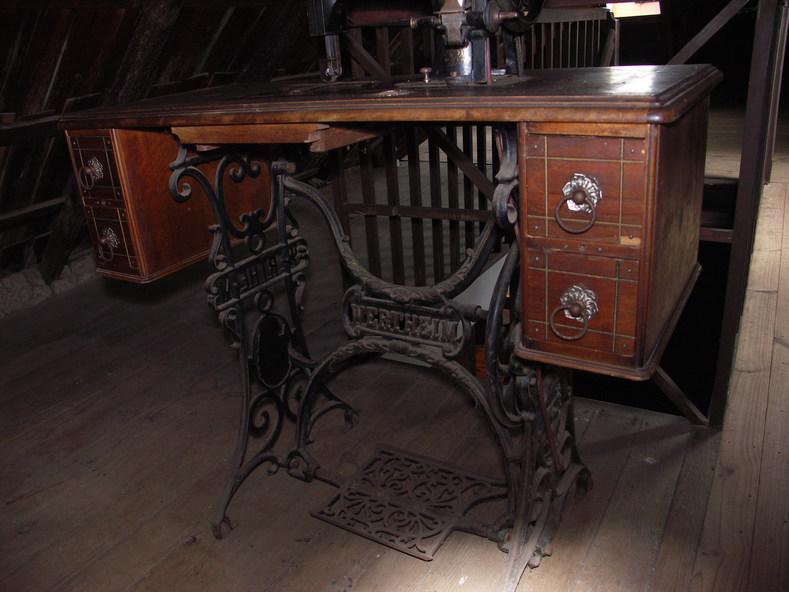
The machine features highly decorative cast-iron legs with ‘Wertheim’ prominently moulded into the frame, a brass plaque reading Wertheim Francfort with the firm’s pick-axe emblem, and a finely detailed sewing mechanism enclosed by a wooden cover. The treadle base, ornate ironwork, side storage compartments, and mobility wheels together illustrate the craftsmanship and functional elegance characteristic of 19th-century European sewing machines.
As part of the Ziebell collection, the machine reflects the domestic craft, self-sufficiency, and technological adaptation of German settler families.
It enriches the museum’s understanding of women’s work, household production, and the adoption of imported machinery in everyday life, offering insight into both global manufacturing histories and local cultural heritage.
Physical description
Hand sewing machine on stand with storage compartments. Ironwork frame, very decorative casting. Large wheel on right as part of sewing machine. Two wooden boxes on each side, with brass pull rings. Wooden box also for covering sewing machine. Decorative border around sewing mechanism. Frame is on wheels.
Inscriptions & markings
Wertheim' cast in iron in centre of frame, and on both sides. 'Wertheim Francfort' on brass plaque nailed onto sewing machine, along with Wertheim symbol of man with pick.
