

Historical information
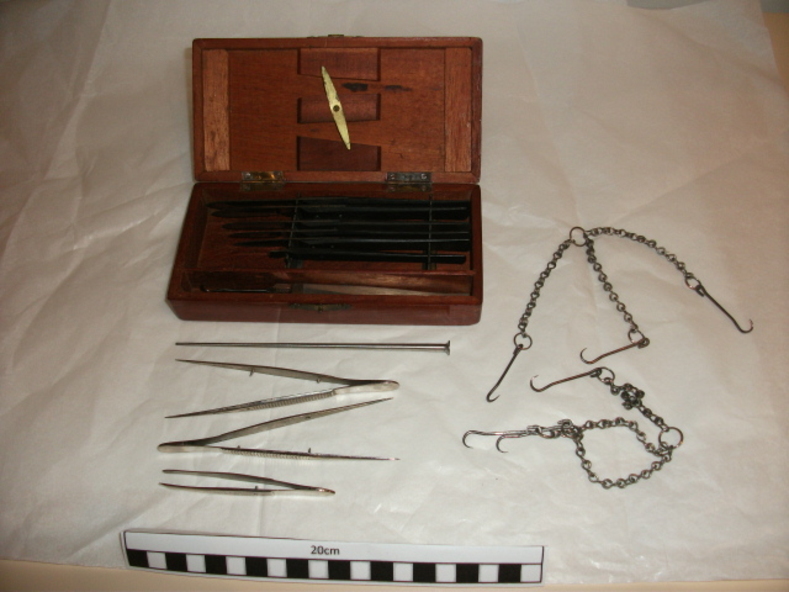
This surgical instrument kit, c1870s, originally belonged to Lord Joseph Lister. On his retirement in 1892, Lord Lister presented the instrument kit to his friend Dr Alexander Matthew. The donor of the surgical kit, Professor Ian Stewart Fraser, is the grandson of Dr Alexander Matthew.
The donor, Ian Fraser, checked with his mother about the inscription "Ethel Livie". There was no one of that name in his mother's family tree and the instruments were passed down from his mother's family. The inscription is faint and difficult to make out, and may also read 'Ethel Lavie' or 'Ethel Lane'.
Significance
This surgical kit, made by Young of Edinburgh Scotland in the 1870s is significant because it belonged to and was most likely used by an internationally important figure in modern medicine, Lord Joseph Lister.
Joseph Lister, 1st Baron Lister, Bt., OM, FRS, PC (5 April 1827 – 10 February 1912), known as Sir Joseph Lister, Bt., between 1883 and 1897, was a British surgeon and a pioneer of antiseptic surgery. By applying Louis Pasteur's advances in microbiology, he promoted the idea of sterile surgery while working at the Glasgow Royal Infirmary. Lister successfully introduced carbolic acid (now known as phenol) to sterilise surgical instruments and to clean wounds, which led to a reduction in post-operative infections and made surgery safer for patients.
Physical description
Surgical instruments in original timber case. Case contains two sharp steel hooks with the manufacturer's stamp,"YOUNG/EDIN" at the top of the handles, five steel scalpels with ebony handles in assorted sizes, and a sixth scalpel for which the blade has been snapped off and missing. The handle of the broken scalpel is faintly inscribed with what appears to be the words 'ETHEL LAVIE'. Also included separately are two sets of autopsy hooks (hooks on chains), one metal blowpipe [commonly used with urine testing apparatus] and three sets of dissector forceps. The case has a hinged lid which is fastened with a decorative brass clasp at the front of the case, and brass hinges which are engraved with the letters 'HS'.
Inscriptions & markings
"YOUNG EDINBURGH"; "ETHEL LAVIE"
