Historical information
As Buddhism spread to Tibet in the 7th century, prayer wheels became an essential attribute of Tibetan Buddhist practice. This practice is linked to teachings attributed to Nagarjuna (ca. 150 –250 CE), who emphasised the power of mantra recitation and visualisation. A prayer wheel, used for personal worship, allowed to release the spiritual power contained within the mantras, enabling practitioners, including those who could not read, to generate spiritual merit.
Significance
Prayer wheels are used by Tibetan practitioners every day, sometimes hours at a time. They believe that turning the wheel with a pure, compassionate intention releases the mantras into the universe, which purifies negative karma, accumulates merit, and radiates compassion to all living beings.
Physical description
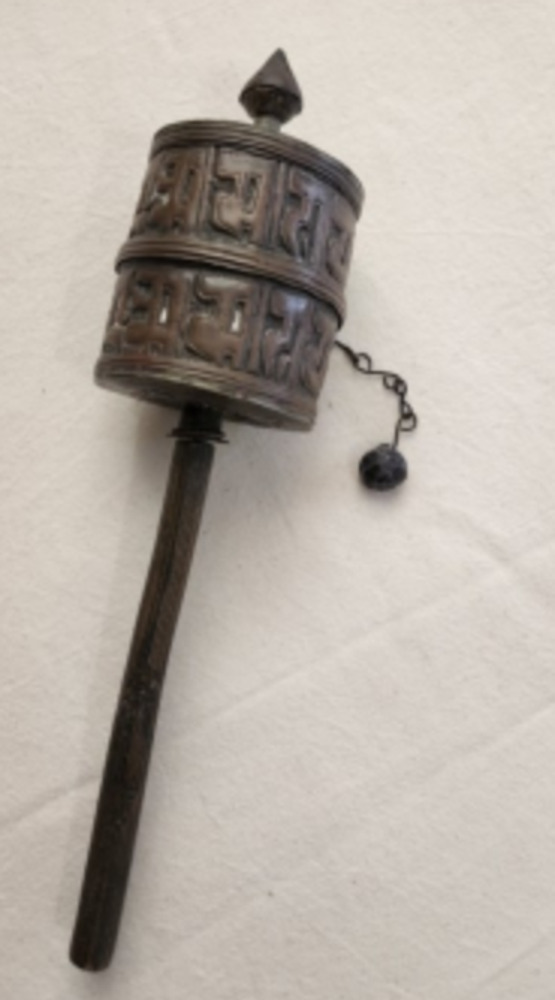
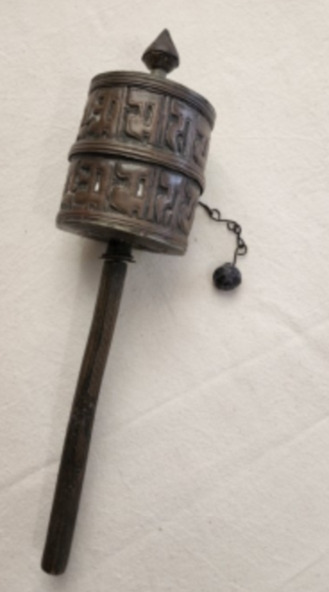
This prayer wheel consists of a hollow metal cylinder attached to a wooden handle. Inside the cylinder is a tightly wound scroll printed with numerous mantras and wrapped around a central spindle. A chain with a small weight attached to its end is affixed to the cylinder, allowing it to be spun with a slight rotation of the wrist.
Inscriptions & markings
"Om Mani Padme Hum" in Tibetan script