Historical information
As Buddhism spread to Tibet in the 7th century, prayer wheels became an essential attribute of Tibetan Buddhist practice. This practice is linked to teachings attributed to Nagarjuna (ca. 150 –250 CE), who emphasised the power of mantra recitation and visualisation. A prayer wheel, used for personal worship, allowed to release the spiritual power contained within the mantras, enabling practitioners, including those who could not read, to generate spiritual merit.
Significance
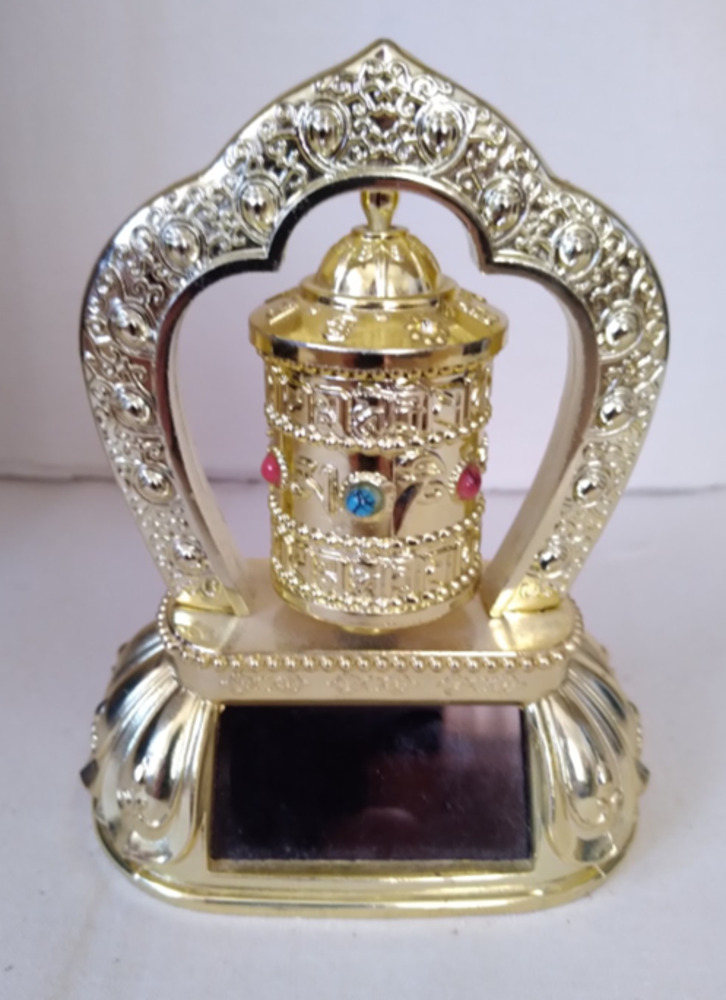
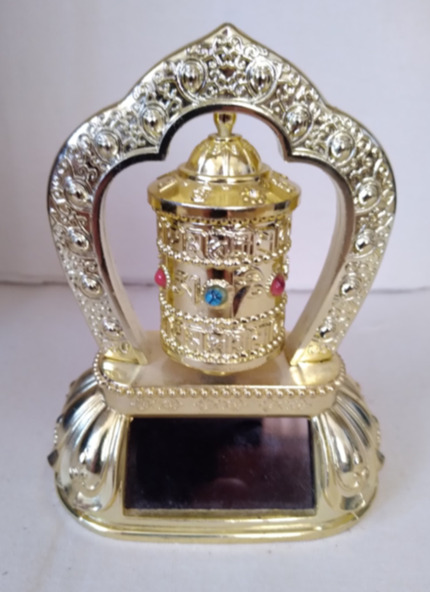
Prayer wheels have been used in Tibetan Buddhism for personal worship since the 7th century. Turning the wheel with a pure, compassionate intention is believed to release the mantras into the universe, resulting in purification of negative karma of the practitioner, accumulation of merit, and spreading compassion to all living beings. This solar-powered prayer wheel is based on the traditional Tibetan prayer wheel design. However, it uses solar power to rotate the wheel containing mantras, disseminating the blessings to all. Often placed by Buddhist practitioners on a windowsill or car dashboard.
Physical description
This modern adaptation of the traditional Tibetan Buddhist prayer wheel has a mantra-filled drum which rotates automatically using solar power when exposed to light. The ornate gold-coloured frame and prayer wheel in the centre (embellished with small faux gemstones) reflect the aesthetic traditions associated with Tibetan Buddhist sacred objects. The solar panel is concealed in the base.