

Historical information
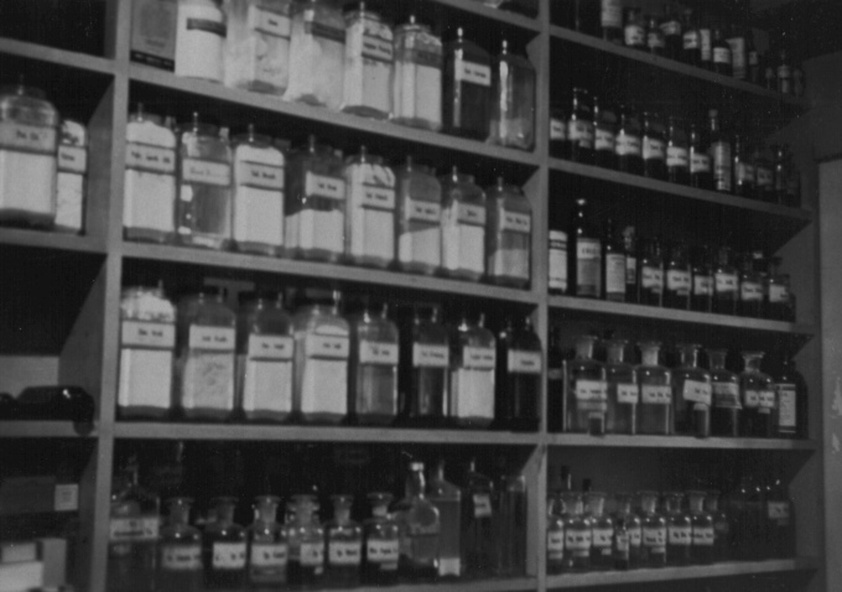
A close-up view of the shelves in the pharmacy of C.P. Wood. It shows jars of substances used to make up medications. The pharmacy of C.P. Wood was at 950 Station Street, Box Hill.
In the early days of pharmacy, most medicines were compounded from liquid and solid ingredients, often from plants, which were made up into tinctures, infusions or syrups, and were collectively called "Galenicals" (named after Galen). Proprietary preparations were viewed with some suspicion. Up until the 1950's pharmacists manufactured and often prescribed many of these preparations for minor ailments. The powders and liquids shown in the photo would have been used to compound medicines in a mortar and pestle, which were often tonics, stomach mixtures and powders. By 1950, hand-made pills were rarely prescribed with the advent of machine manufactured tablets and capsules. Syrup of glucose, liquorice root and gum acacia or tragacanth were often used as binding agents to make the pill mass to which the drug required would be added. The ingredients would be worked into a malleable consistency, which was rolled into a thin pipe. This would be placed on the pill machine and the cutter would produce pill size pieces which were rolled into roughly spherical shapes and coated with starch, french chalk liquorice powder or varnish. In the early days some pills were coated in silver or gold leaf. A gross of pills would take a great deal of time to make and the job would often be given to the apprentice to make under supervision, to keep the wages cost lower.
Physical description
B&w photo
