Historical information
Chinese participation in the Bendigo Easter Fair is a rare surviving cultural practice of Chinese involvement in similar events, which also took place in Melbourne, Beechworth, Ararat, Ballarat and other gold mining towns in the nineteenth century.
According to Chinese tradition the dragon is a mythical creature with the attributes of a number of animals. The dragon has associated regalia in the form of a pearl (or teaser) and a flame. In procession, dancers carrying Loong's pearl and flame preceded the dragon. The pearl was intended to entice the dragon to join the procession and encourage him to play while the flame symbolised the power of the dragon. The pearl and flame were imported from China, possibly in the nineteenth century.
The Easter Fair has since 1871 raised money for the Bendigo Benevolent Home and Asylum and the Bendigo Hospital. The Chinese took part in the annual Easter Fair celebrations from 1879, providing traditionally dressed actors and dancers for the procession in the streets of Bendigo. From 1892, a dragon provided a focus for the Chinese contribution to the festivities and was extremely popular with the whole community. Two large dragons and one small dragon participated in the Federation celebrations held in Melbourne in May 1901. It appears that one of the large dragons was Loong and the other large dragon may be the one now held at the See Yup temple in South Melbourne.
There is slight doubt as to the date the present Loong was made and imported from China as there were a number of dragons in use in Bendigo and Melbourne at the time, and there are contemporary newspaper reports from Bendigo and Melbourne of dragons and regalia being imported in 1892, 1901 and 1906. Ceremonial dragons are fragile items made of organic materials and some of the dragons described in contemporary sources no longer exist. However the State Library of Victoria holds a photograph of a dragon in front of Parliament House at the Federation celebrations. This photo is securely dated to May 1901 and was definitely taken during the Federation celebration. The details of the dragon's decoration and regalia are almost identical to the existing Loong. The only minor differences seem to be loss of ornament on the chin and sides of the face which are likely the result of later restorations. Therefore Loong almost definitely dates from 1901 at least and may be earlier.
Whether Loong dates from 1892 or 1901 does not diminish his significance as a rare surviving artefact relating to the Chinese in Victoria.(source Victorian Heritage Listing)
Physical description
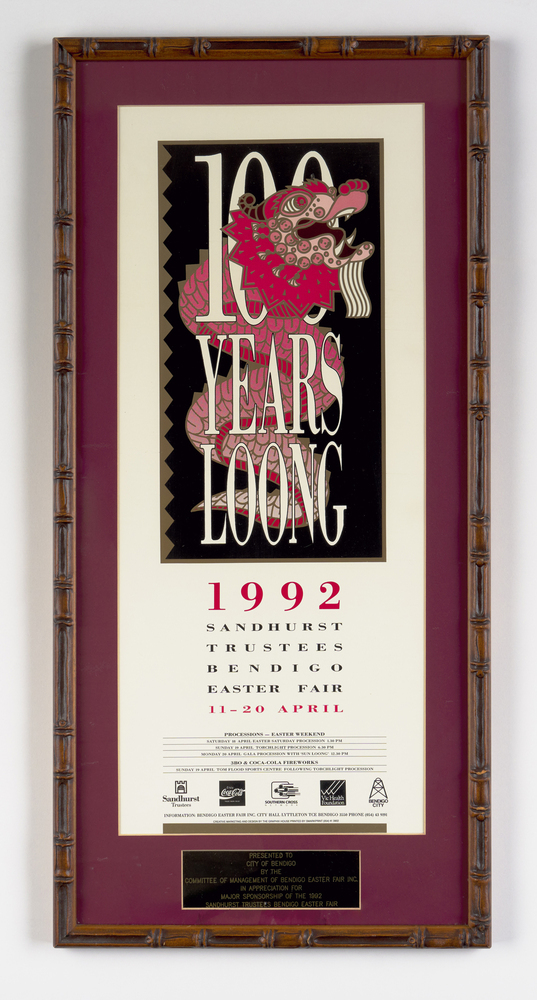
Commercially printed poster mounted on foam core and framed. Engraved plaque lower centre. Poster includes an image of Loong, believed to be the oldest complete imperial dragon in the world. This poster plays on a pun of Loong being 100 years old. Bamboo look molded frame.
Inscriptions & markings
Engraved plaque centre lower edge of glass: Presented to / City of Bendigo / By the / Committee of Management of Bendigo Easter Fair Inc / In appreciation for / Mayor sponsorship of the 1992 / Sandhurst Trustees Bendigo Easter Fair
References
- Loong, Chinese Dragon Heritage register listing