Historical information
Assisi embroidery originated in Assisi, Umbria region in Italy, during the Renaissance. The techniques involved in Assisi embroiderywere practiced for many centuries; however, the modern form of Assisi embroidery as it is recognized today took its shape and form in Assisi in the 18th century.
Early examples of Assisi embroidery often feature religious themes, pointing to its ecclesiastical beginnings. Convent nuns stitched church altar cloths, chasubles, vestments, and other religious items and materials with Assisi embroidery motifs. St. Clare of Assisi, an Italian nun who started the order of St. Clare, later became the patron saint of embroiderers. She was known for stitching altar cloths for churches in Assisi.
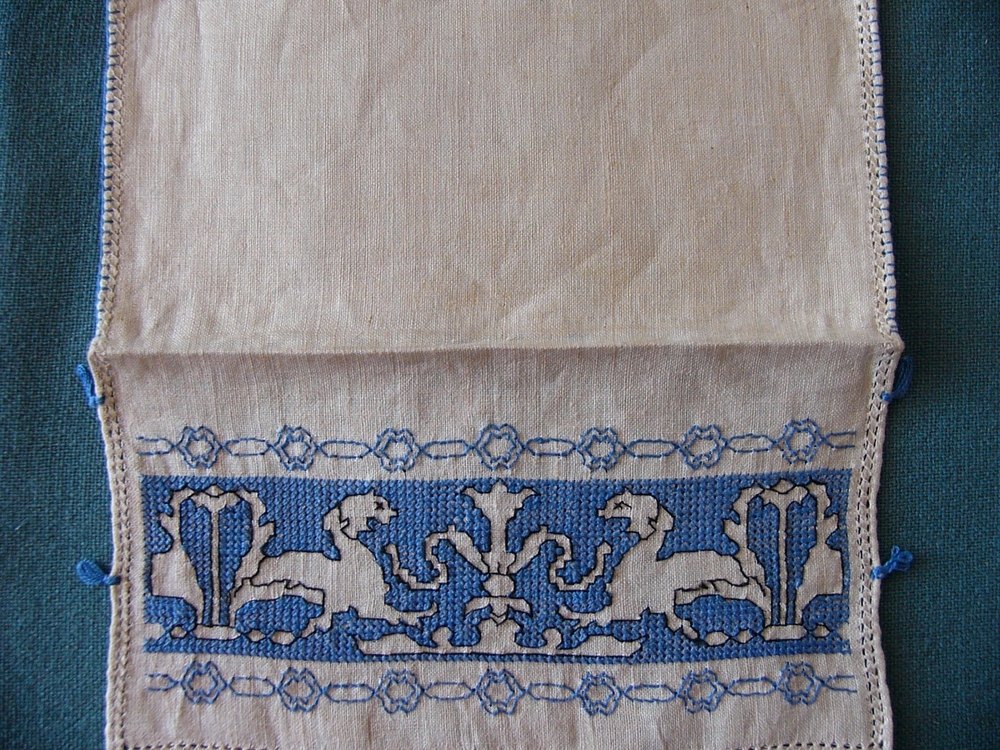
Assisi embroidery went through several evolutionary stages, reflected in its changing motifs. In the 13th and 14th centuries, motifs included stylized birds and animals, scrollwork, and geometric designs. In the 15th and 16th centuries, Assisi work reflected Biblical and Renaissance-inspired motifs, with demons, angels, and mythological creatures.
Physical description
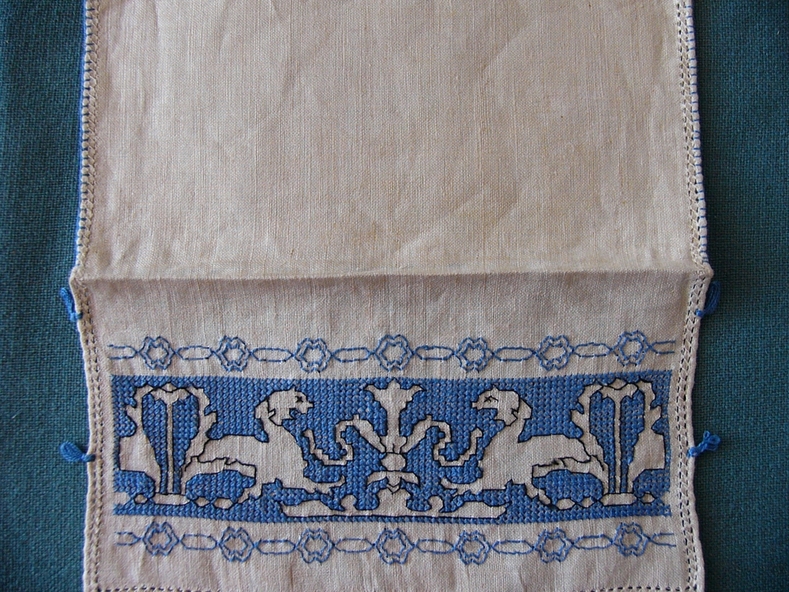
Assisi work - natural evenweave linen with double running in black round the design then filled in with blue cross stitch, leaving the design 'voided'.