Historical information
Stevengraphs are pictures woven from silk, originally created by Thomas Stevens in the 19th century.
In the mid-19th century the town of Coventry, England, was the centre of a ribbon weaving industry. In 1860 the Cobden–Chevalier Treaty was signed; this free trade treaty introduced new competition into the industry, leading to a collapse in the local economy.
Thomas Stevens, a local weaver, responded by adapting the Jacquard looms used in Coventry to weave colourful pictures from silk.
By 1862, Stevens could produce four different designs and by the late 1880s this had grown to over 900; they became known as "Stevengraphs", after their maker. Many of these designs were used to produce bookmarks, while others were used to make greeting cards and other silk objects.
Physical description
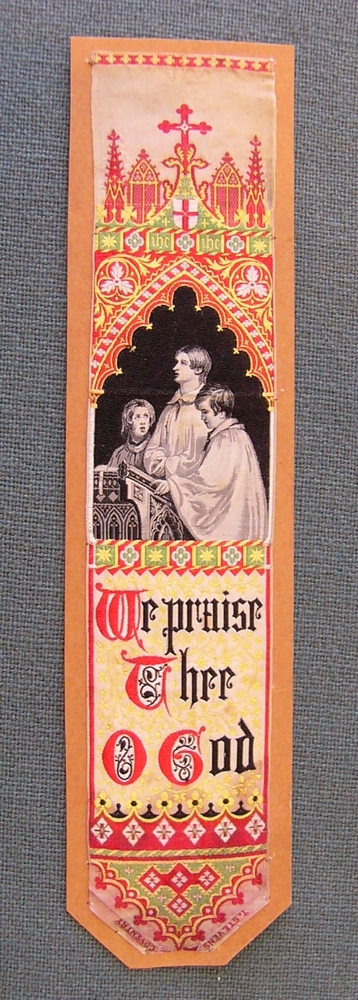
A "Stevengraph marker" woven (loom) in Coventry, England. A collectors item. Religious theme with choir boys in black and white and text mounted on card.
Inscriptions & markings
'We promise thee O God'
T. Stevens. Coventry