

Historical information
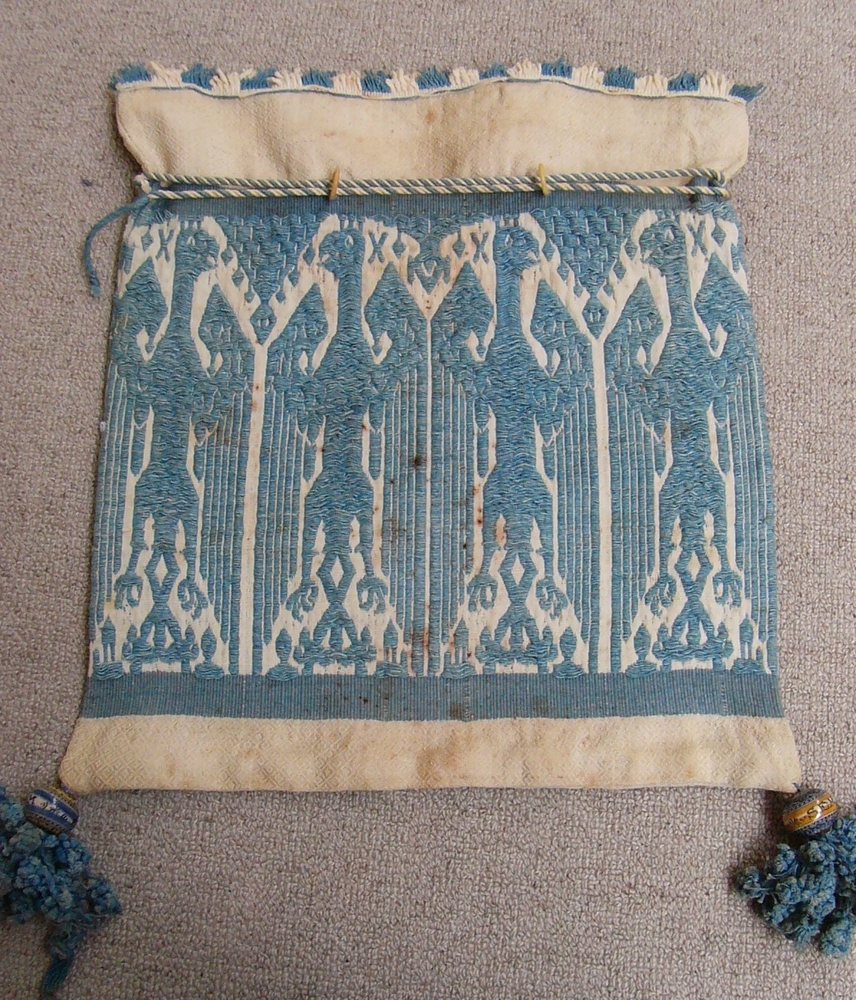
Blue and white pattern bands with woven figures resembling historical Perugia towels (tovaglie perugine) or similar patterned weaves from the 16th to 17th centuries.
Perugia towels were a highly specialized textile tradition from Umbria, Italy that flourished during the Late Middle Ages and the Renaissance.
The aesthetic impact was so massive that Renaissance masters like Leonardo da Vinci painted Perugia tablecloths into their works - for example "The Last Supper".
Symbolism and motifs characterised medieval and Renaissance bestiary - the Griffin was the mythological symbol of Perugia.
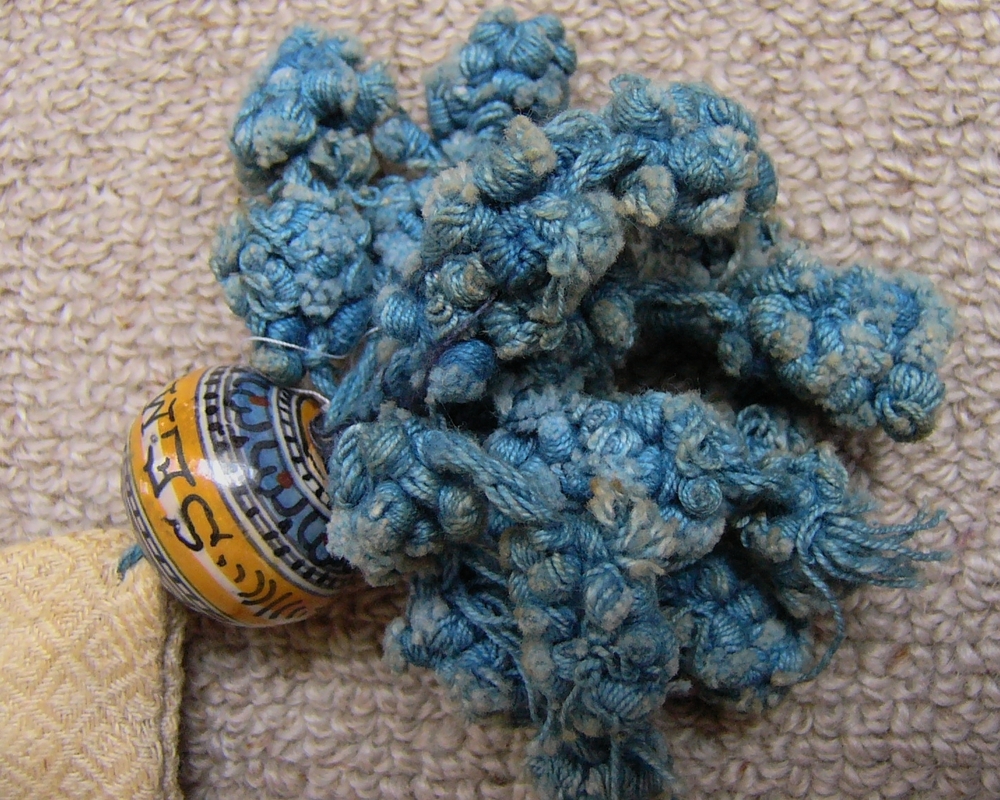
Majolica fuseruola beads (or spindle-whorl bead) originate from Deruta, Italy, mainly date from the late 19 th to mid 20 th century. The Latin phrase SEMPER IDEM translates to
'Always the same' or 'Ever constant, unchanging'.
Giuditta Brozzetti Museum Atelier
Housed inside the deconsecrated Church of Saint Francis of the Women (built in 1212) in Perugia.
Founded in 1921 by Giuditta Brozzetti to revive Umbrian hand-weaving, the workshop is now run by her great-granddaughter, master artisan Marta Cucchia (representing four consecutive generations of women weavers).
Uses functional, antique 18th-century wooden pedal looms and 19th-century Jacquard looms (including 1836 Vincenzi-patented models).
23.10.2026
Thank you for contacting us and giving us the opportunity to see such a beautiful piece!
In the early 20th century, there was a major revival movement for Umbrian textile art. This bag was likely created by one of the many workshops that emerged during that period.
Unfortunately, as we are the last remaining atelier still in operation—and many of the others closed a very long time ago—we have no way of verifying exactly which workshop produced it. Based on certain details, it might have come from the Ceccucci workshop, though we cannot state this with certainty.
The design appears to depict the Griffin—the symbol of our city. Since the Griffin was rarely portrayed from a frontal perspective during the Middle Ages, I would attribute this piece to the 20th-century revival; it seems to be an Art Nouveau interpretation of a Gothic motif.
The simple, tone-on-tone weave pattern found above and below the decorated section is known as "Occhietto" ("little eye") and is characteristic of the Perugian tradition. The entire item appears to be made of 100% cotton.
The Brozzetti Team Perugia
Physical description
Indigo and cream cotton bag, woven with Griffin motifs, from Perugia, Italy.
The simple, tone-on-tone weave pattern found above and below the decorated section is known as "Occhietto" ("little eye") and is characteristic of the Perugian tradition.
It features tassels which hang from lower corners, made of many knotted bobbins attached to two Majolica fuseruola beads which has SEMPER IDEM around the circumference.