Physical description
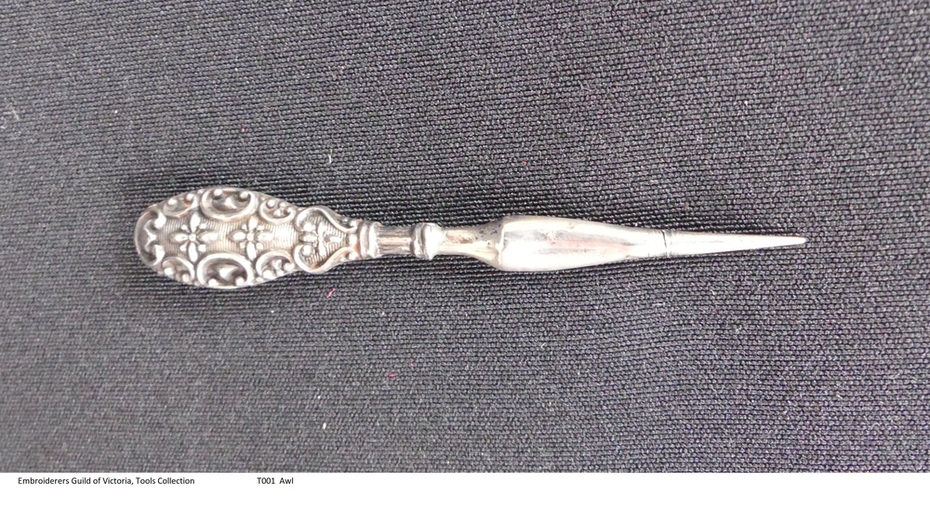
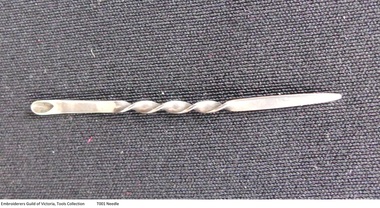
Silver stilleto
Inscriptions & markings
Floral patterned handle with a tapered fine point


Untitled image
Can you reuse this media without permission? No (with exceptions, see below)
All rights reserved
This media item is licensed under "All rights reserved". You cannot share (i.e. copy, distribute, transmit) or rework (i.e. alter, transform, build upon) this item, or use it for commercial purposes without the permission of the copyright owner. However, an exception can be made if your intended use meets the "fair dealing" criteria. Uses that meet this criteria include research or study; criticism or review; parody or satire; reporting news; enabling a person with a disability to access material; or professional advice by a lawyer, patent attorney, or trademark attorney.
Please acknowledge the item’s source, creator and title (where known)
Have a question? Contact Embroiderers Guild, Victoria
Silver stilleto
Floral patterned handle with a tapered fine point
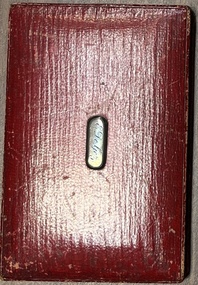
Workbox fitted for needlework tools as became popular for upper class houses 1840-60's
Use of work boxes to store and present sewing tools evolved from the use of embroidered bags and chatelaines by 18th century.
Red imitation leather covered wooden box (two pieces) with a silver escutcheon on top, containing tools. (Thimble in box is item T107 which has been placed here)
Inscription on cartouche "E.de Gez"
needlework box
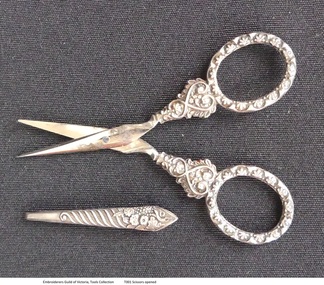
Finely pointed scissors were made with matching sheaths to protect their points from damage to maintain their value for fine work.
Fine pointed scissors were essential tools for fine embroidery work. A boxed set of tools such as these were the property of of the upper classes
Small silver scissors with ornate handles and shafts
Flowery decoration to handles
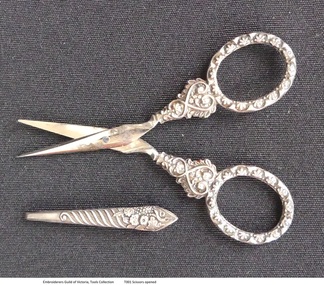
Finely pointed scissors were made with matching sheaths to protect their points from damage to maintain their value for fine work.
Fine pointed scissors were essential tools for fine embroidery work. A boxed set of tools such as these were the property of of the upper classes
Small silver scissors with ornate handles and shafts and sheath cover for points (T1.3)
Flowery decoration to handles
Wax was used to smooth sewing thread, an ear spoon was used to collect wax from the ear canal for this purpose
Silver ear spoon in a sewing etui (may not be original to the box). The ability of early cotton and threads to pass through fabric was improved with the application of wax.
Ear spoon on end of a silver handle with a blunt point
Barley twist in middle of shaft.
