



Historical information
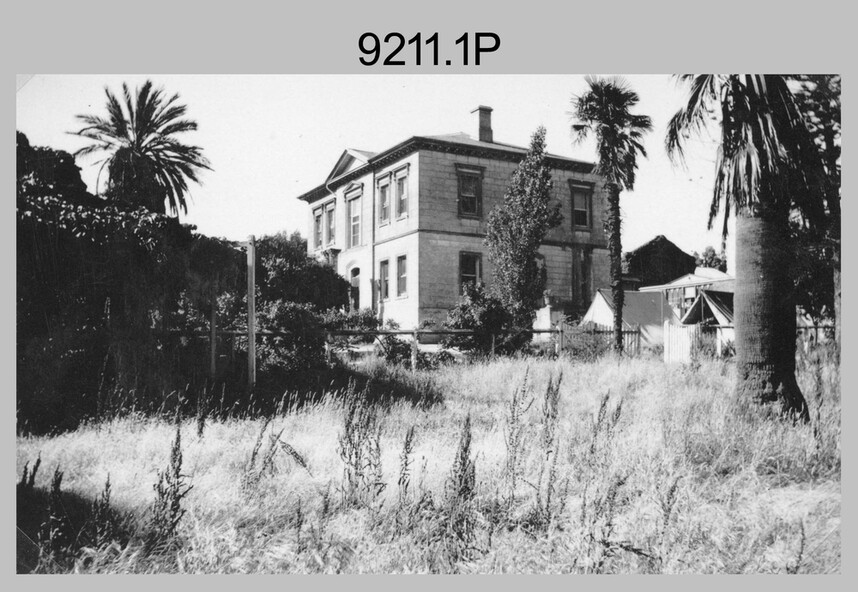
This is a set of 12 photographs taken during Army’s occupation at Fortuna, Bendigo in WW2. On 1 Feb 1941, a Cartographic Section was reformed as the Land Headquarters (LHQ) Cartographic Company. Deputy Chief of the General Staff, Major General Sidney Rowell instructed Its OC - Major William Sarll, in the interests of security of plant and to provide against possible damage of air attack, to investigate suitable safer inland accommodation for LHQ Cartographic Company. Major William Sarll inspected many properties before finding one that would meet the requirements of the Cartographic Company. In late 1941, he came to inspect Fortuna, a rambling old mansion dating back to the gold rush, with about fifteen acres of ground in central Bendigo. On 23 March 1942, the Commonwealth of Australia, under the provisions of the National Security Act of 1939, took possession of the house, the old battery buildings and the fifteen acres of grounds. LHQ Cartographic Company moved to Bendigo on 11 Jun 1942, from Mitchell House, Melbourne. The responsibilities of this unit were map compilation, fair drawing and lithographic reproduction, including printing the work of other Units as well as their own. A decision of War Cabinet on 13 August 1941 had authorised the formation of the Australian Women's Army Service (AWAS), in order to release men from certain military duties for employment with fighting units. Originally their employment was restricted to traditional female areas and numbers were strictly limited, but the outbreak of the Pacific War in 1942 led to a broadening of employment categories and an increase in numbers. The first AWAS arrived at Fortuna on 26 November 1942 and immediately became an integral part of the unit. Seventy-five AWAS served with the Cartographic Company during the war and Major Sarll paid them a special tribute for their 'untiring efforts' in the Company's war report. The AWAS could not be accommodated at Fortuna, and a nearby house, Westend Hall, on the corner of Lily and Barnard Streets, provided the first barracks with Warrant Officer Durack in charge. The building, designed by Vahland and Getzchmann in 1868, has been described as the 'grandest house on the goldfields with elegant Corinthian columns supporting a balustraded portico.' The building was conveniently situated close to the front gates of Fortuna. The women appreciated their pleasant surroundings as a magazine article written a year after their arrival reveals. 'It was a stroke of luck which gave us West End Hall with its gardens and large airy rooms; and it is to Miss Durack that we must give thanks for the bright furnishings, the good food and ... the splendid atmosphere of comradeship. But not all could be accommodated in the house; some slept in tents through the freezing Bendigo winters. Local girls like Gwen McGown were able to live at home, but had to report for the Monday morning parade after which the women would march to work. Saturday afternoon was designated sports afternoon for the women. They formed teams among themselves for competitions in basketball and softball. The women participated in an active way in the recreational activities of the Company, including athletics sports days, marching contests, concerts and dances. In the later years of the war, the barracks at West End Hall were too cramped and the AWAS were transferred to Lansellstowe, a beautiful old home in Barkly Terrace built originally for Leonard Vere Lansell, the third son of George Lansell. Prior to the AWAS occupation the Army had used the spacious house as a camp hospital.
Refer to Item 6099.17P for photos taken in 1942, the first year of LHQ Cartographic Company’s occupation at Fortuna, Bendigo in WW2. The Survey Corps’ occupation of Fortuna during WW2 is covered in more detail with additional historic photographs, in pages 17 to 27 of Valerie Lovejoy’s book 'Mapmakers of Fortuna – A history of the Army Survey Regiment’ ISBN: 0-646-42120-4.Other items from Rosemary (Atkinson) Bowman are: 9209.12P, 9210.16P, 9212.6P, 9213.4P and 9214.12.
Physical description
This is a set of four photographs of AWAS Accommodation at ‘Westend Hall’, taken in 1943 during Army’s early years of occupation at Fortuna, Bendigo in WW2. The black and white photo, graphs are printed on photographic paper are contained in a photo album provided by the family of Rosemary (Atkinson) Bowman, a former member of RA Svy. The photographs were scanned at 600 dpi and are part of the Army Survey Regiment’s Collection.
.1) - Photo, black & white, 1943. AWAS Accommodation, Westend Hall.
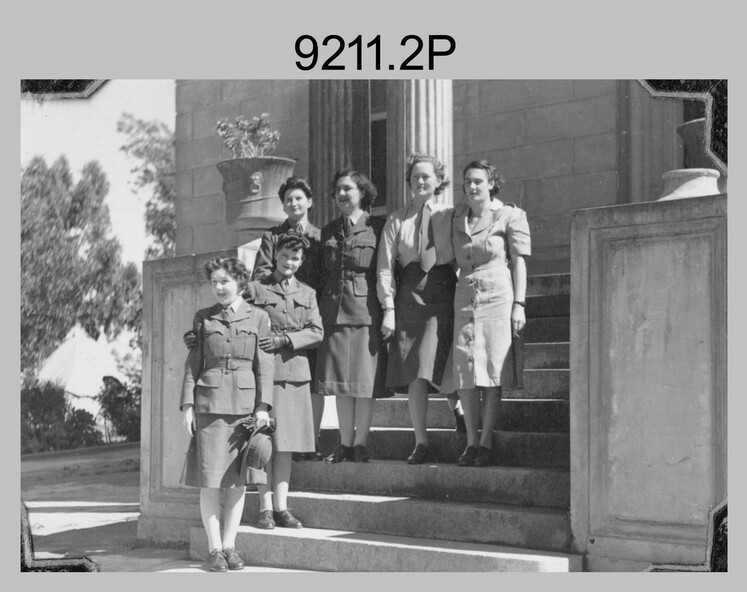
.2) - Photo, black & white, 1943. At front steps of Westend Hall. L to R: Norma Lewis, Tiny Lewis, Billie Hyatt, Norma Jeffrey, Betty Eyval, Peggy Priest.
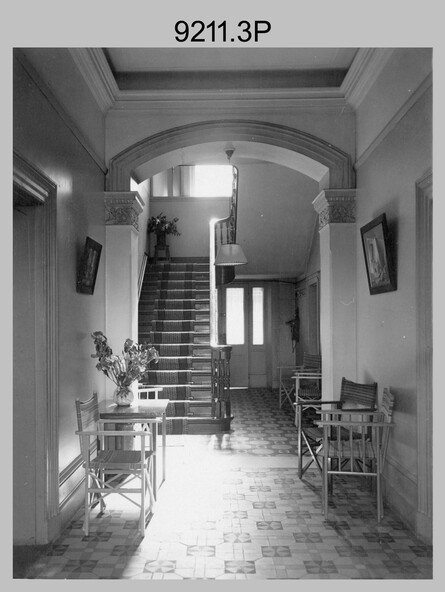
.3) - Photo, black & white, 1943. Hall and stairway inside the old barracks - Westend Hall.
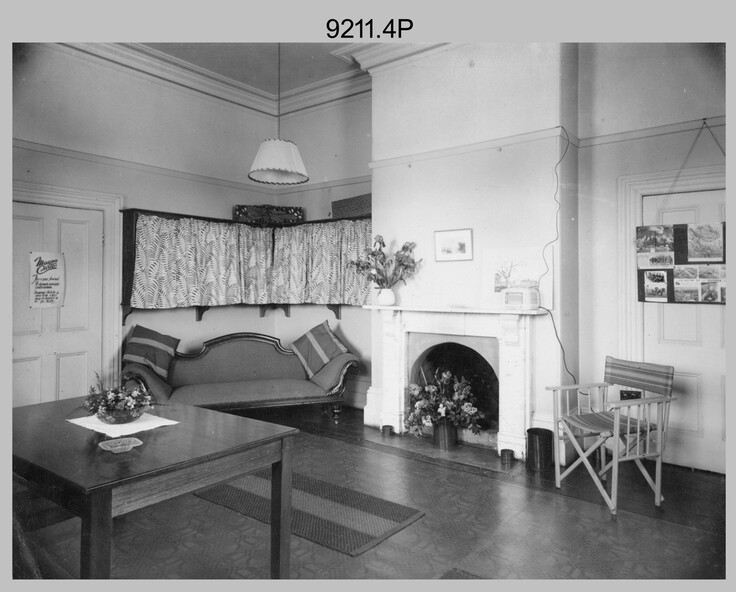
.4) - Photo, black & white, 1943. Recreation room inside the old barracks - Westend Hall.
Inscriptions & markings
Some personnel are identified with dates in the photo album.
