Historical information
As Buddhism spread to Tibet in the 7th century, prayer wheels became an essential attribute of Tibetan Buddhist practice. This practice is linked to teachings attributed to Nagarjuna (ca. 150 –250 CE), who emphasised the power of mantra recitation and visualisation. A prayer wheel, used for personal worship, allowed to release the spiritual power contained within the mantras, enabling practitioners, including those who could not read, to generate spiritual merit.
Significance
Prayer wheels have been used in Tibetan Buddhism for personal worship since the 7th century. Turning the wheel with a pure, compassionate intention is believed to release the mantras into the universe, resulting in purification of negative karma of the practitioner, accumulation of merit, and spreading compassion to all living beings.
Physical description
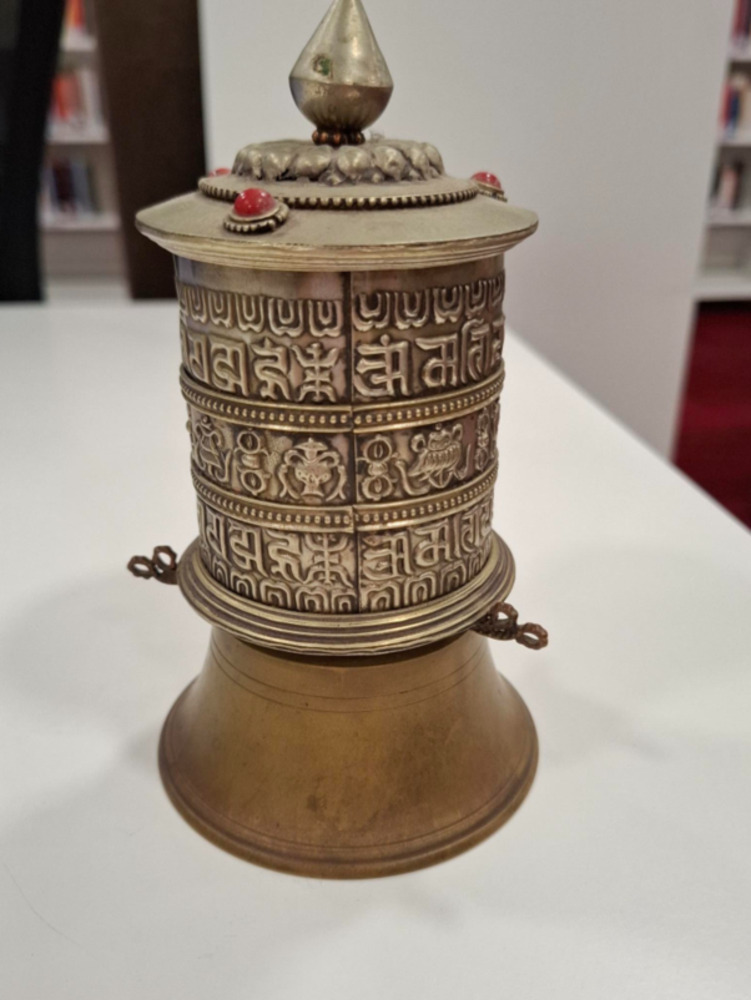
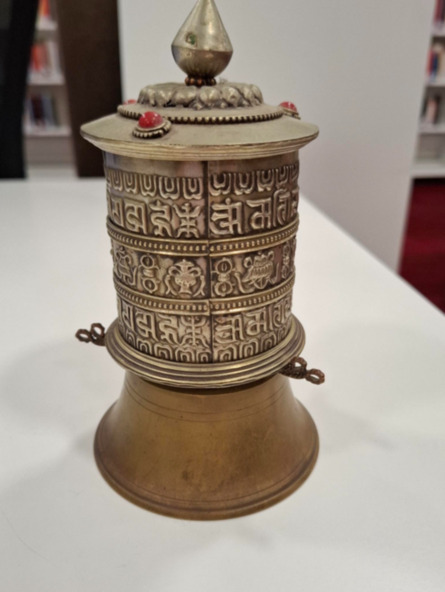
The main body of this standing prayer wheel consists of a rotating hollow metal cylinder (drum) set on a flared, bell-shaped pedestal stand. Small decorative loops extend outward from the lower rim of the drum, which are used to manually flick and spin the wheel in a clockwise direction. The top lid features decorative, scalloped petal patterns resembling a lotus flower. It is crowned with a pointed metallic finial–in a jewel shape–and adorned with small, inlaid red coral stones. This small standing prayer wheel can be placed by Buddhist practitioners on a flat surface like an altar or table and easily rotated to disseminate the blessings to all.
Inscriptions & markings
"Om Mani Padme Hum" mantra in Sanskrit script