
Showing 67 items matching "aboriginal depiction"
-
 Bendigo Historical Society Inc.
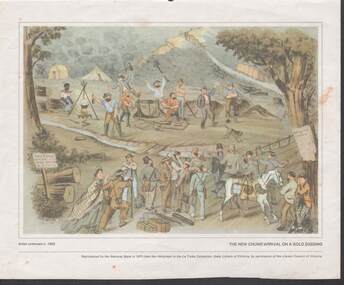
Painting - CAROL HOLSWORTH COLLECTION: 1970 NATIONAL BANK PAINTING 'THE NEW CHUMS ARRIVAL ON A GOLD DIGGING'
... 1970 NATIONAL BANK PAINTING REPRODUCTION The New Chums Arrival on a Gold Digging .Artist unknown c. 1855 Below the picture title the words - Reproduced by the National Bank in 1970 from the lithograph in the La Trobe Collection , State Library of Victoria , by permission of the Library Council of Victoria .Bottom left corner shows a rough sign nailed to an upright post saying The Star Concert Hall Gus Hatton To night.The painting is divided lengthways by a stream with a two plank crossing apparently to show the differences between the seasoned miners above the stream and the new chums below the stream .The above centre of the picture is a windlass surrounded by men - an Aboriginal sitting by a fire , two men with bottles in hand depicting the proliferation of drink .The New Chums below the stream show men and a woman all wearing smart hats and clothes , some carrying unneeded items such as Umbrellas...PAINTING Watercolour gold diggers 1970 NATIONAL BANK PAINTING REPRODUCTION The New Chums Arrival on a Gold Digging .Artist unknown c. 1855 Below the picture title the words - Reproduced by the National Bank in 1970 from the lithograph in the La Trobe Collection , State Library of Victoria , by permission of the Library Council of Victoria .Bottom left corner shows a rough sign nailed to an upright post saying The Star Concert Hall Gus Hatton To night.The painting is divided lengthways by a stream with a two plank crossing apparently to show the differences between the seasoned miners above the stream and the new chums below the stream .The above centre of the picture is a windlass surrounded by men - an Aboriginal sitting by a fire , two men with bottles in hand depicting the proliferation of drink .The New Chums below the stream show men and a woman all wearing smart hats and clothes , some carrying unneeded items such as Umbrellas Painting CAROL HOLSWORTH COLLECTION: 1970 NATIONAL BANK PAINTING 'THE NEW CHUMS ARRIVAL ON A GOLD DIGGING' ...1970 NATIONAL BANK PAINTING REPRODUCTION The New Chums Arrival on a Gold Digging .Artist unknown c. 1855 Below the picture title the words - Reproduced by the National Bank in 1970 from the lithograph in the La Trobe Collection , State Library of Victoria , by permission of the Library Council of Victoria .Bottom left corner shows a rough sign nailed to an upright post saying The Star Concert Hall Gus Hatton To night.The painting is divided lengthways by a stream with a two plank crossing apparently to show the differences between the seasoned miners above the stream and the new chums below the stream .The above centre of the picture is a windlass surrounded by men - an Aboriginal sitting by a fire , two men with bottles in hand depicting the proliferation of drink .The New Chums below the stream show men and a woman all wearing smart hats and clothes , some carrying unneeded items such as Umbrellaspainting, watercolour, gold diggers -
 Bendigo Historical Society Inc.
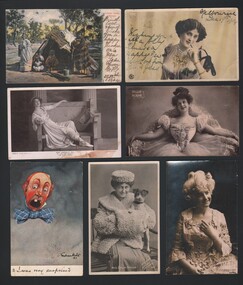
Postcard - WES HARRY COLLECTION: 7 POSTCARDS, 1904 - 07
... (a) Unknown Actress, (b) Caricature of a surprised face with the words ' I was very surprised ' hand written underneath, (c) Miss Delia Mason, (d) Miss Gabrielle Ray in ' The Lady Dandies ', (e) Billie Burke , (f) Hand tinted card depicting women at an Aboriginal Camp, entitled ' Lubras camp, Maloga ' , (g) Unknown Actress....(a) Unknown Actress, (b) Caricature of a surprised face with the words ' I was very surprised ' hand written underneath, (c) Miss Delia Mason, (d) Miss Gabrielle Ray in ' The Lady Dandies ', (e) Billie Burke , (f) Hand tinted card depicting women at an Aboriginal Camp, entitled ' Lubras camp, Maloga ' , (g) Unknown Actress. ...Group of seven postcards from various people addressed to Mrs. A Stephens (nee Palmer). Five of the cards are depicting Theatre Actresses. (a) Unknown Actress, (b) Caricature of a surprised face with the words ' I was very surprised ' hand written underneath, (c) Miss Delia Mason, (d) Miss Gabrielle Ray in ' The Lady Dandies ', (e) Billie Burke , (f) Hand tinted card depicting women at an Aboriginal Camp, entitled ' Lubras camp, Maloga ' , (g) Unknown Actress.postcard, actresses, actresses, delia mason, billie burke, gabrielle ray, lubras camp maloga -
 National Vietnam Veterans Museum (NVVM)
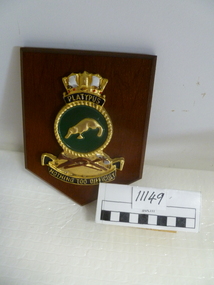
Plaque, Platypus
... Wooden shield depicting emblem of gold bordered royal crown centred with gold platypus and aboriginal weapons below...Plaque Platypus Aboriginal Motto "Nothing too difficult" Wooden shield depicting emblem of gold bordered royal crown centred with gold platypus and aboriginal weapons below Platypus Plaque Plaque ...Wooden shield depicting emblem of gold bordered royal crown centred with gold platypus and aboriginal weapons belowMotto "Nothing too difficult"plaque, platypus, aboriginal -
 Geoffrey Kaye Museum of Anaesthetic History
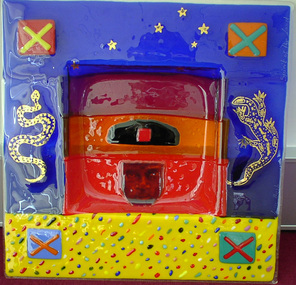
Decorative object - Glass platter
... Aboriginal art First Nations art Southern Cross A large, square-shaped glass platter decorated in bright colours. The central well has three horizontal stripes of burgundy, burnt orange, and red. The central orange stripe has a black, roughly ovular shape in the middle with a red square in its centre. The lower red stripe depicts ...A large, square-shaped glass platter decorated in bright colours. The central well has three horizontal stripes of burgundy, burnt orange, and red. The central orange stripe has a black, roughly ovular shape in the middle with a red square in its centre. The lower red stripe depicts a person's face. Outside of the well is painted in an ultramarine blue, with a speckled yellow stripe across the width of the platter below the well. To the left of the well is the image of a snake in gold, and on the right of the well is the image of a goanna, also in gold. Above the well is the image of the Southern Cross painted in gold. In each corner of the platter is a square with a saltire (diagonal cross), each in different colours.platter, snake, goanna, indigenous art, aboriginal art, first nations art, southern cross -
 Warrnambool and District Historical Society Inc.
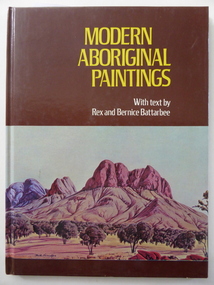
Book, Rigby Limited, Modern Aboriginal Paintings, 1976
... aboriginal art work, including the work of several of Albert Namatjira’s children. Reginald (Rex) Battarbee (1893-1973) was the son of George and Mary Battarbee who lived in East Warrnambool at a property called ‘Skiddaw’. Rex’s sister, Florinda was a local artist who was his first teacher of art. Rex became a well-known artist, depicting...aboriginal art work, including the work of several of Albert Namatjira’s children. Reginald (Rex) Battarbee (1893-1973) was the son of George and Mary Battarbee who lived in East Warrnambool at a property called ‘Skiddaw’. Rex’s sister, Florinda was a local artist who was his first teacher of art. Rex became a well-known artist, depicting ...A collection of reproductions of aboriginal art work from the Hermannsburg area as collated by Rex Batterbee.This is a hard cover book with the pages unnumbered. The cover is brown with colour reproductions of two aboriginal paintings on the front and back cover. The printing on the front cover is in yellow and white lettering. The book contains written text and many reproductions of aboriginal paintings. The inscription on the first page is handwritten in black biro. non-fictionA collection of reproductions of aboriginal art work from the Hermannsburg area as collated by Rex Batterbee.rex battarbee, aboriginal art, albert namatjira -
 Winchelsea and District Historical Society
Lithograph, Prebble & James, circa. 1933
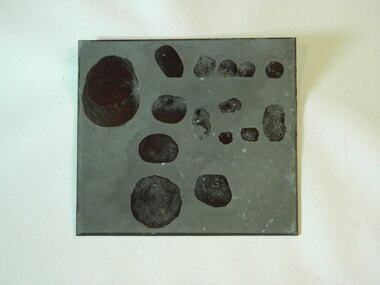
... depicting indigenous artefacts collected and displayed by Cr. Koenig. Koenigs collection of indigenous artefacts remain as unique in the Surf Coast Shire as a relic of material culture from the district in Pre-Colonial times. These lithographs remain as significant in themselves being the master copy remaining from the publication of Koenig's work. They are aesthetically beautiful as a work of art, and historically (technologically) important in the narrative of printing. koenig lithograph illustration printing blocks picture book indigenous artefact image stone tools winchelsea wadda wurrung witharong wathaurong wito wurrung aboriginal NIL Lithograph for printing a Photograph of a collection of indigenous artefacts for publication in the book "History of the Winchelsea SDhire" By Cr. ...These Lithographs were made for the printing and Publishing of the Book entitled "The History of Winchelsea Shire" by Cr. W.L Koenig who was commissioned by the Shire of Winchelsea to collate, Document and present the Pre-Colonial and Colonial History of the Barwon District and in particular the Winchelsea Shire for posterity and public education. The Book was published including the photographs represented by these lithographs as illustrations, and remains the foundation of the historical narrative of the area, and the context of this collection. This Lithograph is one of four depicting indigenous artefacts collected and displayed by Cr. Koenig. Koenigs collection of indigenous artefacts remain as unique in the Surf Coast Shire as a relic of material culture from the district in Pre-Colonial times. These lithographs remain as significant in themselves being the master copy remaining from the publication of Koenig's work. They are aesthetically beautiful as a work of art, and historically (technologically) important in the narrative of printing.Lithograph for printing a Photograph of a collection of indigenous artefacts for publication in the book "History of the Winchelsea SDhire" By Cr. W.L. Koenig.NILkoenig, lithograph, illustration, printing blocks, picture, book, indigenous, artefact, image, stone tools, winchelsea, wadda wurrung, witharong, wathaurong, wito wurrung, aboriginal -
 Winchelsea and District Historical Society
Lithograph, Prebble & James, circa. 1933
... depicting indigenous artefacts collected and displayed by Cr. Koenig. Koenigs collection of indigenous artefacts remain as unique in the Surf Coast Shire as a relic of material culture from the district in Pre-Colonial times. These lithographs remain as significant in themselves being the master copy remaining from the publication of Koenig's work. They are aesthetically beautiful as a work of art, and historically (technologically) important in the narrative of printing. Koenig Lithograph Illustration Printing Blocks Picture Book Indigenous artefact image stone tools bone Winchelsea Wadda Wurrung Witharong Wathaurong wito wurrung aboriginal ...These Lithographs were made for the printing and Publishing of the Book entitled "The History of Winchelsea Shire" by Cr. W.L Koenig who was commissioned by the Shire of Winchelsea to collate, Document and present the Pre-Colonial and Colonial History of the Barwon District and in particular the Winchelsea Shire for posterity and public education. The Book was published including the photographs represented by these lithographs as illustrations, and remains the foundation of the historical narrative of the area, and the context of this collection. This Lithograph is one of four depicting indigenous artefacts collected and displayed by Cr. Koenig.Koenigs collection of indigenous artefacts remain as unique in the Surf Coast Shire as a relic of material culture from the district in Pre-Colonial times. These lithographs remain as significant in themselves being the master copy remaining from the publication of Koenig's work. They are aesthetically beautiful as a work of art, and historically (technologically) important in the narrative of printing.Lithograph for printing a Photograph of a collection of indigenous artefacts for publication in the book "History of the Winchelsea Shire" By Cr. W.L. Koenig.NILkoenig, lithograph, illustration, printing blocks, picture, book, indigenous, artefact, image, stone tools, bone, winchelsea, wadda wurrung, witharong, wathaurong, wito wurrung, aboriginal -
 Victorian Aboriginal Corporation for Languages
Periodical, Australian Institute of Aboriginal and Torres Strait Islander Studies, Australian Aboriginal studies : journal of the Australian Institute of Aboriginal and Torres Strait Islander Studies, 2008
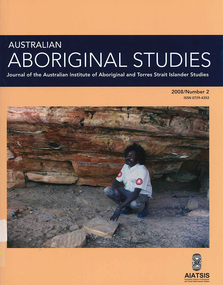
... depicted. Vincent was deeply concerned about members of the younger generation around him ?losing their way? in modern times. In a similar vein, Brett Leavy (Kooma) sees the 3D game engine as an opportunity to engage the younger generation in its own cultural heritage in an activity that capitalises on a common pastime. Vincent was an enthusiastic advocate of this approach. Working in consultation with Vincent and the research team, CyberDreaming developed a simulation of Vincent?s Country for young Aboriginal...depicted. Vincent was deeply concerned about members of the younger generation around him ?losing their way? in modern times. In a similar vein, Brett Leavy (Kooma) sees the 3D game engine as an opportunity to engage the younger generation in its own cultural heritage in an activity that capitalises on a common pastime. Vincent was an enthusiastic advocate of this approach. Working in consultation with Vincent and the research team, CyberDreaming developed a simulation of Vincent?s Country for young Aboriginal ...Mawul Rom Project: Openness, obligation and reconciliation Morgan Brigg (Universtiy of Queensland) and Anke Tonnaer (University of Aarhus, Denmark) Aboriginal Australian initiatives to restore balanced relationships with White Australians have recently become part of reconciliation efforts. This paper provides a contextualised report on one such initiative, the Mawul Rom crosscultural mediation project. Viewing Mawul Rom as a diplomatic venture in the lineage of adjustment and earlier Rom rituals raises questions about receptiveness, individual responsibility and the role of Indigenous ceremony in reconciliation efforts. Yolngu ceremonial leaders successfully draw participants into relationship and personally commit them to the tasks of cross-cultural advocacy and reconciliation. But Mawul Rom must also negotiate a paradox because emphasis on the cultural difference of ceremony risks increasing the very social distance that the ritual attempts to confront. Managing this tension will be a key challenge if Mawul Rom is to become an effective diplomatic mechanism for cross-cultural conflict resolution and reconciliation. Living in two camps: the strategies Goldfields Aboriginal people use to manage in the customary economy and the mainstream economy at the same time Howard Sercombe (Strathclyde University, Glasgow) The economic sustainability of Aboriginal households has been a matter of public concern across a range of contexts. This research, conducted in the Eastern Goldfields of Western Australia, shows how economically successful Aboriginal persons manage ?dual economic engagement?, or involvement in the customary economy and the mainstream economy at the same time. The two economies sometimes reinforce each other but are more often in conflict, and management of conflicting obligations requires high degrees of skill and innovation. As well as creating financially sustainable households, the participants contributed significantly to the health of their extended families and communities. The research also shows that many Aboriginal people, no matter what their material and personal resources, are conscious of how fragile and unpredictable their economic lives can be, and that involvement in the customary economy is a kind of mutual insurance to guarantee survival if times get tough. Indigenous population data for evaluation and performance measurement: A cautionary note Gaminiratne Wijesekere (Dept. of Families, Housing, Community Services and Indigenous Affairs, Canberra) I outline the status of population census counts for Indigenous peoples, identifying information on Indigenous births and deaths, and internal migration estimates. I comment on the ?experimental? Indigenous population projections and question the rationale for having two sets of projections. Program managers and evaluators need to be mindful of limitations of the data when using these projections for monitoring, evaluating and measuring Indigenous programs. Reaching out to a younger generation using a 3D computer game for storytelling: Vincent Serico?s legacy Theodor G Wyeld (Flinders University, Adeliade) and Brett Leavy (CyberDreaming Australia) Sadly, Vincent Serico (1949?2008), artist, activist and humanist, recently passed away. Born in southern Queensland in Wakka Wakka/Kabi Kabi Country (Carnarvon Gorge region) in 1949, Vincent was a member of the Stolen Generations. He was separated from his family by White administration at four years of age. He grew up on the Cherbourg Aboriginal Reserve in the 1950s, when the policies of segregation and assimilation were at their peak. Only returning to his Country in his early forties, Vincent started painting his stories and the stories that had been passed on to him about the region. These paintings manifest Vincent?s sanctity for tradition, storytelling, language, spirit and beliefs. A team of researchers was honoured and fortunate to have worked closely with Vincent to develop a 3D simulation of his Country using a 3D computer game toolkit. Embedded in this simulation of his Country, in the locations that their stories speak to, are some of Vincent?s important contemporary art works. They are accompanied by a narration of Vincent?s oral history about the places, people and events depicted. Vincent was deeply concerned about members of the younger generation around him ?losing their way? in modern times. In a similar vein, Brett Leavy (Kooma) sees the 3D game engine as an opportunity to engage the younger generation in its own cultural heritage in an activity that capitalises on a common pastime. Vincent was an enthusiastic advocate of this approach. Working in consultation with Vincent and the research team, CyberDreaming developed a simulation of Vincent?s Country for young Aboriginal and non-Aboriginal persons from the Carnarvon Gorge region to explore Vincent?s life stories of the region. The use of Vincent?s contemporary paintings as storyboards provides a traditional medium for the local people to interactively re-engage with traditional values. Called Serico?s World, it represents a legacy to his life?s works, joys and regrets. Here we discuss the background to this project and Vincent?s contribution. A singular beeswax representation of Namarrkon, the Lightning Man, from western Arnhem Land RG Gunn (La Trobe University) and RL Whear (Jawoyn Association) Samples from a beeswax representation of Namarrkon, the Lightning Man, from western Arnhem Land were analysed for radiocarbon and dated to be about 150 years old. An underlying beeswax figure was found to be approximately 1100 years old. The Dreaming Being Namarrkon is well known throughout Arnhem Land, although his sphere of activity is concentrated around the northern half of the Arnhem Land plateau. Namarrkon is well represented in rock-paintings in this area and continues to be well represented in contemporary canvas-paintings by artists from the broader plateau region. We conclude that representations of Namarrkon in both painted and beeswax forms appear to be parallel manifestations of the late Holocene regionalisation of Arnhem Land. ?Missing the point? or ?what to believe ? the theory or the data?: Rationales for the production of Kimberley points Kim Akerman (Moonah) In a recent article, Rodney Harrison presented an interesting view on the role glass Kimberley points played in the lives of the Aborigines who made and used them. Harrison employed ethnographic and historical data to argue that glass Kimberley points were not part of the normal suite of post-contact artefacts used primarily for hunting and fighting or Indigenous exchange purposes, but primarily were created to service a non-Indigenous market for aesthetically pleasing artefacts. Harrison asserted that this market determined the form that these points took. A critical analysis of the data does not substantiate either of these claims. Here I do not deal with Harrison?s theoretical material or arguments; I focus on the ethnographic and historical material that he has either omitted or failed to appreciate in developing his thesis and which, in turn, renders it invalid. The intensity of raw material utilisation as an indication of occupational history in surface stone artefact assemblages from the Strathbogie Ranges, central Victoria Justin Ian Shiner (La Trobe University, Bundoora) Stone artefact assemblages are a major source of information on past human?landscape relationships throughout much of Australia. These relationships are not well understood in the Strathbogie Ranges of central Victoria, where few detailed analyses of stone artefact assemblages have been undertaken. The purpose of this paper is to redress this situation through the analysis of two surface stone artefact assemblages recorded in early 2000 during a wider investigation of the region?s potential for postgraduate archaeological fieldwork. Analysis of raw material utilisation is used to assess the characteristics of the occupational histories of two locations with similar landscape settings. The analysis indicates variability in the intensity of raw material use between the assemblages, which suggests subtle differences in the occupational history of each location. The results of this work provide a direction for future stone artefact studies within this poorly understood region.document reproductions, maps, b&w photographs, colour photographskimberley, mawul rom project, 3d computer game, storytelling, vincent serico, beeswax, namarrkon, artefact assemblages, strathbogie ranges, groote eylandt, budd billy ii -
 Victorian Aboriginal Corporation for Languages
Periodical, Australian Institute of Aboriginal and Torres Strait Islander Studies, Australian Aboriginal studies : journal of the Australian Institute of Aboriginal and Torres Strait Islander Studies, 2013
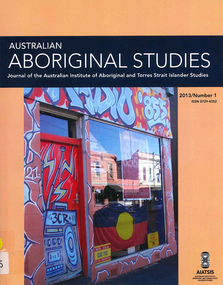
... The world from Malarrak: Depictions of South-east Asian and European subjects in rock art from the Wellington Range, Australia Sally K May, Paul SC Ta�on, Alistair Paterson, Meg Travers This paper investigates contact histories in northern Australia through an analysis of recent rock paintings. Around Australia Aboriginal...The world from Malarrak: Depictions of South-east Asian and European subjects in rock art from the Wellington Range, Australia Sally K May, Paul SC Ta�on, Alistair Paterson, Meg Travers This paper investigates contact histories in northern Australia through an analysis of recent rock paintings. Around Australia Aboriginal ...We don?t leave our identities at the city limits: Aboriginal and Torres Strait Islander people living in urban localities Bronwyn Fredericks Aboriginal and Torres Strait Islander people who live in cities and towns are often thought of as ?less Indigenous? than those who live ?in the bush?, as though they are ?fake? Aboriginal people ? while ?real? Aboriginal people live ?on communities? and ?real? Torres Strait Islander people live ?on islands?. Yet more than 70 percent of Australia?s Indigenous peoples live in urban locations (ABS 2007), and urban living is just as much part of a reality for Aboriginal and Torres Strait Islander people as living in remote discrete communities. This paper examines the contradictions and struggles that Aboriginal and Torres Strait Islander people experience when living in urban environments. It looks at the symbols of place and space on display in the Australian cities of Melbourne and Brisbane to demonstrate how prevailing social, political and economic values are displayed. Symbols of place and space are never neutral, and this paper argues that they can either marginalise and oppress urban Aboriginal and Torres Strait Islander people, or demonstrate that they are included and engaged. Juggling with pronouns: Racist discourse in spoken interaction on the radio Di Roy While the discourse of deficit with regard to Australian Indigenous health and wellbeing has been well documented in print media and through images on film and on television, radio talk concerning this discourse remains underresearched. This paper interrogates the power of an interactive news interview, aired on the Radio National Breakfast program on ABC Radio in 2011, to maintain and reproduce the discourse of deficit, despite the best intentions of the interview participants. Using a conversation-analytical approach, and membership categorisation analysis in particular, this paper interrogates the spoken interaction between a well-known radio interviewer and a respected medical researcher into Indigenous eye health. It demonstrates the recreation of a discourse emanating from longstanding hegemonies between mainstream and Indigenous Australians. Analysis of firstperson pronoun use shows the ongoing negotiation of social category boundaries and construction of moral identities through ascriptions to category members, upon which the intelligibility of the interview for the listening audience depended. The findings from analysis support claims in a considerable body of whiteness studies literature, the main themes of which include the pervasiveness of a racist discourse in Australian media and society, the power of invisible assumptions, and the importance of naming and exposing them. Changes in Pitjantjatjara mourning and burial practices Bill Edwards, University of South Australia This paper is based on observations over a period of more than five decades of changes in Pitjantjatjara burial practices from traditional practices to the introduction of Christian services and cemeteries. Missions have been criticised for enforcing such changes. However, in this instance, the changes were implemented by the Aboriginal people themselves. Following brief outlines of Pitjantjatjara traditional life, including burial practices, and of the establishment of Ernabella Mission in 1937 and its policy of respect for Pitjantjatjara cultural practices and language, the history of these changes which commenced in 1973 are recorded. Previously, deceased bodies were interred according to traditional rites. However, as these practices were increasingly at odds with some of the features of contemporary social, economic and political life, two men who had lost close family members initiated church funeral services and established a cemetery. These practices soon spread to most Pitjantjatjara communities in a manner which illustrates the model of change outlined by Everett Rogers (1962) in Diffusion of Innovations. Reference is made to four more recent funerals to show how these events have been elaborated and have become major social occasions. The world from Malarrak: Depictions of South-east Asian and European subjects in rock art from the Wellington Range, Australia Sally K May, Paul SC Ta�on, Alistair Paterson, Meg Travers This paper investigates contact histories in northern Australia through an analysis of recent rock paintings. Around Australia Aboriginal artists have produced a unique record of their experiences of contact since the earliest encounters with South-east Asian and, later, European visitors and settlers. This rock art archive provides irreplaceable contemporary accounts of Aboriginal attitudes towards, and engagement with, foreigners on their shores. Since 2008 our team has been working to document contact period rock art in north-western and western Arnhem Land. This paper focuses on findings from a site complex known as Malarrak. It includes the most thorough analysis of contact rock art yet undertaken in this area and questions previous interpretations of subject matter and the relationship of particular paintings to historic events. Contact period rock art from Malarrak presents us with an illustrated history of international relationships in this isolated part of the world. It not only reflects the material changes brought about by outside cultural groups but also highlights the active role Aboriginal communities took in responding to these circumstances. Addressing the Arrernte: FJ Gillen?s 1896 Engwura speech Jason Gibson, Australian National University This paper analyses a speech delivered by Francis James Gillen during the opening stages of what is now regarded as one of the most significant ethnographic recording events in Australian history. Gillen?s ?speech? at the 1896 Engwura festival provides a unique insight into the complex personal relationships that early anthropologists had with Aboriginal people. This recently unearthed text, recorded by Walter Baldwin Spencer in his field notebook, demonstrates how Gillen and Spencer sought to establish the parameters of their anthropological enquiry in ways that involved both Arrernte agency and kinship while at the same time invoking the hierarchies of colonial anthropology in Australia. By examining the content of the speech, as it was written down by Spencer, we are also able to reassesses the importance of Gillen to the ethnographic ambitions of the Spencer/Gillen collaboration. The incorporation of fundamental Arrernte concepts and the use of Arrernte words to convey the purpose of their 1896 fieldwork suggest a degree of Arrernte involvement and consent not revealed before. The paper concludes with a discussion of the outcomes of the Engwura festival and the subsequent publication of The Native Tribes of Central Australia within the context of a broader set of relationships that helped to define the emergent field of Australian anthropology at the close of the nineteenth century. One size doesn?t fit all: Experiences of family members of Indigenous gamblers Louise Holdsworth, Helen Breen, Nerilee Hing and Ashley Gordon Centre for Gambling Education and Research, Southern Cross University This study explores help-seeking and help-provision by family members of Indigenous people experiencing gambling problems, a topic that previously has been ignored. Data are analysed from face-to-face interviews with 11 family members of Indigenous Australians who gamble regularly. The results confirm that substantial barriers are faced by Indigenous Australians in accessing formal help services and programs, whether for themselves or a loved one. Informal help from family and friends appears more common. In this study, this informal help includes emotional care, practical support and various forms of ?tough love?. However, these measures are mostly in vain. Participants emphasise that ?one size doesn?t fit all? when it comes to avenues of gambling help for Indigenous peoples. Efforts are needed to identify how Indigenous families and extended families can best provide social and practical support to assist their loved ones to acknowledge and address gambling problems. Western Australia?s Aboriginal heritage regime: Critiques of culture, ethnography, procedure and political economy Nicholas Herriman, La Trobe University Western Australia?s Aboriginal Heritage Act 1972 (WA) and the de facto arrangements that have arisen from it constitute a large part of the Aboriginal ?heritage regime? in that state. Although designed ostensibly to protect Aboriginal heritage, the heritage regime has been subjected to various scholarly critiques. Indeed, there is a widespread perception of a need to reform the Act. But on what basis could this proceed? Here I offer an analysis of these critiques, grouped according to their focus on political economy, procedure, ethnography and culture. I outline problems surrounding the first three criticisms and then discuss two versions of the cultural critique. I argue that an extreme version of this criticism is weak and inconsistent with the other three critiques. I conclude that there is room for optimism by pointing to ways in which the heritage regime could provide more beneficial outcomes for Aboriginal people. Read With Me Everyday: Community engagement and English literacy outcomes at Erambie Mission (research report) Lawrence Bamblett Since 2009 Lawrie Bamblett has been working with his community at Erambie Mission on a literacy project called Read With Me. The programs - three have been carried out over the past four years - encourage parents to actively engage with their children?s learning through reading workshops, social media, and the writing and publication of their own stories. Lawrie attributes much of the project?s extraordinary success to the intrinsic character of the Erambie community, not least of which is their communal approach to living and sense of shared responsibility. The forgotten Yuendumu Men?s Museum murals: Shedding new light on the progenitors of the Western Desert Art Movement (research report) Bethune Carmichael and Apolline Kohen In the history of the Western Desert Art Movement, the Papunya School murals are widely acclaimed as the movement?s progenitors. However, in another community, Yuendumu, some 150 kilometres from Papunya, a seminal museum project took place prior to the completion of the Papunya School murals and the production of the first Papunya boards. The Warlpiri men at Yuendumu undertook a ground-breaking project between 1969 and 1971 to build a men?s museum that would not only house ceremonial and traditional artefacts but would also be adorned with murals depicting the Dreamings of each of the Warlpiri groups that had recently settled at Yuendumu. While the murals at Papunya are lost, those at Yuendumu have, against all odds, survived. Having been all but forgotten, this unprecedented cultural and artistic endeavour is only now being fully appreciated. Through the story of the genesis and construction of the Yuendumu Men?s Museum and its extensive murals, this paper demonstrates that the Yuendumu murals significantly contributed to the early development of the Western Desert Art Movement. It is time to acknowledge the role of Warlpiri artists in the history of the movement.b&w photographs, colour photographsracism, media, radio, pitjantjatjara, malarrak, wellington range, rock art, arrernte, fj gillen, engwura, indigenous gambling, ethnography, literacy, erambie mission, yuendumu mens museum, western desert art movement -
 Bayside Gallery - Bayside City Council Art & Heritage Collection
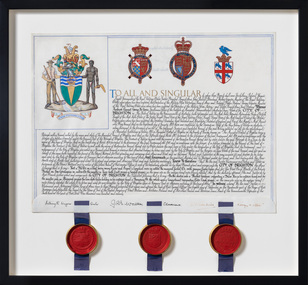
Document - Certificate, College of Arms, City of Brighton Coat of Arms, 1970
... depicts the progression from a seaside gardening community to a modern residential city. The prominent forms are on the shield-like coat of arms include waves and a Lymphad (a ship, symbolic of the sea); a market gardener; an aboriginal man; two horns plenty with abundant fruit and vegetables (the wealth and plenty) and Elster Creek. ...depicts the progression from a seaside gardening community to a modern residential city. The prominent forms are on the shield-like coat of arms include waves and a Lymphad (a ship, symbolic of the sea); a market gardener; an aboriginal man; two horns plenty with abundant fruit and vegetables (the wealth and plenty) and Elster Creek. ...The Coat of Arms, represents Brighton City Council's "growing awareness of the importance of formality and correct symbolism in local government". It replaced the council's crest of a pier and yachting scene and was used as council's seal, and emblem on its flag and letterhead. The new Coat of Arms, drawn up by the College of Arms in England, depicts the progression from a seaside gardening community to a modern residential city. The prominent forms are on the shield-like coat of arms include waves and a Lymphad (a ship, symbolic of the sea); a market gardener; an aboriginal man; two horns plenty with abundant fruit and vegetables (the wealth and plenty) and Elster Creek. It is underscored by the motto 'By their fruits, ye shall know them'. Brighton was first incorporated as a borough on 18 January 1859, it became a town on 18 March 1887 and was proclaimed a city on 12 March 1919.Ink and gouache on parchment with wax seals. Allocates a Coat of Arms to the City of Brighton, by the College of Arms in London on 08/09/1970. The Coat of Arms is located on the upper left quadrant and has the following parts: the crest, the wreath, the helmet and mantle, the shield, the supporters, the compartment and the motto. The crest is two cornucopias with fruits and vegetables, above which sits a seagull. The mantle above the helmet is in green and gold. The shield is also green and gold with a lymphad (ship), and blue and white waves, representing the sea. The market gardener, holding a hoe, and Aboriginal figure, bearing a boomerang, support the shield and stand upon the compartment which is soil with a representation of Elster Creek. A ribbon below contains the motto in 'FRUCTU NOSCITUR'. The certificate text explains the origins of Brighton and the parts of the coat of arms. At the bottom of the folded parchment are three signatures and titles, below which three red wax seals in gold tin containers hang from blue ribbons.coat of arms, certificate, city of brighton, college of arms, market gardener, aboriginal, wax seal, elster creek, lymphad, fructu noscitur, letters patent, armorial bearings, heraldry, seal -
 Bayside Gallery - Bayside City Council Art & Heritage Collection
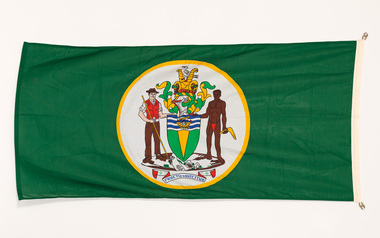
Flag, Evan Evans, City of Brighton flag
... depicts the progression from a seaside gardening community to a modern residential city. The prominent forms are on the shield-like coat of arms include waves and a Lymphad (a ship, symbolic of the sea); a market gardener; an aboriginal man; two horns of plenty with abundant fruit and vegetables (the wealth and plenty) and Elster Creek (now Elster Canal). ...depicts the progression from a seaside gardening community to a modern residential city. The prominent forms are on the shield-like coat of arms include waves and a Lymphad (a ship, symbolic of the sea); a market gardener; an aboriginal man; two horns of plenty with abundant fruit and vegetables (the wealth and plenty) and Elster Creek (now Elster Canal). ...The coat of arms on this flag were granted by the British College of Arms in 1970 and represented Brighton City Council's "growing awareness of the importance of formality and correct symbolism in local government". It replaced the council's crest of a pier and yachting scene and was used as council's seal, emblem on its flag and letterhead. The new Coat of Arms, drawn up by the College of Arms in England, depicts the progression from a seaside gardening community to a modern residential city. The prominent forms are on the shield-like coat of arms include waves and a Lymphad (a ship, symbolic of the sea); a market gardener; an aboriginal man; two horns of plenty with abundant fruit and vegetables (the wealth and plenty) and Elster Creek (now Elster Canal). It is underscored by the motto "By their fruits, ye shall know them". Brighton was first incorporated as a borough on 18 January 1859, it became a town on 18 March 1887 and was proclaimed a city on 12 March 1919.Green flag with circular City of Brighton Coat of Arms in the centre. The central circle is white with a yellow edge, with a polychrome coat of arms featuring: the crest which is two cornucopia with fruits and vegetables, above sits a seagull. The mantle above the helmet is in green and gold. The shield is also green and gold with a lymphad (ship) and blue and white waves. The market gardener, holding a hoe, and Aboriginal figure, bearing a boomerang, support the shield and stand upon the compartment which is soil with a representation of Elster creek. A ribbon below contains the motto in blue 'FRUCTU NOSCITUR'.flag, brighton, city of brighton, coat of arms, college of arms, market gardener, aboriginal, elster creek, lymphad, fructu noscitur, armorial bearings, heraldry, cornucopia, by their fruits ye shall know them, motto -
 National Wool Museum
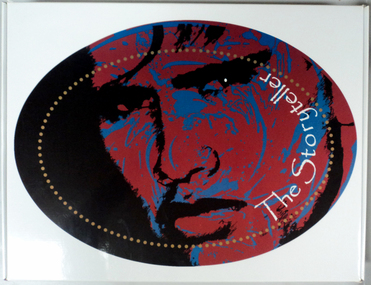
Leisure object - Game, The Storyteller, 2004
... Games Board Games First Nations Aboriginal Identity Place Belonging The Storyteller Board game based on Indigenous education. White box with an oval shaped design on the front depicting the face of a man in red. ...The board game, titled The Storyteller, was created by Geelong Wathaurong/Ngarrindjeri man Glenn Shea, who was a youth justice worker at the Wathaurong Aboriginal Co-operative when the game was created. The idea for The Storyteller evolved through Glenn's personal experience of working with Aboriginal adolescents and young people. Board game based on Indigenous education. White box with an oval shaped design on the front depicting the face of a man in red.The Storytellergames, board games, first nations, aboriginal, identity, place, belonging -
Clunes Museum
Book, Fred Cahir, My Country All Gone The White Men Have Stolen It - The Invasion of the Wadawurrung Country 1800-1870, 2019
... Soft Cover book , depicts a young Aboriginal women wrapped in a possum skin cloak standing in front of an early topographical map of Port Phillip. 348 pages....Soft Cover book , depicts a young Aboriginal women wrapped in a possum skin cloak standing in front of an early topographical map of Port Phillip. 348 pages. ...THIS BOOK REALLY BEGAN ON THE NULLABORE PLAIN IN 1983 WHEN I WAS CYCLING SOLO ACROSS AUSTRALIA FROM PERTH TO MELBOURNE...Soft Cover book , depicts a young Aboriginal women wrapped in a possum skin cloak standing in front of an early topographical map of Port Phillip. 348 pages.non-fictionTHIS BOOK REALLY BEGAN ON THE NULLABORE PLAIN IN 1983 WHEN I WAS CYCLING SOLO ACROSS AUSTRALIA FROM PERTH TO MELBOURNE...first nations history, wadawurrung country -
Clunes Museum
Book, Fred Cahir, THEY RESCUED US! ABORIGINAL HEROES ON COUNTRY
... ABORIGINAL PEOLE ACROSS AUSTRALIA FROM THE EARLIEST DAYS... WRITTEN IN LEAD PENCIL ON FIRST PAGE - $35 .1 SOFT COVER BOOK. FRONT COVER ILLUSTATION OF A MAN HOLDING A HAT ALOFT. HORSE IN FRONT OF TREE, TAN AND BROWN COLOURED DEPICTION ...THIS BOOK AIMS TO ILLLUMINTAE HERIOIC REUCRES BY ABORIGINAL PEOPLE OF NON-ABORIGINAL PEOLE ACROSS AUSTRALIA FROM THE EARLIEST DAYS....1 SOFT COVER BOOK. FRONT COVER ILLUSTATION OF A MAN HOLDING A HAT ALOFT. HORSE IN FRONT OF TREE, TAN AND BROWN COLOURED DEPICTION A YOUNG PERSON, LIES AT THE FOOT OF THE MAN. .2 POSTCARDnon-fictionTHIS BOOK AIMS TO ILLLUMINTAE HERIOIC REUCRES BY ABORIGINAL PEOPLE OF NON-ABORIGINAL PEOLE ACROSS AUSTRALIA FROM THE EARLIEST DAYS...first nations, waddawurrung country -
 Wangaratta RSL Sub Branch
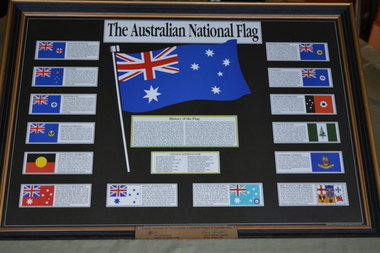
Poster - Framed poster, The Australian National Flag, c1992
... Australian National Flag Montage depicting 15 Australian flags, including Naval, Military and Aboriginal flags - with history and details of each flag, also featuring the words of our National Anthem...Australian National Flag Montage depicting 15 Australian flags, including Naval, Military and Aboriginal flags - with history and details of each flag, also featuring the words of our National Anthem Australia entered the first world war with three flags representing its dual nationality: the Union Jack as national flag and its two Australian ensigns. ...Australian National Flag Montage depicting 15 Australian flags, including Naval, Military and Aboriginal flags - with history and details of each flag, also featuring the words of our National AnthemAustralia entered the first world war with three flags representing its dual nationality: the Union Jack as national flag and its two Australian ensigns. All three featured in recruiting drives for the Australian Imperial Force (the AIF). At that time the Union Jack was clearly regarded as the most importantBlack and gold painted frame containing montage of Australian flag and 14 smaller flags with boxed narratives.The Australian National Flag Gold Plaque - Proudly endorsed by the Returned & Services League of Australia 1992 Signed by Brigadier A B Garland AM and B C Ruxton OBEflags, australian, australian states and territories -
 Hepburn Shire Council Art and Heritage Collection
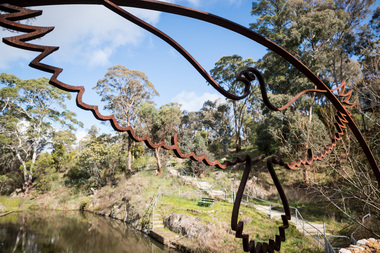
Public Art Work, 'Bunjil' - Russell Petherbridge. 2012, 2012
... Information provided by Russell Petherbridge, December 2015 art public art sculpture installation art aboriginal art site specific art hepburn shire hepburn shire public art collection russell petherbridge bunjil hepburn hepburn pool aboriginal significance steel sculpture Large scale steel sculpture depicting 'Bunjil', the dreamtime totem of the Hepburn Pool, an eagle in flight. ...'Hepburn Pool is a forgotten treasure which many visitors to Hepburn Springs would never be aware of. The owners of the Bellinzona Grange hotel explained that it was once the hotel pool and was built in the 1930's. You can find it behind this hotel, downhill at a street called The Pool Way. Steps and a ramp continue down to the pool itself and the secluded park around it. It was built into Spring Creek and became a competition pool for state swimming championships. A concrete weir separates a shallow children's pool from the main pool. You can still see the numbers of each lane painted on the walls at the deep end. There are plenty of seats and a barbeque area. A sign says this is a sacred aboriginal spot and you can certainly feel something magical about the place. I wouldn't suggest swimming in the former pool, it looks rather murky now.' Review of Hepburn Pool by 'Jolyon67' on 'Tripadvisor', 3 June 2015'The Bunji: The Bunjil sculpture emerged from discussions with local indigneous Elders, as a dreamtime totem to the Sacred Pool at Hepburn Springs. The original idea was to create the 3 totems of the area...the Bunjil, The Crow and The Bat. Russell applied for, a council grant of $3,000 to design, create and install the Bunjil Sculpture to overlook the pool and reflect its powerful image in the water.' Information provided by Russell Petherbridge, December 2015Large scale steel sculpture depicting 'Bunjil', the dreamtime totem of the Hepburn Pool, an eagle in flight.art, public art, sculpture, installation art, aboriginal art, site specific art, hepburn shire, hepburn shire public art collection, russell petherbridge, bunjil, hepburn, hepburn pool, aboriginal significance, steel sculpture -
![Painting, [Spirit] by Marley Smith, 2004](/media/collectors/530576742162ef0fa09a2288/items/534748169821f420f8c0385a/item-media/5ee0502521ea671dc4225c50/item-fit-380x285.jpg?cb=6) Federation University Art Collection
Federation University Art CollectionPainting, [Spirit] by Marley Smith, 2004
... The Art Collection features over 1000 works and was listed as a 'Ballarat Treasure' in 2007. art artwork marley smith smith indigenous aboriginal alumni This painting depicts the spirit of the Australian INdigenous education Conference held at the university in 2004. ...Marley SMITH A Gundijtmara woman, Marley Smith has lived in Ballarat all of her life and has strong ties with family. Marley Smith completed the Ballarat Schoo of Mines Koori Art Course in 1995. This item is part of the Federation University Art Collection. The Art Collection features over 1000 works and was listed as a 'Ballarat Treasure' in 2007.This painting depicts the spirit of the Australian INdigenous education Conference held at the university in 2004. The central circle represents a meeting place. "It's all about ... coming together and to understand and educate one another on everyone's culture - if you have no understanding, then there's no way of learning. [Marley Smith]art, artwork, marley smith, smith, indigenous, aboriginal, alumni -
 Federation University Art Collection
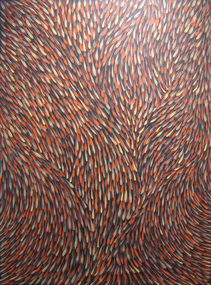
Painting, Gloria Petyarre, 'Bush Medicine' by Gloria Petyarre
... The Art Collection features over 2000 works and was listed as a 'Ballarat Treasure' in 2007. art artwork gloria petyarre aboriginal utopia ‘Bush Medicine Dreaming’ depicts the leaves of a special plant that is used to aid in the healing process. ...Gloria PETYARRE (c.1942 - 2021) Born: Mosquito Bore, Utopia, Northern Territory Language Group: Anmatyerre Community: Utopia, Northern Territory Gloria Petyarre's depiction of the Kurrajong bush medicine leaves with her layered, swirling brushstrokes is her iconic motif. In 1999 Gloria Petyarre became the first Indigenous Australian artist to win the 'Wynne Prize for Landscape' at the New South Wales Gallery. She is credited with being the creator of this popular style, which was adopted and adapted by several generations of her family members over Gloria's retirement in 2019. The artistic tradition in Utopia started in the Utopia Women's Silk Batik Group introduced in 1977. Gloria Petyarre and her aunt Emily Karne Kngwarrye were found members of this group. Gloria Petyarre started painting on canvas in 1988 with her brushstrokes and layered paint having foundations in the batik tradition. This item is part of the Federation University Art Collection. The Art Collection features over 2000 works and was listed as a 'Ballarat Treasure' in 2007.Utopian Art Movement‘Bush Medicine Dreaming’ depicts the leaves of a special plant that is used to aid in the healing process. The leaves are collected and then boiled to extract the resin. Following this, the resin is mixed with kangaroo fat collected from the kangaroo’s stomach. This creates a paste that can be stored for up to six months in bush conditions. This medicine is used to heal cuts, wounds, bites, rashes and as an insect repellent. The Dreaming that is the basis for Petyarre’s paintings comes from the important ceremonies and traditions held by the people of Atnwengerrp. art, artwork, gloria petyarre, aboriginal, utopia -
Federation University Art Collection
Work on paper - Digital Prints, Gilson, Deanne, 'Wadawurrung Axe Heads 1-4' by Deanne Gilson, 2011
... The Art Collection features over 2000 works and was listed as a 'Ballarat Treasure' in 2007. art artwork deanne gilson gilson Wadawurrung stone axe aboriginal alumni This work depicts an axehead found on Wadawurrung country and is a responce to workign alongside archeologists untertaking land surveys of her ancestral lands and the visual documentaiton of artefcts. ...Dr Deanne GILSON (1967- ) Country: Wadawurrung Deanne Gilson is a Federation University alumni, and an award-winning multi-disciplinary artist. Her practice draws its inspiration from ‘Ancestral marks’ and design on cultural objects found in museum archives and family oral histories. Deanne’s practice seeks to interrogate the colonial legacy of settlement and the western hegemonic systems of class, race and representation in historical photographs that were imposed on her Ancestors. Her work also explores the matriarchal role through her feminist perspectives, looking at the history of marriage and the oppressive function it has played within her family. Deanne has completed the following educationala achievements. 2014 – 2015 Masters by Research (Visual Art), Deakin University Geelong 2013 Graduate Diploma in Education Secondary, Federation University 2011 Certificate IV in Aboriginal Contemporary Art & Craft 2010 Cultural Heritage Management Course, Lakes Entrance 1 Week 2007 – 2010 Graduated, Bachelor of Visual Arts with Honours, University of Ballarat 1984 Diploma of Art, School of Mines & Industries TAFE This item is part of the Federation University Art Collection. The Art Collection features over 2000 works and was listed as a 'Ballarat Treasure' in 2007.This work depicts an axehead found on Wadawurrung country and is a responce to workign alongside archeologists untertaking land surveys of her ancestral lands and the visual documentaiton of artefcts.art, artwork, deanne gilson, gilson, wadawurrung, stone axe, aboriginal, alumni -
 Federation University Art Collection
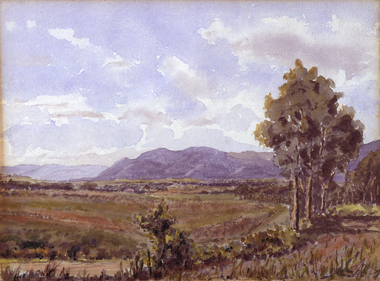
Painting - Watercolour, 'Mount Dandenong' by Dr Sydney Pern
... Aboriginal artefacts during travels in Central and Northern Australia. This item is part of the Federation University Art Collection. The Art Collection features over 2000 works and was listed as a 'Ballarat Treasure' in 2007. art artwork sydney pern landscape mount dandenong Watercolour landscape glued onto card depicting a view towards Mount Dandenong. ...Sydney PERN (c1876-23 October 1967 ) Born Battley, England Dr Sydney Pern began practicing medicine in the Victorian town of Yarram before setting up practice in Ballarat. He was a competent artist, and as an amateur anthropologist collected Aboriginal artefacts during travels in Central and Northern Australia. This item is part of the Federation University Art Collection. The Art Collection features over 2000 works and was listed as a 'Ballarat Treasure' in 2007.Watercolour landscape glued onto card depicting a view towards Mount Dandenong.art, artwork, sydney pern, landscape, mount dandenong -
 Federation University Art Collection
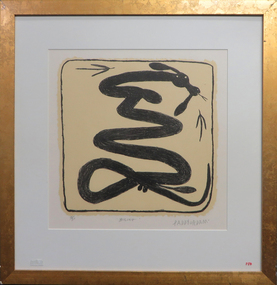
Artwork, other - Artwork - Printmaking, Lytlewode Press, 'Bolunga' by Paddy Fordham
... Paddy FORDHAM WAINBURRANGA (c1930-2006) (Katherine, Northern Territory) bolung rainbow serpent rembarrnga paddy fordham wainburranga paddy fordham wainburranga artist artworks aboriginal Framed lithograph where artist Paddy Fordham Wainburranga has depicted 'Bolung', the Rainbow Serpent, an important life giving figure for the Rembarrnga people whose clan country lies to the south and west of Ramingining, towards the Katherine area. ...Paddy FORDHAM WAINBURRANGA (c1930-2006) (Katherine, Northern Territory)Framed lithograph where artist Paddy Fordham Wainburranga has depicted 'Bolung', the Rainbow Serpent, an important life giving figure for the Rembarrnga people whose clan country lies to the south and west of Ramingining, towards the Katherine area. Donated through the Australian Gifts Programme by Katherine Littlewood.bolung, rainbow serpent, rembarrnga, paddy fordham wainburranga, paddy fordham, wainburranga, artist, artworks, aboriginal -
 Lilydale RSL Sub Branch
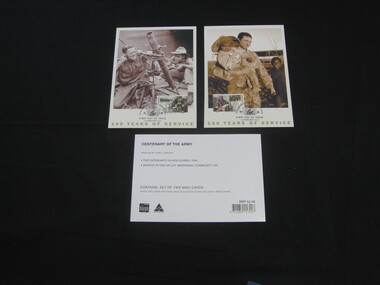
Stamp maxi cards, 100 Years of Service
... One depicting two Sergeants in New Guinea in 1944 and one depicting service in Oak Valley Aboriginal Community, SA. First day of issue 15 Feb 2001 ...One depicting two Sergeants in New Guinea in 1944 and one depicting service in Oak Valley Aboriginal Community, SA. First day of issue 15 Feb 2001 100 Years of Service Stamp maxi cards ...Set of two maxi cards each with 45 stamp. One depicting two Sergeants in New Guinea in 1944 and one depicting service in Oak Valley Aboriginal Community, SA. First day of issue 15 Feb 2001 -
 Lilydale RSL Sub Branch
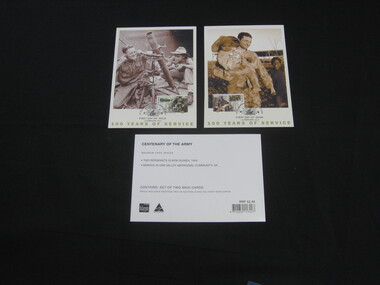
Postcards Stamps
... Depicting two Sergeants in New Guinea 1944 with historical stamp - First day of issue 15 Feb 2001. Service in Oak Valley Aboriginal Community South Australia - First day of issue 15 Feb 2001 (2 sets)...Depicting two Sergeants in New Guinea 1944 with historical stamp - First day of issue 15 Feb 2001. Service in Oak Valley Aboriginal Community South Australia - First day of issue 15 Feb 2001 (2 sets) Postcards Stamps ...Depicting two Sergeants in New Guinea 1944 with historical stamp - First day of issue 15 Feb 2001. Service in Oak Valley Aboriginal Community South Australia - First day of issue 15 Feb 2001 (2 sets) -
 Tramways/East Melbourne RSL Sub Branch - RSL Victoria Listing id: 27511
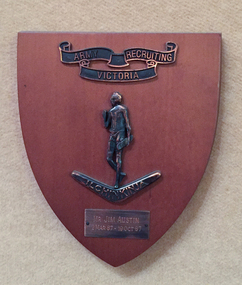
Memorabilia - Army Recruiting Victoria Plaque, c. 1987
... No historical information available at present. army recruitment commemorative plaques boomerangs cultural identity jim austin aboriginal depictions Plate on bottom of piece states "Mr Jim Austin, 2 March 1987 - 19 October 1987". ...No historical information available at present. Bronze pieces mounted on wood as a plaque. Pieces state 'Army Recruiting Victoria' and ' ILCHINKINJA' on the boomerang at the bottom of the piece. Plate on bottom of piece states "Mr Jim Austin, 2 March 1987 - 19 October 1987". army, recruitment, commemorative plaques, boomerangs, cultural identity, jim austin, aboriginal depictions -
Ballarat Heritage Services
Print - Printmaking
... Shorty Jangala Robertson uses strong colour of colour to depict his Dreamings, which include Ngapa (Water), Watiyawarnu (Acacia), Yankirri (Emu) and Pamapardu (Flying Ant). He continued to live at Yuendumu with his family until his passing in 2014. aboriginal Shorty Jangala Robertson Signed with an X Colour sugarlift acquatint of fruit bats, printed in colour inks, from multiple stencils. ...Shorty Jangala Robertson (c1930s-2014) Born Jila (Chilla Well). A large soakage clay pan near Yuendumu, approx 300kms north west of Alice Springs in Central Australia. He lived a nomadic with his family having virtually no contact with white people during his youth but remembers leaving Jila for Mt Theo 'to hide' from being shot. His father died at Mt Theo and then with his mother he moved to the new settlement of Yuendumu. His working life was full of adventure and he worked for different enterprises in the Alice Springs/Yuendumu area, finally settling at Yuendumu in 1967. In all of his travels and jobs over his whole working life, he escaped the growing Central Desert art movement. It was not until much later in his life that he began to paint. Shorty Jangala Robertson uses strong colour of colour to depict his Dreamings, which include Ngapa (Water), Watiyawarnu (Acacia), Yankirri (Emu) and Pamapardu (Flying Ant). He continued to live at Yuendumu with his family until his passing in 2014. Colour sugarlift acquatint of fruit bats, printed in colour inks, from multiple stencils. The work features cross hatching (rarrk).Signed with an Xaboriginal, shorty jangala robertson -
Ballarat Heritage Services
Work on paper, Bede TANGUTALUM, Yam, 1991
... Bede Tangutalum Tiwi Wurrumiyanga Bathurst Island Tiwi Design Yam Aboriginal Framed lithograph depicting yams, printed in colour inks, from multiple stones Yam Work on paper Bede TANGUTALUM ...Bede TANGUTALUM (1952- ) Wurrumiyanga (Nguiu), Bathurst Island Tiwi People Bede Tungutalum works across a range of media, including carved and painted wooden sculpture,printmaking and painting. Tungutalum learned carving from his father, the well-known sculptor Gabriel Tungutalum, and was taught how to cut woodblocks for printing while attending Xavier Boys School at Nguiu. He refined and developed these techniques in the late 1960s and early 1970s. His earliest prints date from the late 1960s. In 1969, with fellow Tiwi artist Giovanni Tipungwuti, Bede Tungutalum established Tiwi Design, an art centre dedicated to the production of hand-printed fabrics featuring traditional Indigenous designs.Framed lithograph depicting yams, printed in colour inks, from multiple stonesbede tangutalum, tiwi, wurrumiyanga, bathurst island, tiwi design, yam, aboriginal -
 Whitehorse Historical Society Inc.
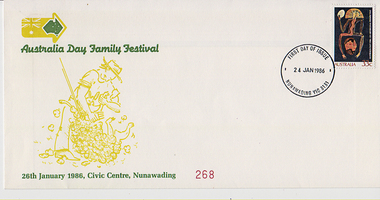
Functional object - Envelope, 1986
... Aboriginal Perspective'. Postmarked 'First Day of Issue 24 Jan 1986 Nunawading Vic 3131' At left of envelope, logo and depiction of shearer shearing sheep; also 'Australia Day Family Festival' and '26th January 1986, Civic Centre, Nunawading'. ...Aboriginal Perspective'. Postmarked 'First Day of Issue 24 Jan 1986 Nunawading Vic 3131' At left of envelope, logo and depiction of shearer shearing sheep; also 'Australia Day Family Festival' and '26th January 1986, Civic Centre, Nunawading'. ...The Nunawading Council produced commemorative First Day Covers showing First Day of issue stamp during the years 1981-1992Three First Day Covers, each bearing 33 cent stamp, reproduction of painting of 'Australia Day 1986: An Aboriginal Perspective'. Postmarked 'First Day of Issue 24 Jan 1986 Nunawading Vic 3131' At left of envelope, logo and depiction of shearer shearing sheep; also 'Australia Day Family Festival' and '26th January 1986, Civic Centre, Nunawading'. Envelopes numbered 119, 120, 268Municipal Offices Nunawading Vic 3131philately, date stamps, civic mementoes, souvenirs -
 Dandenong/Cranbourne RSL Sub Branch
Plaque - Army Careers plaque
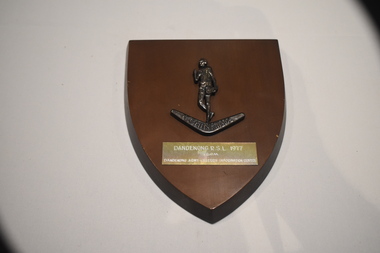
... From Dandenong Army Careers Information Centre. Depiction of Aboriginal stood on boomarang inscribed " ILCHINKINJA ". ...From Dandenong Army Careers Information Centre. Depiction of Aboriginal stood on boomarang inscribed " ILCHINKINJA ". ...The name ILCHINKINJA was given to the Arunta Tribe messenger and was to summon young men for initiation. The name is derived from the Arunta words " ILACH " (a hand) and IKINJA ( to raise ). Best expressed by the phrase " The Beckoning Hand ".Metal statue on wooden plaque.Dandenong RSL 1977. From Dandenong Army Careers Information Centre. Depiction of Aboriginal stood on boomarang inscribed " ILCHINKINJA ". -
 Federation University Art Collection
Work on paper - Printmaking - Multiplate Etching, Dean Bowen, 'The Car Park' by Dean Bowen, 1994
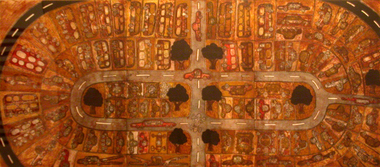
... Aboriginally is further given by his use of earthy browns and by the outlining of shapes (cars, roads, trees).' (Susan McCulloch) This work was selected by the Art Acquisitions Committee (1995) to be placed in the 1870 Founders Hall at Mt Helen Campus. The Federation University Art Collection features over 2000 works and was listed as a 'Ballarat Treasure' in 2007. art artwork dean bowen bowen etching multi-plate etching printmaking printmaking etching carpark Edition 12/20 A multiprint etching depicting a carpark that won the 1994 Fremantle Print Award; 'The Car Park' by Dean Bowen Work on paper Printmaking - Multiplate Etching Dean Bowen ...Dean BOWEN (1957 -) Born Maryborough, Victoria Dean Bowen's work combines humour and gentle irony with technical proficiency to explore the world around him. 'The car park epitomises qualities found in the best of his post 1990 work. Born out of the daily grind of stop-start commuting by car along Melbourne's Punt Road to and from his former workplace, the feeling of this large work (just over two metres long) is of duality. On the one hand there is the crowded chaos of a relentless number of cars choking the roads; on the other, order is imposed in his aerial view of cars 'parked' around intersecting roads as well as the actual charting of roads and interstitial spaces. Zooming in as though from above, cars are alternately cross-sectioned and flattened in outline. Despite his denial that there is nothing reminiscent of Aboriginal art in this work, to the onlooker there are quite a number of similarities. Not that he presumes anything of the Aboriginal experience or imagery (indeed, that it is unconscious is probably the only reason it works), such qualities are nevertheless present. The aerial perspective, for example, is so like the Aboriginal system of painting song lines and dreaming tracks from above. And as seen in the famous 'X ray' paintings of Arnhem Land, his cars and buildings are cross-sectioned to reveal the objects (usually humans) within. The impression of Aboriginally is further given by his use of earthy browns and by the outlining of shapes (cars, roads, trees).' (Susan McCulloch) This work was selected by the Art Acquisitions Committee (1995) to be placed in the 1870 Founders Hall at Mt Helen Campus. The Federation University Art Collection features over 2000 works and was listed as a 'Ballarat Treasure' in 2007.A multiprint etching depicting a carpark that won the 1994 Fremantle Print Award;Edition 12/20art, artwork, dean bowen, bowen, etching, multi-plate etching, printmaking, printmaking etching, carpark -
 Federation University Art Collection
Sculpture - Mace, 'University Mace' by Trefor Prest, 1995
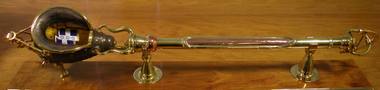
... The mace's straight shaft is depicted as the tree of knowledge and, incorporating a bark canoe scar, Ballarat's Aboriginal heritage. ...The mace's straight shaft is depicted as the tree of knowledge and, incorporating a bark canoe scar, Ballarat's Aboriginal heritage. ...The University's mace was carried in procession for the first time during the Graduation ceremonies in May 1996. The mace was presented to the University by former Chief Commissioner of the Ballarat City Council, Vern Robson, at a ceremony on 02 February, following a national competition for its design, sponsored by the Council. (The Flag, Issue 2, July 1996) Nineteen artists responded to the competition which called for a design that would embody a distinctive Australian image reflecting the heritage of the city and in relationship with gold, an Aboriginal element and the history of the University. The winning entry, dominated by a poppet head, was submitted by Central Victorian artist/sculptor Trefor Prest, a sessional lecturer in sculpture at the University.(The Flag, Issue 2, July 1996) The Herald Sun of 03 February 1996 reported 'the new mace shows importance elements of Ballarat's heritage as well as the university's focus on the future. The artist emphasises the egalitarian nature of Australia as embodied in Ballarat's famous slice of history - the Eureka uprising. ... The mace has a poppet head at the top of the shaft - an unusual element for a mace - but it represents Ballarat's mining history and the University's evolution from the Ballarat School of Mines. An opening egg at the top stands for the nurturing of development and learning. The mace's straight shaft is depicted as the tree of knowledge and, incorporating a bark canoe scar, Ballarat's Aboriginal heritage. At the end of the shaft is a surveying device, which represents precision and accuracy ads embodied in the university's academic pursuits.' Bob Morrell of the University organised the national competition to design the mace and said 'It is in keeping with the university's logo, 'proudly flying the flag', which incorporates the Southern Cross.' This item is part of the Federation University Art Collection. The Art Collection features over 1000 works and was listed as a 'Ballarat Treasure' in 2007. Trefor Prest lectured in Sculpture at the University of Ballarat from 1995-1996.The mace symbolises the office of the Chancellor. The design of the mace is the outcome of a national competition and represents the cultural diversity of Australia. The poppet head on the top of the mace refers to gold mining, which underpinned the development of Ballarat. The protruding spikes recall the Eureka Stockade. The 'egg' shape enfolds and nurtures the development of knowledge and learning. The shaft with the three 'branches' represents the Tree of Knowledge, and includes a bark canoe scar which recognises the integration of black and white Australian traditions. The lower part of the shaft culminates in a device suggestive of scientific or surveying and measuring technology. This represents precision and accuracy embodied in the academic pursuits of Federation University Australia.art, artwork, trefor prest, prest, mace, federation university, university, eureka stockade, aborigines, scarred tree, mining, university mace, ballarat
