
Showing 632 items matching "innovation"
-
 Victorian Aboriginal Corporation for Languages
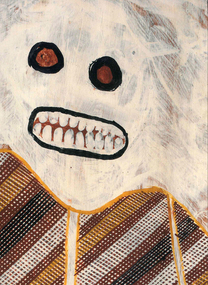
Book, Hetti Perkins, Crossing country : the alchemy of Western Arnhem Land art, 2004
... Hetti Perkins introduces this collection of reproductions of of Western Arnhem Land bark paintings, rock art, woven fibre art and wooden sculpture that was exhibited by the Art Gallery of NSW in 2004, emphasising the cultural foundations of the Kuninjku artists, their beliefs, artistic conventions and innovations. The book includes interviews with traditional rock and bark artists (including some language), and essays describing the connection of the people to the land, their spiritual beliefs and their art. ...Colour photographs Hetti Perkins introduces this collection of reproductions of of Western Arnhem Land bark paintings, rock art, woven fibre art and wooden sculpture that was exhibited by the Art Gallery of NSW in 2004, emphasising the cultural foundations of the Kuninjku artists, their beliefs, artistic conventions and innovations. The book includes interviews with traditional rock and bark artists (including some language), and essays describing the connection of the people to the land, their spiritual beliefs and their art. ...Hetti Perkins introduces this collection of reproductions of of Western Arnhem Land bark paintings, rock art, woven fibre art and wooden sculpture that was exhibited by the Art Gallery of NSW in 2004, emphasising the cultural foundations of the Kuninjku artists, their beliefs, artistic conventions and innovations. The book includes interviews with traditional rock and bark artists (including some language), and essays describing the connection of the people to the land, their spiritual beliefs and their art. There are also reproductions of works on paper and woven forms and an essay on the role of women in producing these art forms. An essay by Professor Jon Altmann is entitled "Brokering Kuninjku Art: Artists, Institutions and the Market. A chronolgy details the history of aboriginal art in the area, there are biographies of the artists whose works were included in the exhibition, a list of the works themselves, a glossary of place names, art terms, aboriginal, linguistic and anthropological terms, and a select bibliography. The list of contributors includes, as well as the two mentioned above, Dr Murray Garde, Apolline Kohen, Steven Miller, Cara Pinchbeck and Dr Luke Taylor.Colour photographs -
 Federation University Historical Collection
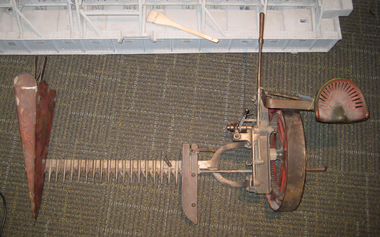
Model, Model of the Munro Reaper, 1887
... An example of good invention in an era of innovation in Australian manufacture and production. ...An example of good invention in an era of innovation in Australian manufacture and production. ...An example of good invention in an era of innovation in Australian manufacture and production. Levers raise the height of the cutter, disengaging the drive from the blades. The moveable blades under the fixed ‘fingers’. An eccentric rod changes circular motion to linear back and forth of the blades. Such a machine is now known as a mower for cutting grass for hay, and other grasses for storing as sheaves. 'Gift for Museum - The School of Mnes committee has accepted the offer from mr H.B. Munro, of Elsternwick, of a model reaping machine made in 1887 when the Munro machinery business was in operation in Alfredton. The model, which has won gold medals at various exhibitions, is to be placed in thr school museum. (Ballarat Courier 22 April 1932) Metal model with red paint detail in sectionsM263ballarat school of mines, ballarat school of mines museum, munro machinery, model, munro reaper -
 Phillip Island and District Historical Society Inc.
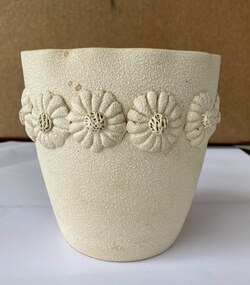
Functional object, Vases by Eric Juckert and Henning Rathjen
... Henning Alfred Rathjen (1903–1968) was one of the Australian-born artists who established a new pottery studio to cater for local demand and post-war innovations in art pottery. Rathjen established his pottery studio in Melbourne in 1948, producing quality slip-cast wares over the next 20 years. ...Henning Alfred Rathjen (1903–1968) was one of the Australian-born artists who established a new pottery studio to cater for local demand and post-war innovations in art pottery. Rathjen established his pottery studio in Melbourne in 1948, producing quality slip-cast wares over the next 20 years. ...Eric Juckert He worked as a potter and painter from around 1949 to 1992 in Victoria. His pottery was also sold by the department stores Myer and David Jones under the trade name “Jacqueline”.He then set up a studio at Point Road, Grossard Point, Ventnor on Phillip Island, in 1959 where he continued working there until 1992. Henning Alfred Rathjen (1903–1968) was one of the Australian-born artists who established a new pottery studio to cater for local demand and post-war innovations in art pottery. Rathjen established his pottery studio in Melbourne in 1948, producing quality slip-cast wares over the next 20 years. HistoricalCream, rough surfaced vase with oval pinched top and daisies in relief around top by Eric Juckert. Small, cream rough surfaced vase with top that flares outward with leaves and cutout sections by Henning Rathjen.Eric Juckert, Rathjen, pottery, vases, eric juckert, henning rathjen -
 Sunshine and District Historical Society Incorporated
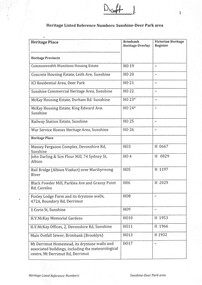
Document - Sunshine And Deer Park Heritage Listed Reference Numbers
... Brimbank’s heritage‑listed properties are protected because they demonstrate important aspects of the area’s history — industrial innovation, early settlement, worker housing, civic development, and significant Aboriginal cultural landscapes. ...Brimbank’s heritage‑listed properties are protected because they demonstrate important aspects of the area’s history — industrial innovation, early settlement, worker housing, civic development, and significant Aboriginal cultural landscapes. ...Brimbank’s heritage‑listed properties are protected because they demonstrate important aspects of the area’s history — industrial innovation, early settlement, worker housing, civic development, and significant Aboriginal cultural landscapes. This document is an extract from the "Collection Document Project" prepared for Mr. Frank Ford, Sunshine & District Historical Society (See Catalogue No 5756). The document lists heritages place names, Brimbank Heritage Overlay Numbers and Victorian Heritage Register Numbers. Notes: 1. This list does not include heritage listed places from the former City of Sunshine currently in the City of Footscray. 2. This list does not include heritage listed places in St. Albans. 3. The date of this list is C2009.Heritage Listed Reference Numbers: Sunshine - Deer Park area 5741 - Sunshine And Deer Park Heritage Listed Reference Numbers Page 1.jpg Heritage Precincts Commonwealth Munitions Housing Estate BCC H019 Concrete Housing Estate Leith Avenue Sunshine BCC H020 ICI Residential Area Deer Park BCC H021 Sunshine Commercial Heritage Area BCC H022 McKay Housing Estate Durham Road BCC H023 McKay Housing Estate King Edward Avenue BCC H024 Railway Estate Sunshine BCC H025 War Service Homes Heritage Area Sunshine BCC H026 Heritage Place Massey Ferguson Complex Devonshire Road Sunshine BCC H03 VH H0667 John Darling & Son Flour Mill 74 Sydney Street Albion BCC H04 VH H0827 Rail Bridge (Albion Viaduct) Over Maribyrnong River BCC H05 VH H1197 Black Powder Mill Parklea Avenue And Grassy Point Road Cairnlea BCC H06 VH H2029 Foxley Lodge Farm And Its Drystone Walls 472A Boundary Road Derrimut BCC H08 1 Corio Steet Sunshine BCC H09 H.V. McKay Memorial Gardens BCC H010 VH 1953 H.V. McKay Offices 2 Devonshire Road Sunshine BCC H010 VH H1953 Main Outfall Sewer Brimbank (Brooklyn) BCC H013 VH H1932 Mt. Derrimut Homestead, Its Drystone Walls And Associated Buildings Including The Meteorological Centre Mt. Derrimut Road Derrimut BCC H017 5741 - Sunshine And Deer Park Heritage Listed Reference Numbers Page 2.jpg Heritage Place (Cont) Albion VR DC Substation Talmage Street Albion BCC H028 Pig And Calf Market 55 Market Road Brooklyn BCC H029 Monsanto Chemicals Huntsman Chemical Co 455 Somerville Road Brooklyn BCC H030 Deer Park Explosive Factories Complex Off Ballarat Road Deer Park BCC H032 Hume And Hovell Cairn Cnr Station Road And Ballarat Road Deer Park BCC H034 Sunshine Signal Box Off Hampshire Road BCC H039 Black Arch Rail Bridge Sunshine Road Sunshine BCC H040 Sugar Gum Row Talmage Street Albion BCC H042 Sunshine Advocate Office 11 - 15 Sun Crescent Sunshine BCC H051 H.V. McKay Memorial Gates Anderson Road Sunshine BCC H053 H.V. McKay Memorial Presbyterian Church Anderson Road Sunshine BCC H054 Sam McKay House And Garden 147 Anderson Road Sunshine BCC H055 Former Sunshine Technical School Derby Road Sunshine BCC H056 Former Sunshine Girls Technical School Derby Road Sunshine BCC H057 Pedestrian Footbridge Over Railway 1 Devonshire Road Sunshine BCC H058 House At 48 Station Place Sunshine BCC H061 ANZ Bank Former ES&A Bank 115 Durham Road Sunshine BCC H063 Sunshine Metropolitan Fire Station And Flats 330 Hampshire Road Sunshine BCC H064 Derrimut Hotel 132 Durham Road Sunshine BCC H065 St. Mark's Anglican Church 49 Suns Crescent Sunshine BCC H066 Robinson House 33 Sun Crescent Sunshine BCC H067 St. Theresa Catholic Church & School 26 Adelaide Street Albion BCC H070 5741 - Sunshine And Deer Park Heritage Listed Reference Numbers Page 3.jpg Heritage Place (Cont) Curacloe BCC H073 Former Wunderlich Now West End Market 47 - 49 McIntyre Road Sunshine North BCC H073 Selwyn Park Albion BCC H074 Sunshine Baptist Church 42 Ridley Street & 16 Sydney Street Albion BCC H075 Cameron House & Dairy BCC H076 Houses & Trees 22 - 24 Talmage Street Albion BCC H077 Ford (Solomon Ford) Burke Road To Canning Street Avondale Heights BCC H079 Lions House Of Sunshine 8 Watt Street Sunshine BCC H080 Guiding Star Hotel 700 Geelong Road Brooklyn BCC H081 Hunt Club Hotel 775 Ballarat Road Deer Park BCC H082 Deer Park Hotel 760 Ballarat Road Deer Park BCC H083 Deer Park Primary School No 1434 812 Ballarat Road Deer Park BCC H084 Opie's Dairy 2 - 4 Egan Street Deer Park BCC H086 St. John's Anglican Church & Hall 2 - 4 Miles Street Deer Park BCC H087 Neale Road Ford 192 Neale Road Deer Park BCC H088 Deer Park Hall 50 Station Road Deer Park BCC H089 Sunshine Market 13 - 19 City Place Sunshine BCC H091 Methodist Church & Hall 32 Devonshire Road Sunshine BCC H0105 Macedonian Community Centre 45 Fourth Avenue Sunshine BCC H0106 Hannah McKay House 145 Anderson Road Albion BCC H0107 Chemist Shop 234 Hampshire Road Sunshine BCC H0108 Sunshine Municipal Offices 6 - 18 Alexandra Avenue Sunshine BCC H0109 Sunshine Primary School 3113 111 Derby Road Sunshine BCC H0110 Standard Steel 12 - 16 Market Road Sunshine BCC H0111 Our Lady of the Immaculate Conception Catholic Church 93 Monash Street Sunshine BCC H0113 Parsons House 114 Moris Street Sunshine BCC H0114 Our Lady's School Station Place Monash Street Sunshine BCC H0115 Palmas 2 Tyler Street Sunshine BCC H0116 St. Andrews Greek Orthodox Church (Greek Cypriot) 14 Simmie Street Sunshine West BCC H0119 5741 - Sunshine And Deer Park Heritage Listed Reference Numbers Page 4.jpg Heritage Place (Cont) William McKay House 150 Durham Road Sunshine BCC H0121 Albion Primary School No 4265 61 - 81 Adelaide Street Albion BCC H0122 Ralph's Meatworks 690 Geelong Road Brooklyn BCC H0123 Former Church of Christ 81 - 83 Hampshire Road Sunshine BCC H0125 Former Masonic Lodge No 226 93 Hampshire Road Sunshine BCC H0126 Sunshine Picture Theatre 126 - 128 Hampshire Road Sunshine BCC H0127 Shops 193 - 199 Hampshire Road Sunshine BCC H0130 Ukrainian Catholic Church 2 Holmes Street Ardeer BCC H0132 Shops 207 - 219 Hampshire Road Sunshine BCC H0133 Victorian Row House 25 Benjamin Street Sunshine BCC H0134 Victorian Row House 29 Benjamin Street Sunshine BCC H0135 Victorian Row House 31 Benjamin Street Sunshine BCC H0136 Victorian Row House 33 Benjamin Street Sunshine BCC H0137 Victorian Row House 35 Benjamin Street Sunshine BCC H0138 50 Forrest Street Albion BCC H0139 -
 Warrnambool and District Historical Society Inc.
Artefact, Archie Graham & Son Warrnambool - 4423, Mid 20th century
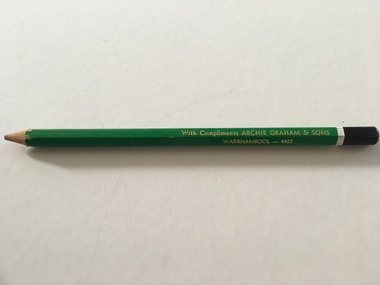
... Archie Graham (1906-1992) commenced a building business in Warrnambool in the 1930s and was well-known for his many building projects in the city and his innovation in the industry. Archie Graham was a prominent member of the Uniting Church and a tireless worker in community affairs in Warrnambool for sixty years. ...Archie Graham (1906-1992) commenced a building business in Warrnambool in the 1930s and was well-known for his many building projects in the city and his innovation in the industry. Archie Graham was a prominent member of the Uniting Church and a tireless worker in community affairs in Warrnambool for sixty years. ...This pencil was used as an advertising medium for the Warrnambool firm of Archie Graham and Sons. It was given to customers of the firm. Archie Graham (1906-1992) commenced a building business in Warrnambool in the 1930s and was well-known for his many building projects in the city and his innovation in the industry. Archie Graham was a prominent member of the Uniting Church and a tireless worker in community affairs in Warrnambool for sixty years. He planned and organized the street decorations for the Warrnambool Centenary in 1947, was chairman of the committee that developed Albert Park and the Reid Oval and was active in Rotary Club and Cricket Club affairs. He was also a member of the Warrnambool Technical School Council. Today the building in Timor Street for senior citizens and other community use is named after Archie Graham. This pencil is of interest as a memento of the type of complimentary article given to customers of businesses in Warrnambool in the mid 20th century. It is also a memento of Archie Graham, an important businessman and community worker in Warrnambool in the 20th century. This is a large six-sided wooden pencil sharpened at one end. The pencil is painted green with a white band near the top and a black-colored end rounded at the top. The paint on the pencil is slightly chipped. The inside of the pencil contains graphite for writing or drawing. The business name on the side of the pencil is inscribed in gold lettering. ‘With Compliments ARCHIE GRAHAM & SONS WARRNAMBOOL – 4422’ archie graham, warrnambool, history of warrnambool -
 Bendigo Historical Society Inc.
Book - Kairn Collection: Mining and Geological Journal, Department of Mines, Victoria, 1959 - 1960
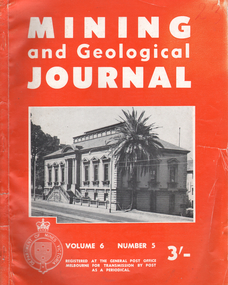
... It was an official publication of the Victorian Government, Department of Mines, devoted to issues and events surrounding mining and metallurgical engineering in Victoria along with education, research and innovations in mining. The journal also included advertisements and references to business interests. ...It was an official publication of the Victorian Government, Department of Mines, devoted to issues and events surrounding mining and metallurgical engineering in Victoria along with education, research and innovations in mining. The journal also included advertisements and references to business interests. ...The Mining & Geological Journal was produced by the Department of Mines, Victoria twice a year, during the period 1937 to 1972. It was an official publication of the Victorian Government, Department of Mines, devoted to issues and events surrounding mining and metallurgical engineering in Victoria along with education, research and innovations in mining. The journal also included advertisements and references to business interests. Editorial (page 3) discusses the imminent demolition of the Geological Museum, situated alongside the Old Treasury Building in Melbourne. The genesis of the Geological Museum was 'the Exhibition of 1861 when the potential value of scientific search to the community as a whole was recognised'. In 1887 the Secretary for Mines in Melbourne was strongly of the opinion that a School of Mines should be established...it was decided that a building should be erected to house a thorough staff of professsors to impart instruction.' Orange cover, white text, printed on front cover: 'Mining and Geological Journal', Volume 6, Number 5, 1965. In centre of cover, black and white photo of the Geological Museum Melbourne. Colour photograph on back cover shows Mindrill type 13 model F 62B diamond drilling machine in PNG. geology, mining, gold mining, bendigo, department of mines, water divining, origins of oil, bentonite, alluvial gold, nickle, serpentinite, hit of miss mine wedderburn, geological museum -
 The Beechworth Burke Museum
Audio - Oral History, Jennifer Williams, John Watson, 22 June 2000
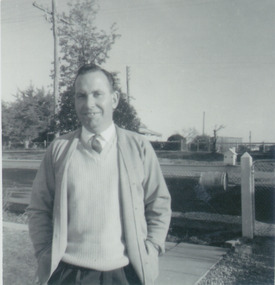
... This history speaks of land cultivation and the innovation of industry in the region, in particular cattle farming and butchering. ...This history speaks of land cultivation and the innovation of industry in the region, in particular cattle farming and butchering. ...John Watson's story shows insight to the families that moved to Beechworth and the motivation behind this. It showcases the nuances of life in the district and the day to day ways of living. This history speaks of land cultivation and the innovation of industry in the region, in particular cattle farming and butchering. Watson's account speaks of the way that the practice of breeding cattle effects the rural lifestyle, and the hardships that come with working on the land. This oral history recording was part of a project conducted by Jennifer Williams in the year 2000 to capture the everyday life and struggles in Beechworth during the twentieth century. This project involved recording seventy oral histories on cassette tapes of local Beechworth residents which were then published in a book titled: Listen to what they say: voices of twentieth century Beechworth. These cassette tapes were digitised in July 2021 with funds made available by the Friends of the Burke.Watson's account is historically significant due to its ability to illustrate the lifestyle and industry of those in Beechworth during the twentieth century. It is a rare insight into the the practices of residents of this time. This oral history also shows deep insight into the social structure of the community. It describes the family and community dynamics over a long period of time, the motivations behind behaviour, and the greater community fabric. This is a digital copy of a recording that was originally captured on a cassette tape. The cassette tape is black with a horizontal white strip and is currently stored in a clear flat plastic rectangular container. It holds up 40 minutes of recordings on each side.John Watson1800s beechworth, 20th century beechworth, beechworth, farming and agriculture, farm, farm work, farmers, farming, cattle, industry, oral history, john watson -
 Federation University Historical Collection
Negative - Object, Lantern Slides, pre 1914
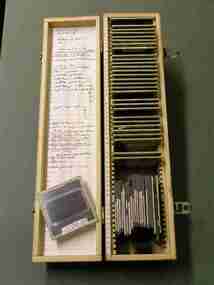
... William Gurley and his younger brother Lewis E. were both engineering alumni of Rensselaer Polytechnic Institute, in Troy, NY, and brought to the business a hunger for technical innovation and unrivaled marketing skill. Exposure at the Centennial Exposition in 1876 launched the company into international prominence from which it never fell. ...William Gurley and his younger brother Lewis E. were both engineering alumni of Rensselaer Polytechnic Institute, in Troy, NY, and brought to the business a hunger for technical innovation and unrivaled marketing skill. Exposure at the Centennial Exposition in 1876 launched the company into international prominence from which it never fell. ...The Gurley enterprise was established in 1845, first as the partnership of Phelps & Gurley and in 1852 as W. & L. E. Gurley. William Gurley and his younger brother Lewis E. were both engineering alumni of Rensselaer Polytechnic Institute, in Troy, NY, and brought to the business a hunger for technical innovation and unrivaled marketing skill. Exposure at the Centennial Exposition in 1876 launched the company into international prominence from which it never fell. The brothers built a factory in 1852 that operated in departments, each department turning out different components, which were then assembled. This revolutionized the industry which, to that time, operated as small shops making, essentially, individual instruments. Gurley was able to roughly halve the price of their instruments over those of their competition, while maintaining quality. (https://www.gurley.com/history)A timber box of 30 lantern Slides.astronomy, lantern slides, gunn's, w. & l.e. gurley -
 Geoffrey Kaye Museum of Anaesthetic History
Tool - Syringe, 1853
... This was an important innovation. Yet in the pre-antiseptic era it was a mixed blessing. ...This was an important innovation. Yet in the pre-antiseptic era it was a mixed blessing. ...Charles Gabriel Pravaz (1791-1853) was a French orthopedic surgeon and inventor of the hypodermic syringe. In 1844, Irish physician Francis Rynd (1811-1861) invented the hollow needle. In 1853, French physician Charles Pravaz developed the first practical metal syringe. Pravaz added a fine, hollow needle to the end of his syringe instead of the tube. This was an important innovation. Yet in the pre-antiseptic era it was a mixed blessing. The use of injections rather than oral drug administration can more readily promote the spread of disease as well as facilitating its cure. An understanding of the germ theory of disease - and the cardinal importance of using sterile needles - awaited the discoveries of Lister, Pasteur and Koch. But intravenous injection allows extremely rapid pain-relief - and the induction of general anaesthesia when suitable agents were developed.Small ornate metal syringe with raised ridge at either end and in the middle. Tapers to a point at the distal end with pencil like extrusion. Finger ring at the proximal end.pravaz, intravenous, hyperdermic, subcutaneous, syringe, needle -
 Melbourne Royal
Photograph, Frank Johnson, 1954
... In 1910, horses and cattle at the Royal Melbourne Show were paraded together for the first time in a ‘Massed’ (Grand) Parade. This innovation proved very popular with exhibitors and the general public alike. ...In 1910, horses and cattle at the Royal Melbourne Show were paraded together for the first time in a ‘Massed’ (Grand) Parade. This innovation proved very popular with exhibitors and the general public alike. ...Black and white photograph of cattle and horses in the Grand Parade on the Melbourne Showgrounds Main Arena, 1954. In 1910, horses and cattle at the Royal Melbourne Show were paraded together for the first time in a ‘Massed’ (Grand) Parade. This innovation proved very popular with exhibitors and the general public alike. The Grand Parade continued to be a Show highlight and in 1952, with the inclusion of all horses for the first time, it became even more of a spectacle. Together with the animals, harness vehicles and Clydesdale wagons were included in the Grand Parade. The following year, as a tribute to the new Queen Elizabeth II, the annual show was named the Coronation Show and for the first time floats from various country agricultural societies were included in the Grand Parade. The final Grand Parade took place in about 2004.A black and white, landscape photograph on glossy paper with a white border.royal melbourne show, grand parade, horse, horses, cattle, agriculture, agricultural shows -
 The Beechworth Burke Museum
Photograph, 1936
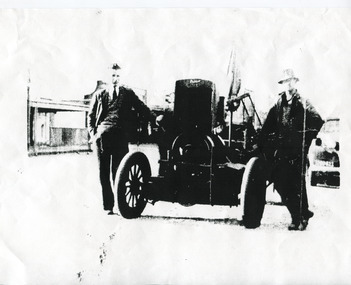
... ...innovation...This photograph is significant because it shows an early instance of an emerging technology, portable sawmills, and is evidence to the innovations that the people of Beechworth have achieved throughout history, as well Bob Pyle Robert Pyle R J Pyle Clarrie Howell Howell Pyle Invention patent sawmill saw sawbench wood Timber forestry Automobile car 1930s 1930s Beechworth industry wooden convenience innovation Obverse: On left Clarrie Howell / Right Bob Pyle / with sawbench built by Bob Pyle / Patent 1936 / Rosalie Pyle has the original / [redacted] Black and White rectangular photograph printed on matte photographic paper. ...This automotive circular saw was designed to allow trees to be sawn into planks at the site they were felled, rather than requiring them to be carted to a lumber mill first. It was invented by Robert John (Bob) Pyle in 1936 and patented in 1937 (serial number 101975). This picture depicts Clarrie Howell (left) and Bob Pyle (right), standing with the sawbench between them. What was special about Bob’s new invention was that it not only allowed a circular saw to be portable and set up at a logging site, but that it allowed the circular saw to be run using the car motor, and that the saw could be detached, allowing the car to be used for carting or other purposes. This photograph is significant because it shows an early instance of an emerging technology, portable sawmills, and is evidence to the innovations that the people of Beechworth have achieved throughout history, as well Black and White rectangular photograph printed on matte photographic paper. Incription on cream paper stapled to bottom left of photographObverse: On left Clarrie Howell / Right Bob Pyle / with sawbench built by Bob Pyle / Patent 1936 / Rosalie Pyle has the original / [redacted]bob pyle, robert pyle, r j pyle, clarrie howell, howell, pyle, invention, patent, sawmill, saw, sawbench, wood, timber, forestry, automobile, car, 1930s, 1930s beechworth, industry, wooden, convenience, innovation -
 Ringwood and District Historical Society
Newsletter, Maroondah High School - Newsletter Vol 2. No. 1 July 1978
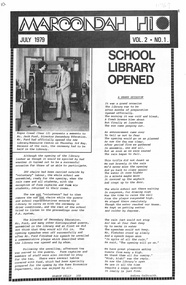
... Burgess 11E ANZAC DAY by Mary Cockman EDUCATION INNOVATION by R. Prior (9G Convenor) YEAR 12 HSC CAMP by Sharon Hunter 12B VISIT TO MCG BY Year 8 Poems by R. ...Burgess 11E ANZAC DAY by Mary Cockman EDUCATION INNOVATION by R. Prior (9G Convenor) YEAR 12 HSC CAMP by Sharon Hunter 12B VISIT TO MCG BY Year 8 Poems by R. ...Black and White printed A4 sized newsletter (8 pages). Articles include: SCHOOL LIBRARY OPENED - Article by Sharon Kelly 10D, and Poem by Andrea Galbraith. Photo of Roger Creed (Year 12) presenting a memento to Mr. Jack Ford, Director of Secondary Education. BUSH FIRE poem by Megan Richardson 8B Salad Days - production announcement WORK EXPERIENCE PROGRAM UNDERWAY - various articles by K. Brandenberger (Careers Teacher), Rachel De Silva, Wendy Krins, Allison Macdonald, Margaret Wiliamson, Glynis Knee and Loretta Sturgess 10D, Craig de la Rue 10A. 1978 OUTSTANDING HSC RESULTS - Jenny Hart, Ralph Audhelm FORM SIX ON THE REBOUND by Carole Owen SCHOOL CANTEEN DAMAGED BY FIRE! by S. Staunton 11E, Pictures by A. Burgess 11E ANZAC DAY by Mary Cockman EDUCATION INNOVATION by R. Prior (9G Convenor) YEAR 12 HSC CAMP by Sharon Hunter 12B VISIT TO MCG BY Year 8 Poems by R. Robertson 9D, Brett Landlands 7B, David Creed, Robert Gollop 8B SPORT 79 -
 Federation University Historical Collection
Book, Standardization of Australia's Railway Gauges, 1945, 1945
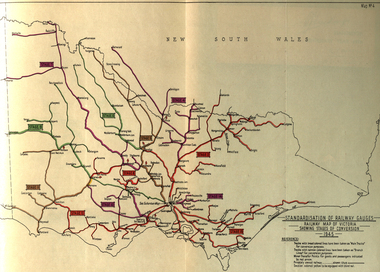
... In two decades as its Chairman of Commissioners, he revolutionised Victorian Railways, with unprecedented attention to customer service and innovations such as more powerful locomotives, air-conditioned carriages, and faster services culminating in the introduction of the flagship Spirit of Progress express train. ...In two decades as its Chairman of Commissioners, he revolutionised Victorian Railways, with unprecedented attention to customer service and innovations such as more powerful locomotives, air-conditioned carriages, and faster services culminating in the introduction of the flagship Spirit of Progress express train. ...Sir Harold Winthrop Clapp KBE (7 May 1875 – 21 October 1952) was a transport administrator who over the course of thirty years had a profound effect on Australia's railway network. In two decades as its Chairman of Commissioners, he revolutionised Victorian Railways, with unprecedented attention to customer service and innovations such as more powerful locomotives, air-conditioned carriages, and faster services culminating in the introduction of the flagship Spirit of Progress express train. Seconded to the Federal Government in World War II, he played a pivotal role in the manufacture of fighter aircraft in the defence of Australia. As Director-General of Australia's Land Transport Board, he presented a report on railway gauge standardisation that ultimately led to the eventual linking of all Australian mainland capital cities by a uniform rail gauge. (http://en.wikipedia.org/wiki/Harold_Winthrop_Clapp, accessed 02/10/2013)Grey, soft covered, stapled report of 89 pages. "Standardization of Australia's Railway Gauges" by Harold Clapp is a report and recommendation regarding the standarization of Australia's railway gauges. The contents include: * Lines suggested for conversion or new lines to be constructed * scheme of conversion of tracks and structures * scheme of conversion of locomotives and rolling stock * Estimated costs * Associated works * Estimated manpower which the project will absorb in its various phases *Standardization of rolling stock * Other considerations associated with the project * Estimated time involved in the various phases of the work. The report includes 8 maps: * Map of Australia showing the various proposals referred to *Map of Australian railways showing extent of standard gauge if proposals are carried out * Map of Australian railways as of 30 June 1944 *Map of Australia showing principal mileages referred to in the report * Railway Map of Western Australia, 1945 * Railway Map of South Australia, 1945 * Railway Map of Victoria, 1945 * Railway Map of Melbourne Suburbs, 1945 railway, guage, standardization, standardisation, fremantle, perth, kalgoorlie, peterborough, silverton, tramway, tram, train, townsville, dajarra, bourke, cunnamulla, charleville, blackall, longreach, winton, hughenden, townsville, gajarra, birdum, darwin, narrow gauge -
 The Beechworth Burke Museum
Audio - Oral History, Jennifer Williams, Hubert Warner, 2 April 2000
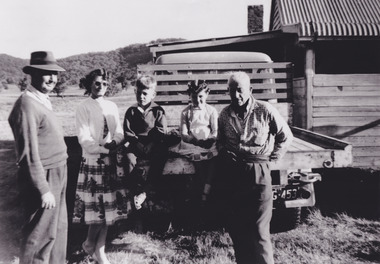
... This history speaks of land cultivation and the innovation of industry in the region, in particular sheep and cattle farming and slaughter. ...This history speaks of land cultivation and the innovation of industry in the region, in particular sheep and cattle farming and slaughter. ...Hubert Warner’s story shows insight to the families that emigrated from Europe for the gold rush. It illustrates the nuances of life in the district. This history speaks of land cultivation and the innovation of industry in the region, in particular sheep and cattle farming and slaughter. Warner speaks of the highs and lows of the practice of breeding cattle, the awards he won, but also the hardships that come with working on the land such as having to face natural disaster. This oral history recording was part of a project conducted by Jennifer Williams in the year 2000 to capture the everyday life and struggles in Beechworth during the twentieth century. This project involved recording seventy oral histories on cassette tapes of local Beechworth residents which were then published in a book titles: Listen to what they say: voices of twentieth century Beechworth. These cassette tapes were digitised in July 2021 with funds made available by the Friends of the Burke.Hubert Warner's account of life in Beechworth is uniquely illustrative as it captures many aspects of the community. It explains the motivation for European migrants for choosing to settle in the area and how they were able to both become a part of and create a presence in their local community. This oral history also exemplifies the process of developing industry through the twentieth century, how it was done, the struggles it faces, and the triumphs that came with this. Warner's history is specific to the cattle industry and shows great nuance in the day-to-day operation of such a business over time. This is a digital copy of a recording that was originally captured on a cassette tape. The cassette tape is black with a horizontal white strip and is currently stored in a clear flat plastic rectangular container. It holds up 40 minutes of recordings on each side. Herbert Warnerlisten to what they say, listen to what they say: voices of twentieth century beechworth, 1800s beechworth, 20th century beechworth, beechworth, farming and agriculture, cattle, gold, gold rush, farm, farming -
 National Wool Museum
Album - Photo Album, Grazcos, c.1999
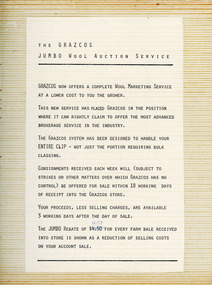
... This process was developed by Grazcos, a company who advanced innovations for shearers and wool farmers before amalgamating with Dalgety in the early 1990s. ...This process was developed by Grazcos, a company who advanced innovations for shearers and wool farmers before amalgamating with Dalgety in the early 1990s. ...Photo album detailing the process involved in the Jumbo Wool Auction Service. This process was developed by Grazcos, a company who advanced innovations for shearers and wool farmers before amalgamating with Dalgety in the early 1990s. Grazcos was a well-known name to source a competent shearing team, or as a destination for wool in need of bulk classing. The Jumbo Wool Auction service was designed to process wool more efficiently through volume. 63 traditionally dumped farm bales of wool would fill a typical shipping container. The Jumbo Wool Auction Service enabled 108 farm bales to fit into the same container. This brought reductions in the costs of handling, selling, storing, and shipping of wool. This photo album details this process; from classing to shipping. This photo album was a draft copy produced for review before the production of mass-produced advertising flyers. 12-page hard cover photo album. Internally colour images and printed text have been stuck behind a protective plastic onto paper. The backing paper has many distinctive orange and grey horizontal lines. Printed text is in black ink. Colour images are 2 x 3 inches with rounded corners. Images and text are numbered 1 to 16 detailing the process of the Jumbo Wool Auction Service developed by Grazcos.wool auction, wool processing, grazcos -
 Lakes Entrance Historical Society
Photograph - Remarkable Stories of Australians and their Boats Exhibition Lakes Entrance June 2021
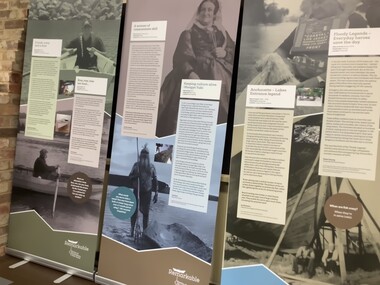
... Rebuilt for the fishing industry the Anchovette became a legend in the area with the brothers making innovations that changed the commercial fishing industry. ...Rebuilt for the fishing industry the Anchovette became a legend in the area with the brothers making innovations that changed the commercial fishing industry. ...In 2019-2020 the National Maritime Museum held a competition for remarkable stories of Australians and their boats. The entry from Lakes Entrance Historical Society, our story about the Mitchelson brothers and their fishing boat the Anchovette was one of the 12 chosen for this traveling exhibition, which was displayed at the Lakes Entrance Historical Society in June of 2021. The Society expanded on the Anchovette story to add to the exhibition which was enjoyed by many. They were surprised to learn that the unfinished hull that would become the legendary Anchovette brought to Lakes Entrance by the Mitchelson brothers in 1948 was designed to be a floating casino. Rebuilt for the fishing industry the Anchovette became a legend in the area with the brothers making innovations that changed the commercial fishing industry. Named after the tons of anchovies it brought in to supply the Peck's Paste factory that operated on Bullock Island Lakes Entrance until the 1970's.Two colour photographs taken at the Remarkable Stories Exhibition Lakes Entrance Victoriaexhibition, boats and boating, fishing industry -
 Greensborough Historical Society
Photograph - Digital Image, Aqueduct Greensborough, 1960c
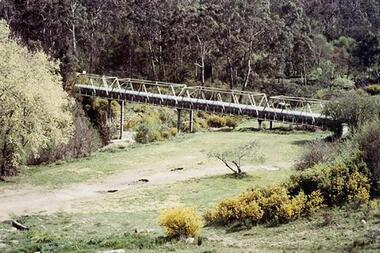
... The use of wrought iron meant the pipes were 75% lighter than cast iron, with the bridge construction reflecting this innovation. Photograph of the Maroondah Aqueduct pipe bridge at Greensborough. ...The use of wrought iron meant the pipes were 75% lighter than cast iron, with the bridge construction reflecting this innovation. Photograph of the Maroondah Aqueduct pipe bridge at Greensborough. ...The Pipe Bridge at Greensborough is a significant and highly visible part of the system. It was constructed to carry the wrought iron aqueduct pipes over the Plenty River. The use of wrought iron meant the pipes were 75% lighter than cast iron, with the bridge construction reflecting this innovation. Photograph of the Maroondah Aqueduct pipe bridge at Greensborough. The Pipe Bridge is 210 feet long, divided into 4 spans. The main girders are light lattice 11 feet deep and 11 ft 4 inches apart. The bridge carried two wrought iron tubular mains, 53 inches in diameter, supported at intervals by cross girders and chairs, placed between the main girders. The bridge is carried on braced cast-iron columns, 18 inches in diameter, set on concrete foundations, with a clear headway of 20 feet above the Plenty River. The eastern side of the bridge is reinforced with a bluestone abutment at the river bank.Digital copy of colour photograph.maroondah aqueduct, aqueduct pipe bridge greensborough -
 City of Moorabbin Historical Society (Operating the Box Cottage Museum)
Personal Effects, man's razor blade in box, 20thC
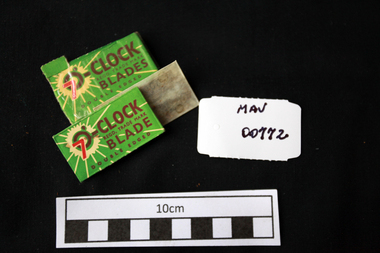
... Gillette improved these earlier safety-razor designs, and introduced the high-profit-margin stamped razor blade steel blade. Gillette's innovation was the thin, inexpensive, disposable blade of stamped steel. ...Gillette improved these earlier safety-razor designs, and introduced the high-profit-margin stamped razor blade steel blade. Gillette's innovation was the thin, inexpensive, disposable blade of stamped steel. ...Safety razors had been developed in the mid-19th century, but still used a forged blade that dulled and rusted. In the 1870s, the Kampfe Brothers ( Germany) introduced a type of safety razor. Gillette improved these earlier safety-razor designs, and introduced the high-profit-margin stamped razor blade steel blade. Gillette's innovation was the thin, inexpensive, disposable blade of stamped steel. King Camp Gillette observed in 1902 that as existing, relatively expensive, razor blades dulled quickly and needed continuous sharpening, a razor whose blade could be thrown away when it dulled would meet a real need and likely be profitable. In 1918, when the U.S. entered World War I, the Gillette company provided all American soldiers with a field razor set, paid for by the government, and as they were allowed to take them at discharge they continued their use of this product thus ensuring future sales. An unused, wrapped, man's razor blade in a box. 7 O'clock brand '7 O'CLOCK / REGD. TRADE MARK / BLADES / DOUBLE EDGED shaving equipment. razorblades, safety razors, cheltenham, moorabbin, bentleigh, pioneers, early settlers -
 Bendigo Military Museum
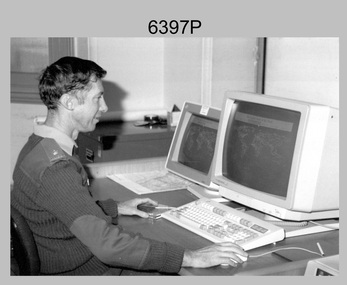
Photograph - MAJ Bob Williams – Technical Award Recipient, Army Survey Regiment, Fortuna, Bendigo, 1990
... He won first prize for his entry ‘Innovations in Cartographic Communication’ in the individual category at the 2nd Australian Institute of Cartographers and BHP Engineering Technology Research and Development Awards. ...He won first prize for his entry ‘Innovations in Cartographic Communication’ in the individual category at the 2nd Australian Institute of Cartographers and BHP Engineering Technology Research and Development Awards. ...In 1990 MAJ Bob Williams was the OC of Technical Development Cell. He won first prize for his entry ‘Innovations in Cartographic Communication’ in the individual category at the 2nd Australian Institute of Cartographers and BHP Engineering Technology Research and Development Awards. The award was announced at the 1990 Australian Cartographic Conference in Darwin where MAJ Williams presented his entry. At the time he had completed PhD studies at the Australian Defence Academy and was the first Survey Corps officer to complete studies at this advanced level. Also, in 1990 the Royal Australian Survey Corps’ meritorious achievements were formally recognised by the Senate of the Australian Parliament in a Notice of Motion on 31st of May 1990. The Royal Australian Survey Corps also featured in the issue of a commemorative stamped envelope issued by Australia Post. These achievements are covered in more detail in page 147 of Valerie Lovejoy’s book 'Mapmakers of Fortuna – A history of the Army Survey Regiment’ ISBN: 0-646-42120-4. This photograph of MAJ Bob Williams was taken in Technical Development Cell at the Army Survey Regiment, Fortuna, Bendigo in 1990. The black & white photograph was printed on photographic paper and is part of the Army Survey Regiment’s Collection. The photograph was scanned at 300 dpi. .1) - Photo, black & white, 1990. MAJ Bob Williams – Technology Award Recipient.1P – annotated in red pen ‘MAJ Williams Technology Awards’royal australian survey corps, rasvy, army survey regiment, army svy regt, fortuna, asr -
 National Alpine Museum of Australia
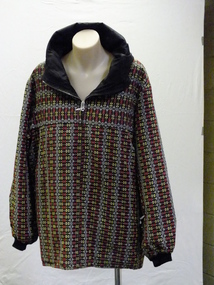
Ski Jacket, 1970s
... Rosalie continued to design and manufacture fashionable but functional ski wear until the late 1970s, although increasing imports from large overseas manufactures and constant new innovations in fabric technology made it difficult for her to compete in a relatively small industry. ...Rosalie continued to design and manufacture fashionable but functional ski wear until the late 1970s, although increasing imports from large overseas manufactures and constant new innovations in fabric technology made it difficult for her to compete in a relatively small industry. skiing ski clothing fashion design Rosalie Kiessling sportswear Melbourne / All cotton Reversible ski jacket with side zip pockets and full zip front. ...Reversible ski jacket made by Rosalie Kiessling, 1970s. Used by Rosalie's son and daughter-in-law, from the 1970s through to the 1990s. The Kiessling family skied at Mt Buller and are members of Omega Ski Lodge. German by birth Rosalie, grew up skiing and ice skating, studied fashion design in Munich and worked designing women’s ski wear and lingerie before migrating to Australia via New Zealand in 1939 with her husband. As skiing increased in popularity following the end of WWII, Rosalie’s business grew reaching its peak during the 1960s. Though it was never large; at most she employed three staff. Rosalie continued to design and manufacture fashionable but functional ski wear until the late 1970s, although increasing imports from large overseas manufactures and constant new innovations in fabric technology made it difficult for her to compete in a relatively small industry. Reversible ski jacket with side zip pockets and full zip front. One side of the jacket is black fabric, while the other is black checked with a yellow and red weave. Rosalie Kiessling sportswear Melbourne / All cottonskiing, ski clothing, fashion design -
 Broadmeadows Historical Society & Museum
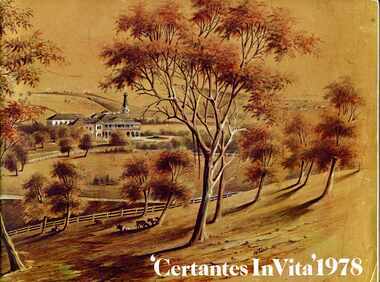
Booklet - School Yearbook, Salesian College, Rupertswood, "Certantes in Vita" 1978, 1978
... This year was defined by a strong sense of tradition and innovation. Students engaged in a wide range of academic, spiritual, and co-curricular activities that enriched their educational journey. ...This year was defined by a strong sense of tradition and innovation. Students engaged in a wide range of academic, spiritual, and co-curricular activities that enriched their educational journey. ...School yearbook, presenting details of the events and students of Salesian College, Rupertswood, Sunbury.A stapled, card-covered, forty-eight-page book. Shows age with damaged corners of front cover.non-fictionSchool yearbook, presenting details of the events and students of Salesian College, Rupertswood, Sunbury.salesian college, rupertswood, sunbury, yearbook, "certantes in vita", 1978 -
 Emerald Museum & Nobelius Heritage Park
Domestic object - Metal roller, Unknown maker, 1920s-1930s
... The cutter is an example of the increasingly specialised devices available to home cooks in a period of kitchen and household innovation beginning in the Nineteenth Century and continuing through the Twentieth Century. ...The cutter is an example of the increasingly specialised devices available to home cooks in a period of kitchen and household innovation beginning in the Nineteenth Century and continuing through the Twentieth Century. ...This cutter is thought to date to the early or middle period of the twentieth Century, but it has no identifying brand or inscriptions. It may have had several uses in the kitchen of the early-to-mid twentieth Century. Its primary use may have been cutting lattice pastry tops for pies, but it could also have been used to chop herbs or to make psta shapes such as spaghetti. It is an example of the increasingly specialised labour-saving devices available to home cooks which in turn reflects the changing social and economic structures of the period. The cutter is an example of the increasingly specialised devices available to home cooks in a period of kitchen and household innovation beginning in the Nineteenth Century and continuing through the Twentieth Century. This reflects broader cultural and economic trends such as the growth of the middle class in society (households in which specialised devices replaced specialist workers such as a hired cook) and the growth of manufacturing of commercial goods as a basis of the economy.This item is significant as it provides insights into the cooking equipment and techniques in use in the region in the early-to-mid twentieth century. As such, it also provides insights into the shifting social and economic conditions of the time period.The item is a metal roller with ten blades. It has a partial blade cover on the upper surface of the item and a continuous loop of metal shaped into a handle for the user to hold while using the item.1930s and 1940s, kitchenware, kitchen, pastry, herb -
 Flagstaff Hill Maritime Museum and Village
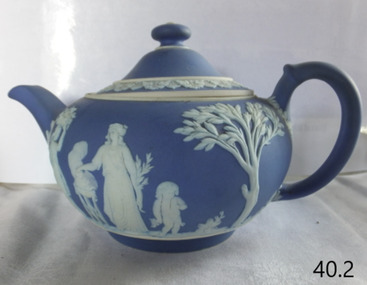
Ceramic - Teapot, Josiah Wedgwood & Sons Ltd, 1890
... In the later 19th century the company returned to being a leader in the design and technical innovation, as well as continuing to make many of the older styles. ...In the later 19th century the company returned to being a leader in the design and technical innovation, as well as continuing to make many of the older styles. ...Josiah Wedgwood (1730–95), came from an established family of potters and trained with his elder brother. He was in partnership with the leading potter Thomas Whieldon from 1754 until 1759 when a new green ceramic glaze he had developed encouraged him to start a new business on his own. Relatives leased him the Ivy House in Burslem, Stoke-on-Trent, and his marriage to Sarah Wedgwood, a distant cousin with a sizeable dowry, helped him launch his new venture. After an extensive and systematic program of experiment Wedgwood in 1765 created a new variety of creamware, a fine glazed earthenware, which was the main body used for his table wares thereafter. After he supplied Queen Charlotte with a tea set for twelve the same year, she gave official permission to call it "Queen's Ware" (from 1767). This new form, perfected as white pearlware (from 1780), sold extremely well across Europe, and to America. It had the additional advantage of being relatively light, saving on transport costs and import tariffs in foreign markets. Wedgwood developed several further industrial innovations for his company, notably a way of measuring kiln temperatures accurately, and several new ceramic bodies including the "dry-body" Stoneware, "black basalt" (by 1769), cane ware, and jasperware (the 1770s), all designed to be sold unglazed, like "biscuit porcelain". In the later 19th century the company returned to being a leader in the design and technical innovation, as well as continuing to make many of the older styles. Despite increasing local competition in its export markets, the business continued to flourish in the 19th and early 20th centuries, remaining in the hands of the Wedgwood family, but after World War II it began to contract, along with the rest of the English pottery industry. After buying several other Staffordshire ceramics companies, in 1987 Wedgwood merged with Waterford Crystal to create Waterford Wedgwood plc, an Ireland-based luxury brands group. After a 2009 purchase by KPS Capital Partners, a New York-based private equity firm. Wedgwood has always been associated with fine china, porcelain, and luxury accessories, the entrepreneur Josiah Wedgwood rapidly became successful and was soon one of the largest manufacturers of Staffordshire pottery. Wedgwood is a significant pottery manufacturer as the company is especially associated with the "dry-bodied" (unglazed) stoneware Jasperware in contrasting colours, and in particular that in "Wedgwood blue" and white that has become a trademark. Teapot and lid, Wedgwood blue Jasperware with white patternImpressed name Wedgewood and date letter "S" = 1890flagstaff hill, warrnambool, flagstaff hill maritime museum, maritime museum, shipwreck coast, flagstaff hill maritime village, great ocean road, teapot, wedgewood blue, wedgewood teapot, tea pot, kitchen ware, josiah wedgwood, staffordshire potteries -
Kew Historical Society Inc
Archive (collection) - Papers of Irena Higgins, Health & Human Services, 1951-2010
... Two of her significant innovations at the Cottages were the establishment of a Parents’ Association, and the development of a network of volunteers trained to work with families in the community. ...Two of her significant innovations at the Cottages were the establishment of a Parents’ Association, and the development of a network of volunteers trained to work with families in the community. ...Irena Higgins (1951-2014) > Barbara Higgins (2015) > Kew Historical Society (2015)Professional papersCollection (Fond) > Series > Sub-series > Items > SubitemsThe Irena Higgins Papers held by the Kew Historical Society include personal and professional papers, written by or collected by her, relating to child and adult mental health issues and treatment, particularly at the Kew Mental Hospital, the Kew Children’s Cottages and the establishment of the first emergency housing in Kew. Donated by her family following her death in 2014, the collection is housed in a number of archive boxes compartmentalised into folders (sub-series). Each folder contains items grouped by subject.department of health (vic.), mental hygiene authority (vic.), mental health authority (vic.), health commission of victoria, community services victoria, department of health and community services, department of human services, kew cottages, kew children’s cottages, kew training centre, kew residential services, kew lunatic asylum, kew mental hospital, willsmere mental hospital, willsmere unit, kew emergency housingdepartment of health (vic.), mental hygiene authority (vic.), mental health authority (vic.), health commission of victoria, community services victoria, department of health and community services, department of human services, kew cottages, kew children’s cottages, kew training centre, kew residential services, kew lunatic asylum, kew mental hospital, willsmere mental hospital, willsmere unit, kew emergency housing -
 Flagstaff Hill Maritime Museum and Village
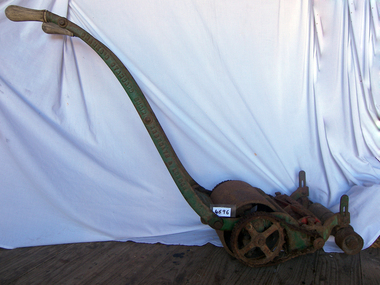
Machine - Lawn Mower, Alex Shanks & Sons Ltd Engineers Arbroth London, 1903-1925
... While credit is usually given to the Englishman Edwin Budding (1795-1846) for the invention of the lawnmower, it is Shanks' machine which was the direct predecessor of the modern mower. Shanks' innovation was a machine which rolled the grass as well as mowing it. ...While credit is usually given to the Englishman Edwin Budding (1795-1846) for the invention of the lawnmower, it is Shanks' machine which was the direct predecessor of the modern mower. Shanks' innovation was a machine which rolled the grass as well as mowing it. ...The firm of Alexander Shanks & Sons Ltd of Arbroath, were engineers, founders and boiler makers the company was incorporated in the year 1893. At the Dens Iron Works, purchased by the firm in the same year, a wide variety of products was manufactured including cranes, hoists, pumps and lawnmowers. In the 1960s the firm was taken over by Alexander Shanks (1801-1845) was an Inventor of the modern lawnmower, who lived in Arbroath Scotland. While credit is usually given to the Englishman Edwin Budding (1795-1846) for the invention of the lawnmower, it is Shanks' machine which was the direct predecessor of the modern mower. Shanks' innovation was a machine which rolled the grass as well as mowing it. Although Shanks himself died at a young age, his son showed the mowers at the Great Exhibition in 1851 which led to a successful business that continued into the 20th century, supplying mowers to cut the tennis courts of Wimbledon, the cricket grounds at Lords and the Old golf course at St Andrews. The firm was also well known for the manufacture of portable steam engines and steam cranes. In 1968, the company was taken over by Giddings & Lewis Fraser Ltd, Engineers of Arbroath. The subject item is a good example of an early lawn mower made by the company that is credited with being the first to patent and manufacture such a machine. The company Alexander Shanks founded was known throughout the world as significant manufactures of large steam machines used from the middle of the 19th century to the first quarter of the 20th century. The subject item is now regarded as a collector's item.Lawnmower, cast iron handles has two wooden ends and two wooden rollers at front. Blades driven by chain fixed to metal roller. Shanks's Standard Chain. Shanks's Standard Chain Arbroth London. Alex Shanks & Sons Ltd Engineers Arbroth Londonflagstaff hill, warrnambool, shipwrecked coast, flagstaff hill maritime museum, maritime museum, shipwreck coast, flagstaff hill maritime village, great ocean road, hand mower, lawn mower, mower, shanks, arboth -
 National Wool Museum
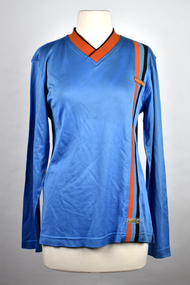
Textile - Australian Open Sportwool Top, CSIRO Division of Textile and Fibre Technology, c. 2000s
... The development of Sportwool® was funded by The Woolmark Company (now Australian Wool Innovation Limited). Source: https://csiropedia.csiro.au/sportwool/...The development of Sportwool® was funded by The Woolmark Company (now Australian Wool Innovation Limited). Source: https://csiropedia.csiro.au/sportwool/ Sportswool Australian Open Athletes Clothing The Woolmark Company CSIRO Division of Textile and Fibre Technology Uniforms 9095.1 Australian Open / Sportwool / Sportwool 9095.2 - front: [printed] Australian Open / OFFICIAL / LICENSED / PRODUCT 9095.3 - front: [printed] SPORTWOOL / Vapour Management Technology / www.sportwool.com 9095.1 - Long sleeve blue sports top with with orange and navy striped detail. 9095.2 - Clothing label tag featuring a black silhouette of a tennis player, with organe and white text and orange and blue graphics on a black background. 9095.3 - Four page fold out clothing label tag, front features printed text, silhouette sports graphics and a background of an orange and blue landscape. ...Sportwool® was developed to combine the physical performance attributes of synthetics with the comfort and breathability of a natural fibre. It is a lightweight, composite fabric consisting of a layer of machine-washable superfine Merino wool next to the skin and a layer of tough, easy-care polyester on the outside. As a result of this construction: - the wearer feels cooler more quickly and formation of liquid sweat is delayed - liquid sweat is carried away from the skin to the outside of the fabric, leaving - the inside dry and resulting in less ‘clammy’ garment cling - the wearer stays cooler when exercising - ‘post-exercise chill’ is reduced. In addition, Sportwool® is elastic, provides UV protection and does not retain odours. Sportwool® is constructed in weights ranging from ultra-light for jogging, to thicker, heavy-duty fabric for football jerseys. It is easily printed in bright colours and designs, including information about sponsors and players. Sportwool® can also be dyed in solid colours. The development of Sportwool® was funded by The Woolmark Company (now Australian Wool Innovation Limited). Source: https://csiropedia.csiro.au/sportwool/9095.1 - Long sleeve blue sports top with with orange and navy striped detail. 9095.2 - Clothing label tag featuring a black silhouette of a tennis player, with organe and white text and orange and blue graphics on a black background. 9095.3 - Four page fold out clothing label tag, front features printed text, silhouette sports graphics and a background of an orange and blue landscape.9095.1 Australian Open / Sportwool / Sportwool 9095.2 - front: [printed] Australian Open / OFFICIAL / LICENSED / PRODUCT 9095.3 - front: [printed] SPORTWOOL / Vapour Management Technology / www.sportwool.comsportswool, australian open, athletes, clothing, the woolmark company, csiro division of textile and fibre technology, uniforms -
 Ararat Gallery TAMA
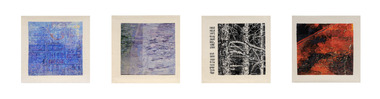
Marcel Marois, Mutation - Time: Blue, Grey, White, Red, 1994-6
... Canadian artist Marcel Marois began his career at the height of a period of innovation and dynamic growth in tapestry weaving in the 1970s. ...Canadian artist Marcel Marois began his career at the height of a period of innovation and dynamic growth in tapestry weaving in the 1970s. ...The TAMA Collection comprises an extensive survey of contemporary (post-1970s) textile and fibre art practices in Australia with key international influences represented from time to time, such as Marcel Marois’ Mutation - Time: Blue, Grey, White, Red. Canadian artist Marcel Marois began his career at the height of a period of innovation and dynamic growth in tapestry weaving in the 1970s. Marois is known for his references to pixilated photographic imagery, particularly as seen in newspapers; his weaving recreates the detail of photographic blur. These four tapestries were acquired to commemorate the major contribution of the Gallery’s inaugural director, the late Pamela Gullifer AM, towards the establishment and development of Ararat Gallery in the early 1970s. An extensive and diligent fundraising campaign was undertaken by the local community between 1999 and 2002, challenged by the Canadian dollar strengthening relative to the Australian dollar in that period. Marois’ imagery references political, environmental and social events of his time and location. In this set of woven panels the artist refers to natural elements – air (blue); water (grey); earth (white) and fire (red). -
 Sunshine and District Historical Society Incorporated
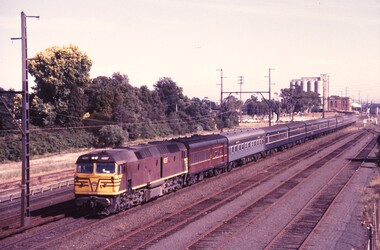
Photograph - The Spirit of Progress, Weston Langford Railway Photography, 2nd February 1985
... It was launched as Australia’s first fully streamlined, air‑conditioned, all‑steel express train service. The key innovations of the train included the full blue-and-gold livery with winged VR monogram, air‑conditioning, sound‑insulated walls, double‑glazed windows, a luxurious parlour observation car, dining car, richly finished timber interiors and a hostess on board, a first in Australian rail travel. ...It was launched as Australia’s first fully streamlined, air‑conditioned, all‑steel express train service. The key innovations of the train included the full blue-and-gold livery with winged VR monogram, air‑conditioning, sound‑insulated walls, double‑glazed windows, a luxurious parlour observation car, dining car, richly finished timber interiors and a hostess on board, a first in Australian rail travel. ...The Spirt of Progress was designed under Victorian Railways Commissioner Harold Clapp, who oversaw every detail. The train was built entirely at the Newport Workshops using Australian materials and labour. The Spirt of Progress entered service on the 25th November 1937. It was launched as Australia’s first fully streamlined, air‑conditioned, all‑steel express train service. The key innovations of the train included the full blue-and-gold livery with winged VR monogram, air‑conditioning, sound‑insulated walls, double‑glazed windows, a luxurious parlour observation car, dining car, richly finished timber interiors and a hostess on board, a first in Australian rail travel. The service initially operated Melbourne to Albury as the premier Victorian Railways service. In 1962, the Melbourne–Sydney standard gauge opened and The Spirit of Progress service was extended to Sydney, becoming the prestige overnight intercapital train. The former steam locomotives were replaced by diesel locomotives. The Spirit of Progress made its final run on 2nd August 1986 and the service was replaced by the more modern but less ceremonially named Sydney – Melbourne Express and later the XPT.The Spirt of Progress was a popular slight for the local Albion, Keilor & Sunshine North residents as it travelled along the Melbourne to Sydney trainline, blowing its whistle at the various road and pedestrian crossings and spectators along the route.5852.01 - The Spirit of Progress Train 1985 42217 5852.02 - The Spirit of Progress Train 1985 42217the spirit of progress train, sunshine, harold clapp, newport workshops, weston langford -
Kew Historical Society Inc
Archive (collection) - Irena Higgins : Fol.1 Disability & Mental Health, 1951-2008
... Two of her significant innovations at the Cottages were the establishment of a Parents’ Association, and the development of a network of volunteers trained to work with families in the community. ...Two of her significant innovations at the Cottages were the establishment of a Parents’ Association, and the development of a network of volunteers trained to work with families in the community. ...Irena Higgins (1951-2014) > Barbara Higgins (2015) > Kew Historical Society (2015)Professional papersCollection > Series > Sub-series (folder) > ItemKew Cottages: Introduction | Mental Retardation in Victoria: an historical perspective (1963) | Chronology of Kew Cottages | Kew Cottages Children's Training Centre | Work Evaluation Sheet for training purposes | History of Kew Cottages 1871-1986 | Kew Children's Cottages [booklet] | Social Work Department [including history of Children's Cottages] | Organising Playground Activities [letters] | Map of Kew Cottages | Role of the Social Worker [notes] | Notes for Student Groups (1968) [incl. reel-to-reel inside] | Annual Report for 1967 | Play Centre [letter] | Writing re Training of Children | Admission Procedure | 'Residential Care of the Retarded" (Seminar 1974) | Report on the Children's Cottages (1979) | Kew Cottages 1887-1987 Centenary Xmas Cardsdepartment of health (vic.), mental hygiene authority (vic.), mental health authority (vic.), health commission of victoria, community services victoria, department of health and community services, department of human services, kew cottages, kew children’s cottages, kew training centre, kew residential servicesdepartment of health (vic.), mental hygiene authority (vic.), mental health authority (vic.), health commission of victoria, community services victoria, department of health and community services, department of human services, kew cottages, kew children’s cottages, kew training centre, kew residential services -
Kew Historical Society Inc
Archive (collection) - Irena Higgins : Fol.3 Disability & Mental Health, 1951-2008
... Two of her significant innovations at the Cottages were the establishment of a Parents’ Association, and the development of a network of volunteers trained to work with families in the community. ...Two of her significant innovations at the Cottages were the establishment of a Parents’ Association, and the development of a network of volunteers trained to work with families in the community. ...Irena Higgins (1951-2014) > Barbara Higgins (2015) > Kew Historical Society (2015)Professional papersCollection > Series > Sub-series (folder) > ItemSundry items: Sexuality and the law in Australia (People with an intellectual disability) | About your child who is Mongoloid (PH) | A study of Mongoloid Children (IH & PH) | A study of children with Mongolism need in the home compared to those reared away from the home | The intellectually handicapped child | Social history proforma | Intellectually handicapped children - education & training | Community Services and unmet community needs - a well rounded program for the retarded | Australia Citizen Ltd (magazine re mental retardation) | Aspects of rehabilitation 1964 (occupational therapy) | Need for a special unit for the assessment and treatment of intellectually disabled | Adolescents with social and or psychiatric problems | Training and recreational (activities of residents at Strathmont Centre) | The need of additional community facilities for intellectually handicapped children | Report - 1966? | The handicap of cerebral palsy.department of health (vic.), mental hygiene authority (vic.), mental health authority (vic.), health commission of victoria, community services victoria, department of health and community services, department of human services, kew cottages, kew children’s cottages, kew training centre, kew residential servicesdepartment of health (vic.), mental hygiene authority (vic.), mental health authority (vic.), health commission of victoria, community services victoria, department of health and community services, department of human services, kew cottages, kew children’s cottages, kew training centre, kew residential services
