
Showing 1040 items matching "staff names"
-
 Kiewa Valley Historical Society
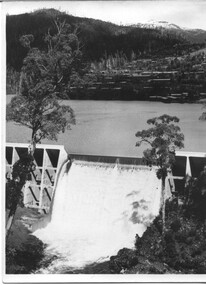
Photograph of Lake Guy and Bogong Village, Lake Guy and Bogong Village, Approx. 1945
... The staff hostel was known as Kiewa House and is now occupied by the Education Department. Lake Guy was named after Mr. ...The staff hostel was known as Kiewa House and is now occupied by the Education Department. Lake Guy was named after Mr. ...In 1940 Field Headquarters for the Kiewa Scheme were established at Bogong with office, workshop facilities and accommodation for workmen, staff and some families constructed. (There had been a 'tent camp' on this site in 1939 but was destroyed by bushfires) Construction of accommodation continued until 1947. A total of 40 houses plus a hostel for single staff, post office, police station, medical centre and primary school all with water and sewerage and electricity supply. The staff hostel was known as Kiewa House and is now occupied by the Education Department. Lake Guy was named after Mr. L.T. Guy who was the Resident Engineer in charge of construction work and associated activities on the Kiewa area. He held this position from 1939 to November 1946 when he was transferred to Head Office.This photograph is an excellent historical record of Bogong Village in about 1945. It shows the layout of the town in the fairly steep terrain, the workmen's camp between the houses and the lake foreshore, the Commissioner's Lodge on the hill behind the Village, the walkway through the dam wall can be seen to the left of the spillway, the dam is on spill and note damage to the large trees is still evident from the 1939 bush fires. The Commissioner's Lodge was lost in the 2003 fires and the camp buildings were in service until 1962, when they were removed and the site converted into a public picnic area with lawns and gardens.A Black and white photograph"Lake Guy and Bogong" hand written on back of photograph.kiewa, accommodation, lake, dam, bogong -
 Warrnambool and District Historical Society Inc.
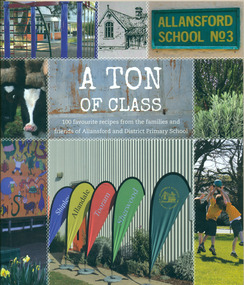
Book, A Ton of Class: 100 favourite recipes from the families and friends of Allansford and District Primary School, 2014
... staff facilities. John McMahon Allan settled in the area in 1839 with his brother William Osborne Allan. They were the sons of David Allan, Deputy Commissary General during Macquarie's term of government. The brothers divided the station with William retaining the Allandale portion and John naming...staff facilities. John McMahon Allan settled in the area in 1839 with his brother William Osborne Allan. They were the sons of David Allan, Deputy Commissary General during Macquarie's term of government. The brothers divided the station with William retaining the Allandale portion and John naming ...This cookery book was produced in 2014 as a school fundraiser. It was purchased at Allansford Cheese World in January 2015 for $15. Allansford school was established as a National School in 1856 on land reserved for the purpose by John McMahon Allan. It comprised two sandstone classrooms -one for boys and one for girls -with an attached pise teacher's residence. In 1872 when the Victorian Education Department was set up existing schools were listed in alphabetical order and given a number. Allansford State School was No.3. The school was enlarged in the late 1800s and again in the early 1920s. In 1994 following the amalgamation of the Allansford, Allans Forest and Naringal schools a new school was built which adjoined the existing buildings. The old buildings were refurbished as administration and staff facilities. John McMahon Allan settled in the area in 1839 with his brother William Osborne Allan. They were the sons of David Allan, Deputy Commissary General during Macquarie's term of government. The brothers divided the station with William retaining the Allandale portion and John naming his portion Tooram. John McMahon Allan was president of the early district Roads Board. In an attempt to recoup some of the heavy losses due to the disastrous Bateman fire of 1854 John subdivided a portion of Tooram at the Hopkins River crossing known as Allans ford. A school reserve was included in this subdivision. Source: McLeod, Graeme & Barbara. Allansford 1855-2006This book has social and historical interest and significance as it is connected to a local school. It provides a snapshot of food and cooking methods in the early 21st cebturyCookery book with full colour cover featuring 8 photographs and drawings of the Allansford Primary School surrounds and pupil activities. The images are 'stitched' together with a white zig-zag diamond pattern as if a quilt. The foldout cover has an image of the school's centenary memorial gates and a brief history of the school. Inside the foldout are images of the pupils in each of the school's four team houses. The foldout back cover has full colour images of pupils performing at the school concert. A white strip noting 'our values' is included on the inside back cover foldout. Soft cover, 112 pages.allansford school, a ton of class, allansford primary school, a ton of class recipe book -
 Sir Reginald Ansett Transport Museum
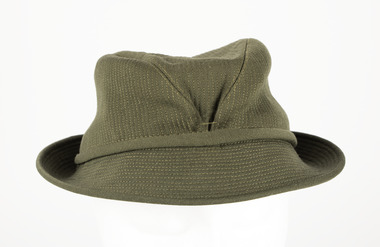
Headwear - Hat, 1964-1968
... This item is part of many item belonging to a former staff member. uniform hat khaki hostess stewardess flight attendants nivek headwear Shirley Boles/21 inches. Khaki hostess brimmed hat by Nivek Headwear. Black inside lining. Grosgrain sweatband. Hat size tag 21 inches. Label with donator's name ...This hat belongs is part of the uniform of the 1954-1968 era. It was donated along with other items by Shirley Boles who was a flight hostess between 1956-1974. Shirley became Sister Shirley Boles.This item is part of many item belonging to a former staff member.Khaki hostess brimmed hat by Nivek Headwear. Black inside lining. Grosgrain sweatband. Hat size tag 21 inches. Label with donator's name: Shirley Boles.Shirley Boles/21 inches.uniform, hat, khaki, hostess, stewardess, flight attendants, nivek headwear -
 Sir Reginald Ansett Transport Museum
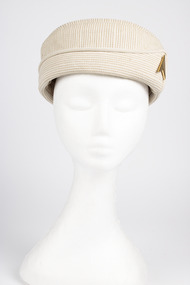
Headwear - Hat, Pillbox, 1972-1977
... She was a popular staff member who worked for many years with the company. customer service staff pill-box hat 1970s beige hostess stewardess shirley boles flight attendants 1969-1972 "by Nivek Headwear Reg. Melb" on label inside. Pencil numeral 20 & 1/2 hand written on label. Commercial Name ...Donated to Sir Reginald Ansett Transport Museum by Shirley Boles Ansett Airlines of Australia 1969-1972 Uniform designed for Hostess/Stewardess uniform. Complements the collection of air flight crew attire 1969-1972.Shirley Boles was an air hostess with ANA in the early days of Ansett. Shirley has made a considerable contribution of items to the Sir Reginald Ansett Transport Museum. She was a popular staff member who worked for many years with the company.Beige coloured pillbox hat , with flat crown and straight, upright sides. Turned up brim featuring peaked detail on one side. Piped edging. Heavy-duty poly-cotton (?) fabric with reinforcing stitching. Fawn grosgrain ribbon interfacing inside. Cream bemsilk lining. Gold coloured badge features 1968-1981 Ansett Logo A Delta "by Nivek Headwear Reg. Melb" on label inside. Pencil numeral 20 & 1/2 hand written on label. Commercial Name Tag hand sown Shirley Boles customer service staff, pill-box hat, 1970s, beige, hostess, stewardess, shirley boles, flight attendants, 1969-1972 -
 Kiewa Valley Historical Society
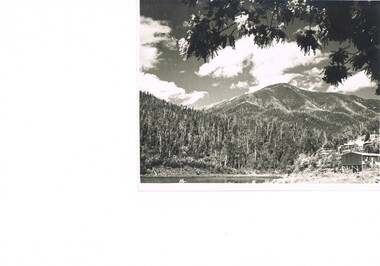
Photograph from Lake Guy, Bogong Village, Scene from shores of Lake Guy to Mountain range, 1930s to 1950s
... The staff hostel was known as Kiewa House and is now occupied by the Education Department. Lake Guy was named after Mr. ...The staff hostel was known as Kiewa House and is now occupied by the Education Department. Lake Guy was named after Mr. ...In 1940 Field Headquarters for the Kiewa Scheme were established at Bogong with office, workshop facilities and accommodation for workmen, staff and some families constructed. (There had been a 'tent camp' on this site in 1939 but was destroyed by bushfires) Construction of accommodation continued until 1947. A total of 40 houses plus a hostel for single staff, post office, police station, medical centre and primary school all with water and sewerage and electricity supply. The staff hostel was known as Kiewa House and is now occupied by the Education Department. Lake Guy was named after Mr. L.T. Guy who was the Resident Engineer in charge of construction work and associated activities on the Kiewa area. He held this position from 1939 to November 1946 when he was transferred to Head Office.The Bogong Township was developed firstly as an accommodation centre (base camp) for construction workers employed under the Kiewa Hydroelectric Scheme. Due to the influx of European workers into the Township the beautification of the immediate surrounds(gardens etc.) had a distinct European flavour. This environment has been very beneficial for tourism in later years. Strict environmental control has not allowed for any extensive redevelopment in tourist accommodation and basically restricted it to the accommodation initially built for the construction workers. Activities such a bike riding, snow skiing, restricted horse riding and bush walking on the Alpine plains and mountains are now a viable part of the Kiewa Valley Tourist Industry. The lake is one of the many water storage storage reservoirs used to supply the power stations their main power to run the huge turbines generating the final product, electricityThis black and white photograph shot from the shores of Lake Guy toward the mountain range of the Victorian Alps details the early construction of the construction worker's accommodation of the Bogong Village. The paper is of 200gms and is not photographic paper and can be assumed to be a reproduction of an original photobogong village circa 1930 to 1950, kiewa hydro-electricity scheme, victorian alpine region mid 1900s -
 Bendigo Military Museum
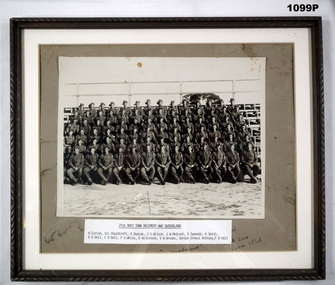
Photograph - PHOTOGRAPH WW2, FRAMED, C.WW2
... staff photograph WWII Queensland. Frame timber metallic paint decoration edge, black and white photograph on fawn cardboard backing, cream mount. Type written label lists 14 names...staff photograph WWII Queensland. Frame timber metallic paint decoration edge, black and white photograph on fawn cardboard backing, cream mount. Type written label lists 14 names ...21st Anti Tank Regiment staff photograph WWII Queensland. Frame timber metallic paint decoration edge, black and white photograph on fawn cardboard backing, cream mount. Type written label lists 14 names of 21st Anti Tank Regiment WW2 Queensland.Hand written on cardboard backing faded blue ink "with love from Noel" "Queensland" - below photograph.photography-photographs/frame accessories, military history, anti tank -
 Warrnambool and District Historical Society Inc.
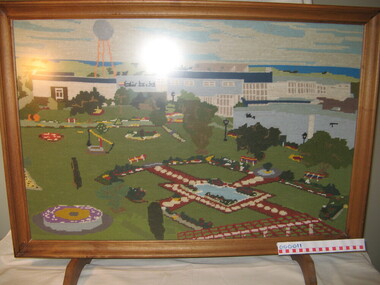
Textile - Fire screen, Tapestry, Post 1967
... In 1951 the company Fletcher Jones and Staff was formed with the staff owning 51% of the shares, By the 1970s Fletcher Jones and Staff had become one of the largest clothing companies in Australia with 55 shops and 3000 employees. In 1992 the Warrnambool City Council bought the factory and gardens with the site now a tourist attraction. Although the name...In 1951 the company Fletcher Jones and Staff was formed with the staff owning 51% of the shares, By the 1970s Fletcher Jones and Staff had become one of the largest clothing companies in Australia with 55 shops and 3000 employees. In 1992 the Warrnambool City Council bought the factory and gardens with the site now a tourist attraction. Although the name ...David Fletcher Jones (1895-1977) was a travelling hawker who opened a business in Liebig Street, Warrnambool in 1924. In 1931 he opened The Man's Shop at the corner of Liebig Street and Koroit Street. He sold suits and overcoats tailored in the work rooms upstairs. In 1948 his factory known as Pleasant Hill was opened in Flaxman Street in Warrnambool, the site of an old quarry. In 1951 the company Fletcher Jones and Staff was formed with the staff owning 51% of the shares, By the 1970s Fletcher Jones and Staff had become one of the largest clothing companies in Australia with 55 shops and 3000 employees. In 1992 the Warrnambool City Council bought the factory and gardens with the site now a tourist attraction. Although the name is retained today for trading purposes the original Fletcher Jones company has been dissolved. The screen is a representation of the Fletcher Jones factory post 1967. It a wool tapestry by Martin Prider who was a painter and caretaker what the Fletcher Jones factory. He lived in one of the Fletcher Jones cottages on site. (Robin Boyd Age Small Homes Scheme, today Heritage listed.)This is an interesting memento of the Fletcher Jones company and the factory. It was done by a local resident and features the famous Fletcher Jones gardensTapestry fire screen in a rectangular light timber frame depicting the Fletcher Jones Factory Gardens. The screen has two timber feet, non relective glass and appears to be a wool tapestry. The image of the gardens is after 1967 as the silver ball is included and that was erected in 1967. Nilfletcher jones company and warrnambool factory, pleasant hill warrnambool, martin prider, fletcher jones, tapestry of fletcher jones factory -
 Warrnambool and District Historical Society Inc.
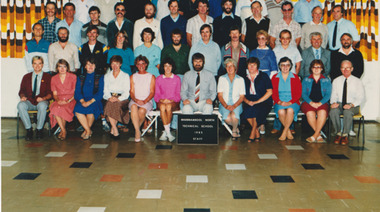
Photograph - Warrnambool North Technical School staff 1985, 1985
... The photograph is important as a record of staff members at Warrnambool North Technical School in 1985 though there are no names attached. warrnambool warrnambool north technical school Warrnambool North Technical School 1985 Staff Colour photograph (45 staff members) Photograph Warrnambool North Technical School staff 1985 ...Warrnambool North Technical School operated from 1968 to 1993 when it merged with Warrnambool High School to form Warrnambool College. The Principal in 1985 was Max Preece who was Principal from 1983 to1989.The photograph is important as a record of staff members at Warrnambool North Technical School in 1985 though there are no names attached.Colour photograph (45 staff members)Warrnambool North Technical School 1985 Staffwarrnambool, warrnambool north technical school -
 Warrnambool and District Historical Society Inc.
Book, The Women's..... A Century of Service, 1956
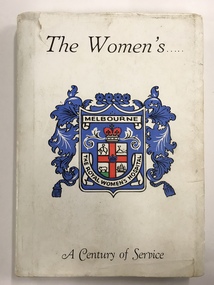
... His name is listed in this book. warrnambool medical staff royal women’s hospital melbourne saltau family warrnambool dr william dixon saltau Statement of Significance Melbourne The Royal Women's Hospital This is a soft-cover book of 170 pages printed in 1976 and giving the history of the first 100 years of the Royal Women’s Hospital, Melbourne. ...This book by C.E. Sayers details the history of the Royal Women's Hospital from the time of its foundation as the Lying In Hospital in 1856.It includes information on doctors and nurses and managerial staff connected with the hospital. Some Warrnambool medical staff in the past have been connected with the Women's Hospital. Apart from its detailing of the history of an important institution in Victoria, this book is of particular interest to the Warrnambool and District Historical Society because William Dixon Saltau (1894-1970), born in Warrnambool, was the Medical Superintendent of the Women’s Hospital from 1924 to 1951. Dr Saltau was the son of Marcus Saltau (M.L.A.) and his wife Jean and the grandson of Henry Saltau who came to Australia in 1860 and who founded in the 1870s the Warrnambool firm of Saltau and Son, general carriers, coal, wood and produce merchants and forwarding agents. Dr Saltau’s father Marcus was Mayor of Warrnambool and a generous benefactor of the Warrnambool Hospital (Marcus Saltau House and Jean Buick Saltau Maternity Ward). Dr Saltau was educated at Warrnambool Academy (Richard Lawson, Headmaster), Scotch College, Melbourne and Melbourne University. He specialized in obstetrics and gynaecology and practised in England, Adelaide and Melbourne. .This book is of general historical interest as it describes the history of the Royal Women’s Hospital in Melbourne and because a Warrnambool identity, Dr William Dixon Saltau, was the Medical Superintendent of this hospital for 25 years. His name is listed in this book. This is a soft-cover book of 170 pages printed in 1976 and giving the history of the first 100 years of the Royal Women’s Hospital, Melbourne. It has a white cover of thick paper with the emblem of the hospital on the front in blue, red, black and white. There is also a dust cover with the same material on it. The book has 26 Chapters and ten Appendices, an Index, a Foreword and an Introduction. It has a black and white sketch of the entrance to the first hospital and portraits of the two medical founders of the hospital. The pages have been bound using glue.Melbourne The Royal Women's Hospitalwarrnambool medical staff, royal women’s hospital, melbourne, saltau family, warrnambool, dr william dixon saltau, statement of significance -
 Warrnambool and District Historical Society Inc.
Book, Horizontal Bar Exercises, Early 20th century
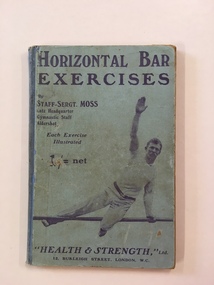
... The book itself is one of the earlier books on muscle building and is indicative of its time. dr angus warrnambool horizontal bar exercises Staff sergeant Alfred Moss Named inside front cover W R Angus.. ...This book works through a number of exercises with photographs illustrating the exercises. It was owned by W R Angus who was a doctor in Warrnambool coming to the city in 1939. He served during the war as a general surgeon and after the war took up ophthalmology as a speciality. He was a member of the state council of the AMA. he was keenly interested in cultural and civic activities and served on a number of community groups during his time in Warrnambool. He died in Cairns in 1970. The book itself was written by Staff Sergt Alfred Moss and was a popular resource for exercising and body building in the early part of the 20th century. At one time he was known as the strongest man in the British army.A book that is linked to a well- known Warrnambool resident and professional. The book itself is one of the earlier books on muscle building and is indicative of its time.Small blue card cover with dark blue text on front cover. Back cover is plain light blue. 72 pages. The front cover has a photograph of a man astride a horizontal bar with his right arm raised.Named inside front cover W R Angus..dr angus warrnambool, horizontal bar exercises, staff sergeant alfred moss -
 Warrnambool and District Historical Society Inc.
Work on paper - Booklets Fletcher Jones, 001143.1 Project Book 001143.2 Booklet:Plusites 001143.3 Flyer, Mid 20th century
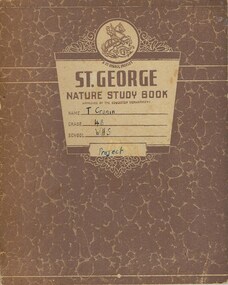
... He transformed his business into a co-operative, with the name, ‘Fletcher Jones and Staff’ registered in 1947. The business diversified into other ranges of clothing for men and women but failed to compete with cheaper overseas clothing imports and the factory and shops were closed in the early 21st century. 001143.1 Project Book. ...He transformed his business into a co-operative, with the name, ‘Fletcher Jones and Staff’ registered in 1947. The business diversified into other ranges of clothing for men and women but failed to compete with cheaper overseas clothing imports and the factory and shops were closed in the early 21st century. 001143.1 Project Book. ...Fletcher Jones Clothing Factory was a key industry in Warrnambool from 1948 to its closure in 2005. The business was founded by David Fletcher Jones (1897-1977), a clothing manufacturer and retailer who worked as a hawker in the Western District following service with the A.I.F. in World War One. In 1924 Fletcher Jones opened three shops in Liebig Street selling men’s wear, hosiery and linen and operating a small tailoring business. He moved his shop to another location in Liebig Street and began to concentrate on men’s trousers production. In 1946 he opened a shop in Collins Street in Melbourne and eventually had stores and factories all over Australia. In Warrnambool he opened his factory at Pleasant Hill in Flaxman Street in 1948 and became a major Warrnambool employer, with over 1000 employees at one time. He transformed his business into a co-operative, with the name, ‘Fletcher Jones and Staff’ registered in 1947. The business diversified into other ranges of clothing for men and women but failed to compete with cheaper overseas clothing imports and the factory and shops were closed in the early 21st century. 001143.1 Project Book. This project book tells the story of the establishment and development of the Fletcher Jones company across the various stores which were established in Melbourne, Adelaide, Sydney, Geelong and Hobart. It explores the philosophy behind the business and milestones achieved and the factory gardens. The book itself provides an example of schoolwork completed in the mid 20th century. 001143.2 Booklet: Plusites: This is a staff booklet which has items of interest relating to staff such as births deaths and marriages. It tells of renovations and happenings in regard to the various shops around the country as well as trading figures. It tells of the royal visit of 1954 and other social events and items of interest around the various shops. 001143.3 Flyer :The text on this flyer also tells the story of the development of the Fletcher Jones brand to the point where there in the year2000 retail expansion was still happening but the Warrnambool workforce had shrunk from over 1000 at the peak to approximately 200. The company had commenced importing a range of clothing by this time These three items present different views of a company which was an important part of industry in Warrnambool for over 60 years in the latter part of the 20th century. The founder was one of Warrnambool’s most well respected people and many district people had connections to the firm. 001143.1 Project Book. Brown mottled card cover with cream insert for personal details. Back cover plain cream. It contains a student’s project work on the Fletcher Jones company. Some is handwritten and also contains a number of black and white photographs throughout the book. A coloured map of Australia is in the middle pages. 001143.2 Booklet: Plusites. White light card cover with dark blue text and diagram. Bottom left of page has a map of the coastline of Victoria. 20 pages. 001143.3 Flyer. Advertising Flyer re factory direct sales at Warrnambool. Black text with maroon border and Fletcher jones logo at the bottom and 4 photographs at the top. 001143.1 Project Book. T Cronin 4B WHS 001143.2 Booklet: Plusites. Vol 1 No 1 June 1954. 001143.3 Flyer fletcher jones, warrnambool history, fletcher jones and staff pty ltd -
 Emerald Museum & Nobelius Heritage Park
Photograph - Framed photographic postcard of soldier, Kodak, 1914-1918
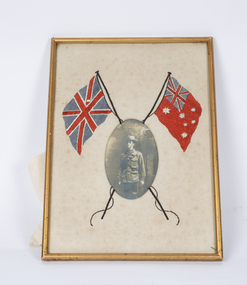
... However, the actual name has not been confirmed. World War I On back of frame handwritten probably by Museum staff: 'Unknown soldier / maybe Victor George Thompson' On back of photographic postcard handwritten: 'To go in Corticilli / with 2 flags / Black flag poles / 3/8 Gold / Standard / Wed / for / certain' Plain wooden frame with gilt coating. ...This photo was taken during World War 1 (1914-1918). It was very common for newly enlisted servicemen to organise a photograph of themselves in their enlistment uniform to give to their family/loved ones before embarking. Two names have been suggested regarding the identity of this soldier: Victor George Thompson and Tommy Dalzeil - both presumably local young men. However, the actual name has not been confirmed.Plain wooden frame with gilt coating. Picture consists of black and white, oval shaped photographic postcard of a soldier in the centre surrounded by two silk embroidered flags on black embroidered flag poles. The flag on the left is the British flag and the flag on the right is the Australian Red Ensign. The background is a cream-coloured calico-type material. This appears to be an enlistment photo, but the soldier is wearing a curiously ill-fitting uniform - perhaps borrowed from the studio for the occasion.On back of frame handwritten probably by Museum staff: 'Unknown soldier / maybe Victor George Thompson' On back of photographic postcard handwritten: 'To go in Corticilli / with 2 flags / Black flag poles / 3/8 Gold / Standard / Wed / for / certain'world war i -
 Warrnambool RSL Sub Branch
Army Uniform, shirt, Fletcher Jones & Staff, 1983
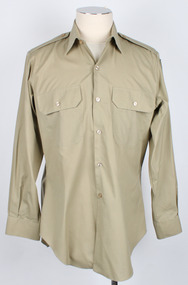
... The uniform was made by Fletcher Jones & Staff, Warrnambool in 1998. army uniform military uniform warrnambool ex service Printed on collar "SIZE 40 84" Printed on tag"A.G.C.F. VIC 1983 [ARROW MOTIF] 8405.66.088.7064 Size 40/84 SERVICE NO. NAME ...This uniform was worn by Bernie Farley, present secretary of Warrnambool RSL (2019). The uniform was made by Fletcher Jones & Staff, Warrnambool in 1998.Long sleeve Khaki shirt, two long sleeve button down breast pockets, six button fastenersPrinted on collar "SIZE 40 84" Printed on tag"A.G.C.F. VIC 1983 [ARROW MOTIF] 8405.66.088.7064 Size 40/84 SERVICE NO. NAME. DO BOIL OR WRING, MACHINE WASHABLE, DRIP DRY, IRON LIGHTLY WITH WARM IRON Patch on Left shoulder with rising sun, crown and cross. THE AUSTRALIAN ARMY.army uniform, military uniform, warrnambool ex service -
 Warrnambool RSL Sub Branch
Army Uniform, jacket, Fletcher Jones & Staff, 1998
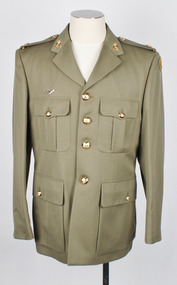
... The uniform was made by Fletcher Jones & Staff, Warrnambool in 1998. army uniform military uniform warrnambool ex service Tag inside (left) FLETCHER JONES VICTORIA 1998 Arrow signifying govt. NAME ...This uniform was worn by Bernie Farley, present secretary of Warrnambool RSL (2019). The uniform was made by Fletcher Jones & Staff, Warrnambool in 1998.Jacket with four pockets each with metal button fasteners. Four front metal button fasteners. One inside pocket . Regimental badges on lapels, Badge over right pocket. Epaulets with metal buttons, a crown and Australia. All metal buttons engraved with army insignia. Front metal button fasteners secured with safety pinsTag inside (left) FLETCHER JONES VICTORIA 1998 Arrow signifying govt. NAME. SERVICE NUMBER. 70% Wool, 30% Polyester, DRY CLEAN ONLY (A) Warm Iron ZC804B AR0003army uniform, military uniform, warrnambool ex service -
 Kiewa Valley Historical Society
Ticket - S.E.C.V. Meal Pass, S.E.C. Meal Pass
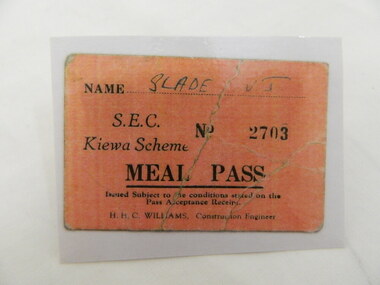
... This would have controlled the number of people entitled to a meal and enabled staff to both prepare the correct number of meals and to use the number of meals when finalising the budget. state electricity commission of victoria. kiewa hydro electric scheme. meal pass. mr slade. Name ...During the construction of the Kiewa Hydro Electric Scheme visitors would have required a Meal Pass. This ticket would have been produced at the office for the purpose of controlling the people entitled to a meal and the number of people requiring one.Historical: This ticket indicates that a meal pass was required during the construction of the Kiewa Hydro Electric Scheme. This would have controlled the number of people entitled to a meal and enabled staff to both prepare the correct number of meals and to use the number of meals when finalising the budget.This orange ticket has been laminated. The writing on it is in black.Name: Slade S.E.C. / Kiewa Scheme No. 2703 Meal Pass (underlined) Issued subject to the conditions stated on the Pass / Acceptance Receipt H.H.C. Williams, Construction Engineer state electricity commission of victoria. kiewa hydro electric scheme. meal pass. mr slade. -
 Ararat & District Historical Society (operating the Langi Morgala Museum)
Photograph, 1920s
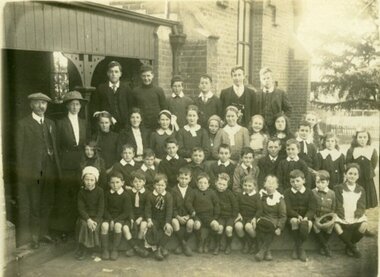
... This appears to be a photo of all or most of the Pupils and Staff of Ararat Church of England School, ca1920s. The names of all or most are written on the back of the photo....This appears to be a photo of all or most of the Pupils and Staff of Ararat Church of England School, ca1920s. The names of all or most are written on the back of the photo. ...This appears to be a photo of all or most of the Pupils and Staff of Ararat Church of England School, ca1920s. The names of all or most are written on the back of the photo.This is an early photo of the Ararat Church of England School. The date, and the names attached to or written on the back of the photo add to the signficance of the photo, making it of local significance.Black and white photograph mounted on cardboard. The photograph shows a group of 39 students in four rows and a man and woman standing to their left. They are in front of a brick building.Inscription: on back, both written in ink, and repeated on an affixed cardboard label. Church of England Grammar School 1920's./ Back row left to right L. Wright, H. Banfield, T. Butt, N. Gamson, R. Hodgetts,/ T. Webb, Mr T. C. Cochrane, Miss K. Webb, First row M. Webb, L. Robertson,/ J. McKay, T. Brown, E. Brown, B. Edwards, D. Hayman, I. Edwards/ Second Row - G. Foster, J.H. Webb, B. Hayman, E. Noltenius, Temple/ B. Richardson, I. Gibletr/ Front Row: F. Ramage, W. Owen, J. Dunn, J. Foster/ M. Hayman, L. Ford, B. Nolteniuseducation, 1920, school, teacher, church-of-england, pupil, ararat-church-of-england-school, ararat-school, ararat-education -
 Conservation Volunteers
Visiting US Conservation Corps Sleeve Patch collections, US Conservation Corps Sleeve Patch collections
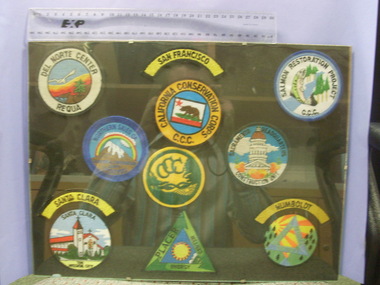
... This cloth sleeve patch is an example of those sewn onto the uniforms of staff and volunteers of the California Conservation Corps. It is round with an orange rim with black lettering naming ther organisation and inside the rime there is a light blue circle inset with the State flag of California. ...This sleeve patch symbolises strong international links in place since ATCV/CVA was founded. corps david conservation mark dwyer california clark sleeve patches This cloth sleeve patch is an example of those sewn onto the uniforms of staff and volunteers of the California Conservation Corps. It is round with an orange rim with black lettering naming ther organisation and inside the rime there is a light blue circle inset with the State flag of California. ...Initially named the Conservation Corps, the British Trust for Conservation Volunteers (BTCV) was founded in 1959 by the Council for Nature. Today BTCV is the “largest practical conservation charity in the United Kingdom”, and celebrated its fiftieth birthday in February 2009. Its original name had been adapted from that of the Civilian Conservation Corps launched by President Roosevelt in Depression-era USA: - "I propose to create a Civilian Conservation Corps to be used in simple work, not interfering with normal employment, and confining itself to forestry, the prevention of soil erosion, flood control and similar projects. More important, however, than the material gains, will be the moral and spiritual value of such work. Roosevelt’s idea had been revived by Governor Jerry Brown of California in 1976 and exchange of ideas and personnel between the California Conservation Corps (CCC) and other US conservation corps) has flourished since. Mark Dwyer (later to play an important role in Green Corps) was leader of the first California Conservation Corps three-month exchange program to Australia in 1988. The first ATCV exchange group to California in 1987 National Director, Tim Cox and Team Leader, David Clark (group leader, in Australian military hat) Right: Members of the first CCC exchange team to Australia at the US Embassy, Canberra in 1988: from left - Merrold, Vicci and Bobby with Mark Dwyer (centre) and David Clark (ATCV, right). Exchanges have continued annually since 1988 and, in addition to environmental work done, many friendships have been made and maintained over the years. This sleeve patch symbolises strong international links in place since ATCV/CVA was founded.This cloth sleeve patch is an example of those sewn onto the uniforms of staff and volunteers of the California Conservation Corps. It is round with an orange rim with black lettering naming ther organisation and inside the rime there is a light blue circle inset with the State flag of California. This sleeve patch is part of CVA's collection of 34 sleeve patches from many States of the USA.corps, david, conservation, mark, dwyer, california, clark, sleeve, patches -
 Buninyong & District Historical Society
Photograph - B/W photograph, Buninyong State School and Teaching Staff 1896
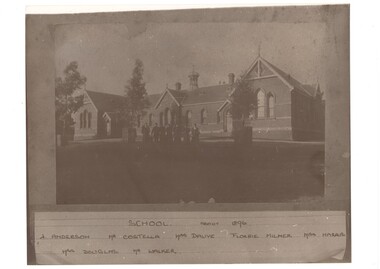
... Staff identified as J. Anderson, Mr. Costella, Mrs. Davye, Florrie Milner, Mrs. Harris, Mrs. Douglas, Mr. Walker (source of names...Staff identified as J. Anderson, Mr. Costella, Mrs. Davye, Florrie Milner, Mrs. Harris, Mrs. Douglas, Mr. Walker (source of names ...Buninyong State school was built and opened in 1873. This1890s photograph shows staff in contemporary dress and the original windows and belltower. Historic and social significance for the Buninyong communityBlack and white photograph of an original photo. Seven members of the teaching staff in front of Buninyong State School circa 1896Staff identified as J. Anderson, Mr. Costella, Mrs. Davye, Florrie Milner, Mrs. Harris, Mrs. Douglas, Mr. Walker (source of names unknown)buninyong primary school, teachers, building, buninyong state school -
 Bendigo Historical Society Inc.
Newsletter - The Grapevine Cuttings by Rob Upson, 1998 to 2000
... Staff produced a monthly newsletter called ‘The Grapevine’. Being reasonably new to Bendigo, Rob became interested in its history and began writing articles to share with the volunteers. He called them ‘Grapevine Cuttings’ under the pen name...Staff produced a monthly newsletter called ‘The Grapevine’. Being reasonably new to Bendigo, Rob became interested in its history and began writing articles to share with the volunteers. He called them ‘Grapevine Cuttings’ under the pen name ...Rob Upson became a volunteer at the Bendigo Visitor Centre in 1998. The Staff produced a monthly newsletter called ‘The Grapevine’. Being reasonably new to Bendigo, Rob became interested in its history and began writing articles to share with the volunteers. He called them ‘Grapevine Cuttings’ under the pen name of ‘Merlot’. Rob wrote about 90 articles over a period of 12 years until ‘The Grapevine’ was finally pruned and shutdown. Rob is a valuable volunteer for the Bendigo Historical Society.Sixty Five Newsletters in PDF format from the Grapevine collection that cover the following historical items: Grapevine Newsletters by Rob Upson (Bendigo Historical Society) 10828 Index 10828 Index - Parent Document (This Page) 10828.00 ‘Objection your Honour’ 10828.01 Bendigo’s Gold Volume 10828.02 Harry Boyle (Cricketer) 10828.03 Ellen Clacy on the Goldfields 10828.04 Gold Fever and Vandemonians 10828.05 The Railway to Bendigo (Part 1 and 2) 10828.07 The Pioneer’s Grave at Maiden Gully 10828.08 The First Parliamentary Election, Bendigo 1855 10828.09 The Origin of Place Names 10828.10 The Tram (Parts 1 to 4) 10828.13 W.D.C. Denovan 10828.14 Knipe’s Castle 10828.15 John Hanlon Knipe 10828.16 1st January 1900 in Bendigo 10828.17 William Gay – Bendigo Poet 10828.18 St. Aidan’s Orphanage 10828.19 The Year 2000 – a Prediction from 1967 10828.20 Dr. Henry Backhaus 10828.21 St. Kilian’s Catholic Church 10828.22 S.T. Gill – Goldfields Artist 10828.23 Cobb and Co. 10828.24 ‘The Lights of Cobb and Co.’ by Henry Lawson 10828.25 Federation Celebrations – Sydney 1901 10828.26 The Australian Flag of Stars 10828.27 Old Treasury Building – Melbourne 10828.28 Key Dates in Bendigo’s First 50 Years 10828.29 The March from Robe to Bendigo and China’s Long March 10828.30 A Goldfields Quiz 10828.31 Did You Know That ………..? 10828.32 The Weekly Times 1869 10828.33 Mark Twain in Australia 10828.34 Bendigo’s Jewish Synagogue 10828.35 Sly Grog on the Goldfields 10828.36 A Brief History of Breweries in Australia 10828.37 The Breweries of Bendigo 10828.38 The Cohn Brothers of Bendigo 10828.39 Mary McCarthy – aged 114 10828.40 Langley Hall and Bishopscourt 10828.41 William ‘Bendigo’ Thompson 10828.42 Lachlan MacLachlan 10828.43 ‘Said Hanrahan’ by John O’Brien 10828.44 The Origin of Sandhurst 10828.45 Lister House 10828.46 Arthur Thomas Woodward 10828.47 The Students of Arthur Thomas Woodward 10828.48 Henry Leggo 10828.49 Chiko Rolls and Four ‘n Twenty Pies 10828.50 HMVS Nelson and Victoria’s Navy (Parts 1 and 2) 10828.52 Anthony Trollope in Australia (Part 1 to 3) 10828.55 Regional Towns of Victoria – a Quiz 10828.56 Exploration and Settlement of Victoria (Parts 1 and 2) 10828.58 The Major Mitchell Expedition into Victoria (Parts 1 to 3) 10828.61 The Gold Rush (Part 1 and 2) 10828.63 The Road to the Diggings (Part 1 and 2) 10828.65 Harold Desbrowe-Annear (Part 1 and 2) 10828.71 Nom de Plumes 10828.72 The New Zealand Gold Rush 10828.73 Ernst Mueller and Ettore Cadorin 10828.74 Sir John Monash 10828.75 P & O Ships 10828.76 Rosalind Park 10828.82 Bendigo Street Names 10828.83 A Constitutional Proposal and Early Bendigo Vineyards 10828.84 Ferdinand von Mueller 10828.85 John Boyd Watsonhistory, bendigo, grapevine cuttings -
 Bendigo Historical Society Inc.
Newsletter - The Grapevine Cuttings by Rob Upson - 'Objection Your Honour', Jan 1998
... Staff produced a monthly newsletter called ‘The Grapevine’. Being reasonably new to Bendigo, Rob became interested in its history and began writing articles to share with the volunteers. He called them ‘Grapevine Cuttings’ under the pen name...Staff produced a monthly newsletter called ‘The Grapevine’. Being reasonably new to Bendigo, Rob became interested in its history and began writing articles to share with the volunteers. He called them ‘Grapevine Cuttings’ under the pen name ...Rob Upson became a volunteer at the Bendigo Visitor Centre in 1998. The Staff produced a monthly newsletter called ‘The Grapevine’. Being reasonably new to Bendigo, Rob became interested in its history and began writing articles to share with the volunteers. He called them ‘Grapevine Cuttings’ under the pen name of ‘Merlot’. Rob wrote about 90 articles over a period of 12 years until ‘The Grapevine’ was finally pruned and shutdown. Rob is a valuable volunteer for the Bendigo Historical Society.Article 00 of 65 Newsletters in PDF format from the Grapevine collection. history, bendigo, grapevine cuttings, objection your honour -
 Bendigo Historical Society Inc.
Newsletter - The Grapevine Cuttings by Rob Upson - 'Bendigo's Gold Vol;ume', Mar 1998
... Staff produced a monthly newsletter called ‘The Grapevine’. Being reasonably new to Bendigo, Rob became interested in its history and began writing articles to share with the volunteers. He called them ‘Grapevine Cuttings’ under the pen name...Staff produced a monthly newsletter called ‘The Grapevine’. Being reasonably new to Bendigo, Rob became interested in its history and began writing articles to share with the volunteers. He called them ‘Grapevine Cuttings’ under the pen name ...Rob Upson became a volunteer at the Bendigo Visitor Centre in 1998. The Staff produced a monthly newsletter called ‘The Grapevine’. Being reasonably new to Bendigo, Rob became interested in its history and began writing articles to share with the volunteers. He called them ‘Grapevine Cuttings’ under the pen name of ‘Merlot’. Rob wrote about 90 articles over a period of 12 years until ‘The Grapevine’ was finally pruned and shutdown. Rob is a valuable volunteer for the Bendigo Historical Society.Article 01 of 65 Newsletters in PDF format from the Grapevine collection. history, bendigo, grapevine cuttings, bendigo's gold volume -
 Bendigo Historical Society Inc.
Newsletter - The Grapevine Cuttings by Rob Upson - 'Harry Boyle', May 1998
... Staff produced a monthly newsletter called ‘The Grapevine’. Being reasonably new to Bendigo, Rob became interested in its history and began writing articles to share with the volunteers. He called them ‘Grapevine Cuttings’ under the pen name...Staff produced a monthly newsletter called ‘The Grapevine’. Being reasonably new to Bendigo, Rob became interested in its history and began writing articles to share with the volunteers. He called them ‘Grapevine Cuttings’ under the pen name ...Rob Upson became a volunteer at the Bendigo Visitor Centre in 1998. The Staff produced a monthly newsletter called ‘The Grapevine’. Being reasonably new to Bendigo, Rob became interested in its history and began writing articles to share with the volunteers. He called them ‘Grapevine Cuttings’ under the pen name of ‘Merlot’. Rob wrote about 90 articles over a period of 12 years until ‘The Grapevine’ was finally pruned and shutdown. Rob is a valuable volunteer for the Bendigo Historical Society.Article 02 of 65 Newsletters in PDF format from the Grapevine collection. history, bendigo, grapevine cuttings, harry boyle, cricket -
 Bendigo Historical Society Inc.
Newsletter - The Grapevine Cuttings by Rob Upson - 'Ellen Clacy on the Goldfields', June 1998
... Staff produced a monthly newsletter called ‘The Grapevine’. Being reasonably new to Bendigo, Rob became interested in its history and began writing articles to share with the volunteers. He called them ‘Grapevine Cuttings’ under the pen name...Staff produced a monthly newsletter called ‘The Grapevine’. Being reasonably new to Bendigo, Rob became interested in its history and began writing articles to share with the volunteers. He called them ‘Grapevine Cuttings’ under the pen name ...Rob Upson became a volunteer at the Bendigo Visitor Centre in 1998. The Staff produced a monthly newsletter called ‘The Grapevine’. Being reasonably new to Bendigo, Rob became interested in its history and began writing articles to share with the volunteers. He called them ‘Grapevine Cuttings’ under the pen name of ‘Merlot’. Rob wrote about 90 articles over a period of 12 years until ‘The Grapevine’ was finally pruned and shutdown. Rob is a valuable volunteer for the Bendigo Historical Society.Article 03 of 65 Newsletters in PDF format from the Grapevine collection. history, bendigo, grapevine cuttings, ellen clacy -
 Bendigo Historical Society Inc.
Newsletter - The Grapevine Cuttings by Rob Upson - 'Gold Fever and Vandemonians', Aug 1998
... Staff produced a monthly newsletter called ‘The Grapevine’. Being reasonably new to Bendigo, Rob became interested in its history and began writing articles to share with the volunteers. He called them ‘Grapevine Cuttings’ under the pen name...Staff produced a monthly newsletter called ‘The Grapevine’. Being reasonably new to Bendigo, Rob became interested in its history and began writing articles to share with the volunteers. He called them ‘Grapevine Cuttings’ under the pen name ...Rob Upson became a volunteer at the Bendigo Visitor Centre in 1998. The Staff produced a monthly newsletter called ‘The Grapevine’. Being reasonably new to Bendigo, Rob became interested in its history and began writing articles to share with the volunteers. He called them ‘Grapevine Cuttings’ under the pen name of ‘Merlot’. Rob wrote about 90 articles over a period of 12 years until ‘The Grapevine’ was finally pruned and shutdown. Rob is a valuable volunteer for the Bendigo Historical Society.Article 04 of 65 Newsletters in PDF format from the Grapevine collection. history, bendigo, grapevine cuttings, vandemonians -
 Bendigo Historical Society Inc.
Newsletter - The Grapevine Cuttings by Rob Upson - 'The Railway to Bendigo', July 1998
... Staff produced a monthly newsletter called ‘The Grapevine’. Being reasonably new to Bendigo, Rob became interested in its history and began writing articles to share with the volunteers. He called them ‘Grapevine Cuttings’ under the pen name...Staff produced a monthly newsletter called ‘The Grapevine’. Being reasonably new to Bendigo, Rob became interested in its history and began writing articles to share with the volunteers. He called them ‘Grapevine Cuttings’ under the pen name ...Rob Upson became a volunteer at the Bendigo Visitor Centre in 1998. The Staff produced a monthly newsletter called ‘The Grapevine’. Being reasonably new to Bendigo, Rob became interested in its history and began writing articles to share with the volunteers. He called them ‘Grapevine Cuttings’ under the pen name of ‘Merlot’. Rob wrote about 90 articles over a period of 12 years until ‘The Grapevine’ was finally pruned and shutdown. Rob is a valuable volunteer for the Bendigo Historical Society.Article 05 of 65 Newsletters in PDF format from the Grapevine collection. history, bendigo, grapevine cuttings, railway to melbourne -
 Bendigo Historical Society Inc.
Newsletter - The Grapevine Cuttings by Rob Upson - 'The Pioneer's Grave in Maiden Gully', Sept 1998
... Staff produced a monthly newsletter called ‘The Grapevine’. Being reasonably new to Bendigo, Rob became interested in its history and began writing articles to share with the volunteers. He called them ‘Grapevine Cuttings’ under the pen name...Staff produced a monthly newsletter called ‘The Grapevine’. Being reasonably new to Bendigo, Rob became interested in its history and began writing articles to share with the volunteers. He called them ‘Grapevine Cuttings’ under the pen name ...Rob Upson became a volunteer at the Bendigo Visitor Centre in 1998. The Staff produced a monthly newsletter called ‘The Grapevine’. Being reasonably new to Bendigo, Rob became interested in its history and began writing articles to share with the volunteers. He called them ‘Grapevine Cuttings’ under the pen name of ‘Merlot’. Rob wrote about 90 articles over a period of 12 years until ‘The Grapevine’ was finally pruned and shutdown. Rob is a valuable volunteer for the Bendigo Historical Society.Article 07 of 65 Newsletters in PDF format from the Grapevine collection. history, bendigo, grapevine cuttings, grave in maiden gully, ninnes grave -
 Bendigo Historical Society Inc.
Newsletter - The Grapevine Cuttings by Rob Upson - 'The First Parliamentary Election - Bendigo 1855', Oct 1998
... Staff produced a monthly newsletter called ‘The Grapevine’. Being reasonably new to Bendigo, Rob became interested in its history and began writing articles to share with the volunteers. He called them ‘Grapevine Cuttings’ under the pen name...Staff produced a monthly newsletter called ‘The Grapevine’. Being reasonably new to Bendigo, Rob became interested in its history and began writing articles to share with the volunteers. He called them ‘Grapevine Cuttings’ under the pen name ...Rob Upson became a volunteer at the Bendigo Visitor Centre in 1998. The Staff produced a monthly newsletter called ‘The Grapevine’. Being reasonably new to Bendigo, Rob became interested in its history and began writing articles to share with the volunteers. He called them ‘Grapevine Cuttings’ under the pen name of ‘Merlot’. Rob wrote about 90 articles over a period of 12 years until ‘The Grapevine’ was finally pruned and shutdown. Rob is a valuable volunteer for the Bendigo Historical Society.Article 08 of 65 Newsletters in PDF format from the Grapevine collection. history, bendigo, grapevine cuttings, grave in maiden gully, first parliamentary election -
 Bendigo Historical Society Inc.
Newsletter - The Grapevine Cuttings by Rob Upson - 'Origin of Place Names', Dec1998
... Staff produced a monthly newsletter called ‘The Grapevine’. Being reasonably new to Bendigo, Rob became interested in its history and began writing articles to share with the volunteers. He called them ‘Grapevine Cuttings’ under the pen name...Staff produced a monthly newsletter called ‘The Grapevine’. Being reasonably new to Bendigo, Rob became interested in its history and began writing articles to share with the volunteers. He called them ‘Grapevine Cuttings’ under the pen name ...Rob Upson became a volunteer at the Bendigo Visitor Centre in 1998. The Staff produced a monthly newsletter called ‘The Grapevine’. Being reasonably new to Bendigo, Rob became interested in its history and began writing articles to share with the volunteers. He called them ‘Grapevine Cuttings’ under the pen name of ‘Merlot’. Rob wrote about 90 articles over a period of 12 years until ‘The Grapevine’ was finally pruned and shutdown. Rob is a valuable volunteer for the Bendigo Historical Society.Article 09 of 65 Newsletters in PDF format from the Grapevine collection. history, bendigo, grapevine cuttings, grave in maiden gully, origins of place names in victoria -
 Bendigo Historical Society Inc.
Newsletter - The Grapevine Cuttings by Rob Upson - 'The Tram', Feb 1999
... Staff produced a monthly newsletter called ‘The Grapevine’. Being reasonably new to Bendigo, Rob became interested in its history and began writing articles to share with the volunteers. He called them ‘Grapevine Cuttings’ under the pen name...Staff produced a monthly newsletter called ‘The Grapevine’. Being reasonably new to Bendigo, Rob became interested in its history and began writing articles to share with the volunteers. He called them ‘Grapevine Cuttings’ under the pen name ...Rob Upson became a volunteer at the Bendigo Visitor Centre in 1998. The Staff produced a monthly newsletter called ‘The Grapevine’. Being reasonably new to Bendigo, Rob became interested in its history and began writing articles to share with the volunteers. He called them ‘Grapevine Cuttings’ under the pen name of ‘Merlot’. Rob wrote about 90 articles over a period of 12 years until ‘The Grapevine’ was finally pruned and shutdown. Rob is a valuable volunteer for the Bendigo Historical Society.Article 10 of 65 Newsletters in PDF format from the Grapevine collection. history, bendigo, grapevine cuttings, grave in maiden gully, the tram -
 Bendigo Historical Society Inc.
Newsletter - The Grapevine Cuttings by Rob Upson - ' W.D.C. Denovan', Aug 1999
... Staff produced a monthly newsletter called ‘The Grapevine’. Being reasonably new to Bendigo, Rob became interested in its history and began writing articles to share with the volunteers. He called them ‘Grapevine Cuttings’ under the pen name...Staff produced a monthly newsletter called ‘The Grapevine’. Being reasonably new to Bendigo, Rob became interested in its history and began writing articles to share with the volunteers. He called them ‘Grapevine Cuttings’ under the pen name ...Rob Upson became a volunteer at the Bendigo Visitor Centre in 1998. The Staff produced a monthly newsletter called ‘The Grapevine’. Being reasonably new to Bendigo, Rob became interested in its history and began writing articles to share with the volunteers. He called them ‘Grapevine Cuttings’ under the pen name of ‘Merlot’. Rob wrote about 90 articles over a period of 12 years until ‘The Grapevine’ was finally pruned and shutdown. Rob is a valuable volunteer for the Bendigo Historical Society.Article 13 of 65 Newsletters in PDF format from the Grapevine collection. history, bendigo, grapevine cuttings, grave in maiden gully, w.d.c. denovan
