
Showing 713 items matching "war service records"
-
 Melbourne Legacy
Photograph, Suez Canal, 1920
... War 1 memorabilia that has come from Private John Basil McLean, 2nd Reinforcements, 37th Battalion, A.I.F. There was a large collection of postcards so he may have been collecting them as souvenirs. J.B. McLean (Service No. 13824) was from near Maffra, Victoria and enlisted on 22 January 1916. He embarked on 16 December 1916 for Europe. His full war record...War 1 memorabilia that has come from Private John Basil McLean, 2nd Reinforcements, 37th Battalion, A.I.F. There was a large collection of postcards so he may have been collecting them as souvenirs. J.B. McLean (Service No. 13824) was from near Maffra, Victoria and enlisted on 22 January 1916. He embarked on 16 December 1916 for Europe. His full war record ...One photo from an album belonging to JB McLean, of his voyage home from World War 1 in 1920 on the Ceramic. The photo shows a canal of freshwater next to the Suez Canal at Kantara. The Ceramic departed Tillbury, UK 12th March and docked in Freemantle on 27th April 1920 and then went onto Adelaide, Melbourne and Sydney. The Ceramic was a transport vessel built in Belfast in 1913 for the White Star Line to transport frozen produce and apples from Australia to UK. It was taken over by the Australian Government for troop transport in October 1914 and could carry over 3,000 troops. This trip in 1920 there were 1467 on board, there were women and children as well as 439 soldiers returning home, one of whom was John 'Basil' McLean. Was with other World War 1 memorabilia that has come from Private John Basil McLean, 2nd Reinforcements, 37th Battalion, A.I.F. There was a large collection of postcards so he may have been collecting them as souvenirs. J.B. McLean (Service No. 13824) was from near Maffra, Victoria and enlisted on 22 January 1916. He embarked on 16 December 1916 for Europe. His full war record is available from AWM. He spent time with the Australian Field Artillery (Pack Section). At the end of the war he worked for a year at the A.I.F. Headquarters in London before returning to Australia on the 'Ceramic', arriving Portsea in 1920.A collection of items from John Basil McLean is in the archive. Kept as an indication of what founding legatees experienced in World War One and what they saw on the way home.Sepia photo of a canal next to the Suez Canal glued to black cardboard in an album of photos from 1920.Handwritten caption 'Kantara Sweet Water Canal' in white ink.souvenir, world war one, jb mclean, ship, ceramic, suez, kantara -
 Melbourne Legacy
Photograph, Suez Canal, 1920
... War 1 memorabilia that has come from Private John Basil McLean, 2nd Reinforcements, 37th Battalion, A.I.F. There was a large collection of postcards so he may have been collecting them as souvenirs. J.B. McLean (Service No. 13824) was from near Maffra, Victoria and enlisted on 22 January 1916. He embarked on 16 December 1916 for Europe. His full war record...War 1 memorabilia that has come from Private John Basil McLean, 2nd Reinforcements, 37th Battalion, A.I.F. There was a large collection of postcards so he may have been collecting them as souvenirs. J.B. McLean (Service No. 13824) was from near Maffra, Victoria and enlisted on 22 January 1916. He embarked on 16 December 1916 for Europe. His full war record ...One photo from an album belonging to JB McLean, of his voyage home from World War 1 in 1920 on the Ceramic. The photo shows military supplies at Kantara including railway wagons. The Ceramic departed Tillbury, UK 12th March and docked in Freemantle on 27th April 1920 and then went onto Adelaide, Melbourne and Sydney. The Ceramic was a transport vessel built in Belfast in 1913 for the White Star Line to transport frozen produce and apples from Australia to UK. It was taken over by the Australian Government for troop transport in October 1914 and could carry over 3,000 troops. This trip in 1920 there were 1467 on board, there were women and children as well as 439 soldiers returning home, one of whom was John 'Basil' McLean. Was with other World War 1 memorabilia that has come from Private John Basil McLean, 2nd Reinforcements, 37th Battalion, A.I.F. There was a large collection of postcards so he may have been collecting them as souvenirs. J.B. McLean (Service No. 13824) was from near Maffra, Victoria and enlisted on 22 January 1916. He embarked on 16 December 1916 for Europe. His full war record is available from AWM. He spent time with the Australian Field Artillery (Pack Section). At the end of the war he worked for a year at the A.I.F. Headquarters in London before returning to Australia on the 'Ceramic', arriving Portsea in 1920.A collection of items from John Basil McLean is in the archive. Kept as an indication of what founding legatees experienced in World War One and what they saw on the way home.Sepia photo of a the Kantara Military Dump from the deck of the Ceramic glued to black cardboard in an album of photos from 1920.Handwritten caption 'Kantara Military Camp' in white ink.souvenir, world war one, jb mclean, ship, ceramic, suez, kantara -
 Melbourne Legacy
Photograph, Suez Canal, 1920
... War 1 memorabilia that has come from Private John Basil McLean, 2nd Reinforcements, 37th Battalion, A.I.F. There was a large collection of postcards so he may have been collecting them as souvenirs. J.B. McLean (Service No. 13824) was from near Maffra, Victoria and enlisted on 22 January 1916. He embarked on 16 December 1916 for Europe. His full war record...War 1 memorabilia that has come from Private John Basil McLean, 2nd Reinforcements, 37th Battalion, A.I.F. There was a large collection of postcards so he may have been collecting them as souvenirs. J.B. McLean (Service No. 13824) was from near Maffra, Victoria and enlisted on 22 January 1916. He embarked on 16 December 1916 for Europe. His full war record ...One photo from an album belonging to JB McLean, of his voyage home from World War 1 in 1920 on the Ceramic. The photo shows buildings at Port Tawfiq at the end of the Suez Canal. The Ceramic departed Tillbury, UK 12th March and docked in Freemantle on 27th April 1920 and then went onto Adelaide, Melbourne and Sydney. The Ceramic was a transport vessel built in Belfast in 1913 for the White Star Line to transport frozen produce and apples from Australia to UK. It was taken over by the Australian Government for troop transport in October 1914 and could carry over 3,000 troops. This trip in 1920 there were 1467 on board, there were women and children as well as 439 soldiers returning home, one of whom was John 'Basil' McLean. Was with other World War 1 memorabilia that has come from Private John Basil McLean, 2nd Reinforcements, 37th Battalion, A.I.F. There was a large collection of postcards so he may have been collecting them as souvenirs. J.B. McLean (Service No. 13824) was from near Maffra, Victoria and enlisted on 22 January 1916. He embarked on 16 December 1916 for Europe. His full war record is available from AWM. He spent time with the Australian Field Artillery (Pack Section). At the end of the war he worked for a year at the A.I.F. Headquarters in London before returning to Australia on the 'Ceramic', arriving Portsea in 1920.A collection of items from John Basil McLean is in the archive. Kept as an indication of what founding legatees experienced in World War One and what they saw on the way home.Sepia photo of a the port at the end of the Suez Canal from the deck of the Ceramic glued to black cardboard in an album of photos from 1920.Handwritten caption 'Port Tewfik' in white ink.world war one, jb mclean, ship, ceramic, suez, souvenir -
 Melbourne Legacy
Photograph, Suez Canal, 1920
... War 1 memorabilia that has come from Private John Basil McLean, 2nd Reinforcements, 37th Battalion, A.I.F. There was a large collection of postcards so he may have been collecting them as souvenirs. J.B. McLean (Service No. 13824) was from near Maffra, Victoria and enlisted on 22 January 1916. He embarked on 16 December 1916 for Europe. His full war record...War 1 memorabilia that has come from Private John Basil McLean, 2nd Reinforcements, 37th Battalion, A.I.F. There was a large collection of postcards so he may have been collecting them as souvenirs. J.B. McLean (Service No. 13824) was from near Maffra, Victoria and enlisted on 22 January 1916. He embarked on 16 December 1916 for Europe. His full war record ...One photo from an album belonging to JB McLean, of his voyage home from World War 1 in 1920 on the Ceramic. The photo shows a wireless station and jetty on the Suez Canal. The Ceramic departed Tillbury, UK 12th March and docked in Freemantle on 27th April 1920 and then went onto Adelaide, Melbourne and Sydney. The Ceramic was a transport vessel built in Belfast in 1913 for the White Star Line to transport frozen produce and apples from Australia to UK. It was taken over by the Australian Government for troop transport in October 1914 and could carry over 3,000 troops. This trip in 1920 there were 1467 on board, there were women and children as well as 439 soldiers returning home, one of whom was John 'Basil' McLean. Was with other World War 1 memorabilia that has come from Private John Basil McLean, 2nd Reinforcements, 37th Battalion, A.I.F. There was a large collection of postcards so he may have been collecting them as souvenirs. J.B. McLean (Service No. 13824) was from near Maffra, Victoria and enlisted on 22 January 1916. He embarked on 16 December 1916 for Europe. His full war record is available from AWM. He spent time with the Australian Field Artillery (Pack Section). At the end of the war he worked for a year at the A.I.F. Headquarters in London before returning to Australia on the 'Ceramic', arriving Portsea in 1920.A collection of items from John Basil McLean is in the archive. Kept as an indication of what founding legatees experienced in World War One and what they saw on the way home.Sepia photo of a wireless station on the Suez Canal glued to black cardboard in an album of photos from 1920.Handwritten caption 'Wireless Station Suez Canal' in white ink.souvenir, world war one, jb mclean, ship, ceramic, suez -
 Melbourne Legacy
Photograph, Ceramic, 1920
... War 1 memorabilia that has come from Private John Basil McLean, 2nd Reinforcements, 37th Battalion, A.I.F. There was a large collection of postcards so he may have been collecting them as souvenirs. J.B. McLean (Service No. 13824) was from near Maffra, Victoria and enlisted on 22 January 1916. He embarked on 16 December 1916 for Europe. His full war record...War 1 memorabilia that has come from Private John Basil McLean, 2nd Reinforcements, 37th Battalion, A.I.F. There was a large collection of postcards so he may have been collecting them as souvenirs. J.B. McLean (Service No. 13824) was from near Maffra, Victoria and enlisted on 22 January 1916. He embarked on 16 December 1916 for Europe. His full war record ...Two photos from an album belonging to JB McLean, of his voyage home from World War 1 in 1920 on the Ceramic. The photos shows the front section of the Ceramic with some passengers. The Ceramic departed Tillbury, UK 12th March and docked in Freemantle on 27th April 1920 and then went onto Adelaide, Melbourne and Sydney. The Ceramic was a transport vessel built in Belfast in 1913 for the White Star Line to transport frozen produce and apples from Australia to UK. It was taken over by the Australian Government for troop transport in October 1914 and could carry over 3,000 troops. This trip in 1920 there were 1467 on board, there were women and children as well as 439 soldiers returning home, one of whom was John 'Basil' McLean. Was with other World War 1 memorabilia that has come from Private John Basil McLean, 2nd Reinforcements, 37th Battalion, A.I.F. There was a large collection of postcards so he may have been collecting them as souvenirs. J.B. McLean (Service No. 13824) was from near Maffra, Victoria and enlisted on 22 January 1916. He embarked on 16 December 1916 for Europe. His full war record is available from AWM. He spent time with the Australian Field Artillery (Pack Section). At the end of the war he worked for a year at the A.I.F. Headquarters in London before returning to Australia on the 'Ceramic', arriving Portsea in 1920.A collection of items from John Basil McLean is in the archive. Kept as an indication of what founding legatees experienced in World War One and what they saw on the way home.Sepia photo x 2 of the forward section of the Ceramic glued to black cardboard in an album of photos from 1920.Handwritten caption 'Looking forward' in white ink.souvenir, world war one, jb mclean, ship, ceramic -
 Melbourne Legacy
Photograph, Suez Canal, 1920
... War 1 memorabilia that has come from Private John Basil McLean, 2nd Reinforcements, 37th Battalion, A.I.F. There was a large collection of postcards so he may have been collecting them as souvenirs. J.B. McLean (Service No. 13824) was from near Maffra, Victoria and enlisted on 22 January 1916. He embarked on 16 December 1916 for Europe. His full war record...War 1 memorabilia that has come from Private John Basil McLean, 2nd Reinforcements, 37th Battalion, A.I.F. There was a large collection of postcards so he may have been collecting them as souvenirs. J.B. McLean (Service No. 13824) was from near Maffra, Victoria and enlisted on 22 January 1916. He embarked on 16 December 1916 for Europe. His full war record ...One photo from an album belonging to JB McLean, of his voyage home from World War 1 in 1920 on the Ceramic. The photo shows the bank of the Suez Canal. The Ceramic departed Tillbury, UK 12th March and docked in Freemantle on 27th April 1920 and then went onto Adelaide, Melbourne and Sydney. The Ceramic was a transport vessel built in Belfast in 1913 for the White Star Line to transport frozen produce and apples from Australia to UK. It was taken over by the Australian Government for troop transport in October 1914 and could carry over 3,000 troops. This trip in 1920 there were 1467 on board, there were women and children as well as 439 soldiers returning home, one of whom was John 'Basil' McLean. Was with other World War 1 memorabilia that has come from Private John Basil McLean, 2nd Reinforcements, 37th Battalion, A.I.F. There was a large collection of postcards so he may have been collecting them as souvenirs. J.B. McLean (Service No. 13824) was from near Maffra, Victoria and enlisted on 22 January 1916. He embarked on 16 December 1916 for Europe. His full war record is available from AWM. He spent time with the Australian Field Artillery (Pack Section). At the end of the war he worked for a year at the A.I.F. Headquarters in London before returning to Australia on the 'Ceramic', arriving Portsea in 1920.A collection of items from John Basil McLean is in the archive. Kept as an indication of what founding legatees experienced in World War One and what they saw on the way home.Sepia photo of the bank of the Suez Canal glued to black cardboard in an album of photos from 1920.Handwritten caption 'On Bank of Suez Canal' in white ink.souvenir, world war one, jb mclean, ship, ceramic -
 Melbourne Legacy
Photograph, Suez Canal, 1920
... War 1 memorabilia that has come from Private John Basil McLean, 2nd Reinforcements, 37th Battalion, A.I.F. There was a large collection of postcards so he may have been collecting them as souvenirs. J.B. McLean (Service No. 13824) was from near Maffra, Victoria and enlisted on 22 January 1916. He embarked on 16 December 1916 for Europe. His full war record...War 1 memorabilia that has come from Private John Basil McLean, 2nd Reinforcements, 37th Battalion, A.I.F. There was a large collection of postcards so he may have been collecting them as souvenirs. J.B. McLean (Service No. 13824) was from near Maffra, Victoria and enlisted on 22 January 1916. He embarked on 16 December 1916 for Europe. His full war record ...One photo from an album belonging to JB McLean, of his voyage home from World War 1 in 1920 on the Ceramic. The photo shows Egyptian traders by the side of the Suez Canal. The Ceramic departed Tillbury, UK 12th March and docked in Freemantle on 27th April 1920 and then went onto Adelaide, Melbourne and Sydney. The Ceramic was a transport vessel built in Belfast in 1913 for the White Star Line to transport frozen produce and apples from Australia to UK. It was taken over by the Australian Government for troop transport in October 1914 and could carry over 3,000 troops. This trip in 1920 there were 1467 on board, there were women and children as well as 439 soldiers returning home, one of whom was John 'Basil' McLean. Was with other World War 1 memorabilia that has come from Private John Basil McLean, 2nd Reinforcements, 37th Battalion, A.I.F. There was a large collection of postcards so he may have been collecting them as souvenirs. J.B. McLean (Service No. 13824) was from near Maffra, Victoria and enlisted on 22 January 1916. He embarked on 16 December 1916 for Europe. His full war record is available from AWM. He spent time with the Australian Field Artillery (Pack Section). At the end of the war he worked for a year at the A.I.F. Headquarters in London before returning to Australia on the 'Ceramic', arriving Portsea in 1920.A collection of items from John Basil McLean is in the archive. Kept as an indication of what founding legatees experienced in World War One and what they saw on the way home.Sepia photo of the bank of the Suez Canal glued to black cardboard in an album of photos from 1920.Handwritten caption 'On Bank of Suez Canal' in white ink.souvenir, world war one, jb mclean, ship, ceramic, suez -
 Melbourne Legacy
Photograph, Ceramic, 1920
... War 1 memorabilia that has come from Private John Basil McLean, 2nd Reinforcements, 37th Battalion, A.I.F. There was a large collection of postcards so he may have been collecting them as souvenirs. J.B. McLean (Service No. 13824) was from near Maffra, Victoria and enlisted on 22 January 1916. He embarked on 16 December 1916 for Europe. His full war record...War 1 memorabilia that has come from Private John Basil McLean, 2nd Reinforcements, 37th Battalion, A.I.F. There was a large collection of postcards so he may have been collecting them as souvenirs. J.B. McLean (Service No. 13824) was from near Maffra, Victoria and enlisted on 22 January 1916. He embarked on 16 December 1916 for Europe. His full war record ...One photo from an album belonging to JB McLean, of his voyage home from World War 1 in 1920 on the Ceramic. The photo shows Egyptian traders by the side of the Suez Canal. The Ceramic departed Tillbury, UK 12th March and docked in Freemantle on 27th April 1920 and then went onto Adelaide, Melbourne and Sydney. The Ceramic was a transport vessel built in Belfast in 1913 for the White Star Line to transport frozen produce and apples from Australia to UK. It was taken over by the Australian Government for troop transport in October 1914 and could carry over 3,000 troops. This trip in 1920 there were 1467 on board, there were women and children as well as 439 soldiers returning home, one of whom was John 'Basil' McLean. Was with other World War 1 memorabilia that has come from Private John Basil McLean, 2nd Reinforcements, 37th Battalion, A.I.F. There was a large collection of postcards so he may have been collecting them as souvenirs. J.B. McLean (Service No. 13824) was from near Maffra, Victoria and enlisted on 22 January 1916. He embarked on 16 December 1916 for Europe. His full war record is available from AWM. He spent time with the Australian Field Artillery (Pack Section). At the end of the war he worked for a year at the A.I.F. Headquarters in London before returning to Australia on the 'Ceramic', arriving Portsea in 1920.A collection of items from John Basil McLean is in the archive. Kept as an indication of what founding legatees experienced in World War One and what they saw on the way home.Sepia photo of the view on deck of the Ceramic glued to black cardboard in an album of photos from 1920.Handwritten caption 'View on Deck Ceramic' in white ink.souvenir, world war one, jb mclean, ship, ceramic, suez -
 Melbourne Legacy
Photograph, Ceramic, 1920
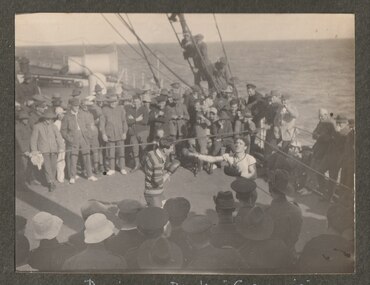
... War 1 memorabilia that has come from Private John Basil McLean, 2nd Reinforcements, 37th Battalion, A.I.F. There was a large collection of postcards so he may have been collecting them as souvenirs. J.B. McLean (Service No. 13824) was from near Maffra, Victoria and enlisted on 22 January 1916. He embarked on 16 December 1916 for Europe. His full war record...War 1 memorabilia that has come from Private John Basil McLean, 2nd Reinforcements, 37th Battalion, A.I.F. There was a large collection of postcards so he may have been collecting them as souvenirs. J.B. McLean (Service No. 13824) was from near Maffra, Victoria and enlisted on 22 January 1916. He embarked on 16 December 1916 for Europe. His full war record ...One photo from an album belonging to JB McLean, of his voyage home from World War 1 in 1920 on the Ceramic. The photo shows two men boxing on the deck of the Ceramic being watched by soldiers and passengers. It shows one of the activities on board ship. The Ceramic departed Tillbury, UK 12th March and docked in Freemantle on 27th April 1920 and then went onto Adelaide, Melbourne and Sydney. The Ceramic was a transport vessel built in Belfast in 1913 for the White Star Line to transport frozen produce and apples from Australia to UK. It was taken over by the Australian Government for troop transport in October 1914 and could carry over 3,000 troops. This trip in 1920 there were 1467 on board, there were women and children as well as 439 soldiers returning home, one of whom was John 'Basil' McLean. Was with other World War 1 memorabilia that has come from Private John Basil McLean, 2nd Reinforcements, 37th Battalion, A.I.F. There was a large collection of postcards so he may have been collecting them as souvenirs. J.B. McLean (Service No. 13824) was from near Maffra, Victoria and enlisted on 22 January 1916. He embarked on 16 December 1916 for Europe. His full war record is available from AWM. He spent time with the Australian Field Artillery (Pack Section). At the end of the war he worked for a year at the A.I.F. Headquarters in London before returning to Australia on the 'Ceramic', arriving Portsea in 1920.A collection of items from John Basil McLean is in the archive. Kept as an indication of what founding legatees experienced in World War One and what they saw on the way home.Sepia photo of two men boxing on deck of the Ceramic being watched by soldiers and passengers, glued to black cardboard in an album of photos from 1920.Handwritten caption 'Boxing on deck Ceramic' in white ink.souvenir, world war one, jb mclean, ship, ceramic, suez -
 Melbourne Legacy
Photograph, Ceramic, 1920
... War 1 memorabilia that has come from Private John Basil McLean, 2nd Reinforcements, 37th Battalion, A.I.F. There was a large collection of postcards so he may have been collecting them as souvenirs. J.B. McLean (Service No. 13824) was from near Maffra, Victoria and enlisted on 22 January 1916. He embarked on 16 December 1916 for Europe. His full war record...War 1 memorabilia that has come from Private John Basil McLean, 2nd Reinforcements, 37th Battalion, A.I.F. There was a large collection of postcards so he may have been collecting them as souvenirs. J.B. McLean (Service No. 13824) was from near Maffra, Victoria and enlisted on 22 January 1916. He embarked on 16 December 1916 for Europe. His full war record ...Two photos from an album belonging to JB McLean, of his voyage home from World War 1 in 1920 on the Ceramic. The photos show passengers on the deck of the Ceramic. It shows the type of clothing worn and style of deck chair. The Ceramic departed Tillbury, UK 12th March and docked in Freemantle on 27th April 1920 and then went onto Adelaide, Melbourne and Sydney. The Ceramic was a transport vessel built in Belfast in 1913 for the White Star Line to transport frozen produce and apples from Australia to UK. It was taken over by the Australian Government for troop transport in October 1914 and could carry over 3,000 troops. This trip in 1920 there were 1467 on board, there were women and children as well as 439 soldiers returning home, one of whom was John 'Basil' McLean. Was with other World War 1 memorabilia that has come from Private John Basil McLean, 2nd Reinforcements, 37th Battalion, A.I.F. There was a large collection of postcards so he may have been collecting them as souvenirs. J.B. McLean (Service No. 13824) was from near Maffra, Victoria and enlisted on 22 January 1916. He embarked on 16 December 1916 for Europe. His full war record is available from AWM. He spent time with the Australian Field Artillery (Pack Section). At the end of the war he worked for a year at the A.I.F. Headquarters in London before returning to Australia on the 'Ceramic', arriving Portsea in 1920.A collection of items from John Basil McLean is in the archive. Kept as an indication of what founding legatees experienced in World War One and what they saw on the way home.Sepia photo x 2 of passengers and soldiers on deck of the Ceramic glued to black cardboard in an album of photos from 1920.Handwritten caption 'View on deck Ceramic' in white ink.souvenir, world war one, jb mclean, ship, ceramic, suez, passengers -
 Melbourne Legacy
Photograph, Ceramic, 1920
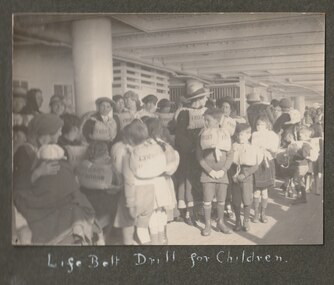
... War 1 memorabilia that has come from Private John Basil McLean, 2nd Reinforcements, 37th Battalion, A.I.F. There was a large collection of postcards so he may have been collecting them as souvenirs. J.B. McLean (Service No. 13824) was from near Maffra, Victoria and enlisted on 22 January 1916. He embarked on 16 December 1916 for Europe. His full war record...War 1 memorabilia that has come from Private John Basil McLean, 2nd Reinforcements, 37th Battalion, A.I.F. There was a large collection of postcards so he may have been collecting them as souvenirs. J.B. McLean (Service No. 13824) was from near Maffra, Victoria and enlisted on 22 January 1916. He embarked on 16 December 1916 for Europe. His full war record ...One photo from an album belonging to JB McLean, of his voyage home from World War 1 in 1920 on the Ceramic. The photos show passengers on the deck of the Ceramic dressed in life jackets. It shows the type of life preservers and clothing worn at the time. The Ceramic departed Tillbury, UK 12th March and docked in Freemantle on 27th April 1920 and then went onto Adelaide, Melbourne and Sydney. The Ceramic was a transport vessel built in Belfast in 1913 for the White Star Line to transport frozen produce and apples from Australia to UK. It was taken over by the Australian Government for troop transport in October 1914 and could carry over 3,000 troops. This trip in 1920 there were 1467 on board, there were women and children as well as 439 soldiers returning home, one of whom was John 'Basil' McLean. Was with other World War 1 memorabilia that has come from Private John Basil McLean, 2nd Reinforcements, 37th Battalion, A.I.F. There was a large collection of postcards so he may have been collecting them as souvenirs. J.B. McLean (Service No. 13824) was from near Maffra, Victoria and enlisted on 22 January 1916. He embarked on 16 December 1916 for Europe. His full war record is available from AWM. He spent time with the Australian Field Artillery (Pack Section). At the end of the war he worked for a year at the A.I.F. Headquarters in London before returning to Australia on the 'Ceramic', arriving Portsea in 1920.A collection of items from John Basil McLean is in the archive. Kept as an indication of what founding legatees experienced in World War One and what they saw on the way home.Sepia photo of passengers on deck of the Ceramic dressed in life jackets glued to black cardboard in an album of photos from 1920.Handwritten caption 'Life boat drill from children' in white ink.souvenir, world war one, jb mclean, ship, ceramic, passengers -
 Melbourne Legacy
Photograph, Ceramic, 1920
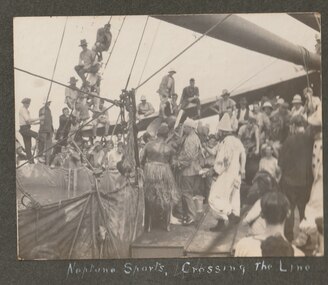
... War 1 memorabilia that has come from Private John Basil McLean, 2nd Reinforcements, 37th Battalion, A.I.F. There was a large collection of postcards so he may have been collecting them as souvenirs. J.B. McLean (Service No. 13824) was from near Maffra, Victoria and enlisted on 22 January 1916. He embarked on 16 December 1916 for Europe. His full war record...War 1 memorabilia that has come from Private John Basil McLean, 2nd Reinforcements, 37th Battalion, A.I.F. There was a large collection of postcards so he may have been collecting them as souvenirs. J.B. McLean (Service No. 13824) was from near Maffra, Victoria and enlisted on 22 January 1916. He embarked on 16 December 1916 for Europe. His full war record ...Two photos from an album belonging to JB McLean, of his voyage home from World War 1 in 1920 on the Ceramic. The photos are of the sports on board when the ship crossed the equator. From the caption it was called Neptune sports and there are people dressed in different costumes. The Ceramic departed Tillbury, UK 12th March and docked in Freemantle on 27th April 1920 and then went onto Adelaide, Melbourne and Sydney. The Ceramic was a transport vessel built in Belfast in 1913 for the White Star Line to transport frozen produce and apples from Australia to UK. It was taken over by the Australian Government for troop transport in October 1914 and could carry over 3,000 troops. This trip in 1920 there were 1467 on board, there were women and children as well as 439 soldiers returning home, one of whom was John 'Basil' McLean. Was with other World War 1 memorabilia that has come from Private John Basil McLean, 2nd Reinforcements, 37th Battalion, A.I.F. There was a large collection of postcards so he may have been collecting them as souvenirs. J.B. McLean (Service No. 13824) was from near Maffra, Victoria and enlisted on 22 January 1916. He embarked on 16 December 1916 for Europe. His full war record is available from AWM. He spent time with the Australian Field Artillery (Pack Section). At the end of the war he worked for a year at the A.I.F. Headquarters in London before returning to Australia on the 'Ceramic', arriving Portsea in 1920.A collection of items from John Basil McLean is in the archive. Kept as an indication of what founding legatees experienced in World War One and what they saw on the way home.Sepia photo x 2 of Neptune sports on the Ceramic glued to black cardboard in an album of photos from 1920.Handwritten caption 'Neptune Sports, Crossing the Line' in white ink.souvenir, world war one, jb mclean, ship, ceramic -
 Melbourne Legacy
Photograph, Ceramic, 1920
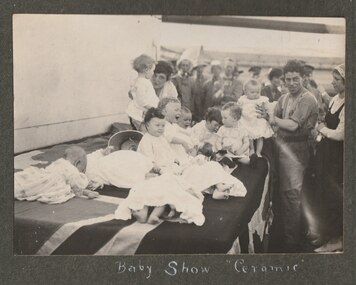
... War 1 memorabilia that has come from Private John Basil McLean, 2nd Reinforcements, 37th Battalion, A.I.F. There was a large collection of postcards so he may have been collecting them as souvenirs. J.B. McLean (Service No. 13824) was from near Maffra, Victoria and enlisted on 22 January 1916. He embarked on 16 December 1916 for Europe. His full war record...War 1 memorabilia that has come from Private John Basil McLean, 2nd Reinforcements, 37th Battalion, A.I.F. There was a large collection of postcards so he may have been collecting them as souvenirs. J.B. McLean (Service No. 13824) was from near Maffra, Victoria and enlisted on 22 January 1916. He embarked on 16 December 1916 for Europe. His full war record ...Two photos from an album belonging to JB McLean, of his voyage home from World War 1 in 1920 on the Ceramic. Two photos of a baby show on board. The babies are sitting on a Union Jack flag. It shows one of the activities on board during the journey. The Ceramic departed Tillbury, UK 12th March and docked in Freemantle on 27th April 1920 and then went onto Adelaide, Melbourne and Sydney. The Ceramic was a transport vessel built in Belfast in 1913 for the White Star Line to transport frozen produce and apples from Australia to UK. It was taken over by the Australian Government for troop transport in October 1914 and could carry over 3,000 troops. This trip in 1920 there were 1467 on board, there were women and children as well as 439 soldiers returning home, one of whom was John 'Basil' McLean. Was with other World War 1 memorabilia that has come from Private John Basil McLean, 2nd Reinforcements, 37th Battalion, A.I.F. There was a large collection of postcards so he may have been collecting them as souvenirs. J.B. McLean (Service No. 13824) was from near Maffra, Victoria and enlisted on 22 January 1916. He embarked on 16 December 1916 for Europe. His full war record is available from AWM. He spent time with the Australian Field Artillery (Pack Section). At the end of the war he worked for a year at the A.I.F. Headquarters in London before returning to Australia on the 'Ceramic', arriving Portsea in 1920.A collection of items from John Basil McLean is in the archive. Kept as an indication of what founding legatees experienced in World War One and what they saw on the way home.Sepia photo x 2 of a baby show onboard the Ceramic glued to black cardboard in an album of photos from 1920.Handwritten caption 'Baby Show Ceramic' in white ink.souvenir, world war one, jb mclean, ship, ceramic, babies -
 Melbourne Legacy
Photograph, Ceramic, 1920
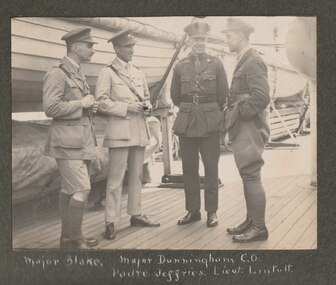
... War 1 memorabilia that has come from Private John Basil McLean, 2nd Reinforcements, 37th Battalion, A.I.F. There was a large collection of postcards so he may have been collecting them as souvenirs. J.B. McLean (Service No. 13824) was from near Maffra, Victoria and enlisted on 22 January 1916. He embarked on 16 December 1916 for Europe. His full war record...War 1 memorabilia that has come from Private John Basil McLean, 2nd Reinforcements, 37th Battalion, A.I.F. There was a large collection of postcards so he may have been collecting them as souvenirs. J.B. McLean (Service No. 13824) was from near Maffra, Victoria and enlisted on 22 January 1916. He embarked on 16 December 1916 for Europe. His full war record ...One photo from an album belonging to JB McLean, of his voyage home from World War 1 in 1920 on the Ceramic. The photo is of some officers on board, including the Padre Jefferies, the CO was Major Dunningham and also Major Blake.The style of life boats is also visible. The Ceramic departed Tillbury, UK 12th March and docked in Freemantle on 27th April 1920 and then went onto Adelaide, Melbourne and Sydney. The Ceramic was a transport vessel built in Belfast in 1913 for the White Star Line to transport frozen produce and apples from Australia to UK. It was taken over by the Australian Government for troop transport in October 1914 and could carry over 3,000 troops. This trip in 1920 there were 1467 on board, there were women and children as well as 439 soldiers returning home, one of whom was John 'Basil' McLean. Was with other World War 1 memorabilia that has come from Private John Basil McLean, 2nd Reinforcements, 37th Battalion, A.I.F. There was a large collection of postcards so he may have been collecting them as souvenirs. J.B. McLean (Service No. 13824) was from near Maffra, Victoria and enlisted on 22 January 1916. He embarked on 16 December 1916 for Europe. His full war record is available from AWM. He spent time with the Australian Field Artillery (Pack Section). At the end of the war he worked for a year at the A.I.F. Headquarters in London before returning to Australia on the 'Ceramic', arriving Portsea in 1920.A collection of items from John Basil McLean is in the archive. Kept as an indication of what founding legatees experienced in World War One and what they saw on the way home.Sepia photo of officers onboard the Ceramic glued to black cardboard in an album of photos from 1920.Handwritten caption 'Baby Show Ceramic' in white ink.souvenir, world war one, jb mclean, ship, ceramic, soliders -
 Melbourne Legacy
Photograph, Ceramic, 1920
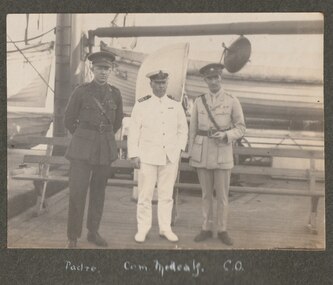
... War 1 memorabilia that has come from Private John Basil McLean, 2nd Reinforcements, 37th Battalion, A.I.F. There was a large collection of postcards so he may have been collecting them as souvenirs. J.B. McLean (Service No. 13824) was from near Maffra, Victoria and enlisted on 22 January 1916. He embarked on 16 December 1916 for Europe. His full war record...War 1 memorabilia that has come from Private John Basil McLean, 2nd Reinforcements, 37th Battalion, A.I.F. There was a large collection of postcards so he may have been collecting them as souvenirs. J.B. McLean (Service No. 13824) was from near Maffra, Victoria and enlisted on 22 January 1916. He embarked on 16 December 1916 for Europe. His full war record ...One photo from an album belonging to JB McLean, of his voyage home from World War 1 in 1920 on the Ceramic. The photo is of the Commanding Officer Major Dunningham and also Padre Jefferies and the Commander of the ship Com. Metcalf. The style of life boats is also visible. The Ceramic departed Tillbury, UK 12th March and docked in Freemantle on 27th April 1920 and then went onto Adelaide, Melbourne and Sydney. The Ceramic was a transport vessel built in Belfast in 1913 for the White Star Line to transport frozen produce and apples from Australia to UK. It was taken over by the Australian Government for troop transport in October 1914 and could carry over 3,000 troops. This trip in 1920 there were 1467 on board, there were women and children as well as 439 soldiers returning home, one of whom was John 'Basil' McLean. Was with other World War 1 memorabilia that has come from Private John Basil McLean, 2nd Reinforcements, 37th Battalion, A.I.F. There was a large collection of postcards so he may have been collecting them as souvenirs. J.B. McLean (Service No. 13824) was from near Maffra, Victoria and enlisted on 22 January 1916. He embarked on 16 December 1916 for Europe. His full war record is available from AWM. He spent time with the Australian Field Artillery (Pack Section). At the end of the war he worked for a year at the A.I.F. Headquarters in London before returning to Australia on the 'Ceramic', arriving Portsea in 1920.A collection of items from John Basil McLean is in the archive. Kept as an indication of what founding legatees experienced in World War One and what they saw on the way home.Sepia photo of officers onboard the Ceramic glued to black cardboard in an album of photos from 1920.Handwritten caption 'Baby Show Ceramic' in white ink.souvenir, world war one, jb mclean, ship, ceramic, soliders -
 Melbourne Legacy
Photograph, Bombay, 1920
... War 1 memorabilia that has come from Private John Basil McLean, 2nd Reinforcements, 37th Battalion, A.I.F. There was a large collection of postcards so he may have been collecting them as souvenirs. J.B. McLean (Service No. 13824) was from near Maffra, Victoria and enlisted on 22 January 1916. He embarked on 16 December 1916 for Europe. His full war record...War 1 memorabilia that has come from Private John Basil McLean, 2nd Reinforcements, 37th Battalion, A.I.F. There was a large collection of postcards so he may have been collecting them as souvenirs. J.B. McLean (Service No. 13824) was from near Maffra, Victoria and enlisted on 22 January 1916. He embarked on 16 December 1916 for Europe. His full war record ...Three photos from an album belonging to JB McLean, of his voyage home from World War 1 in 1920 on the Ceramic. The photos are of street scenes in Bombay, India. They include the Towers of Silence and a cow lying in the street as well as street traders. These scenes would have been unusual for an Australian soldier and made a good souvenir. The visit to Bombay was a stop over point for the Ceramic on it's way to Australia. The Ceramic departed Tillbury, UK 12th March and docked in Freemantle on 27th April 1920 and then went onto Adelaide, Melbourne and Sydney. The Ceramic was a transport vessel built in Belfast in 1913 for the White Star Line to transport frozen produce and apples from Australia to UK. It was taken over by the Australian Government for troop transport in October 1914 and could carry over 3,000 troops. This trip in 1920 there were 1467 on board, there were women and children as well as 439 soldiers returning home, one of whom was John 'Basil' McLean. Was with other World War 1 memorabilia that has come from Private John Basil McLean, 2nd Reinforcements, 37th Battalion, A.I.F. There was a large collection of postcards so he may have been collecting them as souvenirs. J.B. McLean (Service No. 13824) was from near Maffra, Victoria and enlisted on 22 January 1916. He embarked on 16 December 1916 for Europe. His full war record is available from AWM. He spent time with the Australian Field Artillery (Pack Section). At the end of the war he worked for a year at the A.I.F. Headquarters in London before returning to Australia on the 'Ceramic', arriving Portsea in 1920.A collection of items from John Basil McLean is in the archive. Kept as an indication of what founding legatees experienced in World War One and what they saw on the way home.Sepia photo of officers onboard the Ceramic glued to black cardboard in an album of photos from 1920.Handwritten caption 'Baby Show Ceramic' in white ink.souvenir, world war one, jb mclean, ceramic, bombay -
 Melbourne Legacy
Photograph, Bombay, 1920
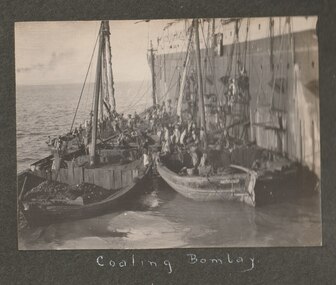
... War 1 memorabilia that has come from Private John Basil McLean, 2nd Reinforcements, 37th Battalion, A.I.F. There was a large collection of postcards so he may have been collecting them as souvenirs. J.B. McLean (Service No. 13824) was from near Maffra, Victoria and enlisted on 22 January 1916. He embarked on 16 December 1916 for Europe. His full war record...War 1 memorabilia that has come from Private John Basil McLean, 2nd Reinforcements, 37th Battalion, A.I.F. There was a large collection of postcards so he may have been collecting them as souvenirs. J.B. McLean (Service No. 13824) was from near Maffra, Victoria and enlisted on 22 January 1916. He embarked on 16 December 1916 for Europe. His full war record ...Three photos from an album belonging to JB McLean, of his voyage home from World War 1 in 1920 on the Ceramic. The photos are of small boats providing coal to the Ceramic in Bombay, India and the type of manual labour it required with the men lifting it up the side of the ship. The visit to Bombay was a stop over point for the Ceramic on its way to Australia. The Ceramic departed Tillbury, UK 12th March and docked in Freemantle on 27th April 1920 and then went onto Adelaide, Melbourne and Sydney. The Ceramic was a transport vessel built in Belfast in 1913 for the White Star Line to transport frozen produce and apples from Australia to UK. It was taken over by the Australian Government for troop transport in October 1914 and could carry over 3,000 troops. This trip in 1920 there were 1467 on board, there were women and children as well as 439 soldiers returning home, one of whom was John 'Basil' McLean. Was with other World War 1 memorabilia that has come from Private John Basil McLean, 2nd Reinforcements, 37th Battalion, A.I.F. There was a large collection of postcards so he may have been collecting them as souvenirs. J.B. McLean (Service No. 13824) was from near Maffra, Victoria and enlisted on 22 January 1916. He embarked on 16 December 1916 for Europe. His full war record is available from AWM. He spent time with the Australian Field Artillery (Pack Section). At the end of the war he worked for a year at the A.I.F. Headquarters in London before returning to Australia on the 'Ceramic', arriving Portsea in 1920.A collection of items from John Basil McLean is in the archive. Kept as an indication of what founding legatees experienced in World War One and what they saw on the way home.Sepia photo x 2 of Indians providing coal to the Ceramic in Bombay glued to black cardboard in an album of photos from 1920.Handwritten caption 'Coaling Bombay' in white ink.souvenir, world war one, jb mclean, ceramic, bombay -
 Melbourne Legacy
Photograph, Ceramic, 1920
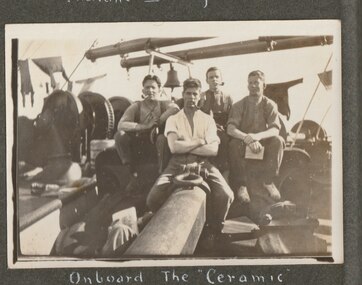
... War 1 memorabilia that has come from Private John Basil McLean, 2nd Reinforcements, 37th Battalion, A.I.F. There was a large collection of postcards so he may have been collecting them as souvenirs. J.B. McLean (Service No. 13824) was from near Maffra, Victoria and enlisted on 22 January 1916. He embarked on 16 December 1916 for Europe. His full war record...War 1 memorabilia that has come from Private John Basil McLean, 2nd Reinforcements, 37th Battalion, A.I.F. There was a large collection of postcards so he may have been collecting them as souvenirs. J.B. McLean (Service No. 13824) was from near Maffra, Victoria and enlisted on 22 January 1916. He embarked on 16 December 1916 for Europe. His full war record ...One photo from an album belonging to JB McLean, of his voyage home from World War 1 in 1920 on the Ceramic. The photo is of a group of four returning soldiers. Presumably JB McLean is one of them. It is the only photo in the album that is likely to contain an image of him. The Ceramic departed Tillbury, UK 12th March and docked in Freemantle on 27th April 1920 and then went onto Adelaide, Melbourne and Sydney. The Ceramic was a transport vessel built in Belfast in 1913 for the White Star Line to transport frozen produce and apples from Australia to UK. It was taken over by the Australian Government for troop transport in October 1914 and could carry over 3,000 troops. This trip in 1920 there were 1467 on board, there were women and children as well as 439 soldiers returning home, one of whom was John 'Basil' McLean. Was with other World War 1 memorabilia that has come from Private John Basil McLean, 2nd Reinforcements, 37th Battalion, A.I.F. There was a large collection of postcards so he may have been collecting them as souvenirs. J.B. McLean (Service No. 13824) was from near Maffra, Victoria and enlisted on 22 January 1916. He embarked on 16 December 1916 for Europe. His full war record is available from AWM. He spent time with the Australian Field Artillery (Pack Section). At the end of the war he worked for a year at the A.I.F. Headquarters in London before returning to Australia on the 'Ceramic', arriving Portsea in 1920.A collection of items from John Basil McLean is in the archive. Kept as an indication of what founding legatees experienced in World War One and what they saw on the way home.Sepia photo of officers onboard the Ceramic glued to black cardboard in an album of photos from 1920.Handwritten caption 'On board the Ceramic' in white ink.souvenir, world war one, jb mclean, ship, ceramic, soliders -
 Melbourne Legacy
Photograph, Bombay, 1920
... War 1 memorabilia that has come from Private John Basil McLean, 2nd Reinforcements, 37th Battalion, A.I.F. There was a large collection of postcards so he may have been collecting them as souvenirs. J.B. McLean (Service No. 13824) was from near Maffra, Victoria and enlisted on 22 January 1916. He embarked on 16 December 1916 for Europe. His full war record...War 1 memorabilia that has come from Private John Basil McLean, 2nd Reinforcements, 37th Battalion, A.I.F. There was a large collection of postcards so he may have been collecting them as souvenirs. J.B. McLean (Service No. 13824) was from near Maffra, Victoria and enlisted on 22 January 1916. He embarked on 16 December 1916 for Europe. His full war record ...One photo from an album belonging to JB McLean, of his voyage home from World War 1 in 1920 on the Ceramic. The photo is of the Museum in Bombay with electric trams in the foreground. The Ceramic departed Tillbury, UK 12th March and docked in Freemantle on 27th April 1920 and then went onto Adelaide, Melbourne and Sydney. The Ceramic was a transport vessel built in Belfast in 1913 for the White Star Line to transport frozen produce and apples from Australia to UK. It was taken over by the Australian Government for troop transport in October 1914 and could carry over 3,000 troops. This trip in 1920 there were 1467 on board, there were women and children as well as 439 soldiers returning home, one of whom was John 'Basil' McLean. Was with other World War 1 memorabilia that has come from Private John Basil McLean, 2nd Reinforcements, 37th Battalion, A.I.F. There was a large collection of postcards so he may have been collecting them as souvenirs. J.B. McLean (Service No. 13824) was from near Maffra, Victoria and enlisted on 22 January 1916. He embarked on 16 December 1916 for Europe. His full war record is available from AWM. He spent time with the Australian Field Artillery (Pack Section). At the end of the war he worked for a year at the A.I.F. Headquarters in London before returning to Australia on the 'Ceramic', arriving Portsea in 1920.A collection of items from John Basil McLean is in the archive. Kept as an indication of what founding legatees experienced in World War One and what they saw on the way home.Sepia photo of the Museum in Bombay glued to black cardboard in an album of photos from 1920.Handwritten caption 'Museum Bombay' in white ink.souvenir, world war one, jb mclean, ship, ceramic, bombay -
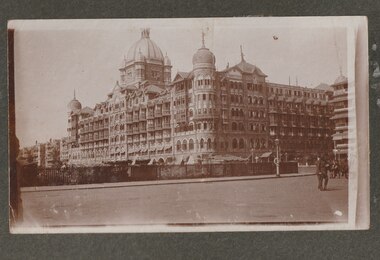 Melbourne Legacy
Photograph, Bombay, 1920
... War 1 memorabilia that has come from Private John Basil McLean, 2nd Reinforcements, 37th Battalion, A.I.F. There was a large collection of postcards so he may have been collecting them as souvenirs. J.B. McLean (Service No. 13824) was from near Maffra, Victoria and enlisted on 22 January 1916. He embarked on 16 December 1916 for Europe. His full war record...War 1 memorabilia that has come from Private John Basil McLean, 2nd Reinforcements, 37th Battalion, A.I.F. There was a large collection of postcards so he may have been collecting them as souvenirs. J.B. McLean (Service No. 13824) was from near Maffra, Victoria and enlisted on 22 January 1916. He embarked on 16 December 1916 for Europe. His full war record ...One photo from an album belonging to JB McLean, of his voyage home from World War 1 in 1920 on the Ceramic. The photo is of the Taj Mahal Palace Hotel, which opened in 1903. There are many photos of Bombay in the album when the Ceramic had a stopover on its way back to the Australia. The Ceramic departed Tillbury, UK 12th March and docked in Freemantle on 27th April 1920 and then went onto Adelaide, Melbourne and Sydney. The Ceramic was a transport vessel built in Belfast in 1913 for the White Star Line to transport frozen produce and apples from Australia to UK. It was taken over by the Australian Government for troop transport in October 1914 and could carry over 3,000 troops. This trip in 1920 there were 1467 on board, there were women and children as well as 439 soldiers returning home, one of whom was John 'Basil' McLean. Was with other World War 1 memorabilia that has come from Private John Basil McLean, 2nd Reinforcements, 37th Battalion, A.I.F. There was a large collection of postcards so he may have been collecting them as souvenirs. J.B. McLean (Service No. 13824) was from near Maffra, Victoria and enlisted on 22 January 1916. He embarked on 16 December 1916 for Europe. His full war record is available from AWM. He spent time with the Australian Field Artillery (Pack Section). At the end of the war he worked for a year at the A.I.F. Headquarters in London before returning to Australia on the 'Ceramic', arriving Portsea in 1920.A collection of items from John Basil McLean is in the archive. Kept as an indication of what founding legatees experienced in World War One and what they saw on the way home.Sepia photo of the Taj Mahal Palace Hotel in Bombay glued to black cardboard in an album of photos from 1920.souvenir, world war one, jb mclean, ship, ceramic, bombay -
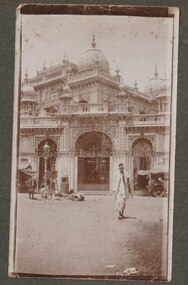 Melbourne Legacy
Photograph, Bombay, 1920
... War 1 memorabilia that has come from Private John Basil McLean, 2nd Reinforcements, 37th Battalion, A.I.F. There was a large collection of postcards so he may have been collecting them as souvenirs. J.B. McLean (Service No. 13824) was from near Maffra, Victoria and enlisted on 22 January 1916. He embarked on 16 December 1916 for Europe. His full war record...War 1 memorabilia that has come from Private John Basil McLean, 2nd Reinforcements, 37th Battalion, A.I.F. There was a large collection of postcards so he may have been collecting them as souvenirs. J.B. McLean (Service No. 13824) was from near Maffra, Victoria and enlisted on 22 January 1916. He embarked on 16 December 1916 for Europe. His full war record ...Four photos from an album belonging to JB McLean, of his voyage home from World War 1 in 1920 on the Ceramic. The photos show buildings around Bombay. There are many photos of Bombay in the album when the Ceramic had a stopover on its way back to the Australia. The Ceramic departed Tillbury, UK 12th March and docked in Freemantle on 27th April 1920 and then went onto Adelaide, Melbourne and Sydney. The Ceramic was a transport vessel built in Belfast in 1913 for the White Star Line to transport frozen produce and apples from Australia to UK. It was taken over by the Australian Government for troop transport in October 1914 and could carry over 3,000 troops. This trip in 1920 there were 1467 on board, there were women and children as well as 439 soldiers returning home, one of whom was John 'Basil' McLean. Was with other World War 1 memorabilia that has come from Private John Basil McLean, 2nd Reinforcements, 37th Battalion, A.I.F. There was a large collection of postcards so he may have been collecting them as souvenirs. J.B. McLean (Service No. 13824) was from near Maffra, Victoria and enlisted on 22 January 1916. He embarked on 16 December 1916 for Europe. His full war record is available from AWM. He spent time with the Australian Field Artillery (Pack Section). At the end of the war he worked for a year at the A.I.F. Headquarters in London before returning to Australia on the 'Ceramic', arriving Portsea in 1920.A collection of items from John Basil McLean is in the archive. Kept as an indication of what founding legatees experienced in World War One and what they saw on the way home.Sepia photo of the Taj Mahal Palace Hotel in Bombay glued to black cardboard in an album of photos from 1920.souvenir, world war one, jb mclean, ship, ceramic, bombay -
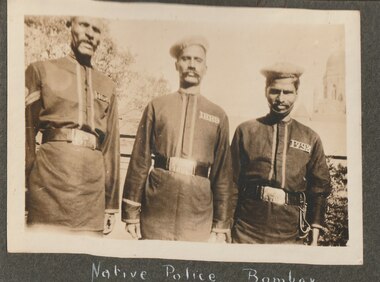 Melbourne Legacy
Photograph, Bombay, 1920
... War 1 memorabilia that has come from Private John Basil McLean, 2nd Reinforcements, 37th Battalion, A.I.F. There was a large collection of postcards so he may have been collecting them as souvenirs. J.B. McLean (Service No. 13824) was from near Maffra, Victoria and enlisted on 22 January 1916. He embarked on 16 December 1916 for Europe. His full war record...War 1 memorabilia that has come from Private John Basil McLean, 2nd Reinforcements, 37th Battalion, A.I.F. There was a large collection of postcards so he may have been collecting them as souvenirs. J.B. McLean (Service No. 13824) was from near Maffra, Victoria and enlisted on 22 January 1916. He embarked on 16 December 1916 for Europe. His full war record ...One photo from an album belonging to JB McLean, of his voyage home from World War 1 in 1920 on the Ceramic. The photo show three policemen from Bombay in their uniform. There are many photos of Bombay in the album when the Ceramic had a stopover on its way back to the Australia. The Ceramic departed Tillbury, UK 12th March and docked in Freemantle on 27th April 1920 and then went onto Adelaide, Melbourne and Sydney. The Ceramic was a transport vessel built in Belfast in 1913 for the White Star Line to transport frozen produce and apples from Australia to UK. It was taken over by the Australian Government for troop transport in October 1914 and could carry over 3,000 troops. This trip in 1920 there were 1467 on board, there were women and children as well as 439 soldiers returning home, one of whom was John 'Basil' McLean. Was with other World War 1 memorabilia that has come from Private John Basil McLean, 2nd Reinforcements, 37th Battalion, A.I.F. There was a large collection of postcards so he may have been collecting them as souvenirs. J.B. McLean (Service No. 13824) was from near Maffra, Victoria and enlisted on 22 January 1916. He embarked on 16 December 1916 for Europe. His full war record is available from AWM. He spent time with the Australian Field Artillery (Pack Section). At the end of the war he worked for a year at the A.I.F. Headquarters in London before returning to Australia on the 'Ceramic', arriving Portsea in 1920.A collection of items from John Basil McLean is in the archive. Kept as an indication of what founding legatees experienced in World War One and what they saw on the way home.Sepia photo of the Taj Mahal Palace Hotel in Bombay glued to black cardboard in an album of photos from 1920.Handwritten 'Native Police Bombay' in white ink.souvenir, world war one, jb mclean, ship, ceramic, bombay -
 Melbourne Legacy
Photograph, Ceramic, 1920
... War 1 memorabilia that has come from Private John Basil McLean, 2nd Reinforcements, 37th Battalion, A.I.F. There was a large collection of postcards so he may have been collecting them as souvenirs. J.B. McLean (Service No. 13824) was from near Maffra, Victoria and enlisted on 22 January 1916. He embarked on 16 December 1916 for Europe. His full war record...War 1 memorabilia that has come from Private John Basil McLean, 2nd Reinforcements, 37th Battalion, A.I.F. There was a large collection of postcards so he may have been collecting them as souvenirs. J.B. McLean (Service No. 13824) was from near Maffra, Victoria and enlisted on 22 January 1916. He embarked on 16 December 1916 for Europe. His full war record ...Three photos from an album belonging to JB McLean, of his voyage home from World War 1 in 1920 on the Ceramic. The photos show sunken ships, a local craft pulling alongside the Ceramic and the Ceramic from a distance. The Ceramic departed Tillbury, UK 12th March and docked in Freemantle on 27th April 1920 and then went onto Adelaide, Melbourne and Sydney. The Ceramic was a transport vessel built in Belfast in 1913 for the White Star Line to transport frozen produce and apples from Australia to UK. It was taken over by the Australian Government for troop transport in October 1914 and could carry over 3,000 troops. This trip in 1920 there were 1467 on board, there were women and children as well as 439 soldiers returning home, one of whom was John 'Basil' McLean. Was with other World War 1 memorabilia that has come from Private John Basil McLean, 2nd Reinforcements, 37th Battalion, A.I.F. There was a large collection of postcards so he may have been collecting them as souvenirs. J.B. McLean (Service No. 13824) was from near Maffra, Victoria and enlisted on 22 January 1916. He embarked on 16 December 1916 for Europe. His full war record is available from AWM. He spent time with the Australian Field Artillery (Pack Section). At the end of the war he worked for a year at the A.I.F. Headquarters in London before returning to Australia on the 'Ceramic', arriving Portsea in 1920.A collection of items from John Basil McLean is in the archive. Kept as an indication of what founding legatees experienced in World War One and what they saw on the way home.Sepia photo x 3 taken from onboard the Ceramic glued to black cardboard in an album of photos from 1920.Handwritten under one 'RMS Ceramic 18,500 tons' in white ink.souvenir, world war one, jb mclean, ship, ceramic -
 Melbourne Legacy
Document - Press Release 1975, Melbourne Legacy, A New Era for Legacy - Brian O'Donohue, 1975
... So in 1971 he joined Legacy because he knew that Legacy helps dependants of comrades who served their country in war and who died on active service or subsequently.' A record of how Legacy promoted their work in the 1970s. press release promotion brian o'donohue Title 'A new era for Legacy' Blue foolscap page x 2 with black type of a press release in 1975. ...A press release from Melbourne Legacy in 1975 which relates the story of Brian O'Donohue who was to be president of Colac Legacy. The information was intended to be used by press and magazines etc. Colac was the first club to select a president that had done his war service in Vietnam. Brian started his National Service aged 20, at Puckapunyal and trained as an artillery signaller. He was posted to join the 104 Field Battery of 12 Field Regiment, Royal Australian Artillery in Vietnam. For 9 months he was a member of a forward observation party which had the responsibility of calling artillery fire to support the operations of the infantry battalion with which it was working. Returning to Australia after a year. 'What he had seen and done in Vietnam, the tough times he had endured and the lighter times he had enjoyed with his mates, had made him conscious of the debt he owed to the families of those who not returned. So in 1971 he joined Legacy because he knew that Legacy helps dependants of comrades who served their country in war and who died on active service or subsequently.'A record of how Legacy promoted their work in the 1970s.Blue foolscap page x 2 with black type of a press release in 1975.Title 'A new era for Legacy'press release, promotion, brian o'donohue -
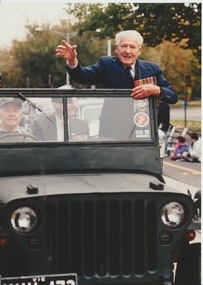 Melbourne Legacy
Photograph, Ron Austin WW 1 Veteran on Anzac Day 1995, 1995
... Service in 1955 as Wing Commander. It comes as no surprise that Ron was awarded an O.B.E. for his tireless devotion to duty and you might sense Ron has been a tireless member of Legacy too." Plus a note in the Answer in 1997 after Ron passed away aged 94. A record of Legatee Austin being one of the last surviving World War ...Colour photos of an Anzac Day march with Legatee Ron Austin in a jeep. More photos from the march include Jeff Kennett, Bruce Ruxton, John Brumby, and Peter Costello who appear to be the distinguished guests. It is Anzac Day 1995. The article in The Answer in May 1993 says: The ever-smiling L/ Ron Austin is an inspiration for all. Ron has the distinction of being the youngest surviving Melbourne Legatee to have served in WW1. He joined over 300 Legatees to march as part of the Legacy contingent to mark Legacy's 70th anniversary, and he marched again for a few blocks as he joined members of his wireless unit to catch up with old friends. Ron was just 14 and a half when he joined the R.A.N. in 1917 as a Boy Seaman. He served for 10 years, resumed civilian life, then in 1931 joined the RAAF Telecommunications. WWII kept him busy! In 1949 he became Assistant Air Attache in Washington, D.C. Ron retired from the Service in 1955 as Wing Commander. It comes as no surprise that Ron was awarded an O.B.E. for his tireless devotion to duty and you might sense Ron has been a tireless member of Legacy too." Plus a note in the Answer in 1997 after Ron passed away aged 94.A record of Legatee Austin being one of the last surviving World War 1 veterans and him attending Anzac Day in the 1990s.Colour photo x 3 of an Anzac Day march with WW1 veteran Ron Austin in a jeep.ron austin, jeep, anzac day, march -
 Melbourne Legacy
Photograph, Anzac commemoration for students 1945, 1945
... War Memorial has this photo labelled as 1944. Either date could be correct. A record of a ceremony for school students at the Shrine run by Legacy for many years. anzac commemoration students wreath laying ceremony Black and white of a group of students taking part in a service inside the Shrine, part of a photo album with blue leather look back and front cover. ...A Legacy ceremony at the Shrine of Remembrance in 1945. One of the annual "Anzac Commemoration Ceremony for Students" events, held just prior to ANZAC Day. The ceremony provides a valuable opportunity for students to gain an appreciation of the Anzac spirit, the significance of the Shrine and the meaning of Anzac Day. The Australian War Memorial has this photo labelled as 1944. Either date could be correct.A record of a ceremony for school students at the Shrine run by Legacy for many years.Black and white of a group of students taking part in a service inside the Shrine, part of a photo album with blue leather look back and front cover. From one of 20 pages with black and white photos.anzac commemoration, students, wreath laying ceremony -
 Melbourne Legacy
Photograph, Wounded Aussies from Gallipoli at Mena Hospital, May 1915, 1915
... service number 1285 who is mentioned on the reverse. Private Pitt married a Sicilian lady called Guiseppina (also known as Josephine) Taibi at the British Consulate in Cairo in February 1916. They settled in Melbourne after the war. His war record...service number 1285 who is mentioned on the reverse. Private Pitt married a Sicilian lady called Guiseppina (also known as Josephine) Taibi at the British Consulate in Cairo in February 1916. They settled in Melbourne after the war. His war record ...A large group photo of wounded men and nurses at Mena Hospital in Cairo. The wounded men had been evacuated from Gallipoli. From the inscription on the reverse it was donated by Mrs A Pitt. She appears to be a family member of Private William James Pitt, service number 1285 who is mentioned on the reverse. Private Pitt married a Sicilian lady called Guiseppina (also known as Josephine) Taibi at the British Consulate in Cairo in February 1916. They settled in Melbourne after the war. His war record can be viewed in the National Archive of Australia. He had been wounded at Gallipoli and treated at the 2nd Australian General Hospital in Mena House in Cairo in May 1915 where this photo was taken. This photo can be found in other places, including the AWM archive. Was with other photos of World War One that had been mounted on board. The founding legatees all served in World War One so these photos would have been of significant places for them. (see 01888 to 01899)Photos from World War One that would have been significant to the founding legatees. A family member of William Pitt thought it significant to donate this photo to Legacy.Black and white group photo of Gallipoli wounded at Mena Hospital in Cairo.Handwritten on front; 'Wounded Aussies from Gallipoli at Mena Hospital May 1915'. Handwritten on reverse; 'From Mrs A Pitt, 18 Blanche St, Collingwood' in pencil and 'Number 1285 / Rank Private / 8th Battalion' in pen.gallipoli, world war one, soldiers, hospital, cairo -
 Melbourne Legacy
Pamphlet, Alma Doepel. Australia 1903, 1983
... war service of the Alma Doepel - the only ship with served in World War II that was still active in 1995. See other items regarding Alma Doepel. Part of the text of the brochure says 'The basic purpose of this non-profit organisation is to provide teenage girls and boys (15 years and over) with an outlet for their spirit of adventure and an opportunity to develop a sense of responsibility, self confidence and above all an ability to work as a member of a team.' A record ...A brochure about the sailing program provided by Alma Doepel. There was a program to send young legatees on trips on the Alma Doepel sailing ship through the 1980s and 90s. The articles from the Answer show timetables and criteria for nomination of junior legatees to be selected on the trips. One of these articles mentions the war service of the Alma Doepel - the only ship with served in World War II that was still active in 1995. See other items regarding Alma Doepel. Part of the text of the brochure says 'The basic purpose of this non-profit organisation is to provide teenage girls and boys (15 years and over) with an outlet for their spirit of adventure and an opportunity to develop a sense of responsibility, self confidence and above all an ability to work as a member of a team.'A record of a type of experience Legacy provided for the junior legatees that they might never have done because of the deaths of their fathers.Brochure outlining the Alma Doepel sailing program. Printed sepia on 12 white pages stapled as a landscape booklet. Handwritten 'JL7' on top left of cover, part of an old archive project numbering system.alma doepel, junior legatee outing -
 Melbourne Legacy
Photograph, Anzac Day 1987, 1987
... He has a New Zealand War Service medal (on black and white ribbon on far right of photo), which implies he might have originally been from New Zealand. According to Forces War Records...He has a New Zealand War Service medal (on black and white ribbon on far right of photo), which implies he might have originally been from New Zealand. According to Forces War Records ...Photo of Fred Bush on Anzac Day 1987. His medals include the Distinguished Flying Cross and the Distinguished Flying Medal. It is assumed Fred Bush was a Legatee. Was found in an envelope marked "For Melbourne Legacy. Anzac Day Parade featuring Legacy Lads.' From his medals it appears he served in the RAF in UK during World War 2 as he has the Europe Air Crew Star. He has a New Zealand War Service medal (on black and white ribbon on far right of photo), which implies he might have originally been from New Zealand. According to Forces War Records UK, the Distinguished Flying Cross (DFC) is awarded to Officers and Warrant officers for "an act or acts of valour and courage or devotion to duty performed whilst flying in active operations against the enemy". The Distinguished Flying Medal was the other ranks' equivalent to the Distinguished Flying Cross.A record of Legatees marching on Anzac Day and that their medals show a history of distinguished service.Photo of Fred Bush with his medals on Anzac Day 1987.Handwritten on the back 'Fred Bush Anzac Day '87 DFC, DFM' in black pen.anzac day, march, fred bush -
 Melbourne Legacy
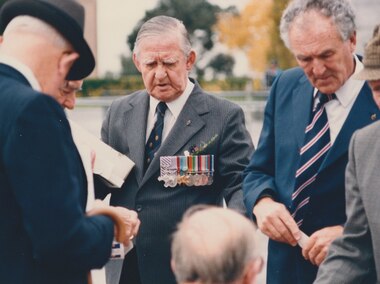
Photograph, Anzac commemoration for students 1987, 1987
... services. Was found in an envelope marked "For Melbourne Legacy. Anzac Day Parade featuring Legacy Lads.' From TROVE: an article from June 1944 mentions him receiving his DFM for 'SKILL AND COURAGE Flying-Officer Richardson, a navigator, has completed a second operational tour. He is an exceptional navigator, whose skill and coolness in time of stress have inspired confidence among his crew.' According to Forces War Records...services. Was found in an envelope marked "For Melbourne Legacy. Anzac Day Parade featuring Legacy Lads.' From TROVE: an article from June 1944 mentions him receiving his DFM for 'SKILL AND COURAGE Flying-Officer Richardson, a navigator, has completed a second operational tour. He is an exceptional navigator, whose skill and coolness in time of stress have inspired confidence among his crew.' According to Forces War Records ...Photo of Legatee Ian Richardson at the students Anzac commemoration ceremony on 28 April 1987. His medals include the Distinguished Flying Cross and the Distinguished Flying Medal. He appears to be holding a tray of rosemary that Legacy Widows prepare for Anzac Day services. Was found in an envelope marked "For Melbourne Legacy. Anzac Day Parade featuring Legacy Lads.' From TROVE: an article from June 1944 mentions him receiving his DFM for 'SKILL AND COURAGE Flying-Officer Richardson, a navigator, has completed a second operational tour. He is an exceptional navigator, whose skill and coolness in time of stress have inspired confidence among his crew.' According to Forces War Records UK, the Distinguished Flying Cross (DFC) is awarded to Officers and Warrant officers for "an act or acts of valour and courage or devotion to duty performed whilst flying in active operations against the enemy". The Distinguished Flying Medal was the other ranks' equivalent to the Distinguished Flying Cross.A record of Legatees attending the student ceremony that was held just prior to Anzac Day. Also that their medals show a history of distinguished service.Photo of Ian Richardson at the students Anzac ceremony in 1987.Handwritten on the back 'Ian Richardson, Legacy Shrine Ceremony for children 28.4.87 DFC, DFM' in black pen.anzac commemoration for students, legatee, ian richardson
