
Showing 3989 items matching "street name"
-
 Federation University Historical Collection
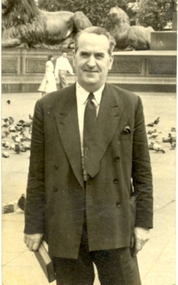
Photograph, Frank Wright, mid 1900s
... name was Sarah. Their family won many singing and instrumental awards. Frank was tutored by Percy Code and was awarded a gold medal for the highest marks in the ALCM examinations in the British Colonies at the age of seventeen years. He became the Australian Open Cornet Champion by the age of eighteen. A year later, Frank conducted the City of Ballarat Band, and later the Ballarat Soldiers’ Memorial Band. He formed the Frank Wright Frisco Band and Frank Wright and his Coliseum Orchestra. These bands won many South Street...name was Sarah. Their family won many singing and instrumental awards. Frank was tutored by Percy Code and was awarded a gold medal for the highest marks in the ALCM examinations in the British Colonies at the age of seventeen years. He became the Australian Open Cornet Champion by the age of eighteen. A year later, Frank conducted the City of Ballarat Band, and later the Ballarat Soldiers’ Memorial Band. He formed the Frank Wright Frisco Band and Frank Wright and his Coliseum Orchestra. These bands won many South Street ...Frank Wright was a renown resident of Smeaton, where he was born in 1901. He lived at Laura Villa, and attended Smeaton State School. His father William was a gold miner and his mother's name was Sarah. Their family won many singing and instrumental awards. Frank was tutored by Percy Code and was awarded a gold medal for the highest marks in the ALCM examinations in the British Colonies at the age of seventeen years. He became the Australian Open Cornet Champion by the age of eighteen. A year later, Frank conducted the City of Ballarat Band, and later the Ballarat Soldiers’ Memorial Band. He formed the Frank Wright Frisco Band and Frank Wright and his Coliseum Orchestra. These bands won many South Street awards, and Frank as conductor won many awards in the Australian Band Championship contest. In 1933 Frank Wright sailed to England to conduct the famous St Hilda’s Band and was later appointed Musical Director of the London County Council, where he organized many amazing concerts in parks, in and around the London district. He was made Professor of Brass and Military Band Scoring and conducted at the Guildhall of Music and Drama. Frank was often invited to adjudicate Brass Band Championships around Europe, in Australia, including South Street and in New Zealand. The Frank Wright Medal at the Royal South Street competition is awarded to an individual recognized as making an outstanding contribution to brass music in Australia.Small black and white photograph of a man wearing a double breasted suit and holding a book. He is standing in a park with pigeons on the ground behind and statues in the distance. The man is Frank Wright.frank wright, composer, conductor -
 Federation University Historical Collection
Sheet Music, Boosey & Hawkes Ltd, Sirius, Diversions on an Original Theme, mid 1900's
... name was Sarah. Their family won many singing and instrumental awards. Frank was tutored by Percy Code and was awarded a gold medal for the highest marks in the ALCM examinations in the British Colonies at the age of seventeen years. He became the Australian Open Cornet Champion by the age of eighteen. A year later, Frank conducted the City of Ballarat Band, and later the Ballarat Soldiers’ Memorial Band. He formed the Frank Wright Frisco Band and Frank Wright and his Coliseum Orchestra. These bands won many South Street...name was Sarah. Their family won many singing and instrumental awards. Frank was tutored by Percy Code and was awarded a gold medal for the highest marks in the ALCM examinations in the British Colonies at the age of seventeen years. He became the Australian Open Cornet Champion by the age of eighteen. A year later, Frank conducted the City of Ballarat Band, and later the Ballarat Soldiers’ Memorial Band. He formed the Frank Wright Frisco Band and Frank Wright and his Coliseum Orchestra. These bands won many South Street ...Frank Wright was a renown resident of Smeaton, where he was born on 2 August 1901. He lived at Laura Villa, and attended Smeaton State School. His father William was a gold miner and his mother's name was Sarah. Their family won many singing and instrumental awards. Frank was tutored by Percy Code and was awarded a gold medal for the highest marks in the ALCM examinations in the British Colonies at the age of seventeen years. He became the Australian Open Cornet Champion by the age of eighteen. A year later, Frank conducted the City of Ballarat Band, and later the Ballarat Soldiers’ Memorial Band. He formed the Frank Wright Frisco Band and Frank Wright and his Coliseum Orchestra. These bands won many South Street awards, and Frank as conductor won many awards in the Australian Band Championship contest. In 1933 Frank Wright sailed to England to conduct the famous St Hilda’s Band and was later appointed Musical Director of the London County Council, where he organized many amazing concerts in parks, in and around the London district. He was made Professor of Brass and Military Band Scoring and conducted at the Guildhall of Music and Drama. Frank was often invited to adjudicate Brass Band Championships around Europe, in Australia, including South Street and in New Zealand. The Frank Wright Medal at the Royal South Street competition is awarded to an individual recognized as making an outstanding contribution to brass music in Australia.1). This includes the original thirty-one page handwritten Full Military Band Score of 'Sirius, Diversions on an Original Theme' arranged by Frank Wright. It was written in pen in small, neat writing. 2). There is also a copied Full Orchestral Score, which was originally hand written in the style of the era. 3). As well there are two distinct copies of all the printed parts for the music, one in portrait by Boosey & Hawkes Brass Band Journal 4). and the other in landscape by Molenaar. 5). The Molenaar edition also includes one large buff coloured edition of the printed music, 6). one blue covered printed edition of the music 7). and four small paper copies of the music. 8). Lastly is a hand written note from Frank Wright showing all the instruments used in this piece.The original score is handwritten as is the note 'Parts of Sirius'frank wright, musical arranger, sheet music, score, sirius diversions on an original theme, original score -
Federation University Historical Collection
Book of sheet music, Beethoven's Works, Solo Cornet B flat, Early 1900's
... name was Sarah. Their family won many singing and instrumental awards. Frank was tutored by Percy Code and was awarded a gold medal for the highest marks in the ALCM examinations in the British Colonies at the age of seventeen years. He became the Australian Open Cornet Champion by the age of eighteen. A year later, Frank conducted the City of Ballarat Band, and later the Ballarat Soldiers’ Memorial Band. He formed the Frank Wright Frisco Band and Frank Wright and his Coliseum Orchestra. These bands won many South Street...name was Sarah. Their family won many singing and instrumental awards. Frank was tutored by Percy Code and was awarded a gold medal for the highest marks in the ALCM examinations in the British Colonies at the age of seventeen years. He became the Australian Open Cornet Champion by the age of eighteen. A year later, Frank conducted the City of Ballarat Band, and later the Ballarat Soldiers’ Memorial Band. He formed the Frank Wright Frisco Band and Frank Wright and his Coliseum Orchestra. These bands won many South Street ...Frank Wright was a renown resident of Smeaton, where he was born on 2 August 1901. He lived at Laura Villa, and attended Smeaton State School. His father William was a gold miner and his mother's name was Sarah. Their family won many singing and instrumental awards. Frank was tutored by Percy Code and was awarded a gold medal for the highest marks in the ALCM examinations in the British Colonies at the age of seventeen years. He became the Australian Open Cornet Champion by the age of eighteen. A year later, Frank conducted the City of Ballarat Band, and later the Ballarat Soldiers’ Memorial Band. He formed the Frank Wright Frisco Band and Frank Wright and his Coliseum Orchestra. These bands won many South Street awards, and Frank as conductor won many awards in the Australian Band Championship contest. In 1933 Frank Wright sailed to England to conduct the famous St Hilda’s Band and was later appointed Musical Director of the London County Council, where he organized many amazing concerts in parks, in and around the London district. He was made Professor of Brass and Military Band Scoring and conducted at the Guildhall of Music and Drama. Frank was often invited to adjudicate Brass Band Championships around Europe, in Australia, including South Street and in New Zealand. The Frank Wright Medal at the Royal South Street competition is awarded to an individual recognized as making an outstanding contribution to brass music in Australia.A four page book of sheet music with a dark red cover. In the style of the early twentieth century, it was a printed copy of hand written music. The arrangement was by A. Owen. This music was owned by Frank Wright and was possibly the music he played to win the gold medal for the highest marks in the ALCM examinations in the British Colonies at the age of seventeen years in 1919.Throughout the music there are pencil notations and on the inside front cover is written in pen, 'Frank Wright, Smeaton. 29/3/1919'.frank wright, sheet music, beethoven's works, solo cornet b flat music, a. owen -
Federation University Historical Collection
March Cards, Once Upon a Time - music for brass band instruments, Early to mid 1900s
... name was Sarah. Their family won many singing and instrumental awards. Frank was tutored by Percy Code and was awarded a gold medal for the highest marks in the ALCM examinations in the British Colonies at the age of seventeen years. He became the Australian Open Cornet Champion by the age of eighteen. A year later, Frank conducted the City of Ballarat Band, and later the Ballarat Soldiers’ Memorial Band. He formed the Frank Wright Frisco Band and Frank Wright and his Coliseum Orchestra. These bands won many South Street...name was Sarah. Their family won many singing and instrumental awards. Frank was tutored by Percy Code and was awarded a gold medal for the highest marks in the ALCM examinations in the British Colonies at the age of seventeen years. He became the Australian Open Cornet Champion by the age of eighteen. A year later, Frank conducted the City of Ballarat Band, and later the Ballarat Soldiers’ Memorial Band. He formed the Frank Wright Frisco Band and Frank Wright and his Coliseum Orchestra. These bands won many South Street ...Frank Wright was a renown resident of Smeaton, where he was born on 2 August 1901. He lived at Laura Villa, and attended Smeaton State School. His father William was a gold miner and his mother's name was Sarah. Their family won many singing and instrumental awards. Frank was tutored by Percy Code and was awarded a gold medal for the highest marks in the ALCM examinations in the British Colonies at the age of seventeen years. He became the Australian Open Cornet Champion by the age of eighteen. A year later, Frank conducted the City of Ballarat Band, and later the Ballarat Soldiers’ Memorial Band. He formed the Frank Wright Frisco Band and Frank Wright and his Coliseum Orchestra. These bands won many South Street awards, and Frank as conductor won many awards in the Australian Band Championship contest. In 1933 Frank Wright sailed to England to conduct the famous St Hilda’s Band and was later appointed Musical Director of the London County Council, where he organized many amazing concerts in parks, in and around the London district. He was made Professor of Brass and Military Band Scoring and conducted at the Guildhall of Music and Drama. Frank was often invited to adjudicate Brass Band Championships around Europe, in Australia, including South Street and in New Zealand. The Frank Wright Medal at the Royal South Street competition is awarded to an individual recognized as making an outstanding contribution to brass music in Australia.Small cards of sheet music, scored for all the instruments in a brass band for the music entitled 'Once upon a time'. Most likely arranged and scored by Frank Wright. As in the style of the early part of the 1900's, the music was hand written, then copied. The instruments included are - 1). Soprano cornet, 2). Repiano cornet, 3). 2nd & 3rd cornets, 4). Solo & 1st horns, 5). 2nd horn, 6). Euphonium, 7). 1st & 2nd Baritones, 8). 1st & 2nd trombones, 9).Bass trombone, 10). E flat Bass, 11). B flat Bass and 12). Drums etc.frank wright, brass bands, march cards, once upon a time, sheet music -
Federation University Historical Collection
Book of sheet music, Stainer & Bell Ltd, 'The Rainbow, A Tale of Dunkirk' by Thomas Wood, brass band arrangement by Frank Wright, approx 1950
... name was Sarah. Their family won many singing and instrumental awards. Frank was tutored by Percy Code and was awarded a gold medal for the highest marks in the ALCM examinations in the British Colonies at the age of seventeen years. He became the Australian Open Cornet Champion by the age of eighteen. A year later, Frank conducted the City of Ballarat Band, and later the Ballarat Soldiers’ Memorial Band. He formed the Frank Wright Frisco Band and Frank Wright and his Coliseum Orchestra. These bands won many South Street...name was Sarah. Their family won many singing and instrumental awards. Frank was tutored by Percy Code and was awarded a gold medal for the highest marks in the ALCM examinations in the British Colonies at the age of seventeen years. He became the Australian Open Cornet Champion by the age of eighteen. A year later, Frank conducted the City of Ballarat Band, and later the Ballarat Soldiers’ Memorial Band. He formed the Frank Wright Frisco Band and Frank Wright and his Coliseum Orchestra. These bands won many South Street ...This music was played for the Grand Armistice Concert of the 11th November 1951, with Frank Wright as the conductor and arranger of the music for brass bands. Frank Wright was a renown resident of Smeaton, where he was born on 2 August 1901. He lived at Laura Villa, and attended Smeaton State School. His father William was a gold miner and his mother's name was Sarah. Their family won many singing and instrumental awards. Frank was tutored by Percy Code and was awarded a gold medal for the highest marks in the ALCM examinations in the British Colonies at the age of seventeen years. He became the Australian Open Cornet Champion by the age of eighteen. A year later, Frank conducted the City of Ballarat Band, and later the Ballarat Soldiers’ Memorial Band. He formed the Frank Wright Frisco Band and Frank Wright and his Coliseum Orchestra. These bands won many South Street awards, and Frank as conductor won many awards in the Australian Band Championship contest. In 1933 Frank Wright sailed to England to conduct the famous St Hilda’s Band and was later appointed Musical Director of the London County Council, where he organized many amazing concerts in parks, in and around the London district. He was made Professor of Brass and Military Band Scoring and conducted at the Guildhall of Music and Drama. Frank was often invited to adjudicate Brass Band Championships around Europe, in Australia, including South Street and in New Zealand. The Frank Wright Medal at the Royal South Street competition is awarded to an individual recognized as making an outstanding contribution to brass music in Australia. Two printed copies of sheet music with buff coloured covers. They are of 'The Rainbow, A Tale of Dunkirk', by Thomas Wood with brass band arrangement by Frank Wright. One is for Solo B flat cornet and the other is for 3rd B flat cornet.On the front covers the title is printed in pen, as is the designated instrument. Also stamped underneath the title is Stainer & Bell, Lts., 89 Newman Street, London, W.1.frank wright, brass bands, sheet music, the rainbow, a tale of dunkirk, grand armistice concert, cornet music -
Federation University Historical Collection
Books, British and Continental Music Agencies Ltd, Sheet Music, mid 1900s
... name was Sarah. Their family won many singing and instrumental awards. Frank was tutored by Percy Code and was awarded a gold medal for the highest marks in the ALCM examinations in the British Colonies at the age of seventeen years. He became the Australian Open Cornet Champion by the age of eighteen. A year later, Frank conducted the City of Ballarat Band, and later the Ballarat Soldiers’ Memorial Band. He formed the Frank Wright Frisco Band and Frank Wright and his Coliseum Orchestra. These bands won many South Street...name was Sarah. Their family won many singing and instrumental awards. Frank was tutored by Percy Code and was awarded a gold medal for the highest marks in the ALCM examinations in the British Colonies at the age of seventeen years. He became the Australian Open Cornet Champion by the age of eighteen. A year later, Frank conducted the City of Ballarat Band, and later the Ballarat Soldiers’ Memorial Band. He formed the Frank Wright Frisco Band and Frank Wright and his Coliseum Orchestra. These bands won many South Street ...Frank Wright was a renown resident of Smeaton, where he was born on 2 August 1901. He lived at Laura Villa, and attended Smeaton State School. His father William was a gold miner and his mother's name was Sarah. Their family won many singing and instrumental awards. Frank was tutored by Percy Code and was awarded a gold medal for the highest marks in the ALCM examinations in the British Colonies at the age of seventeen years. He became the Australian Open Cornet Champion by the age of eighteen. A year later, Frank conducted the City of Ballarat Band, and later the Ballarat Soldiers’ Memorial Band. He formed the Frank Wright Frisco Band and Frank Wright and his Coliseum Orchestra. These bands won many South Street awards, and Frank as conductor won many awards in the Australian Band Championship contest. In 1933 Frank Wright sailed to England to conduct the famous St Hilda’s Band and was later appointed Musical Director of the London County Council, where he organized many amazing concerts in parks, in and around the London district. He was made Professor of Brass and Military Band Scoring and conducted at the Guildhall of Music and Drama. Frank was often invited to adjudicate Brass Band Championships around Europe, in Australia, including South Street and in New Zealand. The Frank Wright Medal at the Royal South Street competition is awarded to an individual recognized as making an outstanding contribution to brass music in Australia.Five books of sheet music (full scores). They are the scores of five different pieces of music owned by Frank Wright. 1). 'Karelia Suite' by Sibelius. Printed with a buff coloured cover. 2). 'The Heavens are Telling, Chorus from The Creation'. Music by Haydn. This has notation throughout the piece in lead pencil and red pencil. 3). 'Symphony of Marches, for Brass Band', by Gilbert Vinter. 4). 'Coriolanus' by Cyril Jenkins. 5). 'The Land-of -the-ever-Young, Hebridean sea poem', by Granville Bantock1). The title is written in pen on the front cover. 2). Red pencil notation throughout the piece and in pencil on the front cover - The musical Director, Belfast Philharmonic Orch, Belfast, N. Trelor? 3). In pencil on front cover - Grave p19 and Brioso(?) p36. 5). In pencil on the front cover - 2nd & 5frank wright, sheet music, full score, the land of the ever young, coriolanus, symphony of marched for brass band, the heavens are telling, karekia suite, sibelius, haydn, gilbert vinter, cyril jenkins, granville bantock -
 Federation University Historical Collection
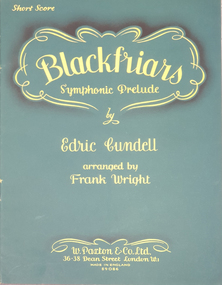
Document - Booklets, Books of sheet music, Mid 1900s
... name was Sarah. Their family won many singing and instrumental awards. Frank was tutored by Percy Code and was awarded a gold medal for the highest marks in the ALCM examinations in the British Colonies at the age of seventeen years. He became the Australian Open Cornet Champion by the age of eighteen. A year later, Frank conducted the City of Ballarat Band, and later the Ballarat Soldiers’ Memorial Band. He formed the Frank Wright Frisco Band and Frank Wright and his Coliseum Orchestra. These bands won many South Street...name was Sarah. Their family won many singing and instrumental awards. Frank was tutored by Percy Code and was awarded a gold medal for the highest marks in the ALCM examinations in the British Colonies at the age of seventeen years. He became the Australian Open Cornet Champion by the age of eighteen. A year later, Frank conducted the City of Ballarat Band, and later the Ballarat Soldiers’ Memorial Band. He formed the Frank Wright Frisco Band and Frank Wright and his Coliseum Orchestra. These bands won many South Street ...Frank Wright was a renown resident of Smeaton, where he was born on 2 August 1901. He lived at Laura Villa, and attended Smeaton State School. His father William was a gold miner and his mother's name was Sarah. Their family won many singing and instrumental awards. Frank was tutored by Percy Code and was awarded a gold medal for the highest marks in the ALCM examinations in the British Colonies at the age of seventeen years. He became the Australian Open Cornet Champion by the age of eighteen. A year later, Frank conducted the City of Ballarat Band, and later the Ballarat Soldiers’ Memorial Band. He formed the Frank Wright Frisco Band and Frank Wright and his Coliseum Orchestra. These bands won many South Street awards, and Frank as conductor won many awards in the Australian Band Championship contest. In 1933 Frank Wright sailed to England to conduct the famous St Hilda’s Band and was later appointed Musical Director of the London County Council, where he organized many amazing concerts in parks, in and around the London district. He was made Professor of Brass and Military Band Scoring and conducted at the Guildhall of Music and Drama. Frank was often invited to adjudicate Brass Band Championships around Europe, in Australia, including South Street and in New Zealand. The Frank Wright Medal at the Royal South Street competition is awarded to an individual recognized as making an outstanding contribution to brass music in Australia.11 books of sheet music written by various composers but all arranged by Frank Wright. 1). 'Le Carnaval Romain' (The Roman Carnival) Overture by Berlioz for Solo B flat Cornet (Conductor). 2). 'Ida and Dot' Polka by F.H.Losey, for Soprano Cornet, 1st & 2nd Solo Cornet (Conductor), 3rd Cornet, Repiano B flat, 2nd Cornet, Solo Tenore E flat, 1st Tenor E flat, 2nd Tenor E flat, Euphonium B flat, Bass Trombone, 1st Baritone B flat, 2nd Baritone B flat, 1st Trombone, 2nd Trombone, Contre Bass E flat & Drums. The Pianoforte accompaniment was arranged by Frank Wright. 3). 'Trumpet Concerto' by Haydn. The Full Score with parts for a band of 25. 4). 'Diadem of Gold' Overture by G.Bailey for Solo B flat Cornet (Conductor). 5). 'The Frogs (of Aristophanes)' Overture for Solo B flat Cornet (Conductor), Short Score & Full Score arranged for brass band. 6). Variations of 'The Shining River' by Edmund Rubbra for Solo B flat Cornet (Conductor). 7). 'Le Roi D'Ys' (The King of Ys) Overture by Edouard Lalo for Solo B flat Cornet (Conductor). 8). 'Sovereign Heritage' Symphonic Overture by J.Beaver for Solo B flat Cornet (Conductor). 9). 'La Forza del Destino' (The Force of Destiny) Overture by Verdi - the Short Score. 10). 'Blackfriars' Symphonic Prelude by Edric Cundell - Short Score. 11). 'Diadem of Gold' Overture by G.Bailey - Short Score1). Pencil markings on page 1,4,5 &6. 9). Written in pen on front cover - Mr Geoffrey Hosier. 10). Written in pen on title page - All good wishes F.W. 29.x.'55frank wright, sheet music, le carnaval romain, berlioz, ida and dot polka, f.h. losey, trumpet concerto, haydn, diadem of gold overture, g. bailey, the frogs overture, granville bantock, the shining river, edmund rubbra, le roi d'ys overture, edouard lalo, sovereign heritage, j. beaver, la forza del destino overture, verdi, cornet, blackfriars symphonic prelude, eric cundell -
Federation University Historical Collection
Sheet music, Boosey & Hawkes Ltd, Benvenuto Cellini Overture, 1070
... name was Sarah. Their family won many singing and instrumental awards. Frank was tutored by Percy Code and was awarded a gold medal for the highest marks in the ALCM examinations in the British Colonies at the age of seventeen years. He became the Australian Open Cornet Champion by the age of eighteen. A year later, Frank conducted the City of Ballarat Band, and later the Ballarat Soldiers’ Memorial Band. He formed the Frank Wright Frisco Band and Frank Wright and his Coliseum Orchestra. These bands won many South Street...name was Sarah. Their family won many singing and instrumental awards. Frank was tutored by Percy Code and was awarded a gold medal for the highest marks in the ALCM examinations in the British Colonies at the age of seventeen years. He became the Australian Open Cornet Champion by the age of eighteen. A year later, Frank conducted the City of Ballarat Band, and later the Ballarat Soldiers’ Memorial Band. He formed the Frank Wright Frisco Band and Frank Wright and his Coliseum Orchestra. These bands won many South Street ...Frank Wright was a renown resident of Smeaton, where he was born on 2 August 1901. He lived at Laura Villa, and attended Smeaton State School. His father William was a gold miner and his mother's name was Sarah. Their family won many singing and instrumental awards. Frank was tutored by Percy Code and was awarded a gold medal for the highest marks in the ALCM examinations in the British Colonies at the age of seventeen years. He became the Australian Open Cornet Champion by the age of eighteen. A year later, Frank conducted the City of Ballarat Band, and later the Ballarat Soldiers’ Memorial Band. He formed the Frank Wright Frisco Band and Frank Wright and his Coliseum Orchestra. These bands won many South Street awards, and Frank as conductor won many awards in the Australian Band Championship contest. In 1933 Frank Wright sailed to England to conduct the famous St Hilda’s Band and was later appointed Musical Director of the London County Council, where he organized many amazing concerts in parks, in and around the London district. He was made Professor of Brass and Military Band Scoring and conducted at the Guildhall of Music and Drama. Frank was often invited to adjudicate Brass Band Championships around Europe, in Australia, including South Street and in New Zealand. The Frank Wright Medal at the Royal South Street competition is awarded to an individual recognized as making an outstanding contribution to brass music in Australia.1). 46 Pages of an early A3 photocopy of the handwritten manuscript of 'Benvenuto Cellini' Overture written by Hector Berlioz and arranged by Frank Wright. It shows the music for each brass band instrument. 2). Loose leaf sheets of music for all the brass band instruments in an orange with black print cover. 3). Letter from the publishers of the sheet music1). Written in red pen - 2nd Photocopy copy 3). Typed letter with the signature of the head of the copyright department of the publisher.frank wright, boosey & hawkes, sheet music, brass band, benvenuto cellini overture, hector berlioz -
Federation University Historical Collection
Document, Trinity College of Music Diploma Examinations 1967, June-July 1967
... name was Sarah. Their family won many singing and instrumental awards. Frank was tutored by Percy Code and was awarded a gold medal for the highest marks in the ALCM examinations in the British Colonies at the age of seventeen years. He became the Australian Open Cornet Champion by the age of eighteen. A year later, Frank conducted the City of Ballarat Band, and later the Ballarat Soldiers’ Memorial Band. He formed the Frank Wright Frisco Band and Frank Wright and his Coliseum Orchestra. These bands won many South Street...name was Sarah. Their family won many singing and instrumental awards. Frank was tutored by Percy Code and was awarded a gold medal for the highest marks in the ALCM examinations in the British Colonies at the age of seventeen years. He became the Australian Open Cornet Champion by the age of eighteen. A year later, Frank conducted the City of Ballarat Band, and later the Ballarat Soldiers’ Memorial Band. He formed the Frank Wright Frisco Band and Frank Wright and his Coliseum Orchestra. These bands won many South Street ...Frank Wright was a renown resident of Smeaton, where he was born in 1901. He lived at Laura Villa, and attended Smeaton State School. His father William was a gold miner and his mother's name was Sarah. Their family won many singing and instrumental awards. Frank was tutored by Percy Code and was awarded a gold medal for the highest marks in the ALCM examinations in the British Colonies at the age of seventeen years. He became the Australian Open Cornet Champion by the age of eighteen. A year later, Frank conducted the City of Ballarat Band, and later the Ballarat Soldiers’ Memorial Band. He formed the Frank Wright Frisco Band and Frank Wright and his Coliseum Orchestra. These bands won many South Street awards, and Frank as conductor won many awards in the Australian Band Championship contest. In 1933 Frank Wright sailed to England to conduct the famous St Hilda’s Band and was later appointed Musical Director of the London County Council, where he organized many amazing concerts in parks, in and around the London district. He was made Professor of Brass and Military Band Scoring and conducted at the Guildhall of Music and Drama. Frank was often invited to adjudicate Brass Band Championships around Europe, in Australia, including South Street and in New Zealand. The Frank Wright Medal at the Royal South Street competition is awarded to an individual recognized as making an outstanding contribution to brass music in Australia.1). With compliments slip from Trinity College of Music, London 2). Printed and folded 4 page examination with 'Instructions to candidates' and 'Musical knowledge' questions.1). Written in blue pen - Bill, 20.11.67frank wright, trinity college of music, diploma examination -
Federation University Historical Collection
Sheet Music, mid 1900s
... name was Sarah. Their family won many singing and instrumental awards. Frank was tutored by Percy Code and was awarded a gold medal for the highest marks in the ALCM examinations in the British Colonies at the age of seventeen years. He became the Australian Open Cornet Champion by the age of eighteen. A year later, Frank conducted the City of Ballarat Band, and later the Ballarat Soldiers’ Memorial Band. He formed the Frank Wright Frisco Band and Frank Wright and his Coliseum Orchestra. These bands won many South Street...name was Sarah. Their family won many singing and instrumental awards. Frank was tutored by Percy Code and was awarded a gold medal for the highest marks in the ALCM examinations in the British Colonies at the age of seventeen years. He became the Australian Open Cornet Champion by the age of eighteen. A year later, Frank conducted the City of Ballarat Band, and later the Ballarat Soldiers’ Memorial Band. He formed the Frank Wright Frisco Band and Frank Wright and his Coliseum Orchestra. These bands won many South Street ...Frank Wright was a renown resident of Smeaton, where he was born in 1901. He lived at Laura Villa, and attended Smeaton State School. His father William was a gold miner and his mother's name was Sarah. Their family won many singing and instrumental awards. Frank was tutored by Percy Code and was awarded a gold medal for the highest marks in the ALCM examinations in the British Colonies at the age of seventeen years. He became the Australian Open Cornet Champion by the age of eighteen. A year later, Frank conducted the City of Ballarat Band, and later the Ballarat Soldiers’ Memorial Band. He formed the Frank Wright Frisco Band and Frank Wright and his Coliseum Orchestra. These bands won many South Street awards, and Frank as conductor won many awards in the Australian Band Championship contest. In 1933 Frank Wright sailed to England to conduct the famous St Hilda’s Band and was later appointed Musical Director of the London County Council, where he organized many amazing concerts in parks, in and around the London district. He was made Professor of Brass and Military Band Scoring and conducted at the Guildhall of Music and Drama. Frank was often invited to adjudicate Brass Band Championships around Europe, in Australia, including South Street and in New Zealand. The Frank Wright Medal at the Royal South Street competition is awarded to an individual recognized as making an outstanding contribution to brass music in Australia.All handwritten scores of music by Frank Wright by other composers- 1). Handwritten in pencil - 'Pastourelle' by Francis Poulence for trumpet in B flat 2). Handwritten in black pen, 7 pages - 'Minuet' by Paderewski 3). Handwritten in black pen - 'Sonatine' by Schubert 4). Handwritten in blue pen with red accents, 8 pages - 'Prelude to Act 1 "Traivata"' by Verdi and arrangement by Drake Rumn?All handwrittenfrank wright, pastourelle, frances poulence, sonatine, schubert, minuet, paderewski, traivata, verdi, sheet music -
Federation University Historical Collection
Sheet music, mid 1900s
... name was Sarah. Their family won many singing and instrumental awards. Frank was tutored by Percy Code and was awarded a gold medal for the highest marks in the ALCM examinations in the British Colonies at the age of seventeen years. He became the Australian Open Cornet Champion by the age of eighteen. A year later, Frank conducted the City of Ballarat Band, and later the Ballarat Soldiers’ Memorial Band. He formed the Frank Wright Frisco Band and Frank Wright and his Coliseum Orchestra. These bands won many South Street...The Frank Wright Medal at the Royal South Street competition is awarded to an individual recognized as making an outstanding contribution to brass music in Australia. frank wright sheet music composer beryl hazelgrove All handwritten A folder of handwritten sheets of music, none of which are titled. Some are written in pencil and some in pen. The folder belonged to Frank Wright, although on the inside front cover is the name ...Frank Wright was a renown resident of Smeaton, where he was born in 1901. He lived at Laura Villa, and attended Smeaton State School. His father William was a gold miner and his mother's name was Sarah. Their family won many singing and instrumental awards. Frank was tutored by Percy Code and was awarded a gold medal for the highest marks in the ALCM examinations in the British Colonies at the age of seventeen years. He became the Australian Open Cornet Champion by the age of eighteen. A year later, Frank conducted the City of Ballarat Band, and later the Ballarat Soldiers’ Memorial Band. He formed the Frank Wright Frisco Band and Frank Wright and his Coliseum Orchestra. These bands won many South Street awards, and Frank as conductor won many awards in the Australian Band Championship contest. In 1933 Frank Wright sailed to England to conduct the famous St Hilda’s Band and was later appointed Musical Director of the London County Council, where he organized many amazing concerts in parks, in and around the London district. He was made Professor of Brass and Military Band Scoring and conducted at the Guildhall of Music and Drama. Frank was often invited to adjudicate Brass Band Championships around Europe, in Australia, including South Street and in New Zealand. The Frank Wright Medal at the Royal South Street competition is awarded to an individual recognized as making an outstanding contribution to brass music in Australia.A folder of handwritten sheets of music, none of which are titled. Some are written in pencil and some in pen. The folder belonged to Frank Wright, although on the inside front cover is the name Beryl Hazelgrove written several times.All handwrittenfrank wright, sheet music, composer, beryl hazelgrove -
 Federation University Historical Collection
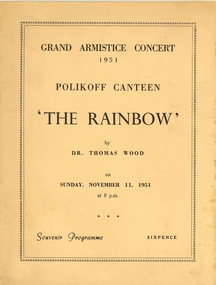
Programme, T.Evans & Sons, Grand Armistice Concert 1951 Polikoff Canteen 'The Rainbow', 11 November 1951
... name was Sarah. Their family won many singing and instrumental awards. Frank was tutored by Percy Code and was awarded a gold medal for the highest marks in the ALCM examinations in the British Colonies at the age of seventeen years. He became the Australian Open Cornet Champion by the age of eighteen. A year later, Frank conducted the City of Ballarat Band, and later the Ballarat Soldiers’ Memorial Band. He formed the Frank Wright Frisco Band and Frank Wright and his Coliseum Orchestra. These bands won many South Street...name was Sarah. Their family won many singing and instrumental awards. Frank was tutored by Percy Code and was awarded a gold medal for the highest marks in the ALCM examinations in the British Colonies at the age of seventeen years. He became the Australian Open Cornet Champion by the age of eighteen. A year later, Frank conducted the City of Ballarat Band, and later the Ballarat Soldiers’ Memorial Band. He formed the Frank Wright Frisco Band and Frank Wright and his Coliseum Orchestra. These bands won many South Street ...Frank Wright was a renown resident of Smeaton, where he was born on 2 August 1901. He lived at Laura Villa, and attended Smeaton State School. His father William was a gold miner and his mother's name was Sarah. Their family won many singing and instrumental awards. Frank was tutored by Percy Code and was awarded a gold medal for the highest marks in the ALCM examinations in the British Colonies at the age of seventeen years. He became the Australian Open Cornet Champion by the age of eighteen. A year later, Frank conducted the City of Ballarat Band, and later the Ballarat Soldiers’ Memorial Band. He formed the Frank Wright Frisco Band and Frank Wright and his Coliseum Orchestra. These bands won many South Street awards, and Frank as conductor won many awards in the Australian Band Championship contest. In 1933 Frank Wright sailed to England to conduct the famous St Hilda’s Band and was later appointed Musical Director of the London County Council, where he organized many amazing concerts in parks, in and around the London district. He was made Professor of Brass and Military Band Scoring and conducted at the Guildhall of Music and Drama. Frank was often invited to adjudicate Brass Band Championships around Europe, in Australia, including South Street and in New Zealand. The Frank Wright Medal at the Royal South Street competition is awarded to an individual recognized as making an outstanding contribution to brass music in Australia.A 12 page booklet with a buff cover containing information about the music - 'The Rainbow', the composer - Dr Thomas Wood, the guest conductor and music scorer - Frank Wright and the solo cornetist - Ken Smith. Along with the programme the booklet also contains the words of the work.frank wright, conductor, brass band, grand armistice concert, polikoff canteen, the rainbow, dr thomas wood, ken smith -
 Federation University Historical Collection
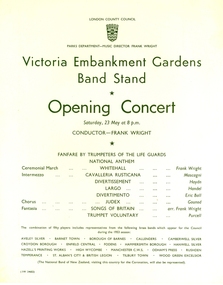
Programme, Greater London Council Parks Department, Victoria Embankment Gardens Band Stand Opening Concert, 23 May 1953
... name was Sarah. Their family won many singing and instrumental awards. Frank was tutored by Percy Code and was awarded a gold medal for the highest marks in the ALCM examinations in the British Colonies at the age of seventeen years. He became the Australian Open Cornet Champion by the age of eighteen. A year later, Frank conducted the City of Ballarat Band, and later the Ballarat Soldiers’ Memorial Band. He formed the Frank Wright Frisco Band and Frank Wright and his Coliseum Orchestra. These bands won many South Street...The Frank Wright Medal at the Royal South Street competition is awarded to an individual recognized as making an outstanding contribution to brass music in Australia. frank wright conductor programme brass band victoria embankment gardens band stand Single page of think paper with black printing, containing the information about the concert held in 1953. It includes the name ...Frank Wright was a renown resident of Smeaton, where he was born on 2 August 1901. He lived at Laura Villa, and attended Smeaton State School. His father William was a gold miner and his mother's name was Sarah. Their family won many singing and instrumental awards. Frank was tutored by Percy Code and was awarded a gold medal for the highest marks in the ALCM examinations in the British Colonies at the age of seventeen years. He became the Australian Open Cornet Champion by the age of eighteen. A year later, Frank conducted the City of Ballarat Band, and later the Ballarat Soldiers’ Memorial Band. He formed the Frank Wright Frisco Band and Frank Wright and his Coliseum Orchestra. These bands won many South Street awards, and Frank as conductor won many awards in the Australian Band Championship contest. In 1933 Frank Wright sailed to England to conduct the famous St Hilda’s Band and was later appointed Musical Director of the London County Council, where he organized many amazing concerts in parks, in and around the London district. He was made Professor of Brass and Military Band Scoring and conducted at the Guildhall of Music and Drama. Frank was often invited to adjudicate Brass Band Championships around Europe, in Australia, including South Street and in New Zealand. The Frank Wright Medal at the Royal South Street competition is awarded to an individual recognized as making an outstanding contribution to brass music in Australia.Single page of think paper with black printing, containing the information about the concert held in 1953. It includes the name of the conductor - Frank Wright and the names of the representative bands along with the programme of music.frank wright, conductor, programme, brass band, victoria embankment gardens band stand -
Federation University Historical Collection
Newspaper, Wright & Rounds, Wright & Rounds Brass Band News, 1 March 1936
... name was Sarah. Their family won many singing and instrumental awards. Frank was tutored by Percy Code and was awarded a gold medal for the highest marks in the ALCM examinations in the British Colonies at the age of seventeen years. He became the Australian Open Cornet Champion by the age of eighteen. A year later, Frank conducted the City of Ballarat Band, and later the Ballarat Soldiers’ Memorial Band. He formed the Frank Wright Frisco Band and Frank Wright and his Coliseum Orchestra. These bands won many South Street...name was Sarah. Their family won many singing and instrumental awards. Frank was tutored by Percy Code and was awarded a gold medal for the highest marks in the ALCM examinations in the British Colonies at the age of seventeen years. He became the Australian Open Cornet Champion by the age of eighteen. A year later, Frank conducted the City of Ballarat Band, and later the Ballarat Soldiers’ Memorial Band. He formed the Frank Wright Frisco Band and Frank Wright and his Coliseum Orchestra. These bands won many South Street ...Frank Wright was a renown resident of Smeaton, where he was born on 2 August 1901. He lived at Laura Villa, and attended Smeaton State School. His father William was a gold miner and his mother's name was Sarah. Their family won many singing and instrumental awards. Frank was tutored by Percy Code and was awarded a gold medal for the highest marks in the ALCM examinations in the British Colonies at the age of seventeen years. He became the Australian Open Cornet Champion by the age of eighteen. A year later, Frank conducted the City of Ballarat Band, and later the Ballarat Soldiers’ Memorial Band. He formed the Frank Wright Frisco Band and Frank Wright and his Coliseum Orchestra. These bands won many South Street awards, and Frank as conductor won many awards in the Australian Band Championship contest. In 1933 Frank Wright sailed to England to conduct the famous St Hilda’s Band and was later appointed Musical Director of the London County Council, where he organized many amazing concerts in parks, in and around the London district. He was made Professor of Brass and Military Band Scoring and conducted at the Guildhall of Music and Drama. Frank was often invited to adjudicate Brass Band Championships around Europe, in Australia, including South Street and in New Zealand. The Frank Wright Medal at the Royal South Street competition is awarded to an individual recognized as making an outstanding contribution to brass music in Australia.An 8 page newspaper containing information about band news from various districts in the United Kingdom, as well as advertisements. This paper belonged to Frank Wright. It was no.654.frank wright, wright & rounds brass band news, composer, conductor -
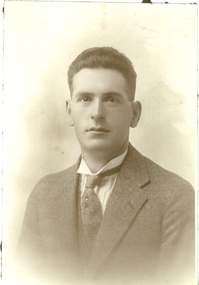 Federation University Historical Collection
Photograph - Black and White, Frank Wright, late1920's
... name was Sarah. Their family won many singing and instrumental awards. Frank was tutored by Percy Code and was awarded a gold medal for the highest marks in the ALCM examinations in the British Colonies at the age of seventeen years. He became the Australian Open Cornet Champion by the age of eighteen. A year later, Frank conducted the City of Ballarat Band, and later the Ballarat Soldiers’ Memorial Band. He formed the Frank Wright Frisco Band and Frank Wright and his Coliseum Orchestra. These bands won many South Street...name was Sarah. Their family won many singing and instrumental awards. Frank was tutored by Percy Code and was awarded a gold medal for the highest marks in the ALCM examinations in the British Colonies at the age of seventeen years. He became the Australian Open Cornet Champion by the age of eighteen. A year later, Frank conducted the City of Ballarat Band, and later the Ballarat Soldiers’ Memorial Band. He formed the Frank Wright Frisco Band and Frank Wright and his Coliseum Orchestra. These bands won many South Street ...Frank Wright was a renown resident of Smeaton, where he was born on 2 August 1901. He lived at Laura Villa, and attended Smeaton State School. His father William was a gold miner and his mother's name was Sarah. Their family won many singing and instrumental awards. Frank was tutored by Percy Code and was awarded a gold medal for the highest marks in the ALCM examinations in the British Colonies at the age of seventeen years. He became the Australian Open Cornet Champion by the age of eighteen. A year later, Frank conducted the City of Ballarat Band, and later the Ballarat Soldiers’ Memorial Band. He formed the Frank Wright Frisco Band and Frank Wright and his Coliseum Orchestra. These bands won many South Street awards, and Frank as conductor won many awards in the Australian Band Championship contest. In 1933 Frank Wright sailed to England to conduct the famous St Hilda’s Band and was later appointed Musical Director of the London County Council, where he organized many amazing concerts in parks, in and around the London district. He was made Professor of Brass and Military Band Scoring and conducted at the Guildhall of Music and Drama. Frank was often invited to adjudicate Brass Band Championships around Europe, in Australia, including South Street and in New Zealand. The Frank Wright Medal at the Royal South Street competition is awarded to an individual recognized as making an outstanding contribution to brass music in Australia.Black and white studio photograph of the torso of a young man dressed in a mid coloured jacket, striped shirt and tie. The man is Frank Wright.frank wright, brass band -
Federation University Historical Collection
Photograph, Page from Musicians Book of Remembrance, January 2nd 1955, 2/1/1955
... name was Sarah. Their family won many singing and instrumental awards. Frank was tutored by Percy Code and was awarded a gold medal for the highest marks in the ALCM examinations in the British Colonies at the age of seventeen years. He became the Australian Open Cornet Champion by the age of eighteen. A year later, Frank conducted the City of Ballarat Band, and later the Ballarat Soldiers’ Memorial Band. He formed the Frank Wright Frisco Band and Frank Wright and his Coliseum Orchestra. These bands won many South Street...The Frank Wright Medal at the Royal South Street competition is awarded to an individual recognized as making an outstanding contribution to brass music in Australia. frank wright musicians book of remembrance g h salter nellie melba edward elgar A black and photograph of a page from the Musicians' Book of Remembrance, dedicated by the Dean of St. Pauls', The Reverend G.H. Salter. It contains many names ...Frank Wright was a renown resident of Smeaton, where he was born on 2 August 1901. He lived at Laura Villa, and attended Smeaton State School. His father William was a gold miner and his mother's name was Sarah. Their family won many singing and instrumental awards. Frank was tutored by Percy Code and was awarded a gold medal for the highest marks in the ALCM examinations in the British Colonies at the age of seventeen years. He became the Australian Open Cornet Champion by the age of eighteen. A year later, Frank conducted the City of Ballarat Band, and later the Ballarat Soldiers’ Memorial Band. He formed the Frank Wright Frisco Band and Frank Wright and his Coliseum Orchestra. These bands won many South Street awards, and Frank as conductor won many awards in the Australian Band Championship contest. In 1933 Frank Wright sailed to England to conduct the famous St Hilda’s Band and was later appointed Musical Director of the London County Council, where he organized many amazing concerts in parks, in and around the London district. He was made Professor of Brass and Military Band Scoring and conducted at the Guildhall of Music and Drama. Frank was often invited to adjudicate Brass Band Championships around Europe, in Australia, including South Street and in New Zealand. The Frank Wright Medal at the Royal South Street competition is awarded to an individual recognized as making an outstanding contribution to brass music in Australia.A black and photograph of a page from the Musicians' Book of Remembrance, dedicated by the Dean of St. Pauls', The Reverend G.H. Salter. It contains many names of notable musicians including Nellie Melba and Edward Elgar. The Photograph is glued to a piece of cardboard. It was the property of Frank Wright.frank wright, musicians book of remembrance, g h salter, nellie melba, edward elgar -
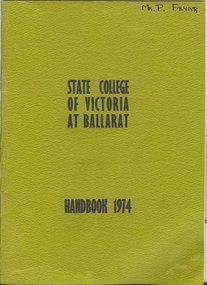 Federation University Historical Collection
Booklet, State College of Victoria, Ballarat Handbook, 1974, 1974
... Street. Accommodation again became a problem in 1968 with the introduction of the three year Diploma of Teaching (Primary) course. On 19 December 1972 the State College of Victoria Act received Royal Assent. The Act restructured the teacher training policies of Victoria. Ballarat was one of the State Teachers' Colleges which until 30th June 1973, was under Education Department control. Ballarat Teachers' College was renames the State College of Victoria at Ballarat and had its own governing council. In 1975 State College of Victoria at Ballarat moved to the Ballarat Institute of Advanced Education campus at Mount Helen, and the name...Street. Accommodation again became a problem in 1968 with the introduction of the three year Diploma of Teaching (Primary) course. On 19 December 1972 the State College of Victoria Act received Royal Assent. The Act restructured the teacher training policies of Victoria. Ballarat was one of the State Teachers' Colleges which until 30th June 1973, was under Education Department control. Ballarat Teachers' College was renames the State College of Victoria at Ballarat and had its own governing council. In 1975 State College of Victoria at Ballarat moved to the Ballarat Institute of Advanced Education campus at Mount Helen, and the name ...In 1958 the Ballarat Teachers' College moved from Dana Street Primary School to a custom built college in Gillies Street. Accommodation again became a problem in 1968 with the introduction of the three year Diploma of Teaching (Primary) course. On 19 December 1972 the State College of Victoria Act received Royal Assent. The Act restructured the teacher training policies of Victoria. Ballarat was one of the State Teachers' Colleges which until 30th June 1973, was under Education Department control. Ballarat Teachers' College was renames the State College of Victoria at Ballarat and had its own governing council. In 1975 State College of Victoria at Ballarat moved to the Ballarat Institute of Advanced Education campus at Mount Helen, and the name was changed to Ballarat College of Advanced Education. Small, green, soft covered booklet. Th book includes course, regulations, assessments, subject details, general information, art collection overview and student organisations. A good history of the evolution of the Ballarat Teachers' College and State College Victoria at Ballarat (SCVB) is given. 'Mr P. Fryar' on front cover. Signed 'Peter Fryar' on inside front page. ballarat teachers' college, state college of victoria at ballarat, state college of victoria, ballarat, art collection, handbook, gillies street -
Federation University Historical Collection
Booklet, St Ann's Press, The Winston, Contest in Music for Youth, 29/10/1966
... name was Sarah. He was the youngest of eleven children. Their family won many singing and instrumental awards. Frank was tutored by Percy Code and was awarded a gold medal for the highest marks in the ALCM examinations in the British Colonies at the age of seventeen years. He became the Australian Open Cornet Champion by the age of eighteen. A year later, Frank conducted the City of Ballarat Band, and later the Ballarat Soldiers’ Memorial Band. He formed the Frank Wright Frisco Band and Frank Wright and his Coliseum Orchestra. These bands won many South Street...name was Sarah. He was the youngest of eleven children. Their family won many singing and instrumental awards. Frank was tutored by Percy Code and was awarded a gold medal for the highest marks in the ALCM examinations in the British Colonies at the age of seventeen years. He became the Australian Open Cornet Champion by the age of eighteen. A year later, Frank conducted the City of Ballarat Band, and later the Ballarat Soldiers’ Memorial Band. He formed the Frank Wright Frisco Band and Frank Wright and his Coliseum Orchestra. These bands won many South Street ...Frank Wright was a renown resident of Smeaton, where he was born in 1901. He lived at Laura Villa, and attended Smeaton State School. His father William was a gold miner and his mother's name was Sarah. He was the youngest of eleven children. Their family won many singing and instrumental awards. Frank was tutored by Percy Code and was awarded a gold medal for the highest marks in the ALCM examinations in the British Colonies at the age of seventeen years. He became the Australian Open Cornet Champion by the age of eighteen. A year later, Frank conducted the City of Ballarat Band, and later the Ballarat Soldiers’ Memorial Band. He formed the Frank Wright Frisco Band and Frank Wright and his Coliseum Orchestra. These bands won many South Street awards, and Frank as conductor won many awards in the Australian Band Championship contest. In 1933 Frank Wright sailed to England to conduct the famous St Hilda’s Band and was appointed in 1934 as the Musical Director of the London County Council (the GLC or Greater London Council), where he organized many amazing concerts in most of the 150 parks, in and around the London district. He was also responsible for some of London’s major concerts at Kenwood, the Crystal Palace and Holland Park. He was made Professor of Brass and Military Band Scoring and Conducting and was a Fellow of the Guildhall School of Music and Drama. Frank was often invited to adjudicate Brass Band Championships around Europe, in Australia, including South Street and in New Zealand. Frank was awarded an M.B.E. in 1967 and he died in November 1970. The Frank Wright Medal at the Royal South Street competition is awarded to an individual recognized as making an outstanding contribution to brass music in Australia.Small 21 page booklet has a blue card cover and is printed in black and white. On the first page is a photograph of the Boys' Brigade Massed Band Concert at the Royal Albert Hall with Frank Wright conducting.frank wright, boys' brigade, brass bands, conductor, the winston, youth in music -
Federation University Historical Collection
Brochure, Besson "Prototype", 1930s?
... name was Sarah. He was the youngest of eleven children. Their family won many singing and instrumental awards. Frank was tutored by Percy Code and was awarded a gold medal for the highest marks in the ALCM examinations in the British Colonies at the age of seventeen years. He became the Australian Open Cornet Champion by the age of eighteen. A year later, Frank conducted the City of Ballarat Band, and later the Ballarat Soldiers’ Memorial Band. He formed the Frank Wright Frisco Band and Frank Wright and his Coliseum Orchestra. These bands won many South Street...name was Sarah. He was the youngest of eleven children. Their family won many singing and instrumental awards. Frank was tutored by Percy Code and was awarded a gold medal for the highest marks in the ALCM examinations in the British Colonies at the age of seventeen years. He became the Australian Open Cornet Champion by the age of eighteen. A year later, Frank conducted the City of Ballarat Band, and later the Ballarat Soldiers’ Memorial Band. He formed the Frank Wright Frisco Band and Frank Wright and his Coliseum Orchestra. These bands won many South Street ...Frank Wright was a renown resident of Smeaton, where he was born in 1901. He lived at Laura Villa, and attended Smeaton State School. His father William was a gold miner and his mother's name was Sarah. He was the youngest of eleven children. Their family won many singing and instrumental awards. Frank was tutored by Percy Code and was awarded a gold medal for the highest marks in the ALCM examinations in the British Colonies at the age of seventeen years. He became the Australian Open Cornet Champion by the age of eighteen. A year later, Frank conducted the City of Ballarat Band, and later the Ballarat Soldiers’ Memorial Band. He formed the Frank Wright Frisco Band and Frank Wright and his Coliseum Orchestra. These bands won many South Street awards, and Frank as conductor won many awards in the Australian Band Championship contest. In 1933 Frank Wright sailed to England to conduct the famous St Hilda’s Band and was appointed in 1934 as the Musical Director of the London County Council (the GLC or Greater London Council), where he organized many amazing concerts in most of the 150 parks, in and around the London district. He was also responsible for some of London’s major concerts at Kenwood, the Crystal Palace and Holland Park. He was made Professor of Brass and Military Band Scoring and Conducting and was a Fellow of the Guildhall School of Music and Drama. Frank was often invited to adjudicate Brass Band Championships around Europe, in Australia, including South Street and in New Zealand. Frank was awarded an M.B.E. in 1967 and he died in November 1970. The Frank Wright Medal at the Royal South Street competition is awarded to an individual recognized as making an outstanding contribution to brass music in Australia.A yellow, red and white three fold brochure printed in black, advertising the Besson brand brass band instruments, sold by A P Sykes of Melbourne. On the front cover are photographs of two musicians who a giving their approval for these instruments. One is Frank Wright and the other is William S. May.frank wright, brass band, musical instruments, william s may, besson, a p sykes -
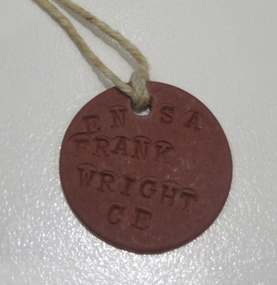 Federation University Historical Collection
Badge - Leather disc, E.N.S.A. Frank Wright C.E, c1942
... name was Sarah. He was the youngest of eleven children. Their family won many singing and instrumental awards. Frank was tutored by Percy Code and was awarded a gold medal for the highest marks in the ALCM examinations in the British Colonies at the age of seventeen years. He became the Australian Open Cornet Champion by the age of eighteen. A year later, Frank conducted the City of Ballarat Band, and later the Ballarat Soldiers’ Memorial Band. He formed the Frank Wright Frisco Band and Frank Wright and his Coliseum Orchestra. These bands won many South Street...name was Sarah. He was the youngest of eleven children. Their family won many singing and instrumental awards. Frank was tutored by Percy Code and was awarded a gold medal for the highest marks in the ALCM examinations in the British Colonies at the age of seventeen years. He became the Australian Open Cornet Champion by the age of eighteen. A year later, Frank conducted the City of Ballarat Band, and later the Ballarat Soldiers’ Memorial Band. He formed the Frank Wright Frisco Band and Frank Wright and his Coliseum Orchestra. These bands won many South Street ...This disc belonged to Frank Wright. The letters ENSA refer to the Entertainments National Service Association, which was set up in 1939 to provide entertainment for the British armed forces personnel. Frank Wright was a renown resident of Smeaton, where he was born in 1901. He lived at Laura Villa, and attended Smeaton State School. His father William was a gold miner and his mother's name was Sarah. He was the youngest of eleven children. Their family won many singing and instrumental awards. Frank was tutored by Percy Code and was awarded a gold medal for the highest marks in the ALCM examinations in the British Colonies at the age of seventeen years. He became the Australian Open Cornet Champion by the age of eighteen. A year later, Frank conducted the City of Ballarat Band, and later the Ballarat Soldiers’ Memorial Band. He formed the Frank Wright Frisco Band and Frank Wright and his Coliseum Orchestra. These bands won many South Street awards, and Frank as conductor won many awards in the Australian Band Championship contest. In 1933 Frank Wright sailed to England to conduct the famous St Hilda’s Band and was appointed in 1934 as the Musical Director of the London County Council (the GLC or Greater London Council), where he organized many amazing concerts in most of the 150 parks, in and around the London district. He was also responsible for some of London’s major concerts at Kenwood, the Crystal Palace and Holland Park. He was made Professor of Brass and Military Band Scoring and Conducting and was a Fellow of the Guildhall School of Music and Drama. Frank was often invited to adjudicate Brass Band Championships around Europe, in Australia, including South Street and in New Zealand. Frank was awarded an M.B.E. in 1967 and he died in November 1970. The Frank Wright Medal at the Royal South Street competition is awarded to an individual recognized as making an outstanding contribution to brass music in Australia.This red coloured 3.5 cm leather disc has been stamped with the letters ENSA Frank Wright CE. It has a hole pinched in the top, through which a string has been threaded.frank wright, armed forces entertainment, musician conductor, brass bands, ensa, entertainments national service association -
Federation University Historical Collection
Black and white photograph - copy, Ballarat Post Office and Academy of Art on corner of Sturt and Lydiard Streets - c1890, c1890
... street Black and white photograph - copy of the original. Shows former Ballarat Post Office. Horse drawn carriages outside. Another building shown is "Academy of Art" with name above. ...First section of the Post Office built 1864. Second section which included a tower was built in 1885. Built in the Victorian Italianate style. Arched headed windows on the ground floor originally formed a colonnade. These were filled in later to provide more internal space. Black and white photograph - copy of the original. Shows former Ballarat Post Office. Horse drawn carriages outside. Another building shown is "Academy of Art" with name above. This cannot be determined.former ballarat post office, colonnade, victorian italianate, victorian italianate style, arched windows, sturt street, lydiard street -
Frankston RSL Sub Branch
Plaque, Memorial, 1914-1918 Memorial Plaque, 1920 (estimated); Issued from 1920
... Although Richard Harness was living at 52 Victoria Street, Abbotsford when enlisted, together with a scroll from the King, it was donated by a Frankston Family. commemorative memorial plaque dead man s penny king s richard evans harkness Around the edge are the words 'HE DIED FOR FREEDOM AND HONOUR' On the righthand side of the plaque is the name of the soldier, in this case Richard Evans Harkness. ...This round, bronze memorial plaque was presented to the family of Private Richard Evans Harkness, service number 3426, of the 37th Battalion, (8th Reinforcements) who was killed in action at Villers-Bretonneux on 12th August, 1918. Colloquially known as 'Dead Man's Penny' or 'King's Penny', this plaque was given to the next of kin of service personnel who died on active service in WW1. 1914-1918 Memorial Plaque In early 1920 it was announced that the next-of-kin of all Australian servicemen and women whose deaths were attributable to the First World War would receive a memorial plaque and scroll "as a solace for bereavement and as a memento". The memorial plaques were not uniquely Australian. In fact they were designed and produced in Britain and issued to commemorate all those who died as a result of war service from within the British Commonwealth. The idea for the plaques was originally conceived mid-way through the war. In 1917 a competition was announced to obtain a suitable design and 800 entries were eventually received. The winner, Mr. E. Carter Preston of Liverpool, England, was chosen in 1918. He was awarded a prize of 250 pounds. Mr Manning Pike directed the manufacture of the memorial plaques at the Memorial Plaque Factory set up at Acton, London. Some later plaques were also made at the Woolwich Arsenal. The cost of manufacturing so many plaques must have been considerable. Each plaque had the name of the soldier commemorated individually embossed (some were engraved) as part of the design. The full name was given without any indication of rank or honours to show the equality of sacrifice of all those who had lost their lives. The scroll designed to accompany the plaques was of thick paper, headed by the royal coat-of-arms, and bore the following message: "He whom this scroll commemorates was numbered among those who, at the call of King and Country, left all that was dear to them, endured hardness, faced danger, and finally passed out of the sight of men by the path of duty and self-sacrifice, giving up their own lives that others might live in freedom. Let those that come after see that his name is not forgotten". Underneath the message the serviceman or woman’s name, rank, honours and unit were written by hand in red ink. Because of the late arrival in Australia of the plaques many scrolls were sent out separately. A message from the King, "I join with my grateful people in sending you this memorial of a brave life given for others in the Great War", was included with the scroll. The first plaques were distributed in Australia in 1922. Each plaque was sent out from Base Records Office at Victoria Barracks in Melbourne by second-class mail. Approximately 60,000 plaques were issued in Australia. Families of deceased members of the Royal Australian Navy and the Australian Army Nursing Service also received plaques and scrolls This plaque is significant because it commemorates the death of an Australian soldier on active service in World War 1. It is representative of some 60,000 issued to next of kin of soldiers killed in World War 1. Although Richard Harness was living at 52 Victoria Street, Abbotsford when enlisted, together with a scroll from the King, it was donated by a Frankston Family.This round, bronze memorial plaque was presented to the family of Australian Army private Richard Evans Harkness, service number 03426, of the 37th battalion, 8th re-inforcement. Harkness was killed in action on 12th August, 1918, near the French village of Proyart, during the 3rd Division's advance along the Somme Valley. further details can be found here: https://www.awm.gov.au/collection/U51477 Colloquially known as 'Dead Man's Penny' or 'King's Penny', these plaques were awarded to the next of kin of service personnel who died on active service during WW1. refer to link for further information : http://www.awm.gov.au/encyclopedia/memorial_scroll/plaque.aspAround the edge are the words 'HE DIED FOR FREEDOM AND HONOUR' On the righthand side of the plaque is the name of the soldier, in this case Richard Evans Harkness.commemorative, memorial, plaque, dead, man s, penny, king s, richard, evans, harkness -
Frankston RSL Sub Branch
Photograph, 2/9th Field Ambulance Bonegilla
... On the reverse is the name H.M. Walker photographer 117 Collins Street Melbourne...On the reverse is the name H.M. Walker photographer 117 Collins Street Melbourne Original sepia photograph mounted on thick buff coloured cardboard. ...Original sepia photograph mounted on thick buff coloured cardboard. The formal photograph is of the 2/9th Field Ambulance Unit at Bonegilla during WW2. Arrows have been drawn on the photograph, identifying a Dick Heatherill and a Chas Stuart.On the reverse is the name H.M. Walker photographer 117 Collins Street Melbourne -
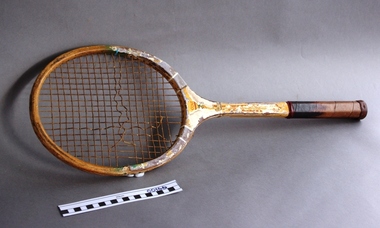 Upper Yarra Museum
Tennis Racket, Racquet, Brewers.Started manufacturing in 1928 in Newport and later in Mitcham
... File sizes Review ideal file sizes for photos http://www.tennishistory.com.au/equipment/vintage-racquets/racquet-retailing.html Extract - Born in Bendigo in 1905, Albert Brewer came to Melbourne in 1920 to commence work as a furniture factory machinist at Rojos Pty.Ltd. in Little Lonsdale Street Melbourne . http://en.wikipedia.org/wiki/Catgut Catgut is a type of cord[1] that is prepared from the natural fiber in the walls of animal intestines.[2] Usually sheep or goat intestines are used, but it is occasionally made from the intestines of a hog, horse, mule, pig or donkey. The name...File sizes Review ideal file sizes for photos http://www.tennishistory.com.au/equipment/vintage-racquets/racquet-retailing.html Extract - Born in Bendigo in 1905, Albert Brewer came to Melbourne in 1920 to commence work as a furniture factory machinist at Rojos Pty.Ltd. in Little Lonsdale Street Melbourne . http://en.wikipedia.org/wiki/Catgut Catgut is a type of cord[1] that is prepared from the natural fiber in the walls of animal intestines.[2] Usually sheep or goat intestines are used, but it is occasionally made from the intestines of a hog, horse, mule, pig or donkey. The name ...File sizes Review ideal file sizes for photos http://www.tennishistory.com.au/equipment/vintage-racquets/racquet-retailing.html Extract - Born in Bendigo in 1905, Albert Brewer came to Melbourne in 1920 to commence work as a furniture factory machinist at Rojos Pty.Ltd. in Little Lonsdale Street Melbourne . http://en.wikipedia.org/wiki/Catgut Catgut is a type of cord[1] that is prepared from the natural fiber in the walls of animal intestines.[2] Usually sheep or goat intestines are used, but it is occasionally made from the intestines of a hog, horse, mule, pig or donkey. The name neither implies nor derives from any association with cats. The word catgut may have been an abbreviation of the word "cattlegut". Alternatively, it may have derived by folk etymology from kitgut or kitstring -- the word kit, meaning fiddle, having at some point been confused with the word kit for little cat. According to legend, string makers of the 17th century deliberately misled people to believe that the strings were made of cat intestines in order to protect their industry, as any association with cats was superstitiously believed to be extremely bad luck, and to be avoided at all costRacket or Racqet. A teardrop shaped wooden frame with tight interlaced network of strings. The strings are made of Cat-gut, several are broken. See narrative on Cat gut.The racket is branded Colt at the base of the tear drop and Designed for Young Players. Made by Brewer Australia. Maker of the Worlds famous style,is printed on the handle on both sides. The frame is made of laminated wood. The paint is in poor condition.The racket has a leather grip, the grip is is worn and stained. .Powerhouse Museum Collection Thesaurus Light bats consisting of a network of cord or nylon stretched in an elliptical frame, used chiefly in playing ball games like tennis, badminton, etc.Colt. Made by Brewers Australia. Maker of the Worlds Famous style leader. Designed for young playersball, sport, leather, game, racquet, racket, colt, cat gut, strings, young players, brewer, handle, grip -
 Blacksmith's Cottage and Forge
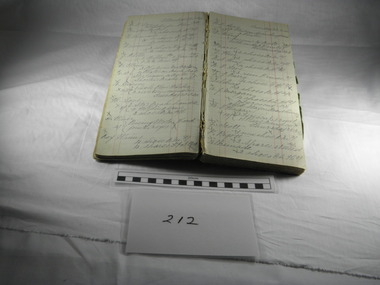
Book, Day, Day Book, 20 January 1920 to 27 April 1921
... names and industries in the Bacchus Marsh district and the work performed for them by the blacksmith during the period mentioned. Most of work relates to shoeing horses, repairs to horse drawn vehicles, repairs to farm machinery/tools and some work on cars. book blacksmith day customers clients charles edwards On the inner cover - Mrs C Edwards, Main Street, Bacchus Marsh Cardboard covers - green marbled design with black spine. ...This book contains information relating to daily work conducted by Charles Edwards, Blacksmith, during period 20th January 1920 to 27 April 1921. It lists customer names, types of work done and costs involved. The written X indicates whether work was paid in full.This books contains historical information relating to peoples names and industries in the Bacchus Marsh district and the work performed for them by the blacksmith during the period mentioned. Most of work relates to shoeing horses, repairs to horse drawn vehicles, repairs to farm machinery/tools and some work on cars.Cardboard covers - green marbled design with black spine. Account type book with red ruled columns. Hand written names, jobs, charges and dates.On the inner cover - Mrs C Edwards, Main Street, Bacchus Marshbook, blacksmith, day, customers, clients, charles edwards -
Blacksmith's Cottage and Forge
Book-reference, The Speedy Ready Reckoner
... Street, Werribee. Back cover, Alexander Bryans. stamp-"Victoria Stamp Duty 2d." Blue cover, blue printing, hard cover. Owners name ...Alex Bryans worked as a night cartman for Mr Smith in Preston. Then A. Bryans worked as a business partner for Mr Smith in Werribee, as a night cartman. A Bryans married Mr Smiths daughter. He is the uncle of Brian Mayne, donor.Local historyBlue cover, blue printing, hard cover. Owners name and address inside front and back cover. Figures (numbers and sums) inside front and back cover.A.Bryans, eager Street, Werribee. Back cover, Alexander Bryans. stamp-"Victoria Stamp Duty 2d."book, reckoner -
 The Beechworth Burke Museum
Photograph, R & M Harvey
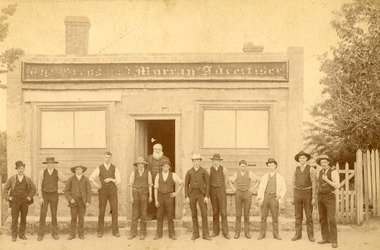
... Street office of the Ovens and Murray Advertiser in Beechworth. This group includes the Advertiser''s manager, Richard Warren, who is bearded man standing in the doorway and who's name is written on the reverse of the photograph. ...Street office of the Ovens and Murray Advertiser in Beechworth. This group includes the Advertiser''s manager, Richard Warren, who is bearded man standing in the doorway and who's name is written on the reverse of the photograph. ...This photograph shows a group of men standing outside the Ford Street office of the Ovens and Murray Advertiser in Beechworth. This group includes the Advertiser''s manager, Richard Warren, who is bearded man standing in the doorway and who's name is written on the reverse of the photograph. The Advertiser was a local paper, first printed as a weekly in 1855, and then as a daily in 1857. It continues to be printed today, albeit in a different form. The Advertiser was launched by architect Francis Hodgson Nixon with assistance from businessman John Henry Gray, and newspaperman Richard Warren. Warren was sole owner from 1860 until his death in 1906, and it responsible for much of the paper’s success. Its goals included coverage of local events, as well as of global news, and the promotion of economic liberty, arts, and sciences. Beyond these initial goals, the Advertiser was instrumental in local politics, particularly Beechworth’s association with conservatism and constitutionalism in the 1860s and 1870s. Numerous other papers sprung up to contest the Advertiser’s hold during the latter half of the nineteenth-century, but none were able to completely oust it from its post. As well as representing a key chapter in Beechworth’s history, the Advertiser can be used as a key source for the stories and figures of historic Beechworth. As well as managing the Advertiser, Richard Warren's owned or managed multiple businesses in Beechworth, founded the Ovens hospital and Benevolent asylum, invested in local companies, and participated in a range of religious brotherhoods and societies. He married Mary Ann Mitchell when he was twenty-six, and, while the couple were unable to have children, they adopted one son, who began managing the Advertiser in the late-nineteenth century. This photograph has historic significance afor its relationship to the history of the Ovens and Murray Advertiser, which is a key example of of successful nineteenth-century business in Beechworth, and for including an image of Richard Warren, a key figure in the period. Sepia rectangular photograph, faded, printed on photographic material and mounted on board. Obverse: The Ovens and Murray Advertiser Reverse: Or M A/ Printing Office/ Ford Street About 1860/ Beechworth/ R Warren [logo: R & M Harvey/Authorised Newsagents/ and Gift Shop/ Beechworth Phone 114]ovens and murray advertiser, the ovens and murray advertiser, newspaper, printing, ford street, richard warren, journalism, advertising, 1800s, 1800s beechworth, #beechworth, local business, advertiser, workmen, hats, printers, journalists, warren, mary ann mitchell, mary ann warren, 1860s, 1860s beechworth, r warren, r & m harvey -
 The Beechworth Burke Museum
Photograph, 1910
... name McKenzie. Evidence suggests that the McKenzie family has a long association with the town of Beechworth. This photograph is historically significant as it provides insight into the nineteenth and twentieth century industrial expansions that happened in the area of Newtown, leading to the urbanisation of Beechworth. Newtown Beechworth Bridge Road 1910 J. Duncan R. McKenzie M. Straughair Industrial Growth Ford Street ...Taken in 1910, this photograph depicts a scene of Bridge road in Newtown, Beechworth. Walking on the road are two men on horseback, one of which is pulling a carriage with a small dog standing beside it. Behind them are a line of small buildings and shops. Small industries began to expand dramatically in Beechworth, particularly during the 1860s, leading to a strengthening of the towns economy. As early as 1853, areas surrounding the waterway known as Spring Creek were surveyed with the intent of mapping out plans for new roads and building allotments. Land was sold and new buildings were erected, creating an expansion of the Beechworth township and retail services. One building shown in this photograph is Straughair and Duncan's Beechworth Foundry. This business was established in 1858 through the partnership of Mark Straughair and John Duncan. It dealt mostly in the manufacturing of castings and mining machinery, receiving orders from all over the Ovens district. The Business eventually collapsed after the deaths of Straughair in 1882 and Duncan in 1896 but was reopened by W.H. Phillips in 1905. The two other buildings are both associated with the name McKenzie. Evidence suggests that the McKenzie family has a long association with the town of Beechworth. This photograph is historically significant as it provides insight into the nineteenth and twentieth century industrial expansions that happened in the area of Newtown, leading to the urbanisation of Beechworth. Black and white rectangular photograph printed on matte photographic paper mounted on card.Reverse: Newton / 1997.2648 / 33 Newton Beechworth / 84-219-1 / McKenzies / BMM3055 / newtown beechworth, bridge road, 1910, j. duncan, r. mckenzie, m. straughair, industrial growth, ford street, beechworth foundry, straughair and duncan, mckenzie and sons grainstore, mckenzie family store -
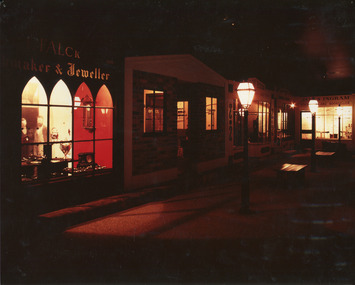 The Beechworth Burke Museum
Photograph, 1990s--estimated
... Street{?}. James Ingram was a 'devoted instigator and supporter of the town's welfare institutions', who raised funds for to establish a hospital, primary school and benevolent asylum, and assisted people who'd fallen on hard times with his wife. He was also a mainstay of the early Baptist church, holding meetings in his house. He died in 1928, six weeks short of his 100th birthday. Ingram's Rock, north-west of Beechworth near where he lived in later life, was named ...Taken in 1990, this photograph depicts a row of shops in Beechworth, with the shopfront of watchmaker and jewellers, William Turner and C.F. Falck, in the foreground, and newsagent and bookseller James Ingram's shop in the background.This photograph is of social significance to the Beechworth community in depicting the Street of Shops, the creation of curator, Roy Harvey, which opened in 1979 at Burke Museum. According to the Indigo Shire Council webpage for Burke Museum, this addition 'began a new period of collecting with Roy Harvey calling to the community for donations. The response resulted in an influx of material adding to the town history/ development and local identities collections. The Shops and their contents reflect another period in museology.' The historic shopfronts in this image portray those of local settlers, William Turner and CF Falck's Watchmaker and Jeweller store, and James Ingram's news agency and bookshop. William Turner was originally a goldfields official who became a commissioner on the Ovens goldfield, and later a resident warden, at times performing magisterial duties and chairing the Local Court. Charles Frederick Falck, born in Korlin, Germany, in 1833, a skilled watchmaker and jeweller, ran the jewellery business from 1862. Along with William Turner and Melbourne barrister, George Milner Stephen, he prepared a dazzling display of gems and jewellery from Beechworth for the Royal Society's Exhibition in Melbourne in 1865. This act signposted Beechworth's progress as a nineteenth-century gold rush town with a population of around 3000. In the mid-1850s, newsagent James Ingram established a newsagency and supplied papers and stationary to the goldfields. He and bookseller R.T. Vale stocked a wide range of literary, historical and religious works, textbooks, periodicals and newspapers, as well as hosting a reading and writing room on Camp Street{?}. James Ingram was a 'devoted instigator and supporter of the town's welfare institutions', who raised funds for to establish a hospital, primary school and benevolent asylum, and assisted people who'd fallen on hard times with his wife. He was also a mainstay of the early Baptist church, holding meetings in his house. He died in 1928, six weeks short of his 100th birthday. Ingram's Rock, north-west of Beechworth near where he lived in later life, was named after him. Colour rectangular photograph printed on matte photographic paper.Obverse: FALCK 1880 / maker & Jeweller/ WARDENS OFFICE/COACHING OFFICE/ EST. ??55/ ????ON HOUSE/ JAMES INGRAM/ NEWS?????? AND BOOKSELLER/ TOYS visible above shopfront in left foreground. Reverse: Catalogue item number 3305 pencilled in top right-hand corner.beechworth, beechworth historic shops, william turner, cf falck, james ingram, turner and falck watchmaker and jeweller, james ingram newsagent and bookseller, burke museum, promoting settlement, marketing and retailing, living in country towns, making regional centres, preserving traditions and commemorating, beechworth founders, victorian gold rush towns, beechworth pioneers, ingram's rock, 1860s beechworth, street of shops, roy harvey -
 Federation University Historical Collection
Drawing - Artwork - Drawing, Jeff Zilles, ZILLES COLLECTION: City of Ballarat Coat of Arms, c1975
... name of the new Council. The Latin motto: Cultus: cultivation, care, worship Formar: form, shape, appearance Industria: diligence, activity, industry Zilles Printers was begun by Lewis Zilles in the early 1930s. It was in McKenzie Street...name of the new Council. The Latin motto: Cultus: cultivation, care, worship Formar: form, shape, appearance Industria: diligence, activity, industry Zilles Printers was begun by Lewis Zilles in the early 1930s. It was in McKenzie Street ...The following research was undertaken for the Coat of Arms in the foyer of Ballarat Civic Hall, painted by Angus Henderson. The Ballarat arms were granted on 10 May 1956. The shield is supported by a farmer and a miner and topped by a trident (referring to Britannia and aquatic sports) with sprigs of wattle and begonias either side. The crossed oars against the Eureka flag refer to rowing events in the 1956 Olympic Games. The importance of farming and industry are shown by the sheep and cogwheel while the lyre reflects the City’s commitment to the arts and Royal South Street Society, which contributed to the design of the Civic Hall. The name Ballaarat came from two Aboriginal words: balla and arat, meaning ‘resting place’. At the time of Council amalgamations, May 1994, Ballarat became the name of the new Council. The Latin motto: Cultus: cultivation, care, worship Formar: form, shape, appearance Industria: diligence, activity, industry Zilles Printers was begun by Lewis Zilles in the early 1930s. It was in McKenzie Street Ballarat. His son Jeffrey also became a printer - letterpress, offset and screen printer. The business became Zilles Printers/Graphics and was in Armstrong Street and later Bell Street Ballarat.Small Ballarat coat of armscity of ballarat coat of arms, crest, zilles printers
