
Showing 763 items matching "geelong no. 2"
-
 Federation University Historical Collection
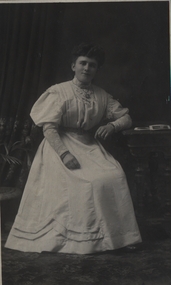
Photograph - Photograph - Black and White, Eden Studio, Horne and Watson Families
... Geelong). Thomas worked on the Victorian Railways and was stationed at Yendon where they acquired a small farmlet named Graceland. Hilda married George Horne in. They lived in a small cottage in Windermere Street, Ballarat. Hilda Horne Hilda Watson Eva Watson Emma Jacka Emma Watson Eden Studio The Yeoman Studios Yeoman & Co .1 Verso: upper Hilda 1910 Horne; Jack in pencil (her brother John Richard Watson) .2 Verso: upper L - The Yeoman Studios ; C- POST CARD; R - postage stamp outline. ...Hilda Horne (b 06/05/1888 in Yendon) was the 10th child of Thomas William Watson and Emma Eliza Jane Phillips (who was one of the first white children born in the Barrabool Hills area (Geelong). Thomas worked on the Victorian Railways and was stationed at Yendon where they acquired a small farmlet named Graceland. Hilda married George Horne in. They lived in a small cottage in Windermere Street, Ballarat.Three black and white photographs of the Horne family .1 Hilda Horne b Watson 06/05/1888 at Yendon, the daughter of Thomas William and Emma Eliza Jane (b Phillips)Watson. .2 Three Watson sisters - Emma Jacka b Watson 30/08/1866 - 03/04/1904, died in childbirth in South Africa (standing); Hilda Horne b Watson 06/05/1888 (seated L); Eva Watson b 4/06/1890 - 08/07/1959 (seated R) married Leo Wise. .3 George Horne aged 6 months, married Hilda Watson..1 Verso: upper Hilda 1910 Horne; Jack in pencil (her brother John Richard Watson) .2 Verso: upper L - The Yeoman Studios ; C- POST CARD; R - postage stamp outline. CORRESPONDENCE / ADRESS ONLY LHS - handwritten "To Jack with love from Eva"; All Watson sisters; RHS Emma Batt( believe incorrect surname) Eva Watson Hilda Horne .3 Verso: Upper L - Eden Studios; C POST CARD; R - postage stamp outline CORRESPONDENCE / ADDRESS ONLY LHS - EDEN STUDIO Sturt Street Ballarat; handwritten in biro -George Horne; in pencil - Georgie 6 months hilda horne, hilda watson, eva watson, emma jacka, emma watson, eden studio, the yeoman studios, yeoman & co -
 Federation University Historical Collection
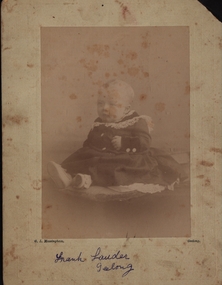
Photograph - Photograph - Sepia, G.L.Massingham, Photographs - Watson Family, 1 1905; .7 c1844
... Geelong Barrabool Reg. G Evans Post Card .1 Black memorial card with gold ink for Henrietta Tierney who was the wife of Daniel Tierney of the Victorian Police. Henrietta died April 28, 1905, aged 25 years. .2 ...This collection of items belonged to Emma Eliza Jane Watson's (bPhillips) son and daughter-in-law, John Richard and Edith Emma Watson (b Yung). Emma married Thomas William Watson at St Paul's Anglican Church , 11/11/1865.They lived in Sebastapol, Ballarat North and lastly at "Gracedale" Yendon - a small farm. They had 10 children and also brought up three grandhildren. .7 Emma Eliza Jane Phillips was born on 25th April 1844 in Barrabool (Geelong), the daughter of Richard and Elizabeth Anne Phillips (b Goodenough). Sometime in the 1850"s after the death of Richard and the breakup of her marriage to Anthony Beck, Elizabeth moves to Ballarat with her children. The eldest boy Richard William Phillips would have been in his late teens. Elizabeth died on 4th August 1858 (aged 42?) before any of her children married. Emma married Thomas Watson in Ballarat. .1 Black memorial card with gold ink for Henrietta Tierney who was the wife of Daniel Tierney of the Victorian Police. Henrietta died April 28, 1905, aged 25 years. .2 Black and white photographic post card of two girls (Florence and Esma) addressed to Mrs Watson from Maurice H. It was sent from Mascoffs, High Street, Rushworth. c 1910-1915. .3 Black and white photograph of two children (Alma and Ida Watson) sent as a 1920 Christmas Greeting to Auntie Edie and Uncle Jack (Watson) from Ted and Jean Watson. Sent from "Kia Ora", Olinda Court, Bendigo. .4 Embossed presentation folder containing a black and white photo of two women and a man who is in an air force uniform. Inscription - "With love to mother from Bill 6th May '42" (possibly Beatty family NSW - connection through Richard Henry Watson's wife Margaret Alison Pike. Richard (Harry) was the son of this collection's owner Edith Emma Watson) .5 Post Card addressed to Jack and Edith .6 Sepia photograph of Ethel, 1890 .7 Sepia photograph of a small child sitting on a cushion . G.L. Massingham. Geelong. Frank Lauder (Hand written in biro) Verso: Gran Emma Eliza Jane Watson b Phillips in Geelong (Barrabool) .8 Two army officers seated on rocks between large cactus plants, possibly overseas in WW1. .9 Black and white photograph of three sisters .10 Black and white photograph of Reverend Stubbings, Mrs Stubbings and their daughter Jackie Stubbings.watson, emma eliza jane phillips, elizabeth anne goodenough, richard phillips, g.l.massingham, geelong, barrabool, reg. g evans, post card -
 Federation University Historical Collection
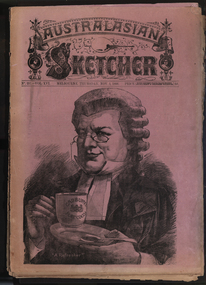
Newspaper, Australasian Sketcher, 30 June 1884 to 01 November 1888, 1883 and 1888
... 2) 01 November 1888 Articles include: Australian animals Images include: Cadbury's cocoa advertisement, A Flemington Picture, Railway Surveying Wangaratta to Mansfield, H.M.S. Nelson Leaving Sydney, New Prince's Bridge, Wilson Hall, Victoria before gold, Fawkner's First Printing Office, Government House Melbourne, Sandridge, Hobson's Bay, Old Supreme Court Melbourne, Melbourne Town Hall, Ballarat in the 50, Geelong in 1840, Ballarat Church of Engand Cathedral, Melbourne Exhibition Building, Flemington Racecourse, the Australian Club, Sir Anthony Musgrave, Fisheries Court at the Centennial Exhibition; Professor Neumayer, Antarctic Exploration, Melbourne Town Hall Organ...2) 01 November 1888 Articles include: Australian animals Images include: Cadbury's cocoa advertisement, A Flemington Picture, Railway Surveying Wangaratta to Mansfield, H.M.S. Nelson Leaving Sydney, New Prince's Bridge, Wilson Hall, Victoria before gold, Fawkner's First Printing Office, Government House Melbourne, Sandridge, Hobson's Bay, Old Supreme Court Melbourne, Melbourne Town Hall, Ballarat in the 50, Geelong in 1840, Ballarat Church of Engand Cathedral, Melbourne Exhibition Building, Flemington Racecourse, the Australian Club, Sir Anthony Musgrave, Fisheries Court at the Centennial Exhibition; Professor Neumayer, Antarctic Exploration, Melbourne Town Hall Organ Australasian Sketcher, 30 June 1884 to 01 November 1888 Newspaper ...Two copies of the Austakasian Sketcher with Pen and Pencil .1) 30 June 1884 Includes articles on Archbishop Moran, Children's Hospital, Sherbourne Sheppard obituary, the Tichborne case Includes images of the Most Reverand P.F. Moran, Catholic Archbishop of Sydney, New Sandridge Dock, Cricketing news from home, sketches from the Children's Hospital, View of Napier New Zealand, F. Mills New Warehouse Launceston, Grace Park .2) 01 November 1888 Articles include: Australian animals Images include: Cadbury's cocoa advertisement, A Flemington Picture, Railway Surveying Wangaratta to Mansfield, H.M.S. Nelson Leaving Sydney, New Prince's Bridge, Wilson Hall, Victoria before gold, Fawkner's First Printing Office, Government House Melbourne, Sandridge, Hobson's Bay, Old Supreme Court Melbourne, Melbourne Town Hall, Ballarat in the 50, Geelong in 1840, Ballarat Church of Engand Cathedral, Melbourne Exhibition Building, Flemington Racecourse, the Australian Club, Sir Anthony Musgrave, Fisheries Court at the Centennial Exhibition; Professor Neumayer, Antarctic Exploration, Melbourne Town Hall Organmelbourne international exhibition -
 Flagstaff Hill Maritime Museum and Village
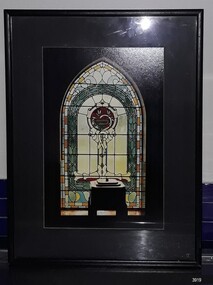
Card - Commemorative, Julian Aird, 'Illumination', Early 21st Century
... Written by hand in black pen " 'ILLUMINATION' / MARITIME MUSEUM WARRNAMBOOL", "JULIAN AIRD / TEL/FAX. 03 52890457" " Printed on adhesive label "EASTERN VIEW / PICTURE FRAMERS" "Proprietors Steven & Annemarie Hocking / 162 Malop Street, Geelong, Vic, 3220 / Ph. (03) 5229 5935" Logo on label in centre of oval with text [2 tall water birds facing each other with a water fountain between them]...Connell stained glass window baptism font gbert John Connell St Nicholas Seamen's Church warrnambool hospital Dr Connell Memorial Window Eastern View Picture Framers Steven & Annemarie Hocking Written by hand in black pen " 'ILLUMINATION' / MARITIME MUSEUM WARRNAMBOOL", "JULIAN AIRD / TEL/FAX. 03 52890457" " Printed on adhesive label "EASTERN VIEW / PICTURE FRAMERS" "Proprietors Steven & Annemarie Hocking / 162 Malop Street, Geelong, Vic, 3220 / Ph. (03) 5229 5935" Logo on label in centre of oval with text [2 tall water birds facing each other with a water fountain between them] This photograph captures the light shining through an arched, stained glass window behind a baptismal font. ...The photograph was created by Geelong artist Julian Aird and framed by a business in Geelong. The window in the photograph is of the 1928 stained glass window and the baptism fold in the St Nicholas' Seamen's Chapel at Flagstaff Hill Maritime Village, which were installed at Flagstaff Hill's for the Chapel's opening in 1981. About the Window - The window in this photograph, once known as the Dr Connell Memorial Window, was a feature of an external wall adjacent to the Women’s and Children’s Wards of Warrnambool Hospital. Honorary Doctors had played a significant role in the operation of the hospital between the years 1900 to 1939. One of these doctors was Dr. Connell, who passed away in 1928. The green glass memorial nameplate has an inscription that dedicates the window to Dr. Connell. The inscription reads: "A tribute to Egbert John Connell M.B.B.S. who for 30 years rendered devoted and valuable service to this institution. Obiit April 4th 1928, A.D." The photograph's significance lies in the subject of the stained glass window, and its connection with the history of the local Warrnambool Base Hospital, dating to Dr Connell's work there in the early 20th century.This photograph captures the light shining through an arched, stained glass window behind a baptismal font. Rectangular framed photograph, portrait view, behind glass, with black frame and matt. A cord for hanging it is attached at the black, and there is a black, round felt pad on each lower rear corner. The photograph by Julian Aird is titled 'Illumination' and was framed in Geelong. Details of title, and photographer are handwritten on the back and and printed label gives the contact details of the framer. Written by hand in black pen " 'ILLUMINATION' / MARITIME MUSEUM WARRNAMBOOL", "JULIAN AIRD / TEL/FAX. 03 52890457" " Printed on adhesive label "EASTERN VIEW / PICTURE FRAMERS" "Proprietors Steven & Annemarie Hocking / 162 Malop Street, Geelong, Vic, 3220 / Ph. (03) 5229 5935" Logo on label in centre of oval with text [2 tall water birds facing each other with a water fountain between them]flagstaff hill maritime museum & village, maritime museum, maritime village, great ocean road, shipwreck coast, ulian aird, illumination, photograph, dr. connell, stained glass window, baptism font, gbert john connell, st nicholas seamen's church, warrnambool hospital, dr connell memorial window, eastern view picture framers, steven & annemarie hocking -
 Flagstaff Hill Maritime Museum and Village
Vehicle - Tip Dray, Prior to 1930s
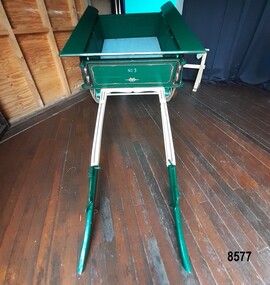
... Geelong Tip Dray Carters) which was a success and a schedule of rates for all carting, whether by contract or day labor, was fixed. By 1912 they had "labelled" more than 50 drays and had representatives on the "Trades Hall and Eight Hours Committee". By the mid 1930's and early 1940's, tip drays were being superseded by mechanical trucks and utes. However tip drays continued to be used in some circumstances. They were a practical solution to the problem of petrol rationing during W. W. 2...Geelong Tip Dray Carters) which was a success and a schedule of rates for all carting, whether by contract or day labor, was fixed. By 1912 they had "labelled" more than 50 drays and had representatives on the "Trades Hall and Eight Hours Committee". By the mid 1930's and early 1940's, tip drays were being superseded by mechanical trucks and utes. However tip drays continued to be used in some circumstances. They were a practical solution to the problem of petrol rationing during W. W. 2 ...A Dray is a type of dead axle wagon that was used to transport heavy loads or objects. They had a flat level floor and while some had no sides, others had box bodies and sides. Tip Drays (also known as Tip Carts, Muck Cart, Scotch Cart, Tumbrel or Putt in different parts of England) were smaller than other drays as their loads were heavy and usually only pulled by one horse. Their basic design included two wheels, a tipping body and shafts. The Tip Dray has a unique mechanism that allows the top to tip backwards to tip the load out of the back of the dray. The tipper was activated by a handle at the front allowing the driver to operate it while still having control over the horse. A Tip Dray was an indispensable piece of equipment in the days before tractors and mechanical trucks. They were used by farmers and carters to transport hay, rocks, bricks, gravel and rubbish etc. and because they were useful for dumping loads, they were favoured for use in road and railway construction. A photo in the collection of the Lorne Historical Society shows a tipping dray being used during the construction of the Great Ocean Road. They were part of the daily street traffic in towns and cities around Australia from the early days of settlement. In Australia in the early 1900's, carters began to join unions to protect their jobs and pay. N.S.W. had a "Trolley, Draymen and Carters Union", Queensland had a "Tip Dray Men's Association" and in W. A. the "Top Dray Driver's Union" had a "cessation of work" in 1911 when they were fighting for an increase in their day's wages. In 1910 a meeting of Tip Carters was held in Geelong at the Trades Hall to discuss the formation of a union (The Geelong Tip Dray Carters) which was a success and a schedule of rates for all carting, whether by contract or day labor, was fixed. By 1912 they had "labelled" more than 50 drays and had representatives on the "Trades Hall and Eight Hours Committee". By the mid 1930's and early 1940's, tip drays were being superseded by mechanical trucks and utes. However tip drays continued to be used in some circumstances. They were a practical solution to the problem of petrol rationing during W. W. 2. It was noted in a letter to the editor in the "Sunshine Advocate" in 1938 that a positive argument for continued use of Tip Drays for rubbish collection related to the idea that a horse drawn vehicle involved with lots of stops and starts at different houses (very like a milkman's delivery route) often involved the horse "driving itself" while the driver picked up the rubbish - something a motor truck was unable to do! Another article written in August 1935 and published in the Age in a parliamentary report into the rubber industry noted "tip drays had almost disappeared and in their place, metal was carted in 5 ton motor trucks" but the report went on to say that as a part of the Government relief work (during the Great Depression) the Government had "to some extent reintroduced the tip drays so that a greater number of men would be employed". This particular tip dray was owned by Mr. Oswald (Jack) Bourke. He used it to deliver dry goods from Sunbury to the Queen Victoria Market in Melbourne several times a week in the 1930's and then (between 1945 and 1962) Mr. Bourke used it on the garbage round in Springvale Victoria for the Springvale Council. The Council owned three drays and the "No. 3" painted on this dray is in recognition of its original number. After the death of Mr. Bourke in 1990, one of Mr. Bourke's sons (Andy) found the dray in a shed and restored it. The sign writing on the back and side panels were added during the restoration. This Tipping Dray is a significant example of a horse drawn vehicle that was used by workers from the early days of white settlement through to the 1940's and even into the early 1960's. It was used in a range of "working class" occupations - road construction, railway construction, carting goods, rubbish collection etc. and would have been found in cities, country towns and on farms.A wooden and metal tipping dray with a box body and four sides. It has two iron and wooden wheels (with 14 spokes), two wooden shafts and a metal tipping mechanism. The back panel folds down to allow loads to be dumped out. It is painted in green and cream with sign writing on one of the sides and on the front and back panels. It features decorative painted lines and designs in burgundy, cream and light blue on most of the wooden parts. The tipping mechanism is on the front of the dray's left side and consists of a metal pin secured with a metal ring, and a lever.Front of dray - "No. 3" Side of dray - "A. & M. BOURKE / Contractors / LONGWARRY" Back of dray - "G.T. ANDREWS / QUEEN VICTORIA MARKET - Stand C23 / Phone DANDENONG 225"flagstaff hill maritime museum and village, warrnambool, shipwreck coast, tipping dray, dray, tip dray, tip cart, vehicles, horse drawn vehicle, springvale council, jack bourke, muck cart, scotch cart, tumbrel, putt, box body, oswald bourke, sunbury, queen victoria market, melbourne, no. 3 -
 Flagstaff Hill Maritime Museum and Village
Photograph - Photograph of S. S. Eumeralla launch, 1908
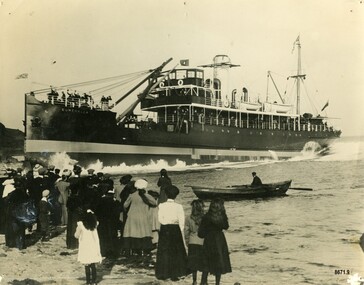
... Geelong...Melbourne...Mel Lee No. 2...Geelong. In 1925 it nearly sank in the Yarra (at Queens Wharf) when it developed a list and water entered the engine room. Firemen from the Eastern Hill Station, crew and wharf workers were able to stop it from sinking. Between 1928 and 1935 the Eumeralla was laid up in Hobson's Bay before being sold to a Chinese firm to be used on the short coastal run between Shanghai and Wen Chow. It was renamed "Mel Lee (Mow Lee) Number 2...Eumeralla Eumerella Steamer Eumeralla John McIlwraith and Company Belfast and Koroit Steam Navigation Company Howard Smith Ltd Portarlington Geelong Melbourne Mel Lee No. 2 Mow Lee No. 2 Tanghai steamship steamer Fred Trewartha Frederick John Fox Trewartha Name of donor, address and telephone number "S. ...This photograph was one of ten photographs donated to Flagstaff Hill Maritime Museum and Village by Fred Trewartha. Frederick John Fox Trewartha (Fred) was a well-known Warrnambool businessman. He was born in Beeac near Geelong in 1920 and came to Warrnambool with his family as a very young child. He was apprenticed to his father John, as a saddler and later opened his own shop on Raglan Parade. He then moved into working with tarpaulins and canvases for the trucking industry. Fred was keenly interested in photography (and was a member of the Warrnambool Cine Club), yachting and boat building. He kept his yacht moored at Port Fairy for many years and participated in sailing events locally and interstate. He also built boats with his sons. He had the opportunity to meet many older sailors and it's thought this photo (and others in the set) may have been given to him by one of these men. Fred Trewartha died in 2016 in Warrnambool. The Eumeralla (sometimes spelt Eumerella) was built in 1908 in Scotland by Messrs. Scott of Kinghorn on the Firth of Forth. It was a steel screw steamer and had been designed to meet the growing demand for a thoroughly up to date passenger and cargo steamer for the Melbourne to Portland service for John McIlwraith and Company in partnership with the Belfast, Koroit Steam Navigation Company and Howard Smith Company Ltd. This photograph appeared in the Leader (Melbourne) on Saturday 28th November 1908 with the headline "Launching the Eumeralla" and shows the ship being launched on October 10th, 1908, in Scotland. It was described as "Length, 190 feet; breadth, 30 feet; depth 15 feet". It went on to say it had a speed guaranteed at 11 knots and was expected in Melbourne by the following January. It could accommodate sixty saloon passengers and thirty in steerage and had electric light fitted throughout. While on the Melbourne to Portland service the Eumeralla had several mishaps. In 1909 it crashed into the breakwater at Portarlington, splintering the woodwork and leaving a gap of about 12 feet. On Saturday 9th August 1913, as it was leaving Warrnambool, it encountered heavy seas and a passenger (Frederick Mahoney) sustained fatal injuries after hitting his head on the bulwark - and the second mate was found dead after the water poured off the deck. Several other passengers were also injured. Between 1912 and 1913 it was used to carry passengers between Brisbane, Maryborough and Rockhampton before being sent back to Melbourne for an overhaul. In 1915 it was selected for the Winter service to run daily trips between Melbourne and Geelong. In 1925 it nearly sank in the Yarra (at Queens Wharf) when it developed a list and water entered the engine room. Firemen from the Eastern Hill Station, crew and wharf workers were able to stop it from sinking. Between 1928 and 1935 the Eumeralla was laid up in Hobson's Bay before being sold to a Chinese firm to be used on the short coastal run between Shanghai and Wen Chow. It was renamed "Mel Lee (Mow Lee) Number 2". It arrived on July 12th, 1935, at Tanghai (a small Chinese port to the south of Shanghai) with 400 local passengers. The population of the town turned out to welcome the new ship with a fireworks display which caused the passengers to rush across to the side of the ship nearest the scene. The steamer immediately listed to one side and sank.This photograph is significant because of its association with the coastal trader S.S. Eumeralla and its important contribution to trade along Victoria's West Coast in the early 20th century.Black and white photograph showing a crowd of people standing on a shore watching a steamer (the Eumeralla) being launched. The crew of the steamer are standing in the bow, waving at the crowd. A single oarsman is in a small rowboat nearby. On the back of the photograph, the name, address and telephone number of the donor is written in black, ballpoint pen. More writing, in cursive script (in blue ink) gives a brief description of the ship and the events depicted in the photograph.Name of donor, address and telephone number "S. S. Eumeralla / Built in Scotland / being launched/ in Scotland/ 1904"warrnambool, flagstaff hill maritime museum and village, great ocean road, portland, port fairy, eumeralla, s. s. eumeralla, eumerella, steamer eumeralla, john mcilwraith and company, belfast and koroit steam navigation company, howard smith ltd, portarlington, geelong, melbourne, mel lee no. 2, mow lee no. 2, tanghai, steamship, steamer, fred trewartha, frederick john fox trewartha -
 City of Moorabbin Historical Society (Operating the Box Cottage Museum)
Functional object - Kitchen Equipment, Coolgardie Safe, c1900
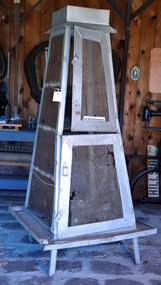
... (MAV website) The early settlers of Moorabbin Shire depended on this type of Food Safe to protect their food from flies and vermin as they established market gardens in the fertile area around the notorious Elster Creek elster creek moorabbin brighton dendy's special survey 1841 market gardens infant mortality disease cemeteries fruit vegetables pioneers coolgardie safe mccormick arthur patrick dendy henry vaccination jones martha jones ethel may '...IN.....GEELONG' A manufacturer's oval metal plate is embossed on one side of Safe but it is illegible. A metal framed, 4 sided structure standing on 4 legs with 2 hinged doors on one side, a metal tray at base of food safe and a metal cover over top. ...The invention of the Coolgardie Safe is credited to Arthur Patrick McCormick, a contractor in Coolgardie, and later the Mayor of Narrogin. Coolgardie is in the Eastern Goldfields region of Western Australia. Gold was first discovered there in 1892; the townsite became a municipality in 1894, and by 1898 its population of 15,000 made it the third largest town in Western Australia after Perth and Fremantle. In the last decade of the 19th century, Coolgardie was the capital of the West Australian goldfields. Being 180 kilometres from the nearest civilisation, food supplies were initially scarce and expensive. As fresh food was a valuable commodity there was incentive to preserve it, and keep it out of reach of scavengers such as birds, dingos, dogs, ants, and flies. It was in an effort to do this, in the extreme heat of the Australian Interior, that McCormick came up with his design for the Coolgardie Safe. McCormick noticed that a wet bag placed over a bottle cooled its contents. He further noted that if this bottle was placed in a breeze, the bag would dry out more quickly, but the bottle would get colder. What McCormick had discovered was the principle of evaporation: ‘to change any liquid into a gaseous state requires energy. This energy is taken in the form of heat from its surroundings.’ Employing this principle, McCormick made a box for his provisions which he covered with a wet hessian bag. He then placed a tray on top, into which he poured water twice daily. He hung strips of flannel from the tray so that water would drip down onto the hessian bag, keeping it damp. As the water evaporated, the heat dissipated, keeping the food stored inside cool and fresh. The success of McCormick’s invention would not have worked without a steady supply of water. Fresh water was scarce in the eastern goldfields at this time but the demand for water from a steadily growing population encouraged innovation. The solution was to condense salt water. Heating salt water in tanks produced steam that was condensed in tall cylinders, cooled and then collected in catchment trays. By 1898 there were six companies supplying condensed water to the goldfields, the largest company producing 100,000 gallons of water a day. In the early 20th century, Coolgardie Safes were also manufactured commercially. These safes incorporated shelving and a door, had metal or wooden frames and hessian bodies. The feet of the safe were usually placed in a tray of water to keep ants away. (MAV website) The early settlers of Moorabbin Shire depended on this type of Food Safe to protect their food from flies and vermin as they established market gardens in the fertile area around the notorious Elster Creek A metal framed, 4 sided structure standing on 4 legs with 2 hinged doors on one side, a metal tray at base of food safe and a metal cover over top. Ridges on which to rest trays carrying food are inside safe. The Safe is enclosed by fly-wire mesh.'...IN.....GEELONG' A manufacturer's oval metal plate is embossed on one side of Safe but it is illegible.elster creek, moorabbin, brighton, dendy's special survey 1841, market gardens, infant mortality, disease, cemeteries, fruit, vegetables, pioneers, coolgardie safe, mccormick arthur patrick, dendy henry, vaccination, jones martha, jones ethel may -
 Greensborough Historical Society
Document, Montmorenci farm fire 1868, 14/12/1868
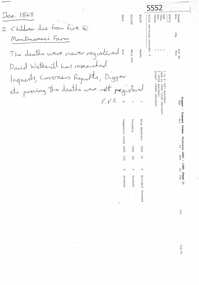
... Geelong Advertiser newspaper articles via Trove. The deaths were reputed to be the first in the area. No registrations were found in the investigation. montmorency 7 p. Digger Pioneer & Inquest index results, with 2 ...Research materials used by David Wetherill to investigate whether the deaths of two children by fire in the Montmorency area in December 1868 were registered. Comprises searches of Pioneer Index, Inquest Index, and copies of Age, Kyneton Observer and Geelong Advertiser newspaper articles via Trove. The deaths were reputed to be the first in the area. No registrations were found in the investigation.7 p. Digger Pioneer & Inquest index results, with 2 p. of copies of newspaper articles published in circa 14 December 1868montmorency -
 Greensborough Historical Society
Movie Film, Alan Partington home movies, 1960s
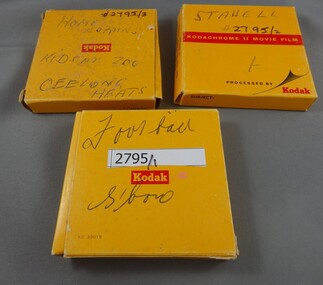
... Alan Partington's hoe movies: Reel 1: Football Greensborough; Reel 2: Stawell Gift; Reel 3: Homecoming; Kids at Zoo; Geelong Heats...Alan Partington's hoe movies: Reel 1: Football Greensborough; Reel 2: Stawell Gift; Reel 3: Homecoming; Kids at Zoo; Geelong Heats greensborough football club stawell gift geelong heats alan partington Three 8mm movie films in yellow card boxes. ...Alan Partington's hoe movies: Reel 1: Football Greensborough; Reel 2: Stawell Gift; Reel 3: Homecoming; Kids at Zoo; Geelong HeatsThree 8mm movie films in yellow card boxes.greensborough football club, stawell gift, geelong heats, alan partington -
 Geelong RSL Sub Branch
Badge - 500 Ewart W Davis, Early 20th Century
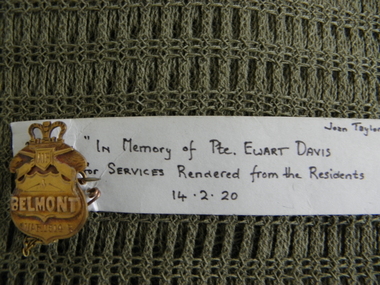
... This badge is the original that was presented to 500 Pte E W Davis family on 14 February 1920 - 500 Pte E W Davis lived in Geelong and enlisted in the AIF on 06 March 1915 and was Killed in Action at Gallipoli Peninsula on 17 October 1915. aif, 500 pte e w davis, kia, gallipoli, ww1, belmont On the front of the badge - AIF, in large print BELMONT, War 1914-5. On the back of the badge - "In memory of Pte Ewart Davis for services rendered from the Residents, 14-2 ...500 Pte Ewart W Davis enlisted in the AIF on 06 March 1915 and was posted to 22 Battalion, Pte Davis was Killed in Action on the Gallipoli Peninsula 17 October 1915. This badge was presented to Pte Davis' family by the Residents of Belmont on 14 February 1920.This badge is the original that was presented to 500 Pte E W Davis family on 14 February 1920 - 500 Pte E W Davis lived in Geelong and enlisted in the AIF on 06 March 1915 and was Killed in Action at Gallipoli Peninsula on 17 October 1915.Gold colour, metal Badge. The badge has crossed rifles on the top front and a crown on the top of the badge.On the front of the badge - AIF, in large print BELMONT, War 1914-5. On the back of the badge - "In memory of Pte Ewart Davis for services rendered from the Residents, 14-2-20.aif, 500 pte e w davis, kia, gallipoli, ww1, belmont -
 Geelong RSL Sub Branch
Photograph - VX139182 S B Freeman, ?mid 20th century
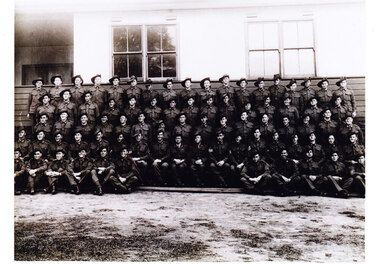
... This is a photograph of a Geelong man VX 139182 S B Freeman who served during WW2 in tge 2nd Aust Medium Regement. VX139182 S B Freeman 2nd Aust Medium Regement Hand writen on the back of the photograph frame - Sydney Barrett Freeman, 2 Aust Medium Regiment, VX 139182. 8th from left, 3rd row down. ...VX139182 S B Freeman served with the 2nd Aust Medium Regiment during WW2 and he is featured in this photograph. VX139182 was born in Geelong but enlisted in Karrakatta WA.This is a photograph of a Geelong man VX 139182 S B Freeman who served during WW2 in tge 2nd Aust Medium Regement.An oblong, black and white photograph on photograph paper.Hand writen on the back of the photograph frame - Sydney Barrett Freeman, 2 Aust Medium Regiment, VX 139182. 8th from left, 3rd row down.vx139182 s b freeman, 2nd aust medium regement -
 Ballarat Fire Brigade
Photograph, C. 1904
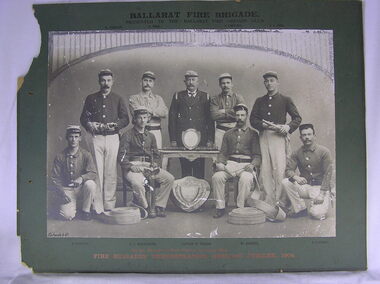
... Geelong Jubilee, 1904. Pictured are the eight man team and the brigade Captain with various hoses, hydrants, branches and the trophys for the event (2 shield & 8 individual trophys). ...Geelong Jubilee, 1904. Pictured are the eight man team and the brigade Captain with various hoses, hydrants, branches and the trophys for the event (2 shield & 8 individual trophys). ...B&W photographof the winning team from Ballarat brigade for the "hose practice for 8 men" event which was held as part of the fire brigades demonstration, Geelong Jubilee, 1904. Pictured are the eight man team and the brigade Captain with various hoses, hydrants, branches and the trophys for the event (2 shield & 8 individual trophys). Photo is mounted on olive coloured card.BALLARAT FIRE BRIGADE / PRESENTED TO THE BALLARAT FIRE BRIGADES CLUB / R.CORNISH, G.FORD, J.CROUGEY, J.C.HEIL / A.DUNSTAN, O.C.REIGELHUTH, CAPTAIN W.TRAHAR, W.ROBERTS, G.VAWDREY / By the Winners of Hose Practice for Eight Men / FIRE BRIGADES DEMONSTRATION, GEELONG JUBILEE, 1904 -
 Ballarat Fire Brigade
Trophy
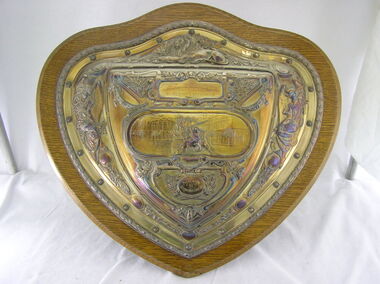
... Geelong Fire Brigade Jubilee in 1904. Trophy was donated by Merrywetather & sons Lim. Trophy has a Lion at the top centre, angels on both the left and right sides. In the centre is a horse drawn fire appliance (assumed a Merryweather steam pumper) drawn by 2 horses through what appears to be a town square. ...Geelong Fire Brigade Jubilee in 1904. Trophy was donated by Merrywetather & sons Lim. Trophy has a Lion at the top centre, angels on both the left and right sides. In the centre is a horse drawn fire appliance (assumed a Merryweather steam pumper) drawn by 2 horses through what appears to be a town square. ...Trophy was won at the Geelong Fire Brigade Jubilee in 1904. This would have been a demonstartion to celebrate the 50th Anniversary of the Geelong brigade which formed in 1854Silver shield mounted on a wooden backing board. Trophy was won by Ballarat Fire Brigade at the Geelong Fire Brigade Jubilee in 1904. Trophy was donated by Merrywetather & sons Lim. Trophy has a Lion at the top centre, angels on both the left and right sides. In the centre is a horse drawn fire appliance (assumed a Merryweather steam pumper) drawn by 2 horses through what appears to be a town square. There are 3 fireman standing on the front of the appliance and 1 on the rear. There are various other branches, leaves etc. that make up the remainder of the decorations on the sheild. Item is very similar to item 020.1904 / GEELONG FIRE BRIGADE JUBILEE / COMPETITION / PRESENTED / BY / Merryweather & Sons Lim1904, geelong fire brigade, geelong fire brigade jubilee, merrywether and sons lim, elkington and co -
 Ballarat Fire Brigade
Trophy
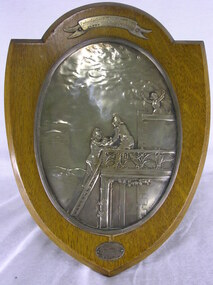
... 2 firemen, 1 standing on a ladder the other on a balcony saving a baby from a building fire. On the upper level of the burning building is a woman waiting to be saved. The centre part of the shield is oval in shape 170 mm W x 230 mm H. there is a ribbon (silver) at the top of the shield & a small oval disc at the base. Shield was won by Ballarat Fire Bigade at the 1904 Geelong...Was one of a number of trophys won by the brigade at the jubilee competition which would have been held to celebrate Geelong Brigades 50th anniversary in 1904 ballarat fire brigade 1904 geelong fire brigade jubilee competition geelong fire brigade Geelong Fire Brigade Jubilee Competition / 1904 / Won by / Ballarat / Brigade Silver platedd shield mounted on wooden board. Shield depicts 2 ...Was one of a number of trophys won by the brigade at the jubilee competition which would have been held to celebrate Geelong Brigades 50th anniversary in 1904Silver platedd shield mounted on wooden board. Shield depicts 2 firemen, 1 standing on a ladder the other on a balcony saving a baby from a building fire. On the upper level of the burning building is a woman waiting to be saved. The centre part of the shield is oval in shape 170 mm W x 230 mm H. there is a ribbon (silver) at the top of the shield & a small oval disc at the base. Shield was won by Ballarat Fire Bigade at the 1904 Geelong Fire Brigade Jubilee competition. Shield is seen on the table in item #017Geelong Fire Brigade Jubilee Competition / 1904 / Won by / Ballarat / Brigadeballarat fire brigade, 1904, geelong fire brigade jubilee competition, geelong fire brigade -
 Ballarat Fire Brigade
Trophy
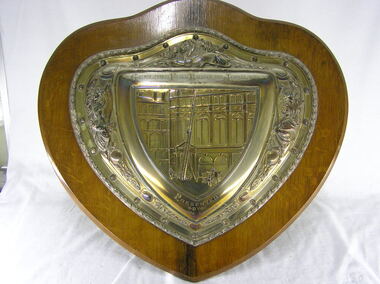
... Geelong Fire Brigade Jubilee in 1904. Trophy was donated by Llyods of London and presented by E. Steane Price esq. Trophy has a Lion at the top centre, angels on both the left and right sides. In the centre there is a depection of 2...Geelong Fire Brigade Jubilee in 1904. Trophy was donated by Llyods of London and presented by E. Steane Price esq. Trophy has a Lion at the top centre, angels on both the left and right sides. In the centre there is a depection of 2 ...Trophy was won at the Geelong Fire Brigade Jubilee in 1904. This would have been a demonstartion to celebrate the 50th Anniversary of the Geelong brigade which formed in 1854 Silver shield mounted on a wooden backing board. Trophy was won by Ballarat Fire Brigade at the Geelong Fire Brigade Jubilee in 1904. Trophy was donated by Llyods of London and presented by E. Steane Price esq. Trophy has a Lion at the top centre, angels on both the left and right sides. In the centre there is a depection of 2 large multi storey buildings. The building in the front of the picture has a carraige ladder raised up against it with 2 firemen climbing the ladder. There are 2 additional firemen either side of the ladder and an additional fireman in front of standing in front of with another standing on top of what appears to be either a mannual pump or possibly the ladders appliance. There are various other branches, leaves etc. that make up the remainder of the decorations on the sheild. Item is very similar to item 018GEELONG FIRE BRIGADES JUBILEE / 1904 / PRESENTED / BY / E.STEANE PRICE Esq. LLYODS LONDON1904, geelong fire brigade, geelong fire brigade jubilee, elkington and co, e steane price esq, llyods london -
 Orbost & District Historical Society
ticket, 1975
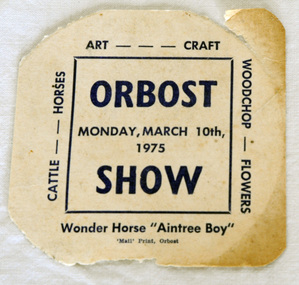
... Geelong orphanage before being put to work at a dairy farm. Doc was given an elderly piebald mare to ride, which ignited his passion for horses. When he was 16, he enlisted in World War 2...Geelong orphanage before being put to work at a dairy farm. Doc was given an elderly piebald mare to ride, which ignited his passion for horses. When he was 16, he enlisted in World War 2 ...Owen 'Doc' Matthews is remembered for his spectacular Grand Prix dressage exhibitions with his horse Aintree Boy, performed to music under spotlights at Melbourne Royal Show from 1965-1975. He also performed at smaller country shows. Doc Matthews was born in the Melbourne suburb of Fitzroy in 1923, during the Great Depression. He and his brother Paddy were placed in a foster home and then in a Geelong orphanage before being put to work at a dairy farm. Doc was given an elderly piebald mare to ride, which ignited his passion for horses. When he was 16, he enlisted in World War 2 but captured by the Japanese and ended up working on the Burma Railway, spending years as a prisoner of war in the notorious Changi Prison. Doc joined Victoria Police in 1952 and by 1962 was chief horse master and riding instructor in the mounted branch. He drilled teams to perform musical rides and horses and riders were always turned out to perfection. Doc and Aintree Boy became a partnership after the horse had been used in the mounted branch for four years. Doc decided to try his hand at dressage and as there were few instructors, trained Aintree Boy with nothing to go by but a couple of books and film of a single dressage competition. Owen 'Doc' Matthews was truly a pioneer of Grand Prix dressage in Australia. ( ref. TOPHORSE )Agricultural shows are an important part of cultural life in small country towns and the Orbost Show is an integral part of Orbost 's agricultural history.A square shaped ticket for Orbost Show - Monday, March 10th 1975. It is on white card with blue print.Orbost Wonder Horse "Aintree Boy". Monday, March 10th 1975aintree-boy dressage equestrian matthews-owen -
 Ringwood and District Historical Society
Train Tickets, Victorian Railways, Ringwood and East Ringwood train tickets circa 1950s
... Blue Ringwood to Blackburn; 2. Ringwood to Geelong - half blue/half brown; 3. Ringwood East to Williamstown Pier- 2 tickets buff colour; 4. ...Blue Ringwood to Blackburn; 2. Ringwood to Geelong - half blue/half brown; 3. Ringwood East to Williamstown Pier- 2 tickets buff colour; 4. ...Train tickets used from Ringwood to various locations and a pram storage ticket. See also 3334.Five train tickets:; 1. Blue Ringwood to Blackburn; 2. Ringwood to Geelong - half blue/half brown; 3. Ringwood East to Williamstown Pier- 2 tickets buff colour; 4. Storage ticket for a pram - buff with green central strip -
 Ringwood and District Historical Society
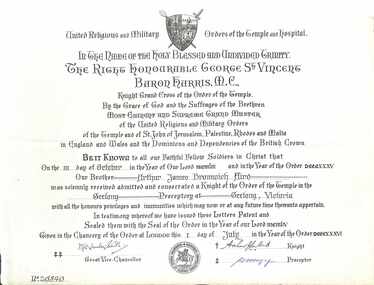
Certificate, United Religious and Military Orders of the Temple and Hospital Membership - Collection of Masonic Degrees and Correspondence maintained by Aird family of Ringwood, Victoria
... Two certificates - Arthur James Bromwich Aird (1) solemly received admitted and consecrated as a Knight of the Order of the Temple in Geelong Preceptory at Geelong, Victoria, on 1st July, 1936, and (2) solemly admitted as a Knight of St.John of Jerusalem, Palestine, Rhodes and Malta in the Geelong Priory, Geelong, Victoria, on 18th April, 1938....Two certificates - Arthur James Bromwich Aird (1) solemly received admitted and consecrated as a Knight of the Order of the Temple in Geelong Preceptory at Geelong, Victoria, on 1st July, 1936, and (2) solemly admitted as a Knight of St.John of Jerusalem, Palestine, Rhodes and Malta in the Geelong Priory, Geelong, Victoria, on 18th April, 1938. ...Two certificates - Arthur James Bromwich Aird (1) solemly received admitted and consecrated as a Knight of the Order of the Temple in Geelong Preceptory at Geelong, Victoria, on 1st July, 1936, and (2) solemly admitted as a Knight of St.John of Jerusalem, Palestine, Rhodes and Malta in the Geelong Priory, Geelong, Victoria, on 18th April, 1938. -
 Mission to Seafarers Victoria
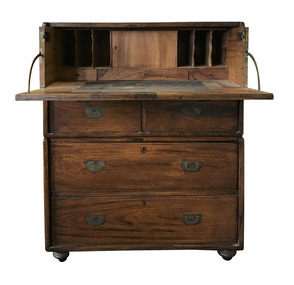
Furniture - Desk, ship, 1800-1880
... This type of secretary would have been used by Volum to write in the ship log. volum collection captain ship seafaring campaign furniture james volum (1803-1884) brewery paper mill geelong peterhead scotland fyansford teak On top of the bottom set of drawers: initials "J.V" and "# 3" 2 sets of drawers setting one on top of each other. ...Because of the initials JV on the bottom part this portable desk possibly belonged to James Volum (1803-1884) The volum family originally from Peterhead, Scotland, had a long seafaring history. Several members of the family were mates, ship captains in the whaling industry and the merchant navy. James Volum settled in Geelong with his brothers, Andrew Volum and William Volum. He purchased brewery there (Volum Brewery) and the Barwon paper mill at Fyansford.This set is a rare example of campaign furniture, a type of portable furniture an officer or ship captain would take with him to bring his personal belongings. This type of secretary would have been used by Volum to write in the ship log.2 sets of drawers setting one on top of each other. The top part is fitted with a secretary drawer.On top of the bottom set of drawers: initials "J.V" and "# 3"volum collection, captain, ship, seafaring, campaign furniture, james volum (1803-1884), brewery, paper mill, geelong, peterhead, scotland, fyansford, teak -
 Mission to Seafarers Victoria
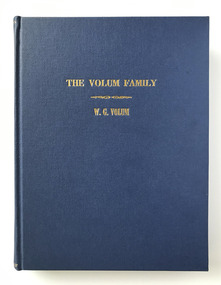
Book - Family history, William Gordon Volum, The Volum Family, 1992
... Geelong Australia, Ceylon, England and Peru. It has fourteen appendices on a variety of topics plus forty-one illustrations. Navy blue cover with gilded title. viii, 216 p., [30] p. of plates : ill., 2 maps, ports. ...An account of the Volum family, largely Peterhead in Scotland, where they were involved with whaling, but also in Geelong Australia, Ceylon, England and Peru. It has fourteen appendices on a variety of topics plus forty-one illustrations.Navy blue cover with gilded title. viii, 216 p., [30] p. of plates : ill., 2 maps, ports. Bibliography: p. 208-210.non-fictionAn account of the Volum family, largely Peterhead in Scotland, where they were involved with whaling, but also in Geelong Australia, Ceylon, England and Peru. It has fourteen appendices on a variety of topics plus forty-one illustrations.volum collection, geelong, peterhead, scotland, captain, seafaring, whaling, brewery, paper mill, mission to seafarers -
 Montmorency–Eltham RSL Sub Branch
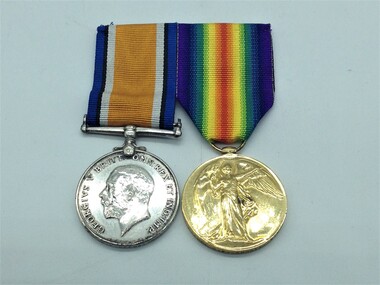
Medal - Medal Group, WW1, 2166 Lieutenant Reginald Frank Barratt
... Geelong on 19th September 1914. Rank Lieutenant - Unit 1st Divisional Ammunition Column. Information from the Roll of Honour - Awarded Royal Human Society Medal for saving three lives from drowning in Orange River during South African War. Wounded at Zillebeke, near Ypres, Belgium. Died of wounds 22nd August 1917 at the age of 38. Buried at Bedford House Cemetery, Enclosure No 2...Geelong on 19th September 1914. Rank Lieutenant - Unit 1st Divisional Ammunition Column. Information from the Roll of Honour - Awarded Royal Human Society Medal for saving three lives from drowning in Orange River during South African War. Wounded at Zillebeke, near Ypres, Belgium. Died of wounds 22nd August 1917 at the age of 38. Buried at Bedford House Cemetery, Enclosure No 2 ...Information from "The AIF Project" Lieutenant Reginald Frank Barratt was born in 1879 in Withington, Manchester, Lancashire, England. Regimental number 2166. 3rd Field Artillery Brigade, Military District 3 and Military District 6. Arrived in Australia in 1903 aged 24. Address was Mount Street, Heidelberg, Victoria. Occupation - Farmer. Enlistment date was 17th August 1914. Served with the 68 Battery Royal Field Artillery during the South African War. Rank on enlistment was Sergeant. Embarkation details - Unit embarked from Melbourne, Victoria on board Transport A2 Geelong on 19th September 1914. Rank Lieutenant - Unit 1st Divisional Ammunition Column. Information from the Roll of Honour - Awarded Royal Human Society Medal for saving three lives from drowning in Orange River during South African War. Wounded at Zillebeke, near Ypres, Belgium. Died of wounds 22nd August 1917 at the age of 38. Buried at Bedford House Cemetery, Enclosure No 2, (Plot 1, R0w F, Grave 23), Zillebeke, Belgium. Panel number , Roll of Honour Australian War Memorial British War Medal - The medal was struck by the Royal Mint, is a silver disc 36mm in diameter with a straight clasp suspended without swivel. The obverse shows Sir Bertram Mackennal's bare headed effigy of King George V facing left with the legend 'GEORGIVS V BRITT:OMN:REX ET IND:IMD - "George V, King of all the British Isles & Emperor of India". The reverse, designed by William McMillan, shows St George, naked on horseback and armed with a short sword, an allegory of the physical & mental strength which achieved victory of Prussianism. The horse tramples on the Prussian eagle shield and the emblems of death, a skull and cross bones. In the background are ocean waves and just off centre near the right upper time is the risen sun of victory. The years 1914-1918 appear on the perimeter in the left and right fields respectively. The watered silk ribbon is 32mm wide with 3mm wide royal blue band, 2mm wide black band, 3mm wide white band repeated in reverse order and separated by 16mm wide orange band. Victory Medal - The medal is bronze disc 36mm in diameter with a winged figure of Victory on the obverse. The reverse has the words 'THE GREAT WAR FOR CIVILIZATION 1914-1918', all surrounded by a laurel leaf. The watered silk ribbon is 32mm wided has two rainbow design with the violet from each rainbow on the outside edges, moving through to a central red stripe where both rainbows meet.The recipients name, rank and unit are impressed on the bottom edge of the medals - Lieut F Barratt AIF -
 Red Cliffs Military Museum
Gift Box, Australian Red Cross Box WW11, 1944 (estimated)
... Geelong West Australia./ Below this is the contents list: Chocolate/Chewing Gum/ Dentifrice/ 4 hankerchiefs/ mail brush/ pullover/ pencil/ razor blades/ 2 safety pins/ shirts/ soap/ 3 prs sox/ shaving soap/ towel/mending wool. ...Geelong West Australia./ Below this is the contents list: Chocolate/Chewing Gum/ Dentifrice/ 4 hankerchiefs/ mail brush/ pullover/ pencil/ razor blades/ 2 safety pins/ shirts/ soap/ 3 prs sox/ shaving soap/ towel/mending wool. ...A cardboard Red Cross Gift Box used by Australian Red Cross in WW11 to send comfort parcel to POW in Germany. This particular box belonged to VX34767 Private T.H. AndersonLeft top of Box: POW Food Parcel/Germany/same size 8lbs. Centre: Red Cross Symbol/A Gift/on behalf of your Next-of-Kin with the best/ wishes of the London Committee/ Australian Red Cross Society. Top right of Box: Postage label/Mrs (torn)?olls/149 (torn off) Street Geelong West Australia./ Below this is the contents list: Chocolate/Chewing Gum/ Dentifrice/ 4 hankerchiefs/ mail brush/ pullover/ pencil/ razor blades/ 2 safety pins/ shirts/ soap/ 3 prs sox/ shaving soap/ towel/mending wool. Left hand side lower down: Despatched 18/5/44/ VX 34767 Private T.H. Anderson/ Australian Prisoner Of War No 125514/ Stalag V11 A Germany/ C/O International Red Cross Society/ Geneva Switzerland.australian, cross, ww11, red, pow, t h, anderson -
 Morongo Old Collegians
Book, Holy Bible, 1958 (estimated)
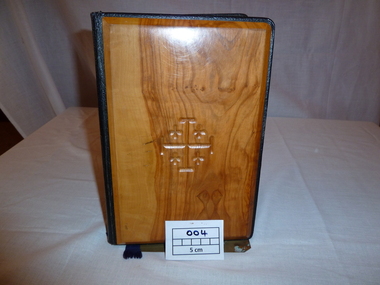
... Also contains two cards: (1) with dried flowers from Jerusalem, and (2) from Bethlehem Before it came to Morongo it was jused in Bethlehem, Nazareth and Titerus (Sea of Galilee). book education school morongo geelong girls boarding presbyterian uniting history assembly private-girls-school lucy-shaw gertrude-pratt dulcie-brookshaw 1920-1994 kindergarten-year-12 holy-bible Presented to "Morongo" by Margaret L. ...Also contains two cards: (1) with dried flowers from Jerusalem, and (2) from Bethlehem Before it came to Morongo it was jused in Bethlehem, Nazareth and Titerus (Sea of Galilee).The Holy Bible contains the Old and New Testaments and is the authorised King James Version. It contains numerous maps showing 'The Ancient World, Canan, Journeys of Children of Israel, Ancienct Jerusalem, Herod's Temple, etc.' The front and back covers faced in wood from the olive tree.Presented to "Morongo" by Margaret L. Toyne, 16/11/63 in appreciation for my School Years. Bought for the School, used in Bathlehem, Nazareth, Titerus (Sea of Galilee).'book, education, school, morongo, geelong, girls, boarding, presbyterian, uniting, history, assembly, private-girls-school, lucy-shaw, gertrude-pratt, dulcie-brookshaw, 1920-1994, kindergarten-year-12, holy-bible -
 Morongo Old Collegians
Badge
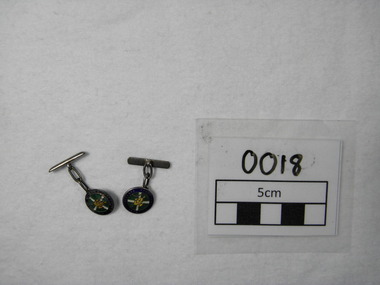
... Cufflinks were only made for individuals not available for general purchase. education school morongo geelong girls boarding presbyterian uniting history school crest badges cufflinks private-girls-school 1920-1994 kindergarten-year-12 sint-lucernae-ardentes lucy shaw gertrude pratt dulcie brookshaw 2 circular cufflinks with coloured enamelled badge featuring the School Crest, consisting of royal blue circle, with white diagonal cross, with dark green background and golden lantern with white flame on top of cross, and a small silver chain and silver cross pin. ...These cufflinks were made for Margery Rix. Cufflinks were only made for individuals not available for general purchase.2 circular cufflinks with coloured enamelled badge featuring the School Crest, consisting of royal blue circle, with white diagonal cross, with dark green background and golden lantern with white flame on top of cross, and a small silver chain and silver cross pin.education, school, morongo, geelong, girls, boarding, presbyterian, uniting, history, school crest, badges, cufflinks, private-girls-school, 1920-1994, kindergarten-year-12, sint-lucernae-ardentes, lucy shaw, gertrude pratt, dulcie brookshaw -
 Mission to Seafarers Victoria
Magazine (item) - Newsletter, Mission to Seafarers Victoria, Ship to Shore , Issue 2 1997, March/April 1997
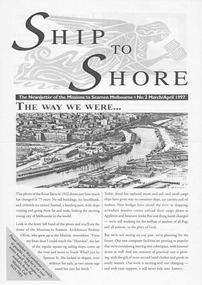
... Ship to Shore is a valable source of information ship to shore mission to seamen mission to seafarers flinders street melbourne victoria news events open house seafaring life shipping sailors seamen sponsors marketing flying angel staff chaplains heritage community xmas christmas welfare board members rodney oliver bill romney geelong mission barque shandon yarra river southbank casino sea sunday 1997 A4 size one page newsletter Ship to Shore , Issue 2 1997 Magazine Newsletter Mission to Seafarers Victoria ...Ship to Shore was first printed in 1997. Inspired by the Jottings From Our Log, this modern version is generally published quarterly (Summer, Autumn, Winter, Spring) Articles are written by the mission's staff and give updates about shipping and seafaring news, staff, events, board Committee, heritage. It is sent by post or email to supporters, members, volunteers and friends of the mission. It is also available to the public in the Flying Angel club and online on the website.Ship to Shore is a valable source of informationship to shore, mission to seamen, mission to seafarers, flinders street, melbourne, victoria, news, events, open house, seafaring life, shipping, sailors, seamen, sponsors, marketing, flying angel, staff, chaplains, heritage, community, xmas, christmas, welfare, board members, rodney oliver, bill romney, geelong mission, barque shandon, yarra river, southbank, casino, sea sunday, 1997 -
 Seaworks Maritime Museum
List of Pennants
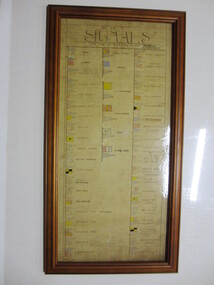
... BOYD/WILLIAM PITT/WILLIAM STRONG/CHAS DUCKETT/EDWARD NORTHCOTE/ H C PIGGOTT/BATMAN/FAWKNER/FRANCIS DUNCAN/WILLIAM ANDREWS/COMMISSIONER/PENGUIN (at Geelong)/ RED BIRD/GELLIBRAND/MOTOR BOAT NO 2 TATEGAMI/MOTOR BOAT NO 3/MOTOR BOAT NO 4/ENGINEER/HARBOR MASTER/LADY STANLEY/HOVELL/ W. ...BOYD/WILLIAM PITT/WILLIAM STRONG/CHAS DUCKETT/EDWARD NORTHCOTE/ H C PIGGOTT/BATMAN/FAWKNER/FRANCIS DUNCAN/WILLIAM ANDREWS/COMMISSIONER/PENGUIN (at Geelong)/ RED BIRD/GELLIBRAND/MOTOR BOAT NO 2 TATEGAMI/MOTOR BOAT NO 3/MOTOR BOAT NO 4/ENGINEER/HARBOR MASTER/LADY STANLEY/HOVELL/ W. ...Has recently been framed and laminatedFramed list of pennants signifying ships and signals hand drawn with coloured pencil in 1915 on paper. Later corrections made in 1933 in black penM. H. T./SIGNALS/FOR THE USE OF FLOATING PLANT OCT 1915 1915/Corrected Feb 1933/ HUME/ J. A. BOYD/WILLIAM PITT/WILLIAM STRONG/CHAS DUCKETT/EDWARD NORTHCOTE/ H C PIGGOTT/BATMAN/FAWKNER/FRANCIS DUNCAN/WILLIAM ANDREWS/COMMISSIONER/PENGUIN (at Geelong)/ RED BIRD/GELLIBRAND/MOTOR BOAT NO 2 TATEGAMI/MOTOR BOAT NO 3/MOTOR BOAT NO 4/ENGINEER/HARBOR MASTER/LADY STANLEY/HOVELL/ W. S. MOUNTAIN/W.M. COWPER/G.F.H./D. YORK SYME/ SUPER of DREDGING/ASSISTANT/HARBOR MASTER/SUPER of MACHINERY/ELECTRICIAN/INSP of DREDGING/INSP of MACHINERY/INSPECTOR WHARVES/(F WILLIAMS)/INSPECTOR DOCKING/& SHIPWRIGHTS/DIVERS WANTED/ACCIDENT SEND/MEDICAL ASSISTANCE/WAITING FOR/EMPTY BARGES/DREDGING STOPPED/WEATHER UNFAVOURABLE/TAKE AWAY/EMPTY BARGES/TUG WANTED/DERRICK PUNT/WANTED/TAKE DERRICK/PUNT AWAY/TAKE AWAY/COAL BARGE/BUCKETS FOULED/OBSTRUCTION SEND/DERRICK PUNT &/DIVERS/ DREDGING STOPPED/REPAIRING/DREDGING RESUMED/ B. Harris 16.8.15/ Drawing No 3415melbourne harbour trust (mba) -
 Seaworks Maritime Museum
Framed print
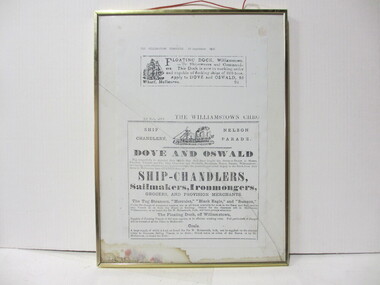
... Article 2: "25 July 1857/ The Willaimstown Chro/ Ship Chandlery/ Nelson Parade/ Dove and Oswald/ Beg respectfully to acquaint their friends that they have bought the Stock in Trade of Messrs,/ Probert, Verdon and Co Ship CHandlers abd Proviso of Merchants Neslon Parade, Williamstown;/ stores in Melbourne have opened them as:/ SHIP CHANDLERS/ Sailmakers, Iron mongers, Grocers and Provision Merchants/ The tug steamers "Hercules," "Black Eagle" and "Samson"/ Under the charge of competent masters, are at all times available for work in the River and Bay and to/ take Vessels to or from the Heads or Geelong. ...Article 2: "25 July 1857/ The Willaimstown Chro/ Ship Chandlery/ Nelson Parade/ Dove and Oswald/ Beg respectfully to acquaint their friends that they have bought the Stock in Trade of Messrs,/ Probert, Verdon and Co Ship CHandlers abd Proviso of Merchants Neslon Parade, Williamstown;/ stores in Melbourne have opened them as:/ SHIP CHANDLERS/ Sailmakers, Iron mongers, Grocers and Provision Merchants/ The tug steamers "Hercules," "Black Eagle" and "Samson"/ Under the charge of competent masters, are at all times available for work in the River and Bay and to/ take Vessels to or from the Heads or Geelong. ...Framed scan of two newspaper articles from "The Williamstown Chronicle" Article 1: "The Williamstown Chronicle 20 September 1856/ Floating dock, Williamstown. To Shipowners and Commanders./ This Dock is now in working order/ and capable of docking ships of 800 tons. Apply to DOVE and Oswald, 95/ Wharf Melbourne. 94." Article 2: "25 July 1857/ The Willaimstown Chro/ Ship Chandlery/ Nelson Parade/ Dove and Oswald/ Beg respectfully to acquaint their friends that they have bought the Stock in Trade of Messrs,/ Probert, Verdon and Co Ship CHandlers abd Proviso of Merchants Neslon Parade, Williamstown;/ stores in Melbourne have opened them as:/ SHIP CHANDLERS/ Sailmakers, Iron mongers, Grocers and Provision Merchants/ The tug steamers "Hercules," "Black Eagle" and "Samson"/ Under the charge of competent masters, are at all times available for work in the River and Bay and to/ take Vessels to or from the Heads or Geelong. Orders for the Steamers left in Melbourne,/ Willaimstown, or on board the Sir W Molesworth, hulk, will have prompt attention,// The floating dock, off Williamstown,/ Capable of Docking Vessels of 800 tons register is in efficient working order. Full particulars of charges/ will be furnished at the Office in Melbourne./ Coals/ A large supply of which is kept on board the Sir W Molesworth, hulk, can be supplied on the shortest / notice to steamers, sailing vessels or on shore; orders aken at either of the stores or by Mr/ McCallum, on board the hulk. -
 Australian National Surfing Museum
Wetsuit, 2004 (estimated)
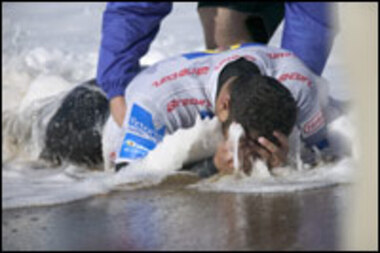
... Geelong Hospital for tests. Garcia, who was leading the heat, rode in with nine minutes remaining and appeared to collapse on the beach, holding his head in his hands." This wetsuit was worn during the prestigious Rip Curl Pro at Bells Beach. It is a rare artefect from a major medical emergency at a world professional surfing contest. rip curl pro wetsuit sunny garcia hotline torn collapse Hotline Wetsuits, Santa Cruz, Calif, Superflex 3/2 model Sunny Garcia's wetsuit. ...This wetsuit was worn by surfer and 2000 world champion, Sunny Garcia (Haw), It was cut off Sunny when he collapsed on the beach during his heat of the 2004 Rip Curl Pro event at Bells Beach. As the Age reported at the time: "One who left the water in unhappier circumstances was three-time Rip Curl Pro winner Sunny Garcia, who forfeited his heat with American Taylor Knox because of a migraine-like condition that saw him taken to Geelong Hospital for tests. Garcia, who was leading the heat, rode in with nine minutes remaining and appeared to collapse on the beach, holding his head in his hands." This wetsuit was worn during the prestigious Rip Curl Pro at Bells Beach. It is a rare artefect from a major medical emergency at a world professional surfing contest.Sunny Garcia's wetsuit. Torn Hotline wetsuit, full length 3/2 steamer. Wetsuit is cut and torn.Hotline Wetsuits, Santa Cruz, Calif, Superflex 3/2 modelrip curl pro, wetsuit, sunny garcia, hotline, torn, collapse -
 Orbost & District Historical Society
book, Brown, Prior & Co, In the Dawning of the Day, 1916
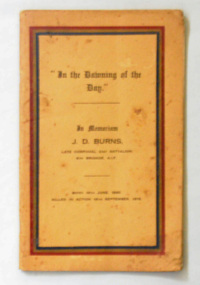
... Geelong the family had moved to Bairnsdale by 1905. As Methodist minister, Hugh had accepted the posting to Bairnsdale where the family stayed till about 1913. He died in Gallipoli on September 18 1915. James was a student when he enlisted on 2...Geelong the family had moved to Bairnsdale by 1905. As Methodist minister, Hugh had accepted the posting to Bairnsdale where the family stayed till about 1913. He died in Gallipoli on September 18 1915. James was a student when he enlisted on 2 ...Many of the poems contained in this book were written by Burns while at school and first appeared in "The Scotch Collegian" which he edited in 1913-1914. Four of his editorials are included. Prose and verse tributes by former schoolmates and fellow soldiers are included, as well as an essay on Burns by the headmaster of Scotch College, W.S. Littlejohn. James Drummond Burns was born in Geelong in 1895. James was the first of eight children born to Hugh and Mary and while he was born at Geelong the family had moved to Bairnsdale by 1905. As Methodist minister, Hugh had accepted the posting to Bairnsdale where the family stayed till about 1913. He died in Gallipoli on September 18 1915. James was a student when he enlisted on 2 February 1915 at Lilydale, Victoria. He served in the 21st Battalion with the rank of Corporal. His Regimental Number was 805. (ref. Scotch College World War I Commemorative Website) This book is a tribute to a WW1 soldier and contains contemporary writing which can be used in research. A thin 32 pp paper back book with a brown cover. On the cover is the title, "In the Dawning of the Day: in Memoriam, J. D. Burns", in black print inside a rectangular red/gold/black line frame. -
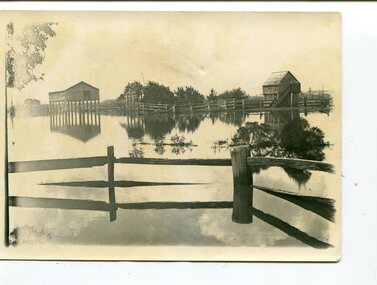 Orbost & District Historical Society
black and white photographs, 1890s
... Geelong. Peter bought the property ―Glen Avon from a Mr Street. The home was situated at the bottom of the paddock, near the corner of Morley and Livingstone streets. The farm stretched from Tennyson Street to the end of Snaggers Lane and along the river frontage to “Carinya” Cameron Home. In the Gippsland Times on Wednesday. 2...Geelong. Peter bought the property ―Glen Avon from a Mr Street. The home was situated at the bottom of the paddock, near the corner of Morley and Livingstone streets. The farm stretched from Tennyson Street to the end of Snaggers Lane and along the river frontage to “Carinya” Cameron Home. In the Gippsland Times on Wednesday. 2 ...Peter Cameron, came to Orbost in 1885, at the age of 69, having sold his farm at Geelong. Peter bought the property ―Glen Avon from a Mr Street. The home was situated at the bottom of the paddock, near the corner of Morley and Livingstone streets. The farm stretched from Tennyson Street to the end of Snaggers Lane and along the river frontage to “Carinya” Cameron Home. In the Gippsland Times on Wednesday. 2 Jul 1890 on Page 3 is an article titled "THE SNOWY RIVER CALAMITY" which describes an ".unexpectedly sudden rush of water down the flats..... the terrified people commenced to remove their stock from the land and the work of saving property was continued all day ............ many head of cattle were washed away.......The river road, for its entire length, is obliterated, and the approaches to the bridge at Watt's Gulch are gone, with the enormous volume of flood water," These photographs are pictorial records of a significant event in the history of Orbost. There are few personal records of the very early floods.Three black / white photographs of wooden buildings with flood water in foreground. There are post and rail fences. 3193.2 has been taken from a distance.on back -" "Glenavon east of Lagoon 1897 Feb"floods-orbost-1890s glenavon-orbost
