
Showing 472 items matching " williams mr."
-
 Federation University Historical Collection
Photograph, Ballarat Teachers' College Students at Ricketts Point, 1949, 1949
... Mr Burns...Rita Rawland...Barbara Young...Ballarat Teachers' College...Ricketts Point...Merle Williams...Black and white photographs of Ballarat Teachers' College Students at Ricketts Point, 1949. .1) L-R Merle Williams, Marg Ransome, Mary Bilton, Shirley Down, Helen Veitch, Rita Rowland, Barbara Young. 2.) L-R Helen Veitch, Marg Ransome, Mary Bilton, Lois Cheetham, Shirley Dawn, Mr Burns, Rita Rawland, Barbara Young...Helen Veitch Marg Ransome Mary Bilton Lois Cheetham Shirley Dawn Mr Burns Rita Rawland Barbara Young Ballarat Teachers' College Ricketts Point Merle Williams Shirley Down Rita Rowland Black and white photographs of Ballarat Teachers' College Students at Ricketts Point, 1949. .1) L-R Merle Williams, Marg Ransome, Mary Bilton, Shirley Down, Helen Veitch, Rita Rowland, Barbara Young. 2.) ...Black and white photographs of Ballarat Teachers' College Students at Ricketts Point, 1949. .1) L-R Merle Williams, Marg Ransome, Mary Bilton, Shirley Down, Helen Veitch, Rita Rowland, Barbara Young. 2.) L-R Helen Veitch, Marg Ransome, Mary Bilton, Lois Cheetham, Shirley Dawn, Mr Burns, Rita Rawland, Barbara Younghelen veitch, marg ransome, mary bilton, lois cheetham, shirley dawn, mr burns, rita rawland, barbara young, ballarat teachers' college, ricketts point, merle williams, shirley down, rita rowland -
Federation University Historical Collection
Booklet, Officers of the Orion Lodge No. 1153, E.C. 1882-83
... Mr Squire every credit for the results that he claimed to have effected; the adoption of his ideas had testified to their value to mine-owners. It was painted out, however, that for want of a thorough debate of the subject with experienced men the author had unwittingly included some general statements that required modifying in some points and extending in others, in justice to other workers among the earlier and the present day managers of mines. It was decided to invite the author to meet a sub-committee on this subject! Orion Lodge Robt. E. Williams ...Richard Squire was a student at the Ballarat School of Mines In 1905 Richard Squire was manager of the West Berry Consols at Allendale, and developed an improved system of mine ventilation, which was supported in "The Age." He was successful in combating and remedying the gas and ventilation troubles of the Deep Mines of Creswick and Allendale Districts after all had failed. MINE MANAGERS’ ASSOCIATION. Ballarat Branch. ... Mr R. B. Squire, manager of the West Berry Consols, at Allendale, submitted a paper detailing what he had done tor the betterment of ventilation in the alluvial mines of Smeaton and Mary borough districts- Members gave Mr Squire every credit for the results that he claimed to have effected; the adoption of his ideas had testified to their value to mine-owners. It was painted out, however, that for want of a thorough debate of the subject with experienced men the author had unwittingly included some general statements that required modifying in some points and extending in others, in justice to other workers among the earlier and the present day managers of mines. It was decided to invite the author to meet a sub-committee on this subject!Small blue covered booklet from the Orion Lodge given to newly initiated members Written in appropriate Sections Unicorn Hotel Sturt Street Second Monday Five Pounds The sum of two pounds the sum of one pound the sum of one pound Five Pounds orion lodge, robt. e. williams wm, morton s. clark immediate pm, edwin baker s.w., samuel j. morgan j.w., john embling p.m. sec. and treas., frederick c. wainwright s.d, kenneth mciver j.d., thomas blight i.g., john gray s.s., vladimer o. petersen j.s, olof s. olden tyler, joseph josephs p.m., charles dyte p.m., lawrence moran p.m., e. richards, w. rushall, j. embling p.m., d. phillipson, t. sayle p.m., w.h. simpson p.m., g.h. leverton p.m., m.s. clark p.m., c. klug, w.t.c. kelly p.m., donald mcdonald, t. potter p.m., e. baker, r.e. williams, david mcdonald, r. baker, j. dickson, w.l.w. dusautoy, j. kilfedder, o.s. olden, w.g. williams, j.a. burritt, j. brazier, j.m. heriot, t.a. freedman p.m., r.s. barclay, t. blight, a. gibson, j.h. jenkins, a. stevenson, s.j. morgan, f.c. wainwright, k. mciver, g. sara, h. oyston, j. haigh, a. hodge, c. gribble, d. ferguson, d. thomas, o.e. wilson, a.w. williams, j. gray, j. pyke, w. glover, a.b. berry, r. mcrae, v.o. petersen, j. laird, j. hinley, h. ritz, f.j. martell, j. weir, w.h. fisher, f.c. standish d.g.m., t.h. lempriere d.g.s., bye-laws -
 Ballarat Clarendon College
Photograph album, 1918
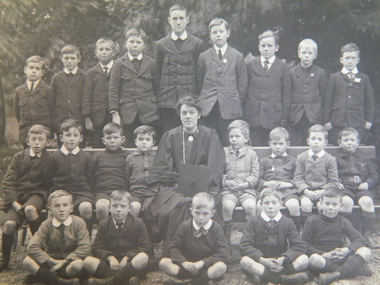
... Junior school Forms I, II, III: Top row: T Dowling, Whitfield, W Paterson, R Paterson, R Morris, B Pain, W Coyle, R Thomas, Campbell; Middle row: Creer, pringle, Greenfield, K Baird, Mrs Gilbert, R Thomas, G Jeffrey, G Shaw, E Morton; Front row: H Strong, C Morton, R Carthew, R Pearce, A Greenfield; Middle School Forms IV, VB: Top row: Leslie, Michael, M Gunn, H Jones, W Hicks, L McLennan, K Bradby, Forster, K Joy, C C McMillan; 2nd row from top: Mr Deans, R Paterson, A Carthew, A Mckenzie, N Shaw, G Ross, H Lester, Leishman, Tanner, G E Clark, W Revelman, Mr Morton; Thurd row from top: A Levy, McLeod, J O'Grady, E Davies, W Walker, J Smith, N Boustead, E Abraham, Alkemade, Ronaldson, Crawford, McDougall, Hill; Front row: Klug, J Tonner, H Deeble, Soloman, Beacham, J Bradby, A Coldham, G Clarke, L Murphy, A King. Senior school Forms VIA, VIB & VA Top row: E Pearce, W Williams...Junior school Forms I, II, III: Top row: T Dowling, Whitfield, W Paterson, R Paterson, R Morris, B Pain, W Coyle, R Thomas, Campbell; Middle row: Creer, pringle, Greenfield, K Baird, Mrs Gilbert, R Thomas, G Jeffrey, G Shaw, E Morton; Front row: H Strong, C Morton, R Carthew, R Pearce, A Greenfield; Middle School Forms IV, VB: Top row: Leslie, Michael, M Gunn, H Jones, W Hicks, L McLennan, K Bradby, Forster, K Joy, C C McMillan; 2nd row from top: Mr Deans, R Paterson, A Carthew, A Mckenzie, N Shaw, G Ross, H Lester, Leishman, Tanner, G E Clark, W Revelman, Mr Morton; Thurd row from top: A Levy, McLeod, J O'Grady, E Davies, W Walker, J Smith, N Boustead, E Abraham, Alkemade, Ronaldson, Crawford, McDougall, Hill; Front row: Klug, J Tonner, H Deeble, Soloman, Beacham, J Bradby, A Coldham, G Clarke, L Murphy, A King. Senior school Forms VIA, VIB & VA Top row: E Pearce, W Williams ...Significant pictorial record of College life at the end of the WW1. Property appearance, uniform/clothing details, furnishings, and named photographs of students. Junior school Forms I, II, III: Top row: T Dowling, Whitfield, W Paterson, R Paterson, R Morris, B Pain, W Coyle, R Thomas, Campbell; Middle row: Creer, pringle, Greenfield, K Baird, Mrs Gilbert, R Thomas, G Jeffrey, G Shaw, E Morton; Front row: H Strong, C Morton, R Carthew, R Pearce, A Greenfield; Middle School Forms IV, VB: Top row: Leslie, Michael, M Gunn, H Jones, W Hicks, L McLennan, K Bradby, Forster, K Joy, C C McMillan; 2nd row from top: Mr Deans, R Paterson, A Carthew, A Mckenzie, N Shaw, G Ross, H Lester, Leishman, Tanner, G E Clark, W Revelman, Mr Morton; Thurd row from top: A Levy, McLeod, J O'Grady, E Davies, W Walker, J Smith, N Boustead, E Abraham, Alkemade, Ronaldson, Crawford, McDougall, Hill; Front row: Klug, J Tonner, H Deeble, Soloman, Beacham, J Bradby, A Coldham, G Clarke, L Murphy, A King. Senior school Forms VIA, VIB & VA Top row: E Pearce, W Williams, A Ramage, D Langsford A Clarke, J Mitchell. Middle row: R Langsford, A Rogers, G Lester, V Cooper, A Thiessen, R Shannon, G Swan, D Robinson, J Coltman, R Jack; Front row: B Jones, L Shannon, R Morrow, Mr A S M Polson BA, R Steveson, R Sloan, M Morris. Social significanceLoose-leaf photograph album featuring photographs of Ballarat College property and classes taken 4th July 1918. Light card cover. 8 inidividual sheets of paper. Front cover: BALLARAT COLLEGE / PHOTOGRAPHS 4th July 1918 C A Ramage / DIFFERENT VIEWS 7 GROUPS / Taken 1918ballarat-college, 1918, uniform, c-a-ramage, boatshed, college-oval, assembly-hall, honour-boards, chemistry-laboratory, a-s-m-polson, mr-deans, mr-morton, miss-gilbert, junior-school, middle-school, senior-school -
 Federation University Historical Collection
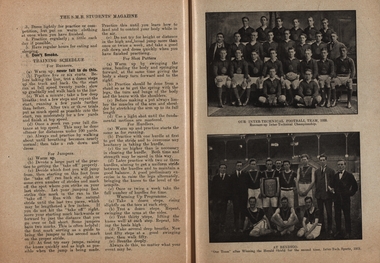
Booklet, Ballarat School of Mines Students' Magazine, 1920, 1920
... Mr M. Copland, Fumes from the Lab, Arts & Crafts Gossip, Echoes of the Past, Sport, Shun Military Notes, The Junior Techs. ballarat school of mines magazine anniversary jubilee w. h. middleton e. kift k. jebb p. tromp percy trompf d. whitehead c. c. mcnamara r. l. coulter e. mckissock maurice copeland j. r. pound l. h. archibald, g. baragwanath r. w. richards dick richards richard w. richards r. l. cutter c. a. schache herbert e. smith j. c. dulfer john dulfer n. hay a. w. steane c. pearlman i. utting g. williams, ethel kift Bone soft covered magazine. ...Ballarat School of Mines celebrated their Jubilee in 1920. Editorial: Obituary - Mr M. Copland, Fumes from the Lab, Arts & Crafts Gossip, Echoes of the Past, Sport, Shun Military Notes, The Junior Techs.Bone soft covered magazine.ballarat school of mines, magazine, anniversary, jubilee, w. h. middleton, e. kift, k. jebb, p. tromp, percy trompf, d. whitehead, c. c. mcnamara, r. l. coulter, e. mckissock, maurice copeland, j. r. pound, l. h. archibald,, g. baragwanath, r. w. richards, dick richards, richard w. richards, r. l. cutter, c. a. schache, herbert e. smith, j. c. dulfer, john dulfer, n. hay, a. w. steane, c. pearlman, i. utting, g. williams,, ethel kift -
Federation University Historical Collection
Booklet, Ballarat School of Mines Students' Magazine, 1934, 1934
... dr. j. r. pound, f. g. proctor, j. hopwood, h. mortimer, j. mole, j. skelton, d. shore, a. collins, a. loughton, r. warnock, l. bailey, j. graham, m. wilson, g. netherway, n. gude, mr sutherland, w. h. steane, professor a. mica smith, k. mathes, d. shore, s. hillman, a. collins, v. leigh, b. walters, e. anderson, n. jelbart, a. gray, j. mouton, d. flynn, g. berryman, j. hulse, b. mcgregor, f. longhurst, n. nimon, h. maddern, j. caddy, w. williams, j. rickard, l. bailey, m. coward, p. salter, j. collins, e. crosthwaite, a. freeman, s. wyres, b, saunders, k. windsor, j. coates, t. morton, l. fitzgerald, b. chaplin, g. george, v. shiers, c. johnson, j. skelton, n. donaldson, k. mathes, g. leviston, d. flynn, v. hunt, colin s. hunt, g. hill, a. goldby, j. o'sullivan, a. laing, s. halladay, l. angwin, g. page, m. hunt, j. sheehan, d. nolan, h. mclachlan, h. mortimer, j. ellis, n. vogel, mr king, h. anderson, j. gilbert, l. moy, m, hunt, f. capuano, m. rickey...Mica Smith, Fumes from the Lab, Arts & Crafts Gossip, Sport, Echoes of the Past, A Trip to England, The Junior Tecs ballarat school of mines magazine dr. j. r. pound, f. g. proctor, j. hopwood, h. mortimer, j. mole, j. skelton, d. shore, a. collins, a. loughton, r. warnock, l. bailey, j. graham, m. wilson, g. netherway, n. gude, mr sutherland, w. h. steane, professor a. mica smith, k. mathes, d. shore, s. hillman, a. collins, v. leigh, b. walters, e. anderson, n. jelbart, a. gray, j. mouton, d. flynn, g. berryman, j. hulse, b. mcgregor, f. longhurst, n. nimon, h. maddern, j. caddy, w. williams, j. rickard, l. bailey, m. coward, p. salter, j. collins, e. crosthwaite, a. freeman, s. wyres, b, saunders, k. windsor, j. coates, t. morton, l. fitzgerald, b. chaplin, g. george, v. shiers, c. johnson, j. skelton, n. donaldson, k. mathes, g. leviston, d. flynn, v. hunt, colin s. hunt, g. hill, a. goldby, j. o'sullivan, a. laing, s. halladay, l. angwin, g. page, m. hunt, j. sheehan, d. nolan, h. mclachlan, h. mortimer, j. ellis, n. vogel, mr king, h. anderson, j. gilbert, l. moy, m, hunt, f. capuano, m. rickey Signed on front cover by "H. ...List of Full Course Students' 1934, Editorial, Obituary, Personal Column, Professor A. Mica Smith, Fumes from the Lab, Arts & Crafts Gossip, Sport, Echoes of the Past, A Trip to England, The Junior TecsYellow, blue and green soft covered magazine of 52 pages.Signed on front cover by "H. Darby".ballarat school of mines, magazine, dr. j. r. pound, f. g. proctor, j. hopwood, h. mortimer, j. mole, j. skelton, d. shore, a. collins, a. loughton, r. warnock, l. bailey, j. graham, m. wilson, g. netherway, n. gude, mr sutherland, w. h. steane, professor a. mica smith, k. mathes, d. shore, s. hillman, a. collins, v. leigh, b. walters, e. anderson, n. jelbart, a. gray, j. mouton, d. flynn, g. berryman, j. hulse, b. mcgregor, f. longhurst, n. nimon, h. maddern, j. caddy, w. williams, j. rickard, l. bailey, m. coward, p. salter, j. collins, e. crosthwaite, a. freeman, s. wyres, b, saunders, k. windsor, j. coates, t. morton, l. fitzgerald, b. chaplin, g. george, v. shiers, c. johnson, j. skelton, n. donaldson, k. mathes, g. leviston, d. flynn, v. hunt, colin s. hunt, g. hill, a. goldby, j. o'sullivan, a. laing, s. halladay, l. angwin, g. page, m. hunt, j. sheehan, d. nolan, h. mclachlan, h. mortimer, j. ellis, n. vogel, mr king, h. anderson, j. gilbert, l. moy, m, hunt, f. capuano, m. rickey -
Federation University Historical Collection
Magazine - Booklet, Baxter & Stubbs, Printers and Bookbinders, Ballarat School of Mines Students' Magazine, 1918, 1918
... Williams...L. Leroux...C. Lukies...H. Herbert...Mr...Williams L. Leroux C. Lukies H. Herbert Mr Murphy G. J. Brelaz W. ...Editorial, Items of interest, Fumes from the Lab, Motion Picture Photography, The Chemlab, The S.M.B. Students' Excursion to the Lead and Copper mining centres, Arts & Crafts gossip, Answers to correspondents, Sport, Shun Military Notes - S.M.B. Roll of Honour, The Junior Techs, Trade notes.Orange soft covered magazine.Signed by Harold Jolly, 1918.ballarat school of mines, magazine, in memoriam, henry j. hall, arthur m. lilburne, a. t. bernaldo, a. h. hoskin, m. williamson, o. fricke, c. a. schache, a. e. williams, l. leroux, c. lukies, h. herbert, mr murphy, g. j. brelaz, w. h. shattock, d. g. mcgrath, p. chatham, h. jolly, editorial, items of interest, fumes from the lab, motion picture photography, the chemlab, the s.m.b. students' excursion to the lead and copper mining centres, arts & crafts gossip, answers to correspondents, sport, shun military notes, the junior techs, trade notes., henry hall, henry hall obituary -
Federation University Historical Collection
Magazine - Booklet, Ballarat School of Mines Students' Magazine, 1935, 1935
... williams...a. moodie...v. hunt...j. shelton...r. warnock...dr. j. r. pound...g. procter...g. merlin...j. b. robinson...james pound...peter wilson...mr...Bickett, An Attitude to War, Some Impressions by a New Comer to New Guinea, Fumes from the Lab, Arts & Crafts Gossip, Sport, Commercial Notes, The Junior Tecs ballarat school of mines magazine f. t. wimble & co. ltd., sydney j. woolcock a. nye d. shore d. taylor j. elliott b. saunders w. williams a. moodie v. hunt j. shelton r. warnock dr. j. r. pound g. procter g. merlin j. b. robinson james pound peter wilson mr alexander mr creelman mr crouch h. steane j. sutherland a. bell. a. max wilson g. f. eric rumpff r. mcconnell t. byrne c. r. king p. marshman a. f. heseltine w. f. tucker j. m. bickett a. m. wilson f. whitworth w. tierney r. leigh g. berriman a. sneddon a. collins h. maddern d. flynn n. bayly m. rickey w. calaghan d. wright e. wallace b. lamb s. wise r. quick i. leviston b. chaplin j. coates n. dunstan d. mcarthy d. henderson j. mathes g. leviston e. mcdonald k. blackie j. mouton n. jelbart r. brown k. mathes a. pickering j. mcghie r. white w. dawson j. forrest m. hamill w. martin m. jeffs k. waller d. nolan l. baxter r. knight l. moy m. hunt j. henry a. goldby j. menhennet mr king w. nice k. pattie f. capuano l. g. r. crouch gilda gude valma jensen e. shaw lorna bailey marjorie john dorothy woolcock Yellow soft covered magazine of 70 pages, including advertisements. ...List of Full Course Students' 1935, Editorial, Obituary - J. B. Robinson, Personal Column, Personal Column, Editor's Notes, Old Boys: Personal, The "Head" - An Appreciation, The Late Dean - W. F. Tucker, A Tribute - J. M. Bickett, An Attitude to War, Some Impressions by a New Comer to New Guinea, Fumes from the Lab, Arts & Crafts Gossip, Sport, Commercial Notes, The Junior TecsYellow soft covered magazine of 70 pages, including advertisements. Artworks * Blocks and Inks supplied by F.T. Wimble and Co. Ltd Sydney - Printed by students of printing class School of Mines Ballarat * Mr G - By Valma Jenson * Miss G - By E.Shaw * Joker of the pack by Gilda Gude * Oh Mother - By Valma Jensen * Man Praying - By A.P. * Swell - By Valma Jensen * In his element - By E.Shaw * Our jazz band - By Valma Jensen * Spaghetti - By E.Shaw * The Peter Pan statue in Kensington Gardens - By Gilda Gude * Hunted - By Valma Jensen * Bridget & Vic - By Valma Jensen * Lady pointing a statue - By Gilda Gude * Hi first solo flight - By Dorothy Woolcock * Dear Me - a millionth of a milligram out ! - By E.Shaw * Marley & Paul - By Valma Jensen * Green Plan Print - By Hunt * Yes, but it doesn't read, it doesn't read - By E.Shaw * The Big Noise - By Valma Jensen * Bashful Barney - By Valma Jensen * Willowy Verna - By E.Shaw * Margaret - By Valma Jensen * Don - By Valma Jensen * Cyril - By Gilda Gude * Jack - By Gilda Gude * Nancy - By Valma Jensen * Off to English - By Valma Jensen * "A mag article today please or six tomorrow" By E. Shaw * "Oh you boys are awful" - By E. Shaw * Maureen - By Valma Jensen * Geggy - By Valma Jensen * Aw crikey - By Valma Jensen * The wheelbarrow crate reaches Africa - By J.W * Lady Dean - By Valma Jensen * Margery - By Valma Jensen * Bubba - By Lorna Bailey * Chook - By Marjorie John * Bunny - By Valma Jensen * Sixa - By Valma Jensen * Fish Print - By Hunt * Betty - By Lorna Bailey * Bessie - By Lorna Bailey * Janette - By Lorna Bailey * Butcher - By Valma Jensen * Minnow - By F.J.Hballarat school of mines, magazine, f. t. wimble & co. ltd., sydney, j. woolcock, a. nye, d. shore, d. taylor, j. elliott, b. saunders, w. williams, a. moodie, v. hunt, j. shelton, r. warnock, dr. j. r. pound, g. procter, g. merlin, j. b. robinson, james pound, peter wilson, mr alexander, mr creelman, mr crouch, h. steane, j. sutherland, a. bell., a. max wilson, g. f. eric rumpff, r. mcconnell, t. byrne, c. r. king, p. marshman, a. f. heseltine, w. f. tucker, j. m. bickett, a. m. wilson, f. whitworth, w. tierney, r. leigh, g. berriman, a. sneddon, a. collins, h. maddern, d. flynn, n. bayly, m. rickey, w. calaghan, d. wright, e. wallace, b. lamb, s. wise, r. quick, i. leviston, b. chaplin, j. coates, n. dunstan, d. mcarthy, d. henderson, j. mathes, g. leviston, e. mcdonald, k. blackie, j. mouton, n. jelbart, r. brown, k. mathes, a. pickering, j. mcghie, r. white, w. dawson, j. forrest, m. hamill, w. martin, m. jeffs, k. waller, d. nolan, l. baxter, r. knight, l. moy, m. hunt, j. henry, a. goldby, j. menhennet, mr king, w. nice, k. pattie, f. capuano, l. g. r. crouch, gilda gude, valma jensen, e. shaw, lorna bailey, marjorie john, dorothy woolcock -
Federation University Historical Collection
Magazine - Booklet, Ballarat School of Mines Students' Magazine, 1936, 1936
... mr. cochrane...w. coates...d. shore...jessie skelton...l. hill...k. h. wilkie...j. pound...h. maddern...n. pickering...john elliott...paul f. chaplin...w. usebach...fergy and p. macgregor...j. hammer...k. ellwood...j. w. muir...john menhennett...philip harris...j. anderson...william mcdonald...lawrence egan...archibald sneddon...p. holioake...lyle dimsey...a. horsfall...eoin macdonald...james martin...jack mole...bill walters...david flynn...william williams...Hill, Personal Column, Old Boys' Personal, Fumes from the Lab, The Newcastle Trip, War and Women, Arts & Crafts Gossip, Sport, Commercial Notes, The Junior Techs ballarat school of mines magazine allan nye r. rickey a. gordon reg warnock maxwell bayley sylvia wyres m. mcrae albino paganetti victor hunt lila welsh f. g. procter mr. cochrane w. coates d. shore jessie skelton l. hill k. h. wilkie j. pound h. maddern n. pickering john elliott paul f. chaplin w. usebach fergy and p. macgregor j. hammer k. ellwood j. w. muir john menhennett philip harris j. anderson william mcdonald lawrence egan archibald sneddon p. holioake lyle dimsey a. horsfall eoin macdonald james martin jack mole bill walters david flynn william williams dororthy billings clarice mcintosh gladys bilney ida shearer j. brady g. lamb grace gordon elva brimacombe r. hutchinson g. leviston i. mcdonald w. callighan t. jones s. j. chambers russell ewins g. berriman j. walker r. t. hocking f. e. capuano f. w. hassell c. m. reynolds r. davies r. c. white h. f. forrest h. h. evans a. j. ritchie j. g. kittelty w. cornish l. liebhardt r. allender a. pobjoy a. laing w. j. paterson v. e. jukes h. v. bolt l. c. henderson c. f. white nornie gude gilda gude max coward alan nye betty brown leila mclachlan dorothy woolcock verma lynch jessie hopwood jean coates e. prout Signed on front cover by "H. ...List of Full Course Students' 1936, Editorial, Obituary - L. Hill, Personal Column, Old Boys' Personal, Fumes from the Lab, The Newcastle Trip, War and Women, Arts & Crafts Gossip, Sport, Commercial Notes, The Junior TechsYellow soft covered magazine of 60 pages, including advertisements. Artwork * Mr. C - By Albino Paganetti * Bo'sun - By Albino Paganetti * " So then says I ' you can't ask me to do that, boys - its dishonest," - By Jessie Hopwood * come on "(hic)" be serious - By Albino Paganetti * Bill - By Albino Paganetti * Mac - By Albino Paganetti * "I used the fruit bowl this time fro a change" - By Dorothy Woolcock * Mother & Bobby - By Dorothy Woolcock * Ernie - By Nornie Gude * Gateway to the Garden city - By Albino Paganetti * Tip - By Albino Paganetti * Pat - By Jean Coates * Our Dark Horse - By Jean Coates * Moorish Tower, Perth University - By Jessie Hopwood * Sailing Ship Print - By Verma Lynch * Lemon - By Albino Paganetti * Site for the King George memorial - By Gilda Gude * Gladys - By Dorothy Woolcock? * Our Tall Story - By Dorothy Woolcock * Another one today Sylvia - By Nornie Gude * Haze - By Dorothy Woolcock * Commercial Notes - By Leila McLachlan * Fred - By Albino Paganetti * Gordon - By Betty Brown * Gandhi - By Dorothy Woolcock * Ellie - By Gilda Gude * Betty - By Alan Nye * Lost Ball - By E. Prout * Cleaning Ladies - Betty Brown * Rusty - By Gilda Gude * Blondie - By Gilda Gude * Peggy - By Betty Brown * Hocky - By Gilda Gude * Betty - By Gilda Gude * Joan - By Gilda Gude * General - By Max Coward * Twitter - By Gilda Gude * Banjo - By Max Coward * Georgie - By Max Coward * Skinny - By Max Coward * Sydney Jim - By Max Coward * Tommy - By Max Coward * Max - By Max Coward * SOS - By Max Coward * Nipper - By Max Coward * Dasha - By Max Coward * Wee Macgregor - By Albino Paganetti Signed on front cover by "H. Darby".ballarat school of mines, magazine, allan nye, r. rickey, a. gordon, reg warnock, maxwell bayley, sylvia wyres, m. mcrae, albino paganetti, victor hunt, lila welsh, f. g. procter, mr. cochrane, w. coates, d. shore, jessie skelton, l. hill, k. h. wilkie, j. pound, h. maddern, n. pickering, john elliott, paul f. chaplin, w. usebach, fergy and p. macgregor, j. hammer, k. ellwood, j. w. muir, john menhennett, philip harris, j. anderson, william mcdonald, lawrence egan, archibald sneddon, p. holioake, lyle dimsey, a. horsfall, eoin macdonald, james martin, jack mole, bill walters, david flynn, william williams, dororthy billings, clarice mcintosh, gladys bilney, ida shearer, j. brady, g. lamb, grace gordon, elva brimacombe, r. hutchinson, g. leviston, i. mcdonald, w. callighan, t. jones, s. j. chambers, russell ewins, g. berriman, j. walker, r. t. hocking, f. e. capuano, f. w. hassell, c. m. reynolds, r. davies, r. c. white, h. f. forrest, h. h. evans, a. j. ritchie, j. g. kittelty, w. cornish, l. liebhardt, r. allender, a. pobjoy, a. laing, w. j. paterson, v. e. jukes, h. v. bolt, l. c. henderson, c. f. white, nornie gude, gilda gude, max coward, alan nye, betty brown, leila mclachlan, dorothy woolcock, verma lynch, jessie hopwood, jean coates, e. prout -
Federation University Historical Collection
Booklet, Ballarat School of Mines Students' Magazine, 1937, 1937
... mr chambers...j. hassell...k. bolleman...w. h. mcdonald...m. coward...a. morshead...e. dunstan...w. sewell...r. matthews...n. brazenor...v. pound...l. gladman...b. lamb...j. pittard...v. fisher...g. james...d. woolcock...o. williams...List of Full Course Students' 1937, Editorial, Obituary - Keith Stanley Clarke, Fumes from the Lab, Primitive Papua, A Trip to the North-West Frontier, Arts & Crafts Gossip, Sport, Commercial Notes, The Junior Techs ballarat school of mines magazine r. hutchinson r. mchutchinson j. sadler a. nye m. bayley r. ewins j. calaby k. heriot r. rickey w. mcdonald d. woolcott j. askwith s. wyres b. martin j. martin p. hollioke i. leviston dr pound m. bayly g. proctor e. gribble i. shearer keith stanley clarke douglas shore w. s. cantelo vic. hunt k. mathes victor leigh w. williams jack mole g. cornell k. h. wilkie g. yorke g. k. sutton j. wilkinson gladys bilney mr cornell f. holioke j. snowball g. watson m. shoppee j. graham w. monteith k. waller i. john a. horsfall a. veale p. harris p. anderson l. dimsey w. walters m. cornell g. white f. hollioke costello e. mcdonald d. flynn a. leviston mr chambers j. hassell k. bolleman w. h. mcdonald m. coward a. morshead e. dunstan w. sewell r. matthews n. brazenor v. pound l. gladman b. lamb j. pittard v. fisher g. james d. woolcock o. williams m. booley g. dunstan g. bilney j. dean m. mcrae e. brimacombe j. neyland n. crouch r. hocking j. leach l. coad k. gingell g. aird m. reynolds e. thomas c. schafer l. taylor h. charlton h. bedggood a. george w. thomas l. henderson g. litchfield e. mccann r. davies e. jones k. cook g. leigh w. j. paterson p. sullivan n. palmer f. hasell t. phillips d. mcgregor a. ritchie r. allender g. reynolds r. cooper e. juke mr hillman f. capuano j. walker k. evans b. rowe c. burgan jean perkins lorna perkins a. janetski Signed on front cover by H. ...List of Full Course Students' 1937, Editorial, Obituary - Keith Stanley Clarke, Fumes from the Lab, Primitive Papua, A Trip to the North-West Frontier, Arts & Crafts Gossip, Sport, Commercial Notes, The Junior TechsWhite soft covered magazine of 54 pages including advertisements.Signed on front cover by H. Darby.ballarat school of mines, magazine, r. hutchinson, r. mchutchinson, j. sadler, a. nye, m. bayley, r. ewins, j. calaby, k. heriot, r. rickey, w. mcdonald, d. woolcott, j. askwith, s. wyres, b. martin, j. martin, p. hollioke, i. leviston, dr pound, m. bayly, g. proctor, e. gribble, i. shearer, keith stanley clarke, douglas shore, w. s. cantelo, vic. hunt, k. mathes, victor leigh, w. williams, jack mole, g. cornell, k. h. wilkie, g. yorke, g. k. sutton, j. wilkinson, gladys bilney, mr cornell, f. holioke, j. snowball, g. watson, m. shoppee, j. graham, w. monteith, k. waller, i. john, a. horsfall, a. veale, p. harris, p. anderson, l. dimsey, w. walters, m. cornell, g. white, f. hollioke, costello, e. mcdonald, d. flynn, a. leviston, mr chambers, j. hassell, k. bolleman, w. h. mcdonald, m. coward, a. morshead, e. dunstan, w. sewell, r. matthews, n. brazenor, v. pound, l. gladman, b. lamb, j. pittard, v. fisher, g. james, d. woolcock, o. williams, m. booley, g. dunstan, g. bilney, j. dean, m. mcrae, e. brimacombe, j. neyland, n. crouch, r. hocking, j. leach, l. coad, k. gingell, g. aird, m. reynolds, e. thomas, c. schafer, l. taylor, h. charlton, h. bedggood, a. george, w. thomas, l. henderson, g. litchfield, e. mccann, r. davies, e. jones, k. cook, g. leigh, w. j. paterson, p. sullivan, n. palmer, f. hasell, t. phillips, d. mcgregor, a. ritchie, r. allender, g. reynolds, r. cooper, e. juke, mr hillman, f. capuano, j. walker, k. evans, b. rowe, c. burgan, jean perkins, lorna perkins, a. janetski -
Federation University Historical Collection
Booklet, J.A. Hoskin & Son, Ballarat School of Mines Students' Magazine, 1945, 1945
... williams...t. r. thomas...john p. l. gibbs...t. mccartney...a. s. richards...p. crosby...h. middlin...mr...Artwork Mr Calder - By Eda Woodfield Miss Williams - By Ruth Mole Basil - By Beatrice Burgess Roy - By Eda Woodfield Mac - By Gweneth Speirs Joll - By Marjorie Gray Doug - By Ruth Mole View from the cutters hut - By Marion Beckwith Mr Fairbank - By Ruth Mole Perc - By Ruth Mole Peter - By Eda Woodfield Fritz - By Joan Walter On the track to the cutter's hut - By Joan Walter The cutter's hut - By Ruth Mole Gertie - By Marjorie Gray Bombhead - By Ruth Mole Gwen - By Francis Duffy Marje - By Ruth Mole David - By Joan Walter Skeeter - By Joan Walter Ewan - By Ruth Mole Blue - By Neville Reeve Stanley - By Joan Walter George - By Joan Walter Vic - By Beatrice Burgess Gladys - By Eda Woodfield Olwyn - By Beatrice Burgess Valda - By Beatrice Burgess Betty - By Eda Woodfield June - By Eda Woodfield Stella - By Beatrice Burgess Verna - By Eda Woodfield Valerie - By Eda Woodfield June - By Beatrice Burgess Dorothy - By Joan Walter Beryl - By Joan Walter Noreen - By Ruth Mole Pat - By Joan Walter Valma - By Eda Woodfield Graham - By Gweneth Speirs Johnny - By Joan Walter Charlie - By Beatrice Burgess Raynor - By Marjorie Gray George - By Marjorie Gray Darkie - By Ruth Mole Duck - By Beatrice Burgess Robert - By Ruth Mole William - By Gweneth Speirs Basil - By Joan Walter Wilson - By Joan Walter Schoolbeck - By Ruth Mole Duck Weed - By Eda Woodfield Bas - By Beatrice Burgess Albert - By Ruth Mole ...Artwork Mr Calder - By Eda Woodfield Miss Williams - By Ruth Mole Basil - By Beatrice Burgess Roy - By Eda Woodfield Mac - By Gweneth Speirs Joll - By Marjorie Gray Doug - By Ruth Mole View from the cutters hut - By Marion Beckwith Mr Fairbank - By Ruth Mole Perc - By Ruth Mole Peter - By Eda Woodfield Fritz - By Joan Walter On the track to the cutter's hut - By Joan Walter The cutter's hut - By Ruth Mole Gertie - By Marjorie Gray Bombhead - By Ruth Mole Gwen - By Francis Duffy Marje - By Ruth Mole David - By Joan Walter Skeeter - By Joan Walter Ewan - By Ruth Mole Blue - By Neville Reeve Stanley - By Joan Walter George - By Joan Walter Vic - By Beatrice Burgess Gladys - By Eda Woodfield Olwyn - By Beatrice Burgess Valda - By Beatrice Burgess Betty - By Eda Woodfield June - By Eda Woodfield Stella - By Beatrice Burgess Verna - By Eda Woodfield Valerie - By Eda Woodfield June - By Beatrice Burgess Dorothy - By Joan Walter Beryl - By Joan Walter Noreen - By Ruth Mole Pat - By Joan Walter Valma - By Eda Woodfield Graham - By Gweneth Speirs Johnny - By Joan Walter Charlie - By Beatrice Burgess Raynor - By Marjorie Gray George - By Marjorie Gray Darkie - By Ruth Mole Duck - By Beatrice Burgess Robert - By Ruth Mole William - By Gweneth Speirs Basil - By Joan Walter Wilson - By Joan Walter Schoolbeck - By Ruth Mole Duck Weed - By Eda Woodfield Bas - By Beatrice Burgess Albert - By Ruth Mole Ballarat School of Mines Students' Magazine, 1945 Booklet Booklet J.A. ...List of Full Course Students' 1945, Editorial, Editor's Notes, News and Notes, End of the War 1939-1945, Obituary, The Literary Society, The Chemical Nature of Women, Fumes from the Lab, Forests - Our Asset and Responsibility, Arts & Crafts Gossip, Sports, Commercial Notes, The Junior TechsMaroon cover with, blue, green and gold lettering, soft covered magazine of 72 pages including advertisements. Artwork Mr Calder - By Eda Woodfield Miss Williams - By Ruth Mole Basil - By Beatrice Burgess Roy - By Eda Woodfield Mac - By Gweneth Speirs Joll - By Marjorie Gray Doug - By Ruth Mole View from the cutters hut - By Marion Beckwith Mr Fairbank - By Ruth Mole Perc - By Ruth Mole Peter - By Eda Woodfield Fritz - By Joan Walter On the track to the cutter's hut - By Joan Walter The cutter's hut - By Ruth Mole Gertie - By Marjorie Gray Bombhead - By Ruth Mole Gwen - By Francis Duffy Marje - By Ruth Mole David - By Joan Walter Skeeter - By Joan Walter Ewan - By Ruth Mole Blue - By Neville Reeve Stanley - By Joan Walter George - By Joan Walter Vic - By Beatrice Burgess Gladys - By Eda Woodfield Olwyn - By Beatrice Burgess Valda - By Beatrice Burgess Betty - By Eda Woodfield June - By Eda Woodfield Stella - By Beatrice Burgess Verna - By Eda Woodfield Valerie - By Eda Woodfield June - By Beatrice Burgess Dorothy - By Joan Walter Beryl - By Joan Walter Noreen - By Ruth Mole Pat - By Joan Walter Valma - By Eda Woodfield Graham - By Gweneth Speirs Johnny - By Joan Walter Charlie - By Beatrice Burgess Raynor - By Marjorie Gray George - By Marjorie Gray Darkie - By Ruth Mole Duck - By Beatrice Burgess Robert - By Ruth Mole William - By Gweneth Speirs Basil - By Joan Walter Wilson - By Joan Walter Schoolbeck - By Ruth Mole Duck Weed - By Eda Woodfield Bas - By Beatrice Burgess Albert - By Ruth Mole ballarat school of mines, magazine, g. curtis, p. edmonds, kevin j. whiter, david t. coburn, peter j. wilson, john k. leicht, douglas d.g. dean, frank d. daykin, grace lawry, p. maloney, j. mckenzie, percival d. fisher, stanley s. parker, beatrice e. burgess, roy e. mawby, roma sudoltz, peter h. marxsen, lois reynolds, robert j. mckenzie, w. coad, marion a. beckwith, john g. procter, gweneth. speirs, neville f. reeve, dr pound, c. fairbank, f. g. procter, jeanette perkins, john w. jolly, m. berlyn, c. g. fairbank, bill f. carroll, marjorie gray, f. n. reeve, joan waller, winifred m. beckwith, isobel murfett, frank daykin, joy martin, max coward, jack henderson, joe wilkinson, alan wilson, muriel harland, m. fogarty, sylvia williams, t. r. thomas, john p. l. gibbs, t. mccartney, a. s. richards, p. crosby, h. middlin, mr cornell, lois kinnersley, margaret murrell, ouida worthington, i. murfett, ruby gladman, john m. blainey, mina gallie, miss darby, p. moloney, v. eva, lester w. roffey, robert f. swales, john e. ambrosio, mr hillman, neville r. morton, basil j. marshall, lloyd lehmann, lindsay s. pattenden, john middlin, alfred e. temby, a. hyett, willaim g. young, kingsley r. bremmer, william j. hewitt, geoffrey f. stevens, n. black, lucy cooper, valma overall, evelyn ditchfield, b. lancaster, miriam horsey, lorraine saunders, n. hoffman, audrey fry, robert j. murell, colin a. bell, ewan c. jones, d. powell, william j. llewllyn, kenneth s. lindsay, nola dridan, patricia gleeson, winifred stevens, mary cummins, b. sherritt, alison johnson, b. conway, b. vallins, k. dowall, m. grinham, k. eberhard, c. lea, k. george, a. coad, c. eltringham, w. allan, m. silvey, f. jacobson, l. clifton, r. sargent, w. caldow, g. pyke, g. bergin, k. dean, r. bennett, k. hoffman, a. kerr, h. sealey, d. mcconville, p. nunn, d. halson, l. frichot, g. smith, m. mcdonald, w. hon, r. irving, l. drake, c. gedye, g. jukes, a. new, a. smith, k. weybury, c. wilson, p. banfield, a. hughes, g. yeoman, eda woodfield, francis duffy -
 Federation University Historical Collection
Photograph - Photograph - Black and White, School of Mines and Industries, Ballarat - Diploma of Business Studies Class, 1968, 1968
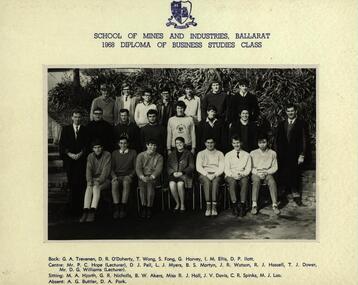
... ...mr d g williams...Two lecturers are photographed with them. ballarat school of mines and industries diploma of business studies class 1968 lecturers g a trevenen d r o'doherty t wong s fong g harvey i m ellis d p ilott mr p c hope d j pell l j myers b s martyn j r watson r j hassell t j dower mr d g williams m a hjorth g r nicholls b w akers miss r j hall j v davis c r spinks m j loo alumni Emblem of SMB Names of students Photograph mounted on heavy card. ...Twenty students posed for class photograph. Students are studying the Diploma of Business Studies - 1968. Two lecturers are photographed with them.Photograph mounted on heavy card. Names of students under photograph. Ballarat School of Mines emblem at topEmblem of SMB Names of studentsballarat school of mines and industries, diploma of business studies, class, 1968, lecturers, g a trevenen, d r o'doherty, t wong, s fong, g harvey, i m ellis, d p ilott, mr p c hope, d j pell, l j myers, b s martyn, j r watson, r j hassell, t j dower, mr d g williams, m a hjorth, g r nicholls, b w akers, miss r j hall, j v davis, c r spinks, m j loo, alumni -
 Federation University Historical Collection
Magazine - Booklet, Ballarat School of Mines Students' Magazine, 1938, 1938
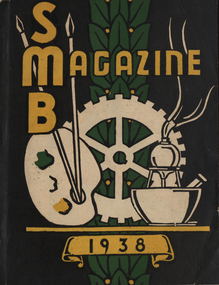
... williams...gordon yorke...bob mchutchinson...w. edward...keith heriot...sylvia wyres...jeff wilkinson...peter richards...d. gordon...f. morris...mr...Cadet Training Scheme, Arts & Crafts Gossip, Sport, Commercial Notes, The Junior Techs, Junior Technical Sporting ballarat school of mines magazine maureen mcrae b. delima j. woolcock herbert j. trevenan n. palmer olwyn williams gordon yorke bob mchutchinson w. edward keith heriot sylvia wyres jeff wilkinson peter richards d. gordon f. morris mr proctor ernest gribble dr. j. r. pound muriel boyd george downing roy s. hall f. j. martell d. v. shore ken wilkie eoin macdonald g. berriman dorothy woolcock russell h. s. ewins v. e. greenhalgh max coward shelia moss frank t. jelbart neil crouch graham white mr cornell francis hollioke k. vaughan david j. jelbart arthur g. veale bill walters richard menhennett james redford w. monteith mr hillman john t. graham james w. thomas keith. walter james m. martin lyle s. dimsey jean birch margaret turner lesley stapleton marjorie day una kersey jean lonie coral robertson norma rowe jean bridges jean cox a. janetski d. ditchfield j. harrison gladys james j. brimacombe sheila moss r. mathews joy martin joan ellsworth e. salter a. spence m. may f. coulson i. clow h. tonkin l. taylor s. harris k. gingell g. jones william t. paterson f. harland w. harrison j. pike a. mcmillan m. lee e. mccann j. harris a. clack f. osborne e. stephens s. nicol d. eltringham j. hosie v. burt w. rowe wm. c. edward j. donald m. cox n. dalton gladys bilney gilda gude patsy walsh elva brimacombe g. day Francis Hollyoake centenary Betty Brown Alan Nye victor greenhalgh alan gilpin george edward e.h. ...School Council, Members of Staff, Magazine Committee, List of Full Course Students 1938, Full Course Commercial Students, Editorial, Personal Column, Obituary - Roy S. Hall - F. J. Martell, S.M.B Old Boys' Association, The Literary Society, Centenary Jottings, Fumes from the Lab, Broken Hill, News from Papua, Sidelights on the B.H.P. Cadet Training Scheme, Arts & Crafts Gossip, Sport, Commercial Notes, The Junior Techs, Junior Technical SportingBlack soft covered magazine with yellow font, green and white images. 64 pages including advertisements. Artworks * Lino cut - By Maureen McRae * Lino Cut - By B. Delima * Lino Cut - By Bessie Martin * The dog you's like to kick - By Gordon Yorke * Harry - By Ernest Gribble * Digger - By Ernest Gribble * Lino cut - By Gordon Yorke * Our little girl - By Dorothy Woolcock * Miss W - By Ernest Gribble * Joan - By Ernest Gribble * Roma - By Gladys Bilney * Doing art for t'arts sake - By Gilda Gude * Una - By Dorothy Woolcock * My Bill - By Dorothy Woolcock * The Sec. - By Ernest Gribble * Hassell - By Dorothy Woolcock * Chief Engineer - By Dorothy Woolcock * Rusty - By Ernest Gribble * Lino Cut - By Jeff Wilkinson * Dick - By Dorothy Woolcock * Goosey - By Ernest Gribble * Pen Drawing - By Dorothy Woolcock * Parking 1 - By Max Coward * Miss King - By Dorothy Woolcock * Goal Umpire - By Ernest Gribble * To Prep Girls - Joe - By Ernest Gribble * Dreamy Dolan - By Ernest Gribble * Lino Cut - By Max Coward * Norma - By Dorothy Woolcock * Lino Cut - By A. Janetski * Dorothy - By Patsy Walsh * Jean - By Dorothy Woolcock * Lino Cut - By Joy Martin * Lino Cut - By Max Coward and A.2., * Ben - By Bob McHutchison * Polly - By Ernest Gribble * Dobber - By Ernest Gribble * Francies - By Ernest Gribble * Ad a line not a bite - By Dorothy Woolcock * Dulcie - By Dorothy Woolcock * Joan - By Ernest Gribble * Kitty - By Bob McHutchison * Stumpy - By Elva Brimacombe * Pegleg - By Dorothy Woolcock * Fat - By Gladys Bilney * Dawn - By Dorothy Woolcock * Joy - By Ernest Gribble * Nipper - By Ernest Gribble * Mac - By Ernest Gribble * Puss - By Bob McHutchison * Tinted Lino Cut - By W. Edward * Lino Cut by G.Day ballarat school of mines, magazine, maureen mcrae, b. delima, j. woolcock, herbert j. trevenan, n. palmer, olwyn williams, gordon yorke, bob mchutchinson, w. edward, keith heriot, sylvia wyres, jeff wilkinson, peter richards, d. gordon, f. morris, mr proctor, ernest gribble, dr. j. r. pound, muriel boyd, george downing, roy s. hall, f. j. martell, d. v. shore, ken wilkie, eoin macdonald, g. berriman, dorothy woolcock, russell h. s. ewins, v. e. greenhalgh, max coward, shelia moss, frank t. jelbart, neil crouch, graham white, mr cornell, francis hollioke, k. vaughan, david j. jelbart, arthur g. veale, bill walters, richard menhennett, james redford, w. monteith, mr hillman, john t. graham, james w. thomas, keith. walter, james m. martin, lyle s. dimsey, jean birch, margaret turner, lesley stapleton, marjorie day, una kersey, jean lonie, coral robertson, norma rowe, jean bridges, jean cox, a. janetski, d. ditchfield, j. harrison, gladys james, j. brimacombe, sheila moss, r. mathews, joy martin, joan ellsworth, e. salter, a. spence, m. may, f. coulson, i. clow, h. tonkin, l. taylor, s. harris, k. gingell, g. jones, william t. paterson, f. harland, w. harrison, j. pike, a. mcmillan, m. lee, e. mccann, j. harris, a. clack, f. osborne, e. stephens, s. nicol, d. eltringham, j. hosie, v. burt, w. rowe, wm. c. edward, j. donald, m. cox, n. dalton, gladys bilney, gilda gude, patsy walsh, elva brimacombe, g. day, francis hollyoake, centenary, betty brown, alan nye, victor greenhalgh, alan gilpin, george edward, e.h. schache, john dulfer, max bayley, eric rumpff, henry kum yuen, fred j. martell, old boys' association, literary society, j.a. wilkie, cyril callister, g. yorke, broken hill, papua, e. macdonald, j. wilkinson, bhp cadet training scheme, g.r. crouch, salt lake city, utah, photography, photographic class, r.h.e. ewins, f. jelbart, n. crouch, g. white, f. hollioake, p. richards, d. jelbart, a. veale, w. walters, e. gribble, r. mchutchison, r. menhennett, i. redford, k. heriot, j. graham, j. thomas, r. ewins, k. waller, j. martin, j. king, bena lamb, j. birch, m. turner, l. stapleton, m. day, u. kersey, j. lonie, c. robertson, n. rowe, j. bridges, m. mcrae, o. williams, j. cox, g. james, s. moss, b. martin, junior technical school old boys' association, des marks, cornell's little liver pills, ballarat wattle tea rooms, the modern dairy -
 Federation University Historical Collection
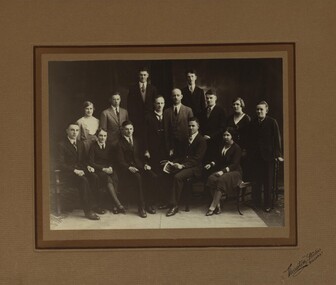
Photograph, Thornton Studios, Ballarat School of Mines: Magazine Committee, 1932, 1932
... J R Pound (President); Mr. A E Williams (manager); C L Smith ( art); K Windsor (sport); J Curran (Junior Tech) Front row: J Walters (sport); J Skelton (Prep); F Whitworth (sec); ...J R Pound (President); Mr. A E Williams (manager); C L Smith ( art); K Windsor (sport); J Curran (Junior Tech) Front row: J Walters (sport); J Skelton (Prep); F Whitworth (sec); student magazine committee m wilson s j allan a bosher r elsworth dr j r pound a e williams c l smith k windsor j curran j walters j skelton f whitworth Thornton Studios Ballarat Black and white photograph mounted on fawn card. ...A Student Magazine was produced regularly with the assistance of students' contributions. News and photographs were also included giving an outline of activities, sporting results and awards. Photograph shows: Back row: M Wilson (chem); S J Allan (art) Second row: A Bosher (art); R Elsworth (science); Dr. J R Pound (President); Mr. A E Williams (manager); C L Smith ( art); K Windsor (sport); J Curran (Junior Tech) Front row: J Walters (sport); J Skelton (Prep); F Whitworth (sec); Black and white photograph mounted on fawn card. People in formal pose - students and staff.Thornton Studios Ballaratstudent magazine, committee, m wilson, s j allan, a bosher, r elsworth, dr j r pound, a e williams, c l smith, k windsor, j curran, j walters, j skelton, f whitworth -
 Greensborough Historical Society
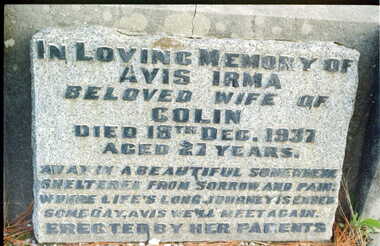
Photograph - Digital Image, Grave of Avis I. Williams, Greensborough Cemetery, 18/12/1937
... Williams (died 18/12/1937) in Plot# I7 Greensborough Cemetery. Greensborough Cemetery was created when land was given for the cemetery by Mr William Poulter, a local settler, about 1864. ...Grave of Avis I. Williams (died 18/12/1937) in Plot# I7 Greensborough Cemetery.Greensborough Cemetery was created when land was given for the cemetery by Mr William Poulter, a local settler, about 1864. The cemetery holds the graves of many of the early settlers in the district. The cemetery holds approximately 250 grave sites with 350 people buried there. Avis Irma Williams died 18/12/1937)Digital copy of colour photograph of grave/headstone.avis williams, greensborough cemetery -
 Greensborough Historical Society
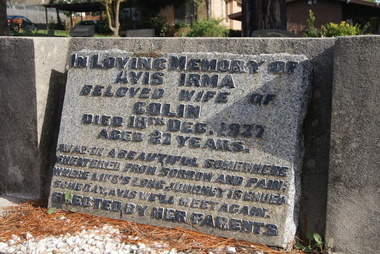
Photograph - Digital Image, Grave of Avis I. Williams , Greensborough Cemetery, 18/12/1937
... Williams (died 18/12/1937) in Plot# I7 Greensborough Cemetery. Greensborough Cemetery was created when land was given for the cemetery by Mr William Poulter, a local settler, about 1864. ...Grave of Avis I. Williams (died 18/12/1937) in Plot# I7 Greensborough Cemetery. Greensborough Cemetery was created when land was given for the cemetery by Mr William Poulter, a local settler, about 1864. The cemetery holds the graves of many early settlers in the district. Digital copy of colour photograph of grave/headstone.avis williams, greensborough cemetery -
 Ringwood and District Historical Society
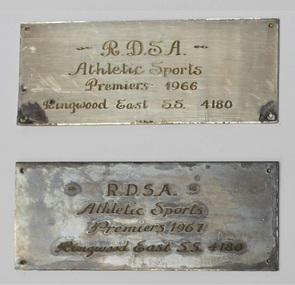
Award, RDSA / Ringwood East State School Premiers engraved award base plates - 1966 & 1967, 1966
... The members of the team are: Elizabeth Campbell (capt.), Rhonda Dick (vice-capt.), Lynda Williams, Janine Stubbs, Kaye Hinds, Pauline Grotto and Jenny Cleary, and the reserves, Margaret Taylor and Rhonda Clarke. The girls are coached by Mr...The members of the team are: Elizabeth Campbell (capt.), Rhonda Dick (vice-capt.), Lynda Williams, Janine Stubbs, Kaye Hinds, Pauline Grotto and Jenny Cleary, and the reserves, Margaret Taylor and Rhonda Clarke. The girls are coached by Mr ...Two engraved metal plates (unmounted) - Ringwood East State School Athletic Sports Premierships in 1966 and 1967, and Ringwood Mail newspaper clipping dated 25 August, 1966, regarding basketball premiership records achieved by the school.RDSA /Athletic sports/Premiers 1966/ Ringwood East State School 4180 RDSA /Athletic sports/Premiers 1967/ Ringwood East State School 4180 Newspaper article includes: ... At the metropolitan semi-finals on August 17, East defeated Pascoe Vale 23-17, and in the final, East, in a close-fought match, defeated Campmeadows 33-31. The members of the team are: Elizabeth Campbell (capt.), Rhonda Dick (vice-capt.), Lynda Williams, Janine Stubbs, Kaye Hinds, Pauline Grotto and Jenny Cleary, and the reserves, Margaret Taylor and Rhonda Clarke. The girls are coached by Mr. John Deany. -
Ringwood and District Historical Society
Certificate, Oliver, Thomas, Ringwood & District Horticultural Society Show First Prize Certificate - 1899, March, 1899
... Mr J. Hewish Best 6 swede turnips" +Additional Keywords: Oliver, Thomas, Lilydale / Hewish, J / Hall, C.D. (Pres) / Williams...Mr J. Hewish Best 6 swede turnips" +Additional Keywords: Oliver, Thomas, Lilydale / Hewish, J / Hall, C.D. (Pres) / Williams ...1 of 5 certificates belonging to J. HewishWhite cardboard certificate with gold printing from "Ringwood & District Horticultural Society. Third Show held on Tuesday March 14, 1899. First Prize Mr J. Hewish Best 6 swede turnips" +Additional Keywords: Oliver, Thomas, Lilydale / Hewish, J / Hall, C.D. (Pres) / Williams, George A. (Sec)as above -
Ringwood and District Historical Society
Document - Handout, Ringwood Garden Club, Handout of the Beautiful Gardens of Ringwood Competition, 19th and 20th September, 1987, 1987
... Blank, 28 Panorama Rd., Ringwood. (44) Section 2: Home Garden - Street Frontage Not Exceeding 65 ft. (20 m.) 1st. Mr. G. Williams, 69 Evelyn Rd., Ringwood.(73) 2nd. ...Blank, 28 Panorama Rd., Ringwood. (44) Section 2: Home Garden - Street Frontage Not Exceeding 65 ft. (20 m.) 1st. Mr. G. Williams, 69 Evelyn Rd., Ringwood.(73) 2nd. ...Handout of the Beautiful Gardens of Ringwood Competition, 19th and 20th September, 1987.Foolscap typed sheet.BEAUTIFUL GARDENS OF RINGWOOD COMPETITION. 19th. & 20th. September, 1987. The following is a list of the Prize-Winning Gardens in this years Garden Competition. A total of 16 gardens were submitted for judging. Points awarded by the judge are in brackets and are given from a maximum of 100. Section 1: Home Garden - Street Frontage Exceeding 65 ft.(20 m.) 1st: Mr. B. Wheatley, 57 Oliver Street, Ringwood.(86) 2nd: Mr. K. Clark, 42 Bronhill Rd., Ringwood East.(67) 3rd: Mr. A. Blank, 28 Panorama Rd., Ringwood. (44) Section 2: Home Garden - Street Frontage Not Exceeding 65 ft. (20 m.) 1st. Mr. G. Williams, 69 Evelyn Rd., Ringwood.(73) 2nd. D. & P. Smithson, 7 Pamela Court, Nth. Ringwood. (72) 3rd. Mrs. D. Kane, 16 Lynwood Ave., Ringwood East.(65) Section 3: Home Garden - Front Only. Area that can be viewed from the Street. 1st: Mr. L. Sperling, 4 Lorienne Rd., Heathmont.(67) 2nd. Mr. H. Smit, 21 Unsworth Rd., Ringwood.(63) 3rd. Mr. & Mrs. G. Schmad, 8 Lyn Crt., Ringwood.(53) Section 4: Individual Garden in a Group of Flats or Home Units. (may include rear garden) 1st: Mr. & Mrs. C. & B. Harris, Unit 6, 32 Wilana St. Ringwood.(72) 2nd: Mr. & Mrs. W.C. & T. Wilson, Unit 5, 32 Wilana St., Ringwood. (49) Section 5: Garden in Non-Residential Property. There were no entries in this section. The Ringwood Garden Competition is sponsored by the Ringwood City Council and organised by the Ringwood Garden Club. The President and Committee of the Ringwood Garden Club would like to thank all home gardeners of Ringwood who entered this year's competition and hope they will enter again next year. If you would like to know more about the activities of our Club, come along to our meetings, which are held on the FOURTH MONDAY of each month, in the Ringwood Senior Citizens Clubrooms, Greenwood Ave., Ringwood commencing at 8.00 p.m. A warm welcome will be made to all visitors to our meetings. ____________________________________________ ___________________________________________ __________________________________________ _________________________________________ ________________________________________ -
 Ringwood and District Historical Society
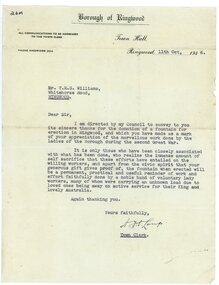
Document, Ringwood Bowls Club- Letter from Town Clerk Ringwood to Mr T. R. G. Williams, giving thanks for donation of Fountain for erection in Ringwood. Letter dated 11th October, 1946
... Ringwood Bowls Club- Letter from Town Clerk Ringwood to Mr T. R. G. Williams, giving thanks for donation of Fountain for erection in Ringwood. ...Ringwood Bowls Club- Letter from Town Clerk Ringwood to Mr T. R. G. Williams, giving thanks for donation of Fountain for erection in Ringwood. ...Typed letter.Letter includes thanks to the many voluntary ladies for their time and effort during the War period to make the donation possible. Signed by Mr A. B. Long, Town Clerk, Borough of Ringwood. -
 Ringwood and District Historical Society
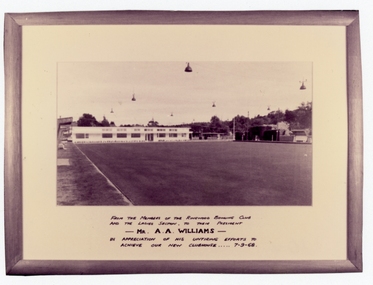
Photograph, Ringwood Bowling Club- Photograph of new Clubhouse, presented to Mr. A. A. Williams, 1968
... Ringwood Bowling Club- Photograph of new Clubhouse, presented to Mr. A. A. Williams, 1968...."Attached to photograph" From the Members of the Ringwood Bowling Club and the Ladies Section, to their President ---- Mr. A. A. Williams ---- in appreciation of his untiring efforts to achieve our new Clubrooms ..... 7-9-68...."Attached to photograph" From the Members of the Ringwood Bowling Club and the Ladies Section, to their President ---- Mr. A. A. Williams ---- in appreciation of his untiring efforts to achieve our new Clubrooms ..... 7-9-68. ...Sepia photograph "Attached to photograph" From the Members of the Ringwood Bowling Club and the Ladies Section, to their President ---- Mr. A. A. Williams ---- in appreciation of his untiring efforts to achieve our new Clubrooms ..... 7-9-68. -
 Ringwood and District Historical Society
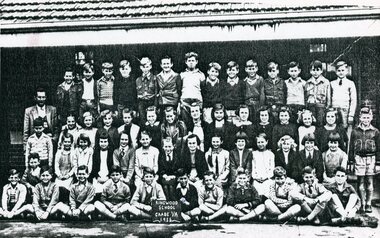
Photograph, Ringwood State School -Class photograph - Grade 5A, 1955
... Williams, John Gray, ?, John Rutledge, Alexander Allen, John Littlepage, Russell Griffin, Peter Tricke, Ray Brown, David Penny, Jan Strys. Teacher: Mr...Williams, John Gray, ?, John Rutledge, Alexander Allen, John Littlepage, Russell Griffin, Peter Tricke, Ray Brown, David Penny, Jan Strys. Teacher: Mr ...Black and white photograph - Grade 5A, 1955"Attached to photograph" Back Row- L to R: Jeffrey Thomas, Alan Isherwood, ?, Bruce Nicholson, Frank Austin, Tom Perkins, Ted McGouldrick, David Rothoni, Jeff Egan, John Littlepage, Lindsay Biggin, ?, John Aoosey, Rodney Uren. 2nd Row - L to R: Phillip Austin, Wendy Hall, Sandra Marshall, Diane Close, Mary Lloyd, Meryle Hagen, Lee Yenkin, Phyllis Horgon, Marcia Kempse, Carol Whitford, Irene Jacobs, Carolyn Roberts, Faye Bryan. 3rd Row - L to R: Ian McLeod, Carolyn Hately, Ailsa Ralston, Heather Clarke, Judy Van Praitt, Pam Goodall, Dawn Marley, Diane Galenato, Jennifer Lewis, Susan Daw, Susan Hayward, Janice Renowden, Pam Hubbard, Colin Tricke. Front Row - L to R: Kevin Williams, John Gray, ?, John Rutledge, Alexander Allen, John Littlepage, Russell Griffin, Peter Tricke, Ray Brown, David Penny, Jan Strys. Teacher: Mr Reid -
 Ringwood and District Historical Society
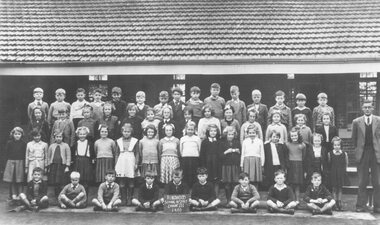
Photograph, Ringwood State School -Class photograph - Grade 3, 1950
... Williams, Ken Seymour, Bruce Fletcher, Ken Baker, Robert Johns. 2nd Row - L to R: Jennifer Mason, Beverley McClean, ?, Isabel Sykes, Julie Sanders, Wendy Anderson, Margaret Dornam, ?, ?, Moya Crane, Sandra Tindall, ?, Anne Whitehouse, Lynette Johnston. 3rd Row - L to R: Nola Burns, Carol Price, Pat Rutherford, Diane Dewer, Margaret Hocking, Gillian Morris, Carol Kennedy, Shirley Spence, ?, Juan Harris, Joan Ingram, Jill Pump, ?, ?, Shirley Kerford, Barbara Johnson. ?. Front Row - L to R: ?, Gary Bentley, Doug Bangay, Ray Taylor, Douglas Mackie, Peter Fry, Frank Morris John Willis, Keith Anderson. Teacher: Mr...Williams, Ken Seymour, Bruce Fletcher, Ken Baker, Robert Johns. 2nd Row - L to R: Jennifer Mason, Beverley McClean, ?, Isabel Sykes, Julie Sanders, Wendy Anderson, Margaret Dornam, ?, ?, Moya Crane, Sandra Tindall, ?, Anne Whitehouse, Lynette Johnston. 3rd Row - L to R: Nola Burns, Carol Price, Pat Rutherford, Diane Dewer, Margaret Hocking, Gillian Morris, Carol Kennedy, Shirley Spence, ?, Juan Harris, Joan Ingram, Jill Pump, ?, ?, Shirley Kerford, Barbara Johnson. ?. Front Row - L to R: ?, Gary Bentley, Doug Bangay, Ray Taylor, Douglas Mackie, Peter Fry, Frank Morris John Willis, Keith Anderson. Teacher: Mr ...Black and white photograph - Grade 3, 1950"Attached to photograph" Back Row- L to R: Alan Telfer, Doug Hume, Terry Decini, Brian Rothney, Jim Armstrong, ?, Ian Sharp, Brian Reynolds, John Munday, Tom Williams, Ken Seymour, Bruce Fletcher, Ken Baker, Robert Johns. 2nd Row - L to R: Jennifer Mason, Beverley McClean, ?, Isabel Sykes, Julie Sanders, Wendy Anderson, Margaret Dornam, ?, ?, Moya Crane, Sandra Tindall, ?, Anne Whitehouse, Lynette Johnston. 3rd Row - L to R: Nola Burns, Carol Price, Pat Rutherford, Diane Dewer, Margaret Hocking, Gillian Morris, Carol Kennedy, Shirley Spence, ?, Juan Harris, Joan Ingram, Jill Pump, ?, ?, Shirley Kerford, Barbara Johnson. ?. Front Row - L to R: ?, Gary Bentley, Doug Bangay, Ray Taylor, Douglas Mackie, Peter Fry, Frank Morris John Willis, Keith Anderson. Teacher: Mr Leach Added Sc0025 photo to "Media" and deleted VC entry 2158 on 14th June 2022. Sc0025 now with this Entry. -
 Ringwood and District Historical Society
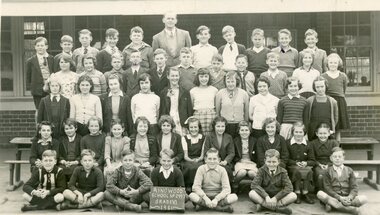
Photograph, Ringwood State School -Class photograph - Grade 6, 1951
... Williams, Annette DeClifford. 3rd Row - L to R: Helen Ingram, ? Jenkins, Valerie Weist, Margaret Mc Dermott, Ellen Mead, Nancy Dyson, ?, Judith Huxley, ? Goodwin, Beverley Wigley. 4th Row - L to R: Fay Staphensen, Glenys Sanders, Lynette Rackham, Margaret Davidson, Joan Chiltern, Louise Ritch, Janice Shepherd, Kay Decini, Jeennifer Stirrup, Roberta Burns, Lynette Koefod, Betty Sumner. Front Row - Don Jones, ?, ?, ?, Graeme Sanders, Keith taylor, ?, Robert Foster. Teacher: Mr...Williams, Annette DeClifford. 3rd Row - L to R: Helen Ingram, ? Jenkins, Valerie Weist, Margaret Mc Dermott, Ellen Mead, Nancy Dyson, ?, Judith Huxley, ? Goodwin, Beverley Wigley. 4th Row - L to R: Fay Staphensen, Glenys Sanders, Lynette Rackham, Margaret Davidson, Joan Chiltern, Louise Ritch, Janice Shepherd, Kay Decini, Jeennifer Stirrup, Roberta Burns, Lynette Koefod, Betty Sumner. Front Row - Don Jones, ?, ?, ?, Graeme Sanders, Keith taylor, ?, Robert Foster. Teacher: Mr ...Black and white photograph - Grade 6, 1951"Attached to photograph" Back Row- L to R: Rex ?, Alan ?, Cliff Jones, Geoff Mathews, Robyn Pratt, ?, ?, Robert Clarke, Don ?, David Crouch, Don McKie, Malcolm Powell. 2nd Row - L to R: Valda Peterson, Glenys Bouvard, Les Lloyd, Les Fordham, Robert Pryor, Alan Hampson, Les Hager, George Patterson, Ron Hager, Joyce Williams, Annette DeClifford. 3rd Row - L to R: Helen Ingram, ? Jenkins, Valerie Weist, Margaret Mc Dermott, Ellen Mead, Nancy Dyson, ?, Judith Huxley, ? Goodwin, Beverley Wigley. 4th Row - L to R: Fay Staphensen, Glenys Sanders, Lynette Rackham, Margaret Davidson, Joan Chiltern, Louise Ritch, Janice Shepherd, Kay Decini, Jeennifer Stirrup, Roberta Burns, Lynette Koefod, Betty Sumner. Front Row - Don Jones, ?, ?, ?, Graeme Sanders, Keith taylor, ?, Robert Foster. Teacher: Mr Davis -
 Ringwood and District Historical Society
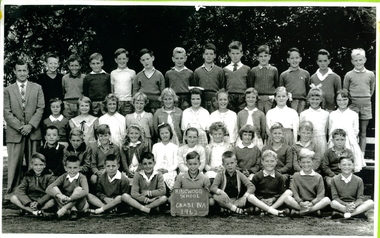
Photograph, Ringwood State School - Grade 4A, 1962
... Front Row- L to R: Robin Hagar, Greg Peters, Malcolm Williams, Phillip Bates, David Kimberley, Michael Craddock, David Kennely, Neil Dawe, Jeffrey Fields. Teacher: Mr...Front Row- L to R: Robin Hagar, Greg Peters, Malcolm Williams, Phillip Bates, David Kimberley, Michael Craddock, David Kennely, Neil Dawe, Jeffrey Fields. Teacher: Mr ...Black and white photograph - Grade 4A, 1962"Attached to photograph" Back Row- L to R: Russell Bourke, Robert Taylor, Malcolm Pearson, Russell Paine, Gavin Phillips, Neil Rattray, Gary Davies, ?, Barry McDonald, Craig Austin, Gary McCubbin, John Moon. 2nd Row- L to R: Julie Cook, Jan Thompson, Leslie Gray, Leanne Thorpe, Laurie Simpson,, Debbie Lawrence, Elizabeth Clarke, Roslyn wiggle, Diana Rankin, Wilemina Cook, Janet Conlon. 3rd Row- L to R: Tommy Colston, Stephen Cross, Jeffrey Ratten, Roslyn (?), Sally Shaw, Debbie Monk, Rhonda McLeod, Karen Williams, Ian Jones, Leslie Reed, David Connell. Front Row- L to R: Robin Hagar, Greg Peters, Malcolm Williams, Phillip Bates, David Kimberley, Michael Craddock, David Kennely, Neil Dawe, Jeffrey Fields. Teacher: Mr Delacca -
 Ringwood and District Historical Society
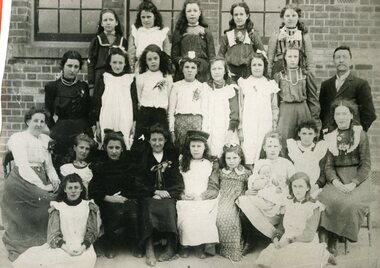
Photograph, Ringwood State School - Grade 6 (?), 1905
... , Olive Porteous, Alice Blood, Evelyn Blood, Floss Hocking, Elvie Hill, ruby Saunders, Mr Hocking (Headmaster). 3rd Row - L to R: Miss Geraghty, Winnie Thomas, Vera Edgar, G McAlpin, Lena Williams, Alice Hodgetts, Ethel Colcott, Doris Oates, Miss Predeaux. ..., Olive Porteous, Alice Blood, Evelyn Blood, Floss Hocking, Elvie Hill, ruby Saunders, Mr Hocking (Headmaster). 3rd Row - L to R: Miss Geraghty, Winnie Thomas, Vera Edgar, G McAlpin, Lena Williams, Alice Hodgetts, Ethel Colcott, Doris Oates, Miss Predeaux. ...Black and white photograph - Grade 6(?), 1905"Attached to photograph" Back Row - L to R: Hilda Aird, Anastasia Smith, Clara Aird, Flo Blood, Edith Blood. 2nd Row - L to R: ?, Olive Porteous, Alice Blood, Evelyn Blood, Floss Hocking, Elvie Hill, ruby Saunders, Mr Hocking (Headmaster). 3rd Row - L to R: Miss Geraghty, Winnie Thomas, Vera Edgar, G McAlpin, Lena Williams, Alice Hodgetts, Ethel Colcott, Doris Oates, Miss Predeaux. Front Row - L to R: Mary Graham, Olive Burchett. Teacher: -
 Ringwood and District Historical Society
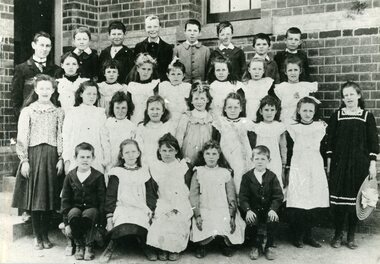
Photograph, Ringwood State School - Grade(?), 1901
... "Attached to photograph" Back Row - L to R: Mr Draper, Bert Hocking (Son of H.T.), George Tortice, Bill Knox, Fred Campbell, Alf Milne, Frank Parker 9( later Mayor of Ringwood), A Milne. 2nd Row - L to R: Edie Graham, Grace Thomas, Alice Hodgetts, ?, Ruby Saunders, Elvie Hill (Mrs McAlpin, Mayroress of Ringwood), ?. 3rd Row - L to R: ?, ?, ?, Vera Hunt, Floss Hocking (Daughter of H.T.), ?, Ethel Colcott, Winnie Thomas, Olive Porteous, Lena Williams..."Attached to photograph" Back Row - L to R: Mr Draper, Bert Hocking (Son of H.T.), George Tortice, Bill Knox, Fred Campbell, Alf Milne, Frank Parker 9( later Mayor of Ringwood), A Milne. 2nd Row - L to R: Edie Graham, Grace Thomas, Alice Hodgetts, ?, Ruby Saunders, Elvie Hill (Mrs McAlpin, Mayroress of Ringwood), ?. 3rd Row - L to R: ?, ?, ?, Vera Hunt, Floss Hocking (Daughter of H.T.), ?, Ethel Colcott, Winnie Thomas, Olive Porteous, Lena Williams ...Black and white photograph - Grade(?), 1901"Attached to photograph" Back Row - L to R: Mr Draper, Bert Hocking (Son of H.T.), George Tortice, Bill Knox, Fred Campbell, Alf Milne, Frank Parker 9( later Mayor of Ringwood), A Milne. 2nd Row - L to R: Edie Graham, Grace Thomas, Alice Hodgetts, ?, Ruby Saunders, Elvie Hill (Mrs McAlpin, Mayroress of Ringwood), ?. 3rd Row - L to R: ?, ?, ?, Vera Hunt, Floss Hocking (Daughter of H.T.), ?, Ethel Colcott, Winnie Thomas, Olive Porteous, Lena Williams. Front Row - L to R: (?) Wadeson, Violet McDermott, Anastasia Smith, Evlyn Blood, (?) Wadeson. Teacher: Mr Draper. -
 Ringwood and District Historical Society
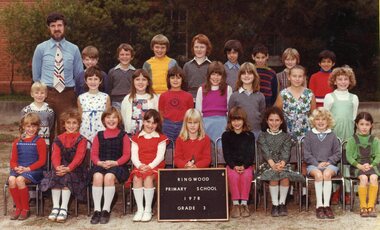
Photograph, Ringwood State School - Grade 3, 1978
... , Tracey Williams, Ellen Hodgson. Teacher: Mr Hatfield. ..., Tracey Williams, Ellen Hodgson. Teacher: Mr Hatfield. Colour photograph - Grade 3, 1978. ...Colour photograph - Grade 3, 1978."Attached to photograph" Back Row-L to R: Simon (?), Johnny Tomada, ?, David Postlewaite, Mark Hirt, ?, Robert McDougall, Dale Franklin. 2nd Row- L to R: Craig McDonald, ?, Nichole Mathieson, Kerryn Hopgood, Rachel McEwen, ?, Lexie Jenkinson, ?. Front Row- L to R: Tania Alhaus, ?, Jenny Murray, Anthoula (?), Julie Rigg, Tania (?), ?, Tracey Williams, Ellen Hodgson. Teacher: Mr Hatfield. -
 Ringwood and District Historical Society
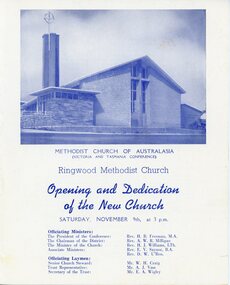
Programme, Methodist Church, Ringwood, Victoria. Opening and Dedication of the New Church - 1963
... Williams, LTh Associate Minister - Rev. E.V. Saynor, B.A. and Rev. D.W. Uren. Officiating Laymen: Senior Church Steward - Mr W.H.Craig Trust Represenative - Mr A.J. ...Williams, LTh Associate Minister - Rev. E.V. Saynor, B.A. and Rev. D.W. Uren. Officiating Laymen: Senior Church Steward - Mr W.H.Craig Trust Represenative - Mr A.J. ...2 Programmes for the opening and dedication of the new church, November 9th, 1963, by the President of the Confrence, Rev. H.B. Freeman, M.A.Officiating Ministers: The President of the Confrence - Rev. H.B. Freeman, M.A The Chairman of the District - Rev A.W.R. Milligan The Minister of the Church - Rev. H.J. Williams, LTh Associate Minister - Rev. E.V. Saynor, B.A. and Rev. D.W. Uren. Officiating Laymen: Senior Church Steward - Mr W.H.Craig Trust Represenative - Mr A.J. Vass Secretary of the Trust - Mr E. A. Wigley -
 Ringwood and District Historical Society
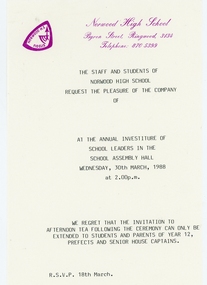
Programme, Norwood High School, Ringwood, Victoria, Investiture of School Leaders 1988
... Peter Cutter, President of School Council, Mr. Max Williams....Peter Cutter, President of School Council, Mr. Max Williams. Order of proceedings, with names of School Captains, Prefects, House Captains, and SRC representatives. ...Order of proceedings, with names of School Captains, Prefects, House Captains, and SRC representatives.Special Guests - Mayor and Mayoress of Ringwood, Cr. J. Caffyn and Mrs. Caffyn, General Manager, Eastern Metropolital Region, Mr. Peter Cutter, President of School Council, Mr. Max Williams. -
 Ringwood and District Historical Society
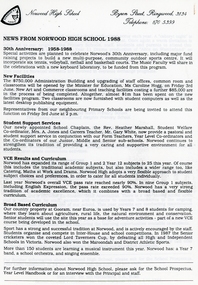
Document, News From Norwood High School, Ringwood, Victoria - 1988
... School Council President: Mr. Max Williams. ...School Council President: Mr. Max Williams. 2-page information sheet outlining 1988 school carriculum, student opportunities and associated activities. ...2-page information sheet outlining 1988 school carriculum, student opportunities and associated activities.Enrolments are increasing and this year more than 1018 students attend Norwood. Further information available through School Prospectus, Year Level Handbook, or interview with the Principal and staff. Principal: Mr. Ian Macfarlane, B.A., B.Ed. School Council President: Mr. Max Williams.
