
Showing 272 items matching "e price"
-
 Bendigo Military Museum
Mixed media - KANGAROO FLAT SOLDIERS MEMORIAL 1917 - 1921
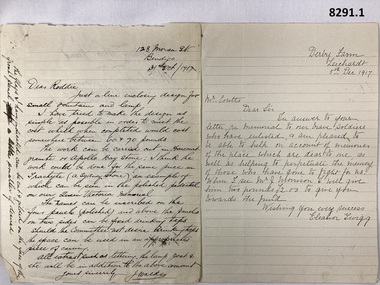
... Price list for Soldiers Memorial works. (c) Sketch in pencil re "Cyclone Spring coil". (d) Letter in Pencil, has a date "Wed April 10th" regarding the final site of the Memorial either, a block of ground in front of the Methodist Church or a block of ground in front of State School. Both fronted the Main Road. Mrs Allen donated the block in front of the School, this offer was accepted. (e...Price list for Soldiers Memorial works. (c) Sketch in pencil re "Cyclone Spring coil". (d) Letter in Pencil, has a date "Wed April 10th" regarding the final site of the Memorial either, a block of ground in front of the Methodist Church or a block of ground in front of State School. Both fronted the Main Road. Mrs Allen donated the block in front of the School, this offer was accepted. (e ...The Cat No 8290 pre this is the Minute book related to "The Kangaroo Flat Soldiers Memorial fund project". These letters, documents, name lists, sketches, quotes all revolve around the project to build a Memorial. They are dated from 31.10.1917 to 12.4.1921. This also includes documentation to have a "War Trophy(s)" on the site. At this time in history Kangaroo Flat was part of the Marong Shire not Bendigo. .1) 1917. These two letters are addressed to Roderick Coutts who was the Secretary of the Memorial Committee. .2) 1918.These letters & documents are broken up into 14 groups (a - n) all re the Kangaroo Flat Memorial. (a) Shire of Marong x two dated 7.6.1918 & 4.10.1918. (b) J.B. Wilson Monumental Sculptures x three dated 2.5.1918 to 9.10.1918. (c) J. Harris Monumental and General Masons dated 6.5.1918. (d) P Finn & Co General Masons dated 21.5.1918. (e) W & R Quinn General Masons dated 21.5.1918. (f) A. M. Irwin Builder & Contractors x two dated 10.11.1918 & 18.11.1918. (g) Herbert Keck & Sons Nurseryman and Orchardist dated 18.9.1918. (h) Department of Public Works x three dated 13.5.1918 - 24.9.1918 - 27.9.1918. (i) Education Department Melbourne x six re State School No 981 Kangaroo Flat dated 6 .3.1918 to 29.8. 1918. (j) Letters x two re R Coutts dated 6.2.1918 & 4.3.1918. (k) Kangaroo Flat & District Soldiers Memorial Fund x one Coutts to Okey. (l) McColl, Rankin & Stanistreet Legal Managers & Accountants x one dated 5.12.1918. (m) Snowden, Neave & Demaine Solicitors & Co x two dated 24.1.1918 & 7.8.1918. (n) Auditors report x one dated 16.12.1918. .3) 1919. Letters x two from "Myr - Nong" Elsternwick to Mr Okey dated 19.3.1919 & 31.3.1919. .4) 1920. Letters x two from the "Prime Ministers Department & Australian Military Forces 3rd Military District" dated 4.3.1920 & 8.3.1920. .5) Six miscellaneous items, only one has a date. (a) Short note re a donation to the Memorial. (b)Price list for Soldiers Memorial works. (c) Sketch in pencil re "Cyclone Spring coil". (d) Letter in Pencil, has a date "Wed April 10th" regarding the final site of the Memorial either, a block of ground in front of the Methodist Church or a block of ground in front of State School. Both fronted the Main Road. Mrs Allen donated the block in front of the School, this offer was accepted. (e) Sketch plan in pencil and red ink showing a proposal of how the site would look with the Memorial on. (f) Two sections of paper pinned together, one in ink, one in pencil. The ink piece is name listed 1 - 65 and some names have notations written next to and is double sided. The notations are "Returned or Killed". The pencil listing has a list of 18 names with "Killed" next to. The other part has 45 names. On the rear of this one is some pencil notes, a sketch and re a meeting on "June 5th". .6) Newspaper cuttings x 2. one relates the site chosen for the Kangaroo Flat Soldiers Memorial being the block in front of the school and donated by Mrs Allen. The other relates to the Repatriation Commission and the costing of local Memorials. .7) War trophy documents & correspondence. (a & b) Dated 10th & 17th December 1918 re application for War trophies replied by the State Parliament House Melbourne. (c) Dated 24 the October 1919. From the Australian War Museum - Wool Exchange King Street Melbourne. (d & e) Dated 22.10.1919 & 8.10.1920. From the Victorian State Trophy Committee and State Parliament. (f) Dated 17th April 1921. From the Victorian State Trophy Committee re allotment of a War trophy. (g) Double sided correspondence with "V98a" at top details the process of allotting War trophies, the Committee, conditions, town size and what is allotted per size. Stamped in purple is "One Machinegun". .1) 1917.Two letters, white paper, ruled lines with black ink hand writing, dated 31.10.1917 & 5.12.1917, the October letter has pencil notes on the rear. .2) 1918. Twenty six letters, documents, quotes either hand written in black pen, pencil, black & purple typed, Business names re letter heads some with images dating from 24.1.1918 ot 30.12.1918. .3) 1919. Two letters all in black pen, one has two pages, both letters have same heading stamp at the top in purple. Dated 19.3.1919 & 31.3.1919. .4) 1920. Two letters typed in black, both have a letter head, dated 4.3.1920 & 8.3.1920. .5) Items. Six miscellaneous items, letter, lists, prices, sketches of the proposed memorial site. .6) Articles. Two Newspaper clippings, yellowed black print, one has been found being 18.4.1918. .7) War trophies. Seven letters and documents, six have a date relating to "War Trophies", black and purple print, dates are 17.2.1918 to 12.4.1921. Sizes vary from note pad size to Foolscap.brsl, smirsl, kfsmf, letters -
 Warrnambool and District Historical Society Inc.
Newspaper, Warrnambool Standard July 1, 1905, 1905
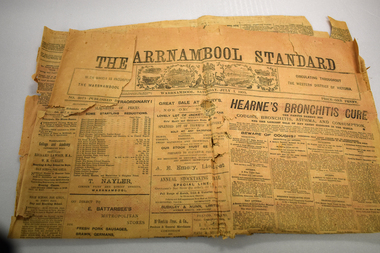
... E Battarbee, Beattie and Phillips,Wm Ardlie, H G Wilkinson Cramond & Dickson, F Tozer, Wm Swinton, Bruce & McClure. There are reports covering items of local, national and International news events. This paper provides a snapshot of history in the given era from a Warrnambool perspective. It shows the wide range of businesses operating at the time 1905 and the general interests of the people. Warrnambool standard 1905 The Warrnambool Standard with which is incorporated the Warrnambool Examiner, circulating throughout the Western District of Victoria. Price ...The Warrnambool Standard newspaper was started in 1872 by William Fairfax and Henry Laurie. It continues in that context today as a daily newspaper for the Western District. This copy is dated July 1 1905 and covers items of interest and advertisements for current businesses many which continued as household names until the latter part of the 20th Century. These include the following: J Younger, E Battarbee, Beattie and Phillips,Wm Ardlie, H G Wilkinson Cramond & Dickson, F Tozer, Wm Swinton, Bruce & McClure. There are reports covering items of local, national and International news events.This paper provides a snapshot of history in the given era from a Warrnambool perspective. It shows the wide range of businesses operating at the time 1905 and the general interests of the people.Four pages of newsprint with the mast head of the Warrnambool Standard . the paper is dated Saturday July 1, 1905. The Warrnambool Standard with which is incorporated the Warrnambool Examiner, circulating throughout the Western District of Victoria. Price -One Penny. The words printed on a banner run below the masthead groups of cattle horses and sheep and reads "By these we thrive". Advance Australia is similarly written underneath a Coat of Arms. warrnambool standard 1905 -
 South West Healthcare
Cheron Uterine Dressing Forceps, 20th Century
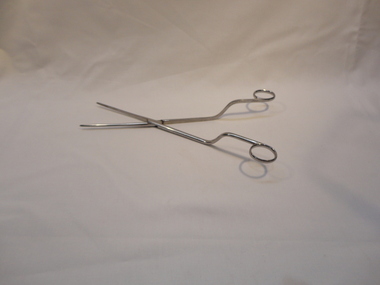
... gynecological instrument uterine forceps hemostat forceps dr rhema price "TURTON & SONS SHEFFIELD" "S" "MADE FOR E & AD. PTY LTD SYDNEY" Stainless steel scissor-like insturment with serrated ends Cheron Uterine Dressing Forceps Turton & Sons ...Stainless steel scissor-like insturment with serrated ends"TURTON & SONS SHEFFIELD" "S" "MADE FOR E & AD. PTY LTD SYDNEY"gynecological instrument, uterine forceps, hemostat forceps, dr rhema price -
 National Wool Museum
Book, Knitting, Patons Book no. 483: Winter Warmers
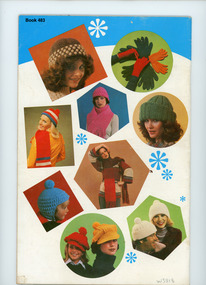
... WINTER / WARMERS / PATONS / Book 483 / 40 Designs for Hats, / Caps, Scarves, Gloves / and Mittens. / PRICE / CODE / E...It was produced by Coats Patons and contains knitting and crochet patterns for hats, scarves and gloves. knitting handicrafts - history crochet coats patons (australia) limited knitting handicrafts - history crochet WINTER / WARMERS / PATONS / Book 483 / 40 Designs for Hats, / Caps, Scarves, Gloves / and Mittens. / PRICE / CODE / E Patons Book no. 483: Winter Warmers Book, Knitting ...This book was owned by the late Dr Elizabeth Kerr and was donated to the Museum by the executor of her estate, Margaret Cameron. It was produced by Coats Patons and contains knitting and crochet patterns for hats, scarves and gloves.WINTER / WARMERS / PATONS / Book 483 / 40 Designs for Hats, / Caps, Scarves, Gloves / and Mittens. / PRICE / CODE / Eknitting handicrafts - history crochet, coats patons (australia) limited, knitting, handicrafts - history, crochet -
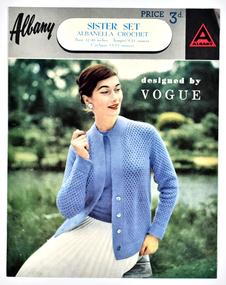 National Wool Museum
Booklet - Albany Knitting, Sister Set Albanella Crochet, Albany Woollen Mills
... PRICE 3d. / SISTER SET / ALBANELLA CROCHET / Bust 32-40 inches. Jumper 9-11 ounces / Cardigan 13-15 ounces / ALBANY / designed by / V O G U E...PRICE 3d. / SISTER SET / ALBANELLA CROCHET / Bust 32-40 inches. Jumper 9-11 ounces / Cardigan 13-15 ounces / ALBANY / designed by / V O G U E Four page paper fold out brochure with colour photograph on the front and printed black text on other pages. ...Four page paper fold out brochure with colour photograph on the front and printed black text on other pages. Image shows a woman seated in a garden setting wearing a blue cardigan.front: [printed] Albany / PRICE 3d. / SISTER SET / ALBANELLA CROCHET / Bust 32-40 inches. Jumper 9-11 ounces / Cardigan 13-15 ounces / ALBANY / designed by / V O G U Eknitting, pattern, fashion, knitwear, albany woollen mills -
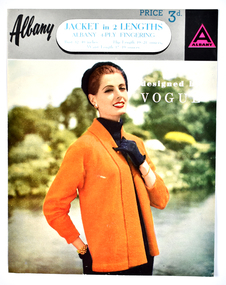 National Wool Museum
Booklet - Albany Knitting, Jacket in 2 Lengths, Albany Woollen Mills
... PRICE 3d. / JACKET in 2 LENGTHS / ALBANY 4-PLY FINGERING / Bust 32-40 inches Hip Length 19-21 ounces. / Waist Length 17-19 ounces / ALBANY / designed by / V O G U E...PRICE 3d. / JACKET in 2 LENGTHS / ALBANY 4-PLY FINGERING / Bust 32-40 inches Hip Length 19-21 ounces. / Waist Length 17-19 ounces / ALBANY / designed by / V O G U E Four page paper fold out brochure with colour photograph on the front and printed black text on other pages. ...Four page paper fold out brochure with colour photograph on the front and printed black text on other pages. Image shows a woman wearing an orange cardigan with black gloves and black headwear.front: [printed] Albany / PRICE 3d. / JACKET in 2 LENGTHS / ALBANY 4-PLY FINGERING / Bust 32-40 inches Hip Length 19-21 ounces. / Waist Length 17-19 ounces / ALBANY / designed by / V O G U Eknitting, pattern, fashion, knitwear, albany woollen mills -
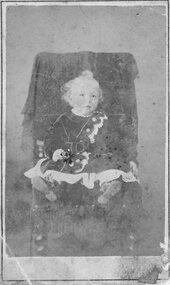 Stawell Historical Society Inc
Photograph, Master Alfred Thomas Huttley -- Studio Portrait
... E Near Parliment House Melbourne A Large Framed copy Of This Portrit may be had Price is View taken within 20 Miles of Town....E Near Parliment House Melbourne A Large Framed copy Of This Portrit may be had Price is View taken within 20 Miles of Town. ...B/W: toddler on a chair wearing dress, dark white lace buckled. colour tinted, fair curly hair holding a coured Rosealfred Thomas Huttley ( my Father) Stewart & Co 217 Bourke St. E Near Parliment House Melbourne A Large Framed copy Of This Portrit may be had Price is View taken within 20 Miles of Town. -
 Robin Boyd Foundation
Book, Kym Bonython, The Harold E Mertz Collection of Australian Art, 2000
... Walsh St library Two Postcards and one Thankyou card addressed to Patricia, Price list from Christie's Hardcover w/ Dust Jacket The Harold E Mertz Collection of Australian Art Book Kym Bonython Christie's Australia ...Hardcover w/ Dust JacketTwo Postcards and one Thankyou card addressed to Patricia, Price list from Christie'swalsh st library -
 Ballarat Tramway Museum
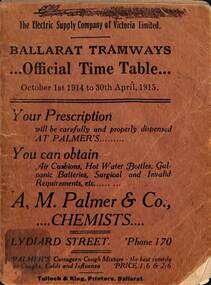
Ephemera - Ballarat, Electric Supply Co. of Vic (ESCo), "Official Time table", 1914
... prices, school tickets, fare box routes, fares, transfer tickets, and route colours both for day and night. Also has notes to passengers and places of interest for each route. Has contact phone numbers for the Company. Manager Mr Pringle. See item 9131 for a 1915 Winter timetable. Has many adverts - from the front page: A M Palmer Chemist Hodgson - optical Snows - department store Summerscales - postcards W E...prices, school tickets, fare box routes, fares, transfer tickets, and route colours both for day and night. Also has notes to passengers and places of interest for each route. Has contact phone numbers for the Company. Manager Mr Pringle. See item 9131 for a 1915 Winter timetable. Has many adverts - from the front page: A M Palmer Chemist Hodgson - optical Snows - department store Summerscales - postcards W E ...Timetable published by the Electric Supply Co of Victoria (ESCo) for Ballarat Tramways - dated 1/10/1914 to 30/4/1915. Provides times for each route, ticket prices, school tickets, fare box routes, fares, transfer tickets, and route colours both for day and night. Also has notes to passengers and places of interest for each route. Has contact phone numbers for the Company. Manager Mr Pringle. See item 9131 for a 1915 Winter timetable. Has many adverts - from the front page: A M Palmer Chemist Hodgson - optical Snows - department store Summerscales - postcards W E Thomas - Dentist L Casper - optician E Jermyn - feed merchant Standsfield & Smith - Decorators Briant's Red shop tea rooms A E White - tailor Ellingsen & Co - furniture Southern Cross Hotel H P Stevens & Co - fur coats Frank Williams - painter and decorator Longhurst's bread factory G Buchanan - metal ceilings Robert Hutchinson - electrical engineer and contractor G Ludbrook - furnishing undertaker A Cant - plumber, gasfitter and ironmonger Huddart Parker and Howard Smith coal merchants Precision Big 4 - motor cycles and bicycles H W Channing - Tram drivers' training school T H Richards - butcher C Ellis - furniture exchange Levecke's motor garage Frank Penhalluriack - electrical work Nankervis - store Taffy King Fred A Reed - tobacconist F & J W Gower - builder E E Hobson - decorator Walter Cornell - liver pills Irvines - wines G Warner - Ironmonger J A Reynolds - Wall papers W J Robson - leadlights Porter's - boots and shoes Holman & Fiscalini - stables and motor garage Butler & Co - blinds Mrs Kerby - clothing reseller Rose Cosmetic - H Binzer & Co Mrs Busfield - laundry Mrs J H Dogson - registry office for servants B G Tucker's Water Cure Electric Supply Co Rowlands drinks On the bottom of most pages - Sidar products and on the top the Coliseum Picture Palace. Demonstrates and ESCo timetable and provides information about fare systems and local businesses.Time table - booklet - 40 pages + brown light card covers centre stapled with tabbed or cut pages.tramways, ballarat, timetables, esco, advertisements, fares, tickets, fare boxes -
 Ballarat Tramway Museum
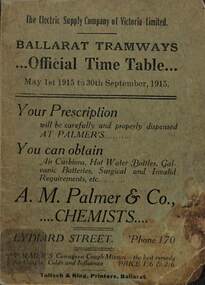
Ephemera - Ballarat, Electric Supply Co. of Vic (ESCo), "Official Time table", 1915
... prices, school tickets, issue and use of tokens, fares, transfer tickets, and route colours both for day and night. Also has notes to passengers and places of interest for each route. Has contact phone numbers for the Company. Manager Mr Pringle. See item 9132 for a 1914 Summer timetable. Has many adverts - from the front page: A M Palmer Chemist Hodgson - optical Snows - department store ESCo - show room in Sturt St L Casper - optician E...prices, school tickets, issue and use of tokens, fares, transfer tickets, and route colours both for day and night. Also has notes to passengers and places of interest for each route. Has contact phone numbers for the Company. Manager Mr Pringle. See item 9132 for a 1914 Summer timetable. Has many adverts - from the front page: A M Palmer Chemist Hodgson - optical Snows - department store ESCo - show room in Sturt St L Casper - optician E ...Timetable published by the Electric Supply Co of Victoria (ESCo) for Ballarat Tramways - dated 1/5/1915 to 30/9/1915 - winter. Provides times for each route, ticket prices, school tickets, issue and use of tokens, fares, transfer tickets, and route colours both for day and night. Also has notes to passengers and places of interest for each route. Has contact phone numbers for the Company. Manager Mr Pringle. See item 9132 for a 1914 Summer timetable. Has many adverts - from the front page: A M Palmer Chemist Hodgson - optical Snows - department store ESCo - show room in Sturt St L Casper - optician E Jermyn - feed merchant Standsfield & Smith - Decorators Briant's Red shop tea rooms A E White - tailor Ellingsen & Co - furniture Southern Cross Hotel H P Stevens & Co - fur coats Frank Williams - painter and decorator Longhurst's bread factory G Buchanan - metal ceilings Robert Hutchinson - electrical engineer and contractor G Ludbrook - furnishing undertaker A Cant - plumber, gasfitter and ironmonger Huddart Parker and Howard Smith coal merchants Precision Big 4 - motor cycles and bicycles H W Channing - Tram drivers' training school T H Richards - butcher C Ellis - furniture exchange Levecke's motor garage Frank Penhalluriack - electrical work Nankervis - store Taffy King Fred A Reed - tobacconist F & J W Gower - builder E E Hobson - decorator Walter Cornell - liver pills Irvines - wines G Warner - Ironmonger J A Reynolds - Wall papers ESCo Electric lighting Holman & Fiscalini - stables and motor garage Butler & Co - blinds Mrs Kerby - clothing reseller Rose Cosmetic - H Binzer & Co Mrs Busfield - laundry Mrs J H Dogson - registry office for servants Summerscales - stationary and postcards W J Robson - glass Porter's Boots and Shoes B G Tucker's Water Cure Electric Supply Co Rowlands drinks On the bottom of most pages - Sidar products and on the top the Coliseum Picture Palace. Demonstrates and ESCo timetable and provides information about fare systems and local businesses.Time table - booklet - 40 pages + green light card covers centre stapled with tabbed or cut pages.tramways, ballarat, timetables, esco, advertisements, fares, tickets, tokens -
 Ballarat Tramway Museum
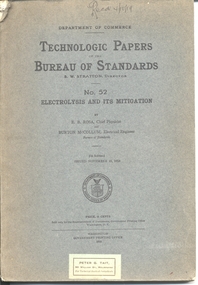
Book, USA Department of Commerce, "Electrolysis and its Mitigation", 1918
... price 35 cents. Has index and looks at various aspects of Electrolysis and railway negative returns. Has authors of E...price 35 cents. Has index and looks at various aspects of Electrolysis and railway negative returns. Has authors of E ...Book - 9 sections, 140 pages + covers, stapled and bound within dark green covers, issues by the USA Department of Commerce, Technological Papers, Bureau of Standards, No. 52, "Electrolysis and its Mitigation", 2nd Edition 1918, price 35 cents. Has index and looks at various aspects of Electrolysis and railway negative returns. Has authors of E. B. Rosa Chief Physicist and Burton McCollum, Electrical Engineer of the Bureau of Standards.On bottom of cover has "Peter G. Tait 90 William St Melbourne" label. and on top edge "Recd 4/10/19" in ink.trams, tramways, tramways, electrolysis -
 Ballarat Tramway Museum
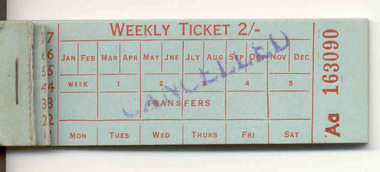
Ephemera - Weekly ticket, State Electricity Commission of Victoria (SECV), Block of SECV 2/- weekly tickets
... E Note: 1. See Reg. Item 230on page dated Feb. 22 for another two weekly tickets, c1950, price 2/6. ...E Note: 1. See Reg. Item 230on page dated Feb. 22 for another two weekly tickets, c1950, price 2/6. ...Each ticket medium weight card, on 200 gsm aqua card and printed on red ink to give day numbers, monthly, week number, transfers and day of week, excluding Sunday. Numbered on the right end of the ticket. Static number (1 - 7) on left it may be to indicate the day of issue. On the rear of the ticket are the details of the ticket use, allowing the passenger one return journey between City and section 4. Not available on Sundays. Form Number TYE 2-10. Each ticket has been stamped "CANCELLED" in purple ink. Demonstrates a SEC Weekly ticket.Block of SECV 2/- weekly tickets, ticket numbers Aa163090 - 16399. Originally printed and stapled into a blocks of 20 tickets. E Note: 1. See Reg. Item 230on page dated Feb. 22 for another two weekly tickets, c1950, price 2/6. Printed in off white card in red ink. Available for travel between city and section 3 or 4. See also Reg. item 2102, 2103, 2105 and 2106. Not known when these tickets used, possibly c1950'stickets, weekly tickets, trams, tramways -
 National Wool Museum
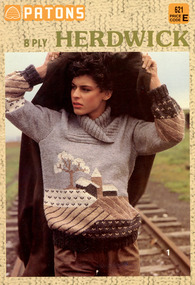
Book - Pattern Book, Patons Knitting Book, No.621, Patons and Baldwins, 1980s
... front: [printed] PATONS / 8 PLY HERDWICK / 621 / PRICE / CODE / E /1...Fashion Design Knitwear Home Made Wool Pattern Book Patons front: [printed] PATONS / 8 PLY HERDWICK / 621 / PRICE / CODE / E /1 Twenty four page knitting pattern book featuring black and white text and colour images. ...Twenty four page knitting pattern book featuring black and white text and colour images. The colour cover features a woman standing on train tracks holding a coat and wearing a knitted jumper.front: [printed] PATONS / 8 PLY HERDWICK / 621 / PRICE / CODE / E /1fashion, design, knitwear, home made, wool, pattern book, patons -
 National Wool Museum
Book - Pattern Book, Patons Knitting Book, No.1090, Patons and Baldwins, 1990s
... front: [printed] 1090 / Patons / PRICE CODE K / LOONEY TUNES TM / featuring / FOGHORN / LEGHORN TM / PORKY PIG TM / WILE E. / COYOTE TM / ROADRUNNER TM / 4 Knitting / patterns / for children and adults / BY GARY KENNEDY (INTARSIA UK) / TM & c Warner Bros. ...Fashion Design Knitwear Home Made Wool Pattern Book Patons front: [printed] 1090 / Patons / PRICE CODE K / LOONEY TUNES TM / featuring / FOGHORN / LEGHORN TM / PORKY PIG TM / WILE E. / COYOTE TM / ROADRUNNER TM / 4 Knitting / patterns / for children and adults / BY GARY KENNEDY (INTARSIA UK) / TM & c Warner Bros. ...Eight page knitting pattern book featuring black and white text and colour images. The colour cover features an image of the cartoon character Porky Pig.front: [printed] 1090 / Patons / PRICE CODE K / LOONEY TUNES TM / featuring / FOGHORN / LEGHORN TM / PORKY PIG TM / WILE E. / COYOTE TM / ROADRUNNER TM / 4 Knitting / patterns / for children and adults / BY GARY KENNEDY (INTARSIA UK) / TM & c Warner Bros. Inc. 1991. All Rights Reserved.fashion, design, knitwear, home made, wool, pattern book, patons -
 Stawell Historical Society Inc
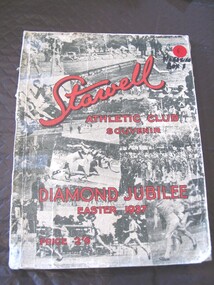
Book, Stawell Athletic Club, Stawell Athletic Club Souvenir, Diamond Jubilee -- Easter 1937, 1937
... Stawell Athletic Club Souvenir DiAMOND JUBILEE EASTER 1937 Price 2'6 (1 Copy) Inside - E & I Mills Stawell ...stawell sport Stawell Athletic Club Souvenir DiAMOND JUBILEE EASTER 1937 Price 2'6 (1 Copy) Inside - E & I Mills Stawell Paper cover various B/W photos of runners and crowd scenes Stawell Athletic Club Souvenir, Diamond Jubilee -- Easter 1937 Book Stawell Athletic Club John J Maher ...Paper cover various B/W photos of runners and crowd scenesStawell Athletic Club Souvenir DiAMOND JUBILEE EASTER 1937 Price 2'6 (1 Copy) Inside - E & I Mills Stawell stawell sport -
 Sunshine and District Historical Society Incorporated
Archive - Martin Baird Lynch
... |Photograph of MB LYnch Blacksmith shop Ballarat Road view from rear of property looking north c1915|Photograph of rear view MB Lynch blacksmith shop|Photograph of MB Lynch and Sons Pty Ltd|Newspaper Article Sunshine Advocate 9 April 1927 Advertising Coach and Motor Body Works Mr MB Lynch|Newspaper Article Sunshine Advocate 23 August Safe Driving Road E 0|Newspaper Article Sunshine Advocate 23 June 1928 Garage and Service Station MB Lynch|Newspaper Article Sunshine Advocate 16 January 1964 Be confident of your car|Newspaper Article Sunshine Advocate18 August 1928 Our Prices will fit your purse|Newspaper Article Sunshine Cavalcade MB Lynchs Garage Ballarat Road|Newspaper Article Advertisement For the First Time in Sunshine Petrol 24 Hours a Day|Newspaper Article Historic Tools for Society|Brochure Blacksmithing in Sunshine|Newspaper Article Sunshine Advocate 15 September 1960 MB Lynch and Sons proudly present the Ford Falcon|Newspaper Article Sunshine Advocate 4 August 1960 Immediate delivery of anglia Zodiac and Zephyr from as low as 200 pound deposit MB Lynch and Sons...|Photograph of MB LYnch Blacksmith shop Ballarat Road view from rear of property looking north c1915|Photograph of rear view MB Lynch blacksmith shop|Photograph of MB Lynch and Sons Pty Ltd|Newspaper Article Sunshine Advocate 9 April 1927 Advertising Coach and Motor Body Works Mr MB Lynch|Newspaper Article Sunshine Advocate 23 August Safe Driving Road E 0|Newspaper Article Sunshine Advocate 23 June 1928 Garage and Service Station MB Lynch|Newspaper Article Sunshine Advocate 16 January 1964 Be confident of your car|Newspaper Article Sunshine Advocate18 August 1928 Our Prices will fit your purse|Newspaper Article Sunshine Cavalcade MB Lynchs Garage Ballarat Road|Newspaper Article Advertisement For the First Time in Sunshine Petrol 24 Hours a Day|Newspaper Article Historic Tools for Society|Brochure Blacksmithing in Sunshine|Newspaper Article Sunshine Advocate 15 September 1960 MB Lynch and Sons proudly present the Ford Falcon|Newspaper Article Sunshine Advocate 4 August 1960 Immediate delivery of anglia Zodiac and Zephyr from as low as 200 pound deposit MB Lynch and Sons Collection of articles and information on Martin Baird Lynch and his family and historic inscriptions Archive Martin Baird Lynch ...Items put together by Melchior Bajada for Elizabeth Lynch's family research. Martin Baird Lynch was GrandfatherTyped Letter from Elizabeth Lynch 12 March 2013|Typed Notes Martin B Lynch Sunshine Advocate Vic 1924 to 1954|Booklet Sunshien Cavalcade Commemorating the Proclamation of the City of Sunshine|Newsletter The Sunshine Recorder September 2012 Series 5 No 23 Sapper Martin Lynch|Website Extract Family Notices 7 June 1924|Website Extract Obituary Mrs Charlotte Ann Lynch 7 June 1924 siccumbed as the result of a chill|Website Extract Sunshine Advocate 1 July 1932 Familty notices Sterling Martin Lynch|Newspaper Article Sunshine Advocate 2 June 1928 Sunshine Garage Broken Into|Newspaper Article Sunshine Advocate 10 November 1944 Death Martin Lynch|Newspaper Article Sunshine Advocate 6 May 1938 Field Gun Club|Newspaper Article Sunshine Advocate12 November 1943 Ballarat Road Death Trap Lynchs Corner a menace to Safety|Newspaper Article Sunshine Advocate 19 November 1943 The Village Blacksmith|Newspaper Article Sunshine Advocate 1 July 1932 Old Pioneer Passes|Newspaper Article Sunshine Advocate 8 October 1943 St Albans Purse|Newspaper Article Sunshine Advocate 3 November 1944 Wedding Bells|Timeline|Handwritten letter to Sunshine Advocate 5 March 2013|Photograph of Lynches Service Station November 1954|Photograph of 3 men and a child outside blacksmith shop which is a corrugated iron building on corner of Hampshire and Ballarat Road in 1950|Photograph of MB Lynch Garage on corner of Hampshire and Ballarat Road built in 1950 after previous corrugate iron shed was demolished Lynch Garage was demolished in 1988 Now 711 store.|Photograph of MB LYnch Blacksmith shop Ballarat Road view from rear of property looking north c1915|Photograph of rear view MB Lynch blacksmith shop|Photograph of MB Lynch and Sons Pty Ltd|Newspaper Article Sunshine Advocate 9 April 1927 Advertising Coach and Motor Body Works Mr MB Lynch|Newspaper Article Sunshine Advocate 23 August Safe Driving Road E 0|Newspaper Article Sunshine Advocate 23 June 1928 Garage and Service Station MB Lynch|Newspaper Article Sunshine Advocate 16 January 1964 Be confident of your car|Newspaper Article Sunshine Advocate18 August 1928 Our Prices will fit your purse|Newspaper Article Sunshine Cavalcade MB Lynchs Garage Ballarat Road|Newspaper Article Advertisement For the First Time in Sunshine Petrol 24 Hours a Day|Newspaper Article Historic Tools for Society|Brochure Blacksmithing in Sunshine|Newspaper Article Sunshine Advocate 15 September 1960 MB Lynch and Sons proudly present the Ford Falcon|Newspaper Article Sunshine Advocate 4 August 1960 Immediate delivery of anglia Zodiac and Zephyr from as low as 200 pound deposit MB Lynch and Sonslynch, ballarat road, sunshine -
 Peterborough History Group
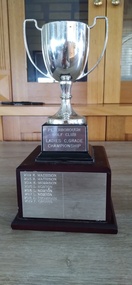
Memorabilia - Peterborough Golf Club Ladies C Grade Championship
... E Spies, 1997 K Bul, 1998 M Smith, 1999 J Bogner, 2000 A. Deppeler, 2001 M O'Connor, 2002 M Bacon, 2003 Jenny Stevens, 2004 M Smith, 2005 Jenny Cunnington, 2006 L Norton, 2007 J Nesseler, 2008 M Price, 2009 J Irwin, 2010 H Finlayson, 2011 H Finlayson, 2012 K Matheson, 2013 K Matheson, 2014 K Morrison, 2015 L Norton, 2016 L Norton, 2017 L Norton, 2018 A Thompson, 2019 F Groves....E Spies, 1997 K Bul, 1998 M Smith, 1999 J Bogner, 2000 A. Deppeler, 2001 M O'Connor, 2002 M Bacon, 2003 Jenny Stevens, 2004 M Smith, 2005 Jenny Cunnington, 2006 L Norton, 2007 J Nesseler, 2008 M Price, 2009 J Irwin, 2010 H Finlayson, 2011 H Finlayson, 2012 K Matheson, 2013 K Matheson, 2014 K Morrison, 2015 L Norton, 2016 L Norton, 2017 L Norton, 2018 A Thompson, 2019 F Groves. ...The Ladies C Grade championship starting in 1991. Winners were: 1991 P Bradshaw, 1992 D Smith, 1993 D Irvine, 1994 N Wills, 1995 D Delaney, 1996 E Spies, 1997 K Bul, 1998 M Smith, 1999 J Bogner, 2000 A. Deppeler, 2001 M O'Connor, 2002 M Bacon, 2003 Jenny Stevens, 2004 M Smith, 2005 Jenny Cunnington, 2006 L Norton, 2007 J Nesseler, 2008 M Price, 2009 J Irwin, 2010 H Finlayson, 2011 H Finlayson, 2012 K Matheson, 2013 K Matheson, 2014 K Morrison, 2015 L Norton, 2016 L Norton, 2017 L Norton, 2018 A Thompson, 2019 F Groves.Significant as it provides a record of C grade winners over the years. Also provides a snapshot of playersSmall silver cup on a pedestalInscribed with the competition title and the names and year of the winnerspeterborough golf club, peterborough, women's golf, women's golf championships -
 Sunshine and District Historical Society Incorporated
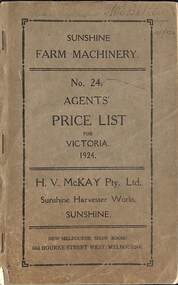
Manual - Sunshine Farm Machinery No 24 Agents' Price List for Victoria 1924, H.V. McKAY PTY LTD, 45292
... Price List for Victoria 1924 H.V. McKay Pty Ltd Sunshine Harvester Works Sunshine. Handwriting on front W. E...Price List for Victoria 1924 H.V. McKay Pty Ltd Sunshine Harvester Works Sunshine. Handwriting on front W. E ...Sunshine Farm Machinery No 24 Agents' Price List for Victoria 1924 H.V. McKay Pty Ltd Sunshine Harvester Works Sunshine. Handwriting on front W. E Balter 10/2/1924. Small loose tag inside B Mcermott 50 Clayton St Nth sunshine 3020h.v. mckays, sunshine harvester works, farm machinery -
 Clunes Museum
Newspaper, J R INGUS, 1978
... E. JONES PHOTO COPY CRESWICK ADVERTISER WEDNESDAY MAY 3 1978 SEVEN PAGE COLLECTION. LOCAL NEWS AND ADVERTISEMENTS. PRICE ...NOTE THE PASSING OF MRS. JEAN PEART - A VALUED CITIZEN OF CLUNES AND DISTRICT NEWS ITEMS AND ADVERTISEMENTS.PHOTO COPY CRESWICK ADVERTISER WEDNESDAY MAY 3 1978 SEVEN PAGE COLLECTION. LOCAL NEWS AND ADVERTISEMENTS. PRICE 10 CENTSE. JONESlocal history, document, newspaper, obituary -
 Ballarat Tramway Museum
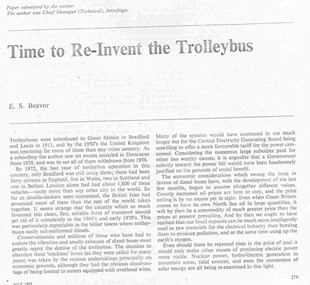
Document - Photocopy, "Time to Re-Invent the Trolleybus", 1980's?
... E. S. Beavor, written after the first oil price shock, looking at Battery supplemented trolley buses....E. S. Beavor, written after the first oil price shock, looking at Battery supplemented trolley buses. ...Three page foolscap photocopy of an article titled "Time to Re-Invent the Trolleybus", stapled within a manila folder. Article on two pages, July 1975 issue of the Chartered Institute of Transport Journal and a page of letters concerning the article in the November 1975 issue. Article written by E. S. Beavor, written after the first oil price shock, looking at Battery supplemented trolley buses."Time to Re-Invent the Trolleybus" written on the outside of the folder.trams, tramways, trolley buses, public transport -
 Brighton Historical Society
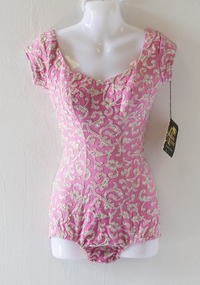
Swimsuit, late 1950s - early 1960s
... e-t-c-h BRI-NYLON / 34” Swing tag, front: black with gold text and palm tree logo. “Ada / OF CALIFORNIA / ‘Limited Edition’”. Back: gold with black text. “‘Limited Edition’”. Interior: “Congratulations on your choice of ADA OF CALIFORNIA ‘Limited Edition” Swimsuit contoured for your discriminating taste. / Style 546 / Size 34 / Price £11.9.6”. ...e-t-c-h BRI-NYLON / 34” Swing tag, front: black with gold text and palm tree logo. “Ada / OF CALIFORNIA / ‘Limited Edition’”. Back: gold with black text. “‘Limited Edition’”. Interior: “Congratulations on your choice of ADA OF CALIFORNIA ‘Limited Edition” Swimsuit contoured for your discriminating taste. / Style 546 / Size 34 / Price £11.9.6”. ...Ada of California was a Melbourne swimwear company founded in the early 1950s by Brighton locals Ada and Toni Murkies. Born in Poland in 1922, Ada was 17 when the Second World War reached her doorstep. She and her family were torn from their home by Soviet soldiers and sent to a brutal labour camp in Siberia as part of a series of mass deportations. In order to escape the horrific conditions of the camp, Ada and her sister Barbara joined the Soviet-backed Polish Army. During her time in the military she became close with a handsome young Jewish officer, Lieutenant Antoni Murkies, who later became her husband. After the war Toni was awarded 15 medals including the highest Polish military honour, the Virtuti Militari. Ada was awarded 10 medals, including the Order of the Cross of Grunwald. Emigrating to Australia as postwar refugees in 1948, Ada and Toni arrived in Melbourne with little to their name. Working initially in garment factories and building their connections, by the mid-1950s the couple were able to start a company of their own, with Ada designing the garments and Toni managing the business. Within ten years, Ada of California swimwear was being sold in department stores throughout Australia, and the Murkies family were able to build a permanent home of their own in Brighton. By the early 1980s they had acquired several other major labels, including Watersun. This swimsuit is believed to be one of a large quantity of samples, seconds and unsold Ada Productions stock donated to Brighton Historical Society in late 1990 by Brian Samuel, who worked at the company between 1979 and 1990.Pink short-sleeved one-piece swimsuit with silver lamé embellishment. Sweetheart neckline and low-cut back with metal zip. A black and gold swing tag is attached to one sleeve.Label in bra: “Ada OF CALIFORNIA / MIRACULOUS s-t-r-e-t-c-h BRI-NYLON / 34” Swing tag, front: black with gold text and palm tree logo. “Ada / OF CALIFORNIA / ‘Limited Edition’”. Back: gold with black text. “‘Limited Edition’”. Interior: “Congratulations on your choice of ADA OF CALIFORNIA ‘Limited Edition” Swimsuit contoured for your discriminating taste. / Style 546 / Size 34 / Price £11.9.6”. Care instructions also included.swimwear, ada productions, ada of california, ada murkies, toni murkies, melbourne designers -
 Melbourne Athenaeum Archives
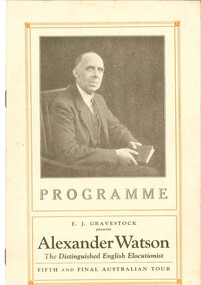
Theatre program, Natonal Press, Alexander Watson : The distinguished English elocutionist (at Melbourne Athenaeum, 1927), 1927
... E J Gravestock presented in Melbourne by Frank Talbot. Two Matinee recitals were held at the Athenaeum Theatre on 24th and 27th May at 2.30pm. athenaeum theatre alexander watson elecution recital theatre program Price 3d (three pence) Program: Regarding the details of the recital to be given by Alexander Watson commencing Saturday 21 May 1927. ...The program includes list of items to be recited and short biography of writers: Roderic Quinn, John Buchan, J M Barrie, Hillaire Belloc, A A Milne, John Masefield, John Drinkwater, Rudyard Kipling.Fifth and final tour of Alexander Watson considered to be the leading British Elocutionist with 25 years' experience. The program was directed by E J Gravestock presented in Melbourne by Frank Talbot. Two Matinee recitals were held at the Athenaeum Theatre on 24th and 27th May at 2.30pm.Program: Regarding the details of the recital to be given by Alexander Watson commencing Saturday 21 May 1927. Program is on beige paper with dark brown print; 8 pagesPrice 3d (three pence)athenaeum theatre, alexander watson, elecution, recital, theatre program -
 Geelong Cycling Club
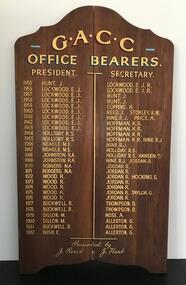
Honour Board, 1955
... gacc; office bearers; president; secretary; hunt j; lockwood ej; holliday rs; neagle me; johnston ra; rodgers na; wood r; buckwell r; 1979 dillon m; bush e; coppins h; reed j; stokley rw; hine rj; price a; hoffman kr; hansen g; jordan r; taylor g; thomson d; hose a; alerton g;..."GACC/Office Bearers/President - Secretary/1955 Hunt J/1956 Lockwood EJ/1957/Lockwood EJ/1958 Lockwood EJ/1959 Lockwood EJ/1963/Lockwood EJ/1964 Holliday RS/1965 Holliday RS/ 1966 Neagle ME/ 1968 Johnston RA/1969 Johnston RA/ 1970 Rodgers NA/1971 Rodgers NA/1972 Wood R/1976 Wood R/1977 Buckwell R/ 1978 Buckwell R/ 1979 Dillon M/ 1980 Dillon M/ 1981 Buckwell R/ 1982 Bush E/ Lockwood EJ/Lockwood EJ/Hunt J/Hunt J/Coppins H/ Reed J. Stokley RW/Hine RJ/Price A/Hoffman KR/Hoffman KR/Hoffman KR. ...A chronicle of officials of the G.A.C.C. during 1955-1982 This honour board has an important place in the history of the Geelong Cycling Club and signifies the high esteem in which the community held cycling and those working behind the scenes during the 20th century. gacc; office bearers; president; secretary; hunt j; lockwood ej; holliday rs; neagle me; johnston ra; rodgers na; wood r; buckwell r; 1979 dillon m; bush e; coppins h; reed j; stokley rw; hine rj; price a; hoffman kr; hansen g; jordan r; taylor g; thomson d; hose a; alerton g; "GACC/Office Bearers/President - Secretary/1955 Hunt J/1956 Lockwood EJ/1957/Lockwood EJ/1958 Lockwood EJ/1959 Lockwood EJ/1963/Lockwood EJ/1964 Holliday RS/1965 Holliday RS/ 1966 Neagle ME/ 1968 Johnston RA/1969 Johnston RA/ 1970 Rodgers NA/1971 Rodgers NA/1972 Wood R/1976 Wood R/1977 Buckwell R/ 1978 Buckwell R/ 1979 Dillon M/ 1980 Dillon M/ 1981 Buckwell R/ 1982 Bush E/ Lockwood EJ/Lockwood EJ/Hunt J/Hunt J/Coppins H/ Reed J. ...A chronicle of officials of the G.A.C.C. during 1955-1982 This honour board has an important place in the history of the Geelong Cycling Club and signifies the high esteem in which the community held cycling and those working behind the scenes during the 20th century. Wooden Board in mahogany colour with gold lettering. The board is in the shape of a rectangle and has a decorative top to it."GACC/Office Bearers/President - Secretary/1955 Hunt J/1956 Lockwood EJ/1957/Lockwood EJ/1958 Lockwood EJ/1959 Lockwood EJ/1963/Lockwood EJ/1964 Holliday RS/1965 Holliday RS/ 1966 Neagle ME/ 1968 Johnston RA/1969 Johnston RA/ 1970 Rodgers NA/1971 Rodgers NA/1972 Wood R/1976 Wood R/1977 Buckwell R/ 1978 Buckwell R/ 1979 Dillon M/ 1980 Dillon M/ 1981 Buckwell R/ 1982 Bush E/ Lockwood EJ/Lockwood EJ/Hunt J/Hunt J/Coppins H/ Reed J. Stokley RW/Hine RJ/Price A/Hoffman KR/Hoffman KR/Hoffman KR. Hine RJ/Hine RJ/Holliday RS/Holliday RS. Hansen G/Hine RJ. Jordan R/Jordan R/JordanR /JordanR/ Taylor G/Jordan R/Thomson D/Thomson D/Hose A/Alerton G/ Alerton G/Alerton G/Presented by /J Reed and J Hunt” gacc; office bearers; president; secretary; hunt j; lockwood ej; holliday rs; neagle me; johnston ra; rodgers na; wood r; buckwell r; 1979 dillon m; bush e; coppins h; reed j; stokley rw; hine rj; price a; hoffman kr; hansen g; jordan r; taylor g; thomson d; hose a; alerton g; -
 Vision Australia
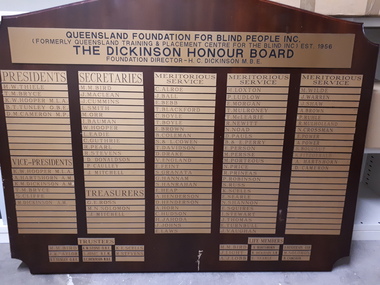
Photograph - Image, The Dickinson Honour Board
... Pauls, B & E Perry, E. Person, M. Persse, M. Porteous, N. Price, R. Prineas, P. Robinson, S. ...Pauls, B & E Perry, E. Person, M. Persse, M. Porteous, N. Price, R. Prineas, P. Robinson, S. ...This board was created to honour the work undertaken to administrate the Foundation by it's board and voluntary members. It is inscribed as follows: "The Queensland Foundation for Blind People Inc, (formerly the Queensland Placement & Training Centre for the Blind Inc) est. 1956. The Dickinson Honour Board. Foundation Director - H.C. Dickinson M.B.E. Presidents: H.W. Thiele, T.M.Bryce, K.W. Hooper MLA, B.T. Turnley OBE, D.M. Cameron MP. Vice-Presidents: K.W. Hooper MLA, A. Hartshorn AM, K.M. Dickinson AM, T.M. Bryce, S. Cliffe, M. Dickinson AM. Secretaries: M.M. Bird, J. Maclean, J. Cummins, L. Smith, M. Orr, I. Bauman, W. Hooper, L. Eadie, C. Guthrie, R. Pearl, R. Stevens, D. Donaldson, P. Caulley, J. Mitchell. Treasurers: G.E. Ross, M.N. Solomon, J. MItchell. Meritorious Service: C. Alroe, J, Ball, E. Bebb, T. Blackford, C. Boyle, T. Boyle, E. Brown, B. Coleman, S & L Cowen, T. Davidson, D. Drake, V. England, F. Feint, S. Granata. G. Hannam, S. Hanarahan, E. Heap, A. Henderson, D. Henderson, A. Horn, C. Hudson, H. Jahoda, J. Johns, E. Laws, M. Loxton, P. Ludlow, E. Morgan, T. Mulroney, T. McLearie, R. Newitt, N. Noad, D. Pauls, B & E Perry, E. Person, M. Persse, M. Porteous, N. Price, R. Prineas, P. Robinson, S. Russ, K. Scells, E. Searle, N. Shannon, E. Squires, I. Stewart, J. Thomas, E. Turnball, J. Vaughan, M. Wilde, J. Warren, J. Shaw, A. Brown, P. Ruhle, R. Mulholland, N. Crossman, E. Power, A. Power, S. Boucat, K. Fitzgerald, A. Hartshorn, D. Cameron. Trustees: M.M. Bird, F.R. Taylor, B.T. Tunley OBE, K.W. Stone OBE, S. Jones BEM, H.C. Dickinson MBE, K.E. Scells, R. Stevens Life Members: M.M. Bird, J. Light, A.J Lobb, A. Hartshorn, M. Dickinson AM, E. Searle, D. Henderson OAM, M. Solomon, D, Cameron Board with rows of etched platesroyal blind foundation of queensland, nameplates -
 Melbourne Legacy
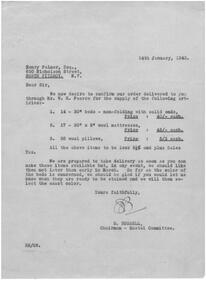
Letter - Document, letter, 1943
... A record of prices and quantities of furniture and items required for the first hostel established by Legacy in 1943 during the war. holmbush administration residences Initialled for E. ...Letter dated 14 January 1943 to Henry Palmer of 650 Nicholson St, North Fitzroy to place an order for 14 beds, 17 mattresses and 36 pillows for the hostel. It states the costs and that the items were to be discounted 2.5% and plus Sales Tax. Delivery was to be no later than the end of March.A record of prices and quantities of furniture and items required for the first hostel established by Legacy in 1943 during the war.Green quarto copy paper, black type, two hole punched.Initialled for E. Russell, Hostel Chairman.holmbush administration, residences -
 Melbourne Legacy
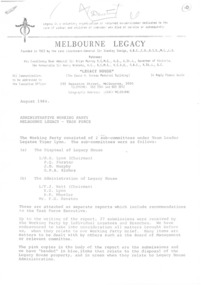
Document, Administrative Working Party Melbourne Legacy - Task Force
... C) Matters that would influence the sale price and/or costs of alterations. D) Reasons for/against various options E) Recommendations. ...C) Matters that would influence the sale price and/or costs of alterations. D) Reasons for/against various options E) Recommendations. ...This document discusses the many options available to Melbourne Legacy in matters such as:- A) Disposal of Legacy House (293 Swanston St, Melbourne), redeveloping the existing site, selling the building and remain as a tenant or moving to another location. Many variations of these options are discussed. B) Whether Legacy luncheons would or should continue, would any of the above options reduce widow visits to Legacy House. C) Matters that would influence the sale price and/or costs of alterations. D) Reasons for/against various options E) Recommendations. There are 5 recommendations in total. The above items are followed up by some observations during the discussions but not central to the brief. A precis of items from submissions relating directly or indirectly upon the disposal of Legacy House A report regarding salary and staffing levels levels, the number of committtees, staff organization and Legatees interactions with staff employed by Legacy. This is followed up by several recommendations. At the time entering the above information 14/9/2018 Legacy House has not been sold but some of the floor space has been rented out. Much of what is discussed in this report (August 1984) is about making the Legacy dollar go further and any positive/adverse effects on the primary purpose of taking care of the widows and the efficient running of Melbourne Legacy. White quarto paper with black type, 14 pages about an administrative working party taskforce.Various notations/marks in pencil, ink, highlighter throughout. properties, staff, dureau house -
 Wangaratta High School
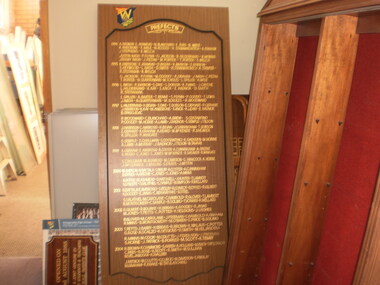
WHS Prefects Honour Board, 1994-2004
... E. JANAS, M. JONES, T. PETTS, C. POTTER, K. SESSIONS, J. USSHER. R. GLOVER: M. CAROLANE, J. FREEMAN, C. GAMBOLD, A. GRAHAM, R. MINNS, B. MONTGOMERY, M. O'BRIEN, S. PRICE...E. JANAS, M. JONES, T. PETTS, C. POTTER, K. SESSIONS, J. USSHER. R. GLOVER: M. CAROLANE, J. FREEMAN, C. GAMBOLD, A. GRAHAM, R. MINNS, B. MONTGOMERY, M. O'BRIEN, S. PRICE ...Brown wooden honour board with gold writing and decorative border. Hugging the border at the top is a curved title reading PREFECTS. In the top left corner of the honour board is a WHS logo.PREFECTS 1994 A. RADNOR: E. ASHMEAD, N. BLANCHARD, E. FURS, N. IMRIE, K. KNEEBONE, E. MALE, N. ROSSER, M. STANIMROACH, A. STANVER, J. STEPHENS, K. WELCH. JUSTIN NASH,: P. FLYNN, G. JACKSON, B. HILDEBRAND, B. MORRIS, JEREMY NASH, J. PIZZINI, M. PORTER, T. PORTER, S. WELCH 1995 K. KNEEBONE: E. ACHMEAD, D. BIGGER, R. BARROW, S. DOBSON, S. HEYWOOD, L. NASH, D. SMITH, H. STANIMIROVITCH, A. STANYER, R. STEFANIARK, K. WELCH. G. JACKSON: P. FLYNN, M. GOODSEY, R. GRAHAM, J. NASH, C. PIZZINI, T. PORTER, N. QUARTERMAIN, M. SCHOLES, L. SPILLER, A. WISE 1996 L. NASH: R. BARROW, S. DIKE, S. DOBSON, R. EVANS, J. GREENE, L. HILDEBRAND, K. KAY, S. KNOX, E. RADNOR, D. SMITH, R. STEFANIAK. L. SPILLER: A. BAXTER, T. BENNE, S. FLYNN, P. GOODEY, T. LEWIS, J. NASH, N. QUARTERMAIN, M. SCHOLES, R. WOODWARD 1997 L. HILDEBRAND: H. BEVAN, S. DIKE, T. TOBSON, E. GEPHART, J. HARRISON, K. KAY, M. KNEEBONE, S. KNOX, K. LEARY, E. RADNOR, B. SPASOJEVIC. r. WOODWARD: C. BLANCHARD, A. BREW, S. CONSTANTINO, P. GOODEY, M. HORNE, A. LAMB, J. RADNOR, S. SEMPLE, J. TILSON 1998 J. HARRISON, C. CAMBROSIO, H. BEVAN, J. CUNNINGHAM, T. DOBSON, E. GEPHART, K. GRAHAM, A. HEARD, M. McKENZIE, R. SHEARER, K. SPILLER, R. WINGATE. S. SEMPLE: S. CHALLMAN, S. CONSTANTINI, K. GADSDEN, M. HORNE, A. LAMB, A. MURRAY, J. RADNOR, J. TILSON, B. TAVARE. 1999 K. GRAHAM: E. AMBROSO, A. COSTER, A. CUNNINGHAM, A. GREENE, K. HEARD, C. JONES, S. JONES, M. McKENZIE, R. SHEARER, R. WINGATE. S. CHALLMAN: M. ASHMEAD, M. CAMERON, G. HANCOCK, A. HORNE, J. MCCORMICK, J. MULLINS, S. O'KEEFE, J. WESTON 2000 M. ANDISON: N. BAYTALA, S. BEILBY, A. COSTER, A. CUNNINGHAM, B. DYKES, A. GREEN, C. JONES, S. JONES, A. MINNS. A. HORNE: M. ASHMEAD, D. HATSWELL, J. HUNTER, T. LAMBERT, S. O'KEEFE, S. SALATHIEL, C. SAMPLE, B. SIMPSON, R. WELLARD 2001 N. BAYTALA: E. AMBROSIO, S. BEILBY, R. CONLEY, B. DYKES, R. GILBERT, K. GOODEY, E. JANAS, C. RIDGEWAY-FAYE, B. STEEL. S. SALATHIEL: M. CAROLANE, C. GAMBOLD, R. GLOVER, T. LAMBERT, B. MONTGOMERY, C. SAMPLE, B. SOLIMO, T. VONARX, R. WELLARD 2002 R. GILBERT: R. BURKE, H. BRIGGS, K. GOODEY, E. JANAS, M. JONES, T. PETTS, C. POTTER, K. SESSIONS, J. USSHER. R. GLOVER: M. CAROLANE, J. FREEMAN, C. GAMBOLD, A. GRAHAM, R. MINNS, B. MONTGOMERY, M. O'BRIEN, S. PRICE, S. SOLIMO 2003 T. PETTS: J. BARRY, H. BRIGGS, R. BROWN, K. NIKLAUS, C. POTTER, G. ROSE, A. SCALZO, K. SESSIONS, R. SMITH, M. VELJANOSKA. R. MINNS: M. COOK, M. COURTS, J. FERGUSON, J. FREEMAN, S. HORNE, J. PATRICK, B. PORKER, M. SCOTT, K. TEMBY 2004 R. BROWN: K. CRAMMOND, S. GREEN, A. HOLLAND, M. ISKOV, S. McCONACHY, S. REES, G. ROSE, K. SCOTT, R. SMITH, M. SULLIVAN, M. VELJANOSKA, K. WALDER. J. PATRICK: M. COUTTS, C. CURCIO, M. DAVIDSON, S. FINDLAY, M. GRAHAM, R. KRAKE, M. TATULASCHWILI -
 Kew Historical Society Inc
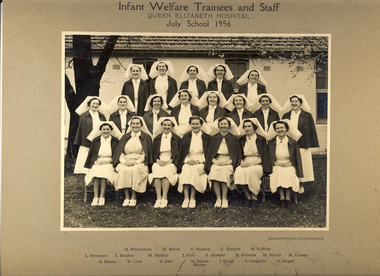
Photograph, Infant Welfare Trainees and Staff, Queen Elizabeth Hospital, 1956
... They include: Back Row {L-R] M Whittenbury, M Bolton, E Haebich, G Barnard, M Griffiths / Middle Row [L-R] L Stevenson, T Boucher, M Madden, J Price, A Glowrey, R Helmore, M Murfet, M Lindsay / Front Row [L-R] R Buxton, W Crick, G Stott, M Buxton Matron, J Keogh, B Longmuir, E Borgelt....They include: Back Row {L-R] M Whittenbury, M Bolton, E Haebich, G Barnard, M Griffiths / Middle Row [L-R] L Stevenson, T Boucher, M Madden, J Price, A Glowrey, R Helmore, M Murfet, M Lindsay / Front Row [L-R] R Buxton, W Crick, G Stott, M Buxton Matron, J Keogh, B Longmuir, E Borgelt. ...Carlton Refuge/Carlton Home was established in 1857 in Madeline Street, Carlton (relocating in 1890 to Keppel Street, Carlton). The Carlton Home provided maternity care for married and unmarried mothers, and residential care for infants and toddlers unable to be at home with their mother. It also operated a day-care centre for children. Most of the residents were mothers or children on private placements. The Children's Welfare Department used the Carlton Home as a maternity home for wards, a foster home for infant wards, and for children requiring placements under the infant life protection provisions of the Children's Welfare Act. By the late 1940s, the home was in a bad state of repair and it closed in 1949. In 1951, the facility reopened as the Queen Elizabeth Maternal and Child Health Centre that also operated as an Infant Welfare and Mothercraft Training School. The Centre provided after-care for nursing mothers and babies transferring from maternity hospitals, and specialised care for babies referred by private practitioners and the Social Welfare Department – babies who were premature, frail or had feeding or similar problems. (Source: DHHS)The photograph is a valuable primary resource relating to training for maternal and infant welfare centres in Kew, Victoria. It has a strong provenance through inscriptions linking it to the Denmark Street Maternal and Child Health Centre.Photograph, mounted on card of Infant Welfare Trainees and Staff, Queen Elizabeth Hospital, 1956. The photograph lists the names of the individuals below the photograph. They include: Back Row {L-R] M Whittenbury, M Bolton, E Haebich, G Barnard, M Griffiths / Middle Row [L-R] L Stevenson, T Boucher, M Madden, J Price, A Glowrey, R Helmore, M Murfet, M Lindsay / Front Row [L-R] R Buxton, W Crick, G Stott, M Buxton Matron, J Keogh, B Longmuir, E Borgelt.Obverse: Infant Welfare Trainees and Staff, Queen Elizabeth Hospital, July School 1956 Reverse: "Presented to Kew Historical Soc by Dr Darbyshire following a 50 year birthday display at the Denmark Street Maternal and Child Health Centre [Kew] in May 1980. [Illegible]."denmark street maternal and child health centre, baby health centres --- kew (vic), queen elizabeth hospital, infant welfare -
 Kew Historical Society Inc
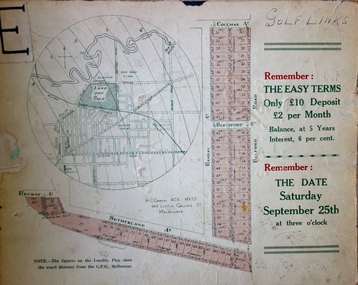
Plan - Subdivision Plan, H C Crouch, Old Golf Links Estate, 1930s
... prices for which individual lots were sold. In a number of cases, the reverse of a subdivision plan in the collection includes a photograph of a house that was also for sale by the agent. These photographs provide significant heritage information relating house design and decoration, fencing and household gardens. Subdivisions -- Kew (Vic.) Old Golf Links Estate Annotations: "E ...The land in North Kew between the Outer Circle Railway and the River Yarra was released in sections. This release included 80 lots. Most of this area was released during the Depression years in the early 1930s.Subdivision plans are historically important documents used as evidence of the growth of suburbs in Australia. They frequently provide information about when the land was sold on which a built structure was subsequently constructed as well as evidence relating to surveyors and real estate and financial agents. The numerous subdivision plans in the Kew Historical Society's collection represent working documents, ranging from the initial sketches made in planning a subdivision to printed plans on which auctioneers or agents listed the prices for which individual lots were sold. In a number of cases, the reverse of a subdivision plan in the collection includes a photograph of a house that was also for sale by the agent. These photographs provide significant heritage information relating house design and decoration, fencing and household gardens.One part of a massive subdivision of the Old Golf Links Estate in North Kew of 80 allotments bordering Sutherland Avenue, Ramsay Avenue, Belford Road, Beresford Street and Coleman Avenue. Inset on the plan at the top left, the route of the Outer Circle Railway is clearly marked. The Kew Golf Links is identified in its current location. The land on which Greenacres Golf Club was to be constructed is at this time marked as ‘Recreation Ground’. The ‘new bridge’ over the Yarra at Burke Road is also marked on the inset map. The Plan identifies the surveyor (sic) H.C. Crouch BCE MVIS, 443 Little Collins St., Melbourne. The date of the subdivision auction sale in identified as Saturday September 25th at three o'clock.Annotations: "E" top left. "Golf Links" top right. Lots 73-76 ticked and listed as "6" poundssubdivisions -- kew (vic.), old golf links estate -
 Kew Historical Society Inc
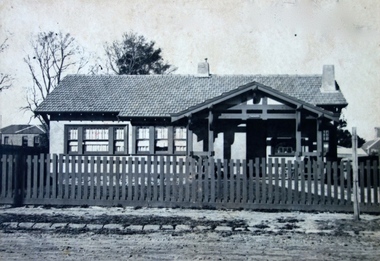
Photograph - Cosy Five Roomed Rough Cast Bungalow, Kew, J E Barnes, c.1920
... prices for which individual lots were sold. In a number of cases, the reverse of a subdivision plan in the collection includes a photograph of a house that was also for sale by the agent. These photographs provide significant heritage information relating house design and decoration, fencing and household gardens. The photograph is also aesthetically significant as it was taken by J. E ...Subdivision plans are historically important documents used as evidence of the growth of suburbs in Australia. They frequently provide information about when the land was sold on which a built structure was subsequently constructed as well as evidence relating to surveyors and real estate and financial agents. The numerous subdivision plans in the Kew Historical Society's collection represent working documents, ranging from the initial sketches made in planning a subdivision to printed plans on which auctioneers or agents listed the prices for which individual lots were sold. In a number of cases, the reverse of a subdivision plan in the collection includes a photograph of a house that was also for sale by the agent. These photographs provide significant heritage information relating house design and decoration, fencing and household gardens. The photograph is also aesthetically significant as it was taken by J. E. Barnes, a nationally significant photographer. He was the most important photographer to have worked in Kew. He was active as a photographer in the district from c.1906 until his death in 1921. Best known as 'the Embarkation Photographer' (see the Australian War Memorial collection), Josiah Earl Barnes was also the official photographer employed by the Borough (and later Town, then City) of Kew. He clearly also completed commercial jobs for local businesses, as is the case in this photograph of a house for a local real estate and financial agent. A modest weatherboard house with rough-cast rendered walls. The gabled entrance incorporates elements of the Japanese aesthetic. The strong lines of the dark timber gable are reinforced by the colour and shape of the pickets in the fence. In contrast to an earlier period, the chimneys appear truncated. The use of extensive double-hung sash windows in the front rooms reflects a new interest in light in houses. The use of separate sunshades over windows in an earlier period is here replaced by an extension of the roofline over the window. The photographer Josiah Barnes died in 1921; so, the photograph of the house must predate this date. The location of the house, which was advertised for sale, has to date not been identified. Illegible inscription. Photographer's information on mount.josiah earl barnes, j e barnes, photography - kew, interwar housing - victoria, 1920s housing - kew
