
Showing 124 items matching " 1st australia division"
-
 Bendigo Historical Society Inc.
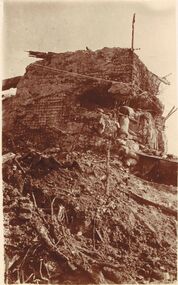
Postcard - ACC LOCK COLLECTION: SEPIA PHOTO OF A DAMAGED STRUCTURE, POSTCARD, 1914-1918
... ... 1st Australia Division...'Pozieres - ("Gibraltar") after capture by 1st Australia Division July 1916'...POSTCARD Postcard WW1 France Pozieres 1st Australia Division Postcard, WW1, sepia photo of a damaged structure that could have been an observation post or a defensive rocky outcrop at Pozieres. ...Postcard, WW1, sepia photo of a damaged structure that could have been an observation post or a defensive rocky outcrop at Pozieres. Had been given the nickname 'Gibraltar' judging by the handwritten comment on the back. 'Pozieres - ("Gibraltar") after capture by 1st Australia Division July 1916'postcard, postcard, ww1, france, pozieres, 1st australia division -
 Bendigo Military Museum
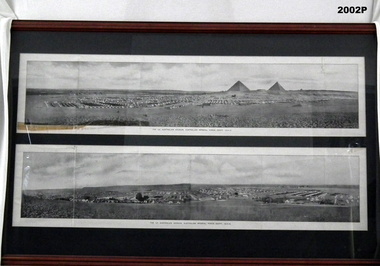
Photograph - PHOTOGRAPH WW1, FRAMED, c.1914-15
... Large timber frame, mid brown colour, dark green mount with glass. 2 black &white panoramic photos of the 1st Australian Division, Egypt. Camp scenes with tents, pyramids & sand....Below photos in black ink: "The 1st Australian Division, Australian Imperial Force - Egypt, 1914-15" Handwritten in black felt tip pen: "Property Bendigo RSL Museum, Peter Ball"...The two images were part of a book called, The All Australian Memorial as part of a fold out section. the two pages were lose in the book. photography-photographs military history - army eygpt pyramids 1st Australian Division Below photos in black ink: "The 1st Australian Division, Australian Imperial Force - Egypt, 1914-15" Handwritten in black felt tip pen: "Property Bendigo RSL Museum, Peter Ball" Large timber frame, mid brown colour, dark green mount with glass. 2 black &white panoramic photos of the 1st Australian Division, Egypt. ...The two images were part of a book called, The All Australian Memorial as part of a fold out section. the two pages were lose in the book.Large timber frame, mid brown colour, dark green mount with glass. 2 black &white panoramic photos of the 1st Australian Division, Egypt. Camp scenes with tents, pyramids & sand.Below photos in black ink: "The 1st Australian Division, Australian Imperial Force - Egypt, 1914-15" Handwritten in black felt tip pen: "Property Bendigo RSL Museum, Peter Ball"photography-photographs, military history - army, eygpt pyramids, 1st australian division -
 Running Rabbits Military Museum operated by the Upwey Belgrave RSL Sub Branch
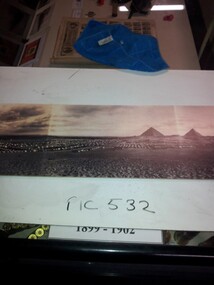
Photograph
... Photo of 1st Australian Division Mena Camp Egypt 1915...Photo WW1 Army Photo of 1st Australian Division Mena Camp Egypt 1915 Photograph ...Photo of 1st Australian Division Mena Camp Egypt 1915photo, ww1, army -
 Wangaratta RSL Sub Branch
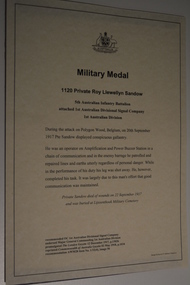
Document - Citation, Military Medal
... Military Medal 1120 Private Roy Llewellyn Sandow 5th Australian Infantry Battalion attached 1st Australian Divisional Signal Company 1st Australian Division...Private Sandow died of wounds on 22 September 1917 and was buried at Lijssenthoek Military Cemetery. roy llewellyn sandow polygon wood belgium 1917 ww1 5th australian infantry battalion Military Medal 1120 Private Roy Llewellyn Sandow 5th Australian Infantry Battalion attached 1st Australian Divisional Signal Company 1st Australian Division Cream coloured citation with Australian Coat of Arms above black type contained in black border. ...During the attack on Polygon Wood Belgium on 20th September 1917 Pte Sandow displayed conspicuousu gallantry - He was an operator on Amplification and Power Buzzer Station in a chain of communication and in the enemy barrage he patrolled and repaired lines and earths utterly regardless of personal danger. While in the performance of his duty his leg was shot away. He however completed his task. It was largely due to this man's effort that good communication was maintained. Private Sandow died of wounds on 22 September 1917 and was buried at Lijssenthoek Military Cemetery. Cream coloured citation with Australian Coat of Arms above black type contained in black border.Military Medal 1120 Private Roy Llewellyn Sandow 5th Australian Infantry Battalion attached 1st Australian Divisional Signal Company 1st Australian Divisionroy llewellyn sandow, polygon wood, belgium, 1917, ww1, 5th australian infantry battalion -
 Lara RSL Sub Branch
Photograph, Mena Camp Egypt 1914-15
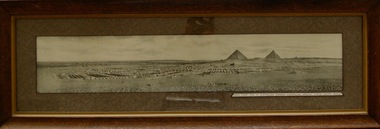
... Mena Camp-1st Australian Division. Australian Imperial Force-Egypt. 1914-15....1st Australian Imperial Forces(AIF) before the Landing at Gallipoli. The camp was located 16Kms from Cairo.Built around Mena House, it was a luxury hotel built next to the Pyramids of Giza (originally spelt Gizeh) supplied with its own purpose built tram-line to Cairo. The centre road up the middle of the camp was known as Artillery Road. The initial force consisted of 20,000 men. The Camp was a major training facility for the 1st Australian Imperial Force in 1014-15. mena camp, egypt, gallipoli, cairo, lara r.s.l. training camps, australian imperial force. Mena Camp-1st Australian Division ...The Mena Camp, Egypt, was the training camp for the 1st Australian Imperial Forces(AIF) before the Landing at Gallipoli. The camp was located 16Kms from Cairo.Built around Mena House, it was a luxury hotel built next to the Pyramids of Giza (originally spelt Gizeh) supplied with its own purpose built tram-line to Cairo. The centre road up the middle of the camp was known as Artillery Road. The initial force consisted of 20,000 men.The Camp was a major training facility for the 1st Australian Imperial Force in 1014-15.Rectangular shaped glass covered picture frame showing a photo of Mena Camp-1914/15.Mena Camp-1st Australian Division. Australian Imperial Force-Egypt. 1914-15.mena camp, egypt, gallipoli, cairo, lara r.s.l. training camps, australian imperial force. -
 Lara RSL Sub Branch
Photograph, Mena Camp Egypt 1914-15
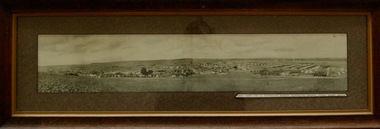
... Mena Camp-1st Australian Division. Australian Imperial Force-Egypt. 1914-15....1st Australian Imperial Forces(AIF) before the Landing at Gallipoli. The camp was located 16Kms from Cairo.Built around Mena House, it was a luxury hotel built next to the Pyramids of Giza (originally spelt Gizeh) supplied with its own purpose built tram-line to Cairo. The centre road up the middle of the camp was known as Artillery Road. The initial force consisted of 20,000 men. The Camp was a major training facility for the 1st Australian Imperial Force in 1014-15. mena camp, egypt, gallipoli, cairo, lara r.s.l. training camps, australian imperial force. Mena Camp-1st Australian Division ...The Mena Camp, Egypt, was the training camp for the 1st Australian Imperial Forces(AIF) before the Landing at Gallipoli. The camp was located 16Kms from Cairo.Built around Mena House, it was a luxury hotel built next to the Pyramids of Giza (originally spelt Gizeh) supplied with its own purpose built tram-line to Cairo. The centre road up the middle of the camp was known as Artillery Road. The initial force consisted of 20,000 men.The Camp was a major training facility for the 1st Australian Imperial Force in 1014-15.Rectangular shaped glass covered picture frame showing a photo of Mena Camp-1914/15.Mena Camp-1st Australian Division. Australian Imperial Force-Egypt. 1914-15.mena camp, egypt, gallipoli, cairo, lara r.s.l. training camps, australian imperial force. -
 Camberwell RSL Sub-Branch
Photo, Australian 1st Division in Mena Camp, 10 miles from center of Cairo. March 1915, 1915
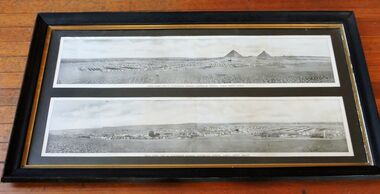
... Australian 1st Division Camp at Mena...Interesting photo showing the Mena camp of the Australian 1st Division from two perspectives. The spread was over several miles and some idea of the size can be made from the images of the Pyramids....Australian 1st Division Camp at Mena Unique Interesting photo showing the Mena camp of the Australian 1st Division from two perspectives. ...Australian 1st Division Camp at MenaUniqueInteresting photo showing the Mena camp of the Australian 1st Division from two perspectives. The spread was over several miles and some idea of the size can be made from the images of the Pyramids. -
 Wangaratta RSL Sub Branch
Card, Christmas 1918, 1918
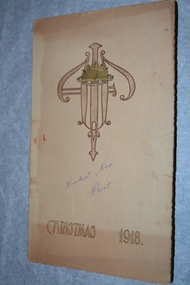
... Christmas Card, 1918 “Fondest Love Bert” handwritten on front Inside - Greetings from 1st Australian Divisional Headquarters Staff - In the Field Sketch of Red Chateau, Villers Bretonneux...Christmas Card, 1918 “Fondest Love Bert” handwritten on front Inside - Greetings from 1st Australian Divisional Headquarters Staff - In the Field Sketch of Red Chateau, Villers Bretonneux 1918 1st australian divisional headquarters red chateau villers bretonneux Christmas card Christmas 1918 Fondest Love,Bert Beige cardboard folded in half with rising sun and decorative emblem on front and sketch of trees on rear. ...Christmas Card, 1918 “Fondest Love Bert” handwritten on front Inside - Greetings from 1st Australian Divisional Headquarters Staff - In the Field Sketch of Red Chateau, Villers BretonneuxBeige cardboard folded in half with rising sun and decorative emblem on front and sketch of trees on rear.Christmas 1918 Fondest Love,Bert1918, 1st australian divisional headquarters, red chateau, villers bretonneux, christmas card -
 Beechworth RSL Sub-Branch
Print - Picture 11th Battalion Cheop Pyramid 1915, Contingent of the 1st Division Australian Imperial Force AIF / 11th Battalion Before Deployment to Gallipoli / Cheop Pyramid, Sunday 10th January 1915
... Top centre is the AIF Badge, bottom left is the Battalion Patch, Bottom right is a miniature set of the three medals and centre is the Title " Contingent of the 1st Division Australian Imperial Force AIF / 11th Battalion Before Deployment to Gallipoli / Cheop Pyramid, Sunday 10th January 1915"...Contingent of the 1st Division Australian Imperial Force AIF / 11th Battalion Before Deployment to Gallipoli / Cheop Pyramid, Sunday 10th January 1915"...Top centre is the AIF Badge, bottom left is the Battalion Patch, Bottom right is a miniature set of the three medals and centre is the Title " Contingent of the 1st Division Australian Imperial Force AIF / 11th Battalion Before Deployment to Gallipoli / Cheop Pyramid, Sunday 10th January 1915" Contingent of the 1st Division Australian Imperial Force AIF / 11th Battalion Before Deployment to Gallipoli / Cheop Pyramid, Sunday 10th January 1915 Print Picture 11th Battalion Cheop Pyramid 1915 ...This item was either purchased or donated to the Sub Branch. Apart form being a a very famous picture of the 11th Battalion on the Pyramid Cheop. The 11 battalion was formed in Western Australia has no connection to the people of BeechworthA wooden framed collage of the print of 11th Battalion Before Deployment to Gallipoli on Cheop Pyramid, Egypt, Sunday 10th January 1915. Top centre is the AIF Badge, bottom left is the Battalion Patch, Bottom right is a miniature set of the three medals and centre is the Title " Contingent of the 1st Division Australian Imperial Force AIF / 11th Battalion Before Deployment to Gallipoli / Cheop Pyramid, Sunday 10th January 1915"Contingent of the 1st Division Australian Imperial Force AIF / 11th Battalion Before Deployment to Gallipoli / Cheop Pyramid, Sunday 10th January 1915"https://11btn.wags.org.au/ -
 Melbourne Legacy
Postcard, Troops camped at the Pyramids, Egypt, 1915
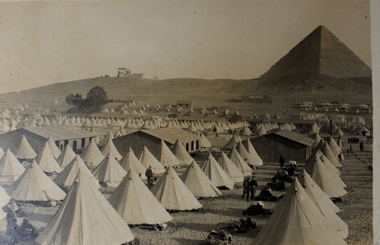
... Message on reverse of postcard is dated 7.2.15 and says: "This is a view of part of Mena camp where the 1st Australian Division has been camped. We have had fine weather and very cold nights. ...This type of souvenir would have been familiar to the first Legatees as they had served in World War 1 and many had passed through Egypt. world war one war correspondence souvenir Message on reverse of postcard is dated 7.2.15 and says: "This is a view of part of Mena camp where the 1st Australian Division has been camped. We have had fine weather and very cold nights. ...This postcard was sent by "O.G." to J. Gawler on 7 February 1915 from an Army camp in Egypt. The postcard appears to have been hung up by a thumb tack as there is a small hole at the top centre of the card. This item is representative of the letters and postcards that were sent home to war by servicemen during the First World War and was a way to maintain a connection to their loved ones during difficult and uncertain times. Postcards were a very common form of communication in the first World War. This postcard also records places for those who didn't have cameras. This type of souvenir would have been familiar to the first Legatees as they had served in World War 1 and many had passed through Egypt.The front image of the postcard is a photograph of a camp of white canvas tents lined up in rows in front of a pyramid. Several soldiers can be seen walking throughout the campsite. On the reverse is a message written in black ink. There is also a small hole in the top centre of the postcard.Message on reverse of postcard is dated 7.2.15 and says: "This is a view of part of Mena camp where the 1st Australian Division has been camped. We have had fine weather and very cold nights. Weigh nearly 11 stone now. O.G." Addressed to: "Mr J M Gawler, Collins St, Melbourne"world war one, war correspondence, souvenir -
 Sunshine and District Historical Society Incorporated
Photograph - Alexander Robert Learmonth 1st Victorian Brigade Artillery Desert Camp Cairo Photograph
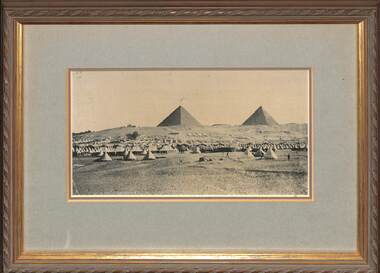
... Australian Imperial Force, including the Victorian artillery units, was originally meant to train in England. Overcrowding there forced a change of plans, and when the convoy reached the Suez Canal in late 1914, the troops were diverted to Egypt instead. Most of the 1st Division...5710 - Alexander Robert Learmonth 1st Victorian Brigade Artillery Desert Camp Cairo Photograph Front.jpg 5710 - Alexander Robert Learmonth 1st Victorian Brigade Artillery Desert Camp Cairo Photograph Back.jpg Alexander Robert Learmonth VX919 25th Battery 1st Victorian Brigade Artillary 1st Australian Division A.I.F. An ANZAC on Gallipoli desert camp near Cairo 1915 Standing to right of tents ...1st Division Mena Training Camp, Giza Plateau, Egypt. He is standing to the right of the tent, bottom right-hand side. Alexander Robert Learmonth World War 1914 - 1918 Cairo Egypt ANZAC Gallipoli Mena Camp Giza Plateau Pyramid Learmonth Crescent Sunshine 5710 - Alexander Robert Learmonth 1st Victorian Brigade Artillery Desert Camp Cairo Photograph Front.jpg 5710 - Alexander Robert Learmonth 1st Victorian Brigade Artillery Desert Camp Cairo Photograph Back.jpg Alexander Robert Learmonth VX919 25th Battery 1st Victorian Brigade Artillary 1st Australian Division A.I.F. ...Alexander Robert Learmonth was a former Sunshine Resident, H.V. McKay / Massey Ferguson employee. He served in the Australian Army during WW1 and was one of the first 1000 volunteer recruits to signed up. Learmonth Crescent, Sunshine West was named after him. The Australian Imperial Force, including the Victorian artillery units, was originally meant to train in England. Overcrowding there forced a change of plans, and when the convoy reached the Suez Canal in late 1914, the troops were diverted to Egypt instead. Most of the 1st Division, including its artillery brigades (which contained many Victorian batteries), trained at the Mena Camp 1914 to 1915, about 10 miles from central Cairo, on the Giza Plateau with the Pyramids and Sphinx as the backdrop. This is a rare photograph of a known Sunshine resident, Alexander Robert Learmonth, taken in 1915, at the A.I.F. 1st Division Mena Training Camp, Giza Plateau, Egypt. He is standing to the right of the tent, bottom right-hand side.5710 - Alexander Robert Learmonth 1st Victorian Brigade Artillery Desert Camp Cairo Photograph Front.jpg 5710 - Alexander Robert Learmonth 1st Victorian Brigade Artillery Desert Camp Cairo Photograph Back.jpg Alexander Robert Learmonth VX919 25th Battery 1st Victorian Brigade Artillary 1st Australian Division A.I.F. An ANZAC on Gallipoli desert camp near Cairo 1915 Standing to right of tents alexander robert learmonth, world war 1914 - 1918, cairo, egypt, anzac, gallipoli, mena camp, giza plateau, pyramid, learmonth crescent sunshine -
 Bendigo Historical Society Inc.
Book - "Diggers And Mates. Victorian World War 1 Veterans In Profile.", 1995
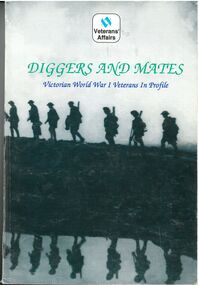
... Soft cover book with image of 'Supporting Troops of the 1st Australian Division photographed on a duckboard track near Ypres, Belgium, 1917. ...Soft cover book with image of 'Supporting Troops of the 1st Australian Division photographed on a duckboard track near Ypres, Belgium, 1917. ...John Henry Lockett OAM (22 January 1891 – 25 May 2002) was the oldest man ever in Australia when he died aged 111 years, 123 days. As one of the last surviving veterans of World War I, he was acclaimed as a national hero during the last decade of his life. Lockett was born in the small Victorian town of Waanyarra, near Bendigo. He left school aged nine to work on a local farm. Later, he worked for his uncles in the Mallee. On 24 March 1916, he travelled to Mildura to enlist in the Australian Imperial Force. He served in France with the 38th Battalion, earning promotion to sergeant and was discharged on 20 September 1919. https://en.wikipedia.org/wiki/Jack_Lockett After the war, Jack returned to The Mallee and selected a 640 acres (260 ha) block of land in Linga, Victoria, deciding to make his living as a farmer. In 1923, he married Maybell Ingwerson and they had four children together. In 1963, the couple retired to Bendigo in 1953, leaving the farmland (which now covered more than 130,000 acres (53,000 ha), in the care of their children and grandchildren. "Diggers And mates. Victorian World War 1 Veterans In Profile." Compiled by Kylie McKenzie. Preamble by Con Sciacca, Minister for Veterans' Affairs. Foreward by Brian Flynn, Deputy Commissioner for Veterans' Affairs. Produced by the Commonwealth Department of Veteran's Affairs, Melbourne. Printed by the Australian Government Publishing Service in 1995. Contains a collection of the experiences and insights of many of Victoria's then surviving World war 1 veterans. Soft cover book with image of 'Supporting Troops of the 1st Australian Division photographed on a duckboard track near Ypres, Belgium, 1917. Titles printed in Green and dark blue. Vererans' Affairs logo in centre at top of front cover. Book includes service particulars of each service person, personal particulars of person, and image(s) of service person at time of publication (1995) and whilst in service. Includes an article on Jack Lockett - serviceman 43 as presented in book . jack lockett, world war 1 -
 Bendigo Historical Society Inc.
Document - BOOKLET - 'THANKS FOR THE MEMORY', Early 1940s'?
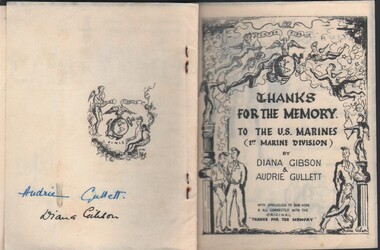
... Re the visit of US 1st Marine Division in Australia during WWII. Written/illustrated by Diana Gibson and Audrie Gullet. ...Re the visit of US 1st Marine Division in Australia during WWII. Written/illustrated by Diana Gibson and Audrie Gullet. ...Booklet - 'Thanks for the Memory'. Re the visit of US 1st Marine Division in Australia during WWII. Written/illustrated by Diana Gibson and Audrie Gullet. Illustrated 12 stapled pages. ( A number of references to Melbourne but none to Bendigo) Signed by the authors on back cover.person, individual -
 Bendigo Military Museum
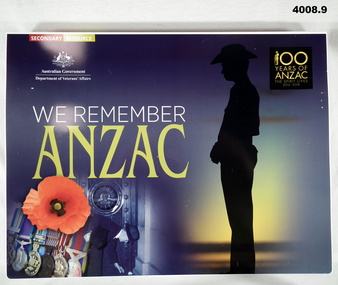
Education kit, Department of Veterans Affairs, WE REMEMBER ANZAC, 2) 2014, .4) 2014, .5) 2014, .6) 2014
... Illustrated - sepia and colour - in silhouette - Troops of 1st Australian Division and members of 4 RAR. Pages - cut, plain, white, illustrated colour, black & white photographs from Boer War to Afghanistan. .7) .8) Card, cardboard with Webkey attached. ...Illustrated - sepia and colour - in silhouette - Troops of 1st Australian Division and members of 4 RAR. Pages - cut, plain, white, illustrated colour, black & white photographs from Boer War to Afghanistan. .7) .8) Card, cardboard with Webkey attached. ...WE REMEMBER ANZAC - 100 years of ANZAC - THE SPIRIT LIVES 2014-2018 - SECONDARY RESOURCE .1) .2) 'WE REMEMBER ANZAC' .3) 'COMMEMORATIVE CEREMONY' .4) 'Memories & Memorabilia - Recognising and Preserving Australia's War Heritage' .5) 'Candour. Stories in the words of those who served 1914-1918.' .6) Over a Century of Service 2015 (Calendar) .7) 'ANZAC CENTENARY' .8) 'ANZAC PORTAL' .9) '2015 Anzac Day School's Awards'.1) Box folder - cardboard, white & gold print front, spine, back. Illustrated - collage colour photographs - medals, poppy, rising sun badge, soldier in silhouette. .2) Softcover, cardboard with fold in front flap, white & gold print, spiral bound, colour collage photographs - poppy, medals, troops. Pages - 86 pages, cut, plain, white, illustrated black & white, colour photographs, work sheets. .3) DVD inside cover flap. .4) Soft cover, cardboard, spiral bound, black, print front, illustrated sepia photograph soldier with letter and slouch hat. Pages - 88 pages, cut, plain, white, illustrated black & white, colour photographs, posters. .5) Soft cover, cardboard, white print front & back, illustrated - collage colour and sepia photographs of service personnel, letters, pens, brooch. Pages - 56 pages, cut, plain, white, illustrated colour, black & white photographs, medals, paintings. .6) Calender - soft cover, cardboard, light brown and black print front and back. Illustrated - sepia and colour - in silhouette - Troops of 1st Australian Division and members of 4 RAR. Pages - cut, plain, white, illustrated colour, black & white photographs from Boer War to Afghanistan. .7) .8) Card, cardboard with Webkey attached. Card - white & dark red print, small colour, sepia illustrations. .8) Key - metal with words printed - 'ANZAC PORTAL'. In plastic pocket. .9) Leaflet - lightweight cardboard black, white, yellow print front and back. Illustrated - black & white photograph of troop ship dockside. educational kit, anzac centenary -
 The Beechworth Burke Museum
Photograph, c.1914
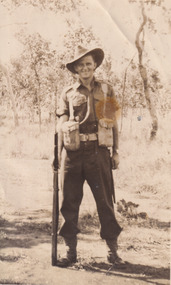
... During this fight, German forces captured several batteries of the 1st Australian Division’s artillery but the Australians led a strong counter-attack by four of their battalions and recaptured the village and most of the guns from the German forces. ...During this fight, German forces captured several batteries of the 1st Australian Division’s artillery but the Australians led a strong counter-attack by four of their battalions and recaptured the village and most of the guns from the German forces. ...This photograph depicts a soldier, credited on the reverse as Fred Foster. The young man is dressed in military attire and is standing tall with a gun beside him. He is located in the Australian bush and the date of the photograph is unknown. Frederick “Fred” Arthur Foster was nephew to famous Bushranger Edward “Ned” Kelly. He was born on the 15th of March 1889 in Forbes, New South Wales. He was the eldest son of Catherine “Kate” Kelly and William Henry “Bricky” Foster. After the death of his mother in October of 1898 from apparent drowning, Foster (then aged 9) was raised by his grandmother Ellen Kelly (née Quinn) at Eleven Mile Creek in Victoria. On the 29th of June 1915, 26 year old Foster travelled to Melbourne, Victoria and enlisted in the Australian Army. He was a Private in the 17th Infantry Battalion (originally C.Company, 47th battalion). He previously was attached to the 55th Battalion but transferred in 1916. Prior to enlisting in the army, Foster worked as a Bee Keeper and served in the 16th Light Horse regiment at Benalla. Foster had blue eyes, brown hair and was of Presbyterian faith. On the 28th of February 1917, Foster travelled to France aboard SS “Golden Eagle”. He was killed in action in Lagnicourt, France on the 15th of April 1917 at 28 years old. The Battle in Lagnicourt France, on the Western Front, occurred from the 1st of March to the 30th of April of 1917 and was the location of fierce fighting between Germany and the British Empire. Germany became aware of a weakness they had along the Hindenburg Line, one of these weaknesses was located in Lagnicourt which is a small village in Northern France. Therefore, the Germans decided to launch a counter-attack in this area on the 15th of April at dawn. During this fight, German forces captured several batteries of the 1st Australian Division’s artillery but the Australians led a strong counter-attack by four of their battalions and recaptured the village and most of the guns from the German forces. German forces were forced into a premature withdrawal. This battle was not undertaken in typical WW1 “trench” style warfare. Instead, the battle was up on the ground in what was described as “old open style warfare”. In this battle, slightly more than 1000 casualties were Australian, with 300 of these prisoners of war. German forces suffered a loss of over 2300 casualties with 360 taken captive. Foster was one of 43 in his regiment who died, 87 were wounded and 51 reported missing. Foster was buried at location in Lagnicourt and whilst the grave was initially marked, it is now unknown. Foster’s service, alongside those who fell at Lagnicourt, is commemorated at the Australian National Memorial in Villers-Bretonneux, France along with other national Australian memorial sites.Photography played an important part in World War 1. Photographs of men in their military uniforms served as propaganda during the Great War to reassure civilians back at home of the military prowess of their nation and the bravery of their men. It did this while hiding the true horrors which faced the men in battle. These photographs, which includes those taken at home prior to embarking overseas like Fred Foster’s, act as censored memory for those who have lost a loved one at war. It enables families to remember their relatives in their youth and standing proudly rather than having to face the actual danger and horror which faced these men at the front line. The battle of Lagnicourt France was a victory for the European Empire and therefore, men who lost their lives protecting their countries became heroes and were awarded posthumous medals for their service. Photos of soldiers in their uniforms, were undertaken by men like Foster, so their families would be able to retain their memories and likeness before they embarked for war. Many men were killed or horribly wounded so these images were important for reminding families about their sons/ husbands/ brothers/ cousins and friends. This photo is a part of the Burke Museum Kelly album which includes numerous photographs relating to the Kelly Gang. As the son of Kate Kelly and William “Bricky” Foster, Fred Foster is an important part of the Kelly story after the execution of Edward “Ned” Kelly which has information it can impart relating to the history of the family after 1880. Whilst an important element of the Kelly Album, Foster’s photograph is also historically important in its own right for its connection to the Great War and the experiences of a soldier at the Western Front.Original sepia rectangular photograph developed on matte photographic paper, unmounted.Reverse: (Top right corner of reverse:) FRED FOSTER/ (Top centre of reverse:) Kate Kelly's son.kelly album, fred foster, kate kelly, photograph, australian soldier, the kelly gang, australian bush, burke museum, sepia photo, gum trees, family of the kelly gang, world war i, langnicourt, france, great war, 1917, ned kelly, frederick foster, william "bricky" foster, ellen kelly, military history, australian military -
 Lara RSL Sub Branch
Framed Photograph of Anzac cove, Anzac Cove 1915
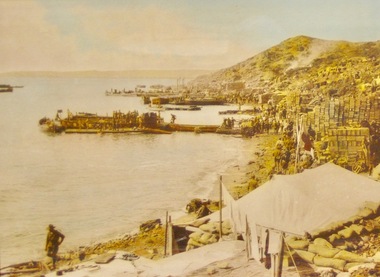
... General William Birdwood, commander of Anzac, made his headquarters in a gully overlooking the cove, as did the commanders of the New Zealand and Australian Division and the Australian 1st Division. It was on 29 April that General Birdwood recommended that the original landing site between the two headlands be known as "Anzac Cove" and that the surrounding, hitherto nameless, area occupied by his corps be known as "Anzac". ...General William Birdwood, commander of Anzac, made his headquarters in a gully overlooking the cove, as did the commanders of the New Zealand and Australian Division and the Australian 1st Division. It was on 29 April that General Birdwood recommended that the original landing site between the two headlands be known as "Anzac Cove" and that the surrounding, hitherto nameless, area occupied by his corps be known as "Anzac". ...Gallipoli Campaign 1915-6[edit] The first objective for soldiers coming ashore in enemy-held territory was to establish a beachhead, that is a safe section of beach protected from enemy attack where supplies and extra troops could be safely brought ashore. Anzac Cove was always within 1 kilometre (3,300 ft) of the front-line, well within the range of Turkish artillery though spurs from the high ground of Plugge's Plateau, which rose above Arıburnu, provided some protection. General William Birdwood, commander of Anzac, made his headquarters in a gully overlooking the cove, as did the commanders of the New Zealand and Australian Division and the Australian 1st Division. It was on 29 April that General Birdwood recommended that the original landing site between the two headlands be known as "Anzac Cove" and that the surrounding, hitherto nameless, area occupied by his corps be known as "Anzac". Anzac Cove is a small cove on the Gallipoli peninsula in Turkey. It became famous as the site of World War I landing of the ANZACs (Australian and New Zealand Army Corps) on 25 April 1915. The cove is 600 metres (2,000 ft) long, bounded by the headlands of Arıburnu to the north and Little Arıburnu, known as Hell Spit, to the south. Following the landing at Anzac Cove, the beach became the main base for the Australian and New Zealand troops for the eight months of the Gallipoli campaign. Rectangular shaped glass covered picture frame showing Anzac Cove.world war 1,gallipoli,anzac cove,lara r.s.l. ww1 -
 Melbourne Legacy
Book, Australians on the Somme. Pozieres 1916, 1986
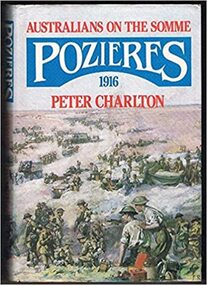
... Between 23 July and 5 August 1916, the Australian 1st and 2nd Divisions captured Pozières village and Pozières heights, a ridge 500 metres east of the village. ...Between 23 July and 5 August 1916, the Australian 1st and 2nd Divisions captured Pozières village and Pozières heights, a ridge 500 metres east of the village. ...A book about the fighting around the French village of Pozieres in 1916. Many of the early legatees fought on the Western Front and some, including founder Stan Savige, fought at Pozieres. There is a photo in the book of Brigadier-General Gellibrand and his staff, including Savige, eating breakfast in a shell hole. Back in Australia after the war Gellibrand inspired Savige to found a club like the Remembrance Club he had founded in Hobart. Thus Savige founded Legacy. Speeches by Legatees Kemsley and Armstrong in later years showed they had also fought in the Pozieres area. Some research has shown: The fighting around Pozières was part of the brave actions of the Australians during the battle of the Somme from July 1916. Between 23 July and 5 August 1916, the Australian 1st and 2nd Divisions captured Pozières village and Pozières heights, a ridge 500 metres east of the village. The 4th Division then continued the attack north along the ridge, the Australians in ten days of continuous action reached Mouquet Farm. The farm resisted capture until 26 September 1916. In less than seven weeks in the fighting at Pozières and Mouquet Farm three Australian divisions suffered 23,000 casualties. Of these, 6,800 men were killed or died of wounds. It was a loss comparable with the casualties sustained by the Australians over eight months at Gallipoli in 1915.A book about a battle that was important to the early legatees.Hardcover book x 318 pages about the Somme battles of World War One.Handwritten 'Melbourne Legacy Library WW1 in black ink on the fly leaf. Also a sticker saying property of Rob Allison on title page.somme, pozieres, battles, aif -
 Federation University Historical Collection
Postcard - black and white, Estaires, France, c1917, C1917
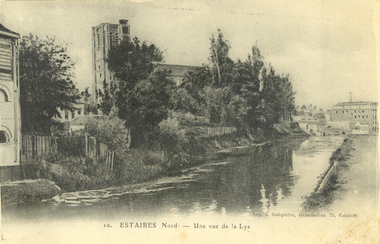
... On the 10 April 1918 it was captured by the enemy, after an obstinate defence by the 50th (Northumbrian) Division; and it was finally retaken by British troops at the beginning of September 1918. The town was a Field Ambulance centre as early as November 1914, and later the 1st Australian Casualty Clearing Station was posted in it. ...On the 10 April 1918 it was captured by the enemy, after an obstinate defence by the 50th (Northumbrian) Division; and it was finally retaken by British troops at the beginning of September 1918. The town was a Field Ambulance centre as early as November 1914, and later the 1st Australian Casualty Clearing Station was posted in it. ...WW1 Australian soldier Holmes Famiiy memento. Estaires is a town and commune in the Department of the Nord, about 11 kilometres west of Armentieres. The Estaires Communal Cemetery and Extension is on the eastern outskirts of the town and on the east side of the road to Bailleul. Estaires town was occupied by French cavalry on the 15 October 1914, and passed at once into British hands. On the 10 April 1918 it was captured by the enemy, after an obstinate defence by the 50th (Northumbrian) Division; and it was finally retaken by British troops at the beginning of September 1918. The town was a Field Ambulance centre as early as November 1914, and later the 1st Australian Casualty Clearing Station was posted in it. (http://www.cwgc.org/find-a-cemetery/cemetery/26801/ESTAIRES%20COMMUNAL%20CEMETERY%20AND%20EXTENSION, accessed 11/07/2014)Australian soldier's WW1souvenirA black and white postcard with buildings along a river at Estaires in Northern France.estaires communal cemetery and extension, estaires, france, chatham-holmes family collection, 1st australian casualty clearing station, postcard -
 Federation University Historical Collection
Document - Document - Information, VIOSH: Ballarat College of Advanced Education; Notice of Seminar, "Product Safety and Product Liability", 1982
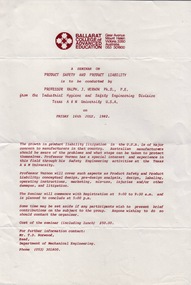
... Division, Texas A&M University U.S.A. Topic is "Product Safety and Product Liability". The growth in product liability litigation in the U.S.A. is a major concern to manufacturers. Australian manufacturers should be aware and protect themselves. Cost of Seminar - $50.00 (including lunch). Those wishing to attend to return slip to Mr T Norwood, Head of Mechanical Engineering by 1st...Division, Texas A&M University U.S.A. Topic is "Product Safety and Product Liability". The growth in product liability litigation in the U.S.A. is a major concern to manufacturers. Australian manufacturers should be aware and protect themselves. Cost of Seminar - $50.00 (including lunch). Those wishing to attend to return slip to Mr T Norwood, Head of Mechanical Engineering by 1st ...Victorian Institute of Occupational Safety and Health (VIOSH) Australia is the Asia-Pacific centre for teaching and research in occupational health and safety (OHS) and is known as one of Australia's leaders on the field. VIOSH has a global reputation for its innovative approach within the field of OHS management. VIOSH had its first intake of students in 1979. At that time the Institution was known as the Ballarat College of Advanced Education. In 1990 it became known as Ballarat University College, then in 1994 as University of Ballarat. It was 2014 that it became Federation University. VIOSH Australia students are safety managers, senior advisors and experienced OHS professionals. They come from all over Australia and industry. Students are taught active research and enquiry; rather than textbook learning and a one-size fits all approach. VIOSH accepts people into the Graduate Diploma of Occupational Hazard Management who have no undergraduate degree - on the basis of extensive work experience and knowledge. Notice advertising a seminar to be held at Ballarat College of Advance Education on Friday 16th July, 1982. Registration is at 9.00 to 9.30am, It is planned to conclude at 5.00pm. The speaker will be Professor Ralph Vernon from the Industrial Hygiene and Safety Engineering Division, Texas A&M University U.S.A. Topic is "Product Safety and Product Liability". The growth in product liability litigation in the U.S.A. is a major concern to manufacturers. Australian manufacturers should be aware and protect themselves. Cost of Seminar - $50.00 (including lunch). Those wishing to attend to return slip to Mr T Norwood, Head of Mechanical Engineering by 1st July.A4 sheet - printed sheet - rust colour ink. Small return slip re attendanceBCAE Letterheadviosh, victorian institute of occupational safety and health, seminar, ballarat college of advanced education, professor ralph vernon, texas a&m university, product safety and product liability, t d norwood, industrial hygiene and safety engineering division, department of mechanical engineering -
 Lara RSL Sub Branch
Photograph, THE 8TH BATTALION IN CAMP AT ELCHO FARM, GEELONG IN 1934, 1934
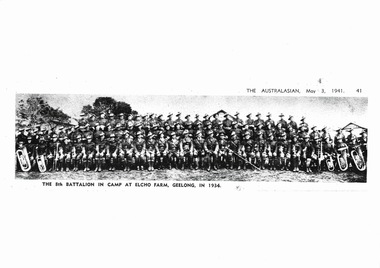
... Initially raised in 1914 for the First Australian Imperial Force during the First World War the battalion was completely recruited from Victoria and formed part of the 2nd Brigade, 1st Division. ...Initially raised in 1914 for the First Australian Imperial Force during the First World War the battalion was completely recruited from Victoria and formed part of the 2nd Brigade, 1st Division. ...The 8th Battalion was an infantry battalion of the Australian Army. Initially raised in 1914 for the First Australian Imperial Force during the First World War the battalion was completely recruited from Victoria and formed part of the 2nd Brigade, 1st Division. During the war it fought at Gallipoli and in France and Belgium on the Western Front. It was disbanded in 1919, before being re-raised as a Militia battalion in 1921. During the Second World War the 8th Battalion was used primarily as a garrison unit before taking part in the Bougainville campaign late in the war. It was disbanded again in 1946 during the demobilisation process, although it was reformed again in 1948 when it was amalgamated with the 7th Battalion. Today, its honours and traditions are perpetuated by the 8th/7th Battalion, Royal Victoria Regiment.Rectangular shaped black and white photograph.THE AUSTRALIAN, May 3, 1941. THE 8TH BATTALION IN CAMP AT ELCHO FARM, GELONG IN 1934. 8th battalion, ww1, australian infantry, lara r.s.l. -
 Lara RSL Sub Branch
Photograph Elcho Farm, 1934
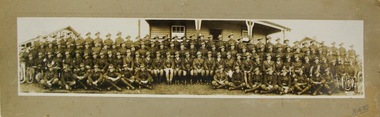
... Initially raised in 1914 for the First Australian Imperial Force during the First World War the battalion was completely recruited from Victoria and formed part of the 2nd Brigade, 1st Division. ...Initially raised in 1914 for the First Australian Imperial Force during the First World War the battalion was completely recruited from Victoria and formed part of the 2nd Brigade, 1st Division. ...The 8th Battalion was an infantry battalion of the Australian Army. Initially raised in 1914 for the First Australian Imperial Force during the First World War the battalion was completely recruited from Victoria and formed part of the 2nd Brigade, 1st Division. During the war it fought at Gallipoli and in France and Belgium on the Western Front. It was disbanded in 1919, before being re-raised as a Militia battalion in 1921.Rectangular Black and White Photograph mounted on Grey CardboardFront H. WaL? George Crawford Elcho Farm Lara 1936-1937elcho farm lara 1936 1937 photo george crawford -
 Lara RSL Sub Branch
Photograph, Set 4 photographs. and others for Torquay Light Horse camp, 1940
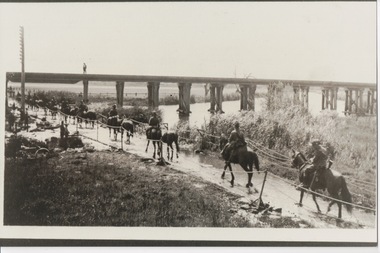
... Australian Imperial Force (AIF). Men were given remounts (if not using their own horses) – army horses bought by Commonwealth purchasing officers from graziers and breeders. These were called “walers” because they were a New South Wales stockhorse type – strong, great-hearted animals with the strains of the thoroughbred and semi-draught to give them speed, strength and stamina. On 1st November, 1914, Australia’s First Infantry Division...Australian Imperial Force (AIF). Men were given remounts (if not using their own horses) – army horses bought by Commonwealth purchasing officers from graziers and breeders. These were called “walers” because they were a New South Wales stockhorse type – strong, great-hearted animals with the strains of the thoroughbred and semi-draught to give them speed, strength and stamina. On 1st November, 1914, Australia’s First Infantry Division ...These images capture for all time Light Horsemen travelling through Geelong on their way to camp at Torquay for the last Group meeting in Australia . information following - details obtained from .........https://torquayhistory.com/light-horse-brigade/ On Australia Day, 1997, Sir John Young unveiled this plaque on Point Danger, Torquay. Torquay history, Light Horse Training Camp, WW2 Plaque at Pt. Danger Note----- (See images to view plaque) The plaque identifies a significant event in Torquay’s history and the sentiments of ‘change’ for the Light Horse Brigade – from horses to machines. In 1940 the four Light Horse Regiments (4th, 8th, 13th and 20th), some 5000 Light Horse and 2000 horses camped and trained at Torquay. Three other regiments, formerly mounted on horses, were also at Torquay ‘mounted’ on privately owned trucks and cars. Division troops included Artillery, Engineers, Signals, Field Ambulance and other branches of the Army necessary to enable a Division to function. It wasn’t just the sheer numbers of men coming to this little town that made the event significant, it was also the fact that the men of the Light Horse were dramatic, almost glamorous figures and it is easy to see their exploits as some splendid adventure. Horses have played a special role in the story of Australia. They were the only means of transport across this huge country, so it was necessary for everyone to have the ability to ride a horse. When war broke out in 1899 between Britain and the Boers of South Africa (“Boer” was Dutch for “farmer”) Australia sent troops to fight. At first Britain was wary of using untried, unprofessional colonial cavalrymen but soon saw that the slouch-hatted Australian “bushmen” were a match for the fast-moving and unconventional mounted commandos of the Boers. The Australians proved themselves to be expert rough-riding horsemen and good shots. Bush life had hardened them to go for long periods with little food and water. They also showed remarkable ability to find their way in a strange country and use its features for cover, in both attack and defence. By 1914, when Australia joined the war against Germany, there were 23 Light Horse regiments of militia volunteers. Many men from these units joined the Light Horse regiments of the Australian Imperial Force (AIF). Men were given remounts (if not using their own horses) – army horses bought by Commonwealth purchasing officers from graziers and breeders. These were called “walers” because they were a New South Wales stockhorse type – strong, great-hearted animals with the strains of the thoroughbred and semi-draught to give them speed, strength and stamina. On 1st November, 1914, Australia’s First Infantry Division and the first four Light Horse regiments sailed for England in a fleet of transport ships. The first of the Light Horse arrived at Gallipoli in May without their horses. Back with their horses after Gallipoli, they were formidable combatants across the Sinai and Palestine. Some British commanders observed that the light horseman moved with a “lazy, slouching gait, like that of a sleepy tiger” but described how the promise of battle “changes that careless gait, into a live athletic swing that takes him over the ground much quicker than other troops”. They had Light Horse, Torquay, training campdeveloped a reputation as formidable infantrymen. The Turks called them “the White Ghurkas” – a reference to their deadly skill with the bayonet. The Arabs called them “The Kings of the Feathers”. The plume had originally been a battle honour of the Queensland Mounted Infantry for their work in the shearer’s strike of 1891. During WW1 it was adopted by almost all the Light Horse Regiments. It was the proud badge of the light horseman. The most famous of their battles was the attack on Beersheba- the charge of the 4th Light Horse Brigade. Mounted infantrymen and their superb walers had carried out one of the most successful cavalry charges in history – against what seemed impossible odds. They surprised the Turks by charging cavalry-style, when they would normally have ridden close to an objective then dismounted to fight. The fall of Beersheba swung the battle tide against the Turks in Palestine; and changed the history of the Middle East. While 19 men from the Surf Coast Shire served with the 4th Light Horse over the course of WW1, only four were involved in the charge of Beersheba- John GAYLARD, Philip QUINN.(Winchelsea); Wallace FINDLAY (Anglesea); Harry TRIGG (Bambra). After the war, Light Horse units played a key role in the Australian Government’s compulsory military training programme. The Citizen Military Forces (C.M.F.) thrived on the glamour of the wartime Light Horse tradition, ignoring the possibility that motor vehicles would soon replace the horses. When training was no longer compulsory, the C.M.F. regiments declined and horses became more of a luxury during the 1930s depression years of poverty and unemployment. Some regiments were motorised. Then, in 1939, Australia joined Britain in another world war. Training was increased for the militia at both home bases and regional training camps. The camp at Torquay in 1940, commanded by Major General Rankin, was at Divisional strength. By the end of the camp some felt that the Division was ready for active service. Gradually, over the next four years, the Australian Light Horse units were mounted on wheels and tracks and the horses were retired. Six men enlisted at the Torquay camp and another 57 men and women enlisted at Torquay for service in WW2. Those who served in the Militia provided valuable Officers and NCOs and men for the armed services during the war. Each infantry division of the 2nd AIF had a Light Horse regiment attached to it. But the day of the Australian mounted soldier hadn’t quite passed. During World War II, Australia’s 6th Cavalry Regiment formed a mounted unit they called “The Kelly Gang” which did valuable scouting work. In New Guinea, a mounted Light Horse Troop did patrol duty and helped carry supplies. Some fully equipped walers were flown into Borneo for reconnaissance in rugged mountain country. But by the end of the war, in 1945, the horse had disappeared from the Australian Army. References: Australian Light Horse Association www.lighthorse.org.au National Australia Archives Australian War Memorial Surf Coast Shire WW1 memorials www.togethertheyserved.com The Light horse- a Cavalry under Canvas Light Horse, Training Camp, Torquay, WW2 Late in 1939 it was decided to set up a Lighthorse training camp in Torquay to train both men and horses for the battles of the Second World War. Horses, men and equipment came on special trains from all over Victoria and NSW, and as you would expect horseman came from areas such as Omeo and Sale, the Wimmera and the Western District. They arrived at the Geelong racecourse for watering in the Barwon River and then were ridden across the ford at the breakwater and began their 11 mile trek to Torquay. Light Horse, Training Camp, Torquay, WW2 Tent city By the end of January 1940 the camp at Torquay accommodated some 5000 men and 2500 horses of the Second Cavalry Division. The rows of horses, tents and huts near Blackgate Road were quite a sight. While the cavalrymen engaged in exercises on the land and on the beaches, many of the troops took over the Torquay School for special training of men and officers. Mr Bob Pettit local farmer and Councillor for the Barrabool Shire, wrote about the Light horse in the Surf Coast Community News in 1985 saying “They used to travel about the district riding four abreast in one long convoy. To my annoyance they went through my property and shut all the gates behind them. I had certain gates open to let stock in to the water holes and it would take me three -quarters of an hour to follow the horsemen up and put all the gates right again” he continued “the men from the Light Horse were here when the fire went through in March 1940. He recalled an incident when early one morning, as some one blew the bugle, a soldier putting a white sheet on the line frightened the horses. They panicked and ran off in all directions. Six went over the cliff near Bird Rock, five were never found, and the rest were gathered up after nearly a fortnight in the bush around Addiscott and Anglesea" Light Horse, Training Camp, Torquay, WW2, Geelong Parade Geelong parade The training camp culminated in a parade through the streets of Geelong on March 12th 1940. The salute was given at the Town Hall and the troops continued on a route to the You Yang’s for a training exercise. Note-----(see media section for photograph) The Camp was abandoned in mid 1940 as it was deemed unsuitable for training during winter and the cost of a permanent camp could not be justified if it could not be used all year. Historic.......Rare,,,Interpretive.Sepia photographs.set of four ....post card size ....Horses &LighthorsemenNo 1, Lighthorsemen Regiment Geelong 1940......No 2 Light Horse at Breakwater Geelong 1938 to 1940....No 3 Light Horse at Breakwater Geelong 1938 to 1940.....No 4 Light Horse crossing Breakwater camped at Geelong Showgrounds. These markings are on reverse of photographs.light horsemengeelong 1940., world war 2 -
 Flagstaff Hill Maritime Museum and Village
Photograph - Military group, C. Fitch & Son, c. 1941
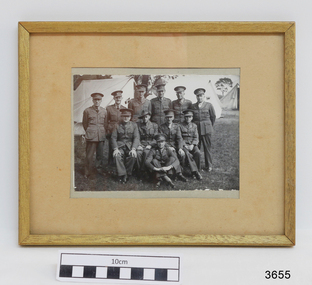
... Framed, glass covered photograph, black and white, of Australian Army Officers of 46th Battalion, 3rd Division at Camp Site 20, September 1941. Amongst the officers is Dr.W.R. Angus (front row, 1st...australian army officers of 46th battalion, 3rd division army surgeon camp 20 army surgeon ww2 c. fitch and son Stamped details of the "Official Photographer C. Fitch & Son, 4 Racing Club Lane, off Little Bourke St, Melbourne. " Framed, glass covered photograph, black and white, of Australian Army Officers of 46th Battalion, 3rd Division at Camp Site 20, September 1941. Amongst the officers is Dr.W.R. Angus (front row, 1st ...This photograph was taken during World War 2 when Dr. W.R. Angus served as an army surgeon. The details on the back of the photograph include the date of 1941. The photograph was donated to Flagstaff Hill Maritime Village by the family of Doctor William Roy Angus, Surgeon and Oculist. It is part of the “W.R. Angus Collection” that includes historical medical equipment, surgical instruments and material once belonging to Dr Edward Ryan and Dr Thomas Francis Ryan, (both of Nhill, Victoria) as well as Dr Angus’ own belongings. The Collection’s history spans the medical practices of the two Doctors Ryan, from 1885-1926 plus that of Dr Angus, up until 1969. ABOUT THE “W.R.ANGUS COLLECTION” Doctor William Roy Angus M.B., B.S., Adel., 1923, F.R.C.S. Edin.,1928 (also known as Dr Roy Angus) was born in Murrumbeena, Victoria in 1901 and lived until 1970. He qualified as a doctor in 1923 at University of Adelaide, was Resident Medical Officer at the Royal Adelaide Hospital in 1924 and for a period was house surgeon to Sir (then Mr.) Henry Simpson Newland. Dr Angus was briefly an Assistant to Dr Riddell of Kapunda, then commenced private practice at Curramulka, Yorke Peninsula, SA, where he was physician, surgeon and chemist. In 1926, he was appointed as new Medical Assistant to Dr Thomas Francis Ryan (T.F. Ryan, or Tom), in Nhill, Victoria, where his experiences included radiology and pharmacy. In 1927 he was Acting House Surgeon in Dr Tom Ryan’s absence. Dr Angus had become engaged to Gladys Forsyth and they decided he would take time to further his studies overseas in the UK in 1927. He studied at London University College Hospital and at Edinburgh Royal Infirmary and in 1928, was awarded FRCS (Fellow from the Royal College of Surgeons), Edinburgh. He worked his passage back to Australia as a Ship’s Surgeon on the on the Australian Commonwealth Line’s T.S.S. Largs Bay. Dr Angus married Gladys in 1929, in Ballarat. (They went on to have one son (Graham 1932, born in SA) and two daughters (Helen (died 12/07/1996) and Berenice (Berry), both born at Mira, Nhill ) Dr Angus was a ‘flying doctor’ for the A.I.M. (Australian Inland Ministry) Aerial Medical Service in 1928 . The organisation began in South Australia through the Presbyterian Church in that year, with its first station being in the remote town of Oodnadatta, where Dr Angus was stationed. He was locum tenens there on North-South Railway at 21 Mile Camp. He took up this ‘flying doctor’ position in response to a call from Dr John Flynn; the organisation was later known as the Flying Doctor Service, then the Royal Flying Doctor Service. A lot of his work during this time involved dental surgery also. Between 1928-1932 he was surgeon at the Curramulka Hospital, Yorke Peninsula, South Australia. In 1933 Dr Angus returned to Nhill where he’d previously worked as Medical Assistant and purchased a share of the Nelson Street practice and Mira hospital from Dr Les Middleton one of the Middleton Brothers, the current owners of what was once Dr Tom Ryan’s practice. Dr L Middleton was House Surgeon to the Nhill Hospital 1926-1933, when he resigned. [Dr Tom Ryan’s practice had originally belonged to his older brother Dr Edward Ryan, who came to Nhill in 1885. Dr Edward saw patients at his rooms, firstly in Victoria Street and in 1886 in Nelson Street, until 1901. The Nelson Street practice also had a 2 bed ward, called Mira Private Hospital ). Dr Edward Ryan was House Surgeon at the Nhill Hospital 1884-1902 . He also had occasions where he successfully performed veterinary surgery for the local farmers too. Dr Tom Ryan then purchased the practice from his brother in 1901. Both Dr Edward and Dr Tom Ryan work as surgeons included eye surgery. Dr Tom Ryan performed many of his operations in the Mira private hospital on his premises. He too was House Surgeon at the Nhill Hospital 1902-1926. Dr Tom Ryan had one of the only two pieces of radiology equipment in Victoria during his practicing years – The Royal Melbourne Hospital had the other one. Over the years Dr Tom Ryan gradually set up what was effectively a training school for country general-practitioner-surgeons. Each patient was carefully examined, including using the X-ray machine, and any surgery was discussed and planned with Dr Ryan’s assistants several days in advance. Dr Angus gained experience in using the X-ray machine there during his time as assistant to Dr Ryan. Dr Tom Ryan moved from Nhill in 1926. He became a Fellow of the Royal Australasian College of Surgeons in 1927, soon after its formation, a rare accolade for a doctor outside any of the major cities. He remained a bachelor and died suddenly on 7th Dec 1955, aged 91, at his home in Ararat. Scholarships and prizes are still awarded to medical students in the honour of Dr T.F. Ryan and his father, Dr Michael Ryan, and brother, John Patrick Ryan. ] When Dr Angus bought into the Nelson Street premises in Nhill he was also appointed as the Nhill Hospital’s Honorary House Surgeon 1933-1938. His practitioner’s plate from his Nhill surgery states “HOURS Daily, except Tuesdays, Fridays and Saturday afternoons, 9-10am, 2-4pm, 7-8pm. Sundays by appointment”. This plate is now mounted on the doorway to the Port Medical Office at Flagstaff Hill Maritime Village, Warrnambool. Dr Edward Ryan and Dr Tom Ryan had an extensive collection of historical medical equipment and materials spanning 1884-1926 and when Dr Angus took up practice in their old premises he obtained this collection, a large part of which is now on display at the Port Medical Office at Flagstaff Hill Maritime Village in Warrnambool. During his time in Nhill Dr Angus was involved in the merging of the Mira Hospital and Nhill Public Hospital into one public hospital and the property titles passed on to Nhill Hospital in 1939. In 1939 Dr Angus and his family moved to Warrnambool where he purchased “Birchwood,” the 1852 home and medical practice of Dr John Hunter Henderson, at 214 Koroit Street. (This property was sold in1965 to the State Government and is now the site of the Warrnambool Police Station. ). The Angus family was able to afford gardeners, cooks and maids; their home was a popular place for visiting dignitaries to stay whilst visiting Warrnambool. Dr Angus had his own silk worm farm at home in a Mulberry tree. His young daughter used his centrifuge for spinning the silk. Dr Angus was appointed on a part-time basis as Port Medical Officer (Health Officer) in Warrnambool and held this position until the 1940’s when the government no longer required the service of a Port Medical Officer in Warrnambool; he was thus Warrnambool’s last serving Port Medical Officer. (The duties of a Port Medical Officer were outlined by the Colonial Secretary on 21st June, 1839 under the terms of the Quarantine Act. Masters of immigrant ships arriving in port reported incidents of diseases, illness and death and the Port Medical Officer made a decision on whether the ship required Quarantine and for how long, in this way preventing contagious illness from spreading from new immigrants to the residents already in the colony.) Dr Angus was a member of the Australian Medical Association, for 35 years and surgeon at the Warrnambool Base Hospital 1939-1942, He served as a Surgeon Captain during WWII 1941-45, in Ballarat, Victoria, and in Bonegilla, N.S.W., completing his service just before the end of the war due to suffering from a heart attack. During his convalescence he carved an intricate and ‘most artistic’ chess set from the material that dentures were made from. He then studied ophthalmology at the Royal Melbourne Eye and Ear Hospital and created cosmetically superior artificial eyes by pioneering using the intrascleral cartilage. Angus received accolades from the Ophthalmological Society of Australasia for this work. He returned to Warrnambool to commence practice as an ophthalmologist, pioneering in artificial eye improvements. He was Honorary Consultant Ophthalmologist to Warrnambool Base Hospital for 31 years. He made monthly visits to Portland as a visiting surgeon, to perform eye surgery. He represented the Victorian South-West subdivision of the Australian Medical Association as its secretary between 1949 and 1956 and as chairman from 1956 to 1958. In 1968 Dr Angus was elected member of Spain’s Barraquer Institute of Barcelona after his research work in Intrasclearal cartilage grafting, becoming one of the few Australian ophthalmologists to receive this honour, and in the following year presented his final paper on Living Intrasclearal Cartilage Implants at the Inaugural Meeting of the Australian College of Ophthalmologists in Melbourne In his personal life Dr Angus was a Presbyterian and treated Sunday as a Sabbath, a day of rest. He would visit 3 or 4 country patients on a Sunday, taking his children along ‘for the ride’ and to visit with him. Sunday evenings he would play the pianola and sing Scottish songs to his family. One of Dr Angus’ patients was Margaret MacKenzie, author of a book on local shipwrecks that she’d seen as an eye witness from the late 1880’s in Peterborough, Victoria. In the early 1950’s Dr Angus, painted a picture of a shipwreck for the cover jacket of Margaret’s book, Shipwrecks and More Shipwrecks. She was blind in later life and her daughter wrote the actual book for her. Dr Angus and his wife Gladys were very involved in Warrnambool’s society with a strong interest in civic affairs. Their interests included organisations such as Red Cross, Rostrum, Warrnambool and District Historical Society (founding members), Wine and Food Society, Steering Committee for Tertiary Education in Warrnambool, Local National Trust, Good Neighbour Council, Housing Commission Advisory Board, United Services Institute, Legion of Ex-Servicemen, Olympic Pool Committee, Food for Britain Organisation, Warrnambool Hospital, Anti-Cancer Council, Boys’ Club, Charitable Council, National Fitness Council and Air Raid Precautions Group. He was also a member of the Steam Preservation Society and derived much pleasure from a steam traction engine on his farm. He had an interest in people and the community He and his wife Gladys were both involved in the creation of Flagstaff Hill, including the layout of the gardens. After his death (28th March 1970) his family requested his practitioner’s plate, medical instruments and some personal belongings be displayed in the Port Medical Office surgery at Flagstaff Hill Maritime Village, and be called the “W. R. Angus Collection”. The W.R. Angus Collection is significant for still being located at the site it is connected with, Doctor Angus being the last Port Medical Officer in Warrnambool. The collection of medical instruments and other equipment is culturally significant, being an historical example of medicine from late 19th to mid-20th century. Dr Angus assisted Dr Tom Ryan, a pioneer in the use of X-rays and in ocular surgery. Framed, glass covered photograph, black and white, of Australian Army Officers of 46th Battalion, 3rd Division at Camp Site 20, September 1941. Amongst the officers is Dr.W.R. Angus (front row, 1st on left). Frame is wood. Names of the officers are hand written in ink on the paper on the back of the photograph, as are the stamped details of the "Official Photographer C. Fitch & Son, 4 Racing Club Lane, off Little Bourke St, Melbourne. "Stamped details of the "Official Photographer C. Fitch & Son, 4 Racing Club Lane, off Little Bourke St, Melbourne. "flagstaff hill, warrnambool, shipwrecked coast, flagstaff hill maritime museum, maritime museum, shipwreck coast, flagstaff hill maritime village, great ocean road, dr w r angus, australian army officers, of 46th battalion, 3rd division, army surgeon camp 20, army surgeon ww2, c. fitch and son -
 Ringwood and District Historical Society
Book, Dr Sue Summers, Elsie Isabel Baner - 20th Century Australian Croquet Champion, 2023
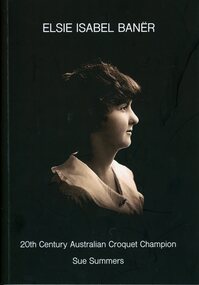
... Australian croquet champion Elsie Isabel Baner (1900-1983) who, in her early thirties in late 1933, began to play crouet on a newly-formed lawn adjoining the Ringwood Bowling Club. Within three years, she won the hightly prestigious English Silver Medal (B Class Division) and was immediately upgraded to A Grade. Elsie remained a champion player for the next three decades and was acknowledged by her colleagues as "a legend in her own lifetime. Author, Dr Sue Summers, is the maternal granddaughter of Elsie Isabel Baner and Frederick Thomas Baner. Awarded to the Croquet Australia Hall of Fame on 1st...Australian croquet champion Elsie Isabel Baner (1900-1983) who, in her early thirties in late 1933, began to play crouet on a newly-formed lawn adjoining the Ringwood Bowling Club. Within three years, she won the hightly prestigious English Silver Medal (B Class Division) and was immediately upgraded to A Grade. Elsie remained a champion player for the next three decades and was acknowledged by her colleagues as "a legend in her own lifetime. Author, Dr Sue Summers, is the maternal granddaughter of Elsie Isabel Baner and Frederick Thomas Baner. Awarded to the Croquet Australia Hall of Fame on 1st ...Foreword Intro: Life story of Australian croquet champion Elsie Isabel Baner (1900-1983) who, in her early thirties in late 1933, began to play crouet on a newly-formed lawn adjoining the Ringwood Bowling Club. Within three years, she won the hightly prestigious English Silver Medal (B Class Division) and was immediately upgraded to A Grade. Elsie remained a champion player for the next three decades and was acknowledged by her colleagues as "a legend in her own lifetime. Author, Dr Sue Summers, is the maternal granddaughter of Elsie Isabel Baner and Frederick Thomas Baner. Awarded to the Croquet Australia Hall of Fame on 1st December 2023, for demonstrated leadership and influence in croquet in Australia as a player, coach and mentor. -
 Mission to Seafarers Victoria
Plaque - Memorial Plaque, Australian Navy, 2007
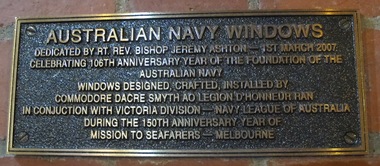
... Australian Navy Windows Dedicated by RT. Rev. Bishop Jeremy Ashton - 1st March 2007 Celebrating 106th Anniversary year of the foundation of the Australian Navy. Windows designed, crafted, installed by Commodore Dacre Smyth AO Legion D'Honneur Ran in conjunction with Victoria Division - Navy League of Australia during the 150th Anniversary year of Mission to Seafarers - Melbourne...Australian Navy Windows Dedicated by RT. Rev. Bishop Jeremy Ashton - 1st March 2007 Celebrating 106th Anniversary year of the foundation of the Australian Navy. Windows designed, crafted, installed by Commodore Dacre Smyth AO Legion D'Honneur Ran in conjunction with Victoria Division - Navy League of Australia during the 150th Anniversary year of Mission to Seafarers - Melbourne Rectangular memorial plaque. ...The two windows commemorate both seafarers of two world wars and the historic vessel Dreadnought. The installation coincided in 2007 with the 150th anniversary of services to seafarers by the Mission to Seafarers.Rectangular memorial plaque. The plaque is bronze with brass edged frame and bronze raised lettering on a black background. The plaque is mounted to a brick wall beneath windows referred to.Australian Navy Windows Dedicated by RT. Rev. Bishop Jeremy Ashton - 1st March 2007 Celebrating 106th Anniversary year of the foundation of the Australian Navy. Windows designed, crafted, installed by Commodore Dacre Smyth AO Legion D'Honneur Ran in conjunction with Victoria Division - Navy League of Australia during the 150th Anniversary year of Mission to Seafarers - Melbourneaustralian navy, windows, reverend bishop jeremy ashton, commodore dacre smyth, ran, 150th anniversary, 2007, mission to seafarers -
 Montmorency–Eltham RSL Sub Branch
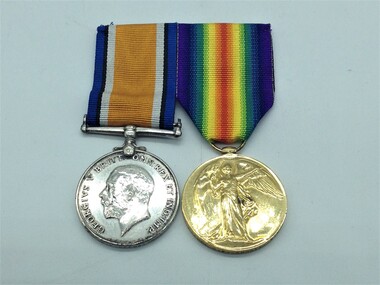
Medal - Medal Group, WW1, 2166 Lieutenant Reginald Frank Barratt
... Australia in 1903 aged 24. Address was Mount Street, Heidelberg, Victoria. Occupation - Farmer. Enlistment date was 17th August 1914. Served with the 68 Battery Royal Field Artillery during the South African War. Rank on enlistment was Sergeant. Embarkation details - Unit embarked from Melbourne, Victoria on board Transport A2 Geelong on 19th September 1914. Rank Lieutenant - Unit 1st Divisional...Australia in 1903 aged 24. Address was Mount Street, Heidelberg, Victoria. Occupation - Farmer. Enlistment date was 17th August 1914. Served with the 68 Battery Royal Field Artillery during the South African War. Rank on enlistment was Sergeant. Embarkation details - Unit embarked from Melbourne, Victoria on board Transport A2 Geelong on 19th September 1914. Rank Lieutenant - Unit 1st Divisional ...Information from "The AIF Project" Lieutenant Reginald Frank Barratt was born in 1879 in Withington, Manchester, Lancashire, England. Regimental number 2166. 3rd Field Artillery Brigade, Military District 3 and Military District 6. Arrived in Australia in 1903 aged 24. Address was Mount Street, Heidelberg, Victoria. Occupation - Farmer. Enlistment date was 17th August 1914. Served with the 68 Battery Royal Field Artillery during the South African War. Rank on enlistment was Sergeant. Embarkation details - Unit embarked from Melbourne, Victoria on board Transport A2 Geelong on 19th September 1914. Rank Lieutenant - Unit 1st Divisional Ammunition Column. Information from the Roll of Honour - Awarded Royal Human Society Medal for saving three lives from drowning in Orange River during South African War. Wounded at Zillebeke, near Ypres, Belgium. Died of wounds 22nd August 1917 at the age of 38. Buried at Bedford House Cemetery, Enclosure No 2, (Plot 1, R0w F, Grave 23), Zillebeke, Belgium. Panel number , Roll of Honour Australian War Memorial British War Medal - The medal was struck by the Royal Mint, is a silver disc 36mm in diameter with a straight clasp suspended without swivel. The obverse shows Sir Bertram Mackennal's bare headed effigy of King George V facing left with the legend 'GEORGIVS V BRITT:OMN:REX ET IND:IMD - "George V, King of all the British Isles & Emperor of India". The reverse, designed by William McMillan, shows St George, naked on horseback and armed with a short sword, an allegory of the physical & mental strength which achieved victory of Prussianism. The horse tramples on the Prussian eagle shield and the emblems of death, a skull and cross bones. In the background are ocean waves and just off centre near the right upper time is the risen sun of victory. The years 1914-1918 appear on the perimeter in the left and right fields respectively. The watered silk ribbon is 32mm wide with 3mm wide royal blue band, 2mm wide black band, 3mm wide white band repeated in reverse order and separated by 16mm wide orange band. Victory Medal - The medal is bronze disc 36mm in diameter with a winged figure of Victory on the obverse. The reverse has the words 'THE GREAT WAR FOR CIVILIZATION 1914-1918', all surrounded by a laurel leaf. The watered silk ribbon is 32mm wided has two rainbow design with the violet from each rainbow on the outside edges, moving through to a central red stripe where both rainbows meet.The recipients name, rank and unit are impressed on the bottom edge of the medals - Lieut F Barratt AIF -
 Montmorency–Eltham RSL Sub Branch
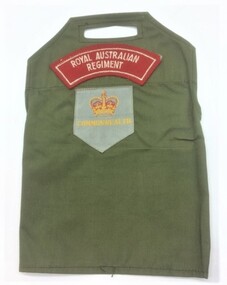
Uniform - Brassard, Sleeve, Circa 1950
... Identification brassard from 1st Commonwealth Division, Korea Donated by: K R Faulks Rank Pte, Number 1/1096, date of birth 24 Feb 1930, Identify Card Number A003610 korean war brassard royal australian army regiment 1st commonwealth division korea australian army Royal Australian Army Regiment Commonwealth Name K R Faulks Rank Pte, Number 1/1096 and signed K R Faulks on back of card Nationality Australian, date of birth 24 Feb 1930, Identify Card Number A003610, date of issue 15th June 54 and signed by Issuing Officer Capt Adjt, 1 Rft Holding Unit Brassard - upper sleeve attachment for shirt, showing unit designation Uniform Brassard, Sleeve ...Identification brassard from 1st Commonwealth Division, KoreaDonated by: K R Faulks Rank Pte, Number 1/1096, date of birth 24 Feb 1930, Identify Card Number A003610Brassard - upper sleeve attachment for shirt, showing unit designationRoyal Australian Army Regiment Commonwealth Name K R Faulks Rank Pte, Number 1/1096 and signed K R Faulks on back of card Nationality Australian, date of birth 24 Feb 1930, Identify Card Number A003610, date of issue 15th June 54 and signed by Issuing Officer Capt Adjt, 1 Rft Holding Unitkorean war, brassard, royal australian army regiment, 1st commonwealth division, korea, australian army -
 Red Cliffs Military Museum
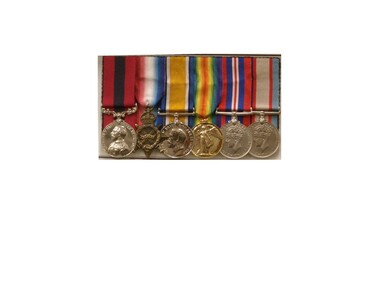
Replica Medals, WW1 & WW11 Medals Awarded to Nathaniel Barclay, (estimated); between 1914 & 1945
... 1st Division, 25th February 1915 per transport 'Runic'. Disembarked Alexandria and to camp Heliopolis, Egypt. Operation Gallipoli from 5th May 1915 with 5th Battalion. Sick with dental problems 2nd Field Ambulance 17th September 1915. To hospital Lemnos 20th December 1915. To Alexandria hospital with pluerisy 12th January 1916. Returned to Australia...1st Division, 25th February 1915 per transport 'Runic'. Disembarked Alexandria and to camp Heliopolis, Egypt. Operation Gallipoli from 5th May 1915 with 5th Battalion. Sick with dental problems 2nd Field Ambulance 17th September 1915. To hospital Lemnos 20th December 1915. To Alexandria hospital with pluerisy 12th January 1916. Returned to Australia ...Born 5th October 1895 in Adavoyle, United Kindom Occupation Grocer and later horticulturalist Married after WW1- Wife - Daisy Florence Barclay World War One Staff Sergeant Regimental Number 2139 Enlisted AIF in Melbourne 29th December 1914, having previously served 3 months with the Ulster Volunteers and to camp Broadmeadows, to depot Battalion 29th December 1914. Embarked from Melbourne for the middle East with 3rd reinforcement group for the 5th Battalion, 2nd Brigade, 1st Division, 25th February 1915 per transport 'Runic'. Disembarked Alexandria and to camp Heliopolis, Egypt. Operation Gallipoli from 5th May 1915 with 5th Battalion. Sick with dental problems 2nd Field Ambulance 17th September 1915. To hospital Lemnos 20th December 1915. To Alexandria hospital with pluerisy 12th January 1916. Returned to Australia with enteric per 'Nestor' 9th February 1916.To duty Broadmeadows 4th April 1916. Wmbarked with 4th reinforcements group for the 58th Battalion, 15th Brigade per transport 'Themistocles' 1st August 1916 Returned to England 14th September 1916. Operations France and Flanders from 6th December 1916. To 59th Battalion 29th December 1916. To 5th Division Infantry School 18th February to 28th March 1917 as Lance Corporal. Corporal 7th April 1917. Sergeant 2nd May 1917. To 3rd Southern General Hospital Oxford 4th October 1917. Returned to Melbourne per Transport 'Persic' 12th February 1918. Discharged 14th March 1918. Second World War. Regimental Number V5571 Emlisted in the Australian Military Forces in Royal Park, Melbourne 22nd August 1940 and to 2nd Infantry Training Battalion, Fyansford. Staff Sergeant 24th August 1940. To 2/14th Training Battalion Wangaratta 11th October 1940. To 2/23rd Training Battalion, Wangaratta 18th October, 1940.To Southern Command Training School 26th May 1941.to Camp Bonegilla 15th May 1942. To Camp Caulfield 11th November 1942. Discharged to Reserve Occupation 19th November 1942. Remarks. Awarded 1915-15 Star, British War Medal, and Victory Medal 1914-1919 Awarded Distinguished Conduct Medal as Lance Corporal vide London Gazette 30111 of 31st July 1918. Citation for action on 9th July 1917 during the third Battle of Ypres reads- " For conspicous gallantry and devotion to duty. He rendered invaluable service during operation in carrying important messsages through heavy fire" Awarded War Medal and Australian Service Medal 1939-45 in 1951. Described as 71.5inches tall, medium complexion, blue eyes and brown hair. He died 11th September 1962.WW1 - Distinguished Conduct Medal 1914/15 Star 1914/18 British War Medal Victory Medal WW11 - 1939/45 British War Medal Australian Service Medal 1939/45 All medals with associated coloured ribbons. These are replica medals made in the exact metals as the originals. Also in display is a record of War Service which can be found in the narrative. Noneservice, medal, 1918, citation, ww1, military, gazette, london, ww11, medals, 30111, 31st, july, ypres, distinguished -
 Red Cliffs Military Museum
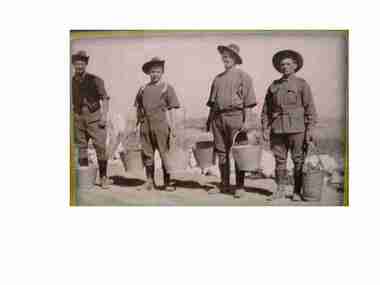
Collage, Collage of WW1 photos of E. H. Rowe, 1st April, 2001 (exact)
... Photos from left-top to bottom: (.1) 1 Australian Divisional Headquarters- Orderlies, Grooms & Police- Derna Camp - Egypt 1914/ (.2) Two Pals and Ernie Rowe -Pyramids, Egypt, 1914/ (.3) Morning fatigues- Derna Camp- Egypt, 1914/ Main Photo: (.4) Officer Cadet Ernest Henry Rowe/ Queens College, Oxford, England/ October 1917./ Top right to bottom: (.5) Recovering at Al Hayat Hospital- Egypt after being wounded at Lone Pine Battle, Gallipoli, in August 1915./ (.6) The boy from the Bush- heading to France with Engineers- 1916./ (.7) The Sphynx and Pyramids - Egypt - 1914/ Plaque: To The Red Cliffs R.S.L. / from/ The Rowe Family of Red Cliffs/ 1st April, 2001. ...Rowe Collection. camp australian ww1 1 gallipoli henry egypt ernest rowe derna divisional headquarters queens college oxford lone pine Photos from left-top to bottom: (.1) 1 Australian Divisional Headquarters- Orderlies, Grooms & Police- Derna Camp - Egypt 1914/ (.2) Two Pals and Ernie Rowe -Pyramids, Egypt, 1914/ (.3) Morning fatigues- Derna Camp- Egypt, 1914/ Main Photo: (.4) Officer Cadet Ernest Henry Rowe/ Queens College, Oxford, England/ October 1917./ Top right to bottom: (.5) Recovering at Al Hayat Hospital- Egypt after being wounded at Lone Pine Battle, Gallipoli, in August 1915./ (.6) The boy from the Bush- heading to France with Engineers- 1916./ (.7) The Sphynx and Pyramids - Egypt - 1914/ Plaque: To The Red Cliffs R.S.L. / from/ The Rowe Family of Red Cliffs/ 1st April, 2001. ...This is part of the E.H. Rowe Collection.A brown wooden frame, containing 7 photos and a history of Ernest Henry Rowe. The frame has a small plaque on the bottom front.Photos from left-top to bottom: (.1) 1 Australian Divisional Headquarters- Orderlies, Grooms & Police- Derna Camp - Egypt 1914/ (.2) Two Pals and Ernie Rowe -Pyramids, Egypt, 1914/ (.3) Morning fatigues- Derna Camp- Egypt, 1914/ Main Photo: (.4) Officer Cadet Ernest Henry Rowe/ Queens College, Oxford, England/ October 1917./ Top right to bottom: (.5) Recovering at Al Hayat Hospital- Egypt after being wounded at Lone Pine Battle, Gallipoli, in August 1915./ (.6) The boy from the Bush- heading to France with Engineers- 1916./ (.7) The Sphynx and Pyramids - Egypt - 1914/ Plaque: To The Red Cliffs R.S.L. / from/ The Rowe Family of Red Cliffs/ 1st April, 2001. camp, australian, ww1, 1, gallipoli, henry, egypt, ernest, rowe, derna, divisional, headquarters, queens, college, oxford, lone, pine -
 Bendigo Military Museum
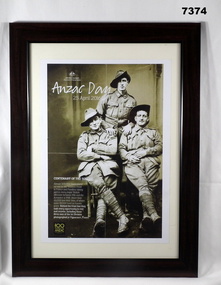
Poster - POSTER - FRAMED, Aust Govt, Department of Veteran's Affairs, 2016
... Australians served on the Western Front in France and Flanders, taking part in every major British offensive between 1916 and the Armistice in 1918. More than 46,000 lost their lives of whom some 18,000 have no known grave. Behind the front line they took every opportunity to rest and recover, including these three men of the 1st Division...Australians served on the Western Front in France and Flanders, taking part in every major British offensive between 1916 and the Armistice in 1918. More than 46,000 lost their lives of whom some 18,000 have no known grave. Behind the front line they took every opportunity to rest and recover, including these three men of the 1st Division ...Acknowledgment of Centenary of ANZAC Day. "Almost 300.000 Australians served on the Western Front in France and Flanders, taking part in every major British offensive between 1916 and the Armistice in 1918. More than 46,000 lost their lives of whom some 18,000 have no known grave. Behind the front line they took every opportunity to rest and recover, including these three men of the 1st Division, photographed in Vignacourt, France.Poster - Sepia coloured. Cream coloured border, dark brown plastic material frame. Glass protection.“ANZAC DAY 25 April 2016” “Centenary of the Somme”, “Three Men of the 1 Division". poster, centenary of the somme
