
Showing 163 items matching " animals (horses)"
-
 Lakes Entrance Historical Society
Photograph - Cattle on the Mitchell River Bairnsdale
... ...animals...horses...Rivers animals horses Cattle Mitchell River Bairnsdale Large coloured postcard Photograph Cattle on the Mitchell River Bairnsdale ...Large coloured postcard Cattle Mitchell River Bairnsdalerivers, animals, horses -
 Women's Art Register
Archive (Collection) - Dawn Howard Artist Archive
... ... Animals... Horses...Outback Animals Horses Landscape Hughesdale Art Group Painting Archive Dawn Howard Artist Archive ...outback, animals, horses, landscape, hughesdale art group, paintingoutback, animals, horses, landscape, hughesdale art group, painting -
Women's Art Register
Archive (Series) - Howard, Dawn. Artist File 1
... ... Animals... Horses...Outback Animals Horses Landscape Hughesdale Art Group Painting Foolscap white archival 4 flap folder or document wallet Archive Howard, Dawn. ...Newspaper Clippingsoutback, animals, horses, landscape, hughesdale art group, paintingoutback, animals, horses, landscape, hughesdale art group, painting -
Women's Art Register
Archive (Series) - Dawn Howard. Duplicate File 1
... ... Animals (Horses)...Painting Outback Animals (Horses) Landscape Hughesdale Art Group Foolscap manilla file Archive Dawn Howard. ...Newspaper Clippingspainting, outback, animals (horses), landscape, hughesdale art grouppainting, outback, animals (horses), landscape, hughesdale art group -
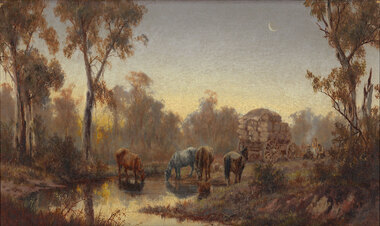 Benalla Art Gallery
Painting, J. A. TURNER, Rest, Not dated
... Animals... Wagon... Horses...Victorian Painting Landscape Figure Animals Wagon Horses Water Reflection Wheels Colonial Recto: Not signed, not dated, not titled Rural landscape with animals at waters edge, trees, packed wagon and figures around a fire. ...Born: Bradford, Yorkshire, England 1850; Arrived: Victoria, Australia c.1874; Died: Melbourne, Victoria, Australia 1908VictorianGift of Mr S.T.Staughton, 1978Rural landscape with animals at waters edge, trees, packed wagon and figures around a fire. Gold plated gesso on timber frame.Recto: Not signed, not dated, not titledpainting, landscape, figure, animals, wagon, horses, water, reflection, wheels, colonial -
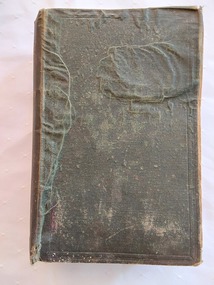 Mont De Lancey
Book, George Routledge and Sons et al, The Horse, in the Stable and the Field, 1877
... Horses...Mammals...Animals...For the first 304 pages the author has drawn solely upon his own resources: but in the remaining chapters he receives the assistance of two veterinary surgeons of good standing in their profession. it has been rewritten and amended. Horses Mammals Animals Horsebreeds Horses - diseases Horse anatomy An 1883 copy of The Horse, In the Stable and The Field: His varieties, management in health and disease, anatomy and physiology, by J. ...An 1883 copy of The Horse, In the Stable and The Field: His varieties, management in health and disease, anatomy and physiology, by J. H. Walsh editor of The Field and author of British Rural Sports. The volume by J. H. (John Henry), 1810-1888, published in 1887considers the early history of the horse, horses from different continents, stable management, anatomy and diseases. With one hundred and seventy illustrations throughout the text by Harrison Weir, Zwecker and others.An antique green covered thick book titled: The Horse, in the Stable and Field: His Varieties, Management in Health and Disease, Anatomy, Physiology by J.H. Walsh, F.R.C.S. (Stonehenge). The front cover is blank, with the spine detailing in gold lettering the title, author and publisher. Opposite the title page is a black and white woodcut illustration titled 'A Group of Favourites' showing a man and woman in the countryside with horses and a dog holding his master's top hat. There is a Preface and a Contents page of XXXIV chapters. The book contains comprehensive details of the horse with black lined drawings, Tables, Lists, Diagrams and more. At the back is an Appendix and Index. Pp. 622. non-fictionAn 1883 copy of The Horse, In the Stable and The Field: His varieties, management in health and disease, anatomy and physiology, by J. H. Walsh editor of The Field and author of British Rural Sports. The volume by J. H. (John Henry), 1810-1888, published in 1887considers the early history of the horse, horses from different continents, stable management, anatomy and diseases. With one hundred and seventy illustrations throughout the text by Harrison Weir, Zwecker and others.horses, mammals, animals, horsebreeds, horses - diseases, horse anatomy -
 Benalla Art Gallery
Painting, George W. LAMBERT, Shearer's Sunday, 1899, 1899
... Horses... Animals...Nationalism Painting Rural Horses Animals Figures Fence Jump Tree Recto: Signed "GEO.W.LAMBERT" in black watercolour in l.r.c of composition; Not dated; Not titled Rural landscape with four horses and riders jumping a fence. ...Born: St Petersburg, Russia 1873; Arrived: Sydney, New South Wales, Australia 1887; Lived and worked: England, France, Wales, Egypt, Palestine 1900-1921; Died: Cobbity, New South Wales, Australia 1930NationalismGift of Mrs E.E. Ledger, 1982Rural landscape with four horses and riders jumping a fence. Image is in black and white colour. Dark stained, gold and grey brushed timber frame.Recto: Signed "GEO.W.LAMBERT" in black watercolour in l.r.c of composition; Not dated; Not titledpainting, rural, horses, animals, figures, fence, jump, tree -
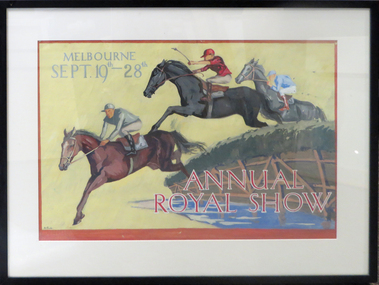 Federation University Art Collection
Painting - Gouache, 'Annual Royal Show' by Nornie Gude, c1935
... horses...animals...The Art Collection features over 1000 works and was listed as a 'Ballarat Treasure' in 2007. art artwork gude royal melbourne show poster available horses animals alumni nornie gude Framed painting showing two horses jumping over a fence. ...From 1931 to 1936 Nornie Gude attended the Ballarat Technical Art School, a division of the Ballarat School of Mines. She was accepted into the School at the age of 15 because she was so advanced in painting. She studied at Ballarat for five years before progressing to Melbourne’s National Gallery of Victoria School. Nornie Gude won many art competitions, including first prize at the 1936 Melbourne Royal Agricultural Show for still life drawing, and in 1941 became the first woman to win the National Gallery Students Travelling Scholarship. As an artist Nornie Gude held no theories and was once heard to say, “You spend your first 20 years learning technique and the next 20 years losing it”. This item is part of the Federation University Art Collection. The Art Collection features over 1000 works and was listed as a 'Ballarat Treasure' in 2007.Framed painting showing two horses jumping over a fence.art, artwork, gude, royal melbourne show, poster, available, horses, animals, alumni, nornie gude -
 Federation University Art Collection
Artwork, Neville Bunning, 'The Rite of Spring' by Neville Bunning
... horses...animals...The Art Collection features over 2000 works and was listed as a 'Ballarat Treasure' in 2007. art artwork neville bunning horses animals Framed painting featuring horses. ...This item is part of the Federation University Art Collection. The Art Collection features over 2000 works and was listed as a 'Ballarat Treasure' in 2007.Framed painting featuring horses.art, artwork, neville bunning, horses, animals -
 Old Colonists' Association of Ballarat Inc.
Work on paper, Harold Herbert, 'The Broken Plough' by Harold Herbert, 1921 – c.1923
... horses...animals...Harold Herbert Old Colonists' Club Ballarat agriculture farming horses animals plough Lower right corner - Harold Herbert for the Old Colonists' Club 1931 A framed etching showing a farmer with a plough which is being pulled by a team of horses. ...Harold HERBERT (1891–1945) A well known watercolour painter who was principal of the Ballarat Technical Art School.A framed etching showing a farmer with a plough which is being pulled by a team of horses.Lower right corner - Harold Herbert for the Old Colonists' Club 1931harold herbert, old colonists' club ballarat, agriculture, farming, horses, animals, plough -
 Old Colonists' Association of Ballarat Inc.
Work on paper, Harold Herbert, 'An Old Cottage Cornwall' by Harold Herbert, c1923
... horses...animals...Harold Herbert Old Colonists' Club Ballarat agriculture farming horses animals plough Lime Kiln Cottage Lower right corner - Harold Herbert for the Old Colonists' Club 1931 A framed etching showing cottage in Cornwall. ...Harold HERBERT (1891–1945) A well known watercolour painter who was principal of the Ballarat Technical Art School. It is also known as Lime Kiln Cottage. A framed etching showing cottage in Cornwall. A proof was exhibited in London at the Fine Art Society in 1923.Lower right corner - Harold Herbert for the Old Colonists' Club 1931harold herbert, old colonists' club ballarat, agriculture, farming, horses, animals, plough, lime kiln cottage -
 Federation University Art Collection
Work on paper - Artwork - Printmaking, Ricardo, Geoffrey, 'A Daily Double' by Geoffrey Ricardo, 1990
... horses...animals...GEOFFREY RICARDO (1964- ) Born Melbourne, Australia 1984-86 Bachelor of Arts (Fine Art), Printmaking, Chisholm Institute of Technology, Melbourne 1987-89 Printing Assistant at Bill Young Studios, Editioning intaglio prints, King Valley, VIC 1988 Full-time Studio Technician at Printmaking Department, Chisholm Institute of Technology, Melbourne 1989-90 Graduate Diploma (Fine Art), Printmaking, Monash University, Melbourne 1991 Travelled to England, France, Spain and USA (Winsor & Newton International Travelling Bursary, National Students Art Prize) Worked in private studios in Gaucin, Spain and New York, USA 1994-95 Master of Fine Arts, Monash University, Melbourne 1995 Guest Lecturer, Victorian College of the Arts, Melbourne Traveled to Europe and America 1996 Guest Lecturer, Royal Melbourne Institute of Technology, Melbourne 1990-98 Sessional Lecturer, Monash University, Melbourne 1998 Traveled to America and Mexico 2001-05 Sessional Lecturer, The Victorian College of the Arts, Melbourne 2003-10 Printmaking Workshops, Warrnambool TAFE, Warrnambool, VIC 2004 Traveled to Europe, Mexico and Cuba 2005 Lecturer, National Art School (Summer School), Sydney Sessional Lecturer, Monash University, Melbourne Lecturer, Institution of Koorie Education, Deakin University, Geelong, VIC geoffrey ricardo available horses animals horse racing Framed limited edition print of two running horses being ridden by numerous people. ...GEOFFREY RICARDO (1964- ) Born Melbourne, Australia 1984-86 Bachelor of Arts (Fine Art), Printmaking, Chisholm Institute of Technology, Melbourne 1987-89 Printing Assistant at Bill Young Studios, Editioning intaglio prints, King Valley, VIC 1988 Full-time Studio Technician at Printmaking Department, Chisholm Institute of Technology, Melbourne 1989-90 Graduate Diploma (Fine Art), Printmaking, Monash University, Melbourne 1991 Travelled to England, France, Spain and USA (Winsor & Newton International Travelling Bursary, National Students Art Prize) Worked in private studios in Gaucin, Spain and New York, USA 1994-95 Master of Fine Arts, Monash University, Melbourne 1995 Guest Lecturer, Victorian College of the Arts, Melbourne Traveled to Europe and America 1996 Guest Lecturer, Royal Melbourne Institute of Technology, Melbourne 1990-98 Sessional Lecturer, Monash University, Melbourne 1998 Traveled to America and Mexico 2001-05 Sessional Lecturer, The Victorian College of the Arts, Melbourne 2003-10 Printmaking Workshops, Warrnambool TAFE, Warrnambool, VIC 2004 Traveled to Europe, Mexico and Cuba 2005 Lecturer, National Art School (Summer School), Sydney Sessional Lecturer, Monash University, Melbourne Lecturer, Institution of Koorie Education, Deakin University, Geelong, VIC Framed limited edition print of two running horses being ridden by numerous people. Donated through the Australian Goverment's Cultural Gifts Prorgram by Katherine Littlewood. geoffrey ricardo, available, horses, animals, horse racing -
 Federation University Art Collection
Oil on board, 'The Rite of Spring No. 2' by Neville Bunning
... horses...animals...The Art Collection features over 2000 works and was listed as a 'Ballarat Treasure' in 2007. art artwork neville bunning bunning available horses animals Framed oil painting depicting four 'dancing' horses in a landscape. ...This item is part of the Federation University Art Collection. The Art Collection features over 2000 works and was listed as a 'Ballarat Treasure' in 2007.Framed oil painting depicting four 'dancing' horses in a landscape. art, artwork, neville bunning, bunning, available, horses, animals -
 Kiewa Valley Historical Society
Double Tyne Pronged Pick - head
... Possibly used for cleaning out animal pens.eg. horses and pigs. Used like a hoe but heavier and stronger....Possibly used for cleaning out animal pens.eg. horses and pigs. Used like a hoe but heavier and stronger. ...Possibly used for cleaning out animal pens.eg. horses and pigs. Used like a hoe but heavier and stronger.Used by residents of the Kiewa ValleyThick steel tool head with hole at one end for the handle and two parallel points. Possibly hand made.pick, double tyne prong pick, farming equipment, hand tool -
Clunes Museum
Functional object - CHART
... Buff cardboard chart with rotating disc of cardboard to enable calculation of gestation periods for common farm animals, pigs, sheep, horses, cows, dogs and rabbits...Pickford Clunes Anzac Oct 14th Buff cardboard chart with rotating disc of cardboard to enable calculation of gestation periods for common farm animals, pigs, sheep, horses, cows, dogs and rabbits Functional object CHART Louden Machinery Co. ...This chart was a "trade loader" or advertising for the Louden Company who were manufacturers and retailers of agricultural equipment. The design of the chart was attributed to A.W. Shaw & Co. by the Louden Machinery Co.Buff cardboard chart with rotating disc of cardboard to enable calculation of gestation periods for common farm animals, pigs, sheep, horses, cows, dogs and rabbitsA. Pickford Clunes Anzac Oct 14thgestation chart, ready reckoner, louden -
Warrnambool and District Historical Society Inc.
Album, early 20th century
... The pages contain children's cut-outs of animals, mainly horses and dogs, newspaper illustrations and images of World War One deceased soldiers. ...The pages contain children's cut-outs of animals, mainly horses and dogs, newspaper illustrations and images of World War One deceased soldiers. ...This album contains cut-outs and newspaper illustrations that date mainly from 1915 and 1916. The compiler is mainly interested in animals and agricultural shows etc bu there are also images of World War One deceased soldiers and local Warrnambool cuttings, including some of an Australia Day parade showing the floats. No information has been found on the compiler, George Bennett.This album is of interest, firstly because it is a good example of a young boy's album compiled in early 20th century times and secondly because it has some local content - images not hitherto seen.This is an album with a red cover decorated with mauve and orange flowers and greenery. The pages contain children's cut-outs of animals, mainly horses and dogs, newspaper illustrations and images of World War One deceased soldiers. All the items are pasted in. The edges of the cover are slightly worn and the binding is a little loose. There are some blank pages.George Bennett 1915album with warrnambool cuttings -
Whitehorse Historical Society Inc.
Document, Things to remember, 1960s?
... Notes on the work of George and Annis Bills, who bequeathed money to benefit animals, including erection of horse water troughs, many of which are in Melbourne, including the City of Nunawading....Notes on the work of George and Annis Bills, who bequeathed money to benefit animals, including erection of horse water troughs, many of which are in Melbourne, including the City of Nunawading. ...Notes on the work of George and Annis Bills, who bequeathed money to benefit animals.Notes on the work of George and Annis Bills, who bequeathed money to benefit animals, including erection of horse water troughs, many of which are in Melbourne, including the City of Nunawading.Notes on the work of George and Annis Bills, who bequeathed money to benefit animals.bills water troughs, bills, george, bills, annis -
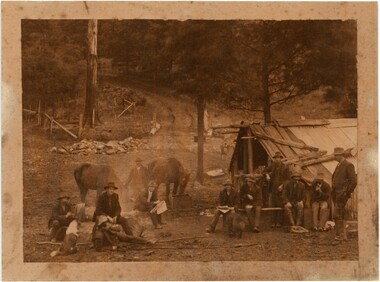 Emerald Museum & Nobelius Heritage Park
Photograph - Jack Moore Monbulk, c. early 20th century
... It depicts ten men with several animals including horses and dogs. To the right of the frame, six of the men sit in front of a triangular hut structure of wood and corrugated metal. ...It depicts ten men with several animals including horses and dogs. To the right of the frame, six of the men sit in front of a triangular hut structure of wood and corrugated metal. ...It is unclear who the Jack Moore in this photograph was or where it came from. There was a Jack Moore who was a hotel proprietor in Kangaroo Ground from 1910, but this is also a very common name so realistically it could have been anyone. It was most likely taken in the early 20th century, judging by the sepia colour but clear photography.This photograph depicts Monbulk in the late 19th or early 20th century, showing ways of life, travel, and accommodation at the time.This item is a sepia photograph with particularly heavy red tinting, printed on white card paper. The reverse has a small handwritten annotation and accession number, both in pencil. It depicts ten men with several animals including horses and dogs. To the right of the frame, six of the men sit in front of a triangular hut structure of wood and corrugated metal. To the left, the other four are near the road, which continues up a hill in the background. The background also contains several trees and a wood-and-wire fence.Reverse, Handwritten Annotation: "[Jack Moore Monbulk] P272" Attached Note: "JACK MOORE IN THIS PHOTO - NOT KNOWN WHERE IT WAS TAKEN / P272"monbulk -
 Warrnambool and District Historical Society Inc.
Bell, James Barwell, Animal, C 19th century
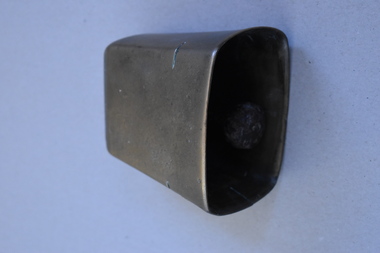
... horses or bullocks to prevent them from being lost and were used from around the 1860's onwards. The initial J B identify the bell as being made by James Barwell who made bells for the Australian market from around the 1860's. His bell and brass foundry manufactured all sorts of bells from school bells to full church peals as well as plumbing fittings. The four marks on the edge of the bell are typical of those used by drovers or owners to identify their animal...This is a brass bell of the type used to hang around the necks of animals such as cows, horses and bullocks. The mechanism for the attachment to a collar or harness has been sheared off and the clapper is detached from the inside hook. ...Its significance lies in the fact that it is typical of bells used for a purpose at that time and as such can be used for discussion in a social and interpretive context. history of warrnambool animal husbandry animal bell James Barwell bells ‘Success to 4 in horse teams J.B.’ This is a brass bell of the type used to hang around the necks of animals such as cows, horses and bullocks. ...Bells of this type were normally used to hang around the necks of cows, horses or bullocks to prevent them from being lost and were used from around the 1860's onwards. The initial J B identify the bell as being made by James Barwell who made bells for the Australian market from around the 1860's. His bell and brass foundry manufactured all sorts of bells from school bells to full church peals as well as plumbing fittings. The four marks on the edge of the bell are typical of those used by drovers or owners to identify their animal. While this bell has no known local provenance, it is a link to the early cattle and agricultural life in Australia and most likely the Western District. Its significance lies in the fact that it is typical of bells used for a purpose at that time and as such can be used for discussion in a social and interpretive context.This is a brass bell of the type used to hang around the necks of animals such as cows, horses and bullocks. The mechanism for the attachment to a collar or harness has been sheared off and the clapper is detached from the inside hook. The bell has an inscription incised around the top and there are four small cuts or incisions made into the bell at the wider end. The bell is a little tarnished.‘Success to 4 in horse teams J.B.’history of warrnambool, animal husbandry, animal bell, james barwell bells -
 Emerald Museum & Nobelius Heritage Park
Photograph - Main Road Looking Toward the Dandenongs, 20th Century
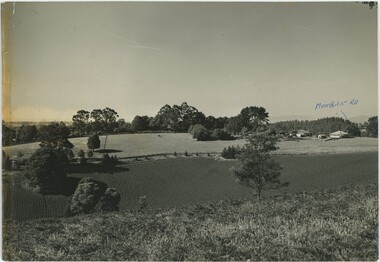
... Behind the road are pastures with scattered animals (two horses or cows, possibly several sheep) leading in to a line of trees in the central background. ...Behind the road are pastures with scattered animals (two horses or cows, possibly several sheep) leading in to a line of trees in the central background. ...This photograph appears to be taken from a hill. While Main Road and Monbulk Road are both in Monbulk, the reference to Madigan's abattoir indicates that the annotations are more likely to be referring to Main Street and Emerald-Monbulk Road in Emerald. It's difficult to determine whether the annotation means it is taken from Main Street or looking down to Main Street, but the absence of buildings in this relatively recent photograph indicate that it is likely the former. It could have been taken from Main Street, looking down at Madigan Way and the undeveloped land behind it. However, it is difficult to confidently assess any of this information, as it is to determine when this picture was taken.The photograph likely captures a unique perspective on an area of Emerald that has since been transformed by time.A black and white picture printed on glossy photograph paper. The photograph is taken from atop a grassy hill, looking down at a plowed field with occasional trees. Behind the field is a road with fences on either side, continuing across the view from left to right. Behind the road are pastures with scattered animals (two horses or cows, possibly several sheep) leading in to a line of trees in the central background. On the left side a hill rises on the horizon, while on the right are several buildings with higher hills or mountains rising in the far background. On the right, handwritten text in blue pen accompanies an arrow pointing to a roadway - 'Monbulk Rd'. The reverse features more writing, both in blue pen and in pencil. The extreme left side of the object is discoloured by yellow tape.Obverse, Pen: "MONBULK RD" Reverse, Pencil: "Lefthand side where trees situated / Madigan's abattoir." Reverse, Pen: "Main Rd / looking towards / the Dandenongs / Nth WEST"emerald -
Emerald Museum & Nobelius Heritage Park
Equipment - Horse coat Trimmer, Chicago Flexible Shaft Company, 1900s
... The clippers could then be used to easily remove long hair from animals such as horses, whose winter coats could interfere with their ability to wear a harness or hold sweat which would be uncomfortable for the horse when it dried. ...The clippers could then be used to easily remove long hair from animals such as horses, whose winter coats could interfere with their ability to wear a harness or hold sweat which would be uncomfortable for the horse when it dried. ...The Chicago Flexible Shaft Company was established in Chicago, Illinois, in 1893. Horses were integral to both the agricultural and transport sectors at the time so hand-cranked clippers that reduced the time to remove the excess winter coat of working horses and other large animals (including sheep) that previously needed to be trimmed with hand shears to a job that could be completed in less than twenty minutes was a considerable advancement. This model, the Number 1, was actually the second iteration of the company's hand-cranked devices; it was smaller and lighter to transport and cheaper for farmers to purchase and therefore had a bigger impact on overall agricultural practices than the company's first, pioneering, 'Chicago Clipper'. This item is the stand and power-generation unit of the machine. An attachment on the left-hand side of the item shows where a long, flexible 'shaft' ending in sharp clippers could be attached to the crank unit and powered by manually turning the crank handle. The clippers could then be used to easily remove long hair from animals such as horses, whose winter coats could interfere with their ability to wear a harness or hold sweat which would be uncomfortable for the horse when it dried. The inventors who founded the Chicago Flexible Shaft Company, John K. Stewart (born Terrence O'Brien Junior) and Thomas J. Clark (born Thomas Conlon), went on to design the speedometer used in the Ford Model T car. After Stewart sold his shares in the Chicago Flexible Shaft Company to focus on developing the speedometer concept, the company changed direction to focus on domestic appliances - including clippers for human hair - and rebranded as Sunbeam, a brand still in use today.This item is significant as an example of agricultural technology in use in the Emerald area in the early Twentieth Century. The particular make and model of clipper represented a considerable technological advance as it was significantly smaller in size and easier to operate than previous models from the same company. This smaller size meant it had a much bigger impact on farming processes internationally as it was easier to transport and more affordable for farmers to purchase. It is not known which farm in the Emerald area purchased and used the machine.The item consists of a small metal case, which may house a ball bearing mechanism, powered by a wooden handled metal crank to the right side of the case. A metal handle is provided at the rear. An outlet for a cord is present on the left hand side of the unit. The unit stands on an attached tripod to raise it to working height. The item is the brown of rusted metal all over, though it can be seen that the rear handle was originally red and the wooden handle black, in distinction to the possible original chrome colour of the unit overall.Top: THE / STEWART / CHICAGO / BALL BEARING / No. 1 / CLIPPER / MADE BY / CHICAGO / FLEXIBLE / SHAFT CO / CHICAGO USA / PATENTED BY / U.S.A., ENGLAND / AUSTRALIA / NEW ZEALAND / CANADA / CUBA / ETC Right side: STEWART / CLIPPER / MADE / BY / CHICAGO FLEXIBLE SHAFT CO /1890s, 1900s, 1910s, chicago flexible shaft co, chicago flexible shaft company, agricultural equipment, farm and equipment, farm tools, horses, john k stewart, terrence o'brien junior, thomas j clark, thomas conlon, ford motor company, ford model t, speedometer, sunbeam -
 Flagstaff Hill Maritime Museum and Village
Weapon - Cannon, circa 1825
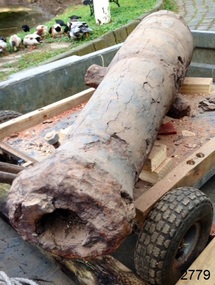
... horse hair, curtains, lead shot, beer and spirits. The hurricane-force winds drove the Children into the limestone stack at the entrance to the cove. The seas smashed it into pieces within twenty minutes. The bodies of sixteen of those who had lost their lives were spread across the shore, along with wreckage from the ship and the cargo of animals. ...horse hair, curtains, lead shot, beer and spirits. The hurricane-force winds drove the Children into the limestone stack at the entrance to the cove. The seas smashed it into pieces within twenty minutes. The bodies of sixteen of those who had lost their lives were spread across the shore, along with wreckage from the ship and the cargo of animals. ...In an article dated 26 March 1963, the Warrnambool Standard reported: “A cannon which has lain on the ocean floor since the barque, Children, was wrecked at Childer’s Cove on January 15, 1839, was raised by three Warrnambool skindivers at the weekend … The cannon, weighing about 750 lb. and 4-ft. 6-in. in length … is in excellent order considering the length of time it has remained underwater”. No conservation measures were taken at that time, other than chipping off the marine growth with hammers and cold chisels. The minutes for the 4 February 1974 meeting of the Flagstaff Hill Planning Board recorded that “a cannon recovered some time ago was lying in the garden of [one of the three original divers] and that it could be picked up at any time”. Peter Ronald, past Manager and Diver for Flagstaff Hill, notes that the CHILDREN cannon would have been recovered by the other divers around 1964. When the cannon came into care of Flagstaff Hill, it was given basic conservation relevant to the time. (At the same meeting, the Board was advised of the recovery of an anchor from the wreck of the CHILDREN by Flagstaff Hill divers (Peter Ronald, Colin Goodall and Gary Hayden, and Hank Howey and Andrew Coffee), and its interim relocation in the sea at the end of the Warrnambool Breakwater while awaiting conservation). About the ship CHILDREN 1825-1839: The sailing ship Children was a wooden, three-masted barque constructed of pitch pine in 1825 at Liverpool. It was felt sheathed and was coppered during an upgrade in 1837. The ship was only 29 metres long and 254 tons in weight; it had two decks and a square stern. The James Henty & Co., a pioneering family from Portland, Victoria, purchased the Children in 1837 for use as a coastal trader. The Children, under the command of Captain H. Browne, was on a voyage from Launceston to Adelaide when it foundered in rough conditions at Childers Cove, west of Peterborough, on 14 January 1839. On board were 14 crew members and 24 passengers, including 9 children. The ship’s cargo was awkwardly balanced: it carried 1500 sheep, 8 bullocks, 7 horses, 5000 London house bricks, 6 whaling boats with associated gear, and general trade goods including beef, pork, tobacco, tipe, butter, lime juice, horse hair, curtains, lead shot, beer and spirits. The hurricane-force winds drove the Children into the limestone stack at the entrance to the cove. The seas smashed it into pieces within twenty minutes. The bodies of sixteen of those who had lost their lives were spread across the shore, along with wreckage from the ship and the cargo of animals. Those who survived suffered injuries; they were rescued and taken by horse and cart to Campbell’s farm, near the whaling station at Port Fairy. They arrived at Portland eleven days after the wreck. The wrecking of the Children is one of colonial Victoria’s earliest and most significant maritime disasters. Little is left to mark the tragedy, apart from some house bricks intended for the Henty family’s Portland Bay settlement. Artefacts recovered in the 1960s to early 1970s include this signal cannon, an anchor, the bottom half of her ship’s bell, and two portions of a ship’s fitting, at one time thought to be a brass porthole frame, London housing bricks and timber flooring. Despite its poor condition, the CHILDREN’s signal cannon remains an important and interpretable record of its demise. From 2015, the CHILDREN cannon has been undergoing the first stages of further conservation.The signal cannon recovered from the Children's wreck is significant as part of the original fittings of the early 19th-century barque. It is an example of maritime defence in the early to mid-19th century. The 1839 wreck and recovered artefacts are examples of the construction methods and materials used in that era and can be used to study the evolution of shipbuilding methods and principles. The wreck of the Children is of state significance as one of colonial Victoria’s earliest and most significant maritime disasters, and one of the first vessels lost in the Western District. This is recognised by its inclusion on the Victorian Heritage Register, VHR No. S116. Little is left on the seabed to mark the tragedy, apart from some of the house bricks intended for the Henty settlement. Signal cannon: a 1.3 metre iron 6pdr cannon recovered from the wreck of the CHILDREN. The shape of the cannon tapers from a thick round breech to a flared muzzle, with an 8-centimetre bore, and two side trunnions for pivoting on a wooden gun carriage. It was recovered from the shipwreck site of the CHILDREN by local divers in 1963. This small muzzle-loading signal cannon is in poor and unrestored condition. The cannon’s upper profile of smooth grey metal casing has corroded off, leaving an extensively oxidised rough red surface of crumbling iron. The bottom half of the cannon remains intact, although the outer smooth casing also appears to be separating from the iron core of the barrel. The original grey casting is also missing from the breech and muzzle ends of the cannon. Corrosion and spalling of the upper surface layer of the cannon have removed the maker’s marks and specificationsflagstaff hill, flagstaff hill maritime museum and village, warrnambool, maritime museum, maritime village, great ocean road, shipwreck coast, shipwreck artefact, children, barque, three-masted, liverpool, childer’s cove, port campbell, 1839 shipwreck, 1939 wreck, james henty and co, henty brothers, captain h. browne, first mate t. gay, second mate w. wentworth, portland, portland bay, 1939, ship’s cannon, signal cannon, conservation of marine artefacts, 6pdr small bore cannon, defence -
 Flagstaff Hill Maritime Museum and Village
Functional object - Cow Bell, Circa 1878
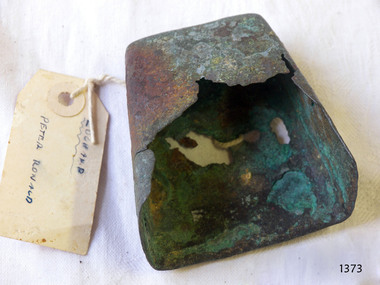
... Cow bells were common to colonial agriculture and transport, used wherever animals were turned out to graze overnight and had to be rounded up again next morning. Bells were fastened around the necks of household milking cows, domestic goats, bullock teams, horse teams, and camel teams, to help find them in the pre-dawn light. ...Cow bells were common to colonial agriculture and transport, used wherever animals were turned out to graze overnight and had to be rounded up again next morning. Bells were fastened around the necks of household milking cows, domestic goats, bullock teams, horse teams, and camel teams, to help find them in the pre-dawn light. ...The artefact is a damaged brass cow bell recovered from the 1878 shipwreck of the LOCH ARD near Port Campbell. It was raised by Flagstaff Hill divers in 1973 and is in storage at the Maritime Village. The LOCH ARD was constructed on the Clyde in 1873 for the prestigious Loch Line of colonial clipper ships, designed for the Australian run. She sailed from England on 1 March 1878 carrying 37 crew, 17 passengers and a diverse general cargo ranging from luxury items to bulk railway iron. On 1 June 1878, emerging from fog and hearing too late the sound of breakers against the tall limestone cliffs, the vessel struck the southern foot of Mutton Bird Island and sank in 23 metres of water. Of the fifty-four people on board only two survived, one young male crewman and one young female passenger. A century later, despite the pounding seas and the efforts of looters, the wreck site continued to provide ample evidence of the extraordinary range of goods being imported into the Colony of Victoria in the post-Gold Rush era. Flagstaff Hill divers in the 1970s reported finds of “Bottles of champagne, window panes, rolls of zinc, barrels of cement, iron rails, clocks, lead shot, corrugated iron, lead, marble, salad oil bottles, ink bottles, copper wire, gin bottles, rolls of carpet, floor tiles, copper rivets, gas light fittings, pocket knives, toys, crystal chandeliers, beer mugs, cutlery, candles sticks, wick scissors, cow bells, and sauce bottles.” From this array of objects on the ocean floor emerged the humble brass cow bell. Cow bells were common to colonial agriculture and transport, used wherever animals were turned out to graze overnight and had to be rounded up again next morning. Bells were fastened around the necks of household milking cows, domestic goats, bullock teams, horse teams, and camel teams, to help find them in the pre-dawn light. Station shepherds and cattle drovers also used them to warn of any disturbances to their flocks and herds overnight. The bells were a necessary item in a largely unfenced continent. So important, that Anthony Mongon began making his pot-bells at Yackandandah from 1861, August Menneke produced the “Wagga Pot” from 1867, and Samuel Jones started manufacturing his distinctively shaped “Condamine Bell” in 1868. However, these deeply resonant Australian bells were made from iron — Mongon and Jones were blacksmiths who simply beat old pitsaw blades into shape. Few genuinely brass cow bells were made here, the vast majority being imported from Britain where the industry of brass founding was already well established. (Some bells were also imported from the United States, but these too were nearly all of iron).This bell is historically significant as typical of a cow bell used by farmers and herdsmen in Colonial Victoria. Its significance is increased by being one of a collection of artefact recovered by the Flagstaff Hill Divers from the wreck of the Loch Ard in the early 1970s. Items that come from several wrecks along Victoria's coast have also been recovered for Flagstaff Hill Maritime Village’s museum collection under Government permit, illustrating this item’s level of historical value. The cow bell is also significant for being part of Flagstaff Hill’s collection of artefacts from LOCH ARD, which is significant for being one of the largest collections of artefacts from this shipwreck in Victoria. It is significant for its association with the shipwreck, which is on the Victorian Heritage Register (VHR S417). The collection is significant because of the relationship between the objects, as together they have a high potential to interpret the story of the LOCH ARD. The LOCH ARD collection is archaeologically significant as the remains of a large international passenger and cargo ship. The LOCH ARD collection is historically significant for representing aspects of Victoria’s shipping history and its potential to interpret sub-theme 1.5 of Victoria’s Framework of Historical Themes (living with natural processes). The collection is also historically significant for its association with the LOCH ARD, which was one of the worst and best known shipwrecks in Victoria’s history.A small brass cow bell, in poor condition. It is blunt-wedge shaped. The sides expand outwards from the smaller rectangular roof of the bell to a larger open rectangle or bell mouth. A handwritten label is attached to the bel. Recovered from the wreck of the Loch Ard.Label text "["10/6/73, Brass Cow Bell, LOCH ARD, Found in the sandy hole in the centre of the wreck site. Cow bells were part of the cargo" - "10/6/73, LOCH ARD, small brass cow bell salvaged by FHMV divers"]. "LOCH ARD / PETER RONALD"flagstaff hill, warrnambool, shipwrecked coast, flagstaff hill maritime museum, maritime museum, shipwreck coast, flagstaff hill maritime village, great ocean road, loch line, loch ard, eva carmichael, mutton bird island, loch ard gorge, brass cow bell, colonial cow bells, 1878 shipwreck, shipwreck artefact, flagstaff hill divers -
 Flagstaff Hill Maritime Museum and Village
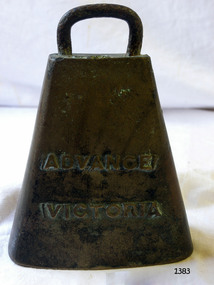
Functional object - Cow Bell, Early 20th century
... horses during the war. It may have been a souvenir or perhaps just a political statement, similar to 'Buy Australian'. Cow bells were common to colonial agriculture and transport, used wherever animals were turned out to graze overnight and had to be rounded up again next morning. ...horses during the war. It may have been a souvenir or perhaps just a political statement, similar to 'Buy Australian'. Cow bells were common to colonial agriculture and transport, used wherever animals were turned out to graze overnight and had to be rounded up again next morning. ...Research is still being carried out regarding the inscription on this bell. Perhaps it was used for horses during the war. It may have been a souvenir or perhaps just a political statement, similar to 'Buy Australian'. Cow bells were common to colonial agriculture and transport, used wherever animals were turned out to graze overnight and had to be rounded up again next morning. Bells were fastened around the necks of household milking cows, domestic goats, bullock teams, horse teams, and camel teams, to help find them in the pre-dawn light. Station shepherds and cattle drovers also used them to warn of any disturbances to their flocks and herds overnight. The bells were a necessary item in a largely unfenced continent. So important, that Anthony Mongon began making his pot-bells at Yackandandah from 1861, August Menneke produced the “Wagga Pot” from 1867, and Samuel Jones started manufacturing his distinctively shaped “Condamine Bell” in 1868. However, these deeply resonant Australian bells were made from iron — Mongon and Jones were blacksmiths who simply beat old pitsaw blades into shape. Few genuinely brass cow bells were made here, the vast majority being imported from Britain where the industry of brass founding was already well established. (Some bells were also imported from the United States, but these too were nearly all of iron).This bell is historically significant as typical of a cow bell used by farmers and herdsmen in Colonial Victoria. Cow bell, brass, topless pyramid shape, inverted "U" shaped pin attached. Pin and clapper are iron. Bell is embossed on sides. Embossed "ADVANCE / VICTORIA" and "WWI"flagstaff hill, warrnambool, shipwreck coast, flagstaff hill maritime museum, flagstaff hill maritime village, maritime museum, great ocean road, cow bell, horse bell, bell smith, vintage bell, farmer, shepherd, drover, stock bell, brass bell, advance australia, wwi -
 Flagstaff Hill Maritime Museum and Village
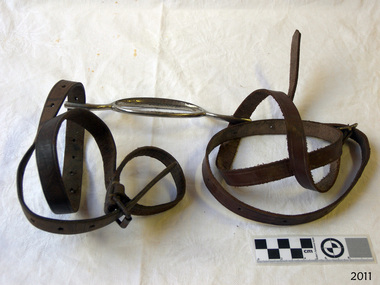
Equipment - Bridle Bit and Headstall, Early 1900s
... The leather headstall is connected to the metal bit are used in conjunction with a set of leather reins to guide and steer a horse or other similar animal. Made in Melbourne in 1900....The leather headstall is connected to the metal bit are used in conjunction with a set of leather reins to guide and steer a horse or other similar animal. Made in Melbourne in 1900. ...The leather headstall is connected to the metal bit are used in conjunction with a set of leather reins to guide and steer a horse or other similar animal. Made in Melbourne in 1900.The horse bridle and headstall were used in Warrnambool in the early 20th century. Bridle bit and headstall; horizontal metal oval shaped bit with a narrow rod each end that finishes in a narrow loop. Adjustable leather straps with holes are threaded through the narrow metal loops.flagstaff hill, flagstaff hill maritime museum and village, warrnambool, maritime museum, maritime village, great ocean road, shipwreck coast, horse husbandry, horse equipment, horse riding, 1900, melbourne, headstall, bridle, horse headgear, riding gear, horsemanship, equestrian equipment, headgear -
 Upper Yarra Museum
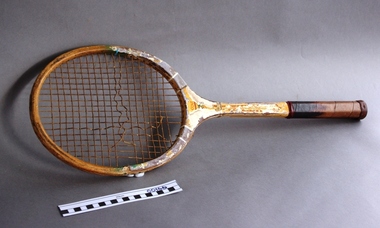
Tennis Racket, Racquet, Brewers.Started manufacturing in 1928 in Newport and later in Mitcham
... File sizes Review ideal file sizes for photos http://www.tennishistory.com.au/equipment/vintage-racquets/racquet-retailing.html Extract - Born in Bendigo in 1905, Albert Brewer came to Melbourne in 1920 to commence work as a furniture factory machinist at Rojos Pty.Ltd. in Little Lonsdale Street Melbourne . http://en.wikipedia.org/wiki/Catgut Catgut is a type of cord[1] that is prepared from the natural fiber in the walls of animal intestines.[2] Usually sheep or goat intestines are used, but it is occasionally made from the intestines of a hog, horse, mule, pig or donkey. ...File sizes Review ideal file sizes for photos http://www.tennishistory.com.au/equipment/vintage-racquets/racquet-retailing.html Extract - Born in Bendigo in 1905, Albert Brewer came to Melbourne in 1920 to commence work as a furniture factory machinist at Rojos Pty.Ltd. in Little Lonsdale Street Melbourne . http://en.wikipedia.org/wiki/Catgut Catgut is a type of cord[1] that is prepared from the natural fiber in the walls of animal intestines.[2] Usually sheep or goat intestines are used, but it is occasionally made from the intestines of a hog, horse, mule, pig or donkey. ...File sizes Review ideal file sizes for photos http://www.tennishistory.com.au/equipment/vintage-racquets/racquet-retailing.html Extract - Born in Bendigo in 1905, Albert Brewer came to Melbourne in 1920 to commence work as a furniture factory machinist at Rojos Pty.Ltd. in Little Lonsdale Street Melbourne . http://en.wikipedia.org/wiki/Catgut Catgut is a type of cord[1] that is prepared from the natural fiber in the walls of animal intestines.[2] Usually sheep or goat intestines are used, but it is occasionally made from the intestines of a hog, horse, mule, pig or donkey. The name neither implies nor derives from any association with cats. The word catgut may have been an abbreviation of the word "cattlegut". Alternatively, it may have derived by folk etymology from kitgut or kitstring -- the word kit, meaning fiddle, having at some point been confused with the word kit for little cat. According to legend, string makers of the 17th century deliberately misled people to believe that the strings were made of cat intestines in order to protect their industry, as any association with cats was superstitiously believed to be extremely bad luck, and to be avoided at all costRacket or Racqet. A teardrop shaped wooden frame with tight interlaced network of strings. The strings are made of Cat-gut, several are broken. See narrative on Cat gut.The racket is branded Colt at the base of the tear drop and Designed for Young Players. Made by Brewer Australia. Maker of the Worlds famous style,is printed on the handle on both sides. The frame is made of laminated wood. The paint is in poor condition.The racket has a leather grip, the grip is is worn and stained. .Powerhouse Museum Collection Thesaurus Light bats consisting of a network of cord or nylon stretched in an elliptical frame, used chiefly in playing ball games like tennis, badminton, etc.Colt. Made by Brewers Australia. Maker of the Worlds Famous style leader. Designed for young playersball, sport, leather, game, racquet, racket, colt, cat gut, strings, young players, brewer, handle, grip -
 Royal Melbourne Yacht Squadron
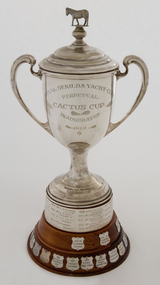
Award - Cactus Cup
... On the other side of the fence was lush grass and all sorts of vegetation and animals in prime condition. The Donkey said to a horse, “things look good in there, how does one get in”. ...On the other side of the fence was lush grass and all sorts of vegetation and animals in prime condition. The Donkey said to a horse, “things look good in there, how does one get in”. ...“The Squadron’s Most Prestigious Trophy” THE CACTUS STORY Years ago a story was told of a Donkey which lived in the desert. The standard of living was poor, and the main course on the menu when things were tough was cactus. The Donkey accepted the good with the bad, and in bad seasons it was always cactus. One day during his wanderings he came to a high fence. On the other side of the fence was lush grass and all sorts of vegetation and animals in prime condition. The Donkey said to a horse, “things look good in there, how does one get in”. The horse said “go down to the end of this fence, and you will come to a gate, there will be someone at the get, ask to get in”. The Donkey went to the end of the fence, found the gate and asked to get in. The horse at the gate said, “what do you want to come in for, all of us are geldings?”. The Donkey said “if that is the case, it is back to the cactus for me”. It was during the early stages of the great depression of 1929-1932, that this story was simulated to the conditions at the then Royal St. Kilda Yacht Club, when during the yachting season there were very few trophies due to the lack of money. A lot of members were out of work, and each Monday many would front up for the jobs that were offering or those who missed out went back to the dole or as many put it “Back to the Cactus”. The “Cactus Cup” race, to be free of entrance fees, was an idea conceived by H.A. (Toby) Armstrong, soon to be backed by Bert Bryant, Ivor Bowles and Jim Thorpe. It was First sailed March 25, 1922, when 9 yachts on sealed handicaps, raced over a 5 mile rectangular course for a small Trophy donated by Jim E. Thorpe and the winning crew of the yacht Helen, skippered by D.Dowse, entertained at a café after the race by the instigators of the race. The next contest was April 12, 1930, for another small trophy also donated by Jim Thorpe, and the crew of the winning yacht Petrel, skippered by Stan Gamble, later on having to arrange for a mussel supper to the extent of Trophy money at an informal musical evening held in the spar room. From then on races for the Cactus Cup became an annual event. In time the format was changed to result in the crew of the first winning yacht having to collect mussels from the pier on the first Saturday of July, cook and prepare them for a no charge informal supper and entertainment evening held in the spar room, towards which the Club provided a keg of Beer. Member Bob Ellis had a special song for the occasion, “Up at Tumba Bloody Rumba shooting Kanga Bloody Roos”. Jim Thorpe then agreed to purchase a Perpetual Cup to be named the Cactus Cup. As guest of honor at the Cactus Supper Evening, May 1940, a dinner suit function in the Spar room, he presented the Cup along with Replica to Barney Snider who won with Eun-Na-Mara. Soon entries became few, for reason nobody wanted to win because of the penalty of having to collect, cook and prepare the mussels. In the interest of the contest and its revival, it was decided that the crew of the last yacht to finish had to collect, cook and prepare the mussels. On the death of Jim E Thorpe in 1944, the trophy, along with its annual replicas, were then provided for by Ivor Bowles until his death in 1970. In time for reason of pollution, the collecting of mussels from the pier was discontinued, so Otto Meik the new provider decided that the format be changed and be replaced by a supper on the day of the race, consisting of bottle mussels, beer and frankfurts. Following the death of Otto Meik in 1979, with no provider for the trophy of replicas, the Squadron in the early 80’s broke tradition by introducing race entry fees. In 2006 the Cactus Cup Tradition was reinstituted by a donation from J.H. (Bert) Ferris – RMYS historian. The Cactus Cup is now free to enter once again for all. The race is run early and a late afternoon feast of mussels and frankfurts is eaten afterwards.Deep sectioned Silver Cup, 300mm high to lip, tapering to thick plain stem flaring out to stepped footing, has two shaped handles. Silver Lid with Donkey positioned on shaped dome. Overall height 110mm. Cup stands on 145mm high round black base with stepped footing, surrounded with Silver winner inscription band.ROYAL ST. KILDA YACHT CLUB PERPETUAL CACTUS CUP INAUGURATED 1922 INSTIGATED BY H.A. ARMSTRONG ESQ. ORIGINAL CUP PRESENTED BY J.E. THORPE ESQ.cactus cup, trophy -
 Federation University Historical Collection
Certificate, Victorian State Schools League of Kindness Member's Certificate, c1920
... In each corner there is an illustration: clockwise from left - a child and two horses; seagulls on a cliff face; koalas on a branch and a dog. In the centre is the Coat of Arms for the Victorian Society For the Protection of Animals with the date 1871....Animals League of Kindness Member's Certificate Murtoa Murtoa State School L. Walker Harry Watson Richard Henry Watson Junior Membership Certificate The Certificate is signed in ink by Harry Watson, Murtoa; Branch State School No.1549. The Witness - L Walker Head Teacher Multi coloured rectangular shaped certificate with a black line border on a white background. In each corner there is an illustration: clockwise from left - a child and two horses ...MEMBER'S CRTIFICATE I will be kind to all living crearures and will protect them as far as I can from cruelty. Richard Henry Watson was a student at Murtoa State School No. 1549 c1920 and signed the following statement on a MEMBER'S CRTIFICATE. 'I will be kind to all living creatures and will protect them as far as I can from cruelty.' Signature Harry Watson Witnessed by Head Teacher - L. WalkerMulti coloured rectangular shaped certificate with a black line border on a white background. In each corner there is an illustration: clockwise from left - a child and two horses; seagulls on a cliff face; koalas on a branch and a dog. In the centre is the Coat of Arms for the Victorian Society For the Protection of Animals with the date 1871.The Certificate is signed in ink by Harry Watson, Murtoa; Branch State School No.1549. The Witness - L Walker Head Teacher league of kindness, victorian state schools, league of kindness certificate, victorian society for the protection of animals, league of kindness member's certificate, murtoa, murtoa state school, l. walker, harry watson, richard henry watson, junior membership certificate -
 Lara RSL Sub Branch
bills trough
... horse trough and a smaller dog,trough which was donated by Annis and George Bills. It is not known whether this trough was donated and installed prior to or after the death of George Bills in 1927. The installation was under taken by The Metropolitan Drinking and Cattle Trough Association which had been set up in England by an English Organisations in 1859 to provide water facilities for both drivers and animals. ...horse trough and a smaller dog,trough which was donated by Annis and George Bills. It is not known whether this trough was donated and installed prior to or after the death of George Bills in 1927. The installation was under taken by The Metropolitan Drinking and Cattle Trough Association which had been set up in England by an English Organisations in 1859 to provide water facilities for both drivers and animals. ...The Bills Cement Trough consists of two parts a large horse trough and a smaller dog,trough which was donated by Annis and George Bills. It is not known whether this trough was donated and installed prior to or after the death of George Bills in 1927. The installation was under taken by The Metropolitan Drinking and Cattle Trough Association which had been set up in England by an English Organisations in 1859 to provide water facilities for both drivers and animals. The Bills drinking trough, corner of Walker and Rennie Streets, Lara, is significant as it forms part of the Annis and George Bills Estate., which was established to provide watering facilities for horses after George's death in 1927. The concrete structure is also a legacy of the days of horse drawn vehicles before cars were introduced.The Billa concrete trough is associated with Annis and George from 1927 who establish a fund in the early 20th century to provide adequate watering facilities for horses and dogs. It is just one of over more than one troughs throughout Australia and the United States. -
 Lara RSL Sub Branch
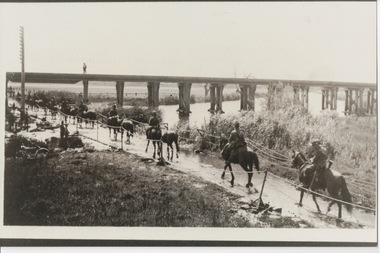
Photograph, Set 4 photographs. and others for Torquay Light Horse camp, 1940
... Men were given remounts (if not using their own horses) – army horses bought by Commonwealth purchasing officers from graziers and breeders. These were called “walers” because they were a New South Wales stockhorse type – strong, great-hearted animals with the strains of the thoroughbred and semi-draught to give them speed, strength and stamina. ...Men were given remounts (if not using their own horses) – army horses bought by Commonwealth purchasing officers from graziers and breeders. These were called “walers” because they were a New South Wales stockhorse type – strong, great-hearted animals with the strains of the thoroughbred and semi-draught to give them speed, strength and stamina. ...These images capture for all time Light Horsemen travelling through Geelong on their way to camp at Torquay for the last Group meeting in Australia . information following - details obtained from .........https://torquayhistory.com/light-horse-brigade/ On Australia Day, 1997, Sir John Young unveiled this plaque on Point Danger, Torquay. Torquay history, Light Horse Training Camp, WW2 Plaque at Pt. Danger Note----- (See images to view plaque) The plaque identifies a significant event in Torquay’s history and the sentiments of ‘change’ for the Light Horse Brigade – from horses to machines. In 1940 the four Light Horse Regiments (4th, 8th, 13th and 20th), some 5000 Light Horse and 2000 horses camped and trained at Torquay. Three other regiments, formerly mounted on horses, were also at Torquay ‘mounted’ on privately owned trucks and cars. Division troops included Artillery, Engineers, Signals, Field Ambulance and other branches of the Army necessary to enable a Division to function. It wasn’t just the sheer numbers of men coming to this little town that made the event significant, it was also the fact that the men of the Light Horse were dramatic, almost glamorous figures and it is easy to see their exploits as some splendid adventure. Horses have played a special role in the story of Australia. They were the only means of transport across this huge country, so it was necessary for everyone to have the ability to ride a horse. When war broke out in 1899 between Britain and the Boers of South Africa (“Boer” was Dutch for “farmer”) Australia sent troops to fight. At first Britain was wary of using untried, unprofessional colonial cavalrymen but soon saw that the slouch-hatted Australian “bushmen” were a match for the fast-moving and unconventional mounted commandos of the Boers. The Australians proved themselves to be expert rough-riding horsemen and good shots. Bush life had hardened them to go for long periods with little food and water. They also showed remarkable ability to find their way in a strange country and use its features for cover, in both attack and defence. By 1914, when Australia joined the war against Germany, there were 23 Light Horse regiments of militia volunteers. Many men from these units joined the Light Horse regiments of the Australian Imperial Force (AIF). Men were given remounts (if not using their own horses) – army horses bought by Commonwealth purchasing officers from graziers and breeders. These were called “walers” because they were a New South Wales stockhorse type – strong, great-hearted animals with the strains of the thoroughbred and semi-draught to give them speed, strength and stamina. On 1st November, 1914, Australia’s First Infantry Division and the first four Light Horse regiments sailed for England in a fleet of transport ships. The first of the Light Horse arrived at Gallipoli in May without their horses. Back with their horses after Gallipoli, they were formidable combatants across the Sinai and Palestine. Some British commanders observed that the light horseman moved with a “lazy, slouching gait, like that of a sleepy tiger” but described how the promise of battle “changes that careless gait, into a live athletic swing that takes him over the ground much quicker than other troops”. They had Light Horse, Torquay, training campdeveloped a reputation as formidable infantrymen. The Turks called them “the White Ghurkas” – a reference to their deadly skill with the bayonet. The Arabs called them “The Kings of the Feathers”. The plume had originally been a battle honour of the Queensland Mounted Infantry for their work in the shearer’s strike of 1891. During WW1 it was adopted by almost all the Light Horse Regiments. It was the proud badge of the light horseman. The most famous of their battles was the attack on Beersheba- the charge of the 4th Light Horse Brigade. Mounted infantrymen and their superb walers had carried out one of the most successful cavalry charges in history – against what seemed impossible odds. They surprised the Turks by charging cavalry-style, when they would normally have ridden close to an objective then dismounted to fight. The fall of Beersheba swung the battle tide against the Turks in Palestine; and changed the history of the Middle East. While 19 men from the Surf Coast Shire served with the 4th Light Horse over the course of WW1, only four were involved in the charge of Beersheba- John GAYLARD, Philip QUINN.(Winchelsea); Wallace FINDLAY (Anglesea); Harry TRIGG (Bambra). After the war, Light Horse units played a key role in the Australian Government’s compulsory military training programme. The Citizen Military Forces (C.M.F.) thrived on the glamour of the wartime Light Horse tradition, ignoring the possibility that motor vehicles would soon replace the horses. When training was no longer compulsory, the C.M.F. regiments declined and horses became more of a luxury during the 1930s depression years of poverty and unemployment. Some regiments were motorised. Then, in 1939, Australia joined Britain in another world war. Training was increased for the militia at both home bases and regional training camps. The camp at Torquay in 1940, commanded by Major General Rankin, was at Divisional strength. By the end of the camp some felt that the Division was ready for active service. Gradually, over the next four years, the Australian Light Horse units were mounted on wheels and tracks and the horses were retired. Six men enlisted at the Torquay camp and another 57 men and women enlisted at Torquay for service in WW2. Those who served in the Militia provided valuable Officers and NCOs and men for the armed services during the war. Each infantry division of the 2nd AIF had a Light Horse regiment attached to it. But the day of the Australian mounted soldier hadn’t quite passed. During World War II, Australia’s 6th Cavalry Regiment formed a mounted unit they called “The Kelly Gang” which did valuable scouting work. In New Guinea, a mounted Light Horse Troop did patrol duty and helped carry supplies. Some fully equipped walers were flown into Borneo for reconnaissance in rugged mountain country. But by the end of the war, in 1945, the horse had disappeared from the Australian Army. References: Australian Light Horse Association www.lighthorse.org.au National Australia Archives Australian War Memorial Surf Coast Shire WW1 memorials www.togethertheyserved.com The Light horse- a Cavalry under Canvas Light Horse, Training Camp, Torquay, WW2 Late in 1939 it was decided to set up a Lighthorse training camp in Torquay to train both men and horses for the battles of the Second World War. Horses, men and equipment came on special trains from all over Victoria and NSW, and as you would expect horseman came from areas such as Omeo and Sale, the Wimmera and the Western District. They arrived at the Geelong racecourse for watering in the Barwon River and then were ridden across the ford at the breakwater and began their 11 mile trek to Torquay. Light Horse, Training Camp, Torquay, WW2 Tent city By the end of January 1940 the camp at Torquay accommodated some 5000 men and 2500 horses of the Second Cavalry Division. The rows of horses, tents and huts near Blackgate Road were quite a sight. While the cavalrymen engaged in exercises on the land and on the beaches, many of the troops took over the Torquay School for special training of men and officers. Mr Bob Pettit local farmer and Councillor for the Barrabool Shire, wrote about the Light horse in the Surf Coast Community News in 1985 saying “They used to travel about the district riding four abreast in one long convoy. To my annoyance they went through my property and shut all the gates behind them. I had certain gates open to let stock in to the water holes and it would take me three -quarters of an hour to follow the horsemen up and put all the gates right again” he continued “the men from the Light Horse were here when the fire went through in March 1940. He recalled an incident when early one morning, as some one blew the bugle, a soldier putting a white sheet on the line frightened the horses. They panicked and ran off in all directions. Six went over the cliff near Bird Rock, five were never found, and the rest were gathered up after nearly a fortnight in the bush around Addiscott and Anglesea" Light Horse, Training Camp, Torquay, WW2, Geelong Parade Geelong parade The training camp culminated in a parade through the streets of Geelong on March 12th 1940. The salute was given at the Town Hall and the troops continued on a route to the You Yang’s for a training exercise. Note-----(see media section for photograph) The Camp was abandoned in mid 1940 as it was deemed unsuitable for training during winter and the cost of a permanent camp could not be justified if it could not be used all year. Historic.......Rare,,,Interpretive.Sepia photographs.set of four ....post card size ....Horses &LighthorsemenNo 1, Lighthorsemen Regiment Geelong 1940......No 2 Light Horse at Breakwater Geelong 1938 to 1940....No 3 Light Horse at Breakwater Geelong 1938 to 1940.....No 4 Light Horse crossing Breakwater camped at Geelong Showgrounds. These markings are on reverse of photographs.light horsemengeelong 1940., world war 2
