
Showing 47 items matching " australia's first parliament house"
-
 Bendigo Historical Society Inc.
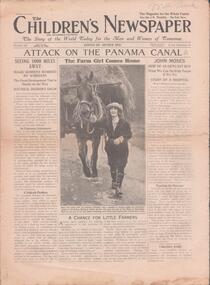
Newspaper - THE CHILDREN'S NEWSPAPER (10 ISSUES), 1924
... ... Australia's first Parliament House...NEWSPAPER Newspaper children Arthur Mee Mrs Bush Australia's first Parliament House Handwritten in pencil on the top of each front page 'Mrs Bush' Newspaper. ...The Children's Newspaper was a long-running newspaper published by the Amalgamated Press (later Fleetway Publications) aimed at pre-teenage children founded by Arthur Mee in 1919. It ran for 2,397 weekly issues before being merged with Look and Learn in 1965.Newspaper. Ten issues of 'The Children's Newspaper', from April 19 to July 26, 1924. A weekly issue edited by Arthur Mee. Each 12 pages. Price Twopence. Illustrated with B & W photographs. Printed and published by The Amalgamated Press, London. Page 7 of issue No. 266 has a photo of Australia's new Parliament House under construction.Handwritten in pencil on the top of each front page 'Mrs Bush'newspaper, newspaper, children, arthur mee, mrs bush, australia's first parliament house -
 Anglesea and District Historical Society
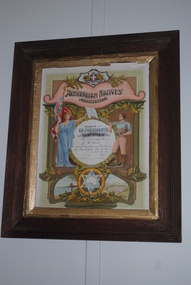
Framed Certificate, Australian Natives' Association, Estimated 1947
... Scenes either side depict native Australian first fleet and Canberra Parliament House. All decorated with wattle and in a wooden frame....Scenes either side depict native Australian first fleet and Canberra Parliament House. All decorated with wattle and in a wooden frame. ...Ex-president's Certificate from the Australian Natives' Association with details of recipient's details in central circle - an Australian emblem on the top - female figure on one side of circle holding flag in one hand and male figure on other side / symbolising bushman? Smaller circle underneath encloses star with map of Australia in centre and six state emblems in points. Scenes either side depict native Australian first fleet and Canberra Parliament House. All decorated with wattle and in a wooden frame.Certificate reads: Branch No 311 / EX PRESIDENT'S / CERTIFICATE / This is to certify that / J.W. Read / occupied the position of President of / this branch from 20.11.45 / to 25.2.47 / faded signature of President / faded signature of Secretary. australian natives' association, j.w. read -
 Warrnambool and District Historical Society Inc.
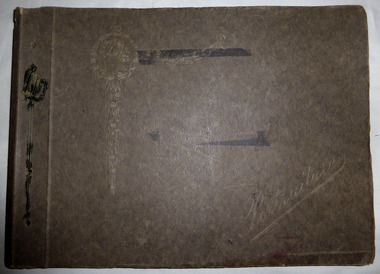
Album, Parliament House opening
... Houses of Parliament. The photographs include the opening of Parliament House in 1927, the N.S.W. Mounted Police, notable military men of the time, the Melbourne escort for the Duke and Duchess of York procession and some views of Canberra. The states of Australia were created in 1901 with the establishment of Federation and the Australian Parliament met at Melbourne from 1901 to 1927 when the Australian Capital Territory was created and the first Australian Parliament House was built. ...Houses of Parliament. The photographs include the opening of Parliament House in 1927, the N.S.W. Mounted Police, notable military men of the time, the Melbourne escort for the Duke and Duchess of York procession and some views of Canberra. The states of Australia were created in 1901 with the establishment of Federation and the Australian Parliament met at Melbourne from 1901 to 1927 when the Australian Capital Territory was created and the first Australian Parliament House was built. ...This is an album used as a scrapbook to insert memorabilia of the 1927 opening of Parliament House in Canberra. The compiler of the scrapbook is unknown. The scrapbook includes small sepia-coloured photographs, a stamp, copies of photographs of the Duke and Duchess of York and a printed program of the 1927 Dedication of the Houses of Parliament. The photographs include the opening of Parliament House in 1927, the N.S.W. Mounted Police, notable military men of the time, the Melbourne escort for the Duke and Duchess of York procession and some views of Canberra. The states of Australia were created in 1901 with the establishment of Federation and the Australian Parliament met at Melbourne from 1901 to 1927 when the Australian Capital Territory was created and the first Australian Parliament House was built. This album is of minor significance as the material concerns mostly the opening of Canberra’s Parliament House in 1927, a national event. One photograph, that of C.A. Rogers, has local significance. He was a Warrnambool man who was part of the Melbourne mounted escort for the processional car of the Duke and Duchess of York in 1927 in MelbourneThis is a 12 page photograph album with a brown cardboard cover with the pages tied with brown cord. Front Cover: ‘Portraiture’canberra establishment, opening of parliament house in canberra 1927, warrnambool -
 Federation University Historical Collection
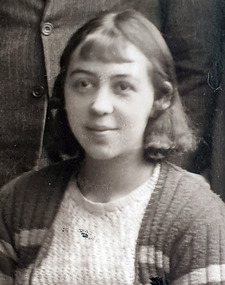
Article - Article - Women, Ballarat Technical Art School: Women of Note; Nornie Gude, Artist, (1915 - 2002)
... first woman to win the National Gallery Students Travelling Scholarship. Gude won many awards for her painting both while at school and throughout her career. Her work is represented in collections at the National Gallery of Victoria, Parliament House, and the Art Gallery of Western Australia, as well as regional collections in Ballarat, Geelong, Castlemaine Art Museum, and Bendigo....first woman to win the National Gallery Students Travelling Scholarship. Gude won many awards for her painting both while at school and throughout her career. Her work is represented in collections at the National Gallery of Victoria, Parliament House, and the Art Gallery of Western Australia, as well as regional collections in Ballarat, Geelong, Castlemaine Art Museum, and Bendigo. nornie gude ballarat technical art school 1931-1936 women of note artist macrobertson scholarship 100 pound per year national gallery school 1936-1939 sidney nolan charles bush first woman national gallery students travelling scholarship parliament house regional collections ballarat geelong castlemaine bendigo national gallery victoria eleanor constance gude Portrait of Nornie Gude while a student at the Ballarat Technical Art School Ballarat Technical Art School: Women of Note; Nornie Gude, Artist, (1915 - 2002) Article Article - Women ...Eleanor Constance (Nornie) Gude was born in 1915 in Ballarat, Victoria to Stella Rehfisch and Walter Gude, musician and violin teacher, and conductor of the St Patrick's Cathedral orchestra and choir in Ballarat. Her parents met when Stella was 27 and the 42-year old Walter was teaching her the violin. Nornie and her sister Gilda were both raised in Ballarat before moving to Melbourne on the eve of World War II. She was accepted into the Ballarat Technical Art School at 15 because of her advanced skill in painting, and trained there from 1931-1936. She won the esteemed MacRobertson Scholarship in art worth £100 a year. She later went on to the National Gallery School from 1936-1939, studying with Sidney Nolan and Charles Bush, and became the first woman to win the National Gallery Students Travelling Scholarship. Gude won many awards for her painting both while at school and throughout her career. Her work is represented in collections at the National Gallery of Victoria, Parliament House, and the Art Gallery of Western Australia, as well as regional collections in Ballarat, Geelong, Castlemaine Art Museum, and Bendigo.Portrait of Nornie Gude while a student at the Ballarat Technical Art Schoolnornie gude, ballarat technical art school, 1931-1936, women of note, artist, macrobertson scholarship, 100 pound per year, national gallery school, 1936-1939, sidney nolan, charles bush, first woman national gallery students travelling scholarship, parliament house, regional collections, ballarat, geelong, castlemaine, bendigo, national gallery victoria, eleanor constance gude -
 Flagstaff Hill Maritime Museum and Village
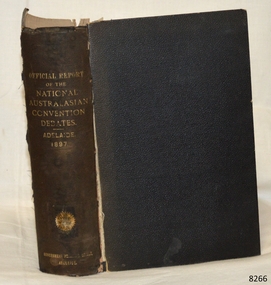
Book - Publication of Speeches, C. E. Bristow Government Printer, Official Report of The National Australasian Convention Debates Adelaide, 1897
... first time, rather than appointed solely by colonial parliaments. The volume covers speeches from premier legal minds and politicians as they debated the crucial constitutional mechanics required to achieve Federation. Some of the significant figures in attendance were Sir Edmund Barton (Australia's first Prime Minister), Charles Kingston (Premier of South Australia), Sir John Forrest, and Sir Samuel Griffith. Among the major topics discussed were the balance of power between large and small states (House...first time, rather than appointed solely by colonial parliaments. The volume covers speeches from premier legal minds and politicians as they debated the crucial constitutional mechanics required to achieve Federation. Some of the significant figures in attendance were Sir Edmund Barton (Australia's first Prime Minister), Charles Kingston (Premier of South Australia), Sir John Forrest, and Sir Samuel Griffith. Among the major topics discussed were the balance of power between large and small states (House ...This volume is one of the primary founding documents of the Australian Federation. Published in Adelaide in 1897 by Charles Edward Bristow (the South Australian Government Printer), this heavy octavo volume captures the verbatim transcript of the First Session of the Australasian Federal Convention, held in Adelaide from 22 March to 5 May 1897. The volume contains verbatim debates from the convention, where statesmen from across the colonies drafted the framework for the Australian Constitution.Hard cover book, National Australasian Convention. (Debate Speeches March 22nd to May 5th 1897) Author: Various Speeches by various Speakers Publisher: C. E. Bristow Government Printer, North Terrace ,Adelaide. SA. Editor: C. E. Bristow Government Printer Date: 1897 Further Information: Black embossed cloth hardcover with a brown spine and lettering in gilt. The spine has a publishers logo in gilt.non-fictionThis volume is one of the primary founding documents of the Australian Federation. Published in Adelaide in 1897 by Charles Edward Bristow (the South Australian Government Printer), this heavy octavo volume captures the verbatim transcript of the First Session of the Australasian Federal Convention, held in Adelaide from 22 March to 5 May 1897. The volume contains verbatim debates from the convention, where statesmen from across the colonies drafted the framework for the Australian Constitution.flagstaff hill, warrnambool, shipwrecked coast, flagstaff hill maritime museum, maritime museum, shipwreck coast, flagstaff hill maritime village, great ocean road, book, pattison collection, warrnambool library, warrnambool mechanics’ institute, ralph eric pattison, corangamite regional library service, warrnambool city librarian, mechanics’ institute library, victorian library board, warrnambool books and records, warrnambool children’s library, official report of the national australasian convention debates adelaide -
 Glenelg Shire Council Cultural Collection
Souvenir - Tea Towel - Australian Bicentennial, c. 1988
... Australia. Made in Poland; images of landing of first fleet, the gold rush, a city scene, Federation, Sydney harbour bridge and new Parliament House....Australia. Made in Poland; images of landing of first fleet, the gold rush, a city scene, Federation, Sydney harbour bridge and new Parliament House. ...Australian Bicentennial calendar tea towel. Cotton/linen blend, designed in Australia. Made in Poland; images of landing of first fleet, the gold rush, a city scene, Federation, Sydney harbour bridge and new Parliament House.tea towel, souvenir, tall ships, bicentenary -
 Orbost & District Historical Society
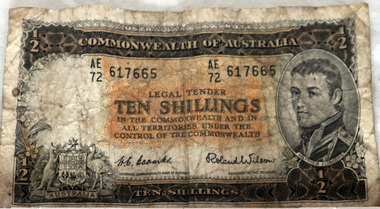
10/- note, June 1954 to February 1966
... first issued on 1 May 1913 as a blue banknote payable in gold. It was equal to a half sovereign gold coin. This is an example of Australian pre-decimal currency. currency Australian-ten-shilling-note A brown rectangular paper Australian ten shilling note. On the obverse side is Matthew Flinders and on the reverseis Parliament House ...The 10/- banknote was first issued on 1 May 1913 as a blue banknote payable in gold. It was equal to a half sovereign gold coin. This is an example of Australian pre-decimal currency.A brown rectangular paper Australian ten shilling note. On the obverse side is Matthew Flinders and on the reverseis Parliament House. The signatories are : H. C. Coombs, Governor, Commonwealth Bank of Australia and Roland Wilson, Secretary to the Treasury. The watermark is Captain Cook in left oval and ’HALF’ behind each signature. The serial number is AE 617665 72currency australian-ten-shilling-note -
 Greensborough Historical Society
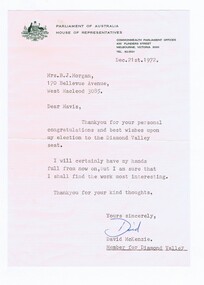
Memorabilia - Letter, David Mckenzie, Thank you letter from David Mackenzie 1972, 21/12/1972
... Thank you letter dated 21st December 1972 to Mavis Morgan from David Mckenzie, Shire of Diamond Valley Councillor, newly elected to the seat of Diamond Valley in the Australian Parliament House of Representatives. Bruce Morgan was the first Shire Secretary (1964-1983) of the Shire of Diamond Valley. ...Thank you letter dated 21st December 1972 to Mavis Morgan from David Mckenzie, Shire of Diamond Valley Councillor, newly elected to the seat of Diamond Valley in the Australian Parliament House of Representatives.Bruce Morgan was the first Shire Secretary (1964-1983) of the Shire of Diamond Valley. This collection was compiled by his wife, Mavis Morgan, detailing the events they attended in their official capacityTyped invitation on a single sheet of buff paper with letterhead.Letterhead: "Parliament of Australia. House of Representatives"bruce morgan, mavis morgan, shire of diamond valley, david mckenzie -
 Orbost & District Historical Society
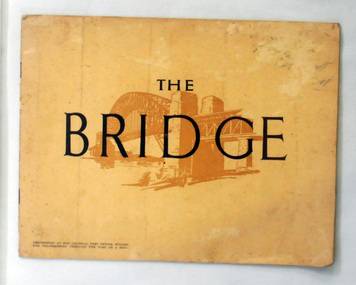
book, The Bridge, 1930's
... Australian engineer who worked with enormous energy and vision to build the infrastructure which he foresaw that Sydney would need as it grew. As early as 1903 Bradfield was making the case for the Sydney Harbour Bridge, in his presidential address as President of the Sydney University Engineering Society. Bradfield’s proposal — at that stage for a cantilever bridge between Dawes Point and Milsons Point — won the committee’s support and they recommended it be accepted. However, the First World War put a stop to these plans. While a bill to authorise the project passed the lower house of the NSW parliament...Australian engineer who worked with enormous energy and vision to build the infrastructure which he foresaw that Sydney would need as it grew. As early as 1903 Bradfield was making the case for the Sydney Harbour Bridge, in his presidential address as President of the Sydney University Engineering Society. Bradfield’s proposal — at that stage for a cantilever bridge between Dawes Point and Milsons Point — won the committee’s support and they recommended it be accepted. However, the First World War put a stop to these plans. While a bill to authorise the project passed the lower house of the NSW parliament ...This book was written by Dr J. J. C. Bradfield, (John Job Crew), 1867-1943. Dr JJC Bradfield was a visionary Australian engineer who worked with enormous energy and vision to build the infrastructure which he foresaw that Sydney would need as it grew. As early as 1903 Bradfield was making the case for the Sydney Harbour Bridge, in his presidential address as President of the Sydney University Engineering Society. Bradfield’s proposal — at that stage for a cantilever bridge between Dawes Point and Milsons Point — won the committee’s support and they recommended it be accepted. However, the First World War put a stop to these plans. While a bill to authorise the project passed the lower house of the NSW parliament in 1916, it failed to pass the upper house, on the grounds that funds should not be diverted from the war effort. With the war over, in 1922 the Sydney Harbour Bridge Act was passed by the NSW Parliament. The Sydney Harbour Bridge was officially opened in 1932 after Museum and St James railway stations were built. This book was written from the story broadcast by Dr. J.J.C. Bradfield. This item is a useful reference tool.A staple soft cover 16 pp booklet with a buff coloured cover. It has a sketch of the Sydney Harbour Bridge behind the title "The Bridge" in dark brown print. It contains information and photographs of the history and construction of Sydney Harbour Bridge.sydney-harbour-bridge bradfield-dr-j-j-c -
 Orbost & District Historical Society
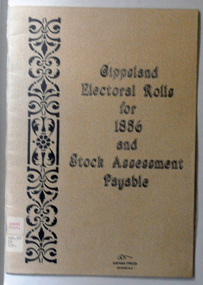
book, E-Gee Printers, Gippsland Electoral Rolls for 1856 and Stock Assessment Payable, 1985
... Parliament o March 13, 1856. Victoria was the first Australian colony, and the first legislature anywhere in the world, to adopt the practice of the secret ballot. Victoria's constitution prescribed that the Parliament was to be bicameral, consisting of an upper house, the Legislative Council and a lower house, Legislative Assembly. ...Parliament o March 13, 1856. Victoria was the first Australian colony, and the first legislature anywhere in the world, to adopt the practice of the secret ballot. Victoria's constitution prescribed that the Parliament was to be bicameral, consisting of an upper house, the Legislative Council and a lower house, Legislative Assembly. ...The Electoral Act 1856 was passed through Parliament o March 13, 1856. Victoria was the first Australian colony, and the first legislature anywhere in the world, to adopt the practice of the secret ballot. Victoria's constitution prescribed that the Parliament was to be bicameral, consisting of an upper house, the Legislative Council and a lower house, Legislative Assembly. Men were entitled to vote according to the qualifications described in this book - the right to vote in each house was dependent on status - educational qualifications, income and for either literacy. Two names are registered for the Orbost district: James Dickson and J.C. McLeod.This item is a useful research tool.A 16 pp paper back book which has a clear plastic cover. The covers are beige coloured with the title "Gippsland Electoral Rolls for 1856 and Stock Assessment Payable" in blak print. On the left hand side is a vertical pattern in black print. The book contains an alphabetical list of persons claiming or supposed to be entitled to Vote in the Election of a Member for the District. It lists the needed qualifications of electors followed by the Voters Roll for Legislative Assembly, 1856 and the Voters Roll for Legislative Council, 1856 . It then lists the Stock Assessments, 1856.voting-registers-victoria -
 Eltham District Historical Society Inc
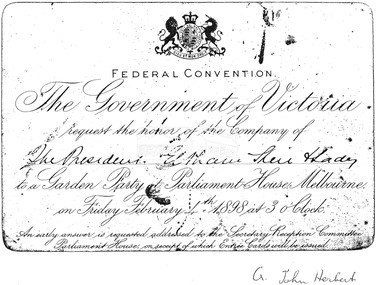
Document - Folder, Cr. John Herbert, Shire President, Eltham Shire, 1894-1906, 1898 to 1917
... Australia - France 12/12/17 - Dear Floss, Just a card to let you know I have not forgotten you. Tell "Mum" I am quite well, but a bit cold, I remain yours sincerely, Will" AIF, Blair Athol, Councillors, Cr. John Herbert, Eltham Railway Station, Eltham Shire Council, Federal Convention, First World War, Flora Herbert, Government of Victoria, Heidelberg & Eltham Railway Construction Trust, Invitation, Nutfield, Opening Ceremony, Parliament House, Postcards, Shire President Photocopy A3 page; all three items on one page Cr. ...Cr. John Herbert served three terms as Eltham Shire President A3 photocopy of 3 documents with note at bottom of page - Cr. John Herbert 1. Federal Convention, The Government of Victoria request the honor of the Company of the The President, Eltham Shire & Lady to a Garden Party at Parliament House Melbourne on Friday February 4th 1898 at 3 o'clock. 2. Heidelberg & Eltham Railway Construction Trust, Ticket No. 87, Dinner in celebration of the opening of the Railway to Eltham, will be given in the Marquee on the Station Ground, Eltham on Thursday, 5th June, 190212.30 o'clock, H.J. Price, Secretary 3. Post card addressed to Miss Flora Herbert, "Blair Athol", Nutfield P.O., Victoria, Australia - France 12/12/17 - Dear Floss, Just a card to let you know I have not forgotten you. Tell "Mum" I am quite well, but a bit cold, I remain yours sincerely, Will"Photocopy A3 page; all three items on one page aif, blair athol, councillors, cr. john herbert, eltham railway station, eltham shire council, federal convention, first world war, flora herbert, government of victoria, heidelberg & eltham railway construction trust, invitation, nutfield, opening ceremony, parliament house, postcards, shire president -
 Conservation Volunteers
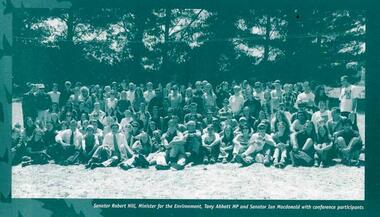
Key Document: First Green Corps National Conference, Canberra, 21-24 February 1998, Conference Organisers David Clark and Mark Purcell, Proceedings of First Green Corps National Conference, Canberra, 21-24 February 1998
... Parliament House, Canberra, on the evening of 20 August 1996. The Federal Treasurer, Peter Costello, announced in his first Budget Speech that: - “the Government will provide $42 million over the next 3 years to establish the Green Corps. The Green Corps will be open to young Australians...Parliament House, Canberra, on the evening of 20 August 1996. The Federal Treasurer, Peter Costello, announced in his first Budget Speech that: - “the Government will provide $42 million over the next 3 years to establish the Green Corps. The Green Corps will be open to young Australians ...In March 1995 ATCV had circulated a proposal for an ‘Australia Corps’. The proposal emerged over time from ATCV board and staff through debate and experience. ATCV Board member Alan Wright had written earlier: “There is in our society a terrible vacuum for adolescents to give expression to their independence and idealism in a constructive way, a chance to try themselves out independent of their parents/teachers in adult roles.” ATCV’s Brisbane office manager Phil Harrison had first been involved with ATCV as a volunteer from UK, drew together ideas about an ‘Australia Corps’, that had been discussed with Alan Wright, John Fenton and others at the ATCV staff/board planning workshop at Sorrento in December 1993 and “…based upon our experience and participation in the LEAP program and observations of Conservation Corps around the world”. The concept of a six-month program for young people with a training wage and accredited training which encouraged both competencies and personal development emerged, with a standard format of ten participants working fopr six months under the direction of a supervisor. The ‘Australia Corps’ proposal was widely distributed to Federal, State and Territory parliamentarians and received positive feedback. The Liberal Party, then in Opposition, included the idea of a “Green Army” in their environmental policy, placing more emphasis on environmental outcomes and less on job creation than the Keating ALP Government had. A young and up-and-coming parliamentarian, Tony Abbott MP, was enthusiastic and was to visit several ATCV projects (both before and after Green Corps started) to learn about their workings direct from volunteers and CVA staff. Several times he visited projects with Ian Smith project and Ian recalls being impressed by the efforts he made to talk at length with all participants. Tony Abbott took a personal interest in the progress of Green Corps. Colin Jackson and Phil Harrison were guests of Abbott in Parliament House, Canberra, on the evening of 20 August 1996. The Federal Treasurer, Peter Costello, announced in his first Budget Speech that: - “the Government will provide $42 million over the next 3 years to establish the Green Corps. The Green Corps will be open to young Australians aged 17 to 20 to demonstrate their commitment to the environment by working on projects to preserve and restore Australia's natural environment and cultural heritage. The projects will also contribute to their career and employment prospects through training, skills development, work experience and personal development.” ATCV’s chief executive officer Colin Jackson worked with senior staff Madeline Townsend, Garry Snowden, Phil Harrison, and John Fenton to fine-tune the ATCV proposal. On the strength of unique national coverage and credible record ATCV went on to win the tender to administer and manage the day-to-day operations of the Green Corps program for five years (1997-2002). Winning a $36 million contract was a big breakthrough for ATCV. Fourteen years before, a small non-profit group had started in Ballarat in country Australia with a vision – but little else. Its key people had shaped opinion and won political support for a concept. There was about to be transformation from hand-to-mouth existence into a nation-wide business with resources to build for the long term. This documents records many positive comments about Green Corps and ATCV's implementation of it.24pp illustrated booklet printed in green and some gold.atcv green corps australia-corps tony abbott mp phil-harrison -
 Bendigo Historical Society Inc.
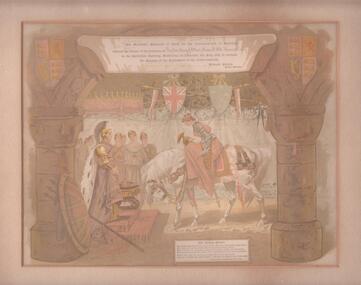
Document - DOCUMENT. ILLUMINATED REQUEST, 1901
... first Federal Parliament, where the new Senators and Members of the House of Representatives were sworn in. Royal Exhibition Building. 9 May 1901. AT this time, Mr H. D. Thomas served as the Secretary of the Shire of McIvor, a local government area based in Heathcote, Victoria. hrh duke of cornwall & york H. D. Thomas Document. Illuminated request. His Majesty's Ministers of the State for the Commonwealth of Australia ...Invitation from HRH The Duke of Cornwall and York (later King George V), acting on behalf of King Edward VII to the Secretary of McIvor Shire Mr. H. D. Thomas and Mrs Thomas to attend the official opening of the first Federal Parliament, where the new Senators and Members of the House of Representatives were sworn in. Royal Exhibition Building. 9 May 1901. AT this time, Mr H. D. Thomas served as the Secretary of the Shire of McIvor, a local government area based in Heathcote, Victoria.Document. Illuminated request. His Majesty's Ministers of the State for the Commonwealth of Australia request the honour of the presence of The Secretary of McIvor Shire Mr. H. D. Thomas and Mrs Thomas in the Exhibition Building, Melbourne, on Thursday, 9th May , 1901, to witness the Opening of the Parliament of the Commonwealth. Edmund Barton, Prime Minister. At the bottom of the Picture there is a quote. "The Young Queen. Authored by Kipling's Commonwealth Ode. Her hand was still on her sword hilt---the spur was still on her heel--- she had not cast her harness of grey war-dinted steel; High on her red-- splashed charger , beautiful, bold, and browned, Bright--eyed out of the battle, the young Queen rode to be crowned, Loyal she gave the greeting, royal she bowed her head, Crying 'Crown me, my mother,' and the old Queen stood and said."hrh duke of cornwall & york, h. d. thomas -
 Australian Queer Archives
Poster, Cathie Knox, International Women's Day 1995, 1995
... The use of the colours purple, green and white reference the colours used during the first wave feminist movement initially in the UK by the Women’s Social and Political Union (WSPU), and subsequently emblematic of the Australian women’s movement. Women's liberation Additional text: "A woman's place is… …in the struggle : 24th consecutive rally and march : 6:30pm steps of Parliament House : Dance afterwards 8:30pm Brunswick Town Hall (cnr. ...The use of the colours purple, green and white reference the colours used during the first wave feminist movement initially in the UK by the Women’s Social and Political Union (WSPU), and subsequently emblematic of the Australian women’s movement.Graphic illustration of a naked female seated figure in purple, white and red, against a background with 'rays' of purple, green and white. Main text in red, with additional text at base in purple.Additional text: "A woman's place is… …in the struggle : 24th consecutive rally and march : 6:30pm steps of Parliament House : Dance afterwards 8:30pm Brunswick Town Hall (cnr. Sydney Rd. + Dawson St.)."women's liberation -
 Bendigo Historical Society Inc.
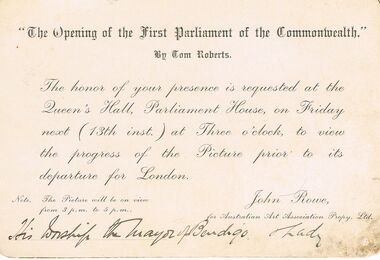
Document - LYDIA CHANCELLOR COLLECTION; INVITATION TO VIEWING OF TOM ROBERT'S PAINTING OF PARLIAMENTARY OPENING
... First Parliament of the Commonwealth.' 'By Tom Roberts. The honor of your presence is requested at the Queen's Hall, Parliament House, on Friday next (13th inst.) at Three o'clock, to view the progress of the Picture prior to its departure for London. John Rowe for Australian...EVENT Official painting Lydia Chancellor collection Australian art art work Australian history history painting Tom Roberts politics Australian politics Australian parliament event An invitation in the form of a card with black print. ' The Opening of the First Parliament of the Commonwealth.' 'By Tom Roberts. The honor of your presence is requested at the Queen's Hall, Parliament House ...An invitation in the form of a card with black print. ' The Opening of the First Parliament of the Commonwealth.' 'By Tom Roberts. The honor of your presence is requested at the Queen's Hall, Parliament House, on Friday next (13th inst.) at Three o'clock, to view the progress of the Picture prior to its departure for London. John Rowe for Australian Art Association Pty. Ltd.' Handwritten in black ink are the words 'His Worship the Mayor of Bendigo & Lady.'event, official, painting, lydia chancellor, collection, australian art, art work, australian history, history, painting, tom roberts, politics, australian politics, australian parliament, event -
 Narre Warren and District Family History Group
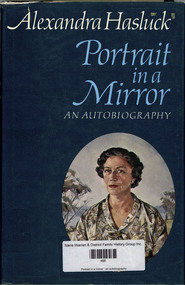
Book, Alexandra Hasluck, Portrait in a mirror : an autobiography, 1981
... Australia, her husband became a member of Parliament and a Cabinet Minister in Sir Robert Menzies' Government, first as Minister for Territories and later as Foreign Minister. Both positions provided them with many new experiences: of journeys to the remoter parts of Australia and New Guinea in his responsibility for Territories and, later, as Foreign Minister, of visits to the capitals of the world, meeting most of the great men of our time. Even wider vistas opened when her husband became Governor General of Australia and the observing historian was able to record characteristically life at Government House ...Alexandra Hasluck is well-known as one of a distinguished group of female historians who have done so much, by their perceptive biographies, to enlarge our knowledge of the characters of our history. In her autobiography she brings her discerning eye to bear on her own ancestors, and with vivid sketches of her English, Irish and Scottish forebears portrays what she regards as the typical experiences of British settlers. The same observing eye and mind follow her basically happy childhood and youth in Western Australia to becoming herself a 'Governor's Lady'. She married Paul Hasluck, then sub-editor on the West Australian newspaper. When he entered the diplomatic sphere she moved with him to Canberra and her descriptions of life in war-time Canberra and later in America, are enlivened by humorous sketches of people and events which few people have been fortunate enough to experience. These opportunities increased when, on their return to Australia, her husband became a member of Parliament and a Cabinet Minister in Sir Robert Menzies' Government, first as Minister for Territories and later as Foreign Minister. Both positions provided them with many new experiences: of journeys to the remoter parts of Australia and New Guinea in his responsibility for Territories and, later, as Foreign Minister, of visits to the capitals of the world, meeting most of the great men of our time. Even wider vistas opened when her husband became Governor General of Australia and the observing historian was able to record characteristically life at Government House with its constant stream of visitors colouring its own equally interesting inner life. Portrait in a Mirror is not only a fascinating story but also a remarkable self-portrait, told through letters diaries and speeches as well as her own commentaries ot a watching woman: a dispassionate observer of the famous people and great events of her time, who was unaffected by her varying environments and remained, as she had begun, a typical scion of that early colonial stock - intelligent, literate, strongly-opinioned - and staunchly Australian. (Cover)non-fictionAlexandra Hasluck is well-known as one of a distinguished group of female historians who have done so much, by their perceptive biographies, to enlarge our knowledge of the characters of our history. In her autobiography she brings her discerning eye to bear on her own ancestors, and with vivid sketches of her English, Irish and Scottish forebears portrays what she regards as the typical experiences of British settlers. The same observing eye and mind follow her basically happy childhood and youth in Western Australia to becoming herself a 'Governor's Lady'. She married Paul Hasluck, then sub-editor on the West Australian newspaper. When he entered the diplomatic sphere she moved with him to Canberra and her descriptions of life in war-time Canberra and later in America, are enlivened by humorous sketches of people and events which few people have been fortunate enough to experience. These opportunities increased when, on their return to Australia, her husband became a member of Parliament and a Cabinet Minister in Sir Robert Menzies' Government, first as Minister for Territories and later as Foreign Minister. Both positions provided them with many new experiences: of journeys to the remoter parts of Australia and New Guinea in his responsibility for Territories and, later, as Foreign Minister, of visits to the capitals of the world, meeting most of the great men of our time. Even wider vistas opened when her husband became Governor General of Australia and the observing historian was able to record characteristically life at Government House with its constant stream of visitors colouring its own equally interesting inner life. Portrait in a Mirror is not only a fascinating story but also a remarkable self-portrait, told through letters diaries and speeches as well as her own commentaries ot a watching woman: a dispassionate observer of the famous people and great events of her time, who was unaffected by her varying environments and remained, as she had begun, a typical scion of that early colonial stock - intelligent, literate, strongly-opinioned - and staunchly Australian. (Cover)autobiography, alexandra hasluck, paul hasluck, governor-general -
 Warrnambool and District Historical Society Inc.
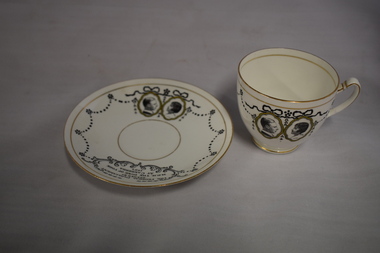
China, The Federation Parliament HRH Duke of York, 1920s
... Australian Federal Parliament sat in Melbourne. When Canberra became the capital of Australia a Parliament House building was erected at a cost of £600,000 but it is now known as Old Parliament House as the present Parliament House was opened in 1988. This cup and saucer set is of interest as a memento of an important event in Australia’s history – the creation of a capital city and the opening of the first ...This cup and saucer set was issued as a souvenir of the opening of the Federal Parliament in Canberra in 1927. The building was opened by Prince Albert, the Duke of York who was accompanied by Elizabeth, the Duchess of York. The Duke of York later became King George VI of England. The colonies in Australia became Federated States in 1901 and from that date to 1927 the Australian Federal Parliament sat in Melbourne. When Canberra became the capital of Australia a Parliament House building was erected at a cost of £600,000 but it is now known as Old Parliament House as the present Parliament House was opened in 1988. This cup and saucer set is of interest as a memento of an important event in Australia’s history – the creation of a capital city and the opening of the first Federal Parliament House. It will be useful for display. This is a white china cup and saucer set. Both the cup and saucer have two gold bands around the rims and are decorated with black ornamentation and the portraits of the Duke and Duchess of York contained within gold oval patterns. There is also black lettering on both objects. The name of the maker is printed on the bottoms of both objects. On both objects: ‘The Federal Parliament opened by H.R.H. The Duke of York at Canberra 1927’ ‘Foley China E.B. & Co. Made in England’ opening of federal parliament 1927, history of warrnambool -
 Warrnambool and District Historical Society Inc.
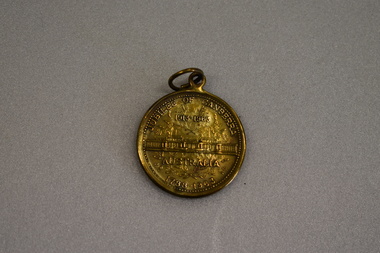
Medal, Jubilee of Canberra 1913-1963
... The Australian capital Territory was established in 1913 and the American architect, Walter Burley Griffin, in association with his wife, Marion Mahony Griffin, was chosen to design the new city of Canberra. The first Parliament House...The Australian capital Territory was established in 1913 and the American architect, Walter Burley Griffin, in association with his wife, Marion Mahony Griffin, was chosen to design the new city of Canberra. The first Parliament House ...This medal was made by W.J.Amor Mint, a medal making company from New South Wales. It was made to commemorate both the 50th anniversary of the establishment of Canberra in 1963 and the Royal Visit of 1963. Because of the rivalry between the two major Australian cities, Melbourne and Sydney, it was decided to establish a new capital city somewhere between the two cities. The Australian capital Territory was established in 1913 and the American architect, Walter Burley Griffin, in association with his wife, Marion Mahony Griffin, was chosen to design the new city of Canberra. The first Parliament House was opened in 1927 and Melbourne ceased to be the location of the Federal Parliament meetings.This medal is of interest, mainly because it commemorates the 50th anniversary of the first Parliament House in Canberra and the establishment of Canberra as Australia's capital city.Circular brass medal with ring attached at the top and a split ring through the ring. The obverse features a raised profile of Queen Elizabeth 11 wearing a crown and text. The reverse depicts old Parliament House, decorative leaves and text.THE ROYAL VISIT OF HM. QUEEN ELIZABETH 11. 1963. JUBILEE OF CANBERRA 1913-1963 AUSTRALIA 1788-1963 australian capital territory, canberra australia, walter burley griffin, queen elizabeth 11 -
 Warrnambool and District Historical Society Inc.
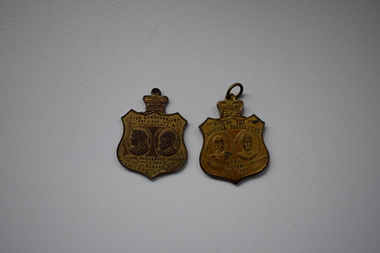
Medals, Opening of First Australian Parliament 1901, 1901
... first Parliament in Australia in Melbourne in May 1901. The Federation of the Australian States and Territories took place in January 1901. The Federal Parliament met in Melbourne until Canberra was established and a new Parliament House was opened in 1927. ...first Parliament in Australia in Melbourne in May 1901. The Federation of the Australian States and Territories took place in January 1901. The Federal Parliament met in Melbourne until Canberra was established and a new Parliament House was opened in 1927. ...These medals were issued to commemorate the opening of the first Parliament in Australia in Melbourne in May 1901. The Federation of the Australian States and Territories took place in January 1901. The Federal Parliament met in Melbourne until Canberra was established and a new Parliament House was opened in 1927. The fist Parliament in Australia was opened by the Duke and Duchess of Cornwall and York. These medals have no known local provenance and are retained for display purposes..1 This is a shield-shaped metal medal with a crown on the top. Obverse: Images of the Duke and Duchess of Cornwall and York and printing. Reverse: Images of Queen Victoria and Edward V11 and printing. .2 as above Opening of the First Federal Parliament T.R.H The Duke & Duchess of Cornwall and York Melbourne, May 1901 Aust. Commonwealth Est. 1 Jan. 1901 First Parliament opened May 1901 63rd of Victoria R.I. 1st of Edward V11 W.A. Tas. N.S.W. Vic. S.A. Qld. -
 Ruyton Girls' School
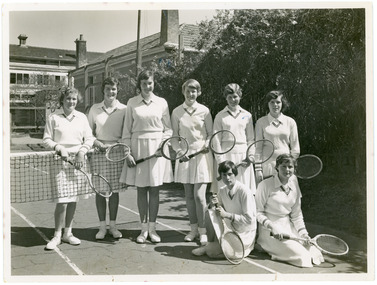
Photograph, Ruyton Girls' School, 1952
... first position at age 19 involved setting up clinics with the Victorian Health Department Poliomyelitis Rural division. Helen’s strong ties to Ruyton continued when she held the position of President of the Old Ruytonians’ Association from the start of 1966 to the end of 1967. In 2019, Helen received an Order of Australia Medal for service to community health as a physiotherapist. She was also the recipient of the 2022 Victorian Senior Achiever Award at Parliament House ...Depicted are eight young women all dressed in white tennis uniforms comprising a knee-length skirt, knitted V-neck jumper with two presumably black stripes, a collared white shirt, white socks and white sneakers. The group is posing for the photograph on a tennis court on the grounds of Ruyton Girls' School. Six of the women are standing up, and two of the women are kneeling in the front row and to the right side. All of the women are holding tennis rackets. The earliest documented mention of tennis being played by students at Ruyton Girls' School is at least 1905. The February 1910 edition of The Ruytonian notes "the Ruyton Tennis Club have had a very successful year ... again won the Kia-Ora club pennant; this is the third year in succession, and fifth time altogether." Ruyton are recorded as having played intra-school tennis with Aldworth Girls' Grammar School, Lauriston Girls' School, and Strathearne Presbyterian Girls' School. The third woman from the left in the back row has been identified as Helen Gordon (maiden name Cole).The record has strong historic significance as it depicts a former notable student, Helen Gordon (maiden name Cole). Helen started at Little Ruyton in Prep 1940 and finished Year 12 in 1952 as School Captain, Bromby Captain, Form Captain for Matric, Tennis Captain, Hockey Captain, Swimming Vice Captain, and an award for Best All-Round Girl. She also played baseball for Victoria. After finishing school, Helen went on to graduate from the University of Melbourne as a physiotherapist in 1956. Her first position at age 19 involved setting up clinics with the Victorian Health Department Poliomyelitis Rural division. Helen’s strong ties to Ruyton continued when she held the position of President of the Old Ruytonians’ Association from the start of 1966 to the end of 1967. In 2019, Helen received an Order of Australia Medal for service to community health as a physiotherapist. She was also the recipient of the 2022 Victorian Senior Achiever Award at Parliament House. Helen passed away in July 2023 at age 88. The record's significance is further enhanced by its strong provenance, having been produced by Ruyton Girls' School and donated to the Archives by a familial connection.Black and white rectangular photograph printed on matte photographic paper.Reverse: HELEN GORDON / 1952. / Elaine (?) c Alpin / Elaine Macdonald . / Sally Backhouse /ruyton girls' school, kew, victoria, tennis, sport, women's sport, students, school, 1950s, uniform -
 Ruyton Girls' School
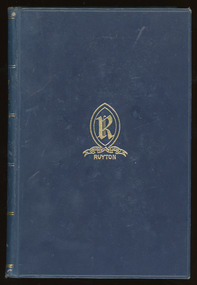
Literary work - Ruyton Prize Book, Geoffrey Cumberlege Oxford University Press, Poems of Tennyson, 1950
... first position at age 19 involved setting up clinics with the Victorian Health Department Poliomyelitis Rural division. Helen’s strong ties to Ruyton continued when she held the position of President of the Old Ruytonians’ Association from the start of 1966 to the end of 1967. In 2019, Helen received an Order of Australia Medal for service to community health as a physiotherapist. She was also the recipient of the 2022 Victorian Senior Achiever Award at Parliament House ...This book contains a collection of poems written by English poet, Alfred, Lord Tennyson, between 1830-1870. It also contains an introduction written by Sir Thomas Herbert Warren, former President of Magdalen College at Oxford University, plus 91 black-and-white illustrations by Millais, Rossetti, Maclise, and others. Alfred Tennyson, 1st Baron Tennyson FRS, was the Poet Laureate during much of Queen Victoria's reign. In 1829, Tennyson was awarded the Chancellor's Gold Medal at Cambridge for one of his first pieces, "Timbuktu." Ruyton Girls' School has a long tradition of awarding prizes to students at annual "Speech Night" events. Speech Night at Ruyton is an extraordinary occasion. It is a time when we gather to celebrate both the year just lived and the contribution of our Year 12 girls to the life of our School. It is a night of stirring student speeches, acknowledgement of student endeavour and excellence and awe-inspiring performances by School choirs and ensembles. The Maisie Brodribb Memorial Prize was named in honour of former Ruyton Girls' School student, Maisie Anderson (maiden name Brodribb), who attended the School between 1898-1903. The Prize, now discontinued, had been awarded for Mathematics and Science.The record has strong historic significance as it was awarded to a former notable student, Helen Gordon (maiden name Cole). Helen started at Little Ruyton in Prep 1940 and finished Year 12 in 1952 as School Captain, Bromby Captain, Form Captain for Matric, Tennis Captain, Hockey Captain, Swimming Vice Captain, and an award for Best All-Round Girl. She also played baseball for Victoria. After finishing school, Helen went on to graduate from the University of Melbourne as a physiotherapist in 1956. Her first position at age 19 involved setting up clinics with the Victorian Health Department Poliomyelitis Rural division. Helen’s strong ties to Ruyton continued when she held the position of President of the Old Ruytonians’ Association from the start of 1966 to the end of 1967. In 2019, Helen received an Order of Australia Medal for service to community health as a physiotherapist. She was also the recipient of the 2022 Victorian Senior Achiever Award at Parliament House. Helen passed away in July 2023 at age 88. The record's significance is further enhanced by its strong provenance, having been produced by Ruyton Girls' School and donated to the Archives by a familial connection.Navy leather hardcover bound book with gold detailing on front cover and spine. 882 pages.Front Cover: R / RECTE ET FIDE LITER / RUYTON / Spine: POEMS OF / TENNYSON / Inside Cover: R / RECTE ET FIDE LITER / RUYTON / PRIZE / AWARDED TO / Helen Cole / FOR / Biology / Form Matriculation / H. Daniell. / 11th Dec. 1952 / Maisie Brodribb Memorial Prize /ruyton girls' school, school, students, prize, speech night, poetry, lord tennyson, queen victoria, senior school, high school, ruyton, old ruytonians' association -
 Ruyton Girls' School
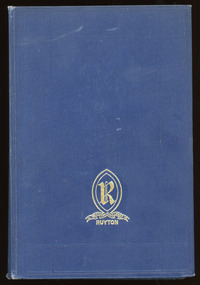
Literary work - Ruyton Prize Book, Geoffrey Cumberlege Oxford University Press, The Poetical Works of Robert Browning, 1940
... first position at age 19 involved setting up clinics with the Victorian Health Department Poliomyelitis Rural division. Helen’s strong ties to Ruyton continued when she held the position of President of the Old Ruytonians’ Association from the start of 1966 to the end of 1967. In 2019, Helen received an Order of Australia Medal for service to community health as a physiotherapist. She was also the recipient of the 2022 Victorian Senior Achiever Award at Parliament House ...This book contains a collection of poems written by English poet, Robert Browning, between 1833-1868. Robert Browning was an English poet and playwright whose dramatic monologues put him high among the Victorian poets. He was noted for irony, characterisation, dark humour, social commentary, historical settings and challenging vocabulary and syntax. Ruyton Girls' School has a long tradition of awarding prizes to students at annual "Speech Night" events. Speech Night at Ruyton is an extraordinary occasion. It is a time when we gather to celebrate both the year just lived and the contribution of our Year 12 girls to the life of our School. It is a night of stirring student speeches, acknowledgement of student endeavour and excellence and awe-inspiring performances by School choirs and ensembles. The Dawn Roach Memorial Prize is awarded for contribution to the sporting life of the school, and is awarded under a points system for participation. Dawn Roach was a former student at Ruyton Girls' School from 1937 until her sudden passing in 1938.The record has strong historic significance as it was awarded to a former notable student, Helen Gordon (maiden name Cole). Helen started at Little Ruyton in Prep 1940 and finished Year 12 in 1952 as School Captain, Bromby Captain, Form Captain for Matric, Tennis Captain, Hockey Captain, Swimming Vice Captain, and an award for Best All-Round Girl. She also played baseball for Victoria. After finishing school, Helen went on to graduate from the University of Melbourne as a physiotherapist in 1956. Her first position at age 19 involved setting up clinics with the Victorian Health Department Poliomyelitis Rural division. Helen’s strong ties to Ruyton continued when she held the position of President of the Old Ruytonians’ Association from the start of 1966 to the end of 1967. In 2019, Helen received an Order of Australia Medal for service to community health as a physiotherapist. She was also the recipient of the 2022 Victorian Senior Achiever Award at Parliament House. Helen passed away in July 2023 at age 88. The record's significance is further enhanced by its strong provenance, having been produced by Ruyton Girls' School and donated to the Archives by a familial connection.Navy leather hardcover bound book with gold detailing on front cover and spine. 698 pages.Front Cover: R / RECTE ET FIDE LITER / RUYTON / Spine: THE / POETICAL / WORKS OF / R.BROWNING / OXFORD / Inside Cover: R / RECTE ET FIDE LITER / RUYTON / PRIZE / AWARDED TO / Helen Cole / FOR / Studies and James / Form VI / H. Daniell. / December 11 1951 / Dawne Roach Memorial Prize /ruyton girls' school, school, students, prize, speech night, poetry, lord tennyson, queen victoria, senior school, high school, ruyton, old ruytonians' association -
 Ruyton Girls' School
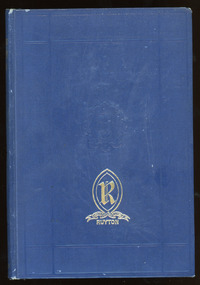
Literary work - Ruyton Prize Book, Geoffrey Cumberlege Oxford University Press, The Poetical Works of Matthew Arnold, No date
... first position at age 19 involved setting up clinics with the Victorian Health Department Poliomyelitis Rural division. Helen’s strong ties to Ruyton continued when she held the position of President of the Old Ruytonians’ Association from the start of 1966 to the end of 1967. In 2019, Helen received an Order of Australia Medal for service to community health as a physiotherapist. She was also the recipient of the 2022 Victorian Senior Achiever Award at Parliament House ...This book contains a collection of poems written by English poet and cultural critic, Matthew Arnold, with an introduction by Sir A. T. Quiller-Couch. Matthew Arnold was characterised as a sage writer, a type of writer who chastises and instructs the reader on contemporary social issues. He was also an inspector of schools for 35 years, and supported the concept of state-regulated secondary education. Ruyton Girls' School has a long tradition of awarding prizes to students at annual "Speech Night" events. Speech Night at Ruyton is an extraordinary occasion. It is a time when we gather to celebrate both the year just lived and the contribution of our Year 12 girls to the life of our School. It is a night of stirring student speeches, acknowledgement of student endeavour and excellence and awe-inspiring performances by School choirs and ensembles. The record has strong historic significance as it was awarded to a former notable student, Helen Gordon (maiden name Cole). Helen started at Little Ruyton in Prep 1940 and finished Year 12 in 1952 as School Captain, Bromby Captain, Form Captain for Matric, Tennis Captain, Hockey Captain, Swimming Vice Captain, and an award for Best All-Round Girl. She also played baseball for Victoria. After finishing school, Helen went on to graduate from the University of Melbourne as a physiotherapist in 1956. Her first position at age 19 involved setting up clinics with the Victorian Health Department Poliomyelitis Rural division. Helen’s strong ties to Ruyton continued when she held the position of President of the Old Ruytonians’ Association from the start of 1966 to the end of 1967. In 2019, Helen received an Order of Australia Medal for service to community health as a physiotherapist. She was also the recipient of the 2022 Victorian Senior Achiever Award at Parliament House. Helen passed away in July 2023 at age 88. The record's significance is further enhanced by its strong provenance, having been produced by Ruyton Girls' School and donated to the Archives by a familial connection.Navy leather hardcover bound book with gold detailing on front cover and spine. 494 pages.Front Cover: R / RECTE ET FIDE LITER / RUYTON / Spine: MATTHEW / ARNOLD'S / POEMS / OXFORD / Inside Cover: R / RECTE ET FIDE LITER / RUYTON / PRIZE / AWARDED TO / Helen Cole / FOR / Best all-round girl / Form Matriculation / H. Daniell. / December 11 1952 / Gift of the Old Ruytonians /ruyton girls' school, school, students, prize, speech night, poetry, lord tennyson, queen victoria, senior school, high school, ruyton, old ruytonians' association -
 Ruyton Girls' School
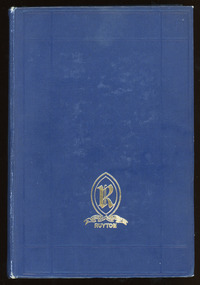
Literary work - Ruyton Prize Book, Geoffrey Cumberlege Oxford University Press, The Poetical Works of Longfellow, No date
... first position at age 19 involved setting up clinics with the Victorian Health Department Poliomyelitis Rural division. Helen’s strong ties to Ruyton continued when she held the position of President of the Old Ruytonians’ Association from the start of 1966 to the end of 1967. In 2019, Helen received an Order of Australia Medal for service to community health as a physiotherapist. She was also the recipient of the 2022 Victorian Senior Achiever Award at Parliament House ...This book contains a collection of poems written by American poet, Henry Wadsworth Longfellow. His original works include the poems "Paul Revere's Ride", "The Song of Hiawatha", and "Evangeline". He was also the first American to completely translate Dante Alighieri's Divine Comedy, and was one of the fireside poets from New England. Ruyton Girls' School has a long tradition of awarding prizes to students at annual "Speech Night" events. Speech Night at Ruyton is an extraordinary occasion. It is a time when we gather to celebrate both the year just lived and the contribution of our Year 12 girls to the life of our School. It is a night of stirring student speeches, acknowledgement of student endeavour and excellence and awe-inspiring performances by School choirs and ensembles. The record has strong historic significance as it was awarded to a former notable student, Helen Gordon (maiden name Cole). Helen started at Little Ruyton in Prep 1940 and finished Year 12 in 1952 as School Captain, Bromby Captain, Form Captain for Matric, Tennis Captain, Hockey Captain, Swimming Vice Captain, and an award for Best All-Round Girl. She also played baseball for Victoria. After finishing school, Helen went on to graduate from the University of Melbourne as a physiotherapist in 1956. Her first position at age 19 involved setting up clinics with the Victorian Health Department Poliomyelitis Rural division. Helen’s strong ties to Ruyton continued when she held the position of President of the Old Ruytonians’ Association from the start of 1966 to the end of 1967. In 2019, Helen received an Order of Australia Medal for service to community health as a physiotherapist. She was also the recipient of the 2022 Victorian Senior Achiever Award at Parliament House. Helen passed away in July 2023 at age 88. The record's significance is further enhanced by its strong provenance, having been produced by Ruyton Girls' School and donated to the Archives by a familial connection.Navy leather hardcover bound book with gold detailing on front cover and spine. 886 pages.Front Cover: R / RECTE ET FIDE LITER / RUYTON / Spine: LONGFELLOW'S / POETICAL / WORKS / OXFORD / Inside Cover: R / RECTE ET FIDE LITER / RUYTON / PRIZE / AWARDED TO / Helen Cole / FOR / Latin / Vc / H. Daniell. / 18th Dec. 1950 / Katie Alsop Memorial Prize /ruyton girls' school, school, students, prize, speech night, poetry, lord tennyson, queen victoria, senior school, high school, ruyton, old ruytonians' association -
 Ruyton Girls' School
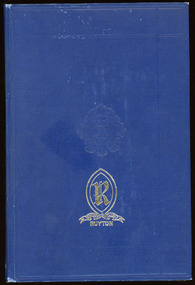
Literary work - Ruyton Prize Book, Geoffrey Cumberlege Oxford University Press, The Poetical Works of Oliver Goldsmith, No date
... first position at age 19 involved setting up clinics with the Victorian Health Department Poliomyelitis Rural division. Helen’s strong ties to Ruyton continued when she held the position of President of the Old Ruytonians’ Association from the start of 1966 to the end of 1967. In 2019, Helen received an Order of Australia Medal for service to community health as a physiotherapist. She was also the recipient of the 2022 Victorian Senior Achiever Award at Parliament House ...This book contains a collection of poems written by Anglo-Irish novelist, playwright, dramatist and poet, Oliver Goldsmith (10 November 1728 – 4 April 1774). Ruyton Girls' School has a long tradition of awarding prizes to students at annual "Speech Night" events. Speech Night at Ruyton is an extraordinary occasion. It is a time when we gather to celebrate both the year just lived and the contribution of our Year 12 girls to the life of our School. It is a night of stirring student speeches, acknowledgement of student endeavour and excellence and awe-inspiring performances by School choirs and ensembles. The record has strong historic significance as it was awarded to a former notable student, Helen Gordon (maiden name Cole). Helen started at Little Ruyton in Prep 1940 and finished Year 12 in 1952 as School Captain, Bromby Captain, Form Captain for Matric, Tennis Captain, Hockey Captain, Swimming Vice Captain, and an award for Best All-Round Girl. She also played baseball for Victoria. After finishing school, Helen went on to graduate from the University of Melbourne as a physiotherapist in 1956. Her first position at age 19 involved setting up clinics with the Victorian Health Department Poliomyelitis Rural division. Helen’s strong ties to Ruyton continued when she held the position of President of the Old Ruytonians’ Association from the start of 1966 to the end of 1967. In 2019, Helen received an Order of Australia Medal for service to community health as a physiotherapist. She was also the recipient of the 2022 Victorian Senior Achiever Award at Parliament House. Helen passed away in July 2023 at age 88. The record's significance is further enhanced by its strong provenance, having been produced by Ruyton Girls' School and donated to the Archives by a familial connection.Navy leather hardcover bound book with gold detailing on front cover and spine. 278 pages.Front Cover: R / RECTE ET FIDE LITER / RUYTON / Spine: THE / POETICAL / WORKS OF / OLIVER / GOLDSMITH / OXFORD / Inside Cover: R / RECTE ET FIDE LITER / RUYTON / PRIZE / AWARDED TO / Helen Cole / FOR / Latin / VI / H. Daniell. / December 11 1951 / Katie Alsop Memorial Prize /ruyton girls' school, school, students, prize, speech night, poetry, lord tennyson, queen victoria, senior school, high school, ruyton, old ruytonians' association -
 Ruyton Girls' School
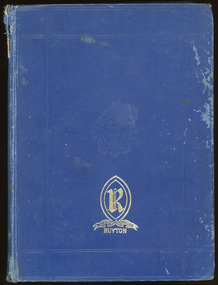
Literary work - Ruyton Prize Book, Geoffrey Cumberlege Oxford University Press, The Complete Works of William Shakespeare, No date
... first position at age 19 involved setting up clinics with the Victorian Health Department Poliomyelitis Rural division. Helen’s strong ties to Ruyton continued when she held the position of President of the Old Ruytonians’ Association from the start of 1966 to the end of 1967. In 2019, Helen received an Order of Australia Medal for service to community health as a physiotherapist. She was also the recipient of the 2022 Victorian Senior Achiever Award at Parliament House ...This book contains a collection of literary works written by William Shakespeare. Shakespeare was an English playwright, poet, and actor, widely esteemed as the foremost writer in the English language and the world's premier dramatist. Often hailed as England's national poet, his surviving works comprise around 39 plays, 154 sonnets, three lengthy narrative poems, and a handful of other verses, some of which are of uncertain authorship. His plays have been translated into every major living language and are staged more frequently than those of any other playwright. Shakespeare remains arguably the most influential figure in English literature, with his works persistently reinterpreted and reimagined. Ruyton Girls' School has a long tradition of awarding prizes to students at annual "Speech Night" events. Speech Night at Ruyton is an extraordinary occasion. It is a time when we gather to celebrate both the year just lived and the contribution of our Year 12 girls to the life of our School. It is a night of stirring student speeches, acknowledgement of student endeavour and excellence and awe-inspiring performances by School choirs and ensembles. The record has strong historic significance as it was awarded to a former notable student, Helen Gordon (maiden name Cole). Helen started at Little Ruyton in Prep 1940 and finished Year 12 in 1952 as School Captain, Bromby Captain, Form Captain for Matric, Tennis Captain, Hockey Captain, Swimming Vice Captain, and an award for Best All-Round Girl. She also played baseball for Victoria. After finishing school, Helen went on to graduate from the University of Melbourne as a physiotherapist in 1956. Her first position at age 19 involved setting up clinics with the Victorian Health Department Poliomyelitis Rural division. Helen’s strong ties to Ruyton continued when she held the position of President of the Old Ruytonians’ Association from the start of 1966 to the end of 1967. In 2019, Helen received an Order of Australia Medal for service to community health as a physiotherapist. She was also the recipient of the 2022 Victorian Senior Achiever Award at Parliament House. This historic significance is further enhanced by Ruyton's bygone "Shakespeare Night" tradition. A celebration of ‘culture’, and a chance to enjoy some ‘fun and games, cakes and ale’, were the motivation behind Ruyton’s annual Shakespeare Night party, led by longstanding Principal Miss Hilda Daniell. In her book, "The History of Ruyton 1878-1956", she describes how the yearly tradition began in 1915, just two years after she took over the role of Principal. That first Shakespeare Night, the senior girls and other guests gathered in the School’s chrysanthemum-filled dining room for music, games and supper. Such fun was had that the festivities became an annual event and was one of the coveted privileges of being one of Ruyton’s older girls. The Night was always held as close and possible to April 23rd, which is the date of William Shakespeare’s death, and the approximate date of his birth. Senior girls and some staff and parents would be invited to a party in the School. There, Shakespearean songs were sung, his poetry recited, and scenes from his plays were acted. Sometimes a competition was held to see who could recognise the largest number of quotations. In other years all the attendees would dress as Shakespearean characters. In a nod to a minor character from ‘A Midsummer Night’s Dream’, Senior teacher Miss Dorothy Derham famously came disguised as a lion one time, and no one knew who it was until she dramatically removed her mask at the end of the evening. Whatever the programme, the Night always drew to a close with a delicious supper that included a spectacular birthday cake especially in honour of the Bard. (Accompanying it may have been the ‘ale’ of Miss Daniell’s description, though of course it was presumably of the ginger rather than the alcoholic variety.) The evening was complete when ‘God Save the King’ and ‘Auld Lang Syne’ were sung. Shakespeare Night was held almost without interruption from 1915 to at least the mid 1950s. Only in 1919, with the threat of Spanish Flu, did the Night get cancelled. Later, fear of Japanese invasion in the Second World War years, and the consequent black-out restrictions, turned the ‘Night’ into an afternoon event. Thankfully, Miss Daniell notes, "from 1944 the programmes could be given as usual", though as we now know, it was a School tradition that eventually faded away. The record's significance is also supported by its strong provenance, having been produced by Ruyton Girls' School and donated to the Archives by a familial connection.Navy leather hardcover bound book with gold detailing on front cover and spine. 1,164 pages.Front Cover: R / RECTE ET FIDE LITER / RUYTON / Spine: SHAKESPEARE'S / COMPLETE / WORKS / OXFORD / Inside Cover: R / RECTE ET FIDE LITER / RUYTON / PRIZE / AWARDED TO / Helen Cole / FOR / Latin / VB / H. Daniell. / 9th Dec. 1949 / Katie Alsop Memorial Prize /ruyton girls' school, school, students, prize, speech night, poetry, lord tennyson, queen victoria, senior school, high school, ruyton, old ruytonians' association -
 Ruyton Girls' School
Letter, Helen Cole, 1952
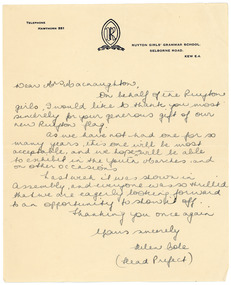
... first position at age 19 involved setting up clinics with the Victorian Health Department Poliomyelitis Rural division. Helen’s strong ties to Ruyton continued when she held the position of President of the Old Ruytonians’ Association from the start of 1966 to the end of 1967. In 2019, Helen received an Order of Australia Medal for service to community health as a physiotherapist. She was also the recipient of the 2022 Victorian Senior Achiever Award at Parliament House ...The handwritten letter addresses Mrs McNaughton (also known as Kathleen "Kitty" Hepworth), thanking her for her gift to Ruyton Girls' School. The Ruytonian December 1952 also acknowledges this gift, describing Mrs McNaughton as having "presented the school with a beautiful Ruyton flag." Kathleen McNaughton was a former Ruyton student, having enrolled in 1925. The letter is signed by Helen Cole. Research indicates that the Ruyton flag was probably one used in inter and intra-school athletic competitions known as 'flag races', which were popular in the first half of the 20th century. In such races, teams ran relay-style, with their School's flag held aloft in the manner of an 18th century soldier charging into battle. Each flag was an important public symbol of school identity, and was made with care and used with pride. Though once a ubiquitous part of any school's sporting equipment, one flag races fell out of favour in the later 20th century, racing flags were usually discarded. However, it is unclear whether the flag gifted by Mrs McNaughton was indeed used for flag racing.The record has strong historic significance as it was written by a former notable student, Helen Gordon (maiden name Cole). Helen started at Little Ruyton in Prep in 1940 and finished Year 12 in 1952 as School Captain, Bromby Captain, Form Captain for Matric, Tennis Captain, Hockey Captain, Swimming Vice Captain, and an award for Best All-Round Girl. She also played baseball for Victoria. After finishing school, Helen went on to graduate from the University of Melbourne as a physiotherapist in 1956. Her first position at age 19 involved setting up clinics with the Victorian Health Department Poliomyelitis Rural division. Helen’s strong ties to Ruyton continued when she held the position of President of the Old Ruytonians’ Association from the start of 1966 to the end of 1967. In 2019, Helen received an Order of Australia Medal for service to community health as a physiotherapist. She was also the recipient of the 2022 Victorian Senior Achiever Award at Parliament House. Helen passed away in July 2023 at age 88. The record's significance is further enhanced by its strong provenance, having been produced by Ruyton Girls' School and donated to the Archives by a familial connection.One loose sheet of cream coloured paper containing a handwritten letter, and printed with Ruyton Girls' School's name and emblem.Obverse: TELEPHONE / HAWTHORN 331 / R / RUYTON GIRLS' GRAMMAR SCHOOL / RECTE ET FIDE LITER / SELBORNE ROAD. / KEW E.4. / Dear Mrs Macnaughton, / On behalf of the Ruyton / girls, I would like to thank you most / sincerely for your generous gift of our / new Ruyton flag. / As we have not had one for so / many years, this one will be most / acceptable, and we hope ^ we will be able / to exhibit in the youth marches and / on other occasions / Last week it was shown in / assembly, and everyone was so thrilled / that we are eagerly looking forward / to an opportunity to show it off. / Thanking you once again / Yours sincerely / Helen Cole / (Head Prefect) / Reverse: RGS008/2024/0008 /ruyton girls' school, students, school, ruyton, victoria, high school, senior school, day school, letter, old ruytonians association, kew -
 Ruyton Girls' School
Programme, Ruyton Girls' School, Ruyton Speech Night Programme, 1950
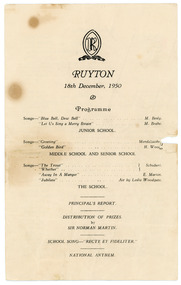
... first position at age 19 involved setting up clinics with the Victorian Health Department Poliomyelitis Rural division. Helen’s strong ties to Ruyton continued when she held the position of President of the Old Ruytonians’ Association from the start of 1966 to the end of 1967. In 2019, Helen received an Order of Australia Medal for service to community health as a physiotherapist. She was also the recipient of the 2022 Victorian Senior Achiever Award at Parliament House ...Ruyton Girls' School has a long tradition of awarding prizes to students at annual "Speech Night" events. Speech Night commenced at Ruyton in 1878; the same year in which the School was founded by Mrs Charlotte Anderson. The Ruytonian December 1944, which recounts events from the last year to date, notes the 1943 Speech Night was the sixty-fifth iteration of the occasion. Previously, students were awarded customary books produced in England which were bound in navy blue leather, with the School's name and motto debossed in gold leaf. Speech Night at Ruyton is an extraordinary occasion. It is a time when the School gathers to celebrate both the year just lived and the contribution of Year 12 girls to the life of the School. It is a night of stirring student speeches, acknowledgement of student endeavour and excellence and awe-inspiring performances by School choirs and ensembles. Historic publications note Speech Night would typically "open with the distribution of prizes, followed by 13 musical items, a play, French Dialogue and four tableaux." This particular record is associated with the Speech Night held on 18 December 1950 at the Recreation Hall in Kew, Victoria.The record has strong historic significance as it was written by a former notable student, Helen Gordon (maiden name Cole). Helen started at Little Ruyton in Prep in 1940 and finished Year 12 in 1952 as School Captain, Bromby Captain, Form Captain for Matric, Tennis Captain, Hockey Captain, Swimming Vice Captain, and an award for Best All-Round Girl. She also played baseball for Victoria. After finishing school, Helen went on to graduate from the University of Melbourne as a physiotherapist in 1956. Her first position at age 19 involved setting up clinics with the Victorian Health Department Poliomyelitis Rural division. Helen’s strong ties to Ruyton continued when she held the position of President of the Old Ruytonians’ Association from the start of 1966 to the end of 1967. In 2019, Helen received an Order of Australia Medal for service to community health as a physiotherapist. She was also the recipient of the 2022 Victorian Senior Achiever Award at Parliament House. Helen passed away in July 2023 at age 88. The record's significance is further enhanced by its strong provenance, having been produced by Ruyton Girls' School and donated to the Archives by a familial connection.A5 size pamphlet printed on cream coloured paper with navy blue ink. Two pages, folded in half.Reverse: RGS008/2024/0014 /ruyton girls' school, students, school, ruyton, victoria, high school, senior school, day school, letter, old ruytonians association, kew -
 Ruyton Girls' School
Photograph, Ruyton Girls' School, 1952
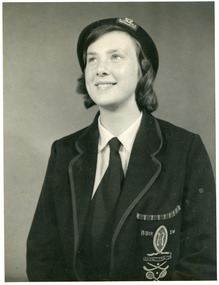
... first position at age 19 involved setting up clinics with the Victorian Health Department Poliomyelitis Rural division. Helen’s strong ties to Ruyton continued when she held the position of President of the Old Ruytonians’ Association from the start of 1966 to the end of 1967. In 2019, Helen received an Order of Australia Medal for service to community health as a physiotherapist. She was also the recipient of the 2022 Victorian Senior Achiever Award at Parliament House ...Depicted are two formal school portraits of Helen Gordon (Cole) against a flat background. The first image depicts her from the waist up. She is dressed in the official Ruyton uniform, including a beret, light coloured collared shirt with a tie, and wool blazer embroidered on the pocket with Ruyton Girls' School's crest and Helen's student leadership positions. She is looking upwards and away from the camera to her right-hand side, and is smiling softly with teeth. The second photo is a more close-up image of Helen. She is still dressed in the same Ruyton uniform, although her blazer pocket embroidery is not visible. In this image, she is looking straight and away from the camera to her left-hand side, and has a closed smile. In both photographs, Helen's hair is short and sits just above her shoulders with a slight wave. The photographs are excellent examples of the Ruyton uniform from the time period in which they were taken. The official school uniform has naturally experienced different iterations since the School's founding in 1878. The most recent changes to the Ruyton uniform were made at the end of 2023, which include a move from brown to black school shoes, and a transition from pale yellow collared shirts to white.The record has strong historic significance as it depicts a former notable student, Helen Gordon (maiden name Cole). Helen started at Little Ruyton in Prep 1940 and finished Year 12 in 1952 as School Captain, Bromby Captain, Form Captain for Matric, Tennis Captain, Hockey Captain, Swimming Vice Captain, and an award for Best All-Round Girl. She also played baseball for Victoria. After finishing school, Helen went on to graduate from the University of Melbourne as a physiotherapist in 1956. Her first position at age 19 involved setting up clinics with the Victorian Health Department Poliomyelitis Rural division. Helen’s strong ties to Ruyton continued when she held the position of President of the Old Ruytonians’ Association from the start of 1966 to the end of 1967. In 2019, Helen received an Order of Australia Medal for service to community health as a physiotherapist. She was also the recipient of the 2022 Victorian Senior Achiever Award at Parliament House. Helen passed away in July 2023 at age 88. The record's significance is further enhanced by its strong provenance, having been produced by Ruyton Girls' School and donated to the Archives by a familial connection.Two black and white rectangular photographs printed on matte photographic paper.Reverse: RGS011/1952/0002.1 / Reverse: RGS011/1952/0002.2 /ruyton girls' school, kew, victoria, tennis, sport, women's sport, students, school, 1950s, uniform -
 Ruyton Girls' School
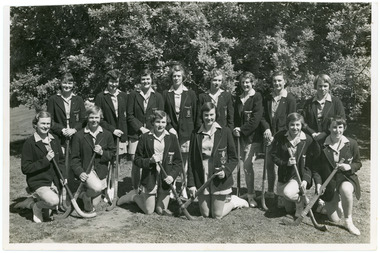
Photograph, Ruyton Girls' School, 1952
... first position at age 19 involved setting up clinics with the Victorian Health Department Poliomyelitis Rural division. Helen’s strong ties to Ruyton continued when she held the position of President of the Old Ruytonians’ Association from the start of 1966 to the end of 1967. In 2019, Helen received an Order of Australia Medal for service to community health as a physiotherapist. She was also the recipient of the 2022 Victorian Senior Achiever Award at Parliament House ...Depicted are 14 students comprising the the 1952 Ruyton Girls' School hockey team. The photograph is an official school portrait taken outdoors on a patch of grass with a leafy bush visible in the background. The students are all dressed in light coloured shorts with a collared, buttoned blouse, wool blazers, white socks and white sneakers. Six girls are kneeling in the front row, and eight are standing up in the back row. All of the students are holding their own hockey stick. The idea of field hockey for female players was brought to Victoria by two sisters, Lillian and Margaret Irving, who had first seen girls playing it during their travels in England in 1902. By 1903, the Irving sisters were joint headmistresses of Lauriston, a school they had founded two years earlier. Both had deep connections to Ruyton Girls' School through their time as teachers at the older school during the 1880s-1890s. For Lilian Irving, this had included seven years as Ruyton's co-Principal with Miss Eliza Bromby from 1888-1895. With these links it was only natural that Ruyton students would join Lauriston to try out the new game. On a vacant block on the corner of Mercer and Malvern Roads, students from Ruyton and Lauriston Girls' Schools had assembled to play Victoria’s first ever inter-school hockey match for girls. Some students from Melbourne Girls' Grammar School came along to watch the spectacle and assess the new game's potential. Hockey quickly caught on, and friendly games were soon being played amongst a number of Melbourne's girls' schools. An Association was formed in 1905, and the rules formalised. These included arrangements around the competition fixture and the length of games (35 minutes for each half). In celebration of their joint role in bringing field hockey to Victorian school girls, Ruyton and Lauriston have met for friendly re-enactment matches in 2003 and 2018. The photograph also illustrates the shift in hockey uniform and apparatus. In the early 1920s, Ruyton established instructions for playing attire: "skirts must be eight inches off the ground. No white petticoats...", and importantly, least any team get an unfair advantage, "hard-rimmed hats and hatpins must not be worn during play." Ruyton appears to have taken the latter instruction to heart, and adopted the soft tam o’shanter hat as seen in surviving photographs of early teams. The tam o’shanter may have been removed for play, but the blouse and long skirt had to be put up with. According to Lilian Irving they had "a horrid habit of parting company", and she was delighted to see the transition to a more comfortable tunic in later years. Another change she observed was the hockey stick itself, which originally were all of "uniform thickness from handle to head, about the thickness of a stout walking stick" and so very different from the hockey sticks that are used today.The record has strong historic significance as it depicts a former notable student, Helen Gordon (maiden name Cole), pictured third from the right in the front row. Helen started at Little Ruyton in Prep 1940 and finished Year 12 in 1952 as School Captain, Bromby Captain, Form Captain for Matric, Tennis Captain, Hockey Captain, Swimming Vice Captain, and an award for Best All-Round Girl. She also played baseball for Victoria. After finishing school, Helen went on to graduate from the University of Melbourne as a physiotherapist in 1956. Her first position at age 19 involved setting up clinics with the Victorian Health Department Poliomyelitis Rural division. Helen’s strong ties to Ruyton continued when she held the position of President of the Old Ruytonians’ Association from the start of 1966 to the end of 1967. In 2019, Helen received an Order of Australia Medal for service to community health as a physiotherapist. She was also the recipient of the 2022 Victorian Senior Achiever Award at Parliament House. Helen passed away in July 2023 at age 88. The record's significance is further enhanced by its strong provenance, having been produced by Ruyton Girls' School and donated to the Archives by a familial connection.Black and white rectangular photographs printed on matte photographic paper.Reverse: gton / Margaret Hanesho (?) / Helen Gordon / 1952 / Mary Macpherson-Smith /ruyton girls' school, kew, victoria, tennis, sport, women's sport, students, school, 1950s, uniform, lauriston, hockey, field hockey, hockey stick
