
Showing 115 items matching " bible school"
-
 Bendigo Historical Society Inc.
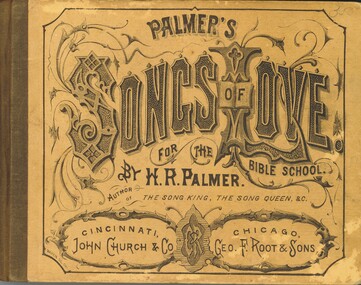
Book - PALMERS SONGS OF LOVE FOR THE BIBLE SCHOOL, 1885
... PALMERS SONGS OF LOVE FOR THE BIBLE SCHOOL...Palmers Songs of Love for the Bible School, published by John Church & Co Cincinnati & Geo F Root & sons Chicago. ...Book PALMERS SONGS OF LOVE FOR THE BIBLE SCHOOL ...Palmers Songs of Love for the Bible School, published by John Church & Co Cincinnati & Geo F Root & sons Chicago. Written inside front cover in ink 'G.A.Pethard Ballarat 1885.'H.R.Palmerbooks, music, religion -
 Merbein District Historical Society
Document, Church of Christ - Anniversary Services of Bible School, 6 Dec.1927
... Church of Christ - Anniversary Services of Bible School...... Bible School...Neville Church of Christ - Anniversary Services of Bible School Document ...religion, bible school, pastor c.g. orford, mr r. fechner, george chislett, bertha chislett, grace chislett, daisy mcswain, lillian cook, mr e. neville -
 Bendigo Historical Society Inc.
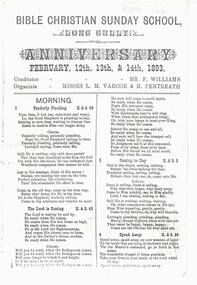
Document - Long Gully Church Bible Christian Sunday School Anniversary Program 1893, 12/02/1893
... Long Gully Church Bible Christian Sunday School Anniversary Program 1893...Bible Christian schools were Sunday schools that were operated primarily by the Methodist church but there is some evidence that the Salvation Army may also have played a part. ...A4 Sheet printed both sides of page, Bible Christian Sunday School Long Gully, Anniversary February, 12th, 13th, and 14th, 1893 - list the conductor Mr F Williams and the Organists Misses L M Vercoe and M Penreath. ...Document Long Gully Church Bible Christian Sunday School Anniversary Program 1893 ...Bible Christian schools were Sunday schools that were operated primarily by the Methodist church but there is some evidence that the Salvation Army may also have played a part. A new schoolroom was built in 1884.A4 Sheet printed both sides of page, Bible Christian Sunday School Long Gully, Anniversary February, 12th, 13th, and 14th, 1893 - list the conductor Mr F Williams and the Organists Misses L M Vercoe and M Penreath. Morning, Afternoon and Evening Order of Prayers and Hyms. Printed by Bolton and Sons, Printers Bendigo.religion, lydia chancellor collection, history, church -
Marysville & District Historical Society
THE TRIANGLE NEWS-VOL 34 NO 18-MAY 25 2007
... ...vacation bible school holiday programme...marysville victoria australia viewers choice vote eco-switch local inventor wins competition dairy dates deadline advertising rates buxton progress assocn results anzac appeal for r.s.l. disclaimer murrindindi shire council ceo visiting schedule fire calls thanks for volunteering bpa update church notices mops dedication of christ church window christ church marysville ladies' guild annual luncheon vacation bible school holiday programme women of hope village hall marysville wilbur the pig at marysville market charlotte's web star pig edgar's mission farm open garden success advertisements mayor's chair opening el kanah work for the dole scheme project nominated for award prime minister's work for the dole achievement award community health services outreach services property numbering squash business opportunity health & wellbeing mental illness & good mental health mystic mountains tourism newsletter bookkeeper alexandra cinema youth night at kooringa wild dog control access to inclusion plan payment of rate installment restaurant advertisements aluminium cans for cash buxton hotel cottage to rent advert/public notice bendigo bank yarra track stopping places marysville medical clinic THE TRIANGLE NEWS-VOL 34 NO 18-MAY 25 2007 ...marysville, victoria, australia, viewers choice vote, eco-switch, local inventor wins competition, dairy dates, deadline, advertising rates, buxton progress assocn, results anzac appeal for r.s.l., disclaimer, murrindindi shire council, ceo visiting schedule, fire calls, thanks for volunteering, bpa update, church notices, mops, dedication of christ church window, christ church marysville ladies' guild annual luncheon, vacation bible school holiday programme, women of hope, village hall marysville, wilbur the pig at marysville market, charlotte's web star pig, edgar's mission farm, open garden success, advertisements, mayor's chair, opening el kanah work for the dole scheme, project nominated for award, prime minister's work for the dole achievement award, community health services, outreach services, property numbering, squash, business opportunity, health & wellbeing, mental illness & good mental health, mystic mountains tourism newsletter, bookkeeper, alexandra cinema, youth night at kooringa, wild dog control, access to inclusion plan, payment of rate installment, restaurant advertisements, aluminium cans for cash, buxton hotel, cottage to rent, advert/public notice, bendigo bank, yarra track stopping places, marysville medical clinic -
 Glen Eira Historical Society
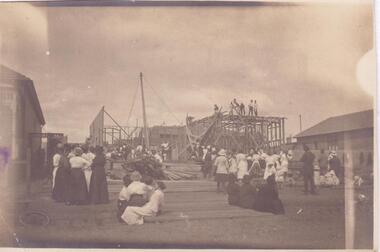
Letter - Bambra Road Church Of Christ
... ... Bible School Committee Of The Churches Of Christ...Sanderson Vera Architects Construction (events and activities) Sunday School Union Of The Churches Of Christ Victoria Bible School Committee Of The Churches Of Christ Beit Hamasiach Messianic Congregation Sport and Recreation Letter Bambra Road Church Of Christ ...This file contains four items. 1/Photocopied pamphlet on the establishment of the Bambra Road Church of Christ, Caulfield South, including information on its early members and the pioneers of the nineteenth century church meetings. The pamphlet was produced for the fiftieth anniversary of the church in May 1970 and includes copies of photographs and drawings of the early church. 2/A postcard photograph by W. Sanderson, taken c. 1921, of the building of the church of Christ, Bambra Road, built in one day. Included with the photo is a letter for the donation dated 02/05/1998. 3/Information on Bambra Road Church of Christ, undated and unattributed, providing details about the pipe organ, Joint Choir and the Adult Group which continued at St. Stephen’s after the Union of the Churches. 4/Two photographs, dated 20/11/2009, of the front of the former Bambra Road Church of Christ and of the foundation stone. The Church is now used by the Beit Hamasiach Messianic Congregation.caulfield south, churches, ennis reg., glenhuntly, sunday schools, earl h.s., bambra road, princes park, cheek stephen, churches of christ, st. stephen’s church, killey f., bambra road church of christ, mcdiarmid a. b, mortimer w., clubs and associations, robbins h. b., religious ceremonies, williams e. l., haddon a l, religious groups, everett maisie, youth clubs, everett doris, lynch maisie, collings a. b., eaton c. burdell, mccann taylor, collings c., davey a., neeson mrs, brooker mr., venty mrs., buckingham mrs, brooker mrs., deveraux mrs, carnie mrs, meehan k., sanderson w., sanderson vera, architects, construction (events and activities), sunday school union of the churches of christ victoria, bible school committee of the churches of christ, beit hamasiach messianic congregation, sport and recreation -
 Mont De Lancey
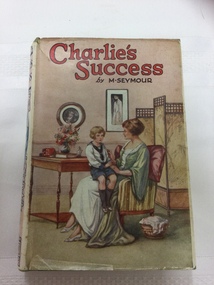
Book, M Seymour, Charlie's Success or The Little Ambassador, 1928
... The Bookplate: 'Bible School Doncaster Church of Christ. Awarded to Clement Thiele for 4th Class L. ...The Bookplate: 'Bible School Doncaster Church of Christ. Awarded to Clement Thiele for 4th Class L. ...A family with six children, the youngest, Charlie, being six years old. Their grandfather is estranged from the family and Charlie wishes to visit him. The grandfather, Mr Maxwell invites Charlie to live with him so the child goes as the family ambassador. It has religious and strong family themes.This green cloth hardcover book has a colourful paper dustjacket depicting a mother with a small boy wearing a sailor suit sitting on her knee. Portraits on the wall, an oriental screen near a small table with knick knacks and a vase of flowers completes the scene. The title is printed at the top in red lettering with the author's name underneath. The spine is coloured in pink and blue lettering with the spine, a picture of a boy and the publisher Shaw at the bottom. On the back of the dustjacket is a list - Uniform with this Volume of 16 titles to read, with another book by M. Seymour, That Boy Tom. Inside on the right endpaper is an Award Bookplate.The frontispiece coloured illustration is the same as the one on the dustjacket. Pp.128fictionA family with six children, the youngest, Charlie, being six years old. Their grandfather is estranged from the family and Charlie wishes to visit him. The grandfather, Mr Maxwell invites Charlie to live with him so the child goes as the family ambassador. It has religious and strong family themes.religious stories, family life, children's fiction -
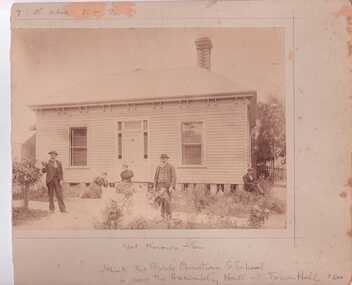 Clunes Museum
Photograph, 1900
... NOT KNOWN WHEN, I THINK THE BIBLE CHRISTIAN SCHOOL IS NOW THE ASSEMBLY AT TOWN HALL....local history photography photographs buildings NOT KNOWN WHEN, I THINK THE BIBLE CHRISTIAN SCHOOL IS NOW THE ASSEMBLY AT TOWN HALL. ...SEPIA PHOTOGRAPH MOUNTED ON CARDBOARD OF A WEATHERBOARD BUILDING - VENETIAN BLINDS AT BOTH WINDOWS. GLASS PANELLING AROUND FRONT DOOR. TWO GENTLEMEN STANDING IN GARDEN - ONE GENTLEMAN SITTING, TWO LADIES SITTING ON STEPNOT KNOWN WHEN, I THINK THE BIBLE CHRISTIAN SCHOOL IS NOW THE ASSEMBLY AT TOWN HALL.local history, photography, photographs, buildings -
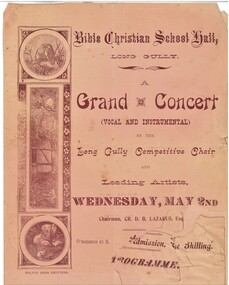 Bendigo Historical Society Inc.
Document - HAMILTON COLLECTION: CONCERT PROGRAM, Early 1900s
... Orange paper two page flyer advertising ''A Grand Concert'', Bible Christian School Hall, Long Gully. Mr A.Hamilton included in program....PERFORMING ARTS Elocution Concert Orange paper two page flyer advertising ''A Grand Concert'', Bible Christian School Hall, Long Gully. Mr A.Hamilton included in program. ...Orange paper two page flyer advertising ''A Grand Concert'', Bible Christian School Hall, Long Gully. Mr A.Hamilton included in program.performing arts, elocution, concert -
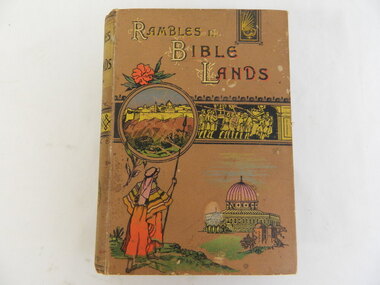 Kiewa Valley Historical Society
Book - Religious Education, Rambles in Bible Lands by Rev. Richard Newton, D.D
... bible...kergunyah...sunday school...School classes at Kergunyah Presbyterian Church. Religion: Presbyterian Church at Kergunyah, in the Kiewa Valley, celebrates its 125th anniversary in 2015 after being handed over to the Uniting Church in the 1970s. religion bible kergunyah sunday school sabbath school ewen wallace presbyterian church (Kergunyah Sabbath School / Library) stamp on inside front cover and back cover Brown hard covered book with coloured pictures. ...Students attended Sunday School classes at the Kergunyah Presbyterian Church. Sunday school was held in a little 16 foot square wooden building which came from Rocky Valley after it was no longer needed there. Ewen Wallace's father initiated and organised the move. C2011 the building was knocked down because of white ants. The Presbyterian Church will be 125 years old in 2015. Historical: Religious Education: This book was used by students who attended the Sunday School classes at Kergunyah Presbyterian Church. Religion: Presbyterian Church at Kergunyah, in the Kiewa Valley, celebrates its 125th anniversary in 2015 after being handed over to the Uniting Church in the 1970s.Brown hard covered book with coloured pictures. Title at top - 1st letter of each word R,B,L is decorated & in gold followed by black print shaded in red. Circular picture seemingly behind it and coming out across the book (gold figures, black background). Shepherd in colour bottom right and church bottom left. Title in black with gold background on spine.(Kergunyah Sabbath School / Library) stamp on inside front cover and back coverreligion, bible, kergunyah, sunday school, sabbath school, ewen wallace, presbyterian church -
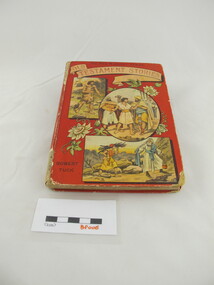 Uniting Church Archives - Synod of Victoria
Book - Book prize, The Sunday School Union, Old Testament Stories, c1904
... "Swanston St S School Bible exam: 4th Class 5th Prize Mabel Barnes 11.8.04...."Swanston Street Sunday School Sunday School prizes Mabel Barnes 1904 Rev Robert Tuck "Swanston St S School Bible exam: 4th Class 5th Prize Mabel Barnes 11.8.04. ...Red hard cover book with a coloured images on the front and back. The book has black text on the spine. non-fiction"swanston street sunday school, sunday school prizes, mabel barnes 1904, rev robert tuck -
 Bendigo Military Museum
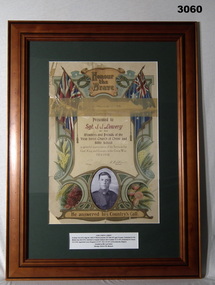
Certificate - MEMBERS AND FRIENDS VIEW STREET CHURCH, FRAMED, Post WW1
... Presented to Sgt J J LOWERY by the Members and Friends of the View Street Church of Christ and Bible School in grateful appreciation of his services for God, King and Country in the Great War 1914 - 1918” Bottom centre on white label: JOHN JOSEPH LOWERY “Enlisted 16.6.1915 Regt No 1926 3rd Reinforcements 22 Batt AIF aged 18. ...Presented to Sgt J J LOWERY by the Members and Friends of the View Street Church of Christ and Bible School in grateful appreciation of his services for God, King and Country in the Great War 1914 - 1918” Bottom centre on white label: JOHN JOSEPH LOWERY “Enlisted 16.6.1915 Regt No 1926 3rd Reinforcements 22 Batt AIF aged 18. ...John Joseph LOWERY Regt No 1926 enlisted in the AIF 3rd Reinforcements, 22nd Batt on 16.6.1915 aged 18. Embarked for Egypt 26.8.1915, taken on strength Gallipoli 25.10.1915. Hospitalised 23.12.1915 frost bite to feet. Embarked for France 19.3.1916, promoted T/Cpl 1.2.1917, promoted L/Cpl 2.5.1917, promoted L/Sgt 21.8.1917. KIA Belgium 2.10.1917. Refer Cat No 2564P.Wooden frame, green border around certificate, glass front, centre is a photo of a soldier.Document: “Honour the Brave. Presented to Sgt J J LOWERY by the Members and Friends of the View Street Church of Christ and Bible School in grateful appreciation of his services for God, King and Country in the Great War 1914 - 1918” Bottom centre on white label: JOHN JOSEPH LOWERY “Enlisted 16.6.1915 Regt No 1926 3rd Reinforcements 22 Batt AIF aged 18. Embarked for the Middle East 26.8.1915. Admitted to hospital Gallipoli with frostbite 15.12.1915 Embarked for France 19.3.1916. Appointed Lance Sergeant 2.5.1917. KIA 2.10.1917 at Broodseinde, Belgium. Donated by Mrs Lyla Sutton” Bendigo District RSL Museum civic mementos - certificates, religion - christian, military history -
 Sunshine and District Historical Society Incorporated
Memorabilia - Church Memorabilia, 1890s - 1975
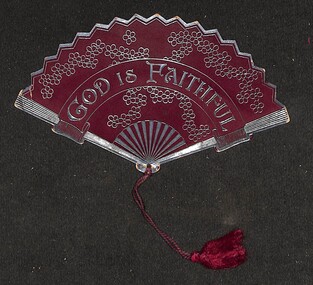
... 1863.01 - Church Memorabilia - God Is Faithful 1863.02 - Church Memorabilia - Jerusalem Map 1863.03 - Church Memorabilia - Kindness Lesson Verse 1863.04 - Church Memorabilia - Sunshine Christian Community Services Social Welfare Service Agency 1863.05 - Church Memorabilia - Mothers' Day Victorian Band Of Hope Union 1863.06 - Church Memorabilia - Paisley Street Baptist Church 1863.07 - Church Memorabilia - Bible Christian Sunshine School 1863.08 - Church Memorabilia - Bible Christian Sunshine School 1863.09 - Church Memorabilia - Music 1863.10 - Church Memorabilia - Music 1863.11 - Church Memorabilia - H.M.S. ...Church Region 1863.01 - Church Memorabilia - God Is Faithful 1863.02 - Church Memorabilia - Jerusalem Map 1863.03 - Church Memorabilia - Kindness Lesson Verse 1863.04 - Church Memorabilia - Sunshine Christian Community Services Social Welfare Service Agency 1863.05 - Church Memorabilia - Mothers' Day Victorian Band Of Hope Union 1863.06 - Church Memorabilia - Paisley Street Baptist Church 1863.07 - Church Memorabilia - Bible Christian Sunshine School 1863.08 - Church Memorabilia - Bible Christian Sunshine School 1863.09 - Church Memorabilia - Music 1863.10 - Church Memorabilia - Music 1863.11 - Church Memorabilia - H.M.S. ...1863.01 - Church Memorabilia - God Is Faithful 1863.02 - Church Memorabilia - Jerusalem Map 1863.03 - Church Memorabilia - Kindness Lesson Verse 1863.04 - Church Memorabilia - Sunshine Christian Community Services Social Welfare Service Agency 1863.05 - Church Memorabilia - Mothers' Day Victorian Band Of Hope Union 1863.06 - Church Memorabilia - Paisley Street Baptist Church 1863.07 - Church Memorabilia - Bible Christian Sunshine School 1863.08 - Church Memorabilia - Bible Christian Sunshine School 1863.09 - Church Memorabilia - Music 1863.10 - Church Memorabilia - Music 1863.11 - Church Memorabilia - H.M.S. Renownchurch, region -
 Flagstaff Hill Maritime Museum and Village
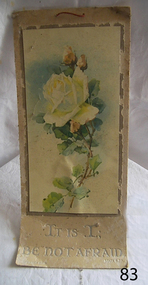
Artwork, other - Card, 1890s
... Quote is from the Bible John 6:20, these cards were often sent as gifts or used in bible studies at Sunday schools around the 1890s to teach religion. ...Quote is from the Bible John 6:20, these cards were often sent as gifts or used in bible studies at Sunday schools around the 1890s to teach religion. ...Quote is from the Bible John 6:20, these cards were often sent as gifts or used in bible studies at Sunday schools around the 1890s to teach religion. They were produced by various companies at this time and known as "Heidelberg cards" from the Heidelberger Druckmaschinen company in Germany that produces catalogues, calendars, posters, and labels to this day.Item is significant as it shows an early example of religious teaching aid from the late Victorian era and gives a snapshot into social life of the time.Card with Bible quotation 'It Is I' Be Not Afraid' with a picture of a roseflagstaff hill, warrnambool, shipwrecked coast, flagstaff hill maritime museum, maritime museum, shipwreck coast, flagstaff hill maritime village, great ocean road, card, bible verse -
 Brighton Historical Society
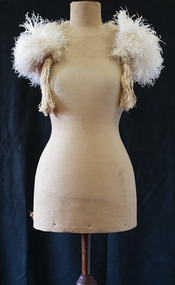
Cape, Capelet, circa 1920
... Active in Protestant moral crusades during the 1990s, he was a vocal opponent of liquor and gambling and advocated Bible reading in public schools. In 1909 he succeeded Sir Thomas Bent as Brighton's representative in the Victorian Legislative Assembly, a seat he held for close to twenty years until his death in 1928. ...Active in Protestant moral crusades during the 1990s, he was a vocal opponent of liquor and gambling and advocated Bible reading in public schools. In 1909 he succeeded Sir Thomas Bent as Brighton's representative in the Victorian Legislative Assembly, a seat he held for close to twenty years until his death in 1928. ...This capelet belonged to Ellen Grace Snowball, nee Anketell, (1866-1945), who lived with husband Oswald Robinson Snowball (1859-1928) at 'Wolsingham', 11 Boxshall Street, Brighton. Oswald Snowball was a solicitor and politician who was active in the Freemasons and the Orange Order. Active in Protestant moral crusades during the 1990s, he was a vocal opponent of liquor and gambling and advocated Bible reading in public schools. In 1909 he succeeded Sir Thomas Bent as Brighton's representative in the Victorian Legislative Assembly, a seat he held for close to twenty years until his death in 1928. During his last year of life, despite serious illness, he served as Speaker of the Legislative Assembly under the Hogan government.White ostrich feather capelet. Feathers sewn onto crescent-shaped cream cotton fabric, with an elaborate silk tassel at either end.ellen grace snowball, ellen grace anketell, oswald snowball, capelet, ostrich feather, 1920s -
 Eltham District Historical Society Inc
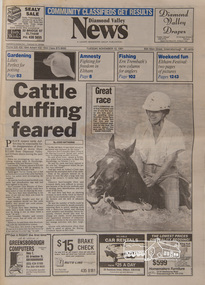
Newspaper, Diamond Valley News, 12 Nov 1991, 12 Nov 1991
... Speed humps not a solution Lower Plenty and Hurstbridge Schools Pen Pal scheme Road Safety education at four local schools Wycliffe Bible Centre opened – mud brick construction , designed by Alistair Knox. ...Speed humps not a solution Lower Plenty and Hurstbridge Schools Pen Pal scheme Road Safety education at four local schools Wycliffe Bible Centre opened – mud brick construction , designed by Alistair Knox. ...Cattle Duffing Feared – missing cattle in Hurstbridge, Christmas Hills, Watsons Creek. Riders vie for “Cup of the Mountains” – horse riding Main Road, Research property no longer attractive to buyers due to rezoning to open space. Work at Churinga, Greensborough praised. Crime rates increase Shire of Diamond Valley to ban incinerators – Shire of Eltham to follow Greensborough Secondary College students enjoy Oaks Day Shire of DV President Barbara Smith attends international conference Tea Party at Panorama Heights Pre-School 14 sheep killed at Panton Hill hobby farm Water discolouration to water supply in Eltham and Diamond Valley Amnesty Comments in Letters section on Council draft Conservation and Heritage Strategy Andre Haermeyer selected as ALP candidate for Yan Yean – a newly created seat. Bill Willis of St Andrews pre-selected by Liberal Party for the above Spring Clean campaign 1991 Photos and report on the Eltham Festival Watsonia Neighbourhood Open House Construction of 24 lot housing commission estate in Kemptson St Greensborough and associated traffic plan to be built. Speed humps not a solution Lower Plenty and Hurstbridge Schools Pen Pal scheme Road Safety education at four local schools Wycliffe Bible Centre opened – mud brick construction , designed by Alistair Knox. Loyola College science students Latest births at Diamond Valley hospital Sunday Community Walks program HEIDELBERG 150 FEATURE General history article Add with history for the Old England Hotel, Heidelberg Janefield Special School Real Estate add with photos of Rosehill Estate, Lower Plenty to be sold. Large real Estate section: Eltham South Historic Mulberry Cottage c 1890 “Arnleigh” Bannons Lane, Yarrambat ca 1889 Early Knox home, 17 York Street, Eltham Briar Hill builder recalls early days – Fred Squire p. 77 Kangaroo Ground Sculpture Awards – Peter Burns, Andrew Smith p. 77 Olive Grove and plaque at Simpsons Barracks Signals headquarters p. 77 Lower Plenty Neighbourhood Watch – p. 79 Feature article on weddings at Eltham Gateway Hotel with photos – p. 84 and more… Local newspaper (complete); 104 pagesnewspaper, local newspapers, diamond valley news -
 Bendigo Historical Society Inc.
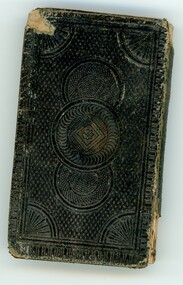
Book - HOSKING AND HUNKIN COLLECTION: BIBLE, 1800s
... A reward - The Bible Christian Sabbath School, Sailors Gully June 29th 1868. ...A reward - The Bible Christian Sabbath School, Sailors Gully June 29th 1868. ...HOSKING AND HUNKIN COLLECTION: Small Bible inside envelope. On Binder: New Testament Inside front cover: This Book Belongs to Ellen Nancarrow November 8th 1857 Redruth Coomb Inside second page: This is a present given to Emily Hoskong by her Aunt Helen a a token of Love November 1860. Bible Details: The New Testament of our Lord and Saviour Jesus Christ translated out of the original Greek and with the former translations diligently compared and revised, by his Majestiy's special Command appointed to be read in Churches. Oxford prineted at the Univerity Press for the British and Froreign Bible Society, instituted in London in the year 1804; and sold to Subscribers at the Society house Earl Street, Blackfriers, London. Diamond's 48's 1856. Cum Privilegio Note inside BibleBible given to Emily Hosking (m. Emmanuel Hunkin) from her aunt Ellen (Nancarrow) Redruth Coomb. 8 Nov 1860 prior to sailing to Victoria. Nancarrow = Valley of the Stags. On front of envelope: Her New Testament a precious possesion. Bible given to Emily Hosking (b. 12-2-1854 d. 22-5-1905) by her mother's sister Ellen Nancarrow (b 17 Mar 1827 husband Wm Hosking m. 1853 Rev. John Cornwall Wm. D. 10 July 1914) in 1860 8th Nov before leaving for Australia. Liven and mined at Eaglehawk, Vic. Then Rushworth area (farming) Emblen Hosking nee Nanacarrow RedruthCoomb Cornwall b. 6/3/1831 d. 20/5/1895 Gobarup. Rear of envelope: Yellow and black stickers (Women with flowers and Man with Scythe, and St. Piran's) written on 'Cornish Patron Saint's day - 5th March. Address Label: Ms Betty Night, 29 Gilbertson Street Essendon Vic 3040 Separate page of Notes: A note in the front of Hymn Book Emily Hosking born 12/2/1854 married 1873 her book. A reward - The Bible Christian Sabbath School, Sailors Gully June 29th 1868. Hyms - Bible Christian 2nd edition 1890. Bible Christian Book Room 26 Paxxxx Road E.C. Mrs E. Hunkin Eaglehawk B.C. Church January 21st (18) 94 Husband Emmanuel Huskin born 21/1/1852 - collection of hymns Wesley hymns Emmanuel Hunkin. 2. A collection of hymns Emmanuel Hunkin, Eaglehawk Bendigo.book -
 Bendigo Historical Society Inc.
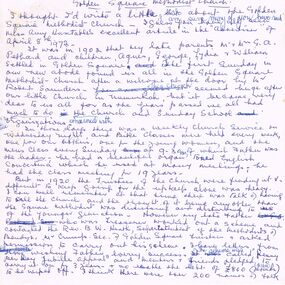
Document - DRAFT ARTICLES FOR RHSV (BENDIGO) NEWSLETTER, MAY 1972
... ''Golden Square Methodist Church'' by Lydia Chancellor - memories of church services, Sunday School and Bible classes. Mention of (Minister?) ...''Golden Square Methodist Church'' by Lydia Chancellor - memories of church services, Sunday School and Bible classes. Mention of (Minister?) ...Draft articles for RHSV (Bendigo) Newsletter, May 1972. 1. ''Golden Square Methodist Church'' by Lydia Chancellor - memories of church services, Sunday School and Bible classes. Mention of (Minister?) Mr Robert Saunders. Also - Rev B W Heath; Mr Crump, Rev Henry Worrall; reference to Jubilee of church in 1923. 2. Article submitted by Mrs E M Checcucci re the 'White Works' (clothing factory making underwear at the top of Wattle Street) - visited by Prince of Wales in 1920; 3. Handwritten and typewritten version of ''Extracts from the 'Sandhurst Library Almanac 1858', published by P M Sparkes, Bookseller and Stationer (four doors from Shamrock Hotel). Names listed of officers of the 40th Foot (Captain's detachment); Location of two cemeteries; Municipal Council of 1858 - Chairman and councillors and meeting times and place; Police Department - names listed of officers of department, Sandhurst Municipality, 'The District' and Eaglehawk Township (names for the last being only on the handwritten copy); 4. Article (w Perry) ''Australian Aboriginals on the Bendigo Gold Field’’ reference to ''King Charlie'' and finding of gold by him (reference to this in the Bendigo Advertiser 1856 & 1857). The gold purchased by a Mr Bannerman; 5. Article on introduction of gas in Bendigo (by I Hendry). Ref to ''Spotlight'' article in Advertiser of Oct 13, 1950. Mention of Mr Dondy (first user of gas in Bendigo); early use and price of gar; poor gas pressure in Eaglehawk; 6. Handwritten article submitted by John O'C Hattam re 'Indian Hawkers in Bendigo': with request to members to join him in further researching this interesting project; mention of accommodation in Hopetoun Street in terrace houses of the same design as Specimen Cottage (''now occupied by ' Glover??? Mills - but referred to in printed Newsletter of April/May 1972 as ''a site occupied by a clothing factory''); mention of hawkers by name - Rajah Singh, Mahonett Betth, Mahonett Shang, Rajah Bouth, Mahoety Bux, Abdul Rahman (last hawker)document, names of bendigo pioneers, bendigo advertiser -
 Uniting Church Archives - Synod of Victoria
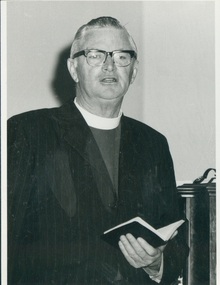
BW photo, Undated
... He worked hard to meet the need for Christian literature, bookshops, adult literacy and theological training. He opened Bible schools for village evangelists and sent suitable clergy overseas for further studies. ...He worked hard to meet the need for Christian literature, bookshops, adult literacy and theological training. He opened Bible schools for village evangelists and sent suitable clergy overseas for further studies. ...STANWAY, ALFRED (b. 9 Sept 1908; d. Melbourne, Vic, 27 June 1989). Anglican bishop, missionary. Stanway grew up in the Wimmera district of western Victoria, and left school when 14 years old. He found work in Melbourne, trained as an accountant, and at the age of 20, held a responsible position with a publishing company. This background, allied with an uncommon flair for figures and finance, was to stand him in good stead throughout his life. But he had little knowledge and no experience of the grace of God until 29 July 1928. At the Evening Service in the parish church of Fairfield on 29 July, he heard the Rev C H Nash (q.v.) preach a sermon which led to his conversion. Within two years he made up his mind to become a missionary and began night studies in order to matriculate. He entered Ridley College in March 1932 to prepare for ordination undertaking week-end duties as a catechist at Deer Park and St Albans. He joined the CMS League of Youth, became chairman, and gathered a fine band of young people many of whom were to become missionaries. He was closely involved with the Belgrave Heights Convention (then at Upwey) and established a League of Youth camp on the site. All his energies were thrown into the task of building up its members in personal holiness and vigorous evangelism. Stanway was ordained in St Paul's Cathedral, Melbourne on St Thomas Day 1934 and was placed in charge of the Old Mission Church of St James and St John, Melbourne. The duties were light enough to allow him to enrol in the Melbourne Teachers College and to complete the Diploma in Teaching. On 26 January 1937, he sailed for Africa to become a missionary in the Anglican Diocese of Mombasa, which at that time embraced the whole of Kenya. He was sent to the hot coastal town of Kaloleni as principal of a Secondary Boys School. Before he left Melbourne, he had become engaged to Marjory Harrison: she followed him to Africa and their marriage took place in Mombasa Cathedral in June 1939. He remained at Kaloleni until 1944 when he was transferred to the inland station of Maseno where all his gifts were to be deployed as rural dean of Nyanza. His oversight of some 500 village churches as well as a widespread primary school system was so efficient that in 1948 he was appointed archdeacon of Kenya with his home and office in Nairobi. As secretary of the African Church Council and of the African Education Board, he was responsible for all African work in the diocese. His contacts with government ministers and public servants were of first class significance at the time when the cry of Uhuru and the demand for independence was travelling throughout the colonial world. On 2 Feb 1951, Alfred Stanway was consecrated in Westminster Abbey as the third Anglican Bp of Central Tanganyika. This Diocese was the special sphere of the CMS Australia, and he already knew most of the missionary personnel. He brought with him the understanding and experience of one who had fully shared the lot and problems of a district missionary, but he came to the diocese at a time when it had yet to recover from its losses in personnel and finance as a result of the war. His immediate task was to provide the impetus of fresh leadership and a long-term overall policy. His aim from-the outset was to build up a strong autonomous church with its own indigenous pastorate. With the whole-hearted confidence of the home base, he was able to enlist the service of new missionaries. He saw a great increase in the number of African clergy and he encouraged village evangelists to open new fields of work. Simple structures were built as new churches at the rate of two a week, week in and week out, year by year. He worked hard to meet the need for Christian literature, bookshops, adult literacy and theological training. He opened Bible schools for village evangelists and sent suitable clergy overseas for further studies. He encouraged initiative in others, helped them to find and use their talents, and gave them his unstinted confidence and support. Fresh finance was required for new ventures. This led him to travel widely in Germany and America, where he raised large funds for these projects. Mackay House was built in Dodoma as the central administrative base for the diocese, hospitals such as those at Mvumi and Hombolo were modernised or established, schools were built and upgraded. In keeping with his vision for ultimate leadership by African personnel, he consecrated Yohana Omari in 1955 as his assistant, he was the first national to become a bp in East Africa. Bp Stanway then set on foot the long and complicated process for the division of his sprawling diocese. In 1963, the diocese of Victoria Nyanza came into being; in 1965, that of Morogoro; in 1966, that of Western Tanganyika. Yet in 1971, his own diocese of Central Tanganyika, though greatly reduced in size, had more churches and more clergy than in its undivided state in 195 l. Stanway then played a leading part in the formation of the Province of Tanzania in 1970, with an African abp as metropolitan. A year later, after 35 years in East Africa and 20 years as bishop of Central Tanganyika, he resigned. His leadership and achievements throughout those years had placed him in the front rank as a great missionary statesman. Stanway had returned to Melbourne at the time when his resignation took effect in August 1971. His early love for Ridley College reasserted itself and he went into residence as deputy principal under the Rev Dr Leon Morris. He was put in charge of chapel worship and the pastoral oversight of the students. All his gifts and experience were called into play as he sought to guide and encourage those who were on the threshold of their ministry. The whole bent of his heart was to foster the spiritual life and missionary calling of those whose hearts the Lord had touched. It was during those years that his life-long zeal for the spread of the gospel through Christian literature had its ultimate flowering. It had begun in his Nairobi days with a small church bookstall, this had developed into a major book-shop in the heart of the city. Then in Dodoma he had established the Central Tanganyika Press in order to promote the publication and distribution of Christian literature at all levels. He had marked out Kevin Engel, trained him, and launched him on the international scene. Hence it was natural that in Melbourne he and Kevin Engel should found the Australian Christian Literature Society. But his time at Ridley College was not to last. Unknown to him, the Rev J R W Stott had put his name forward as that of a person who could head a new school of theology in the United States to provide a sound training for evangelical ordinands. Such a task would have been formidable enough for a younger man who had grown up in America. How could an Australian who had spent half his life in Africa hope to succeed in a venture of that kind in America? How could one who had been a missionary, not a theologian, found a new school to train men for ordination? Nevertheless he rose to the challenge. In Sept 1975, he and Mrs Stanway left Melbourne for Sewickly, an outer suburb of Pittsburg, with the promise of three years' service. He had to start from scratch. He found a house to live in, but there was no land for the school, no funds in hand, no staff yet appointed, no students, and no buildings. His drive, his infections enthusiasm, and his flair for practical enterprise carried the day. One by one, obstacles were overcome and support grew in volume and strength. Twelve months after his arrival, in Sept 1976, the Trinity Episcopal School for Ministry was opened with three staff members, seventeen students, and the goodwill of the whole American Episcopal Church to win. During the next two years, the school took shape and was firmly established. Bp Stanway left an indelible stamp on every aspect of its life and work, its spiritual tone and ideals, its financial and administrative principles. He had inspired widespread support among evangelical episcopalians and had imparted a strong sense of divine guidance and purpose. The council would gladly have extended his term in office beyond three years, but at 75 years of age he knew that his health had begun to fail. When he finally relinquished his office in Nov 1978, he could look back on those three years as the crown of his ministry. It is not too much to say that his name was even more highly honoured and revered in the Trinity School of Ministry than in his own dearly loved Africa. His return to Melbourne led to quiet retirement at Mount Waverley where he settled down to a long battle with the ever worsening effects of Parkinson's Disease. The slow loss of physical capacity and the ultimate failure in powers of speech were a great trial, but he never complained. His faith was summed up in his brief reply when he was asked why he had not prayed for healing: 'What God allows, I accept'. That acceptance was without reserve; his testimony was never brighter. His mental powers were undiminished and his spiritual concerns were as wide as ever. He kept in touch with CMS, he went to church, he met with missionaries, he led Bible studies in his home as long as he was able. Africa was always in his heart, news from Sewickly always gave him great pleasure. He had left a mark for God on three great continents and his death left sad but thankful hearts in them all. It was the close of a life in which he had felt that he could never do enough for God who had done so much for him. One of Bp Stanway's sayings was 'when the Holy Spirit takes hold of you, anything can happen'. So it was in his case. He was very human, with his full share of human foibles and frailties. He had a great zest for life and an endless fund of stories drawn from his own experience. He was himself the subject of many stories, some true, others legendary. His vibrant personality always seemed to fill the house where he was, his presence could not be overlooked. His own home was one in which Mrs Stanway had a paramount influence. She was a trained teacher, a skilled artist, a born hostess and a first-class linguist. They had no children of their own, but were devoted Godparents and always deeply interested in the children of missionaries. Home life allowed him to relax in a serene and contented atmosphere and to exercise his gifts for friendship and hospitality. He was always on the watch for souls, a person-to-person evangelist par excellence. He was a man of faith and prayer who dared to believe in the God of the impossible. His love for Africa, his total dedication as a missionary; his gifts as a soulwinner; his genius for finance; his shrewd practical initiatives, and his statesmanlike vision were outstanding characteristics. But great or small, all his gifts were laid out in the service of the gospel, and that service marked him out as one of the most remarkable Australian missionaries of his generation. M L Loane, Men to Remember (Sydney, 1987) Rev. Alfred Stanway is standing with open book in hand, dressed in clerical garb.Bishop Alfred Stanwaybishop alfred stanway -
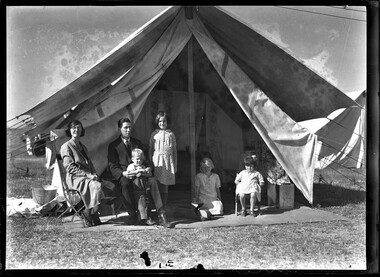 City of Melbourne Libraries
Photograph, Bull, Hugh Jones, 1897-1993, Seventh Day Adventists Camp at Hampton: E. Gane + family
... White she arrived in Australia to start a Bible school, spread her health philosophy and for missionary work. ...White she arrived in Australia to start a Bible school, spread her health philosophy and for missionary work. ...Photographer notations on slide: Seventh Day Adventists Camp. E Gane + family Published: 28 December 1933 Published title: SEVENTH DAY ADVENTISTS. Published caption: “I. — The Annual Camp of the Seventh Day Adventists in Highett-road, Hampton, comprising more than 250 tents and accommodating over a thousand persons. II. —W. J. Westerman (vice-president of Australasian) and Pastor G. G. Stewart (president of Victoria), conversing with Pastor C. H. Watson (world president of the Seventh Day Adventists).- III.— Evangelist E. R. Gane and family.” SEVENTH DAY ADVENTISTS. (1933, December 28). The Age (Melbourne, Vic. : 1854 - 1954), p. 9. Retrieved August 1, 2025, from http://nla.gov.au/nla.news-article203356427 Research by project volunteer, Fiona Collyer: In December 1933, evangelist Mr E.R. Gane and his family gather outside their tent during the ten day Seventh Day Adventist Conference held in Highett Road, Hampton. Description: A woman, man and four small children sit and stand in front of a tent. One child plays with a toy train. In December 1933, delegates from all over Victoria and beyond travelled to Melbourne for the annual Seventh Day Adventists Conference of Victoria, held over ten days on a vacant allotment at Highett Road Hampton. A canvas town of 250 tents for over 1000 campers was created along with large marquees for lectures, devotional services and kitchens. Many daily visitors also attended the lectures and services. The principal speaker was Victorian born world president of the Seventh Day Adventists, Pastor Charles H. Watson (1877-1962), who travelled from Washington DC for the event. The Highett Street campers attended a busy schedule of bible readings, devotional services and health lectures during the ten days of the camp. Lecture subjects included- “Among the Head Hunters of the Solomon Islands”, “ Looking Through the Prophetic Telescope into 1934”, “Soul Surgery”, “Viewing the Celestial Land Through the Prophetic Telescope”and “The Four Horsemen of the Apocalypse”. The Seventh Day Adventist religion was established in the USA in 1863. One of its co-founders was American Ellen G. White whose writings are regarded as divinely inspired and are still adhered to today. Ellen preached on the “Eight Laws of Health”- Nutrition, exercise, water, sunshine, temperance, air, rest and trust in God. Adventists regard their bodies as holy temples and avoid food deemed by the Bible as unclean. They eat a mainly plant based diet with no caffeinated beverages and abstain from alcohol and tobacco. They believe in the observance of Saturday, the seventh day of the week in the Christian (Gregorian) and Hebrew calendars as the sabbath and the literal and imminent second coming of Jesus Christ. New converts are baptised by immersion in water. The Adventists opened the Warburton Sanitarium in 1910 as a health retreat, integrating their holistic health philosophy of physical, mental and spiritual well being. It was a resort in the hills “among picturesque mountain scenery…surrounded by tall forests and deep fern gullies…” where highly strung Melburians could alleviate their digestive maladies, stress and jaded nerves as “…worn down nervous systems mend quickly in this peaceful environment…invigorating air and an abundance of home-grown fruit, vegetables, fresh eggs, milk, and cream help to build healthy bodies”. The resort also offered hydrotherapy, massage and electrical treatments. An advertisement in The Argus- 1 December 1947 assured readers- “EVERYTHING SUNNY AGAIN." “That's how you'll feel when you say farewell to Warburton Sanitarium and Hospital after spending a holiday here. Victoria's Hydro is famous far and wide for wonders worked with sufferers from nervous and digestive disorders. Wholesome food, perfectly cooked; splendid air, regulated exercise, sweet natural sleep; these quickly correct faulty digestion, restore vitality, bring back that sunny optimism natural to healthy people. Massage and curative baths under medical supervision…” Later, after further building work, it became the Warburton Hospital with medical, casualty and obstetrics wards as well as offering strategies to stop smoking, lose weight and for stress management. The hospital ceased operation in 2001. Ellen G. White wrote “God sent me to Australia” and in 1891, accompanied by her son William C. White she arrived in Australia to start a Bible school, spread her health philosophy and for missionary work. At first health food products were imported from America, but it soon became apparent that due to the expense and the food becoming stale over the long journey, that local manufacturing was necessary. In 1898 William secured the services of American Adventist baker Edward C. Halsey, who had worked at Dr Kellogg’s Battle Creek (“Cereal City”), Sanitarium, Michigan, USA. They rented the St George’s bakery in Northcote, Melbourne, producing the first ready to eat breakfast cereal Granola, Caramel Cereal, and peanut butter. The fledgling company relocated to larger premises in Cooranbong, NSW soon after. The Sanitarium Health Food Company opened a factory in Warburton in 1925, manufacturing Granose Biscuits, Cerix Puffed Wheat, San-Bran, Bixies malted wheat flakes, Betta peanut butter, Marmite, “Kwic-Bru - A delicious health “coffee” made from choicest cereals and free from drugs that affect the heart and nerves” In 1928, Sanitarium bought out Grain Products Limited who were manufacturing a sweet cereal biscuit called Weet-Bix which soon became Australia’s favourite breakfast cereal. The Warburton factory closed in 1997, with manufacturing shifting interstate. Sanitarium breakfast cereal boxes offered free collectable cards inside and children could buy albums from grocers for sixpence and mount the cards. Subjects of the albums included- “Aboriginal Tribes, Legends, Customs”, “Australia- Yesterday and Today”, “Marvels of the Great Barrier Reef”, “Advance Australia- a Pageant of the Years”. In 1902 the Adventist’s opened the “Pure Food Vegetarian Cafe” in Sydney (In 1907 the name was changed to “Sanitarium Health Food Cafe”), Eating vegetarian food was definitely a curiosity. “Cristina” reviewed the cafe for The Australasian-27 October 1906. Topics For The Block. “Feeling somewhat like a criminal, and hoping to escape detection, I stealthily made my way into a vegetarian restaurant the other day... If my friends happened to catch me walking in there, I should henceforth be considered a crank, a faddist, and little short of a lunatic! Whom did I find within, seated with the air of habitués at the small tables, but heaps of my friends. They had all this while been pursuing their vegetarian way, layin' low and sayin' nuffin'. Flesh-eaters, now that the Sydney summer has set in apparently in good earnest, are beginning to wonder if the vegetarians are not wiser in their day and generation. Roast beef, hot cornea beef, ragouts, and meat curries, the very thought of them makes one feel hot. Frosted lemon pudding, stewed fruits, wheatmeal rolls, and tomatoes sound nice when you look at their names on the vegetarian menu. Such weird messes are served, square, unintelligible blocks of some brown substance, a few bites of which form a full and satisfying meal. Cold nut foods, granose, nuttose, and jam protose, bromose, with jelly and various "ose" sandwiches, impossible for the unbeliever to diagnose, are put before you. You drink malted nut broth, you eat gluten sticks, stewed beans, lentil patties, with vegetable sauce, any or all of which are distinctly nourishing and filling at the price. A mock (decidedly mock) veal cutlet or a red lentil roast is sufficient lunch, it appears, for anyone. Thus, "you obtain the best working results from your machinery with the least possible expenditure..." In December 1906 the Adventists branched out to Melbourne, opening the Sanitarium Health Food Cafe at 289 Collins Street next to the Royal Bank building. (corner Collins and Elizabeth Streets, demolished in 1939). Their motto was “Quality and Purity”. “Cynthia” of The Leader “Social Circle” column reviewed the cafe in 9 March 1907- “Hundreds of people have a feeling of positive affection for a diet that will be satisfying, appetising and nourishing, without having meat for its backbone. It will come as news that we have in Melbourne a cafe where you can really enjoy yourself without eating anything in the way of meat. Cream, custard, cheese and the like are not cold shouldered out of the menu, and the housewife in search of new dishes will find here ever so much in the way of suggestions. Nuts figure conspicuously in the menu, and lentil and walnut cutlets may be instanced among the delicacies. Beans are cooked in quite alluring fashion, while creamed parsnips are excellent. For sandwiches you could hardly desire anything more appetising than granosi biscuits, and nut cheese. The combination is suggestive of school lunches, and nut meat might well be employed as a variant. A visit to the cafe itself — it is next the Royal Bank in Collins-street — will surprise anyone used to the average vegetarian restaurant. Every thing is fresh, fragrant, and thoroughly modern… It is run, in connection with that curious people the Seventh Day Adventists.” However, “Adele” writing for the Evelyn Observer and Bourke East Record -13 December 1907 had a different experience- CITY RESTAURANTS. “There is no glamour from the outside. We enter the dining room at six and secure a seat at a small table, for this night we are going to dine on vegetables. Some people pride themselves on being vegetarians, and devote a great deal of their spare cash and energy to disseminating vegetarian principles. I shall not in a hurry forget the dinner we tried to get through at this vegetarian restaurant. There was put before us plate after plate of vegetables not soaked, but sodden with water, not an atom of flavouring or dressing; no attempt was made to give the slightest piquancy to potato, cabbage, turnip or carrot. I beg pardon, I am unjust, there were two caterpillars in the cabbage. It is astonishing how persistently ordinary cooks spoil vegetables in the process of cooking and how little they understand the value of vegetables on a menu.” From the extensive menu of 1924, you could order cream of green pea soup, followed by nut meat with Yorkshire pudding, egg timbales, stewed brown lentils, savoury rissoles with piquant sauce. Among the dessert offerings were creamed sago, steamed figs and walnut drops. Washed down with fermented wine and to finish, “Frucerea”, a coffee substitute essence made from fruit and cereal. A four course meal of soup, entree, vegetables and sweets cost 1/6 in 1924. Proving that plant-based food was not just a novelty, 67,000 meals were served at the cafe in 1918, rising to 73,000 in 1921. Later the Sanitarium Cafe moved to 293 Little Collins Street, (opposite Royal Arcade) sharing the building with The Lilliput Golf Course, a miniature golf course of 18 holes. The course was a replica of the fashionable Lido Course in France and was open daily from 10am to midnight with a green fee of one shilling. It featured goldfish, waterfalls and dance music. Lilliput boasted that they were “Melbourne’s coolest indoor course” Miniature golf (mini, minnie, midget, miget, Tom Thumb, Wee golf, putt-putt, pigmy, peewee, crazy golf, obstacle golf) swept the globe in the 1930s, starting in the USA, then Europe. The courses provided affordable recreation during uncertainty at the start of the Great Depression. The craze arrived in Sydney September 1930 with the first mini golf course opening in the basement of the State Theatre. It featured a replica Sydney Harbour Bridge and attracted over 1000 players a day at one shilling per game. The miniature golf bug hit Melbourne hard in 1930-31 with nearly 200 courses springing up in the CBD and suburbs within a few months. The first miniature golf course to open in Melbourne was on 4 October 1930 in the basement of recently built art deco style Wentworth House at 203 Collins Street, designed by architect Cedric Heise Ballantyne, (also designed Regent Theatre, Plaza Ballroom, Athenaeum Club, National Theatre, St Kilda, built in 1930, demolished in 1974 for the City Square) It was managed by J. C. Williamson who advertised for a “Girl Spruiker” who “Must be Young, Attractive Personality, and Able to Talk to the Public” to work at the course. The Age 26 September 1930 reported - “The Wentworth House management have spared no expense in preparing the links. Water hazards, sand bunkers, running streams, ancestral castles, moats and a cunning drawbridge have each been devised to test the skill of players, while the walls and ceiling have been "atmospherically" treated to convey an exterior effect”. Even Melbourne City Council jumped on the bandwagon, leasing the lower hall of Melbourne Town Hall to colourful car dealer and racehorse owner Mr A. G. Barlow for £43 per week for the “Kit Kat Tiny Golf Course”, opening on 11 December 1930. (Turf identity, Mr Alexander George Barlow, (1880-1937) who raced under the nom de course “A. G. Vauxhall”, owned filly Frances Tressady, who in 1923 won the Victoria Derby and Oaks Stakes double and came fifth in the Melbourne Cup. The “Frances Tressady Stakes” is held each March at Flemington Racecourse in honour of the horse, the last filly to win the Derby. Barlow was the proprietor of Barlow Brothers Pty Ltd car dealership at 442 Elizabeth Street, Melbourne. He played 14 games for Carlton Football Club (VFL) on the half-forward line from 1901-1903). Patrons could vie for The Herald Miniature Golf Championship Cup, a gold cup worth £7/7, in an eight week long competition. Sports newspaper The Sporting Globe also offered a Cup and prize money. Many courses offered prizes of theatre tickets, cash and cigarettes. Myer’s department store, hoping to cash in on the fad, advertised in Melbourne’s newspapers that their Sports Department could design and equip complete miniature golf courses using “Fairway” imitation turf at 4/6 a yard. Newspaper cartoonists loved to lampoon the fad. Both Percy Leason, cartoonist for society magazine Table Talk and Syd Miller of Smith’s Weekly depicted “real” golfers causing havoc on a mini golf course, showing that being a “real” golf player was no advantage to playing miniature golf. But bust often follows boom. With such rapid market saturation, expensive novel hazards, waning interest, long opening hours, often to midnight, and price cutting of game fees from one shilling to sixpence and then to threepence amongst some courses, the bubble was bound to burst. The Sporting Globe columnist J.M.Dillon on 20 May 1931 lamented- £100,000 LOST Failure of ‘Minnie’ Golf. “Miniature golf might have provided fun and jokes for thousands of people in Australia, but there were many for whom it panned out a tragedy. It is likely that the dead losses of those who attempted to make money out of the game in Australia were in the vicinity of £100,000. …For a while there was hardly a spare block of land, or a possible “site” in the shape of a hall, or a showroom, in Sydney and Melbourne, that some one was not after to set upon it a “minnie links.” Big amusement firms and private individuals anxious to make money began to run courses. Practically every individual who touched the game had his finger’s financially burnt. …From the approximately £60,000 invested in Melbourne alone, there must have been £25,000 lost. …There are now dozens of courses going to ruin, and many more that the owners would be happy to give away if the takers would remove from them obligations of leases, &c…” The lease on the “Kit Kat Tiny Golf Club” at the Melbourne Town Hall expired on 30 April 1931, with Mr Barlow losing £798 on the venture. The hazards and fittings, which cost £400 and included a large replica of the Town Hall, now worthless. Due to declining patronage, the Little Collins Street cafe closed in 1938, although the adjacent shop continued to sell Sanitarium products. In New Zealand, the first Sanitarium factory opened in Christchurch in 1900, with the company later opening factories in Palmerston North and Auckland. The Adventists opened vegetarian cafes, firstly at 37 Taranaki Street Wellington in 1906, followed by cafes in Auckland, Christchurch and Dunedin. Weet-Bix is also New Zealand’s favourite cereal- there the jingle is “Kiwi kids are Weet-Bix kids.” In 1955, the Australian Women’s Weekly ran an illustrated, full colour advertisement featuring New Zealand born Edmund Hillary (later Sir) 1919-2008, who, along with Sherpa Tenzing Norgay, was the first climber to reach the summit of Mount Everest on 29 March 1953. The Australian Women’s Weekly, 30 March, 1955- “WEET-BIX carried by Hillary on Himalayan adventure! c/- N.Z. Alpine Club Inc., Dunedin, New Zealand. The Manager, Sanitarium Health Food Company, Christchurch, N.Z. Dear Sir. …Weet-Bix was chosen at my special request as I had always felt that some easily prepared form of breakfast was essential to the primitive conditions of high camps. Weet-Bix fulfilled its task very well indeed. We usually had them with hot milk (powdered) and sugar, and even when we were unable to eat anything else, we usually managed to have a little Weet-Bix . . . I regard them as a great success and expect they will be more widely used in the Himalayas in future. Yours faithfully, (Signed) E.P. Hillary. Sanitarium Marmite - motto- “Too much spoils the flavour”- is as beloved with Kiwis as Vegemite is with Australians. In 1966, a fire gutted the Christchurch Marmite factory causing a nation wide shortage. Once the factory was rebuilt, Sanitarium relaunched the yeasty extract in reusable glass tumblers with printed designs such as yachts, New Zealand birds and vintage cars. These popular collectibles can still be found in the kitchen cupboards of many New Zealand baches (holiday homes). After the devastating 2011 earthquake in Christchurch damaged the Marmite factory causing shortages and panic buying, a “Marmageddon” was declared with jars of the “black gold” advertised online for up to NZ$800. Consumers were advised to spread their Marmite sparingly until production resumed. (The Christchurch plant reportedly produces around 640,000kg of Marmite per year). Sanitarium Health and Wellbeing Company is exempt from paying company income tax on their profits due to their ownership by a religious organisation. Although not a compulsory rule for salvation, Adventists are encouraged to pay a tithe of 10% of their income to the church to support the ministry in God’s work. Nowadays, there are over 25 million members of the Seventh Day Adventists Church in 200 countries. ITEMS OF INTEREST (1933, December 22). The Argus (Melbourne, Vic. : 1848 - 1957), p. 8. Retrieved July 21, 2025, from http://nla.gov.au/nla.news-article11723188 SEVENTH DAY ADVENTISTS. (1933, December 28). The Age (Melbourne, Vic. : 1854 - 1954), p. 9. Retrieved July 1, 2025, from http://nla.gov.au/nla.news-article203356427 EVANGELISTS' CAMP (1933, December 20). The Herald (Melbourne, Vic. : 1861 - 1954), p. 30. Retrieved July 1, 2025, from http://nla.gov.au/nla.news-article243213209 Master Butchers Have A Time Pilots FOR School Air Race Charity Golf At Riversdale (1931, May 1). The Sun News-Pictorial (Melbourne, Vic. : 1922 - 1954; 1956), p. 14-15. Retrieved September 4, 2025, from http://nla.gov.au/nla.news-article276159136 2000 ADVENTISTS UNDER CANVAS (1933, December 27). The Herald (Melbourne, Vic. : 1861 - 1954), p. 17. Retrieved July 1, 2025, from http://nla.gov.au/nla.news-article243223698 TOPICS FOR THE BLOCK. (1906, October 27). The Australasian (Melbourne, Vic. : 1864 - 1946), p. 45. Retrieved August 30, 2025, from http://nla.gov.au/nla.news-article139178204 https://en.wikipedia.org/wiki/Seventh-day_Adventist_Church https://www.sanitarium.com/au/about/sanitarium-story/profits-for- ENTERTAINMENT AT MENZIES'. (1906, December 6). Punch (Melbourne, Vic. : 1900 - 1918; 1925), p. 26. Retrieved August 3, 2025, from http://nla.gov.au/nla.news-article175380296 https://encyclopedia.adventist.org/article?id=9HN0&highlight=Conference SOCIAL CIRCLE (1907, March 9). Leader (Melbourne, Vic. : 1862 - 1918, 1935), p. 41. Retrieved August 3, 2025, from http://nla.gov.au/nla.news-article196649677 CITY RESTAURANTS. (1907, December 13). Evelyn Observer and Bourke East Record (Vic. : 1902 - 1917), p. 1 (MORNING.). Retrieved August 3, 2025, from http://nla.gov.au/nla.news-article61133109 Advertising (1924, May 6). The Sun News-Pictorial (Melbourne, Vic. : 1922 - 1954; 1956), p. 9. Retrieved August 3, 2025, from http://nla.gov.au/nla.news-article274271406 1930, December 5). The Herald (Melbourne, Vic. : 1861 - 1954), p. 14. Retrieved August 5, 2025, from http://nla.gov.au/nla.news-page26374135 Thousands Are Still Playing Miniature Golf (1931, January 2). The Herald (Melbourne, Vic. : 1861 - 1954), p. 11. Retrieved August 8, 2025, from http://nla.gov.au/nla.news-article242880087 MINIATURE GOLF. (1930, October 16). The Argus (Melbourne, Vic. : 1848 - 1957), p. 10. Retrieved August 8, 2025, from http://nla.gov.au/nla.news-article4209280 THE REAL GOLFER WHO FORGOT HIMSELF ON THE MINIATURE GOLF COURSE (1930, November 13). Table Talk (Melbourne, Vic. : 1885 - 1939), p. 13. Retrieved August 8, 2025, from http://nla.gov.au/nla.news-article146706596 Advertising (1930, December 5). The Herald (Melbourne, Vic. : 1861 - 1954), p. 14. Retrieved August 8, 2025, from http://nla.gov.au/nla.news-article242761991 Advertising (1931, January 9). The Herald (Melbourne, Vic. : 1861 - 1954), p. 12. Retrieved August 8, 2025, from http://nla.gov.au/nla.news-article242887972 1955, March 30). The Australian Women's Weekly (1933 - 1982), p. 38. Retrieved August 9, 2025, from http://nla.gov.au/nla.news-page4812489 £100,000 LOST (1931, May 20). Sporting Globe (Melbourne, Vic. : 1922 - 1954), p. 1 (Edition1). Retrieved August 14, 2025, from http://nla.gov.au/nla.news-article183023946 1930, December 5). The Herald (Melbourne, Vic. : 1861 - 1954), p. 14. Retrieved August 15, 2025, from http://nla.gov.au/nla.news-page26374135 Advertising (1931, January 23). The Herald (Melbourne, Vic. : 1861 - 1954), p. 14. Retrieved August 15, 2025, from http://nla.gov.au/nla.news-article242887795 MINIATURE GOLF. (1931, February 5). The Dandenong Journal (Vic. : 1927 - 1954), p. 6. Retrieved August 16, 2025, from http://nla.gov.au/nla.news-article201082526 Still Time To Enter Midge (1931, January 16). The Herald (Melbourne, Vic. : 1861 - 1954), p. 12. Retrieved August 16, 2025, from http://nla.gov.au/nla.news-article242888830 WIT OF THE WEEK (1930, October 23). Table Talk (Melbourne, Vic. : 1885 - 1939), p. 23. Retrieved August 29, 2025, from http://nla.gov.au/nla.news-article146455050 Advertising (1930, October 2). Table Talk (Melbourne, Vic. : 1885 - 1939), p. 16. Retrieved August 18, 2025, from http://nla.gov.au/nla.news-article146454620 MIDGET GOLF LINKS. (1930, September 26). The Age (Melbourne, Vic. : 1854 - 1954), p. 6. Retrieved August 18, 2025, from http://nla.gov.au/nla.news-article202235074 https://www.smh.com.au/national/fairfax-archive-mini-golf-20131125-2y608.html TURF NOTES (1923, November 6). The Ballarat Star (Vic. : 1865 - 1924), p. 6. Retrieved September 3, 2025, from http://nla.gov.au/nla.news-article213855201 Advertising (1930, October 4). The Herald (Melbourne, Vic. : 1861 - 1954), p. 10. Retrieved October 14, 2025, from http://nla.gov.au/nla.news-article242937272 LAUGHTER AND TEARS. (1930, November 15). Smith's Weekly (Sydney, NSW : 1919 - 1950), p. 21. Retrieved September 9, 2025, from http://nla.gov.au/nla.news-article234426874 Advertising (1947, December 1). The Argus (Melbourne, Vic. : 1848 - 1957), p. 5. Retrieved September 15, 2025, from http://nla.gov.au/nla.news-article22523355Photographer notations on slide: "Seventh Day Adventists Camp. E Gane + family".religion, health food, mini golf, 1930-1939, tents, churches, camps -
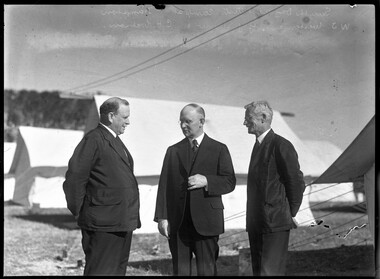 City of Melbourne Libraries
Photograph, Bull, Hugh Jones, 1897-1993, Seventh Day Adventists Camp at Hampton: W.J. Westerman, G.G. Stewart & C.H. Watson
... White she arrived in Australia to start a Bible school, spread her health philosophy and for missionary work. ...White she arrived in Australia to start a Bible school, spread her health philosophy and for missionary work. ...Photographer notations on slide: Seventh Day Adventists Camp at Hampton W.J. Westerman, G.G. Stewart & C.H. Watson Published: 28 December 1933 Published title: SEVENTH DAY ADVENTISTS. Published caption: “I. — The Annual Camp of the Seventh Day Adventists in Highett-road, Hampton, comprising more than 250 tents and accommodating over a thousand persons. II. —W. J. Westerman (vice-president of Australasian) and Pastor G. G. Stewart (president of Victoria), conversing with Pastor C. H. Watson (world president of the Seventh Day Adventists).- III.— Evangelist E. R. Gane and family.” SEVENTH DAY ADVENTISTS. (1933, December 28). The Age (Melbourne, Vic. : 1854 - 1954), p. 9. Retrieved August 1, 2025, from http://nla.gov.au/nla.news-article203356427 Research by project volunteer, Fiona Collyer: In December 1933, the annual Seventh Day Adventists Conference of Victoria was held, with over a 1000 participants camping for ten days at Highett Road Hampton. Pastor Charles H. Watson, world president of the Seventh Day Adventists, Walter J. Westerman, vice-president of Australasian and Pastor George G. Stewart, president of Victoria attended. Interestingly, The Age newspaper modified the original photo in their publication, placing the three men close to each other. Description: Three middle aged men dressed in suits converse in front of tents. In December 1933, delegates from all over Victoria and beyond travelled to Melbourne for the annual Seventh Day Adventists Conference of Victoria, held over ten days on a vacant allotment at Highett Road Hampton. A canvas town of 250 tents for over 1000 campers was created along with large marquees for lectures, devotional services and kitchens. Many daily visitors also attended the lectures and services. The principal speaker was Victorian born world president of the Seventh Day Adventists, Pastor Charles H. Watson (1877-1962), who travelled from Washington DC for the event. The Highett Street campers attended a busy schedule of bible readings, devotional services and health lectures during the ten days of the camp. Lecture subjects included- “Among the Head Hunters of the Solomon Islands”, “ Looking Through the Prophetic Telescope into 1934”, “Soul Surgery”, “Viewing the Celestial Land Through the Prophetic Telescope”and “The Four Horsemen of the Apocalypse”. The Seventh Day Adventist religion was established in the USA in 1863. One of its co-founders was American Ellen G. White whose writings are regarded as divinely inspired and are still adhered to today. Ellen preached on the “Eight Laws of Health”- Nutrition, exercise, water, sunshine, temperance, air, rest and trust in God. Adventists regard their bodies as holy temples and avoid food deemed by the Bible as unclean. They eat a mainly plant based diet with no caffeinated beverages and abstain from alcohol and tobacco. They believe in the observance of Saturday, the seventh day of the week in the Christian (Gregorian) and Hebrew calendars as the sabbath and the literal and imminent second coming of Jesus Christ. New converts are baptised by immersion in water. The Adventists opened the Warburton Sanitarium in 1910 as a health retreat, integrating their holistic health philosophy of physical, mental and spiritual well being. It was a resort in the hills “among picturesque mountain scenery…surrounded by tall forests and deep fern gullies…” where highly strung Melburians could alleviate their digestive maladies, stress and jaded nerves as “…worn down nervous systems mend quickly in this peaceful environment…invigorating air and an abundance of home-grown fruit, vegetables, fresh eggs, milk, and cream help to build healthy bodies”. The resort also offered hydrotherapy, massage and electrical treatments. An advertisement in The Argus- 1 December 1947 assured readers- “EVERYTHING SUNNY AGAIN." “That's how you'll feel when you say farewell to Warburton Sanitarium and Hospital after spending a holiday here. Victoria's Hydro is famous far and wide for wonders worked with sufferers from nervous and digestive disorders. Wholesome food, perfectly cooked; splendid air, regulated exercise, sweet natural sleep; these quickly correct faulty digestion, restore vitality, bring back that sunny optimism natural to healthy people. Massage and curative baths under medical supervision…” Later, after further building work, it became the Warburton Hospital with medical, casualty and obstetrics wards as well as offering strategies to stop smoking, lose weight and for stress management. The hospital ceased operation in 2001. Ellen G. White wrote “God sent me to Australia” and in 1891, accompanied by her son William C. White she arrived in Australia to start a Bible school, spread her health philosophy and for missionary work. At first health food products were imported from America, but it soon became apparent that due to the expense and the food becoming stale over the long journey, that local manufacturing was necessary. In 1898 William secured the services of American Adventist baker Edward C. Halsey, who had worked at Dr Kellogg’s Battle Creek (“Cereal City”), Sanitarium, Michigan, USA. They rented the St George’s bakery in Northcote, Melbourne, producing the first ready to eat breakfast cereal Granola, Caramel Cereal, and peanut butter. The fledgling company relocated to larger premises in Cooranbong, NSW soon after. The Sanitarium Health Food Company opened a factory in Warburton in 1925, manufacturing Granose Biscuits, Cerix Puffed Wheat, San-Bran, Bixies malted wheat flakes, Betta peanut butter, Marmite, “Kwic-Bru - A delicious health “coffee” made from choicest cereals and free from drugs that affect the heart and nerves” In 1928, Sanitarium bought out Grain Products Limited who were manufacturing a sweet cereal biscuit called Weet-Bix which soon became Australia’s favourite breakfast cereal. The Warburton factory closed in 1997, with manufacturing shifting interstate. Sanitarium breakfast cereal boxes offered free collectable cards inside and children could buy albums from grocers for sixpence and mount the cards. Subjects of the albums included- “Aboriginal Tribes, Legends, Customs”, “Australia- Yesterday and Today”, “Marvels of the Great Barrier Reef”, “Advance Australia- a Pageant of the Years”. In 1902 the Adventist’s opened the “Pure Food Vegetarian Cafe” in Sydney (In 1907 the name was changed to “Sanitarium Health Food Cafe”), Eating vegetarian food was definitely a curiosity. “Cristina” reviewed the cafe for The Australasian-27 October 1906. Topics For The Block. “Feeling somewhat like a criminal, and hoping to escape detection, I stealthily made my way into a vegetarian restaurant the other day... If my friends happened to catch me walking in there, I should henceforth be considered a crank, a faddist, and little short of a lunatic! Whom did I find within, seated with the air of habitués at the small tables, but heaps of my friends. They had all this while been pursuing their vegetarian way, layin' low and sayin' nuffin'. Flesh-eaters, now that the Sydney summer has set in apparently in good earnest, are beginning to wonder if the vegetarians are not wiser in their day and generation. Roast beef, hot cornea beef, ragouts, and meat curries, the very thought of them makes one feel hot. Frosted lemon pudding, stewed fruits, wheatmeal rolls, and tomatoes sound nice when you look at their names on the vegetarian menu. Such weird messes are served, square, unintelligible blocks of some brown substance, a few bites of which form a full and satisfying meal. Cold nut foods, granose, nuttose, and jam protose, bromose, with jelly and various "ose" sandwiches, impossible for the unbeliever to diagnose, are put before you. You drink malted nut broth, you eat gluten sticks, stewed beans, lentil patties, with vegetable sauce, any or all of which are distinctly nourishing and filling at the price. A mock (decidedly mock) veal cutlet or a red lentil roast is sufficient lunch, it appears, for anyone. Thus, "you obtain the best working results from your machinery with the least possible expenditure..." In December 1906 the Adventists branched out to Melbourne, opening the Sanitarium Health Food Cafe at 289 Collins Street next to the Royal Bank building. (corner Collins and Elizabeth Streets, demolished in 1939). Their motto was “Quality and Purity”. “Cynthia” of The Leader “Social Circle” column reviewed the cafe in 9 March 1907- “Hundreds of people have a feeling of positive affection for a diet that will be satisfying, appetising and nourishing, without having meat for its backbone. It will come as news that we have in Melbourne a cafe where you can really enjoy yourself without eating anything in the way of meat. Cream, custard, cheese and the like are not cold shouldered out of the menu, and the housewife in search of new dishes will find here ever so much in the way of suggestions. Nuts figure conspicuously in the menu, and lentil and walnut cutlets may be instanced among the delicacies. Beans are cooked in quite alluring fashion, while creamed parsnips are excellent. For sandwiches you could hardly desire anything more appetising than granosi biscuits, and nut cheese. The combination is suggestive of school lunches, and nut meat might well be employed as a variant. A visit to the cafe itself — it is next the Royal Bank in Collins-street — will surprise anyone used to the average vegetarian restaurant. Every thing is fresh, fragrant, and thoroughly modern… It is run, in connection with that curious people the Seventh Day Adventists.” However, “Adele” writing for the Evelyn Observer and Bourke East Record -13 December 1907 had a different experience- CITY RESTAURANTS. “There is no glamour from the outside. We enter the dining room at six and secure a seat at a small table, for this night we are going to dine on vegetables. Some people pride themselves on being vegetarians, and devote a great deal of their spare cash and energy to disseminating vegetarian principles. I shall not in a hurry forget the dinner we tried to get through at this vegetarian restaurant. There was put before us plate after plate of vegetables not soaked, but sodden with water, not an atom of flavouring or dressing; no attempt was made to give the slightest piquancy to potato, cabbage, turnip or carrot. I beg pardon, I am unjust, there were two caterpillars in the cabbage. It is astonishing how persistently ordinary cooks spoil vegetables in the process of cooking and how little they understand the value of vegetables on a menu.” From the extensive menu of 1924, you could order cream of green pea soup, followed by nut meat with Yorkshire pudding, egg timbales, stewed brown lentils, savoury rissoles with piquant sauce. Among the dessert offerings were creamed sago, steamed figs and walnut drops. Washed down with fermented wine and to finish, “Frucerea”, a coffee substitute essence made from fruit and cereal. A four course meal of soup, entree, vegetables and sweets cost 1/6 in 1924. Proving that plant-based food was not just a novelty, 67,000 meals were served at the cafe in 1918, rising to 73,000 in 1921. Later the Sanitarium Cafe moved to 293 Little Collins Street, (opposite Royal Arcade) sharing the building with The Lilliput Golf Course, a miniature golf course of 18 holes. The course was a replica of the fashionable Lido Course in France and was open daily from 10am to midnight with a green fee of one shilling. It featured goldfish, waterfalls and dance music. Lilliput boasted that they were “Melbourne’s coolest indoor course” Miniature golf (mini, minnie, midget, miget, Tom Thumb, Wee golf, putt-putt, pigmy, peewee, crazy golf, obstacle golf) swept the globe in the 1930s, starting in the USA, then Europe. The courses provided affordable recreation during uncertainty at the start of the Great Depression. The craze arrived in Sydney September 1930 with the first mini golf course opening in the basement of the State Theatre. It featured a replica Sydney Harbour Bridge and attracted over 1000 players a day at one shilling per game. The miniature golf bug hit Melbourne hard in 1930-31 with nearly 200 courses springing up in the CBD and suburbs within a few months. The first miniature golf course to open in Melbourne was on 4 October 1930 in the basement of recently built art deco style Wentworth House at 203 Collins Street, designed by architect Cedric Heise Ballantyne, (also designed Regent Theatre, Plaza Ballroom, Athenaeum Club, National Theatre, St Kilda, built in 1930, demolished in 1974 for the City Square) It was managed by J. C. Williamson who advertised for a “Girl Spruiker” who “Must be Young, Attractive Personality, and Able to Talk to the Public” to work at the course. The Age 26 September 1930 reported - “The Wentworth House management have spared no expense in preparing the links. Water hazards, sand bunkers, running streams, ancestral castles, moats and a cunning drawbridge have each been devised to test the skill of players, while the walls and ceiling have been "atmospherically" treated to convey an exterior effect”. Even Melbourne City Council jumped on the bandwagon, leasing the lower hall of Melbourne Town Hall to colourful car dealer and racehorse owner Mr A. G. Barlow for £43 per week for the “Kit Kat Tiny Golf Course”, opening on 11 December 1930. (Turf identity, Mr Alexander George Barlow, (1880-1937) who raced under the nom de course “A. G. Vauxhall”, owned filly Frances Tressady, who in 1923 won the Victoria Derby and Oaks Stakes double and came fifth in the Melbourne Cup. The “Frances Tressady Stakes” is held each March at Flemington Racecourse in honour of the horse, the last filly to win the Derby. Barlow was the proprietor of Barlow Brothers Pty Ltd car dealership at 442 Elizabeth Street, Melbourne. He played 14 games for Carlton Football Club (VFL) on the half-forward line from 1901-1903). Patrons could vie for The Herald Miniature Golf Championship Cup, a gold cup worth £7/7, in an eight week long competition. Sports newspaper The Sporting Globe also offered a Cup and prize money. Many courses offered prizes of theatre tickets, cash and cigarettes. Myer’s department store, hoping to cash in on the fad, advertised in Melbourne’s newspapers that their Sports Department could design and equip complete miniature golf courses using “Fairway” imitation turf at 4/6 a yard. Newspaper cartoonists loved to lampoon the fad. Both Percy Leason, cartoonist for society magazine Table Talk and Syd Miller of Smith’s Weekly depicted “real” golfers causing havoc on a mini golf course, showing that being a “real” golf player was no advantage to playing miniature golf. But bust often follows boom. With such rapid market saturation, expensive novel hazards, waning interest, long opening hours, often to midnight, and price cutting of game fees from one shilling to sixpence and then to threepence amongst some courses, the bubble was bound to burst. The Sporting Globe columnist J.M.Dillon on 20 May 1931 lamented- £100,000 LOST Failure of ‘Minnie’ Golf. “Miniature golf might have provided fun and jokes for thousands of people in Australia, but there were many for whom it panned out a tragedy. It is likely that the dead losses of those who attempted to make money out of the game in Australia were in the vicinity of £100,000. …For a while there was hardly a spare block of land, or a possible “site” in the shape of a hall, or a showroom, in Sydney and Melbourne, that some one was not after to set upon it a “minnie links.” Big amusement firms and private individuals anxious to make money began to run courses. Practically every individual who touched the game had his finger’s financially burnt. …From the approximately £60,000 invested in Melbourne alone, there must have been £25,000 lost. …There are now dozens of courses going to ruin, and many more that the owners would be happy to give away if the takers would remove from them obligations of leases, &c…” The lease on the “Kit Kat Tiny Golf Club” at the Melbourne Town Hall expired on 30 April 1931, with Mr Barlow losing £798 on the venture. The hazards and fittings, which cost £400 and included a large replica of the Town Hall, now worthless. Due to declining patronage, the Little Collins Street cafe closed in 1938, although the adjacent shop continued to sell Sanitarium products. In New Zealand, the first Sanitarium factory opened in Christchurch in 1900, with the company later opening factories in Palmerston North and Auckland. The Adventists opened vegetarian cafes, firstly at 37 Taranaki Street Wellington in 1906, followed by cafes in Auckland, Christchurch and Dunedin. Weet-Bix is also New Zealand’s favourite cereal- there the jingle is “Kiwi kids are Weet-Bix kids.” In 1955, the Australian Women’s Weekly ran an illustrated, full colour advertisement featuring New Zealand born Edmund Hillary (later Sir) 1919-2008, who, along with Sherpa Tenzing Norgay, was the first climber to reach the summit of Mount Everest on 29 March 1953. The Australian Women’s Weekly, 30 March, 1955- “WEET-BIX carried by Hillary on Himalayan adventure! c/- N.Z. Alpine Club Inc., Dunedin, New Zealand. The Manager, Sanitarium Health Food Company, Christchurch, N.Z. Dear Sir. …Weet-Bix was chosen at my special request as I had always felt that some easily prepared form of breakfast was essential to the primitive conditions of high camps. Weet-Bix fulfilled its task very well indeed. We usually had them with hot milk (powdered) and sugar, and even when we were unable to eat anything else, we usually managed to have a little Weet-Bix . . . I regard them as a great success and expect they will be more widely used in the Himalayas in future. Yours faithfully, (Signed) E.P. Hillary. Sanitarium Marmite - motto- “Too much spoils the flavour”- is as beloved with Kiwis as Vegemite is with Australians. In 1966, a fire gutted the Christchurch Marmite factory causing a nation wide shortage. Once the factory was rebuilt, Sanitarium relaunched the yeasty extract in reusable glass tumblers with printed designs such as yachts, New Zealand birds and vintage cars. These popular collectibles can still be found in the kitchen cupboards of many New Zealand baches (holiday homes). After the devastating 2011 earthquake in Christchurch damaged the Marmite factory causing shortages and panic buying, a “Marmageddon” was declared with jars of the “black gold” advertised online for up to NZ$800. Consumers were advised to spread their Marmite sparingly until production resumed. (The Christchurch plant reportedly produces around 640,000kg of Marmite per year). Sanitarium Health and Wellbeing Company is exempt from paying company income tax on their profits due to their ownership by a religious organisation. Although not a compulsory rule for salvation, Adventists are encouraged to pay a tithe of 10% of their income to the church to support the ministry in God’s work. Nowadays, there are over 25 million members of the Seventh Day Adventists Church in 200 countries. ITEMS OF INTEREST (1933, December 22). The Argus (Melbourne, Vic. : 1848 - 1957), p. 8. Retrieved July 21, 2025, from http://nla.gov.au/nla.news-article11723188 SEVENTH DAY ADVENTISTS. (1933, December 28). The Age (Melbourne, Vic. : 1854 - 1954), p. 9. Retrieved July 1, 2025, from http://nla.gov.au/nla.news-article203356427 EVANGELISTS' CAMP (1933, December 20). The Herald (Melbourne, Vic. : 1861 - 1954), p. 30. Retrieved July 1, 2025, from http://nla.gov.au/nla.news-article243213209 Master Butchers Have A Time Pilots FOR School Air Race Charity Golf At Riversdale (1931, May 1). The Sun News-Pictorial (Melbourne, Vic. : 1922 - 1954; 1956), p. 14-15. Retrieved September 4, 2025, from http://nla.gov.au/nla.news-article276159136 2000 ADVENTISTS UNDER CANVAS (1933, December 27). The Herald (Melbourne, Vic. : 1861 - 1954), p. 17. Retrieved July 1, 2025, from http://nla.gov.au/nla.news-article243223698 TOPICS FOR THE BLOCK. (1906, October 27). The Australasian (Melbourne, Vic. : 1864 - 1946), p. 45. Retrieved August 30, 2025, from http://nla.gov.au/nla.news-article139178204 https://en.wikipedia.org/wiki/Seventh-day_Adventist_Church https://www.sanitarium.com/au/about/sanitarium-story/profits-for- ENTERTAINMENT AT MENZIES'. (1906, December 6). Punch (Melbourne, Vic. : 1900 - 1918; 1925), p. 26. Retrieved August 3, 2025, from http://nla.gov.au/nla.news-article175380296 https://encyclopedia.adventist.org/article?id=9HN0&highlight=Conference SOCIAL CIRCLE (1907, March 9). Leader (Melbourne, Vic. : 1862 - 1918, 1935), p. 41. Retrieved August 3, 2025, from http://nla.gov.au/nla.news-article196649677 CITY RESTAURANTS. (1907, December 13). Evelyn Observer and Bourke East Record (Vic. : 1902 - 1917), p. 1 (MORNING.). Retrieved August 3, 2025, from http://nla.gov.au/nla.news-article61133109 Advertising (1924, May 6). The Sun News-Pictorial (Melbourne, Vic. : 1922 - 1954; 1956), p. 9. Retrieved August 3, 2025, from http://nla.gov.au/nla.news-article274271406 1930, December 5). The Herald (Melbourne, Vic. : 1861 - 1954), p. 14. Retrieved August 5, 2025, from http://nla.gov.au/nla.news-page26374135 Thousands Are Still Playing Miniature Golf (1931, January 2). The Herald (Melbourne, Vic. : 1861 - 1954), p. 11. Retrieved August 8, 2025, from http://nla.gov.au/nla.news-article242880087 MINIATURE GOLF. (1930, October 16). The Argus (Melbourne, Vic. : 1848 - 1957), p. 10. Retrieved August 8, 2025, from http://nla.gov.au/nla.news-article4209280 THE REAL GOLFER WHO FORGOT HIMSELF ON THE MINIATURE GOLF COURSE (1930, November 13). Table Talk (Melbourne, Vic. : 1885 - 1939), p. 13. Retrieved August 8, 2025, from http://nla.gov.au/nla.news-article146706596 Advertising (1930, December 5). The Herald (Melbourne, Vic. : 1861 - 1954), p. 14. Retrieved August 8, 2025, from http://nla.gov.au/nla.news-article242761991 Advertising (1931, January 9). The Herald (Melbourne, Vic. : 1861 - 1954), p. 12. Retrieved August 8, 2025, from http://nla.gov.au/nla.news-article242887972 1955, March 30). The Australian Women's Weekly (1933 - 1982), p. 38. Retrieved August 9, 2025, from http://nla.gov.au/nla.news-page4812489 £100,000 LOST (1931, May 20). Sporting Globe (Melbourne, Vic. : 1922 - 1954), p. 1 (Edition1). Retrieved August 14, 2025, from http://nla.gov.au/nla.news-article183023946 1930, December 5). The Herald (Melbourne, Vic. : 1861 - 1954), p. 14. Retrieved August 15, 2025, from http://nla.gov.au/nla.news-page26374135 Advertising (1931, January 23). The Herald (Melbourne, Vic. : 1861 - 1954), p. 14. Retrieved August 15, 2025, from http://nla.gov.au/nla.news-article242887795 MINIATURE GOLF. (1931, February 5). The Dandenong Journal (Vic. : 1927 - 1954), p. 6. Retrieved August 16, 2025, from http://nla.gov.au/nla.news-article201082526 Still Time To Enter Midge (1931, January 16). The Herald (Melbourne, Vic. : 1861 - 1954), p. 12. Retrieved August 16, 2025, from http://nla.gov.au/nla.news-article242888830 WIT OF THE WEEK (1930, October 23). Table Talk (Melbourne, Vic. : 1885 - 1939), p. 23. Retrieved August 29, 2025, from http://nla.gov.au/nla.news-article146455050 Advertising (1930, October 2). Table Talk (Melbourne, Vic. : 1885 - 1939), p. 16. Retrieved August 18, 2025, from http://nla.gov.au/nla.news-article146454620 MIDGET GOLF LINKS. (1930, September 26). The Age (Melbourne, Vic. : 1854 - 1954), p. 6. Retrieved August 18, 2025, from http://nla.gov.au/nla.news-article202235074 https://www.smh.com.au/national/fairfax-archive-mini-golf-20131125-2y608.html TURF NOTES (1923, November 6). The Ballarat Star (Vic. : 1865 - 1924), p. 6. Retrieved September 3, 2025, from http://nla.gov.au/nla.news-article213855201 Advertising (1930, October 4). The Herald (Melbourne, Vic. : 1861 - 1954), p. 10. Retrieved October 14, 2025, from http://nla.gov.au/nla.news-article242937272 LAUGHTER AND TEARS. (1930, November 15). Smith's Weekly (Sydney, NSW : 1919 - 1950), p. 21. Retrieved September 9, 2025, from http://nla.gov.au/nla.news-article234426874 Advertising (1947, December 1). The Argus (Melbourne, Vic. : 1848 - 1957), p. 5. Retrieved September 15, 2025, from http://nla.gov.au/nla.news-article22523355Photographer notations on slide: "Seventh Day Adventists Camp at Hampton W.J. Westerman, G.G. Stewart & C.H. Watson".religion, health food, mini golf, 1930-1939, tents, churches, camps -
 Federation University Historical Collection
Book - Register, Ballarat School of Mines Library Register of Books, 1870-1896, 1870-1896
... Bible, donated by R. J. Litton, 21.05.1886 802. Essays of Addison, J.R. Green, 18/06/1887, donated by Bella Guerin 803. Rec De Planches Dur Les sciences Les Arts Liberaux et les Arts Mechaniques, Vol VI, 1875, Donated by Theo William, 01/07/1887 Excel spreadsheet attached (incomplete) Ballarat School of Mines Library Register of Books, 1870-1896 Book Register ...The listing of books in the Ballarat School of Mines library begins with No 1 and ends at No 1465. This book is identical to Library Catalogue No 00007, but isonly numbered to No. 921. Redmond Barry, Robert Broigh Smyth, Ferdinandy Von Mueller, the Victorian Geolofical Survey and many local illuminaries donated to the Ballarat School of Mines. Black cloth covered exercise book with handwritten lists of books in the Ballarat School of Mines Library dating from 1870 to 1896. The pages have been divided into columns with the following headings: Reg. No; Title; Author; Vol.; Issue; Donor, Receipt. Some of the books are as follows: 1. Memoirs of Geological Survey of Great Britain, Vol 1., 1846, Donated by Her Majesty's Government, 16/03/1870 19. Prospectus of the School of Mines, 1869, Donated by Her Majesty's Government, 16/03/1870 44. The Steam Engine, Rankine, purchased, 09/03/1871 72. Melbourne University Calendar, 1859-1860, donated by Sir Redmond Barry, 14/04/1871 85. Maps of County of Anglesey, donated by Minister of Mines, 23/05/1871 107. Electric Telegraph, R. Sabine, purchased, June 1874 356. Organic Constituents of Plants and Vegetable Substances, Dr. G.C. Willstein, donated by Ferdinand Von Mueller 375. The native Plants of Victoria Succinctly Defined, Baron Von Mueller, purchased, 1879 569. Platur's Manual of Qual and Quan Analysis with the blowpipe, donated by Henry Sutton, May 1884 738. German Bible, donated by R. J. Litton, 21.05.1886 802. Essays of Addison, J.R. Green, 18/06/1887, donated by Bella Guerin 803. Rec De Planches Dur Les sciences Les Arts Liberaux et les Arts Mechaniques, Vol VI, 1875, Donated by Theo William, 01/07/1887 Excel spreadsheet attached (incomplete)ballarat school of mines, library, books, ballarat school of mines library, william laplau, dr bunce, james oddie, bella guerin, j.f. usher, r.m. sergeant, redmond barry, robert brough smyth, cosmo newbery, john noble wilson, joseph flude, commissioner of patents, henry sutton, w.n. wooster, theophilus taylor, rivett henry bland, ferdinand von mueller, c.c. shoppee, william luplau, ferdinand krause, william wooster -
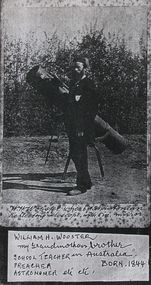 Federation University Historical Collection
Photograph, William H. Wooster at the Ballarat Observatory, Mount Pleasant
... school of mines ballarat field naturalists club observatory telescope 7707.2 "Notes Grandpa has lectured scores of times in the Sch. of Mines, sometimes for one of the Professors who was ill. Also Lectured in the City Fire Brigade, Ballarat E Fire Brigade, Barkley St Wesn chap., Lydiard St. Wes. Chapl, St Peter's Church of England, Mt Pleasant Wes. Chapl., Baptist Church; & many other places. Preached i the Neil St. Wes. Chapels at Brown Hill, the Gong, Ltl Bendigo, Golden Point, Macarthur St., Mnt Pleasant, the Bible ...An image of W.H. Wooster with telescope, and a page copy of his handwritten notes outlining his achievements.7707.2 "Notes Grandpa has lectured scores of times in the Sch. of Mines, sometimes for one of the Professors who was ill. Also Lectured in the City Fire Brigade, Ballarat E Fire Brigade, Barkley St Wesn chap., Lydiard St. Wes. Chapl, St Peter's Church of England, Mt Pleasant Wes. Chapl., Baptist Church; & many other places. Preached i the Neil St. Wes. Chapels at Brown Hill, the Gong, Ltl Bendigo, Golden Point, Macarthur St., Mnt Pleasant, the Bible Christian Chppl., and many others. Too photos of most of the places shown in these "Ballarat Views", and many others. And laid the Foundation of the fine Municipal Observatory, in a long series of "Astronomical" and other "Scientific Notes", published in the Ballarat Courier and Ballarat Star, & occasionally in another Newspaper, which roused much public interest in Astronomy. The present official astronomer, Mr John Brittain, is my pupil in Astronomy and Microscopy, and calls me his Father in Science. W.H. Wooster."w.h. wooster, ballarat observatory, microscope, microscopy, churched, preaching, lay preacher, ballarat school of mines, ballarat field naturalists club, observatory, telescope -
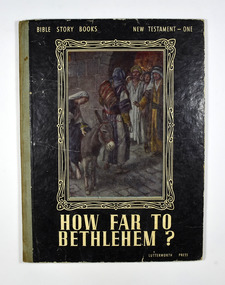 Marysville & District Historical Society
Book, Elfreyda M C Wightman, How Far to Bethlehem?-Stories from the Bible, 1945
... A book that was presented by the Christ Church Sunday School in Marysville to a child who is still a resident of Marysville. bible story new testament bethlehem A book for children based on the Bible. ...A book for children based on the Bible.Front cover has a picture depicting Joseph and Mary, who is astride a donkey, talking to a group of men in the doorway of a building. The front cover is black with the title and series name in white. The back cover has information about a series of Bible Picture Story Books that this book is one of.fictionA book for children based on the Bible.bible story, new testament, bethlehem -
Federation University Historical Collection
Book, John Drinkwater, Outline of Literature, c1940
... School of Mines library...literature...homer...Book of the dead...first books...Bible...Ballarat School of Mines library literature homer Book of the dead first books Bible Sacred books of the East greek mythology roman renaissance William Shakespeare john milton marvill walton john bunyan pepys john dryden Samuel dryden pierre corneille charles Perrault Alexander pope daniel defoe samuel richardson henry fielding tobias smollett maria edgeworth samuel johnson edmund burke jean mielot Edward Gibbon Robert Burns james hogg French revolution Goethe schiller lessing wordsworth southey coleridge hood Thomas Moore William Blake Byron Shelley keats Walter scott Aleandre Dumas victor hugo charles lamb alfred Tennyson william morris edward fitzgerald charles dickens William Thackeray Anthony trollope edward lytton wilkie collins charles read charles Kinglsey Bronte george eliot charlott yonge mark rutherford ralph emerson nathaniel hawthorne edgar Allan Poe mark Twain George Sand balzac James Froude george borrow richard jeffereis winston churchill nietsche hans anderson lewis carroll may sinclair Inside front "Office No 71" Stamped The School of Miens Industries and Science Ballarat Red cloth covered book with red leather spline and marbled papers. ...Red cloth covered book with red leather spline and marbled papers.non-fictionballarat school of mines library, literature, homer, book of the dead, first books, bible, sacred books of the east, greek mythology, roman, renaissance, william shakespeare, john milton, marvill, walton, john bunyan, pepys, john dryden, samuel dryden, pierre corneille, charles perrault, alexander pope, daniel defoe, samuel richardson, henry fielding, tobias smollett, maria edgeworth, samuel johnson, edmund burke, jean mielot, edward gibbon, robert burns, james hogg, french revolution, goethe, schiller, lessing, wordsworth, southey, coleridge, hood, thomas moore, william blake, byron, shelley, keats, walter scott, aleandre dumas, victor hugo, charles lamb, alfred tennyson, william morris, edward fitzgerald, charles dickens, william thackeray, anthony trollope, edward lytton, wilkie collins, charles read, charles kinglsey, bronte, george eliot, charlott yonge, mark rutherford, ralph emerson, nathaniel hawthorne, edgar allan poe, mark twain, george sand, balzac, james froude, george borrow, richard jeffereis, winston churchill, nietsche, hans anderson, lewis carroll, may sinclair -
 Federation University Historical Collection
Book, George E. Eyre & William Spottiswoode, Holy Bible belonging to Henry Sutton, c. 1854
... Henry Sutton taught Applied Electricity at the Ballarat School of Mines in 1883 to 1886. Holy Bible Bible Henry Sutton King James Bible Mrs H. ...c. 1854 Holy Bible owned by a member of Henry Sutton's familyLeather bound Holy Bible c. 1854 owned by a member of the Sutton Family. Brass corners with missing clasp non-fictionc. 1854 Holy Bible owned by a member of Henry Sutton's familyholy bible, bible, henry sutton, king james bible, mrs h. sutton, ron sutton, jack sutton -
Marysville & District Historical Society
THE TRIANGLE NEWS-VOL 35 NO 2-JANUARY 25 2008
... school dates...best decorated bike...thank you bendigo bank...marysville medical clinic...bible...marysville victoria australia marysville australia day lions park uppbeats band buxton hall the elderly bros band diary dates deadline advertising rates flags australia day parade buxton progress assocn murrindindi shire council ceo visiting schedule disclaimer fire calls terra cotta room regional food & wine centre marysville village walk mops church notices marysville under 12 cricket marysville start school dates best decorated bike thank you bendigo bank marysville medical clinic bible quote community kitchens advertisements mayor's chair paradise bead & craft centre wirreanda festival 2008 marysville & district historical society automotive needs public notice temporary road closure australia day mystic mountains outdoors community health services outreach services murrindindi business development calendar community events employing people workshop wilks creek & andersons sawmills alexandra clearance sale for sale real estate THE TRIANGLE NEWS-VOL 35 NO 2-JANUARY 25 2008 ...marysville, victoria, australia, marysville australia day, lions park, uppbeats band, buxton hall, the elderly bros band, diary dates, deadline, advertising rates, flags, australia day parade, buxton progress assocn, murrindindi shire council, ceo visiting schedule, disclaimer, fire calls, terra cotta room, regional food & wine centre, marysville village walk, mops, church notices, marysville under 12 cricket, marysville start school dates, best decorated bike, thank you bendigo bank, marysville medical clinic, bible quote, community kitchens, advertisements, mayor's chair, paradise bead & craft centre, wirreanda festival 2008, marysville & district historical society, automotive needs, public notice, temporary road closure australia day, mystic mountains outdoors, community health services, outreach services, murrindindi business development calendar, community events, employing people workshop, wilks creek & andersons sawmills, alexandra clearance sale, for sale, real estate -
Ballarat Clarendon College
Book, Robert Vaughan, Milton's Paradise Lost
... school by her grandson Robert Tunbridge, son of Basil Tunbridge (BC 1916) in 2011. Socially significant because of the value placed on religious education and academic prowess amongst girls in the late 19th century in an Australian country town. prize janie-jebb margaret-jane-jebb 1882 robert-tunbridge basil-tunbridge clarendon-ladies-college Book plaque inside front cover: 'CLARENDON LADIES COLLEGE / BALLARAT / 1st Bible PRIZE / AWARDED TO / Janie Jebb / R KENNEDY / PRINCIPAL / 19th December 1882 Red cloth bound book (rebound) with original detail on front cover. ...Beautiful example of academic book prize gifted by Clarendon Ladies College to Janie Jebb (CLC 1882). Donated to school by her grandson Robert Tunbridge, son of Basil Tunbridge (BC 1916) in 2011. Socially significant because of the value placed on religious education and academic prowess amongst girls in the late 19th century in an Australian country town. Red cloth bound book (rebound) with original detail on front cover. Black and white etchings with tissue interleaves. Book plaque inside front cover: 'CLARENDON LADIES COLLEGE / BALLARAT / 1st Bible PRIZE / AWARDED TO / Janie Jebb / R KENNEDY / PRINCIPAL / 19th December 1882prize, janie-jebb, margaret-jane-jebb, 1882, robert-tunbridge, basil-tunbridge, clarendon-ladies-college -
 Ballarat Clarendon College
Book, Gall & Inglis, Gems of womanhood, 1870
... bible. Fanny enrolled in Clarendon Ladies' College in 1882 along with her sisters Agnes Williamson Nicol and Katy Beatrice Nicol. In the original register the father's name is listed as James and he was a produce merchant who resided at 119 Lydiard Street, North Ballarat. This book was donated to the school...bible. Fanny enrolled in Clarendon Ladies' College in 1882 along with her sisters Agnes Williamson Nicol and Katy Beatrice Nicol. In the original register the father's name is listed as James and he was a produce merchant who resided at 119 Lydiard Street, North Ballarat. This book was donated to the school ...This book was awarded to Fanny Nicol in 1882 for special prize for bible. Fanny enrolled in Clarendon Ladies' College in 1882 along with her sisters Agnes Williamson Nicol and Katy Beatrice Nicol. In the original register the father's name is listed as James and he was a produce merchant who resided at 119 Lydiard Street, North Ballarat. This book was donated to the school library in 1978 by Fanny's niece.Presbyterian educators placed great value on a classical education matched with diligence in study. Book prizes were highly regarded and academic success admired. In the school’s early years prizes were ordered direct from London and had the school crest embossed in gold on the front or back cover. Many of the prizes given in early years were returned to the school to equip the Weatherly Library when it opened in 1936.Green cloth cover with ornate gilt decorations on cover, back and spine; gilt edges; color illustrations, slight foxing on pages, 314 p. Book plate inside front cover: CLARENDON LADIES' COLLEGE,/ BALLARAT./ Special prize./ Bible/ Awarded to/ Fanny Nicol./ 19th December, 1882.fanny-nicol, 1882, book-prize, clarendon-ladies'-college, agnes-williamson-nicol, katy-beatrice-nicol, james-nicol. -
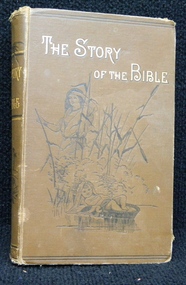 Ballarat Clarendon College
Book, S. W. Partridge and Co, The story of the bible, Prior to the book prize presented on Christmas, 1889
... school. Book plate inside front cover: college crest/ Scripture/ Second Form,/ Second Prize./ Awarded to/ Royden Moore/ Christmas, 1889. Bound in brown cloth with illustration on front and spine, college crest embossed on back cover. Floral end papers, black and white illustrations throughout, slight detached spine and detached papers. Slight foxing on pages, 621 p. The story of the bible ...This book was awarded to Roydon Osmond Moore in 1889 for second prize for scripture in the second form. Roydon enrolled in Ballarat College in 1887 at the age of 8 along with his siblings: Leslie Travis Stanley Moore (B.D. 4/2/1877) and Gilbert Kent Moore (B.D. 14/12/1877). In the original register Parent/Guardian is listed as R.T.Moore, residing at 1 Cardygin Terrace/200 Sturt Street. It also documents that Roydon and his brothers previously attended Miss Jago's School II Class.Presbyterian educators placed great value on a classical education matched with diligence in study. Book prizes were highly regarded and academic success admired. In the school’s early years prizes were ordered direct from London and had the school crest embossed in gold on the front or back cover. Many of the prizes given in early years were returned to the school to equip the Weatherly Library when it opened in 1936.Bound in brown cloth with illustration on front and spine, college crest embossed on back cover. Floral end papers, black and white illustrations throughout, slight detached spine and detached papers. Slight foxing on pages, 621 p.Book plate inside front cover: college crest/ Scripture/ Second Form,/ Second Prize./ Awarded to/ Royden Moore/ Christmas, 1889.roydon-osmond-moore, book-prize, 1889, ballarat-college, leslie-travis-stanley-moore, gilbert-kent-moore, r-t-moore, miss-jago's-school. -
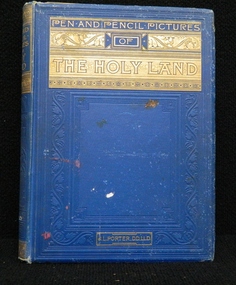 Ballarat Clarendon College
Book, T Nelson and Sons, Pen and pencil pictures of the holy land, Prior to the book prize given at Christmas, (1890s?)
... Many of the prizes given in early years were returned to the school to equip the Weatherly Library when it opened in 1936. book-prize clarendon-ladies'-college Book plate inside front cover: Clarendon Ladies' College,/ BALLARAT,/ First PRIZE./ Bible-Class I/ AWARDED TO/ R. ...The person to which this book prize has been awarded has been erased from the book plate.Presbyterian educators placed great value on a classical education matched with diligence in study. Book prizes were highly regarded and academic success admired. In the school’s early years prizes were ordered direct from London and had the school crest embossed in gold on the front or back cover. Many of the prizes given in early years were returned to the school to equip the Weatherly Library when it opened in 1936.Bound in blue cloth with gilt decoration and script on the front cover and spine. Gilt edges on paper, black and white illustrations throughout with one fold out color illustration. Slight detached spine with several detached pages.330 p.Book plate inside front cover: Clarendon Ladies' College,/ BALLARAT,/ First PRIZE./ Bible-Class I/ AWARDED TO/ R. KENNEDY,/ Principal/ December.book-prize, clarendon-ladies'-college
