
Showing 221 items matching " brown brother"
-
 Wodonga & District Historical Society Inc
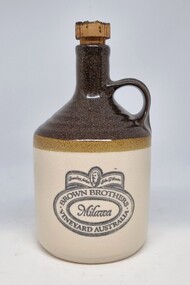
Functional object - Earthenware Bottle - Brown Brothers Milawa, 1970s - 1980s
... These ceramic jars were used by Brown Brothers in the 1970s and 1980s to package Port, Muscat and Tokay. ...An earthenware wine jug created for Brown Brothers Milawa Vineyard manufactured by John Elischer Pottery. ...In a central oval around the name "Milawa", BROWN BROTHERS/ VINEYARD AUSTRALIA" On base: "97"...Earthenware Bottle - Brown Brothers Milawa Functional object Earthenware Bottle - Brown Brothers Milawa ...In 1885 John Francis Brown first planted 10 acres of vines in Milawa, Victoria. Brown Brothers was founded in 1889 when the vines were ready to produce their first crop, as John hoped his brothers would join him in this new and promising venture. This did not happen but the name remained. Since 1899 Brown Brothers has grown into one of Australia’s largest family-owned wine businesses and now operates several vineyards in Victoria and Tasmania. These ceramic jars were used by Brown Brothers in the 1970s and 1980s to package Port, Muscat and Tokay. Fortified wines packaged in this manner would maintain their quality for decades as long as the wax seal was unbroken. Elischer Pottery was started in Sandringham, Melbourne Victoria in 1947 by well-known sculptor John (Johann Wolfgang) Elischer (1891-1966) and his son, also named John, (known as Wolly). John (Snr) was born in Vienna and trained at the Academy of Vienna from 1908 to 1911 and was an Associate of the Royal Academy Vienna. John (Senior) died in 1966 and the business was continued by his son John (Wolly), until 1987 when it was sold. Prior to that, at some time, he started making pieces the brand NCP. The business continues today as “Unique Ceramics” in Highett, Victoria. They continue to use the “Elischer” brand on some of their products.This jug is representative of an historic and continuing leading Australian Winemaker located in Northeast Victoria.An earthenware wine jug created for Brown Brothers Milawa Vineyard manufactured by John Elischer Pottery. The jug has a tradition loop handle. The bottom half of the jug is a traditional beige colour with a darker brown top section. The logo is imprinted in black and is covered in a clear glaze. The cork stopper is still intact although before being opened would have been sealed with wax.Company logo on one side: at top a central male image between the text "Founding Father /John F Brown. In a central oval around the name "Milawa", BROWN BROTHERS/ VINEYARD AUSTRALIA" On base: "97"brown brothers milawa, elischer pottery, northeast victorian wineries -
 Glen Eira Historical Society
Document - CHURCH OF CHRIST, NORTH ROAD AND ARNOTT STREET, ORMOND
... ... Brown Brother...Andrews Sister Burton May Briggs B. Bevan Sister Brown Brother Fisher Brother Faragher L. Streader D. ...This file contains 3 items: 1/A program for the 50th anniversary of Ormond Church of Christ dated 29/06/1975. 2/A Diamond Jubilee book for Ormond Church of Christ dated 23/06/1985. 3/A 75 years of witness book of Ormond Community Church of Christ from 1925-2000. It chronicles the church’s activities and progress by year.ormond, ormond church of christ, henrichsen e.c., hutchings brother, hutchings sister, lyall r., pratt c., lintott brother, lumley brother, ring brother, tuck brother, blair sister, olliver sister, ring sister, tuck sister, goddard elsie, hanaker sister, bowen-jones sister, kershaw brother, kershaw sister, merrin r. brother, moore sister, mcclelland i. brother, mcclelland i. sister, nesbit brother, oliver brother, oliver sister, oliver p. sister, paynter j. sister, ring sister, ring minnie, ring reynold, ring robbie, richards sister, small sister, smedley sister, scott brother, scott sister, taylor sister, telfer brother, telfer sister, theyer mrs., theyer miss., yewdall v., yewdall f., linttot mrs., lumley mr., ring mr., tuck mr., blair mrs., oliver mrs., ring mrs., tuck mrs., yewdall mrs., mcclelland mr., yewdall mr., thomson w.j., kershaw mr., taylor mr., mcclelland mrs., oliver mr., pioneers, ring mrs., veal mrs., oliver mrs., smail mrs., brown mrs., yates mrs., lumley mrs., knight mrs., hannaker mrs., hooper miss, merrin mrs., tuck mrs., smith mrs., henry mrs., bartlett mrs., johnson mrs., vautier mrs., mulroney mrs., bethany nursery school, murrumbeena, oakleigh, ward clive, henry edna, weaver edna, moorabbin hospital, north road, bambra road, mckenzie r., cole g., ghys p., jacques b., kay d., knee b., streader c., kilgour p., stibbe g.o., cannon p.r., hunt a., stibbe b., crittle w., yewdall sister, yewdall brother, mcclelland brother, thomson w.j. brother, taylor brother, brown sister, bartlett sister, hannaker sister, henry sister, hooper sister, johnson sister, knight sister, lumley sister, merrin sister, mclelland sister, smail sister, smith sister, theyer sister, meyer sister, veal sister, yates sister, clay w.h., clay l., withers a.b., baker s.r., andrews g.j., mcnaughton k.a., lang c.l., mcdowell w.w., martin j.k., vautier r.w., buckingham f.e., mansell d.w., randall e.h., garros n., mckenzie r.c., barker l.f., mathieson g.w., clayden c.p., cole brother, keneley brother, knee brother, alabaster brother, hood brother, hunt brother, kay brother, kilgour brother, manson brother, parker brother, towns brother, canns sister, houzego sister, grant sister, keneley sister, knee sister, mulroney sister, mcmillan sister, streader sister, young sister, hunt sister, whittaker brother, ennor sister, manson sister, ryall brother, alabaster j., beazley f., whittaker b., flanders g., north l., skews n., cole p., knee i., beazley bev., bradley n.w., cole d., keneley r., alabaster r., hood h., kay j., knee a.j., wannan john, wannan jennifer, arnott street, walsh street, hutchings mr., hutchings mrs., andrews sister, burton may, briggs b., bevan sister, brown brother, fisher brother, faragher l., streader d., mcdonald i., mcmillan d., cannon p., cannon h., mcquatter s., mcqualter s., kwong d., wittick r., mcdonald a., w.a. o’donnell pty ltd., williams louis r., henrichsen e.c., mayor of caulfield, shaw h.h., shaw w.g., drayton r., killmier e.r., stibbe glen, stibbe betty, stibbe ian, stibbe michelle, nicholls road, cannon peter, cannon helen, randall e.r., westwood j., langford f., white a.e., williams e.l., jones a.r., gray m., heath b., mullen i., van lean a., holt r., stevens d., fechner k., leake k., tippet i., tunks b., wilson d., bannon g., alabaster r.l., bishop j., faragher m., hunt l., reeves o., swankie m., cann b., ennor e., roper j., nash n., ryall d., kappa sigma pi, phi beta pi, clubs and associations, bethany close, webb j.e., lang c.l., skewes home, claire street, mckinnon, bethany nursing school, bentleigh east, j. bond and timms mission, thorpe jack, ormond station, ormond railway station, avery allan, aurelia, langford frank, drayton r., moorabbin town hall, hunt lindsay, whittaker john, deuble greg, gauson bill, beavis colin, pell norman, mansell david, niven alan, ormond road, ormond community church of christ, risson anthony, risson bronwyn, avery allan, avery liliane, cannon p.r., adamson m., bainbridge b., larkham j., moore j., bauer p., longmuir p., dodd m., uldrich m., thistlewaite a., english c., avery a., risson a., westwood t., langford f., white a.e., williams e.l., jones a.r., gray m., heath b., mullen i., van lean a., holt r., stevens d., fechner k., leake k., tippet i., tunks b., wilson d., bannon g., religious structures and establishments, religious groups, church groups, congregations (religious), monuments and memorials, clergy, baptisms, funerals, choirs, church festivals, rites and ceremonies, festivals and celebrations, paralysis epidemic, organs, manses -
 Flagstaff Hill Maritime Museum and Village
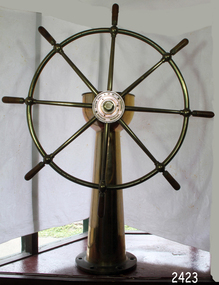
Equipment - Ship's Wheel, John Hastie et al, Early 20th Century
... The company was dissolved in 1991. Brown Brothers Brown Bros Rosebank Ironworks made the steering gears for many large ship's, including The Titanic. ...Inscription to wheel hub "Brown Brothers & Co. Ltd, Rosebank Ironworks, Edinburgh"...The company was dissolved in 1991. Brown Brothers Brown Bros Rosebank Ironworks made the steering gears for many large ship's, including The Titanic. ...John Hastie Engineer and millwright John Hastie opened small manufacturing works in Greenock in 1845 and 1853 patented the first self-holding steering gear. The firm became known as John, Hastie and Co. Ltd. in 1898 after taking on limited liability status and their main works were at Kilblain Street, Greenock, where they specialised in ships' steering gear. The company also occupied works at Rue End Street, Greenock. Plans of this unit depict a stockyard to the east, with areas for welding; fitting and assembly; flame, cutting and fabrication; and a machine bay. The company was dissolved in 1991. Brown Brothers Brown Bros Rosebank Ironworks made the steering gears for many large ship's, including The Titanic. Andrew Betts Brown the founder was born in 1741 and closely associated with many improvements in marine engineering. He was educated in his native city and served his apprenticeship as an engineer in the locomotive works of the North British Railway Company at St. Margaret's. During his apprenticeship, he attended the evening classes at Watt College. subsequently going to Manchester to study chemistry. He went to London around 1863 and took over an old brewery, which he converted into an engineering works. During his time there he invented an overhead travelling crane, which was used on the construction of Blackfriars Bridge London. He went on to develop plant which used steam and hydraulic power for discharging ships as a result the company was contracted to install this equipment in Hamburg Docks. By around 1870 he continued to construct machinery in London but realised that conditions were more favourable in Edinburgh. He acquired land at Rosebank adjoining the North British Railway Company's line to Granton, and the necessary infrastructure was completed allowing him to finish the Hamburg contract. The works at Rosebank were eventually extended and added to until they became one of the largest engineering works in the East of Scotland. Mr Brown was a member of numerous engineering institutions, the best known at the time being the Institution of Naval Architects. He was also a Fellow of the Royal Society of Edinburgh, a member of the Institute of Mechanical Engineers and of the Institution of Marine Engineers he died in 1906 at the age of 67.An item made by two marine innovators of marine auxiliary machinery, equipment and itemsShip's wheel, brass, attached to brass pillar. The base has six holes in it for securing it in place. Top of the ship's wheel pillar has a brass, adjustable arrow pointer that is positioned over a dial etched into the flat brass surface. The dial reads " PORT STABD". Lines and degrees are marked, with '0' in centre and every 5 degrees, from 0-35, in both Port and Starboard sidesInscription to wheel hub "Brown Brothers & Co. Ltd, Rosebank Ironworks, Edinburgh"flagstaff hill, warrnambool, shipwrecked-coast, flagstaff-hill, flagstaff-hill-maritime-museum, maritime-museum, shipwreck-coast, flagstaff-hill-maritime-village, john hastie, john hastie, andrew betts brown, ships wheel, ship steering gear, marine equipment, instrument, navigation -
 Greensborough Historical Society
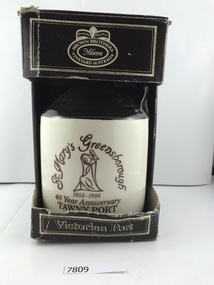
Container - Bottle, St Mary's Greensborough 40 year anniversary tawny port, 1995
... Brown Brothers Milawa Vineyard Australia: Viictorian Port on cardboard container...Commemorative Port issued in 1995 to celebrate the 40th anniversary of the opening of St Mary's Church in Greensborough. st marys parish greensborough st marys catholic church greensborough brown brothers Brown Brothers Milawa Vineyard Australia: Viictorian Port on cardboard container Ceramic wine bottle with cork in cardboard container, black and white St Mary's Greensborough 40 year anniversary tawny port Container Bottle ...Commemorative Port issued in 1995 to celebrate the 40th anniversary of the opening of St Mary's Church in Greensborough.Ceramic wine bottle with cork in cardboard container, black and whiteBrown Brothers Milawa Vineyard Australia: Viictorian Port on cardboard containerst marys parish greensborough, st marys catholic church greensborough, brown brothers -
 Tennis Australia
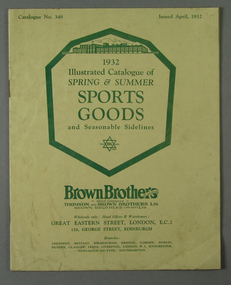
Catalogue, Advertisement, 1932
... 1932 Brown Brothers illustrated catalogue of sports goods and seasonable sidelines. ...Tennis 1932 Brown Brothers illustrated catalogue of sports goods and seasonable sidelines. ...1932 Brown Brothers illustrated catalogue of sports goods and seasonable sidelines. Materials: Paper, Inktennis -
 National Vietnam Veterans Museum (NVVM)
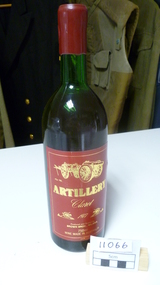
Memorabilia, Artillery Claret 1977
... 750ml bottle of Brown Brothers claret "Artillery", featuring a 40 pounder rifle breech loading Armstrong, in gold sketch on label...Artillery claret 750ml bottle of Brown Brothers claret "Artillery", featuring a 40 pounder rifle breech loading Armstrong, in gold sketch on label Artillery Claret 1977 Memorabilia Memorabilia Brown Bros ...750ml bottle of Brown Brothers claret "Artillery", featuring a 40 pounder rifle breech loading Armstrong, in gold sketch on labelartillery claret -
Greensborough Historical Society
Article - Memoir, The adventures of the Brown brothers on the playing fields of Greensborough by Val Wilson (nee Rolfs), 1890o
... Val Wilson (nee Rolfs) recounts the problems faced by the Brown brothers in their quest to play cricket for Greensborough Cricket Club in the late 1800s....Val Wilson (nee Rolfs) recounts the problems faced by the Brown brothers in their quest to play cricket for Greensborough Cricket Club in the late 1800s. ...Val Wilson (nee Rolfs) recounts the problems faced by the Brown brothers in their quest to play cricket for Greensborough Cricket Club in the late 1800s.This story is supported by articles in the Evelyn Observer.3 typed pages text only.val wilson, val rolfs, greensborough cricket club, brown brothers, william brown, thomas brown, adam brown, henry brown, bundoora -
Greensborough Historical Society
CD-ROM, John Gibson et al, Interviews and Recordings by John Gibson, 2011-2016
... Three presentations at GHS meetings are also recorded: Felicity Williams on teaching history and research into the soldiers on the "Fallen Soldiers' Memorial" (2011), Noel Withers on the Bosch family of Greensborough (2011) and Val Wilson on the Brown Brothers of Bundoora....Three presentations at GHS meetings are also recorded: Felicity Williams on teaching history and research into the soldiers on the "Fallen Soldiers' Memorial" (2011), Noel Withers on the Bosch family of Greensborough (2011) and Val Wilson on the Brown Brothers of Bundoora. oral history CD-ROM with 7 interviews and 3 recordings of presentations at GHS meetings. 2 copies. ...Oral history stories written by John Gibson came from these original interviews with Betty Thatcher (2011), Bill and Thelma Hutchinson (2012), Eric Barclay (2014), Graeme and Lorraine Collins (2011), Jean Luxford (2016), and Keith and Margaret Willimott (2011). Three presentations at GHS meetings are also recorded: Felicity Williams on teaching history and research into the soldiers on the "Fallen Soldiers' Memorial" (2011), Noel Withers on the Bosch family of Greensborough (2011) and Val Wilson on the Brown Brothers of Bundoora.CD-ROM with 7 interviews and 3 recordings of presentations at GHS meetings. 2 copies.oral history -
 Wodonga & District Historical Society Inc
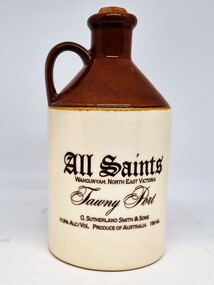
Functional object - Earthenware Bottle - All Saints Estate early 1980s
... After being passed in at a receiver’s auction in 1991, All Saints was acquired by Brown Brothers of Milawa in 1992. It is now owned and operated by the children of Peter R. ...After being passed in at a receiver’s auction in 1991, All Saints was acquired by Brown Brothers of Milawa in 1992. It is now owned and operated by the children of Peter R. ...All Saints Estate is a family-owned winery established in 1864 and located on the banks of the Murray River in Wahgunyah, Northeast Victoria. Original owners George Sutherland Smith, and John Banks, arrived from Caithness, Scotland in 1852. After being involved in a range of enterprises, they established the vineyard, including a castle based on the design of The Castle of Mey in Scotland, which was built in 1864. In 1873 in London, Sutherland Smith became the first Australian winemaker to win an award at an overseas wine show. Banks died in 1876 and All Saints remained in the hands of G. Sutherland Smith and his family, until after some variable fortunes in the late 1980s, it fell into the hands of a syndicate in 1989. After being passed in at a receiver’s auction in 1991, All Saints was acquired by Brown Brothers of Milawa in 1992. It is now owned and operated by the children of Peter R. Brown. During the early 1980s, All Saints took bulk orders for different corporations such as Ansett Air Freight, packaging them in jugs as this for special occasions or functions.This jug is representative of an historic and continuing leading Australian Winemaker located in Northeast Victoria.A pottery wine jug of tradition colours featuring a lower half of natural earthenware colour and a brown glazed top section. It has a loop handle and a cork closure. Originally it also had a wax seal closure. Company information and logos are featured on each side.On side 1: "All Saints / WAHGUNYAH, NORTH EAST VICTORIA/ Tawny Port / G. SUTHERLAND SMITH & SONS / 17.5% ALC/VOL. PRODUCE OF AUSTRALIA 750 ML" On reverse side: Below an image of an Ansett Airfreight Aeroplane: "We offer to you our warmest, / best wishes for the Christmas Season/ and a year of continued/ peace and prosperity. / Merry Christmas, / from Ansett Air Freight." Underneath the jug: " Elischer / AUSTRALIA" all saints estate, australian wine industry, north east victoria wineries, viticulture australia -
 Bendigo Historical Society Inc.
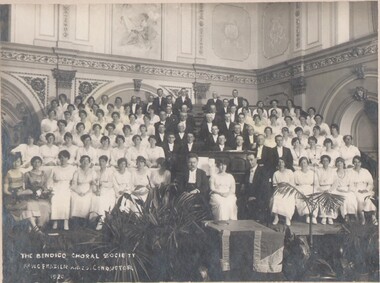
Photograph - WES HARRY COLLECTION: TWO PHOTOGRAPHS OF BENDIGO CHOIR
... Frazier B Bendigo & Castlemaine Choirs combined with Melbourne Oriana Choir performing at the Melbourne Town Hall, approx. 1920 A Bendigo Choral Society at the Bendigo Town Hall Owner Elva Jean Brown, of E.J. Brown Bookshop; from her brother Bernard Allen Brown (unknown how he came to him)...Frazier B Bendigo & Castlemaine Choirs combined with Melbourne Oriana Choir performing at the Melbourne Town Hall, approx. 1920 A Bendigo Choral Society at the Bendigo Town Hall Owner Elva Jean Brown, of E.J. Brown Bookshop; from her brother Bernard Allen Brown (unknown how he came to him) Photograph WES HARRY COLLECTION: TWO PHOTOGRAPHS OF BENDIGO CHOIR ...two black & white mounted photographs of the Bendigo Choir, circa 1920s, Conductor Mr. W. C. Frazier B Bendigo & Castlemaine Choirs combined with Melbourne Oriana Choir performing at the Melbourne Town Hall, approx. 1920 A Bendigo Choral Society at the Bendigo Town Hall Owner Elva Jean Brown, of E.J. Brown Bookshop; from her brother Bernard Allen Brown (unknown how he came to him)A W. Vincent Kelly, Bendigo B Garge Photos, Collins Street, Melbournewes harry, bendigo choir -
 Warrnambool and District Historical Society Inc.
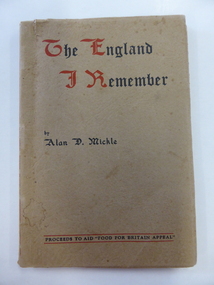
Book, The England I Remember, 1940s
... Clarke, whose signature appears in the book, was a descendant of a local Clarke family which included Angus Henry Clarke (b. 1866) who married Maggie Brown and Angus’ brother, John Sanders Clarke (b.1870) who married Bessie McMahon of Warrnambool. ...Clarke, whose signature appears in the book, was a descendant of a local Clarke family which included Angus Henry Clarke (b. 1866) who married Maggie Brown and Angus’ brother, John Sanders Clarke (b.1870) who married Bessie McMahon of Warrnambool. ...This book has been written by Alan Mickle and tells of his impressions of England in 1908, 1923 and 1938. The proceeds of the sale of the book went to the ‘Food For Britain’ drive, an appeal that operated throughout Australia during World War Two. Alan Mickle, the son of David and Clara, was related to an early 20th century Shire Engineer in the Camperdown area and to Thomas Mickle, a prominent landowner, hotel keeper and photographer in early Warrnambool. Alan Mickle died in 1969. M.E. Clarke, whose signature appears in the book, was a descendant of a local Clarke family which included Angus Henry Clarke (b. 1866) who married Maggie Brown and Angus’ brother, John Sanders Clarke (b.1870) who married Bessie McMahon of Warrnambool. Bessie’s father, William was a prominent 19th century lawyer in Warrnambool. The book was donated to the Warrnambool and District Historical Society by Aileen Hassell who was the daughter of John and Bessie Clarke. This book is significant because of its links to the ‘Food For Britain’ appeal which was active in Warrnambool during World War Two. Also the book is significant because of its links to the Clarke and Mickle families, resident in the Warrnambool district in the late 19th and early 20th centuries This is a soft cover book of 93 pages. The cover is buff-coloured with a fold-in flap at the ends of the cover to make the cover more sturdy. The lettering on the cover is in red and black calligraphy. The book has a Foreword by the Rt. Hon. R.G. Casey and includes several black and white photographs. The cover is a little scuffed and worn. The inscription is handwritten in blue ink.‘M.E.Clarke’ alan mickle, food for britain appeal, world war two, world war two in warrnambool, john and bessie clarke, aileen hassell -
 Flagstaff Hill Maritime Museum and Village
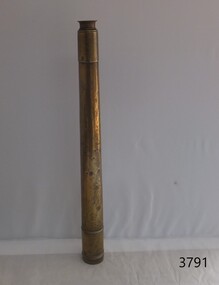
Instrument - Marine Telescope, 1870-1880
... John Browning's great-grandfather was also an instrument maker as well as John’s brother Samuel Browning of the firms Spencer & Browning and Spencer, Browning & Rust, who also manufactured navigational instruments. ...John Browning's great-grandfather was also an instrument maker as well as John’s brother Samuel Browning of the firms Spencer & Browning and Spencer, Browning & Rust, who also manufactured navigational instruments. ...This telescope was amongst various items collected from a sea dive in Port Phillip Bay. The diver was the caretaker of the Port Lonsdale Lighthouse, who dived on various wrecks in the bay during the 1960's. After the caretaker's death, his son sold off many of the shipwreck artefacts. The telescope was purchased from the caretaker's son in the 1990's by a previous owner of the Marine Shop, Queenscliff, Victoria. John Browning was particularly well known for his scientific advances in the fields of spectroscopy, astronomy, and optometry. Between 1856 and 1872, Browning acquired provisional patents for designs of numerous scientific instruments. He was also the recipient of an award at the 1862 International Exhibition held in London. Also recognised for his temperature-compensated aneroid barometer. Browning's scientific instruments were used in physics, chemistry, and biology. The products he designed and manufactured included spectroscopes, telescopes, microscopes, barometers, photometers, cameras, ophthalmologist, and electrical equipment such as electric lamps. John Browning was born around 1831 in Kent, England. His father, William Spencer Browning, was a maker of nautical instruments. John Browning's great-grandfather was also an instrument maker as well as John’s brother Samuel Browning of the firms Spencer & Browning and Spencer, Browning & Rust, who also manufactured navigational instruments. The latter firm was in operation in London from 1784 to 1840 and was succeeded by the firm of Spencer, Browning & Co. John Browning initially intended to follow the medical profession and entered Guy's Hospital, a teaching hospital and a school of medicine. Despite having passed the required examinations, however, he abandoned his plans. Instead, he apprenticed with his father, William Spencer Browning. At the same time, in the late 1840s, he was a student attending the Royal College of Chemistry several days per week. By the early 1870s, practical optics had become John Browning's primary interest, and he listed his occupation as an optician on the census records from 1871 to 1901. He was well known among London's ophthalmic surgeons for his various ophthalmic instruments. He had a large part in reforming the art of crafting spectacles. Other achievements were as an author of the book, How to Use Our Eyes and How to Preserve them by the Aid of Spectacles. Published in 1883, the book included thirty-seven illustrations, including a diagram demonstrating the anatomy of the eye. In 1895, he was one of the founders of the "British Ophthalmology" the first professional organisation for optometry. He was not only its first president but also registered as its first member so many considered him to be the first professional optometrist. Other professional organisations he belonged too was as a member of “The Aeronautical Society of Great Britain”. In 1871 constructing the first wind tunnel located at Greenwich Marine Engineering Works. He was also a member of other scientific organisations, such as the “Microscopical Society of London”, the “Meteorological Society”, and the “Royal”. Then in 1908 the company of W. Watson & Son, opticians and camera makers, took over John Browning's company since 1901 John Browning had been semi-retired but in 1908 he fully retired and moved to Bournemouth in Hampshire. He died in Cheltenham, Gloucestershire in 1925.The telescope is significant for its association with one of the world’s leading scientific instrument makers and inventor of the 19th and early 20th century. It is believed the donation came off a wreck either in Port Philip Bay or between Point Lonsdale and the Nepean Heads making it a significant maritime historical artefact. Its provenance is good given it was taken off a wreck in this area by the Point Lonsdale lighthouse caretaker. Examples of John Browning's telescopes because of their scientific and historical importance are highly valued by collectors.Marine style single draw brass telescope with a sunshade. The single draw has no split and the second cartridge is held in a long brass tube within the single draw, mounted from the objective end. The eyepiece is flat and at the end of the first draw in a very faded engraving that is believed to read "John Browning, 63 Strand, and should read London under the word strand but this is hard to establish given the engravings condition. This interpretation of the engraving has been arrived at by examination of other John Browning telescope engraving examples."John Browning, engraved to the first tube in copper plate style "63 STRAND" Engraved under in capital textflagstaff hill, flagstaff hill maritime museum and village, warrnambool, maritime museum, maritime village, great ocean road, shipwreck coast, shipwreck artefact, port phillip bay, port lonsdale lighthouse, wreck, 1960’s diver, queenscliff marine shop, john browning, telescope, spectroscopy, optometry, scientific instruments, william spencer browning, optician, navigational instrument, microscopical society of london, aeronautical society, marine technology -
 Federation University Historical Collection
Magazine, Extra Muros: Journal of the Ballarat Teachers' College, 1929, 1929
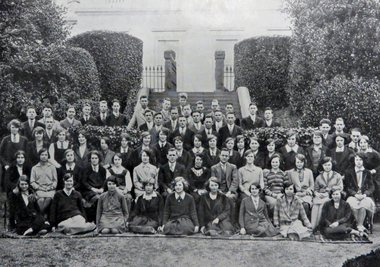
... Monahan; Ina Dickman; Himmie Brothers; Jean Green; Alex A. Brown; Eva Varae; H.A. Frost; E.O. ...Monahan; Ina Dickman; Himmie Brothers; Jean Green; Alex A. Brown; Eva Varae; H.A. Frost; E.O. ...The 1929 Magazine Committee were John H. McNaughton (President and Editor), Miss I. Dickman (Secretary) , Mr E.B. Tregoning (Business Manager) and Miss P. Bunnett. John McNaughton was also president of the 1929 Ballarat Teachers' College Dramatic Club. The 1929 Ballarat Teachers' College Council comprised of Miss A. Ballinger, Mr R. Broben, John H. McNaughton, Mr R.P. Warriner and Miss Monahan.Crimson soft covered booklet of 50 pages relating to the Ballarat Teachers' College. It belonged to John McNaughton. The magazine includes the following images: Ballarat Teachers' College Staff and Students; women's tennis; football, men's tennis; hockey; Ballarat Teachers' College Council; visit of Bendigo Teachers' College. The Ballarat Teachers' College Football team included: C. Goltz (Captain), A.M. McPherson (Vice-captain), S.C. Hender, Rex Broben, N. Povey, F. Hickey, J. Heard, J. Johnson, J. Thomas, R. Watson, J. Braden, F. Spencer, H. Parker, I. Young, J. McNaughton, E. Errey, R. Moosman, G. Neumann, R. Nicholls and R. Warriner. The magazine reported "There are undoubtedly three outstanding players in the team - C. Goltz, R. Broben , and A. McPherson. 'The last page is autographed by members and staff of the Ballarat Teachers' College. The autographs include: W.H. Elwood (Principal), A.P. Hamano, H.B. Jones; M.H. Miller; W. Braden, Rose Battye; Jean Renkin; Mabel Roll; Nancy Schroeter; O.K. McLeod; George E. Neumann; Z. Zerby; Ada J. Looney; O. Van Bertel; R.P. Warriner; R.R. Watson; C. Goltz; Charles Hender; E.B. Tregoning; Bunnett; Henry J. Parker; H. Duggan; C.F. Kirk; Gladys Dunstan; Clare M. Cummin; J.B. Hickey; Norman Povey; Joan McKebery; Monica J. Monaghan; Elsie E. Bruhn; Muriel E. McDonald; Kathleen Fitzgerald; Mary Fogarty; Peggy Skene; Frances Craig; Andrew B. Morton; Ron E. Mosman; Rex Braben; Doris Jarman; A.R. Gready; Monica J. Monahan; Ina Dickman; Himmie Brothers; Jean Green; Alex A. Brown; Eva Varae; H.A. Frost; E.O. Jones; Florence Old; C.A. Harrison; J. Leath-Kingsley; Jack Heard; A.M. McPherson; W. Ian Youngballarat teachers' college, mcnaughton, john mcnaughton, dickman, tregoning, bunnett, ellwood, j. brown, a. ballinger, warriner, g. goltz, a.m. mcppherson, s.c. hender, rex broben, n. povey, f. hickey, j. heard, j. johnson, j. thomas, r. watson, j. braden, f. spencer, h. parker, i. young, j.mcnaughton, e. errey, r. moosman, g. neumann, r. nicholls, r. warriner -
 Flagstaff Hill Maritime Museum and Village
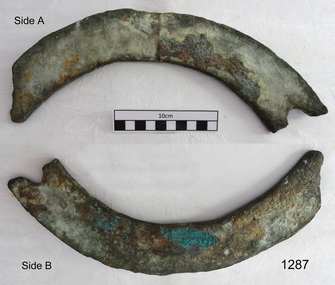
Functional object - Ship's Fitting, circa 1825
... Brothers Captain H. Browne Portland Portland Bay brass flange brass rim ship’s fitting Ship's fitting, of heavy gauge brass circle, previously classified as a section of the ship's fitting, which was raised from the wreck of the Children. One end is broken off at an original bolt hole, and the other is severed or cut at an acute angle from the inner rim. The artefact is 6cm across and 1cm deep, indicating strength and function as a substantial and finished item of moulded metal. The upper face bears sedimentary accretion stained red/brown ...This attractively patinated artefact was raised from the wreck site of the CHILDREN and was quite reasonably catalogued as a portion of a ship's porthole. This identification is unlikely, however, because the CHILDREN was built at Liverpool in 1824, and round portholes were not in common use until the 1850s. The catalogue identification has since been changed to "Ship's Fitting" Before the appearance of round portholes in the middle of the nineteenth century, the function of introducing light to lower decks was performed by square half-glassed ‘ports’ in the side of the hull (known as a port-sash), or ground-glass ‘bullseyes’ inserted in the deck (scuttles). In historical terms, ports were always square, cut into the timber originally to allow the firing of a ship's guns, and were closed in weather by a tight-fitting square hatch. Flagstaff Hill Shipwreck Museum has three portholes on display that illustrate the gradual development and adoption of circular brass portholes. First in sequence is a small 12.5cm diameter window (with a deep frame for thick wooden hulls) from the 1855 wreck of SCHOMBERG. The second and third are larger 25cm diameter windows (with a shallower frame for thinner iron hulls) from the 1892 wreck of the NEWFIELD and the 1908 wreck of the FALLS OF HALLADALE. Once the apparently obvious use of the brass object is discounted, an accurate and reliable alternative classification is difficult to specify. One artefact register notes it was ‘found in about the centre of the wreck site’. This would mitigate against the possibilities of (1) ‘horseshoe frame’ joining pieces of the keel and hull at the bow of the vessel, or (2) ‘deckseat’ for a binnacle at the stern. It may support the idea of a ‘head frame’ on a cooped companionway or a ‘deckseat’ for a mainmast pump. But this is only speculation. The actual identification is not known. The sip's fitting recovered from the Children's wreck is significant as part of the original fittings of the early 19th-century barque. The 1839 wreck and recovered artefacts are examples of the construction methods and materials used in that era and can be used to study the evolution of shipbuilding methods and principles. The wreck of the Children is of state significance as one of colonial Victoria’s earliest and most significant maritime disasters, and one of the first vessels lost in the Western District. This is recognised by its inclusion on the Victorian Heritage Register, VHR No. S116. Little is left on the seabed to mark the tragedy, apart from some of the house bricks intended for the Henty settlement. Ship's fitting, of heavy gauge brass circle, previously classified as a section of the ship's fitting, which was raised from the wreck of the Children. One end is broken off at an original bolt hole, and the other is severed or cut at an acute angle from the inner rim. The artefact is 6cm across and 1cm deep, indicating strength and function as a substantial and finished item of moulded metal. The upper face bears sedimentary accretion stained red/brown. The rear face has been gouged by hard or corrosive materials and bears brilliant blue/green oxidation.flagstaff hill, flagstaff hill maritime museum and village, warrnambool, maritime museum, maritime village, great ocean road, shipwreck coast, shipwreck artefact, children, childer’s cove, port campbell, 1839 shipwreck, james henty and co, henty brothers, captain h. browne, portland, portland bay, brass flange, brass rim, ship’s fitting -
 Mission to Seafarers Victoria
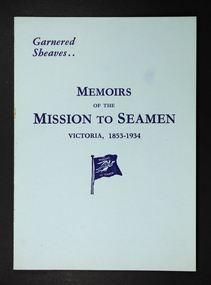
Booklet - Memoirs, Aileen Elizabeth Brown, Garnered Sheaves: Memoirs of The Mission to Seamen, Victoria 1853-1934, 1935
... Brown. In 1935 she wrote the memoirs presented during the annual meeting of the Mission on the 10th of April by her brother, Reverend Noel Johnston Danne. ...Brown. In 1935 she wrote the memoirs presented during the annual meeting of the Mission on the 10th of April by her brother, Reverend Noel Johnston Danne. ...Aileen was the daughter of Reverend Richard Vallencey Danne and Mary Danne , nee Johnston, herself daughter of Reverend Kerr Johnston. She was married to Alfred Augustus Brown. In 1935 she wrote the memoirs presented during the annual meeting of the Mission on the 10th of April by her brother, Reverend Noel Johnston Danne. It was sold for fundraising purposes for the Mission. In the article from the Herald published on Wednesday 10 April 1935, page 14 : "An interesting presentation took place during the afternoon when the Rev. N. J. Danne, on behalf of his sister, Mrs A. E. Browne, will present the Mission with a copy of the Memoirs of the Victoria Mission to Seamen from the year 1853, when their grandfather was the first chaplain of the Mission. Further copies of the memoirs were sold to assist the funds of the mission."Medium sized booklet. 16 pages memoirs with blue cover written by Aileen Elizabeth Brown in 1935 tells the beginnings of the mission and Kerr Johnston (1812-1887), seamen's mission chaplain. Foreword written by Aileen Elizabeth Brown. On page 2 are the photographs of the Reverend Kerr Johnston and his wife.reverend noel johnston danne, 1890-1969, aileen elizabeth brown, nee danne, 1879-1956, reverend richard vallencey danne, 1846-1904, mary alice isabelle danne nee johnston, 1851-1926, fundraising, mission to seafarers, seamen's mission, mission to seamen, port melbourne, 1935, memoirs, history, reminiscence -
 Blacksmith's Cottage and Forge
Cake Stand, Beginning of the 20th Century
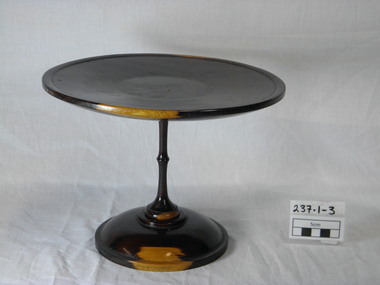
... The stand is made of osage orange giving it the unique tones of dark brown and orange wood. Cake Stand Simon Brothers ...This cake stand was hand turned from osage orange wood. The wood was sourced from a grove of osage orange trees in the Fisken/Taverner Street area. This grove was planted by Mr A C Simon, an orchardist, who brought the seeds from North America in the 1860's to create a protective hedge for his plants The wood from these plants produces a beautiful toned affect of dark brown and yellow/orange when turned and polished. The significance of this cake stand is that it has been carved from the osage orange which grows well in Bacchus Marsh although originated in America. Mr Simon made many items from this wood. This gives it local significance.This polished wooden stand would have been used for cake to be displayed It consists of a round 'plate' of wood as the top, with a fine narrow turned wood pedestal and a round base. The stand is made of osage orange giving it the unique tones of dark brown and orange wood.turned wood, osage orange, food stand, food display, brown orange wood, wooden, cake stand, parlour item, table centre piece, polished wood, ornamental stand -
 Federation University Historical Collection
Equipment - Piano Rolls, Three Piano rolls from Sutton's Music
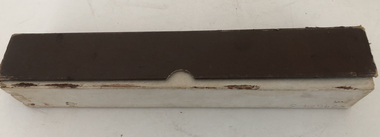
... brothers that ran the Sutton's Music Store after the death of their Father Richard Sutton. Henry Sutton taught Applied Electricity at the Ballarat School of Mines in 1883 to 1886. piano rolls Sutton's music Henry Sutton O Thou That From Heaven Art Rosie Pansies VocalStyle Imperial .1 in white box with black lid - Piano roll - Rosie .2 In purple box - O Thou That From Heaven Art .3 In white box with brown lid - Pansies Three Piano rolls from Sutton's Music Equipment Piano Rolls ...Henry Sutton is a talented world-wide accepted inventor with inventions relating to the telephone, photography, wireless, cars, motorcycles, and bicycles as well as many more inventions. Henry was also one of four brothers that ran the Sutton's Music Store after the death of their Father Richard Sutton. Henry Sutton taught Applied Electricity at the Ballarat School of Mines in 1883 to 1886..1 in white box with black lid - Piano roll - Rosie .2 In purple box - O Thou That From Heaven Art .3 In white box with brown lid - Pansiespiano rolls, sutton's music, henry sutton, o thou that from heaven art, rosie, pansies, vocalstyle, imperial -
 Federation University Historical Collection
Letter, Letters written by Richard Squire to his son Tom Squire 1937
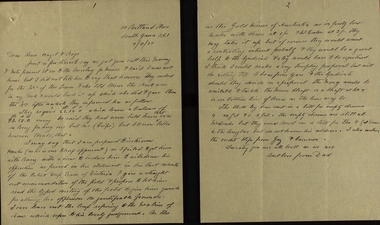
... brothers G.Gay & Co Buninyong Glenfine The Star Mine of Avoca Fields Talbot Alluvials Guildford Plateau A.B.C. Special Supply Store Geological Branch Shell Coy Lawaluk Almanac McBinny Bingley's Paddock Cargaire Valley and Lead Stand and Deliver Demands Sheehan's Smeaton Hotel John Charleson Aleck Charleson Ted Brown Billy Jordan Mr Banks Ballarat Main Lead Binney Goon Illabrook Mrs Trenery Bre Max June Mary Len Barry Hunter Herman Martin Aunt Annie Bella Pitfield Coy McNaughtons Donaldson Dereel Hogan The Bay Leads Avoca Field Ballarat Alluvials Neil Cameron Haddon Field Courier Tom Cotton Llewellen Stanley Hunter Mr Leonard Tom Mitchell School of Mines Bryant A.C. ...In 1905 Richard Squire was manager of the West Berry Consols at Allendale, and developed an improved system of mine ventilation, which was supported in "The Age."[4] He was successful in combating and remedying the gas and ventilation troubles of the Deep Mines of Creswick and Allendale Districts after all had failed. MINE MANAGERS’ ASSOCIATION. Ballarat Branch. ... Mr R. B. Squire, manager of the West Berry Consols, at Allendale, submitted a paper detailing what he had done tor the betterment of ventilation in the alluvial mines of Smeaton and Mary borough districts- Members gave Mr Squire every credit for the results that he claimed to have effected; the adoption of his ideas had testified to their value to mine-owners. It was painted out, however, that for want of a thorough debate of the subject with experienced men the author had unwittingly included some general statements that required modifying in some points and extending in others, in justice to other workers among the earlier and the present day managers of mines. It was decided to invite the author to meet a sub-committee on this subject!A variety of Letters written by Richard Squire to his son Tom Squire about the goings on at Mt Mercer Mine 1937richard squire, tom squire, hazel squire, jack squire, jim squire, ned, mt mercer, plant, skids, pump, poppet, carburetor, shaft, balance weight, pulleys, syndicate, suction, lease, reports, estimates, flat fields, reef, trucks, pipeclay, sandstone, suction pipe, valves, honeycomb rock, yarrowee, ballarat, reef combs, cheques, yellow slate, leigh river, dyke, quartz, ballarat deep leads, ballarat deep leads extension, bore, reads, bedrock, cemented sand, g m of a, gold mines of australia, liz the car, geoff squire, lode, cameron and sutherland, hayes timber, alan squire, ethel, ross creek field, ross creek gold mining co., frank herman, lillas, jack hayes, eyres brothers, g.gay & co, buninyong, glenfine, the star mine of avoca fields, talbot alluvials, guildford plateau, a.b.c. special supply store, geological branch, shell coy, lawaluk, almanac, mcbinny, bingley's paddock, cargaire valley and lead, stand and deliver demands, sheehan's, smeaton hotel, john charleson, aleck charleson, ted brown, billy jordan, mr banks, ballarat main lead, binney, goon, illabrook, mrs trenery, bre, max, june, mary, len, barry, hunter, herman, martin, aunt annie, bella, pitfield coy, mcnaughtons, donaldson, dereel, hogan, the bay leads, avoca field, ballarat alluvials, neil cameron, haddon field, courier, tom cotton, llewellen, stanley hunter, mr leonard, tom mitchell, school of mines, bryant, a.c. connely, dodson, constable mcmullins, adam ronaldson, bewick mining & co., reginald murray, r.c. selwyn, craig's hotel, broken hill syndicate, morrison's lead, wilkinson, j. hayes, mr nichol, burglary, baragwanath, wilkinson ross, creswick, seville, mr. ross, o'connor, c. mcgrath, alfred mica smith, henderson ross, angus kelly, a. r. dodson, duke of wellington plant, the moorabool lead, williams, paralysis, woodlock, squire, whipp, joe williams, peacock, moran, buchanan, hoare, bree kutchel, kohinoor band and alluvian, star of the east, bonshaw, epidemic, polio, mining -
 Federation University Historical Collection
Photograph, Photograph of A.E. Sutton with motorcycle
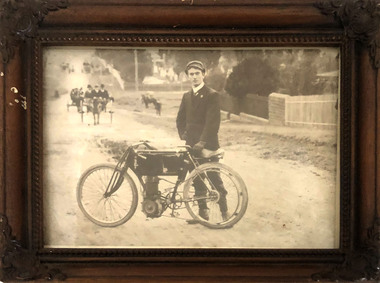
... brothers that ran the Sutton's Music Store after the death of their Father Richard Sutton. Henry Sutton taught Applied Electricity at the Ballarat School of Mines in 1883 to 1886. Henry Sutton A.E. Sutton Motorcycle Photograph VMCC Race Winner Black and White Photograph of A.E. Sutton and motorcycle on which he won the first VMCC 100 Mile road road race in 1906, in a brown ...Henry Sutton is a talented world-wide accepted inventor with inventions relating to the telephone, photography, wireless, cars, motorcycles, and bicycles as well as many more inventions. Henry was also one of four brothers that ran the Sutton's Music Store after the death of their Father Richard Sutton. Henry Sutton taught Applied Electricity at the Ballarat School of Mines in 1883 to 1886.Black and White Photograph of A.E. Sutton and motorcycle on which he won the first VMCC 100 Mile road road race in 1906, in a brown wooden framed.henry sutton, a.e. sutton, motorcycle, photograph, vmcc, race, winner -
 Federation University Historical Collection
Photograph - Photograph - Black and White, Elite Photos, Cox Family of Nhill
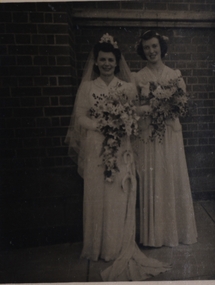
... Brown print Nhill .3 Half of a Post Card. Beryl + Jeff Cox Three black and white photographs of the Cox family of Nhill .1 Beryl Yung and Bridesmaid .2 Two children - possibly Beryl and her brother. ...Beryl Cox b Yung was the daughter of Ernest Herbert Yung, son of George Edward Godlip and Clara Emma Yung (b Smith) of Happy Valley. Ernest was a returned soldier having fought in the Battle of Menin Road, Belgium, in WW1.Three black and white photographs of the Cox family of Nhill .1 Beryl Yung and Bridesmaid .2 Two children - possibly Beryl and her brother. Children of Ernest Herbert Yung .3 Wedding photo of Beryl and Jeff Cox.1 Half of a Post Card. Verso: Beryl + bridesmaid, married Geoff Cox. Elite Photos. no. 24213 .2 Verso: Jas Brown print Nhill .3 Half of a Post Card. Beryl + Jeff Coxyung family, happy valley, beryl cox, 1940's wedding, children 1920's, jeff cox, beryl yung -
 Flagstaff Hill Maritime Museum and Village
Domestic object - Spoon, Cooper Brothers, 1866-1932
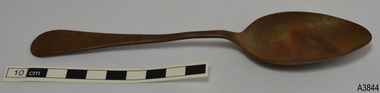
... Items that come from several wrecks have since been donated to the Flagstaff Hill Maritime Village’s museum collection by his family, illustrating this item’s level of historical value. flagstaff hill warrnambool flagstaff hill maritime museum maritime museum shipwreck coast flagstaff hill maritime village great ocean road john chance cutlery flatware silver silver plate antique flatware old english flatware pattern eating utensils spoon tablespoon silverware dining utensil cooper brothers don plate works pompton silver sheffield silver Embossed within two rectangular shapes “POMPTON” and “SILVER” (other marks have worn off) Spoon; plated silver tablespoon with brown base metal. ...This tablespoon was recovered from an unknown shipwreck in the coastal waters of Victoria in the late 1960s to early 1970s. The shipwrecks in the area range from around the 1840s to the early 1930s, and this particular spoon dates from about 1866 to 1932. It is part of the John Chance Collection. This spoon has the embossed names of Pompton and Silver and appears to have other marks that have worn off. The Pompton brand was used on silver flatware made by Cooper Brothers & Sons. Ltd of Sheffield. In Australia the Pompton Silver cutlery was advertised for sale in Sydney in the mid-1920s. The spoon is likely to be plated silver or silver plate, which is a base metal such as nickel or nickel alloy with copper and/or zinc that has been plated or coated with a thin layer of silver. Wear on the metal will cause the base metals to appear through the silver plating. Some manufacturers gave a warranty that the cutlery was ‘white throughout’ but didn’t necessarily say it was solid silver. Cooper Brothers was established in 1866 by brothers Thomas and John William Cooper in High Street, Sheffield. They bought Don Plate Works in 1872. By 1876 they were at Bridge Street and in 1885 they purchased the works at 44 Arundel St Sheffield. In 1895 the firm became Cooper Brothers & Sons Ltd. By 1914 they had branches in London, Sydney, Melbourne and Montreal, advertising as silversmiths, silver cutlers, electroplaters, Britannia Metal smiths and cutlers, particularly spoons and forks. The firm also used the trademarks of DON SILVER, POMPTON SILVER and a logo of a Cooper (barrel maker) in different formats. Cooper Brothers & Sons had a reputation for producing good quality silver and silver plate. In 1900 they registered their Maker’s Mark of the letters ‘CB&s’ within a shield. They also used the Sheffield Assay Hallmark of a Crown. A diagram on a Copper Brothers & Sons, Don Plate Works, advertisement showed three styles of cutlery; No. 393, Old English, and Fiddle. They announced that they were the ‘sole makers of the celebrated “Don” brand of nickel silver spoons and forks’. A burglary in NSW in 1929 listed a stolen flatware set as ‘all Sheffield Silver plate and branded Pompton Silver Works A.1.’. It was ‘guaranteed to wear white throughout’ and was a ‘good, medium quality, nickel silver line’. Cooper Brothers & Sons Ltd. was acquired in 1983 by Frank Cobb & Co. Ltd. Although the spoon is not linked to a particular shipwreck, it is recognised as being historically significant as an example of cutlery either as part of the ship’s flatware service or imported for use in Colonial Victoria in the 19th to early 20th century. The spoon is significant for its association with renowned makers Cooper Brothers of Sheffield, makers of silverware from the 1860s to the 1980s and exporters into the Colonies. The spoon is also significant as it was recovered by John Chance, a diver in Victoria’s coastal waters in the late 1960s to early 1970s. Items that come from several wrecks have since been donated to the Flagstaff Hill Maritime Village’s museum collection by his family, illustrating this item’s level of historical value. Spoon; plated silver tablespoon with brown base metal. Handle is Old English design and is embossed - some marks are worn and unidentifiable. Branded Pompton Silver.Embossed within two rectangular shapes “POMPTON” and “SILVER” (other marks have worn off)flagstaff hill, warrnambool, flagstaff hill maritime museum, maritime museum, shipwreck coast, flagstaff hill maritime village, great ocean road, john chance, cutlery, flatware silver, silver plate, antique flatware, old english flatware pattern, eating utensils, spoon, tablespoon, silverware, dining utensil, cooper brothers, don plate works, pompton silver, sheffield silver -
 Flagstaff Hill Maritime Museum and Village
Furniture - Armchair, 1897-1921
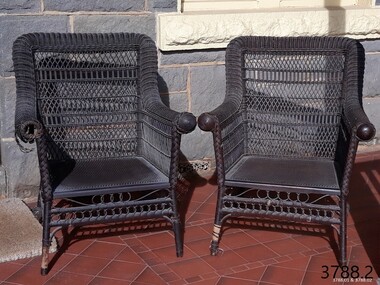
... The wicker furniture is a fine example of late 19th and early 20th century lightweight domestic furniture that is today a very collectible item and quite rare and valuable. flagstaff hill warrnambool shipwrecked coast flagstaff hill maritime museum shipwreck coast great ocean road giles collection giles family henry and mary jane giles tower hill cooramook warrnambool breakwater mailor’s flat wangoom 19th century furniture wicker armchairs rolled serpentine wicker work cane armchair classic wicker furniture victorian style furniture domestic furniture late 19th century chair armchair woven cane wicker rolled serpentine MANUFA - Heywood B – GARDNE Heywood Brothers & Wakefield Company USA Tag, orange with black print: “MANUFA - Heywood B – GARDNE” Armchair: pair of wicker armchairs, painted dark brown. ...These cane chairs are one of many 19th-century items of furniture, linen and crockery donated to Flagstaff Hill Maritime Village by Vera and Aurelin Giles. The items are associated with Warrnambool and the Giles Family history. Items donated by the family have come to be known as the Giles Collection. Many items in the Lighthouse Keeper’s Cottage were donated by Vera and Aurelin Giles and mostly came from the home of Vera’s parents-in-law, Henry Giles and his wife Mary Jane (nee Freckleton), who married in 1880 and whose photos are on display in the parlour. Henry was born at Tower Hill in 1858 and was a labourer on the construction of the Warrnambool Breakwater before leaving in 1895 for around seven years to build bridges in NSW. Mary Jane was born in 1860 at Cooramook, and she attended Mailor’s Flat State School and where she eventually became a student teacher. After which she became a governess at “Injemiara”, where her grandfather, Francis Freckleton, had once owned land. Henry and Mary’s family consisted of six; some of the children were born at Mailor’s Flat, and later, some children were born at Wangoom. They lived with their parents at Wangoom and Purnim west, and this is where Henry died in 1933 and Mary Jane in 1940. Heywood & Wakefield Furniture Co: - The Heywood-Wakefield Company is an American furniture manufacturer established in 1897. It went on to become a major presence in the US. Its older products are considered collectibles and have been featured on television antique programs. The Heywood brothers established themselves in 1826 as furniture makers, and the Wakefield Company began in 1855 as a separate company. Both firms produced wicker and rattan furniture, and as these products became increasingly popular towards the end of the century, they became serious rivals. In 1897, the companies merged as Heywood Brothers & Wakefield Company (this name was changed to Heywood-Wakefield Company in 1921), purchasing Washburn-Heywood Chair Company in 1916, Oregon Chair Company in 1920, and Lloyd Manufacturing Company in 1921. While its wooden furniture plant in Gardner, Massachusetts, closed in 1979, a branch in Menominee, Michigan, continued to manufacture metal outdoor seats, auditorium seats, and school furniture. The Heywood-Wakefield Company Complex in Gardner was added to the National Historic Register in 1983. The South Beach Furniture Company acquired the rights to the name in 1994 and reproduces its wooden furniture. Both founding companies produced wicker and rattan furniture in the late 19th century. The wicker styles drew on the Aesthetic Movement and Japanese influences simpler designs arose in the wake of the Arts and Crafts Movement. The merged entity stayed abreast of wicker furniture trends by hiring designers such as Paul Frankl and Donald Deskey during the 1920s. Its furniture was exhibited at the 1933 Century of Progress exhibition and the 1964 New York World's Fair. During the 1930s and 1940s, Heywood-Wakefield began producing furniture using sleek designs based on French Art Deco.The Giles family collection has social significance at a local level because it illustrates the level of material support the Warrnambool community gave to Flagstaff Hill when the village and museum were established. The wicker furniture is a fine example of late 19th and early 20th century lightweight domestic furniture that is today a very collectible item and quite rare and valuable.Armchair: pair of wicker armchairs, painted dark brown. The open wicker weave pattern of a traditional Asian design extends from the seat up to the armrests and completely over the backrest, plus across the front of the chair below the seat. The seat is very firmly woven and fitted into a timber frame. A reinforcing pattern of wicker work covers the top edges of the armrests and backrest in one piece and folds around to the underside, referred to as rolled serpentine arms and back. The hollow ends of the armrests are filled with a circular knob of wicker work. The back legs are also completed with decorative wicker knobs. The frames are constructed from bamboo. One chair base (3788.1) has been strengthened with metal bracing. The other chair (3788.2) has the remnants of an orange manufacturer’s tag fixed to the base. The chairs were made from 1897 to 1921 by Heywood Brothers & Wakefield Company, USA. These chairs are part of the Giles Collection.Tag, orange with black print: “MANUFA - Heywood B – GARDNE”flagstaff hill, warrnambool, shipwrecked coast, flagstaff hill maritime museum, shipwreck coast, great ocean road, giles collection, giles family, henry and mary jane giles, tower hill, cooramook, warrnambool breakwater, mailor’s flat, wangoom, 19th century furniture, wicker armchairs, rolled serpentine wicker work, cane armchair, classic wicker furniture, victorian style furniture, domestic furniture late 19th century, chair, armchair, woven cane, wicker, rolled serpentine, manufa - heywood b – gardne, heywood brothers & wakefield company, usa -
 Phillip Island and District Historical Society Inc.
Photographs, West Family, 2004
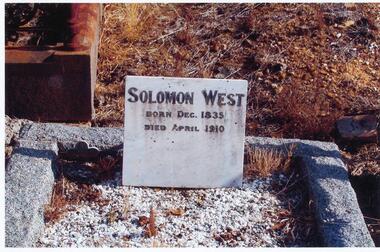
... brother John became pioneer settlers on Phillip Island. Solomon married Elizabeth Bryant in 1857 at St Andres Church of England, Brighton. Elizabeth died in 1895 on Phillip island and is buried in the Phillip Island cemetery. Archie was the son of William and Jane West who died tragically in the Bendigo rail yards at the age of 21. Jane was buried in the same grave in Bendigo. Nellie, William and Jane's 2nd child married Harry Alexander Brown...brother John became pioneer settlers on Phillip Island. Solomon married Elizabeth Bryant in 1857 at St Andres Church of England, Brighton. Elizabeth died in 1895 on Phillip island and is buried in the Phillip Island cemetery. Archie was the son of William and Jane West who died tragically in the Bendigo rail yards at the age of 21. Jane was buried in the same grave in Bendigo. Nellie, William and Jane's 2nd child married Harry Alexander Brown ...A collection of 3 photographs with a page of notes on the West family. Solomon West and his brother John became pioneer settlers on Phillip Island. Solomon married Elizabeth Bryant in 1857 at St Andres Church of England, Brighton. Elizabeth died in 1895 on Phillip island and is buried in the Phillip Island cemetery. Archie was the son of William and Jane West who died tragically in the Bendigo rail yards at the age of 21. Jane was buried in the same grave in Bendigo. Nellie, William and Jane's 2nd child married Harry Alexander Brown and are buried in the same grave together with Nellie's father, William West.355-01: Coloured photograph of the grave and headston of Solomon West in the Bendigo Cemetry. 355-02: Coloured photograph of the headstone of Archie S. West and Janet West in the Bendigo Cemetry. 355-03: Coloured photograph of the headstone of Nellie Brown, Harry Brown and William West in the Bendigo Cemetry. 355-04: A4 sheets of notes written by Alan West in May 2004 describing the above three photographs and the West family.355-01: On the headstone: Solomon West Born Dec 1835 Died April 1910. 355-02: On the headstone: In loving memory of our beloved son Archie S West, accidentally killed Dec. 7 1911. Aged 21 years. Only "Good Night, Beloved" not "Farewell". Also his mother Janet West. Died July 30, 1938 Aged 79 years. 355-03: On the headstone: In memory of Nellie Elizabeth Brown died Jan 4 1971. Also her husband Harry Alexander Brown and he father William West.the west family phillip island, alan west, bendigo cemetry -
 Mission to Seafarers Victoria
Plaque - Memorial Plaque, Amy Neville Brown (1882-1974), 1976
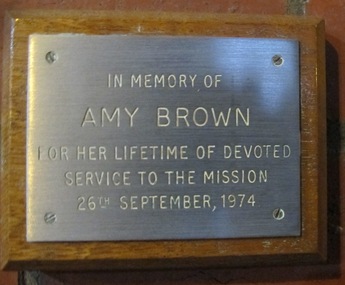
... Amy’s parents were Andrew Howden Brown & Catherine Marianne (Kitty) Wight. She had 2 brothers: Charles John Brown, Edward Byam Brown & 3 sisters: Jean Constance Brown (1884-1973), Catherine Philpott Brown (1886-1980), Grace *Beatrice Brown (1889-1984) who was also a member of the Mission's ladies' committee. ...Amy’s parents were Andrew Howden Brown & Catherine Marianne (Kitty) Wight. She had 2 brothers: Charles John Brown, Edward Byam Brown & 3 sisters: Jean Constance Brown (1884-1973), Catherine Philpott Brown (1886-1980), Grace *Beatrice Brown (1889-1984) who was also a member of the Mission's ladies' committee. ...Amy Neville Brown (1882-1974) was a longlife member of the Mission to Seafarers ladies' Committees: 1910 - Amy is first mentioned in our records as LHLG branch secretary for Elsternwick. (from diaries written by her and her sister Beatrice during 1909-1913 and held at the Glen Eira Historical Society, Amy tells she attends “kirk” with Miss Godfrey about once a month and each time they go to the “Institute” afterwards.) 1918 - 1922 sees Amy as “Schools secretary” LHLG. 1933 - Miss A N Brown becomes Honorary Secretary of the LHLG. 1946 – LHLG becomes “Harbour Lights Guild”. 1949 – Dora Simpson is president of HLG & Amy Brown is Honorary Secretary. 1957 – Amy retires as Honorary Secretary of the HLG. Other interests: 1933 - Amy founded the Victorian Aboriginal Group along with Valentine Alexa Leeper (1900-2001). She acted as Hon. Sec. to the VAG for 40 years until its winding up in 1971 8 boxes of papers related to their activities are held at the SLV under Amy’s name (with Val Leeper). 1950 - Amy was a member of the YWCA 1963 – she was president of the Agnes Benson Auxiliary of the YWCA. Amy’s parents were Andrew Howden Brown & Catherine Marianne (Kitty) Wight. She had 2 brothers: Charles John Brown, Edward Byam Brown & 3 sisters: Jean Constance Brown (1884-1973), Catherine Philpott Brown (1886-1980), Grace *Beatrice Brown (1889-1984) who was also a member of the Mission's ladies' committee. None of 4 sisters married, they lived all their lives in Elsternwick. Edward Byam Brown was an academic at Melbourne University rising to become Ass. Prof. of Electrical Engineering by the 1950s. He married Vera Scantlebury in 1926 – they had 2 children. Amy’s maternal grandparents were Edward Byam Wight and Catherine Philpott. Both arrived in Melbourne in the early 1840s. Edward Wight is included on Thomas Chuck’s collage of early Victorian pioneers. Anne Jackson has written a short biography of Catherine’s brother, William Philpott, which includes a paragraph on Edward Wight. Catherine’s youngest son, Neville Wight, became a solicitor living at Woodend. He married Grace Rutherford – Mrs Neville Wight was a member of our Executive Committee from 1929 to 1933. Neville Wight’s obituary states that “he served his articles with … the firm of Moule & Seddon”. The principal of this firm was W H Moule, well known judge and cricketer. His son, also W H Moule, was Honorary Secretary of MtSV Executive Committee for 20 years until his retirement in 1958. was a member of the Harbour Lights Guild ( Honorary General Secretary in the 30s) then the Flying Angel League. She passed away in September 1974. A protege and friend of the Godfreys and Ina Higgins she actively assisted in setting up school branches of LHLG and eventually became a leading member in the 1930s.The window made by Tony Hall along with this plaque were dedicated in 1976. Amy Neville Brown had a lifelong association with the Mission and other philanthropic and social causes. Small plaque mounted on wooded board.In memory of Amy Brown For her lifetime of devoted service to the Mission 26th September, 1974amy brown, plaque, memorial, flying angel club, lhlg, amy neville brown (1882-1974), victoria aboriginal group (1933-1971), vag, val leeper, valentina alexa leeper (1900-2001) -
 Montmorency–Eltham RSL Sub Branch
Functional object - Bandage Case
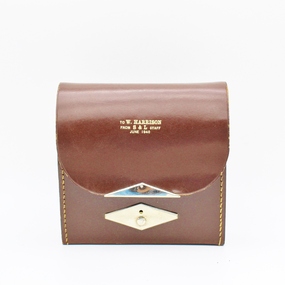
... Items donated (date unknown) by brother-in-law who was living in Montmorency and was a committee member of MERSL when item donated. To W.HARRISON From S & L Staff June 1940 Brown vinyl case with silver coloured clasp at front and cotton stitching around edging Bandage Case Functional object Bandage Case ...Owned by William Albert HARRISON (Service Number VX41478; above Link ["WW2 Record"] indicates that Rank on Discharge was Cpl, but other AIF documents, from National Archives Australia [including Proceedings on Discharge - see pdf Media File above], indicate that he was Sergeant).Soldier's name known. Items donated (date unknown) by brother-in-law who was living in Montmorency and was a committee member of MERSL when item donated.Brown vinyl case with silver coloured clasp at front and cotton stitching around edgingTo W.HARRISON From S & L Staff June 1940 -
 Montmorency–Eltham RSL Sub Branch
Plaque - Wooden wall-hanging, Cedar Wooden Wall Hanging, 1941
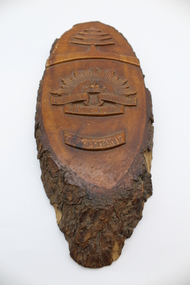
... brother-in-law who was living in Montmorency and was a committee member of MERSL when item donated. Two stamps in French possibly where it was made, Artiols bois des cedres. Becharry Liban. Salim Kabalan. Hand written message;- Mother with all the best to you Bill. Dated 25-10-41 Oval shaped slice of wood from the cedar tree in Lebanon. Carving of a cedar tree across top and emblem of Australian Commonwealth Military Services half way down and Cedar of Lebanon across the bottom half. Stained with light brown ...Owned by William Albert HARRISON (Service Number VX41478; above Link ["WW2 Record"] Sent home to his mother from Liban on 25-10-41 Soldier's name known. Items donated (date unknown) by brother-in-law who was living in Montmorency and was a committee member of MERSL when item donated.Oval shaped slice of wood from the cedar tree in Lebanon. Carving of a cedar tree across top and emblem of Australian Commonwealth Military Services half way down and Cedar of Lebanon across the bottom half. Stained with light brown varnish. Original bark of tree all the way around the edge.Two stamps in French possibly where it was made, Artiols bois des cedres. Becharry Liban. Salim Kabalan. Hand written message;- Mother with all the best to you Bill. Dated 25-10-41 -
 Montmorency–Eltham RSL Sub Branch
Memorabilia - Wooden plate or platter, Souvenir Wooden Platter, 1941
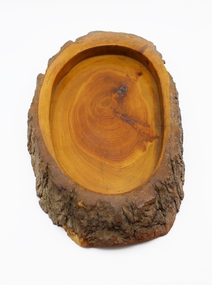
... brother-in-law who was living in Montmorency and was a committee member of MERSL when item donated. Stamp in French possibly where it was made, Artiols bois des cedres. Becharry Liban. Salim Kabalan. Hand written message;- Edna with all the best to you Bill. Dated 25-10-41 Oval shaped slice of wood from the cedar tree in Lebanon. (Liban) Stained with light brown ...Owned by William Albert HARRISON (Service Number VX41478; above Link ["WW2 Record"] Sent home to his mother from Liban on 25-10-41 Soldier's name known. Items donated (date unknown) by brother-in-law who was living in Montmorency and was a committee member of MERSL when item donated.Oval shaped slice of wood from the cedar tree in Lebanon. (Liban) Stained with light brown varnish. Original bark from tree all around trhe edge of plateStamp in French possibly where it was made, Artiols bois des cedres. Becharry Liban. Salim Kabalan. Hand written message;- Edna with all the best to you Bill. Dated 25-10-41 -
 Flagstaff Hill Maritime Museum and Village
Plaque - Nameplate, James & Alexander Brown, 1849 – 1931
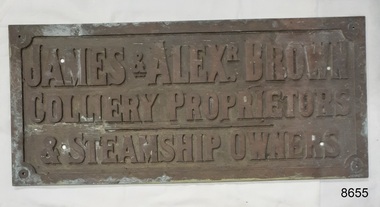
... About James & Alexander Brown: - James (1816-1894), John (1823-1846) and Alexander Brown (1827-1877) migrated with their parents from Scotland to Sydney, Australia, in 1842. The next year James leased land and was assisted by his brothers Alexander and John in mining coal in the area near Maitland. ...About James & Alexander Brown: - James (1816-1894), John (1823-1846) and Alexander Brown (1827-1877) migrated with their parents from Scotland to Sydney, Australia, in 1842. The next year James leased land and was assisted by his brothers Alexander and John in mining coal in the area near Maitland. ...This is one of two cast brass nameplates of James & Alexander Brown in our collection. The Newcastle, NSW, firm was renowned for its coal mining and exporting business established in colonial Australia in 1843. The firm had an office in Melbourne and sold coal for commercial use and from the Wharf for the domestic market. The coal was then distributed along the southwest coast of Victoria in steamships or steam packets and into the regional areas of Victoria by cart and wagon. In 1890 there was a strike of coal workers but the Geelong Advertiser, September 1, 1890, announced that “a firm of coal merchants only recently received some large cargoes from Newcastle”. This supply of coal could have originated at the colliery of James & Alexander Brown. About James & Alexander Brown: - James (1816-1894), John (1823-1846) and Alexander Brown (1827-1877) migrated with their parents from Scotland to Sydney, Australia, in 1842. The next year James leased land and was assisted by his brothers Alexander and John in mining coal in the area near Maitland. The market was very competitive, with the government controlling prices. James was instrumental in a legal battle that resulted in the introduction of open competition for coal mining. James and Alexander had become business partners by 1852 and moved south of Newcastle where they established and worked a profitable mining enterprise. Their assets by 1857 included a ships’ chandlery, a fleet of steamships and an overseas trading business. They were the first firm to import rum, sugar and coffee into Newcastle. By 1892 they were exporting coal to New Zealand, China, North America, and various colonial ports. They had elaborate workshops to service their own steam engines and steamships. They were the first to use a steam collier vessel in Australian waters and they set up the second tug boat in Newcastle, the beginning of being owners of many more tug boats and performing a towing business. By 1868 James & Alexander Brown was the largest coal producer in the colony. James focused on managing the colliery and Alexander on overseas trade. It was estimated that the firm had produced over eight per cent of coal in New South Wales by 1914. James & Alexander Brown advertised in the Melbourne Herald in the early 1900s and kept an office at Queen Street, Melbourne as well as at the Wharf, stating their telephone numbers for both places. The coal was available for ‘Immediate Delivery’ for household and industrial purposes. The advertising claimed that their Pelaw Main coal was the famous household coal that met the highest test in Australia and burned bright and clean. Domestic customers could purchase the coal at the wharf or pay for delivery. Commercial customers could load their purchases into their steamships or wagons for further distribution into regional Victoria. After James’s death in 1894 his son John managed the firm, which was also known as J & A Brown. John passed away in 1930 and his sons took over. In 1931 the firm amalgamated with Abermain Seaham and the new name was J & A Brown & Abermain Seaham Collieries Ltd. commonly abbreviated to JABAS, which merged with Caledonian Collieries Ltd in 1960 and Coal & Allied Industries Ltd. was formed. The pair of nameplates is significant for its connection with the firm James & Alexander Brown. The firm was established in 1845 and became one of the largest collieries in colonial Australia. It was involved in trading within Australia and overseas. James was involved in the introduction of open competition for coal mining prices. They were the first to use a steam colliery in Australian waters and the first to import goods such as rum, sugar and coffee into New South Wales. The firm had a Melbourne office in the early 1900s, selling and distributing coal throughout Victoria, which likely included the Port of Warrnambool, which opened in 1890. The nameplates are likely to have originated from the Melbourne location.Brass Entrance Name Plate, one of a pair. Eight holes are formed through the plate; one in each corner, and four more holes are within the inscription area. The cast plate has three rows of text with the company’s name and type of business. The plate was owned by James & Alex. Brown. "JAMES & ALEXR. BROWN / COLLIERY PROPRIETORS / & STEAMSHIP OWNERS"flagstaff hill, warrnambool, maritime museum, maritime village, great ocean road, shipwreck coast, nameplate, james & alexander brown, j & a brown, james & alexr brown, colliery proprietors, steamship owners, ship chandlers, coal mine, coal export, australian import, australian export, newcastle, colliers, coastal trade, steamships -
 Flagstaff Hill Maritime Museum and Village
Plaque - Nameplate, James & Alexander Brown, 1849 – 1931
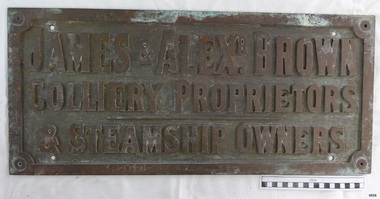
... About James & Alexander Brown: - James (1816-1894), John (1823-1846) and Alexander Brown (1827-1877) migrated with their parents from Scotland to Sydney, Australia, in 1842. The next year James leased land and was assisted by his brothers Alexander and John in mining coal in the area near Maitland. ...About James & Alexander Brown: - James (1816-1894), John (1823-1846) and Alexander Brown (1827-1877) migrated with their parents from Scotland to Sydney, Australia, in 1842. The next year James leased land and was assisted by his brothers Alexander and John in mining coal in the area near Maitland. ...This is one of two cast brass nameplates of James & Alexander Brown in our collection. The Newcastle, NSW, firm was renowned for its coal mining and exporting business established in colonial Australia in 1843. The firm had an office in Melbourne and sold coal for commercial use and from the Wharf for the domestic market. The coal was then distributed along the southwest coast of Victoria in steamships or steam packets and into the regional areas of Victoria by cart and wagon. In 1890 there was a strike of coal workers but the Geelong Advertiser, September 1, 1890, announced that “a firm of coal merchants only recently received some large cargoes from Newcastle”. This supply of coal could have originated at the colliery of James & Alexander Brown. About James & Alexander Brown: - James (1816-1894), John (1823-1846) and Alexander Brown (1827-1877) migrated with their parents from Scotland to Sydney, Australia, in 1842. The next year James leased land and was assisted by his brothers Alexander and John in mining coal in the area near Maitland. The market was very competitive, with the government controlling prices. James was instrumental in a legal battle that resulted in the introduction of open competition for coal mining. James and Alexander had become business partners by 1852 and moved south of Newcastle where they established and worked a profitable mining enterprise. Their assets by 1857 included a ships’ chandlery, a fleet of steamships and an overseas trading business. They were the first firm to import rum, sugar and coffee into Newcastle. By 1892 they were exporting coal to New Zealand, China, North America, and various colonial ports. They had elaborate workshops to service their own steam engines and steamships. They were the first to use a steam collier vessel in Australian waters and they set up the second tug boat in Newcastle, the beginning of being owners of many more tug boats and performing a towing business. By 1868 James & Alexander Brown was the largest coal producer in the colony. James focused on managing the colliery and Alexander on overseas trade. It was estimated that the firm had produced over eight per cent of coal in New South Wales by 1914. James & Alexander Brown advertised in the Melbourne Herald in the early 1900s and kept an office at Queen Street, Melbourne as well as at the Wharf, stating their telephone numbers for both places. The coal was available for ‘Immediate Delivery’ for household and industrial purposes. The advertising claimed that their Pelaw Main coal was the famous household coal that met the highest test in Australia and burned bright and clean. Domestic customers could purchase the coal at the wharf or pay for delivery. Commercial customers could load their purchases into their steamships or wagons for further distribution into regional Victoria. After James’s death in 1894 his son John managed the firm, which was also known as J & A Brown. John passed away in 1930 and his sons took over. In 1931 the firm amalgamated with Abermain Seaham and the new name was J & A Brown & Abermain Seaham Collieries Ltd. commonly abbreviated to JABAS, which merged with Caledonian Collieries Ltd in 1960 and Coal & Allied Industries Ltd. was formed. The pair of nameplates is significant for its connection with the firm James & Alexander Brown. The firm was established in 1845 and became one of the largest collieries in colonial Australia. It was involved in trading within Australia and overseas. James was involved in the introduction of open competition for coal mining prices. They were the first to use a steam colliery in Australian waters and the first to import goods such as rum, sugar and coffee into New South Wales. The firm had a Melbourne office in the early 1900s, selling and distributing coal throughout Victoria, which likely included the Port of Warrnambool, which opened in 1890. The nameplates are likely to have originated from the Melbourne location.Brass Entrance Name Plate, one of a pair. Eight holes are formed through the plate; one in each corner, and four more holes are within the inscription area. The cast plate has three rows of text with the company’s name and type of business. The plate was owned by James & Alex. Brown. "JAMES & ALEXR. BROWN / COLLIERY PROPRIETORS / & STEAMSHIP OWNERS"flagstaff hill, flagstaff hill maritime museum and village, warrnambool, maritime museum, maritime village, great ocean road, shipwreck coast, nameplate, james & alexander brown, j & a brown, james & alexr brown, colliery proprietors, steamship owners, ship chandlers, coal mine, coal export, australian import, australian export, newcastle, colliers, coastal trade, steamships -
 Phillip Island and District Historical Society Inc.
Booklet, Churchill Island Sale Booklet, 1938
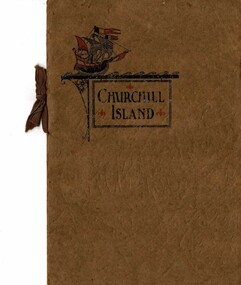
... The Jeffrey brothers were promised by Buckley that Churchill Island would be passed to them on his death but this never happened. Historical Churchill Island Churchill Island Sale Brown covered booklet with Information, maps and photos of Churchill Island Churchill Island Sale Booklet Booklet ...Small booklet prepared for the Sale of Churchill Island - distributed by Martin & Co. Melbourne. The Island was owned from 1929 until this time by Gerald Buckley . An absentee owner, Buckley employed the Jeffery brothers, Bob and Ted, with the help of Harry Cleeland, to run the property. The Jeffrey brothers were promised by Buckley that Churchill Island would be passed to them on his death but this never happened. HistoricalBrown covered booklet with Information, maps and photos of Churchill Islandchurchill island, churchill island sale
