
Showing 1204 items matching " carriage"
-
 Port Melbourne Historical & Preservation Society
Book, Hackney Carriage Committee, Borough of Sandridge, Municipal Council of Sandridge - Hackney Carriage Committee Minutes, 1860 - 1877
... Municipal Council of Sandridge - Hackney Carriage Committee Minutes...Volume of minutes of three meetings of the Sandridge Borough Council Hackney Carriage Committee. 27.03.1861 - 09.09.1861...Hackney Carriage Committee, Borough of Sandridge...Local Government - Borough of Sandridge Transport - Horse Joseph Weaver ALLEN Robert BYRNE William MORLEY Thomas SWALLOW Volume of minutes of three meetings of the Sandridge Borough Council Hackney Carriage Committee. 27.03.1861 - 09.09.1861 Municipal Council of Sandridge - Hackney Carriage Committee Minutes Book Hackney Carriage Committee, Borough of Sandridge ...Volume of minutes of three meetings of the Sandridge Borough Council Hackney Carriage Committee. 27.03.1861 - 09.09.1861local government - borough of sandridge, transport - horse, joseph weaver allen, robert byrne, william morley, thomas swallow -
Camberwell Historical Society
Document, Rooks & Rooks Carriage Builders et al, Rooks & Rooks Carriage Builders correspondence items, March - April 1921
... Rooks & Rooks Carriage Builders correspondence items...Letter and invoice from 'Rooks & Rooks' Carriage Builders, 15-25 Riversdale Road, Camberwell, 1921...Rooks & Rooks Carriage Builders...receipt camberwell invoice carriage builders Letter and invoice from 'Rooks & Rooks' Carriage Builders, 15-25 Riversdale Road, Camberwell, 1921 Rooks & Rooks Carriage Builders correspondence items Document Document Rooks & Rooks Carriage Builders Henry Rooks, proprietor ...Letter and invoice from 'Rooks & Rooks' Carriage Builders, 15-25 Riversdale Road, Camberwell, 1921receipt, camberwell, invoice, carriage builders -
 Coal Creek Community Park & Museum
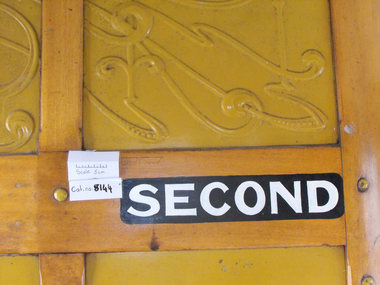
Railway Carriage, Second Class Railway Carriage, 1911 - 1914
... Second Class Railway Carriage...This carriage forms part of a matching set of the W classification which were built to match each other around 1914...Second class railway carriage red in colour with a white clerestory roof. ...The outside of the carriage has the numbers 2 BW painted on the side....This carriage forms part of a matching set of the W classification which were built to match each other around 1914 The outside of the carriage has the numbers 2 BW painted on the side. ...This carriage forms part of a matching set of the W classification which were built to match each other around 1914Second class railway carriage red in colour with a white clerestory roof. It has 7 compartments each with two green vinyl bench seats. Pressed metal ceilings with a light in the centre and racks above the seats. There is a men's toilet at one end of the carriage and a ladies toilet at the other end, with a double seat outside both toilets as a waiting area. In these areas there are several Art Nouveau pressed metal panels. The outside of the carriage has the numbers 2 BW painted on the side. -
 Daylesford & District Historical Society
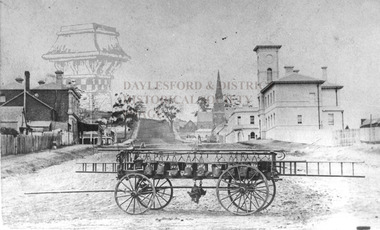
Photograph (copy), Daylesford Fire Brigade First Ladder Carriage, c1867 (original)
... Daylesford Fire Brigade First Ladder Carriage...The Daylesford Fire Brigade carriage was locally built by White and Oldham, wheelwrights and carriage makers to the design of Captain Henshaw. ...Black and white photograph showing the first ladder carriage of the Daylesford Fire Brigade taken from Bridport Street looking towards Wombat Hill. ...Date about mid 1860s. This ladder carriage was locally built by a wheel and carriage maker with premises behind Victorian Hotel. ...The Daylesford Fire Brigade carriage was locally built by White and Oldham, wheelwrights and carriage makers to the design of Captain Henshaw. ...The Daylesford Fire Brigade carriage was locally built by White and Oldham, wheelwrights and carriage makers to the design of Captain Henshaw. Their premises was behind the Victoria Hotel, and American by origin.Photograph of the first ladder carriage bought by the Daylesford Volunteer Fire Brigade, built locally, and designed by Captain Henshaw. It is an important record of purchase and some significant buildings circa 1867.Black and white photograph showing the first ladder carriage of the Daylesford Fire Brigade taken from Bridport Street looking towards Wombat Hill. The carriage stands in Victoria Street (now Central Springs Road) and shows the former Daylesford Post Office on the right. The building on the left was the Bank of Victoria, later the Belvedere Hotel, and in 2012 was Kookla. Other buildings include Victoria Building, Church of England (Anglican), Stanbridge Hall.The carriage shows ten canvas water buckets hanging on hooks, a long ladder and two hoses hang from hooks on the lower section of the four wheeled carriage. The roads and footpaths are unsealed.Typed verso: "Copied from on original kindly loaned by J. Ogilthorpe. Shows Daylesford Fire Brigades first Ladder Carriage outside the then Fire Station where Kindergarten now stands 1977. Date about mid 1860s. This ladder carriage was locally built by a wheel and carriage maker with premises behind Victorian Hotel. White and Oldham. Designed by Capt. Henshaw was an American who went to the New Zealand goldfields about 1870. Post Office was built in 1867. On Belvedre (sic) at this time a a Bank, Bank of Victoria." Stamped: "Daylesford and District Historical Society"dayelsford, daylesford fire brigade, henshaw, post office, white and oldham, -
 Coal Creek Community Park & Museum
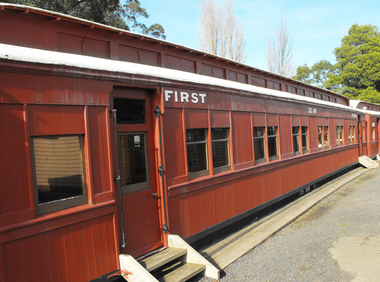
Railway Carriage, First Class Railway Carriage, 1922
... First Class Railway Carriage...Part of a matching set of W class carriages....First Class railway carriage 35 AW red with a white clerestory roof. ...The carriage has the 35AW mark on the outside. ...Part of a matching set of W class carriages. The carriage has the 35AW mark on the outside. ...Part of a matching set of W class carriages.First Class railway carriage 35 AW red with a white clerestory roof. Six compartments each with six green possibly leather studded seats with arm and head rests. The floor is carpeted and there is a white metal drinking fountain with a tap in the corridor. Each compartment also has decorative pressed metal ceiling, overhead racks and a central light fixture. There is a mens' and ladies' seating area at each end with a toilet.The carriage has the 35AW mark on the outside. -
 Puffing Billy Railway
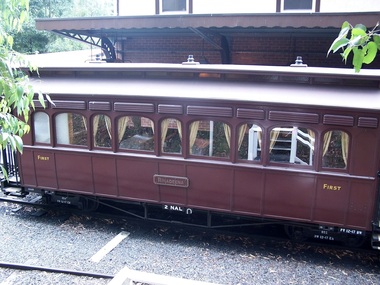
Equipment - Railway carriage (pbr Rinadeena No.2nal) ( Mt. Lyell Mining & Railway Company No.02), 1901–1902
... Four saloon end-platform cars originally built during 1901–1902 by the Lancaster Railway Carriage and Wagon Company Ltd. for the 3'6" gauge Mt. ...The word 'FIRST' is painted in gold at both ends of the carriage. The car has nine windows on either side of the carriage and a wrought iron ballastrade upon entry at eiether end of the carriage as well as iron steps to ascend. ...Lancaster Railway Carriage and Wagon Company...The word 'FIRST' is painted in gold at both ends of the carriage. The car has nine windows on either side of the carriage and a wrought iron ballastrade upon entry at eiether end of the carriage as well as iron steps to ascend. ...2 NAL - Rinadeena - (Mt. Lyell) O 2; 2 NBL - 1st. class saloon car (20) NAL FIRST-CLASS SALOON CAR. Four saloon end-platform cars originally built during 1901–1902 by the Lancaster Railway Carriage and Wagon Company Ltd. for the 3'6" gauge Mt. Lyell Mining & Railway Company in Tasmania and classed O. Converted for use as second-class cars on the 2'6" gauge Puffing Billy Railway during 1965–1966, these cars were reclassified NBL and numbered 1–4. The L recognises their Mt. Lyell origin, No. 1 was kept for use as the Railway's VIP car and was reconditioned to a higher standard. No. 2 was similarly upgraded in 1985 for use on special occasions. In 1989 No. 3 was similarly reconditioned with No. 4 receiving similar treatment in 1995. These cars were re-classified NAL in recognition of their new first-class nature. The Mt Lyell Railway was closed in 1963 and subsequently dismantled, but fortunately several of the locomotives and carriages passed into preservation. Purchased by the Puffing Billy Preservation Society from the Mount Lyell Mining & Railway Company in the 1960's and converted to 2' 6" gauge. It has since given many years of service on the Puffing Billy Railway. TASMANIAN CARRIAGES & GUARDS VANS No. Builder Type Year built Ex. Location Note NAL 1 Lancaster Railway Carriage and Wagon Co Saloon 1901 Mt Lyell Railway Named Mt Lyell NAL 2 Lancaster Railway Carriage and Wagon Co Saloon 1901 Mt Lyell Railway Named Rinadeena NAL 3 Lancaster Railway Carriage and Wagon Co Saloon 1901 Mt Lyell Railway Named Teepookana NAL 4 Lancaster Railway Carriage and Wagon Co Saloon 1901 Mt Lyell Railway Named Dubbil BarrilThe Rinadeena is a stunning example of a classic narrow gauge 1st Class Saloon Carriage, used as a luxury edition to train travel in the late 1800s and the 2NAL within Puffing Billy's collection was purchased by the Puffing Billy Preservation Society in the 1960s, where it underwent restoration to become part of the railway's historic transport collection.A timber and iron saloon car - painted in crimson with a name plate 'Rinadeena' attached to the centre of the carriage and the words '2 NAL' painted in white directly below. The word 'FIRST' is painted in gold at both ends of the carriage. The car has nine windows on either side of the carriage and a wrought iron ballastrade upon entry at eiether end of the carriage as well as iron steps to ascend. Inside the carriage are 10 bench seats made of wood and leather and ten tables for dining. The windows are adorned with cream cloth fabric and above each bench are wrought iron luggae racks. The ceiling is covered in cloth and features two suspended ornate glass and metal light fixtures. A wooden door with two glass panels can be found at both ends of the carriage.2 NAL - Rinadeenarailway carriages, first class saloon, narrow gauge, rinadeena, mt lyell, transport, travel, leisure, luxury -
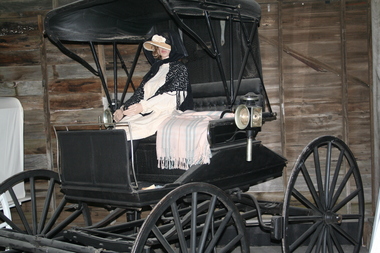 Trafalgar Holden Museum
Vehicle - Carriage, 1888
... Carriage...Two seat carriage drawn by single horse. ...Lanterns also fixed to both sides of carriage...Lanterns also fixed to both sides of carriage Vehicle Carriage ...Two seat carriage drawn by single horse. Manufactured and sold by Holden and Frost of AdelaideFour wheeled carriage with the driver and passenger area covered with a coated canvas canopy, four wooden wheels and set up to be pulled by one horse only. A small cargo tray affixed behind main seat. Lanterns also fixed to both sides of carriagecarraige, horse drawn, single horse -
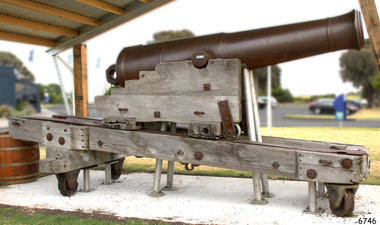 Flagstaff Hill Maritime Museum and Village
Weapon - Cannon, 1861
... The properties of the timber (regarded as being Burmese teak) have helped to preserve these carriages in Australia. This particular carriage and traversing slide would have been manufactured about the same time as the gun (in 1861) in the Royal Carriage Department of the Royal Gun Factory in Woolwich, England. ...Mounted on the wooden carriage with wrought iron traversing slide and wrought iron runners and fittings. ......Royal Carriage Department, Royal Gun Factory...The properties of the timber (regarded as being Burmese teak) have helped to preserve these carriages in Australia. This particular carriage and traversing slide would have been manufactured about the same time as the gun (in 1861) in the Royal Carriage Department of the Royal Gun Factory in Woolwich, England. ...The artillery piece of the cannon was cast at the Low Moor foundry in England in 1861. It is a 68 pound muzzle loading cannon, capable of firing a 68 pound weight projectile. The arrow on the top of the barrel is the symbol of government ownership. It is probably one of the artillery pieces purchased by the Victorian government in response to the 1863 report by Captain Scratchley, which recommended 19 such artillery pieces be bought for the defence of Hobsons Bay, (Williamstown, Melbourne) (Billets p.12). It was possibly brought to Warrnambool in the late 1860s or the 1870s, to be used for training purposes by volunteers and local militia. The wrought iron runners were probably added to the slides at a later date. This model of carriage had been manufactured since 1855, and the traversing slide since 1860. The traversing slide of the wooden carriage absorbs the recoil when the gun is then returns to the gun to its original position for loading and re-firing. The properties of the timber (regarded as being Burmese teak) have helped to preserve these carriages in Australia. This particular carriage and traversing slide would have been manufactured about the same time as the gun (in 1861) in the Royal Carriage Department of the Royal Gun Factory in Woolwich, England. The gun would then have been assembled on the traversing slide of the carriage, then despatched as a unit. The wooden slide compressor mechanism that belongs to the cannon was used to limit the recoil when the cannon was fired. It is now stored separately for purposes of preservation. It is extremely rare, as it is the only one surviving in this group of South Western Victorian cannons.This 68 pdr cannon, mounted with its original wooden carriage, is part of the South Western Victoria collection of surviving 19th Century artillery pieces, item number W/F/02. It is rated as EXTREMELY RARE on a State, National and World level. The 68 pound smooth bore cannon of this period are not particularly rare either in Australia or overseas; its significance lies in its Victorian provenance and as an element in a major collection of 19th century cannon. The number of surviving carriages with traversing slides in this group in South Western Victoria is unique in Australia and probably in the World. Out of 10 such platforms surviving in Australia, the South Western Victorian group has half. Several survive around the world but probably not in such a large group. The wooden sliding compressor mechanism belonging to this cannon is extremely rare, and the only one in this South Western Victorian group of Guns and Cannons. As a whole, this cannon has undergone very little restoration or modification, giving it a high level of integrity.Warrnambool Garrison Cannon. 68pdr smoothbore, muzzle-loading, cast-iron cannon. Manufactured in Low Moor, 1861, No. 10310. Mounted on the wooden carriage with wrought iron traversing slide and wrought iron runners and fittings. The cannon's Cascabel is cast with a loop. The wooden slide Compressor Mechanism, or Recoil Mechanism, is extremely rare. This mechanism comprises two equal-sized sections of wood, one on each side of the centre, joined by metal rods. In the centre of this wooden platform, with openings, top and bottom is a 15cm diameter metal cylinder with two cusps on the edge of the top (this wood has split over time). Two parallel sides each have two 1cm thick metal "L' plates attached 15cm long and 8.5cm wide. With the unit is ‘ L’ bracket, curved bracket and bolt head.Cannon trunnion "LOW MOOR / 10310 / 1861" Top of the barrel "7045, (symbol of an arrow pointing up), 95 – 3 – 14, 1861, 209" Cascabel "CV / N / C" The rear of left-hand slide " "OD” “JW” “No 33” Side chock – “JW” twice. flagstaff hill, warrnambool, shipwrecked-coast, flagstaff-hill, flagstaff-hill-maritime-museum, maritime-museum, shipwreck-coast, flagstaff-hill-maritime-village, muzzle loading cannon, 68 pound cannon, low moor foundry, royal gun factory, warrnambool militia, warrnambool garrison volunteers, warrnambool fortifications, wooden sliding compression mechanism, carriage and traversing slide, 19th century cannon, traversing platform, garrison sliding carriage, 68 pounder -
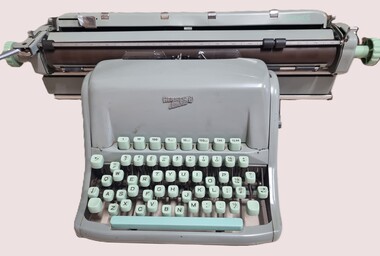 Wodonga & District Historical Society Inc
Functional object - Hermes 8 Standard Wide Carriage Typewriter, Paillard, 1964
... Hermes 8 Standard Wide Carriage Typewriter...Typewriters of this model with a wide carriage were considered to be quiet rare. They were designed for the operator to be able to produce wide ledgers. ...A pale green Hermes Standard 8 typewriter with wide carriage....Yverdon A pale green Hermes Standard 8 typewriter with wide carriage. Hermes 8 Standard Wide Carriage Typewriter Functional object Hermes 8 Standard Wide Carriage Typewriter Paillard ...Hermes typewriters were manufactured by Paillard S.A. of Yverdon in Switzerland. Paillard Ltd (originally Maison Paillard) was a premier Swiss precision engineering company which operated for 175 years. It developed from a small watchmaker collective into a global leader in typewriters as well as gramophones, radio sets and, under the name of Paillard-Bolex, cameras and film cameras. Paillard began making typewriters under the Hermes name in 1923. Early typewriters were usually heavy office typewriters but over time popular portable typewriters were added to their range. The Hermes Standard 8 typewriter was produced between 1953 and 1965. It was a heavy-duty desktop model. Typewriters of this model with a wide carriage were considered to be quiet rare. They were designed for the operator to be able to produce wide ledgers. However by 1963 its successor the Hermes Standard 9 had gone into production. With the rise of personal computers in the 1980s, typewriters gradually fell into obsolescence and came to be thought of as an outdated writing technology of the past. The company was ultimately taken over by Olivetti in 1981, and operations largely ceased by 1989. This item is significant because it was a popular and important piece of office equipment used in many Wodonga business in the 1950s and 1960s.A pale green Hermes Standard 8 typewriter with wide carriage.Serial Number 8120839 Hermes Standard 8 On back - HERMES / Made in Switzerland / paillard s.a. Yverdontypewriter, hermes typewriters, functional office equipment -
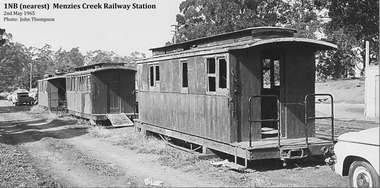 Puffing Billy Railway
1NB, Saloon carriage, 4/ 2/1899
... Saloon carriage...1NB - (1st Series) Saloon carriage (24) Body and underframe purchased by Puffing Billy Preservation Society from Pakenham In Active Service NB There were three types:- NB Class - Number Built (1st Series) 6 - Number Built (2nd Series) 17 - Number Built (3rd Series) 4 Nos. 1-6 were Saloon cars having end platforms and a ladies toilet, and were built from 1899-1904. ...1NB Passenger Rolling Stock: Saloon carriage (No. 1) - Made of Timber and steel ...VR Service History NBB 1.VA - 4/ 2/1899 NWS Built new - circa 1910 - To NB 1.VA - *NB 1.VA - / 2/1928 - Modified AC Malco BO 21/10/1930 NWS Into Workshops - 5/12/1930 NWS Out of Workshops (46 days) 30/ 1/1951 - Scrapped Historic - Victorian Railways Narrow Gauge - Passenger Rolling Stock: Saloon carriage (No. 1) Victorian Heritage Register (VHR) Number H2187 The Puffing Billy Rolling Stock Collection puffing billy 1nb saloon carriage victorian railways narrow gauge passenger rolling stock 2'6" guage 1NB 1NB Passenger Rolling Stock: Saloon carriage (No. 1) - Made of Timber and steel Saloon carriage 1NB Victorian Railways - Newport Workshop ...1NB - (1st Series) Saloon carriage (24) Body and underframe purchased by Puffing Billy Preservation Society from Pakenham In Active Service NB There were three types:- NB Class - Number Built (1st Series) 6 - Number Built (2nd Series) 17 - Number Built (3rd Series) 4 Nos. 1-6 were Saloon cars having end platforms and a ladies toilet, and were built from 1899-1904. Nos. 7-23 were 5-compartment side loading cars, built from 1906-1915. Nos. 24-27 were the former NAB class cars mentioned previously and were also side loading, having 6 compartments and two ladies toilets. VR Service History NBB 1.VA - 4/ 2/1899 NWS Built new - circa 1910 - To NB 1.VA - *NB 1.VA - / 2/1928 - Modified AC Malco BO 21/10/1930 NWS Into Workshops - 5/12/1930 NWS Out of Workshops (46 days) 30/ 1/1951 - Scrapped Historic - Victorian Railways Narrow Gauge - Passenger Rolling Stock: Saloon carriage (No. 1) Victorian Heritage Register (VHR) Number H2187 The Puffing Billy Rolling Stock Collection1NB Passenger Rolling Stock: Saloon carriage (No. 1) - Made of Timber and steel 1NBpuffing billy, 1nb, saloon carriage, victorian railways, narrow gauge passenger rolling stock, 2'6" guage -
 Puffing Billy Railway
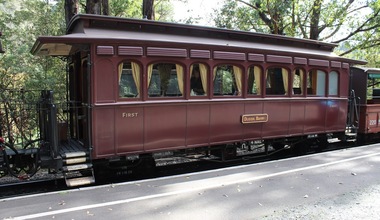
4 NAL (Dubbil Barril), 1st. class saloon car, 1901–1902
... Four saloon end-platform cars originally built during 1901–1902 by the Lancaster Railway Carriage and Wagon Company Ltd. for the 3'6" gauge Mt. ...Lancaster Railway Carriage and Wagon Company...Four saloon end-platform cars originally built during 1901–1902 by the Lancaster Railway Carriage and Wagon Company Ltd. for the 3'6" gauge Mt. ...4 NAL - Dubbil Barril - (Mt. Lyell) O 6; 4 NBL - 1st. class saloon car (28) NAL FIRST-CLASS SALOON CAR. Four saloon end-platform cars originally built during 1901–1902 by the Lancaster Railway Carriage and Wagon Company Ltd. for the 3'6" gauge Mt. Lyell Mining & Railway Company in Tasmania and classed O. Converted for use as second-class cars on the 2'6" gauge Puffing Billy Railway during 1965–1966, these cars were reclassified NBL and numbered 1–4. The L recognises their Mt. Lyell origin, No. 1 was kept for use as the Railway's VIP car and was reconditioned to a higher standard. No. 2 was similarly upgraded in 1985 for use on special occasions. In 1989 No. 3 was similarly reconditioned with No. 4 receiving similar treatment in 1995. These cars were re-classified NAL in recognition of their new first-class nature. The Mt Lyell Railway was closed in 1963 and subsequently dismantled, but fortunately several of the locomotives and carriages passed into preservation. Purchased by the Puffing Billy Presevation Society from the Mount Lyell Mining & Railway Company in the 1960s and converted to 2' 6" gauge. It has since given many years of service on the Puffing Billy Railway. TASMANIAN CARRIAGES & GUARDS VANS No. Builder Type Year built Ex. Location Note NAL 1 Lancaster Railway Carriage and Wagon Co Saloon 1901 Mt Lyell Railway Named Mt Lyell NAL 2 Lancaster Railway Carriage and Wagon Co Saloon 1901 Mt Lyell Railway Named Rinadeena NAL 3 Lancaster Railway Carriage and Wagon Co Saloon 1901 Mt Lyell Railway Named Teepookana NAL 4 Lancaster Railway Carriage and Wagon Co Saloon 1901 Mt Lyell Railway Named Dubbil Barril Lancaster Railway Carriage and Wagon Co The Lancaster Company was formed in 1863 and owned extensive works on the outskirts of Lancaster where it produced railway rolling stock of all descriptions, tram cars, wheels and axles, etc and had a reputation for work of a very high-class character. In 1902 Metropolitan Amalgamated Railway Carriage and Wagon Co was registered on 18 April and incorporated as a limited company to amalgamate 6 companies including Lancaster Railway Carriage and Wagon Co These works were closed in 1908 when the business was transferred to Ashbury.Historic - Industrial Narrow Gauge railway - Mt. Lyell Mining & Railway Company in Tasmania - 1st Class Saloon Carriage1st. class saloon car made of Timber and steel4 NAL - Dubbil Barrilpuffing billy railway, narrow gauge -
 Ringwood and District Historical Society
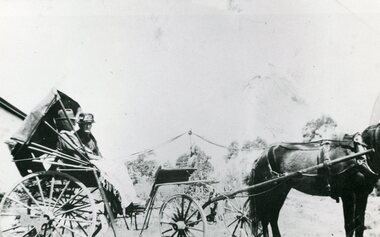
Photograph, Mr & Mrs J.McAlpin in horse drawn carriage- Ringwood, c1918
... Mr & Mrs J.McAlpin in horse drawn carriage- Ringwood, c1918..."Written on back of photograph" Mr & Mrs J.McAlpin in horse drawn carriage. ..."Written on back of photograph" Mr & Mrs J.McAlpin in horse drawn carriage. Black and white photograph Mr & Mrs J.McAlpin in horse drawn carriage- Ringwood, c1918 Photograph ...Black and white photograph"Written on back of photograph" Mr & Mrs J.McAlpin in horse drawn carriage. -
 Puffing Billy Railway
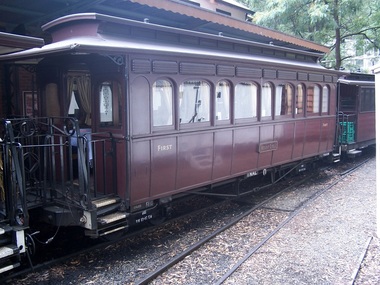
1 NAL (Mount Lyell), 1st. class saloon car, 1901–1902
... Four saloon end-platform cars originally built during 1901–1902 by the Lancaster Railway Carriage and Wagon Company Ltd. for the 3'6" gauge Mt. ...Lancaster Railway Carriage and Wagon Company...Location Note NAL 1 Lancaster Railway Carriage and Wagon Co Saloon 1901 Mt Lyell Railway Named Mt Lyell NAL 2 Lancaster Railway Carriage and Wagon Co Saloon 1901 Mt Lyell Railway Named Rinadeena NAL 3 Lancaster Railway Carriage and Wagon Co Saloon 1901 Mt Lyell Railway Named Teepookana NAL 4 Lancaster Railway Carriage and Wagon Co Saloon 1901 Mt Lyell Railway Named Dubbil Barril Historic - Industrial Narrow Gauge railway - Mt. ...1 NAL - Mt. Lyell - (Mt. Lyell) O 5; 1 NBL - 1st. class saloon car (20) In Active Service Puffing billy railway NAL FIRST-CLASS SALOON CAR. Four saloon end-platform cars originally built during 1901–1902 by the Lancaster Railway Carriage and Wagon Company Ltd. for the 3'6" gauge Mt. Lyell Mining & Railway Company in Tasmania and classed O. Converted for use as second-class cars on the 2'6" gauge Puffing Billy Railway during 1965–1966, these cars were reclassified NBL and numbered 1–4. The L recognises their Mt. Lyell origin, No. 1 was kept for use as the Railway's VIP car and was reconditioned to a higher standard. No. 2 was similarly upgraded in 1985 for use on special occasions. In 1989 No. 3 was similarly reconditioned with No. 4 receiving similar treatment in 1995. These cars were re-classified NAL in recognition of their new first-class nature. The Mt Lyell Railway was closed in 1963 and subsequently dismantled, but fortunately several of the locomotives and carriages passed into preservation. This original Mt Lyell Railway passenger carriage was donated to the Puffing Billy Preservation Society by the Mount Lyell Mining & Railway Company in the 1960s and was converted to 2' 6" gauge. It has since given many years of service on the Puffing Billy Railway. TASMANIAN CARRIAGES & GUARDS VANS No. Builder Type Year built Ex. Location Note NAL 1 Lancaster Railway Carriage and Wagon Co Saloon 1901 Mt Lyell Railway Named Mt Lyell NAL 2 Lancaster Railway Carriage and Wagon Co Saloon 1901 Mt Lyell Railway Named Rinadeena NAL 3 Lancaster Railway Carriage and Wagon Co Saloon 1901 Mt Lyell Railway Named Teepookana NAL 4 Lancaster Railway Carriage and Wagon Co Saloon 1901 Mt Lyell Railway Named Dubbil BarrilHistoric - Industrial Narrow Gauge railway - Mt. Lyell Mining & Railway Company in Tasmania - 1st Class Saloon Carriage 1st. class saloon car made of Timber and Steel1 NAL - Mt. Lyell -
 Puffing Billy Railway
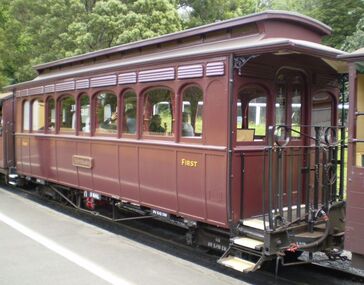
3 NAL (Teepookana), 1st. class saloon car, 1901–1902
... Four saloon end-platform cars originally built during 1901–1902 by the Lancaster Railway Carriage and Wagon Company Ltd. for the 3'6" gauge Mt. ...Lancaster Railway Carriage and Wagon Company...Four saloon end-platform cars originally built during 1901–1902 by the Lancaster Railway Carriage and Wagon Company Ltd. for the 3'6" gauge Mt. ...3 NAL - Teepookana - (Mt. Lyell) O 3; 3 NBL - 1st. class saloon car (20) NAL FIRST-CLASS SALOON CAR. Four saloon end-platform cars originally built during 1901–1902 by the Lancaster Railway Carriage and Wagon Company Ltd. for the 3'6" gauge Mt. Lyell Mining & Railway Company in Tasmania and classed O. Converted for use as second-class cars on the 2'6" gauge Puffing Billy Railway during 1965–1966, these cars were reclassified NBL and numbered 1–4. The L recognises their Mt. Lyell origin, No. 1 was kept for use as the Railway's VIP car and was reconditioned to a higher standard. No. 2 was similarly upgraded in 1985 for use on special occasions. In 1989 No. 3 was similarly reconditioned with No. 4 receiving similar treatment in 1995. These cars were re-classified NAL in recognition of their new first-class nature. The Mt Lyell Railway was closed in 1963 and subsequently dismantled, but fortunately several of the locomotives and carriages passed into preservation. Purchased by Puffing Billy Preservation Society from the Mount Lyell Mining & Railway Company in the 1960s, it was converted to 2' 6" gauge. It has since given many years of service on the Puffing Billy Railway. TASMANIAN CARRIAGES & GUARDS VANS No. Builder Type Year built Ex. Location Note NAL 1 Lancaster Railway Carriage and Wagon Co Saloon 1901 Mt Lyell Railway Named Mt Lyell NAL 2 Lancaster Railway Carriage and Wagon Co Saloon 1901 Mt Lyell Railway Named Rinadeena NAL 3 Lancaster Railway Carriage and Wagon Co Saloon 1901 Mt Lyell Railway Named Teepookana NAL 4 Lancaster Railway Carriage and Wagon Co Saloon 1901 Mt Lyell Railway Named Dubbil Barril Lancaster Railway Carriage and Wagon Co The Lancaster Company was formed in 1863 and owned extensive works on the outskirts of Lancaster where it produced railway rolling stock of all descriptions, tram cars, wheels and axles, etc and had a reputation for work of a very high-class character. In 1902 Metropolitan Amalgamated Railway Carriage and Wagon Co was registered on 18 April and incorporated as a limited company to amalgamate 6 companies including Lancaster Railway Carriage and Wagon Co These works were closed in 1908 when the business was transferred to Ashbury 1st Saloon Carriage Owner Mount Lyell Mining and Railway Company, Queenstown, TAS Builder Lancaster Railway Carriage and Wagon Company Ltd, England Build date 1901 - 1902 Car length 31 ft 4 in (9.55 m) Car weight 11 t (11.18 ton) Gauge Original Narrow: 1,067 mm (3 ft 6 in) Rebuilt Narrow: 762 mm (2 ft 6 in) Configuration Bogie Capacity 1 -3: 20 Passengers 4: 28 Passengers Number in class 4 Numbers Mt. Lyell: O 2 - O 3, O 5, O 6 Puffing Billy: NBL 1 - NBL 4, NAL 1 - NAL 4, Mt. Lyell, Teepookana, Rinadeena, Dubbil Barril First run 1901 No. Name Location In Service Withdrawn Condition Livery NAL 1 Mt Lyell, NBL 1 Puffing Billy Reclassed from O 5. Recoded to NAL 1. Operational NAL 2 Teepookana, NBL 2 Puffing Billy Converted from O 2. Upgraded - 1985. Recoded to NAL 2. Operational NAL 3 Rinadeena, NBL 3 Puffing Billy Converted from O 3. Upgraded - 1989. Converted to NAL 3. Operational NAL 4 Dubbil Barril, NBL 4 Puffing Billy Converted from O 6. Upgraded - 1995. Converted to NAL 4. Operational Historic - Industrial Narrow Gauge railway - Mt. Lyell Mining & Railway Company in Tasmania - 1st Class Saloon Carriage1st. class saloon car made of Timber and steel3 NAL - Teepookanapuffing billy railway -
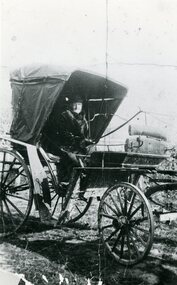 Ringwood and District Historical Society
Photograph, Mrs J.McAlpin in horse drawn carriage-Ringwood, 1918
... Mrs J.McAlpin in horse drawn carriage-Ringwood, 1918..."Written on back of photograph" Mrs J.McAlpin in horse drawn carriage. Taken in Wonga Road - 1918..."Written on back of photograph" Mrs J.McAlpin in horse drawn carriage. Taken in Wonga Road - 1918 Black and white photograph Mrs J.McAlpin in horse drawn carriage-Ringwood, 1918 Photograph ...Black and white photograph"Written on back of photograph" Mrs J.McAlpin in horse drawn carriage. Taken in Wonga Road - 1918 -
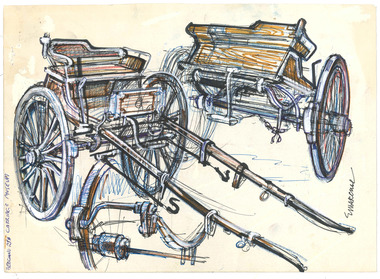 The Beechworth Burke Museum
Drawing, Ernest Marcuse, Beechworth Carriage Museum I, c1972-1976
... Beechworth Carriage Museum I...Obverse: BEECHWORTH CARRIAGE MUSEUM / MARCUSE Reverse: BEECHWORTH NOSTALGIA / BW-08 / B 9 ...Beechworth Carriage Museum I Drawing Drawing Ernest Marcuse ...Ernest Heinrich Marcuse was born on the 1st of December 1900 to Hedwig and Siegmund Marcuse in Berlin Germany. While Marcuse's artistic talent was apparent from a younger age, his earliest existing artwork was from when he was approximately 20 years old. Ernest's formal art training commenced in 1918 with a three year course at the Berlin school of Interior design. After completion he found work until 1924 when Germany's Great Depression took effect. To broaden his career opportunities he undertook a further 12 months study of fashion, drawing and advertising at Berlin's Reiman school of art. From 1925 to 1934 Ernest was primarily a freelance press artist specialising in industrial, architectural and figurative drawing. Prominent newspaper The Berliner Morgenpost was his largest client along with Gross Deutsche Rundfunaustellung (Germany's organisation for major trade shows). During this period he would create many significant works. Two months after Hitler and the Nazi part came to power in 1933, Ernest received a life changing letter stating that being Jewish he could no longer continue employment in Germany. Up until 1938 he would only be able to undertake private commissions and occasional unofficial work as a book illustrator and games designer. This was by arrangement with non Jewish artists who claimed his work as their own, they would then share the income with Ernest. With increasing unrest in Germany during late 1938 Ernest decided to move to London and there he married his girlfriend Lotte. In late 1939 Ernest and Lotte Marcuse embarked on an eight week journey to their new home in Australia where they had been accepted as refugees. Shortly after arriving in Australia Ernest presented his portfolio to an editor at the Argus newspaper and gained employment as a war events illustrator. He soon became well respected and known in particular for his detailed illustrations and cross sections of ships , artillery and aircrafts. His detailed depictions of battles were displayed on the front pages of The Argus newspaper on a number of occasions. In May 1940 as the war intensified Ernest was dismissed from The Argus newspaper due to his Australian government classification of 'stateless person of enemy origin' and was considered a potential security risk. The editor of the time commented "don't blame us, blame Hitler". Marcuse then began to establish himself as a commercial artist. Ernest was de-classified as a 'stateless person of enemy origin' and in early 1942. The Australian army heard of Ernest's artistic abilities and began to utilize his designs for visual training aids and posters. Ernest became Private E.H Marcuse V377746, his first army posting was as staff artist at The infantry officer's training school at Bonegilla. When off duty he was inspired by the beauty of the surrounding area creating the works in North east Victoria 'Kiewa river bridge', 'Hume weir', ' Dried up river bed' and 'Hawksview gold reef mine' from his 1942-1943 period at Bonegilla Victoria. Ernest returned to the area to create drawings and paintings from 1948 to 1983 in locations including Bright, Wandilligong, Bogong High plains and Wallace's Hut, Mt Buffalo, Beechworth, Pretty valley, Kiewa Hydro, Yackandandah and Bontherambo homestead. These sketches were often completed on location, photographs were also taken onsite to assist the works back at the studio. Occasionally Marcuse also painted in the field. Ernest's preferred choice of medium was pencil and ink. Up until 1952 he would often incorporate watercolour into his work. Later into his career he began introducing pastels, acrylic and mixed media. In earlier years Ernest Marcuse often signed his work Mar, later on the signing of works ranged from Marcuse, E.Marcuse, Ernest Marcuse, EHM or simply EM . If a work was considered incomplete or Marcuse did not like the work it would remain unsigned. From Bonegilla Marcuse was transferred to Woodside South Australia before his final posting in Melbourne until the end of 1945. Ernest's work from within his army posting 'Troop Train at Night' from his 1945 exhibition Australia at War are part of the permanent collection at Canberra's War Museum. Between 1946 and 1969 Ernest largely worked from home and concentrated on a career as a freelance commercial artist and graphic designer. During that time he created work for well known household names including CRA/Conzinc, Vacuum oil (Caltex), Cottee's Brand (Schweppes and Heinz), Home Beautiful magazine Fulton garden supplies, International Iveco trucks, Ego pharmaceuticals, QV and Sunsense. After retirement Ernest concentrated on his true love of fine art and focused on painting images of personal interest both across Australia and Internationally. Earnest never drove a car. He would often walk or use public transport or enlist in the help of family or artist friends to drive him. Throughout his career Ernest Marcuse's artworks were purchase by private collectors these included ACTU, Melbourne City council, Holland Constructions, Melbourne Metropolitan Tramways Board, GJ Coles and Australian Resources Bank. Ernest Marcuse permanent collections can be viewed at The National Gallery of Victoria , Sydney Jewish Museum, Jewish Holocaust Centre Melbourne, Canberra's War Museum, City of Melbourne, Shire of Yarra ranges and now the Burke Museum. © 2020 Art by Marcuse https://www.artbymarcuse.com.au/aboutDonated to the Burke Museum through the Australian Government's Cultural Gifts Program by Peter and Evelyn MarcusePen and pencil landscape drawing on paper.Obverse: BEECHWORTH CARRIAGE MUSEUM / MARCUSE Reverse: BEECHWORTH NOSTALGIA / BW-08 / B 9 ernest marcuse, marcuse, art, artbymarcuse, beechworth, burke museum, indigo shire, landscape, illustration, drawing, pen and pencil, australian army, war events illustrator, the age, the sun, the argus, germany, refugee, industrial drawing, architectual drawing, figure drawing, berliner morgenpost, grosse deutsche rundfunaustellung, berlin’s reiman school of art., cultural gifts program -
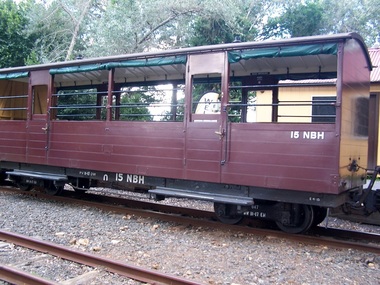 Puffing Billy Railway
15 NBH, Passenger Carriage - Excursion Car, July 1976
... Passenger Carriage - Excursion Car ...15 NBH - Passenger Carriage - Excursion Car made of steel and timber...Historic - Victorian Railways Narrow Gauge - Passenger Rolling Stock: Excursion Car victorian railways Puffing billy railway 15NBH 15 NBH - Passenger Carriage - Excursion Car made of steel and timber Passenger Carriage - Excursion Car 15 NBH Puffing Billy Preservation Society (Body only) ...15NBH - Excursion Car Body built by Puffing Billy Preservation Society 1976. NBH - SECOND CLASS EXCURSION CAR. The H was recognising their use for "Holiday" traffic. Originally 15 of these cars were built in 1919 and numbered 1-15. Four were broken up prior to 1962, and replaced with new vehicles in 1975-76. Two more were built in 1981, and numbered 16 & 17. Two extended versions for wheelchair passengers were built in 1981 & 1983. These were numbered 51 & 52 - a separate number series due to the different type of vehicle. Six, numbered 18-23, were built in 1997-98. These had steel frames, padded seats, and a wide "window sill". At first glance they look the same as the previous NBHs. There are other minor construction differences due to the use of steel framing. 18NBH entered traffic 19/4/1997; 19NBH on 5/12/1997; 20NBH on 19/12/1997, the others added in 1998. VR Service History 8/12/1919 NWS Built new *NBH 15.VA - 8/12/1919 NWS Built new - / 3/1928 - Modified AC Malco BO circa 1955 - Condemned - 1/ 7/1962 - Scrapped. Replica body built by Puffing Billy Preservation Society 1976. Puffing Billy Service History or Notes 8 Dec 1919 - Nos 7 to 15 NBH (new) delivered to UPPER FERN TREE GULLY after this date.Historic - Victorian Railways Narrow Gauge - Passenger Rolling Stock: Excursion Car 15 NBH - Passenger Carriage - Excursion Car made of steel and timber15NBHvictorian railways, puffing billy railway -
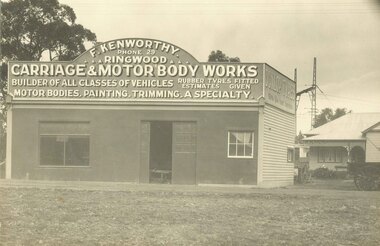 Ringwood and District Historical Society
Photograph, Maroondah Highway West, Ringwood- c1930. F. Kenworthy, Carriage & Motor Body Works
... Maroondah Highway West, Ringwood- c1930. F. Kenworthy, Carriage & Motor Body Works....Written on back of original photograph: "F.Kenworthy Carriage & Motor Body Works Whitehorse Rd Ringwood. ...Written on back of original photograph: "F.Kenworthy Carriage & Motor Body Works Whitehorse Rd Ringwood. ...Black and white photograph (1 original, 1 copy)Written on back of original photograph: "F.Kenworthy Carriage & Motor Body Works Whitehorse Rd Ringwood. Circa 1930" -
 Ringwood RSL Sub-Branch
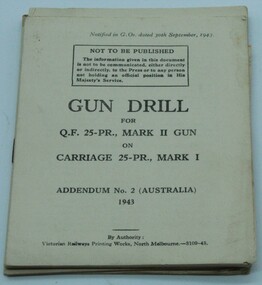
Book - Gun Carriage Drill Book, 1943
... Gun Carriage Drill Book...For Mk 2 gun on a Mk1 carriage...For Mk 2 gun on a Mk1 carriage Gun Carriage Drill Book Book Gun Carriage Drill Book Victorian Railways Printing Wiorks ...Paper Book, no binding 30 pages ? For Mk 2 gun on a Mk1 carriage -
 Melbourne Tram Museum
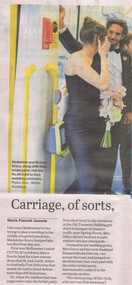
Newspaper - Newspaper clipping, The Age, "Carriage, of sorts, gets pair to wedding on time", 7/12/21
... "Carriage, of sorts, gets pair to wedding on time"...Newspaper clipping from the Age titled: "Carriage, of sorts, gets pair to wedding on time"...Has a photo inside tram number 6045 Route 48 Weddings Tram 6045 E-class tram Tramways Trams Newspaper clipping from the Age titled: "Carriage, of sorts, gets pair to wedding on time" "Carriage, of sorts, gets pair to wedding on time" Newspaper Newspaper clipping Australia Victoria Melbourne The Age ...Bridal couple, Madeleine and Richard Greco, and their bridal party, caught a tram to their wedding ceremony at the Old Treasury Building, after their vehicle was held up in heavy traffic.Has a photo inside tram number 6045Newspaper clipping from the Age titled: "Carriage, of sorts, gets pair to wedding on time"route 48, weddings, tram 6045, e-class tram, tramways, trams -
 The Beechworth Burke Museum
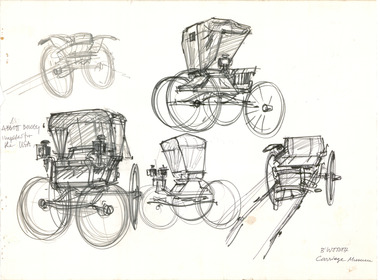
Drawing, Ernest Marcuse, Beechworth Carriage Museum III, c1972-1976
... Beechworth Carriage Museum III...Obverse: ABBOT BAGGY / B'WORTH / CARRIAGE MUSEUM Reverse: B7 / Beechworth Nostalgia / BW - 07 B (crossed out) / 008...Beechworth Carriage Museum III Drawing Drawing Ernest Marcuse ...Ernest Heinrich Marcuse was born on the 1st of December 1900 to Hedwig and Siegmund Marcuse in Berlin Germany. While Marcuse's artistic talent was apparent from a younger age, his earliest existing artwork was from when he was approximately 20 years old. Ernest's formal art training commenced in 1918 with a three year course at the Berlin school of Interior design. After completion he found work until 1924 when Germany's Great Depression took effect. To broaden his career opportunities he undertook a further 12 months study of fashion, drawing and advertising at Berlin's Reiman school of art. From 1925 to 1934 Ernest was primarily a freelance press artist specialising in industrial, architectural and figurative drawing. Prominent newspaper The Berliner Morgenpost was his largest client along with Gross Deutsche Rundfunaustellung (Germany's organisation for major trade shows). During this period he would create many significant works. Two months after Hitler and the Nazi part came to power in 1933, Ernest received a life changing letter stating that being Jewish he could no longer continue employment in Germany. Up until 1938 he would only be able to undertake private commissions and occasional unofficial work as a book illustrator and games designer. This was by arrangement with non Jewish artists who claimed his work as their own, they would then share the income with Ernest. With increasing unrest in Germany during late 1938 Ernest decided to move to London and there he married his girlfriend Lotte. In late 1939 Ernest and Lotte Marcuse embarked on an eight week journey to their new home in Australia where they had been accepted as refugees. Shortly after arriving in Australia Ernest presented his portfolio to an editor at the Argus newspaper and gained employment as a war events illustrator. He soon became well respected and known in particular for his detailed illustrations and cross sections of ships , artillery and aircrafts. His detailed depictions of battles were displayed on the front pages of The Argus newspaper on a number of occasions. In May 1940 as the war intensified Ernest was dismissed from The Argus newspaper due to his Australian government classification of 'stateless person of enemy origin' and was considered a potential security risk. The editor of the time commented "don't blame us, blame Hitler". Marcuse then began to establish himself as a commercial artist. Ernest was de-classified as a 'stateless person of enemy origin' and in early 1942. The Australian army heard of Ernest's artistic abilities and began to utilize his designs for visual training aids and posters. Ernest became Private E.H Marcuse V377746, his first army posting was as staff artist at The infantry officer's training school at Bonegilla. When off duty he was inspired by the beauty of the surrounding area creating the works in North east Victoria 'Kiewa river bridge', 'Hume weir', ' Dried up river bed' and 'Hawksview gold reef mine' from his 1942-1943 period at Bonegilla Victoria. Ernest returned to the area to create drawings and paintings from 1948 to 1983 in locations including Bright, Wandilligong, Bogong High plains and Wallace's Hut, Mt Buffalo, Beechworth, Pretty valley, Kiewa Hydro, Yackandandah and Bontherambo homestead. These sketches were often completed on location, photographs were also taken onsite to assist the works back at the studio. Occasionally Marcuse also painted in the field. Ernest's preferred choice of medium was pencil and ink. Up until 1952 he would often incorporate watercolour into his work. Later into his career he began introducing pastels, acrylic and mixed media. In earlier years Ernest Marcuse often signed his work Mar, later on the signing of works ranged from Marcuse, E.Marcuse, Ernest Marcuse, EHM or simply EM . If a work was considered incomplete or Marcuse did not like the work it would remain unsigned. From Bonegilla Marcuse was transferred to Woodside South Australia before his final posting in Melbourne until the end of 1945. Ernest's work from within his army posting 'Troop Train at Night' from his 1945 exhibition Australia at War are part of the permanent collection at Canberra's War Museum. Between 1946 and 1969 Ernest largely worked from home and concentrated on a career as a freelance commercial artist and graphic designer. During that time he created work for well known household names including CRA/Conzinc, Vacuum oil (Caltex), Cottee's Brand (Schweppes and Heinz), Home Beautiful magazine Fulton garden supplies, International Iveco trucks, Ego pharmaceuticals, QV and Sunsense. After retirement Ernest concentrated on his true love of fine art and focused on painting images of personal interest both across Australia and Internationally. Earnest never drove a car. He would often walk or use public transport or enlist in the help of family or artist friends to drive him. Throughout his career Ernest Marcuse's artworks were purchase by private collectors these included ACTU, Melbourne City council, Holland Constructions, Melbourne Metropolitan Tramways Board, GJ Coles and Australian Resources Bank. Ernest Marcuse permanent collections can be viewed at The National Gallery of Victoria , Sydney Jewish Museum, Jewish Holocaust Centre Melbourne, Canberra's War Museum, City of Melbourne, Shire of Yarra ranges and now the Burke Museum. © 2020 Art by Marcuse https://www.artbymarcuse.com.au/aboutDonated to the Burke Museum through the Australian Government's Cultural Gifts Program by Peter and Evelyn MarcusePen and pencil landscape drawing on paper.Obverse: ABBOT BAGGY / B'WORTH / CARRIAGE MUSEUM Reverse: B7 / Beechworth Nostalgia / BW - 07 B (crossed out) / 008ernest marcuse, marcuse, art, artbymarcuse, beechworth, burke museum, indigo shire, landscape, illustration, drawing, pen and pencil, australian army, war events illustrator, the age, the sun, the argus, germany, refugee, industrial drawing, architectual drawing, figure drawing, berliner morgenpost, grosse deutsche rundfunaustellung, berlin’s reiman school of art., cultural gifts program -
 Warrnambool and District Historical Society Inc.
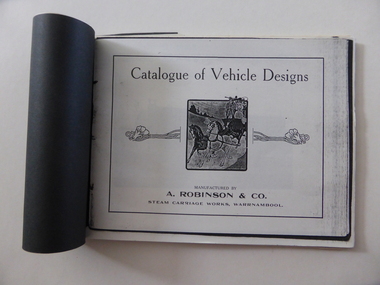
Booklet, Steam carriage works - A Robinson, Early 1900s (original)
... Steam carriage works - A Robinson...He was an award-winning coach and carriage builder, firstly in partnership with Frederick Morse in Fairy Street and later with his own company A. ...This is a photocopy of a booklet produced by Alexander Robinson advertising his Steam Carriage Works in the early 1900s. The pages are bound together with a plastic clip and the back cover is a piece of stiff cardboard. ...History of Warrnambool Coach and Carriage Making in Warrnambool fairy street This is a photocopy of a booklet produced by Alexander Robinson advertising his Steam Carriage Works in the early 1900s. ...This is a photocopy of a booklet produced in the early 1900s by the firm of A.Robinson & Co. of Warrnambool. Alexander Robinson, the son of James and Jane Robinson (farmers) was born in Warrnambool in 1862. He was an award-winning coach and carriage builder, firstly in partnership with Frederick Morse in Fairy Street and later with his own company A. Robinson and Co. By the early 20th century he was also selling and repairing motor cars. Alex Robinson was a Warrnambool City Councillor from 1904 to 1910 and from 1922 to 1927 and Mayor on two occasions. His business site was occupied by Callaghan Motors until 2017. In 2025 the site was for sale after plans to develop it did not proceed.Although this is only a photocopy it is of great interest as the photocopied photographs are clear and show us exactly what type of horse-drawn vehicles were in use in the Warrnambool area at the end of the 19th century and the beginning of the 20th century. The firm of A. Robinson was a prominent one in Warrnambool and Alex Robinson was active in civic affairs in the town. This is a photocopy of a booklet produced by Alexander Robinson advertising his Steam Carriage Works in the early 1900s. The pages are bound together with a plastic clip and the back cover is a piece of stiff cardboard. The booklet contains black and white photographs of the factory building and of the buggies, wagons, jinkers and carts for sale. It also has a page detailing the prizes won by the firm at Agricultural Shows all over Victoria.robinson & morse, a.robinson & co., history of warrnambool, coach and carriage making in warrnambool, fairy street -
 Ringwood and District Historical Society
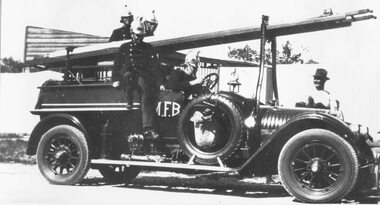
Photograph, Ringwood Hose Carriage M.F.B. Nov 1936
... Ringwood Hose Carriage M.F.B. Nov 1936...Written on rear of backing sheet: "Ringwood Hose Carriage Nov.1936 (Returning from a fire at Croydon, when hose reel broke down there)."...Black and white photograph Ringwood Hose Carriage M.F.B. Nov 1936 Photograph ...Black and white photographWritten on rear of backing sheet: "Ringwood Hose Carriage Nov.1936 (Returning from a fire at Croydon, when hose reel broke down there)." -
 Otway Districts Historical Society
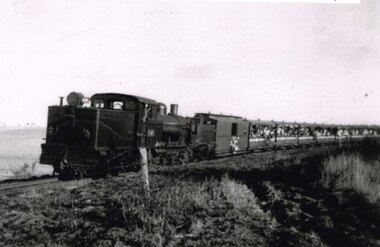
Photograph, R. Preston, Tulloh: Last NBH excursion carriage train on the line from Beech Forest, 1962, 31 March 1962
... Tulloh: Last NBH excursion carriage train on the line from Beech Forest, 1962....Led by locomotive G42, the last NBH excursion carriage passenger train near Friend's Road, Tulloh, on 31 March 1962....Tulloh: Last NBH excursion carriage train on the line from Beech Forest, 1962. ...B/W. Led by locomotive G42, the last NBH excursion carriage passenger train near Friend's Road, Tulloh, on 31 March 1962.tulloh; railways; loco g42; -
 Greensborough Historical Society
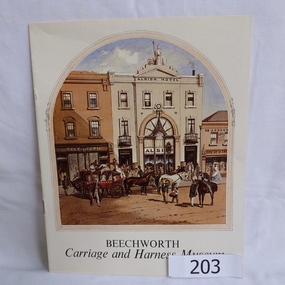
Booklet, National Trust of Australia, Beechworth Carriage and Harness Museum, 1970c
... Beechworth Carriage and Harness Museum...Details contents of museum and describes the various types of carriages, tools and harnesses...Details contents of museum and describes the various types of carriages, tools and harnesses History of the manufacturing and maintenance of carriages carriages beechworth beechworth carriage and harness museum harness buggy tools 12 page souvenir booklet, coloured front page, illustrated with a reproduction of an S.T Gill painting, black and white interior Beechworth Carriage and Harness Museum Booklet Booklet National Trust of Australia ...Details contents of museum and describes the various types of carriages, tools and harnessesHistory of the manufacturing and maintenance of carriages12 page souvenir booklet, coloured front page, illustrated with a reproduction of an S.T Gill painting, black and white interiorcarriages, beechworth, beechworth carriage and harness museum, harness, buggy tools -
 Melbourne Tram Museum
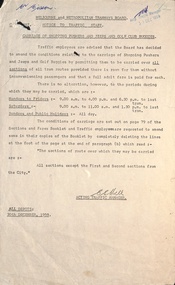
Document - Notice to Traffic Staff, Melbourne & Metropolitan Tramways Board (MMTB), "Carriage of shopping pushers, jeeps and golf club buggies", Dec 1959
... "Carriage of shopping pushers, jeeps and golf club buggies"...This allowed for the carriage of these items in the first and second sections from the City....Yields information about the carriage of "Carriage of shopping pushers, jeeps and golf club buggies" tramways golf shopping pushers Has hand date stamp of 31 Dec. 1959 and Mr Misson's initials. ...Notice to traffic staff, dated 30 Dec 1959 about the "Carriage of shopping pushers, jeeps and golf club buggies" being allowed to be carried on all routes during off peak hours at a charge of a full adult fare. This allowed for the carriage of these items in the first and second sections from the City.Yields information about the carriage of "Carriage of shopping pushers, jeeps and golf club buggies"Notice - printed on foolscap size paper with handwritten notes and a date stamp.Has hand date stamp of 31 Dec. 1959 and Mr Misson's initials.tramways, golf, shopping pushers -
 Melbourne Tram Museum
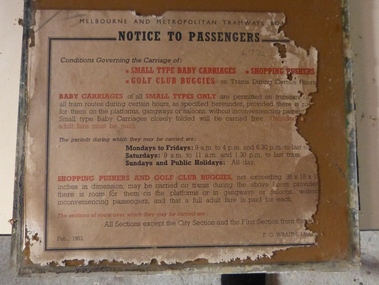
Poster, Melbourne & Metropolitan Tramways Board (MMTB), "Notice to Passengers - Conditions Governing the Carriage of Small type baby carriages, shopping pushers, golf club buggies on trams during Certain Hours", Feb. 1953
... "Notice to Passengers - Conditions Governing the Carriage of Small type baby carriages, shopping pushers, golf club buggies on trams during Certain Hours"...Poster - white sheet of paper, titled "Notice to Passengers - Conditions Governing the Carriage of Small type baby carriages, shopping pushers, golf club buggies on trams during Certain Hours". ...Trams tramways MMTB Prams Tickets Poster - white sheet of paper, titled "Notice to Passengers - Conditions Governing the Carriage of Small type baby carriages, shopping pushers, golf club buggies on trams during Certain Hours". ...Poster - white sheet of paper, titled "Notice to Passengers - Conditions Governing the Carriage of Small type baby carriages, shopping pushers, golf club buggies on trams during Certain Hours". Signed by F. G. Wraith as Manager. Dated Feb. 1953. Provides details of times, fares and where on the system. Poster has been adhered to a sheet of glass that was backed with a sheet of brown paper. The glass was used in the driver's bulkhead of a W class tram.trams, tramways, mmtb, prams, tickets -
 Wonga Park Community Cottage History Group
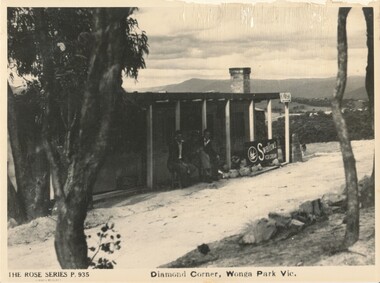
Postcard - with photo “The Rose Series P. 935", "Diamond corner, Wonga Park Vic “Arthur Davis’ cedar train carriage kiosk c. 1948
... "Diamond corner, Wonga Park Vic “Arthur Davis’ cedar train carriage kiosk c. 1948...Postcard with photo “The Rose Series P. 935 Diamond corner, Wonga park Vic “Arthur Davis’ cedar train carriage kiosk c. 1948...Postcard with photo “The Rose Series P. 935 Diamond corner, Wonga park Vic “Arthur Davis’ cedar train carriage kiosk c. 1948 "Diamond corner, Wonga Park Vic “Arthur Davis’ cedar train carriage kiosk c. 1948 Postcard with photo “The Rose Series P. 935" ...Postcard with photo “The Rose Series P. 935 Diamond corner, Wonga park Vic “Arthur Davis’ cedar train carriage kiosk c. 1948 -
 Eltham District Historical Society Inc
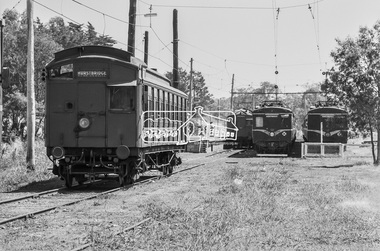
Photograph, George Coop, A single carriage Tait (Red Rattler) train pulls out from Hurstbridge Railway Station, 6 December 1980, 1980
... A single carriage Tait (Red Rattler) train pulls out from Hurstbridge Railway Station, 6 December 1980...Meanwhile, Single Motor Carriage trains ran the Eltham-Hurstbridge service adequately at weekends. ...Meanwhile, Single Motor Carriage trains ran the Eltham-Hurstbridge service adequately at weekends. ...Two Harris (Blue) trains can be seen in the Hurstbridge storage yard. Full seven coach trains would be stored here at weekends to permit rapid start of weekday services on a Monday. Meanwhile, Single Motor Carriage trains ran the Eltham-Hurstbridge service adequately at weekends. Two single carriages can be seen here. The Harris trains operated in Melbourne 1956-1988. They were full of asbestos and were taken out of service, wrapped in plastic and buried in land fill near Clayton.Digital TIFF file Scan of 35mm Ilford FP4 black and white transparencyharris (blue) train, hurstbridge line, red rattler, single motor carriage, tait train -
 Eltham District Historical Society Inc
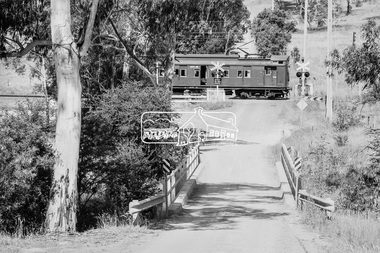
Photograph, George Coop, Single Motor Carriage 471M Tait (Red Rattler) train crossing Allendale Road, heading to Eltham station, 6 December 1980, 1980
... Single Motor Carriage 471M Tait (Red Rattler) train crossing Allendale Road, heading to Eltham station, 6 December 1980...The single carriage Tait regularly ran between Eltham and Hurstbridge stations. ...The single carriage Tait regularly ran between Eltham and Hurstbridge stations. ...The single carriage Tait regularly ran between Eltham and Hurstbridge stations. Looking east along Allendale Road, Eltham to the railway level crossing. The tree on the left remains today (2019) https://goo.gl/maps/zngEcUA29tEWFzuj7Digital TIFF file Scan of 35mm Ilford FP4 black and white transparency471m, allendale road, eltham, hurstbridge line, railway level crossing, red rattler, single motor carriage, tait train
