
Showing 39 items matching " chalk board"
-
 Canterbury History Group
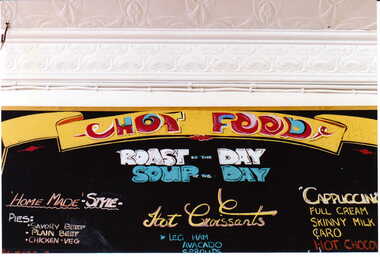
Photograph - Detail of the chalk board outlining hot food available inside shop No. 123 Maling Road, Jan Pigot, 27/03/1993 12:00:00 AM
... Detail of the chalk board outlining hot food available inside shop No. 123 Maling Road...Coloured photograph of a detail of the chalk board outlining hot food inside the Village Pantry at No. 123 Maling Road...Canterbury Maling Road Shops Coloured photograph of a detail of the chalk board outlining hot food inside the Village Pantry at No. 123 Maling Road Photograph Detail of the chalk board outlining hot food available inside shop No. 123 Maling Road Jan Pigot ...Coloured photograph of a detail of the chalk board outlining hot food inside the Village Pantry at No. 123 Maling Roadcanterbury, maling road, shops -
 Canterbury History Group
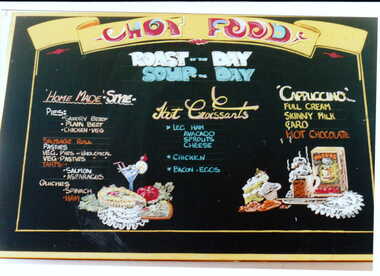
Photograph - Chalk board outling food choices inside the shop at No. 123 Maling Road, Jan Pigot, 27/03/1993 12:00:00 AM
... Chalk board outling food choices inside the shop at No. 123 Maling Road...Canterbury Maling Road Shops Coloured photograph of Photograph Chalk board outling food choices inside the shop at No. 123 Maling Road Jan Pigot ...Coloured photograph of canterbury, maling road, shops -
 Stawell Historical Society Inc
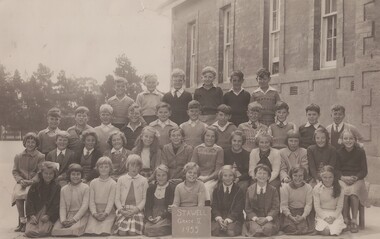
Photograph, Stawell State School 502 -- Students Grade 5 Group 2 1955, 1955
... Students in front of School Building with Chalk Board ...Education Stawell Grade V 1955 Students in front of School Building with Chalk Board Stawell State School 502 -- Students Grade 5 Group 2 1955 Photograph ...Students in front of School Building with Chalk Board Stawell Grade V 1955education -
 Sunshine and District Historical Society Incorporated
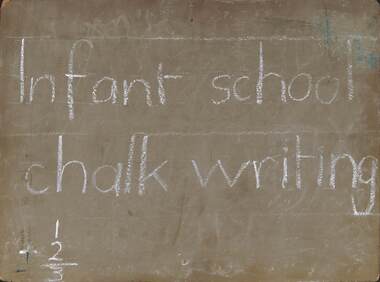
Education kit - Sunvale Primary School Infant Chalk Boards
... ... Chalk Board...They were lasted used in schools during the 1970s Sunvale Primary School Primary School Neil Street Chalk Board 3585.01 - Infant school chalk writing 1 2 3|2505.02 - Sunshine School Display Two chalk boards of different sozes Education kit Sunvale Primary School Infant Chalk Boards ...These boards were typically used by State & Primary infant students to learn writing. They were lasted used in schools during the 1970sTwo chalk boards of different sozes3585.01 - Infant school chalk writing 1 2 3|2505.02 - Sunshine School Displaysunvale primary school, primary school, neil street, chalk board -
 Kew Historical Society Inc
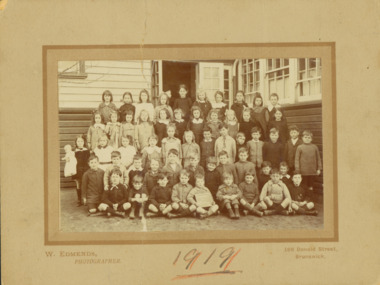
Photograph - Kew East State School, 1919
... Obverse: Written on held chalk board: "Kew East 3161 / ? Grades / 1919". ...Kew East primary school Margery canham Margery nickell Elizabeth angel Kew East state school Kew East country school Obverse: Written on held chalk board: "Kew East 3161 / ? Grades / 1919". ...State School No. 3161 was originally situated between High Street (then Bulleen Road) and Kilby Road adjacent to Burke Road and was officially opened on 25th April 1892 with Mr Roland Gray as its Headmaster. With more people moving into the district, the School was moved in 1905 to Strathalbyn Street. (This site was to became the Kew East Bowling Club, and is now a Kindergarten.) 1929 saw the erection of the brick Infant School adjacent to the main building. In subsequent years many other buildings were added, including a weatherboard ‘Rural’ school, a brick library, an administration block, several portables, and a Community Music Centre and shelter sheds, culminating in the opening in March 2011 of the Commonwealth funded new Music/Sports Complex. At one time it was called Kew East Central School and included years 7 & 8. When Kew High School started, the high school students were accommodated there whilst their buildings were being completed.Original print positive, mounted on board of a co-educational class of students at Kew East 'Country School'. Margery Canham (nee Nickell) is identified in an inscription on the reverse of the mount. The Age newspaper on 6 March 1906 included in News of the Day that: "At a meeting of the Executive Council yesterday it was decided to proclaim the following State schools as training schools under the provisions of the Teachers' Act: Brunswick 1213; Queensberry-street, Carlton 2365; Kew East 3161; and Queensberry-street, North Melbourne 307. These schools have been specially selected and staffed in order that teachers in training and junior teachers may study the methods of the best teachers in special kinds of work. The infant class is the special feature at Brunswick, while Kew East will be a model of the methods of a country school. The schools at Queensberry-street, North Carlton and North Melbourne, are to be more especially connected with the training college."Obverse: Written on held chalk board: "Kew East 3161 / ? Grades / 1919". Reverse: "Margery Nickell, 4th row, back right"kew east primary school, margery canham, margery nickell, elizabeth angel, kew east state school, kew east country school -
 Rutherglen Historical Society
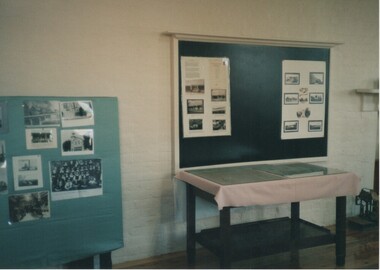
Image, 12/11/2003
... Colour photograph of the interior of the Common School Museum, Home Economics Room, showing a display of photographs on a table, a free-standing board, and on the old school-room chalk board....Photograph taken at reopening of Common School Museum, after repairs to floor. reopening common school museum On back of photo: "12/11/03" Colour photograph of the interior of the Common School Museum, Home Economics Room, showing a display of photographs on a table, a free-standing board, and on the old school-room chalk board. Image ...Photograph taken at reopening of Common School Museum, after repairs to floor.Colour photograph of the interior of the Common School Museum, Home Economics Room, showing a display of photographs on a table, a free-standing board, and on the old school-room chalk board.On back of photo: "12/11/03"reopening, common school, museum -
 Kew Historical Society Inc
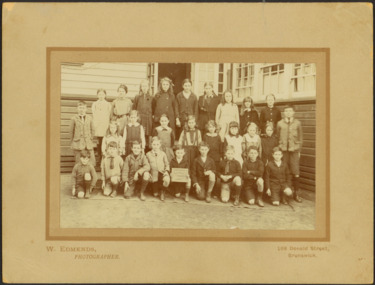
Photograph - Kew East Country School, 1919
... Obverse: Written on held chalk board: "Kew East 3161 / Country School / 1919". ...Kew East primary school Margery canham Margery nickell Elizabeth angel Kew East state school Kew East country school Obverse: Written on held chalk board: "Kew East 3161 / Country School / 1919". ...State School No. 3161 was originally situated between High Street (then Bulleen Road) and Kilby Road adjacent to Burke Road and was officially opened on 25th April 1892 with Mr Roland Gray as its Headmaster. With more people moving into the district, the School was moved in 1905 to Strathalbyn Street. (This site was to became the Kew East Bowling Club, and is now a Kindergarten.) 1929 saw the erection of the brick Infant School adjacent to the main building. In subsequent years many other buildings were added, including a weatherboard ‘Rural’ school, a brick library, an administration block, several portables, and a Community Music Centre and shelter sheds, culminating in the opening in March 2011 of the Commonwealth funded new Music/Sports Complex. At one time it was called Kew East Central School and included years 7 & 8. When Kew High School started, the high school students were accommodated there whilst their buildings were being completed.Original print positive, mounted on board of a co-educational class of students at Kew East 'Country School'. Howard Nickell is identified in an inscription on the reverse of the mount. The Age newspaper on 6 March 1906 included in News of the Day that: "At a meeting of the Executive Council yesterday it was decided to proclaim the following State schools as training schools under the provisions of the Teachers' Act: Brunswick 1213; Queensberry-street, Carlton 2365; Kew East 3161; and Queensberry-street, North Melbourne 307. These schools have been specially selected and staffed in order that teachers in training and junior teachers may study the methods of the best teachers in special kinds of work. The infant class is the special feature at Brunswick, while Kew East will be a model of the methods of a country school. The schools at Queensberry-street, North Carlton and North Melbourne, are to be more especially connected with the training college."Obverse: Written on held chalk board: "Kew East 3161 / Country School / 1919". Reverse: "Howard Nickell, 2nd row, left - end of row"kew east primary school, margery canham, margery nickell, elizabeth angel, kew east state school, kew east country school -
 Wangaratta RSL Sub Branch
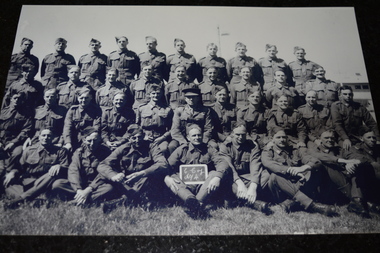
Photograph, Lanes Studio, C Coy No 4
... Soldier in middle of front row holding chalk board. Image most likely one of four rifle companies that comprised the 2/24 Battalion which was formed at Wangaratta in 1940...Soldier in middle of front row holding chalk board. Image most likely one of four rifle companies that comprised the 2/24 Battalion which was formed at Wangaratta in 1940 c coy no 4 wangaratta 2/24 battalion 1940 C Coy No 4 Reproduced black and white photograph depicting two rows of soldiers standing and two rows sitting C Coy No 4 Photograph Photograph Lanes Studio ...Black and white group photograph depicting 4 rows of soldiers. Soldier in middle of front row holding chalk board. Image most likely one of four rifle companies that comprised the 2/24 Battalion which was formed at Wangaratta in 1940Reproduced black and white photograph depicting two rows of soldiers standing and two rows sittingC Coy No 4c coy no 4, wangaratta, 2/24 battalion, 1940 -
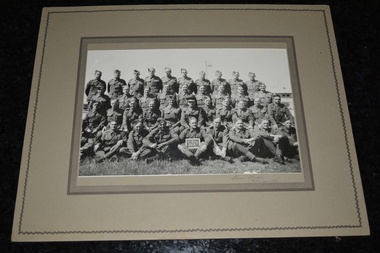 Wangaratta RSL Sub Branch
Photograph, Lanes Studio, C Coy No 4
... Soldier in middle of front row holding chalk board. Image most likely one of four rifle companies that comprised the 2/24 Battalion which was formed in Wangaratta in 1940...Soldier in middle of front row holding chalk board. Image most likely one of four rifle companies that comprised the 2/24 Battalion which was formed in Wangaratta in 1940 c coy no 4 wangaratta 2/24 battalion 1940 C Coy No 4 Black and white photograph mounted on beige colored cardboard depicting two rows of soldiers standing and two rows sitting C Coy No 4 Photograph Photograph Lanes Studio ...Black and white group photograph depicting 4 rows of soldiers taken by Lane Studios of Wangaratta. Soldier in middle of front row holding chalk board. Image most likely one of four rifle companies that comprised the 2/24 Battalion which was formed in Wangaratta in 1940Black and white photograph mounted on beige colored cardboard depicting two rows of soldiers standing and two rows sittingC Coy No 4c coy no 4, wangaratta, 2/24 battalion, 1940 -
 Bendigo Historical Society Inc.
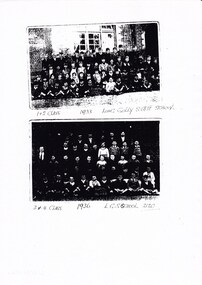
Photograph - LONG GULLY HISTORY GROUP COLLECTION: LONG GULLY SCHOOL PHOTOS, 1933, 1935,1936 & 1938
... The name and number of the school and the Class year are written on a chalk board in the centre of the front row. The 1936 photo is very dark....The name and number of the school and the Class year are written on a chalk board in the centre of the front row. The 1936 photo is very dark. ...Copies of four photos of Long Gully School Children. First & Second Class of 1933, Third & Fourth Class of 1936, Third & Fourth Class of 1935 and Fifth & Sixth Class of 1938. Photos taken in front of a brick building. The name and number of the school and the Class year are written on a chalk board in the centre of the front row. The 1936 photo is very dark.bendigo, history, long gully history group, the long gully history group - long gully school photos 1933, 1935, 1936 & 1938, long gully state school 2120 -
 Kiewa Valley Historical Society
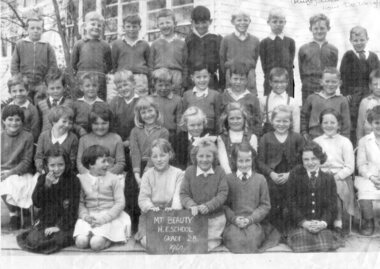
Photograph – Mt Beauty Higher Elementary School Grade 2B, 1960 – Black and white photocopy of original photograph
... Chalk Board at front of children in photograph – MT BEAUTY H.E.SCHOOL GRADE 2B. 1960 Handwritten in top right hand corner of photograph, with arrow pointing to the boy 4th from the right Alex Van De Auigh (Ruijt) dutch now De Wright Handwritten on back of photograph – Top row: 6 from left (4th from Right) ...Many of the children would also have been the descendants of parents who immigrated to Australia as foreign workers on the Hydro Electric Scheme such as Alex Van De Ruijt, whose parents were Dutch. mt beauty school Chalk Board at front of children in photograph – MT BEAUTY H.E.SCHOOL GRADE 2B. 1960 Handwritten in top right hand corner of photograph, with arrow pointing to the boy 4th from the right Alex Van De Auigh (Ruijt) dutch now De Wright Handwritten on back of photograph – Top row: 6 from left (4th from Right) Photocopy of a black and white class photograph of Mt Beauty H E School Grade 2B, 1960 Back row: Lawrence Woods, John Wayne, Terry Hertzog, Phillip Jervies, ? ...On Feb 3rd 1948, the Mt Beauty State School was opened with 28 pupils in all grades up to VII. Classes began in the SECV Recreation Hall, which was converted to classrooms during the school week and returned to a recreation hall on weekends for motion pictures and social occasions for SECV workers and their families. A new school building was opened in 1950 on the current school site, with an enrolment of 170 primary and secondary students. A further extension of 4 buildings was added in 1951 with a population increase to 303 students. In May 1953, the status of the school was raised to Higher Elementary School with a total of 403 students. In 1958, the school population rose to a high of 617 students with 436 in primary and 181 in secondary. In 1964, the status of the secondary section of Mt Beauty HES was raised to a High School and was moved to separate facilities in the west of town in September 1964 Pictorial history of children who attended Mt Beauty Higher Elementary School in 1960. Many of the students would have had parents working on the Hydro-Electric Scheme in and around Mt Beauty. Many of the children would also have been the descendants of parents who immigrated to Australia as foreign workers on the Hydro Electric Scheme such as Alex Van De Ruijt, whose parents were Dutch. Photocopy of a black and white class photograph of Mt Beauty H E School Grade 2B, 1960 Back row: Lawrence Woods, John Wayne, Terry Hertzog, Phillip Jervies, ?, Alex Van De Wright , ?John Sigmund, Wayne Shoebridge, Brian Harkin 3rd row: Doug Newbound, Roy Hetherington, ? Kevin Hills, Peter Renshaw, ? Grenville Gerecke, ?, Ken Thomas, Detlef Rueff, ?, not in picture Berndt Homfeld 2nd Row, ?, Lyn Plant, ?, Gabrielle Sigmund, ? Pauline Gerecke, Christine Harmer, ?, Lesley McDonald, not in picture, Jenny Richardson Front Row, ? Christine Pennery, Robyn Symons, ?, ?, Sue Mckendrick, ?, ? with a name may not be correct Chalk Board at front of children in photograph – MT BEAUTY H.E.SCHOOL GRADE 2B. 1960 Handwritten in top right hand corner of photograph, with arrow pointing to the boy 4th from the right Alex Van De Auigh (Ruijt) dutch now De Wright Handwritten on back of photograph – Top row: 6 from left (4th from Right) mt beauty school -
 Melbourne Tram Museum
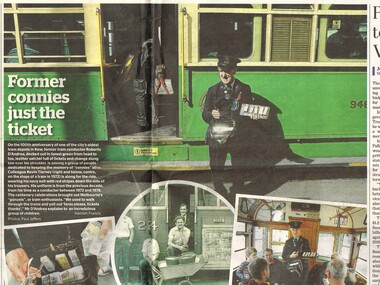
Newspaper, The Age, "Former connies just the ticket", 4/05/2015 12:00:00 AM
... Has a photo of Kew depot workers with a barrow of sand - Staff Christmas function 1977 written in chalk on a board on the steps of tram 224....Has a photo of Kew depot workers with a barrow of sand - Staff Christmas function 1977 written in chalk on a board on the steps of tram 224. "Former connies just the ticket" Newspaper The Age Kevin Tierney ...Newspaper clipping from The Age, Monday 4 May 2015 - titled "Former connies just the ticket", featuring a story on Kevin Tierney of the Connies standing with tickets in front of tram 946 and inside the tram as well. Article by Hannah Francis, photos Paul Jeffers. Has a photo of Kew depot workers with a barrow of sand - Staff Christmas function 1977 written in chalk on a board on the steps of tram 224.trams, tramways, the connies, kew depot, conductors, sanding equipment, tram 946, tram 224 -
 Flagstaff Hill Maritime Museum and Village
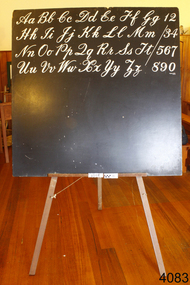
Functional object - Blackboard & Easel, Probably first half of 20th century
... The first classroom uses of large blackboards are difficult to date, but they were used for music education and composition in Europe as far back as the 16th century.The term "blackboard" is attested in English from the mid-18th century; the Oxford English Dictionary provides a citation from 1739, to write "with Chalk on a black-Board". The first attested use of chalk on blackboard in the United States dates to 1801, in a lecture course in mathematics given by George Baron. ...The first classroom uses of large blackboards are difficult to date, but they were used for music education and composition in Europe as far back as the 16th century.The term "blackboard" is attested in English from the mid-18th century; the Oxford English Dictionary provides a citation from 1739, to write "with Chalk on a black-Board". The first attested use of chalk on blackboard in the United States dates to 1801, in a lecture course in mathematics given by George Baron. ...The first classroom uses of large blackboards are difficult to date, but they were used for music education and composition in Europe as far back as the 16th century.The term "blackboard" is attested in English from the mid-18th century; the Oxford English Dictionary provides a citation from 1739, to write "with Chalk on a black-Board". The first attested use of chalk on blackboard in the United States dates to 1801, in a lecture course in mathematics given by George Baron. James Pillans has been credited with the invention of coloured chalk (1814); he had a recipe with ground chalk, dyes and porridge! The use of blackboards did change methods of education. Manufacturing of slate blackboards began by the 1840s. A green porcelain enamel surface was first used in 1930, and as this type of board became popular, the word "chalkboard" appeared. Various types of easel have been in use since ancient times, in particular for supporting paintings and other artwork. However, the schoolroom easel would have been introduced around the same time as when the blackboard started to be used in educational establishments. Wooden board painted black, resting on wooden easel with rope supporting the three easel legs.Noneflagstaff hill, warrnambool, shipwrecked-coast, flagstaff-hill, flagstaff-hill-maritime-museum, maritime-museum, shipwreck-coast, flagstaff-hill-maritime-village -
 Federation University Historical Collection
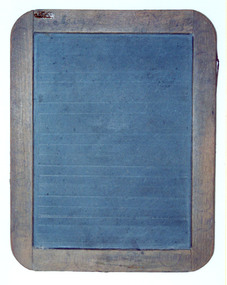
Equipment - Writing Slate, Slate Board
... They made chalk boards and pencils in Slatington, Pennsylvania school education teaching slate black board mary cook slate board .1) has 'Mary Cook' written on top in pencil Two slate boards. ...The National School Slate Co. was started in 1847 and was a world importer of slate. They made chalk boards and pencils in Slatington, PennsylvaniaTwo slate boards. The slate, commonly used in schools, is housed in a timber frame and was used for drawing and writing with a special slate pencil. (.1) lines marked on slate. .1) has 'Mary Cook' written on top in pencilschool, education, teaching, slate, black board, mary cook, slate board -
 City of Moorabbin Historical Society (Operating the Box Cottage Museum)
Education kit - School Writing Slate early 20thC, 20thC
... The board was made from a piece of quarry slate set in a wooden frame. A slate pencil (not chalk) was used to form the letters. ...The board was made from a piece of quarry slate set in a wooden frame. A slate pencil (not chalk) was used to form the letters. ...School children learned to write using a slate From 1880’s to mid 1950’s in most schools, very young children first learned to write their letters in sand trays using their fingers or a stick. When about 6, they progressed onto writing on slates . The board was made from a piece of quarry slate set in a wooden frame. A slate pencil (not chalk) was used to form the letters. This slate pencil was often sharpened on the school wall. The advantage of slates over paper was that they could be wiped clean and used again and again. Until the mid 20thC paper was expensive . After the pupil wrote on the Slate, the work was checked by the teacher and then erased for a new task Children had to bring a dampened cloth or sponge to school so that they could clean the slate and start again. The pioneer settlers in the Moorabbin Shire area valued education and established schools for their children in Cheltenham and East Brighton c1860's This writing slate is typical of the type used up to the mid 20th Century in preparatory classes.A writing slate in a wood frame used by school children from c1880s to c1950sschools, education, writing equipment, slate writing boards, victoria melbourne, market gardeners, pioneer, settlers, cheltenham state school no. 84., bentleigh east state school no. 2083, st stephens c of e school tucker road east brighton -
 Orbost & District Historical Society
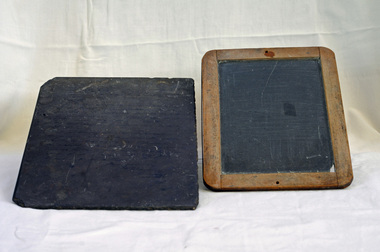
slates
... The board was made from a piece of quarry slate set in a wooden frame. In early times a slate pencil (not chalk) was used to form the letters. ...The board was made from a piece of quarry slate set in a wooden frame. In early times a slate pencil (not chalk) was used to form the letters. ...The board was made from a piece of quarry slate set in a wooden frame. In early times a slate pencil (not chalk) was used to form the letters. This slate pencil was often sharpened on the school wall. The advantage of slates over paper was that they could be wiped clean and used again and again. Children had to bring a dampened cloth or sponge to school so that they could clean the slate and start again but often they would use their own spit and the cuff of their sleeve! Two rectangular slate writing boards used in schools. .1 is plain black and is unframed. .2 is wooden-framed.education slate school-equipment -
Glenelg Shire Council Cultural Collection
Book, The Pictorial History of England, Vol. 1, BC55-AD1399.1, 1846
... board cover: marbling, greens, red and yellow ochre. History of England, BC.55 to AD1815. Gold texta and graphics on spine. The Pictorial History of England, Vol. 1, BC55-AD1399.1 Book Book George L. Chalk ...Light brown coloured leather-bound spine and cover corners. Paper covered board cover: marbling, greens, red and yellow ochre. History of England, BC.55 to AD1815. Gold texta and graphics on spine.history of england -
Glenelg Shire Council Cultural Collection
Book, George L. Chalk and Charles MacFarlane and other contributors, The Pictorial History of England, Vol. VII1, 1802-1815, 1846
... board covers with greens red and ochre marbling. Gold lettering and gold graphics on spine. The Pictorial History of England, Vol. VII1, 1802-1815 Book Book George L. Chalk ...Light brown coloured leather-bound spine and cover corners. Paper-covered board covers with greens red and ochre marbling. Gold lettering and gold graphics on spine. -
Glenelg Shire Council Cultural Collection
Book, George L. Chalk and Charles MacFarlane and other contributors, The Pictorial History of England, Vol. VI, 1785-1791, 1846
... board covers with greens red and ochre marbling. Gold lettering and gold graphics on spine. The Pictorial History of England, Vol. VI, 1785-1791 Book Book George L. Chalk ...Light brown coloured leather-bound spine and cover corners. Paper-covered board covers with greens red and ochre marbling. Gold lettering and gold graphics on spine. -
 Glenelg Shire Council Cultural Collection
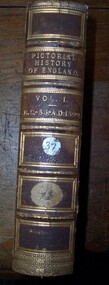
Book, The Pictorial History of England, Vol. II. 1399-1603, 1846
... board covers with greens red and ochre marbling. Gold lettering and gold graphics on spine. The Pictorial History of England, Vol. II. 1399-1603 Book Book George L. Chalk ...Light brown coloured leather-bound spine and cover corners. Paper-covered board covers with greens red and ochre marbling. Gold lettering and gold graphics on spine. -
Glenelg Shire Council Cultural Collection
Book, George L. Chalk and Charles MacFarlane and other contributors, The Pictorial History of England, Vol. IV, 1688-1760, 1846
... board covers with greens red and ochre marbling. Gold lettering and gold graphics on spine. The Pictorial History of England, Vol. IV, 1688-1760 Book Book George L. Chalk ...Light brown coloured leather-bound spine and cover corners. Paper-covered board covers with greens red and ochre marbling. Gold lettering and gold graphics on spine. -
Glenelg Shire Council Cultural Collection
Book, George L. Chalk and Charles MacFarlane and other contributors, The Pictorial History of England, Vol. III, 1603-1688, 1846
... board covers with greens red and ochre marbling. Gold lettering and gold graphics on spine. The Pictorial History of England, Vol. III, 1603-1688 Book Book George L. Chalk ...Light brown coloured leather-bound spine and cover corners. Paper-covered board covers with greens red and ochre marbling. Gold lettering and gold graphics on spine. -
 Orbost & District Historical Society
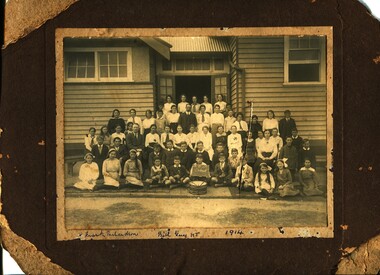
black and white photograph, 1915
... Behind the drum is a boy holding a board with H.E.S. Orbost hand-written in what appears to be white chalk on a blackboard. ...Behind the drum is a boy holding a board with H.E.S. Orbost hand-written in what appears to be white chalk on a blackboard. ...This is a photograoh of students at the Higher Elementary School at Orbost. Mary Gilbert has identified those in the photograph. From L-R Back Row - ? Irvine; Madge Macalaster; Rhoda Perry; Daisy Scouller; Dorrie Napier; Lila Perry; Don Cameron_____________________- Rita Murray; Raay Fisher; Grace Morris; Reston Nish; Bill Irvine; Stella Rodwell; Headmaster Mr W. Guy; ?; Annie Stirling; Harold Napier; R Lay; Dora Smith; Doris Shortell; Percy Hambrock Nellie MacPherson; Irene Parker; Gertie Griebenow; Vera Saunders; Mr Jack Blaikie; Bernice Feltis; Dillkys Broome; Vera Spink; Jean Irvine; Lexie Nixon; Eda Ross; Maggie Whillance; Violet Scouller; Jean Stirling; Miss Zoe Hazlett; Lily Daly; Jack Parker; Eric Herbert; ?; Tom Henderson; Frank Richardson; Vance Moysey; Vernon Nevins; Frank Rodwell; Bill Fisher; ? Murray Kerr Molly Dreverman; Emmy Gibbs; Hilda Kerr; Charlie Richards; Mick; Spink; Tom Swan; Ronnie Gluth; Annie Gibbs; Madge Grose; Mary Reynolds During 1910-11 the first approaches were made to the Department for the establishment of a HES in Orbost and this became a reality in 1912. Orbost HES supplied post-primary education in the district until a high school was built in 1948.Orbost High School / Orbost Secondary College has played a significant part in the education of senior students in the Orbost district . It is the sole senior educational institution. This photograph is representative of its history.A black / white photograph of children in front of a timber building with an open door. One female and two adult male teachers are with the children. At the front centre is a drum. Behind the drum is a boy holding a board with H.E.S. Orbost hand-written in what appears to be white chalk on a blackboard. There are three smaller boys holding brass musical instruments. The photograph is mounted on a brown card which is damaged. a card with names written in it has been attached to the photograph, on the front of the card at the bottom - "X Frank Richardson Bill Guy H.T. 1915".education-orbost-higher-elementary -
 Orbost & District Historical Society
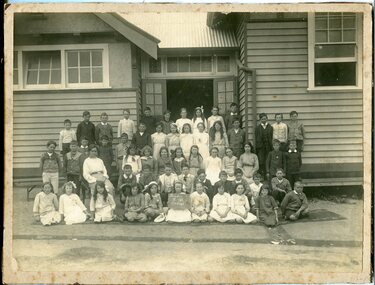
black and white photograph, 1915
... A black / white photograph of a group of children and one female teacher in front of an open doorway of a wooden school building. agirl seated in the front row is holding a board with "Grades V V1 Orbost" hand-written in what appears to be white chalk on a blackboard. .A list of those in photograph is attached....Mary Gilbert on her right in picture" A black / white photograph of a group of children and one female teacher in front of an open doorway of a wooden school building. agirl seated in the front row is holding a board with "Grades V V1 Orbost" hand-written in what appears to be white chalk on a blackboard. .A list of those in photograph is attached. black and white photograph ...This is a photograph of students at Orbost State School in 1915. Included in the photograph, as identified by Mary Gilbert' are Brian Harrison; ?; ? Whillance; Rupert Perry; ; Dolly Nixxon; Dot Stagg; Ella Cowell; Annie Macalaster; ? ?; ? Winchester; Rupert Bird; Mac Kerr; :; Clarrie Reynolds; D. Daly; Marion Watt; Audrey Cameron; Teen Dixon; Ethel Morris; ?; Toby Nixon; Charlie Winchester Miss Marie Haynes; Doris Smith; Alison Cameron; Ruby Morgan; Thida(?) Guy; Elsa Wehner; Gladys Boucher; Gloria Swanson; ? Lay; ? Rodwell Wally Simpson; ? Morgan; Reece Harrison; P. Summers; ?; Les Morgan; W. Lawless; ? Craker; A. Nish; P. Hocking Zenie Irvine; Essie Nixxon; Violet Gibbs; Adelaide Hardy; Verna Perry; Mary Gilbert; Margaret Irvine; Marge Henderson; Nellie Draffin; Roy Cameron The 19th of March 1886 proved an important day in the lives of many early settlers in the Orbost area, because on this day the Orbost State School opened. The fact that the school had first operated temporarily in a leased building, and on a half-time basis with SS2745 Jarrahmond, did not dampen the enthusiasm of the local inhabitants as they saw their offspring commence their education under the guidance of HT Campbell Mackay. However he remained in charge only until 12th of May 1886. The second HT, John Rowe, served until 1908. On 30th of June 1887, a portable room was provided; it being brought to the area by schooner. The school now had accommodation for 30 pupils; the teacher's welfare was considered because quarters of two rooms were attached. As the population increased so did the needs of the school. This was reflected in the provision of a larger classroom in 1898.This photograph is associated with the history of education in Orbost.A black / white photograph of a group of children and one female teacher in front of an open doorway of a wooden school building. agirl seated in the front row is holding a board with "Grades V V1 Orbost" hand-written in what appears to be white chalk on a blackboard. .A list of those in photograph is attached.on back - "Grades V V1 Teacher Miss Merle Haynes who is now married, graduated at Monash, Maisie Ross holding board. Mary Gilbert on her right in picture"education-orbost-state-school -
 Orbost & District Historical Society
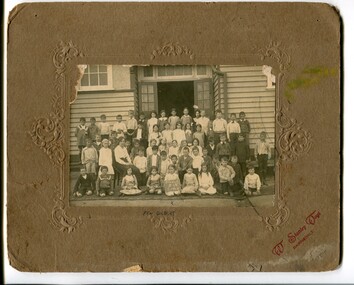
black and white photograph, Vogt, Stanley, C 1915-1920
... A girl in the front is holding a board with what appears to be handwritten in white chalk on a blackboard -"Grades 111 & 1V Orbost"....A girl in the front is holding a board with what appears to be handwritten in white chalk on a blackboard -"Grades 111 & 1V Orbost". black and white photograph Vogt, Stanley ...This is a photograph of students of Orbost State School. Mary Gilbert has identified the girl holding the sign as Pen Gilbert. The 19th of March 1886 proved an important day in the lives of many early settlers in the Orbost area, because on this day the Orbost State School opened. The fact that the school had first operated temporarily in a leased building, and on a half-time basis with SS2745 Jarrahmond, did not dampen the enthusiasm of the local inhabitants as they saw their offspring commence their education under the guidance of HT Campbell Mackay. However he remained in charge only until 12th of May 1886. The second HT, John Rowe, served until 1908. On 30th of June 1887, a portable room was provided; it being brought to the area by schooner. The school now had accommodation for 30 pupils; the teacher's welfare was considered because quarters of two rooms were attached. As the population increased so did the needs of the school. This was reflected in the provision of a larger classroom in 1898. During 1910-11 the first approaches were made to the Department for the establishment of a HES in Orbost and this became a reality in 1912. Orbost HES supplied post-primary education in the district until a high school was built in 1948.This photograph is associate with the history of education i n Orbost.a black / white photograph mounted on brown card. It is of a group of school children in front of an open doorwaay of a timber building. A female teacher is seated on a chair among them. A girl in the front is holding a board with what appears to be handwritten in white chalk on a blackboard -"Grades 111 & 1V Orbost".at bottom - "X PEN GILBERT"education-orbost-state-school -
 Bendigo Military Museum
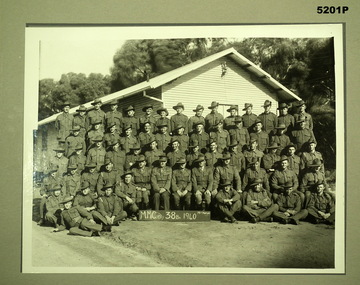
Photograph - GROUP PORTRAIT OF SOLDIERS, PHOTOGRAPHIC, C Fitch & Son, c1940
... On a board in front of the unit is written in chalk - "MMG COY 38 BN 1940 MT MARTHA" . ...See Cat 5192 WW2 38th Battalion Photo On a board in front of the unit is written in chalk - "MMG COY 38 BN 1940 MT MARTHA" . ...See Cat 5192Black and white portrait of Australian soldiers and officers. There are five rows of men. Only one man has a peaked cap, the other officers and men have slouch hats. There are two different patterns of soldier's uniforms. There are different patterns of puggarees. In the background is a galvanised iron hut. Photo is mounted on a cardboard "frame". On a board in front of the unit is written in chalk - "MMG COY 38 BN 1940 MT MARTHA" . On rear is a photographers stamp.ww2, 38th battalion, photo -
 Warrnambool and District Historical Society Inc.
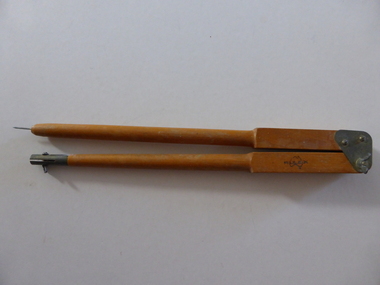
Artefact, Black board compass, c. 1950
... chalk or other large writing medium. The maker’s name and an outline of a map of Australia are engraved into the top part of one of the prongs. Black board ...This compass would have been used in a school or other educational institution for drawing a circle or part circle on a blackboard or whiteboard. A compass similar to this has been used in schools for many decades and may still be used. This school blackboard compass has no known local provenance but was a common classroom item and will be useful for display.This is a wooden blackboard compass with two wooden prongs hinged at the top end with three metal screws. The other end of one prong has a pointed nail protruding for fixing to a blackboard or whiteboard and the end of the other prong has a metal part around the tip of the prong with a metal screw for adjustment and a hollow part to insert chalk or other large writing medium. The maker’s name and an outline of a map of Australia are engraved into the top part of one of the prongs. ‘Rulex’ education in the western district, history of warrnambool, blackboard compass -
 Royal Australian and New Zealand College of Obstetricians & Gynaecologists (RANZCOG)
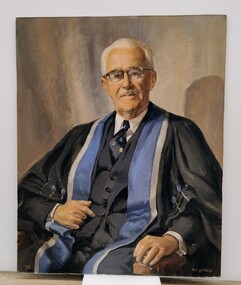
Painting - Portrait of Sir Brian Swift, Reg Campbell, 1957
... board painting. Portrait painting of a man in a dark suit, wearing a black and blue robe with silver trim. The man has silver hair and a moustache, is wearing glasses, and is seated in a wooden chair, with one arm of the chair visible beneath his left hand. Text at bottom left of painting reads " '58". Text at bottom right of painting reads 'REG CAMPBELL'. Text handwritten in chalk...board painting. Portrait painting of a man in a dark suit, wearing a black and blue robe with silver trim. The man has silver hair and a moustache, is wearing glasses, and is seated in a wooden chair, with one arm of the chair visible beneath his left hand. Text at bottom left of painting reads " '58". Text at bottom right of painting reads 'REG CAMPBELL'. Text handwritten in chalk ...This painting was an Archibald Prize Finalist in 1957. Sir Brian Swift was the second Chairman of the Australian Council, RCOG. Swift also fought in World War I, where he started as a lieutenant medical officer before being promoted to Captain. He was awarded the Military Cross in 1918 'for splendid courage and determination under enemy fire'. He was knighted by the Queen in 1954.Oil on board painting. Portrait painting of a man in a dark suit, wearing a black and blue robe with silver trim. The man has silver hair and a moustache, is wearing glasses, and is seated in a wooden chair, with one arm of the chair visible beneath his left hand. Text at bottom left of painting reads " '58". Text at bottom right of painting reads 'REG CAMPBELL'. Text handwritten in chalk on the back of the artwork reads 'A51/CAMPBELL'. Brass plaque associated with painting is engraved with the text 'SIR BRIAN SWIFT/Chairman/AUSTRALIAN REGIONAL COUNCIL, RCOG/1953-1956'. -
 Warrnambool and District Historical Society Inc.
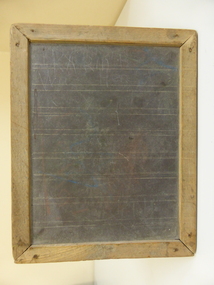
Functional object - School writing slate, Child's School Slate
... board. A more recent blackboard or chalkboard was in common use until the 1970's in junior classes. the writing with these was done with chalk....board. A more recent blackboard or chalkboard was in common use until the 1970's in junior classes. the writing with these was done with chalk. ...This slate comes from the Glasgow Estate (Ellen Isabel Glasgow died in Warrnambool in 1971). It is presumed it was used by members of the Glasgow family. Slates such as this were used by all school children in Victoria (and presumably elsewhere) in the infant and younger age classes from the early days of the State until the early 1940s. It had the advantage of the work being able to be easily erased so that other work could be written. A slate pencil was used to write on this board. A more recent blackboard or chalkboard was in common use until the 1970's in junior classes. the writing with these was done with chalk.This is significant firstly as an example of past educational tools used by small children and so has important social significance as every school child of past generations would have used a slate. It is also important as it belonged to the Glasgow family. John Glasgow (c.1847-1925), at his property, Blackwood Hill, Wangoom, was a prominent cheese maker in the late 19th century and was one of the first shareholders and a member of the first Board of Directors of the Warrnambool Cheese and Butter Factory at Allansford. The dairying industry is of key importance in Warrnambool economic history.This is a child's school writing slate made from quarry slate with permanent lines for handwriting with a wooden frame. The surface is much marked and scratched. Scratch marksschool slates, educational tools of the past, warrnambool history, glasgow family wangoom -
 Bendigo Historical Society Inc.
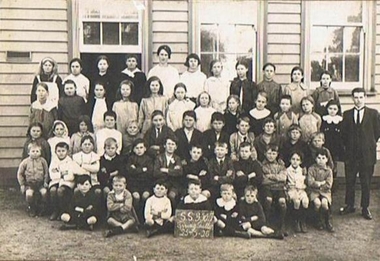
Photograph - COOK COLLECTION: SPRING GULLY SCHOOL STUDENTS 25/5/1920
... board. 52 school students standing/seated in five rows, outside school weatherboard building. Male teacher standing on Right Hand side, dressed in three piece suit, wing collar and tie. Students are dressed in various types of clothing, not uniform. Student centre front row is holding blackboard with '3505, Spring Gully, 25.5.20' written in white chalk...board. 52 school students standing/seated in five rows, outside school weatherboard building. Male teacher standing on Right Hand side, dressed in three piece suit, wing collar and tie. Students are dressed in various types of clothing, not uniform. Student centre front row is holding blackboard with '3505, Spring Gully, 25.5.20' written in white chalk ...Photograph: black and white photo mounted on tan board. 52 school students standing/seated in five rows, outside school weatherboard building. Male teacher standing on Right Hand side, dressed in three piece suit, wing collar and tie. Students are dressed in various types of clothing, not uniform. Student centre front row is holding blackboard with '3505, Spring Gully, 25.5.20' written in white chalk. On back of photo is written in biro: Mrs. J. Noble, 232 Carpenter Street, Spring Gully, Bendigo Bottom Right Hand side of board : Photo, G.W. Bolton, Artist.G.W.Boltonphotograph, person, school children, spring gully, g.w. bolton, cook, noble, j. spring gully school. education
