
Showing 15 items matching " christian spiritual church"
-
 Glen Eira Historical Society
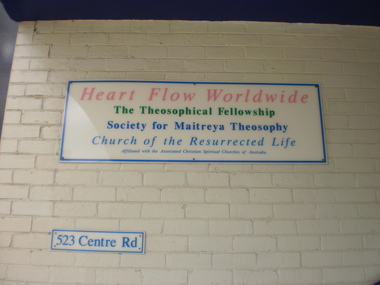
Photograph - Heartflow Worldwide
... ... Christian Spiritual Church...3 Digital Photographs Of The Heartflow Worldwide Church Heartflow Christian Spiritual Church Theosophical Fellowship Bentleigh Maitreya Theosophy Centre Road Church Resurrected Life Photograph Heartflow Worldwide ...3 Digital Photographs Of The Heartflow Worldwide Churchheartflow, christian spiritual church, theosophical fellowship, bentleigh, maitreya theosophy, centre road, church, resurrected life -
 Flagstaff Hill Maritime Museum and Village
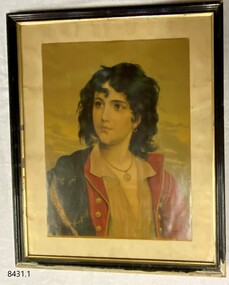
Artwork, other - A religious print and almanac, Australasian Church of Christ, 1892
... This church was closed early in the 21st century when a new church, Gateway Church of Christ, was opened in Ragland Parade in Warrnambool. A rare survival of social and spiritual ephemera related to the Christian worship throughout Australia during the late nineteenth century. ...This religious almanac with biblical imagery listed the Churches of Christ in Australasia and scripture readings for a calendar year of 1892. The almanac was produced and updated annually to reflect current information. The Churches of Christ in Australia is a Reformed Restorationist denomination. Congregations in South Australia, Victoria and New South Wales were established by individuals who travelled to these colonies to pursue employment opportunities, elsewhere in Australia Churches of Christ congregations were established as missionary initiatives. Churches of Christ in Victoria began with the arrival of the Ingram and Picton families from England who established regular meetings in Prahran and officially constituted a congregation in 1855. In Warrnambool plans were drawn up in 1883 for the erection of a Church of Christ at 12 Spence Street. The church was opened in 1885 with visiting pastors until a resident minister, A. J. Fisher, was appointed in 1915. This church was closed early in the 21st century when a new church, Gateway Church of Christ, was opened in Ragland Parade in Warrnambool. A rare survival of social and spiritual ephemera related to the Christian worship throughout Australia during the late nineteenth century. Portrait of a religious female figure wearing a naval type of coat and pendent around her neck. On the rear of the frame is an 1892 Australasian Church of Christ Almanac for suggested scripture readings. One of a pair.flagstaff hill, warrnambool, maritime museum, 1892, almanac, scripture readings, australiasian church of christ, church, religion, christianity -
 Flagstaff Hill Maritime Museum and Village
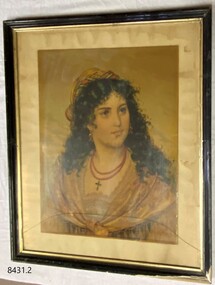
Artwork, other - A religious print and almanac, Australasian Church of Christ, 1892
... This church was closed early in the 21st century when a new church, Gateway Church of Christ, was opened in Ragland Parade in Warrnambool. A rare survival of social and spiritual ephemera related to the Christian worship throughout Australia during the late nineteenth century. ...This religious almanac with biblical imagery listed the Churches of Christ in Australasia and scripture readings for a calendar year of 1892. The almanac was produced and updated annually to reflect current information. The Churches of Christ in Australia is a Reformed Restorationist denomination. Congregations in South Australia, Victoria and New South Wales were established by individuals who travelled to these colonies to pursue employment opportunities, elsewhere in Australia Churches of Christ congregations were established as missionary initiatives. Churches of Christ in Victoria began with the arrival of the Ingram and Picton families from England who established regular meetings in Prahran and officially constituted a congregation in 1855. In Warrnambool plans were drawn up in 1883 for the erection of a Church of Christ at 12 Spence Street. The church was opened in 1885 with visiting pastors until a resident minister, A. J. Fisher, was appointed in 1915. This church was closed early in the 21st century when a new church, Gateway Church of Christ, was opened in Ragland Parade in Warrnambool. A rare survival of social and spiritual ephemera related to the Christian worship throughout Australia during the late nineteenth century. Portrait of a religious female figure wearing a simple dress with a crucifix around her neck. On the rear of the frame is an 1892 Australasian Church of Christ Almanac for suggested scripture readings. One of a pair.flagstaff hill, warrnambool, maritime museum, 1892, almanac, scripture readings, australiasian church of christ, church, religion, christianity -
 Uniting Church Archives - Synod of Victoria
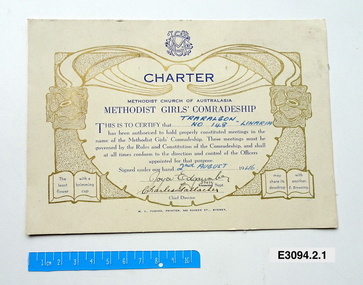
Certificate - Methodist Girls' Comradeship, Charter Tralagon Linaria
... The aims of the MGC was to "challenge young people with the saving power of Jesus Christ and provide avenues of christian service" and "to provide for the spiritual, social, physical and educational welfare of the members". The MGC's motto was "The Utmost for the Highest". Methodist Girls' Comradeship Methodist Girls' Comradeship Rays' Section Charters Methodist Church of Australasia Youth Groups Traralgon Junior Rays Branch No. 404 "Linaria" Traralgon No 148 "Linaria Barbara Brown Joan M Williams State Chief Ray Joyce Edgcumbe State Superintendent Charles Gallacher Chief Director E3094.2.1 "TRARALGON NO 148 - LINARIA 26th AUGUST 1946 Joyce Edgcumbe Charles Gallacher" E3094.2.2 "Traralgon Junior Rays Branch No. 404 "Linaria" 24th October, 1966 Barbara Brown Joan M. ...The Methodist Girls' Comradeship was formed in 1918 with the first Branch being in Bondi, NSW. There were three sections: Junior Rays, 8 - 11 years; Senior Rays, 11 - 15 years and Comrades, 15 years and over. The aims of the MGC was to "challenge young people with the saving power of Jesus Christ and provide avenues of christian service" and "to provide for the spiritual, social, physical and educational welfare of the members". The MGC's motto was "The Utmost for the Highest".Two cream coloured charters with blue and gold print and handwritten information. E3094.2.1 Traralgon No 148 and E3094.2.2 Traralgon No 404.E3094.2.1 "TRARALGON NO 148 - LINARIA 26th AUGUST 1946 Joyce Edgcumbe Charles Gallacher" E3094.2.2 "Traralgon Junior Rays Branch No. 404 "Linaria" 24th October, 1966 Barbara Brown Joan M. Williams State Chief Ray"methodist girls' comradeship, methodist girls' comradeship rays' section, charters, methodist church of australasia, youth groups, traralgon junior rays branch no. 404 "linaria", traralgon no 148 "linaria, barbara brown, joan m williams state chief ray, joyce edgcumbe state superintendent, charles gallacher chief director -
 Uniting Church Archives - Synod of Victoria
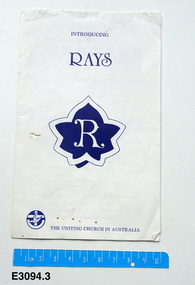
Pamphlet - Methodist Girls' Comradeship, The Uniting Church in Australia, Introducing Rays
... christian service" and "to provide for the spiritual, social, physical and educational welfare of the members". The MGC's motto was "The Utmost for the Highest". Methodist Girls' Comradeship Rays' Section Joy Menhennet E3094.3.1 has a name and address written in pencil on the back. E3094.3.1 and E3094.3.2 - bifold white paper with blue ink. The front has the Methodist Girls' Comradeship ivy leaf with an R in the centre. Their is also the Uniting Church ...The Methodist Girls' Comradeship was formed in 1918 with the first Branch being in Bondi, NSW. There were three sections: Junior Rays, 8 - 11 years; Senior Rays, 11 - 15 years and Comrades, 15 years and over. The aims of the MGC was to "challenge young people with the saving power of Jesus Christ and provide avenues of christian service" and "to provide for the spiritual, social, physical and educational welfare of the members". The MGC's motto was "The Utmost for the Highest".E3094.3.1 and E3094.3.2 - bifold white paper with blue ink. The front has the Methodist Girls' Comradeship ivy leaf with an R in the centre. Their is also the Uniting Church in Australia logo on the front.E3094.3.1 has a name and address written in pencil on the back.methodist girls' comradeship rays' section, joy menhennet -
 Uniting Church Archives - Synod of Victoria
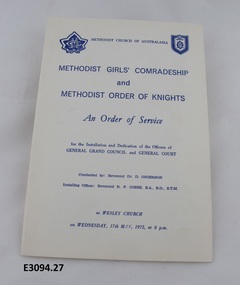
Document - Program, Methodist Girls' Comradeship and Methodist Order of Knights: An Order of Service
... christian service" and "to provide for the spiritual, social, physical and educational welfare of the members". The MGC's motto was "The Utmost for the Highest". methodist order of knights methodist girls' comradeship rev dr d grierson rev r f giese Order of Service for a joint service of the Methodist Girls' Comradeship and Methodist Order of Knights for the Installation and Dedication of the Officers of General Grand Council and General Court at Wesley Church on Wednesday, 17th May, 1972 at 8pm. ...The service was conducted by Rev Dr D Grierson with the Installing Officer being Rev R F Giese. The Methodist Girls' Comradeship was formed in 1918 with the first Branch being in Bondi, NSW. There were three sections: Junior Rays, 8 - 11 years; Senior Rays, 11 - 15 years and Comrades, 15 years and over. The aims of the MGC was to "challenge young people with the saving power of Jesus Christ and provide avenues of christian service" and "to provide for the spiritual, social, physical and educational welfare of the members". The MGC's motto was "The Utmost for the Highest".Order of Service for a joint service of the Methodist Girls' Comradeship and Methodist Order of Knights for the Installation and Dedication of the Officers of General Grand Council and General Court at Wesley Church on Wednesday, 17th May, 1972 at 8pm. The document has both the MGC and MOK symbols on its cover. methodist order of knights, methodist girls' comradeship, rev dr d grierson, rev r f giese -
 Uniting Church Archives - Synod of Victoria
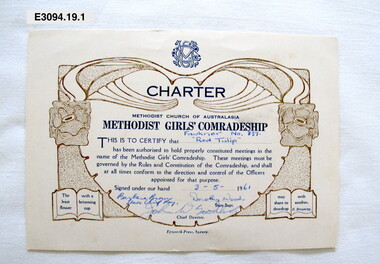
Certificate - Methodist Girls' Comradeship, Epworth Press, Charter Fawkner Red Tulip 337, 1961
... The aims of the MGC was to "challenge young people with the saving power of Jesus Christ and provide avenues of christian service" and "to provide for the spiritual, social, physical and educational welfare of the members". The MGC's motto was "The Utmost for the Highest". Methodist Girls' Comradeship Methodist Girls' Comradeship Rays' Section Methodist Church of Australasia Youth Groups Barbara Brown State Chief Ray Dorothy Wood State Supt. ...In 1961 when the Charter was issued Barbara Brown was the Victorian Chief Ray, Dorothy Wood the State Supt. and John W Goodluck the Chief Director. The Methodist Girls' Comradeship was formed in 1918 with the first Branch being in Bondi, NSW. There were three sections: Junior Rays, 8 - 11 years; Senior Rays, 11 - 15 years and Comrades, 15 years and over. The aims of the MGC was to "challenge young people with the saving power of Jesus Christ and provide avenues of christian service" and "to provide for the spiritual, social, physical and educational welfare of the members". The MGC's motto was "The Utmost for the Highest".Cream coloured Charter with blue and gold print and handwritten informatiion.."Fawkner No. 337 Red Tulip" "Barbara Brown State Chief Ray" "Dorothy Wood State Supt" "John W Goodluck Chief Director"methodist girls' comradeship, methodist girls' comradeship rays' section, methodist church of australasia, youth groups, barbara brown state chief ray, dorothy wood state supt., john w goodluck chief director -
 Uniting Church Archives - Synod of Victoria
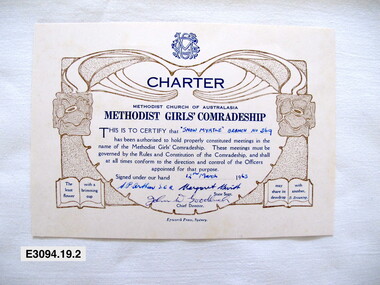
Certificate - Methodist Girls' Comradeship, Charter, 1963
... The aims of the MGC was to "challenge young people with the saving power of Jesus Christ and provide avenues of christian service" and "to provide for the spiritual, social, physical and educational welfare of the members". The MGC's motto was "The Utmost for the Highest". Methodist Girls' Comradeship Methodist Girls' Comradeship Rays' Section Methodist Church of Australasia Snow Myrtle Branch No 369 John W Goodluck Chief Director S.P.Arthur State Chief Ray Margaret Nevitt State Supt. ...In 1963 when this Charter was issued S.P.Arthur was the Victorian Chief Ray, Margaret Nevitt the State Superintendent and John W Goodluck the Chief Director. The Methodist Girls' Comradeship was formed in 1918 with the first Branch being in Bondi, NSW. There were three sections: Junior Rays, 8 - 11 years; Senior Rays, 11 - 15 years and Comrades, 15 years and over. The aims of the MGC was to "challenge young people with the saving power of Jesus Christ and provide avenues of christian service" and "to provide for the spiritual, social, physical and educational welfare of the members". The MGC's motto was "The Utmost for the Highest".Cream coloured charter with blue and gold print and handwritten information.."SNOW MYRTLE BRANCH NO 369" " S.P.Arthur S.C.R." "Margaret Nevitt" "John W Goodluck"methodist girls' comradeship, methodist girls' comradeship rays' section, methodist church of australasia, snow myrtle branch no 369, john w goodluck chief director, s.p.arthur state chief ray, margaret nevitt state supt. -
 Uniting Church Archives - Synod of Victoria
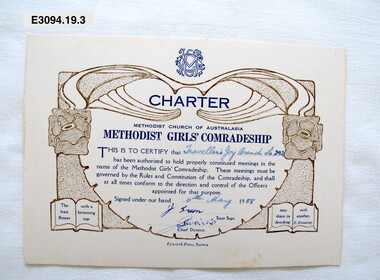
Certificate - Methodist Girls' Comradeship, Epworth Press, Charter Traveller's Joy 292, 1958
... The aims of the MGC was to "challenge young people with the saving power of Jesus Christ and provide avenues of christian service" and "to provide for the spiritual, social, physical and educational welfare of the members". The MGC's motto was "The Utmost for the Highest". Methodist Girls' Comradeship Methodist Girls' Comradeship Rays' Section Methodist Church of Australasia J Green State Supt. ...When this Charter was issued in 1958 J Green was the State Superintendent. The Methodist Girls' Comradeship was formed in 1918 with the first Branch being in Bondi, NSW. There were three sections: Junior Rays, 8 - 11 years; Senior Rays, 11 - 15 years and Comrades, 15 years and over. The aims of the MGC was to "challenge young people with the saving power of Jesus Christ and provide avenues of christian service" and "to provide for the spiritual, social, physical and educational welfare of the members". The MGC's motto was "The Utmost for the Highest".Cream coloured charter with blue and gold print and handwritten information.."Traveller's Joy Branch No 292" "J Green" "6th May 58"methodist girls' comradeship, methodist girls' comradeship rays' section, methodist church of australasia, j green state supt., traveller's joy branch no 292 -
 Uniting Church Archives - Synod of Victoria
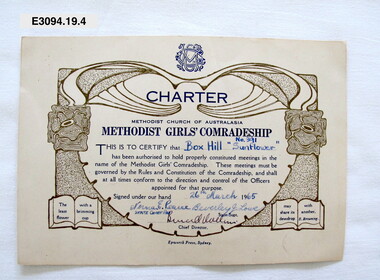
Certificate - Methodist Girls' Comradeship, Epworth Press, Charter Box Hill Sunflower 391, 1965
... The aims of the MGC was to "challenge young people with the saving power of Jesus Christ and provide avenues of christian service" and "to provide for the spiritual, social, physical and educational welfare of the members". The MGC's motto was "The Utmost for the Highest". Methodist Girls' Comradeship Methodist Girls' Comradeship Rays' Section Methodist Church of Australasia Box Hill Sunflower No 391 Norma E Pearce State Chief Ray Beverley J Lowe State Supt. ...In 1965 when the Charter was issued Norma E Pearce was the Victorian Chief Ray and Beverley J Lowe was the State Superintendent. The Methodist Girls' Comradeship was formed in 1918 with the first Branch being in Bondi, NSW. There were three sections: Junior Rays, 8 - 11 years; Senior Rays, 11 - 15 years and Comrades, 15 years and over. The aims of the MGC was to "challenge young people with the saving power of Jesus Christ and provide avenues of christian service" and "to provide for the spiritual, social, physical and educational welfare of the members". The MGC's motto was "The Utmost for the Highest".Cream coloured Charter with blue and gold print and handwritten information.."Box Hill Sunflower No 391" "Norma E Pearce STATE CHIEF RAY" "Beverley J Lowe" "Bruce R Rollins" methodist girls' comradeship, methodist girls' comradeship rays' section, methodist church of australasia, box hill sunflower no 391, norma e pearce state chief ray, beverley j lowe state supt., bruce r rollins chief director -
 Uniting Church Archives - Synod of Victoria
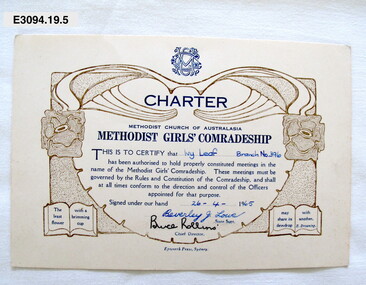
Certificate - Methodist Girls' Comradeship, Epworth Press, Charter Ivy Leaf 396, 1965
... The aims of the MGC was to "challenge young people with the saving power of Jesus Christ and provide avenues of christian service" and "to provide for the spiritual, social, physical and educational welfare of the members". The MGC's motto was "The Utmost for the Highest". Methodist Girls' Comradeship Methodist Girls' Comradeship Rays' Section Methodist Church of Australasia Ivy Leaf Branch No 396 Beverley J Lowe State Supt. ...The Methodist Girls' Comradeship was formed in 1918 with the first Branch being in Bondi, NSW. There were three sections: Junior Rays, 8 - 11 years; Senior Rays, 11 - 15 years and Comrades, 15 years and over. The aims of the MGC was to "challenge young people with the saving power of Jesus Christ and provide avenues of christian service" and "to provide for the spiritual, social, physical and educational welfare of the members". The MGC's motto was "The Utmost for the Highest".Cream coloured Charter with blue and gold print and handwritten information.."Ivy Leaf Branch No 396" "Beverley J Lowe" "Bruce Rollins"methodist girls' comradeship, methodist girls' comradeship rays' section, methodist church of australasia, ivy leaf branch no 396, beverley j lowe state supt., bruce rollins chief director -
 Uniting Church Archives - Synod of Victoria
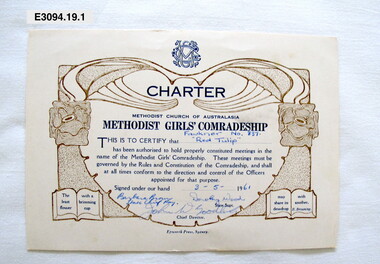
Certificate - Methodist Girls' Comradeship, Charter
... The aims of the MGC was to "challenge young people with the saving power of Jesus Christ and provide avenues of christian service" and "to provide for the spiritual, social, physical and educational welfare of the members". The MGC's motto was "The Utmost for the Highest". Methodist Girls' Comradeship Methodist Girls' Comradeship Rays' Section Charters Methodist Church of Australasia Youth Groups Barbara Brown State Chief Ray Graeme W Speedy Chief Director Beverley J Lowe State Supt. ...The Methodist Girls' Comradeship was formed in 1918 with the first Branch being in Bondi, NSW. There were three sections: Junior Rays, 8 - 11 years; Senior Rays, 11 - 15 years and Comrades, 15 years and over. The aims of the MGC was to "challenge young people with the saving power of Jesus Christ and provide avenues of christian service" and "to provide for the spiritual, social, physical and educational welfare of the members". The MGC's motto was "The Utmost for the Highest".Six cream coloured charters with blue and gold print and handwritten information. E3094.19.1 Fawkner No 337; E3094.19.2 Snow Myrtle No 369; E3094.19.3 Traveller's Joy No 292; E3094.19.4 Box Hill No 391; E3094.19.5 Ivy Leaf No 396 and E3094.19.6 West Newport No 325.E3094.19.1 "Fawkner No. 337 Red Tulip 3-5-61 Barbara Brown State Chief Ray Dorothy Waod John W Goodluck" "E3094.19.2 ""SNOW MYRTLE" BRANCH NO 369 12th march 63 S.P.Arhur S.C.R. Margaret Nevitt John W Goodluck" E3094.19.3 "Traveller's Joy Branch No 292 6th May 58 J Green" E3094.19.4 "Box Hill no.391 "Sunflower" 26th March 65 Norma E Pearce STATE CHIEF RAY Beverley J. Lowe" E3094.19.5 "Ivy Leaf Branch No. 396 26-4-65 Beverley J. Lowe Bruce Rollins" E3094.19.6 "Chrysantemum Rays' Branch Wes Newport No.325 24-5-60 Barbara Brown State Chief Ray Dorothy Wood Graeme W Speedy"methodist girls' comradeship, methodist girls' comradeship rays' section, charters, methodist church of australasia, youth groups, barbara brown state chief ray, graeme w speedy chief director, beverley j lowe state supt., bruce rollins chief director, ivy leaf branch no 396, chrysanthemum west newport no 325, norma e pearce state chief ray, sunflower box hill no 391, traveller's joy no 292, j green state supt., snow myrtle no 369, s p arthur state chief ray, margaret nevitt state supt., john w goodluck chief director, dorothy wood state supt., red tulip fawkner no 337 -
 Uniting Church Archives - Synod of Victoria
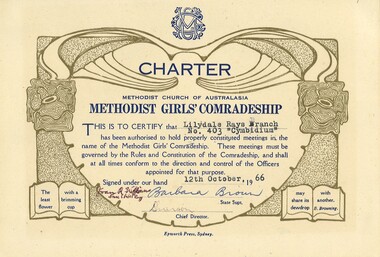
Certificate - Methodist Girls' Comradeship, Charter Lilydale Rays No 403, 1966
... The aims of the MGC was to "challenge young people with the saving power of Jesus Christ and provide avenues of christian service" and "to provide for the spiritual, social, physical and educational welfare of the members". The MGC's motto was "The Utmost for the Highest". Methodist Girls' Comradeship Methodist Girls' Comradeship Rays' Section Charters Methodist Church of Australasia Youth Groups Lilydale Rays No 403 Cymbidium Barbara Brown State Supt. ...The Methodist Girls' Comradeship was formed in 1918 with the first Branch being in Bondi, NSW. There were three sections: Junior Rays, 8 - 11 years; Senior Rays, 11 - 15 years and Comrades, 15 years and over. The aims of the MGC was to "challenge young people with the saving power of Jesus Christ and provide avenues of christian service" and "to provide for the spiritual, social, physical and educational welfare of the members". The MGC's motto was "The Utmost for the Highest".Cream coloured charters with blue and gold print and typed information and handwritten signatures."Lilydale Rays Branch No. 403 "Cymbidium"" "12th October 66methodist girls' comradeship, methodist girls' comradeship rays' section, charters, methodist church of australasia, youth groups, lilydale rays no 403 cymbidium, barbara brown state supt., joan m williams state chief ray -
 Uniting Church Archives - Synod of Victoria
BW photo, Undated
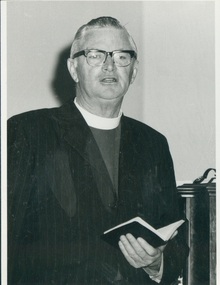
... spiritual life and missionary calling of those whose hearts the Lord had touched. It was during those years that his life-long zeal for the spread of the gospel through Christian literature had its ultimate flowering. It had begun in his Nairobi days with a small church...spiritual life and missionary calling of those whose hearts the Lord had touched. It was during those years that his life-long zeal for the spread of the gospel through Christian literature had its ultimate flowering. It had begun in his Nairobi days with a small church ...STANWAY, ALFRED (b. 9 Sept 1908; d. Melbourne, Vic, 27 June 1989). Anglican bishop, missionary. Stanway grew up in the Wimmera district of western Victoria, and left school when 14 years old. He found work in Melbourne, trained as an accountant, and at the age of 20, held a responsible position with a publishing company. This background, allied with an uncommon flair for figures and finance, was to stand him in good stead throughout his life. But he had little knowledge and no experience of the grace of God until 29 July 1928. At the Evening Service in the parish church of Fairfield on 29 July, he heard the Rev C H Nash (q.v.) preach a sermon which led to his conversion. Within two years he made up his mind to become a missionary and began night studies in order to matriculate. He entered Ridley College in March 1932 to prepare for ordination undertaking week-end duties as a catechist at Deer Park and St Albans. He joined the CMS League of Youth, became chairman, and gathered a fine band of young people many of whom were to become missionaries. He was closely involved with the Belgrave Heights Convention (then at Upwey) and established a League of Youth camp on the site. All his energies were thrown into the task of building up its members in personal holiness and vigorous evangelism. Stanway was ordained in St Paul's Cathedral, Melbourne on St Thomas Day 1934 and was placed in charge of the Old Mission Church of St James and St John, Melbourne. The duties were light enough to allow him to enrol in the Melbourne Teachers College and to complete the Diploma in Teaching. On 26 January 1937, he sailed for Africa to become a missionary in the Anglican Diocese of Mombasa, which at that time embraced the whole of Kenya. He was sent to the hot coastal town of Kaloleni as principal of a Secondary Boys School. Before he left Melbourne, he had become engaged to Marjory Harrison: she followed him to Africa and their marriage took place in Mombasa Cathedral in June 1939. He remained at Kaloleni until 1944 when he was transferred to the inland station of Maseno where all his gifts were to be deployed as rural dean of Nyanza. His oversight of some 500 village churches as well as a widespread primary school system was so efficient that in 1948 he was appointed archdeacon of Kenya with his home and office in Nairobi. As secretary of the African Church Council and of the African Education Board, he was responsible for all African work in the diocese. His contacts with government ministers and public servants were of first class significance at the time when the cry of Uhuru and the demand for independence was travelling throughout the colonial world. On 2 Feb 1951, Alfred Stanway was consecrated in Westminster Abbey as the third Anglican Bp of Central Tanganyika. This Diocese was the special sphere of the CMS Australia, and he already knew most of the missionary personnel. He brought with him the understanding and experience of one who had fully shared the lot and problems of a district missionary, but he came to the diocese at a time when it had yet to recover from its losses in personnel and finance as a result of the war. His immediate task was to provide the impetus of fresh leadership and a long-term overall policy. His aim from-the outset was to build up a strong autonomous church with its own indigenous pastorate. With the whole-hearted confidence of the home base, he was able to enlist the service of new missionaries. He saw a great increase in the number of African clergy and he encouraged village evangelists to open new fields of work. Simple structures were built as new churches at the rate of two a week, week in and week out, year by year. He worked hard to meet the need for Christian literature, bookshops, adult literacy and theological training. He opened Bible schools for village evangelists and sent suitable clergy overseas for further studies. He encouraged initiative in others, helped them to find and use their talents, and gave them his unstinted confidence and support. Fresh finance was required for new ventures. This led him to travel widely in Germany and America, where he raised large funds for these projects. Mackay House was built in Dodoma as the central administrative base for the diocese, hospitals such as those at Mvumi and Hombolo were modernised or established, schools were built and upgraded. In keeping with his vision for ultimate leadership by African personnel, he consecrated Yohana Omari in 1955 as his assistant, he was the first national to become a bp in East Africa. Bp Stanway then set on foot the long and complicated process for the division of his sprawling diocese. In 1963, the diocese of Victoria Nyanza came into being; in 1965, that of Morogoro; in 1966, that of Western Tanganyika. Yet in 1971, his own diocese of Central Tanganyika, though greatly reduced in size, had more churches and more clergy than in its undivided state in 195 l. Stanway then played a leading part in the formation of the Province of Tanzania in 1970, with an African abp as metropolitan. A year later, after 35 years in East Africa and 20 years as bishop of Central Tanganyika, he resigned. His leadership and achievements throughout those years had placed him in the front rank as a great missionary statesman. Stanway had returned to Melbourne at the time when his resignation took effect in August 1971. His early love for Ridley College reasserted itself and he went into residence as deputy principal under the Rev Dr Leon Morris. He was put in charge of chapel worship and the pastoral oversight of the students. All his gifts and experience were called into play as he sought to guide and encourage those who were on the threshold of their ministry. The whole bent of his heart was to foster the spiritual life and missionary calling of those whose hearts the Lord had touched. It was during those years that his life-long zeal for the spread of the gospel through Christian literature had its ultimate flowering. It had begun in his Nairobi days with a small church bookstall, this had developed into a major book-shop in the heart of the city. Then in Dodoma he had established the Central Tanganyika Press in order to promote the publication and distribution of Christian literature at all levels. He had marked out Kevin Engel, trained him, and launched him on the international scene. Hence it was natural that in Melbourne he and Kevin Engel should found the Australian Christian Literature Society. But his time at Ridley College was not to last. Unknown to him, the Rev J R W Stott had put his name forward as that of a person who could head a new school of theology in the United States to provide a sound training for evangelical ordinands. Such a task would have been formidable enough for a younger man who had grown up in America. How could an Australian who had spent half his life in Africa hope to succeed in a venture of that kind in America? How could one who had been a missionary, not a theologian, found a new school to train men for ordination? Nevertheless he rose to the challenge. In Sept 1975, he and Mrs Stanway left Melbourne for Sewickly, an outer suburb of Pittsburg, with the promise of three years' service. He had to start from scratch. He found a house to live in, but there was no land for the school, no funds in hand, no staff yet appointed, no students, and no buildings. His drive, his infections enthusiasm, and his flair for practical enterprise carried the day. One by one, obstacles were overcome and support grew in volume and strength. Twelve months after his arrival, in Sept 1976, the Trinity Episcopal School for Ministry was opened with three staff members, seventeen students, and the goodwill of the whole American Episcopal Church to win. During the next two years, the school took shape and was firmly established. Bp Stanway left an indelible stamp on every aspect of its life and work, its spiritual tone and ideals, its financial and administrative principles. He had inspired widespread support among evangelical episcopalians and had imparted a strong sense of divine guidance and purpose. The council would gladly have extended his term in office beyond three years, but at 75 years of age he knew that his health had begun to fail. When he finally relinquished his office in Nov 1978, he could look back on those three years as the crown of his ministry. It is not too much to say that his name was even more highly honoured and revered in the Trinity School of Ministry than in his own dearly loved Africa. His return to Melbourne led to quiet retirement at Mount Waverley where he settled down to a long battle with the ever worsening effects of Parkinson's Disease. The slow loss of physical capacity and the ultimate failure in powers of speech were a great trial, but he never complained. His faith was summed up in his brief reply when he was asked why he had not prayed for healing: 'What God allows, I accept'. That acceptance was without reserve; his testimony was never brighter. His mental powers were undiminished and his spiritual concerns were as wide as ever. He kept in touch with CMS, he went to church, he met with missionaries, he led Bible studies in his home as long as he was able. Africa was always in his heart, news from Sewickly always gave him great pleasure. He had left a mark for God on three great continents and his death left sad but thankful hearts in them all. It was the close of a life in which he had felt that he could never do enough for God who had done so much for him. One of Bp Stanway's sayings was 'when the Holy Spirit takes hold of you, anything can happen'. So it was in his case. He was very human, with his full share of human foibles and frailties. He had a great zest for life and an endless fund of stories drawn from his own experience. He was himself the subject of many stories, some true, others legendary. His vibrant personality always seemed to fill the house where he was, his presence could not be overlooked. His own home was one in which Mrs Stanway had a paramount influence. She was a trained teacher, a skilled artist, a born hostess and a first-class linguist. They had no children of their own, but were devoted Godparents and always deeply interested in the children of missionaries. Home life allowed him to relax in a serene and contented atmosphere and to exercise his gifts for friendship and hospitality. He was always on the watch for souls, a person-to-person evangelist par excellence. He was a man of faith and prayer who dared to believe in the God of the impossible. His love for Africa, his total dedication as a missionary; his gifts as a soulwinner; his genius for finance; his shrewd practical initiatives, and his statesmanlike vision were outstanding characteristics. But great or small, all his gifts were laid out in the service of the gospel, and that service marked him out as one of the most remarkable Australian missionaries of his generation. M L Loane, Men to Remember (Sydney, 1987) Rev. Alfred Stanway is standing with open book in hand, dressed in clerical garb.Bishop Alfred Stanwaybishop alfred stanway -
 Ballarat Heritage Services
Photograph, Italian Holy Cards from the 1860s
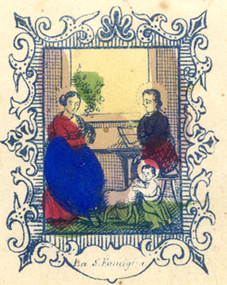
... A contemporary of Paul of Thebes, he is considered the founder of Christian monasticism and the first of the abbots; he is responsible for the permanent establishment of families of monks who, under the guidance of a spiritual father, abba, consecrated themselves to the service of God. His life has been handed down by his disciple Athanasius of Alexandria. He is one of the four Fathers of the Eastern Church...A contemporary of Paul of Thebes, he is considered the founder of Christian monasticism and the first of the abbots; he is responsible for the permanent establishment of families of monks who, under the guidance of a spiritual father, abba, consecrated themselves to the service of God. His life has been handed down by his disciple Athanasius of Alexandria. He is one of the four Fathers of the Eastern Church ...The Sanctuary of the Blessed Virgin of the Coast is located in the picturesque municipality of San Giovanni Bianco, is a fascinating example of a subsidiary church immersed in the greenery of the mountains. Its privileged location, at an altitude offering breathtaking views, has made this place an important point of reference for the local community since its founding. The church, characterized by a simple yet elegant architectural style, features a façade that exudes serenity and welcome, inviting visitors to discover its history and significance. The feast of the Blessed Virgin of the Coast is celebrated every year on 15 August, becoming a moment of joy and sharing for the community. True Image of the Blessed Virgin venerated in the Church of the Costa of St. Gall One black and white holy card shows an artwork of the Blessed Virgin, St. Joseph, and the Magi and is venerated in the Church of the Costa of S. Gallo. The history of the sanctuary has its roots in an extraordinary event that occurred on 04 April 1492. A sacred image depicting the Virgin Mary, kept in the home of Caterina Lupis, was the scene of a miracle: tears of blood flowed from the painting. This event, interpreted as a divine sign, stirred great emotion and devotion in the local community. After a series of miraculous events, the Madonna herself expressed the desire to build a sanctuary in her honor, in a specific place: the coast overlooking the town and the hamlets of San Giovanni. Construction of the sanctuary began in 1492, marking the beginning of a story of faith and devotion that continues to this day. S. Antonio Abate, or St Anthony the Abbot Anthony the Abbot, Saint Anthony the Great, Saint Anthony of Egypt, Saint Anthony of the Fire, Saint Anthony of the Desert and Saint Anthony the Anchorite , ( Qumans , 12 January 251 – Thebaid Desert , 17 January 356 ) was an Egyptian abbot and hermit. A contemporary of Paul of Thebes, he is considered the founder of Christian monasticism and the first of the abbots; he is responsible for the permanent establishment of families of monks who, under the guidance of a spiritual father, abba, consecrated themselves to the service of God. His life has been handed down by his disciple Athanasius of Alexandria. He is one of the four Fathers of the Eastern Church who bear the title of "Great" together with Athanasius himself, Basil and Photius of Constantinople. He is remembered in the Calendar of Saints of the Catholic Church and the Lutheran Church on January 17, but the Coptic Orthodox Church celebrates him on January 31, which corresponds, in its calendar, to the 22nd of the month of Tobit . St Catherine of Alexandra was a martyr. T he emperor angrily ordered her to be executed on a breaking wheel. The breaking wheel is an ancient form of torture where a person's limbs are threaded among the spokes and their bones are shattered by an executioner with a heavy rod. It is a brutal punishment that results in a slow and painful death, normally reserved for the worst criminals. When Catherine was presented before the wheel, she touched it and a miracle occurred that caused the wheel to shatter. Unable to torture her to death, the emperor simply ordered her beheaded. Around the year 800, a legend spread that her body has been found with her hair still growing and a constant stream of oil coming from her body. Nothing exists to this day of her remains, and her very existence has been called into question. Despite these questions, and the possibility that her story may be confused with that of one or more other saints, she is still venerated in the Eastern Orthodox Church as a Martyr. Many Roman Catholics also venerate her to this day as one of the great virgin saints of the early Church. During the medieval period, St. Catherine was one of the most famous saints of the Church. She has was a popular subject in renaissance art and many paintings from the period are dedicated to her. St. Henry, son of Henry, Duke of Bavaria, and of Gisella, daughter of Conrad, King of Burgundy, was born in 972. He received an excellent education under the care of St. Wolfgang, Bishop of Ratisbon. In 995, St. Henry succeeded his father as Duke of Bavaria, and in 1002, upon the death of his cousin, Otho III, he was elected emperor. Firmly anchored upon the great eternal truths, which the practice of meditation kept alive in his heart, he was not elated by this dignity and sought in all things, the greater glory of God. He was most watchful over the welfare of the Church and exerted his zeal for the maintenance of ecclesiastical discipline through the instrumentality of the Bishops. He gained several victories over his enemies, both at home and abroad, but he used these with great moderation and clemency. In 1014, he went to Rome and received the imperial crown at the hands of Pope Benedict VIII. On that occasion he confirmed the donation, made by his predecessors to the Pope, of the sovereignty of Rome and the exarchate of Ravenna. Circumstances several times drove the holy Emperor into war, from which he always came forth victorious. He led an army to the south of Italy against the Saracens and their allies, the Greeks, and drove them from the country. The humility and spirit of justice of the Saint were equal to his zeal for religion. He cast himself at the feet of Herebert, Bishop of Cologne, and begged his pardon for having treated him with coldness, on account of a misunderstanding. He wished to abdicate and retire into a monastery, but yielded to the advice of the Abbot of Verdun, and retained his dignity. Both he and his wife, St. Cunegundes, lived in perpetual chastity, to which they had bound themselves by vow. The Saint made numerous pious foundations, gave liberally to pious institutions and built the Cathedral of Bamberg. His holy death occurred at the castle of Grone, near Halberstad, in 1024. His feast day is July 13th. He is the patron saint of the childless, of Dukes, of the handicapped and those rejected by Religious Order. What we know of St. Elizabeth comes from the Gospel, the book of Luke, in particular. In Luke, Elizabeth, a daughter of the line of Aaron, and the wife of Zechariah, was "righteous before God" and was "blameless" but childless. Elizabeth is also a cousin to the Virgin Mary.What we know of St. Elizabeth comes from the Gospel, the book of Luke, in particular. In Luke, Elizabeth, a daughter of the line of Aaron, and the wife of Zechariah, was "righteous before God" and was "blameless" but childless. Elizabeth is also a cousin to the Virgin Mary. Five holy cards from San Gallo, Lombardy, Italy, carried by Luigi Gervasoni in a small prayer book that he carried to Australia. Two of the Holy Cards are hand coloured, and one mentions the Church were he was baptised, The Chiesa della Costa di S. Gallo. caterina lupis, san gallo, luigi gervasoni, italy, saint elizabeth, san giovanni bianco, chiesa di costa san giovanni bianco, holy family, saint anthony the abbot, st catherine
