
Showing 21 items matching " darning stitches"
-
 Embroiderers Guild, Victoria
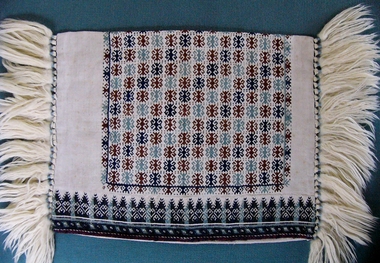
Domestic object - Bosnian Pattern Darning Cushion Cover, Late 19th century
... ... Darning Stitches...Natural linen with pattern darning in dark blue, light blue, brown and dark grey. Plaited edge stitch on one long edge. ...Made from a sleeve, one of many peasant designs from Bosnia. Embroidery Darning Stitches Cushions Late 19th century Mid European Natural linen with pattern darning in dark blue, light blue, brown and dark grey. ...Purchased in Greece, 1961. Made from a sleeve, one of many peasant designs from Bosnia.Natural linen with pattern darning in dark blue, light blue, brown and dark grey. Plaited edge stitch on one long edge. Wide tasselled fringe in cream wool.embroidery, darning stitches, cushions, late 19th century, mid european -
 Embroiderers Guild, Victoria
Textile - 1920's School Sampler, Hester Fairlie, Late 1920's
... Cream/beige linen hemmed sampler, with buttonhole, button, hook fastening, darning, patching and embroidery stitches in orange and aqua threads....Cream/beige linen hemmed sampler, with buttonhole, button, hook fastening, darning, patching and embroidery stitches in orange and aqua threads. ...Made by Hester Fairlie, aged 9 - donor.School sampler. Cream/beige linen hemmed sampler, with buttonhole, button, hook fastening, darning, patching and embroidery stitches in orange and aqua threads.Hester Fairlieembroidery, sampler -
 Embroiderers Guild, Victoria
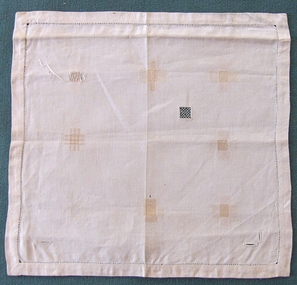
Textile - 19th C Dutch Darning Sampler, Late 19th century (c. 1872)
... Fine white linen sampler with darning in brown. Hem stitch edge in the pattern of tea towels and other items of the time including button holes....Embroidery Darning Samplers Late 19th century Holland Fine white linen sampler with darning in brown. Hem stitch edge in the pattern of tea towels and other items of the time including button holes. ...Made by Donor's grandmother.Fine white linen sampler with darning in brown. Hem stitch edge in the pattern of tea towels and other items of the time including button holes.embroidery, darning, samplers, late 19th century, holland -
 Embroiderers Guild, Victoria
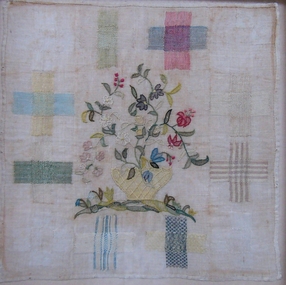
Textile - Darning Sampler, Late 18th/early 19th century
... A number of squares and crosses surround a central motif of flowers in a basket in pattern darning and outline stitch. Wooden frame....A number of squares and crosses surround a central motif of flowers in a basket in pattern darning and outline stitch. Wooden frame. Textile Darning Sampler ...A fine example of a darning sampler. It shows examples of fine darning in silk with a variety of patterns suitable for the mending of household linen. A number of squares and crosses surround a central motif of flowers in a basket in pattern darning and outline stitch. Wooden frame.embroidery, darning, samplers, early 19th century, england -
 Embroiderers Guild, Victoria
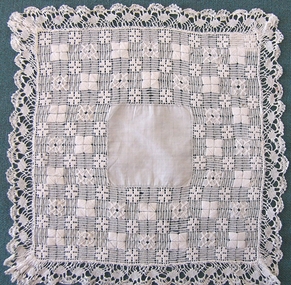
Accessory - Drawn Thread Handkerchief with Bobbin Lace Edge, C. 1900
... Fine central square of silk or cotton, surrounded by smaller squares in alternating designs of pattern darning and whipping, satin stitch and large cross stitches. ...Embroidery Drawn thread c. 1900 Fine central square of silk or cotton, surrounded by smaller squares in alternating designs of pattern darning and whipping, satin stitch and large cross stitches. ...Fine central square of silk or cotton, surrounded by smaller squares in alternating designs of pattern darning and whipping, satin stitch and large cross stitches. Edging is bobbin lace.embroidery, drawn thread, c. 1900 -
 Embroiderers Guild, Victoria
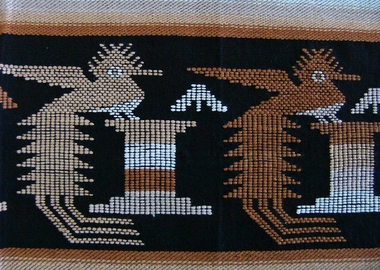
Textile - Handwoven Pattern Darning Guatemalan Wall Decoration, Late 20th century
... Handwoven and embroidered Guatemalan wall decorations are traditional Mayan folk art pieces created using backstrap looms and intricate hand-embroidery techniques like brocade, darning, and randa stitching. Key Features of Guatemalan Wall Textiles Backstrap Loom Weaving: Panels are woven on a traditional backstrap loom where the weaver uses body tension to control the warp and weft threads. ...Handwoven and embroidered Guatemalan wall decorations are traditional Mayan folk art pieces created using backstrap looms and intricate hand-embroidery techniques like brocade, darning, and randa stitching. Key Features of Guatemalan Wall Textiles Backstrap Loom Weaving: Panels are woven on a traditional backstrap loom where the weaver uses body tension to control the warp and weft threads. ...Handwoven and embroidered Guatemalan wall decorations are traditional Mayan folk art pieces created using backstrap looms and intricate hand-embroidery techniques like brocade, darning, and randa stitching. Key Features of Guatemalan Wall Textiles Backstrap Loom Weaving: Panels are woven on a traditional backstrap loom where the weaver uses body tension to control the warp and weft threads. Pattern Darning and Brocade: Artisans use supplementary-weft techniques—such as brocade (randa) and darning—to build geometric, zoomorphic, and nature-inspired motifs like quetzals, deer, horses, and floral mandalas. Regional Craftsmanship: Many distinct pieces originate from highland communities like Chichicastenango and Santiago Atitlán, where multi-purpose textiles like tzutes or ceremonial huipils are crafted.Hand woven striped cotton, black back ground,brown and white tones. Large central band has 4 large quetzel birds, 2 narrow bands have 11 figures in pattern darning. Ends are fringed.embroidery, wall hanging, pattern darning, south america, 1960-80 -
 Kew Historical Society Inc
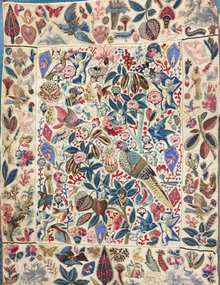
Decorative object - Cotton chintz applique on linen wall hanging [Broderie Perse], 19th Century
... The hanging had belonged to her mother - Amy Grigg - and was used by the latter to demonstrate skills in darning (the red stitching). Provenance includes a certificate dating from 1889 which records an award to Amy Grigg of Pakington Street (Kew) for skills in needlework, issued by the Kew Floral Industrial & Art Society. ...Later stitching in red wool was added in the 1890s to demonstrate skill in darning. The main panel is bordered by a narrow green and ecru braid. ...The hanging had belonged to her mother - Amy Grigg - and was used by the latter to demonstrate skills in darning (the red stitching). Provenance includes a certificate dating from 1889 which records an award to Amy Grigg of Pakington Street (Kew) for skills in needlework, issued by the Kew Floral Industrial & Art Society. ...This broderie perse' wall hanging was donated to the Kew Historical Society in 1980 by Mrs Joy Ivory. The hanging had belonged to her mother - Amy Grigg - and was used by the latter to demonstrate skills in darning (the red stitching). Provenance includes a certificate dating from 1889 which records an award to Amy Grigg of Pakington Street (Kew) for skills in needlework, issued by the Kew Floral Industrial & Art Society. Amy Grigg later married Albert Watson, the son of John Watson. The latter was an early pastor of the Kew Methodist Church in Highbury Grove, Kew. Both the Watson and Grigg families were early pioneers of Kew. While the hanging was modified by Amy Grigg in 1889, the original textile dates from an earlier period when 'Broderie Perse' (Persian embroidery) was used to create quilts and wall hangings. It is estimated that the hanging dates from the first half of the 19th century. An exact dating will require a detailed examination of the cotton chintz fabrics used to embroider the hanging. This appliquéd wall hanging is one of the earliest textiles in the Kew Historical Society's fashion & textiles collection. Similar examples are held in major international collections such as the Victoria & Albert Museum. This example of broderie perse is significant for the cross-cultural influence of Indian textiles on European taste, not unusual given the English foothold in India during this period. Additional interest is due to the mixing of Indian and European textiles in the design, while staying true to the derivation of the design. The textile is both well-provenanced and rare. While it is unlikely to be Australian-made, it is probably an example of a textile brought to Australia during the colonial period that indicates a desire to decorate interiors using items created in and for the English home. On another level, the wall hanging is a fine example of 'women's work' in the first half of the nineteenth century.Small wall hanging, comprised of five panels that are each appliquéd by hand in herringbone stitch using a range of decorative figurative motifs including flora and fauna. The design is based on an Indian palimpore representing a tree of life design. The base textile is a cream linen while the appliquéd figures or shapes are cut from cotton chintz. These additions are probably a mix of Indian and European designs. The quality of the herringbone stitching is very fine. Later stitching in red wool was added in the 1890s to demonstrate skill in darning. The main panel is bordered by a narrow green and ecru braid. It has a narrow tan braid at the top and bottom of the two side panels. A surrounding tan braid around the entire textile is missing in some places. textiles, applique, broderie perse, amy grigg, wall hangings, migration -
 Flagstaff Hill Maritime Museum and Village
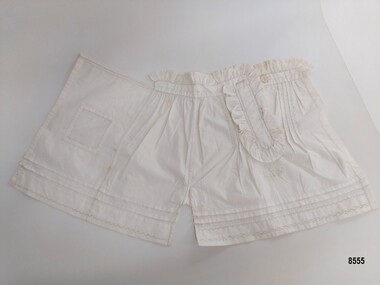
Textile - Plain Sewing Sampler, 1897
... darning, patching, hemming, mending, structural sewing (making pleats, inserting gussets, joining fabric with seams) making buttonholes and embroidery. Samplers could also be intended for practicing a particular technique. There were several articles printed in Australian newspapers around 1889 referring to the "Plain Sewing Movement". In 1889 a Melbourne branch of the "London Institute for the Advancement of Plain Needlework" was formed by a group of ladies led by Lady Loch and Lady Clarke with the purpose of teaching "plain needlework' to women and girls. "Plain Sewing" included fundamental stitches...Flagstaff Hill Maritime Museum and Village Warrnambool Shipwreck Coast needlework textiles plain sewing sampler darning sampler handwork sewing Great Ocean Road Susan Henry OAM Vedmore Trust hand sewing sewing techniques L L/1897 A cream cotton sampler made from three smaller rectangular shapes, displaying a wide variety of plain sewing techniques including hand stitched seams (french, bound and herringboned), inserted patch, buttonhole, button, gathering, a gusset, frills, pintucks, a placket, cross stitch initials and date (L L and 1897) and decorative embroidery. ...A "Plain Sewing Sampler" or "Darning Sampler" was intended to showcase the wide range of sewing techniques and skills a girl or woman had. These skills might include hand sewing techniques such as darning, patching, hemming, mending, structural sewing (making pleats, inserting gussets, joining fabric with seams) making buttonholes and embroidery. Samplers could also be intended for practicing a particular technique. There were several articles printed in Australian newspapers around 1889 referring to the "Plain Sewing Movement". In 1889 a Melbourne branch of the "London Institute for the Advancement of Plain Needlework" was formed by a group of ladies led by Lady Loch and Lady Clarke with the purpose of teaching "plain needlework' to women and girls. "Plain Sewing" included fundamental stitches and techniques that were essential for practical clothing construction and maintenance. Several years later in 1891, another meeting was held at Clivedon (the residence of Lady Clarke) to look into the possibility of improving the teaching of sewing in the state schools. This meeting was attended by several school inspectors and the committee of "the Melbourne Institute for the Advancement of Plain Needlework". This "Plain Sewing Sampler" was donated from the estate of Susan Henry OAM nee Vedmore (1944 - 2021). Susan's family (Harold and Gladys Vedmore) immigrated to Australia from Wales in 1955 and settled in Warrnambool. Susan was well known in the Warrnambool community for her work supporting children and families across the district - particular those with disabilities, or those who were homeless, unemployed or isolated. Susan was the founding trustee of the "Vedmore Foundation" - a Warrnambool philanthropic trust set up to support a range of charitable and not-for-profit causes by providing grant assistance. In 2021, she was awarded a Medal of the Order of Australia for services to the community. It has not been possible to identify the lady (with the initials L. L.) who made this item in 1897 but it was thought to possibly be a female relation in her maternal (or possibly, paternal) grandmother's family. It has many of the same elements and techniques that were taught by the "Plain Sewing Movement" that originated in England at the end of the nineteenth century.This item is a rare example of the handcraft skills learnt by women and girls in the late 1890's to construct and maintain practical clothing for their families.A cream cotton sampler made from three smaller rectangular shapes, displaying a wide variety of plain sewing techniques including hand stitched seams (french, bound and herringboned), inserted patch, buttonhole, button, gathering, a gusset, frills, pintucks, a placket, cross stitch initials and date (L L and 1897) and decorative embroidery.L L/1897flagstaff hill maritime museum and village, warrnambool, shipwreck coast, needlework, textiles, plain sewing sampler, darning sampler, handwork, sewing, great ocean road, susan henry oam, vedmore trust, hand sewing, sewing techniques -
 Flagstaff Hill Maritime Museum and Village
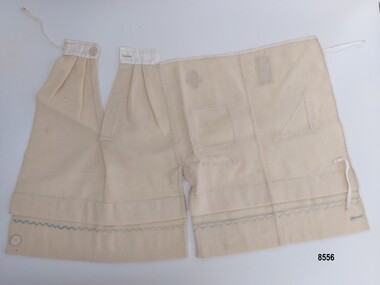
Textile - Plain Sewing Sampler, 1897
... darning, patching, hemming, mending, structural sewing (making pleats, inserting gussets, joining fabric with seams) making buttonholes and embroidery. Samplers could also be intended for practicing a particular technique. There were several articles printed in Australian newspapers around 1889 referring to the "Plain Sewing Movement". In 1889 a Melbourne branch of the "London Institute for the Advancement of Plain Needlework" was formed by a group of ladies led by Lady Loch and Lady Clarke with the purpose of teaching "plain needlework' to women and girls. "Plain Sewing" included fundamental stitches...darning sampler hand sewing textiles Susan Henry OAM Vedmore Foundation sewing techniques L.L. / ?? Yr 1897 A cream flannel sampler made from three smaller rectangular shapes, displaying a wide variety of plain sewing techniques including hand stitched seams (french, bound and herringboned), darned patches, inserted patches, pleats, buttonholes, buttons, a gusset, pintucks, a placket, cross stitch initials and date (L L and 1897) and decorative embroidery. ...A "Plain Sewing Sampler" or "Darning Sampler" was intended to showcase the wide range of sewing techniques and skills a girl or woman had. These skills might include hand sewing techniques such as darning, patching, hemming, mending, structural sewing (making pleats, inserting gussets, joining fabric with seams) making buttonholes and embroidery. Samplers could also be intended for practicing a particular technique. There were several articles printed in Australian newspapers around 1889 referring to the "Plain Sewing Movement". In 1889 a Melbourne branch of the "London Institute for the Advancement of Plain Needlework" was formed by a group of ladies led by Lady Loch and Lady Clarke with the purpose of teaching "plain needlework' to women and girls. "Plain Sewing" included fundamental stitches and techniques that were essential for practical clothing construction and maintenance. Several years later in 1891, another meeting was held at Clivedon (the residence of Lady Clarke) to look into the possibility of improving the teaching of sewing in the state schools. This meeting was attended by several school inspectors and the committee of "the Melbourne Institute for the Advancement of Plain Needlework". This "Plain Sewing Sampler" was donated from the estate of Susan Henry nee Vedmore (1944 - 2021). Susan's family (Harold and Gladys Vedmore) immigrated to Australia from Wales in 1955 and settled in Warrnambool. Susan was well known in the Warrnambool community for her work supporting children and families across the district - particular those with disabilities, or those who were homeless, unemployed or isolated. Susan was the founding trustee of the "Vedmore Foundation" - a Warrnambool philanthropic trust set up to support a range of charitable and not-for-profit causes by providing grant assistance. In 2021, she was awarded a Medal of the Order of Australia for services to the community. It has not been possible to identify the lady (with the initials L. L.) who made this item in 1897 but it was thought to possibly be a female relation in her maternal (or possibly, paternal) grandmother's family. It has many of the same elements and techniques that were taught by the "Plain Sewing Movement" that originated in England at the end of the nineteenth century.This item is a rare example of the handcraft skills needed by women and girls in the late 1890's to construct and maintain practical clothing for their families.A cream flannel sampler made from three smaller rectangular shapes, displaying a wide variety of plain sewing techniques including hand stitched seams (french, bound and herringboned), darned patches, inserted patches, pleats, buttonholes, buttons, a gusset, pintucks, a placket, cross stitch initials and date (L L and 1897) and decorative embroidery.L.L. / ?? Yr 1897flagstaff hill maritime museum and village, great ocean road, warrnambool, sewing, plain sewing, sewing sampler, plain sewing sampler, darning sampler, hand sewing, textiles, susan henry oam, vedmore foundation, sewing techniques -
 Montmorency–Eltham RSL Sub Branch
Tool - Sewing Kit
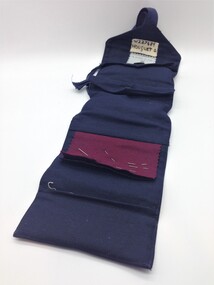
... W 227689 Houguet D on white square tape and Stitch in Time 1968 A F L22L/290 on a square of pale grey mitred material Pockets contain Darning thread , press studs, darning needles, reels of cotton, hooks and eyes and sewing needles ...Clothing Repair kit W 227689 Houguet D on white square tape and Stitch in Time 1968 A F L22L/290 on a square of pale grey mitred material Pockets contain Darning thread , press studs, darning needles, reels of cotton, hooks and eyes and sewing needles Navy cotton material with hanging straps at top and three pockets and extra material swatches to hold pins and needles. ...Navy cotton material with hanging straps at top and three pockets and extra material swatches to hold pins and needles.W 227689 Houguet D on white square tape and Stitch in Time 1968 A F L22L/290 on a square of pale grey mitred material Pockets contain Darning thread , press studs, darning needles, reels of cotton, hooks and eyes and sewing needles clothing, repair kit -
 Embroiderers Guild, Victoria
Clothing - Cream Kashmiri Shawl, 1970's
... It is used alongside other stitches like parallel darning, overlapping darning, herringbone, knot, and buttonhole stitches to create intricate designs, often on items such as Pashmina shawls. ...It is used alongside other stitches like parallel darning, overlapping darning, herringbone, knot, and buttonhole stitches to create intricate designs, often on items such as Pashmina shawls. ...See Rehman, Sharry & Nahead Jafri "The Kashmiri Shawl" Page 286, extract in Archives . The term "watachikan" appears to be a specific term used in reference to a style of sozni (couching) embroidery. It is used alongside other stitches like parallel darning, overlapping darning, herringbone, knot, and buttonhole stitches to create intricate designs, often on items such as Pashmina shawls. Kashmiri shawl/scarf. Cream wool embroidered in 'watachikan' style with dark brown cotton straight stitch outline, and yellow and green satin stitch. Wide border of embroidery each end. Narrow border along each long side, and regularly spaced individual motifs.embroidery, kashmiri -
 Embroiderers Guild, Victoria
Textile - 1910 German Darning Sampler, Clara Toepelmann, c. 1910
... White linen darning sampler, red, white and blue stitching. Hem stitched edges with different hem stitches....Made at the School of Domestic Science, Leipzig, Germany by Clara Toepelmann Embroidery Darning Samplers 1900-20 Germany White linen darning sampler, red, white and blue stitching. Hem stitched edges with different hem stitches. ...Made at the School of Domestic Science, Leipzig, Germany by Clara ToepelmannWhite linen darning sampler, red, white and blue stitching. Hem stitched edges with different hem stitches.embroidery, darning, samplers, 1900-20, germany -
 Tatura Irrigation & Wartime Camps Museum
Decorative object - Sampler, 1944
... Open weave beige sampler showing 2 embroidered, 3 darning and 4 inserts in gold, brown and pink cotton. Threads have been drawn and cut away at the back. Blanket stitch...Made by Gertrud Hermann an internee in Camp 3. gertrud hermann camp 3 internees sampler internment camp crafts Open weave beige sampler showing 2 embroidered, 3 darning and 4 inserts in gold, brown and pink cotton. Threads have been drawn and cut away at the back. Blanket stitch ...Made by Gertrud Hermann an internee in Camp 3.Open weave beige sampler showing 2 embroidered, 3 darning and 4 inserts in gold, brown and pink cotton. Threads have been drawn and cut away at the back. Blanket stitch around the hems.gertrud hermann, camp 3 internees, sampler, internment camp crafts -
 Embroiderers Guild, Victoria
Textile - Child's Doll Apron Sewing Sampler, Floretta Thomas, Late 19th century
... This apron was done by a small girl in order to learn different needlework techniques and shows hemming, buttonhole edgings, bars, eyelets, darning, drawn thread and feather stitch. Made by the donor's mother Mrs J.B. ...This apron was done by a small girl in order to learn different needlework techniques and shows hemming, buttonhole edgings, bars, eyelets, darning, drawn thread and feather stitch. Made by the donor's mother Mrs J.B. ...This apron was done by a small girl in order to learn different needlework techniques and shows hemming, buttonhole edgings, bars, eyelets, darning, drawn thread and feather stitch. Made by the donor's mother Mrs J.B. Rentoul (nee Floretta Thomas) late of St. Georges Manse, Geelong and St. Andrews, Wagga Wagga, N.S.W. It was worked when she was six, for the Sydney Exhibition and was highly commended.Tiny dolls apron in white cotton with pale blue stitching.embroidery, samplers, dolls clothes, late 19th century, australia, plain sewing -
 Mont De Lancey
Container - Cane Sewing Basket, Happy Home, 1950's
... Inside are various pieces of vintage sewing items including; large and small cotton reels with cotton thread, very small cotton cardboard reels with thread, plastic container of pins, a handmade wooden darning mushroom, a brightly coloured tin of pins and needles, two short zips, a piece of embroidery material stamped with a pansy pattern to sew, a Birch brand packet of sewing needles, a Delyta brand "Nu-Bras" Brassiere Repair Set, two "Mendex" Cuff Savers for Men's Trousers, a Happy Home Needle Book with a few needles, and a paper pattern for Cross Stitch. ...Inside are various pieces of vintage sewing items including; large and small cotton reels with cotton thread, very small cotton cardboard reels with thread, plastic container of pins, a handmade wooden darning mushroom, a brightly coloured tin of pins and needles, two short zips, a piece of embroidery material stamped with a pansy pattern to sew, a Birch brand packet of sewing needles, a Delyta brand "Nu-Bras" Brassiere Repair Set, two "Mendex" Cuff Savers for Men's Trousers, a Happy Home Needle Book with a few needles, and a paper pattern for Cross Stitch. ...The handmade basket has a variety of pieces of vintage sewing items as listed in the detailed Description. These would have been used in the home for repairs as well as pieces sewn. Mrs Pratt owned the sewing basket and it's contents - she lived in Beenak Road, Wandin, Victoria.An open rectangular shaped cane woven sewing basket with three bands of green and tan raffia woven around the sides. It had a lid which is missing but there is one twisted wire loop where the lid would have been attached. Inside are various pieces of vintage sewing items including; large and small cotton reels with cotton thread, very small cotton cardboard reels with thread, plastic container of pins, a handmade wooden darning mushroom, a brightly coloured tin of pins and needles, two short zips, a piece of embroidery material stamped with a pansy pattern to sew, a Birch brand packet of sewing needles, a Delyta brand "Nu-Bras" Brassiere Repair Set, two "Mendex" Cuff Savers for Men's Trousers, a Happy Home Needle Book with a few needles, and a paper pattern for Cross Stitch. See above for the brands and details of the sewing items included in the basket.containers, sewing, baskets, sewing equipment -
 Embroiderers Guild, Victoria
Textile - Swedish Darning Mat, 1960-80
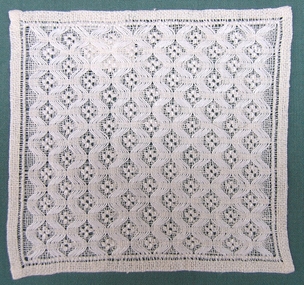
... Fine ecru linen in a chevian design in Swedish darning, with a pulled thread motif in each centre. Hem stitched edge....Embroidery Mats Drawn fabric Switzerland 1960-80 Fine ecru linen in a chevian design in Swedish darning, with a pulled thread motif in each centre. Hem stitched edge. Textile Swedish Darning Mat ...Fine ecru linen in a chevian design in Swedish darning, with a pulled thread motif in each centre. Hem stitched edge.embroidery, mats, drawn fabric, switzerland, 1960-80 -
 Embroiderers Guild, Victoria
Accessory - Serbian Embroidered Collar and Cuff Set, Early 20th Century
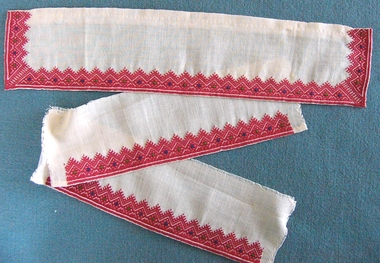
... Natural coloured cotton (fine) with pattern darning in red, with small satin stitch dots in navy and green....Embroidery Garment Darning 1900-20 Mid European Natural coloured cotton (fine) with pattern darning in red, with small satin stitch dots in navy and green. ...Probably made for a blouse.Natural coloured cotton (fine) with pattern darning in red, with small satin stitch dots in navy and green.embroidery, garment, darning, 1900-20, mid european -
 Embroiderers Guild, Victoria
Textile - Japanese Pattern Darning Mats (Boxed), 1982
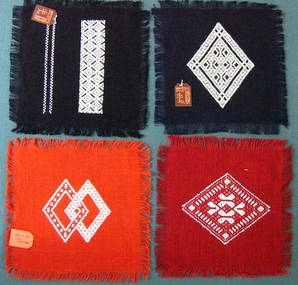
... darning in white cotton. A. Red mat (fringed) with large central diamond. B. Navy blue with large central diamond C. Orange with 2 interlaced diamonds D. Navy with 2 bands of running stitch...darning in white cotton. A. Red mat (fringed) with large central diamond. B. Navy blue with large central diamond C. Orange with 2 interlaced diamonds D. Navy with 2 bands of running stitch ...All made of even weave linen and using pattern darning in white cotton. A. Red mat (fringed) with large central diamond. B. Navy blue with large central diamond C. Orange with 2 interlaced diamonds D. Navy with 2 bands of running stitch (Kogin) embroidery.embroidery, mats, 1980-2000, japan, darning (kogin) -
 Embroiderers Guild, Victoria
Textile - Traditional Embroidered Iranian Sash, Arts and Crafts Centre, Mid 20th century
... Loosely woven black material with pattern darning in orange, red, blue and green with the addition of other embroidery stitches. ...Loosely woven black material with pattern darning in orange, red, blue and green with the addition of other embroidery stitches. ...Made at the Arts and Crafts Centre by local embroiderers trained to reproduce the classical Iranian designs. Selected by Lady Amies on a trip to Iran in 1976.Edging strip for a dress. The design is seen in Persian carpets. Loosely woven black material with pattern darning in orange, red, blue and green with the addition of other embroidery stitches. Could be a sash.embroidery, band, 1960-80, middle east, surface stitchery -
 Embroiderers Guild, Victoria
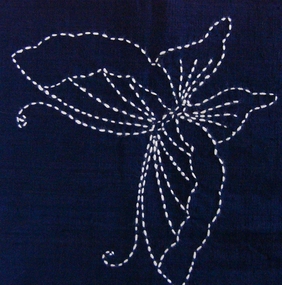
Domestic object - Sashiko on Indigo Japanese Apron, 1982
... Embroidery Aprons 1980-2000 Japan Darning Sashiko Embroidery A long apron of indigo coloured cotton, a specialty of Japan with an unpretentious design of 3 large butterflies that symbolise happiness are worked entirely in running stitch. ...A long apron of indigo coloured cotton, a specialty of Japan with an unpretentious design of 3 large butterflies that symbolise happiness are worked entirely in running stitch. The apron has very long ties and large pocket.embroidery, aprons, 1980-2000, japan, darning, sashiko embroidery -
 Embroiderers Guild, Victoria
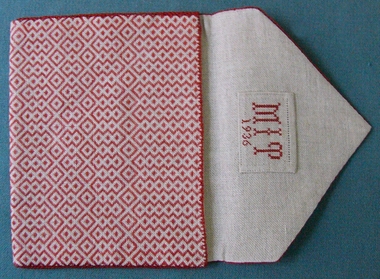
Textile - Kogin Japanese Pattern Darning Sachet, 1936
... darning using red stranded cotton. Lined with same linen. Front flap tapers to a point. Edged in red, knotted and wrapped stitching (Antwerp)....darning using red stranded cotton. Lined with same linen. Front flap tapers to a point. Edged in red, knotted and wrapped stitching (Antwerp). ...Worked by donor after her trip to Japan in 1965 and described by her in the News sheet No. 38 June. A Japanese embroidery called Kogin.Natural evenweave linen with an overall design of pattern darning using red stranded cotton. Lined with same linen. Front flap tapers to a point. Edged in red, knotted and wrapped stitching (Antwerp).MIT 1963embroidery, bags, 1960-80, australia, darning
