
Showing 63 items matching " embroidery- mid 19th century"
-
 Embroiderers Guild, Victoria
Domestic Object - 19 th C Black Satin Hostess Tea Apron, Mid 19th century
... Embroidery... Mid 19th Century...Embroidery Aprons Silk Embroidery Mid 19th Century England Black grosgrain with a border of roses around edge. ...Black grosgrain with a border of roses around edge. Thread is twisted silk in shades of red/pinks and yellows.embroidery, aprons, silk embroidery, mid 19th century, england -
 Embroiderers Guild, Victoria
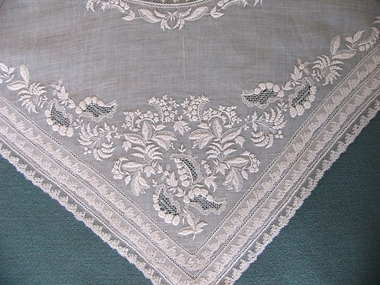
Accessory - Fichu, Circa 1850
... Embroidery... Mid 19th Century...Donated by Miss B Lucas Embroidery Mid 19th Century England Whitework Drawn thread Muslin - continuois border in floral design with drawn thread fillings. ...Donated by Miss B LucasMuslin - continuois border in floral design with drawn thread fillings. Floral design in satin stitch etc. machine made lace in 3 teirs around edge.embroidery, mid 19th century, england, whitework, drawn thread -
 Embroiderers Guild, Victoria
Accessory - Pair of Chinese Sleeve Bands, Mid 19th Century
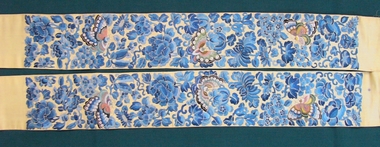
... Embroidery... Mid 19th Century...19th century saw the introduction of chemical 'aniline' dyes from Europe, leading to brighter, bolder colours in embroidery. Motifs and their Meanings: Auspicious symbols: Designs often included symbols for good fortune, wealth, and longevity. Natural imagery: Birds, flowers, and landscapes were common motifs that could represent natural beauty or convey specific symbolic meanings. Figurative scenes: Bands could also feature narrative scenes from classical stories or legends. The choice of motifs allowed women to express personal desires, cultural values, and aesthetic preferences, reflecting a more personal and informal style than official court attire. Embroidery Garments Silk Embroidery Mid ...Chinese sleeve embroidery bands, or wanxiu became popular in the late 19th century during the Qing Dynasty, evolving from the traditional Han cuff embroidery and Manchu styles. These detachable, decorated bands were added to women's informal jackets and robes, often featuring symbolic motifs like landscapes, flowers, and auspicious symbols. They served both a decorative function, displaying artistic skill and personal wishes, and a practical one by covering the sleeves when hands were folded at the waist. History and evolution: Origins: The practice of embroidering cuffs on robes existed during the previous Ming Dynasty for Han women, and this was adopted by the Manchu rulers who founded the Qing Dynasty. Qing Dynasty (1644-1911): The practice was popularized and elaborated upon during this era, with detachable bands becoming a fashionable element for informal wear. Symbolism: The embroidery included a complex visual vocabulary of wishes for a long life, many offspring, and a happy marriage, derived from nature, mythology, and classical literature. Functionality: Women would fold their arms, often with their hands inside the sleeves, so the embroidered bands, which were sewn to hang down the back of the jacket, would be displayed prominently down the front. 19th century peak: The late 19th century was the peak of their popularity, with intricate designs becoming fashionable and even influenced by court tastes, such as those favoured by the Empress Dowager Cixi. Later developments: The late 19th century saw the introduction of chemical 'aniline' dyes from Europe, leading to brighter, bolder colours in embroidery. Motifs and their Meanings: Auspicious symbols: Designs often included symbols for good fortune, wealth, and longevity. Natural imagery: Birds, flowers, and landscapes were common motifs that could represent natural beauty or convey specific symbolic meanings. Figurative scenes: Bands could also feature narrative scenes from classical stories or legends. The choice of motifs allowed women to express personal desires, cultural values, and aesthetic preferences, reflecting a more personal and informal style than official court attire.Pale gold satin. Design of peonies embroidered in shades of blue satin stitch with coloured butterflies..embroidery, garments, silk embroidery, mid 19th century, china, oriental -
 Embroiderers Guild, Victoria
Clothing - Ayrshire Christening Gown, Mid 19th Century
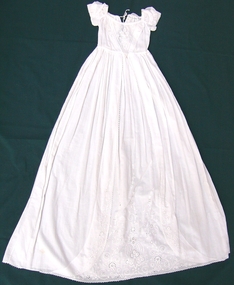
... ... Embroidery- Mid 19th Century...Embroidery Embroidery- Garments Embroidery- Mid 19th Century Embroidery - Ayrshire Embroidery - Whitework Fine Ayrshire Embroidery. ...Purchased by donor for 2/- at a jumble sale. (2 shillings in 1960 or about 20c in decimal currency, in 2026 about $3.70).Fine Ayrshire Embroidery. Robe is typical Ayrshire with triangular bodice and "wings" on skirt.embroidery, embroidery- garments, embroidery- mid 19th century, embroidery - ayrshire, embroidery - whitework -
 Embroiderers Guild, Victoria
Accessory - Handkerchief (Part of), Mid 19th century
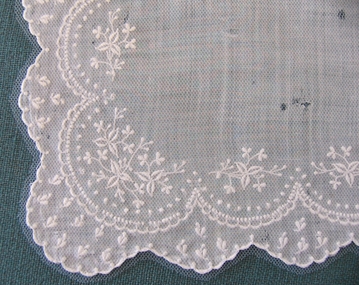
... Embroidery... Handkerchief... Mid 19th Century...Embroidery Handkerchief Mid 19th Century Scotland Ayrshire work Made of lawn with a border of flowers in satin stitch and buttonhole stitch. ...Made of lawn with a border of flowers in satin stitch and buttonhole stitch. Fine embroidery in classical style.embroidery, handkerchief, mid 19th century, scotland, ayrshire work -
 Embroiderers Guild, Victoria
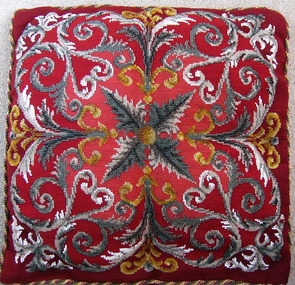
Domestic Object - Berlin Work Canvas and Beadwork Cushion, 1860
... Embroidery... Cushion... Mid 19th Century...Made by donor's grandmother in 1860 (Mrs Henry Atkinson-Blackham) Embroidery Cushion Mid 19th Century Australia Canvas work Beadwork Canvas and bead work. ...Made by donor's grandmother in 1860 (Mrs Henry Atkinson-Blackham)Canvas and bead work. Background in gros point wool in two tones of maroon red. A bold design worked in large beads of black, dark grey, white and crystals with highlights of gold. Back made from red woollen fabric, the edge decorated with a multi-coloured silk cord.embroidery, cushion, mid 19th century, australia, canvas work, beadwork -
 Embroiderers Guild, Victoria
Textile - Durham or North Country Quilt, c 1840
... Embroidery... Quilting... Mid 19th Century...A pair was made by a distant relative of the donor's from County Durham during a voyage lasting six months to settle in Victoria in 1840 and apparently were in long use in Australia by the family. Embroidery Quilting Mid 19th Century England Durham White cotton quilt of two layers of cotton material interlined with a fine wool layer and then quilted in strips of varying widths in running stitch the whole length of the quilt. ...A pair was made by a distant relative of the donor's from County Durham during a voyage lasting six months to settle in Victoria in 1840 and apparently were in long use in Australia by the family.White cotton quilt of two layers of cotton material interlined with a fine wool layer and then quilted in strips of varying widths in running stitch the whole length of the quilt. There are a total of five strips of quilting, a broad central one, 900 mm wide and two narrower ones on each side, approx. 350 mm and 250 mm in classical North Co9untry geometric designs.embroidery, quilting, mid 19th century, england, durham -
 Embroiderers Guild, Victoria
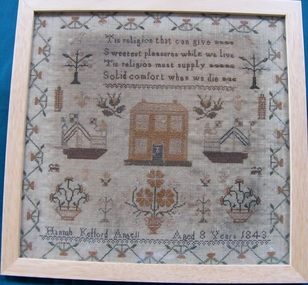
Textile - Hannah Kefford Angell Sampler 1843, Hannah Kefford Angell, 1843
... Embroidery... Samplers... Mid 19th Century...See attached letter. Embroidery Samplers Mid 19th Century Cross stitch "Tis religion that can give sweetest pleasures while we live tis religion must supply solid comfort when we die" Hannah Kefford Angell Aged 8 years 1843 Cream even weave linen with cross stitched religious text, house, and ships, flowers and animals. ...Gifted by P.L.C. School Craft Dept. Melbourne by courtesy of Miss Lexie Luly, Art Mistress P.L.C. 1970. See attached letter.Cream even weave linen with cross stitched religious text, house, and ships, flowers and animals. Border of flowers. Pale wooden frame. "Tis religion that can give sweetest pleasures while we live tis religion must supply solid comfort when we die" Hannah Kefford Angell Aged 8 years 1843embroidery, samplers, mid 19th century, cross stitch -
 Embroiderers Guild, Victoria
Accessory - Handkerchief, Mid 19th century
... Embroidery... Handkerchief... Whitework... Mid 19th Century...Purchased by Guild 17/7/1960 Embroidery Handkerchief Whitework Mid 19th Century White muslin with white cotton embroidery design of convolvulus. ...Purchased by Guild 17/7/1960White muslin with white cotton embroidery design of convolvulus. Very decorative edge of buttonhole stitch, satin stitch flower heads, tiny eyelets.embroidery, handkerchief, whitework, mid 19th century -
 Embroiderers Guild, Victoria
Accessory - Handkerchief, Mid 19th century
... Embroidery... Handkerchief... Whitework... Mid 19th Century...Purchased by Guild 17/7/1960 Embroidery Handkerchief Whitework Mid 19th Century Initials H.G. Fine linen with woven border. ...Purchased by Guild 17/7/1960Fine linen with woven border. Embroidered decoration of small rosebuds in satin stitch and tiny satin stitch spots. Fine scalloped edge.Initials H.G.embroidery, handkerchief, whitework, mid 19th century -
 Embroiderers Guild, Victoria
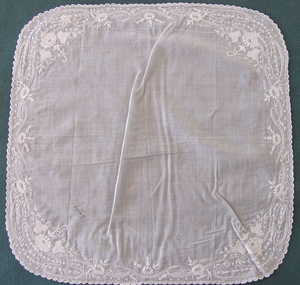
Accessory - Handkerchief, Mid 19th century
... Embroidery... Ayrshire... Scotland... Mid 19th Century...Embroidery Ayrshire Scotland Mid 19th Century Emily (inked) Fine white cotton with floral sprays in a border design. ...Fine white cotton with floral sprays in a border design. Edge finished in buttonhole scallops. Embroidered in white.Emily (inked)embroidery, ayrshire, scotland, mid 19th century -
 Embroiderers Guild, Victoria
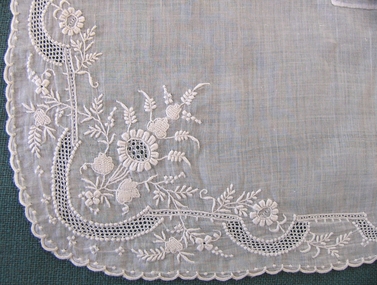
Accessory - Handkerchief, Mid 19th century
... Embroidery... Ayrshire... Scotland... Mid 19th Century...Embroidery Ayrshire Scotland Mid 19th Century Fine white cotton with sprays of flowers in the corners. ...Fine white cotton with sprays of flowers in the corners. Continuous band of open work, and an edge of scalloped buttonhole with satin stitch dots.embroidery, ayrshire, scotland, mid 19th century -
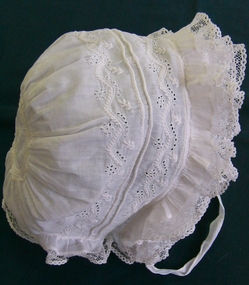 Embroiderers Guild, Victoria
Headwear - Ayrshire Baby Bonnet, Mid 19th century
... Embroidery... Whitework... Bonnets... Mid 19th Century...Embroidery Whitework Bonnets Mid 19th Century Scotland Garments A triple frill of Buckingham lace, followed by two bands of fine embroidery - eyelets and satin stitch, and tucking, with small circle at crown. ...Traditionally worked using white thread onto a fine white muslin, Ayrshire embroidery is recognisable by stylised floral motifs with areas of filled in cutwork. Developed from Dresden embroidery (a form of pulled work) and tambour embroidery, it uses a range of stitches, including satin stitch, chain stitch, eyelets and buttonhole edging as well as a range of lace filling stitches. The technique became popular in the early nineteenth century, when the previous fashion of elaborate gowns with hooped skirts was replaced by looser, simpler white cotton muslin garments. Although the elegant simplicity was favoured, women also desired some decoration. However, looms of the time could not create complex designs, so women turned to hand stitching.Using cotton muslin woven in Ayrshire, local women and girls would complete the intricate whitework to help supplement their family income. Mainly produced at home, Ayrshire whitework garments would be initially completed by one person. However, as the technique became more popular and the industry developed, to ensure high quality work, a piece would be passed around so that each embroiderer could focus on completing the stitches they specialised in.It is believed that the designs and motifs used in Ayrshire whitework were inspired by lace filling stitches found within an inset in a French Christening robe that was bought to Scotland by Lady Mary Montgomery, who then lent it to Mrs Jamieson of Ayr. She copied the stitches used within the robe and taught them to her outworkers, and she also produced plain muslin that was stamped with a water-soluble blue ink design that made embroidering the designs neater and more efficient. Ayrshire work became popular quite quickly, and it was incorporated into collars, cuffs and caps as well as children’s clothes and bonnets. Pieces were exported across Europe and the British Empire. As the decades progressed, technology advanced, resulting in looms that could incorporate decoration into the weave of the cloth, reducing the need for hand embroidered Ayrshire whitework.A triple frill of Buckingham lace, followed by two bands of fine embroidery - eyelets and satin stitch, and tucking, with small circle at crown.embroidery, whitework, bonnets, mid 19th century, scotland, garments -
 Embroiderers Guild, Victoria
Textile - Piano sconce (Part), c. 1856
... Embroidery... Beading... Furnishings... Mid 19th Century...Embroidery Beading Furnishings Mid 19th Century Australia Classic Victoria piece, with red cotton half-cross on tent stitch background, with a large floral beaded motif in blues, browns, pinks, grey and black. ...One of a pair, worked by a pioneer family in the 1856 period.Classic Victoria piece, with red cotton half-cross on tent stitch background, with a large floral beaded motif in blues, browns, pinks, grey and black.embroidery, beading, furnishings, mid 19th century, australia -
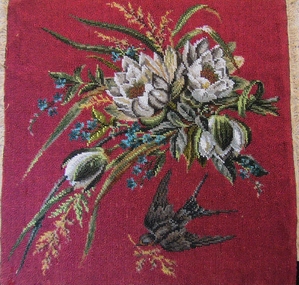 Embroiderers Guild, Victoria
Textile - Victorian Berlin Beadwork Panel, Mid 19th century
... Embroidery... Beadwork... Panel... Mid 19th Century...Embroidery Beadwork Panel Mid 19th Century England Victorian beadwork on a Berlin work design. ...Victorian beadwork on a Berlin work design. A large spray of flowers in black, white, grey, blue and green beads. Background is also beaded in deep rose pink.embroidery, beadwork, panel, mid 19th century, england -
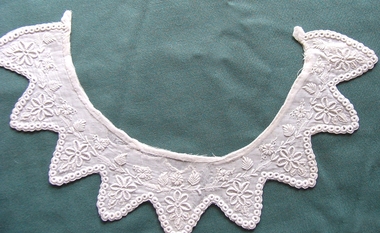 Embroiderers Guild, Victoria
Accessory - Collar, Mid 19th century
... Embroidery... Collars... Whitework... Mid 19th Century...Embroidery Collars Whitework Mid 19th Century White muslin embroidered in whitework. ...White muslin embroidered in whitework. Nine pointed edge with a flower in each point, and a trail of smaller flowers and leaves in satin stitch eyelets and open work.embroidery, collars, whitework, mid 19th century -
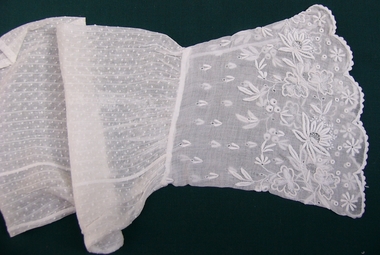 Embroiderers Guild, Victoria
Accessory - 19th C Whitework on Spotted Muslin Under Sleeve, mid 19th century
... Embroidery... Whitework... Garments... Mid 19th Century...Embroidery Whitework Garments Mid 19th Century Sleeve of spotted muslin, with a deep (190 mms) cuff embroidered in floral design in satin and buttonhole stitches, and finishing in a widely scalloped buttonholed edge. ...Sleeve of spotted muslin, with a deep (190 mms) cuff embroidered in floral design in satin and buttonhole stitches, and finishing in a widely scalloped buttonholed edge.embroidery, whitework, garments, mid 19th century -
 Embroiderers Guild, Victoria
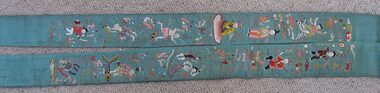
Accessory - Pair of Chinese Sleeve Bands, Mid 19th Century
... Embroidery... Garments... China... Mid 19th Century...19th century saw the introduction of chemical 'aniline' dyes from Europe, leading to brighter, bolder colours in embroidery. Motifs and their Meanings: Auspicious symbols: Designs often included symbols for good fortune, wealth, and longevity. Natural imagery: Birds, flowers, and landscapes were common motifs that could represent natural beauty or convey specific symbolic meanings. Figurative scenes: Bands could also feature narrative scenes from classical stories or legends. The choice of motifs allowed women to express personal desires, cultural values, and aesthetic preferences, reflecting a more personal and informal style than official court attire. Embroidery Garments China Mid ...Chinese sleeve embroidery bands, or wanxiu became popular in the late 19th century during the Qing Dynasty, evolving from the traditional Han cuff embroidery and Manchu styles. These detachable, decorated bands were added to women's informal jackets and robes, often featuring symbolic motifs like landscapes, flowers, and auspicious symbols. They served both a decorative function, displaying artistic skill and personal wishes, and a practical one by covering the sleeves when hands were folded at the waist. History and evolution: Origins: The practice of embroidering cuffs on robes existed during the previous Ming Dynasty for Han women, and this was adopted by the Manchu rulers who founded the Qing Dynasty. Qing Dynasty (1644-1911): The practice was popularized and elaborated upon during this era, with detachable bands becoming a fashionable element for informal wear. Symbolism: The embroidery included a complex visual vocabulary of wishes for a long life, many offspring, and a happy marriage, derived from nature, mythology, and classical literature. Functionality: Women would fold their arms, often with their hands inside the sleeves, so the embroidered bands, which were sewn to hang down the back of the jacket, would be displayed prominently down the front. 19th century peak: The late 19th century was the peak of their popularity, with intricate designs becoming fashionable and even influenced by court tastes, such as those favoured by the Empress Dowager Cixi. Later developments: The late 19th century saw the introduction of chemical 'aniline' dyes from Europe, leading to brighter, bolder colours in embroidery. Motifs and their Meanings: Auspicious symbols: Designs often included symbols for good fortune, wealth, and longevity. Natural imagery: Birds, flowers, and landscapes were common motifs that could represent natural beauty or convey specific symbolic meanings. Figurative scenes: Bands could also feature narrative scenes from classical stories or legends. The choice of motifs allowed women to express personal desires, cultural values, and aesthetic preferences, reflecting a more personal and informal style than official court attire.Mid green silk embroidered with a variety of coloured silk threads and some metal thread.embroidery, garments, china, mid 19th century, figures, fish, turtle, sea -
 Embroiderers Guild, Victoria
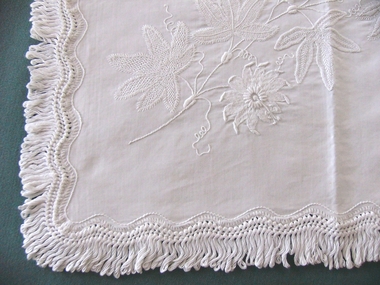
Textile - Mountmellick Embroidered Pillow Sham, Mid 19th century
... Embroidery... Mountmellick... Ireland... Mid 19th Century...Embroidery Mountmellick Ireland Mid 19th Century C.W. Satin jean, diagonal spray of flowers and leaves in the classical mountmellick style. ...Mountmellick embroidery is a traditional, heavy white-on-white (whitework) hand embroidery style that originated around 1825 in the town of Mountmellick in County Laois, Ireland. Developed by Johanna Carter, the craft is celebrated for its deeply textured, sculptural appearance and all-Irish origins. Strictly monochrome white-on-white (white thread on white fabric). Traditionally worked on heavy, firm cotton satin jean, providing a sturdy, durable base for household items like bedspreads, tablecloths, and doilies. Uses thick, matte, twistless or heavy cotton threads that do not divide, contrasting with the sheen of the cotton jean fabric. Inspired by the local Irish flora, including blackberries, brambles, oak leaves, dog roses, ivy, ferns, and shamrocks, as well as later cultivated garden plants. Features heavily padded and knotted stitches, such as satin stitch, French knots, stem stitch, buttonhole stitch, and the signature Mountmellick stitch (which creates a triangle-like, spiked outline effect).Satin jean, diagonal spray of flowers and leaves in the classical mountmellick style. Traditional heavy fringed edge.C.W.embroidery, mountmellick, ireland, mid 19th century -
 Flagstaff Hill Maritime Museum and Village
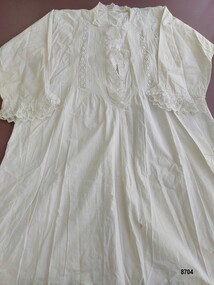
Textile - Nightgown, Circa 1900
... mid to late 1800's it had become more acceptable ladies to wear simple, modest nightgowns. They tended to have a very loose fit and were usually made of linen, cotton or flannel, which had the advantage of providing warmth and also being easy to wash - a necessity for a garment worn next to the skin. Although the basic design of the nightgown was fairly simple, the wearer was free to add various types of trim e.g. lace, crochet, pintucks, embroidery etc. This item is an example of the needlework skills of women in the late 19th and early 20th century ...This item is one of a collection of clothing items that belonged to the Stephenson family who lived at 22 McCracken Street, Kensington, Melbourne. Matthew Stephenson (1861 – 1943) who had grown up on the Bendigo goldfields and shifted to Melbourne in the early 1900’s was a train driver and later, a fireman with the railways. His wife Elizabeth Jane (Betsy) Wigley (1865 – 1953) also grew up on the goldfields around Majorca and Bendigo. They married in 1885 in Bendigo. They had two daughters – Ethel Evelyn Stephenson (1886 – 1956) and Lillian or Lila (1891 – 1977) who were milliners and dressmakers and who continued to live in the family home after the death of their parents. The family are recorded as living at 22 McCracken Street, Kensington, as early as 1914. It is not known who made or owned the clothing that makes up this collection but as it appears to be from the late Victorian and early Edwardian era, the different pieces were probably made and worn by any of the three ladies of the house – Betsy, Ethel and/or Lila. During W.W.2, a local Warrnambool couple (Meryl and Tony Everard) boarded with them – Tony was in the airforce training paratroopers to jump into (and survive) enemy territory and his wife Meryl worked in the Methodist baby Home. The Everards developed a close friendship with the Stephensons and were responsible for clearing out the house (and finding this clothing collection) after Lila died in 1977. This nightgown is machine sewn and has an added detailed design of pintucks and broderie anglaise lace to the front yoke and cuffs as a decorative element. The 1800's bought a shift in attitude towards modesty as the Victorian era progressed and by the mid to late 1800's it had become more acceptable ladies to wear simple, modest nightgowns. They tended to have a very loose fit and were usually made of linen, cotton or flannel, which had the advantage of providing warmth and also being easy to wash - a necessity for a garment worn next to the skin. Although the basic design of the nightgown was fairly simple, the wearer was free to add various types of trim e.g. lace, crochet, pintucks, embroidery etc.This item is an example of the needlework skills of women in the late 19th and early 20th century - combining machine stitching with hand embroidery to personalise and embellish a practical item of clothing. A full length lady's cotton nightgown with long sleeves finished with a diagonal pointed cuff of broderie anglaise. The bodice features a front opening placket with 3 buttons and buttonholes and a broderie anglaise cover. On either side of the placket, the bodice has been decorated with rows of vertical pintucks and a broderie anglaise panel insert. There is also a frill of broderie anglaise lace around the neck. The back of the nightgown is gathered onto a yoke.flagstaff hill maritime museum and village, great ocean road, shipwreck coast, warrnambool, nightgown, lady's nightgown, needlework, sewing, broderie anglaise, pintucks, stephenson family -
 Flagstaff Hill Maritime Museum and Village
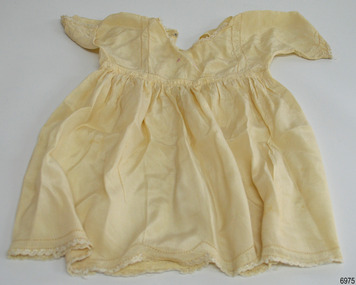
Leisure object - Doll's dress, Gladys Angus, wife of Dr. W.R. Angus, 1930s
... 19th to the mid-20th century. Additional items in the collection relate to Dr Angus’ service in the Flying Doctor Service and the Army. The doll's dress is also significant as an example of handcrafting in the early 20th century and represents toys made for and used by children in the Warrnambool community. Flagstaff Hill Warrnambool Maritime Village Maritime Museum Shipwreck coast Great Ocean Road Dr W R Angus Dr Roy Angus Dr Ryan Warrnambool Oculist Port Medical Officer Mira Hospital Nhill toy Nhill hospital doll doll's dress silk doll's dress handmade doll's dress Gladys Angus embroidery W.R. ...This doll's dress was skillfully handmade by Gladys Angus, wife of Dr Angus, in a similar design to the silk lingerie she made and wore. Gladys made this dress for her daughter’s doll, which was also donated along with its pram and blanket. It is part of the W.R. Angus collection, donated by the family of Dr W R Angus, surgeon and oculist. The W R Angus Collection spans from 1885 to the mid-1900s and includes historical medical and surgical equipment and instruments from the doctors Edward and Thomas Ryan of Nhill, Victoria. Dr Angus married Gladys in 1927 at Ballarat, the nearest big city to Nhill where he began as a Medical Assistant. He was also Acting House surgeon at the Nhill hospital where their two daughters were born. He and his family moved to Warrnambool in 1939, where Dr Angus operated his own medical practice. He later added the part-time Port Medical Officer responsibility and was the last person appointed to that position. Dr Angus and his wife were very involved in the local community, including the early planning stages of the new Flagstaff Hill, where they contributed to the layout of the gardens. Dr Angus passed away in March 1970.This silk doll's dress is connected to the history of Warrnambool, as it was owned by the daughter of Dr W. R. Angus and his wife Gladys. It is part of the W.R. Angus Collection, which is important for still being located at the site connected to Doctor Angus, Warrnambool’s last Port Medical Officer. Dr Angus and his wife brought their young family to Warrnambool in 1939 and he remained a resident until his death in 1970. Early in his profession in the town of Nhill, Dr Angus assisted Dr Tom Ryan in his pioneering use of X-rays and in ocular surgery, and Dr Angus later inherited these items. The W.R. Angus Collection includes these medical instruments and other related equipment and is culturally and historically significant as an example of the medical practice of the late 19th to the mid-20th century. Additional items in the collection relate to Dr Angus’ service in the Flying Doctor Service and the Army. The doll's dress is also significant as an example of handcrafting in the early 20th century and represents toys made for and used by children in the Warrnambool community.The doll’s dress is handmade using cream silk fabric. It has floral embroidery on the bodice, a gathered waist, crochet trim at the neck, wrists and hem, which also has a scalloped edge. It has a press stud closure at the back. The doll’s dress was made by Gladys Angus for her daughter’s doll. It is part of the W.R. Angus Collection.flagstaff hill, warrnambool, maritime village, maritime museum, shipwreck coast, great ocean road, dr w r angus, dr roy angus, dr ryan, warrnambool oculist, port medical officer, mira hospital nhill, toy, nhill hospital, doll, doll's dress, silk doll's dress, handmade doll's dress, gladys angus, embroidery, w.r. angus collection -
 Flagstaff Hill Maritime Museum and Village
Leisure object - Doll's blanket, Gladys Angus, wife of Dr. W.R. Angus, 1930s
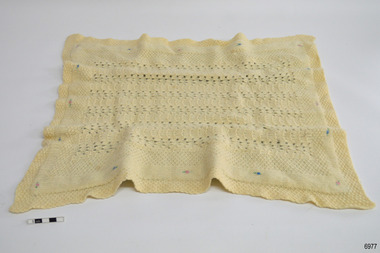
... 19th to the mid-20th century. Additional items in the collection relate to Dr Angus’ service in the Flying Doctor Service and the Army. The doll's blanket is also significant as an example of handcrafting in the early 20th century and represents toys made for and used by children in the Warrnambool community. Flagstaff Hill Warrnambool Maritime Village Maritime Museum Shipwreck coast Great Ocean Road Dr W R Angus Dr Roy Angus Dr Ryan Warrnambool Oculist Port Medical Officer Mira Hospital Nhill toy Nhill hospital doll silk doll's dress Gladys Angus embroidery doll's blanket handmade doll's blanket knitted blanket W.R. ...This doll's blanket was beautifully handmade by Gladys Angus, wife of Dr Angus. Gladys made it for her daughter’s doll, which was also donated along with its pram and a silk doll's dress. It is part of the W.R. Angus collection, donated by the family of Dr W R Angus, surgeon and oculist. The W R Angus Collection spans from 1885 to the mid-1900s and includes historical medical and surgical equipment and instruments from the doctors Edward and Thomas Ryan of Nhill, Victoria. Dr Angus married Gladys in 1927 at Ballarat, the nearest big city to Nhill where he began as a Medical Assistant. He was also Acting House surgeon at the Nhill hospital where their two daughters were born. He and his family moved to Warrnambool in 1939, where Dr Angus operated his own medical practice. He later added the part-time Port Medical Officer responsibility and was the last person appointed to that position. Dr Angus and his wife were very involved in the local community, including the early planning stages of the new Flagstaff Hill, where they contributed to the layout of the gardens. Dr Angus passed away in March 1970.This doll's blanket is connected to the history of Warrnambool, as it was owned by the daughter of Dr W. R. Angus and his wife Gladys. It is part of the W.R. Angus Collection, which is important for still being located at the site connected to Doctor Angus, Warrnambool’s last Port Medical Officer. Dr Angus and his wife brought their young family to Warrnambool in 1939 and he remained a resident until his death in 1970. Early in his profession in the town of Nhill, Dr Angus assisted Dr Tom Ryan in his pioneering use of X-rays and in ocular surgery, and Dr Angus later inherited these items. The W.R. Angus Collection includes these medical instruments and other related equipment and is culturally and historically significant as an example of the medical practice of the late 19th to the mid-20th century. Additional items in the collection relate to Dr Angus’ service in the Flying Doctor Service and the Army. The doll's blanket is also significant as an example of handcrafting in the early 20th century and represents toys made for and used by children in the Warrnambool community.The doll’s blanket is rectangular in shape. It has been hand-knitted in a decorative pattern using cream wool, and then embroidered with floral motifs. The blanket is lined with a hand-knitted blue rectangle. Gladys Angus made the blanket for her daughter’s doll. It is part of the W.R. Angus Collection.flagstaff hill, warrnambool, maritime village, maritime museum, shipwreck coast, great ocean road, dr w r angus, dr roy angus, dr ryan, warrnambool oculist, port medical officer, mira hospital nhill, toy, nhill hospital, doll, silk doll's dress, gladys angus, embroidery, doll's blanket, handmade doll's blanket, knitted blanket, w.r. angus collection -
 Flagstaff Hill Maritime Museum and Village
Clothing - Chemise, Eliza Towns, Late Victorian era
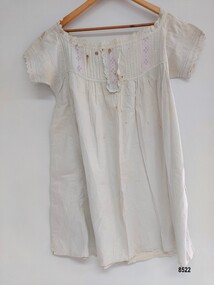
... This item is an example of the needlework skills of women in the mid to late 19th century - combining machine stitching with hand embroidery to personlise and embellish an item of clothing. ...This chemise is one of several linen and clothing items that were made and belonged to Mrs. Eliza Towns and donated to Flagstaff Hill Maritime Museum and Village. Eliza was born Eliza Gould in 1857 in South Melbourne (Emerald Hill) and in 1879 married Charles Towns. In the early 1880's they moved to Nhill in western Victoria and remained there for the rest of their married life. Charles was a jeweller and later became an accountant and for many years was involved with the Shire Council, the local show committee (A & P Society), the Hospital Committee and the Board of the local newspaper (the Nhill Free Press). They had three children and lived a life that would be regarded as comfortably "middle class". Eliza probably had a treadle sewing machine and would have made many of her own clothes as well as clothes for her children - adding her own handmade embroidered or crocheted decorative trim. This chemise is machine sewn by Eliza Towns and she has added pintucks and broderie anglaise lace as a decorative element. A chemise was usually a sleeveless garment made of linen or cotton (so they could be easily washed) and its shape was much like a modern day nightgown. The name comes from the French word for "shirt" or "shift". Women wore chemises next to the skin (under the corset) to keep stains and odors away from the less washable corset and gown.This item is an example of the needlework skills of women in the mid to late 19th century - combining machine stitching with hand embroidery to personlise and embellish an item of clothing. It is also significant as an example of a practical solution to the difficulties of needing to regularly hand wash a bulky outer garment or gown in the Victorian era.A white cotton, short sleeved, knee length chemise. The fabric at the front is gathered on a yoke which is decorated with bands of five pintucks alternating with broderie anglaise lace and embroidered strips lined with pink ribbon. A different broderie anglaise design decorates the sleeve edges, neckline and center broderie anglaise strip. The back of the chemise is gathered on to the neckline. There are two bands of pintucks on each sleeve. The fabric around each armhole has been strengthened with another layer of cotton and a length of cotton has been added (from the left shoulder to the hem) to increase the width of chemise.flagstaff hill, flagstaff hill maritime museum and village, warrnambool, great ocean road, south west victoria, victorian era, victorian era undergarments, chemise, victorian era chemise, undergarments, pintucks, victorian chemise, eliza towns, nhill, wimmera, home sewing, machine sewn, hand made -
 Flagstaff Hill Maritime Museum and Village
Clothing - Nightgown, Eliza Towns, circa 1890's
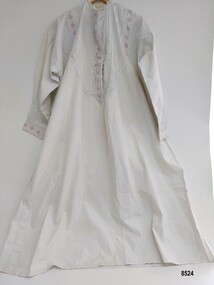
... mid to late 1800's it had become more acceptable ladies to wear simple, modest nightgowns. They tended to have a very loose fit and were usually made of linen, cotton or flannel, which had the advantage of providing warmth and also being easy to wash - a necessity for a garment worn next to the skin. Although the basic design of the nightgown was fairly simple, the wearer was free to add various types of trim e.g. lace, crochet, pintucks, embroidery etc. This item is an example of the needlework skills of women in the late 19th century ...This nightgown is one of several linen and clothing items that were made and belonged to Mrs. Eliza Towns and donated to Flagstaff Hill Maritime Museum and Village. Eliza was born Eliza Gould in 1857 in South Melbourne (Emerald Hill) and in 1879 married Charles Towns. In the early 1880's they moved to Nhill in western Victoria and remained there for the rest of their married life. Charles was a jeweller and later became an accountant and for many years was involved with the Shire Council, the local show committee (A & P Society), the Hospital Committee and the Board of the local newspaper (the Nhill Free Press). They had three children and lived a life that would be regarded as comfortably "middle class". Eliza probably had a treadle sewing machine and would have made many of her own clothes as well as clothes for her children - adding her own handmade embroidered or crocheted decorative trim. This nightgown is machine sewn by Eliza Towns and she has added a detailed design of pintucks and broderie anglaise lace to the front yoke and cuffs as a decorative element. The 1800's bought a shift in attitude towards modesty as the Victorian era progressed and by the mid to late 1800's it had become more acceptable ladies to wear simple, modest nightgowns. They tended to have a very loose fit and were usually made of linen, cotton or flannel, which had the advantage of providing warmth and also being easy to wash - a necessity for a garment worn next to the skin. Although the basic design of the nightgown was fairly simple, the wearer was free to add various types of trim e.g. lace, crochet, pintucks, embroidery etc.This item is an example of the needlework skills of women in the late 19th century - combining machine stitching with hand embroidery to personalise and embellish a practical item of clothing. It is also significant as an example of a practical solution to the difficulties that women of this era faced with regard to the washing of clothes and household linens.Lady's long, white, cotton nightgown with a V shaped bodice decorated with bands of nine pintucks alternating with strips of broderie anglaise lined with pink ribbon. The opening front placket and neckline are bordered with a simpler broderie anglaise lace. The long sleeves are gathered into cuffs with a matching V shape, pintuck and broderie anglaise design. The front placket fastens with three cream buttons although one is missing. The back of the nightgown has gathered fabric on a plain, narrow V shape yoke. A narrow gusset has been added to the both sides at the bottom of the nightgown.Noneflagstaff hill, flagstaff hill maritime museum and village, warrnambool, great ocean road, shipwreck coast, victorian era clothing, victorian era nightgown, nightgown, nightdress, eliza towns, nhill, wimmera, textiles, clothing, machine sewing, hand sewing, pintucks, broderie anglaise, sewing -
 Orbost & District Historical Society
food cover, approx. 1940's
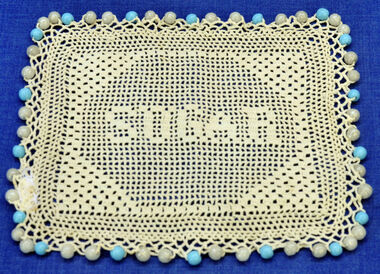
... 19th to mid 20th century. Women's focus was the home and its decoration was important. Embroidery and crochet work was an affordable way to personalise and add aesthetic value, and examples of embroidered and crocheted pieces could be found in most Australian homes, decorating or protecting furniture, floors and walls, and keeping off flies and insects from food. food-cover handcrafts crochet Small square cream coloured hand crocheted sugar bowl cover. ...This handmade item represents an important pastime of Australian women of the late 19th to mid 20th century. Women's focus was the home and its decoration was important. Embroidery and crochet work was an affordable way to personalise and add aesthetic value, and examples of embroidered and crocheted pieces could be found in most Australian homes, decorating or protecting furniture, floors and walls, and keeping off flies and insects from food.Small square cream coloured hand crocheted sugar bowl cover. Word "sugar" is patterned into it. The beaded fringing is blue and white.food-cover handcrafts crochet -
 Orbost & District Historical Society
sampler, first half 20th century
... Embroidery and crochet work was an important pastime of Australian women of the late 19th to mid 20th century. ...Embroidery and crochet work was an important pastime of Australian women of the late 19th to mid 20th century. Needlework was commonly taught to girls at school and at home.A small white linen sampler with examples of different stitches, buttonholes, buttons, loops, tapes and hemming.sampler linen handcraft -
 Orbost & District Historical Society
doily, Woodward, Ruth (daughter of Alan Richardson), 1910-1930
... 19th to mid 20th century. Women's focus was the home and its decoration was important. Embroidery and crochet work was an affordable way to personalise and add aesthetic value, and examples of embroidered and crocheted pieces could be found in most Australian homes, decorating or protecting furniture, floors and walls, and keeping off flies and insects from food. doily handcrafts needlework beading richardson-alan Small square needlepoint doily with kangaroo pattern and beaded triangular fringe. ...Doily was hand made by Riuth Woodward who was the daughter of Alan Richardson, a sawmiller at Tabbara. He held ticket for the paddlesteamer Curlip.This item represents an important pastime of Australian women of the late 19th to mid 20th century. Women's focus was the home and its decoration was important. Embroidery and crochet work was an affordable way to personalise and add aesthetic value, and examples of embroidered and crocheted pieces could be found in most Australian homes, decorating or protecting furniture, floors and walls, and keeping off flies and insects from food.Small square needlepoint doily with kangaroo pattern and beaded triangular fringe. Centre is white with pink clear beading.doily handcrafts needlework beading richardson-alan -
 Flagstaff Hill Maritime Museum and Village
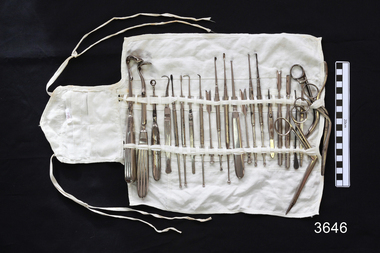
Surgical Kit, late 19th century
... 19th to mid-20th century. Dr Angus assisted Dr Tom Ryan, a pioneer in the use of X-rays and in ocular surgery. Flagstaff Hill Warrnambool Shipwrecked coast Flagstaff Hill Maritime Museum Maritime Museum Shipwreck coast Flagstaff Hill Maritime Village Great Ocean Road Dr W R Angus Dr Ryan surgical instrument ENT Ear Nose Throat surgery Warrnambool Base Hospital Nhill Base Hospital Mira hospital Flying Doctor medical treatment surgical kit fabric sutrical instrument holder surgery Name tag, sewn on, with red embroidery, "DR T.F. ...This surgical kit holder was used by Dr T.F. Ryan's to hold surgical instruments for Ear Nose and Throat surgery. I was useful for both holding these particular instruments and for keeping them together whilst they were sterilised. It was donated to Flagstaff Hill Maritime Village, including the instruments, by the family of Doctor William Roy Angus, Surgeon and Oculist. It is part of the “W.R. Angus Collection” that includes historical medical equipment, surgical instruments and material once belonging to Dr Edward Ryan and Dr Thomas Francis Ryan, (both of Nhill, Victoria) as well as Dr Angus’ own belongings. The Collection’s history spans the medical practices of the two Doctors Ryan, from 1885-1926 plus that of Dr Angus, up until 1969. ABOUT THE “W.R.ANGUS COLLECTION” Doctor William Roy Angus M.B., B.S., Adel., 1923, F.R.C.S. Edin.,1928 (also known as Dr Roy Angus) was born in Murrumbeena, Victoria in 1901 and lived until 1970. He qualified as a doctor in 1923 at University of Adelaide, was Resident Medical Officer at the Royal Adelaide Hospital in 1924 and for a period was house surgeon to Sir (then Mr.) Henry Simpson Newland. Dr Angus was briefly an Assistant to Dr Riddell of Kapunda, then commenced private practice at Curramulka, Yorke Peninsula, SA, where he was physician, surgeon and chemist. In 1926, he was appointed as new Medical Assistant to Dr Thomas Francis Ryan (T.F. Ryan, or Tom), in Nhill, Victoria, where his experiences included radiology and pharmacy. In 1927 he was Acting House Surgeon in Dr Tom Ryan’s absence. Dr Angus had become engaged to Gladys Forsyth and they decided he would take time to further his studies overseas in the UK in 1927. He studied at London University College Hospital and at Edinburgh Royal Infirmary and in 1928, was awarded FRCS (Fellow from the Royal College of Surgeons), Edinburgh. He worked his passage back to Australia as a Ship’s Surgeon on the on the Australian Commonwealth Line’s T.S.S. Largs Bay. Dr Angus married Gladys in 1929, in Ballarat. (They went on to have one son (Graham 1932, born in SA) and two daughters (Helen (died 12/07/1996) and Berenice (Berry), both born at Mira, Nhill ) Dr Angus was a ‘flying doctor’ for the A.I.M. (Australian Inland Ministry) Aerial Medical Service in 1928 . The organisation began in South Australia through the Presbyterian Church in that year, with its first station being in the remote town of Oodnadatta, where Dr Angus was stationed. He was locum tenens there on North-South Railway at 21 Mile Camp. He took up this ‘flying doctor’ position in response to a call from Dr John Flynn; the organisation was later known as the Flying Doctor Service, then the Royal Flying Doctor Service. A lot of his work during this time involved dental surgery also. Between 1928-1932 he was surgeon at the Curramulka Hospital, Yorke Peninsula, South Australia. In 1933 Dr Angus returned to Nhill where he’d previously worked as Medical Assistant and purchased a share of the Nelson Street practice and Mira hospital from Dr Les Middleton one of the Middleton Brothers, the current owners of what was once Dr Tom Ryan’s practice. Dr L Middleton was House Surgeon to the Nhill Hospital 1926-1933, when he resigned. [Dr Tom Ryan’s practice had originally belonged to his older brother Dr Edward Ryan, who came to Nhill in 1885. Dr Edward saw patients at his rooms, firstly in Victoria Street and in 1886 in Nelson Street, until 1901. The Nelson Street practice also had a 2 bed ward, called Mira Private Hospital ). Dr Edward Ryan was House Surgeon at the Nhill Hospital 1884-1902 . He also had occasions where he successfully performed veterinary surgery for the local farmers too. Dr Tom Ryan then purchased the practice from his brother in 1901. Both Dr Edward and Dr Tom Ryan work as surgeons included eye surgery. Dr Tom Ryan performed many of his operations in the Mira private hospital on his premises. He too was House Surgeon at the Nhill Hospital 1902-1926. Dr Tom Ryan had one of the only two pieces of radiology equipment in Victoria during his practicing years – The Royal Melbourne Hospital had the other one. Over the years Dr Tom Ryan gradually set up what was effectively a training school for country general-practitioner-surgeons. Each patient was carefully examined, including using the X-ray machine, and any surgery was discussed and planned with Dr Ryan’s assistants several days in advance. Dr Angus gained experience in using the X-ray machine there during his time as assistant to Dr Ryan. Dr Tom Ryan moved from Nhill in 1926. He became a Fellow of the Royal Australasian College of Surgeons in 1927, soon after its formation, a rare accolade for a doctor outside any of the major cities. He remained a bachelor and died suddenly on 7th Dec 1955, aged 91, at his home in Ararat. Scholarships and prizes are still awarded to medical students in the honour of Dr T.F. Ryan and his father, Dr Michael Ryan, and brother, John Patrick Ryan. ] When Dr Angus bought into the Nelson Street premises in Nhill he was also appointed as the Nhill Hospital’s Honorary House Surgeon 1933-1938. His practitioner’s plate from his Nhill surgery states “HOURS Daily, except Tuesdays, Fridays and Saturday afternoons, 9-10am, 2-4pm, 7-8pm. Sundays by appointment”. This plate is now mounted on the doorway to the Port Medical Office at Flagstaff Hill Maritime Village, Warrnambool. Dr Edward Ryan and Dr Tom Ryan had an extensive collection of historical medical equipment and materials spanning 1884-1926 and when Dr Angus took up practice in their old premises he obtained this collection, a large part of which is now on display at the Port Medical Office at Flagstaff Hill Maritime Village in Warrnambool. During his time in Nhill Dr Angus was involved in the merging of the Mira Hospital and Nhill Public Hospital into one public hospital and the property titles passed on to Nhill Hospital in 1939. In 1939 Dr Angus and his family moved to Warrnambool where he purchased “Birchwood,” the 1852 home and medical practice of Dr John Hunter Henderson, at 214 Koroit Street. (This property was sold in1965 to the State Government and is now the site of the Warrnambool Police Station. ). The Angus family was able to afford gardeners, cooks and maids; their home was a popular place for visiting dignitaries to stay whilst visiting Warrnambool. Dr Angus had his own silk worm farm at home in a Mulberry tree. His young daughter used his centrifuge for spinning the silk. Dr Angus was appointed on a part-time basis as Port Medical Officer (Health Officer) in Warrnambool and held this position until the 1940’s when the government no longer required the service of a Port Medical Officer in Warrnambool; he was thus Warrnambool’s last serving Port Medical Officer. (The duties of a Port Medical Officer were outlined by the Colonial Secretary on 21st June, 1839 under the terms of the Quarantine Act. Masters of immigrant ships arriving in port reported incidents of diseases, illness and death and the Port Medical Officer made a decision on whether the ship required Quarantine and for how long, in this way preventing contagious illness from spreading from new immigrants to the residents already in the colony.) Dr Angus was a member of the Australian Medical Association, for 35 years and surgeon at the Warrnambool Base Hospital 1939-1942, He served as a Surgeon Captain during WWII1942-45, in Ballarat, Victoria, and in Bonegilla, N.S.W., completing his service just before the end of the war due to suffering from a heart attack. During his convalescence he carved an intricate and ‘most artistic’ chess set from the material that dentures were made from. He then studied ophthalmology at the Royal Melbourne Eye and Ear Hospital and created cosmetically superior artificial eyes by pioneering using the intrascleral cartilage. Angus received accolades from the Ophthalmological Society of Australasia for this work. He returned to Warrnambool to commence practice as an ophthalmologist, pioneering in artificial eye improvements. He was Honorary Consultant Ophthalmologist to Warrnambool Base Hospital for 31 years. He made monthly visits to Portland as a visiting surgeon, to perform eye surgery. He represented the Victorian South-West subdivision of the Australian Medical Association as its secretary between 1949 and 1956 and as chairman from 1956 to 1958. In 1968 Dr Angus was elected member of Spain’s Barraquer Institute of Barcelona after his research work in Intrasclearal cartilage grafting, becoming one of the few Australian ophthalmologists to receive this honour, and in the following year presented his final paper on Living Intrasclearal Cartilage Implants at the Inaugural Meeting of the Australian College of Ophthalmologists in Melbourne In his personal life Dr Angus was a Presbyterian and treated Sunday as a Sabbath, a day of rest. He would visit 3 or 4 country patients on a Sunday, taking his children along ‘for the ride’ and to visit with him. Sunday evenings he would play the pianola and sing Scottish songs to his family. One of Dr Angus’ patients was Margaret MacKenzie, author of a book on local shipwrecks that she’d seen as an eye witness from the late 1880’s in Peterborough, Victoria. In the early 1950’s Dr Angus, painted a picture of a shipwreck for the cover jacket of Margaret’s book, Shipwrecks and More Shipwrecks. She was blind in later life and her daughter wrote the actual book for her. Dr Angus and his wife Gladys were very involved in Warrnambool’s society with a strong interest in civic affairs. Their interests included organisations such as Red Cross, Rostrum, Warrnambool and District Historical Society (founding members), Wine and Food Society, Steering Committee for Tertiary Education in Warrnambool, Local National Trust, Good Neighbour Council, Housing Commission Advisory Board, United Services Institute, Legion of Ex-Servicemen, Olympic Pool Committee, Food for Britain Organisation, Warrnambool Hospital, Anti-Cancer Council, Boys’ Club, Charitable Council, National Fitness Council and Air Raid Precautions Group. He was also a member of the Steam Preservation Society and derived much pleasure from a steam traction engine on his farm. He had an interest in people and the community He and his wife Gladys were both involved in the creation of Flagstaff Hill, including the layout of the gardens. After his death (28th March 1970) his family requested his practitioner’s plate, medical instruments and some personal belongings be displayed in the Port Medical Office surgery at Flagstaff Hill Maritime Village, and be called the “W. R. Angus Collection”. The W.R. Angus Collection is significant for still being located at the site it is connected with, Doctor Angus being the last Port Medical Officer in Warrnambool. The collection of medical instruments and other equipment is culturally significant, being an historical example of medicine from late 19th to mid-20th century. Dr Angus assisted Dr Tom Ryan, a pioneer in the use of X-rays and in ocular surgery. Surgical kit holder once belonging to Dr T.F. Ryan, part of the W.R. Angus Collection. Roll-up kit, right weight, flexible canvas, 21 loops for instruments, with fastening and tying tapes, plus 6 pockets for needles and sutures. Fabric is suitable for sterilising by boiling or autoclave treatment. Name tag, sewn on, with red embroidery, "DR T.F. RYAN" Used by Dr Ryan to store ENT surgical instruments (Ear Nose Throat).Name tag, sewn on, with red embroidery, "DR T.F. RYAN" flagstaff hill, warrnambool, shipwrecked coast, flagstaff hill maritime museum, maritime museum, shipwreck coast, flagstaff hill maritime village, great ocean road, dr w r angus, dr ryan, surgical instrument, ent ear nose throat surgery, warrnambool base hospital, nhill base hospital, mira hospital, flying doctor, medical treatment, surgical kit, fabric sutrical instrument holder, surgery -
 Flagstaff Hill Maritime Museum and Village
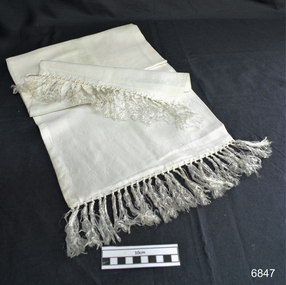
Scarf, 20th century
... 19th to mid-20th century. Dr Angus assisted Dr Tom Ryan, a pioneer in the use of X-rays and in ocular surgery. flagstaff hill warrnambool shipwrecked coast flagstaff hill maritime museum maritime museum shipwreck coast flagstaff hill maritime village great ocean road dr w r angus dr ryan surgical instrument t.s.s. largs bay warrnambool base hospital nhill base hospital mira hospital flying doctor scarf formal wear accessories Blue embroidered text "ANGUS" Scarf, part of the W.R. Angus Collectionl. White fine fabric sewn into rectangle shape with tassels of embroidery ...This scarf was donated to Flagstaff Hill Maritime Village by the family of Doctor William Roy Angus, Surgeon and Oculist. It is part of the “W.R. Angus Collection” that includes historical medical equipment, surgical instruments and material once belonging to Dr Edward Ryan and Dr Thomas Francis Ryan, (both of Nhill, Victoria) as well as Dr Angus’ own belongings. The Collection’s history spans the medical practices of the two Doctors Ryan, from 1885-1926 plus that of Dr Angus, up until 1969. ABOUT THE “W.R.ANGUS COLLECTION” Doctor William Roy Angus M.B., B.S., Adel., 1923, F.R.C.S. Edin.,1928 (also known as Dr Roy Angus) was born in Murrumbeena, Victoria in 1901 and lived until 1970. He qualified as a doctor in 1923 at University of Adelaide, was Resident Medical Officer at the Royal Adelaide Hospital in 1924 and for a period was house surgeon to Sir (then Mr.) Henry Simpson Newland. Dr Angus was briefly an Assistant to Dr Riddell of Kapunda, then commenced private practice at Curramulka, Yorke Peninsula, SA, where he was physician, surgeon and chemist. In 1926, he was appointed as new Medical Assistant to Dr Thomas Francis Ryan (T.F. Ryan, or Tom), in Nhill, Victoria, where his experiences included radiology and pharmacy. In 1927 he was Acting House Surgeon in Dr Tom Ryan’s absence. Dr Angus had become engaged to Gladys Forsyth and they decided he further his studies overseas in the UK in 1927. He studied at London University College Hospital and at Edinburgh Royal Infirmary and in 1928, was awarded FRCS (Fellow from the Royal College of Surgeons), Edinburgh. He worked his passage back to Australia as a Ship’s Surgeon on the on the Australian Commonwealth Line’s T.S.S. Largs Bay. Dr Angus married Gladys in 1929, in Ballarat. (They went on to have one son (Graham 1932, born in SA) and two daughters (Helen (died 12/07/1996) and Berenice (Berry), both born at Mira, Nhill ) According to Berry, her mother Gladys made a lot of their clothes. She was very talented and did some lovely embroidery including lingerie for her trousseau and beautifully handmade baby clothes. Dr Angus was a ‘flying doctor’ for the A.I.M. (Australian Inland Ministry) Aerial Medical Service in 1928 . Its first station was in the remote town of Oodnadatta, where Dr Angus was stationed. He was locum tenens there on North-South Railway at 21 Mile Camp. He took up this ‘flying doctor’ position in response to a call from Dr John Flynn; the organisation was later known as the Flying Doctor Service, then the Royal Flying Doctor Service. A lot of his work during this time involved dental surgery also. Between 1928-1932 he was surgeon at the Curramulka Hospital, Yorke Peninsula, South Australia. In 1933 Dr Angus returned to Nhill and purchased a share of the Nelson Street practice and Mira hospital (a 2 bed ward at the Nelson Street Practice) from Dr Les Middleton one of the Middleton Brothers, the current owners of what previously once Dr Tom Ryan’s practice. Dr Tom and his brother had worked as surgeons included eye surgery. Dr Tom Ryan performed many of his operations in the Mira private hospital on his premises. He had been House Surgeon at the Nhill Hospital 1902-1926. Dr Tom Ryan had one of the only two pieces of radiology equipment in Victoria during his practicing years – The Royal Melbourne Hospital had the other one. Over the years Dr Tom Ryan had gradually set up what was effectively a training school for country general-practitioner-surgeons. Each patient was carefully examined, including using the X-ray machine, and any surgery was discussed and planned with Dr Ryan’s assistants several days in advance. Dr Angus gained experience in using the X-ray machine there during his time as assistant to Dr Ryan. When Dr Angus bought into the Nelson Street premises in Nhill he was also appointed as the Nhill Hospital’s Honorary House Surgeon 1933-1938. His practitioner’s plate from his Nhill surgery is now mounted on the doorway to the Port Medical Office at Flagstaff Hill Maritime Village, Warrnambool. When Dr Angus took up practice in the Dr Edward and Dr Tom Ryan’s old premises he obtained their extensive collection of historical medical equipment and materials spanning 1884-1926. A large part of this collection is now on display at the Port Medical Office at Flagstaff Hill Maritime Village in Warrnambool. In 1939 Dr Angus and his family moved to Warrnambool where he purchased “Birchwood,” the 1852 home and medical practice of Dr John Hunter Henderson, at 214 Koroit Street. (This property was sold in1965 to the State Government and is now the site of the Warrnambool Police Station. and an ALDI sore is on the land that was once their tennis court). The Angus family was able to afford gardeners, cooks and maids; their home was a popular place for visiting dignitaries to stay whilst visiting Warrnambool. Dr Angus had his own silk worm farm at home in a Mulberry tree. His young daughter used his centrifuge for spinning the silk. Dr Angus was appointed on a part-time basis as Port Medical Officer (Health Officer) in Warrnambool and held this position until the 1940’s when the government no longer required the service of a Port Medical Officer in Warrnambool; he was thus Warrnambool’s last serving Port Medical Officer. (Masters of immigrant ships arriving in port reported incidents of diseases, illness and death and the Port Medical Officer made a decision on whether the ship required Quarantine and for how long, in this way preventing contagious illness from spreading from new immigrants to the residents already in the colony.) Dr Angus was a member of the Australian Medical Association, for 35 years and surgeon at the Warrnambool Base Hospital 1939-1942, He served as a Surgeon Captain during WWII1942-45, in Ballarat, Victoria, and in Bonegilla, N.S.W., completing his service just before the end of the war due to suffering from a heart attack. During his convalescence he carved an intricate and ‘most artistic’ chess set from the material that dentures were made from. He then studied ophthalmology at the Royal Melbourne Eye and Ear Hospital and created cosmetically superior artificial eyes by pioneering using the intrascleral cartilage. Angus received accolades from the Ophthalmological Society of Australasia for this work. He returned to Warrnambool to commence practice as an ophthalmologist, pioneering in artificial eye improvements. He was Honorary Consultant Ophthalmologist to Warrnambool Base Hospital for 31 years. He made monthly visits to Portland as a visiting surgeon, to perform eye surgery. He represented the Victorian South-West subdivision of the Australian Medical Association as its secretary between 1949 and 1956 and as chairman from 1956 to 1958. In 1968 Dr Angus was elected member of Spain’s Barraquer Institute of Barcelona after his research work in Intrasclearal cartilage grafting, becoming one of the few Australian ophthalmologists to receive this honour, and in the following year presented his final paper on Living Intrasclearal Cartilage Implants at the Inaugural Meeting of the Australian College of Ophthalmologists in Melbourne In his personal life Dr Angus was a Presbyterian and treated Sunday as a Sabbath, a day of rest. He would visit 3 or 4 country patients on a Sunday, taking his children along ‘for the ride’ and to visit with him. Sunday evenings he would play the pianola and sing Scottish songs to his family. One of Dr Angus’ patients was Margaret MacKenzie, author of a book on local shipwrecks that she’d seen as an eye witness from the late 1880’s in Peterborough, Victoria. In the early 1950’s Dr Angus, painted a picture of a shipwreck for the cover jacket of Margaret’s book, Shipwrecks and More Shipwrecks. She was blind in later life and her daughter wrote the actual book for her. Dr Angus and his wife Gladys were very involved in Warrnambool’s society with a strong interest in civic affairs. He had an interest in people and the community They were both involved in the creation of Flagstaff Hill, including the layout of the gardens. After his death (28th March 1970) his family requested his practitioner’s plate, medical instruments and some personal belongings be displayed in the Port Medical Office surgery at Flagstaff Hill Maritime Village, and be called the “W. R. Angus Collection”. The W.R. Angus Collection is significant for still being located at the site it is connected with, Doctor Angus being the last Port Medical Officer in Warrnambool. The collection of medical instruments and other equipment is culturally significant, being an historical example of medicine from late 19th to mid-20th century. Dr Angus assisted Dr Tom Ryan, a pioneer in the use of X-rays and in ocular surgery. Scarf, part of the W.R. Angus Collectionl. White fine fabric sewn into rectangle shape with tassels of embroidery thread each end. Attached is a fabric label with blue embroidered text “ANGUS” Blue embroidered text "ANGUS"flagstaff hill, warrnambool, shipwrecked coast, flagstaff hill maritime museum, maritime museum, shipwreck coast, flagstaff hill maritime village, great ocean road, dr w r angus, dr ryan, surgical instrument, t.s.s. largs bay, warrnambool base hospital, nhill base hospital, mira hospital, flying doctor, scarf, formal wear accessories -
 Flagstaff Hill Maritime Museum and Village
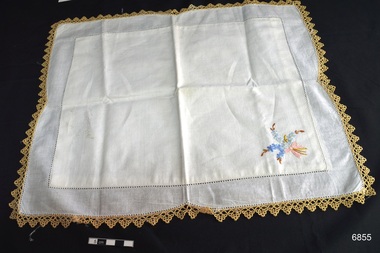
Pillowcase, 29th century
... 19th to mid-20th century. Dr Angus assisted Dr Tom Ryan, a pioneer in the use of X-rays and in ocular surgery. flagstaff hill warrnambool shipwrecked coast flagstaff hill maritime museum maritime museum shipwreck coast flagstaff hill maritime village great ocean road dr w r angus pillowcase linen manchester Small white pillowcase from the W.R. Angus Collection. Embroidered floral motif and tatted edging in yellow colour. Embroidery ...This pillowcase was donated to Flagstaff Hill Maritime Village by the family of Doctor William Roy Angus, Surgeon and Oculist. It is part of the “W.R. Angus Collection” that includes historical medical equipment, surgical instruments and material once belonging to Dr Edward Ryan and Dr Thomas Francis Ryan, (both of Nhill, Victoria) as well as Dr Angus’ own belongings. The Collection’s history spans the medical practices of the two Doctors Ryan, from 1885-1926 plus that of Dr Angus, up until 1969. ABOUT THE “W.R.ANGUS COLLECTION” Doctor William Roy Angus M.B., B.S., Adel., 1923, F.R.C.S. Edin.,1928 (also known as Dr Roy Angus) was born in Murrumbeena, Victoria in 1901 and lived until 1970. He qualified as a doctor in 1923 at University of Adelaide, was Resident Medical Officer at the Royal Adelaide Hospital in 1924 and for a period was house surgeon to Sir (then Mr.) Henry Simpson Newland. Dr Angus was briefly an Assistant to Dr Riddell of Kapunda, then commenced private practice at Curramulka, Yorke Peninsula, SA, where he was physician, surgeon and chemist. In 1926, he was appointed as new Medical Assistant to Dr Thomas Francis Ryan (T.F. Ryan, or Tom), in Nhill, Victoria, where his experiences included radiology and pharmacy. In 1927 he was Acting House Surgeon in Dr Tom Ryan’s absence. Dr Angus had become engaged to Gladys Forsyth and they decided he further his studies overseas in the UK in 1927. He studied at London University College Hospital and at Edinburgh Royal Infirmary and in 1928, was awarded FRCS (Fellow from the Royal College of Surgeons), Edinburgh. He worked his passage back to Australia as a Ship’s Surgeon on the on the Australian Commonwealth Line’s T.S.S. Largs Bay. Dr Angus married Gladys in 1929, in Ballarat. (They went on to have one son (Graham 1932, born in SA) and two daughters (Helen (died 12/07/1996) and Berenice (Berry), both born at Mira, Nhill ) According to Berry, her mother Gladys made a lot of their clothes. She was very talented and did some lovely embroidery including lingerie for her trousseau and beautifully handmade baby clothes. Dr Angus was a ‘flying doctor’ for the A.I.M. (Australian Inland Ministry) Aerial Medical Service in 1928 . Its first station was in the remote town of Oodnadatta, where Dr Angus was stationed. He was locum tenens there on North-South Railway at 21 Mile Camp. He took up this ‘flying doctor’ position in response to a call from Dr John Flynn; the organisation was later known as the Flying Doctor Service, then the Royal Flying Doctor Service. A lot of his work during this time involved dental surgery also. Between 1928-1932 he was surgeon at the Curramulka Hospital, Yorke Peninsula, South Australia. In 1933 Dr Angus returned to Nhill and purchased a share of the Nelson Street practice and Mira hospital (a 2 bed ward at the Nelson Street Practice) from Dr Les Middleton one of the Middleton Brothers, the current owners of what previously once Dr Tom Ryan’s practice. Dr Tom and his brother had worked as surgeons included eye surgery. Dr Tom Ryan performed many of his operations in the Mira private hospital on his premises. He had been House Surgeon at the Nhill Hospital 1902-1926. Dr Tom Ryan had one of the only two pieces of radiology equipment in Victoria during his practicing years – The Royal Melbourne Hospital had the other one. Over the years Dr Tom Ryan had gradually set up what was effectively a training school for country general-practitioner-surgeons. Each patient was carefully examined, including using the X-ray machine, and any surgery was discussed and planned with Dr Ryan’s assistants several days in advance. Dr Angus gained experience in using the X-ray machine there during his time as assistant to Dr Ryan. When Dr Angus bought into the Nelson Street premises in Nhill he was also appointed as the Nhill Hospital’s Honorary House Surgeon 1933-1938. His practitioner’s plate from his Nhill surgery is now mounted on the doorway to the Port Medical Office at Flagstaff Hill Maritime Village, Warrnambool. When Dr Angus took up practice in the Dr Edward and Dr Tom Ryan’s old premises he obtained their extensive collection of historical medical equipment and materials spanning 1884-1926. A large part of this collection is now on display at the Port Medical Office at Flagstaff Hill Maritime Village in Warrnambool. In 1939 Dr Angus and his family moved to Warrnambool where he purchased “Birchwood,” the 1852 home and medical practice of Dr John Hunter Henderson, at 214 Koroit Street. (This property was sold in1965 to the State Government and is now the site of the Warrnambool Police Station. and an ALDI sore is on the land that was once their tennis court). The Angus family was able to afford gardeners, cooks and maids; their home was a popular place for visiting dignitaries to stay whilst visiting Warrnambool. Dr Angus had his own silk worm farm at home in a Mulberry tree. His young daughter used his centrifuge for spinning the silk. Dr Angus was appointed on a part-time basis as Port Medical Officer (Health Officer) in Warrnambool and held this position until the 1940’s when the government no longer required the service of a Port Medical Officer in Warrnambool; he was thus Warrnambool’s last serving Port Medical Officer. (Masters of immigrant ships arriving in port reported incidents of diseases, illness and death and the Port Medical Officer made a decision on whether the ship required Quarantine and for how long, in this way preventing contagious illness from spreading from new immigrants to the residents already in the colony.) Dr Angus was a member of the Australian Medical Association, for 35 years and surgeon at the Warrnambool Base Hospital 1939-1942, He served as a Surgeon Captain during WWII1942-45, in Ballarat, Victoria, and in Bonegilla, N.S.W., completing his service just before the end of the war due to suffering from a heart attack. During his convalescence he carved an intricate and ‘most artistic’ chess set from the material that dentures were made from. He then studied ophthalmology at the Royal Melbourne Eye and Ear Hospital and created cosmetically superior artificial eyes by pioneering using the intrascleral cartilage. Angus received accolades from the Ophthalmological Society of Australasia for this work. He returned to Warrnambool to commence practice as an ophthalmologist, pioneering in artificial eye improvements. He was Honorary Consultant Ophthalmologist to Warrnambool Base Hospital for 31 years. He made monthly visits to Portland as a visiting surgeon, to perform eye surgery. He represented the Victorian South-West subdivision of the Australian Medical Association as its secretary between 1949 and 1956 and as chairman from 1956 to 1958. In 1968 Dr Angus was elected member of Spain’s Barraquer Institute of Barcelona after his research work in Intrasclearal cartilage grafting, becoming one of the few Australian ophthalmologists to receive this honour, and in the following year presented his final paper on Living Intrasclearal Cartilage Implants at the Inaugural Meeting of the Australian College of Ophthalmologists in Melbourne In his personal life Dr Angus was a Presbyterian and treated Sunday as a Sabbath, a day of rest. He would visit 3 or 4 country patients on a Sunday, taking his children along ‘for the ride’ and to visit with him. Sunday evenings he would play the pianola and sing Scottish songs to his family. One of Dr Angus’ patients was Margaret MacKenzie, author of a book on local shipwrecks that she’d seen as an eye witness from the late 1880’s in Peterborough, Victoria. In the early 1950’s Dr Angus, painted a picture of a shipwreck for the cover jacket of Margaret’s book, Shipwrecks and More Shipwrecks. She was blind in later life and her daughter wrote the actual book for her. Dr Angus and his wife Gladys were very involved in Warrnambool’s society with a strong interest in civic affairs. He had an interest in people and the community They were both involved in the creation of Flagstaff Hill, including the layout of the gardens. After his death (28th March 1970) his family requested his practitioner’s plate, medical instruments and some personal belongings be displayed in the Port Medical Office surgery at Flagstaff Hill Maritime Village, and be called the “W. R. Angus Collection”. The W.R. Angus Collection is significant for still being located at the site it is connected with, Doctor Angus being the last Port Medical Officer in Warrnambool. The collection of medical instruments and other equipment is culturally significant, being an historical example of medicine from late 19th to mid-20th century. Dr Angus assisted Dr Tom Ryan, a pioneer in the use of X-rays and in ocular surgery. Small white pillowcase from the W.R. Angus Collection. Embroidered floral motif and tatted edging in yellow colour. Embroidery is inclomplete as there is still more stencil print visible. flagstaff hill, warrnambool, shipwrecked coast, flagstaff hill maritime museum, maritime museum, shipwreck coast, flagstaff hill maritime village, great ocean road, dr w r angus, pillowcase, linen, manchester
