
Showing 31 items matching " hoddle street"
-
 Glen Eira Historical Society
Letter - Hoddle Street, 23, Elsternwick
... Hoddle Street, 23, Elsternwick...... Hoddle Street...A copy of a two page valuation of 23 Hoddle Street, Elsternwick, dated 03/09/1976, from valuator W V Scott. ...23 Hoddle Street, Elsternwick, Victoria, Australia...A copy of a two page valuation of 23 Hoddle Street, Elsternwick, dated 03/09/1976, from valuator W V Scott. ...A copy of a two page valuation of 23 Hoddle Street, Elsternwick, dated 03/09/1976, from valuator W V Scott. The valuation provides a description of the land and house improvements. The file also includes one page of unattributed, undated, handwritten working notes for the purposes of the valuation. The file also includes a rate notice for the property from the City of Caulfield.negus vera m, elsternwick, hoddle street, baxter street, brick houses, flats, romeo f a, caulfield council, rents and renting, receipts, architectural features, scott w v, rates -
Glen Eira Historical Society
Article - Hoddle Street, 31, Elsternwick
... Hoddle Street, 31, Elsternwick...... Hoddle Street...31 Hoddle Street, Elsternwick, Victoria, Australia...Lyndene Elsternwick Hoddle Street Glenhuntly Road Hocking Stuart Mansions Auctions Lead lights Architectural features House names Article Hoddle Street, 31, Elsternwick ...Item in PRW-Residential newspaper of 22/07/2011 featuring this address. It describes the architectural features of this 1930s residence, plus two exterior and two interior photographs. House name is 'Lyndene'.lyndene, elsternwick, hoddle street, glenhuntly road, hocking stuart, mansions, auctions, lead lights, architectural features, house names -
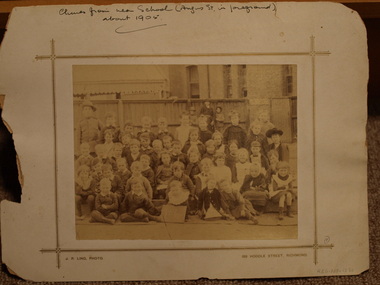 Clunes Museum
Photograph, J.P. LIND, CIRCA 1905
... PHOTOGRAPH OF SCHOOL CHILDREN - CIRCA 1905, J P LIND PHOTO 183 HODDLE STREET RICHMOND...local history photography photographs schools 1552 CLUNES FROM NEAR SCHOOL (ANGUS STREET IN FOREGROUND), ABOUT 1905 PHOTOGRAPH OF SCHOOL CHILDREN - CIRCA 1905, J P LIND PHOTO 183 HODDLE STREET RICHMOND Photograph PHOTOGRAPH J.P. ...PHOTOGRAPH OF SCHOOL CHILDREN - CIRCA 1905, J P LIND PHOTO 183 HODDLE STREET RICHMONDCLUNES FROM NEAR SCHOOL (ANGUS STREET IN FOREGROUND), ABOUT 1905 local history, photography, photographs, schools, 1552 -
Glen Eira Historical Society
Document - Elsternwick Congregational Church – Caulfield Union Church
... ... Hoddle Street...Orrong Road King Street Curral Road Hoddle Street Elizabeth Street Robertson R.J. Pedler B.R. ...Souvenir programme of the Elsternwick Congregational Church Welcome Home Social for their members, who served in World War 1, held on 05/05/1919 at the church. Includes a photograph of church exterior. A programme for the Combined Welcome Social for the new pastor Rev. J.S. Griffiths held on 09/12/1919. The twenty-seventh annual report of Elsternwick Congregational Church for year ending 30/06/1921. Pamphlet for jubilee celebration for Elsternwick Congregational Church in August 1944. Includes programme of events and brief history of the church. Programme for fifty-first church anniversary and social held on 12/08/1945 and 15/08/1945. Undated church letterhead sheet of paper. Includes exterior photograph of the church. Four church newsletters from March 1973, March 1975, February 1977 and May 1977. Three black and white photographs, undated and photographer unknown, of church exterior, Pilots’ Club and Sunday School children.elsternwick congregational church, world war 1914-1918, butters r.w., elliot t., hale w.r., christiansen a.l.a., thoms f.e., emmerson j.h., angwin h.h., white s.j., anderson g., wragge l.g., adams g.h., smith e.j., thoms s.e., anderson j., wragge t.w.e, emmerson e., cleghorn h., lindsay g.j., fullagar w.k., barker j.n., snowball g.f., clarke r., wragge s., joynes a., lewis r., griffith j. shaw rev., griffith mrs., bryant samuel rev., christiansen w. rev, slatter j.c., robertson w., clarke w., forward f.a. rev., orrong road, king street, curral road, hoddle street, elizabeth street, robertson r.j., pedler b.r., hoare j.g., lewis g.n., tytherleigh r. j., watts v., message h.t., barlow c.w., northey j.d. rev., krohn f.w. rev, swan e.f.w. rev., riddles f.j. rev., elsternwick, caulfield north, hatley l., hatley l. mrs., parkside street, langdon bob rev., bendelack i., sandham court, mcloghlin j.r., prahran grove, smitham nancy, religious groups, sunday schools, congregational church, newsletters, st. john’s uniting church elsternwick, strickland a. mrs., watts w.c. mrs., mcivor miss, watts t. mr., watts t. mrs., watts r. miss, anderson a. mr., white miss, white c. miss, white p. miss, gladman f.e. mr., glandman f.e. mrs., slatter h.t. mr., slatter h.t. mrs., boldner a. mr., boldner a. mrs., smith s.a. mrs., strickland a. mr., owen w. mr., owen w. mrs., woodward t. mr., gregson j.b. mr., shippey f.l. mr., turner c. mr., turner c. mrs., blanch j.w. mr., blanch j.w. mrs., pye h. mr., pye h. mrs., haynes m.j. mrs., burgess e. mr., burgess e. mrs., watts h. g. miss, burgess a.s. mr., burgess a.s. mrs., watts m. miss, thoms w. mr., thoms h. mr., thompson j.m. mrs., thompson miss, grover e. miss, slatter h.h. mr., slatter r. miss, anderson a. miss, thoms e.m. mrs., newson m. mrs, legge mrs., legge f. miss, legge b. miss, young mrs., young miss, copland o. rev., copland o. mrs., steed mr., steed mrs. -
Glen Eira Historical Society
Plan - Uniting Church Archives, Orrong Road, 78-66, Elsternwick
... ... Hoddle Street...Methodist Church Trust Town Clerks Hoddle Street Plan Uniting Church Archives, Orrong Road, 78-66, Elsternwick ...Six documents including plan and correspondence between Elsternwick Methodist Church, Public Health Department and Beddoe Pty Ltd concerning the application to make alterations and additions including the erecting of a brick kindergarten from 30/07/1937 to 03/03/1939.elsternwick methodist church, orrong road, beddoe pty ltd., halls, kindergarten, robinson c.h., briggs james r., beddoe f.g., charlesworth a.c., methodist church trust, town clerks, hoddle street -
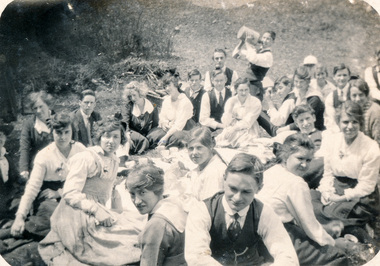 Eltham District Historical Society Inc
Photographs, Group shots of family and friends of Leslie Beard and his wife Lois (nee Wright), ca1920s
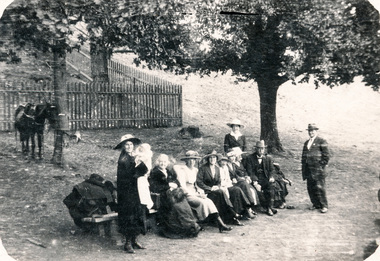
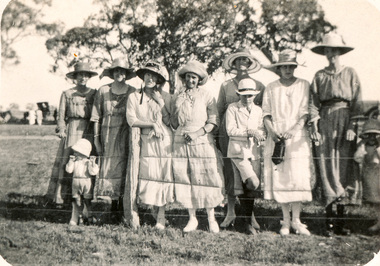
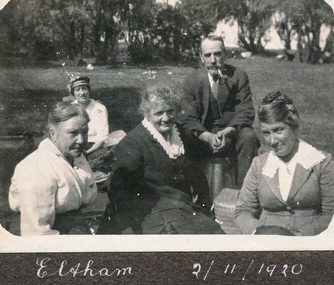
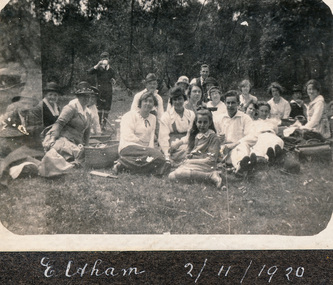
... The donor/relative suggests that the older group would most likely be St Phillips Church of England, Hoddle Street, Collingwood picnics, and the smaller groups of Lois' family. ...The donor/relative suggests that the older group would most likely be St Phillips Church of England, Hoddle Street, Collingwood picnics, and the smaller groups of Lois' family. ...Family Group photos from an album belonging to Leslie Beard who married Lois Wright. The donor/relative suggests that the older group would most likely be St Phillips Church of England, Hoddle Street, Collingwood picnics, and the smaller groups of Lois' family. Two photos are marked as at Eltham 2nd November 1920. Photo 5 with fence line is marked as Heidelberg 19209 small black and white photographs with white borders. 2 are cut from a photo album with captions and explanatory letter from Donor Dulcie Mugavinleslie beard, lois wright, beard family, picnics, eltham -
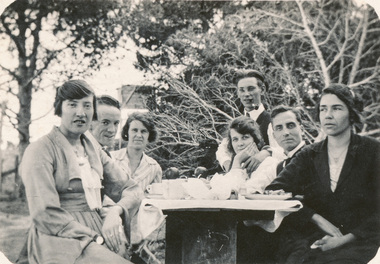 Eltham District Historical Society Inc
Photographs, Group shots of family and friends of Leslie Beard and his wife Lois (nee Wright), ca1920s
... The donor/relative suggests that the older group would most likely be St Phillips Church of England, Hoddle Street, Collingwood picnics, and the smaller groups of Lois' family. ...The donor/relative suggests that the older group would most likely be St Phillips Church of England, Hoddle Street, Collingwood picnics, and the smaller groups of Lois' family. ...Family Group photos from an album belonging to Leslie Beard who married Lois Wright. The donor/relative suggests that the older group would most likely be St Phillips Church of England, Hoddle Street, Collingwood picnics, and the smaller groups of Lois' family. Two photos are marked as at Eltham 2nd November 1920. Photo 5 with fence line is marked as Heidelberg 19209 small black and white photographs with white borders. 2 are cut from a photo album with captions and explanatory letter from Donor Dulcie Mugavinleslie beard, lois wright, beard family, picnics, eltham -
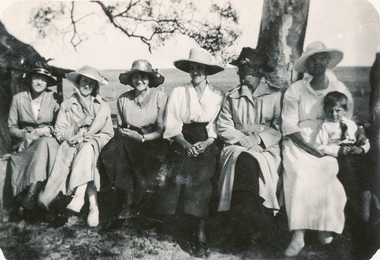 Eltham District Historical Society Inc
Photographs, Group shots of family and friends of Leslie Beard and his wife Lois (nee Wright), ca1920s
... The donor/relative suggests that the older group would most likely be St Phillips Church of England, Hoddle Street, Collingwood picnics, and the smaller groups of Lois' family. ...The donor/relative suggests that the older group would most likely be St Phillips Church of England, Hoddle Street, Collingwood picnics, and the smaller groups of Lois' family. ...Family Group photos from an album belonging to Leslie Beard who married Lois Wright. The donor/relative suggests that the older group would most likely be St Phillips Church of England, Hoddle Street, Collingwood picnics, and the smaller groups of Lois' family. Two photos are marked as at Eltham 2nd November 1920. Photo 5 with fence line is marked as Heidelberg 19209 small black and white photographs with white borders. 2 are cut from a photo album with captions and explanatory letter from Donor Dulcie Mugavinleslie beard, lois wright, beard family, picnics, eltham -
 Eltham District Historical Society Inc
Photographs, Group shots of family and friends of Leslie Beard and his wife Lois (nee Wright), ca1920s
... The donor/relative suggests that the older group would most likely be St Phillips Church of England, Hoddle Street, Collingwood picnics, and the smaller groups of Lois' family. ...The donor/relative suggests that the older group would most likely be St Phillips Church of England, Hoddle Street, Collingwood picnics, and the smaller groups of Lois' family. ...Family Group photos from an album belonging to Leslie Beard who married Lois Wright. The donor/relative suggests that the older group would most likely be St Phillips Church of England, Hoddle Street, Collingwood picnics, and the smaller groups of Lois' family. Two photos are marked as at Eltham 2nd November 1920. Photo 5 with fence line is marked as Heidelberg 19209 small black and white photographs with white borders. 2 are cut from a photo album with captions and explanatory letter from Donor Dulcie Mugavinleslie beard, lois wright, beard family, picnics, eltham -
 Eltham District Historical Society Inc
Photographs, Group shots of family and friends of Leslie Beard and his wife Lois (nee Wright), ca1920s
... The donor/relative suggests that the older group would most likely be St Phillips Church of England, Hoddle Street, Collingwood picnics, and the smaller groups of Lois' family. ...The donor/relative suggests that the older group would most likely be St Phillips Church of England, Hoddle Street, Collingwood picnics, and the smaller groups of Lois' family. ...Family Group photos from an album belonging to Leslie Beard who married Lois Wright. The donor/relative suggests that the older group would most likely be St Phillips Church of England, Hoddle Street, Collingwood picnics, and the smaller groups of Lois' family. Two photos are marked as at Eltham 2nd November 1920. Photo 5 with fence line is marked as Heidelberg 19209 small black and white photographs with white borders. 2 are cut from a photo album with captions and explanatory letter from Donor Dulcie Mugavinleslie beard, lois wright, beard family, picnics, eltham -
 Eltham District Historical Society Inc
Photographs, Group shots of family and friends of Leslie Beard and his wife Lois (nee Wright), ca1920s
... The donor/relative suggests that the older group would most likely be St Phillips Church of England, Hoddle Street, Collingwood picnics, and the smaller groups of Lois' family. ...The donor/relative suggests that the older group would most likely be St Phillips Church of England, Hoddle Street, Collingwood picnics, and the smaller groups of Lois' family. ...Family Group photos from an album belonging to Leslie Beard who married Lois Wright. The donor/relative suggests that the older group would most likely be St Phillips Church of England, Hoddle Street, Collingwood picnics, and the smaller groups of Lois' family. Two photos are marked as at Eltham 2nd November 1920. Photo 5 with fence line is marked as Heidelberg 19209 small black and white photographs with white borders. 2 are cut from a photo album with captions and explanatory letter from Donor Dulcie Mugavinleslie beard, lois wright, beard family, picnics, eltham -
 Eltham District Historical Society Inc
Photographs, Group shots of family and friends of Leslie Beard and his wife Lois (nee Wright), ca1920s
... The donor/relative suggests that the older group would most likely be St Phillips Church of England, Hoddle Street, Collingwood picnics, and the smaller groups of Lois' family. ...The donor/relative suggests that the older group would most likely be St Phillips Church of England, Hoddle Street, Collingwood picnics, and the smaller groups of Lois' family. ...Family Group photos from an album belonging to Leslie Beard who married Lois Wright. The donor/relative suggests that the older group would most likely be St Phillips Church of England, Hoddle Street, Collingwood picnics, and the smaller groups of Lois' family. Two photos are marked as at Eltham 2nd November 1920. Photo 5 with fence line is marked as Heidelberg 19209 small black and white photographs with white borders. 2 are cut from a photo album with captions and explanatory letter from Donor Dulcie Mugavinleslie beard, lois wright, beard family, picnics, eltham -
 Eltham District Historical Society Inc
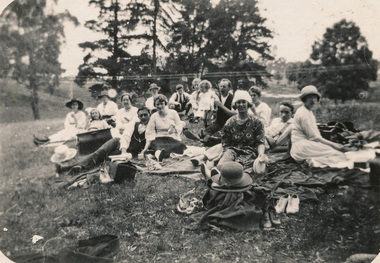
Photographs, Group shots of family and friends of Leslie Beard and his wife Lois (nee Wright), ca1920s
... The donor/relative suggests that the older group would most likely be St Phillips Church of England, Hoddle Street, Collingwood picnics, and the smaller groups of Lois' family. ...The donor/relative suggests that the older group would most likely be St Phillips Church of England, Hoddle Street, Collingwood picnics, and the smaller groups of Lois' family. ...Family Group photos from an album belonging to Leslie Beard who married Lois Wright. The donor/relative suggests that the older group would most likely be St Phillips Church of England, Hoddle Street, Collingwood picnics, and the smaller groups of Lois' family. Two photos are marked as at Eltham 2nd November 1920. Photo 5 with fence line is marked as Heidelberg 19209 small black and white photographs with white borders. 2 are cut from a photo album with captions and explanatory letter from Donor Dulcie Mugavinleslie beard, lois wright, beard family, picnics, eltham -
 Eltham District Historical Society Inc
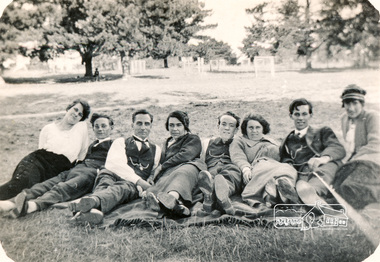
Photographs, Group shots of family and friends of Leslie Beard and his wife Lois (nee Wright), 1920c
... The donor/relative suggests that the older group would most likely be St Phillips Church of England, Hoddle Street, Collingwood picnics, and the smaller groups of Lois' family. ...The donor/relative suggests that the older group would most likely be St Phillips Church of England, Hoddle Street, Collingwood picnics, and the smaller groups of Lois' family. ...Family Group photos from an album belonging to Leslie Beard who married Lois Wright. The donor/relative suggests that the older group would most likely be St Phillips Church of England, Hoddle Street, Collingwood picnics, and the smaller groups of Lois' family. Two photos are marked as at Eltham 2nd November 1920. Photo 5 with fence line is marked as Heidelberg 19209 small black and white photographs with white borders. 2 are cut from a photo album with captions "Eltham 2/11/1920". Also explanatory letter from donor Dulcie Mugavinleslie beard, lois wright, beard family, picnics, eltham -
 Warrnambool and District Historical Society Inc.
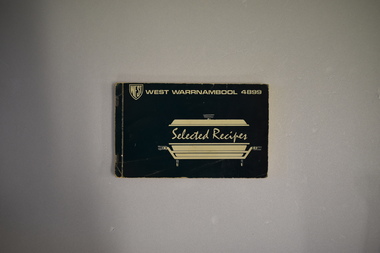
Booklet, Selected Recipes, 1960s
... The West Warrnambool School still operates today in Hoddle Street Warrnambool....The West Warrnambool School still operates today in Hoddle Street Warrnambool. This booklet is retained as an example of the recipe books produced for fund raising purposes by non-profit organizations in the second half of the 20th century. ...This recipe booklet has been produced as a fund-raiser for the West Warrnambool State School. The production of recipe books such as this one was a popular school project in the 1960s and 70s. West Warrnambool School No. 4899 opened in February 1966 with an enrolment of 183 children and a staff of 8 teachers under the Head Teacher J.J.Godfrey. The West Warrnambool School still operates today in Hoddle Street Warrnambool.This booklet is retained as an example of the recipe books produced for fund raising purposes by non-profit organizations in the second half of the 20th century. It is also a memento of West Warrnambool State School. This is a soft cover booklet with a green front cover with an image of a fry pan and cream printing. The back cover is cream. (This copy has two front covers). The booklet contains a foreword, an index, printed recipes on different coloured pages and hand-drawn advertisements for local businesses. west warrnambool school, history of warrnambool -
 Melbourne Tram Museum
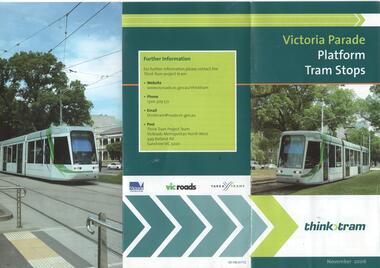
Pamphlet, VicRoads, "Victoria Parade Platform Tram Stops", Oct. 2006
... Pamphlet - 3 fold DL full colour titled "Victoria Parade Platform Tram Stops" between the Lansdowne Street Stop and Hoddle Street. Gives proposed construction timing (Nov. 2006 and Feb. 2007), shows a map and details the timing and work at each stop and shows what existing stops would be closed. ...Trams tramways Victoria Parade Platform stops Tram Stops Pamphlet - 3 fold DL full colour titled "Victoria Parade Platform Tram Stops" between the Lansdowne Street Stop and Hoddle Street. Gives proposed construction timing (Nov. 2006 and Feb. 2007), shows a map and details the timing and work at each stop and shows what existing stops would be closed. ...Pamphlet - 3 fold DL full colour titled "Victoria Parade Platform Tram Stops" between the Lansdowne Street Stop and Hoddle Street. Gives proposed construction timing (Nov. 2006 and Feb. 2007), shows a map and details the timing and work at each stop and shows what existing stops would be closed. Has photos of C1 3001 and 3029 on the exterior of the pamphlet. Published by the VicRoads Think Tram project team. Has the State Government, Yarra Trams and VicRoads logos.trams, tramways, victoria parade, platform stops, tram stops -
 Melbourne Tram Museum
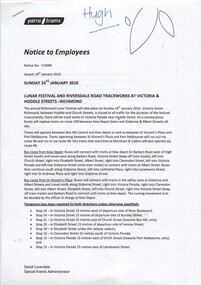
Document - Notice, Yarra Trams, "Notice to Employees - Lunar Festival and Riversdale Trackwork at Victoria and Hoddle Streets - 2010", "Notice to Employees - St Kilda Road Track Works Phase 2 - 2010", 2010
... Set of three documents concerned with track works. .1 - Notice - three A4 stapled sheets - titled "Notice to Employees - Lunar Festival and Riversdale Trackwork at Victoria and Hoddle Streets - 2010", outlining bus replacement arrangements and staff supervision and CSE arrangements - lists names of people involved. .2 - Notice - three A4 stapled sheets - "Notice to Employees - St Kilda Road Track Works Phase 2 - 2010", outlining bus arrangements. .3 - List of Officers and locations for the above works on 14 June and tram services affected...."Notice to Employees - Lunar Festival and Riversdale Trackwork at Victoria and Hoddle Streets - 2010", "Notice to Employees - St Kilda Road Track Works Phase 2 - 2010" Document Notice Yarra Trams Mudher, Chau, Sjo, Waldron, Ghobrial, Smith, D'Rosario, Manlio, Curley, Barsom, Stevenson, Marshall, Iskander, Dimov, Poppen, Evangelista, Michael, Dunkley, Daniel, Wong, Fernando, Soeny, Almeida, Aruma, Mahoney, Dunkley, Dezilwa, Scott, Mete ...Set of three documents concerned with track works. .1 - Notice - three A4 stapled sheets - titled "Notice to Employees - Lunar Festival and Riversdale Trackwork at Victoria and Hoddle Streets - 2010", outlining bus replacement arrangements and staff supervision and CSE arrangements - lists names of people involved. .2 - Notice - three A4 stapled sheets - "Notice to Employees - St Kilda Road Track Works Phase 2 - 2010", outlining bus arrangements. .3 - List of Officers and locations for the above works on 14 June and tram services affected..1 - has "Hugh" in ink along the top of the first page. .3 - has "Hugh" in red ink along the top of the first page.trams, tramways, yarra trams, road works, victoria st, kew depot, st kilda rd, bus replacement -
 Brighton Historical Society
Clothing - Dress, Day dress, Circa 1850
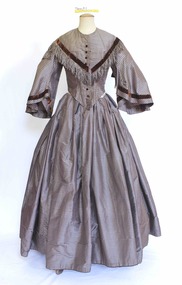
... In December 1869 he bought a property at 1115 Hoddle Street, East Melbourne, between Hotham and George Streets. ...In December 1869 he bought a property at 1115 Hoddle Street, East Melbourne, between Hotham and George Streets. ...A dress believed to have belonged to a family member of Mrs. Jessie Somerville Singer (nee Watson), 1849-1935. As the dress dates from circa 1850, it could have belonged to someone from one generation previous, possibly her mother Elizabeth Watson. Jessie Somerville Singer was the second wife of Mr. Edward Singer (1829 – 1904) of 'Somerville', New Street, Brighton Beach. Edward's first wife, Maria, died in 1861; their son William died approximately 12 months later. In the 1861 census of North Bradley England, Edward was recorded as a carpenter journeyman. After these tragedies Edward, then aged 30, left England to start a new life in Australia. He emigrated as an unassisted passenger on the steamship 'Great Britain', departing from Liverpool and arriving in Melbourne in April 1863. Edward worked as a joiner and overseer for a timber merchant in Franklin Street, Melbourne. In December 1869 he bought a property at 1115 Hoddle Street, East Melbourne, between Hotham and George Streets. At some stage he also acquired 1117 Hoddle Street. He also owned another property in Rushall Crescent, North Fitzroy. On 10 July 1873 Edward married Jessie Somerville Watson, the daughter of William Watson and Elizabeth Martin. They lived at Hoddle Street for some years, later moving to Rushall Crescent, North Fitzroy before in the 1880s settling in what was then the semi-rural suburb of Brighton. Edward is recorded as working there as a joiner. The house 'Somerville' was built by the Singers in circa 1880 at 100 (now 78) New Street, Brighton. The family moved there upon Edward's early retirement and lived there until 1941. 'Somerville' was sold, the house demolished and the land subdivided in the 1930s. Edward and Jessie appear to have lived comfortably. Edward died on 30 July 1909. Jessie died on 11 November 1935. Many members of the Singer family have lived in and around Brighton since Edward and Jessie first made their home there. The donor, Mrs Dorothy Constance Cook, was Jessie's granddaughter.A silver and brown striped silk taffeta dress comprising separate bodice (.1) and skirt (.2). The dress features a high round neckline fastening down the centre front with concealed hook and eye closures with ten (two missing) decorative brown silk velvet buttons. The front and back feature a briown silk velvet ribbon that forms a v shape from the shoulder to the centre front just below the bust and centre back below the shoulder blades. From the ribbon falls a brown and silver silk fringe approx seven cms deep. The bodice is shaped and boned into the waist and finishes in a deep v over the stomach. At the back the bodice is shaped to the body finishing in a smaller curved v over the small of the back. The sleeve attaches to the bodice at the true shoulder and falls in a pagoda sleeve to the mid forearm. The sleeve is also trimmed with brown silk velvet ribbon near the base of the sleeve. The full skirt is pleated at the waist, falling to the floor, longer at the back to accommodate the crinoline.somerville, new street brighton, jessie somerville singer, edward singer, elizabeth martin, brighton, 1850s -
 City of Moorabbin Historical Society (Operating the Box Cottage Museum)
Personal Effects, cigarette papers 'Boomerang', c1946
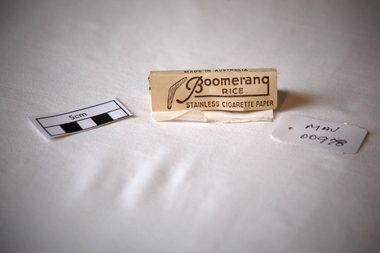
... PROV - The West Richmond heritage overlay - The smaller former Australian Automatic Cigarette Paper Company factory at no.103-05 Hoddle Street Richmond, also retains original Moderne detailing, which includes 'Boomerang' in Art Deco script set vertically within the piers at either end of the building. ...PROV - The West Richmond heritage overlay - The smaller former Australian Automatic Cigarette Paper Company factory at no.103-05 Hoddle Street Richmond, also retains original Moderne detailing, which includes 'Boomerang' in Art Deco script set vertically within the piers at either end of the building. ...Cigarette or Rolling papers are small sheets, rolls, or leaves of pre-cut paper made from wood pulp, hemp, flax, or rice straw which are sold for rolling cigarettes either by hand or with a rolling machine. When rolling a cigarette, one fills the rolling paper with tobacco. PROV - The West Richmond heritage overlay - The smaller former Australian Automatic Cigarette Paper Company factory at no.103-05 Hoddle Street Richmond, also retains original Moderne detailing, which includes 'Boomerang' in Art Deco script set vertically within the piers at either end of the building. 'Boomerang' was the brand of the cigarette papers manufactured by the company until 1948. A packet of 'Boomerang' precut cigarette papers Top: 60 LEAVES / BOOMERANG/ RICE / STAINLESS CIGARETTE PAPER/ Back:: 1/3 / 60 LEAVES / BOOMERANG / RICE / AUTOMATIC GUMMED / MADE IN AUSTRALIA . Inside packet: AUSTRALIAN AUTOMATIC CIGARETTE / PAPER CO. PTY. LTD. / MELBOURNEmelbourne, early settlers, market gardeners, moorabbin, bentleigh, cheltenham, cigarette papers, tobacco, boomerang papers, australian automatic cigarette paper co. pty.ltd. -
 Wodonga & District Historical Society Inc
Footwear - Infant's shoes, J & E Robertson, 1950s
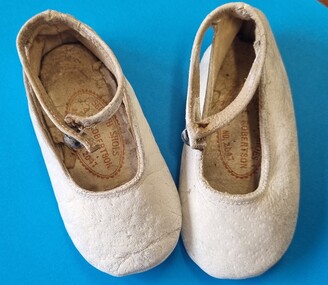
... Robertson, a shoe manufacturer located at 64 Hoddle Street, Clifton Hill, Victoria. Clifton Hill was the heart of the shoe manufacturing industry in the immediate post World War II era. ...Robertson, a shoe manufacturer located at 64 Hoddle Street, Clifton Hill, Victoria. Clifton Hill was the heart of the shoe manufacturing industry in the immediate post World War II era. ...A pair of a young girl's shoes, made from soft leather, with a single button ankle strap. The shoes were cherished by the donor as the first pair of shoes she had worn as a child. The shoes were made by J. & E. Robertson, a shoe manufacturer located at 64 Hoddle Street, Clifton Hill, Victoria. Clifton Hill was the heart of the shoe manufacturing industry in the immediate post World War II era. The company was highly regarded for producing structured children's footwear made of premium materials designed. These shoes are from their "Seraph" range which was designed to combat the flat feet and structural posture issues common in children at the time. This focus on podiatric health earned them official certifications and the distinctive Approval Numbers. The inscription "approval number 2047" stamped on their inner soles indicates that the shoe met government guidelines for structure and the use of local materials.These shoes are significant because they are representative of footwear worn by young children in Wodonga in the late 1940s and 1950s.A pair of infant's sandals made from satin with button up ankle strap.Inside shoe: Seraph shoes J & E Robertson approval number 2047children's footwear, j & e robertson shoes -
 Whitehorse Historical Society Inc.
Photograph, L L Road Vermont, late 1800
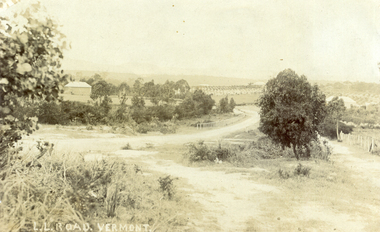
... Shambrook - Tim's father)|Information on the back of the Postcard reveal it was sent to Miss Roberts of 61 Hoddle Street Richmond Victoria by Muriel at 37 Victoria Road Northcote and was posted at the Fairfield Post Office Victoria on 27 August 1909. ...Shambrook - Tim's father)|Information on the back of the Postcard reveal it was sent to Miss Roberts of 61 Hoddle Street Richmond Victoria by Muriel at 37 Victoria Road Northcote and was posted at the Fairfield Post Office Victoria on 27 August 1909. ...Dr L L Smith was a pioneer of the Vermont District. He owned 250 acres in the area bounded by Boronia, Canterbury and Heatherdale Roads and the creek. The property was known as L L Vale after which the road was named. Name was changed to Boronia Road in later years. He was a Doctor with rooms in the City, was a member of Parliament.Sepia Postcard of L L Road, Vermont (now Boronia Road) taken in the early 1900s (card is postmarked 27 Aug 1909). Shows the road going down it is presumed to the creek. It is possible that the house is that of Dr.L.L.Smith. See History.|Orchard in background is the Finger orchard. (from Mr. Shambrook - Tim's father)|Information on the back of the Postcard reveal it was sent to Miss Roberts of 61 Hoddle Street Richmond Victoria by Muriel at 37 Victoria Road Northcote and was posted at the Fairfield Post Office Victoria on 27 August 1909. Text is 'Dear Ethel Just a Post Card to let you know I will be out to see you on Monday if convenient. I came down with Mr Hutchinson and he asked me what were we laughing out on the Sunday when he came up. Muriel|See the following references -ND199, 313, 539. 1242, 2013, 3680 & 4295.l l road vermont, boronia road vermont, smith . l l dr -
 Glen Eira Historical Society
Album - Album page, Bureel (Kooyong Road), Circa 1972
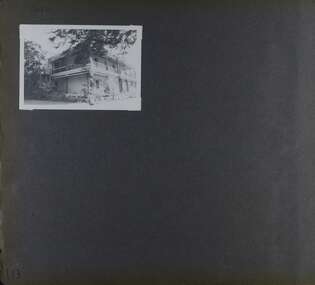
... Burreel Avenue, Baxter, Buxton and Hoddle Streets were created. "Burreel" was rated to Burreel Avenue and stood on lot 13 with frontages to Burreel Avenue and Kooyong Road of 198' and 214'. ...Burreel Avenue, Baxter, Buxton and Hoddle Streets were created. "Burreel" was rated to Burreel Avenue and stood on lot 13 with frontages to Burreel Avenue and Kooyong Road of 198' and 214'. ...This photograph is part of the Caulfield Historical Album 1972. This album was created in approximately 1972 as part of a project by the Caulfield Historical Society to assist in identifying buildings worthy of preservation. The album is related to a Survey the Caulfield Historical Society developed in collaboration with the National Trust of Australia (Victoria) and Caulfield City Council to identify historic buildings within the City of Caulfield that warranted the protection of a National Trust Classification. Principal photographer thought to be Trevor Hart, member of Caulfield Historical Society. Most photographs were taken between 1966-1972 with a small number of photographs being older and from unknown sources. All photographs are black and white except where stated, with 386 photographs over 198 pages. From: Glen Eira Heritage Management Plan 1996 by Andrew Ward In 1856, John Allee, a builder from Brighton, purchased C.A. 37 on the south-west corner of Glenhuntly and Kooyong Roads. The land comprised just over 45 acres. By 1863, Francis John Sidney Stephen, a lawyer and cousin of J. Wilberforce Stephen, owned most of lot 37. By 1866, Stephen had a built a "small mansion" named ''Burreel". It was a brick house and Stephen lived there until 1882. By 1884, Mrs Buxton of Hillside Terrace, East Melbourne, had purchased the property. Richard Buxton, a gentleman was listed as occupant and the house described as "brick, eight rooms". NAV was £300. Richard Buxton continued residency in 1887 however in 1888, George Allen, music seller, became occupant. At that time the house had thirteen rooms on twenty-three acres of land. Twelve people lived there and NAV was £920. In 1900, Daniel Luxton, stock and sharebroker and the Honourable John Taverner, M.H.A. leased the property. Fourteen people lived there. Mrs Buxton continued as owner. By 1910, ownership had passed to Mrs Mary Neate, who converted the house to a nursing home. The land had been subdivided by 1913 and sold by ''Buxtons Estate". Burreel Avenue, Baxter, Buxton and Hoddle Streets were created. "Burreel" was rated to Burreel Avenue and stood on lot 13 with frontages to Burreel Avenue and Kooyong Road of 198' and 214'. The house had ten rooms. NAV was £60. Mary Neate, a nurse, continued as owner/ operator of ''Burreel" nursing home in 1927. At that time there were sixteen rooms and fourteen residents. NAV was £100. Mrs Neat remained there until 1947. In 1948, the house was turned into apartments. In the 1980's, the Alexander family purchased it and restored it to a private residence.Burreel 331 Kooyong Road, ELSTERNWICK VIC 3185 - Property No B4950 National Trust https://vhd.heritagecouncil.vic.gov.au/places/65648 This is a large and substantially intact example of the grand villas of nineteenth century Melbourne. The bulk of the house most probably was built in 1866-1868 for Francis John Sidney Stephen, a prominent and highly regarded Melbourne solicitor and a member of an illustrious legal family. Stephen conducted a lucrative private practice and in 1845 was appointed first solicitor to the City of Melbourne; a position he held until his death in 1895. He took an active part in the development of Caulfield and was Shire President in 1874 and 1877. He was a resident at Burreel from 1868 to 1882. The house has evolved in stages, the rear wings possibly remaining from a house built during the 1850s. The existing ornate cast iron verandah was probably built between 1882 and 1888 during the residence of Richard Buckhurst Buxted, a notable boom period auctioneer and real estate agent. George Allan, the founder of Allan's music store, was another important occupier from 1888 to 1991. Bureel's essentially residential quality has been retained and the interior has been well preserved. The significance of this building does not rest in any single unusual outstanding architectural feature, or in its association with a particularly prominent member of society in the past, but rather in the consistent integrity of both the interior and exterior, which results in the survival of an outstanding example of this type of residential building and its associations with two notable citizens. Classified:11/08/1990Page 113 of photograph album with 1 photograph of Burreel in its garden.Handwritten: Bureel [top left] / 113 [bottom left]trevor hart, caulfield, caulfield north, kooyong road, thomas king, mansion, 1860's, bureel, burreel, francis john sidney stephen, city of melbourne, shire president, 1850's, verandah, nursing home, john allee, ornamented corner stones, new orleans manner, plaster rendered, mrs luxton, vincent willis, alexander family, victorian architectural style, ornate cast iron work, lawyers, brick houses, richard buxton, richard buckhurst buxton, george allen, george leavis allan, allans music, daniel luxton, john taverner, mary neate, buxtons estate, land subdivision, mary neat, gardens -
 Melbourne Tram Museum
Pamphlet, Public Transport Victoria (PTV), "Tram service changes Elizabeth St tram track renewal stage 1", "Tram service changes - Routes 70 and 75 - Intersection of Power St, Wallen Road and Riversdale Road Burnley", "Your new Victoria Street accessible stops", 2012 and 2016
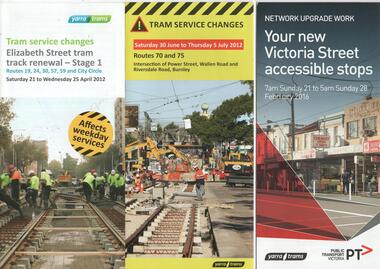
... All give the relevant service changes and maps. .1 - "Tram service changes Elizabeth St tram track renewal stage 1" - April 2012 - 2 fold DL .2 - "Tram service changes - Routes 70 and 75 - Intersection of Power St, Wallen Road and Riversdale Road Burnley" - June to July 2012 - 3 fold DL .3 - "Your new Victoria Street accessible stops" - Feb,. 2016 - 4 fold DL, including a Vietnamese translation. Details work between Hoddle and Church Streets. .4 - Route 70 - Swan St Burnley track renewal - 9 to 11 Jun 2012 - 3 fold DL 5 - Fitzroy St and The Esplanade - superstops.11/6 to 17/6/2011 - 3 fold DL Produced by Public Transport Victoria and Yarra Trams...All give the relevant service changes and maps. .1 - "Tram service changes Elizabeth St tram track renewal stage 1" - April 2012 - 2 fold DL .2 - "Tram service changes - Routes 70 and 75 - Intersection of Power St, Wallen Road and Riversdale Road Burnley" - June to July 2012 - 3 fold DL .3 - "Your new Victoria Street accessible stops" - Feb,. 2016 - 4 fold DL, including a Vietnamese translation. Details work between Hoddle and Church Streets. .4 - Route 70 - Swan St Burnley track renewal - 9 to 11 Jun 2012 - 3 fold DL 5 - Fitzroy St and The Esplanade - superstops.11/6 to 17/6/2011 - 3 fold DL Produced by Public Transport Victoria and Yarra Trams "Tram service changes Elizabeth St tram track renewal stage 1", "Tram service changes - Routes 70 and 75 - Intersection of Power St, Wallen Road and Riversdale Road Burnley", "Your new Victoria Street accessible stops" Pamphlet Public Transport Victoria (PTV) ...Set of three pamphlets advising of changes to tram services for the renewal of tram track works. All give the relevant service changes and maps. .1 - "Tram service changes Elizabeth St tram track renewal stage 1" - April 2012 - 2 fold DL .2 - "Tram service changes - Routes 70 and 75 - Intersection of Power St, Wallen Road and Riversdale Road Burnley" - June to July 2012 - 3 fold DL .3 - "Your new Victoria Street accessible stops" - Feb,. 2016 - 4 fold DL, including a Vietnamese translation. Details work between Hoddle and Church Streets. .4 - Route 70 - Swan St Burnley track renewal - 9 to 11 Jun 2012 - 3 fold DL 5 - Fitzroy St and The Esplanade - superstops.11/6 to 17/6/2011 - 3 fold DL Produced by Public Transport Victoria and Yarra Tramstrams, tramways, public transport, tram stops, elizabeth st, hawthorn, riversdale junction, wallen rd, route 70, route 75, route 109, victoria st, route 12, swan st, esplanade, route 70, fitzroy st -
 Eltham District Historical Society Inc
Binder, Eltham District History, Eltham Road Board, 1856-1871; Research by Keith Chappel, 1971-1974
... street...gold mining...goodman...gordon melville...government gazette...graham lindsay bride...grazing...greenhill...greensborough...grierson...gun maker...h. g. james...h. stooke...h. taylor...h.g. jhones...h.t. beams...harold edward bartlett...heatherleigh...heidelberg...helen louise wells...henry creswell...henry gilbert jones...henry holloway...henry peers...herbert eric rundle...herbert hewitt...herbert rutter...hoddle...francis watson rosier frank haley frank wayne maas franklin william nankervis frederick charles barrett frederick edward falkiner frederick eldred griffith frederick filed durham frederick gration frederick kirk gration frederick vincent squire fredrick ninck g. drabble g. haley g. hodgkins g. lee g. thomas g. thomson g.d. boursiquot g.f. belcher garden hill geoffrey charles dreverman geology george d'arley boursiquot george ellis parker george fletcher george frederick belcher george haley george hirt george louie cresp george love george robertson george turnbull george wise godalmin street gold mining goodman gordon melville government gazette graham lindsay bride grazing greenhill greensborough grierson gun maker h. g. james h. stooke h. taylor h.g. jhones h.t. beams harold edward bartlett heatherleigh heidelberg helen louise wells henry creswell henry gilbert jones henry holloway henry peers herbert eric rundle herbert hewitt herbert rutter hoddle holiday resort horace hilton house of assembly hugh larimour hurst i. barrow i. rooks ian g smedley ian gordon smedley industry isaac rooks isidore t. wilmor j. alison j. brown j. cameron j. carfrae & co. j. ferguson j. frank j. garthwaite j. greaves j. greitzner j. irish j. lindsay j. murray j. o'brien j. stevenson j. wilson j.b. phipps j.b. rodda j.f. imley j.g. foxton j.g. fraser j.h.f. hawke j.k. zahn j.m. holloway j.p. imley jack cato jack clendinnen gill jacob belcham jacob greitzner jakeb greitzner james bailey james cox james d mealy james darley mealy james frank james frederick mackay james graham james johnstone james kay bryce james mclaren james murray james oliver white james pearson imley james pearsons imley james rosier james ryan jane thompson jersey johann karl zahn john a porter john alexander hampton lewis john alison john b. wilson john barter bennett john blackmore phipps john blakemore phipps john carfrae john dane john g. foxton john gerald searle john greaves john green foxton john greenlaw foxton john henry sabelberg john johnstone john lee smith john lindsay john lindsay beale john mann john mason john pape john porter john samuel lithgow john stevenson john verran mcconnell john wilson jonathan scott joseph anderson panton joseph bromley shallard joseph garthwaite joseph smedley joseph walter henry bradbury josiah morris holloway k.e. dunstan m kinglake keelbundora kenneth chareles crompton kenneth donald macmillan kenneth frederick hines kenyon kerby street kinglake school krelbundora l. jenyns l.m. bill lancefield land act 1862 land act 1865 land act 1869 land alienation land settlement legislative council leopold kershaw lawry leslie christopher docksey leslie edward clarke little eltham school m. o'shea m.h. fitzpatrick mail run mail service main road map margaret moody martin fogarty mary leak maxwell alexander spence medical practitioner michael o'shea miss haley moira morang mr. ford mrs galbraith n. gillies n. rodda name names neil stewart roberts norman ernest charles williams opening orchard district p. ryan p.a.c o'farrell p.p. cotter parish of nillumbik parish of nillumbik 1856 patrick costello patrick turnbull percy downer peter andrew charles o'farrell peter fair peter graham petr lawlor phillip cumming photographer plenty river polling place polling places porter street portrait post office post office directory 1868 princes bridge proclamation r. boston r. hepburn r. lane r. wadeson r.d. mess r.s.h. moody radley (rodney) douglas quin rag mill railway lines raymond clive duncan registrar research state school no. 2959 reserve for aborigines reynolds road richard jones and co richard robert woolcott river plenty robert alan bell robert benn (ship) robert cadden robert cunningham white robert david taylor robert hepburn robert kenneth marshall robert miller robert reid robert stewart hull moody robinia joyce rodda family rosemount rupert norman maskell ryans road s. evans s. wekey samuel evans samuel phillips samuel ramsden samuel w. scott searle shire of diamond valley sigismund wekey sly grog seller sources south province south yarra st kilda stanley simpson addison strathbogie strippers of bark stuart alexander donaldson sweeneys lane sweeny sylvia ruth houston t. archer t. huntley t. murray t. stephens t. watkins t.a. stork t.b. daling t.b. darling t.c. darling t.milthorpe t.p. cross tannery tenders terence alphonsus collins the explorers and early colonists of victoria the story of the camera in australia thomas bell darling thomas clarke thomas darling thomas foster chuck thomas grant thomas henry bowman thomas herbert power thomas irvine thomas maltby thomas mccombie thomas scarce thomas sweeny thornton street town of eltham vaccinations act victorian government gazette virtue hall station virtue hill w. archer w. brown w. gordon w. inglis w. jones w. matthew w. mcdonald w. williams w. wilson w.r. belcher w.t. fitzpatrick walter craig walter wipple warringal water wheel wattle glen whittlesea william acland william adams william b. burnley william buckingham william c. farrell william cleve william craig william frederick ford william george gray william henry hull william john taylor william john turner clarke william johnson william jones william lorimer william morris william redmond belcher william thomas cochrane william vasey houghton william walker william wandliss herbert william white willie haley willie stanley dawson yan yean yarra flats yarra river yielima york street yow yow gully zig zag road Frederick George hurst Grimshaw mrs s marshall mrs mcclelland bushfire parish of greensborough f. baker h. hude j.l. caudwell m. borelli p.e. clarke church of england reserve m. miller t.j. carr i.d. marshall t.c. pickering m.e. lazarus w.r. gathercole j.p. adam p.f. plunkett state school reserve t. wilkinson a.e. hopkinson m.l. merritt w.e. apted e. cohen g. brandt j.j. foubister h. foubister w.h. hopkinson mechanics institute & free library j.o. hughes church of england trusts corporation c.a. brennan j.a.d. brennan e.m. tucker j. carter e. carter p.e. plunkett j. plunkett cricket and recreation reserve d.j. & e.i. ross w. wigham l.s. mendes Two binders containing 486 A4 pages (photocopied) of mostly handwritten notes from research undertaken of Public Office Records of Victoria various holdings. ...Eltham District History, Eltham Road Board, 1856-1871Two binders containing 486 A4 pages (photocopied) of mostly handwritten notes from research undertaken of Public Office Records of Victoria various holdings. Some photocopies from source reference books. Includes 20 page subject index (handwritten) at front and 5 pages of notes and sources at rear and a photocopy of short biography of Keith Chappel.a. foley, a. harkness, a. mackie, a. mcintyre, a. von ziegler, a.a. vivian, a.d. kinninmont, a.d. quadri, a.h. grimshaw, a.w. page, aboriginal reserve, aborigines, abraham quarman, abraham rooks, abraham taylor, adam goudie, aenaes harrison, agnes black, agnes charlton, agnes dalrymple, ah chong, ah cock, ah hein, ah lie, ah sing, albert lunson, albert ness, albert parker, albert ramseyor, alert hunt, alex cameron, alex eason, alex mcandrew, alexander crichton, alexander donaldson, alexander falconer, alexander innes, alexander james, alexander mcdonald, alexander miller, alexander thompson, alexander walker, alexander white, alfred armstrong, alfred burgess, alfred davey, alfred deschamp, alfred eddy, alfred hinley, alfred hooper, alfred hubbard, alfred lowman, alfred smith, alfred whelpton, alice power, allen heeps, allwood, amelia neuman, amos taylor, anderson, andersons creek, andrew brown, andrew byrne, andrew harkness, andrew herbert, andrew ross, andrew smith, angus mcdonald, ann emmott, ann mcphee, ann odea, ann plunkett, ann snell, ann tatty, annie ashmore, annie herbert, annie stuart, anthony beale, anthony currie, ants nest, archibald mcphee, arthur connor, arthur lyttle, arthur rooke, arthur young, arthurs creek, arthurs creek school, august ostling, b.o. wallis, barkers creek, barr, belton, benjamin bain, benjamin jenken, benjamin lawford, benjamin rice, benjamin shaw, benjamin smith, benjamin wallis, benjamin walton, berry, bismark hotel, black calf gully, black thursday, boomers gully, bridget bunker, bridget hailes, bridget kearse, bruno hirt, burns, bushranger, c. twiss, c.h. bade, caleb sherar, caledonia, caledonia diggings, campbell hunter, carl euman, caroline davey, catherine kennedy, cathren brock, cecilia farman, chamberlain, chapman, charles caldwell, charles campbell, charles dale, charles draper, charles fowler, charles green, charles hawkins, charles hempel, charles hirt, charles hirtson, charles jefer, charles jesse, charles kerchevell, charles lidgerwood, charles morris, charles peake, charles prince, charles rielly, charles roberts, charles rowand, charles simms, charles souter, charles swan, charles verso, charles wells, charles whelpton, charles williams, charles wingrove, charles woodley, charleys gully, charlotte beltison, charlotte goodwin, ching ah hock, christine brennan, christine mckenzie, christmas hills hotel, christmas hills school, christopher battaila, christopher twiss, chune grove, church of england, church of england school, clarissa milton, cleir hills, colin amos, constable quirke, constable talty, cornelius haley, cornelius stewart, cottles bridge, councillors hotel, cricket, cucksons brewery, d. nicholson, d.w. morrissey, dalry, daniel charleston, daniel harding, daniel jepps, daniel mccarthy, daniel mckenzie, daniel mcloughlin, daniel oloughlin, david boyd, david christian, david clark, david creighton, david rogers, david rolfe, david sharp, david shawcross, david smith, david stevenson, diamond accommodation store, diamond reef mine, dickson, dixon bertram, donald cameron, donald mcmillan, donaldson, dougald mcphee, dr barclay, dugald mcphee, dugald taylor, duncan fraser, duncan smith, dungey, e. hildebrand, e. stichlins, e.f. falkiner, e.j. hughes, e.m. garsed, e.w. morrissey, edith staff, edmund clarke, edmund cuckson, edmund hall, edmund picket, edward bage, edward beltison, edward bunker, edward ford, edward hindley, edward jackson, edward jones, edward kelly, edward qualtrough, edward staff, edward tresain, edward weller, edward whelpton, edward whilpson, edwin biley, edwin cartwright, edwin cohen, edwin deschamp, edwin mcleish, edwin rodda, edwin smith, effie rodda, eliza bellamy, eliza dawson, eliza howell, eliza nield, eliza smith, elizabeth cockshutt, elizabeth eiles, elizabeth fitch, elizabeth gillespie, elizabeth harris, elizabeth herbert, elizabeth hollow, elizabeth le juge, elizabeth plunkett, elizabeth whelpton, ellen hurst, ellen kearse, ellen quarman, ellen sweeney, ellen white, ellis, eltham cemetery, eltham hotel, eltham lower park, eltham market, eltham police station, eltham pound, eltham quarry, eltham racecourse, eltham roads board, eltham school, emile hude, emily anderson, emily blamire, emily coutie, emma smith, emma taylor, ephraim wyett, ernest baillie, ernest henrick, ernest steer, esther porter, ethel baillie, evan jones, evelyn hotel, evelyn observer, ewen cameron, ewen jones, f. chrimes, f. grundel, f.e. falkiner, f.r. howard, fanny benson, fanny white, felix hude, felix noisette, ferdinand ramseyer, flora vale, florence hurst, fogarty, forbes mackenzie, fords creek, frances kearse, francis baker, francis hales, francis raselli, francis steer, frank eiles, frank rogerson, frank tanner, fraser, fred hurst, frederick falkiner, frederick hurst, frederick muller, frederick nink, frederick walker, frederick wharington, friedrich muller, fryers gully, furphy, g. donaldson, g. houghton, g. turnbull, geanetta hude, george assender, george bear, george beare, george benson, george bird, george boston, george brain, george brandt, george burley, george buswell, george coutie, george eiles, george ewings, george ford, george godber, george goodman, george gray, george griffiths, george hall, george herbert, george horn, george kirk, george langhorne, george mann, george mclelland, george mosely, george neumayer, george orchard, george parish, george porter, george purcell, george ralph, george reid, george rocke, george rogers, george rolfe, george stebbing, george stebbings, george stebbins, george switzer, george symons, george thompson, georgina hilton, glenda moriss, glengloy, gold, goulstone, greensborough police station, gulf station, h. jennings, h. mann, h.h. farquason, hannah sunderland, happy valley, harkness, harold scarce, harriet hunt, harriet smith, harry hollow, hazel glen, healesville, heinrich hirt, helena peters, henrietta hill, henry arthur, henry ashmore, henry austin, henry brown, henry dendy, henry dineen, henry fowler, henry gardner, henry green, henry griffin, henry hart, henry hirst, henry hirt, henry hopkinson, henry hude, henry hurst, henry inch, henry jones, henry mills, henry scarce, henry st paul, henry stevens, henry stooke, henry thomson, henry vogt, henry wallace, henry wilson, herbert rodda, herman henrick, hermann lampe, hermann steinmann, hester staff, hitchill, holbert, honoree hude, hotel de france, hugh mccann, humphrey peers, humphrey spicer, hurstbridge, hurstbridge general store, i.h. clarke, ida adelskold, ignatz kinzel, ira pimm, irene donaldson, isaac briggs, isaac hickson, isaac hill, isaac kerr, isaac varby, isaac williams, isabella donaldson, isabelle herbert, j. dungate, j. eccleston, j. harkness, j. hartley, j. hude, j. irvine, j. jones, j. manduell, j. mason, j. mcdonald, j. mcnamara, j. nichenson, j. renahen, j. scott, j. seymour, j.a. goold, j.a. panton, j.c. hughes, j.d. thompson, j.f. hughes, j.f. johnstone, j.g. walter, j.h. taylor, j.p. morris, jack ewart, jacob belsham, jacob goldstein, jacob morast, jam loon, james alexander, james anderson, james andrew, james andrews, james baines, james batchelor, james bond, james bradford, james brennan, james brock, james brown, james brunning, james buchanan, james cockburn, james cowan, james dalrymple, james donaldson, james duckworth, james goodwin, james harding, james harrison, james hartley, james hawkins, james hewish, james holinger, james hughes, james inglis, james jamieson, james johnson, james johnston, james kaye, james kew, james lindsay, james lindsey, james lynan, james macpherson, james mann, james martley, james mayger, james mccutcheon, james mcmahon, james mcpherson, james mess, james miller, james mitton, james morton, james murdoch, james murdock, james nickinson, james orford, james purcell, james qualtrough, james rudall, james simpson, james smith, james spence, james stonachan, james stuart, james suman, james surman, james sutherland, james thompson, james thomson, james walker, james walters, james watts, jane cleave, jane donaldson, jane mess, jane sadler, jane shaw, jane thomson, janefield, jean borelli, jeanette hudi, jeanne hude, johann muller, john ainsworth, john andrew, john baillie, john barr, john beale, john bell, john bellin, john blake, john blyth, john brock, john brown, john byers, john cameron, john candler, john carter, john cobbock, john cockshank, john cockshutt, john coleman, john connell, john crozier, john darroch, john dennis, john donaldson, john elsworthy, john fenton, john fitch, john gardner, john gast, john graham, john grimshaw, john haines, john haley, john harper, john harris, john hassall, john hayes, john heales, john herbert, john holland, john holman, john hood, john horner, john horton, john hughes, john jardine, john johns, john johnston, john jones, john kearse, john kilpatrick, john knell, john lawrey, john macadam, john mandell, john manduell, john marker, john mccoll, john mccolly, john mcdonald, john mcintyre, john mckimmie, john mcnamara, john mitchell, john moore, john morgan, john muller, john murray, john pearson, john peterson, john petty, john pullen, john quinn, john rawlings, john ryder, john sabelberg, john scott, john semar, john serman, john seymour, john shawcross, john smith, john staff, john steer, john stephens, john sweeney, john thompson, john thomson, john trahy, john walker, john weller, john wells, john williams, john williamson, john yates, john yeoman, john young, johnn mcdonnell, joseph bull, joseph burns, joseph caldwell, joseph caudwell, joseph coutie, joseph elliott, joseph emmott, joseph fayver, joseph furphy, joseph hall, joseph hibbert, joseph hilton, joseph johns, joseph lithgow, joseph panton, joseph rodda, joseph sands, joseph sanson, joseph schubert, joseph scott, joseph shaw, joseph smith, joseph spedder, joseph stevenson, joseph verco, joseph wilson, josiah hollis, josiah hullis, josiah thomas, judith furphy, julie williams, junction hotel, kangaroo forest, kangaroo ground, kangaroo ground cemetery, kangaroo ground general store, kangaroo ground hotel, kangaroo ground police station, kangaroo ground post office, kangaroo ground school, kate bolger, kath scarce, katherine kearse, kidd, kinglake, kinglake hotel, kingstown, l. storey, lan quan, lang, latimour, laura henrick, laurence paterson, leon berlioz, levinia henrick, lillian gillan, linton, little eltham, long gully, louis henrick, louis le juge, louis smith, louisa steinmann, louise miller, lower plenty bridge hotel, lucy tidell, lydia qualtrough, m.j. careton, m.s. adams, macrudden, maggs, mail coach, maplestone, margaret graham, margaret hollins, margaret kearse, margaret kennedy, margaret kinrade, margaret lynch, margaret mcbirney, margaret steinmann, marguerite borelli, maria reilly, maria st paul, maria trew, marian trew, marianne miller, marie wright, marion hillier, mark bunker, martha herbert, martin brennan, mary alexander, mary beltison, mary bradford, mary bridgman, mary brock, mary bull, mary eiles, mary hopkinson, mary kearse, mary lean, mary mcinerney, mary miller, mary parmington, mary pearson, mary pickles, mary robertson, mary rodda, mary ross, mary smith, mary surman, mary weller, matilda jordan, matilda mcmillan, matthias watson, mawson, mechanics institute, michael callanan, michael fenton, michael kearse, michael mctyne, michael merritt, michael oday, michael odea, midgley hall, mills, minnie watts, miss bellon, morgans gully, mount joy, mr donnan, mr omeare, mr page, mrs greenaway, mrs havard, mrs hude, mrs morris, muller, murrays bridge, n.d. whyte, ned kelly, new caledonia creek, nicholas rodda, nillumbik, norman mcphee, old caledonia gully, oliver gourlay, one tree hill, owen finnegan, panton hill, panton hill hotel, panton hill post office, panton hill school, parambool, patrick armstrong, patrick bourke, patrick burke, patrick callaghan, patrick green, patrick harrington, patrick kearse, patrick lynch, patrick mcintyre, patrick o'callaghan, patrick rodgers, patrick sheahan, peach grove, perinella bull, perry, peter carrucan, peter flyn, peter ford, peter lawlor, peter patterson, peter snodgrass, peter watson, philip korfman, phillip gakden, phillip kaufman, phillip korfman, pierce brennan, pierce power, poo long, pound bend, pretty hill, queenstown, queenstown cemetery, queenstown police station, queenstown school, r. mackie, r.a. davidson, rebecca noisette, rebecca weller, reefers hotel, research, research gully, research gully hotel, research hotel, research school, rev dobinson, rhoda coutie, richard brook, richard capper, richard dunstan, richard goulding, richard heales, richard lane, richard matthews, richard rodda, richard searle, richard smith, richard wallis, richard warren, richard woolcott, robert alice, robert bourke, robert burke, robert charlton, robert clarke, robert cunningham, robert dugdale, robert grant, robert hall, robert harris, robert hempel, robert hill, robert hurst, robert lowman, robert mcadam, robert mckee, robert nink, robert norman, robert pontessey, robert sharp, robert smith, robert steel, robert stevenson, robert strong, robert surnam, robert wood, robina joyce, rogerson, roman catholic church, rossiter, rudolph muller, ruth mess, ruth sadler, ruth stevenson, s. smith, s. stewart, salters rush, sam deacon, samuel bird, samuel brace, samuel cameron, samuel candler, samuel cole, samuel cracknell, samuel dagley, samuel flier, samuel furphy, samuel merriman, samuel moseley, samuel mosley, samuel smith, sarah howard, sarah moseley, sarah raston, sarah walters, second watery gully school, self, shin hun, simon armstrong, smiths gully, smiths gully mechanics institute, smiths gully school, sophia greenaway, spanish gully, st andrews, st andrews hotel, st helena, stack, stanley smith, stephen gonnet, stephenson turner, stephensons bridge, steven anderson, stevensons corner, sumner, susan dickson, susan street, susan walke, sutherland, t. davidson, t. mclaughlin, t. symons, t.a. aldwell, t.b. drummond, t.b. henderson, t.e. johnston, t.h. subelly, tarrawarra, theis, theodore sabelberg, theresa lynch, thomas anderson, thomas armstrong, thomas baillie, thomas batt, thomas bell, thomas benson, thomas bibbs, thomas boardman, thomas bradford, thomas bull, thomas cattery, thomas cochrane, thomas cook, thomas cottle, thomas cousins, thomas downward, thomas edwards, thomas evans, thomas grierson, thomas haines, thomas harmer, thomas hunniford, thomas huntford, thomas hurry, thomas jardine, thomas jones, thomas kearse, thomas kennedy, thomas marland, thomas martin, thomas mcinerney, thomas morrison, thomas mundy, thomas murphy, thomas murray, thomas peacock, thomas plunkett, thomas postlethwaite, thomas prior, thomas qualtrough, thomas smith, thomas stone, thomas sunderland, thomas swatling, thomas sweeney, thomas symons, thomas walke, thomas wall, thomas wright, thomas young, tim shaw, toll gate, tom collins, tommys hut, true, upper diamond creek, upper diamond creek school, view hill, virtue hall, w. cockayne, w. craig, w. foster, w. marriott, w. ridley, w. trenoweth, w.a. page, w.b. andrew, w.b. burnley, w.b. phillips, w.c. shortt, w.w. herbert, walter barlow, walter hillier, walter joyce, walter knell, walter mckimmie, walter mcnicoll, walter thomson, walter wippell, warburton carr, warrandyte, warrens hotel, watery gully, watsons creek, watsons creek hotel, wattle glen school, wellers hotel, weymss donaldson, whipstick gully, white cloud, wild dog creek, wild dog gully, wiliam albert, william aitken, william albert, william anderson, william andrews, william barr, william barrow, william bell, william bond, william bowden, william bremmer, william brewer, william bridgman, william burnley, william buswell, william cant, william clarke, william cleave, william crozier, william dawson, william dodging, william ellis, william finn, william fitzgibbon, william ford, william foster, william garland, william ghosley, william golding, william goodwin, william graham, william gray, william grimshaw, william hall, william harding, william herbert, william hoilett, william hopkinson, william howitt, william howlett, william hubbard, william hunt, william inglis, william jarrold, william joyce, william kidd, william kilpatrick, william kommer, william lodge, william mclaughlin, william mcmurray, william mitton, william moore, william mosley, william murphy, william nicholson, william normage, william norman, william nuttall, william phillips, william quarman, william ronald, william sadler, william scott, william seaville, william sharp, william smith, william spicer, william taylor, william thomson, william tobin, william underwood, william walsh, william walshe, william walters, william watkins, william west, william wilmot, william wilson, william wolverston, william woods, wolfe, woodley, yarra bank, yow yow creek, a. brewer, a. easson, a. edwards, a. melville, a.m. ross, a.r. larrimour, aborigine reserve, advertisements, agricultural district, alan bernhard horsley, albert frederick charles glover, albert h price, albert h.c. price, albert henry charles price, alex easson, alexander campbell, alexander melville, alexander thomas haley, alexander thomson, alfred j. lowman, alice may peake, alie haley, alistair knox, alistair samuel knox, allandale road, allendale road, allwood run, andrew, andrew mckay, anton william brinkkotter, archibald brown, argus, arthur chichester allen, arthur edwin cracknell, arthur john braid, arthur robert traynor, atlas of australia 1886, b. lawford, b. mess, barry thale houston, basil y hall, basil yaldwyn hall, bell street, benjamin baxter, benjamin bowater, benjamin thomas taylor, benjaomin o. wallis, bible street, billis, bolton street, brewery, brisbane street, buckingham, bushrangers, c. brown, c. carroll, c. hirt, c.s. haley, c.s. wingrove, c.t. harris, caledonia run, cam, cattle, charis meta alexander pelling, charles brown, charles ellis, charles hicks bath, charles newman, clara gonnet, claude bryan gibbs, clifford henry goulding seear, coleraine, colin t. bell, collectors, collingwood, commissioner airey, coplin thomas bell, cornelius john stewart, cornelius sharp haley, cornelius sharpe haley, county of evelyn, culla hill, cutto hill, d. ryan, daily news newspaper, dalton street, daniel jepp, derek cecil o'beirne, diamond creek, diamond creek post office, diamond creek railway station, diamond creek run, diamond creek station, diamond creek township, divisions, doctor, donald alfred neil, donald charles maling, donald ingersole, donald kennedy, douglas anderson, e. cameron, e. falkiner, e. stooke, e.t. peers, edward dumaresq, edward heller, edward james, edward wilson, edwin stooke, elections, electoral districts, electoral roll, electrified railway, eltham, eltham district description, eltham district history, eltham district road board, eltham post office, eltham railway station, eltham road district, eltham road district board, eltham shire council, eltham shire councillors, eltham shire history, eltham town common, eltham village, eltham-hurstbridge railway, ely street, eric dudley butler, eric nichol staff, eric percival harmer, ernest james andrews, eve may edwards, evelyn and mornington division, evelyn division, everard albert hale, ewn hugh cameron, f. stone, f.d. wickham, flour mill, fountain of friendship hotel, francis bradley, francis joseph favier, francis regiereals(?), francis watson rosier, frank haley, frank wayne maas, franklin william nankervis, frederick charles barrett, frederick edward falkiner, frederick eldred griffith, frederick filed durham, frederick gration, frederick kirk gration, frederick vincent squire, fredrick ninck, g. drabble, g. haley, g. hodgkins, g. lee, g. thomas, g. thomson, g.d. boursiquot, g.f. belcher, garden hill, geoffrey charles dreverman, geology, george d'arley boursiquot, george ellis parker, george fletcher, george frederick belcher, george haley, george hirt, george louie cresp, george love, george robertson, george turnbull, george wise, godalmin street, gold mining, goodman, gordon melville, government gazette, graham lindsay bride, grazing, greenhill, greensborough, grierson, gun maker, h. g. james, h. stooke, h. taylor, h.g. jhones, h.t. beams, harold edward bartlett, heatherleigh, heidelberg, helen louise wells, henry creswell, henry gilbert jones, henry holloway, henry peers, herbert eric rundle, herbert hewitt, herbert rutter, hoddle, holiday resort, horace hilton, house of assembly, hugh larimour, hurst, i. barrow, i. rooks, ian g smedley, ian gordon smedley, industry, isaac rooks, isidore t. wilmor, j. alison, j. brown, j. cameron, j. carfrae & co., j. ferguson, j. frank, j. garthwaite, j. greaves, j. greitzner, j. irish, j. lindsay, j. murray, j. o'brien, j. stevenson, j. wilson, j.b. phipps, j.b. rodda, j.f. imley, j.g. foxton, j.g. fraser, j.h.f. hawke, j.k. zahn, j.m. holloway, j.p. imley, jack cato, jack clendinnen gill, jacob belcham, jacob greitzner, jakeb greitzner, james bailey, james cox, james d mealy, james darley mealy, james frank, james frederick mackay, james graham, james johnstone, james kay bryce, james mclaren, james murray, james oliver white, james pearson imley, james pearsons imley, james rosier, james ryan, jane thompson, jersey, johann karl zahn, john a porter, john alexander hampton lewis, john alison, john b. wilson, john barter bennett, john blackmore phipps, john blakemore phipps, john carfrae, john dane, john g. foxton, john gerald searle, john greaves, john green foxton, john greenlaw foxton, john henry sabelberg, john johnstone, john lee smith, john lindsay, john lindsay beale, john mann, john mason, john pape, john porter, john samuel lithgow, john stevenson, john verran mcconnell, john wilson, jonathan scott, joseph anderson panton, joseph bromley shallard, joseph garthwaite, joseph smedley, joseph walter henry bradbury, josiah morris holloway, k.e. dunstan, m kinglake, keelbundora, kenneth chareles crompton, kenneth donald macmillan, kenneth frederick hines, kenyon, kerby street, kinglake school, krelbundora, l. jenyns, l.m. bill, lancefield, land act 1862, land act 1865, land act 1869, land alienation, land settlement, legislative council, leopold kershaw lawry, leslie christopher docksey, leslie edward clarke, little eltham school, m. o'shea, m.h. fitzpatrick, mail run, mail service, main road, map, margaret moody, martin fogarty, mary leak, maxwell alexander spence, medical practitioner, michael o'shea, miss haley, moira, morang, mr. ford, mrs galbraith, n. gillies, n. rodda, name, names, neil stewart roberts, norman ernest charles williams, opening, orchard district, p. ryan, p.a.c o'farrell, p.p. cotter, parish of nillumbik, parish of nillumbik 1856, patrick costello, patrick turnbull, percy downer, peter andrew charles o'farrell, peter fair, peter graham, petr lawlor, phillip cumming, photographer, plenty river, polling place, polling places, porter street, portrait, post office, post office directory 1868, princes bridge, proclamation, r. boston, r. hepburn, r. lane, r. wadeson, r.d. mess, r.s.h. moody, radley (rodney) douglas quin, rag mill, railway lines, raymond clive duncan, registrar, research state school no. 2959, reserve for aborigines, reynolds road, richard jones and co, richard robert woolcott, river plenty, robert alan bell, robert benn (ship), robert cadden, robert cunningham white, robert david taylor, robert hepburn, robert kenneth marshall, robert miller, robert reid, robert stewart hull moody, robinia joyce, rodda family, rosemount, rupert norman maskell, ryans road, s. evans, s. wekey, samuel evans, samuel phillips, samuel ramsden, samuel w. scott, searle, shire of diamond valley, sigismund wekey, sly grog seller, sources, south province, south yarra, st kilda, stanley simpson addison, strathbogie, strippers of bark, stuart alexander donaldson, sweeneys lane, sweeny, sylvia ruth houston, t. archer, t. huntley, t. murray, t. stephens, t. watkins, t.a. stork, t.b. daling, t.b. darling, t.c. darling, t.milthorpe, t.p. cross, tannery, tenders, terence alphonsus collins, the explorers and early colonists of victoria, the story of the camera in australia, thomas bell darling, thomas clarke, thomas darling, thomas foster chuck, thomas grant, thomas henry bowman, thomas herbert power, thomas irvine, thomas maltby, thomas mccombie, thomas scarce, thomas sweeny, thornton street, town of eltham, vaccinations act, victorian government gazette, virtue hall station, virtue hill, w. archer, w. brown, w. gordon, w. inglis, w. jones, w. matthew, w. mcdonald, w. williams, w. wilson, w.r. belcher, w.t. fitzpatrick, walter craig, walter wipple, warringal, water wheel, wattle glen, whittlesea, william acland, william adams, william b. burnley, william buckingham, william c. farrell, william cleve, william craig, william frederick ford, william george gray, william henry hull, william john taylor, william john turner clarke, william johnson, william jones, william lorimer, william morris, william redmond belcher, william thomas cochrane, william vasey houghton, william walker, william wandliss herbert, william white, willie haley, willie stanley dawson, yan yean, yarra flats, yarra river, yielima, york street, yow yow gully, zig zag road, frederick george hurst, grimshaw, mrs s marshall, mrs mcclelland, bushfire, parish of greensborough, f. baker, h. hude, j.l. caudwell, m. borelli, p.e. clarke, church of england reserve, m. miller, t.j. carr, i.d. marshall, t.c. pickering, m.e. lazarus, w.r. gathercole, j.p. adam, p.f. plunkett, state school reserve, t. wilkinson, a.e. hopkinson, m.l. merritt, w.e. apted, e. cohen, g. brandt, j.j. foubister, h. foubister, w.h. hopkinson, mechanics institute & free library, j.o. hughes, church of england trusts corporation, c.a. brennan, j.a.d. brennan, e.m. tucker, j. carter, e. carter, p.e. plunkett, j. plunkett, cricket and recreation reserve, d.j. & e.i. ross, w. wigham, l.s. mendes -
Glen Eira Historical Society
Letter - ELSTERNWICK POST OFFICE
... Street South... Hardy Joan... Baird Rob... Snowball Betty... Ward Andrew... Hoddle...Neville Street Glenhuntly Marten Veronika Ballantyne Richard Royal Historical Society of Victoria Dunstan Don Alfada Street South Hardy Joan Baird Rob Snowball Betty Ward Andrew Hoddle Robert Foot Henry Ebden Charles Hodson Elster Oldham Mary Kate English ‘Queen Anne’ Revival style Rifle Club Coulson Herbert H. ...This file contains seven items about the significance of this building and how this was established : 1/ Photocopies of a handwritten application (in duplicate) by Walter Kay of Elsternwick dated 13/10/1985 and Rodney H Bush’s dated 16/10/1985 to the Historic Buildings Council to register the former Elsternwick Post Office building, and an original typewritten letter dated 17/10/1985 from the Historic Buildings Council to Caulfield and Historic Society advising them of an application and inviting them to submit relevant information about the building with a copy of application attached. 2/ Six pieces of correspondence between various interested parties (Caulfield Council , Caulfield Historical Society, National Trust, of Australia and Ministry for Planning and Environment on behalf of Historic Buildings Council, Victoria) about the significance of the former Elsternwick Post Office building and the progress of efforts to include it on the Register of Historic buildings. Dated between November 1985 and May 1986. 3/ Two pieces of correspondence between the Caulfield Progress Association and the Caulfield Historical Society dated April and May 1986, regarding the efforts of the Historical Society to save the former Elsternwick Post Office building. 4/ Two pieces of ephemera by the Caulfield Progress Association, one original undated and one photocopy undated in 1986. Both appealing to the public for support to help the former Elsternwick Post Office building and to protest a proposal to demolish it, by Caulfield Council. 5/Original newspaper article dated 07/06/1989 from the Malvern-Caulfield Progress newspaper written by Robert Carmody. The article talks about the approval by the Historic Buildings Council of Caulfield Council’s restoration program of the former Elsternwick Post Office building worth approximately $850,000. The refurbishment would consist of a shop and office space which would then be rented out. Mayor Emil Braun outlines the progress to implement the plans. 6/ Caulfield Conservation Study by Andrew Ward dated September 1994 of former Elsternwick Post Office Building. The building plans for the Elizabethan Style building were approved in 1891. The original timber verandahs were replaced by the present brickworks in circa 1918 rear extensions in 1941-42. Similar Post Offices were built at Kew, Queenscliff and Portarlington. 7/ Computer printout dated 19/03/2010 of Statement of Significance held by the Victorian Heritage database of the former Elsternwick Post Office Building. It was built in 1891 in the ‘Queen Anne’ style. The substantial two story red brick building was set on a bluestone plinth with an ornate façade incorporating cement dressings. There is a brief summary of the settlement and development of the Elsternwick area with mention of how important the building is to the Elsternwick Community. Original date and author is unknown.elsternwick post office, glenhuntly road, elsternwick, riddell parade, office buildings, postal services, caulfield city council, kay walter, regent street, caulfield, bush rodney h, gisborne street, city of caulfield, braun emil councillor, mayors, aylen doug, aylen douglas r, historic buildings council, caulfield historical society, ministry for planning and environment, head stephen, historic buildings act 1981, anderson p, national trust of australia (victoria), public works department, architectural styles, calder g.k. councillor, wills cathie, lyall kerry, marsden john hudson, town clerk, hill douglas, caulfield progress association, caulfield south, glen eira road, hawthorn road, mac neil j.r., neville street, glenhuntly, marten veronika, ballantyne richard, royal historical society of victoria, dunstan don, alfada street south, hardy joan, baird rob, snowball betty, ward andrew, hoddle robert, foot henry, ebden charles hodson, elster, oldham mary kate, english ‘queen anne’ revival style, rifle club, coulson herbert h., fick p.g., railway, city manager, austin g.b. h., architects, builders, architectural features, australia post, register of historical buildings, grey karen, planning appeal board, heritage overlay no h029, victorian government gazette no. 60 dated 16/07/1986, historic building no640, certificate of title volume 5817, kennan james harley, nelson ivor, blake alison, neale anne, telegraph offices, wardell, ward andrew -
 Robin Boyd Foundation
Document - Manuscript, Robin Boyd, The Melbourne Book, 1966
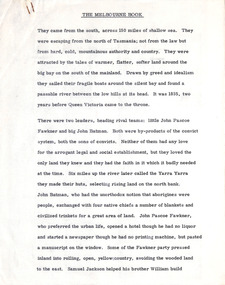
... Description of first grid drawn of Melbourne by Robert Hoddle and design impetus; naming of gridiron streets; Charles Troedel prints/The Melbourne Album, F. ...Description of first grid drawn of Melbourne by Robert Hoddle and design impetus; naming of gridiron streets; Charles Troedel prints/The Melbourne Album, F. ...Description of first grid drawn of Melbourne by Robert Hoddle and design impetus; naming of gridiron streets; Charles Troedel prints/The Melbourne Album, F. Cogne drew Melbourne scenes on lithographic stones; Harold Freedman drew same scenes of Melbourne 1964/65; comparative discussion of Melbourne then and now; between 1865-1965 substantial buildings erected and demolished; cable tram; strength and delicacy of Melbourne style; first tree planting; first electric tram 1927; lifting of building height limits 1956; list of representative buildings; Melbourne unlike other capitals as it was not conceived as a capital city.Published as a chapter titled 'The Town at Port Phillip' in 'The Book of Melbourne and Canberra', The Griffin Press, Adelaide 1966Typewritten (c copy), quarto, 14 pagesjohn batman, john fawkner, robert russell, robert hoddle, charles troedel prints/the melbourne album, f. cogne; cable trams; building height limits; tree planting; electric tram 1927; representative buildings, robin boyd, manuscript -
 Surrey Hills Historical Society Collection
Book, Early Canterbury, 1994
... This booklet gives a brief description of the local settlement in Canterbury giving the landholders names and name of the house (before street numbering was introduced) and street it was located in. canterbury (ms) jane f portingale postmistress (mr) arundel wrighte wood brothers koonung creek (mr) thomas power (mr) oliver russell (mr) frederick griffin (mr) thomas payne shrublands w creek (mr) john gardiner (mr) james shanley (mr)robert hoddle (mr) michael logan (mr) patrick moloney (mr) hugh glass r. larkins t. hassett e. sturt d.s. campbell (mr) joseph camm riversdale road w. logan rochester road 1843 trees mont albert road a. sikes (mr) william smith 1853 (mr) ernest carter dentist elgar's surrey hindson family (mr) george granville mercy (mr) alfred golding (mr)alexander patterson (mr) thomas boanas (mr) thomas hyde builders (mr) richard terrill architects (mr) thomas miles drapers This booklet gives a brief description of the local settlement in Canterbury giving the landholders names and name of the house (before street numbering was introduced) and street it was located in. ...This booklet gives a brief description of the local settlement in Canterbury giving the landholders names and name of the house (before street numbering was introduced) and street it was located in.This booklet gives a brief description of the local settlement in Canterbury giving the landholders names and name of the house (before street numbering was introduced) and street it was located in.canterbury, (ms) jane f portingale, postmistress, (mr) arundel wrighte, wood brothers, koonung creek, (mr) thomas power, (mr) oliver russell, (mr) frederick griffin, (mr) thomas payne, shrublands, w creek, (mr) john gardiner, (mr) james shanley, (mr)robert hoddle, (mr) michael logan, (mr) patrick moloney, (mr) hugh glass, r. larkins, t. hassett, e. sturt, d.s. campbell, (mr) joseph camm, riversdale road, w. logan, rochester road, 1843, trees, mont albert road, a. sikes, (mr) william smith, 1853, (mr) ernest carter, dentist, elgar's surrey, hindson family, (mr) george granville mercy, (mr) alfred golding, (mr)alexander patterson, (mr) thomas boanas, (mr) thomas hyde, builders, (mr) richard terrill, architects, (mr) thomas miles, drapers -
 Melbourne Tram Museum
Drawing, Melbourne & Metropolitan Tramways Board (MMTB), "Johnston St Engine House", "Northcote Engine House", "Richmond Engine House", c1938
... Trams tramways Drawings Depots Property Cable Trams Winding Houses Johnston St Northcote Richmond Hoddle St Bridge Rd Set of four photocopied plans or drawings on A3 sheet of the "Johnston St Engine House", "Northcote Engine House" and "Richmond Engine House", c2/1938. .1 - Sheet 1 - P8498 - Plan showing land and surrounding streets for the "Johnston St Engine House" .1 - Sheet 2 - P8499 - Plan showing the layout of the engine house. ...Set of four photocopied plans or drawings on A3 sheet of the "Johnston St Engine House", "Northcote Engine House" and "Richmond Engine House", c2/1938. .1 - Sheet 1 - P8498 - Plan showing land and surrounding streets for the "Johnston St Engine House" .1 - Sheet 2 - P8499 - Plan showing the layout of the engine house. Has a note sheets 1 and 2 that it has been sold .2 - P8506 -Plan showing land and surrounding streets for the "Northcote Engine House" - 2 copies held. .3 - P8607 - Plan showing Richmond Engine House and adjacent streets with sub-station next doortrams, tramways, drawings, depots, property, cable trams, winding houses, johnston st, northcote, richmond, hoddle st, bridge rd -
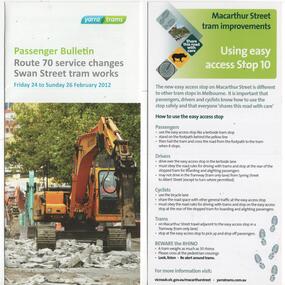 Melbourne Tram Museum
Pamphlet, Public Transport Victoria (PTV), "Route 70 service changes - Swan Street tramway works", "Macarthur St tram stop 10", "Tram route 86 Improvements - using trams stops 31 and 32", "Tram route 86 Improvements - High Street Westgarth", c2012 to 2013
... Set of four pamphlets advising of changes to tram services for the installation of various trams stops or track works. .1 - "Route 70 service changes - Swan Street tramway works" - Hoddle St intersection - 3 fold DL - Feb. 2012. .2 - "Macarthur St tram stop 10" - super stop, known as an "Easy Stop" - gives a map of the stop and how it may be used. ...Trams tramways Public Transport Tram Stops High St Northcote Route 70 Route 86 Macarthur St Swan St Set of four pamphlets advising of changes to tram services for the installation of various trams stops or track works. .1 - "Route 70 service changes - Swan Street tramway works" - Hoddle St intersection - 3 fold DL - Feb. 2012. .2 - "Macarthur St tram stop 10" - super stop, known as an "Easy Stop" - gives a map of the stop and how it may be used. ...Set of four pamphlets advising of changes to tram services for the installation of various trams stops or track works. .1 - "Route 70 service changes - Swan Street tramway works" - Hoddle St intersection - 3 fold DL - Feb. 2012. .2 - "Macarthur St tram stop 10" - super stop, known as an "Easy Stop" - gives a map of the stop and how it may be used. Single DL sheet on light card. .3 - "Tram route 86 Improvements - using tram stops 31 and 32" - gives a map of the stop and how it may be used. Single DL sheet on light card. \.4 - "Tram route 86 Improvements - High Street Westgarth" - explains the use of the Central Island Platform stops - stops 27 and 30, including a diagram, printed on 3 fold DL paper. Produced by Public Transport Victoria and Yarra Trams with VicRoads.trams, tramways, public transport, tram stops, high st, northcote, route 70, route 86, macarthur st, swan st -
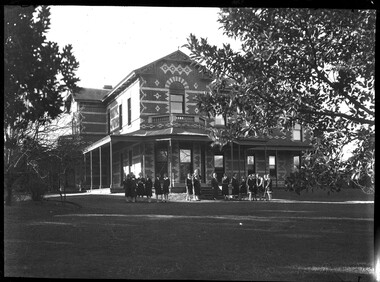 City of Melbourne Libraries
Photograph, Bull, Hugh Jones, 1897-1993, Ruyton Girls School 1933
... Street. Wikipedia notes in an early reference to Purchas that “An early story is that one of his first jobs, when he would have been about 25 years old, was a position under Surveyor-General Robert Hoddle, and disagreeing with him over the line for St Kilda Road, appealed to Governor La Trobe, and successfully got the road diverted around the hill which eventually became the site of the Shrine of Remembrance. ...Street. Wikipedia notes in an early reference to Purchas that “An early story is that one of his first jobs, when he would have been about 25 years old, was a position under Surveyor-General Robert Hoddle, and disagreeing with him over the line for St Kilda Road, appealed to Governor La Trobe, and successfully got the road diverted around the hill which eventually became the site of the Shrine of Remembrance. ...Published: Age (Melbourne, Vic.: 1854- ), 4 August 1933, page 3 Published title: GIRLS’ SCHOOLS – MODEL YACHTING - FOOTBALL Published caption: The headmistress, Miss H. Daniell, and girls at Ruyton, Selbourne Road, Kew, snapped after school hours. Trove article identifier: http://nla.gov.au/nla.news-article204381763 Research by Project Volunteer, Louise McKenzie: Rather than the people, this charming building takes the eye! Originally named “Tarring”, it was built in 1872 by Mr Henry Henty and his wife Mrs Marion Anne Henty (nee McKellar) for their family. Located at 82 Selbourne Road, Kew, it is described by Melbourne’s Open House organisation as “… a two-storey, polychrome brick mansion built for them by prominent Melbourne architect Albert Purchas. The house and nearly four acres of grounds served as their family home until the death of Marian Henty in 1919. “ (See below for further information on Albert Purchas.) In 1920 it was sold to Ruyton Girls School. Ruyton was established in 1878 by its first principal, Charlotte Anderson (1838-1906), who named it in honour of the parish in Shropshire, England, Ruyton-XI-Towns, where her great-great-grandfather David Evans had been vicar. Its motto is Recte et Fideliter, meaning "Upright and Faithful", which is also the name of the school song. The original school, one of Victoria’s oldest independent schools for girls, was located at the home of Mrs Anderson at 63 High Street South, Kew. In 1882 she moved the school to Edgecombe in Studley Park Road. Mrs Anderson retired due to ill health and sold the school to her friend Miss Eliza Bromby. One of Ruyton's four Houses, Anderson, is named for Charlotte Anderson. When Ruyton Girls School was moved to the site in 1920 it established the building as a Boarding House, and renamed the building “Henty House” in honour of its original owners. Today the school remains an all girls’ school, and pays tribute to its founder and the historic significance of Henty House and its magnificent Moreton Bay Fig tree, which still stands today. The building retains many original, Victorian-era features, while also showing the layers of change, made over the decades in order to meet the evolving needs of one of Melbourne’s leading schools. The headmistress mentioned in the caption for MCK016 is Miss Hilda Daniell, shown standing in front of Henty House in the midst of a group of Ruyton girls in their school uniforms, some holding hockey sticks. Miss Daniell was the longest serving Principal of Ruyton 1913-1952. She was originally a student in 1893, then joined the teaching staff in 1898. It was under her leadership that the School purchased and moved to “Tarring”. The boarding house included a flat for Hilda to live onsite. An article in the Ruyton Heritage Collection – Bedford Series, dated 21 May 2021 cites that Miss Daniell “was affectionately known as “Dream” by Ruytonians of her era” apparently due to a tendency to quiet reflection. The article continues, “After her retirement in 1952 Miss Daniell was awarded an Order of the British Empire for her many services to education, an award she received from the hands of the Queen during the 1954 Royal Tour. Also in 1952, the Kew Council honoured her by renaming Brougham Place as ‘Daniell Place’.” Arthur Purchas, architect: The architect responsible for the design of “Tarring”. Arthur Purchas, was extremely active and highly regarded at this time. Born in Wales in 1825, he emigrated to Melbourne in 1851 and soon established a private practice as a surveyor and architect, with offices variously in Little Collins, Queen Street, Chancery Lane, and finally 462 Little Collins Street. Wikipedia notes in an early reference to Purchas that “An early story is that one of his first jobs, when he would have been about 25 years old, was a position under Surveyor-General Robert Hoddle, and disagreeing with him over the line for St Kilda Road, appealed to Governor La Trobe, and successfully got the road diverted around the hill which eventually became the site of the Shrine of Remembrance. There may not be much truth to this, since by 1851 St Kilda Road was already a well worn track running around the hill, the top of which La Trobe had reserved for a Government House in 1840.” The timing of Purchas’s arrival in Melbourne was perfect. The Victorian gold rush of the 1850’s generated enormous wealth in Melbourne, and a building boom followed. The Wikipedia entry continues … that alone, or with his brother in law Charles R Swyer, “Purchas is said to have designed over 140 houses, offices, churches, banks and cemetery buildings in Victoria in his long career. Berkely Hall, St Kilda dating from 1854 is one of his first buildings, and still exists, though the original house is obscured by an early C20th verandah. Another notable early design was the head office of the Melbourne Savings Bank, built on the corner Flinders Lane and Market Street in 1857-58, in an elaborately detailed Renaissance Revival style. His churches were mostly Gothic Revival, built for the Anglican Church, along with some parsonages, while most of the bank buildings were Renaissance Revival designs for the Bank of Australasia. He also designed city buildings in the 1860s and 70s, such as the Mutual Insurance Co, Northern Insurance Co, and the first premises for George & George, destroyed by fire in 1889. One of his most outstanding designs is St George's Presbyterian Church in Chapel Street, St Kilda (1877–80), in a striking polychrome brick Gothic Revival style, unusually carried on through to the interior. Purchas produced one of the few published maps and compilations of the early pastoral settlers runs in Victoria in 1853. In the same year he designed the layout of the Melbourne General Cemetery, the first 'garden' cemetery in Victoria, a curvilinear layout with extensive plantings, as well as the gate lodge and gates (the gates lodge were demolished and the gates relocated to their present position in the 1930s). He was a long time member of the Cemetery Trust, serving as secretary from 1876-1886. He was also Chairman of the Boroondara General Cemetery Board of Trustees 1867 to 1909, and designed many aspects of the cemetery, including the landscape, the cast iron entrance gates (1889), the rotunda (1890) and the surrounding brick wall (1895–6). Purchas was a keen inventor having applied for a patent for an invention for lighting a railway carriage with gas in 1861, and won a competition for a model farm complex, in 1862. This unusual design had the dairy either underground or half underground, to keep it cool, with a 'dry lining' around the outside of the sunken portions. In 1883, with fellow architect Alfred Smith, he took out a patent for fire-proof floors, arches, staircases and other parts of buildings.” Purchas died in his home in Kew in 1909 and, not surprisingly, was buried at Boroondara Cemetery. Henty family history in Australia: Henry Henty (b.1833-d.1912) was a successful businessman, and briefly a MLA for the seat of Grenville, Victoria in 1866. He was one of three sons of James Henty, and nephew of Edward Henty who is considered to be the first permanent European colonist to take up residence in Victoria. The Australian Dictionary of Biography provides a riveting overview of the complex and enthusiastic activities of the Henty family, and its entanglement in the development of mercantile life in WA, Tasmania, SA and Victoria from 1828 onwards. The family had a focussed commitment to creating thriving businesses in Australia, despite being regularly thwarted by legislative pushbacks and law changes, instigated in Britain as the Australian colony developed. Areas of greatest influence were merino sheep, beef and horse breeding, whaling, farm establishment, membership of the legal and political fraternities, sporting prowess, and board directorships in banking and railways. The Dictionary of Biography summarises: “As settlers the Henty men were notable not merely for being the first to settle in Victoria but also for their number and quality: a father and seven educated sons experienced in farming and trading, occupations of prime importance to a new colony, and importers of unusually substantial capital in money, skilled workers and thoroughbred stock.” As well as Tarring, the Henty family Melbourne residences included Findon (in Kew, overlooking Studley Park), Offington (St Kilda Road overlooking Albert Park) and Field Place (Henty Court, Kew), and descriptions of the houses in Wikipedia –Melbourne Architecture 1870s - reflect the development of Melbourne society. References RUYTON (1934, December 15). The Argus (Melbourne, Vic. : 1848 - 1957), p. 18. Retrieved March 12, 2025, from http://nla.gov.au/nla.news-article11001092 https://en.wikipedia.org/wiki/Ruyton_Girls%27_School#:~:text=Ruyton%20Girls'%20School%2C%20commonly%20referred,of%20Melbourne%2C%20Victoria%2C%20Australia. https://www.ruyton.vic.edu.au/our-school#:~:text=With%20an%20international%20reputation%20as,opportunity%20and%20challenge%20for%20girls. https://victoriancollections.net.au/items/5bea06b121ea690bf4eb08ed https://www.ruyton.vic.edu.au/our-school/campus-and-facilities Biography of Edward Henty and family: https://adb.anu.edu.au/biography/henty-edward-2247 Article on Offington House: http://nla.gov.au/nla.news-article196554993 Article on Field Place House : https://vhd.heritagecouncil.vic.gov.au/places/64881 Article on Findon: https://www.facebook.com/KewHistoryGroup/posts/in-the-book-jubilee-history-of-kew-1803-1910-by-fga-barnard-there-is-a-photo-of-/4389837914376555/ Charlotte Anderson/Ruyton: https://victoriancollections.net.au/items/5be4b8c821ea6a039c7a13e3 https://victoriancollections.net.au/items/6179e90da912eb195970bdf8 https://victoriancollections.net.au/items/5bea06b121ea690bf4eb08ed https://victoriancollections.net.au/items/65d3e05c5b5e5c61346420a2 Photo of Charlotte Anderson: https://viewer.slv.vic.gov.au/?entity=IE1515776&mode=browse Photo of Charlotte Anderson: https://victoriancollections.net.au/items/6179e90da912eb195970bdf8 https://victoriancollections.net.au/items/5be4b8c821ea6a039c7a13e3 Wikipedia: Architecture of Melbourne: https://en.wikipedia.org/wiki/Architecture_of_Melbourne Open House Melbourne: Henty House: https://www.universe.com/events/henty-house-ruyton-girls-school-tickets-Z45LYH Albert Purchas: https://en.wikipedia.org/wiki/Albert_Purchas Leader (Melbourne, Vic. : 1862 - 1918, 1935), Saturday 3 June 1876, page 9 – Article on Offington http://www.ohta.org.au/organs/organs/BoxHillUC.html Melb Architecture 1870s - Wikipedia Victorian Collections: Letters of Hilda Daniell https://victoriancollections.net.au/items/65d3e05c5b5e5c61346420a2 Photographer notations on slide: "Ruyton Girls School 1933".schools, 1930-1939, architecture, victorian architecture, trees, architects
