
Showing 70 items matching " iron merchants"
-
 City of Ballarat Libraries
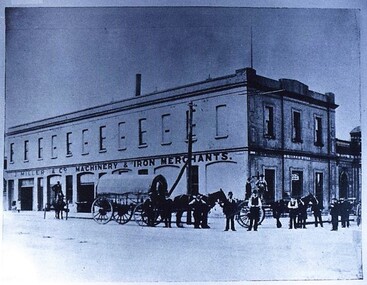
Postcard - Card Box Photographs, J. Miller & Co. Machinery & Iron Merchants, Ballarat
... Miller & Co. Machinery & Iron Merchants, Ballarat....Miller & Co. Machinery & Iron Merchants, Ballarat. Postcard Card Box Photographs ...j. miller & co, manufacturing, building, persons -
 Glen Eira Historical Society
Document - MORRIS FAMILY
... ... Iron merchants...‘Maysbury’ Orrong Road Elsternwick House names Mansions Morris John Iron merchants ‘Glenmayne’ Murray William Eddington George Morris Constance Eddington Constance Willmot Gertrude Morris Gertrude Maesmore Billiard rooms Coach houses Eddington Leonore authors Stables Morris Maesmore Maesmore actors Wilmott Dr. ...This file has two items about the Morris Family: 1/Nine typed pages taken from Trove – includes social history on John Morris and his family from 1890 to 1937. Subjects range from the letting of ‘Maysbury’ family weddings, his will and resulting auction of ‘Maysbury’ after his wife died. Source documents are from newspapers, reports and magazines. 2/Eleven pages of typed and photocopied photographs sourced from Trove regarding the divorce of son, Maesmore Morries and wife Gertrude, her subsequent marriage and the grandchildren’s weddings and social achievements.‘maysbury’, orrong road, elsternwick, house names, mansions, morris john, iron merchants, ‘glenmayne’, murray william, eddington george, morris constance, eddington constance, willmot gertrude, morris gertrude maesmore, billiard rooms, coach houses, eddington leonore authors, stables, morris maesmore, maesmore actors, wilmott dr. julius, divorce, morris ethel, morris kate, stuckey kate soames, stockey mortimer, morries james jackson, sutor mcdonald robert, sutor gertrude mrs, auctions, mcdonald sutor betty, mcdonald suttor john allan, morris jackson mrs, smith jessie murray, smith alexander, poetry, morris ethel jackon, artists, authors, ‘the white butterfly’, morries colin maesmore captain, doyle miss maesmore, morris mrs, tea and coffee merchants, elliott madge, overton john captain, morris elizabeth alice margaret mrs, morris gertrude, actresses, maesmore morris mr, miners, accountants, morries thomas wiltshire, morris eliza k, st mary’s caulfield, greenaway kate, wedding dresses, weddings, wills, eddington leonora, ‘maysbury mansions’, flats, springfield avenue, morris jackson, morris steve -
Glen Eira Historical Society
Document - MORRIS FAMILY
... ... Iron merchants...Morris Roberts and Meeks Iron merchants Agricultural machinery Agricultural shows Agricultural implements Chaffcutters Morris J.J. ...The file has three items relating to John Morris’ business: 1/Reprinted article from Trove, including design of the ‘Walter A. Wood’ new light steel wheel reaper and binder, exhibited by Messis Morris, Roberts and Meeks; dated 27/08/1887 from ‘The Australasian’. 2/Article from Trove dated 01/09/1888 discussing machinery being exhibited at the trade show by Messrs Morris, Roberts and Meeks; published in ‘The Australasian’. 3/Staff photograph dated 12/12/1912 of Messrs Morris, Robert and Meeks; reprinted from ‘Punch’ via Trove.morris roberts and meeks, iron merchants, agricultural machinery, agricultural shows, agricultural implements, chaffcutters, morris j.j., employees -
 Bendigo Historical Society Inc.
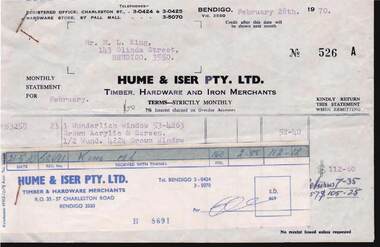
Document - HUME & ISER PTY.LTD, 28 Feb 1970
... Ltd.,Timber , Hardware and Iron Merchants Charleston St Bendigo Hardware store 67 Pall mall Invoice (dated 28.2.1970) and Receipt (dated 21.3.1970) for Mr. ...Ltd.,Timber , Hardware and Iron Merchants Charleston St Bendigo Hardware store 67 Pall mall Invoice (dated 28.2.1970) and Receipt (dated 21.3.1970) for Mr. ...Document, Hume & Iser Pty. Ltd.,Timber , Hardware and Iron Merchants Charleston St Bendigo Hardware store 67 Pall mall Invoice (dated 28.2.1970) and Receipt (dated 21.3.1970) for Mr. M.L.King.143 Olinda Street, Bendigo,3550.document, hume & iser -
 Bendigo Historical Society Inc.
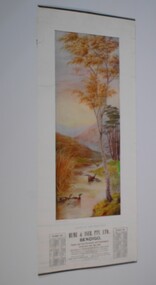
Document - CALENDAR COLLECTION: HUME AND ISER
... Park titled ''Haunt of the wild duck'' Under the painting the name Hume & Iser Pty Ltd Bendigo Timber and iron Merchants and ironmongers, established over 50 years. ...Park titled ''Haunt of the wild duck'' Under the painting the name Hume & Iser Pty Ltd Bendigo Timber and iron Merchants and ironmongers, established over 50 years. ...Wall calendar 1924 for Hume & Iser Pty Ltd Bendigo. The main part is a painting by J. C. Park titled ''Haunt of the wild duck'' Under the painting the name Hume & Iser Pty Ltd Bendigo Timber and iron Merchants and ironmongers, established over 50 years. Large stocks of all building material always on hand.business, retail, hume and iser -
 Chelsea & District Historical Society Inc
Photograph - Shops in Chelsea, W. McGarry, estate agent, 1914
... G & A COATES - BUILDERS & CONTRACTORS - IRON & TIMBER MERCHANTS &c. PAINTS, OILS, COLOURS &c. ...G & A COATES - BUILDERS & CONTRACTORS - IRON & TIMBER MERCHANTS &c. PAINTS, OILS, COLOURS &c. ...William McGarry, estate agent, was secretary of the Chelsea Progress Association in 1915 and was a Borough of Carrum councillor from 1921 to 1926. Mr and Mrs McGarry were Proprietors of Chelsea House, a guest house and reception rooms in the 1920's.Black and white photo of two shops in Chelsea: Wm. McGarry, Estate Agents and G & A Coates Builders & Contractors. There are a group of men standing in front of the shops and young boy with shoes. A horse and wagon carrying timber is parked on the road.WM. McGARRY - HOUSE, LAND ESTATE & INSURANCE AGENT. G & A COATES - BUILDERS & CONTRACTORS - IRON & TIMBER MERCHANTS &c. PAINTS, OILS, COLOURS &c. GLASS CUT TO SIZES - LIME & CEMENTshops, chelsea, mcgarry, g & a coates -
 Bendigo Historical Society Inc.
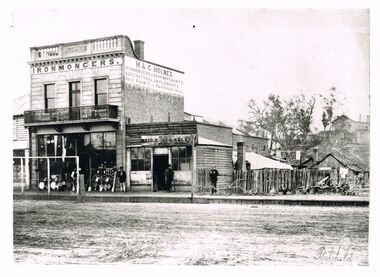
Photograph - WES HARRY COLLECTION: H.& C. HOLMES, IRONMONGERS
... Holmes, ironmongers & iron merchants, agricultural implements, oils, paints & paperhangings. ...Holmes, ironmongers & iron merchants, agricultural implements, oils, paints & paperhangings. ...Black and white reproduction: street scape view showing two storey building, ornate wrought iron balcony. On side of building : H. & C. Holmes, ironmongers & iron merchants, agricultural implements, oils, paints & paperhangings. Single storey building on RH side, timber above single doorway, paned windows either side. On front 'Bendigo rifle caller' (?) Dirt road at front, four men standing on footpath. Wooden fence on right hand side, small chimney behind. Batchelder written on bottom right hand side.Batcheldercottage, miners, bendigo, sandhurst, h. & c. holmes, ironmongers, agricultural, rifle -
 Bendigo Historical Society Inc.
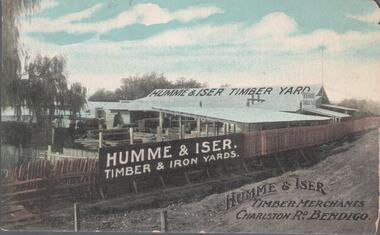
Postcard - BENDIGO BUSINESSES COLLECTION: HUME & ISER
... Coloured postcard advertising Humme & Iser timber and iron yards, timber merchants, Charlston Road, Bendigo. ...BENDIGO Business hume & iser Coloured postcard advertising Humme & Iser timber and iron yards, timber merchants, Charlston Road, Bendigo. ...Coloured postcard advertising Humme & Iser timber and iron yards, timber merchants, Charlston Road, Bendigo. On the back in pencil: railway to the side, saw mills hotel on left side.bendigo, business, hume & iser -
 Bendigo Historical Society Inc.
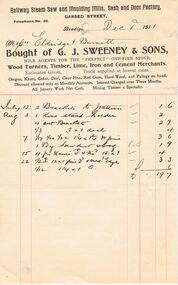
Document - PEARCE COLLECTION: ACCOUNTS G J SWEENEY & SONS
... Collection of Accounts, 1911-12, G J Sweeney, Railway Steam Saw and Mouliding Mills, Sash and Door Factory (Wood Turners, Timber, Lime, Iron and Cement Merchants), Garsed St....Sweeney & Sons Collection of Accounts, 1911-12, G J Sweeney, Railway Steam Saw and Mouliding Mills, Sash and Door Factory (Wood Turners, Timber, Lime, Iron and Cement Merchants), Garsed St. Document PEARCE COLLECTION: ACCOUNTS G J SWEENEY & SONS, ...Collection of Accounts, 1911-12, G J Sweeney, Railway Steam Saw and Mouliding Mills, Sash and Door Factory (Wood Turners, Timber, Lime, Iron and Cement Merchants), Garsed St.business, retail, general, h. j. sweeney & sons -
 Warrnambool and District Historical Society Inc.
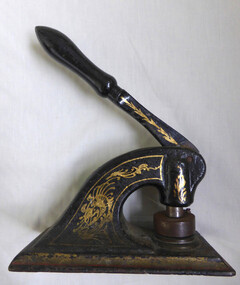
Functional object - Newcombe timber company Seal, Mid to Late 19th century
... Newcombe and Co traded as timber merchants And iron mongers in Koroit Street in the later part of the 19th century and early 20th century. ...Newcombe and Co traded as timber merchants And iron mongers in Koroit Street in the later part of the 19th century and early 20th century. ...Newcombe and Co traded as timber merchants And iron mongers in Koroit Street in the later part of the 19th century and early 20th century. It was destroyed by fire in March 1918.A commonly used office item which is well linked to a long established business in Warrnambool.Cast iron rectangular base with arch form leading to handle. Painted black and decorated with gold scroll work. Orange line around rectangular base. The seal is operated by pushing down the handle which stamps on paper which would be placed between the circular stamp and the base plate.warrnambool, company seal, embossing seal, newcombe timber company, koroit street -
 Bendigo Historical Society Inc.
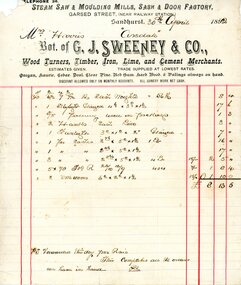
Document - HARRIS COLLECTION: INVOICE
... Sweeney and Company wood turners, timber, iron, lime and cement merchant for 8 pounds 13 shilling and 5 pence....Sweeney and Company wood turners, timber, iron, lime and cement merchant for 8 pounds 13 shilling and 5 pence. ...Invoice issued to Mr Harris, Axedale on the 30th April 1892 by G. J. Sweeney and Company wood turners, timber, iron, lime and cement merchant for 8 pounds 13 shilling and 5 pence.business, retail, g.j. sweeney -
 Bendigo Historical Society Inc.
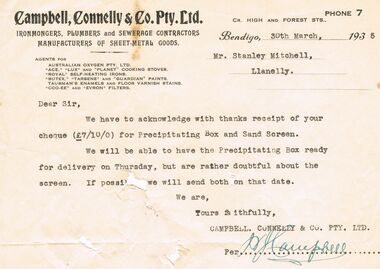
Document - MARY ANNE MITCHELL COLLECTION CAMPBELL, CONNELLY & CO RECEIPTS, 1924-1939
... Ltd. Timber & Iron Merchants; Warren's Drapers, Milliners, Outfitters, etc; Cocking's Bendigo Drapers Manchester, Dresses, Clothing, Mercery, Underclothing & Millinery; Hartley's (J.L. ...Ltd. Timber & Iron Merchants; Warren's Drapers, Milliners, Outfitters, etc; Cocking's Bendigo Drapers Manchester, Dresses, Clothing, Mercery, Underclothing & Millinery; Hartley's (J.L. ...Mary Anne Mitchell Collection Local Bendigo Business Receipts dating from 1924-1939. Businesses include: Campbell, Connelly & Co. Pty. Ltd. Ironmongers, Plumbers & Sewerage Contractors of Sheet Metal Goods; The Northern Seed Supply Co. Seed & Service Station; Gerrand, King & Son, Wholesale Fruiterer's & Commission Agents; Myer's Bendigo Pty Ltd. Drapers & Outfitters; Foggitt Jones Pty Ltd. Ham & Bacon Curers Central Provision Merchants & Bendigo Bacon Factory; W.J.Knight Late Knight & Wilkinson Wheelwright, General Blacksmith, Wagon & Lorry Builder, Motor Body Builders; D.Whyte's Farmers Cash Store Pty. Ltd Wholesale & Retail Grocers; Harol Pettit Used Cars; Whitelock & Carter Tailors, Mercers, Hatters & Bootmen Specialists in Ladies' Hosiery; W.Lewis Williams Chemist; J.C. Morrison Carriage Builder & Vehicle Manufacturer; Stilwell's Complete House Furnishers; Matthew Bros. General Drapers, Specialists in Men's Clothing, Mercery Manchester, Childs, Ladies'Wear etc; George Bennett Arcade Store Crockery, Glasswear, Ironmongery, Stationery, Toys; Chandlers'Hardware Stores; J.H. Curnow & Son Farm, Dairy Produce & Furniture Salesmen Fire & Livestock Insurance Merchants Bendigo Auction Rooms; Hume & Iser, Pty. Ltd. Timber & Iron Merchants; Warren's Drapers, Milliners, Outfitters, etc; Cocking's Bendigo Drapers Manchester, Dresses, Clothing, Mercery, Underclothing & Millinery; Hartley's (J.L. Shoosmith) Bicycle, Motorcycle, Motor, Sporting & Radio Store; Williams The Shoemen Pty Ltd; Walter A. Reynell & Co. Stock & Station Agents;bendigo, history, bendigo businesses -
 Melbourne Tram Museum
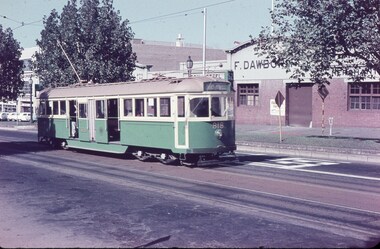
Slide - Set of 3, Keith Caldwell, 9/03/1960 12:00:00 AM
... Dawbourne Iron and Steel Merchants. .2 - W5 769 outbound at Haymarket after leaving Elizabeth St. ...Dawbourne Iron and Steel Merchants. .2 - W5 769 outbound at Haymarket after leaving Elizabeth St. ...Set of 3 Agfa Colour slide, cardboard mount, by Keith Caldwell - .1 - W5 818, outbound in Elizabeth St North Melbourne, showing route 52, Fletcher St Essendon. Note the tramcar number above the headlight. Dated 12 March 1960. In the background is the F. Dawbourne Iron and Steel Merchants. .2 - W5 769 outbound at Haymarket after leaving Elizabeth St. Showing destination of Coburg Route 20. In the background is the Mayne Nickless building. Note the signpost showing the various highways out of town. Dated 9 March 1960. .3 - W5 727 - as for .2hand stamped "12 Mar '60" or "12 Mar '60"trams, tramways, elizabeth st, route 52, essendon, haymarket, coburg, route 20, w5 class, tram 818, tram 769, tram 727 -
 Bendigo Historical Society Inc.
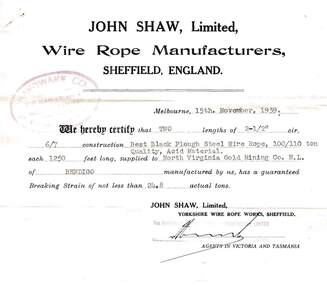
Document - MCCOLL, RANKIN AND STANISTREET COLLECTION: NORTH VIRGINIA GOLD MINING CO NL, JOHN SHAW LTD, 1939
... Of Australia, Iron & Steel Merchants, South Melbourne. Descriptions per (a) 109.7.3 Signed: Hunt. ...Of Australia, Iron & Steel Merchants, South Melbourne. Descriptions per (a) 109.7.3 Signed: Hunt. ...McColl Rankin & Stanistreet, North Virginia Gold Mining Co NL. a/ John Shaw Ltd, Wire Rope Manufacturers, Sheffield England. Certificate that 2 lengths of 2-1/2 cir. 6/7 construction Best Black Plough Steel Wire Rope, Quality, Acid Material. 100/110 ton each 1250 feet long supplied. Breaking strain of not less then 24.8 actual tons. Stamped: For Hardware of Australia Propriety Limited. Signed: ?? (attached by pin to b) b/ Hardware Co. Of Australia, Iron & Steel Merchants, South Melbourne. Descriptions per (a) 109.7.3 Signed: Hunt. Dated 15/11/1939. c/ Test Certificate For Wire Ropes Issued to J R Reid & Sons. Rope dispatched per S.S.''Mildura'' to Melbourne on 3.12.1946.Tested in the presence of A Boots, Abbott Supply Coy. Pty. Ltd. For the Australian Wire Rope Works Pty Ltd. Signed: J Humphy. Dated: 6/12/1946. Includes picture.organization, business, gold mine, mccoll rankin & stanistreet, north virginia gold mining co nl. a/ john shaw ltd, wire rope manufacturers, sheffield england 6/7 construction best black plough steel wire rope quality acid material 100/110 ton each 1250 feet long supplied reid & son -
 Bendigo Historical Society Inc.
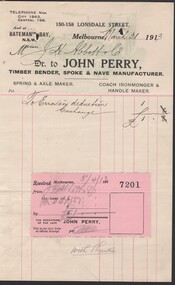
Administrative record - Abbott Collection: 1913 invoices & correspondence - correspondence from 61 individual companies addressed to J.H. Abbott & Co
... Ltd., Melbourne - 2 letters & 2 invoices K Richard Linton, Melbourne - 1 letter & 1 invoice L George Russell Prop. Ltd., Iron & Steel Merchants, General Hardware Importers, Melbourne - 1 invoice & 8 letters M J. ...Ltd., Melbourne - 2 letters & 2 invoices K Richard Linton, Melbourne - 1 letter & 1 invoice L George Russell Prop. Ltd., Iron & Steel Merchants, General Hardware Importers, Melbourne - 1 invoice & 8 letters M J. ...A wide range of invoices and business letters from 1913 from 66 companies (predominantly Melbourne based companies) addressed to J.H. Abbott 1913 Company correspondence from 61 companies/organisations addressed to Mr. J.H. Abbott: A John Perry, Timber Bender, Spoke & Nave manufacturers - 6 letters and invoices B James Miller & Co, Rope, Twine & Mat Manufacturers - 2 invoices C Dalgety Company Limited, general merchandise - 6 invoices D Gibbs, Bright & Co., Melbourne - 2 letters E Thomas McPherson & Son (McPhersons Pty. Ltd.), Iron & Machinery Merchants - 2 correspondence & 1 invoice F Bickford, Smith & Co., manufacturers of Safety Fuse, Melbourne - 3 letters G Hopkins Bros & Odlum, Machine Belting Manufacturers, Melbourne, H Stewart & Lloyds (Australia) Limited, Glaasgow - 6 letters I The Federal Manure Co., The Australian Explosives and Chemical Coy. Ltd., Melbourne - 8 letters J Ullathorne, Hartridge Co. Ltd., Melbourne - 2 letters & 2 invoices K Richard Linton, Melbourne - 1 letter & 1 invoice L George Russell Prop. Ltd., Iron & Steel Merchants, General Hardware Importers, Melbourne - 1 invoice & 8 letters M J. Kitchen & Sons Ltd., Candle & Soap Manufacturers Glycerine Refiners & Tallow Brokers, Melbourne - 10 letters N G. G. Crespin & Son, Melbourne - 4 letters O Noyes Bros. (Melbourne) Propy. Ltd. - 3 letters P The Eagle & Globe Steel Co., Melbourne - 4 letters & 1 memorandum Q C.S. Green & Son, 368 & 370 Post Office Place, Melbourne - 1 invoice & 1 memorandum R Michaelis, Hallenstein & Co. Proprietary Limited., 382-384 Lonsdale Street, Melbourne - 4 business letters S R.W. Cameron & Co.,34 Queen Street, Melbourne (agent for The Texas Co.) - 2 business letters T Joyce Bros. Ltd., 475 - 481 Flinders Lane (West), Melbourne - 2 business letters U Keep Bros. & Wood, importers of Carriage Materials, 100 Franklin Street, Melbourne - 2 business letters V Lycett Agency Manufacturing Co., P.O. Box 643 G.P.O., Melbourne - 3 business letters W Currie and Richards, Galvanised Iron Merchants, Importers and Spouting Manufacturers, 3 locations Melbourne - 2 business letters X James Outen, Saddlery Goods and Patent Horse and Cow Rugs, 184-186 Queen Street, Melbourne - 2 business letters Y Standard Oil Company of New York, Branch office Australasia, Melbourne - 5 business letters Z Jas. Henty & Co., Manufacturers of Soap, Starch, Candles, Soda Crystals, etc., 95 & 97 William Street, Melbourne - 7 business letters AA John Sanderson & Co., Mercghandise Department 111 William Street, Melbourne - 9 business letters AB Gargoyle Oil Company Pty. Ltd., 90 & 92 William Street, Melbourne - 3 business letters AC Dunlop Rubber Co. of Australasia Ltd.,108 Flinders Street, Melbourne - 3 business letters AD Perry's Australian Fuse manufacturing Company, manufacturers of Safety Fuses for Mining and Other Purposes, Ballarat Road, Footscray - 6 business letters AE Morris & Meeks, Little Collins Street, Melbourne - 4 business letters AF Brown & Dureau Ltd., Mercantile Brokers, Commission and Manufacturers'' Agents, Import and Export, 9 Queen Street, Melbourne - 6 business letters AG Michaelis, Hallenstein & Co. Proprietary Limited, Tanners, Curriers, Leather & Grindery Merchants, Saddlers' Ironmongers, Manufacturers of Glue, Doe Hair & Neatsfoot Oil, 385-384 Lonsdale Street, Melbourne - 2 letters AH Marwald, Son & Lemon, Indenting Agents and Importers, 201-3 William Street Melbourne (Sydney Brisbane, London, Wellington NZ, Fremantle) - 2 business letters AI 32 individual suppliers' invoices and business letters from companies in Bendigo, Melbourne and London (covering a wide range of supplies - glass, rubber, oils, hides, accountants, harvesters, etc.)company invoices and business correspondence -
 Bendigo Historical Society Inc.
Financial record - Devils Own Cricket Club Receipts 1875
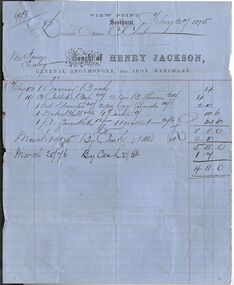
... 3767.4a: A receipt of purchase from Henry Jackson, General ironmonger and Iron merchant, by Mr F.D. Jones (labelled as secretary on the receipt/treasure in other documents) on behalf of the Devils Own Cricket club. ...Jones 3767.4a: A receipt of purchase from Henry Jackson, General ironmonger and Iron merchant, by Mr F.D. Jones (labelled as secretary on the receipt/treasure in other documents) on behalf of the Devils Own Cricket club. ...Organisation-Club/society-sport3767.4a: A receipt of purchase from Henry Jackson, General ironmonger and Iron merchant, by Mr F.D. Jones (labelled as secretary on the receipt/treasure in other documents) on behalf of the Devils Own Cricket club. The receipt is a professionally made, printed template printed on blue/purple coloured limed paper with red margins. The transactions made by Mr Jones are handwritten in cursive font with black ink. The receipt indicates that payment was made to Mr Jackson on the 10th and 25th of March 1875. the pound was used as currency. 3767.4b: This receipt is dated March 25th 1875. Detailing the repair of a cricket ball. W.B. Fox, a saddler and harness marker, executed the repairs. The receipt is a professionally made, printed template in black ink on a light blue sheet of lined paper with red margins. The purchase order and payment remarks are handwritten in cursive with black ink. Pounds were used a currency. 3767.4c: This receipt is entirely handwritten in cursive with black ink on a torn rectangular piece of blue coloured paper. There is no official printing or branding on the receipt. The receipt details the purchase of a cricket ball by the Treasurer of the DOCC in March 1875 from F. Macoboy. The page has a large red stain/smudge in the top right-hand corner. 3767.4d: This professionally printed receipt is printed in black ink on a rectangular piece of white/cream coloured paper. The official branding is that of W. Welch, a general printer, binder etc. from Sandhurst. The record of the purchase of a 150-page record book for the DOCC by Mr. Jones is handwritten in cursive with black ink. The receipt is dated 8th March 1875 and payment was made on 9th March 1875. 3767.4e: This reciept is a handwritten note in black ink on a blue piece of lined paper no larger than a business card. The note, dated 1st March 1875, is addressed to Mr. F Jones, Hon Treasurer Devils Own C.C. The note is written by R.W. Franklyn in reference to 3767.4c and reads as follows: "Please pay M'acoboy 5/- price of ball" 3767.4f: This receipt in professionally printed in black ink on a blue coloured, lined paper. The branding refers to Henry Jackson, as per 3767.4a, and details the purchase of cricket equipment by the Law C.C. The receipt is dated February 19, 1875.docc, devils own cricket club, sandhurst, w. welch, w.b. fox, henry jackson, f. m'acoboy, law cricket club, financials, f.d. jones -
 Federation University Historical Collection
Book, Ballarat School of Mines Invoice Book, 1870 - 1875
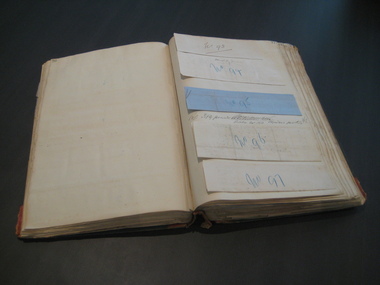
... Mullen, Ballarat Stationery Warehouse & Printing Office, * 31Jany. 1871 - A.H. King, Iron Merchant, * 1 February 1871 - Richard Tunbridge, Timber Merchant, * January 4th 1871- Henry Gough, * 8th March 1871 William Murfet, * March 1871- Maxwell Morrow, * 1 February 1871- James Curtis, Caxton Steam Printing Works, * May 4th 1871 - William Blomeley, Iron and Brass Founder, * 4 May 1871 - Thomas Rogers, Draper, Milliner, Haberdasher & c. * May14 1871- George Shannon & Co, Importers of China, Glass & Earthenware, * May 31st 1871, Wreford & Co, Machine Printers, *1st July 1871 William McCulloch & Co,( late Reynolds and English) General Carriers to all parts of the Colony, * 1871- J.J. ...Mullen, Ballarat Stationery Warehouse & Printing Office, * 31Jany. 1871 - A.H. King, Iron Merchant, * 1 February 1871 - Richard Tunbridge, Timber Merchant, * January 4th 1871- Henry Gough, * 8th March 1871 William Murfet, * March 1871- Maxwell Morrow, * 1 February 1871- James Curtis, Caxton Steam Printing Works, * May 4th 1871 - William Blomeley, Iron and Brass Founder, * 4 May 1871 - Thomas Rogers, Draper, Milliner, Haberdasher & c. * May14 1871- George Shannon & Co, Importers of China, Glass & Earthenware, * May 31st 1871, Wreford & Co, Machine Printers, *1st July 1871 William McCulloch & Co,( late Reynolds and English) General Carriers to all parts of the Colony, * 1871- J.J. ...Scrap book containing invoices relating to accounts to be paid by the Ballarat School of Mines between 1870 until 1875. The School of Mines at Ballarat was the first school of Mines in Australia and was established in 1870. The works done to the former Ballarat Circuit Court House were overseen by Robert Davidson (architect and Surveyor) with the contractor being James Williams. Large book, green leather with red binding, numerous original invoices pasted onto the pages. The first pages of the scrapbook includes correspondence relating to the refurbishment of the former Ballarat Court House which was used as the Ballarat School of Mines from 1870. The building was demolished c1913 to make way for the Ballarat Technical Art School (still standing). * 23 August 1870 - Bateman, Clark & Co, The Ballarat Courier * August 1870 - Klug Bros. Furniture and Bedding Warehouse * April 1870 - J. Armstrong * Statement of Receipts and Expenditure from 23rd Aug. 1870 to 19 January 1871 * W. Gooch, * 1870 - William L. Mullen, Ballarat Stationery Warehouse & Printing Office, * 31Jany. 1871 - A.H. King, Iron Merchant, * 1 February 1871 - Richard Tunbridge, Timber Merchant, * January 4th 1871- Henry Gough, * 8th March 1871 William Murfet, * March 1871- Maxwell Morrow, * 1 February 1871- James Curtis, Caxton Steam Printing Works, * May 4th 1871 - William Blomeley, Iron and Brass Founder, * 4 May 1871 - Thomas Rogers, Draper, Milliner, Haberdasher & c. * May14 1871- George Shannon & Co, Importers of China, Glass & Earthenware, * May 31st 1871, Wreford & Co, Machine Printers, *1st July 1871 William McCulloch & Co,( late Reynolds and English) General Carriers to all parts of the Colony, * 1871- J.J. McDonald, Plumber and Gas Fitters, * August 29th 1871 - Eyres Brothers, Furnishing and General Ironmongers, * 1st August 1871, Frank Pinkerton,H Ben. Franklin Printing and Stationary House 18, Armstrong Street, Ballarat. * 12TH July 1871 J. Donovan, * 10th August, 1871 - Edward Rand, Wholesale Druggist & Importer, *11 Nov 1871 - Matthew Hamilton, * October 2nd 1871 - C.B. Retallack, Engineer and General Smith, *December 8 1871 - James Harrington, * June 1871 - Wayne, Wholesale Druggist * 21st Nov. 1871 - Smith Brothers, Timber Merchants. * 5 January 1872 - T. Eggington, Carpenter, * 12 January 1872 - James Fayle, Plumbers & Ironwork * January 26th 1872 - S. Stansfield, * August 10th 1872 - John H. Hammond Wholesale and Retail, Bookseller, Commercial and General Stationer, etc. etc."VOUCHER" inscribed on spine in gold Each invoice pasted into the scrapbook has a number written onto it. The numbers are in chronological order at start at 1 in each calendar year. ballarat school of mines, redmond barry, hugh gray, henry richards caselli, henry caselli, joseph flude, ballarat court house, harrie wood, clock, invoice book, robert davison, james williams, ballarat circuit court house, old ballarat court, emanuel steinfeld, j.t. sleep, c.b. retallack, john phillips, eyres bros, ballaarat gas company, national insurance company, broadbent bros, charles evans, niven and co, william johnson, william ford, george robertson, william vale, m.d. hamilton, plumbago crucible company, morgans crucibles, h.r. caselli, henry richards caselli, george evans, bateman, clark & co,, klug bros., j. armstrong, w. gooch,, william l. mullen, a.h. king, richard tunbridge, henry gough,, william murfet,, james curtis, william blomeley,, thomas rogers, george shannon, wreford, william mcculloch, j.j. mcdonald, frank pinkerton, ben franklin printing and stationary house, j. donovan, edward rand, matthew hamilton, c.b. retallack,, james harrington, smith brothers,, james fayle,, maxwell morrow,, s. stansfield, walhalla, brunswick house, t rogers -
 Bendigo Historical Society Inc.
Administrative record - Abbott Collection: 1885 correspondence between J. H. Abbott and suppliers, 1885
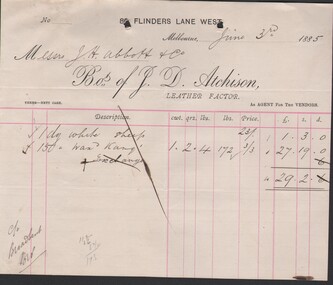
... Sydenham, Lonsdale Street West Melbourne, importers of Saddlers' Ironmongery, Hodskins, Patent Leather, etc. 2403.100s 1 invoice, May 1885, Frederick Tate, Market Street, Melbourne, Tate's Parcel Post Express. 2403.100t 2 invoices, Feb & Apr 1885, Taylor & Currie, Bourke Street West Melbourne. 2403.100u 1 invoice, Mar 1885, Eliza Tinsley, Iron Merchant & Manufacturer of Nail Chains, Patent Wrought Nails, Rivets etc. 2403.100v 1 invoice, Mar 1885, Reid & Marshall, Hawthorn Tannery, Melbourne, Tanners & Curriers, Kangaroo Leather Manufacturers. 2403.100w 17 invoices, 2 reports & 18 letters, Jan-Dec 1885, Ullathorne & Co. ...Sydenham, Lonsdale Street West Melbourne, importers of Saddlers' Ironmongery, Hodskins, Patent Leather, etc. 2403.100s 1 invoice, May 1885, Frederick Tate, Market Street, Melbourne, Tate's Parcel Post Express. 2403.100t 2 invoices, Feb & Apr 1885, Taylor & Currie, Bourke Street West Melbourne. 2403.100u 1 invoice, Mar 1885, Eliza Tinsley, Iron Merchant & Manufacturer of Nail Chains, Patent Wrought Nails, Rivets etc. 2403.100v 1 invoice, Mar 1885, Reid & Marshall, Hawthorn Tannery, Melbourne, Tanners & Curriers, Kangaroo Leather Manufacturers. 2403.100w 17 invoices, 2 reports & 18 letters, Jan-Dec 1885, Ullathorne & Co. ...business records/correspondenceAbbott Collection: 1885 correspondence between J. H. Abbott and suppliers (all handwritten correspondence, but difficult to decipher): 2403.100a 3 June 1885 - J. D. Atkinson, Flinders Lane Melbourne, leather factor - sheep and kangaroo hides 2403.100b 17 & 31 Jan 1885 - The Apollo Company Limited, Collins St Melbourne, Stearine Candles & Soap Manufacturers, Oil & Glycerine Refiners 2403.100c June-July 1885 - Briscoe & Co., Melbourne, Wholesale Ironmongers, Iron & Machinery Merchants; copper rivets & washers 2403.100d April-May 1885, 4 documents (1 invoice and 3 letters) - Birchard & Raspe, London & Hamburg 2403.100e Feb-June 1885, 7 invoices, William Dean & Co., Oil & Color Merchants, White Lead, Paperhangers and General Importers 2403.100g 5 invoices Feb-Oct 1885; Gavin Gibson, Melbourne, importers of Boots & Shoes, Leather & Grindery, Machinery, etc. 2403.100h 3 invoices Mar-Jun 1885; Guthridge Power & Co., East Melbourne, Wholesale Saddlers, Saddlers, Ironmongers & Importers. 2403.100i 2 invoices, Jan & Apr 1885, J. Hodges. Little Bourke Street West, Melbourne; American Hame & Saddle Tree Manufacturers. 2403.100j 1 invoice, Apr 1885, Alfred E. Hobbs, Elizabeth Street Melbourne, Rope Manufacturers 2403.100k 2 invoices, Mar & July 1885, Andrew Jack & Co., Flinders Lane West, Melbourne; Importers and Wholesale Stationers. 2403.100l 3 invoice, Apr-Jun 1885, J. Kitchen & Sons & Apollo Company, Flinders Lane West, Melbourne, Sterine Candle, Soap & Soda Crystal Manufacturers Glyuerine & Oil Refiners. 2403.100m 1 invoice, Feb 1885, Lister Henry, Flinders Lane West, Melbourne. 2403.100n 1 invoice, Jun 1885, Thomas Mitchell, Little Bourke Street West Melbourne, Paint & General Brush Manufacturer. 2403.100o 4 invoices, Feb-Jun 1885, New Zealand Loan & Mercantile Agency Company Limited; Colins Street West, Melbourne; Melbourne Wool & Grain Warehouses. 2403.100p 1 invoice & 2 letters, Jan-Apr 1885, T. J. & T. Powell, Lime Street London. 2403.100q 3 letters, Feb -Mar 1885, W. Shammon. Mosley Street, Birmingham, Whip Manufacturer, Cach & Saddler Ironmonger. 2403.100qq 1invoice, May 1885, James C. Steel, Kensington Tannery, Hotham. 2403.100 r 3 invoices, Jan-Mar 1885, G. V. Sydenham, Lonsdale Street West Melbourne, importers of Saddlers' Ironmongery, Hodskins, Patent Leather, etc. 2403.100s 1 invoice, May 1885, Frederick Tate, Market Street, Melbourne, Tate's Parcel Post Express. 2403.100t 2 invoices, Feb & Apr 1885, Taylor & Currie, Bourke Street West Melbourne. 2403.100u 1 invoice, Mar 1885, Eliza Tinsley, Iron Merchant & Manufacturer of Nail Chains, Patent Wrought Nails, Rivets etc. 2403.100v 1 invoice, Mar 1885, Reid & Marshall, Hawthorn Tannery, Melbourne, Tanners & Curriers, Kangaroo Leather Manufacturers. 2403.100w 17 invoices, 2 reports & 18 letters, Jan-Dec 1885, Ullathorne & Co. Lonsdale Street Melbourne and Lincolns Inn Fields, London; Leather Shoe Mersey, Grindery Merchants, etc. Importers of Tanners and Curriers Tools, oils, Dyes & Twines, Shoe and Saddlers Thread, Silks, etc. 2403.100x 62 invoices, Jan-Dec 1885, compiled by J. H. Abbott & Co., Edinburgh Tannery.sales of australian leather, shipments ofhides to england, shipments from melbourne & england -
 Bendigo Historical Society Inc.
Administrative record - Abbott Collection: July to Dec 1898: records and receipts for purchases by J.H. Abbott & Co
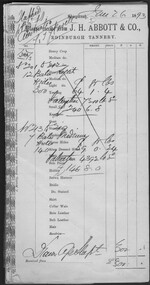
... Power, Saddler Ironmonger & Manufacturer; 5 July - 28 December 1898 2403.87C: 12 (blue) invoices Thomas McPherson & Son, Machinery & Iron Merchants; 9 July - 17 December 1898 2403.87D: 23 invoices The India Rubber Gutta Percha & Telegraph Works Co. 11 August - 29 September 1898 2403.87E: 30 invoices & 5 credit notes Edward Keep & Co, Wholesale Ironmongers & Importers of Carriage Materials; 6 July - 23 December 1898 2403.87F: 16 invoices Ullathorne & Co, materials; 12 July - 28 December 1898 2403.87G: 5 invoices Tuck & Co. ...Power, Saddler Ironmonger & Manufacturer; 5 July - 28 December 1898 2403.87C: 12 (blue) invoices Thomas McPherson & Son, Machinery & Iron Merchants; 9 July - 17 December 1898 2403.87D: 23 invoices The India Rubber Gutta Percha & Telegraph Works Co. 11 August - 29 September 1898 2403.87E: 30 invoices & 5 credit notes Edward Keep & Co, Wholesale Ironmongers & Importers of Carriage Materials; 6 July - 23 December 1898 2403.87F: 16 invoices Ullathorne & Co, materials; 12 July - 28 December 1898 2403.87G: 5 invoices Tuck & Co. ...various 1898 company letterhead receipts which J.H. Abbott used to access supplies2403.86 (A to G) Abbott Collection: Jan to Jun 1893: records and receipts for purchases by J.H. Abbott & Co. from a wide range of generally Melbourne based companies 2403.87A: J.H. Abbott's issued 46 invoices for their Edinburgh Tannery 1 July - 24 December 1898 2403.87B: 18 invoices Thomas P. Power, Saddler Ironmonger & Manufacturer; 5 July - 28 December 1898 2403.87C: 12 (blue) invoices Thomas McPherson & Son, Machinery & Iron Merchants; 9 July - 17 December 1898 2403.87D: 23 invoices The India Rubber Gutta Percha & Telegraph Works Co. 11 August - 29 September 1898 2403.87E: 30 invoices & 5 credit notes Edward Keep & Co, Wholesale Ironmongers & Importers of Carriage Materials; 6 July - 23 December 1898 2403.87F: 16 invoices Ullathorne & Co, materials; 12 July - 28 December 1898 2403.87G: 5 invoices Tuck & Co. Limited, manufacturers of asbestos goods for every description; 28 July - 27 October 1898 2403.87H: 3 invoices Banks & Company, importers and wholesalers; 6 July - 11 November 1898 2403.87I: 2 invoices John Danks & Son, Sheet Lead, Lead, Compo. & Tin Plate; 18 August - 22 August 1898 2403.87J: 6 invoices M. Donahy & Sons, Manufacturers of Steam-Laid flat & Round Ropes. 14 September - 10 November 1898 2403.87K: 17 invoices Reid Brothers & Russel, importers of Mines and Engineering Furnishings, 15 September - 22 December 1898 2403.87L: 2 invoices A. Spooner & Co., manufacturers of a wide range of goods; 30 August - 22 October 1898 2403.87M: 5 invoices Charles Aitkins & Co., manufacturers, refiners and importers of Lubricating Oils, Antifriction Grease, Machine Belting, Engine Packings etc.; 17 August - 31 December 1898 2403.87N: 2 invoices E. L. Yencken & Co. Oil Color and Glass Merchants; 14 August - 23 December 1898 2403.87O: 3 invoices Morris & Meeks, Wholesalers Ironmongers & Machinery Merchants; 24 November - 6 December 1898 2403.87P: 8 invoices Felton Grimwade Co.: 22August - 16 December 1898 2403.87Q: 12 invoices N. Gutheridge & Co., Wholesale Saddlers, Saddlers, Ironmongers & Importers; 6 July - 21 December 1898 2403.87R: 2 invoices John Perry., Timber Merchant, Coach Builders, Ironmongery & Wheelwrights' Materials; 19 & 30 November 1898 2403.87S: 34 invoices Frank Vial & Co., Universal Leather Belt Factory; 7 July - 23 December 1898trade company purchases 1893 -
 Bendigo Historical Society Inc.
Administrative record - Abbott Collection: Receipts for purchases by J.H. Abbott & Co.in 1881, 1881
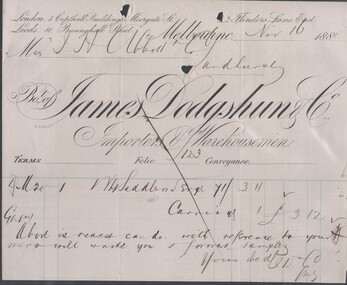
... Oil & Color Merchants, Melbourne; 2403.97o 30 Dec 1881 of 4 itemised (copper rings) blue receipts from Thomas McPherson, Machinery & Iron Merchants, Melbourne; 2403.97p 10 Aug 1881 6 No. receipts for purchases from Gavin Gibson, Boot Shoe & Leather Importers. ...Oil & Color Merchants, Melbourne; 2403.97o 30 Dec 1881 of 4 itemised (copper rings) blue receipts from Thomas McPherson, Machinery & Iron Merchants, Melbourne; 2403.97p 10 Aug 1881 6 No. receipts for purchases from Gavin Gibson, Boot Shoe & Leather Importers. ...business records/receiptsAbbotts collection: Receipts for purchases made by J. H. Abbott & Co. in 1881; both for a wide range of goods and from a wide range of, both local and international, companies: 2403.91a 16 Nov 1881bought from James Dodgshun & Co. of one saddle from their Melbourne office; 2403.97b 2 Nov 1881 return of one 64 lbs belt from J. B. Hayman, Melbourne; 2403.97c 27 Jun 1899 five letters of correspondence regarding the purchase of100 cases of "British" gelignite from Reid Bros. & Russell Prop. Ltd., Melbourne; 2403.97d 5 Nov 1881 purchase of tallow oil from Apollo Stearine Candle Company, Melbourne 2403.97e 13 Dec 1881 eight itemised (whips, snaffles and saddle soap, etc)purchases from Guthridge Power & Co Saddlers, Ironmongers and Importers, Sandhurst 2403.97f 8 Dec 1881 purchase of hessians from James Dodgshun & Co., Melbourne; 2403.97g 1 Nov 1881 purchase of 3 Bago Curled Hair nets from E. R. Priestly, Melbourne; 2403.97h 15 Aug 1881 purchase of 3 No. foolscap books from Andrew Jack & Co., wholesale stationers, Melbourne; 2403.97i 13 Oct 1881 purchase of 10 itemised skins from The New Zealand Loan & Mercantile Agency Company Limited, Melbourne; 2403.97j 6 Nov 1881 purchase of one "Bale Heavy Crop" from Gill & Boston, Melbourne; 2403.97k 17 Dec 1881 ten (blue) receipts of a wide range of products from Ullathorne & Co. Importers & Manufacturers of all articles used by Tanners, Curriers, Leather & Grindery Dealers & Boot Manufacturers, Melbourne; 2403.97l 18 Nov 1881three receipts (harnesses, hobbles, etc.) from Monchton D. Synnot Bros. Melbourne 2403.97m 7 Dec 1881 purchase of 2 leather hides from Briscoe & CO. Melbourne; 2403.97n 18 Aug 1881, 3 receipts for purchases of Olive Oil from Dean & Co. Oil & Color Merchants, Melbourne; 2403.97o 30 Dec 1881 of 4 itemised (copper rings) blue receipts from Thomas McPherson, Machinery & Iron Merchants, Melbourne; 2403.97p 10 Aug 1881 6 No. receipts for purchases from Gavin Gibson, Boot Shoe & Leather Importers. Melbourne; 2403.97q 18 Oct 1881 receipt for purchase of leather goods from J. B. Hayman, Melbourne; 2403.97r multiple 1881 receipts for the purchase/transfer of leather goods from his J. H. Abbott Edinburgh Tannery, Sheepwash, to his other businesses 2403.91s 14 Oct 1881 receipt from The Australasian Wool Stores, bought from The Australasian Mortgage & Agency Company Limited and correspondence from multiple Government Departments receipts ordered by abbotts 1881 -
 Federation University Historical Collection
Print - Scrapbook, Ballarat School of Mines Invoice Scrapbook, 1875-1879, 1875-1879
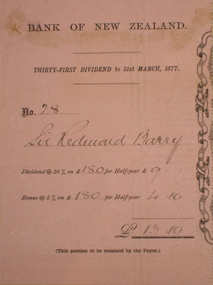
... McHutchison, Bookbinder * 1/6/1876 - account from A.H. King - Iron Merchant * 1/6/1876 - account from Cornell and King - Chemists * 31/5/1876 - account from W.M. ...McHutchison, Bookbinder * 1/6/1876 - account from A.H. King - Iron Merchant * 1/6/1876 - account from Cornell and King - Chemists * 31/5/1876 - account from W.M. ...Quarter leather bound scrap book with pasted in invoices which were sent to the Ballarat School of Mines.Ballarat School of Mines Invoice Scrapbook, with many invoices made out to the Ballarat School of Mines stuck into the book (most folded over). * 01/12/1875 - 31/12/1875 - Annual account of all sums of Money for subscriptions to the Ballarat School of Mines * 31/12/1875 - Charles J. Evans - printer * 1875 - William Gooch - for Argus newspaper * 13/01/1876 - M.D. Hamilton - salary payment * 14/01/1876 - receipt for two shillings and sixpence from M.D. Hamilton * 31/1/1876 - account to R.J. Vale * 1/2/1876 - Caxton printing works - account to James Curtis * 4/12/1876 - Ballarat Gas company - receipt from J.W.Robertson * 29/1/1876 - Permewan Hunt and company - account to Hon. W.H.Barnard *28/1/1876 - Osborn, Cushing and company - account to Hon. W.H.Barnard * 7/10/1875 - Geo. H. Bliss and company - account to Hon.N.H. Barnard * 31/12/1875 - I. Longstaff - Druggist * 1875 - A. M. Leirnan * 9/12/1876 - Petty cash - M. Hamilton * 15/12/1875 - reimbursement to W.D. Barnard * 31/1/1876 - "Ballarat Star" newspaper account - Rob Wreford * 12/4/1876 - Geelong Gas company - receipt for 2 pounds and ten shillings - A.B. Langlands * 27/1/1876 - Geelong Gas company - account to School of Mines * 1/2/1876 - Cornell and King - Chemists - account to School of Mines * 10/2/1876 - Salary payment slip to M.D. Hamilton for 8 pounds 6 shillings and 8 pence * January 1876 - Stansfield and Robson, Importers - account to School of Mines * January 1876 - Stansfield and Robson - School of Mines - Dr. A.M.Leisman - account * 31/1/1876 - Charles J. Evans - account to School of Mines * 31/1/1876 - Proprietors of the Evening Post - account to School of Mines * 10/2/1876 - Petty cash receipt from W. Barnard * 1/2/1876 - Bateman, Clark and Company - account to School of Mines * 8/3/1876 - Salary payment to M.D. Hamilton from School of Mines Ballarat *1/3/1876 - William Johnson - Chemist - account to School of Mines Ballarat * 28/2/1876 - Cornell and King - Chemists - account to School of Mines Ballarat * 2/1876 - Hugh Gray and Son - Instrument makers - account from School of Mines * 28/2/1876 - J. Longstaff - druggist * 11/3/1876 - Fidelity Guarantee of Alfred B.Burne for 100 pounds from Victoria Life Insurance Co. *10/3/1876 - Petty cash slip from W.H. Barnard * 4/3/1876 - account from Alfred B. Burne * 15/3/1876 - personal expenses account from I.W. Jonan * 27/3/1876 - account from John Victor * 25/3/1876 - account from C.W. Thomas * 27/3/1876 - account from W. Schmidt - Lecturer * 25/3/1876 - account from Joseph Flude * 29/6/1876 - account from J. Thomas * 30/6/1876 - receipt from W.M. Barnard * 1/4/1876 - receipt from Joseph Flude * 1/3/1876 - account from William Blomeley, Iron and Brass Founder * 31/3/1876 - account from A.H. King, Iron Merchant * 31/3/1876 - account from W.M. Gooch, Newsagent * 13/4/1876 - salary payment to M.D. Hamilton * 12/4/1876 - Petty cash receipt * 13/4/1876 - List of subscriptions received from Alfred B. Burne (collector) (John P. Hanson, Comm. Bank of Aust., T.A. Wanliss, Andrew Cant, B. Hepburn, R. Lewis, Sovereign Hill Mining Co., Buninyong Shire Council, Union Bank Aust. Francis Taylor) * 15/2/1876 - account from Battersea Works London * 2/5/1876 - account from Charles J. Evans Lithographic Printer etc. * 11/5/1876 - salary slip to M.D. Hamilton * 30/4/1876 - subscriptions received from Alfred B. Bruce (M.P. Whiteside, S. Steele, J. Usher, Charles Walker, W.H. Bougghen, W.V. Jenkins, A.M. Gransfield, Hon. Henry Cuthbert, Aust. Bank, Borough Council, Thomas Bath, Rev. William Henderson, James Smith, S. Hamburger) * 30/4/1876 - account from The Ballarat Star Newspaper * 7/6/1876 - account from Ballarat Gas Company * 11/5/1876 - petty cash account from M.J. Barnard * 9/5/1876 - receipt from M.D. Hamilton * 6/5/1876 - account from M.D. Barnard * 4/1876 - account from W.M. Gooch - News and Advertising agents * 22/4/1876 - account from Broadbent Bros and Co. - Railway Carriers etc * 1/6/1876 - account from Bateman, Clark, and Co. * 31/5/1876 - account from J. Longstaff - Druggist * 16/2/1876 account from A.M. Leiman * 6/1876 - account from R.T. Vale - Newsagent * 31/5/1876 - receipt from Sir Redmond Barry for one shilling * 1/6/1876 - account from F.W. Niven - Stationer etc. * 31/5/1876 - account to The Ballarat Star and The Miner newspapers * 31/5/1876 - account from Stansfield and Robson, Importers * 31/5/1876 - account from The Evening Post * 8/6/1876 - Salary slip fro M.D. Hamilton * 1/6/1876 - account to J. McHutchison, Bookbinder * 1/6/1876 - account from A.H. King - Iron Merchant * 1/6/1876 - account from Cornell and King - Chemists * 31/5/1876 - account from W.M. Gooch - Advertising agent * 8/6/1876 - petty cash receipt from M.D. Barnard * 31/5/1876 - List of subscriptions from Alfred B. Bruce (T.J. Kerr, Jacob Showman, J.L. Thompson, W.J. Clarke, R.C. Baih, L. Ballhausen, James Coghlan, Parade Gold mining Co., A. Williams, Sung Hung Fat, A. Dimmock Esq.M.D., Bank Victoria, Reform Co., Gilbert, James Ward, James Stewart, Ian Kwong Yick 7/6/1876 - account to Alfred White - Custom House Agent 30/6/1876 - receipt from John Victor for twelve pounds 10 shillings 29/7/1876 - receipt from A.M. Barnard 26/6/1876 - receipt from Joseph Flude 4/6/1876 - receipt from E.S. Schmidt 22/6/1876 - receipt from John W. Tail 19/6/1876 - receipt from Jonathan Butterworth 3/7/1876 - receipt from Joseph Hurde 1/7/1876 - account from Henry Richards Caselli - Architect and Building Surveyor 30/6/1876 - account from J. Scovell - Cabinet Maker 14/7/1876 - account from H.R. Caselli - Architect and Building Surveyor 20/7/1876 - payslip to M.D. Hamilton 1/7/1876 - account from Henry Brind - Chemist 6/1876 - account from W.M. Gooch - News and Advertising Agent 21/7/1876 - account from W.D. Hamilton 26/6/1876 - account from Parkinson and co. - City Nightmen and van proprietors 19/7/1876 - petty cash receipt from M.D.Barnard 30/6/1876 - account of subscriptions received - J.A. Anderson, A. Anderson, John Osborne, J. Noble Wilson, Bateman and Clarke, National bank of Aust., James Lory, F. Atkins 27/7/1876 - account from H. Hunt - Builder 26/7/1876 - account to G. Leitch and co. 1/8/1876 - receipt to The National Insurance Co. of Aust., Ltd. 1/8/1876 - receipt from Victoria Fire and Marine Insurance Company 1/8/1876 - account to The Victoria Lime and Cement Co. 1/8/1876 - receipt from Ballarat Gas Company 1/8/1876 - account from Charles J. Evans, Printer 1/8/1876 - account from Cornell and King - Druggists and Chemists 8/8/1876 account from Cornell and King - Druggists and Chemists 5/6/1876 to 22/9/1876 - account to A.N. Lennan 11/8/1876 - receipt from W.D. Hamilton 16/9/1876 - receipt from Geelong Gas Company 7/8/1876 - account to the Geelong Gas Company 1/8/1876 - account to Bateman, Clark and Co. 31/7/1876 - account from The Ballarat Star and of The Miner 10/8/1876 - salary slip to M.D. Hamilton 1/7/1876 to 31/7/1876 - list of subscriptions from Alfred B. Burne - P. Channey, P. Pakenhagen, John Price, Ballarat Gas Co., L.E. Brann, A.H. King, M. O"Ferrall, John Foord 19/7/1876 to 10/8/1876 - Petty cash receipt from M.N. Barnard 7/ 1876 - account to W. M. Gooch - General News and Advertising agent 1/7/1876 - account to Stansfield and Robson - Importers in Oils, colours, window glass, etc. 17/8/1876 - account to Lermes Lamurk 4/8/1876 - account to James Allen "Camperdown Chronicle" general printing office from W.H. Barnard 6/9/1876 - account to Henry Masham 1/9/1876 - account to A.H. King - Iron Merchant, Furnishing and General Ironmonger 22/9/1876 - travelling expenses account from R.D. Ellery 25/9/1876 - receipt from M. Schmidt 15/9/1876 - receipt from M.D. Hamilton 1/9/1876 - account to James Curtis - Caxton Printing Works 25/8/1876 - account from William McCulloch and Co., General Carriers 18/8/1876 - account to G. Leitch and Co. 14/9/1876 - payment slip to M.D. Hamilton 10/8/1876 - petty cash account from M.H. Barnard 25/9/1876 - receipt from John Victor 25/9/1876? - receipt from M.H.Barnard 6/10/1876 - receipt from Joseph Fude 12/10/1876 - receipt from M.D. Hamilton 30/9/1876 - receipt from Joseph Fude 1/10/1876 - account to A.M. Lennan 12/10/1876 - salary slip to M.D. Hamilton 30/9/1876 - account from Ballarat Star Newspaper Office 12/10/1876 - petty cash account - M.H. Barnard 30/9/1876 - account to J. McHutchison - Bookbinder 1/8/1876 - account from Ballarat Gas Company 1/11/1876 - receipt from Ballarat Gas Company 1/11/1876 - account to Charles J. Evans - Lithographic Printer 1/11/1876 - account from Cornell and King - Chemists 9/1876 - account from W.M. Gooch - General news and advertising agent 10/1876 - account from J. and J. McDonald - Plumbers and gas fitters 13/10/1876 to 9/11/1876 - petty cash statement from M.H. Barnard 14/11/1876 - receipt from M.D. Hamilton 11/9/1876 - account from A.M. Lennan 9/11/1876 - Salary slip to M.D. Hamilton 12/10/1876 - Expenses account received by M.H. Barnard 1/11/1876 - account from J. Longstaff - Druggist 10/1876 - account from Parkinson and Co. - City Nightmen and van proprietors 6/12/1876 - account from Emanuel Steinfield, Importer of Furniture etc. 13/11/1876 - account The Geelong Gas Company 31/11/1876 - account from The Ballarat Star Newspaper office 28/11/1876 - account from R.T. Vale - bookseller, stationer and news agent 28/11/1876 - acount from John Slater and co. 1/12/1876 - account from J. Doig and co., Tinsmiths, Gasfitters etc. 14/12/1876 - Salary slip to M.D. Hamilton 14/12/1876 - receipt from M.D. Hamilton for one pound one shilling and ninepence 1/11/1876 to 31/12/1876 - petty cash statement 15/12/1876 - statement of travelling expenses for A.B. Barnes 23/12/1876 - receipt from John Victor 21/2/1877 - receipt from C.M.Thomas 23/12/1876 - receipt from Joseph Flude 29/12/1876 - receipt from Lecturer - S.Schmidt 30/12/1876 - receipt from Joseph Flude 1876 - receipt from Joseph Flude 12/1/1877 - statement of refund to W.H. Barnard 11/1/1877 - Salary slip to M.D.Hamilton 8/1/1877 - petty cash statement 18/1/1877 - receipt for Ballarat Gas company 2/1/1877 - account from Eyres Brothers - Furnishing and general ironmongers 19/12/1876 - statement from W.H. Barnard - registrar 1/1/1877 - account from Bateman, Clark and company 11/121876 - account from Parkinson and co. - City nightmen 31/12/1876 - account from Ballarat Star Newspaper office 25/1/1877 - account from J. McHutchison, Bookbinder 3/2/1877 - account from J. McHutchison, Bookbinder 1/2/1877 - account from Cornell and King - Chemists 1/2/1877 - account from Stansfield J. Robson - Importers in oils, colours, window glass etc. 1/2/1877 - account from Charles J. Evans - Bookbinder etc. 12/12/1876 - account from W. Gooch - General news and advertising agent 2/1/1877 - account from proprietors of the Evening Post 14/2/1877 - account from John F.Paten - Printer, Publisher and Bookseller "Avoca Mail" 2/2/1877 - account from T. Longstaff - wholesale and retail druggist 8/81877 - salary slip for M.D. Hamilton 21/1/1877 - account from Ballarat Star Newspaper office 9/2/1877 - account for petty cash from W.H. Barnard 7/2/1877 - account from S.C. Steele - Ballarat Fine Art Gallery 13/2/1877 account from R.T. Vale - Bookseller, Stationer and News Agent 8/2/1877 - account from Joseph Flude 13/1/1877 - account from William Johnson, Chemist 9/1877 - account to J. Flude from William Johnson, Chemist, 3 accounts 2/11/1876 to 23/1/1877 - account from A.N. Leiman 1/3/1877 - account from Bateman, Clark and company 8/3/1877 - salaray payment to M.D. Hamilton 8/3/1877 - salary payment to J. Ashley 9/3/1877 - statement from Post Office Ballarat (one shilling - for the first years rent of telegraph line on school premises) 1/2/1877 - statement from Mining and commercial stationer - J.W. Niven Dec.1876 to 15/2/1877 - account from R.T. Vale - Bookseller, Stationer, and News agent 1/1877 - statement from C.W. Thomas 8/3/1877 - petty cash account from W.H. Barnard 9/3/1877 - account from R. Gibbings - Livery and Letting Stables and carriage repository 28/2/1877 - account from Charles J. Evans - Stationer, Lithographic printer etc. 9/3/1877 - receipt from M.D. Hamilton 31/3/1877 - account from Ballarat Star and The Miner 2/1877 - receipt from Joseph Flude 8/3/1877 - receipt from F.J. Ashley 28/3/1877 salary statement from John Victor 28/4/1877 - salary statement from John A. Sharp 28/3/1877 - receipt from Joseph Flude 26/3/1877 - receipt from T.Schmidt - Lecturer 12/3/1877 - receipt from C.H. Walker 6/4/1877 - account from Mr. Ellery 27/4/1877 - account from A. M. Leiman 31/3/1877 - account from W.M. Gooch, General news and advertising agent 6/3/1877 - statement from London Remittances 12/4/1877 - salary payment to M.D. Hamilton 1877 - receipt from W.H. Barnard 1/4/1877 - account from Parkinson and company, City nightmen and van proprietors 5/4/1877 - account from William McCulloch and company, General carriers 11/4/1877 - account from S. Steele, Draper 31/3/1877 - account from Charles J. Evans, Stationer etc. 1/4/1877 - account from James Curtis - Caxton Printing Works 4/1877 - receipt from W.H. Barnard 8/3/1877 to 12/4/1877 - petty cash receipt from W.H.Barnard 12/4/1877 - receipt from C. Flude 31/3/1877 - receipt for Sir Redmond Barry for 13 pounds 10 shillings 1/1877 - receipt from Alphonse Ausaldie 1/3/1877 - 30/4/1877 - account from Joseph Flude 9/5/1877 - account from Henry Costin - Machinery Merchant 31/1/1877 to 3/5/1877 - Ballarat Gas Company 13/6/1877 - receipt to Ballarat Gas Company 9/5/1877 - salary slip to M.D. Hamilton 11/5/1877 - account for stationary from C. Flude, Registrar 23/3/1877 - account from Edmund Donelly 1/5/1877 - account from Charles J. Evans, Stationer etc. 9/4/1877 - account from W.M. Gooch, News and advertising agent 30/4/1877 - account from The Ballarat Star and The Miner 13/4/1877 - account from T. Longstaff, wholesale and retail druggist 30/4/1877 - account from Echuca railway station 1/5/1877 - account from Cornell and King, Chemists 11/5/1877 - salaray slip for C. Flude 11/5/1877 - petty cash account to the Registrar, W.H. Barnard 2/5/1877 - account from William McCulloch and co.,general carriers 5/1877 - account from William Willis and co. Locksmiths etc. 1/5/1877 - account from Joseph Flude 6/6/1877 - account from Henry Morham 31/5/1877 - account from Charles J. Evans, Stationer and Printer etc. 14/6/1877 - salary payment to M.D. Hamilton 15/6/1877 - salary payment to C. Flude 15/6/1877 - receipt from M.D. Hamilton 1/6/1877 - account from James Curtis, Caxton Printing Works 31/1/1877 - Ballarat Gas company account 23/8/1877 - receipt from Ballarat Gas company 15/6/1877 - receipt from The National Insurance Company of Aust., Ballarat Branch 1/6/1877 - account from The Ballarat Courier 3/1877 - receipt from L.M. Cook 1/6/1877 - account from J.McHutchison, Bookbinder 10/5/1877 to 14/6/1877 - petty cash account 17/5/1877 - account from William McCulloch and co., general carriers 15/6/1877 - account from T. Longstaff, Wholesale and retail Druggist 1/5/1877 - account from H. Hunt, Builder 4/1877 - receipt from John Victor 3/7/1877 - receipt from J.Alex Sharp 15/6/1877 - receipt from Sir Redmond Barry to Revenue and Pay Office 26/6/1877 - receipt from M. Shaw, Lecturer 25/6/1877 - receipt from Joseph Flude 23/6/1877 - receipt from S.Schmidt 6/1877 - account from W.M. Gooch, general news and advertising agent for Argus newspapers 6/1877 - account from the Proprietors of the Evening Post 21/6/1877 - account from John F. Paten, "Avoca Mail" and general printing office 14/6/1877 - account from Ballarat Star and The Miner Newspaper office 30/6/1877 - account from Ballarat Star Newspaper office 2/7/1877 - account from R.T. Vale, News Agent 19/6/1877 account for railway fare and personal expenses 23/5/1877 - account from William Johnson, Chemist 1/7/1877 - account from Henry Brind, Chemist and Family Pharmacist 2/7/1877 - account from Cornell and King, Druggists and Chemists 12/7/1877 - salary slip to M.D. Hamilton 14/7/1877 - salary slip to C. Flude 14/6/1877 - 12/7/1877 petty cash account from W.H. Barnard 16/6/1877 - account from William McMulloch and Co., general carriers 1/7/187 - account from Parkinson and Co., City Nightmen and Van Proprietors 1/6/1877 to 30/6/1877 - account from Joseph Flude 1/8/1877 - receipt to Victoria Fire and Marine Insurance Company 21/7/1877 - account to Brush and Drummond, Importers and Manufacturing Jewellers 11/7/1877 - account from Charles J. Evans, Printer etc. 31/7/1877 - account from The Ballarat Star Newspaper Office 1/8/1877 - account from James Curtis, Caxton Printing Works 7/71877 - account from W.M. Gooch, Advertising Agent 7/1877 - account from Hugh Gray and Son, Mechanists and Philosophical Instrument Makers 13/8/1877 - account from Ballarat Gas Company redmond barry, joseph flude, hall of commerce, george crocker, ballarat star, the miner, bank of new zealand, daniel brophy, james curtis, caxton printing works, mcdonald plumbers and gas fitters, mcvitty and co, j. mchutchison, bookbinder, niven, john warrington rogers, henry bland, rivett henry bland, telegraphy, ellery, r.t. vale, richard vale, w. johnson analytical chemist st kilda, judge warrington rogers, art gallery of ballarat, henry richards caselli, h. hunt, ballarat school of mines botanical gardens, henry caselli, charles flude, ballarat star news, john armstrong -
Bendigo Historical Society Inc.
Document - ROYAL PRINCESS THEATRE COLLECTION: PROGRAM OF COMING EVENTS, 1916
... Hume & Iser: English and Canadian wallpapers. Timber Merchants & Iron Mongers, full range of stoves, Mantlepieces, grates, tiles, bath-heaters, bathroomware, Berger's Paints. ...Hume & Iser: English and Canadian wallpapers. Timber Merchants & Iron Mongers, full range of stoves, Mantlepieces, grates, tiles, bath-heaters, bathroomware, Berger's Paints. ...Princess Theatre Bendigo - Program of coming events in c1917. Coming Events: Gonsalez, Italian Grand Opera Company, commencing Monday May 7, for 3 nights' season. The Brilliant and Incomparable Gonzalez, Italian Grand Opera Company. Opening Production_Verdi's Immortal Masterpiece Il Trovatore. Page 3. Monday, May 7, 1917. Il Trovatore. Opera in 4 acts. Music by G Verdi. Cast of Characters: Signorinas: De Revers, Russ, Capelli. Signors: Scamuzzi, Cacialli. Chorus of voices. Overture at 8pm sharp. Director of Orchestra: Giovanni Gonsalez. Leader of Orchestra: Mr S de Tarczynski. Cello Soloist: Mr Laurie Kennedy. Page 9 Farewell Night. Wednesday, May 9, 1917 Faust, Opera in 5 acts. Music by Gounod. Cast of Characters: Signors Balboni, Cacialli, Filippini, Cesaroni. Signorinas: Visoni, Russ, Piccolo. Overture at 7.45pm sharp. Director of Orchestra: Giovanni Gonsalez. Leader of Orchestra: Mr S de Tarczynski. Cello: Mr Laurie Kennedy. Cast members: Signors Balboni, Cacialli, Filippini and Cesaroni. Signorinas: Visoni, Russ and Piccolo. Director of Orchestra: Giovanni Gonzalez. Leader of Orchestra: Mr S de Tarczynski. Cello Soloist: Mr Laurie Kennedy. Page 11, Repertoire of Operas to be produced by the Gonsalez Opera Company to Wednesday, May 9. Monday, May 7, at 8pm. Cavalleia Rusticana, I Pagliacci. Wednesday, May 9 at 7.45pm. Faust. Between the acts. The story of 'Cavalleria Rusticana' is based on truth and reality alone. It is built up on the fact Turridu, a young peasant, has loved and wooed Lola before . . . . . . Of all the many successful productions in which Mme. Petrova, the celebrated Metro star, appeared, 'The Black Butterfly,' in which she appears in this Theatre, on Thursday, Friday and Saturday, next, is considered her greatest, In 'The Black Butterfly . . . The story of 'Rigoletto' is taken from Victor Hugo's drama 'Le roi S'amuse.' In it the Duke of Mantua a wild and unprincipled youth makes love to every . . . Programme Compiled. Wholly Set Up and Printed by The Cambridge Press, Phone 130. Market Sq., Bendigo. Many ads appear throughout the brochure: Allan's, 253 Mitchell Street Bendigo. Ph 244. W Brown, 171 Mitchell Street, 'Centerway' 105 View Street, Bendigo's Leading Pastrycook & Caterer. Hume & Iser: English and Canadian wallpapers. Timber Merchants & Iron Mongers, full range of stoves, Mantlepieces, grates, tiles, bath-heaters, bathroomware, Berger's Paints. Phones: Yard 48, Showroom 470. Cambridge Press: For artistic programmes, menus, concert tickets, At-Home Cards, and Commercial Printing. Ph 130. Delves' Café, Dainty Service. 'Class' Suppers at moderate Cost. Ph 805. Next to Royal Bank (above Hampton's). Bendigo Business College: Evening Commercial Classes, book-keeping, typewriting, shorthand. Applications to James E Holland, F.P.S.A. Pianoforte & Organ Tuning. A B Challen, Qualified Tuner Ph 319, 42 Rowan St., Bendigo. Chatfield Bros. The Motor Experts, High Street, Bendigo. Ph 609. Car repairs, New cars, hire cars, something for your car. Service Station for Ford car parts, Dunlop & Goodyear tyres. Accessories of all kinds stocked. Oxy Acetylene welding of all metals. Bartlett Bros. Photographers. Bartlett Bros' Studios, (R W Bugg, Proprietor) Williamson St, (opp Hotel Shamrock). Half & Half (Registered) Non-Alcoholic and Invigorating. Manufactured by C J Glover, Ph 343, Chapel Street, Bendigo. R D Ellis, Ladies & Gents Tailor, 241 Mitchell Street, (opposite Morley Johnson's). Nursery (Rose) at Epsom, Stock to be Sold at Half Usual Price. Mr S H Hunt, who has 33 prizes & championships, has accepted a position with Brunning's of Bendigo and has sold the of his 10,000 Roses to them. There are . . . Baker & Woods, 313 Hargreaves St, Ph 209. Electric light installed in your home. 'THE BEEHIVE' Bendigo's Famous Store. Blouses of Beauty, Coats of Comfort, Costumes of Character, Dresses of Delight, Skirts of Style, Millinery of Merit are Permantant Features of Bendigo's Famous Store 'The Beehive'. Best by Test, Leggos of Bendigo 'Progress' Tomato Sauce on the table, wether at home or in the restaurant, there should always be Leggos of Bendigo 'Progress' Tomato Sauce. It's the kind of Sauce you enjoy to the last-no bitting acidity-but a Delicious and Delicate Flavor combined with a Smoothness always agreeable to the palate,. Leggo's 'Progress' Sauce is the result of the . . . H M Leggo& Co Manufacturers, Bendigo. Est. 1881.The Cambridge Press, Market Sq. Bendigo Ph 130program, theatre, princess theatre bendigo -
 Flagstaff Hill Maritime Museum and Village
Book - Portfolio, Newcraft Pulicity, The Line of Sail; Magnificent Clipper Ships, 1969
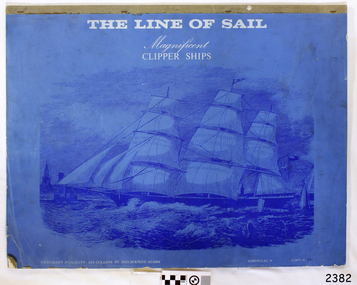
... Beatson’s Expedition in search of Sir John Franklin – the “ISABEL” The Black Ball Line Clipper Ship “JAMES BAINES” The “MERCHANT PRINCE” – Australian Clipper The White Star Line Clipper Ship “MORNING LIGHT” The Aberdeen Clipper Built Barque “PHOENICIAN” New Australian Clipper Ship the “ROYAL FAMILY” The “SOVEREIGN OF THE SEAS” American Clipper The New Iron Clipper Built Ship “TAYLEUR” for Australia H.M. ...Beatson’s Expedition in search of Sir John Franklin – the “ISABEL” The Black Ball Line Clipper Ship “JAMES BAINES” The “MERCHANT PRINCE” – Australian Clipper The White Star Line Clipper Ship “MORNING LIGHT” The Aberdeen Clipper Built Barque “PHOENICIAN” New Australian Clipper Ship the “ROYAL FAMILY” The “SOVEREIGN OF THE SEAS” American Clipper The New Iron Clipper Built Ship “TAYLEUR” for Australia H.M. ...These prints include large sailing ships that were also referred to as Clippers and Tall Ships. These ships were used to transport cargo and passengers across the world in the 19th century. They were powered purely by harnessing the wind. It could take three to four months to sail in this manner from England to Australia. On many occasions the ships were wrecked, often close to their destination, through errors of navigation. The method of production of the original images is over a century old. The Melbourne publisher of this portfolio book, Newcraft Publicity, describes the contents as follows-' Magnificent Clipper Ships: Clipper ships in the line of sail make the most romantic and spectacular pictorial chapter of marine history. This collection depicting early clippers and other types of sailing ships were originally fine engravings on wooden printing blocks used in newspapers a century ago. They were taken directly from the original newspaper prints, and reproduced in enamel inks to provide a choice of fine line prints suitable for framing. LIST OF PRINTS- The New Australian Clipper "BLUE JACKET" The Clipper Ship “CHRYSOLIER” The “GAUNTLET” Clipper Ship The New American Clipper “GREAT REPUBLIC” The Clipper Ship “GUIDING STAR” New Emigrant Ship “HESPERIDES” for the South Australian Line Capt. Beatson’s Expedition in search of Sir John Franklin – the “ISABEL” The Black Ball Line Clipper Ship “JAMES BAINES” The “MERCHANT PRINCE” – Australian Clipper The White Star Line Clipper Ship “MORNING LIGHT” The Aberdeen Clipper Built Barque “PHOENICIAN” New Australian Clipper Ship the “ROYAL FAMILY” The “SOVEREIGN OF THE SEAS” American Clipper The New Iron Clipper Built Ship “TAYLEUR” for Australia H.M. New Frigate “THETIS” The American Clipper Ship “WITCH OF THE WAVE” ABOUT THE PUBLISHER- The Newcraft Publicity was a Melbourne business that operated in the 1960s at 243 Collins Street, Melbourne.This portfolio book of clipper ship prints is historically significant as it shows an important part of Australia's history, It includes some of the shipping lines famous in the 19th century for transporting passengers and goods to Australia. The prints are also significant for their origin in the carved wooden blocks used a century ago for creating images for the newspapers of the time. Book is also significant from being one of a limited edition of books produced. There are copes in both the Victorian State Library and the National Library of Australia.The Line of Sail is a portfolio of sixteen fine line, black and white prints on paper. The subject is clipper ships. The covers are paper-covered card, coloured a strong blue with white line images and text. The image side of the pages has a sheen, the back is matt. Each print has a caption. The top of the book is stapled and bound with grey tape. Produced by Newcraft Publicity, Melbourne. Limited Edition - Copy Number 086. Stamped on front cover "086"flagstaff hill, warrnambool, shipwrecked-coast, flagstaff-hill, flagstaff-hill-maritime-museum, maritime-museum, shipwreck-coast, flagstaff-hill-maritime-village, lithographs, newscraft publicity, book, the line of sail, dlipper ships, tall shipos, sailing ships, wood block print, newspaper drawings, newcraft productions, newcraft melbourne, portfolio of clipper ships, limited edition, wooden engravings, magnificent clipper ships -
 Flagstaff Hill Maritime Museum and Village
Galvanised Jug
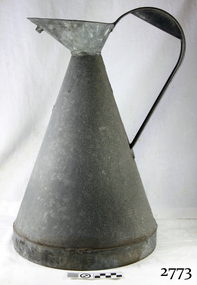
... merchants was developed in Australian based on the Imperial British measurement system. The container has social significance as an item used in Victoria as a legal standard measure to ensure that goods sold in Victoria were correct given the item is galvanised it was probability used for kerosene or petrol etc not for liquids used for human consumption. flagstaff hill warrnambool shipwrecked-coast flagstaff-hill flagstaff-hill-maritime-museum maritime-museum shipwreck-coast flagstaff-hill-maritime-village Inscription on handle at back. 2 gallon GV.35 Galvanised Iron jug with rounded top, Galvanised Jug ...The beginning of standardised weights and measures began In Victoria when the Melbourne Observatory received sets of standard weights and measures, which had been tested in Britain against the then British Imperial standards. These included the primary standard yard and pound for the Colony of Victoria. Other standards of weights and measure held by shires and the administrative body's within the colony could then be compared to these primary standards. A Weights and Measures Act was passed in Victoria in 1862, establishing local inspectors throughout the colony. By the 1870s each local council and shire in Victoria held a set of standards that were used to test scales, weights and dry measures used by wholesalers, factories and shops. Every ten years the councils’ standards would themselves need to be rechecked against the Victorian Standards. The checking was done by the Victorian Customs Department in the 19th century, but with the transfer of responsibility for customs to the Federal Government in 1901, weights and measures function was retained by the Victorian Government and was shifted to the Melbourne Observatory. In 1904, a new building was erected at the south end of the Great Melbourne Telescope House, where the standard weights and measures and testing equipment was installed. This room had a large whirling apparatus for testing air meters and became known as the Whirling Room. When the Melbourne Observatory closed in 1944, the Weights and Measures Branch was formed to continue and this branch remained at the Observatory site unit until 1995. An example of a galvanised measuring jug made specifically to maintain government standard liquid measurements that were sold to the public. The probability is that this artifact was made around the first quarter of the 20th century and gives us today a snapshot of how imperial weights and measures were used before decimalisation and how a standard of measurement for merchants was developed in Australian based on the Imperial British measurement system. The container has social significance as an item used in Victoria as a legal standard measure to ensure that goods sold in Victoria were correct given the item is galvanised it was probability used for kerosene or petrol etc not for liquids used for human consumption. Galvanised Iron jug with rounded top, Inscription on handle at back. 2 gallon GV.35flagstaff hill, warrnambool, shipwrecked-coast, flagstaff-hill, flagstaff-hill-maritime-museum, maritime-museum, shipwreck-coast, flagstaff-hill-maritime-village -
 Flagstaff Hill Maritime Museum and Village
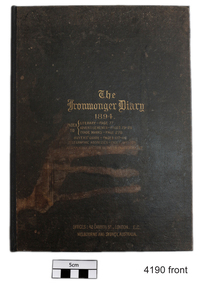
Manual - Ironmongers Diary, Edward, Gwyn, and Penry Vaughan Morgan, The Ironmonger Diary 1894, circa 1894
... iron, steel, wire, tools, and domestic hardware to its thriving colonies. To cater to this massive export market, the Morgan Brothers established major branch offices in Australia. The core headquarters was located at 42 Cannon Street, London, E.C., but the publication was simultaneously managed, distributed, and adapted for the colonies through its offices in Melbourne and Sydney. It ensured that Australian ironmongers, hardware merchants...iron, steel, wire, tools, and domestic hardware to its thriving colonies. To cater to this massive export market, the Morgan Brothers established major branch offices in Australia. The core headquarters was located at 42 Cannon Street, London, E.C., but the publication was simultaneously managed, distributed, and adapted for the colonies through its offices in Melbourne and Sydney. It ensured that Australian ironmongers, hardware merchants ...The 1894 edition of The Ironmonger Diary is not a personal, handwritten journal, but rather a highly specialized, annual commercial trade publication and desk reference book. It was published by The Ironmonger, the premier British trade journal for the hardware, metallurgical, and tool-making industries during the Victorian era. It served a dual purpose: part practical office desk calendar and part comprehensive trade directory. It was engineered to be the ultimate daily companion for anyone buying, selling, or working with metal goods.The Ironmonger Diary 1894 is a hard covered book bound book with gold lettering on the front cover and spine. The front cover includes an index to the information inside. It is titled on top of the inner pages "The Ironmonger Diary and Text Book". The inner pages contain blank diary pages, two weeks to an opening, with a light weight, blank pink page between the weeks. There are also Cash Book pages. The front and back sections of the diary contain product advertisements for ironmonger's wares, hardware, household goods, farm machinery, bicycles and even some clothing. There are Tables of measurements, a green-aged section called Classified List of Trade Marks and Brands, The Buyer's Guide and a list of Hallmarks on Plate (such as gold) identifying the years of manufacture.non-fictionThe 1894 edition of The Ironmonger Diary is not a personal, handwritten journal, but rather a highly specialized, annual commercial trade publication and desk reference book. It was published by The Ironmonger, the premier British trade journal for the hardware, metallurgical, and tool-making industries during the Victorian era. It served a dual purpose: part practical office desk calendar and part comprehensive trade directory. It was engineered to be the ultimate daily companion for anyone buying, selling, or working with metal goods.flagstaff hill, warrnambool, shipwrecked-coast, flagstaff-hill, flagstaff-hill-maritime-museum, maritime-museum, shipwreck-coast, flagstaff-hill-maritime-village, ironmonger diary, 1894, hardware catalogue, hardware diary -
 Flagstaff Hill Maritime Museum and Village
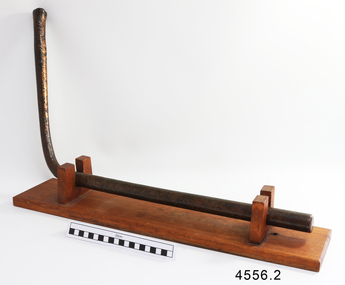
Nail, circa 1810
... iron nails. Towards the end of the 18th century the British Navy trialled the use of copper nails, finding them to be very successful. Merchant...iron nails. Towards the end of the 18th century the British Navy trialled the use of copper nails, finding them to be very successful. Merchant ...This copper nail, sometimes known as a ‘Dumpy Bolt’ or spike, was salvaged from the hull of the wreck of the “George III”. It dates back to at least 1810. It was found by an abalone diver on the south east coast of Tasmania. The nail would have been used to hold the layers of the ship’s keel frame and the planking together. The nail has been passed from the abalone diver to an interested business man on a trip to the south of Hobart, on again to the business man’s close friend who then donated it to Flagstaff Hill Maritime Village. The metal of nails such as this one, after being in the sea for a long time, become affected by the natural reaction of the sea water, causing it to degenerate and thin, and the stress from the force of the sea over the years alters its shape. Iron nails had been used on ships previously, but they quickly corroded in the salt; ships needed regular, costly and time-consuming maintenance to replace the iron nails. Towards the end of the 18th century the British Navy trialled the use of copper nails, finding them to be very successful. Merchant ships began to adopt this process in the early 19th century, although it made ship building very expensive and was more often used for ships such as the “George III” that sailed on long voyages. The three masted sailing ship “George III” was a convict transport ship built in Deptford, England, in 1810. On 14th December 1834 she left Woolwich, England, bound for Hobart Town, Van Diemen’s Land (Tasmania), under Captain William Hall Moxey. She was carrying 220 male convicts plus crew, guards and their families, totalling 294 persons (another 2 were during the voyage). Amongst the cargo were military stores including several copper drums of gun powder. On 27th January 1835 the “George III” was near the Equator, about half way into her journey. A fire broke out and the gun powder was in danger of explosion, threatening the whole ship. Two convicts braved the heat and smoke, entered the store and seized the gun powder drums, suffering burns for their efforts but saving a probable disaster. The fire destroyed some of the provisions and food was scarce. Many became ill with scurvy and some died during the journey. Nearing the end of their journey on 10th April 1835 the “George III” was headed through the D'Entrecasteaux Channel, south east Tasmania, between the mainland and Bruny Island. She was sailing in the moonlit night to hasten her arrival in port due to the great number of sick on board. She struck uncharted rocks, known only to the local whalers, between Actaeon Reef and Southport Lagoon and within hours began to break up. The ship’s boats were used to first rescue the women and children. Firearms were used to help quell the panic of the convicts below decks and some were killed by the shots. Many convicts, including the sick, were drowned. In all, 133 lives were lost including 5 of the crew, guards and their families. It was the third worst shipping disaster in Tasmanian waters. A monument in honour of the prisoners who perished in the “George III” has been erected, noting the date of the wreck as “Friday 10th April 1835.” (NOTE: there are a few differences between sources regarding dates of the shipwreck, some saying March and others April 1835. There are also differences in the figures of those on board and the number of lives lost.) The copper nail is significant as an example of sailing ship construction; fasteners used in the early 19th century on ships carrying convicts to Australia. The nail is also significant for its association with the ship “George III”. The “George III” is registered on the Australian National Shipwreck Database, ID 7195 as an Historic Shipwreck. She is the third worst shipwreck in Tasmanian waters. She is also associated with Early Australian History and the transportation of convicts to Australia. The incident of the fire on board and the bravery of the convicts in making the gun powder safe is an example of the social character of the people in early Tasmanian colonisation. Copper nail (also called a Dumpy bolt or spike) from the convict ship George III, wrecked in 1835. Nail is long, bent in an ‘L’ shape about 3/5ths along, tapering from both ends to the bend. Both ends are flat and do not taper to a point, nor have a thread. The shorter end has been polished, showing bright copper. There is pitting along the nail and virdigris is evident on the longer, unpolished end. The nail is displayed with the longer section resting on a wooden board between two ‘U’ shaped uprights, the shorter section upright. flagstaff hill, warrnambool, shipwrecked coast, flagstaff hill maritime museum, maritime museum, shipwreck coast, flagstaff hill maritime village, great ocean road, george iii, ship construction, ship nail, 1835 shipwreck, 19th century shipwreck, william moxey, d'entrecasteaux channel, convict transportation, copper nail, dumpy bolt, spike, keel nail -
 Flagstaff Hill Maritime Museum and Village
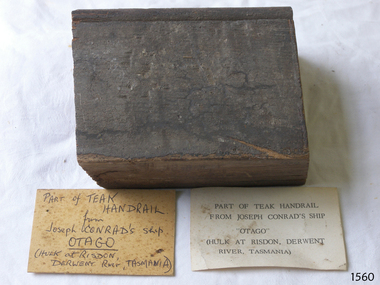
Souvenir - Wood Sample, Alexander Stephen and Sons, 1869
... merchant ship...cargo ship...hulk...1869 ship...iron...The barque Otago 1869-1931 - The iron-hulled 3-masted barque Otago was built in Glasgow by Alexander Stephen & Sons Ltd, Kelvinhaugh, as a merchant ship and launched in 1869. ...The barque Otago 1869-1931 - The iron-hulled 3-masted barque Otago was built in Glasgow by Alexander Stephen & Sons Ltd, Kelvinhaugh, as a merchant ship and launched in 1869. ...This teak wood sample was part of a handrail from the wreck of the barque Otago. The barque Otago 1869-1931 - The iron-hulled 3-masted barque Otago was built in Glasgow by Alexander Stephen & Sons Ltd, Kelvinhaugh, as a merchant ship and launched in 1869. The vessel changed hands several times in the late 19th century after being sold to an Australian firm in 1871. During one of its voyages, the captain died while the ship was in port at Bangkok. Marine author Joseph Conrad was on board and, being a qualified captain, he took command and continued the journey to Sydney and Mauritius. It was the only ship he ever commanded. In 1903, the Melbourne shipping company Huddart, Parko & Co., purchased the Otago and converted it to serve as a coal hulk for use in Sydney. The Otago was later sent to Hobart, Tasmania, where it continued as a hulk until 1931. It was sold for scrap and eventually abandoned on the banks of the Derwent River at a place now known as Otago Bay, opposite Conrad Drive, Otago. The outline of the hull is still visible, and a nearby plaque tells the story. There are other vessels also named Otago, one of which was built in the same year. Joseph Conrad (1857-1927): - Polish-born Joseph Conrad became a British subject in 1886. He was a renowned marine fiction writer and, for a short time, a mariner and Captain. As a 13-year-old boy, Joseph Conrad desired to be a sailor. At 19, he joined the British merchant marine, working in several roles. He eventually qualified as a captain but only served in this role once: from 1888 to 1889, when he commanded the barque Otago, taking over from the deceased captain and completing the ship’s journey from Sydney to Mauritius. In 1889, he began writing his first novel, Almayer’s Folly. He retired from life as a mariner in 1894, aged 36. Conrad’s affection for Australia and his visits to Australia from 1878 to 1982 were later commemorated by a plaque in Circular Quay, Sydney. Conrad continued as an author; some characters in his books were said to be inspired by his maritime experiences and the people he had met. By the end of his life, he had completed 19 novels, stories, and essays, plus one incomplete novel, Suspense, which was finished and published posthumously. In 1924, Prime Minister Ramsay MacDonald offered Conrad a knighthood for his work, but he declined. There is an 1882 sailing ship named the Joseph Conrad, after the author, that is now preserved at the Mystic Seaport Maritime Museum in the USA as part of the fleet of historic ships, used as an exhibit and a training ship. The Danish square-rigged training ship was originally named Georg Stage but was renamed by marine author Alan Villiers when he bought it in 1934. The wood sample from the Otago is significant for its association with renowned marine author Joseph Conrad, who had once commanded the vessel; it was his only command as Captain and was known as Joseph Conrad's Otago. The maritime connection with Conrad extends to items in the collection, including some of his maritime novels based on his first-hand knowledge, a wooden ship model of a ship named after him, and a navigation chart of Otago Harbour. The sample of teak is significant as an example of materials used in the construction of the 1869 iron-hulled sailing ship, built in Glasgow, Scotland, specifically for use to sail across the world with cargo to trade between the colonies including Australian ports. Wood sample; a rectangular section of a teak wood handrail that has a bead planed along one side. Two cards with the sample have inscriptions, one handwritten and one typed. The sample is from the wreck of the barque Otago, once under the command of Captain Joseph Conrad. Handwritten on a card, and typed on another card: "PART OF TEAK HANDRAIL / from / Joseph CONRAD'S ship / OTAGO / (HULK at RISDON, DERWENT River, TASMANIA)flagstaff hill, flagstaff hill maritime museum and village, warrnambool, maritime museum, maritime village, great ocean road, shipwreck coast, joseph conrad, joseph conrad's ship, captain joseph conrad, otago, barque otago, merchant ship, cargo ship, hulk, 1869 ship, iron hull, sailing ship, handrail, fitting, souvenir, wood sample, teak, new zealand, sydney, newcastle, tasmania, hobart, derwent river, otago harbour, otago bay, conrad drive, 19th century, mauritius, marine author, marine novel, alex villiers, georg stage -
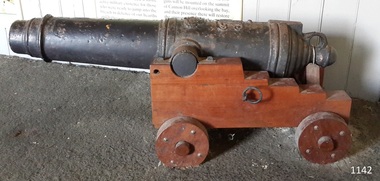 Flagstaff Hill Maritime Museum and Village
Weapon - Carronade
... History: The carronade was designed as a short-range naval weapon with a low muzzle velocity for merchant ships, but it also found a niche role on warships. It was produced by the Carron iron works and was at first sold as a complete system with the gun, mounting, and shot altogether. ...History: The carronade was designed as a short-range naval weapon with a low muzzle velocity for merchant ships, but it also found a niche role on warships. It was produced by the Carron iron works and was at first sold as a complete system with the gun, mounting, and shot altogether. ...This deck cannon is believed to be a replica Carronade as it has no foundry mark, year of manufacture, proof marks or weight of carronade on it. However, its design matches the design of Carronades used in the early to mid 19th century. History: The carronade was designed as a short-range naval weapon with a low muzzle velocity for merchant ships, but it also found a niche role on warships. It was produced by the Carron iron works and was at first sold as a complete system with the gun, mounting, and shot altogether. Carronades initially became popular on British merchant ships during the American Revolutionary War. A lightweight gun that needed only a small gun crew and was devastating at short range was well suited to defending merchant ships against French and American privateers. Its invention is variously attributed to Lieutenant General Robert Melville in 1759, or to Charles Gascoigne, manager of the Carron Company from 1769 to 1779. In its early years, the weapon was sometimes called a "mellvinade" or a "gasconade". The carronade can be seen as the culmination of a development of naval guns reducing the barrel length and thereby the gunpowder charge. The Carron Company was already selling a "new light-constructed" gun, two-thirds of the weight of the standard naval gun and charged with one-sixth of the weight of the ball in powder before it introduced the carronade, which further halved the gunpowder charge. The theory of its design was to use less powder and had other advantages that were advertised in the company's sales pamphlet of the time, state. The smaller gunpowder charge reduced the barrel heating in action, also reduced the recoil. The mounting, attached to the side of the ship on a pivot, took the recoil on a slider, without altering the alignment of the gun. The pamphlet advocated the use of woolen cartridges, which eliminated the need for wadding and worming, although they were more expensive. Carronades also simplified gunnery for comparatively untrained merchant seamen in both aiming and reloading that was part of the rationale for adopting the gun. Other advantages promoted by the company were. The replacement of trunnions by a bolt underneath, to connect the gun to the mounting, reduced the width of the carriage that enhanced the wide angle of fire. A merchant ship would almost always be running away from an enemy, so a wide-angle of fire was much more important than on a warship. A carronade weighed a quarter as much as a standard cannon and used a quarter to a third of the gunpowder charge. This reduced charge allowed Carronades to have a shorter length and much lighter weight than long guns. Increasing the size of the bore and ball reduces the required length of the barrel. The force acting on the ball is proportional to the square of the diameter, while the mass of the ball rises by the cube, so acceleration is slower; thus, the barrel can be shorter and therefore lighter. Long guns were also much heavier than Carronades because they were over-specified to be capable of being double-shotted,(to load cannons with twice the shot, for increased damage at the expense of range). Whereas it was dangerous to do this in a carronade. A ship could carry more carronades, or carronades of a larger caliber, than long guns, and carronades could be mounted on the upper decks, where heavy long guns could cause the ship to be top-heavy and unstable. Carronades also required a smaller gun crew, which was very important for merchant ships, and they were faster to reload. Additional notes: Cannon cast in England, Wales and Scotland had their imperial weight chiselled or engraved in the format of 4-2-0 on the bottom of the cascabel, indicating the weight of the cannon as 4 hundredweight, 2 quarters and 0 pounds. Since a hundredweight equals 112 pounds and a quarter weight is 28 pounds the total weight is 504 pounds or about 228 kilograms. The small bore replica carronade and carriage is part of a collection of nineteenth Century Flagstaff Hill Guns and cannons, and is a representation of carronades used from the early 18th up to the 1850s on merchant and military ships particularly the British Royal Navy until 1850. This example is not significant in the historic sense but demonstrates the type of artillery used aboard vessels of the time for protection & offensive military actions. Cannon, cast iron, small smooth bore cannon on the stepped wooden carriage with wooden wheels. It appears to fire a 12-pound cannonball. The Cannon barrel can have its elevation adjusted via a sliding sloped block at the rear of the cannon. Gun carriage has loops for locating and holding the carriage in position with the use of ropes. It is believed this carronade is a replica of a mid-to-late 19th-century Carronade cannon.Cast into metal; [Royal emblem of Queen Victoria (VR "Victoria Regina")]warrnambool, flagstaff-hill, flagstaff-hill-maritime-museum, maritime-museum, shipwreck-coast, flagstaff-hill-maritime-village, cannon, naval cannon, cannon on carriage, 19th century cannon, fortifications, smooth bore cannon, 12 pounder, carronade, artillery, replica, deck cannon, cannon in carriage, ship cannon -
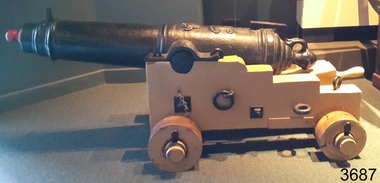 Flagstaff Hill Maritime Museum and Village
Weapon - Carronade, 1840
... The carronade was designed as a short-range naval weapon with a low muzzle velocity for merchant ships, but it also found a niche role on warships. It was produced by the Carron Iron Works and was at first sold as a complete system with the gun, mounting, and shot altogether. ...The carronade was designed as a short-range naval weapon with a low muzzle velocity for merchant ships, but it also found a niche role on warships. It was produced by the Carron Iron Works and was at first sold as a complete system with the gun, mounting, and shot altogether. ...The carronade was designed as a short-range naval weapon with a low muzzle velocity for merchant ships, but it also found a niche role on warships. It was produced by the Carron Iron Works and was at first sold as a complete system with the gun, mounting, and shot altogether. Carronades initially became popular on British merchant ships during the American Revolutionary War. A lightweight gun that needed only a small gun crew and was devastating at short range was well suited to defending merchant ships against French and American privateers. The invention of the cannon is variously attributed to Lieutenant General Robert Melville in 1759, or to Charles Gascoigne, manager of the Carron Company from 1769 to 1779. In its early years, the weapon was sometimes called a "mellvinade" or a "gasconade". The carronade can be seen as the culmination of a development of naval guns reducing the barrel length and thereby the gunpowder charge. The Carron Company was already selling a "new light-constructed" gun, two-thirds of the weight of the standard naval gun and charged with one-sixth of the weight of the ball in powder before it introduced the carronade, which further halved the gunpowder charge. The theory of its design was to use less powder and had other advantages that were advertised in the company's sales pamphlet of the time, state. The smaller gunpowder charge reduced the barrel heating in action, also reduced the recoil. The mounting, attached to the side of the ship on a pivot, took the recoil on a slider, without altering the alignment of the gun. The pamphlet advocated the use of woollen cartridges, which eliminated the need for wadding and worming, although they were more expensive. Carronades also simplified gunnery for comparatively untrained merchant seamen in both aiming and reloading that was part of the rationale for adopting the gun. Other advantages promoted by the company were. The replacement of trunnions by a bolt underneath, to connect the gun to the mounting, reduced the width of the carriage that enhanced the wide angle of fire. A merchant ship would almost always be running away from an enemy, so a wide-angle of fire was much more important than on a warship. A carronade weighed a quarter as much as a standard cannon and used a quarter to a third of the gunpowder charge. This reduced charge allowed Carronades to have a shorter length and much lighter weight than long guns. Increasing the size of the bore and ball reduces the required length of the barrel. The force acting on the ball is proportional to the square of the diameter, while the mass of the ball rises by the cube, so acceleration is slower; thus, the barrel can be shorter and therefore lighter. Long guns were also much heavier than Carronades because they were over-specified to be capable of being double-shotted, (to load cannons with twice the shot, for increased damage at the expense of range), whereas it was dangerous to do this in a carronade. A ship could carry more carronades, or carronades of a larger calibre, than long guns, and carronades could be mounted on the upper decks, where heavy long guns could cause the ship to be top-heavy and unstable. Carronades also required a smaller gun crew, which was very important for merchant ships, and they were faster to reload. The small bore carronade and carriage is part of a collection of nineteenth Century Flagstaff Hill Guns and Cannon, which is classified as being of significance and was made a few years after the beginning of Queen Victoria's reign in 1837 and fires a 6 lb pound cannon ball. This nineteenth century artillery piece is a rare and representative item of artillery of this era, used predominately on ships, both military and merchant. The artillery piece, individually and as part of the collection, is highly significant for its historical, scientific and aesthetic reasons at the state, national and world level. This carronade represents the methods of artillery technology, its advancement and its modifications to suit dangerous situations that sailors encountered from attacks from free booters (pirates, living from plunder) or others at the time. Carronade firing a 6 lb cast iron ball, with a smooth bore barrel 6.5 cm in dia the item is mounted on stepped wooden carriage with wooden wheels. Cannon barrel can have its elevation adjusted via a wooden wedge. Gun carriage has loops for locating and holding in position to a deck by ropes. Carriage is a replica made 1982Cast into the barrel is the royal emblem of Queen Victoria (VR "Victoria Regina") indicating the carronade was cast during Queen Victoria's reign / 1840 & 4-2-0 denoting the weight of the barrel. Right hand trunnion has a serial number “8708”. Also on top of the barrel is the British "Board of Ordinance" identifying mark a broad arrow indicating the carronade was in military use. flagstaff hill, warrnambool, shipwrecked coast, flagstaff hill maritime museum, maritime museum, shipwreck coast, flagstaff hill maritime village, great ocean road, colonial defences, victoria’s coastal defences, warrnambool fortification, warrnambool garrison battery, warrnambool volunteer corps, ordinance, armaments, garrison gun, smooth bore cannon, carronade, black powder, 12 pounder, 1840, artillery, lieutenant general robert melville, charles gascoigne, carron company, mellvinade, gasconade -
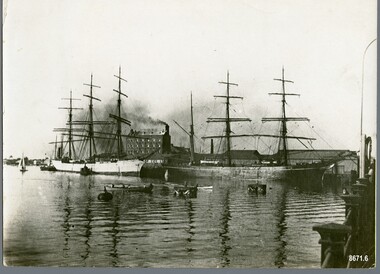 Flagstaff Hill Maritime Museum and Village
Photograph - Vessels, Sailing Ships, Circa 1910 - 1913
... It was an iron barque of 945 tons, built at Sunderland in 1877 by Osbourne, Graham and Company. On October 18th 1916, the Lobo (owned by Walter and Morris, timber merchants) was on a voyage from Parapato (Mozambique) to New York with a cargo of mango bark and ebony, when it struck rocks and ran aground 30 miles east of the Angoche River in Portuguese East Africa. ...It was an iron barque of 945 tons, built at Sunderland in 1877 by Osbourne, Graham and Company. On October 18th 1916, the Lobo (owned by Walter and Morris, timber merchants) was on a voyage from Parapato (Mozambique) to New York with a cargo of mango bark and ebony, when it struck rocks and ran aground 30 miles east of the Angoche River in Portuguese East Africa. ...This photograph was one of ten photographs donated to Flagstaff Hill Maritime Museum and Village by Fred Trewartha. Frederick John Fox Trewartha (Fred) was a well-known Warrnambool businessman. He was born in Beeac near Geelong in 1920 and came to Warrnambool with his family as a very young child. He was apprenticed to his father John, as a saddler and later opened his own shop on Raglan Parade. He then moved into working with tarpaulins and canvases for the trucking industry. Fred was keenly interested in photography (and was a member of the Warrnambool Cine Club), yachting and boat building. He kept his yacht moored at Port Fairy for many years and participated in sailing events locally and interstate. He also built boats with his sons. He had the opportunity to meet many older sailors and it's thought this photo (and others in the set) may have been given to him by one of these men. Fred Trewartha died in 2016 in Warrnambool. There is some conflict re the identity of the ship in the foreground of this photograph. It has been identified as the "Dimsdale" by the original owner of this photograph and by the website "Photos of the Past" which have an identical copy of the photo, however the State Library of South Australia (who also have an identical copy of the photograph) have identified the date of the photograph as 1910 and the ship as the "Ainsdale". The "Dimsdale" and the "Lobo" were recorded several times in the local shipping news as being docked at the Port of Adelaide, at the same time, during the years 1912 and 1913, whereas the "Ainsdale" wasn't in Adelaide very often but was recorded as coming in and out of the Port of Adelaide in the years 1915 and 1916. On February 25th 1916, the two ships (the "Ainsdale" and "Lobo") were both in the Port of Adelaide at the same time, but the "Ainsdale" was loading at Outer Harbor and the "Lobo" was discharging timber at Corporation Wharf. The "Ainsdale" was owned by the same firm that had owned the "Dimsdale". The Dimsdale was a three masted steel ship built in 1890 by C. J. Bigger of Londonderry. It became notorious when it struck the Wonga Shoal lighthouse near Port Adelaide on the night of 17th November 1912, destroying the structure and killing two lighthouse keepers. The accident was investigated by the Marine Board, the Coroner, the Police Court, the Admiralty Court and by the Criminal Courts of South Australia where the Captain (John Jones) was charged with manslaughter and found "not guilty". The Dimsdale was sold to a Norwegian firm and its name was changed to "Kwango". It sank in 1915 near the Magdalen Islands in the Gulf of St. Lawrence. The "Lobo" was a well known "windjammer" trading from the Port of Adelaide to other parts of the world. For a number of years it was employed in the New Zealand and Tasmanian services, after which it made several voyages to North America. It was an iron barque of 945 tons, built at Sunderland in 1877 by Osbourne, Graham and Company. On October 18th 1916, the Lobo (owned by Walter and Morris, timber merchants) was on a voyage from Parapato (Mozambique) to New York with a cargo of mango bark and ebony, when it struck rocks and ran aground 30 miles east of the Angoche River in Portuguese East Africa. A detailed account of the incident, written by Mrs Murchison (the Captains wife who was on board with her two year old son) was published in the Adelaide newspaper "The Mail" on Saturday 9th December 1916. She, and several of the crew were put in a boat early in the morning and sent away from the wreck. Several hours later, they were joined by Captain Murchison and the remainder of the crew. They were in their small open boats for several hours before landing on a small uninhabited island where they remained for several days before being picked up by another vessel and taken back to Parapato. The captain was able to obtain a position on a steamer which took him and his wife and child back to England.This photograph is significant as a record of the world wide mercantile trade Australia was engaged in at the end of the nineteenth century and beginning of the twentieth century and as a record of the dangers faced by the crews of these ships.A black and white photograph showing two large sailing ships moored at a dock. There are industrial buildings in the background (one has smoke coming from its chimney) and several smaller craft (a rowing boat, two small boats that may be tugs and a little yacht) at the side of the ships. Pylons can be seen in the water and a metal fence is in the bottom right corner. On the back of the photo the words "Ship Dimsdale" and "Bk Lobo" are written diagonally across the top left corner in pencil. A beige paper label has been attached to the top right corner with the words "Dimsdale at Port Adelaide" and "Port Adelaide Historical Society may be interested" written in black ballpoint pen."Ship Dimsdale" / "Bk Lobo" ""Dimsdale" / at Port Adelaide" "- Port Adelaide Historical /Society may be / interested"warrnambool, dimsdale, lobo, barque lobo, port of adelaide, kwango, wonga shoal lighthouse, fred trewartha, ainsdale, frederick john fox trewartha, captain john jones, windjammer, iron barque, parapato
