
Showing 105 items matching " lamp cover"
-
 Embroiderers Guild, Victoria
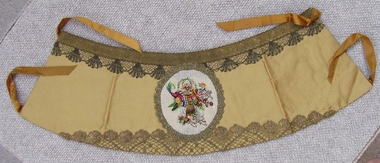
Textile - Petit Point And Gold Lace Lampshade, Baroness Viola, c. 1900
... ... Lamp cover...Embroidery Furnishings Canvas work Lamp cover Mid European bird floral flowers Gold silk fabric with matching ribbon ties, trimmed with gilt handmade lace from the village of Tazovitz. ...Belonged to the Baroness Felicitas Wiedersperger of Tazvitz. The embroidery was worked by her sister, the Baroness Viola.Gold silk fabric with matching ribbon ties, trimmed with gilt handmade lace from the village of Tazovitz. Oval canvas, motif in petit point at the front. Lining is bright yellow cotton.embroidery, furnishings, canvas work, lamp cover, mid european, bird, floral, flowers -
 Parks Victoria - Point Hicks Lightstation
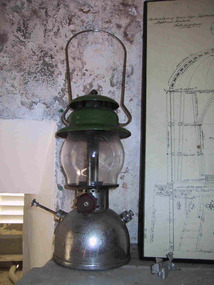
Lamps, kerosene
... PHLS0008.1 & PHLS0008.2 Pressurised kerosene lamp, cover over glass is made of green enamelled metal. ...PHLS0008.1 & PHLS0008.2 Pressurised kerosene lamp, cover over glass is made of green enamelled metal. ...The two hand-held, portable kerosene lamps each have green enamel caps over the glass. They were used from around the 1930s until 1993, and one is now located on the groundfloor level of the lighthouse and the other is in the assistant lightkeeper’s quarters. The brand name of the Point Hicks lamp, while not stated is probably Coleman, Tilley or Austramax, which were all similarly made, portable pressurised kerosene lamps. Coleman brand pressure lamps and lanterns were first made in about 1905 by American, William Coleman, and their English competitor was the firm, Tilley. The Australian company Austramax began manufacturing kerosene pressure lamps in Brunswick in 1946, making the bases and the workings by hand, turning out 1000s of lamps each week. Portable lamps were used worldwide where bright light was needed and they became essential as an emergency back-up source of light for the lightstation as well as the lantern room. Through the multiplication of light by the lighthouse lenses, they could provide a tower with a 26 nautical mile range. Lamps similar to the two Point Hicks examples can be found at Gabo Island, one of which is a green enamelled Austramax lamp; Cape Nelson (Austramax), and similar lamps are held at Cape Schanck and Cape Otway. The two Point Hicks lamps have first level contributory significance for their historic value and provenance, and as representative examples of lamps that were widely used in Australian lightstations between the 1930s and 1960s.PHLS0008.1 & PHLS0008.2 Pressurised kerosene lamp, cover over glass is made of green enamelled metal. -
 University of Melbourne, School of Chemistry
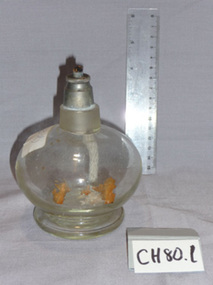
Spirit Lamp
... Old methylated spirit lamp (without cover)...Old methylated spirit lamp (without cover) Spirit Lamp ...l. Old methylated spirit lamp (without cover) -
 Flagstaff Hill Maritime Museum and Village
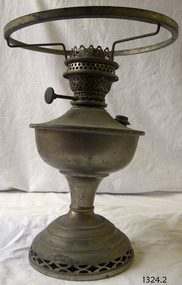
Lamp
... Label attached R 12 x A "ORAC" inscribed on burner control. Removable Lamp cover. Filler cap engraved "Wick Patent 19267/24 Trimmer" ....Label attached R 12 x A "ORAC" inscribed on burner control. Removable Lamp cover. Filler cap engraved "Wick Patent 19267/24 Trimmer" . ...Lamp base, metal with removable lamp-holder. Label attached R 12 x A "ORAC" inscribed on burner control. Removable Lamp cover. Filler cap engraved "Wick Patent 19267/24 Trimmer" .flagstaff hill, warrnambool, shipwrecked-coast, flagstaff-hill, flagstaff-hill-maritime-museum, maritime-museum, shipwreck-coast, flagstaff-hill-maritime-village -
 Friends of Westgarthtown
Domestic object - Lamp, paraffin
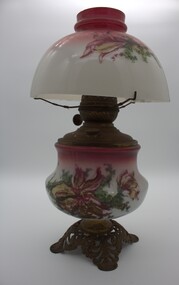
... Pink and white base colours on glass, with floral pattern printed on both sides of lamp. Cover a semi-circular shape with round neck opening on top....Pink and white base colours on glass, with floral pattern printed on both sides of lamp. Cover a semi-circular shape with round neck opening on top. ...Table lamp with tubular wick, paraffin. Cast brass decorative base with four feet, cast brass interior and burner, with glass exterior and covering. Pink and white base colours on glass, with floral pattern printed on both sides of lamp. Cover a semi-circular shape with round neck opening on top.… Success…' (some words unreadable) embossed on burner platelighting, kerosene & oil, table lamp, brass, glass, paraffin, floral -
 Mont De Lancey
Lamp shade, c1940
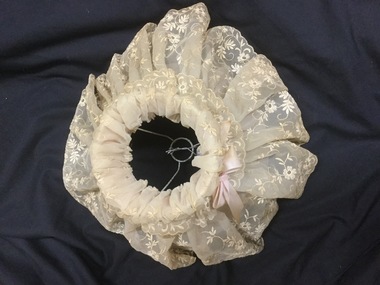
... Round cream lace covered lamp shade with floral design. Ribbon trimming....Almeda Bell lampshades lighting equipment Round cream lace covered lamp shade with floral design. Ribbon trimming. ...Owned by Mrs. Almeda BellRound cream lace covered lamp shade with floral design. Ribbon trimming.lampshades, lighting equipment -
 Mont De Lancey
Functional object - Lamp - Kerosene
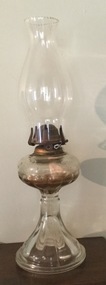
... Clear glass lamp with fluted top cover and double bulged stand...Russell Sebire. kerosene lamps lamps Clear glass lamp with fluted top cover and double bulged stand Functional object Lamp - Kerosene ...Russell Sebire.Clear glass lamp with fluted top cover and double bulged standkerosene lamps, lamps -
 Wodonga & District Historical Society Inc
Functional object - Railway Signal Lamp, 1901
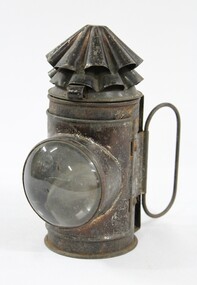
... There is an oval plate with an embossed inscription on the proper left side of the lamp that is partly covered by the door at the front which holds the clear glass lens. ...There is an oval plate with an embossed inscription on the proper left side of the lamp that is partly covered by the door at the front which holds the clear glass lens. ...These types of metal and glass railway signal lamps were used for communication, safety and lighting by train guards, shunters and signalmen, as well as station staff in the late 1880s to the early 1900s. They were hand operated and used fuel such as kerosene.The railway signal lamp has local significance as part of a set of three lamps donated by a resident of Wodonga who worked for the Victorian Railways. It also has national significance as an example of communication and safety equipment used by the railways in Australia in the late 19th century and early 20th century.Black painted metal signal lamp with a clear glass lens secured at the front and one thin elongated oval shaped handle showing at the back. The metal appears to be tin plated iron under the black paint layer. There is an oval plate with an embossed inscription on the proper left side of the lamp that is partly covered by the door at the front which holds the clear glass lens. The inscription includes the date 1901."...NARIPPINGILLE STOVE / CO LTD 1901 / PATENT...S & / ...NUFACTURERS / RMINGHAM" on an oval shaped plate on the proper left side, which is partly covered by the door with the clear glass lens.railways wodonga, victorian railways -
 Flagstaff Hill Maritime Museum and Village
Functional object - Glass Lens, 1886-1908
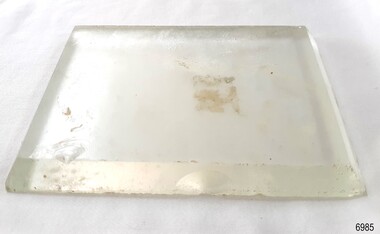
... Its purpose is unknown but could have been a clock face cover, a lamp or torch lens or even the lens from underwater equipment. ...Its purpose is unknown but could have been a clock face cover, a lamp or torch lens or even the lens from underwater equipment. ...This glass lens was recovered from the wreck of the Falls of Halladale. Its purpose is unknown but could have been a clock face cover, a lamp or torch lens or even the lens from underwater equipment. The FALLS of HALLADALE 1886 - 1908- The sailing ship Falls of Halladale was an iron-hulled, four-masted barque, used as a bulk carrier of general cargo. She left New York in August 1908 bound for Melbourne and Sydney. In her hold was general cargo consisting of roof tiles, barbed wire, stoves, oil, benzene, and many other manufactured items. After three months at sea and close to her destination, a navigational error caused the Falls of Halladale to be wrecked on a reef off the Peterborough headland on the 15th of November, 1908. The captain and 29 crew members survived, but her cargo was largely lost, despite two salvage attempts in 1908-09 and 1910. The Court of Marine Inquiry in Melbourne ruled that the foundering of the ship was entirely due to Captain David Wood Thomson's navigational error, not too technical failure of the Clyde-built ship. The Falls of Halladale was built in1886 by Russell & Co., at Greenock shipyards on the River Clyde, Scotland for Wright, Breakenridge & Co of Glasgow. The ship had a sturdy construction built to carry maximum cargo and was able to maintain full sail in heavy gales, one of the last of the 'windjammers' that sailed the Trade Route. She and her sister ship, the Falls of Garry, were the first ships in the world to include fore and aft lifting bridges. The new raised catwalk-type decking allowed the crew to move above the deck in stormy conditions. This glass lens is significant for its association with the wreck of the sailing ship the Falls of Halladale. The Falls of Halladale shipwreck is listed on the Victorian Heritage (No. S255). She was one of the last ships to sail the Trade Routes from Europe and the Americas. Also of significance is that the vessel was one of the first ships to have fore and aft lifting bridges as a significant safety feature still in use on modern vessels today. The subject model is an example of an International Cargo Ship used during the 19th and early 20th centuries to transport goods around the world and represents aspects of Victoria’s shipping industry. Glass lens; transparent glass rectangle with bevelled edges. It was recovered from the wreck of the Falls of Halladale. flagstaff hill, warrnambool, flagstaff hill maritime museum and village, shipwreck coast, great ocean road, shipwreck artefact, falls of halladale, glass lens, rectangular lens, glass cover -
 Federation University Historical Collection
Book, Diary of R.W. Richards, c1960
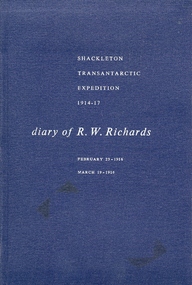
... lamps on the paper. Heather was told that Dick Richards only started keeping the diary when ther became a chance the Ross Sea Shore Party may not survive. Heather remembered Dick Richards affectionately - he always carried a pipe and called her 'girlie'. ballarat school of mines dick richards r.w. richards antarctica shackleton heather durant diary bookplate ballarat school of mines bookplate scott's hut richard W. Richards Bookplate inside cover ...Dick Richards was a member of the Shackleton Trans Antarctic Expedition Ross Sea Shore Party. He later became Principal of the Ballarat School of Mines. The text for this book was typed by Ballarat School of Mines librarian Heather Durant, who remembered that at times it was difficult to read the writing due to whale blubber oil from the lamps on the paper. Heather was told that Dick Richards only started keeping the diary when ther became a chance the Ross Sea Shore Party may not survive. Heather remembered Dick Richards affectionately - he always carried a pipe and called her 'girlie'.Blue hard covered book of 14 pages. It is the verbatim copy of the diary kept by Dick Richards from 23 February 1916 to 19 March 1918, during the Shackleton trans-antarctic Expedition 1914-17.Bookplate inside cover - "Ex Libris School of Mines and industries. Presented by Mr R.W. Richards"ballarat school of mines, dick richards, r.w. richards, antarctica, shackleton, heather durant, diary, bookplate, ballarat school of mines bookplate, scott's hut, richard w. richards -
 Flagstaff Hill Maritime Museum and Village
Functional object - Lamp, Mid-20th century
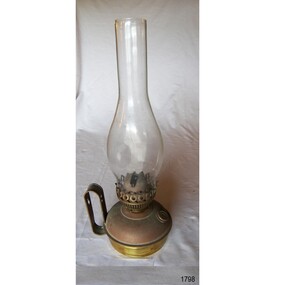
... Kerosene lamp with electro-plated tank and handle and shaped glass cover. The handle has holes for attachment to a wall bracket. ...Warrnambool Shipwreck Coast Flagstaff Hill Flagstaff Hill Maritime Museum Flagstaff Hill Maritime Village lamp lighting kerosene lamp wall mounted model lamp Kerosene lamp with electro-plated tank and handle and shaped glass cover. The handle has holes for attachment to a wall bracket. ...The kerosene lamp was one of the most common oil lamps used and was manufactured until the 1980s. This lamp is a wall-mounted model made in the likeness of a Victorian era lamp. The lamp is an example of a 19th and early 20th-century kerosene lamp that used kerosene for fuel. It has the option of being wall-mounted or used on a flat surface.Kerosene lamp with electro-plated tank and handle and shaped glass cover. The handle has holes for attachment to a wall bracket. warrnambool, shipwreck coast, flagstaff hill, flagstaff hill maritime museum, flagstaff hill maritime village, lamp, lighting, kerosene lamp, wall mounted model lamp -
 Flagstaff Hill Maritime Museum and Village
Domestic object - Lamp, Valor Co. Ltd, 1920-1936
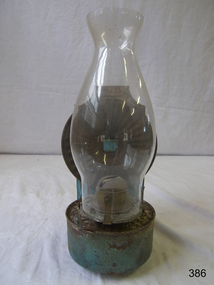
... Kerosene lamp; blue painted metal fuel can and metal rear reflector support. and a round corrugated reflector at the rear. The mid-section wick is made of brass. The glass cover...Ltd V inside a clover Veritas British made lamp reflector lighting lamp The Valor Company Ltd Trademark; "[clover symbol] surrounding a "V" Stamp: "BRITISH MADE" Marked on adjusting device: "English Made 1 in w" Marked on support of deflector shield - "British Made" and symbol Kerosene lamp; blue painted metal fuel can and metal rear reflector support. and a round corrugated reflector at the rear. The mid-section wick is made of brass. The glass cover ...This trade mark (V inside a clover) was German. It was used by the lamp makers Veritas Efsca Works in Birmingham, and for a time by Valor Co. Ltd. which took over Veritas. Valor Co. Ltd. was established in Birmingham in 1890 and produced oil containers for the Anglo-American Oil Com. In 1901 the firm advertised themselves as Stampers And Pieces. Later it was named 'The Valor Co. and was associated with the Aston Brass Co., and advertised as makers of oil lamps and stoves. Valor became a maker of oil heaters cookers and many other products that were fueled by oil. Later it sold gas heaters and ovens. In 1936 Valor Co. Ltd. was made a Public Company and operated under the name The Velor Company Ltd. The company changed names over the years and it was still operating under Velor Fires in January 2002.Oil or kerosene lamps were the means of lighting for homes, farms and industry in the late 19th and early-to-mid 20th centuries. Lamps like these were important as Lighthouse Keepers and Assistant Keepers' equipment. They were in common use in until the lighting was powered by gas and electricity. The reflector at the back of the lamp makes it of greater significance as most lamps don't have this feature. The logo is also interesting as it originated in Germany and was used with permission by a British company and the company that brought it out for a short time. Similar lamps are still available today, usually with gas for fuel. Kerosene lamp; blue painted metal fuel can and metal rear reflector support. and a round corrugated reflector at the rear. The mid-section wick is made of brass. The glass cover or chimney is bulbous in shape. Inscriptions include a trademark "V" inside a clover. It is British-made in Birmingham by either Veritas Efsca Works or Veritas Valor.Trademark; "[clover symbol] surrounding a "V" Stamp: "BRITISH MADE" Marked on adjusting device: "English Made 1 in w" Marked on support of deflector shield - "British Made" and symbolwarrnambool, shipwreck coast, flagstaff hill, flagstaff hill maritime museum, flagstaff hill maritime village, oil lamp, table lamp, kerosene lamp, valor co. ltd, v inside a clover, veritas, british made, lamp reflector, lighting, lamp, the valor company ltd -
 Flagstaff Hill Maritime Museum and Village
Lamp
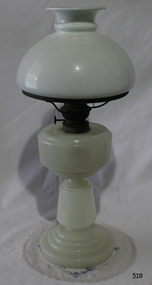
... Kerosene lamp with ceramic base and shade. Metal shade holder and glass cover for mantle....flagstaff hill warrnambool shipwrecked-coast flagstaff-hill flagstaff-hill-maritime-museum maritime-museum shipwreck-coast flagstaff-hill-maritime-village Kerosene lamp with ceramic base and shade. Metal shade holder and glass cover for mantle. ...Kerosene lamp with ceramic base and shade. Metal shade holder and glass cover for mantle.flagstaff hill, warrnambool, shipwrecked-coast, flagstaff-hill, flagstaff-hill-maritime-museum, maritime-museum, shipwreck-coast, flagstaff-hill-maritime-village -
 Flagstaff Hill Maritime Museum and Village
Lamp
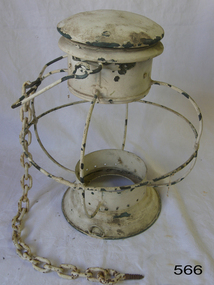
... Flagstaff Hill Warrnambool Shipwrecked-coast Flagstaff-Hill Flagstaff-Hill-Maritime-Museum Maritime-Museum Shipwreck-coast Flagstaff-Hill-Maritime-Village Lantern frame with chain painted white with glass cover and lighting apparatus missing. Lamp ...Lantern frame with chain painted white with glass cover and lighting apparatus missing.flagstaff hill, warrnambool, shipwrecked-coast, flagstaff-hill, flagstaff-hill-maritime-museum, maritime-museum, shipwreck-coast, flagstaff-hill-maritime-village -
 Frankston RSL Sub Branch
Lamp, c. World War 1
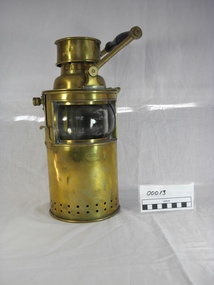
... lamp there is a brass side handle. Immediately to the left of the handle is a rectangular curved view port with brass cover. ...lamp there is a brass side handle. Immediately to the left of the handle is a rectangular curved view port with brass cover. ...Arthur E. Woodley donated the WW1 Military Carbide Signal and General Purpose Lamp to Frankston RSL. It was given to Arthur E. Woodley of Crib Point during the 1960s by Captain Ivan E. Layton MBE who was then the Executive Officer of Melbourne Legacy. During WW2 Ivan Layton was secretary to General Blamey. Ivan Layton died on 15th September, 1979. The carbide workings of the lamp were removed because of corrosion, otherwise it is almost complete.WW1 Military Carbide Signal and General Purpose Lamp which is round and made of brass. The lamp has a latched and hinged brass top. Brass and wood hinged handle with knurled access knob which is situated at the top of the lamp. In between the handle uprights is a round chimney flu which allows heat to escape. Approximately one third down from the top of the lamp there is a brass side handle. Immediately to the left of the handle is a rectangular curved view port with brass cover. Directly opposite the side handle is a convex glass window. Air vents are located at the bottom of the lamp. Inside the top half of the lamp is a chamber which contains the carbide lamp and perpendicular sleeves for the insertion of coloured glass panels. The bottom half of the lamp contains the carbide.Manufacturers Stamp, 'PLAYER & MITCHELL LTD', 'SENTINEL WORKS' 'BIRMINGHAM'ww1, military, brass, lamp, world war 1, round, great war, carbide, signal lamp, player mitchell, birmingham -
 Upper Yarra Museum
Lamp
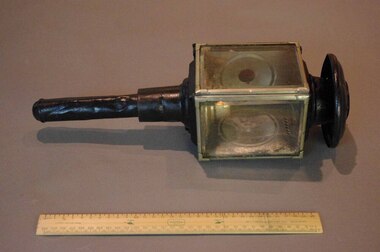
... This removeable light or lantern has 4 sides with 2 oblong bevelled glass panals, 3rd panel is plain with a heat vent and the 4th opens to light the lamp and has a 4.5 cm round red glass which would act as a reflector. The candle holder screws out to allow for a narrow candle to be inserted. It has a black ventilated cover...This removeable light or lantern has 4 sides with 2 oblong bevelled glass panals, 3rd panel is plain with a heat vent and the 4th opens to light the lamp and has a 4.5 cm round red glass which would act as a reflector. The candle holder screws out to allow for a narrow candle to be inserted. It has a black ventilated cover ...http://en.wikipedia.org/wiki/Horse-drawn_vehicle http://www.coyaltix.com/lamps.htmlThe candle light needed to be protected from the wind. This removeable light or lantern has 4 sides with 2 oblong bevelled glass panals, 3rd panel is plain with a heat vent and the 4th opens to light the lamp and has a 4.5 cm round red glass which would act as a reflector. The candle holder screws out to allow for a narrow candle to be inserted. It has a black ventilated cover on top and has slide fixture to attached the lamp on to the carriage. . Powerhouse Museum Collection Thesaurus Protected lamps or lanterns, fixed or removable, used on coaches or carriages. Commonly made of brass, they often were fitted with reflectors as well as red lenses to serve as tail lights (Art and Architecture Thesaurus).red and clear glass lenses light candle reflector bevelled glass horse buggy tail light -
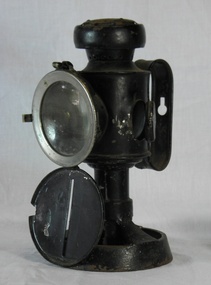 Blacksmith's Cottage and Forge
Lamp, 1900 (estimated)
... cover with vertical slit. There is considerable damage to the black paint in the external regions of the lamp....It is historically and technically siginficant at a national level. world war one military candle artillery europe lamp black artillery siege lamp artillery units candle power aiming lamp wwi 1900 australian war memorial bike light bike bicycle bicycle lamp blackout Painted black metal(tin) candle power, hand held or placed on flat area, open base so candle can be inserted and 'screwed' in, side door for lighting, fron magnifying glass, metal lens cover with vertical slit. ...This item type was used during the First World War throughout Europe. This item is an artillery siege lamp. It was used by artillery units. The lamps were powered by a single candle, the light being magnified by a lens. A shutter closes over the lens to give an illuminated vertical line. They were used originally in fortified siege artillery posititions as a general purpose lamp. They were also used as aiming lamps when they were placed in front of artillery posititions and used as a guide in aiming at night. Further research has suggested that this item may have been attached to bicycles for illuminating the way in the blackout.This item is considered rare and important. It is historically and technically siginficant at a national level. Painted black metal(tin) candle power, hand held or placed on flat area, open base so candle can be inserted and 'screwed' in, side door for lighting, fron magnifying glass, metal lens cover with vertical slit. There is considerable damage to the black paint in the external regions of the lamp.world war one, military, candle, artillery, europe, lamp, black, artillery siege lamp, artillery units, candle power, aiming lamp, wwi, 1900, australian war memorial, bike light, bike, bicycle, bicycle lamp, blackout -
 Blacksmith's Cottage and Forge
Kerosene table lamp
... lamp lighting table glass kerosene Moulded clear glass base with glass handle. Clear glass flame cover. ...Moulded clear glass base with glass handle. Clear glass flame cover. Brass wick holder with cotton wick.lamp, lighting, table, glass, kerosene -
Federation University Historical Collection
Book, American Institute of Mining Engineers, Transactions of the American Institute of Mining Engineers, Vol 1, 1871-1873
... Meetings of the institute were held in Wilkes-Barre, Bethlehem, Troy, Philadelphia, New York, Pittsburgh and Boston. american institute of mining engineers mining engineering prop screw jack mining districts in the United States of America waste inn coal mining lehigh zinc company lake superior copper districtblast furnace rolling versus hammering ingots indianablack coal pig-iron longwall system of mining wickersham process midlothian colliary, virginia plummet lamp diamond drills Stamped "Department of Mining University of Melbourne" Red hard covered book. ...Meetings of the institute were held in Wilkes-Barre, Bethlehem, Troy, Philadelphia, New York, Pittsburgh and Boston.Red hard covered book. Contents include: * List of members * Geological Distribution of MIning Districts in the United States (R.W. Raymond) * The Relation between the Speed and Effectiveness of Stamps (R.W. Raymond) * Remarks on the Waste in Coal-Mining (R. P Rothwell) * An Eccentric Theodolite (Francis Vinton) * The Use ad Advantages of the Prop Srew-Jack (E. Gaijot) * The Manufacture of Iron and Steel Rails ( John B. Pearse) * The importance of Surveying in Geology (Benjamin Smith Lyman) * Use of Blast-Furnace Slag (T. Egleston) * The Geonostical History of Metals (T. Sterry Hunt) * The Mining and Metallurgical Laboratories of the Massachusetts Institute of Technology (Robert H. Richards) Stamped "Department of Mining University of Melbourne"american institute of mining engineers, mining engineering, prop screw jack, mining districts in the united states of america, waste inn coal mining, lehigh zinc company, lake superior copper districtblast furnace, rolling versus hammering ingots, indianablack coal, pig-iron, longwall system of mining, wickersham process, midlothian colliary, virginia, plummet lamp, diamond drills -
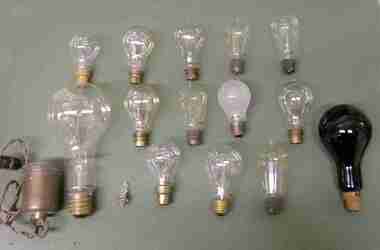 Federation University Historical Collection
Equipment - Scientific Instument, Globes, 20th Century
... (The disc is loose in 10) .11 a&b) Osram black glass, large standard shaped, 230-240 V 125 W, bayonet light bulb. .12) Philips tubular shaped projector lamp with instruction leaflet. .13) Philips tubular shaped projector lamp with instruction leaflet in original box. .14) EH JA 12 V 55 W small projector lamp. .15) Large special purpose, standard shaped, frosted bayonet light bulb. .16) Siemens, standard shaped, modern Edison screw light bulb. .17) Philips, standard shaped, modern Edison screw, frosted light bulb. .18) Crompton, gas filled 240 V 75 W, standard shaped, bayonet frosted light bulb in original box. .19) Crompton, gas filled 230 V 300 W. standard shaped, large modern Edison screw light bulb. .20) Probably an extension cord with a bayonet fitting at one end connected by a twisted cord of two fabric covered wires to a large socket. ...(The disc is loose in 10) .11 a&b) Osram black glass, large standard shaped, 230-240 V 125 W, bayonet light bulb. .12) Philips tubular shaped projector lamp with instruction leaflet. .13) Philips tubular shaped projector lamp with instruction leaflet in original box. .14) EH JA 12 V 55 W small projector lamp. .15) Large special purpose, standard shaped, frosted bayonet light bulb. .16) Siemens, standard shaped, modern Edison screw light bulb. .17) Philips, standard shaped, modern Edison screw, frosted light bulb. .18) Crompton, gas filled 240 V 75 W, standard shaped, bayonet frosted light bulb in original box. .19) Crompton, gas filled 230 V 300 W. standard shaped, large modern Edison screw light bulb. .20) Probably an extension cord with a bayonet fitting at one end connected by a twisted cord of two fabric covered wires to a large socket. ...Most were used in various capacities at Ballarat School of Mines or University of Ballarat.Assorted lamps including Edison Carbon filament light bulbs and other special purpose lamps, .1-3) Robertson, pear shaped 220 V 16, carbon filament? bayonet light bulb with 'nipple'. .4) Ediswan, standard shaped, 928, carbon filament? bayonet light bulb with 'nipple'. .5) (B in a circle) 280 V 32 oo1A, pear shaped, carbon filament? bayonet light bulb with 'nipple'. .6-7) Crompton? standard shaped, carbon filament? bayonet light bulb. Clear glass with an amber tint. .8) 230-240 V 40 W, pear shaped, wire filament bayonet light bulb. .9-10) Osram standard shaped, heavy spiral and disc electrodes, bayonet light bulb. (The disc is loose in 10) .11 a&b) Osram black glass, large standard shaped, 230-240 V 125 W, bayonet light bulb. .12) Philips tubular shaped projector lamp with instruction leaflet. .13) Philips tubular shaped projector lamp with instruction leaflet in original box. .14) EH JA 12 V 55 W small projector lamp. .15) Large special purpose, standard shaped, frosted bayonet light bulb. .16) Siemens, standard shaped, modern Edison screw light bulb. .17) Philips, standard shaped, modern Edison screw, frosted light bulb. .18) Crompton, gas filled 240 V 75 W, standard shaped, bayonet frosted light bulb in original box. .19) Crompton, gas filled 230 V 300 W. standard shaped, large modern Edison screw light bulb. .20) Probably an extension cord with a bayonet fitting at one end connected by a twisted cord of two fabric covered wires to a large socket. This socket has a copper Edison screw inner, surrounded by a ceramic tube and covered with a copper housing. The housing is cracked in two places.Some have makers brand and voltage and wattage stamped onto the glass.scientific instrument, ballarat school of mines, globes, edison, lamps, light bulbs, bayonet -
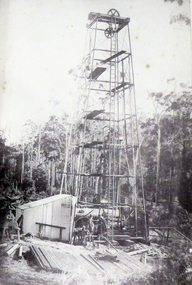 Federation University Historical Collection
Report, Annual Report for the Secretary For Mines, 1889, 1889
... duncan gillies mining safety cages timbering in mines ballarat minin district statistics chinese fossil plants wolf's miners' safety lamp thorneburry safety lamp wood's point clunes chiltern valley underground survey wire ropes ballarat warrenheip dowling forest Blue soft covered book. ...Blue soft covered book.duncan gillies, mining, safety cages, timbering in mines, ballarat minin district, statistics, chinese, fossil plants, wolf's miners' safety lamp, thorneburry safety lamp, wood's point, clunes, chiltern valley, underground survey, wire ropes, ballarat, warrenheip, dowling forest -
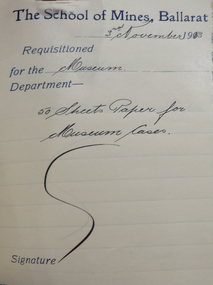 Federation University Historical Collection
Book, Ballarat School of Mines Requisitions Stubb Book, 1902, 1902
... ballarat school of mines requisitions purchases ballarat school of mines museum frederick martell rubber tubing bellows repair rubber stamps osram filament lamps f.c. hall typewriter ribbon roneo ink steel tape handbook of geology sloyd Hard covered stubb book with marbled paper, and blue tape spine. ...Hard covered stubb book with marbled paper, and blue tape spine. Lists purchases by the Ballarat School of Mines. ballarat school of mines, requisitions, purchases, ballarat school of mines museum, frederick martell, rubber tubing, bellows repair, rubber stamps, osram filament lamps, f.c. hall, typewriter ribbon, roneo ink, steel tape, handbook of geology, sloyd -
 Flagstaff Hill Maritime Museum and Village
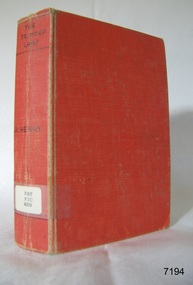
Book, The Trimmed Lamp
... The Warrnambool Mechanics' Institute’s publication collection is of both local and state significance. shipwrecked-coast flagstaff-hill flagstaff-hill-maritime-museum warrnambool maritime-museum shipwreck-coast flagstaff-hill-maritime-village shipwrecked-artefact book pattison collection warrnambool library warrnambool mechanics’ institute ralph eric pattison corangamite regional library service warrnambool city librarian mechanics’ institute library victorian library board warrnambool books and records warrnambool children’s library great ocean road the trimmed lamp o henry william sydney porter The label on the spine with typed text PAT FIC HEN Pastedown front endpaper has a sticker from Warrnambool Public Library covered by a sticker from Corangamite Regional Library Service Front loose endpaper has a stamp from Corangamite Regional Library Service Flyleaf has a stamp from Warrnambool Mechanics Institute The Trimmed Lamp Collection of 25 short stories: Author: O Henry Publisher: Hodder Stoughton Date: 1st published in 1907 The Trimmed Lamp Book ...Pattison Collection This item is from the ‘Pattison Collection’, a collection of books and records that was originally owned by the Warrnambool Mechanics’ Institute, which was founded in Warrnambool in 1853. By 1886 the Warrnambool Mechanics’ Institute (WMI) had grown to have a Library, Museum and Fine Arts Gallery, with a collection of “… choice productions of art, and valuable specimens in almost every branch and many wonderful national curiosities are now to be seen there, including historic relics of the town and district.” It later included a School of Design. Although it was very well patronised, the lack of financial support led the WMI in 1911 to ask the City Council to take it over. In 1935 Ralph Pattison was appointed as City Librarian to establish and organise the Warrnambool Library as it was then called. When the WMI building was pulled down in 1963 a new civic building was erected on the site and the new Warrnambool Library, on behalf of the City Council, took over all the holdings of the WMI. At this time some of the items were separated and identified as the ‘Pattison Collection’, named after Ralph Pattison. Eventually the components of the WMI were distributed from the Warrnambool Library to various places, including the Art Gallery, Historical Society and Flagstaff Hill. Later some were even distributed to other regional branches of Corangamite Regional Library and passed to and fro. It is difficult now to trace just where all of the items have ended up. The books at Flagstaff Hill Maritime Village generally display stamps and markings from Pattison as well as a variety of other institutions including the Mechanics’ Institute itself. RALPH ERIC PATTISON Ralph Eric Pattison was born in Rockhampton, Queensland, in 1891. He married Maude Swan from Warrnambool in 1920 and they set up home in Warrnambool. In 1935 Pattison accepted a position as City Librarian for the Warrnambool City Council. His huge challenge was to make a functional library within two rooms of the Mechanics’ Institute. He tirelessly cleaned, cleared and sorted a disarrayed collection of old books, jars of preserved specimens and other items reserved for exhibition in the city’s museum. He developed and updated the library with a wide variety of books for all tastes, including reference books for students; a difficult task to fulfil during the years following the Depression. He converted all of the lower area of the building into a library, reference room and reading room for members and the public. The books were sorted and stored using a cataloguing and card index system that he had developed himself. He also prepared the upper floor of the building and established the Art Gallery and later the Museum, a place to exhibit the many old relics that had been stored for years for this purpose. One of the treasures he found was a beautiful ancient clock, which he repaired, restored and enjoyed using in his office during the years of his service there. Ralph Pattison was described as “a meticulous gentleman whose punctuality, floorless courtesy and distinctive neat dress were hallmarks of his character, and ‘his’ clock controlled his daily routine, and his opening and closing of the library’s large heavy doors to the minute.” Pattison took leave during 1942 to 1942 to serve in the Royal Australian Navy, Volunteer Reserve as Lieutenant. A few years later he converted one of the Museum’s rooms into a Children’s Library, stocking it with suitable books for the younger generation. This was an instant success. In the 1950’s he had the honour of being appointed to the Victorian Library Board and received more inspiration from the monthly conferences in Melbourne. He was sadly retired in 1959 after over 23 years of service, due to the fact that he had gone over the working age of council officers. However he continued to take a very keen interest in the continual development of the Library until his death in 1969. WARRNAMBOOL PUBLIC LIBRARY The Warrnambool Mechanics’ Institute (WMI) was formed by a voluntary community group in 1863, within six years of Warrnambool’s beginnings, and its Reading Room opened in 1854. The WMI operated until 1963, at which time it was one of the oldest Mechanics’ Institutes in Victoria. Mechanics’ Institutes offered important services to the public including libraries, reading rooms and places to display and store collections of all sorts such as curiosities and local historical relics. In 1886 a Museum and Fine Arts Gallery were added to the WMI and by the beginning of the 20th century, there was also a billiards room and a School of Art. By this time all Mechanics’ Institutes in country Victoria had museums attached. Over the years the Warrnambool Mechanics’ Institute Library was also known as the Warrnambool Public Library the Warrnambool Library and the Free Library. Early funding from the government was for the “Free Library”. The inscription in a book “Science of Man” was for the “Warrnambool Public Library”, donated by Joseph Archibald in 1899. Another inscription in the book “Catalogue of Plants Under Cultivation in the Melbourne Botanic Gardens 1 & 2, 1883” was presented to the “Warrnambool Library” and signed by the author W.R. Guilfoyle. In 1903 the Warrnambool Public Library decided to add a Juvenile Department to library and stock it with hundreds of books suitable for youth. In 1905 the Public Library committee decided to update the collection of books and added 100 new novels plus arrangements for the latest novels to be included as soon as they were available in Victoria. In July 1911 the Warrnambool Council took over the management of the Public Library, Art Gallery, Museum and Mechanics’ Institute and planned to double the size of the then-current building. In 1953, when Mr R. Pattison was Public Librarian, the Warrnambool Public Library’s senior section 10,000 of the 13,000 books were fiction. The children’s section offered an additional 3,400 books. The library had the equivalent of one book per head of population and served around 33 per cent of the reading population. The collection of books was made up of around 60 per cent reference and 40 per cent fiction. The library was lending 400 books per day. In 1963 the Warrnambool City Council allocated the site of the Mechanics’ Institute building, which included the Public Library, Museum and Art Gallery, for the new Municipal Offices and the Collections were dispersed until 1971. The Warrnambool Library took over the Mechanics’ Institute Library’s holdings on behalf of the Warrnambool City Council. Since the closure of the Warrnambool Mechanics’ Institute the exact location and composition of the original WMI books and items have become unclear. Other materials have been added to the collection, including items from Terang MI, Warrnambool Court House and Customs House. Many of the books have been identified as the Pattison Collection, named after the Librarian who catalogued and numbered the books during his time as Warrnambool Public Librarian in the time before the Mechanics’ Institute closed. It seems that when Warrnambool became part of the Corangamite Regional Library some of the books and materials went to its head office in Colac and then back to Warrnambool where they were stored at the Art Gallery for quite some time. Some then went to the Warrnambool Historical Society, some stayed at the Art Gallery and some were moved to Flagstaff Hill Maritime Village. The various stamps and labels on the books held at Flagstaff Hill show the variety of the collection’s distribution and origin. The books in the collection at Flagstaff Hill Maritime Village date from the 1850s to the late 1950s and include rare and valuable volumes. Many of the books are part of the “Pattison Collection” after the Warrnambool’s Public Librarian, Mr R. Pattison. WARRNAMBOOL MECHANICS’ INSTITUTE Warrnambool's Mechanics' Institute (or Institution as it was sometimes called) was one of the earliest in Victoria. On 17th October 1853, a meeting was held where it was resolved to request the Lieutenant Governor of the Colony to grant land for the erection of a Mechanics' Institutes building. A committee was formed at the meeting and Richard Osburne chaired the first meeting of this committee. The land on the North West corner of Banyan and Merri Streets was granted but there were no funds to erect the building. The Formal Rights of the Warrnambool Mechanics' Institute's encompassed its aims and these were officially adopted in1859; "This Institution has for its object the diffusion of literary, scientific, and other useful knowledge amongst its members, excluding all controversial subjects, religious or political. These objects are sought to be obtained by means of a circulating library, a reading room, the establishment of classes, debates, and the occasional delivery of lectures on natural and experimental philosophy, mechanics, astronomy, chemistry, natural history, literature, and the useful and ornamental arts, particularly those which have a more immediate reference to the colony." The Warrnambool Mechanics' Institute opened its first reading room in November 1884 in the National School building at the corner of Banyan and Timor Streets. The Institute was funded by member subscription, payable on a quarterly, half-yearly or yearly basis. Samuel Hannaford, the Manager of the Warrnambool Bank of Australasia, was the first Honorary Secretary of the Mechanics' Institutes, and an early President and Vice-President. He also gave several of the early lectures in the Reading Room. Another early Secretary, Librarian and lecturer was Marmaduke Fisher, the teacher at the National School. Lecture topics included The Poets and Poetry of Ireland', 'The Birth and Development of the Earth', 'The Vertebrae - with Remarks on the pleasures resulting from the study of Natural History' and 'Architecture'. In 1856 the Reading Room was moved to James Hider's shop in Timor Street, and by 1864 it was located in the bookshop of Davies and Read. In the 1860's the Mechanics' Institute struggled as membership waned but in 1866, after a series of fundraising efforts, the committee was able to purchase land in Liebig Street, on a site then called Market Square, between the weighbridge and the fire station. A Mechanics' Institute building was opened at this site in August 1871. The following year four more rooms were added to the main Reading Room and in 1873 the Artisan School of Design was incorporated into the Institute. The same year Joseph Archibald established a Museum; however, it deteriorated when he was transferred to Bendigo in 1877. In 1880, with Archibald's return to Warrnambool, the Museum was re-established, and in 1885 a new building was built at the back of the Institute to accommodate the re-created School of Design, the Art Gallery and the Museum. In 1887 the Museum section was moved to the former courthouse in Timor Street (for some time the walls of the building formed part of the TAFE cafeteria but all is now demolished)). In 1911 the Museum was transferred back to the original building and the management of the Mechanics' Institute was handed over to the Warrnambool City Council. The Museum and Art Gallery became one and housed many fine works of art, and the Library continued to grow. The building was well patronised, with records showing that at the beginning of the 20th century there were between 500 and 800 visitors. During World War One the monthly figures were in the thousands, with 3,400 people visiting in January 1915. The Museum was a much - loved Institution in Warrnambool until the contents of the Museum and Art Gallery were removed to make room for the Warrnambool City Council Engineers' Department. The contents were stored but many of the items were scattered or lost. When the original building was demolished the site became occupied by the Civic Centre, which included the new City Library. (The library was temporarily located in the old Palais building in Koroit Street.) In the process of reorganisation the Collection was distributed amongst the community groups: -The new City Library took some of the historical books and some important documents, historic photographs and newspapers. -The Art Gallery kept the 19th Century art collection and some of the artefacts from the museum. -The Historical Society has some items -The State Museum has some items -Some items were destroyed -Flagstaff Hill Maritime Village has old newspapers, Government Gazettes, most of the Mechanics' Institute Library, ledgers and documents connected to the Mechanics' Institute Library, some framed and unframed artworks and some photographs. The Warrnambool Mechanics' Institute Library book collection is deemed to be of great importance because it is one of the few collections in an almost intact state, and many of the books are now very rare and of great value. The Pattison Collection, along with other items at Flagstaff Hill Maritime Village, was originally part of the Warrnambool Mechanics' Institute’s collection. The Warrnambool Mechanics’ Institute Collection is primarily significant in its totality, rather than for the individual objects it contains. Its contents are highly representative of the development of Mechanics' Institute libraries across Australia, particularly Victoria. A diversity of publications and themes has been amassed, and these provide clues to our understanding of the nature of and changes in the reading habits of Victorians from the 1850s to the middle of the 20th century. The collection also highlights the Warrnambool community’s commitment to the Mechanics’ Institute, reading, literacy and learning in the regions, and proves that access to knowledge was not impeded by distance. These items help to provide a more complete picture of our community’s ideals and aspirations. The Warrnambool Mechanics Institute book collection has historical and social significance for its strong association with the Mechanics Institute movement and the important role it played in the intellectual, cultural and social development of people throughout the latter part of the nineteenth century and the early twentieth century. The collection of books is a rare example of an early lending library and its significance is enhanced by the survival of an original collection of many volumes. The Warrnambool Mechanics' Institute’s publication collection is of both local and state significance. The Trimmed Lamp Collection of 25 short stories: Author: O Henry Publisher: Hodder Stoughton Date: 1st published in 1907 The label on the spine with typed text PAT FIC HEN Pastedown front endpaper has a sticker from Warrnambool Public Library covered by a sticker from Corangamite Regional Library Service Front loose endpaper has a stamp from Corangamite Regional Library Service Flyleaf has a stamp from Warrnambool Mechanics Institute shipwrecked-coast, flagstaff-hill, flagstaff-hill-maritime-museum, warrnambool, maritime-museum, shipwreck-coast, flagstaff-hill-maritime-village, shipwrecked-artefact, book, pattison collection, warrnambool library, warrnambool mechanics’ institute, ralph eric pattison, corangamite regional library service, warrnambool city librarian, mechanics’ institute library, victorian library board, warrnambool books and records, warrnambool children’s library, great ocean road, the trimmed lamp, o henry, william sydney porter -
 Flagstaff Hill Maritime Museum and Village
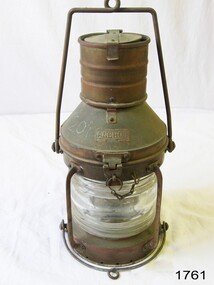
Functional object - Kerosene Lamp, 1950s to 1984
... This lamp in our collection has a design is similar to the early marine designs but its finish and materials resemble lamps made in the 20th century to represent the older ones. The etched "20" on its cover could represent the 20-mile distance the light could shine, and the "↑" Broad Arrows could represent a maritime navy ship. ...Kerosene lamp; This Anchor Lamp design has a brass frame, a handle with a loop at the top, a rail around the base, two opposing loops, and a kerosene burner and tank with ventilation holes around it. A clear glass Fresnel 360-degree lens covers...An etched inscription on the cover includes the Broad Arrow symbol identifying government property. Functional object Kerosene Lamp India ...The Kerosene lamp was one of the most common oil lamps used and was manufactured until the 1980s. The Anchor Lamp design was used for marine purposes in the days of sailing ships when a ship at anchor or sailing in the dark was required to display a white light on the top of its main mast. The Anchor Lamp's top loop was for a rope to hoist it up the mast, and ropes through the two bottom loops to anchor it in place and prevent it from swaying. The light could be seen by ships up to 20 miles away due to the magnification of the Fresnel glass lens. This lamp in our collection has a design is similar to the early marine designs but its finish and materials resemble lamps made in the 20th century to represent the older ones. The etched "20" on its cover could represent the 20-mile distance the light could shine, and the "↑" Broad Arrows could represent a maritime navy ship. The lamp is an example of 19th and early 20th-century Anchor Lamps fueled by kerosene and used onboard ships when at anchor or sailing at night.Kerosene lamp; This Anchor Lamp design has a brass frame, a handle with a loop at the top, a rail around the base, two opposing loops, and a kerosene burner and tank with ventilation holes around it. A clear glass Fresnel 360-degree lens covers the burner. It is an all-around design. The brand Anchor is inscribed on a plate fixed to its brass cover. An etched inscription on the cover includes the Broad Arrow symbol identifying government property.Engraved plaque: "Anchor" brand. Etched into the metal: "↑20↑"warrnambool, shipwreck coast, flagstaff hill, flagstaff hill maritime museum, flagstaff hill maritime village, kerosene lamp, lighting, ship light, anchor lamp, marine technology, marine lamp, 20 mile light, broad anchor, oil lamp, whale oil lamp, ↑ -
 Flagstaff Hill Maritime Museum and Village
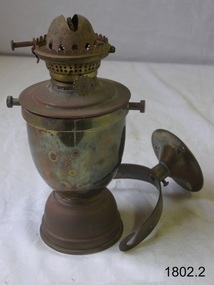
Functional object - Kerosene Lamp, Bef. 09-02-1984
... Kerosene lamp; round electroplated metal top and base, both shaped inward to join together. The base is a solid counterweight to work with the gimbal wall attachment bracket. There is no glass cover...Shipwreck Coast Flagstaff Hill Maritime Museum Flagstaff Hill Maritime Village Warrnambool Flagstaff Hill Kerosene lamp lighting marine lamp Kerosene lantern lamp lantern marine equipment wall gimbal wall mounted lamp ship lamp Kerosene lamp; round electroplated metal top and base, both shaped inward to join together. The base is a solid counterweight to work with the gimbal wall attachment bracket. There is no glass cover ...The kerosene lamp was one of the most common oil lamps used and was manufactured until the 1980s. This particular lamp has the design of the early kerosene lamps. Its gimbal bracket and counterweight heavy base allow it to swing with a vessel's movement and still stay horizontal. The lamp is significant for its design which is an example of a 19th and early 20th-century kerosene lamp with a wall-mounted gimbal bracket and counterweight base. These features were important to vessels at sea, allowing the lamp to swing with the vessel's movement and stay vertical on rough seas.Kerosene lamp; round electroplated metal top and base, both shaped inward to join together. The base is a solid counterweight to work with the gimbal wall attachment bracket. There is no glass cover.shipwreck coast, flagstaff hill maritime museum, flagstaff hill maritime village, warrnambool, flagstaff hill, kerosene lamp, lighting, marine lamp, kerosene lantern, lamp, lantern, marine equipment, wall gimbal, wall mounted lamp, ship lamp -
 Flagstaff Hill Maritime Museum and Village
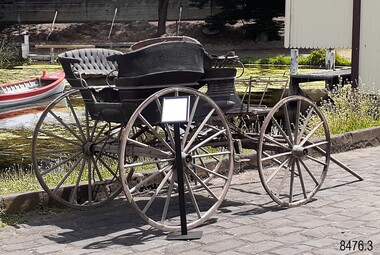
Vehicle - Murweh Carriage, c.1874
... The carriage could have been illuminated by oil or carbide lamps placed into the lamp holders on the sides. The carriage was kept under cover for many years in an open-front sandstone building that also included living quarters and an area that may have been stable. ...The carriage could have been illuminated by oil or carbide lamps placed into the lamp holders on the sides. The carriage was kept under cover for many years in an open-front sandstone building that also included living quarters and an area that may have been stable. ...This private late-nineteenth-century four-wheeled carriage has been built to transport a family or group of passengers with a coachman in the front seat. It can be pulled by one horse, or by two horses if the T-pole is attached. The button fittings along each side of the carriage indicate that a folding roof or hood was once attached. The frame across the front of the carriagewas likely to have been a ‘dashboard’ with a leather or wood covering to prevent water, mud and other particles from splashing onto the passengers. The rear step between the two side-facing bench seats is adjustable to allow for ladies’ long skirts. These rear seats appear to be removable, in which case the carriage could be converted to a wagon to transport goods and equipment. The carriage could have been illuminated by oil or carbide lamps placed into the lamp holders on the sides. The carriage was kept under cover for many years in an open-front sandstone building that also included living quarters and an area that may have been stable. It was at ‘Murweh’ a Warrnambool property at 203 Liebig Street. The home is now Heritage and National Trust Listed and described as a ‘gentleman’s residence’. It was built by James Wotton Shevill in the 1860s. Shevill was a councillor from 1875 to 1878, serving in 1878 as Mayor of the Borough of Warrnambool. Jeremiah Wade lived at Murweh there from 1879-1880. By 1915 F.B. Whitehead and his family were living there, and by 1930 the address was used by Mr T.J. Rome and his family. Thomas James Rome was still using that address in September 1973 after his 100th birthday. It is believed that one of the property’s owners had been an Obstetrician in Warrnambool. The current owner re-told the story that children used to hide in the back section of the carriage and smoke, hidden from the sight of onlookers. He had heard the story from a previous owner.The well-appointed horse-drawn four-wheeled carriage is likely to have first belonged to a local councillor and past Mayor of the town of Warrnambool, J.W. Shervill, whose 1860s city property was the carriage location for many years. The carriage is a rare local example of a town-based lifestyle befitting a prosperous personality of the late 19th century. It adds to the story of Warrnambool's development as a town influenced by the port, wealth gained from shipping and the home place of prominent local people such as the Councillor and later Mayor. The side-facing rear seating is unusual for a passenger carriage. It has the feature of removable rear bench seats, allowing for the dual purpose of a carriage or wagon.Carriage; the Victorian-era horse-drawn four-wheeled open carriage has a coachman’s bench seat across the front and two side-facing bench seats in the rear. There are steps at the front on each side and a centre adjustable step and the back. It has a hinged shaft, two lamp holders and a separate T-pole. The bench seats have padded backrests upholstered in green leather and each has padded armrests at the ends. A rectangular metal frame, likely to have been a dashboard, is mounted across the front of the carriage. It has two inner vertical bars. The carriage's body is painted dark green with crimson highlights on some of the panelling. Decorative oval panels with hand-painted motifs are mounted along the sides. The side panels of the carriage have metal fastener buttons attached. The iron-rimmed wheels have sixteen wooden spokes and copper cuffs on the outside of the hubs, and the rear wheels are higher than the front wheels. Wooden brake blocks are mounted onto the back wheels and are active by a metal lever at the front right side of the carriage. The undercarriage is fitted with leaf springs on each side, mounted from front to back axles. Included are: (1) The separate T-pole that allows two horses to be harnessed to the carriage (2) Leather horse winkers with metal hardware and oval brass plate on the side of each winkerMotif painted on an oval panel [a musical lyre within a blue floral wreath flanked by scrolls] flagstaff hill maritime museum and village, warrnambool, great ocean road, shipwreck coast, murweh, buggy, cart, carriage, wagon, horse-drawn vehicle, victorian buggy, four-wheeled carriage, coachman’s seat, bench seat, side-facing benches, upholstered seats, victorian decals, heritage vehicle decoration, antique hand painting, hand painted decals, motifs, iron-rimmed wheels, wooden brake blocks, leaf springs, t-pole shaft, rear step, equine carriage, 19th century vehicle, victorian transport, transport, gentleman’s vehicle, james wotton shevill, councillor, mayor, jeremiah wade, f.b. whitehead, thomas james rome, warrnambool obstruction, warrnambool genealogy, warrnambool pioneers, victorian carriage, one horse carriage, two horse carriage, horse drawn carriage -
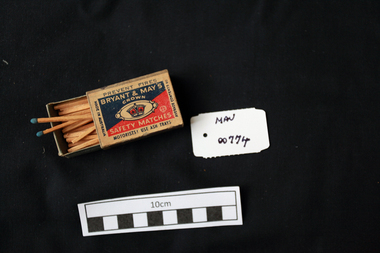 City of Moorabbin Historical Society (Operating the Box Cottage Museum)
Manufactured objects, safety matches Bryant & May Ltd, 20thC
... lamps tobacco PREVENT FIRES/ BRYANT & MAY'S / a crown in an oval shape / SAFETY MATCHES/ MOTORISTS USE ASHTRAY/ AV. CONTENTS 60 / Made in Australia A box of safety matches with unused matches made by Bryant & May Pty Ltd , Richmond Victoria Australia. The tray containing the matches slides inside the open ended cover ...Bryant and May was a United Kingdom (UK) company created in the mid-nineteenth century specifically to make matches. Their original Bryant and May Factory was located in Bow, London. They later opened other match factories in the United Kingdom and Australia, such as the Bryant and May Factory, Melbourne; and owned match factories in other parts of the world.Bryant and May survived as an independent company for over seventy years, but went through a series of mergers with other match companies and later with consumer products companies. To protect its position Bryant and May merged with or took over its rivals. In 1971 the Northern Ireland factory, Maguire & Patterson closed down following a terrorist attack.. In the 1980s, factories in Gloucester and Glasgow closed too leaving Liverpool as the last match factory in the UK, until December 1994. The former Australian match factory, in Melbourne, closed in the mid-1980s. The registered trade name Bryant and May still exists and it is owned by Swedish Match, as are many of the other registered trade names of the other, formerly independent, companies within the Bryant and May group. The British match brands continue to survive, as brands of Swedish Match, and are made outside the UK. Matches were first produced by Bryant & May in Australia in 1909. The Redhead name applies to the red striking heads of the matches which were introduced to Australia in 1946. The logo on the matchbox depicted the head and shoulder of a redheaded woman and has had four major updates since that time with a number of special issues depicting animals, birds and notable persons also producedThe Bryant & May Ltd factory in Church St Richmond is a listed building and has been converted to apartments following the closure of the Company 1980. Bryant & May's Ltd were influential in fighting against the dreadful disease known as Phossy jaw which was caused by white phosphorus used in the manufacture of the early matches. They were also the object of the 'Match Girls Strike' in London 1888, which won important improvements in working conditions and pay for the mostly female workforce working with the dangerous white phosphorus. The public were slow to purchase these safety matches because of the higher price .A box of safety matches with unused matches made by Bryant & May Pty Ltd , Richmond Victoria Australia. The tray containing the matches slides inside the open ended cover.. The striking patch is on both sides of the cover.PREVENT FIRES/ BRYANT & MAY'S / a crown in an oval shape / SAFETY MATCHES/ MOTORISTS USE ASHTRAY/ AV. CONTENTS 60 / Made in Australiasafety matches, bryant & may's pty ltd, phosy jaw disease, early settlers, moorabbin, bentleigh, richmond, cheltenham, lights, lamps, tobacco -
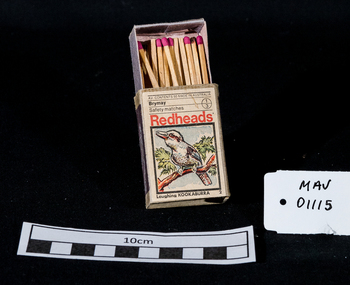 City of Moorabbin Historical Society (Operating the Box Cottage Museum)
Containers, matchbox 'Redhead' with matches, 20thC
... lamps, tobacco, white phosphorous, phosphorus sesquisulfide, swedish match pty ltd, pitt william, savens henri, cahen emile david , richmond victoria, Av. CONTENTS 50 MADE IN AUSTRALIA / Brymay / 1/3 / Safety Matches / Redheads / a colour picture of a Kookaburra / Laughing KOOKABURRA A box of safety matches with unused matches made by Bryant & May Pty Ltd , Richmond Victoria Australia. The tray containing the matches slides inside the open ended cover ...On 15th December 1909, Bryant & May, Australia’s first match factory at Church Street, Richmond, Victoria. was opened by The Honourable Alfred Deakin, Prime Minister of Australia, and Mrs. Deakin. It was heralded by the first Commonwealth Government of newly-federated Australia because the government of the day was anxious to encourage secondary industry and pledged tariff protection of local manufacturers. The building was constructed in 1909 as the Empire Works to a design by prolific Melbourne architect William Pitt and was purchased soon after by British safety match manufacturer Bryant and May, who significantly expanded the building, adding another level and the landmark clock tower. Bryant and May were unique in that they operated as a model factory, providing workers with conditions and amenities that even today seem generous. These included a dining hall and sports facilities such as a tennis court and bowling green which were constructed in the 1920s. Bryant and May ceased Australian match manufacture in the early 1980s as a result of import competition. Their iconic Redheads matches are now imported from Sweden. The complex has since been converted for use as offices and showrooms but is extremely well preserved. It is listed on the Victorian Heritage Register. Bryant and May was a United Kingdom (UK) company created in the mid-nineteenth century specifically to make matches. Their original Bryant and May Factory was located in Bow, London. They later opened other match factories in the United Kingdom and Australia, such as the Bryant and May Factory, Melbourne; and owned match factories in other parts of the world. Bryant and May survived as an independent company for over seventy years, but went through a series of mergers with other match companies and later with consumer products companies. To protect its position Bryant and May merged with or took over its rivals. In 1971 the Northern Ireland factory, Maguire & Patterson closed down following a terrorist attack.. In the 1980s, factories in Gloucester and Glasgow closed too leaving Liverpool as the last match factory in the UK, until December 1994. . The registered trade name Bryant and May still exists and it is owned by Swedish Match, as are many of the other registered trade names of the other, formerly independent, companies within the Bryant and May group. Two French chemists, Henri Savene and Emile David Cahen, proved in 1898 that the addition of phosphorus sesquisulfide meant that the substance was not poisonous, that it could be used in a "strike-anywhere" match, and that the match heads were not explosive. British company Albright and Wilson, was the first company to produce phosphorus sesquisulfide ( Red Phosphorous) matches commercially. The company developed a safe means of making commercial quantities of phosphorus sesquisulfide in 1899 and started selling it to match manufacturers. Matches were first produced by Bryant & May in Australia in 1909. The Redhead name applies to the red striking heads of the matches which were introduced to Australia in 1946. The logo on the matchbox depicted the head and shoulder of a redheaded woman and has had four major updates since that time with a number of special issues depicting birds, animals and notable persons also produced.The Bryant & May Ltd factory in Church St Richmond is a listed building and has been converted to apartments following the closure of the Company 1980. Bryant & May's Ltd were influential in fighting against the dreadful disease known as Phossy jaw which was caused by white phosphorus used in the manufacture of the early matches. They were also the object of the 'Match Girls Strike' in London 1888, which won important improvements in working conditions and pay for the mostly female workforce working with the dangerous white phosphorus. The public were slow to purchase these safety matches because of the higher price .A box of safety matches with unused matches made by Bryant & May Pty Ltd , Richmond Victoria Australia. The tray containing the matches slides inside the open ended cover.. The striking patch is on both sides of the cover. Av. CONTENTS 50 MADE IN AUSTRALIA / Brymay / 1/3 / Safety Matches / Redheads / a colour picture of a Kookaburra / Laughing KOOKABURRAsafety matches, bryant & may pty ltd, phossy jaw disease, early settlers, moorabbin, bentleigh, cheltenham, lights, lamps, tobacco, white phosphorous, phosphorus sesquisulfide, swedish match pty ltd, pitt william, savens henri, cahen emile david , richmond victoria, -
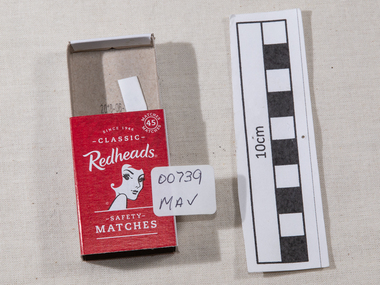 City of Moorabbin Historical Society (Operating the Box Cottage Museum)
Manufactured Objects, safety matches 'Redheads' 2015, c2015
... The public were slow to purchase these safety matches because of the higher price redheads safety matches, safety matches, bryant & may pty ltd, phossy jaw disease, early settlers, moorabbin, bentleigh, cheltenham, lights, lamps, tobacco, white phosphorous, phosphorus sesquisulfide, swedish match pty ltd, pitt william, savens henri, cahen emile david , richmond victoria, match girls strike 1888, Top of cover ; Redheads / 45 safety / matches . ...This is a current example of the 'Redhead' logo used by Bryant & May Ltd Richmond,Victoria, Australia c 1946 - 1980 On 15th December 1909, Bryant & May, Australia’s first match factory at Church Street, Richmond, Victoria. was opened by The Honourable Alfred Deakin, Prime Minister of Australia, and Mrs. Deakin. It was heralded by the first Commonwealth Government of newly-federated Australia because the government of the day was anxious to encourage secondary industry and pledged tariff protection of local manufacturers. The building was constructed in 1909 as the Empire Works to a design by prolific Melbourne architect William Pitt and was purchased soon after by British safety match manufacturer Bryant and May, who significantly expanded the building, adding another level and the landmark clock tower. Bryant and May were unique in that they operated as a model factory, providing workers with conditions and amenities that even today seem generous. These included a dining hall and sports facilities such as a tennis court and bowling green which were constructed in the 1920s. Bryant and May ceased Australian match manufacture in the early 1980s as a result of import competition. Their iconic Redheads matches are now imported from Sweden. The complex has since been converted for use as offices and showrooms but is extremely well preserved. It is listed on the Victorian Heritage Register. Bryant and May was a United Kingdom (UK) company created in the mid-nineteenth century specifically to make matches. Their original Bryant and May Factory was located in Bow, London. They later opened other match factories in the United Kingdom and Australia, such as the Bryant and May Factory, Melbourne; and owned match factories in other parts of the world. Bryant and May survived as an independent company for over seventy years, but went through a series of mergers with other match companies and later with consumer products companies. To protect its position Bryant and May merged with or took over its rivals. In 1971 the Northern Ireland factory, Maguire & Patterson closed down following a terrorist attack.. In the 1980s, factories in Gloucester and Glasgow closed too leaving Liverpool as the last match factory in the UK, until December 1994. . The registered trade name Bryant and May still exists and it is owned by Swedish Match Industries as are many of the other registered trade names of the other, formerly independent, companies within the Bryant and May group. Two French chemists, Henri Savene and Emile David Cahen, proved in 1898 that the addition of phosphorus sesquisulfide meant that the substance was not poisonous, that it could be used in a "strike-anywhere" match, and that the match heads were not explosive. British company Albright and Wilson, was the first company to produce phosphorus sesquisulfide ( Red Phosphorous) matches commercially. The company developed a safe means of making commercial quantities of phosphorus sesquisulfide in 1899 and started selling it to match manufacturers. Matches were first produced by Bryant & May in Australia in 1909. The Redhead name applies to the red striking heads of the matches which were introduced to Australia in 1946. The logo on the matchbox depicted the head and shoulder of a redheaded woman and has had four major updates since that time with a number of special issues depicting animals, birds and notable persons also producedThe Bryant & May Ltd factory in Church St Richmond is a listed building and has been converted to apartments following the closure of the Company 1980. Bryant & May's Ltd were influential in fighting against the dreadful disease known as Phossy jaw which was caused by white phosphorus used in the manufacture of the early matches. They were also the object of the 'Match Girls Strike' in London 1888, which won important improvements in working conditions and pay for the mostly female workforce working with the dangerous white phosphorus. The public were slow to purchase these safety matches because of the higher price An empty box of 'Redheads' safety matches made in Sweden for ST-Group, Springvale, Victoria, Australia c2015. The tray for the matches slides inside the open ended cover. The striking patch is on both sides of the cover. The matches have been removed. Matches were first produced by Bryant & May in Australia in 1909. The Redhead name applies to the red striking heads of the matches which were introduced to Australia in 1946. The logo on the matchbox depicted the head and shoulder of a redheaded woman and has had four major updates since that time with a number of special issues depicting animals, birds and notable persons also produced. Bryant and May ceased Australian match manufacture in the early 1980s.Top of cover ; Redheads / 45 safety / matches . Logo ; head & shoulders of a female with red hair Base of coverMade in Sweden / Redheads (R) is proudly marketed / by ST- Group Australia. / 718 Princes Highway Springvale Vic. 3171 / .............../ Readheads is a registered trademark / of Swedish Match Industries AB. / Complies ith European / Match Standard EN 1783-1997-SAF/ WARNING; / KEEP OUT OF REACH / OF CHILDREN. STRIKE / GENTLY AWAY FROM BODY . / barcode.redheads safety matches, safety matches, bryant & may pty ltd, phossy jaw disease, early settlers, moorabbin, bentleigh, cheltenham, lights, lamps, tobacco, white phosphorous, phosphorus sesquisulfide, swedish match pty ltd, pitt william, savens henri, cahen emile david , richmond victoria, match girls strike 1888, -
Glenelg Shire Council Cultural Collection
Functional object - Lamp, n.d
... City of Portland Collection|19/4/2000 Lamp light Spherical glass sitting within white painted metal frame. Sitting on white painted metal circular base, with white painted metal cylindrical cover on top, with fluted vents, and fold-down handle. ...City of Portland Collection|19/4/2000Spherical glass sitting within white painted metal frame. Sitting on white painted metal circular base, with white painted metal cylindrical cover on top, with fluted vents, and fold-down handle.lamp, light
